An Orwellian Perspective on Pacificism

This speaks for itself:

The majority of pacifists either belong to obscure religious sects or are simply humanitarians who object to taking life and prefer not to follow their thoughts beyond that point. But there is a minority of intellectual pacifists, whose real though unacknowledged motive appears to be hatred of western democracy and admiration for totalitarianism. Pacifist propaganda usually boils down to saying that one side is as bad as the other, but if one looks closely at the writings of the younger intellectual pacifists, one finds that they do not by any means express impartial disapproval but are directed almost entirely against Britain and the United States…

George Orwell, “Notes on Nationalism,” 1945

(Thanks to my son for finding this.)

Time Out for Music

Vivaldi Revivified

This evening I heard a breathtaking performance of Vivaldi’s Il cimento dell’armonia e dell’inventione, played by Fabio Biondi and his group, Europa Galante. It’s on the Virgin Classics label. Here’s how Virgin Classics describes the recording:

Fabio Biondi and Europa Galante offer a new recording of the 12 concertos published as Vivaldi’s now-famous opus 8, Il cimento dell’armonia e dell’inventione – the collection which contains the much-loved Four Seasons. For this unusual reading Fabio Biondi has worked not from the familiar, published score but from manuscripts held in Manchester, Turin and Dresden. There are marked differences between Vivaldi’s published works and manuscript sources: in the music not intended for publication Vivaldi was able to display a freedom that marks out his typically exuberant and Venetian style. This spirit of freedom is, for Biondi, the key to the works’ interpretation. Fabio Biondi, as violin soloist, and Europa Galante react with the passion and flair for this repertoire that explains why they now stand pre-eminent among the world’s Baroque ensembles.

That’s not hype. It’s the most scintillating performance of Vivaldi’s works that I’ve ever heard — by a long shot — and I’ve heard a lot of them. For a sample of Concerto RV 253 (No.5) La tempesta di mare, click here.

A Past Master at Work

Earlier in the evening I had heard the overture to Rossini’s The Barber of Seville, which reminded me of a great recording of the aria Largo al Factotum, made by baritone Riccardo Stracciari in 1917. Yes, recorded 87 years ago — and as bright and shiny as if

Stracciari were today’s hit baritone. Just listen and enjoy.

No, Dummy, That’s Not What He’s Saying

Ventriloquist and blogger Joe Gandelman’s nose for offensive politicking is getting a tad too sensitive. Now he suggests that this quote from a news story:

Vice President Dick Cheney on Tuesday warned Americans about voting for Democratic Sen. John Kerry, saying that if the nation makes the wrong choice on Election Day it faces the threat of another terrorist attack.

Means this:

[I]f voters don’t vote for this administration — even if they support it on terrorism and Iraq but have other serious disgreements that cause them to vote for someone else — they’re risking the destruction of the U.S?

No. It means that if Kerry is elected, for whatever reason, his lackadaisical attitudes about war and terrorism will invite terrorists to attack us. Remember why bin Laden thought he could get away with 9/11, Joe? He thought we lacked resolve. Clearly, Kerry lacks resolve. He can’t decide whether he’s for the war in Iraq or against it. He can’t decide whether he’s for pre-emptive war or against it — though he seems to be against it more than he’s for it. Get the picture, Joe?

Actually, Joe got the picture, because he said:

[Cheney] was suggesting a vote against the GOP or for John Kerry means exposing the U.S. to a terrorist attack and massive bloodshed.

Joe somehow finds that offensive. I find it compellingly logical.

Time Out for Beauty

FuturePundit informs us that “Babies Prefer To Stare At Beautiful Faces.” So do I:


Vivien Leigh in Waterloo Bridge (1940)

>
Hedy Lamarr (date and venue not given, probably early 1930s)


Ingrid Bergman (date and venue not given, probably 1930s)


Joan Crawford (date and venue not given, but definitely the beautiful pre-war Crawford)


Katharine Hepburn (date and venue not given, probably mid-1930s)

The Golden Era of Hollywood was rich in beautiful women.

But What About Kerry’s Voting Record?

Jimmy Carter, in a letter to Zell Miller, dances around the core of Miller’s speech before the Republican convention, which was Kerry’s record on defense issues:

You seem to have forgotten that loyal Democrats elected you as mayor and as state senator. Loyal Democrats, including members of my family and me, elected you as lieutenant governor and as governor. It was a loyal Democrat, Lester Maddox, who assigned you to high positions in the state government when you were out of office. It was a loyal Democrat, Roy Barnes, who appointed you as U.S. Senator when you were out of office. By your historically unprecedented disloyalty, you have betrayed our trust.

Great Georgia Democrats who served in the past, including Walter George, Richard Russell, Herman Talmadge, and Sam Nunn disagreed strongly with the policies of Franklin Roosevelt, Harry Truman, John Kennedy, Lyndon Johnson, and me, but they remained loyal to the party in which they gained their public office. Other Democrats, because of philosophical differences or the race issue, like Bo Callaway and Strom Thurmond, at least had the decency to become Republicans.

Everyone knows that you were chosen to speak at the Republican Convention because of your being a “Democrat,” and it’s quite possible that your rabid and mean-spirited speech damaged our party and paid the Republicans some transient dividends.

Perhaps more troublesome of all is seeing you adopt an established and very effective Republican campaign technique of destroying the character of opponents by wild and false allegations. The Bush campaign’s personal attacks on the character of John McCain in South Carolina in 2000 was a vivid example. The claim that war hero Max Cleland was a disloyal American and an ally of Osama bin Laden should have given you pause, but you have joined in this ploy by your bizarre claims that another war hero, John Kerry, would not defend the security of our nation except with spitballs. (This is the same man whom you described previously as “one of this nation’s authentic heroes, one of this party’s best-known and greatest leaders — and a good friend.”)

I, myself, never claimed to have been a war hero, but I served in the navy from 1942 to 1953, and, as president, greatly strengthened our military forces and protected our nation and its interests in every way. I don’t believe this warrants your referring to me as a pacificist.

Zell, I have known you for forty-two years and have, in the past, respected you as a trustworthy political leader and a personal friend. But now, there are many of us loyal Democrats who feel uncomfortable in seeing that you have chosen the rich over the poor, unilateral preemptive war over a strong nation united with others for peace, lies and obfuscation over the truth, and the political technique of personal character assassination as a way to win elections or to garner a few moments of applause. These are not the characteristics of great Democrats whose legacy you and I have inherited. [From Talking Points Memo]

No further comment is necessary.

Triple-Wow Post at The American Thinker

Steve Gilbert of The American Thinker has this exclusive report at americanthinker.com:

Kerry, Kansas City, and the FBI files

September 7th, 2004

By now you’ve probably heard that John F. Kerry attended a meeting of his Vietnam Veterans Against the War (VVAW) group in Kansas City in November 1971, where they considered a proposal to murder top governmental leaders….

Here is a fuller description of subsequent events from [an] FBI file dated November 18, 1971:

VIETNAM VETERANS AGAINST THE WAR (VVAW)

STEERING COMMITTEE MEETING

KANSAS CITY, MISSOURI

NOVEMBER 12, 13, 14, 1971

INTERNAL SECURITY – NEW LEFT

A confidential source, who was furnished reliable information in the past, advised as follows:

On November 12, 1971, a meeting of the Steering Committee of the Vietnam Veterans Against The War (VVAW) was convened in Kansas City, Missouri. The meeting was attended by approximately sixty persons, not more than seventy, which included the Executive Committee, people from the National Office in New York, the Regional Coordinators from around the country and some other representatives from some regions….

The Friday meeting ended at approximately 11:00 p.m.. A party ensued at the home of [redacted], which was attended by many of the delegates.

At the party SCOTT CAMIL, VVAW Regional Coordinator for [redacted] and [redacted] from Gainesville, Florida, bragged that he had a training range in either Florida or Georgia but would not divulge the location. CAMIL proposed the establishment of “readiness groups” of the “Phoenix type”….

When asked if CAMIL meant “Phoenix type” in the same context as understood by military personnel, CAMIL answered in the affirmative and outlined a plan for “political elimination” of the “governmental chain of command”. The “Phoenix type” is a military term given to groups with specific assassination assignments and the delegates knew that CAMIL meant political assassinations rather than political eliminations.

CAMIL said the activities would depend upon the men being devoted enough to carry out their assignments. CAMIL said that even talking and planning such activities was against the law and therefore the “Phoenix type” groups should carry out their assignments.

CAMIL said he had training ranges for rifle, pistol and mortar practice. He claimed he had rifles, pistols and rifle grenades, but no mortars. CAMIL’s proposal for the “readiness squads” and the training was favorably received by many of the persons present and was thereafter quietly disseminated to those at the party. CAMIL indicated he was already conducting his own training program…

The general meeting on Saturday, November 13, 1971, started at 9:00 a.m. and was held in a church, the Institute for Human Studies, near 40th and Main Streets, Kansas City. The first day and part of the second day was spent establishing order. There were numerous interruptions and discussions and very little order during that period.

On Saturday morning MIKE OLIVER, a VVAW national leader from New York, acted as chairman and recognized persons wishing to speak from the floor.

JOHN KERRY, a VVAW national leader from Massachusetts, arrived and spoke to the committee. He resigned from the executive committee of VVAW for “personal reasons” but added he would still be active in VVAW and available to speak for the organization….

The Agenda Committee again held a meeting of approximately one hour and returned to the general meeting prior to noon. SCOTT CAMIL proposed to the Agenda Committee the discussion of the training ranges and “readiness squads”. The Agenda Committee would not allow CAMIL to discuss his proposal at the general meeting, because of the time element and other matters to be discussed but placed CAMIL’s proposal on the agenda for a vote at the spring meeting in February, 1972….

Many of the delegates to the meeting slept in the basement of [redacted] house. A one-pound chunk of marijuana was made available for those delegates wishing to indulge, and many smoked themselves to sleep.

Some of the delegates who were present were: [redacted] Kansas City, Missouri, who was responsible for most of the arrangements; MIKE OLIVER; JOHN KERRY; SCOTT CAMIL from Florida…

It’s not clear to me that Kerry was privy to the discussions about a “Phoenix type” operation aimed at “political elimination” of the “governmental chain of command.” It is clear, from an FBI file marked “urgent” and dated November 12, 1971, that

JOHN KERRY AND AL HUBBARD, MEMBERS OF EXECUTIVE COMMITTEE, VVAW, WERE PLANNING TO TRAVEL TO PARIS, FRANCE, WEEK OF NOV. ONE FIVE – TWENTY NEXT FOR TALKS WITH NORTH VIETNAMESE PEACE DELEGATION.

It seems that John Kerry was prepared to negotiate with the enemy, in violation of the Constitution and laws of the United States. That’s bad stuff, but probably not enough to kill Kerry’s candidacy.

However, if other sources confirm that Kerry was privy to discussions of a “Phoenix type” operation, and if the story is picked up by the mainstream media, Kerry might as well resign his candidacy and the Democrats might as well save their campaign funds for 2008.

Freedom of Contract and the Rise of Judicial Tyranny

Anyone who thinks that this earlier post reflects a softening on my part with respect to judicial tyranny should read this, this, this, and this, for starters. I take aim today at the grievous mischief done by the U.S. Supreme Court in the name of preserving freedom of contract. That freedom is specified in Article I, Section 10, of the U.S. Constitution:

No State shall…pass any…Law impairing the Obligation of Contracts…

Some have argued that the Constitution enables the federal government to interfere in contractual relationships because such interference isn’t forbidden. Those sophists conveniently forget that the Constitution grants to the federal government only the powers enumerated in the Constitution.

Others have argued that the federal government’s interference in contractual relationships is warranted by the Commerce Clause in Article I, Section 8, of the Constitution:

The Congress shall have Power…

To regulate Commerce with foreign Nations, and among the several States, and with the Indian Tribes….

But it is clear that the Constitution grants Congress the power to regulate interstate commerce for the purpose of fostering free trade among the States, not for the purpose of regulating the operation of businesses engaged in that trade. For example, Article I, Section 9, specifies that

[n]o Tax or Duty shall be laid on Articles exported from any State.

No Preference shall be given by any Regulation of Commerce or Revenue to the Ports of one State over those of another: nor shall Vessels bound to, or from, one State, be obliged to enter, clear, or pay Duties in another.

And Article I, Section 10, goes on to say that

[n]o State shall, without the Consent of the Congress, lay any Imposts or Duties on Imports or Exports, except what may be absolutely necessary for executing it’s inspection Laws: and the net Produce of all Duties and Imposts, laid by any State on Imports or Exports, shall be for the Use of the Treasury of the United States; and all such Laws shall be subject to the Revision and Controul of the Congress.

With that issue out of the way, let us consider the fate of contractual freedom and the rise of judicial tyranny. The U.S. Supreme Court upheld that right in Bronson v. Kinzie (1843). According to The Oxford Guide to United States Supreme Court Decisions (Oxford University Press, 1999, p. 33),

Chief Justice Roger B. Taney held that [a] legislative attempt to modify the terms of [an] existing mortgage was an unconstitutional impairment of the obligation of contract. Taney agreed that a state could alter the remedies available to enforce past as well as future contracts. He nonetheless emphasized that such changes could not materially impair the rights of creditors. In broad language Taney extolled the virtue of the Contract Clause: “It was undoubtedly adopted as part of the Constitution for a great and useful purpose. It was to maintain the integrity of contracts, and to secure their faithful execution throughout this Union.”

The Oxford Guide continues :

The Court long adhered to the Bronson rule, invalidating state laws that interfered with contractual rights in the guise of regulating remedies. The decision was effectively superseded, however, by Home Building and Loan Association v. Blaisdell (1934), in which the justices ruled that contracts were subject to the reasonable exercise of state police power.

Just what is “reasonable exercise of state police power”? In Home Building and Loan Association, according to Chief Justice Hughes, writing for the Court, it is this:

We come back, then, directly, to the question of impairment. As to that, the conclusion reached by the court here seems to be that the relief [from mortgage foreclosures] afforded by the [Minnesota] statute does not contravene the constitutional provision because it is of a character appropriate to the emergency and allowed upon what are said to be reasonable conditions.

That is, the Court simply decided to uphold a Minnesota statute that altered the terms of a contract because it wanted to do so, not because it had constitutional authority for doing so. The Constitution doesn’t forbid States from impairing contracts except in emergencies or to exercise their “policing power”; the Constitution flatly forbids States from impairing contracts.

How hard can it be to enforce the plain meaning of the Constitution? It can be impossible when that isn’t what the Court wants to do. Take the doctrine of “substantive due process” — a whole-cloth invention of the Court in the case of Dred Scott (1857), as described by Brian C. Anderson at City Journal:

What makes Dred Scott the prototype of today’s judicial activism is its radical rewriting of the Fifth Amendment’s due process clause, which states that no person shall be “deprived of life, liberty, or property, without due process of law”—meaning, according to ancient legal tradition, simply that the authorities had to follow the legally proper procedures in applying the law. In Dred Scott, the Court declared that any federal law that deprived a citizen of his slaves would in itself violate due process. This notion of “substantive” due process—that government can’t deprive citizens of certain property or certain liberties without violating due process by the very act of doing so—“has enabled judges to do more freewheeling lawmaking than any other,” says [Justice Antonin] Scalia.

What does substantive due process have to do with freedom of contract? Anderson continues:

[F]rom the late 1890s until the mid-1930s, [the Court] again marshaled the substantive due process concept to make, rather than interpret, law. This time, the Court injected into the due process clause (not just of the Fifth Amendment but also of the post–Civil War Fourteenth Amendment, modeled on it, that applied to states) a natural right to “freedom of contract” dear to the nation’s rising business class. This “substance”—this liberty that could be taken away by no legitimate due process—was more morally defensible than slaveholding, but the interpretive sleight of hand to “discover” a protection that wasn’t in the Constitution was the same as in Dred Scott. The 1905 Lochner case symbolizes this period in constitutional history: it struck down, on the substantive due process grounds that it violated freedom of contract, a New York law that limited bakers’ workweeks to 60 hours for health reasons—only one of hundreds of federal and state social welfare laws, including early New Deal initiatives, that couldn’t get past the courts during these decades. “Like its even more unseemly ancestor Dred Scott,” observe legal thinkers Eugene Hickok and Gary McDowell, “Lochner helped set in motion the mechanics of government by judiciary.”

The Lochner Court could have decided that case by standing foursquare on the Contracts Clause, as did the Court in Bronson v. Kinzie. But the Court was too anxious to find rights where none existed, thus paving the way for

[t]he heroic new judge [who] drew inspiration from a doctrine called “the Living Constitution,” which held, as Justice William Brennan put it, that: “The genius of the Constitution rests not in any static meaning it might have had in a world that is dead and gone, but in the adaptability of its great principles to cope with current problems and current needs.” More than adapt, the Living Constitution could bring about epochal social changes whenever judges like Brennan believed that justice demanded them….

Another Look at Judicial Supremacy

I have written before (here and here) about the logic of judicial supremacy — a doctrine that I accept in spite of the long history of judicial tyranny in the United States. But why accept my logic when we can read Chief Justice John Marshall, writing for the U.S. Supreme Court in Marbury v. Madison (1803)?

The constitution vests the whole judicial power of the United States in one Supreme Court, and such inferior courts as congress shall, from time to time, ordain and establish. This power is expressly extended to all cases arising under the laws of the United States; and, consequently, in some form, may be exercised over the present case; because the right claimed [by William Marbury to receive a commission as judge, granted by President John Adams, but withheld by President Thomas Jefferson’s Secretary of State James Madison,] is given by a law of the United States.

In the distribution of this power it is declared that “the Supreme Court shall have original jurisdiction in all cases affecting ambassadors, other public ministers and consuls, and those in which a state shall be a party. In all other cases, the Supreme Court shall have appellate jurisdiction.”

It has been insisted, at the bar, that as the original grant of jurisdiction, to the supreme and inferior courts, is general, and the clause, assigning original jurisdiction to the Supreme Court, contains no negative or restrictive words, the power remains to the legislature, to assign original jurisdiction to that court in other cases than those specified in the article which has been recited; provided those cases belong to the judicial power of the United States.

If it had been intended to leave it in the discretion of the legislature to apportion the judicial power between the supreme and inferior courts according to the will of that body, it would certainly have been useless to have proceeded further than to have defined the judicial power, and the tribunals in which it should be vested. The subsequent part of the section is mere surplusage, is entirely without meaning, if such is to be the construction. If congress remains at liberty to give this court appellate jurisdiction, where the constitution has declared their jurisdiction shall be original; and original jurisdiction where the constitution has declared it shall be appellate; the distribution of jurisdiction, made in the constitution, is form without substance….

The constitution is either a superior, paramount law, unchangeable by ordinary means, or it is on a level with ordinary legislative acts, and, like other acts, is alterable when the legislature shall please to alter it.

If the former part of the alternative be true, then a legislative act contrary to the constitution is not law: if the latter part be true, then written constitutions are absurd attempts, on the part of the people, to limit a power in its own nature illimitable.

Certainly all those who have framed written constitutions contemplate them as forming the fundamental and paramount law of the nation, and consequently, the theory of every such government must be, that an act of the legislature, repugnant to the constitution, is void.

This theory is essentially attached to a written constitution, and is, consequently, to be considered, by this court, as one of the fundamental principles of our society. It is not therefore to be lost sight of in the further consideration of this subject.

If an act of the legislature, repugnant to the constitution, is void, does it, notwithstanding its invalidity, bind the courts, and oblige them to give it effect? Or, in other words, though it be not law, does it constitute a rule as operative as if it was a law? This would be to overthrow in fact what was established in theory; and would seem, at first view, an absurdity too gross to be insisted on. It shall, however, receive a more attentive consideration.

It is emphatically the province and duty of the judicial department to say what the law is. Those who apply the rule to particular cases, must of necessity expound and interpret that rule. If two laws conflict with each other, the courts must decide on the operation of each.

So if a law be in opposition to the constitution; if both the law and the constitution apply to a particular case, so that the court must either decide that case conformably to the law, disregarding the constitution; or conformably to the constitution, disregarding the law; the court must determine which of these conflicting rules governs the case. This is of the very essence of judicial duty.

If, then, the courts are to regard the constitution, and the constitution is superior to any ordinary act of the legislature, the constitution, and not such ordinary act, must govern the case to which they both apply.

Those then who controvert the principle that the constitution is to be considered, in court, as a paramount law, are reduced to the necessity of maintaining that the courts must close their eyes on the constitution, and see only the law.

This doctrine would subvert the very foundation of all written constitutions. It would declare that an act which, according to the principles and theory of our government, is entirely void, is yet, in practice, completely obligatory. It would declare that if the legislature shall do what is expressly forbidden, such act, notwithstanding the express prohibition, is in reality effectual. It would be giving to the legislature a practical and real omnipotence, with the same breath which professes to restrict their powers within narrow limits. It is prescribing limits, and declaring that those limits may be passed at pleasure.

That it thus reduces to nothing what we have deemed the greatest improvement on political institutions — a written constitution — would of itself be sufficient, in America, where written constitutions have been viewed with so much reverence, for rejecting the construction. But the peculiar expressions of the constitution of the United States furnish additional arguments in favour of its rejection.

The judicial power of the United States is extended to all cases arising under the constitution.

Could it be the intention of those who gave this power, to say that in using it the constitution should not be looked into? That a case arising under the constitution should be decided without examining the instrument under which it arises?

This is too extravagant to be maintained.

In some cases, then, the constitution must be looked into by the judges. And if they can open it at all, what part of it are they forbidden to read or to obey?

There are many other parts of the constitution which serve to illustrate this subject.

It is declared that “no tax or duty shall be laid on articles exported from any state.” Suppose a duty on the export of cotton, of tobacco, or of flour; and a suit instituted to recover it. Ought judgment to be rendered in such a case? Ought the judges to close their eyes on the constitution, and only see the law?

The constitution declares that “no bill of attainder or ex post facto law shall be passed.” If, however, such a bill should be passed, and a person should be prosecuted under it; must the court condemn to death those victims whom the constitution endeavors to preserve?

“No person,” says the constitution, “shall be convicted of treason unless on the testimony of two witnesses to the same overt act, or on confession in open court.”

Here the language of the constitution is addressed especially to the courts. It prescribes, directly for them, a rule of evidence not to be departed from. If the legislature should change that rule, and declare one witness, or a confession out of court, sufficient for conviction, must the constitutional principle yield to the legislative act?

From these, and many other selections which might be made, it is apparent, that the framers of the constitution contemplated that instrument as a rule for the government of courts, as well as of the legislature. Why otherwise does it direct the judges to take an oath to support it? This oath certainly applies, in an especial manner, to their conduct in their official character. How immoral to impose it on them, if they were to be used as the instruments, and the knowing instruments, for violating what they swear to support!

The oath of office, too, imposed by the legislature, is completely demonstrative of the legislative opinion on this subject. It is in these words: “I do solemnly swear that I will administer justice without respect to persons, and do equal right to the poor and to the rich; and that I will faithfully and impartially discharge all the duties incumbent on me as _____, according to the best of my abilities and understanding, agreeably to the constitution, and laws of the United States.” Why does a Judge swear to discharge his duties agreeably the constitution of the United States, if that constitution forms no rule for his government? If it is closed upon him, and cannot be inspected by him?

If such be the real state of things, this is worse than solemn mockery. To prescribe, or to take this oath, becomes equally a crime.

It is also not entirely unworthy of observation that in declaring what shall be the supreme law of the land, the constitution itself is first mentioned; and not the laws of the United States generally, but those only which shall be made in pursuance of the constitution, have that rank.

Thus, the particular phraseology of the constitution of the United States confirms and strengthens the principle, supposed to be essential to all written constitutions, that a law repugnant to the constitution is void; and that courts, as well as other departments, are bound by that instrument.

In summary: The Constitution is the supreme law of the land. Courts are empowered to hear cases arising under the Constitution and the laws of the United States. Courts are obliged to obey the Constitution. Therefore, when a court finds that a law is in conflict with the Constitution, the court must strike down such a law.

The grant of judicial supremacy is like “checks and balances” — it is never mentioned in the Constitution but it is implicit in the structure of the Constitution.

Clinton’s Heart Surgery — Another Politically Incorrect Post for Labor Day

UPDATED FROM 09/04/04

Why have so many conservative and libertarian bloggers (e.g., Feddie at Southern Appeal and Virginia Postrel) made a special point of wishing Bill Clinton well before his heart surgery and issuing sighs of relief when his surgery was pronounced a success?

I don’t wish Clinton ill, but I sure as hell didn’t make a big deal about wishing him well, nor will I ooze delight at the outcome of his surgery. What’s the point? He’s not my friend or relative. Even if he were, I wouldn’t post about it.

Is Clinton related to all of those blogging well-wishers and congratulators? If so, why don’t they just send him a box of cigars and a get-well card? Perhaps my usually rational brethren are trying to compensate for all the bad things they said about him while he was president. Or perhaps they get a thrill from mentioning Clinton’s name in their blogs — a sort of vicarious association with the political version of Elvis. I wish they wouldn’t clutter their blogs with such treacle. They should save their sentimentality for someone they know and truly care about. And then, they should keep it private.

End of tirade.

Too Much Time in Space

John Glenn, who logged 218 hours in space as an astronaut, and later served in the Senate as a Democrat from Ohio, sizes up the Bush strategy:

Former senator John Glenn (D-Ohio) took the defense a step further by comparing the Republicans’ misleading statements to those of Nazi Germany. “You’ve just got to separate out fact from fiction….Too often, too often, in this country, if you hear something repeated, it’s the old Hitler business — if you hear something repeated, repeated, repeated, repeated, you start to believe it,” he said. [washingtonpost.com]

Not John Glenn, of course, because he’s a Democrat. And too dumb to come up with a new cliché.

I’d Rather Have Divisiveness

Some bloggers — most notably Joe Gandelman at The Moderate Voice and Jeff Jarvis at BuzzMachine — are touting political moderation or, as Jarvis calls it, “the militant middle”. Gandelman links to a post that links to a site called Centrist Coalition. Here’s a sample of what the coalition has on its mind:

On the one hand, we embrace an economic agenda focused on growth and fiscal responsibility. We believe in free trade, fair competition, and limited government.

On the other hand, we embrace an inclusive social agenda that celebrates the rich diversity of American life, and seeks to avoid imposing one person’s choices on another. We are pro-choice and pro-civil rights.

The first set of ideas in unexceptionable — though “limited government” is inconsistent with the second set of ideas, which seeks “an inclusive social agenda” by enabling legal murder and fostering racial quotas, the code words for which are “pro-choice” and “pro-civil rights”.

The coalition “endorse[s] candidates with a bold mix of views consistent with this vision of a prosperous and inclusive America.” Such a candidate is Rep. Christopher Shays (R-Conn.):

He has a particularly bold record — solid in embracing pro-growth economic policies, but also strong on government reform issues. He was the chief Republican sponsor of the Shays-Meehan campaign finance reform bill, an initiative that ultimately succeeded in bringing fundamental reform to the electoral process.

On the one hand, Rep. Shays embraces a variety of conservative fiscal and economic policies, including free trade, welfare reform, partial privatization of Social Security, and bankruptcy reform. He favors tax cuts on capital gains, small businesses, and eliminating the estate tax.

On the other hand, he is pro-choice, pro-gay rights, and has a strong environmental record, to go along with his passionate advocacy of campaign finance reform.

The coalition doesn’t want to impose one person’s views on others, but it is willing to abide restrictions on freedom of speech through campaign-finance “reform”. Then there is the obligatory bow to “choice” (legal murder), “gay rights” (don’t gays already have the right to own property and vote?), and “the environment” (a sign that these centrists have fallen under the spell of the hysterics and know-nothings in charge of environmentalism).

That’s too much moderation for me. I’ll take good old-fashioned divisiveness over wishy-washy, mindless compromise — any day.

Scoff at This — I Dare You

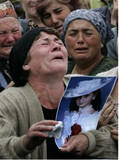
Which one of you “sophisticated” liberals and antiwar libertarians wants to tell this woman that “evil” is just a word used by simple-minded politicians?

A relative of Madina Tamayeva, 10, killed together with her mother in the school hostage taking, cries as she holds Madina’s portrait during her funeral in Beslan, Monday Sept. 6, 2004. In Beslan, townspeople crowded around the coffins of children, parents, grandparents and teachers ahead of the 120 burials scheduled in the town cemetery and adjoining fields Monday. (AP Photo/Alexander Zemlianichenko)

Here Comes "Scandal"

Democrat “strategist” Susan Estrich — infamous for her success as Michael Dukakis’s campaign manager in 1988 — has called for an all out sleaze attack on Bush. So here’s Kitty Kelly, via Mirror.co.uk, with the first salvo in the Democrats’ last-ditch effort to find some mud that will stick to Bush:

BUSH ‘TOOK COCAINE AT CAMP DAVID’

Sep 6 2004

And wife Laura liked dope, says book

By Emma Pryer

GEORGE W Bush snorted cocaine at Camp David, a new book claims.

His wife Laura also allegedly tried cannabis in her youth.

Author Kitty Kelley says in her biography, The Family: The Real Story of the Bush Dynasty, that the US President first used coke at university in the mid-1960s.

She quotes his former sister-in-law Sharon Bush who claims: “Bush did coke at Camp David when his father was President, and not just once either.”…

Other acquaintances allege that as a 26-year-old National Guard, Bush “liked to sneak out back for a joint or into the bathroom for a line of cocaine”.

Even if it’s true — which seems doubtful, given the source — it’s hardly relevant in the way that Kerry’s voting record on defense and foreign policy is relevant. And since when have Democrats been against a bit of snorting and toking?

A Very Politically Incorrect Labor Day Post

Labor Day gives most workers a day off. That’s good because an extra day off now and then is a pause that refreshes. A longish trek to a park or a beach on a hot day with a car full of kids isn’t a refreshing way to spend Labor Day, but those workers who spend the day at home, perhaps reading a book and listening to music, will find their souls somewhat restored.

Now let us consider the significance of Labor Day as a holiday. According to Wikipedia:

The origins of Labor Day can be traced back to the Knights of Labor in the United States, and a parade organized by them at that time on September 5, 1882 in New York City. In 1884 another parade was held, and the Knights passed resolutions to make this an annual event. Other labour organizations (and there were many), but notably the affiliates of the International Workingmen’s Association who were seen as a hotbed of socialists and anarchists, favoured a May 1 holiday. With the event of Chicago’s Haymarket riots in early May of 1886, president Grover Cleveland believed that a May 1 holiday could become an opportunity to commemorate the riots. But fearing it may strengthen the socialist movement, he quickly moved in 1887 to support the position of the Knights of Labor and their date for Labor Day. The date was adopted in Canada in 1894 by the government of Prime Minister John Thompson, although the concept of a Labour Day actually originated with marches in both Toronto and Ottawa in 1872. On the other hand, socialist delegates in Paris in 1889 appointed May 1 as the official International Labour Day.

Labor Day has been celebrated on the first Monday in September in the United States and Canada since the 1880s. The September date has remained unchanged, even though the two governments were encouraged to adopt May 1 as Labor Day, the date celebrated by the majority of the world. Moving the holiday, in addition to violating U.S. tradition, could have been viewed as aligning U.S. labor movements with internationalist sympathies.

In summary (for those of you who didn’t grow up in the North), Labor Day is an invention of organized labor, and the historical roots of organized labor are socialistic.

Labor Day also serves to remind us of one of the “monuments” of FDR’s New Deal (quoting again from Wikipedia):

The National Labor Relations Act of 1935 (or Wagner Act) protects the rights of workers in the private sector of the United States to organize unions, to engage in collective bargaining over wages, hours, and terms and conditions of employment, and to take part in strikes and other forms of concerted activity in support of their demands….

In the first few years of the Wagner Act, however, many employers simply refused to recognize it as law. The United States Supreme Court had already struck down a number of other statutes passed during the New Deal on the grounds that Congress did not have the constitutional authority to enact them under its power to regulate interstate commerce. Most of the initial appellate court decisions reached the same conclusion, finding the Act unconstitutional and therefore unenforceable. It was not until the Supreme Court upheld the constitutionality of the statute in 1937 in National Labor Relations Board v. Jones & Laughlin Steel Corp. that the Wagner Act became law in practical terms as well.

Thus Labor Day, in its way, commemorates legislative and judicial infamy. The Wagner Act, at one stroke, deprived business owners of their property rights and thus discouraged investment and business formation; invalidated the freedom of employers to contract with employees on terms acceptable to employers as well as employees; caused artificially high wages and benefits that harmed American workers by making American industry less and less competitive with foreign industry; and set the stage for the use of the Commerce Clause as an excuse for the federal government’s interference in all aspects of business.

So, if you are a worker, enjoy your Labor Day holiday, but don’t thank organized labor or the New Deal for your material blessings.

Next Stop, Legal Genocide?

I have written before about abortion as a step down the slippery slope toward involuntary euthanasia. Here is more evidence of the slipperiness of the slope:

The World Federation of the Catholic Medical Associations published a statement in response to the decision to allow Groningen University Hospital [in Holland] to euthanize children under 12 when their suffering is intolerable, or if they have an incurable illness.

The document states that this initiative “is another violent laceration of the very fundamentals of our social coexistence.”

“Officially aimed at putting an end to ‘unbearable suffering,’ in fact it permits the killing of human beings without their consent,” the statement continues….

“This happens in a society, as the Dutch one, in which euthanasia on adults has been legally performed even on depressed persons and where, as documented by official studies, there is already an illegal but tolerated euthanasia performed by physicians” on patients who have not given their consent, the statement adds….

Worse yet, “it opens the door on a national scale to the ‘mercy killing’ of other mentally incompetent persons, to be eliminated without their consent for reasons based on an external appreciation of their quality of life,” said the federation.

This move is also in line with the Aug. 26 decision of the Kentucky Supreme Court, which granted legal authority to the state to end the life of one of its citizens, the statement adds [emphasis mine].

“The case involved a mildly retarded black male, Matthew Woods, who was placed on a ventilator after suffering cardiac arrest at the age of 54. The state requested permission to remove his life support, contrary to the wishes of Woods’ guardian ad litem,” the statement explains….

“The next steps will be the mental capacity bill under scrutiny by the British Parliament, and the attempt by local authorities to change the ethical code of Belgian doctors,” the statement stresses.

“The risks of such an attitude, in terms of violence and discrimination, should be evident for physicians and call them to resist and fight,” the statement concludes.

[Zenit.org ZE04090305]

Are you ready to be put down by your heirs? It could happen here.

Libertarians ought to be up in arms about euthanasia. Where are they on the issue? Buried deep in the Libertarian Party website is one reference to euthanasia, in a string of comments about politicians least popular with libertarians:

My vote for most anti-freedom political zealot goes to Pat Robertson. [Who] espouses [among other things] condemnation of euthanasia…[emphasis mine].

— Barry Rowe, Melbourne, Florida

And that’s all to be found on the website of the political party that claims to “hold that all individuals have the right to exercise sole dominion over their own lives….” No wonder I am developing a case of deep disrespect for the Libertarian Party as a exponent of libertarian ideals.

Thanks to my daughter-in-law for the tip about the statement by the World Federation of the Catholic Medical Associations.

Looking Ahead

Assume that President Bush wins re-election, with a clear majority of the popular vote. Assume that Republicans gain seats in the House and Senate. In what major ways will the world and the United States change in the next four years? Here are 10 predictions:

1. International terrorism will be disrupted significantly through the combined efforts of the U.S., UK, Israel, and Russia — with increasingly enthusiastic support from France, Germany, China, and Japan.

2. The Middle East will become more stable, as Syria and Iran are brought to heel by the threat of massive military action by the U.S.

3. North Korea will be brought to heel by the same method.

4. China and Russia will more quickly accept the virtues of representative democracy and free-market capitalism. Russia will strive to ensure the success of its venture by more rigorously imposing the rule of law.

5. France and Germany, as beneficiaries of Pax Americana, will rediscover the virtues of American leadership in world affairs.

6. The global economy and the U.S. economy will make great strides, practically eliminating serious support for protectionism and anti-globalism.

7. The U.S. will take the first steps toward privatization of Social Security.

8. A healthy U.S. economy will quell demands for universal health insurance and greater government interference in health care.

9. Bush will nominate — and the Senate will confirm — judges who are committed to the enforcement of legislative meaning and who do make law for the sake of attaining particular social goals. Those judges will be “activist judges” in that they will overturn previous, unconstitutional decisions.

10. A clear majority vote for Bush will soften — though not eliminate — the tone of extreme partisanship that has dominated American politics since 1992, when Clinton beat Bush Senior by virtue of Perot’s candidacy. The next four years will be more like Reagan’s second term than like Clinton’s second term.

Boo, hoo!

Poor Democrats, poor Johnny Kerry:

Democrats Claim Bush’s Bounce Will Fade

By TOM RAUM, Associated Press Writer

WASHINGTON – Democrats on Sunday said President Bush’s post-convention bounce was triggered by “four days of mean, vicious attacks” on John Kerry, and would be short-lived.

They vowed a nonstop, two-month offensive to make up for any lost ground….

Mean, vicious attacks = True statements about Kerry’s record

Two-month offensive = Untrue statements about Bush’s record

That’s all they have left in their arsenal.

Moral Confusion in the British Academy

Novelist and essayist John Banville, writing at books.guardian.co.uk, reviews Heresies: Against Progress and Other Illusions, by John Gray. Banville notes that Gray

is richly dismissive, for instance, of the Bush administration’s neo-conservatives — “Washington’s new Jacobins”, he calls them — who believe that it is possible to eradicate evil from the world. “The danger of American foreign policy,” he writes, “is not that it is obsessed with evil but that it is based on the belief that evil can be abolished.” Such foolishness, he points out, is far removed from the wisdom of America’s founding fathers, for whom “the purpose of government was not to conduct us to the Promised Land but to stave off the recurrent evils to which human life is naturally prone”.

Why does Gray think that the Founders rejected a promised land? If he would read our Declaration of Independence and the Preamble of our Constitution it would be clear to him that the Founders embraced a secular promised land and established a system of governance that would guide us to that promised land.

As for evil, Gray is merely nit-picking when he contrasts Bush’s supposed fixation on abolishing evil — falsely imputing naïveté to Bush — with the Founders’ view that evil is recurrent. A cheap rhetorical trick.

I am ceaselessly amused — but never amazed — by the depths to which half-baked, left-wing academicians will stoop to score points against their political enemies.

More Drivel from the Times

What’s wrong with this story from the dependably lachrymose New York Times?

Always on the Job, Employees Pay With Health
By JOHN SCHWARTZ

Published: September 5, 2004

American workers are stressed out, and in an unforgiving economy, they are becoming more so every day.

Sixty-two percent say their workload has increased over the last six months; 53 percent say work leaves them “overtired and overwhelmed.”

Even at home, in the soccer bleachers or at the Labor Day picnic, workers are never really off the clock, bound to BlackBerries, cellphones and laptops. Add iffy job security, rising health care costs, ailing pension plans and the fear that a financial setback could put mortgage payments out of reach, and the office has become, for many, an echo chamber of angst.

It is enough to make workers sick – and it does.

Decades of research have linked stress to everything from heart attacks and stroke to diabetes and a weakened immune system. Now, however, researchers are connecting the dots, finding that the growing stress and uncertainty of the office have a measurable impact on workers’ health and, by extension, on companies’ bottom lines….

Does someone hold a gun to these people and force them to work at stressful jobs? Ah so, they just want what everyone else has — a huge-screen TV, a cell phone for every family member, a car or two for every family member, a McMansion, and on and on. Life is full of choices. If you can’t stand the stress, do something less stressful and give up some material things.

I’d like to be sympathetic — really I would — because I know how hard some people work to provide the goods and services I buy. But what’s the point of whining about it? Do the job you’re paid to do as well as you can, or do something else if you don’t like the job you’re doing. Or quit wasting your money on conspicuous consumption and save more so that you can retire early. (By the way, I follow my own advice, so I don’t mind giving it to other people.)

Imagine the reaction of readers who had to struggle through the Great Depression to put stale bread on the table. What a self-indulgent nation we’ve become.

A Reflection on the Greatest Generation

Yesterday I served as a pallbearer at the funeral of my wife’s aunt, who died at the age of 83. Of her four siblings, only my wife’s father survives — hearty and healthy at the age of 85. My wife’s mother was one of eight children, of whom three survive, aged 89, 84, and 80. My father and his sister have passed from the scene. My mother, who was one of 10 children, still lives alone at age 88; her youngest brother is edging toward 82.

That’s it: six survivors from a generation of 25 children born between 1903 and 1924. All of the members of that generation lived through the Great Depression. Half the members of that generation served in World War II. All of them grew up poor — some of them “dirt poor” — but by dint of hard work, all of them went on to live comfortably, if not lavishly.

Like many other members of the Greatest Generation, they tended to spoil their children, many of them born after World War II in the Baby Boom generation. The Greatest tried to compensate for their own privations by giving their children what they, the parents, had never had in the way of material possessions and “fun”. And that is where the Greatest Generation failed its children — especially the Baby Boomers — in large degree. A large proportion of Boomers grew up believing that they should have whatever they want, when they want it, with no strings attached. Thus many of them divorced, drank, and used drugs almost wantonly. Those traits seem to have passed to the next generation (Generation X), but that generation’s children (the Millenials) may be sobering up — without any help from their parents, grandparents, and great grandparents.

The Greatest Generation — having grown up believing that FDR was a secular messiah, and having learned comradeship in World War II — also bequeathed us governmental self-indulgence in the form of the welfare-regulatory state. Meddling in others’ affairs seems to be a predilection of the Greatest Generation, a predilection that the Millenials may be shrugging off.

We owe the Greatest Generation a great debt for its service during World War II. We also owe the Greatest Generation a reprimand for the way it raised its children and kowtowed to government. Respect forbids me from delivering the reprimand, but I record it here, for the benefit of anyone who has unduly romanticized the Greatest Generation.