The Will to Win

Arthur Chrenkoff reminds us why the will to win is all-important:

I’m currently reading Mark W Woodruff’s “Unheralded Victory: Who won the Vietnam War?”. Highly recommended for history and military buffs, this book makes it painfully clear that the American forces, together with South Vietnamese army and other allies…convincingly won every military engagement of the war,…in the process almost completely destroying Viet Cong and inflicting staggering casualties on the North Vietnamese Army….

…In Vietnam, for over 50 thousand Americans killed in action, 1.1 million North Vietnamese troops perished in fighting, the deadly ratio of some 20:1. This is quite similar to another American defeat, Mogadishu in 1993, where the engagement immortalised in “Black Hawk Down” cost the lives of less than 20 American soldiers but anywhere between 500 and 1,000 Somalis. Military actions in Iraq, both during the major combat operations phase as well as during significant anti-insurgency operations ever since, have resulted in similar ratios of enemy deaths….

When reading Woodruff’s book I was struck by how much the Vietnam War resembles the current conflict in Iraq – not in the way that the left says it is – a military quagmire – but in the way the left wants to make it so. What we have in both cases is a highly successful military operation conducted under restrictive rules of engagement, resulting in serious defeat of enemy forces but portrayed by the media as an inconclusive stalemate at best, while at the same time the public support for the action is being white-anted by a small but influential section of the elite….

…Let’s hope and pray that this time around the rush to disengage from the “quagmire” will not again live an Asian country at the mercy of the enemies of freedom.

It all comes down to November 2.

More Baseball Facts and Opinions

The Houston Astros have advanced to the second round of post-season play by beating the Atlanta Braves. The Astros — an expansion franchise dating from 1962 — will face the St. Louis Cardinals. The Cards are an old-line franchise, as are the N.Y. Yankees and Boston Red Sox — who will face each other in the American League Championship Series.

Since 1995, with the inauguration of two rounds of playoffs before the World Series, at least one of the first-round teams has represented an expansion franchise. And at least one expansion team has advanced to the second round in every year since 1996. In fact, the last three World Series have been won by expansion teams: the Florida Marlins in 2003, the Anaheim Angels in 2002, and the Arizona Diamondbacks in 2001.

What’s worse — for a “purist” like me — is the fact that expansion teams have won nine of the 34 World Series since the advent of pre-World Series playoffs in 1969. The quality of the game would be much higher today if there were still only 16 teams (the number from 1901 through 1960). Then we wouldn’t have to put up with fluke World Series victories by such teams as the wild-card Florida Marlins (1997, 2003) and the New York Mets (1969, 1986) — a team whose fans are easily the most obnoxious of all in baseball.

There should be eight teams in each league, and regular season play should determine the championship of each league. The league champions should meet head-to-head in the World Series. And may the better team win.

Hey, it worked for more than 60 years, and it wasn’t broke. Why did they have to go and “fix” it?

Andrew Sullivan, Nailed

About a month ago I had my say about Andrew Sullivan and his gay-marriage litmus test for politicians, which led him to switch his allegiance from Bush to Kerry. Here’s a sample:

…Like many other bloggers, I long sensed that Sullivan eventually would change his colors because he has been monomaniacal about the recognition of homosexual marriage. He kept harping on it in post after post, day after day, week after week. It got so boring that I took Sullivan’s blog off my blogroll and quit reading it….

He seems to have put his sexual orientation above all else. He’s really a one-issue voter. Sure, he has rationalized his change of mind, but his change of mind can be traced, I think, to his preoccupation with gay marriage as a political litmus test….

Today John Weidner at Random Jottings nails Sullivan to the floor:

…Poor Sullivan’s in knots again. I wish he would just say he supports Kerry because of gay marriage. But no, he has to cover up by trying to actually make a case for Kerry, and against Bush. (He was for him before he was against him.)

If Osama bin Laden was in favor of gay marriage, Sullivan would face an difficult choice: Whether to go the whole enchilada and wear a black-turban, or to fudge a bit with a white one.

Hyperbolic, yes. But Weidner makes my point far more dramatically than I was able to make it.

Straight Thinking About Business Cycles

Economists and common folk have long thought that a recession — a sustained drop in the total output of goods and services — is caused by a failure of markets or government “to do the right thing.” Now, the Nobel prize for economics has been awarded to Finn E. Kydland and Edward C. Prescott, a pair of economists who say otherwise. Here’s the story, according to Alex Tabarrok at Marginal Revolution:

…Recessions have almost always been thought of as a failure of market economies. Different theories point to somewhat different failures, in Keynesian theories it’s a failure of aggregate demand, in Austrian theories a mismatch between investment and consumption demand, in monetarist theories a misallocation of resource due to a confusion of real and nominal price signals. In some of these theories government actions may prompt the problem but the recession itself is still conceptualized as an error, a problem and a waste.

Kydland and Prescott show that a recession may be a purely optimal and in a sense desirable response to natural shocks. The idea is not so counter-intuitive as it may seem. Consider Robinson Crusoe on a desert island….Every day Crusoe ventures out onto the shoals of his island to fish. One day a terrible storm arises and he sits the day out in his hut – Crusoe is unemployed. Another day he wanders out onto the shoals and finds an especially large school of fish so he works especially long hours that day – Crusoe is enjoying a boom economy. Now add into Crusoe’s economy some investment goods, nets for example, that take “time to build.” A shock on day one will now exert an influence on the following days even if the shock itself goes away – Crusoe begins making the nets when it rains but in order to finish them he continues the next day when it shines. Thus, Crusoe’s fish GDP falls for several days in a row – first because of the shock and then because of his choice to build nets, an optimal response to the shock.

An analogy is one thing but K[ydland] and P[rescott] showed that a model built from exactly the same microeconomic forces as in the Crusoe economy could duplicate many of the relevant statistics of the US economy over the past 50 years. This was a real shock to economists! There are no sticky prices in K & P’s model, no systematic errors or confusions over nominal versus real prices and no unexploited profit opportunities. A perfectly competitive economy with no deviations from classical Arrow-Debreau assumptions could/would exhibit behaviour like the US economy.

That’s what I’ve been trying to tell my wife (a Bush-hater), who likes to parrot the Democrats’ line about “all those people who don’t have jobs.” My response: First, right now it’s no worse than usual. The 5.4 percent unemployment rate for September was slightly lower than the average of 5.6 percent for 1948-2003 (computed from BLS data given here). Second, when the unemployment rate was worse it wasn’t Bush’s fault, nor was it Clinton’s (even though the latest recession began on his watch). Recessions happen. They’re inevitable and even desirable in a dynamic economy; they’re fluctuations around an ever-rising trend, albeit a trend that has become less robust since the onset of the regulatory-welfare state about 100 years ago:


Data on real GDP for 1870-2003 are from Louis Johnston and Samuel H. Williamson, “The Annual Real and Nominal GDP for the United States, 1789 – Present.” Economic History Services, March 2004, URL: http://www.eh.net/hmit/gdp/. Real GDP for 2004 estimated by deflating nominal 2004 GDP (source at footnote a) by increase in CPI between 2000 and 2004 (from Bureau of Labor Statistics).

A Left-Winger Grasps at Libertarian Straws, and Misses

Kos is all excited because he stumbled onto a Cato Institute paper that purports to show the advantages of divided government: lower spending and less chance of going to war. I guess it’s the war part that Kos has latched onto. Surely he’s not for less government spending, and surely he favors divided government (Kerry in the White House, Republicans in Congress) only as a way station toward undivided, all-Democrat government.

Be that as it may, I long ago debunked the Cato paper in question, as well as a later, more detailed analysis along the same lines. My take:

There is a very strong — almost perfect — relationship between real nondefense spending and the unemployment rate for the years 1969 through 2001, that is, from the Nixon-Ford administration through the years of Carter, Reagan, Bush I, and Clinton. Using a linear regression with five pairs of observations, one pair for each administration, I find that the percentage change in real nondefense spending is a linear function of the change in the unemployment rate….

[equation here]

In words, the work of the New Deal and Fair Deal had been capped by the enactment of the Great Society in the Kennedy-Johnson era. The war over domestic spending was finished, and the big spenders had won. Real nondefense spending continued to grow, but more systematically than it had from 1933 to 1969. From 1969 through 2001, each administration (abetted or led by Congress, of course) increased real nondefense spending according to an implicit formula that reflects the outcome of political-bureaucratic bargaining. It enabled the beast to grow, but at a rate that wouldn’t invoke images of a new New Deal or Great Society.

Divided government certainly hampered the ability of Republican administrations (Nixon-Ford, Reagan, Bush I) to strangle the beast, had they wanted to. But it’s not clear that they wanted to very badly. Nixon was, above all, a pragmatist. Moreover, he was preoccupied by foreign affairs (including the extrication of the U.S. from Vietnam), and then by Watergate. Ford was only a caretaker president, and too “nice” into the bargain. Reagan talked a good game, but he had to swallow increases in nondefense spending as the price of his defense buildup. Bush I simply lacked the will and the power to strangle the beast.

Bureaucratic politics also enters the picture. It’s hard to strangle a domestic agency once it has been established. Most domestic agencies have vocal and influential constituencies, in Congress and amongst the populace. Then there are the presidential appointees who run the bureaucracies. Even Republican appointees usually come to feel “ownership” of the bureaucracies they’re tapped to lead.

What happened before 1969?

The beast — a creature of the New Deal — grew prodigiously through 1940, when preparations for war, and war itself, brought an end to the Great Depression. Real nondefense spending grew by a factor of 3.6 during 1933-40. If the relationship for 1969-2001 had been in effect then, real nondefense spending would have increased by only 10 percent.

Truman and the Democrats in control of Congress were still under the spell of their Depression-inspired belief in the efficacy of big government and counter-cyclical fiscal policy. The post-war recession helped their cause, because most Americans feared a return of the Great Depression, which was still a vivid memory. Real nondefense spending increased 2.8 times during the Truman years. If the relationship for 1969-2001 had been in effect, real nondefense spending would have increased by only 20 percent.

The excesses of the Truman years caused a backlash against “big government” that the popular Eisenhower was able to exploit, to a degree, in spite of divided government. Even though the unemployment rate more than doubled during Ike’s presidency, real domestic spending went up by only 9 percent. That increase would have been 28 percent if the relationship for 1969-2001 had been in effect. But even Ike couldn’t resist temptation. After four years of real cuts in nondefense spending, he gave us the interstate highway program: another bureaucracy — and one with a nationwide constituency.

The last burst of the New Deal came in the emotional aftermath of Kennedy’s assassination and Lyndon Johnson’s subsequent landslide victory. Real nondefense spending in the Kennedy-Nixon years rose by 56 percent, even though the unemployment rate dropped by 48 percent during those years. The 56 percent increase in real spending would have been only 8 percent if the 1969-2001 relationship had applied.

As for Bush II, through the end of 2003 he was doing a bit better than average, by the standards of 1969-2001 — but not significantly better. He now seems to have become part of the problem instead of being the solution. In any event, the presence of the federal government has become so pervasive, and so important to so many constituencies, that any real effort to strangle the beast would invoke loud cries of “meanie, meanie” — cries that a self-styled “compassionate conservative” couldn’t endure.

Events since 1969 merely illustrate the fact that the nation and its politicians have moved a long way toward symbiosis with big government. The beast that frightened conservatives in the 1930s, 1940s, and 1950s has become a household pet, albeit one with sharp teeth. Hell, we’ve even been trained to increase his rations every year.

Tax cuts won’t starve the beast — Friedman, Becker, and other eminent economists to the contrary. But tax increases, on the other hand, would only stimulate the beast’s appetite.

The lesson of history, in this case, is that only a major war — on the scale of World War II — might cause us to cut the beast’s rations. And who wants that?

Too Gullible for Words

UPDATED

Left and right alike are trying to explain this (from the LA Times, no link because obnoxious registration is required):

WASHINGTON — The Bush administration will delay major assaults on rebel-held cities in Iraq until after U.S. elections in November, say administration officials, mindful that large-scale military offensives could affect the U.S. presidential race.

Although American commanders in Iraq have been buoyed by recent successes in insurgent-held towns such as Samarra and Tall Afar, administration and Pentagon officials say they will not try to retake cities such as Fallujah and Ramadi — where insurgents’ grip is strongest and U.S. military casualties could be the greatest — until after Americans vote in what is likely to be a close election.

“When this election’s over, you’ll see us move very vigorously,” said one senior administration official involved in strategic planning, speaking on condition of anonymity.

“Once you’re past the election, it changes the political ramifications” of a large-scale offensive, the official said. “We’re not on hold right now. We’re just not as aggressive.”

Seems to me we heard something like this just before U.S.-Iraqi forces went into Samarra and seriously kicked butt. It’s called disinformation. I wouldn’t be surprised if that’s what’s at work here.

UPDATE:

I told you so. Here’s the AP story, via Yahoo! News:

U.S. Steps Up Attacks on Iraq Insurgents

By ALEXANDRA ZAVIS, Associated Press Writer

BAGHDAD, Iraq – U.S. forces stepped up operations Tuesday across a wide swath of the Sunni insurgent strongholds northwest of the capital, pounding targets in two cities from the air and supporting Iraqi troops in raids on mosques suspected of harboring insurgents….

And there’s more, in the story and on the ground in Iraq.

Character Will Out

UPDATED – 10/11/04

A few posts ago I quoted QD at Southern Appeal:

So in spite of the fact that Kerry promises to “kill” the terrorists, it seems much more plausible to think that he’ll instead tack toward the French and German strategy of using intelligence and legal means to disrupt terrorist plans while carefully avoiding acts which might “inflame” potential adversaries. In other words, he’ll revert to a pre-Sept. 11th strategy. What makes the Kerry supporters think I’m wrong here?

My comment:

QD is quite right. Character shows up early in adult life and sticks with you, unless you experience what QD calls a deep psychological crisis. James David Barber’s classic book, Presidential Character: Predicting Performance In The White House, amply documents the persistence of long-held character traits into the White House years of American presidents.

But what about Bush, the erstwhile playboy, alcoholic, and drug-taker? Bush, unlike Kerry, forced a psychological crisis upon himself. He is not the same person he was in his wanton days. He has evolved into a hard-nosed realist who will kill terrorists.

Now, thanks to pointers from all over the blogosphere, I find the following in today’s New York Times:

When I asked Kerry what it would take for Americans to feel safe again, he displayed a much less apocalyptic worldview. “We have to get back to the place we were, where terrorists are not the focus of our lives, but they’re a nuisance,” Kerry said. “As a former law-enforcement person, I know we’re never going to end prostitution. We’re never going to end illegal gambling. But we’re going to reduce it, organized crime, to a level where it isn’t on the rise. It isn’t threatening people’s lives every day, and fundamentally, it’s something that you continue to fight, but it’s not threatening the fabric of your life.”

What a dunce! The only way to get back to where we were — if we can — is to wage an all-out war on terror by constantly disrupting terrorists’ plans and destroying terrorists wherever we can, with every means at our disposal: legal, financial, diplomatic, and military. Suggesting that we might tolerate terrorists as a “nuisance” — like hookers on a street corner or back-room gamblers — is a perfect illustration of Kerry’s legalistic view of the problem.

We’re in a war, dammit — not a fight to reduce the incidence of graffiti. And we’ll be in a war until the terrorist bastards are less than a nuisance.

UPDATE 1:

Lileks, as usual, says it better:

But that’s not the key phrase. This matters: We have to get back to the place we were.

But when we were there we were blind. When we were there we losing. When we were there we died. We have to get back to the place we were. We have to get back to 9/10? We have to get back to the place we were. So we can go through it all again? We have to get back to the place we were. And forget all we’ve learned and done? We have to get back to the place we were. No. I don’t want to go back there. Planes into towers. That changed the terms. I am remarkably disinterested in returning to a place where such things are unimaginable. Where our nighmares are their dreams.

We have to get back to the place we were.

No. We have to go the place where they are.

UPDATE 2:

Filmmaker Alexandra Pelosi (daughter of Big Democrat Nancy Pelosi and a Democrat herself), made a ripple a few years ago with her documentary about Bush’s 2000 campaign. Now she’s back with another campaign documentary and some telling insights about Bush and Kerry (from an AP story, via the Austin American-Statesman, registration required):

…Pelosi’s documentary “Journeys with George,” which made a splash at the 2002 South by Southwest Film Festival, depicted a goofy but endearing George W. Bush in backstage moments during the 2000 presidential campaign.

Fortunately, Pelosi wasn’t looking for the star of a sequel. She went back to the campaign trail more to expose a dysfunctional process than a candidate. The quickly edited film “Diary of a Political Tourist” premieres tonight at 7 on HBO.

The documentary opens nostalgically with Bush holding a barbecue for members of Congress on the White House lawn (Pelosi is the daughter of House Democratic leader Nancy Pelosi) and good-naturedly teasing Alexandra.

“How much money did you make off of me?” the president asks.

“I’m going to be a beneficiary of your tax cut,” she replies.

By contrast, the man who’s looking to replace him exposes virtually nothing in hours of filming. Kerry is always cautious, always conscious of the camera.

Whatever you think of his politics, Bush is a movie star, Pelosi said. Kerry isn’t.

“I don’t think if I spent six more months on his lap was he going to reveal any more than he did,” she said. “He was who he was. I wasn’t going to crack the code of understanding John Kerry.”

It didn’t happen during the depths of Kerry’s campaign — when Pelosi impudently asked, “Are you a dead man walking?” — or its heights, when the filmmaker tried for weeks to land a one-on-one interview with the presumptive nominee.

When an audience was finally granted, Kerry surrounded himself with young aides and derailed the process by grabbing Pelosi’s camera and turning it on her, just like Bush had four years earlier.

“I never thought I saw one honest moment during the entire campaign,” Pelosi said….

Enough said.

It Happens Every Four Years

At least a few pro-Bush bloggers (here and here) are worried because of reports like this:

Surge in voter registration setting records

By Donald Lambro

THE WASHINGTON TIMES

A surge in voter registration that is setting records in the battleground states has led election forecasters to predict the largest increase in turnout in more than a decade.

With a little more than three weeks left before Election Day, election officials nationwide report that new voter registrations are still pouring in, boosting the number of registered voters in many states to levels never seen before.

“We have seen a real rush to become registered by eligible voters all over the country,” said Meredith Imwalle, spokeswoman for the National Association of Secretaries of State, the officials who tabulate and oversee elections and voter registration.

Election officials say that the sharp rise in registration is to a large degree the result of a much more intensive grass-roots canvassing campaign by the Republican and Democratic parties and the campaigns of the two presidential candidates, President Bush and Sen. John Kerry.

“They have been very aggressive, the most aggressive that I’ve seen in my career,” said Curtis Gans, who runs the Committee for the Study of the American Electorate.

The same political intensity that is driving voter registration to new highs likely will boost voter turnout as well, the analysts said.

“I don’t think there has been a more emotionally intense an election since 1968. Turnout will be up,” Mr. Gans said….

Republican National Committee (RNC) officials said they have signed up more than 3 million new Republican voters. Democratic National Committee (DNC) officials said they have exceeded that number, but refused to give any statistics Friday.

“The Democrats have not put out a number. We saw registration as part of our election strategy. It’s an area where the Republicans are playing catch-up,” DNC spokesman Tony Welch said. “They set their goals to create headlines. We’re looking for voters, and by all accounts our registration is far outpacing theirs.”…

It’s all hype and PR. Of course, voter registrations are spiking now; the election is coming and registration deadlines are looming. Of course registrations are at an all-time high; the U.S. is more populous than ever. Of course the Democrats are claiming that the new registrations help them; we hear that every four years because Democrats seem to think that new voters prefer Democrats, though there’s little evidence for that in the results of presidential elections in recent decades. In fact, the “emotionally intense” 1968 election — when new, draft-age voters presumably favored anti-war Humphrey over tricky Dick and George the segregationist — resulted in a trouncing of Humphrey, the only liberal in the field.

More Blasts from the Past

About 50 years ago, my Uncle Joe was the commanding officer at this Coast Guard station:

Lighthouse at the Fort Gratiot (Port Huron, Michigan) Coast Guard station

I think he lived in the brick house to the left of the lighthouse.

Here’s the main street of my home town, as it looks today (better than it looked when I was growing up):
Downtown, Port Huron, Michigan

And here’s the city’s museum, formerly its public library (one of the many endowed by Andrew Carnegie):

Port Huron Museum – Carnegie Center

It’s time to watch a ball game — baseball, that is, the real ball game. Speaking of baseball, it’s too bad the Tigers don’t play here anymore:
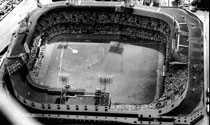
Briggs Stadium, Detroit, 1951

Bennett Park, Navin Field, Briggs Stadium, and Tiger Stadium occupied the same piece of real estate at the corner of Michigan and Trumbull from 1901 through 1999. The “modern” ballpark known originally as Navin Field opened for business in 1912. It grew through the years and became Briggs Stadium in 1938. Only the name changed when Briggs Stadium became Tiger Stadium in 1961. The stadium’s upper deck rose directly above the lower deck, unlike the arrangement in newer stadiums, where the upper deck is set back from the playing field. Thus a seat in the upper deck between first and third afforded the best view of a baseball game to be had anywhere — a bird’s eye view of a beautifully maintained playing field, upon which strode the shades of Cobb, Cochrane, Crawford, Gehringer, Greenberg, Heilmann, Kaline, Kell, and Newhouser.

For earlier entries in this nostalgia series, click here, here, and here.

Deconstruct This!

First, the news:

Deconstructionism Founder Derrida Dies

Sat Oct 9, 7:01 PM ET

By ELAINE GANLEY, Associated Press Writer

PARIS – World-renowned thinker Jacques Derrida, a charismatic philosopher who founded the school known as deconstructionism, has died, the French president’s office said Saturday. He was 74….

Deconstructionists like Derrida explored the means of liberating the written word from the structures of language, opening limitless textual interpretations. Not limited to language, Derrida’s philosophy of deconstructionism was then applied to western values….

Then, the underlying “text”:

…What most characterizes deconstruction is its notion of textuality, a view of language as it exists not only in books, but in speech, in history, and in culture. For the deconstructionist, language is everything. The world itself is “text.” Language directs humanity and creates human reality. (A reality that cannot be named or described is illusory, at best.) Yet, upon close examination, words seem to have no connection with reality or with concepts or ideas.

Related to textuality, the notion of intertext refers to the broader cultural background, the context that saturates the text with innumerable and nonverbal conventions, concepts, figurations, and codes. Given the silent and hidden links of a text to its cultural and social intertext, the text’s content and meaning are, essentially, indeterminate. Texts, therefore, are unreadable, and the practice of interpretation may be defined as misreading.

Derrida’s deconstructions of Western thinkers from Plato to Martin Heidegger attack what he calls “logocentrism,” the human habit of assigning truth to logos — to spoken language, the voice of reason, the word of God. Derrida finds that logocentrism generates and depends upon a framework of two-term oppositions that are basic to Western thinking, such as being/nonbeing, thing/word, essence/appearance, presence/absence, reality/image, truth/lie, male/female. In the logocentric epistemological system the first term of each pair is the stronger (TRUTH/lie, MALE/female).

Derrida is critical of these hierarchical polarities, and seeks to take language apart by reversing their order and displacing, and thus transforming, each of the terms — perhaps by putting them in slightly different positions within a word group, or by pursuing their etymology to extreme lengths, or by substituting words in other languages that look and sound alike. Extending the work of Derrida, feminist critics have deconstructed the “phallocentric” pair male/female. Feminists in general see phallocentrism as fundamental to the larger “social text” of Western logocentric society, which, aided by language, has given women secondary sexual, economic, and social roles.

Deconstruction has been regularly attacked as childish philosophical skepticism and linguistic nihilism….

Precisely. Derrida’s philosophy — if you can call it that — is as dead (intellectually) as Derrida. What is, or was, deconstruction? If the preceding explanation seems opaque, that’s because deconstruction is essentially meaningless. It’s merely an arbitrary, open-ended method of attacking any philosophy, ideology, science, writing, or fact of life that runs counter to one’s prejudices. It’s on a par with conspiracy theories and junk science. It’s juvenile psychobabble. Deconstruction should go the way of Derrida.

Getting It Right about Character

QD at Southern Appeal has this to say about Kerry and the war on terror:

Question for Kerry Supporters: I have a question for those of you who are planning to vote for Sen. Kerry….In your view,where in Kerry’s background, temperament, or ideas do you find assurance that he’ll do a good job in fighting the war on terror?

My experience has been that people mostly don’t change their stripes (absent some deep psychological crisis or religious conversion). Kerry’s entire political career has been oriented, it seems to me, around the opposition to the forceful projection of American military power. With respect to Vietnam, the Cold War, Central America, the first Gulf War, and now the war in Iraq….Now, maybe none of that previous history has anything to do with how he would conduct the war on terror, but, as I said, people don’t often change their character….So in spite of the fact that Kerry promises to “kill” the terrorists, it seems much more plausible to think that he’ll instead tack toward the French and German strategy of using intelligence and legal means to disrupt terrorist plans while carefully avoiding acts which might “inflame” potential adversaries. In other words, he’ll revert to a pre-Sept. 11th strategy. What makes the Kerry supporters think I’m wrong here?

QD is quite right. Character shows up early in adult life and sticks with you, unless you experience what QD calls a deep psychological crisis. James David Barber’s classic book, Presidential Character: Predicting Performance In The White House, amply documents the persistence of long-held character traits into the White House years of American presidents.

But what about Bush, the erstwhile playboy, alcoholic, and drug-taker? Bush, unlike Kerry, forced a psychological crisis upon himself. He is not the same person he was in his wanton days. He has evolved into a hard-nosed realist who will kill terrorists.

Thinking Back

Since I’ve been on a nostalgia jag, which autumn always evokes in me, I’ve been musing about technologies that have become prevalent in my lifetime. Here are the things I like most and least (in no particular order):

Most–

Transistors

Pocket calculators

Tubeless tires

Computer languages

Personal computers and their accoutrements

Ethernet, Internet, and WWW

Hypertext

Search engines

Japanese automobiles

High-fidelity stereophonic sound systems

Video replay systems (VCRs and DVD players)

FM radio

Voice messaging

E-mail

Online banking

UPC (bar codes) and all that flows from them

Smart weapons (owned by the U.S.)

Satellite surveillance systems (owned by the U.S.)

Every “wonder” drug since penicillin

Almost every medical technology since x-rays

Fiberoptics, nanotechnology, and all those other neat ways of communicating, seeing, and manipulating things

Velcro

Nuclear power

Post-it notes

ATMs

Least–

TV (except as a medium for playing videotapes and DVDs)

Public radio & TV

Cell phones

SUVs

Electronic musical instruments

Autodialers

Canned music

Digital special effects

Spam

Tracking cookies

Computer viruses

Truck and car bombs

(Thanks to “Twentieth Century Inventions” at About for many of the items on these lists.)

And here, of everything that has become rare if not extinct since my birth, are the things I miss the most:

Weekly radio shows (e.g., Jack Benny, Our Miss Brooks, The Great Gildersleeve, Burns & Allen)

Movie musicals whose stars were truly talented (e.g., Allan Jones, Kathryn Grayson, Fred Astaire & Ginger Rogers)

The corner store (not a 7-11 or its ilk)

Mom & pop bakeries with fresh bread and pastries

Tranquil villages with well-kept homes and stable businesses that were “real” places and not tourist attractions

Tree-lined streets with sidewalks, laid out in a rectangular grid

Neighborhoods

Main street

People who whistled while they worked

Absolute victory.

Hobbesian Libertarianism

I’ve latched onto the term neolibertarian, which was coined at QandO. I think a neolibertarian might also be called a Hobbesian libertarian.

Wikipedia summarizes Hobbes’s views on the state of nature:

The seventeenth century English philosopher, Thomas Hobbes, is famous for presenting a sort of useful fiction in political philosophy, which has come to be called the state of nature. Hobbes himself does not use this term in Leviathan: he describes it as a “warre, as is of every man, against every man” (bellum omnium contra omnes).

The state of nature is presented as the condition humanity would be in if government did not exist….

Hobbes does not base his argument on the historical existence of such a state.

Hobbes believed that human beings in the state of nature would behave “badly” towards one another (“badly” in the sense of the morality that we would commonly apply: but Hobbes argued that people had every right to defend themselves by whatever means, in the absence of order). Famously, he believed that such a state would lead to a “war of every man against every man” and make life “solitary, poor, nasty, brutish, and short.” Hobbes’s negative view of human character was shaped at least in part by the Christian doctrines of original sin and total depravity; the Christian tradition is generally at one with Hobbes in supporting the need for government. However, Hobbes would strongly disagree with the Christian view of the innate, inherent, and inescapable sinfulness of human beings: in Hobbes’s view, these problems are soluble by good government. As he incisively stated in its “De cive. Epistola dedicatoria“, borrowing a well known aphorism from Plautus’s Asinaria: “homo homini lupus” (man is wolf to man).

Hobbes’s view was challenged in the eighteenth century by Jean-Jacques Rousseau, who affirmed instead that people in a state of nature would be born good; their bad habits are the products of civilization, and specifically social hierarchies, property, and markets. Rousseau’s view underlines much of the Romantic period’s political thinking, including the thought of Karl Marx.

John Locke, who is thought to have been a greater influence than Hobbes on Jefferson and the other Founders, was more Rousseauvian in his view of human nature, according to infoplease:

…Contradicting Thomas Hobbes, Locke believed that the original state of nature was happy and characterized by reason and tolerance. In that state all people were equal and independent, and none had a right to harm another’s “life, health, liberty, or possessions.” The state was formed by social contract because in the state of nature each was his own judge, and there was no protection against those who lived outside the law of nature. The state should be guided by natural law.

Rights of property are very important, because each person has a right to the product of his or her labor. Locke forecast the labor theory of value. The policy of governmental checks and balances, as delineated in the Constitution of the United States, was set down by Locke, as was the doctrine that revolution in some circumstances is not only a right but an obligation….

It is evident that the “state of nature” is more like Hobbes’s “warre, as is of every man, against every man” than it is like Locke’s state of “reason and tolerance.” Merge that understanding with Lockean rights (though they flow from experience and not from a Platonic ideal); throw in a Hobbesian government to secure those hard-won rights; stir in Adam Smith, John Stuart Mill, and Friedrich A. Hayek; and you have modern libertarianism — or, better yet, neolibertarianism.

The Pre-Debate Numbers

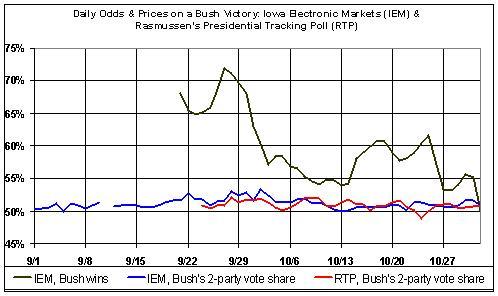
The popular vote share market at Iowa Electronic Markets and Rasumussen’s presidential tracking poll, in my estimation, do the best job of projecting Bush’s share of the two-party popular vote. (Bush’s share of the Rasmussen poll = percent for Bush/(percent for Bush + percent for Kerry.) Here’s how the numbers looked on the eve of the second Bush-Kerry debate:

Bush’s showing in IEM’s popular vote share market yields 337 to 388 electoral votes. His share of the Rasmussen poll yields a slightly lower estimate: 319 to 369 electoral votes. (The conversion of popular vote share to electoral votes is explained here (see method 3).)

The Consequences of Drug Reimportation

What will happen if it becomes U.S. policy to allow the reimportation of drugs from Canada? A recent paper in the Quarterly Journal of Economics, by Daron Acemoglu and Joshua Linn, tells the tale. Here’s the bottom line, according to Alex Tabarrok at Marginal Revolution:

Acemoglu and Linn’s paper is formally about a different issue [than reimportation]; the effect of market size on innovation. What they find is that a 1 percent increase in the potential market size for a drug leads to an approximately 4 percent increase in the growth rate of new drugs in that category. In other words, if you are sick it is better to be sick with a common disease because the larger the potential market the more pharmaceutical firms will be willing to invest in research and development. Misery loves company.

Although they don’t mention it, this finding has implications for price controls. In the pharmaceutical market the major costs are all fixed costs (they don’t vary much with market size) so profit =P*Q-F. Acemoglu and Linn look at changes in Q but a 1% change in P has exactly the same effects on profits, and thus presumably on R&D, as a 1% change in Q.

We can expect, therefore, that a 1% reduction in price will reduce the growth rate of new drug entries by 4% and a 10% reduction in price will reduce new drug entries by 40%. That is a huge effect. I suspect that the authors have overestimated the effect but even if it were one-half the size would you be willing to trade a 10% reduction in price for a 20% reduction in the growth rate of new drugs? No one who understands what these numbers mean would think that is a good deal.

What the numbers mean is that allowing large-scale reimportation of drugs from Canada (where prices are controlled) will cut into drug companies’ profits. Now, before you send up a loud cheer because you’ve been raised to believe that “profit” is a dirty word, consider what will happen after that. The reduction in profits will have a chilling effect on R&D and, therefore, on the introduction of new, life-enhancing drugs.

The logic of the issue is that simple, but it’s probably lost on consumers and politicians, who will focus on what we pay for today’s drugs and ignore the dire, long-term consequences of reimportation.

It’s just another case where consumers will suffer because economic illiteracy leads to wrong-headed government intervention in markets.

Blame It on Bush

Over at TalkLeft:

Weekend Ad Sale

I just dropped the rates for ads on TalkLeft. Check them out, there are some real bargains….

Or maybe it’s Dan Rather’s fault.

That’s It, in a Nutshell

Timothy Sandefur at Freespace has a good post about acting in the face of imperfect information. The summation:

Again, the question is not as much whether, knowing what we know now, Iraq was a good idea. The question is what sort of decisions we should make when we don’t know very much — should we wait, and run the risk of letting a disastrous terrorist attack occur — or should we take the risk of acting on imperfect information? In the case of Iraq, the President made the right decision because, in addition to the imperfect information, we at least knew that we would not be doing a bad thing getting rid of Hussein….The question is not whether war is a good thing or a bad thing. The question is not whether the Vice President is part of an evil capitalist conspiracy to exploit the proletarians in Iraq. The question is not even whether Bush’s domestic policies are good for the country, which they almost invariably are not. The question is what sort of mentality should we have toward undeniably dangerous states in the future. The answer to that, I think, is that we should be willing to attack even on the basis of imperfect information regarding a potential threat.

Not to put words in Sandefur’s mouth, but here’s my take: It’s better to be wrong than dead — even at the risk of being proved dead wrong after the fact.

Racism in Detroit

You know what happens when a racial majority becomes arrogant with power? Of course, it runs roughshod over the racial minority? It’s happening in Detroit, which is more than 80 percent black. Here’s the story from The Washington Times:

Detroit’s plan for ‘African Town’ stirs racial tensions

By Brian DeBose

THE WASHINGTON TIMES

The Detroit City Council, in defiance of Mayor Kwame Kilpatrick, likely will move forward with plans to create an “African Town” in the tradition of Chinatowns and Little Italys nationwide, even though the issue has turned into a racially divisive economic-development proposal.

In July, the council resolved to build up a section of the city devoted to African and black American literature, cuisine and art, which Mr. Kilpatrick endorsed. He vetoed the resolution, however, when it became clear that the council’s plan would allow only black businessmen and investors to use the $38 million earmarked for the project.

Mr. Kilpatrick argued that the resolution is both racist and unconstitutional.

“It’s not the African Town proposal. We like the idea,” said Howard Hughey, spokesman for Mr. Kilpatrick. “But what they are proposing is to create a publicly funded private entity and give one man $40 million to use and distribute to investors, and it is unconstitutional to do that based on race and [the resolution] says very clearly that it would be.”…

Council member Kay Everett, who is black, said the first resolution was “ridiculous” and opposed the African Town resolution for being illegal and divisive.

“It is reverse racism, and you can’t right a wrong with another wrong. It’s reparations with public money,” she said….

Typically, Chinatowns, Little Italys and other locales, such as Spanish Harlem in New York, were created by immigrants in a time when they were not accepted in other areas of the city and forced to build their own businesses and communities centered on their respective cultures….

So, Detroit would use public funds to discriminate against non-blacks in erecting an ethnic district of the kind that other ethnic groups created with their own money and enterprise. At least the mayor and some council members see the plan for what it is: the arrogance of racial power.

I Love It!

Linking to this post, Alan at Occam’s Carbuncle says,

A safe environment for libertarian victorymongers

If you loathe big government, but think freedom is good for foreigners too; if you want bureaucrats out of your life, but would rather see terrorism destroyed in its own back yard than yours; if you feel like a libertarian hawk without a home, Liberty Corner is your rainbow space. Enjoy.

Many thanks, Alan. It’s such a great endorsement of Liberty Corner that I’m placing it right below the banner.

No One Should Be above the Law — Not Even a Reporter

This will invoke a lot of whining about “freedom of the press” and “chilling effects,” but “due process of law” won’t get a mention:

Judge Holds Reporter in Contempt in Leak Probe

WASHINGTON (Reuters) – A federal judge held a New York Times reporter in contempt on Thursday for refusing to testify in the investigation of whether the Bush administration illegally leaked a covert CIA officer’s name to the media….

The emphasis is mine, all mine.