The True Cost of Government: An Addendum

Five months ago, in “The True Cost of Government,” I wrote this:

Americans are far less prosperous than they could be, for three reasons:

• Government uses resources that would otherwise be used productively in the private sector (19 percent of GDP in 2003).

• Government discourages work and innovation by taxing income at progressive rates and by transferring income from the productive to the non-productive (12 percent of GDP for recipients of Social Security, Medicare, Medicaid, etc., in 2003).

• Government regulation stifles innovation and raises the cost of producing goods and services (a net loss of 16 percent of GDP in 2003)….

I noted that

the regulatory state began to encroach on American industry with the passage of the Food and Drug Act and the vindictive application of the Sherman Antitrust Act, beginning with Standard Oil (the Microsoft of its day). There followed the ratification of Amendment XVI (enabling the federal government to tax incomes); World War I (a high-taxing, big-spending operation); a respite (the boom of the 1920s, which was owed to the Harding-Coolidge laissez-faire policy toward the economy); and the Great Depression and World War II (truly tragic events that imbued in the nation a false belief in the efficacy of the big-spending, high-taxing, regulating, welfare state).

The Great Depression also spawned the myth that good times (namely the Roaring ’20s) must be followed by bad times, as if good times are an indulgence for which penance must be paid. Thus the Depression often is styled as a “hangover” that resulted from the “partying” of the ’20s, as if laissez-faire — and not wrong-headed government policies — had caused and deepened the Depression.

I should have noted, also, the debilitating effect of labor unionism, which received the imprimatur of the federal government in the 1930s. An article by Thomas E. Woods includes this estimate of the economic effects of unionism:

The ways in which labor unionism impoverishes society are legion, from the distortions in the labor market…to union work rules that discourage efficiency and innovation. The damage that unions have inflicted on the economy in recent American history is actually far greater than anyone might guess. In a study published jointly in late 2002 by the National Legal and Policy Center and the John M. Olin Institute for Employment Practice and Policy, economists Richard Vedder and Lowell Gallaway of Ohio University calculated that labor unions have cost the American economy a whopping $50 trillion over the past 50 years alone.

That is not a misprint. “The deadweight economic losses are not one-shot impacts on the economy,” the study explains. “What our simulations reveal is the powerful effect of the compounding over more than half a century of what appears at first to be small annual effects.” Not surprisingly, the study did find that unionized labor earned wages 15 percent higher than those of their nonunion counterparts, but it also found that wages in general suffered dramatically as a result of an economy that is 30 to 40 percent smaller than it would have been in the absence of labor unionism….

Woods’s article lays out the argument against unionism at length. I highly recommend it.

Nicely Observed

DJ Drummond at PoliPundit.com says:

…Pick any Left-leaning blog, and what you’ll find is a strict two-level code; Liberals must be praised, and Conservatives damned. While some Right-leaning blogs are also guilty of this, in the main Conservatives prefer to use facts, and are respectful of dissent, even when it is unreasonable….

That jibes with my experience. In the months before the election I regularly visited several of the most popular left-wing blogs (e.g., Eschaton and Daily Kos). They were filled with vile, foul-mouthed expressions of hatred for GWB. Their supporting “facts” — when they pretended to have any — were on a par with Dan Rather’s forgeries.

Yes, conservative and libertarian blogs carried (and still carry) a lot of sniping at the Left (not to mention some righteous gloating). But conservative and libertarian blogs do rely mainly on facts and logic to make their points. Moreover, conservative and libertarian blogs — quite in keeping with the generally forward-looking and optimistic nature of today’s conservatives and libertarians — have moved on to new subjects, while the Left remains mired in its hatred of Bush and those who elected him.

Escalating the Netwar

Douglas Hanson, in “Netwar: The first battles” at The American Thinker, lays down some heavy fire on the Left and the press:

…A recent unclassified study by the Army’s Intelligence and Security Command predicted, in a conceptual sense, what we have witnessed in the information war during the [recent] political campaign. In concert with the guerilla war in Iraq against Coalition forces, the leadership of global Islamofascism has executed a well thought-out IW campaign, since they realize that the armed forces of Western civilization cannot be defeated on the battlefield….

Al Qaeda (AQ) understands well the concepts of information warfare (IW). They not only want to achieve information dominance, but also understand that Psychological Operations (PSYOPs) are a critical part of IW, so that they can influence the target population’s emotions and objective reasoning. But IW is normally waged within the confines of the theater of war and consists of targeting the enemy’s command and control apparatus and attempting to influence his soldiers involved in the fight. The new IW is different.

If AQ wants to target a civilian population beyond its normal area of influence, that is, outside of the Middle East and Central Asia, it must establish its own network of groups who share in AQ’s goals and objectives, and capitalize on the efforts of independent actors whose own goals and activities also unwittingly serve AQ’s ends. Simply put, AQ understands and practices Netwar, which according to the Army Intelligence and Security Command study is,

Information-related conflict at a grand level between nations or societies. It means trying to disrupt or damage what a target population knows or thinks it knows about itself and the world around it. A Netwar may focus on public or elite opinion, or both [emphasis mine]. It may involve diplomacy, propaganda and psychological campaigns, political and cultural subversion, deception of or interference with local media, infiltration of computer networks and databases, and efforts to promote dissident or opposition movements across computer networks.

The Netwar battlefield is not confined to the internet, it involves using the entire array of communication and information infrastructure of “open societies” to achieve victory over the US and the Coalition. Misdirection is a key tactic. Understand that the Islamofascists have, in fact, chosen Iraq as the key physical battlefield for the global jihad. This is why they have staked their Netwar campaign on operations to portray Operation Iraqi Freedom as a “distraction” from the War on Terror. We are hurting them badly, and they want the American left, the EU, the UN, and other actors of the so-called international community to make it stop….

…An average of polling data just before the election was showing a Bush victory, and the new video of Osama Bin Laden, promising peace and prosperity to Blue states and death and destruction to Red states, certainly didn’t help matters for the Democrats. If one listened closely to some of bin Laden’s words, a reasonable person might ask if he were parroting the talking points of the DNC. Clearly, this was bin Laden’s last ditch attempt at PSYOPs on the American electorate. Most Americans thankfully took it as a challenge, and concluded that we were not going to be dissuaded from our decision by threats. John Kerry, after thinking about it for more than a week following his defeat, blamed the bin Laden tape for his loss….

This last year has witnessed just the beginning of intense fights in the ongoing Netwar. After all, it’s the only hope for the terrorists’ cause. The outcome of our Armed Forces conventional battles against Islamofascism will never be in doubt, but the Netwar battles in the ether are just as critical in fighting the War on Terror….

Strong stuff. Stronger stuff omitted. Hanson goes over the top in practically accusing the Left and the press of complicity with the enemy. But there’s certainly nothing wrong with pointing out that the Left and the press, at times, advance the enemy’s cause. Free speech works in both directions.

Let ‘Em Secede

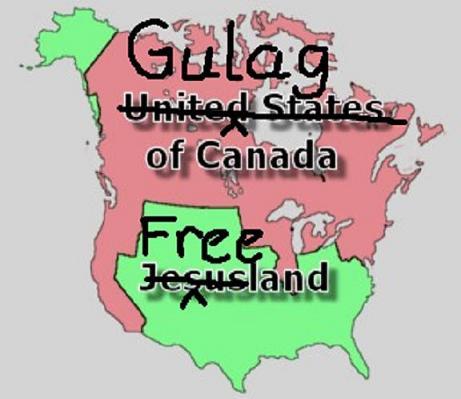
Pejman Yousefzadeh, writing at Tech Central Station, has a roundup of post-election reaction from the Left. I especially like the idea of Blue-State secession (though its proponents should check out Texas v. White). The secessionists would like to join their ideologically compatible neighbour to the north, with this result (my editing):

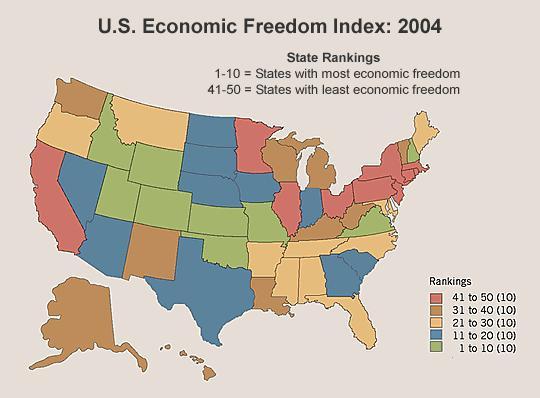
P.S. Note the correlation between “Freeland” and States with the best scores on the index of economic freedom (green, blue, and tan in the chart below):

(Thanks to Let’s Try Freedom for the pointer to the index.)

The Next Chief Justice?

I’ve long favored Thomas, but the Dems have signaled a preference for Scalia. In other words, if Bush were to nominate Thomas, stand by for a bruising confirmation hearing and a filibuster.

The Institute for Justice (a libertarian public-interest law firm) has a somewhat dated, but probably still accurate, assessment of the Justices’ records on individual liberties. Here’s the bottom line:


Those ratings reflect IJ’s assessment of the Justices’ stance on IJ amicus cases and other major cases, in these categories: free speech and association, limiting federal power, property rights, race neutrality, and school choice. The main difference between Thomas and Scalia seems to lie in the realm of property rights, where both Scalia and Thomas are strong on takings but Scalia is soft on forfeiture. Kennedy places ahead of Scalia for the same reason.

Scalia would be a good second choice to Thomas. Kennedy is too much the compromiser on other issues.

The Face of "Academc Freedom"


Prof. Hamid Dabashi of Columbia University.

Remember the name and face. Here’s why (from the New York Daily News):

In the world of Hamid Dabashi, supporters of Israel are “warmongers” and “Gestapo apparatchiks.”

The Jewish homeland is “nothing more than a military base for the rising predatory empire of the United States.”

It’s a capital of “thuggery” – a “ghastly state of racism and apartheid” – and it “must be dismantled.”

A voice from America’s crackpot fringe? Actually, Dabashi is a tenured professor and department chairman at Columbia University. And his views have resonated and been echoed in other areas of the university.

Columbia is at risk of becoming a poison Ivy, some critics claim, and tensions are high.

In classrooms, teach-ins, interviews and published works, dozens of academics are said to be promoting an I-hate-Israel agenda, embracing the ugliest of Arab propaganda, and teaching that Zionism is the root of all evil in the Mideast.

In three weeks of interviews, numerous students told the Daily News they face harassment, threats and ridicule merely for defending the right of Israel to survive.

And the university itself is holding investigations into the alleged intimidation.

Dabashi has achieved academic stardom: professor of Iranian studies; chairman of the Middle East and Asian languages and cultures department; past head of a panel that administers Columbia’s core curriculum.

The 53-year-old, Iranian-born scholar has said CNN should be held accountable for “war crimes” for one-sided coverage of Sept. 11, 2001. He doubts the existence of Al Qaeda and questions the role of Osama Bin Laden in the attacks.

Though Dabashi and his fellow travelers on the loony Left aren’t necessarily a majority in academia, they’re not far from its mainstream. Consider this report from The New York Times:

…[A] national survey of more than 1,000 academics, shows that Democratic professors outnumber Republicans by at least seven to one in the humanities and social sciences. That ratio is more than twice as lopsided as it was three decades ago, and it seems quite likely to keep increasing, because the younger faculty members are more consistently Democratic than the ones nearing retirement, said Daniel Klein, an associate professor of economics at Santa Clara University and a co-author of the study.

In a separate study of voter registration records, Professor Klein found a nine-to-one ratio of Democrats to Republicans on the faculties of Berkeley and Stanford. That study, which included professors from the hard sciences, engineering and professional schools as well as the humanities and social sciences, also found the ratio especially lopsided among the younger professors of assistant or associate rank: 183 Democrats versus 6 Republicans…

No surprises there.

(Thanks to Instapundit for the tip about Dabashi, and to Marginal Revolution for the pointer to the Times story.)

Today’s Entertainment Trivia

You may have heard of Efrem Zimbalist Jr. (1917 – ), who starred in two successful TV series: 77 Sunset Strip (1958-64) and The FBI (1965-74). Did you know that he is the son of concert violinist Efrem Zimbalist Sr. (1889-1985) and opera singer Alma Gluck (1884-1938). Here’s Gluck:

And here are links to RealAudio tracks of two of Gluck’s recordings:

Charpentier, Louise, “Depuis le jour” (Rec: 23 January 1913)

Rimsky-Korsakov, The Tsar’s Bride, “Liuba’s Air ” (Rec: 31 December 1913)

Assimilation

Donald Sensing (One Hand Clapping) has been writing about what may become a trend in Europe, namely, demanding that Muslim immigrants assimilate or leave:

Just a few days after prominent, conservative Dutch politician Geert Wilders demanded that Muslim immigrants either assimilate into the mainstream of Dutch culture and politics or leave the country, one of Europe’s leading liberal leaders echoed his words.

[Germany’s] Chancellor Gerhard Schröder called on Muslims to better integrate themselves into German society and warned over what he called a “conflict of cultures.”

The same article covers a 20,000-strong march in Cologne today, “to protest against the use of violence in the name of Islam.” Significantly, the march originated from both a mosque and a cathedral. The marchers “converged in the middle of the city for the event organized by the Islamic-Turkish Union with the slogan ‘Hand in Hand for Peace and Against Terror.'” As Glenn Reynolds said, “It’s a start,” hopefully toward an interfaith alliance against religious terrorism. The Muslim marchers, though, were almost exclusively Turks who hail from the most democratic and liberalized societies in the Islamic world.

There is something to be said for assimilation in America, and not just among Muslims.

The Next Big Financial Disaster

From Arnold Kling at EconLog (quoting the Wall Street Journal):

Congress and the White House produced a big, fat bailout for the most financially shaky companies, and some of those same companies are now joining the queue to dump their liabilities on the feds. Meanwhile, PBGC’s [Pension Benefit Guaranty Corporation] deficit was left to balloon, as it now has — by $12 billion with 155 company plans terminating.

Kling adds:

A friend who once did consulting for the PBGC says that its policies are completely irrational. It tells companies with overfunded pension plans that they can take every dollar of overfunding out the plans, and it tells companies with underfunded plans that it will bail them out. There is no risk-based pricing or other incentive mechanism to make companies want to maintain sound plans. He says that it makes the pre-S&L-crisis FSLIC seem well-run by comparison.

Will politicians never learn that the best way to help individuals and businesses avoid poverty and financial ruin is to make them responsible for the consequences of their own decisions? Apparently not.

Good Medical Advice

FuturePundit has a post on this topic: “Sleep a Lot to Avoid Burn-Out from Stress and to Stay Skinny.” I’ve been sleeping a lot lately, as I recover from a deeply embedded sinus infection, and it’s working for me.

Conservative Revisionism, Conservative Backlash, or Conservative Righteousness?

Cathy Young, writing from her libertarian perch at reasononline, asks “Why are conservatives trying to rehabilitate McCarthyism and the Japanese internment?” Young refers specifically to Michelle Malkin’s In Defense of Internment: The Case for “Racial Profiling” in World War II and the War on Terror and to Ann Coulter’s Treason.

I have yet to read either book (though I’ve followed the debate about Malkin’s), so I’ll defer to Young’s summary of their theses. She says of Malkin’s book:

Malkin believes our safety is being compromised because any common-sense proposal that involves profiling — be it extra-vigilant screening of Middle Eastern passengers at airports, targeted monitoring of visitors with guest visas from countries with terrorist links, or special scrutiny of Muslim chaplains in the armed forces — is shouted down by invoking the specter of internment camps.

That leads Malkin to a defense of the internment of Japanese-Americans who were living on the West Coast.

As for Coulter’s book, Young characterizes it as a

rehabilitation of Sen. Joseph McCarthy and a debunking of “the myth of ‘McCarthyism.’” McCarthy, Coulter proclaimed, was a true hero in the struggle against communism, and the only unjust persecution was that of Tail Gunner Joe himself by his left-wing, America-hating enemies.

Although she is unsympathetic (hostile, really) to Malkin and Coulter’s theses, Young seems to grasp their essential point:

Why the rush to defend what was only recently seen, across the political spectrum, as indefensible? Partly, it’s the sheer appeal and satisfaction of skewering sacred cows, liberal ones especially — and there are, God knows, so many that deserve skewering. Indeed, in the case of McCarthyism, the stubborn blindness of leftists and many liberals both to the brutality of the Soviet regime and to the extent of Soviet espionage during the Cold War undoubtedly helped create fertile ground for Coulter-style polemics.

A similar dynamic may be at work with the Japanese internment issue. Some of the history textbooks Malkin indignantly quotes probably do err on the side of dismissing all World War II-era concerns about subversive activities by Japanese ethnics as unfounded paranoia….

It is useful, too, to remember that defending the indefensible has long been a popular sport on the left, whose own revisionist historians are busy trying to sugarcoat not McCarthyism but Stalinism….

Also at work, however, is the dark side of modern American conservatism. The left’s obsession with America’s allegedly unique evilness, and in particular with real or imagined racism, has prompted a fully justified backlash. But that backlash can morph into an ugly and disturbing mind-set — one that regards all efforts to confront America’s past wrongs as the province of sissy liberals and wild-eyed lefties….

I agree with “fully justified backlash.” As for the notion that “all efforts to confront America’s past wrongs [are] the province of sissy liberals and wild-eyed lefties,” I’ll say that all efforts to blacken Americans as a benighted, racist, ravening pack of fundamentalist yahoos are, indeed, the province of liberals and lefties. Conservatives, for the most part, have done a pretty good job of confronting America’s past wrongs and moving beyond them.

On the substance of Coulter’s book, McCarthy was right, but his methods backfired and caused otherwise sensible people to conclude that the “witch hunt” was nothing more than that. From Wikipedia, here:

In 1995, when the VENONA transcripts were declassified, it was learned that regardless of the specific number, McCarthy consistently underestimated the extent of Soviet espionage. VENONA specifically references at least 349 people in the United States–including citizens, immigrants, and permanent residents–who cooperated in various ways with Soviet intelligence agencies.

It is generally believed that McCarthy had no access to VENONA intelligence, deriving his information from other sources. VENONA does confirm that some individuals investigated by McCarthy were indeed Soviet agents. For example, Mary Jane Keeney was identified by McCarthy simply as “a communist”; in fact she and her husband were both Soviet agents. Another individual named by McCarthy was Lauchlin Currie, a special assistant to President Roosevelt. He was confirmed by VENONA to be a Soviet Agent.

And here:

The VENONA documents, and the extent of their significance, were not made public until 1995. They show that the US and others were targeted in major espionage campaigns by the Soviet Union as early as 1942.

The decrypts include 349 individuals who were maintaining a covert relationship with the Soviet Union. It can be safely assumed that more than 349 agents were active, as that number is from a small sample of the total intercepted message traffic. Among those identified are Alger Hiss, believed to have been the agent “ALES”; Harry Dexter White, the second-highest official in the Treasury Department; Lauchlin Currie, a personal aide to Franklin Roosevelt; and Maurice Halperin, a section head in the Office of Strategic Services. Almost every military and diplomatic agency of any importance was compromised to some extent, including, of course, the Manhattan Project. Even today, the identities of fewer than half of the 349 agents are known with any certainty. Agents who were never identified include “Mole”, a senior Washington official who passed information on American diplomatic policy, and “Quantum”, a scientist on the Manhattan Project.

Some known spies, including Theodore Hall, were neither prosecuted nor publicly implicated, because the VENONA evidence against them could not be made public. VENONA evidence has also clarified the case of Ethel and Julius Rosenberg, making it clear that Julius was guilty of espionage while Ethel was guilty of cooperating, while also showing that their contributions to Soviet nuclear espionage were less important than was publicly alleged at the time. In fact, Ethel had been only an accomplice, and Julius’ information was probably not as valuable as that provided by sources like “Quantum” and “Pers” (both still unidentified.)

This is an extremely different picture from the one that which had developed over most of 50 years in the absence of solid evidence. While critics debate the identity of individual agents, the overall picture of infiltration is more difficult to refute. The release of the VENONA information has forced reevaluation of the Red Scare in the US….

Tell me, again, why I shouldn’t consider FDR a Soviet dupe and why McCarthy was merely a publicity-seeking loudmouth.

As for the internment (or exclusion) of Japanese-Americans, there’s this from Wikipedia:

The attack on Pearl Harbor on December 7, 1941 led many to suspect the Japanese were preparing a full-scale attack on the West Coast. Further attacks, such as the submarine shelling of a California oil refinery in 1942 redoubled these suspicions. Also, Japan’s rapid military conquest of much of Asia made their military machine seem to Americans frighteningly unstoppable. Civilian and military officials had concerns about the loyalty of the ethnic Japanese on the West Coast and considered them to be a security risk.

Critics of the exclusion argue that the military justification was unfounded, claiming that there are no cases of military espionage that were attributable to Japanese Americans. David Lowman has, however, asserted that the decryption of the MAGIC codes suggested to the military and political leaders at the time that there was a substantial spy network of Japanese Americans feeding information to the Japanese military. Lowman’s claims have been controversial with others pointing out that much of the information that the Japanese officials obtained may have come from public sources such as newspapers, and that communications by Japanese consular officials stating an attempt to recruit Japanese-Americans did not necessarily mean that those attempts were successful. However, historical revisionists who rely on Lowman’s claims point to his assertion that some of the intercepted messages specifically said that the information had come from Japanese-American spies. One captured Japanese officer who had graduated from UCLA, and spoke fluent English specifically reported attempting to cultivate contacts for such spying, as reported in a letter sent to Congressman Wallop of Wyoming by a serviceman.

Lieutentant Commander Kenneth Ringle, a naval intelligence officer tasked with evaluating the loyalty of the Japanese American population, estimated in a 1941 report to his superiors that “better than 90% of the Nisei [second generation] and 75% of the original immigrants were completely loyal to the United States.” A 1941 report prepared on President Roosevelt’s orders by Curtis B. Munson, special representative of the State Department, concluded that most Japanese nationals and “90 to 98 percent” of Japanese American citizens were loyal. He wrote: “There is no Japanese `problem’ on the Coast … There is far more danger from Communists and people of the Bridges type on the Coast than there is from Japanese.”

Historical revisionists state that approximately 20,000 Japanese-Americans in Japan at the start of the war joined the Japanese war effort, and hundreds joined the Japanese Army. They also state that Tomoya Kawakita, an American citizen who worked as an interpreter and a POW guard for the Japanese army, actively participated in the torture (and at least one death) of American soldiers, including survivors of the Bataan Death March.

In January 25, 1942 the Secretary of War reported that “on the Pacific coast not a single ship had sailed from our Pacific ports without being subsequently attacked”. Due to this, espionage was suspected.

In addition to espionage, there was also concern that in the event of an invasion there could be sabotage of both military and civilian facilities inside the United States. Military officials expressed concerns that California’s water systems were highly vulnerable, and there were concerns about the possibility of arson, brush fires in particular….

In early 1944, the government began clearing individuals to return to the West Coast; on January 2, 1945, the exclusion order was rescinded entirely. The internees then began to leave the camps to rebuild their lives at home, although the relocation camps remained open for residents who weren’t ready to make the move back. The fact that this occurred long before the Japanese surrender (see V-J day), while the war was arguably at its most vicious, weighs heavily against the claim that the relocation was an essential security measure….

However, the outcome of the war in the Pacific had ceased to be in doubt since the Battle of Midway, which

took place on June 5, 1942 [when] [t]he United States Navy defeated a Japanese attack against Midway Atoll, marking a turning point in the war in the Pacific theatre….

…The loss of four carriers stopped the expansion of the Japanese Empire in the Pacific, and put Japan on the defensive. It had been six months to the day since the attack on Pearl Harbor. Admiral Yamamoto had predicted to his superiors that Japan would prevail for only six months to a year against the United States, after which American resources would begin to overwhelm the Japanese Navy. He had been exactly correct….

Thus, by 1944, Japanese forces were in vicious retreat, a threat to Allied forces but no longer a threat to the American homeland.

War (hot or cold) is not an academic debate. It is a life-and-death struggle, conducted in the midst of great uncertainty, without a lot of second chances. It is better to act somewhat rashly than not to act at all; the enemy whose life (or feelings) you spare will rise up to stab you in the back.

Wars aren’t won by scrupulous self-doubters, they’re won by the bold and brave. I want Malkin and Coulter on my side in the heat of battle, not a bunch of liberals, lefties, and libertarian doves.

A Day to Remember

Tomorrow will bring a spate (but not a tidal wave) of reminiscences about the death of John F. Kennedy, 41 years earlier. I still remember precisely where I was when I heard that JFK had been shot, then later when I heard that he had died.

I was devastated by the assassination, for I had come to believe in the Kennedy mystique, even though I had, three years earlier (and a bit too young to vote), favored Nixon over Kennedy because I associated the Democrat Party with such evils as legal segregation, high taxes, and corrupt unionism. (How little has changed in 44 years.)

The pomp and mourning that ensued the assassination seemed, somehow, to validate my idealistic belief in the power of government to do good, and the right of government to use that power. I then fell prey to the hysteria that Barry Goldwater’s candidacy invoked, in those days of genuine fear of a nuclear holocaust and naive idealism about ending racial separation legally. It took riots in big cities, the debacle in Vietnam, and Watergate to overcome my emotional attachment to the prevailing faith that government is all-knowing, all-wise, and beneficent.

Yes, November 22, 1963, and the days that followed are seared in my memory. But they now remind me of the folly of allowing emotion to govern reason.

The Beginning of the End?

In a piece I cite here, columnist Jack Wheeler predicts that “The dark chapter of America’s peculiar institution of abortion is coming to an end.” Perhaps it is. Consider this story, from AP via Yahoo! News:

Congress Helps Providers Refuse Abortions

Sun Nov 21, 8:25 AM ET

Politics – U. S. Congress

WASHINGTON – Congress made it a little easier for hospitals, insurers and others to refuse to provide or cover abortions. A provision in a $388 billion spending bill passed by the House and Senate on Saturday would block any of the measure’s money from going to federal, state or local agencies that act against health care providers and insurers because they don’t provide abortions, make abortion referrals or cover them.

“This policy simply states that health care entities should not be forced to provide elective abortions, a practice to which a majority of health care providers object and which they will not perform as a matter of conscience,” said Rep. David Weldon, R-Fla., a doctor who sponsored the language.

Weldon said his measure was simply a refinement of decades-old restrictions against federal aid for most abortions. “This provision is meant to protect health care entities from discrimination because they choose not to provide abortion services,” he said.

But Democrats complained that the provision was slipped into the voluminous year-end spending bill without debate or discussion in the Senate or the House.

“Now any business entity can decide to tell doctors working for it they can’t give information to women about their right to choose,” said Sen. Barbara Boxer (news, bio, voting record), D-Calif.

Many clinics and other providers, in exchange for federal funds, are required to at least tell pregnant women who do not wish to have a child that abortion is among their options. Weldon’s language would make it more difficult to enforce that, opponents said.

“The Weldon amendment is essentially a domestic gag rule, restricting access to abortion counseling, referral and information,” said House Democratic leader Nancy Pelosi of California. “Health care companies should not be able to prevent doctors from giving medically necessary information.”…

Well, boo hoo, Ms. Boxer and Ms. Pelosi, but private businesses most certainly can tell their employees what constitutes acceptable, job-related speech. You may be able to say anything in the halls of Congress, but you can’t go to work for, say, an airline and expect to keep your job if you publish an article in which you advise travelers to fly with a different airline. The pending law merely nudges a traditional employer-employee relationship toward its proper state.

If a doctor doesn’t like it that his employer forbids him to discuss abortion as an option, the doctor can find an amenable employer or set up his own practice. Isn’t that the American way?

In any event, the pending law also signals another positive change. It breaks a link between federal funding and federal interference in the operations of state and local governments and businesses. It’s a small step, but it’s in the right direction.

Libertarian Name-Calling

UPDATED 11/25/04

There’s a bit of a dust-up about whether libertarians are really liberals of the original variety. Will Wilkinson at Crescat Sententia has the story:

John Phillips, a Ph.D. student in political theory at Brown, has some interesting thoughts on Samuel Freeman’s arguments that libertarians aren’t bona fide liberals.

Here’s my take: If libertarianism just is the view that the state has no legitimacy and that agents of the state have no justifiable moral permission to use their powers of coercion AND the very concept of liberalism contains (in the Kantian sense) the idea of state legitimacy and permissible coercion by state agents, well, then of course libertarianism isn’t a kind of liberalism.

But I don’t think a political conception has to deny the legitimacy of the state or permissible coercion by state agents to count as libertarian. People think that I am a libertarian because I think that the state should be very small and limited in its powers, not that I think that there should be no state, or that coercion is never justified. There are, of course, libertarians who think coercion is never justified, and so conclude that there should be no state, but that’s just the content of one conception of ‘libertarianism.’ That’s not the concept. Negative income tax Friedmanites are also libertarians. Additionally, I don’t think the connection between liberalism and state legitimacy, coercion, etc., is anything close to analytic. If there is an anarchic social order that fulfills substantive liberal ideals better than a state-based order, then that order should count as liberal.

I don’t think that a view about the conferral of legitimacy on state coercion through democratic means is a part of the substantive content of the concept of liberalism, although it is obviously a huge part of liberal conceptions such as Freeman’s. Coercive democracy, in my view, is, at best, a contingent means to liberal ends. At far less than its worst, it is inconsistent with liberal ends.

Timothy Sandefur at Freespace has an Objectivist take:

…I associate liberalism with “dynamism” as the term is used in The Future And Its Enemies, and I would define the term as referring to the political view that individuals should be liberated from the coercive restraints imposed by others, as I explained in an old post on “What is Libertarianism.”

But dividing libertarianism from liberalism is probably misleading and unhelpful, something like dividing Christians from Catholics. There are certainly non-Catholics who would regard Catholics as not real Christians, but the Catholics would hardly concur. But on the other hand, as a hardline “classical liberal,” I regard the paleoconservatives who masquerade as libertarians over at Lew Rockwell.com to be a bunch of frauds, and not real libertarians, on the grounds that a true libertarian should put individual liberty as the primary political goal, while they believe that if one person wishes to enslave another, no third man may interfere. The problem is not that they’re libertarians while we’re liberals or something like that. It’s that we libertarians are liberals, while they are really conservatives who don’t like the drug laws. (But, of course, if some foreign dictator wished to have drug laws, that would be fine with them.)

Unfortunately, “liberal” and “liberalism” have long since come to be identified with a world-view that has nothing to do with classical liberalism or libertarianism (of any stripe). It’s a statist and internally inconsistent world-view that goes something like this: I believe in individual liberty (i.e., the right to do as I please with my money and my life), but the world will be a much better place if government does certain things to restrict and even undermine freedom (e.g., ban smoking, take money from those who earn it and give money to those who don’t, force children to go to inferior schools by taxing their parents for the privilege, spend less on defense, negotiate with enemies who have amply demonstrated their bad faith).

I know that it’s de rigeur for libertarians to call themselves liberals (of the classical variety), but I will not call myself one. Given the bad connotations of “liberal” and “liberalism” , I’d rather call myself a “misogynistic homophobe” or a “tree-hugging enviro-nut” — neither of which am I.

UPDATE:

Wilkinson has more to say:

I want to clarify that the post below [quoted above: ED] on the question, Are Libertarians Liberals?, was a spontaneous riff off what John Phillips was saying, and not a considered response to the Samuel Freeman paper John was thinking about. John’s post conjured a phantom interlocuter who I decided to argue against. Now that I’ve looked again at the Freeman essay (“Illiberal Libertarians” in Philosophy & Public Affairs 30, no. 2), I see that most of what I said doesn’t apply to Freeman’s particular argument. Freeman reserves the label ‘libertarian’ for natural rights anarchists and minimal statists such as Nozick, Rothbard, and Rand. He labels Hayek, Buchanan, and Friedman as ‘classical liberals.’ And classical liberals, along with Freeman’s ‘high liberals’, are naturally enough kinds of liberals. He’s arguing, among other things, that natural rights anarchists and minarchists have no room for an account of legislative authority or political legitimacy, which he takes to be necessary conditions of liberalism.

I’ll say more about Freeman’s very interesting (and long!) paper later. But for now let me say I think there is (a) some tendentiousness or at least arbitrariness in the way Freeman decides to characterize the nature of liberalism, (b) perhaps room for legislative authority for some natural rights minimal statists, (c) more complexity in the minarchist’s notion of contracting and the adjudicatory function of state courts than Freeman makes it out, which may solve most of the problems he thinks you get without legislative authority, and (d) confusion in the way he attempts to apply the idea of the “political” to anarchists.

In any case, in Freeman’s terms, I am a classical liberal, not a libertarian, my current views being a frothy stew of Hayek, Buchanan, Coase, Schelling, Rawls, Gauthier, Vernon Smith, and Douglass North. But in the vernacular that just makes me a libertarian.

Me too.

“Natural rights anarchists” and “minarchists” should call themselves just that. As the saying goes, liberty isn’t anarchy. Therefore, anarchism isn’t libertarianism.

UPDATE:

Tom W. Bell at Agoraphilia has a somewhat different take:

…I will not…agree to let [leftists] appropriate “liberal.” The derivation and near-universal meaning of that word—in nearly every time and place except contemporary, casual U.S. speech—reserves “liberal” for people who regard liberty as a paramount value. Leftists, because they disparage economic freedom and property rights, manifestly do not.

We have very accurate and fair labels for people who think that civil liberties exist independent of and merit more respect than economic liberties. We can call those people “leftist” or “left-wing.” Moreover, we should not call them “liberal,” a term that they neither deserve nor that they always welcome.

I am not sure that true liberals will ever be able to reclaim their rightful name. At a minimum, though, they can and should deny the term to illiberals. It would represent a great step forward if, when someone in the U.S. used “liberal,” they had immediately to address the question, “Do you mean ‘left-wing’ or do you mean ‘libertarian’?” We should thus aim, at least at first, to cast “liberal” into a linguistic no-man’s-land. Reconquering that lost semantic territory can come later….

“Liberal” and “liberalism” are beyond salvation. From now on, I’ll stick with “leftist” and “the left” when I refer to regressives and their agenda. That includes so-called moderate Democrats, who have revealed their disdain for liberty by belonging to the party of Social Security, Medicare, unionism, and affirmative action.

Europe, Take Note

From Robert Kagan’s “The Crisis of Legitimacy: America and the World“:

…The great transatlantic debate over Iraq was rooted in deep disagreement over world order. Yes, Americans and Europeans debated whether Saddam Hussein posed a serious threat and whether war was the right way to deal with it. A solid majority of Americans answered yes to both questions, while even larger majorities of Europeans answered no. Yet these disagreements reflected more than just differing tactical and analytical assessments of the situation in Iraq . As Dominique de Villepin, France ‘s foreign minister, put it, the struggle was less about Iraq than it was between “two visions of the world.” The differences over Iraq were not only about policy. They were also about first principles.

Opinion polls taken before, during, and after the war show two peoples living on separate strategic and ideological planets. Whereas more than 80 percent of Americans believe that war can sometimes achieve justice, less than half of Europeans agree. Americans and Europeans disagree about the role of international law and international institutions and about the nebulous but critical question of what confers legitimacy on international action. These diverging world views predate the Iraq war and the presidency of George W. Bush, although both may have deepened and hardened the transatlantic rift into an enduring feature of the international landscape.

At the beginning of 2003, before the Iraq war, the transatlantic gulf was plainly visible. What was less clear then was how significant it would turn out to be for the world as a whole.

Today, a great philosophical schism has opened within the West, and mutual antagonism threatens to debilitate both sides of the transatlantic community. At a time when new dangers and crises are proliferating rapidly, this schism could have serious consequences. For Europe and the United States to come apart strategically is bad enough. But what if their differences over world order infect the rest of what we have known as the liberal West? Will the West still be the West?

A few years ago, such questions were unthinkable. After the Cold War, the political theorist Francis Fukuyama assumed along with the rest of us that at the end of history the world’s liberal democracies would live in relative harmony. Because they share liberal principles, these democracies would “have no grounds on which to contest each other’s legitimacy.” Conflicts might divide the West from the rest, but not the West itself. That reasonable assumption has now been thrown into doubt, for it is precisely the question of legitimacy that divides Americans and Europeans today — not the legitimacy of each other’s political institutions, perhaps, but the legitimacy of their respective visions of world order. More to the point, for the first time since World War II, a majority of Europeans has come to doubt the legitimacy of U.S. power and of U.S. global leadership….

…To address today’s global dangers, Americans will need the legitimacy that Europe can provide, but Europeans may well fail to grant it. In their effort to constrain the superpower, they might lose sight of the mounting dangers in the world, which are far greater than those posed by the United States. Out of nervousness about unipolarity, they might underestimate the dangers of a multipolar system in which nonliberal and nondemocratic powers would come to outweigh Europe. Out of passion for the international legal order, they might forget the other liberal principles that have made postmodern Europe what it is today. Europeans might succeed in debilitating the United States this way. But since they have no intention of supplementing its power with their own, in doing so they would only succeed in weakening the overall power that the liberal democratic world can wield in its defense — and in defense of liberalism itself.

Right now, many Europeans are betting that the risks posed by the “axis of evil,” from terrorism to tyrants, will never be as great as the risk posed by the American leviathan unbound. Perhaps it is in the nature of a postmodern Europe to make such a judgment. But now may be the time for the wisest heads in Europe, including those living in the birthplace of Pascal, to ask themselves what will result if that wager proves wrong.

Europeans should reflect on this simple fact: The enemy of Europe’s rival isn’t Europe’s friend.

John Kerry: Ingrate

In spite of Osama bin Laden’s ringing, last-minute endorsement, “Kerry blames bin Laden for defeat.” The Washington Times story continues:

Sen. John Kerry believes the videotape of Osama bin Laden that appeared days before the Nov. 2 election cost him the presidency, Fox News reported yesterday.

The Massachusetts Democrat told Fox News the tape first aired by Arab television network Al Jazeera may have scared the American electorate.

Mr. Kerry said the tape was released too late for his camp to rebut and the Democratic campaign couldn’t counteract it in time for the election.

Yeah, the tape scared the American electorate all right. It’s pretty scary when our main enemy quotes Michael Moore — the darling of the Democrat convention. That was enough to scare a lot more Republicans into the voting booth.

So what was Kerry going to rebut, the bit where bin Laden said he would attack only the Red States? I guess Kerry could have offered to substitute New York for Texas, but then he would have lost New York without gaining Texas. I mean, those Red-Staters just piled up the Bush votes when they heard about that threat from bin Laden. Come to think of it, I imagine those Blue-Staters piled up the Kerry votes when they heard about the threat.

So much for nasty, post-election gloating. I’ll stop now (maybe).

Social Security — Myth and Reality

Not only is Social Security unconstitutional, but — as I said here — “Social Security is merely a transfer-payment Ponzi scheme that’s going to begin claiming victims in about 14 years, when benefits begin to outrun taxes. ”

What about the Social Security trust fund, which is supposed to last another 38 years? As I pointed out here, the trust fund is mythical. I quoted two members of the President’s Commission to Strengthen Social Security — Olivia S. Mitchell, a Democrat, and Thomas R. Saving, a Republican — who reiterated the commission’s view of the trust fund in a July 2001 Washington Post op-ed piece:

…When Social Security ran annual surpluses in the past, it enabled other parts of government to spend more. The trust fund measures how much the government has borrowed from Social Security over the years, just as your credit card balance indicates how much you have borrowed. The only way to get the money to pay off your credit balance is to earn more, spend less or take out a loan. Likewise, the only way for the government to redeem trust fund IOUs is to raise taxes, cut spending or borrow….

We are surprised that this perspective on the trust fund is controversial. The commission’s interim report quotes credible sources — the Congressional Budget Office, the General Accounting Office and the Congressional Research Service — supporting the view that the trust fund is an asset to Social Security but a liability to the rest of the government. The Clinton administration’s fiscal year 2000 budget indicated a similar perspective:

“These [trust fund] balances are available to finance future benefit payments and other Trust Fund expenditures — but only in a bookkeeping sense. . . . They do not consist of real economic assets that can be drawn down in the future to fund benefits. Instead, they are claims on the Treasury that, when redeemed, will have to be financed by raising taxes, borrowing from the public, or reducing benefits or other expenditures. The existence of large Trust Fund balances, therefore, does not, by itself, have any impact on the Government’s ability to pay benefits.”…

[T]he nation has only three ways to redeem trust fund bonds: raising taxes, cutting spending or increasing government borrowing. If there is some alternative source of funds, no one has yet suggested it….

Nevertheless, the trust fund has some true believers, among them Paul Krugman, who in July 2001 made this effort to rebut the commission’s position:

The Social Security system has been running surpluses since 1983, when the payroll tax was increased in order to build up a trust fund out of which future benefits could be paid. These surpluses could have been invested in stocks or corporate bonds, but it seemed safer and less problematic to buy U.S. government debt instead. The system now has $1.2 trillion in its rapidly growing trust fund. But the commission says that the government bonds in that trust fund aren’t real assets….

Every dollar that the Social Security system puts in government bonds — as opposed to investing in other assets, such as corporate bonds — is a dollar that the federal government doesn’t have to borrow from other sources. If the Social Security trust fund hadn’t used its accumulated surpluses to buy $1.2 trillion in government bonds, the government would have had to borrow those funds elsewhere. And instead of crediting the trust fund with $65 billion in interest this year, the government would have had to cough up at least that much extra in actual, cash interest payments to private bondholders. So the trust fund makes a real contribution to the federal budget. Doesn’t that make it a real asset?…

No. Here’s why: As Krugman admits, the government didn’t invest Social Security surpluses in stocks and corporate bonds, it squandered the surpluses. Did the surpluses enable the government to borrow less from other sources, or did the surpluses simply enable the government to spend more money without raising taxes from other sources? We’ll never know, but I suspect the latter; that is, the surpluses simply fed Washington’s big-spending addiction. No matter how you slice it, the government didn’t invest in real assets. Ergo, the trust fund is nothing more than a big IOU.

To come at it another way, consider the following thought experiment: Suppose the government is collecting $700 billion in Social Security taxes and spending $500 billion of that on benefits and program administration. Suppose, further, that Social Security is the government’s only program; it collects no other taxes and has no other outlays. The government can do four things with its $200 billion surplus:

  • simply make a bookkeeping entry to record the surplus (without doing anything else)
  • increase benefits by $200 billion
  • cut taxes by $200 billion
  • invest the $200 billion in real assets (e.g., stocks and corporate bonds)

What are economic effects of the four policy options?

Making a bookkeeping entry — and doing nothing else — would mean that the government has chosen to increase taxes without increasing spending by the same amount. That would soon lead to a reduction in national income and employment; in the longer run it would reduce economic growth by reducing the flow of saving that underwrites capital investment.

Increasing benefits (spending the surplus) would — in the short run — leave the economy roughly in the status quo, with some shifts in the level of consumption and saving because of the redistribution of income from workers to retirees. But the economy would suffer in the longer run because future retirees would expect — and probably get — the same higher benefits as their predecessors. Because the retiree-to-worker ratio is rising, the average future worker would face a higher tax burden, thus reducing incentives to work and invest.

Cutting taxes to the level of benefits would boost the economy in the short run, by increasing incentives to work and invest. But actuarial reality would set in, as the retiree-to-worker ratio rises, and the average future worker would face a higher tax burden, thus reducing incentives to work and invest.

Investing in real assets would shift resources from consumption to investment — for as long as there are surpluses — with beneficial long-run economic effects and roughly neutral short-run effects. However, even with real assets, the trust fund would someday be exhausted without imposing some combination of tax increases and benefit reductions (including further increases in the retirement age). Then, we’d be right back where we started.

Here’s the bottom line: The trust fund is mythical and cannot be salvaged. Social Security is a drag on the economy, no matter how it’s packaged. Complete privatization (i.e., abolition) of Social Security is the only economically sensible option:

  • It would increase incentives to work and invest, thus boosting employment in the short run and economic growth in the long run.
  • Armed with greater prosperity, we could do a better job (privately and publicly) of helping the aged, their survivors, and the disabled who are truly in need.

But that’s an economic perspective which won’t survive political scrutiny (not yet, anyway).

Perhaps the easiest way, politically, to “fix” Social Security would be to allow benefits to slide gradually to a level that can be supported by the current tax formula. Additionally, the benefit formula might be skewed even further in favor of low-income workers. Given ample notice, higher-income workers would increase their rate of saving, thus underwriting beneficial, growth-generating capital investments.

Call it partial, back-door privatization. But it would be better than the more likely alternative, which is to transfer an ever-larger chunk of the economy from those who produce to those who don’t. There’s a formula for economic disaster.

Too Rational for My Taste

Sometimes the “rationality” of the “marginal” mindset drives me a bit nuts. Glen Whitman, an assistant professor of economics and a co-blogger at Agoraphila, wrote this:

When I return to my car in a parking lot, I’ll often find advertisements, flyers, brochures, etc., stuck underneath the windshield wipers. The latest was an ad for Billy Graham’s upcoming performances in the L.A. area. As an individual car owner, what policy should I follow for these unsolicited pieces of trash? In general, I’m not a litterbug; I think people should clean up after themselves and keep public areas clean. But in this case, I make an exception. I refuse to bring the unwanted material into my vehicle, so I immediately throw it on the ground of the parking lot.

I believe my policy is the correct one. If parking lot owners don’t like the litter, they can (a) police their lots to stop the offenders, or (b) collect the litter and track down the perpetrators – after all, their locations and phone numbers are usually written right there.

Litter is litter. So I posted this comment:

Do you leave your shopping cart in a parking space or — even worse — in a traffic lane? Do you fail to stop at the stop sign or traffic light on the way out of the parking lot? I just want to know where you draw the line between littering as a form of “speech”, discourtesy, and risking the lives of others. Observation leads me to believe that there’s a high correlation between self-indulgence, discourtesy, and recklessness. It may be libertine, but it’s not libertarian.

Chalk it up to Irritable Male Syndrome, exacerbated by a raging sinus infection.

Flooding the Moral Low Ground

A few posts ago I observed that “pro-abortion extremists have captured the moral low ground in the battle over abortion rights,” after opining that “animals are more important than human fetuses” to the Left. But the Left’s moral decay is evident in other ways.

The Left caricatures black Republicans — that is blacks who choose not align themselves unthinkingly with the party of liberal condescension — as something like “Aunt Jemimas” and “Uncle Toms”.

The Left views non-Western cultures as incapable of embracing democracy. Yet, the Left is incapable of accepting a democratic outcome in the United States, preferring instead to think of the majority as religious fanatics, cretins, and “Hitlers”.

The Left would abandon the Middle East to Osama bin Laden and other terrorist thugs, all the while complaining about the high price of oil. One wonders where the Left will stand when we face down (or take down) Syria, Iran, and North Korea.

The Left claims to “support the troops” but shows it by spitting on them, just as it shows its true disdain for democracy by its thuggish behavior at political events.

The affluent Left (that is, much of it) shows its arrogance toward “inferiors” by opposing school vouchers and the privatization of Social Security, because the “masses” must be told how to mange their own affairs.

The Left profits from free-market capitalism — then spends some of the profits to promote “enlightened” government regulation of those same markets.

The list could go on and on. But the moral bankruptcy of the Left has become so evident — outside the media, academia, and other Leftish circles — that it’s only a matter of time before the political tide turns against the Left — and rolls over it.

Is It Time to Abolish the Electoral College?

Bush won 30 States and 271 electoral votes in 2000, while winning a minority of the two-party popular vote. For that fact, Republicans have been blessing the Electoral College.

Although Bush did better in 2004 — winning 31 States and 286 electoral votes — Republicans can see how Bush might nevertheless have lost, even while “winning” by more than 3 million popular votes. Kerry could have walked off with an electoral-vote victory simply (?) by rolling up another few hundred thousand popular votes in the right places: Ohio, by itself, or Colorado, Iowa, and New Mexico, altogether.

In sum, Kerry came fairly close to trumping Bush’s feat of four years earlier. But before Republicans panic and jump on the bandwagon to abolish the Electoral College, they should consider two reasons for keeping it.

The most obvious, and oft-cited, reason is that the existence of the College narrows the scope for decisive electoral fraud to those “battleground” States whose electoral votes might tip the balance in a close election. Deciding presidential elections by the popular-vote count is an invitation to fraud in every precinct in the land.

A less obvious, but — to me — equally compelling reason is that the abolition of the College would encourage more voters to vote. Think of all those abstaining Republicans in places like Massachusetts and New York and all those abstaining Democrats in places like Texas and Utah. Why do they abstain? Because they know that their votes won’t make a difference. Many of the abstainers would vote if they thought their votes might affect the outcome. But the act of voting might also lead them to expect something in return from the federal government: prayer in public schools, less gun control, more gun control, a ban on gay marriage, support of gay marriage, and on and on. In other words, they would swell the ranks of those who have a stake in the centralization of political power. That’s the last thing we need.

Contain electoral fraud, contain mobocracy — retain the Electoral College.