As I Was Saying

UPDATED TWICE

Ryan Sager, writing at Tech Central Station says, “Libertarians need to get serious about foreign policy.” Sager goes on to say:

Libertarianism, in and of itself, does not in any way limit its adherents to a minimalist approach to foreign policy — i.e. using the least amount of force possible to respond only to the most imminent of threats.

Check out Sager’s piece. While you’re at it, take at look at something I wrote, in the same vein, back in June.

UPDATE (11/19/04):

Here’s everything I’ve written on the subject of libertarianism and defense:

Libertarian Nay-Saying on Foreign and Defense Policy

Libertarian Nay-Saying on Foreign and Defense Policy, Revisited

Libertarianism and Pre-emptive War: Part I

Right On! For Libertarian Hawks Only

Understanding Libertarian Hawks

More about Neolibertarianism

More about Libertarian Hawks and Doves

Defense, Anarcho-Capitalist Style

UPDATE (11/25/04):

Maxwell Borders ( Jujitsui Generis), responding to a critique by Justin Logan of Sager’s piece, says:

…The burden of proof is not on Ryan Sager to show why he thinks one nation is justified in invading another. The burden of proof is on Justin Logan to show why any nation should not do what it perceives to be in its interests….

Amen.

Roadrunner vs. Coyote

James Lileks, today:

Who is the Road Runner, anyway? An idiot bird blessed with speed, he personifies not ingenuity but luck. You can’t tell me that he somehow figured out how to avoid triggering the Coyote’s various traps. If anything, he didn’t set them off because he was light and / or fast…

In an alternate universe there is one Road Runner cartoon, because at the end the Coyote brought him down with a revolver at 30 paces, and roasted his meat for a light midafternoon snack. It would be a less amusing universe, but perhaps one more just. That said, I’ll take this one….

Me, I’ve always rooted for the Coyote to inflict enough damage to erase Roadrunner’s smug smile, but not enough to end the series.

Handicapping National Politics

Catherine Seipp says:

One of the election lessons for Democrats is that while the Left doesn’t understand the Right, the Right can’t help but understand the Left, because the Left is in charge of pop culture. Urban blue staters can go their entire lives happily innocent of the world of church socials and duck hunting and Boy Scout meetings, but small-town red staters are exposed to big-city blue-state values every time they turn on the TV.

Not only that, but the Left is mainly in charge of the news — though talk radio manages to apply some corrective spin.

In spite of the Left’s dominance of pop culture and the news media, Red manages to eke out victories over Blue. Amazing.

A Victory of Sorts

AP reports, via Yahoo! News:

The Illinois Supreme Court threw out two lawsuits accusing gunmakers of knowingly letting weapons fall into the hands of gang members and other criminals, ruling Thursday that the manufacturers cannot legally be blamed for street violence.

Both rulings were unanimous, but five of the seven justices were so disturbed by allegations raised in the case that they wrote a separate opinion urging the Legislature to create tougher gun regulations….

Chicago’s lawsuit cited a sting in which undercover officers bought guns at suburban shops even after plainly telling the sellers that they were gang members, buying them for gang members, or taking them to Chicago, where handguns are banned.

“Allegations about defendants’ conduct, if true, suggest that defendants were not only aware that their products were used by third parties for criminal acts, but the defendants affirmatively sought to increase their profit by pandering to that market,” the five justices said in their concurring, separate opinion…

Okay, gun manufacturers have no liability for crimes committed with guns. That’s the good news.

But why can’t gun sellers be charged with criminal conduct for knowingly selling guns that will be used for criminal purposes? Seems simple to me. What’s the catch?

Good Advice for Libertarians

Read this piece by Max Borders at Tech Central Station.

And this post at Borders’s blog, Jujitsui Generis.

PETA, NARAL, and Roe v. Wade

Hypothesis: Members of PETA tend to hold NARAL-like views about abortion. If that’s true, then those who profess to abhor almost any harm to animals — even if the harm feeds humans or benefits medical science — also tend to favor an almost-unbridled (perhaps totally unbridled) right to kill a living human fetus. In other words, I suspect that animals are more important than human fetuses in world of the fashionably left, as epitomized by PETA.

All of which is another way of saying that pro-abortion extremists have captured the moral low ground in the battle over abortion rights. As Jack Wheeler explains, in a piece at WorldNetDaily about “The beginning of the end of abortion“,

…Confederate Southerners held many decent values – but on slavery they were morally wrong. No relativistic morals here, no “that’s just your opinion” situational ethics, no wiggles, hesitations or qualifiers. Slavery is immoral, period – even the LibDems agree.

Thus the teachable moment – for abortion is morally no different than slavery, the claim that one human being may own another as personal property to be disposed of if the owner so chooses.

Thus we need to refer to abortion as “the peculiar institution,” and Roe v. Wade as disgracefully unconstitutional as Dred Scott. Watch for this to happen. Watch for abortion advocates to be increasingly on the defensive as they are made to understand the moral equivalence between abortion and slavery….

If you’re wondering how a libertarian can be against abortion, read here, here, and here.

How About Mandatory Corporal Punishment?

I have written before about mandatory mental screening, which still looms as a threat to replace parenting with something like state-sponsored thought control. Here’s the issue, according to a report at NewsMax:

By way of background: in April 2002, President George W. Bush created the New Freedom Commission on Mental Health. Its objective was to enhance mental health services to those in need.

Among other things, the commission concluded that there is a need to search for mental disorders – especially in children – and the best way to do this was with mandatory mental health screening for everyone, starting with preschoolers.

According to the Commission’s 2003 report: “Quality screening and early intervention should occur in readily accessible, low-stigma settings, such as primary health care facilities and schools.”

The report goes on to say: “…the extent, severity, and far-reaching consequences make it imperative that our Nation adopt a comprehensive, systemic approach to improving the mental health status of children.”

However, critics of the plan suggest that the random testing of millions of people makes little sense to anyone but the drug companies that will stand to profit from the potential customers.

The New Freedom Commission’s proposed treatment programs are based on the Texas Medication Algorithm Project (TMAP). TMAP, which was first used in Texas in 1996 and has since expanded to other states, is a set of very specific medication recommendations – most of them new, expensive, psychotropic drugs.

Despite the criticisms, the White House has remained solid behind the testing initiative, noting that the commission found that schools are in a “key position” to influence the phenomena of young children being “expelled from preschools and childcare facilities for severely disruptive behaviors and emotional disorders.”

But detractors are just as adamant that “problem” children in schools are readily identifiable, making the universal testing an unnecessary tool that does nothing but infringe on a parent’s right to make decisions regarding their child’s welfare.

Yes, and what many “problem” children need is a good swat or two, not a pill. Simplistic? Somewhat, perhaps, but there were far fewer problem children (and problem adults) in the days when giving a kid good swat or two wouldn’t land the swatter in jail.

(Thanks to my daugher-in-law for the tip.)

Debasing the Language

USA Today quotes that deep thinker of the Left, Linda Ronstadt:

“People don’t realize that by voting Republican, they voted against themselves,” she says. Of Iraq in particular, she adds, “I worry that some people are entertained by the idea of this war. They don’t know anything about the Iraqis, but they’re angry and frustrated in their own lives. It’s like Germany, before Hitler took over. The economy was bad and people felt kicked around. They looked for a scapegoat. Now we’ve got a new bunch of Hitlers.”

A “new bunch of Hitlers” — what a thought! Next thing you know kids will be marching off to Bush Youth camps; Bush’s Brown Shirts will invade Hollywood and hang everyone — er, every liberal — in sight; and Ronstadt will be sent to a “rest home” for a nice, hot shower. Now, that’s Hitlerian, Linda. Get your terms straight.

The Case for Devolved Government

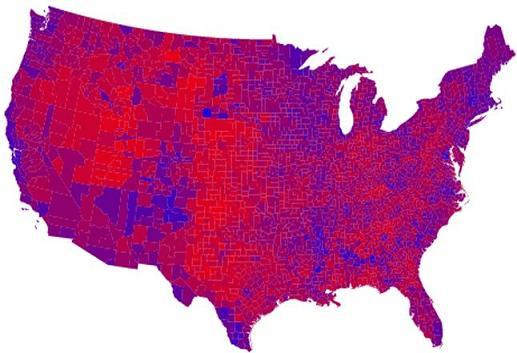
Libertarian purists argue that government should have almost no power. Libertarian pragmatists argue that government power should be devolved to the lowest practical level. The pragmatists case is the better one, given that the urge to regulate social and economic practices is especially strong where people (and votes) are concentrated. Consider the following graphics:


Shades of purple indicate the spectrum of election preferences within counties. The deeper the shade of purple the higher the proportion of votes cast for Kerry.


Counties shaded pink, red, and purple have the highest population density.

Comes as no surprise does it? Nor does it matter if the urban-rural split reflects a difference in “values” or traditions. A fact is a fact. City dwellers prefer more government because they “need” more; country folk feel less “need” for government because they don’t rub up against each other as much as city dwellers.

Thus the ultimate argument for devolution: Push government functions to the lowest practical level and allow citizens to express their preferences by voting with their feet.

(Thanks to Patrick Cox at Tech Central Station for the maps.)

Defining Liberalism

John Gray, in a rather unfocused review of Mark Garnett’s The Snake That Swallowed Its Tail, asserts that

even though we are all liberal, there is no agreement about what liberalism means. Some people will tell you that the core liberal value is personal liberty, but others insist it is equality. Some say that liberal values require multiculturalism, while others believe they demand a common culture based on personal autonomy. For some, liberalism is a strictly political theory that applies only to the structure of the state. For others, it is a whole way of life.

These are not just minor differences. They extend to the basic concepts of liberalism itself and to the underlying philosophical beliefs in line with which they are interpreted. If some liberals see freedom as mere absence of interference, others view it as a positive ability to act. For some liberal thinkers, justice requires protecting private property; for others, it means redistribution….

A person who cannot see the difference between process and outcome has no business reviewing a book about political philosophy. He needs a massive injection of Hayek — stat!

Round Up the Usual Balderdash

This is front-page news in my local rag:

It will be 50 years before the pay of women matches that of men, and another century will pass before women make up half the U.S. Congress, a report released Tuesday by an independent research organization predicted.

And it might never happen, but so what? Suppose that women, on the whole, choose not to pursue education, careers, and political power to the same degree as men. In spite of feminist cant, it is honorable, productive, and civilizing to make a home and raise children. Moreover, the tendency of women to avoid competitive occupations may arise from inherent gender differences, perhaps of hormonal origin.

Making History

And I thought it was all about lying under oath in a federal case about sexual harassment:

Clinton Library Exhibits Include Scandals

By DAVID HAMMER, Associated Press Writer

LITTLE ROCK, Ark. – Bill Clinton (news – web sites)’s presidential library, opening Thursday, covers Whitewater and Monica Lewinsky in a single display that portrays the White House scandals as a “fight for power” and an exercise in the “politics of persecution.”

“We had to show this was a systematic attempt by Republican leaders to de-legitimize Bill Clinton and the administration,” said former Clinton adviser Bruce Lindsey, who worked with the ex-president through much of the exhibit-design process.

Do you suppose Karl Rove planted Paula Jones and Monica Lewinsky — and let nature take its course?

Reality-Based Blogging?

Many left-wing blogs — especially those of the virulently anti-Bush variety (but I repeat myself) — took to calling themselves “reality based.” Now comes the dawn, sort of. Here’s Pandragon:

[W]e need to get real. I can’t tell you how optimistic I was going into this election, though, looking back, there doesn’t seem to have been a reason for quite such a sunny view. But I, like most of us, fell for the echo chamber. Daily Kos, MyDD, Steve Soto, Pandagon, and all the other blogs are run by good people with positive intentions, but if they’re you’re primary source for information, you’re outlook is perverted by an overwhelming amount of good news and a general disdain for the factual accuracy of bad news. It perverts your perspective and, because the sample group is so totally different than most of America, it begins to twist your political predictions and assumptions of what works….

But he doesn’t really “get it”:

…We didn’t lose this [because] of terror or Iraq or the economy, we lost it on values and wedge issue shit. In the end, Rove was right to spend years playing to his base, and we were wrong to go after the center….

So, the left (at least this particular segment of the left) wants the Democrat Party to win by going further to the left. Somehow, I don’t think that’ll work. Nor do I think that Bill Clinton — who is the closest thing the Democrats have to a leader — will allow it to happen.

So much for reality-based blogging.

UPDATE:

Oh, I just found some. But it wasn’t on the left. Here’s Gerard Vanderluen, quoting his own post of July 29, 2004:

There are millions and millions of citizens who are registered as Democrats and who talk the Democrat talk but do not always walk the Democrat walk when push comes to shove. You might be in a union — Trade, Government, Teachers, etc. — that could harm you if you announced for Bush. You might be in a family with deep Democratic roots. You might be a member of a minority in which you would be ostracised if you confessed you would vote for Bush. You might be of a sexual persuasion where you’re chances of dates would be severely curtailed if you said you were voting for Bush. You might be working in an office or in a career where you chances for advancement might be crippled if you voted for Bush. You might be at a school where even your grades would be impacted if you said you were voting for Bush.

In short there are hundreds of situations in which millions of people find themselves where a declared preference for Bush would not be a wise thing to announce. Much better to simply nod vaguely and stay out of the way of any negative consequences. The idea that everybody is going to vote the way they say they will is very oversold, particularly by the media or the pollsters who have a vested interest in declaring the race “tight.” The “stealth vote” is especially relevant in an election where the single most pressing question that will come into a voter’s mind after the curtains close behind him or her and they stand ready to vote is: “What’s it going to be? Issue X, Y, Z, or my life?”

Sensible people, no matter what they may or may not say, choose life. And sensible people know that that is what this election is about.

Now, that’s much closer to reality than anything I’ve seen from the left today.

Absolute Rubbish

spiked announces that it is

kickstarting a major debate on the aftermath of the US election – exploring its impact in America and internationally, on everything from war and peace to science and environmentalism.

The first installment (same link) includes this bit of sneering nonsense, among others of its ilk:

Norman Levitt

A glance at the electoral map tells the essential story. America is a deeply fissured society. The post-Second World War ‘Era of Good Feeling’, with its universal consensus that one was singularly lucky to be living in the USA, has disintegrated. Two cultures glare balefully at each other with an antagonism that goes far beyond party politics. Ironically, the events of 9/11 and their sequel have catalysed, rather than retarded, the hardening of mutual distrust into mutual detestation.

The two factions might usefully be called ‘Nativist’ and ‘Cosmopolitan’. The former – Bush country on your map – is fiercely nostalgic for a perhaps imaginary nineteenth-century ethos. It is undereducated, superstitious, saturated with religious zeal, puritanical, chauvinist, xenophobic, and easily seduced by platitudes into supporting the very politicians who, in reality, bleed its people white. The latter – Kerry country – is reasonably well-read, articulate, analytical, sceptical of religion and other blind enthusiasms, tolerant of cultural difference and individual eccentricity, and sensitive to the fact that there is a real world beyond America’s borders.

The apparent re-election of the half-wit favorite son of the Nativists obviously deepens the gloom of the Cosmopolitans (but even a Kerry victory wouldn’t have effaced it). An unprecedented number of Americans now daydream, at least, about the possibility of living somewhere else, somewhere where Yahoos don’t abound. The scientific community is especially alienated.

America’s vaunted prosperity is now threatened by decay – not mere numinous psychological malaise, but concrete, physical degradation of infrastructure, concomitant with the paralysis of American society’s ability to renew and innovate on an appropriate scale. Europe, all in all, is a much more hopeful place. One wonders, then, whether a reverse brain-drain might eventually develop, with American scientists and intellectuals migrating, in serious numbers, eastward across the Atlantic, leaving the Nativist barbarians to deal with the growing mess.

Norman Levitt is professor of mathematics at Rutgers University and author of Prometheus Bedeviled: Science and the Contradictions of Contemporary Culture.

So, I am a Red-State “nativist,” am I? Mmmm…not a bad description, except for the fact that I’m not undereducated, superstitious, saturated with religious zeal, puritanical, chauvinist, xenophobic, and easily seduced by platitudes. In fact, I’m a “Cosmopolitan”: well-read, articulate, analytical, skeptical of religion and other blind enthusiasms, tolerant of cultural difference and individual eccentricity, and sensitive to the fact that there is a real world beyond America’s borders. That’s why I — and many, many others like me who also supported Bush’s re-election — detest (yes “detest”) the shallowness of Levitt and his like. Blinded by their hatred of those who simply refuse to accept the superiority of their judgments and values, they resort to childish name-calling.

I believe what I believe — about the robustness of America’s political system and economy (freighted as they are by taxation, regulation, and agenda-ridden science), the essential corruptness of most foreign regimes, and the wisdom of an aggressive defense posture — precisely because I am well-read, articulate, analytical, tolerant (but not a dupe to political correctness), and knowledgeably realistic about the world beyond America’s borders.

Levitt and his like simply cannot abide the fact that are many, many more like me who have the gall — the very gall — to think instead of mindlessly swallowing and regurgitating their proscribed vision of collectivist anti-Americanism. They huddle in mutually reinforcing packs, stoking their egos and flaunting their imaginary superiority, but lacking the curiosity and imagination to understand anything that doesn’t conform to their vision. They epitomize

…the idiot who praises, with enthusiastic tone,
All centuries but this, and every country but his own….
[Gilbert & Sullivan, The Mikado]

Norman, you’ve got it wrong when you accuse me and my intellectual allies of nostalgia “for a perhaps imaginary nineteenth-century ethos.” We’re not nostalgic for anything but a return to something America once had but has lost because of left-wing Yahoos like you: the greater measure of economic and political liberty that made America a place its citizens would rush to defend. Only, this time, we want that economic and political liberty for all Americans.

Re-Fighting the Civil War

In “Still More Trouble for the Lincoln Cartel,” Thomas J. DiLorenzo reviews Born Fighting: How the Scots-Irish Shaped America, by former U.S. Navy Secretary James Webb; and The Fate of Their Country: Politicians, Slavery Extension, and the Coming of the Civil War, by University of Virginia historian Michael F. Holt. DiLorenzo’s review amounts to another salvo at what he calls the “Lincoln Cartel”:

In my [DiLorenzo’s] LRC [LewRockwell.com] article, “More Trouble for the Lincoln Cartel,” I noted how such court historians as James McPherson, and court semanticists like Harry Jaffa, have fabricated an “Official History” of the War to Prevent Southern Independence that is often sharply at odds with historical reality. These self-appointed gatekeepers of America’s Official State History do all they can to censor competing views within academe, but their influence is rapidly waning because of the fact that competing views are now widely published on the Internet, and by commercial and “think tank” publishers.

DiLorenzo prefers socio-psychological explanations and conspiracy theories to a straightforward accounting for the Civil War. Thus, writing about Webb’s book, he says:

So why did the Confederate soldier fight? Because “he was provoked, intimidated, and ultimately invaded” and “his leaders convinced him that this was a war of independence in the same sense as the Revolutionary War” (p. 225). The “tendency to resist outside regression” was “bred deeply into every heart” of the Scots-Irish, and had been for centuries. That’s why they had to fight.

Bravo. But why was the Confederate soldier “provoked, intimidated, and ultimately invaded”? Aha, here it is in DiLorenzo’s comments about Holt’s book:

The North was driven by an agenda that would legally plunder the South. They were pure plunder seekers. The South, on the other hand, was comprised of plunder avoiders. They fought for years in the political trenches to avoid being the victims of the northern political plunderers, whose population was more than double that of the South, implying an inevitable Northern domination in the halls of Congress. As Professor Holt demonstrates, slavery extension was one big smokescreen or “chimera” that clouded the real issues at stake in the period leading up to the war.

I sent my son a link to DiLorenzo’s review. We then had the following exchange:

Son: I don’t think either of us are die hard Confederates, are we? I guess my take on it is: interesting historical revisionism, but I’m not going to try to re-fight the Civil War.

Me: I might prefer more power in the hands of the States, but not at the cost of slavery. It strikes me as one more attempt to throw the Civil War into a new light. Kind of clever, but not compelling. Such theories fail Occam’s test, which tells me that the proximate cause of the war was slavery, and Lincoln was determined to keep the Union whole. Yes, there were a lot of subplots, but that’s the main plot.

Son [referring to the early election returns]: Maybe we don’t need to refight the Civil War, but can we let Canada annex the Northeast?

I’d go along with that, but my Canadian friends who are Red Ensign bloggers probably don’t want to bring more socialist-leaning provinces into the Dominion.

The Republican Era Continues

Bush wins decisively and the GOP strengthens it hold on the House and Senate. The Republican era continues. As I wrote almost two months ago:

…[T]he fact is that we’re in a Republican era that began as long ago as 1968, when Nixon beat Humphrey, even though Wallace took a lot of votes that probably would have gone to Nixon. (Don’t start on that racist crap, again, there’s a lot more to the South than race — and always has been.) Republicans have held the White House ever since, except for Carter’s term, which he owed to Nixon’s disgrace, and Clinton’s two terms, which he owed to Perot’s candidacy. Moreover, Republicans began to claw their way back into congressional power in the 1980s, when they held the Senate for several years. They regained full control of Congress in the election of 1994 — ten whole years ago.

So, it seems that Democrats are suffering from a bizarre form of near-term memory loss. They remember 1933-1969, when they held the White House for all but Ike’s two terms. (And what kind of Republican was Ike, anyway?) They mistakenly thought their White House hegemony had been restored with Clinton’s ascendancy, but Clinton was really an accidental president. Democrats vividly remember having controlled both houses of Congress for most of the 62 years from 1933 to 1995, and they keep deluding themselves that they will retake Congress in the “next” election….

As long as the Democrat Party remains the Eeyore Party — or, as my son suggests, the Death (pro-abortion) and Taxes Party — it will remain the minority party.

How’d I Do?

In my final election projections I said:

Bush will win 51 percent of the two-party popular vote….

Well, it looks like Bush will wind up with about 51.5 percent of the two-party popular vote. Not bad.

Then I said:

[Bush] will take at least 279 and perhaps well more than 300 electoral votes. The range of uncertainty about electoral votes (EVs) reflects the apparent closeness of the race in many states.

Kerry faces likely-to-certain victory in the District of Columbia (3 EVs) and these 20 States: California (55 EVs), Connecticut (7), Delaware (3), Hawaii (4), Iowa (7), Illinois (21), Maine (4), Maryland (10), Massachusetts (12), Michigan (17), Minnesota (10), New Hampshire (4), New Jersey (15), New York (31), Oregon (7), Pennsylvania (21), Rhode Island (4), Vermont (3), Washington (11), and Wisconsin (10). That’s a total of 259 EVs for Kerry. The other 30 States, which are leaning-to-solid for Bush, have 279 EVs….

I went on to explain how Bush might garner more than 279 EVs. But my baseline prediction of 279 EVs for Bush and 259 EVs for Kerry is looking very good at the moment. Bush might take Iowa, but that one’s as “tight as a tick,” as Dan Whatshisname would say. Other than that, everything seems to be falling the way I called it (with a slight caveat on Ohio).

Over in the Senate, I called it this way:

Republicans are poised to pick up six Democrat seats: Florida, Georgia, Louisiana, North Carolina, South Carolina, and South Dakota. Democrats will probably pick up three Republican seats: Alaska, Colorado, and Illinois. That’s a net GOP gain of three seats, for a 54-46 advantage in the Senate.

The best the Republicans can hope for is 55-45, with a come-from-behind win by Republican Murkowski in Alaska. However, that gain could be canceled by a come-from-behind win by Democrat Daschle in South Dakota.

At the moment, the Republican (Martinez) has a slim lead in Florida. A win there would make it 54-46. On top of that, Murkowski has a slim lead in Alaska. If she holds that lead, the GOP will take a 55-45 edge, now that Daschle has gone down in South Dakota — praise heaven.

So, I humbly accept the Nostradamus Award for 2004. In doing so, I acknowledge the help of Iowa Electronic Markets and TradeSports, both of which were on the money until speculative madness began to prevail on election eve. You’ve got to know when to hold ’em and know when to fold ’em.

The Gore of 2004

UPDATED

So, in Ohio, Bush has a lead of 136,000 votes with all precincts reporting. So what? The Dems undoubtedly have a pile of votes stashed somewhere that will make it close enough for a recount, then a court battle. Kerry will be the Gore of 2004. A divisive loser.

UPDATE:

Kerry has conceded. That doesn’t rule out chicanery in Ohio, but it makes it a lot less likely. Classy move, John. At least you’re no Gore.

Time to Retire the Fair Model

The die-hards of the liberal press still refuse to call Ohio for Bush, so I’m not quite ready to claim my Nostradamus Award. But I most respectfully suggest that it is time for Yale economist Ray Fair — whose model of presidential election outcomes I have discussed here — to abandon his econometric prediction model and go with the betting markets.

Fair issued his final prediction for the 2004 election on October 29. He said that Bush would get 57.70 percent of the two-party popular vote. As it turns out, Bush will probably get something close to 51.5 percent of the two-party popular vote.

My own prediction (issued at 11:23 a.m. CST on November 1) was that Bush would get 51 percent of the two-party popular vote. I based that prediction on the state of play at Iowa Electronic Markets on October 31, where the average price on Bush’s two-party popular-vote share was equivalent to a bet of 51.7 percent — which is about as close as you can get.* I shaved my prediction to 51 percent because Rasmussen’s presidential tracking poll (as of November 1) gave Bush 50.7 percent of the two-party popular vote.

It’s only fair that Fair concede defeat and heed the wisdom of the markets — as a good economist would.

__________

* I ignored the trading on Monday, November 1, because the betting markets had by then begun to show signs of last-minute specualtive volatility. The Bush popular-vote-share contract at Iowa Electronic Markets, for example, hit a low of 48 percent on Monday. That was followed by a low of 47.7 percent on Tuesday, and an average price of 48.9 percent. Yesterday’s last price (51.9 percent at midnight last night) was close to the mark — but that’s like calling the winner of a horse race when he’s near the wire with a three-length lead.

I Told You So

Just about three weeks ago, I debunked the notion that the “upsurge” in new voter registrations bode well for Democrats. As I said then:

…Of course, voter registrations are spiking now; the election is coming and registration deadlines are looming. Of course registrations are at an all-time high; the U.S. is more populous than ever. Of course the Democrats are claiming that the new registrations help them; we hear that every four years because Democrats seem to think that new voters prefer Democrats, though there’s little evidence for that in the results of presidential elections in recent decades. In fact, the “emotionally intense” 1968 election — when new, draft-age voters presumably favored anti-war Humphrey over tricky Dick and George the segregationist — resulted in a trouncing of Humphrey, the only liberal in the field.

Well, as I write this, Bush is pulling in 51 percent of the popular vote, which is probably about what he’ll have when all’s said and done. Four years ago, Bush pulled only 48 percent of the popular vote. So much for all those new Democrats. As Fox News says: “2004: Not the Year of the Youth Vote.”

Oh, and about my final election projections. I think I was right on target. Kerry holds a slim lead in one State that I called for Bush — Nevada — but only 18 percent of the precincts have reported there. Everything else seems to be going according to my final projections, including the Senate races.

I’m not going to stay up and wait for all the States to be called. I’ll claim my Nostradamus Award later this morning.