The Principle of Actionable Harm

Glen Whitman of Agoraphilia writes about Will Wilkinson’s flaying of Richard Layard, who

has devised a new kind of negative externality argument. He observes that inequality of status makes many people — specifically, envious people — unhappy. As a result, any productive effort to improve one’’s position creates a negative externality by reducing the relative status, and thus happiness, of others. Using standard Pigovian logic, Layard concludes that we ought to discourage (e.g., tax) productive effort in order to correct the externality.

Whitman and Wilkinson spend a lot of words to prove Layard wrong — which he is, of course.

My initial reaction to Layard’s observation that envious people are made unhappy by the relative success of others is this: “That’s tough; get over it.”

I follow that observation with this one: If feelings count, then government’s effort to make the envious happy must make the objects of their envy unhappy, which must — by Layard’s logic — call for a restoration of the status quo ante. In other words, why should government be in the business of kow-towing to envious persons; why should the feelings of the envious be privileged? I would adapt what I wrote here to suggest that it is the envious, not the envied, who do harm:

1. Government should not act or condone action except when it seeks to deter, prevent, or remedy an actionable harm to liberty.

2. An actionable harm to liberty is one that arises or would arise directly from the commission of an overt act or acts by any person or entity, domestic or foreign.

3. An expression of thought cannot be an actionable harm unless it

a. intentionally obstructs or would directly obstruct governmental efforts to deter, prevent, or remedy an actionable harm (e.g., divulging classified defense information, committing perjury),

b. intentionally causes or would directly cause an actionable harm (e.g., plotting to commit an act of terrorism, forming a lynch mob),

c. purposely — through a lie or the withholding of pertinent facts — causes a person to act against self-interest in an economic transaction (e.g., misrepresenting a product, inflating a corporation’s statement of earnings), or

d. purposely — through its intended influence on government — results in what would be an actionable harm if committed by a private entity (e.g., the taking of income from persons who earn it, simply to assuage the envy of those who earn less).

4. Government should act to prevent, deter, or remedy the actionable harms described in 3.a, 3.b, and 3.c. By the same token, government should avert actionable harms of the type described in 3.d. With those exceptions, a mere statement of fact, belief, opinion, or attitude cannot be an actionable harm or indicate the existence of an actionable harm, regardless of the subject of the statement, unless it amounts to slander or libel (both of which are actionable harms). Otherwise, those persons who do not care for the facts, beliefs, opinions, or attitudes expressed by other persons would be able to stifle speech they find offensive merely by claiming to be harmed by it. Similarly, those persons who claim to be offended by the superior income or wealth of other persons would be entitled to recompense from those other persons.

5. An act of omission (e.g., the refusal of social or economic relations because of some form of bias), other than a breach of contract or duty, cannot be an actionable harm. It is incompatible with liberty for government to judge voluntary actions that are not otherwise actionable harms.

Governmental intervention in our affairs — for any reason but to deter, prevent, or remedy an actionable harm to liberty — is harmful in many ways, among them economically. The right to strive uninhibitedly toward economic advancement (without committing actionable harms) has great potential benefits — for the envious as well as the envied. As I have explained here, it is thinkers like Layard who have robbed all of us of a huge share of those benefits.

Round Up the Usual Hypocrites

From the Associated Press:

British Gov’t Under Fire Over Bomber Probe

LONDON – Criticism of the British government grew Monday over the revelation that the vaunted domestic intelligence service did not detain one of the London attackers last year after linking him to a suspect in an alleged plot by other Britons of Pakistani descent to explode a truck bomb in the capital.

Can you imagine the furor if the Briton of Pakistani descent had been detained?

Global Warming and Life

Philip Stott, an emeritus professor of biogeography in the University of London, has much to say about global warming and the G8 summit in “Global warming: Common sense prevails,” at spiked!:

Since the Rio Conference in 1992, the Greens and their camp-following Guardianistas have tried, with Cromwellian zeal, to employ the threat of ‘global warming’ to induce Protestant guilt in us all, to cap growth, to change lifestyles, to attack the car, industry and the Great Satan of America. Now it is surely time to face the facts: there isn’t a snowflake-in-hell’s chance of this altering real life. Indeed, it would be disastrous for the developing world, the other plank of the G8 agenda, if it did. Without increasing demand in the countries of the North, there is no way in which the poorer countries of the South will be able to grow out of their poverty. The attempt to cap growth through the environmental proxy of ‘global warming’ is a sleight of hand too far. Luckily, it appears that the general public has no intention of being conned.

But the failure of the Greens is not just with the public. While playing the climate-change card at the G8 Summit, the final Gleneagles’ declaration shows that the leaders of the developed world have no intention of sacrificing growth and economic success for an ascetic ‘global warming’ religion.

First, there is the clear recognition that global energy demand is expected to grow by 60 per cent over the next 25 years, especially in China and India, and that this will require the maintenance and development of ‘secure, reliable and affordable energy sources’ that are fundamental to economic stability and development, because ‘rising energy demand poses a challenge to energy security given increased reliance on global energy markets’. The declaration also correctly acknowledges that around two billion people lack modern energy services. As the document states: ‘We need to work with our partners to increase access to energy if we are to support the achievement of the goals agreed at the Millennium Summit in 2000….

[W]hat I wrote recently in a letter published in the Daily Telegraph (2) was more true than I had imagined: ‘In the UK, “global warming” is a faith. Here the “science” is legitimised by the myth. This is something that even our august Royal Society has failed to grasp. Too many of us believe we are making an independent scientific assessment, when, in reality, we have subsumed Hume-scepticism to the demands of faith.

‘With respect to the science of climate change, the most fundamental question remains: “Can humans manipulate climate predictably?” Or, more scientifically: “Will cutting carbon dioxide emissions at the margin produce a linear, predictable change in climate?” The answer is “No”. In so complex a coupled, non-linear, chaotic system as climate, not doing something at the margins is as unpredictable as doing something. This is the cautious science; the rest is dogma.’

Economic imperatives prevail over “scientific correctness.”

Related posts:

Hemibel Thinking (07/16/04)
Climatology (07/16/04)
Global Warming: Realities and Benefits (07/18/04)
Words of Caution for the Cautious (07/21/04)
Scientists in a Snit (08/14/04)
Another Blow to Climatology? (08/21/04)
Bad News for Politically Correct Science (10/18/04)
Another Blow to Chicken-Little Science (10/27/04)
Bad News for Enviro-nuts (11/27/04)
The Hockey Stick Is Broken (01/31/05)
The Thing about Science (03/24/05)
Science in Politics, Politics in Science (05/11/05)

By Their Deeds You Shall Know Them

A small taste of what would happen if U.S. forces were to leave Iraq:


A general view of the square where a suicide bomber killed at least 60 people and wounded 85 in a massive fireball, when he blew himself up next to a liquefied gas tanker outside a Shiite mosque in the town of al-Mussayib, south of Baghdad. More than 110 Iraqis were killed and 300 wounded in a three day suicide bombing blitz as justice officials lifted the curtain on the trial of ousted dictator Saddam Hussein.(AFP/Ahmad al-Rubaye)

The Old Eugenics in a New Guise

George Neumayr writes about “The New Eugenics” at The American Spectator:

EACH YEAR IN AMERICA fewer and fewer disabled infants are born. The reason is eugenic abortion. Doctors and their patients use prenatal technology to screen unborn children for disabilities, then they use that information to abort a high percentage of them. Without much scrutiny or debate, a eugenics designed to weed out the disabled has become commonplace….

“I THINK OF IT AS COMMERCIAL EUGENICS,” says Andrew Kimbrell, executive director of the International Center for Technology Assessment. “Whenever anybody thinks of eugenics, they think of Adolf Hitler. This is a commercial eugenics. But the result is the same, an intolerance for those who don’t fit the norm. It is less open and more subtle….

THE IMPULSE BEHIND PRENATAL SCREENING in the 1970s was eugenic. After the Roe v. Wade decision, which pumped energy into the eugenics movement, doctors scrambled to advance prenatal technology in response to consumer demand, mainly from parents who didn’t want the burdens of raising children with Down syndrome. Now prenatal screening can identify hundreds of conditions. This has made it possible for doctors to abort children not only with chronic disabilities but common disabilities and minor ones. Among the aborted are children screened for deafness, blindness, dwarfism, cleft palates, and defective limbs.

In some cases the aborted children aren’t disabled at all but are mere carriers of a disease or stand a chance of getting one later in life. Prenatal screening has made it possible to abort children on guesses and probabilities. A doctor speaking to the New York Times cited a defect for a eugenic abortion that was at once minor and speculative: a women suffering from a condition that gave her an extra finger asked doctors to abort two of her children on the grounds that they had a 50-50 chance of inheriting that condition.

The law and its indulgence of every conceivable form of litigation has also advanced the new eugenics against the disabled. Working under “liability alerts” from their companies, doctors feel pressure to provide extensive prenatal screening for every disability, lest parents or even disabled children hit them with “wrongful birth” and “wrongful life” suits….

The right to abort a disabled child, in other words, is approaching the status of a duty to abort a disabled child. Parents who abort their disabled children won’t be asked to justify their decision. Rather, it is the parents with disabled children who must justify themselves to a society that tacitly asks: Why did you bring into the world a child you knew was disabled or might become disabled?…

Andrew Imparato of AAPD [American Association of People with Disabilities] wonders how progressives got to this point. The new eugenics aimed at the disabled unborn tell the disabled who are alive, “disability is a fate worse than death,” he says. “What kind of message does this send to people living with spina bifida and other disabilities? It is not a progressive value to think that a disabled person is better off dead.”

In sum, the state is condoning and encouraging a resurgence of Hitlerian eugenics. And it’s not just happening to the unborn. As I wrote here, “think about the ‘progressive’ impulses that underlie abortion (especially selective abortion), involuntary euthanasia, and forced mental screening — all of them steps down a slippery slope toward state control of human destiny.”

Related posts:
I’ve Changed My Mind (08/15/04)
Next Stop, Legal Genocide? (09/05/04)
Here’s Something All Libertarians Can Agree On
(09/10/04)
It Can Happen Here: Eugenics, Abortion, Euthanasia, and Mental Screening (09/11/04)
Creeping Euthanasia (09/21/04)
PETA, NARAL, and Roe v. Wade (11/17/04)
Flooding the Moral Low Ground (11/19/04)
The Beginning of the End? (11/21/04)
Peter Singer’s Fallacy (11/26/04)
Taking Exception (03/01/05)
Protecting Your Civil Liberties
(03/22/05)
Where Conservatism and (Sensible) Libertarianism Come Together (04/14/05)
Conservatism, Libertarianism, and Public Morality (04/25/25)
The Threat of the Anti-Theocracy (05/03/05)
The Consequences of Roe v. Wade (06/08/05)

A Footnote about Movies

I noticed that as I was scouring the Internet Movie Database for movies to add to my Blockbuster.com queue I eschewed films starring Kirk Douglas, Glenn Ford, Burt Lancaster, and Robert Mitchum. Perhaps it’s because I tend to dislike the melodramatic, unrealistic movies of the late 1940s and 1950s, which was when Douglas, Ford, Lancaster, and Mitchum became stars. But even their later films don’t appeal to me. I’ll have to give it some more thought. Stay tuned for a P.S.

Second-Guessing, Paternalism, Parentalism, and Choice

You make the best decision you can, at the time you make it, in light of your preferences and knowledge at that time. Then someone (sometimes yourself) comes along to tell you that you would would have made a “more rational” decision if only you had had different knowledge or different preferences at the time you made the decision.

Persons with a compulsion to second-guess the decisions of others are paternalists; they want to use the power of the state to force others to make “rational” (i.e., different) decisions. Persons with a compulsion to second-guess themselves are parentalists; they want the state to make “rational” decisions for them. Paternalism and parentalism have the same effect: loss of liberty.

Glen Whitman explains:

Julian [Sanchez has] written up an excellent piece on “parentalism” – the desire of some people to have their own freedom restricted for their own good. He cites a forthcoming Cato Policy Analysis by yours truly on the subject of “internalities,” a term of art for within-person externalities that people impose on themselves. In so doing, he helpfully saves me the trouble of having to summarize my own argument:

There are plenty of practical problems with the parentalist impulse. As economist Glen Whitman notes in a forthcoming Cato Institute paper, we cannot assume we always help people by giving preference to their “long term” over their “short term” interests. Imagine an aging man in ill-health lamenting his sybaritic youth. We are tempted to say that his younger self, seeing the pleasures immediately available to him and giving short shrift to their long term consequences, exhibited a foolish bias toward the present. But surely it’s also possible that his older self, faced with the proximate pains and inconveniences of poor health, discounts the pleasures past he’d have forsaken had he been more health-conscious. If we’re prone to the first form of cognitive bias, why not the second?

Whitman also argues that, just as simple Pigovian taxes on pollution may be less efficient than allowing market negotiation to determine how much pollution will be produced in what location, sin taxes, smoking bans, and other parentalist attempts to spare our future selves the costs of our present choices may displace a rich variety of mechanisms for self-restraint that would match the rich variety of risk profiles and time-discount rates we find among members of a pluralistic society. And as the young man interviewed by the Village Voice demonstrated, we can be ingenious at outwitting imposed restraints—even those we welcome in principle. We may find ourselves running up bigger credit card bills to buy more sin-taxed Twinkies and cigarettes, or traveling inconvenient distances to find a smoke friendly bar.

So what’s the difference between parentalism and paternalism? Paternalism involves other people favoring restrictions for a person’s own good, whereas parentalism involves people favoring restrictions on themselves. While this distinction is clear in principle, in practice the latter quickly shades into the former. True paternalists will seize upon the (possibly idle) statements of parentalists to justify their favored policies. Indeed, the whole thrust of the “new paternalism” is that restrictions on personal liberty will help people to better achieve their own preferences, not externally imposed preferences. As I put it in my article, “[T]he old paternalism said, ‘We know what’s best for you, and we’ll make you do it.’ The new paternalism says, ‘You know what’s best for you, and we’ll make you do it.’” The problem is that the policymakers, who cannot possibly know the “true” preferences of all those affected by their policies, ultimately have to impose an external set of preferences via their regulatory choices.

Giving the state the power to make your choices for you is like handing the remote control to a stranger who can force you to sit and watch the TV programs he chooses.

Related posts:

The Rationality Fallacy (08/16/04)

Socialist Calculation and the Turing Test (02/13/05)

Libertarian Paternalism (04/24/05)

Movies

UPDATED 07/15/05

I have been building my queue at Blockbuster.com by searching the Internet Movie Database. In the process of searching, I’ve updated the lists of movies I keep there.

Here are my IMDb power-search criteria:

  • English language (I’m finding subtitles hard to read)
  • Made between 1910 and the present
  • Minimum of 100 voters (persons rating a movie)
  • Exclude all movies in all of my IMDb categories (see below)
  • Rated between 7 and 10 (where 10 is the highest rating) by persons aged 45 or older

And here are my IMDb categories and the numbers of movies currently in each one:

Blockbuster Queue — This category comprises the 158 titles on their way to me or in my queue at Blocbuster.com.

Must See — There are 65 movies I’d like to see that aren’t yet available (a few new movies, but mostly titles from the 1930s to 1960s).

Don’t See — This category (currently 941 titles) comprises movies I’m not interested in, or that I have rented and rejected, even though they meet my IMDb power-search criteria.

Seen — These are the 1,883 titles (good, bad, and indifferent) that I can remember having seen* in almost 60 years of movie-watching. Most of the titles are feature films, but the list does include about 80 notable TV miniseries, such as Bramwell; The Forsyte Saga (original and remake); The Sopranos; and Upstairs, Downstairs.

Related post: A Week in the Making…Now Showing on Your Computer Screen…”The 325 Greatest Movies of All Time”…
__________
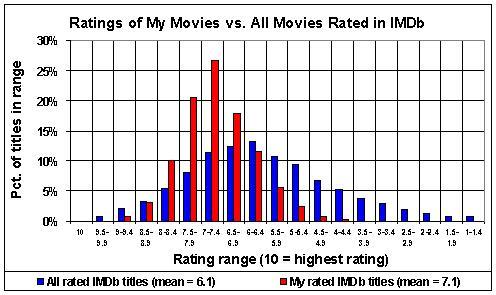
* IMDb has ratings for 1,851 of the 1,883 titles on my “Seen” list. The average rating for my titles is 7.1 (out of 10) as of 11 p.m. CT on 07/14/05. The average rating for the 105,886 IMDb titles with ratings (as of the same time and date) is 6.1. Pickiness pays off:

A Law Professor to Admire

I balance my dismissal of UT lawprof Brian Leiter by endorsing his senior colleague, Lino Graglia. In an interview with Columbia Law School Report on the occasion of the 50th anniversary of the Supreme Court’s decision in Brown v. Board of Education, Graglia had much to say, including this:

The overwhelming negative effect of Brown is that it changed the view of many people – certainly of most professors of constitutional law and, most important, of the justices themselves – as to the proper role of the Supreme Court in our system of government. If the court (as was believed) could do so great and good a thing as end racial segregation, what other great and good things could it not do? Did not Brown demonstrate that decision-making by judges on issues of basic social policy is superior to decision-making by elected representatives? The result has been a perversion of the system of government created by the Contitution, the basic principles of which are self-government through elected representatives, decentralized power (federalism), and separation of powers. At least in part as a result of Brown, we have arrived at the antithesis of this system: government by majority vote of a committee of nine unelected, life-tenured lawyers making the most basic policy decisions for the nation as a whole from Washington, D.C. The acclaim the court received as a result of Brown emboldened it to go on to such further decisions as Roe v. Wade, purporting to find that the Constitution, incredibly enough, guarantees rights of abortion, thereby converting an issue that was being peacefully settled on a state-by-state basis into an intractable national controversy.

On the race issue itself, the eventual success of Brown as a result of the 1964 Civil Rights Act emboldened the court to move from Brown’s prohibition of segregation – prohibiting the assignment of students to separate schools by race – to a vastly more ambitious and questionable requirement of integration – requiring the assignment of students to schools by race, now to increase racial mixing. Compulsory school racial integration, given residential racial concentrations, could only be attempted by ordering cross-district busing, but the justices now felt powerful enough to think that they could order even that. The result has been not to lessen but to increase school racial separation – as middle-class parents, black as well as white, fled school systems subject to busing orders – and the expenditure of billions of dollars and devastation of public school systems across the nation with no educational or other benefit….

Segregation should have been ended by Congress, as it in fact eventually was, and it is most unfortunate, as shown above, that the issue was purportedly decided instead by the court. The court’s supposed reliance on the totally discredited so-called sociological evidence in Brown illustrates only that constitutional law need have no relation to truth or reality….

It is misleading to state that “public schools in America remain segregated,” even after adding “though not officially by law,” seeming to suggest some inconsistency with Brown when in fact it is compulsory integration that violates Brown’s prohibition of all official race discrimination. For social, economic, and perhaps other reasons, areas of residential racial concentration are the norm, and neighborhood schools (which have many advantages) necessarily reflect residential patterns. This does not make the schools “segregated” any more than the neighborhoods are “segregated.” The pursuit of school “racial balance” is not only largely futile or counterproductive, but essentially pointless. The problem to be faced in regard to black education is the astounding fact that the average black 12th grader performs at about the level of the average white or Asian eighth grader in reading and math, and blacks from high income homes score below whites and Asians from low income homes. Some schools with the highest per pupil expenditures, as in Washington, D.C., and New York City, have the lowest levels of pupil performance. The pursuit of school “racial balance” – the dispersal of black students among whites and Asians (but not among Hispanics who have similar, though lesser educational difficulties) – will do nothing to change these facts. It will serve only to divert attention from possibly effective efforts and keep racial activists in business.

Graglia for Chief Justice. (If only he weren’t “too old” and “politically incorrect.”)

The Essential Case for Consequentialist Libertarianism

Steven Horowitz, a guest gadfly at Agoraphilia, succinctly makes the case:

It may be that utilitarians don’t believe in natural rights, but one can be a utilitarian, in the broadest sense, and still argue that a particular set/bundle of rights will lead to the greatest good, or put better, will have consequences that (virtually) all will think are good. Or put somewhat differently, it may be that a system in which individuals have very strong rights is a system that generates the best consequences (i.e., is best from a utilitarian point of view).

For an elaboration of this point, see my series on “Practical Libertarianism.” Start with Part VIII. Practical Libertarianism — A Summary. The core of my argument for consequentialism is detailed in these parts:

III. The Origin and Essence of Rights

Addendum to Part V: The Destruction of Income and Wealth by the State

The Last of Leiter

I’ve posted thrice about Brian Leiter (a.k.a. B. Leiter or the blighter): here, here, and here. Also weighing in are Steve Burton at Right Reason and Armed Liberal at Windsofchange.net. Burton’s take on Leiter is especially devastating.

I’ve come to the view that the blighter is merely a stupid, shrill version of Cass Sunstein. Given that, Leiter’s no longer worth my time. I’ll spend my ammo on bigger game. Bye-bye, Brian.

Aid for Africa: Wishful Thinking vs. the Facts of Life

Wishful thinking (from Sarah Vowell, writing in The New York Times):

That fact, that every three seconds an African human being dies from hunger or AIDS or, honestly, mosquito bites in this day and age, is literally the dumbest thing I’ve ever heard…That every-three-seconds statistic is so moronic, and having the richest countries in the world do something about it is such a total no-brainer….

The facts of life (from a Spiegel interview of Kenyan economics expert James Shikwati):

SPIEGEL: Mr. Shikwati, the G8 summit at Gleneagles is about to beef up the development aid for Africa…

Shikwati: … for God’s sake, please just stop.

SPIEGEL: Stop? The industrialized nations of the West want to eliminate hunger and poverty.

Shikwati: Such intentions have been damaging our continent for the past 40 years. If the industrial nations really want to help the Africans, they should finally terminate this awful aid. The countries that have collected the most development aid are also the ones that are in the worst shape. Despite the billions that have poured in to Africa, the continent remains poor.

SPIEGEL: Do you have an explanation for this paradox?

Shikwati: Huge bureaucracies are financed (with the aid money), corruption and complacency are promoted, Africans are taught to be beggars and not to be independent. In addition, development aid weakens the local markets everywhere and dampens the spirit of entrepreneurship that we so desperately need. As absurd as it may sound: Development aid is one of the reasons for Africa’s problems. If the West were to cancel these payments, normal Africans wouldn’t even notice. Only the functionaries would be hard hit. Which is why they maintain that the world would stop turning without this development aid.

SPIEGEL: Even in a country like Kenya, people are starving to death each year. Someone has got to help them.

Shikwati: But it has to be the Kenyans themselves who help these people. When there’s a drought in a region of Kenya, our corrupt politicians reflexively cry out for more help. This call then reaches the United Nations World Food Program — which is a massive agency of apparatchiks who are in the absurd situation of, on the one hand, being dedicated to the fight against hunger while, on the other hand, being faced with unemployment were hunger actually eliminated. It’s only natural that they willingly accept the plea for more help. And it’s not uncommon that they demand a little more money than the respective African government originally requested. They then forward that request to their headquarters, and before long, several thousands tons of corn are shipped to Africa …

and at some point, this corn ends up in the harbor of Mombasa. A portion of the corn often goes directly into the hands of unsrupulous politicians who then pass it on to their own tribe to boost their next election campaign. Another portion of the shipment ends up on the black market where the corn is dumped at extremely low prices. Local farmers may as well put down their hoes right away; no one can compete with the UN’s World Food Program. And because the farmers go under in the face of this pressure, Kenya would have no reserves to draw on if there actually were a famine next year. It’s a simple but fatal cycle.

SPIEGEL: If the World Food Program didn’t do anything, the people would starve.

Shikwati: I don’t think so. In such a case, the Kenyans, for a change, would be forced to initiate trade relations with Uganda or Tanzania, and buy their food there. This type of trade is vital for Africa. It would force us to improve our own infrastructure, while making national borders — drawn by the Europeans by the way — more permeable. It would also force us to establish laws favoring market economy.

SPIEGEL: Would Africa actually be able to solve these problems on its own?

Shikwati: Of course. Hunger should not be a problem in most of the countries south of the Sahara. In addition, there are vast natural resources: oil, gold, diamonds. Africa is always only portrayed as a continent of suffering, but most figures are vastly exaggerated. In the industrial nations, there’s a sense that Africa would go under without development aid. But believe me, Africa existed before you Europeans came along. And we didn’t do all that poorly either.

SPIEGEL: But AIDS didn’t exist at that time.

Shikwati: If one were to believe all the horrorifying reports, then all Kenyans should actually be dead by now. But now, tests are being carried out everywhere, and it turns out that the figures were vastly exaggerated. It’s not three million Kenyans that are infected. All of the sudden, it’s only about one million. Malaria is just as much of a problem, but people rarely talk about that.

SPIEGEL: And why’s that?

Shikwati: AIDS is big business, maybe Africa’s biggest business. There’s nothing else that can generate as much aid money as shocking figures on AIDS. AIDS is a political disease here, and we should be very skeptical.

SPIEGEL: The Americans and Europeans have frozen funds previously pledged to Kenya. The country is too corrupt, they say.

Shikwati: I am afraid, though, that the money will still be transfered before long. After all, it has to go somewhere. Unfortunately, the Europeans’ devastating urge to do good can no longer be countered with reason. It makes no sense whatsoever that directly after the new Kenyan government was elected — a leadership change that ended the dictatorship of Daniel arap Mois — the faucets were suddenly opened and streams of money poured into the country.

SPIEGEL: Such aid is usually earmarked for a specific objective, though.

Shikwati: That doesn’t change anything. Millions of dollars earmarked for the fight against AIDS are still stashed away in Kenyan bank accounts and have not been spent. Our politicians were overwhelmed with money, and they try to siphon off as much as possible. The late tyrant of the Central African Republic, Jean Bedel Bokassa, cynically summed it up by saying: “The French government pays for everything in our country. We ask the French for money. We get it, and then we waste it.”…

SPIEGEL: The German government takes pride in precisely monitoring the recipients of its funds.

Shikwati: And what’s the result? A disaster. The German government threw money right at Rwanda’s president Paul Kagame. This is a man who has the deaths of a million people on his conscience — people that his army killed in the neighboring country of Congo.

SPIEGEL: What are the Germans supposed to do?

Shikwati: If they really want to fight poverty, they should completely halt development aid and give Africa the opportunity to ensure its own survival. Currently, Africa is like a child that immediately cries for its babysitter when something goes wrong. Africa should stand on its own two feet.

Interview conducted by Thilo Thielke

Translated from the German by Patrick Kessler

Unusually Bad Advice

Don Boudreaux of Cafe Hayek writes:

I content myself here merely to point out that if a government has any legitimate functions, surely the most central of these is to protect its people from violence inflicted by foreign invaders. If Uncle Sam’s current foreign policies promote such invasions of terrorists (as Pape’s evidence suggests), then Uncle Sam’s first duty – if it truly puts the welfare of Americans first – is to have its garrisons and guns scram from the middle east ASAP.

Our garrisons and guns in the Middle East are there not only to fight organized terrorism (not an oxymoron) but also to guard our access to oil. Our withdrawal would enable bin Laden and his ilk to disrupt the production and shipment of oil at will. Our withdrawal would also send the message that we’re unwilling to defend our vital interests, which would only embolden bin Laden and his ilk. In sum, withdrawal would undermine the economic and physical security of Americans.

Boudreaux, who usually thinks clearly, seems to have let his anti-statism cloud his judgment on a matter of fundamental importance to Americans. Cafe Hayek is reliable on economic issues, but not otherwise.

The only way to defend against terrorism is to fight it, wherever we find it.

A Theory of Everything, Occam’s Razor, and Baseball

A theory of everything

is a theory of theoretical physics and mathematics that fully explains and links together all known physical phenomena (i.e. “everything”). Initially the term was used with an ironical connotation, to refer to various overgeneralized theories….Over time, the term stuck in popularizations of quantum physics to describe a theory that would unify the theories of the four fundamental interactions of nature.

There have been numerous theories of everything proposed by theoretical physicists over the last century, but as yet none has been able to stand up to experimental scrutiny or there is tremendous difficulty in getting the theories to produce even experimentally testable results. The primary problem in producing a TOE is that quantum mechanics and general relativity have radically different descriptions of the universe….

There is…a philosophical debate within the physics community as to whether or not a “theory of everything” should be seen as the fundamental law of the universe. One view is the hard reductionist view that the TOE is the fundamental law of the universe and that all other theories of the universe are a consequence of the TOE. Another view is that there are laws which Steven Weinberg calls free floating laws which govern the behavior of complex systems, and while these laws are related to the theory of everything, they cannot be seen as less fundamental than the TOE. Some argue that this explanation would violate Occam’s Razor if a completely valid TOE were formulated.

Occam’s Razor notwithstanding, I’m in favor of “free floating laws” which, taken together, are the theory of everything, but which otherwise seem to operate independently. Baseball serves as a metaphor:

  • There are rules for determining the “quantum events” of a game (e.g., balls, strikes, walks, strikeouts, errors, hits, runs, and outs).
  • The quantum events of each team’s innings determine the outcome of each game, which is another quantum event (a team either wins or loses a game).
  • Another set of rules determines how wins and losses determine the standing of each team relative to the other teams in its division.
  • Yet another set of rules determines how a team’s position in its division affects its advancement to post-season play.
  • A final set of rules determines the outcome of post-season play, in which individual games are decided by the quantum events of the first and second bullets.

Distinct sets of rules determine microcosmic outcomes (e.g, individual events in a game) and macrocosmic outcomes (e.g., the winner of the World Series). But those distinct sets of rules are connected systematically. Perhaps physicists should try to understand the connectedness of the various laws of physics instead of seeking a single law that explains all physical phenomena.

The Illogical Left, via Leiter

UPDATED BELOW

B. Leiter (blighter) commends a post by one P.Z. Myers, in which Myers says:

But if I…agree that there is a statistical difference in the distribution of the sexes in various occupations which is in some way driven by gender, I would say that it is 100% the product of society and culture, and that it is 100% the product of biological evolution.

[Todd Zywicki of The Volokh Conspiracy is] making the old, tired nature/nurture distinction, and it drives me nuts. It’s a false dichotomy that is perpetuated by an antiquated misconception about how development and biology works. Genes don’t work alone, they always interact with their environment, and the outcome of developmental processes is always contingent upon both genetic and non-genetic factors.

So much for the intellectual superiority of blighter and his ilk. Genes don’t work alone, but nature must precede nurture in any explanation of aptitude. Consider this, for example. I learned to love the game of baseball at an early age (nurture). My love of the game fostered in me a desire to become a major league baseball player (a leaning born of nurture). I could never become a major league baseball player because of my eyesight, which even when corrected is about 20-40 (nature).

In sum: Nature trumps nuture when it comes to having the requisite ability to excel in any occupation that requires a modicum of skill, whether it be playing major league baseball or doing physics.

Glibness and intellectual superiority are not the same thing, as blighter proves whenever he opines or approvingly cites a like-minded Leftist.

UPDATE: Todd Zywicki defends himself rather nicely in the third update to his original post; for example:

In response to PZ Myer’s assertion that evolutionary psychology is “poorly done hokum” and that there is “vigorous disagreement” about the entire field of evolutionary psychology I requested (quite reasonably, I thought) that Myers supply some specific examples of scientific disagreement over many of the core principles of evolutionary psychology, such as Hamilton’s theory of kin selection. He has responded to this request for specifics that would support his claim that the entire field “poorly done hokum”:

That semi-random list of principles is not the same as EP. It’s like saying that because Michael Behe understands and agrees that natural selection has occurred, Intelligent Design is therefore the same as accepted neo-Darwinian theory. Picking a few points of concordance while ignoring the points of divergence between two ideas to imply a unity of support that is not there is, well, dishonest.

Nah, I’m plainspoken. He’s lying. There is substantial disagreement in the biological community on evolutionary psychology, and to imply that this question has been settled in his favor is either gross ignorance on his part or simple fraud. Of course there is currently an ongoing battle over EP; check out the last link in my article.

I’m actually being kind by conceding that there is a legitimate debate on the subject. I know very few scientists who don’t think Pinker is full of shit.

Ah, so now I understand–no need to respond to my request for analysis, because, well, “Pinker is full of shit.” Why attack Pinker out of the blue when I never even mentioned him, rather than addressing the specifics I raised? Is it that Pinker is the only evolutionary psychologist with whom Myers is familiar? Then, falling back (again) on the good old reliable argument from authority, he also links to an interview with philosopher David J. Buller, a critic of evolutionary psychology, who raises doubts about some aspects of the evolutionary psychology research program. Apparently citing an interview with this particular philosopher where he critiques some aspects of the evolutionary psychology research program sufficies to demonstrate that the entire field is “hokum” and that the entire field is open to question (it is not clear whether Buller is one of the scientists, actually he’s a philosopher so he may not be included, who think that “Pinker is full of shit”–if so, that must be in his book because I couldn’t find that particular quote in the interview he links).

If anything, it seems like the argument Myers is making is much closer to the ID argument that he critiques, than the argument I was making. As I understand the ID argument, it picks up on small holes in the theory of evolution or questions around the edges of the theory, and then proceeds to infer that the entire theory is open to question. Similarly, I have enumerated a long list of core (not semi-random at all) evolutionary psychology ideas on which there seems to be a substantial degree of agreement. Indeed, from what I can tell, he does not disagree with my assessment that there is widespread agreement on these concepts, he simply dismisses this agreement as irrelevant under his particular definition of evolutionary psychology. His response, as I understand it, is that this scientific agreement on these many core principles of evolutionary psychology is irrelevant because there are some unsettled questions around the edges of the research program, and so that therefore the whole research program itself is questionable and that there is controversy about the entire field. This seems much more similar to the arguments that I have read by ID theorists critiquing Darwinian theory, rather than the arguments that I was making. For the record, I don’t know whether adherents to intelligent design theory also think that Pinker (or Darwin, for that matter) “is full of shit.”

And so on.

Blighter and his Leftist friends are so unsure of their grasp of truth — or so afraid of the truth — that they simply stoop to scurrilous prose. Dismissiveness is the last refuge of an ignoramus (one of blighter’s favorite terms for those who challenge his pointy-headed blatherings).

P.S. I’m purposely being scurrilous here and in my other posts about blighter because he endorses abusive and offensive blogging. If he says it’s all right, it must be — he knows all.

Alter’s Ego

Jonathan Alter of Newsweek disgorges a few hundred self-serving words in “You Shield Us, We’ll Shield You.” Here’s the core of Alter’s argument for a federal shield law:

The Supreme Court refused [last week] to rule in the Valerie Plame case, leaving a federal judge free to jail innocent reporters. When Norman Pearlstine, editor in chief of Time Inc., agreed to turn over Time magazine reporter Matt Cooper’s sources to the prosecutor, the chilling message to any other anonymous sources thinking of telling their stories to Time Inc. publications was clear: don’t. Your identity cannot be protected. Reporters will now have to tell their confidential sources two things: (1) I’ll go to jail to protect you; and (2) I’ll never turn over my notes to my corporate bosses. That’s not going to be very comforting to whistle-blowers (see Time’s “Persons of the Year,” 2002) who put their jobs on the line when they talk to the press.

Innocent or not, Matt Cooper and the other jailed reporter (Judith Miller of The New York Times) have refused to give crucial testimony in a criminal case. What puts them above the law?

Alter studiedly ignores the fact that the two reporters were asked to reveal sources in the Plame case because Plame’s outing as a CIA agent, if done knowingly, was a crime. I certainly hope that the Supreme Court’s refusal to consider the reporters’ appeal in the Plame case will have a chilling effect on illegal disclosures.

Alter’s holier-than-thou defense of the press’s right to consort with criminals knows no logic:

[C]onsider that Judith Miller of The New York Times (who, unlike Cooper, is fully backed by her corporate boss) will likely go to jail soon over a story she never wrote. She simply talked to someone in the government, then did nothing.

Miller didn’t simply “talk to someone in the government.” She talked to someone who may have committed a crime by telling Miller something that neither Miller nor any other nor any other reporter had a right to know. The fact that Miller didn’t write a story based on the information she received is beside the point. Miller, and all other reporters in the case, should be compelled to cooperate in the pursuit of justice. But Alter doesn’t think so, because he’s a reporter. Well, he thinks of himself as one.

Alter’s scare-mongering aside, the Supreme Court’s refusal to hear Miller and Cooper’s appeal is unlikely to have a chilling effect on legal disclosures. For one thing, Congress has absolute power to investigate matters of its choosing and to subpoena relevant witnesses. For another thing, most whistle-blowing is born of an irrepresible desire to settle scores, which works just as much against the powers-that-be as in their favor. The Supreme Court’s action in the Plame case upholds the rule of law without harming the public’s so-called right to know.

Through the Looking Glass with Leiter

`When I use a word,’ Humpty Dumpty said, in rather a scornful tone, `it means just what I choose it to mean — neither more nor less.’

Lewis Carroll in Through the Looking Glass, Chapter VI, Humpty Dumpty*

Reminds me of B. Leiter (blighter), who uses his command of philosophical argot to call easy questions “hard” and hard questions “easy”:

Start with some examples of hard questions, the kinds of questions I largely avoid on the blog (though some of them are the subject of my scholarly work):

Does the now orthodox thesis of the token-identity of the mental and the physical (the supervenience of the mental on the physical) have the unintended consequence that the mental is epiphenomenal? (Relatedly: is there really an intelligible kind of metaphysical relationship between properties [i.e., supervenience] that is intermediate between property-dualism and type-identity?)

Is there any reason to think that putative moral facts will figure in the best causal explanation of any aspect of our experience?

What exactly is Nietzsche’s doctrine of the will to power, and what role is it playing in the argument of the Genealogy?

Do authoritative reasons in Raz’s sense really have to be exclusionary reasons, or will it suffice if they simply have more “weight” than other kinds of reasons?

What reasons, if any, does (or can) Quine give for his naturalism, and are they sound?

Is it an obstacle to descriptive jurisprudence that the concepts central to law are (as I have called them) hermeneutic concepts, i.e., concepts whose extension is supposed to be fixed by the role they play in how people understand themselves and their social world?

What is Foucault’s view of the cognitive and epistemic status of the claims of the human sciences?…

By contrast, here are some easy questions:

Was the U.S. justified in invading Iraq?

Are Bush’s economic policies in the interests of most people?

Is Darwin’s theory of evolution by natural selection a well-confirmed scientific theory?

Is there a social security “crisis”?

Leiter goes on, in his usual egotistical manner, to assume that he has a monopoly on the answers to the “easy” questions (presumably “no,” “no,” “yes,” and “no,” respectively), which entitles him to dismiss those who have different answers:

These questions, and many others, are easily addressed in the blogosphere, since there is no serious–or at least no honest or intelligent–dispute about the epistemic merits of the possible answers. Where I get into “trouble,” of course, is with those who can’t tell the difference between the two kinds of questions, the ones who think that the dialectical care, caution, and intellectual humility required for the genuinely “hard” questions ought to apply to the easy questions as well. These folks are a bit miffed when I dismiss their positions out of hand. But that is what their positions usually deserve.

Part of intellectual maturity is being able to tell the difference between questions where humility is required and questions which are not worth one’s time. The so-called “blogosphere,” like the public culture in general, is not a rich repository of intellectual maturity, needless to say. And, unsurprisingly, intellectual lightweights with trite opinions, and limited analytical skills, take offense when I make it all too clear what the answers to the easy questions are. Many of these folks are no doubt honest, well-intentioned, decent people, who have been led down unhappy paths by circumstances or indoctrination. It is an important question, far beyond my ken, what can be done to set them straight. But it is not the aim of this blog to do so.

Leiter’s “hard” questions are nothing more than the kind of intellectual pornography that stimulates professional academics and pseudo-intellectuals to engage in endless, meaningless bouts of mutual, mental masturbation.

Leiter’s first two “easy” questions are in fact hard questions with indeterminate, political answers and real consequences for real people (as opposed to academics). Leiter’s third “easy” question is in fact a hard scientific question which cannot be answered “yes” or “no” because it pertains to a falsifiable hypothesis. Leiter’s fourth “easy” question is easy only because of the way Leiter has framed it. The real question (what to do about Social Security) is as hard as his first two “easy” questions.

Leiter would object that I am not using “hard” and easy” as he intends them. But I am using “hard” and “easy” as they are commonly understood; Leiter is not. He has no monopoly on the terms of public discourse, just as he has no monopoly on the answers to truly hard questions, his delusions of intellectual superiority to the contrary.
__________
* Who must look like this:


Source: B. Leiter’s homepage.