Foxhole Rats

Apropos the preceding post, there’s a sizable cheering section for the enemy, right here in the U.S. of A. David Kopel of The Volokh Conspiracy has more:

I just ran “support the Iraqi resistance” through Yahoo, and looked at some of the top hits. Among the supporters of the so-called “resistance” are James Petras (an emeritus professor at the State University of NY), . . . . comedienne Janeane Garafolo analogizing the Iraqi resistance to Americans resisting an illegitimate Russian-Chinese invasion of the United States, and Virginia Rodino (Green Party candidate for U.S. House in Maryland in 2004), who declares herself “in solidarity with the courageous Iraqi resistance.” This is obviously not a comprehensive list, just what was easy to find in a few minutes.

An interesting thread on Democratic Underground shows that among rank and file activists (not the more famous types that Eugene originally asked about), there is a substantial diversity of opinion about whether anti-war activists should support the “resistance.”

There may be a “diversity of opinion” at the Democratic Underground about support for the “resistance,” but one graphic is worth a bunch of words about the allegiance of the post-patriots who lurk in the Underground. Here’s the answer to the question “which country having ‘nukes’ concerns/scares your the most?”:

Poll result (42 votes)
Iran (3 votes, 7%)
North Korea (2 votes, 5%)
Pakistan (1 votes, 2%)
India (0 votes, 0%)
China (1 votes, 2%)
France (0 votes, 0%)
Russia (0 votes, 0%)
Israel (1 votes, 2%)
United States
(34 votes, 81%)


What scares me the most is that those people are breathing the same air as I am.

Now, some may say that I’m equating dissent with disloyalty. Not at all. I’m equating decades of anti-defense, anti-war, and sometimes pro-enemy rhetoric with a willingness to abandon the common defense.

You can call it what you like.

Shall We All Hang Separately?

I believe that the willingness of humans to come to each other’s defense has emotional and practical roots:

1. An individual is most willing to defend those who are emotionally closest to him because of love and empathy. (Obvious examples are the parent who risks life in an effort to save a child, and the soldier who throws himself on a grenade to protect his comrades.)

2. An individual is next most willing to defend those who are geographically closest to him because those persons, in turn, are the individual’s nearest allies. (This proposition is illustrated by the Union and the Confederacy in the American Civil War, and by the spirit of “we’re all in this together” that prevailed in the U.S. during World War I and World War II. This proposition is related to but does not depend on the notion that patriotism has evolutionary origins.)

3. If an individual is not willing to defend those who are emotionally or geographically closest to him, he cannot count on their willingness to defend him. In fact, he may be able to count on their enmity. (A case in point is Southerners’ antagonism toward the North for many decades after the Civil War, which arose from Southerners’ resentment toward the “War of Northern Aggresssion” and Reconstruction.)

The Constitution — in its pledge to “provide for the common defence” and its specific language enabling that “defence” — embodies the second and third observations. As Benjamin Franklin said to John Hancock at the signing of the Declaration of Independence, “We must indeed all hang together, or, most assuredly, we shall all hang separately.” A main impetus for the adoption of the Constitution, to replace the Articles of Confederation that first bound the States, was to ensure that the States and the people could indeed hang together. And so we did, in the main, through World War II (the Civil War being the exception that truly proves the rule about geographic cohesion).

What we have seen since the end of World War II is the dissipation of the spirit that “we’re all in this together.” Every American war has had its domestic opponents, even World War II — at least before America joined it. But the Leftish voices of opposition to war — and to preparedness for war — have become louder and more strident in recent decades.

Republicans who opposed LBJ’s handling of the war in Vietnam opposed it largely because they viewed LBJ’s incrementalism as self-defeating. And they were right. My own contemporary, non-Republican view of the Vietnam War was that it was the wrong war, in the wrong place, at the wrong time, but that we ought to try to win it or simply walk away from it. We did neither, opting instead for virtual defeat. That defeat emboldened and legitimated America’s anti-defense, anti-war Leftists, who came to dominate the Democrat Party even before that Party’s venture in Vietnam had ended in ignominy. And thus it came to pass that the Democrat Party’s presidential nominee in 2004 was a notorious anti-Vietnam War veteran of that war.

Congressional Democrats, who mainly opposed George H.W. Bush’s entry into Gulf War I, weren’t granted enough time in which to beat him about the head with his “mistakes.” The war ended too quickly for that. The senior Bush’s real mistake was to heed the advice of those who wanted to walk away with the job half done, that is, with Saddam Hussein defeated but not unseated.

The many congressional Democrats who ostensibly supported George W. Bush’s entry into Iraq felt they had little choice but to do so in the aftermath of 9/11. But many of them since have followed their instincts (and their constituents’ instincts) and reneged on their initial support of the war. They have reverted to the anti-defense, anti-war posture of the modern Democrat Party, reviling President Bush for his “mistakes” (i.e., lack of 100-percent foresight) and blaming him for a fictitious “climate of oppression” in which voices against the war are stifled. They are so stifled that it is hard to be heard above the din of anti-defense, anti-war talk in the media and on the Web.

The country is divided. An important reason for that division is that half the country is unsure, for good reason, that the other half understands the value of — or even wants — a “common defence.” It is apparent to many Americans that many other Americans (i.e., most Democrats and all unaffiliated Leftists) will not countenance the defense of a fellow American (except perhaps a loved one or a next-door neighbor) unless and until the enemy is within spitting distance — if then.

This isn’t about the Iraq War being “the wrong war, in the wrong place, at the wrong time.” That’s merely the latest excuse for the American Left’s long-standing allegiance to anti-defense, anti-war dogmas, under which lies the post-patriotic attitude that America is nothing special, just another place to live. Christopher Chantrill of The American Thinker explains:

Among the many things that our American liberals ask us to swallow in our own best interest is the idea that it is an act of lèse-majesté to call them unpatriotic even though they are utterly embarrassed by patriotism. Who has not heard the liberal across the dinner table dismissing nationalism as dangerous and aggressive? But we are not allowed to call them on it.

This power play began after World War II when it came to public knowledge that a number of people with first names that sounded like last names had been passing government secrets to the Soviet Union. We call this time the McCarthy Era.

The McCarthy Era taught liberals that their ideas of a post-nationalist world did not go down too well with the American people. By the skin of their teeth they managed to swim back into the mainstream through a successful counterattack upon Senator McCarthy. Ever since, when caught in a post-patriotic act, they have waved the bloody shirt of McCarthyism to cow their accusers into silence.

Alger Hiss and Dexter White were unpatriotic and proud of it, and so are today’’s liberals — in their hearts. Hiss and White believed in a world higher and better than nation states. From their experience in the 1930s they knew that the age of capitalism and fractious nation states was coming to an end, and they wanted to be part of the exciting and altruistic movement that would create a new world order to replace the old, failed system. There would be no place for atavisms like patriotism in the post-patriotic world that they wanted to build.

And so it goes today.

Well, I wonder how those anti-defense, anti-war, post-patriots would feel if there weren’t some pro-defense, willing-to-go-to-war patriots around to defend them before the enemy is at their throats? Would France save them? How about their precious enemy detainees at Gitmo?

The Left has, by its words and deeds over the decades, seceded from the mutual-defense pact of the Constitution. The Left has served notice that it will do everything in its power to weaken the ability of those Americans who aren’t post-patriotic to prepare for and execute an effective mutual defense.

Lincoln said, “A house divided against itself cannot stand.” And Lincoln was right, but he was able to reunite the “house” by force. That is not an option now. The Left has more effectively seceded from the Union than did the Confederacy, but the Left’s secession cannot be rectified by force.

And so, those Americans who wish “to provide for the common defence” are forced to share a foxhole with those post-patriots who wish to undermine “the common defence.”

If the Left’s agenda prevails, we shall indeed all hang separately.

Three More Cheers for the Great Political Divide

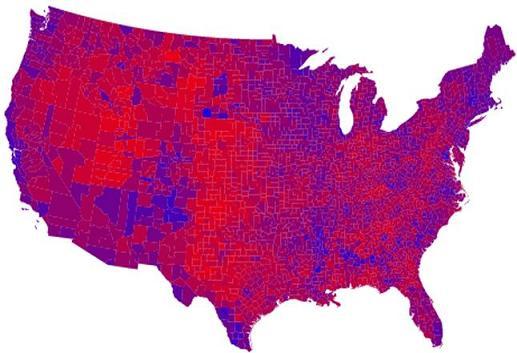
Remember the famous red-blue charts that appeared in the aftermath of the 2004 presidential election? Here’s one of them:


Shades of purple indicate the spectrum of election preferences within counties. The deeper the shade of purple the higher the proportion of votes cast for Kerry.

But too often overlooked is this companion chart:


Counties shaded pink, red, and purple have the highest population density.

In sum, we already knew about the high correlation of population density (i.e., large cities) with “blueness” (Democrat votes).

Now, an outfit that calls itself the Bay Area Center for Voting Research (BACVR) has published a list of America’s 237 most liberal and conservative cities. Buried in the fine print (in a paper that I didn’t find on the Center’s site), is this description of the Center’s “research method”:

The Bay Area Center for Voting Research identified every American city with a population greater than 100,000 according to the 2000 Census, and obtained the election returns in each of these cities. . . . The votes were tabulated by combining the voting returns from all of the precincts located in a particular city.

Following the gathering of city voting returns, BACVR analyzed the political leanings of third party candidates who received more than 0.1% of the votes cast in a city so that they could be tabulated as liberal, conservative, or neutral. Cities were ranked based upon the percentage of residents who voted for George Bush and John Kerry, and eligible third party Presidential candidates also had their support tabulated. When analyzing the voting returns, votes for George W. Bush or other third party right-wing presidential candidates contributed to the city’s conservative score, while votes for John Kerry or other left-wing presidential candidates contributed to the city’s liberal score.

In other words, given the paucity of votes for third-party candidates in 2004, BACVR does little more than replicate the red-blue (Republican-Democrat) split, but does so only for cities with a population of more than 100,000. Moreover, BACVR counts votes for the Libertarian Party’s Michael Badnarik as “conservative” votes; Badnarik — a vocally anti-war libertarian — received more than 40 percent of the third-party votes cast in the cities in BACVR’s sample. In sum, BACVR’s “research” subtracts from the sum of human knowledge. But I’ll let BACVR speak for itself:

Being Liberal Now Means Being African American

By Phil Reiff and Jason Alderman

. . . .

New research done by the Bay Area Center for Voting Research (BACVR) reveals who the real liberals in American are and the answer is not the tree-hugging, ponytail wearing ex-hippies you might expect. Instead, the new face of American liberalism is of a decidedly different hue. The nation’s remaining liberals are overwhelming African Americans.

The BACVR study that ranks the political ideology of every major city in the country shows that cities with large black populations dominate the list of liberal communities. The research finds that Detroit is the most liberal city in the United States and has one of the highest concentrations of African American residents of any major city. Over 81% of the population in Detroit is African American, compared to the national average of 12.3%. In fact, the average percentage of African American residents in the 25 most liberal cities in the country is 40.3%, more than three times the national rate.

The list of America’s most liberal cities reads like a who’s who of prominent African American communities. Gary, Washington D.C., Newark, Flint, Cleveland, Baltimore, Philadelphia, and Birmingham have long had prominent black populations. While most black voters have consistently supported Democrats since the 1960s, it is the white liberals that have slowly withered away over the decades, leaving African Americans as the sole standard bearers for the left.

Despite being the core of America’s liberal base, a major split exists between who the nation’s liberals are and who leads them politically. White politicians still control the levers of power within the Democratic Party, and black faces are rare around the decision making tables of America’s liberal advocacy groups.

While there are some noteworthy pockets of liberals who are not African American, these places end up being the exceptions. College towns like Berkeley and Cambridge have modest black populations, but remain bastions of upper middle-class, white, intellectual liberalism. These liberal communities, however, are more reminiscent of penguins clustering together around a shrinking iceberg, than of a vibrant growing political movement.

Further reinforcing this racial and ideological divide is BACVR research which shows that the most conservative city in America is the ultra white community of Provo, Utah, where less than 1% of the population is black.

Political pundits have noted the highly polarized nature of the American electorate, postulating that religion, age, education, wealth, and even the love of car racing are at the heart of the schism between liberals and conservatives. While these experts have identified some of the symptoms of our national rift, they have missed the root cause.

BACVR’s research gives us the real answer, disheartening as it may be. The great political divide in America today is not red vs. blue, north vs. south, costal vs. interior, or even rich vs. poor – it is now clearly black vs. white.

It seems to me that the piece should be titled “Being African American or an Academic Means Being a Democrat,” with this subhead: “Blacks Play into the Hands of White Liberal Elites.” But what else is new?

The real story isn’t that “white liberals that have slowly withered away over the decades, leaving African Americans as the sole standard bearers for the left.” The real story (a non-story, actually) is that larger cities have become increasingly black, and blacks have remained true to the Democrat Party. The real story is that blacks, on the whole, are less educated and less affluent than whites and therefore less likely to live in college towns like Berkeley and Cambridge (not to mention Madison and Ann Arbor) or high-tech centers like Provo (and nearby Orem).

Given BACVR’s less-than-candid description of its methods, I wasn’t surprised to read this in today’s Austin American-Statesman:

[BACVR] named Austin the 93rd most liberal city in the land, just slightly bluer on the electoral map than Virginia Beach and Salt Lake City.

Dallas was 32nd, two slots more liberal than Madison, Wis.

The study found that cities with large black populations tended to turn out for liberal candidates. Austin has a relatively small black population.

The rankings threaten to obliterate a tradition of snide remarks about [Austin] from less-liberal burgs such as Plano (fifth most conservative U.S. city, the study says), Abilene (third most conservative) and Lubbock (No. 2, trailing/leading only Provo, Utah).

Thus, the report was immediately dismissed by everyone.

“I would find it hard to believe that Austin is not in the top 25 or 30 liberal cities,” Travis County Republican Party Chairman Alan Sager said, not particularly complimentarily.

The unsurprising news is that the city of Dallas is more “liberal” than Austin because the city of Dallas has a proportionally larger black population. That’s about all there is to it. Metropolitan Dallas is another story. There are, for example, the suburbs and exurbs of Plano (number 5 on the “conservative” list), Arlington (number 10), Garland (number 29), Carrollton (number 34), and Mesquite (number 52).

Consider this map of the cities in the lower 48 States that voted more than 55 percent “conservative” (red) or more than 55 percent “liberal” (blue) in the 2004 presidential election:

What do you see? I see voluntary social, economic, and academic segregation. I see the “rust, snow, and mist belt” of the Northeast, upper Midwest, and Pacific Northwest vs. the “sun and farm belt” of the South (excluding its large cities) and “flyover country.” I see the “have nots” in the older cities (and close-in suburbs), teamed with college-town socialists, vs. the “haves” (but not the super-rich guilty ones) in the newer cities and exurbs. Birds of a feather do tend to flock together.

As I wrote in “The Great Divide Is a Great Thing,” a commentary on another fatuous piece of non-news from the local rag:

The Austin American Statesman, that great proponent of civic morality, has been running an occasional series called “The Great Divide.” It’s about the supposed polarization of American politics and American society. A sample from today’s installment (registration required, not worth the trouble):

In stories published this year, the Statesman has reported that since the late 1970s, Democrats and Republicans have been segregating, as people sift themselves into more politically homogeneous communities. . . .

People are less likely to live and vote among those with different political leanings, and the nation’s politics have grown bitter as a result. “Things get ugly when you have this kind of divergence,” California Institute of Technology political scientist Jonathan Katz says. “Each side thinks the other is wrong.”

Of course “each side thinks the other is wrong,” as the idiot from CalTech so pompously observes. (He probably analyzed a lot of data for a lot of years to figure that out.) It’s always been that way and always will be that way. That’s why the nation’s politics are so “ugly” and “bitter”. Actually they’re no more ugly and bitter than they’ve ever been, we’re just more aware of the ugliness and bitterness because (1) there are more screaming heads on TV and the internet than there used to be and (2) Democrats no longer rule the roost as they used to, which has caused them to scream louder than ever.

All this business with screaming heads just confirms one fact of life: Face-to-face political argument seldom ever changes a person’s mind, it usually hardens it.

So why should people with opposing views live near each other if they’re going to wind up fighting about politics? How many family dinners have been ruined by Uncle Joe called his nephew Fred a pinko, commie, hippie freeloader or a right-wing, fascist, capitalist exploiter of the working classes? Now, if you don’t like your family’s politics you move to where your family ain’t — and to where your can enjoy a peaceful meal with like-minded friends, chuckling over the idiocy of John Kerry or George Bush, as you prefer, without an Uncle Joe to spoil the fun.

The truly bad thing about the great political divide is that most blacks choose to remain with the party whose policies ensure their enslavement to and impoverishment by the welfare state.

Other related posts:
Is There Such a Thing as Legal Discrimination? (09/23/04)
More on the Legality of Discrimination (09/24/04)
Race and Acceptance (09/27/04)
Buckley Cuts Through the Cant (10/26/04)
The Case for Devolved Government (11/17/04)
Let ‘Em Secede (11/22/04)
Rich Voter, Poor Voter, and Academic Liberalism (04/13/05)
Tolerance and Poverty (04/19/05)
Class in America (05/17/05)

Why Not Marry Your Pet?

The “hot” story these days is the impending marriage of two Canadian men. Not because they’re homosexual, but because they’re not:

Two self-professed straight (that is, heterosexual) Canadian men have made public their decision to get ‘married’ to one another. It was only a matter of time, of course.

The Ottawa Citizen reported [. . .] that while sitting in a bar last week it occurred to Bill Dalrymple, 56, and Bryan Pinn, 65, that [. . .] with both of them being single, apparently without any serious opposite-sex marriage prospects on the line, it wouldn’t be such a bad tax-saving idea to get hitched . . . to each other. Thanks to the newly instated civil marriage act, extending “marriage” rights to same-sex couples, that’s not a problem. And since the new act doesn’t include any discriminatory restrictions on ‘sexual preference’ (as if that could be measured anyway) the two thoroughly straight men seem to have a clear path to the altar. . . .

[. . .] Bruce Walker, a Toronto area gay and lesbian rights activist, has [criticized Dalrymple and Pinn]. “Generally speaking, marriage should be for love,” he said. “People who don’t marry for love will find themselves in trouble.” . . .

“Marriage”, now, as Canada has defined it and the pro-gay activists have consistently defended it, has absolutely nothing to do with copulation or sexuality or procreation and everything to do with ‘love’—not erotic love, just . . . love, of whatever kind. . . .

Dalrymple and Pinn simply believe in the old-fashioned kind of brotherly love.

Well, why not marry a beloved pet? If you die before the pet does, the pet will inherit your home and have a comfy place in which to live out its days, without going through the fuss and bother of probate.

(Thanks to my son for pointing me to the story about Dalrymple and Pinn.)

Technorati tag:

PC Madness

Coyote Blog points to the NCAA’s latest venture into political correctness:

The presidents and chancellors who serve on the NCAA Executive Committee have adopted a new policy to prohibit NCAA colleges and universities from displaying hostile and abusive racial/ethnic/national origin mascots, nicknames or imagery at any of the 88 NCAA championships.

The Executive Committee, meeting Thursday in Indianapolis, also approved recommended best practices for schools who continue to use Native American mascots, nicknames and imagery in their intercollegiate athletic programs.

“Colleges and universities may adopt any mascot that they wish, as that is an institutional matter,” said Walter Harrison, chair of the Executive Committee and president at the University of Hartford. “But as a national association, we believe that mascots, nicknames or images deemed hostile or abusive in terms of race, ethnicity or national origin should not be visible at the championship events that we control.”

Obviously, no college or university in the U.S. is hostile toward Native Americans or any other group of persons that isn’t white, male, and heterosexual. So what’s the problem?

Why aren’t the Greeks and Turks upset about all those teams of Spartans and Trojans dotted around the country?

If livestock could vote, the NCAA certainly would be riding herd on Mustangs and Broncos, and all of those other rampaging animals. Though I doubt that anyone would stick up for the Mud Hens (the nickname of a minor league baseball team).

Speaking of baseball — my favorite sport — why aren’t New Englanders up in arms about the New York Yankees when most New Englanders (the original Yankees) are fans of the Boston Red Sox.

I guess it’s okay to call a team the Sox (the Red of Boston or White of Chicago) because there are few textile and hosiery manufacturers still operating in the U.S. We still have a lot of mountains, though, so I do have to wonder about the Colorado Rockies.

Why aren’t matched siblings and extra-large persons upset about the Minnesota Twins and San Francisco Giants?

Why aren’t professional groups of various sorts marching against the Houston Astros (for astronauts), Kansas City Royals, Los Angeles Angels, Los Angeles (trolley) Dodgers, Milwaukee Brewers, Oakland Athletics, Pittsburgh Pirates, San Diego Padres, Seattle Mariners, and Texas Rangers?

Birds should sue the Baltimore Orioles, St. Louis Cardinals, and Toronto Blue Jays. And there are the beasts of land and sea who must be offended by the likes of the Arizona Diamondbacks, Chicago Cubs, Detroit Tigers, Florida Marlins, and Tampa Bay Devil Rays.

Then there are those pesky Native American teams, the Atlanta Braves and Cleveland Indians. Why haven’t they wised up yet?

So we’re right back where we started. I guess what we need are more teams with innocuous names like the New York Mets, Philadelphia Phillies, and Washington Nationals.

Come to think of it, I doubt that any self-respecting PC policeperson would object to the Cincinnati Reds. I mean, aren’t socialism and communism far more enlightened systems than free-market capitalism?

Technorati tag:

Celebrity Twaddle

Sir (to some) Ian McKellen, interviewed in this week’s Newsweek, has this to say about his “coming out”:

I became a better actor, and my film career took off in a way that I couldn’t have expected. You can’t lie about something so central to yourself without harming yourself. Acting in my case is no longer about disguise—it’s about telling the truth, and my truth is that I’m gay. I’m very happy for people to know that, and then I can get on with telling the truth about the character that I’m playing. That’s why I can say to other actors: if you really want to be a good actor and a successful one, and you’re gay, let everybody know it.

It’s lucky for McKellen that he’s instinctively a good actor, for he doesn’t seem to understand what acting is all about. A character in a film or play has no “truth” because a character is, by definition, fictional. The actor’s job is to make the character believable to an audience. An actor can do that successfully and still be a liar, a cheat, a drunkard, a dope addict, or an adulterer (to name only a few traits common to actors) — as generations of actors have proved. Acting is acting. It has nothing to do with one’s “truth.”

But political correctness requires celebrities to utter twaddle such as that uttered by McKellen. One thing’s for sure: Successful acting doesn’t require a very high degree of intelligence, just good acting instincts and good scripts.

Technorati tag:

Defending My Right to Be Bombed

Now we learn this from The Times Online:

Mohammed Atta and three other men who hijacked aircraft on September 11, 2001 were identified by the US Government as possible members of an al-Qaeda cell more than a year before the attacks, it was reported today. . . .

The secret military team, known as Able Danger, recommended that the identities of the four men be shared with the FBI and other parts of the military, but the recommendation was never taken up, according to a Republican Congressman, Curt Weldon, quoted by the newspaper. . . .

The CIA tracked the men through 2000 before passing their information to the FBI in the spring of 2001.

According to Mr Weldon, who said he has tried to share this information since September 2001, when it first came to his notice, the risk posed by Atta and his cohorts never spread through America’a law enforcement agencies because of the uneasy co-operation between the FBI and the military. . . .

The classified military intelligence unit used sophisticated “data mining” techniques, which process huge amounts of data to find patterns, to identify Atta and the three other men as likely members of an al-Qaeda cell within two months of their arrival in America in 2000.

And from The International Herald Tribune:

. . . Able Danger, prepared a chart in the summer of 2000 that included visa photographs of the four men, including the ringleader, Mohammed Atta. The unit recommended to the military’s Special Operations Command that the information be shared with the FBI, the former official and the Republican congressman, Curt Weldon of Pennsylvania, said Monday.

The recommendation was rejected, and the information was not shared, they said, apparently at least in part because Atta and the others were in the United States on valid entry visas.

Under U.S. law, intelligence agencies may not collect intelligence on individual citizens and permanent residents. That protection does not extend to visa holders, but Weldon and the former official said it may have reinforced a sense of discomfort[*] common before Sept. 11 about sharing intelligence information with a law enforcement agency.

So we have here two lessons:

  • Data mining can actually detect bad guys.
  • Intelligence sharing might well have led to the capture of the bad guys before they did something terribly bad.

But knee-jerk civil libertarians won’t have any of it. They want to defend my right to be bombed.
__________
* There was more than “discomfort” about intelligence-sharing, there was a wall between criminal investigators and intelligence agents.

Technorati tag:

Moral Luck

I have just come across the philosophical concept known as moral luck, which is illustrated by this example from Wikipedia:

Suppose there are two truck drivers, Driver A, and Driver B. They are exactly alike in every single way, drive the same exact car, have the same driving schedule, have the same exact reaction time, and so forth. Let’s say that Driver A is driving down a road, following all legal driving requirements, when suddenly, a child runs out in the middle of the road to retrieve a lost ball. Driver A slams the brakes, swerves, in short, does everything to try to avoid hitting the child — alas, the inertia of the truck is too great, and the distance between the truck and the child is too short. Unfortunately, the child is killed as the result of the collision. Driver B, in the meantime, is following the exact same route, doing all the exact same things, and everything is quite exactly the same –– except for one important distinction. In his scenario, there is no child that appears on the road as if out of nowhere. He gets to his destination safely, and there no accident occurs.

If a bystander were asked to morally evaluate Drivers A and B, there is very good reason to expect him to say that Driver A is due more moral blame than Driver B. After all, his course of action resulted in the death of a child, whereas the course of action taken by Driver B was quite uneventful. However, there are absolutely no differences in the controllable actions performed by Drivers A and B. The only disparity is that in the case of Driver A, an external uncontrollable event occurred, whereas it did not in the case of Driver B. The external uncontrollable event, of course, is the child appearing on the road. In other words, there is no difference at all in what the two of them could have done –– however, one seems clearly more to blame than the other. How does this occur?

This is the problem of moral luck. If we agree that moral responsibility should only be relevant when the agent voluntarily performed or failed to perform some action, we should blame Drivers A and B equally, or praise them equally, as may be the case. At the same time, this seems to be at least intuitively problematic, as — whatever the external circumstances are –– one situation resulted in an unfortunate death, and the other did not.

My reaction: The example only shows that moral luck is an artificial philosophical construct. Specifically, Driver B’s experience is irrelevant because Driver B wasn’t placed in the same circumstances as Driver A. The example avoids the real issues, which are these:

  • Did Driver A in fact drive prudently? That isn’t the same thing as “following all legal driving requirements.” Driver A might have passed a breathalyzer test, but perhaps just barely. Or Driver A might have been talking on his cell phone in a jurisdiction that doesn’t forbid doing so while driving. Or Driver A might not have been paying full attention to his surroundings (an undetectable lapse) because he was thinking about where to make his next turn.
  • More fundamentally, the example fails to mention the actions of the child and the child’s parents. Was the child of an age to have known better than to dart into the street without looking? Why was the child allowed to play with a ball near the street? Why wasn’t someone keeping an eye on the child? Why hadn’t the child’s parents fenced the front yard and seen to it that the child couldn’t unlatch the gate?

If Driver A drove prudently, no blame can attach to Driver A. The blame, if any, must attach to the child or the child’s parents, an option that the example omits.

Wikipedia continues:

Moral luck entails two extreme outcomes, both of which seem intuitively unacceptable.

If, one hand, we accept moral luck as a real phenomenon and accept it as a valid restriction on personal responsibility (and, consequently, the assign[ment] of moral blame or praise), it is difficult to identify a situation where moral luck does not affect an event or an individual. Many, if not all, of the moral judgments that we engage in daily seem to become problematic, since any single action can be defended as having been affected by moral luck. Constitutive moral luck [pertaining to the personal character of the moral agent] especially highlights this problem –– after all, it is perfectly valid to argue that every single thing that we do relates in some way to our personal character disposition, and is not one hundred percent voluntary. Thus, if we do stick by our requirement of moral responsibility as needing complete volition, we cannot validly morally assess any action performed by an individual. As Nagel himself points out, if moral luck is accepted as a valid premise, the area of individual moral responsibility seems to ““shrink . . . to an extensionless point.”

On the other hand, if we deny the influence of moral luck and refuse to accept that it has anything to do with moral evaluation (as Kant most certainly would, for example), we are left with a single unappealing option: we are responsible for everything that we do, whether voluntarily or not, and for all the consequences, no matter how unforeseen or unlikely, that our actions entail. By this logic, the unlucky Driver A from our earlier example can take no solace in the fact that there was nothing he could have done to prevent the death of the child as the result of the accident –– he deserves the full amount of moral blame that can be assigned for such an outcome.

That is, moral luck either (1) negates personal responsibility or (2) places all responsibility on the individual actor to whom things happen. I reject the first premise because we have free will or must act as if we have it. (See this post.) I reject the second premise because, as I argued above, it fails to account for the freely chosen actions of others.

The concept of moral luck strikes me as useless philosophical casuistry. I’m sorry it came to my attention. I will now try to forget it.

Technorati tag:

The Consequences and Causes of Abstinence

A few weeks ago, in a comment thread at Catallarchy, I made this observation:

Less teen sex = less disease + fewer unwanted children + fewer early (and often unhappy) marriages

Parents who want to protect their children therefore try to teach them to eschew sex because of its potential consequences. Abstinence — by definition — works better than prophylaxis and contraception.

That evoked a response in a later comment thread that I had “list[ed] only the harm caused by sex and not the benefit.” Well, there were plenty of hedonistic voices arguing the benefit side. What was needed was someone to argue the cost side, and that’s what I did. Moreover, my point — which seems to have been missed in all the shouting — was about the responsibility of parents to teach their children about the cost side.

The usual argument goes like this: Kids will do it anyway. Well, kids are less likely to do it “anyway” if they’re brought up to believe that they shouldn’t do it “anyway.” And the bringing-up isn’t done in public schools, it’s done in the home by parents who teach their children not only about sex but also about responsible (i.e., moral) behavior.

The critics of abstinence education focus on the results of studies (e.g., here and here) about the sexual practices of groups of public-school students. They conclude that abstinence education in public schools is ineffective and perhaps even counterproductive in its effects on teen pregnancy and sexually transmitted diseases. But such studies aren’t above criticism; see this, from The Heritage Foundation, for instance. Moreover, what those studies don’t tell us is what happens to teens who are predisposed (by their parents) to eschew sex. Here’s one bit of relevant information (from a research paper published by The Heritage Foundation):

[T]aking a virginity pledge in adolescence…is associated with a substantial decline in STD rates in young adult years. Across a broad array of analysis, virginity pledging was found to be a better predictor of STD reduction than was condom use. Individuals who took a virginity pledge in adolescence are some 25 percent less likely to have an STD as young adults, when compared with non-pledgers who are identical in race, gender, and family background.

More tellingly, there’s this, from the National Institutes of Health:

Teens — particularly girls — with strong religious views are less likely to have sex than are less religious teens, largely because their religious views lead them to view the consequences of having sex negatively. According to a recent analysis of the NICHD-funded Add Health Survey, religion reduces the likelihood of adolescents engaging in early sex by shaping their attitudes and beliefs about sexual activity . . . .

Sexual intercourse places teens at risk for sexually transmitted diseases, including HIV, and unintended pregnancy. The information provided by the study may prove important for health researchers and planners devising programs that help prevent teens from engaging in sexual activity.

Hmm . . . isn’t that what I said at the outset?

I now turn to this story about a letter published in the British Medical Journal (available only by subscription):

A letter by Australian bioethicist Dr. Amin Abboud published in the July 30 edition of the British Medical Journal notes that “A regression analysis done on the HIV situation in Africa indicates that the greater the percentage of Catholics in any country, the lower the level of HIV.”

Dr. Abboud’s letter comes in response to an article published in the journal’s June 4 issue which wonders if newly elected Pope Benedict XVI will alter the Church’s teaching on condoms in light of the burgeoning HIV/AIDS epidemic. Abboud asserts that “On the basis of statistical evidence it would seem detrimental to the HIV situation in Africa if he did authorise such a change.”

“On the basis of data from the World Health Organization,” reports Abboud, “in Swaziland where 42.6% have HIV, only 5% of the population is Catholic. In Botswana, where 37% of the adult population is HIV infected, only 4% of the population is Catholic. In South Africa, 22% of the population is HIV infected, and only 6% is Catholic. In Uganda, with 43% of the population Catholic, the proportion of HIV infected adults is 4%.” . . .

Abboud concludes his letter stating, “The causes of the HIV crisis in Africa need to be found elsewhere. The solutions must go beyond latex. If anything, the holistic approach to sexuality that Catholicism advocates, based on the evidence at hand, seems to save lives. I would welcome an editorial on that or, as a minimum, some evidence based advice on HIV.”

It all boils down to personal responsibility, which is taught by parents (especially those who bring up their children in a traditional religion) and undermined by government programs. I thought libertarianism was all about personal responsibility, but for many libertarians it seems to be all about hedonism.

Technorati tag:

Conservatism, Libertarianism, Socialism, and Democracy

Libertarians have much company in the struggle against socialism. From Ten Books That Shaped America’s Conservative Renaissance:

George H. Nash’s The Conservative Intellectual Movement in America Since 1945 is the authoritative study on conservatism’s intellectual renaissance. In it, Nash outlines an American conservative movement that was forged, at times uneasily, from three intellectual groups: libertarians, anti-Communists, and traditionalists. . . .

After the 1964 election, and especially after the implementation of Lyndon Johnson’s “Great Society” programs, the conservative movement welcomed what was to become the fourth component of its intellectual coalition. Popularly known as “neoconservatives,” this group of disillusioned liberals, claiming, as one of them put it, to have been “mugged by reality,” migrated to the conservative cause. Reacting in part to the social uprisings of the 60s, in part to the isolationism and perceived “anti-Americanism” ofthe New Left, and in part to the consequences of liberal activism in government, these gifted newcomers came to realize that good intentions do not guarantee good or effective government.

Let’s hear it for the libertarians:

Since the days of Franklin Roosevelt, conservatives of all stripes have denounced the growth of the American welfare state. After World War II in particular, many conservatives were alarmed at the decrease of economic freedom at home and the rise of collectivism overseas. The growth of the omnipotent state was leading to a degree of cultural deterioration that alarmed many thoughtful people.

It was the so-called “libertarians” who responded first to the unwelcome changes that were wrought by this new American “superstate.” The libertarians were attracted to the economic an political teachings of classical, nineteenth century individualists. The principles libertarians believed should guide government were free markets, private property, individualism, and limited government, in short, laissez-faire. The 1930s, the decade of the New Deal, had been uncongenial years for devotees of economic and personal liberty, and it wasn’t until after the war that these libertarian ideas gained a sympathetic hearing.

As has been suggested by a number of scholars, post-war libertarians were buttressed theoretically and philosophically from their association with members of the Austrian School of economics. Since the late-nineteenth century, economists associated with the Austrian School have been forceful critics of all variants of anti-capitalism and collectivism. The most famous of these Austrian economists is Friedrich von Hayek, whose 1944 book The Road to Serfdom was central to the early definition of the conservative movement. It was Hayek’s contention that “[a]lthough we had been warned by some of the greatest political thinkers of the nineteenth century, by Tocqueville and Lord Acton, that socialism means slavery, we have steadily moved in the direction of socialism.” The purpose of his book was to explain “why and how certain kinds of economic controls tend to paralyze the driving forces of a free society.”. . . For Hayek, the socialists, under the guise of equality, were setting us back on the road to serfdom—that is, back to a condition ofpolitical and economic servitude and away from the ideal of a free society….

[Ludwig von Mises’s] book Socialism, [a] work that considerably influenced early conservative thinking, powerfully challenged socialist economics as being not only inherently flawed because they are unable to allocate scarce resources efficiently, but contrary to the very nature of the individual as well. Collectivist economics does not recognize the central role played by the entrepreneur in ordinary economic and social organization. For Mises, socialism was far from being a humane alternative to the free market. Rather, at bottom, it was contrary to human nature itself. By denying the human aspect—the role each individual plays in communicating vital economic information—socialism, according to Mises, was doomed to fail.

Hayek and Mises were right about the inhumane character of socialism, but Mises was wrong about its inevitable failure. The neoconservative Irving Kristol glimpsed the truth of the matter:

[Kristol’s] book On the Democratic Idea in America helped to direct and shape the conservative movement. The subject of the book, in Kristol’s own words, was “the tendency of democratic republics to depart from…their original, animating principles, and as a consequence precipitate grave crises in the moral and political order.” Kristol condemned moral relativism as vigorously as did the traditionalists. As against the libertarians, however, he only gave “two cheers” for capitalism. He noted that while he did “think that, within limits, the notion of the ‘hidden hand’ has its uses in the market place,” he also believed that “the results are disastrous when it is extended to the polity as a whole….” For Kristol, “[s]elf-government, the basic principle of the republic, is inexorably being eroded in favor of self-seeking, self-indulgence, and just plain aggressive selfishness.”

Kristol misunderstands libertarianism if he thinks that it tolerates a form of government which enables some to steal from others. But Kristol is right that (limited) self-government has been replaced by unconstrained self-indulgence, operating through government.

As I have written elsewhere, democracy is an enemy of liberty. What should be private, such as the voluntary exchange of goods and services for mutual gain, “democracy” has made public. The problem isn’t libertarianism or capitalism, it’s state interference in consensual private matters, which diminshes the general good on the pretext of serving the general good. This passage from Jill Paton Walsh’s A Desert in Bohemia captures the socialist mindset, wherever it prevails:

‘You see,’ said Slavomir, swinging in his chair, and twirling a pencil between finger and thumb, ‘this idea that there is a private sphere which is of no concern to the authorities is a very decadent and dangerous one. No-one has an individuality which is not a construction of society, and no-one can have any right to purse conduct which is not for the general good. What do you say to that?’

‘Who decides what is for the general good?’ said Frantsiek.

‘The party,’ said Slavomir, ‘because they are the most enlightened section of society. . . .’

And there you have it. Our counterpart of “the party” — political “leaders,” abetted by the “intelligentsia,” and goaded by the voting masses — cynically imposes its desires in the name of the general good. Limited government, free people, and free markets be damned.

Related post: A Paradox for Libertarians

Technorati tag:

Now, Let’s Talk About Something Else

UPDATED BELOW

From Richard B. Frank, writing at The Weekly Standard:

The sixtieth anniversary of Hiroshima seems to be shaping up as a subdued affair–though not for any lack of significance. A survey of news editors in 1999 ranked the dropping of the atomic bomb on August 6, 1945, first among the top one hundred stories of the twentieth century. And any thoughtful list of controversies in American history would place it near the top again. It was not always so. In 1945, an overwhelming majority of Americans regarded as a matter of course that the United States had used atomic bombs to end the Pacific war. They further believed that those bombs had actually ended the war and saved countless lives. This set of beliefs is now sometimes labeled by academic historians the “traditionalist” view. One unkindly dubbed it the “patriotic orthodoxy.”

But in the 1960s, what were previously modest and scattered challenges of the decision to use the bombs began to crystallize into a rival canon. The challengers were branded “revisionists,” but this is inapt. Any historian who gains possession of significant new evidence has a duty to revise his appreciation of the relevant events. These challengers are better termed critics.

The critics share three fundamental premises. The first is that Japan’s situation in 1945 was catastrophically hopeless. The second is that Japan’s leaders recognized that fact and were seeking to surrender in the summer of 1945. The third is that thanks to decoded Japanese diplomatic messages, American leaders knew that Japan was about to surrender when they unleashed needless nuclear devastation. The critics divide over what prompted the decision to drop the bombs in spite of the impending surrender, with the most provocative arguments focusing on Washington’s desire to intimidate the Kremlin. Among an important stratum of American society–and still more perhaps abroad–the critics’ interpretation displaced the traditionalist view….

[I]t is clear [from a review of the evidence now available] that all three of the critics’ central premises are wrong. The Japanese did not see their situation as catastrophically hopeless. They were not seeking to surrender, but pursuing a negotiated end to the war that preserved the old order in Japan, not just a figurehead emperor. Finally, thanks to radio intelligence, American leaders, far from knowing that peace was at hand, understood–as one analytical piece in the “Magic” Far East Summary stated in July 1945, after a review of both the military and diplomatic intercepts–that “until the Japanese leaders realize that an invasion can not be repelled, there is little likelihood that they will accept any peace terms satisfactory to the Allies.” This cannot be improved upon as a succinct and accurate summary of the military and diplomatic realities of the summer of 1945.

UPDATE: See also this piece by Victor Davis Hanson.

Technorati tag:

A Paradox for Libertarians

Libertarians, by definition, believe in the superiority of liberty: the negative right to be left alone — in one’s person, pursuits, and property — as long as one leaves others alone. Libertarians therefore believe in the illegitimacy of state-enforced values (e.g., income redistribution, censorship, punishment of “victimless” crimes) because they are inimical to liberty.

Some libertarians (minarchists, such as I) nevertheless believe in the necessity of a state, as long as the state’s role is restricted to the protection of liberty. Other libertarians (anarcho-capitalists) argue that the state itself is illegitimate because the existence of a state necessarily compromises liberty. I have dealt elsewhere with the anarcho-capitalist position, and have found it wanting. (See “But Wouldn’t Warlords Take Over?” and the posts linked to at the bottom of that post.)

Let’s nevertheless imagine a pure anarcho-capitalist society whose members agree voluntarily to leave each other alone. All social and economic transactions are voluntary. Contracts and disputes are enforced through arbitration, to which all parties agree to submit and by the results of which all parties agree to abide. A private agency enforces contractual obligations and adherence to the outcomes of arbitration. (You know that this anarcho-capitalist society is pure fantasy because a private agency with such power is a de facto state. And competing private agencies, each of which may represent a party to a dispute are de facto warlords. But I digress.)

Now, for the members of this fantasyland to enjoy liberty implies, among other things, absolute freedom of speech, except for speech that amounts to harassment, slander, or libel (which are forms of aggression that deprive others of liberty). But what about speech that would sunder the society into libertarian and non-libertarian factions? Suppose that a persuasive orator were to convince a potentially dominant faction of the society of the following proposition: The older members of society should be supported by the younger members, all of whom must “contribute” to the support of the elders, like it or not. Suppose further that the potentially dominant faction heeds the persuasive orator and forces everyone to “contribute” to the support of elders.

Note that our little society’s prior agreement to let everyone live in peace wouldn’t survive persuasive oratory (just as America’s relatively libertarian economic order didn’t survive FDR, the Constitution notwithstanding). Perhaps our little society should therefore adopt this restraint on liberty: No one may advocate or conspire in the coercion of the populace, for any end other than defense of the society.

Why an exception for defense? Imagine the long-term consequences for our little society if it were to dither as a marauding band approached, or if too few members of the society were to volunteer the resources needed to defeat the marauding band. What’s the good of the society’s commitment to liberty if it leads to the society’s demise?

Now, the restraint on speech and the exception for defense couldn’t be self-enforcing. There would have to a single agency empowered to enforce such things. That agency might as well be called the state.

Here, then, is the paradox for libertarians: Some aspects of liberty must be circumscribed in order to preserve most aspects of liberty.

Note: My free-speech example is just that, an example. I’m not proposing any further restrictions on freedom of speech in the United States, which already has been restricted too much, notably in the realms of commercial and political speech.

This post is also available at Blogger News Network.

Technorati tag: