It’s All Truman’s Fault

Harry Truman showed the world that America had lost its will to win. And so, we have gone from Korea, to Vietnam, to Lebanon, to Gulf War I, to Somalia, and — now, it seems — to Iraq. I must quote myself:

Vietnam was the wrong war, in the wrong place, at the wrong time. But once we had committed our forces there, we should have fought to win, regardless of the amount of force required for victory. Why? Because our ignominious withdrawal from Vietnam changed the national psyche — especially coming as it did within a generation of the stalemate in Korea. As a result of Vietnam, we went from believing that we could win any war we set our minds to win to believing that there wasn’t a war worth fighting.

Our (incomplete) victory in the Gulf War of 1991 came so quickly and at so little cost that it didn’t really reinvigorate America’s military self-confidence. Our 1999 bombing campaign in Kosovo succeeded only in showing our willingness to win a quick victory (if it was that) in a situation that posed little or no threat to American forces.

On the other hand, the new, defeatist American psyche — which most of the mainstream press has been striving for 30 years to perpetuate — manifested itself in our abrupt withdrawals from Lebanon (1983) and Somalia (1993) after the public saw “too many” body bags. Then there was our legalistic response to the 1993 World Trade Center bombing and our tepid military response to the 1998 bombings of the U.S. embassies in Kenya and Tanzania. The sum total of American actions in 1983, 1993, and 1998 — coupled with the obvious ascendancy of American defeatism — surely led Osama bin Laden to believe that he could accomplish his aims through a few spectacular terrorist attacks within the U.S., and the threat of more such attacks.

Thus, although we may be having a hard time in Iraq — and the hard time may continue for a while — we cannot back down. We must redouble our efforts to quell the insurgency and to build a stable Iraq. To do otherwise would be to admit that the American psyche remains defeatist. It would invite our enemies and potential enemies to take bold actions — if not directly against us, then against our interests around the world. We would find it harder and harder to fight back, diplomatically and militarily, against increasingly emboldened enemies and rivals — even if we had the will to fight back. Vital resources would become exorbitantly expensive to us, if we did not lose access to them altogether. America’s economic and military might would descend together, in a death spiral, and with them — very likely — the remnants of domestic civility.

And that is how bin Laden will destroy America, if he can. And that is why we must persevere in Iraq.

Oxymorons at Work

AP headline: Hawkish Democrat Calls for Iraq Pullout

Well, he (Rep. John Murtha, D-Pa.) might once have been hawkish about something. But when he called for a pullout he lost his standing as a putative hawk. The headline is an oxymoron, except to the morons at AP.

The correct headline: Formerly Reputed Hawk Revealed As Typical Democrat Appeaser

Workplace Whiners

I was thinking earlier today about the prevalance of whining in the workplace. Then I came across this, from Suits in the Workplace: An Employment Law Blog:

In this age of easily hurt feelings and heightened sensitivity to just about everything, it’s nice to see a common sense decision in an employment case. The Tenth Circuit just ruled – brace yourself – that a supervisor who “set goals and deadlines for an ongoing project, requested that [an employee] 1) keep track of her daily activities in fifteen-minute intervals for seven days, 2) work in her cubicle so [the supervisor] could more closely supervise her, and 3) inform [the supervisor] of dates she would be out of the office” did not constructively discharge the employee she was managing. Turnwall v. Trust Co. of America, No. 04-1303 (10th Cir. 2005). . . .

Thankfully, the Tenth Circuit held that the working conditions weren’t objectively intolerable, and that there was no outrageous conduct, so they got it right. But what does this lawsuit say about the average supervisor’s ability to manage an employee who admittedly had problems prioritizing her work? Goal setting and regular monitoring of progress are textbook management techniques, and were perfectly appropriate under these circumstances. Nevertheless, the employer here had to defend a federal lawsuit, and a subseqent appeal, at no small cost, essentially because somebody couldn’t handle criticism from a supervisor.

We are blessed with excellent Federal Judges here in the Eastern District of Virginia. . . .

Yes, you are blessed. I speak from experience. The experience of putting up with workplace whiners like Ms. Turnwall, and the experience of having been backed up by the Eastern District of Virigina whenever one of those whiners went to court.

Your Point Is?

Alex Tabarrok of Marginal Revolution seems to be straining for a point here:

In the late 1790s the US was having difficulty with Muslim pirates in the waters off Northern Africa. After some difficulty, a treaty was signed in 1796 with the Bey of Tripoli promising friendship, trade and an end to hostilities. The 11th article of the treaty provides a remarkable contrast between how these sorts of issues were handled by the founders and how they are handled today. It reads:

As the government of the United States of America is not in any sense founded on the Christian Religion; as it has in itself no character of enmity against the laws, religion or tranquility of Musselmen; and as the said States never have entered into any war or act of hostility against any Mehomitan nation, it is declared by the parties that no pretext arising from religious opinions shall ever produce an interruption of the harmony existing between the two countries.

The 11th article of the treaty provides no contrast between how “these sorts of issues” were handled then and now — by the government of the United States. President Bush and leaders of Congress have bent over backward to say that the war on terror has nothing to do with Islam per se. They have made the point that our enemy is radical Islam, not because it is a branch of Islam but because radical Islamists have made us their enemy. They have made us their enemy, in part, because Americans today — as in 1796 — are predominantly Christian. The fact that the government of the United States was not founded on Christianity has nothing to do with the case.

The UN and the Internet

It seems that the U.S. will remain in charge of the Internet:

By MATT MOORE, Associated Press Writer

TUNIS, Tunisia – A U.N. technology summit opened Wednesday after an 11th-hour agreement that leaves the United States with ultimate oversight of the main computers that direct the Internet’s flow of information, commerce and dissent.

A lingering and vocal struggle over the Internet’s plumbing and its addressing system has overshadowed the summit’s original intent: to address ways to expand communications technologies to poorer parts of the world.

Negotiators from more than 100 countries agreed late Tuesday to leave the United States in charge, through a quasi-independent body called the Internet Corporation for Assigned Names and Numbers. . . .

Libertarian purists will object that no government agency should be involved in the operation of the Internet. I would agree with that if the Internet weren’t an international phenomenon. But it is, and that opens the possibility of overt or covert control by foreign governments. Faced with that possibility, the second-best option is to retain the U.S. government’s oversight role.

It’s bad enough that some nations try to control the content of Internet traffic within their own borders. But imagine an Internet in which the likes of Canada, France, Russia, China, Syria, and Iran had a hand in controlling the “flow of information, commerce and dissent” within the U.S. and between the U.S. and the rest of the world. We would then have to create a separate, U.S.-and-free-speech-partners-only Internet that could connect to the UN-controlled system only through special protocols and filters. What a step backward that would be.

Then and Now

Give me liberty or give me death. — Patrick Henry, 1775

Give the enemy a timetable for our surrender. — U.S. Senate, 2005

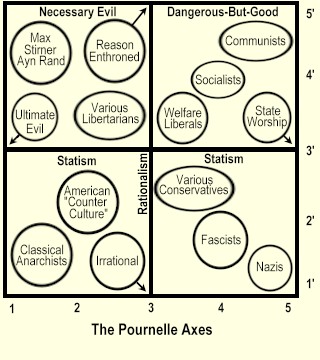
Political Taxonomies

Thanks to a comment by Mr. Meval on a post at Catallarchy, I found this:

My own, simpler, taxonomy — which anarcho-capitalists will reject — looks like this:

• Anarchy — “might makes right” without an effective state to referee the fight

• Libertarianism — the minimal state for the protection of life, property, and liberty

• Communitiarianism — the regulation of private institutions to produce “desirable” outcomes in such realms as income distribution, health, safety, education, and the environment

• Statism — outright state control of most institutions, reached either as an extension of communitarianism or via post-statist anarchy or near-anarchy, as in Stalin’s Russia, Hitler’s Germany, and Mao’s China.

A Baseless Debate

Legal Affairs Debate Club is hosting a debate about the limits of presidential power. The premise of the debate:

Critics of the Bush Administration have attacked the president for a host of unilateral actions he has taken. The president, critics say, took the country into two wars without congressional approval, detained suspected terrorists without trials or even charges, and pulled the United States out of longstanding agreements like the Kyoto Accords.

Or, “when did you stop beating your wife?”

The debate is baseless because the answers to the critics’ charges are straightforward:

  • Military operations in Afghanistan and Iraq were — and are — expressly authorized by Congress.
  • Terrorists (as opposed to members of the Iraqi Army) who have fought against American forces abroad merit none of the protections of the Geneva Conventions and certainly none of the protections of the Bill of Rights — no matter what the Supreme Court says.
  • The U.S. Senate has never ratified the Kyoto Protocol and, therefore, the U.S. is not bound by it.

Perhaps the next debate should be about the greatest movie ever made. At least there would be something to debate, even if no one could win the debate.

Bad Law Makes for Bad Consequences

“Hard cases, it is said, make bad law” — John Campbell Argyll (Scottish, 1678-1743)

Difficult cases — cases in which the law must be twisted to achieve “desirable” results — can cause good laws to be changed, with bad consequences.

Metaphor du Jour

Groucho Marx is supposed to have said “I wouldn’t join any club that would have me as a member” — or something in that vein. In other words, when an exclusive club loses its exclusivity, membership in the club becomes less valuable, both to the members who joined it when it was still exclusive and to prospective members (if they are as astute as Groucho Marx).

But there’s more to it than that. Suppose that the exclusive club has stringent standards of conduct, which aren’t always observed but which most of its members strive to honor. Suppose that by changing its rules of admission — by admitting Groucho Marx, for instance — the club also seems to signal that it has lowered its standards of conduct. What is likely to happen as a result? At the margin, even some of those members who had joined the club when it was exclusive will adapt to the lower standards of conduct. Moreover, many persons who would have sought membership in the club when it was exclusive will simply decline to join it, with the result that, at the margin, some of them will not rise to the standards of conduct that they would have risen had they joined the club.

Human beings respond to social norms in ways that might seem “irrational” to those who think that humans are nothing but wealth-maximizing automata. Humans are much more complex than that, however, which is why it’s important to have exclusive “clubs” with high standards of conduct. If abstractions such as “honor” and “duty” were meaningless, soldiers wouldn’t join a “club” whose unwritten rules sometimes require them to throw themselves onto hand grenades; firemen wouldn’t join a “club” whose unwritten rules sometimes require them to risk almost-certain death on the slim odds of rescuing a person from an inferno.

There is a lesson in this for who are ineligible for certain exclusive clubs. They should — in the interest of society’s well-being — form their own exclusive clubs instead of trying to force their way into those clubs that already exist. They can call their clubs whatever they wish — and they can set very high standards for membership in those clubs — but they should not devalue the clubs that already exist by trying to change the rules of admission to those clubs.

Understanding Introverts

Jonathan Rauch understands. Just read it, please.

My thanks to A Constrained Vision, via Jujitsui Generis, for the pointer.

Related posts:

IQ and Personality (March 14, 2004)
IQ and Politics (March 14, 2004)
The Right is Smarter Than the Left (June 11, 2004)
The Advantages of Introversion (May 1, 2005)
“Thinking” vs. “Feeling” (June 8, 2005)

The Next Winner of the World Series?

UPDATED, 11/13/05, 11/14/05, AND 10/28/07
REVISED, 10/29/07

The Boston Red Sox won the World Series in 2004. That was the first WS win for a Red Sox team since 1918. The Chicago White Sox won the WS in 2005. That was the first WS win for a White Sox team since 1917. Who’s next? Who knows?

Now we know, the St. Louis Cardinals (2006) and the Red Sox, again (2007).

But to fuel offseason speculation, the following list ranks teams by the number of World Series that have been played since a team’s last WS win. The number after the “/” indicates a team’s longest drought (the consecutive number of WS played in which the team failed to win a WS). The year of a team’s last WS victory is shown parenthetically. The 16 pre-expansion teams are listed in bold; the 14 expansion teams, in italics. League designations are AL (American League), NL (National League).

98/98 – Chicago Cubs (1908) NL
58/58 – Cleveland Indians (1948) AL
52/52 – San Francisco Giants (1954) (New York Giants through 1957; San Francisco Giants, 1958-) NL
46/46 – Texas Rangers (1961 expansion team without WS victory; Washington Senators, 1961-71; Texas Rangers, 1972-) AL
45/45 – Houston Astros (1962 expansion team without WS victory) NL
38/38 – Milwaukee Brewers (1969 expansion team without WS victory; Seattle Pilots, 1969; Milwaukee Brewers, 1970-97) AL /(Milwaukee Brewers, 1998-) NL
38/38 – San Diego Padres (1969 expansion team without WS victory) NL
38/38 – Washington Senators (1969 expansion team without WS victory; Montreal Expos, 1969-2004; Washington Nationals, 2005-) NL
30/30 – Seattle Mariners (1977 expansion team without WS victory) AL
27/51 – Pittsburgh Pirates (1979) NL
26/76 – Philadelphia Phillies (1980) NL
23/40 – Baltimore Orioles (1983) (Milwaukee Brewers, 1901; St. Louis Browns, 1902-53: Baltimore Orioles, 1954-) AL
22/31 – Detroit Tigers (1984) AL
21/19 – Kansas City Royals (1977 expansion team, WS victory in 1985) AL
20/18 – New York Mets (1986) (1962 expansion team, last WS victory in 1986) AL
18/51 – Los Angeles Dodgers (1988) (Brooklyn Dodgers through 1957; Los Angeles Dodgers, 1958-) NL
17/41 – Oakland Athletics (1989) (Philadelphia A’s, 1901-54; Kansas City A’s, 1955-67; Oakland A’s 1968-) AL
16/34 – Cincinnati Reds (1990) NL
15/62 – Minnesota Twins (1991) (Washington Senators, 1901-60; Minnesota Twins, 1961-) AL
14/14 – Colorado Rockies (1993 expansion team without WS victory) NL
13/16 – Toronto Blue Jays (1977 expansion team, last WS victory in 1993) AL
12/42 – Atlanta Braves (1995) (Boston Braves through 1952; Milwaukee Braves, 1953-65; Atlanta Braves, 1966-) NL
10/10 – Tampa Bay Devil Rays (1998 expansion team without WS victory) AL
07/19 – New York Yankees (2000) (Baltimore Orioles, 1901-2; New York Highlanders/Yankees, 1903-) AL
06/06 – Arizona Diamondbacks (1998 expansion team, WS victory in 2001) NL
05/40 – Los Angeles Angels (2002) (1961 expansion team, WS victory in 2002) (known variously as Los Angeles Angels, California Angels, Anaheim Angels, and now Los Angeles Angels of Anaheim) AL
04/05 – Florida Marlins (2003) (1993 expansion team, last WS victory in 2003) AL
02/86 – Chicago White Sox (2005) AL
01/23 – St. Louis Cardinals (2006) NL
00/84 – Boston Red Sox (2007) AL

Notes and comments:

1. The Cubs are closing in on the century mark. Will 2006 be the “Year of the Cubs”? (No.) How about a World Series between the Cubs and Indians? The Cubs probably would lose it.

2. Nineteen different teams won the 28 World Series that were played from 1979 through 2007. Here’s the breakdown: Yankees, 4 wins; Cardinals, 2 wins; Red Sox, 2 wins; Marlins, 2; Blue Jays, 2; Twins, 2; Dodgers, 2; and 1 each for the White Sox, Angels, Diamondbacks, Braves, Reds, Athletics, Mets, Royals, Tigers, Orioles, Phillies, and Pirates. That’s a far cry from the 28 World Series played from, say, 1934 through 1959, which were won by only 8 different teams: Yankees, 14 wins; Cardinals, 4; Dodgers, 2; Tigers, 2; and 1 each for the Braves, Giants, Indians, and Reds.

3. And how about those Yankees? Of the 18 World Series played from 1936 through 1953, the Yankees played in 13 and won 12. The Yankees played in 22 of the 29 World Series from 1936 through 1964, winning 16 times. Of the 44 World Series played from 1921 through 1964, the Yankees played in 29 and won 20. Since 1964 — after expansion began and not too long before the era of free agency for players — the Yankees have appeared in 10 of 40 World Series, and have won 6 times. That’s the best record of any team for 1965-2005, but it’s a far cry from the Yankees’ glory days of 1921-64. Expansion and free agency do seem to have made a difference in the competitiveness of baseball (a statement corroborated by a post I wrote two years later).

4. Washington is now on its third franchise. The original Senators played in D.C. from 1901 through 1960, then became the Minnesota Twins. The expansion Senators lasted only from 1961 through 1971, when they became the Texas Rangers. The present Senators (oops, Nationals) were the Montreal Expos from 1969 through 2004. My money on another flop (see, also, this later post). After the novelty of major-league baseball wears off, residents of D.C. and environs will pay only to see a consistent winner, if then.

How to End the Postal Monopoly

In my lifetime, the price of a first-class postage stamp

Began at           .03
Then increased to .05 on Jan. 7, 1963
Then increased to .06 on Jan. 7, 1968
Then increased to .08 on May 16, 1971
Then increased to .10 on March 2, 1974
Then increased to .13 on Dec. 31,1975
Then increased to .15 on May 29, 1978
Then increased to .18 on March 22, 1981
Then increased to .20 on Nov. 1, 1981
Then increased to .22 on Feb. 17, 1985
Then increased to .25 on April 3, 1988
Then increased to .29 on Feb. 3, 1991
Then increased to .32 on Jan. 1, 1995
Then increased to .33 on Jan. 10, 1999
Then increased to .34 on Jan. 7, 2001
Then increased to .37 on June 30, 2002

The price will increase to 39 cents in 2006.

Are we getting our money’s worth? Of course not. The U.S. Postal Service (formerly known as the U.S. Post Office) enjoys a legal monopoly on the delivery of letters, bills, catalogs, and junk mail to your mailbox. Well, its not your mailbox, even though you bought it. It’s there for the exclusive use of USPS, and its use by any other party invites a stiff penalty.

The best evidence that we don’t get our money’s worth from the post office is the flight to online banking, online billpaying, online shopping, and the rise of UPS, FedEx, and similar carriers. USPS boasts of an operating surplus in 2004, but that surplus is down from the one recorded in 2003, and it is probably due to the continuing contraction of USPS employment. USPS is in a death spiral, and its management knows it.

In recognition of that, USPS contrived a partnership with FedEx. Perhaps, in the long run, that partnership will evolve into the absorption of USPS by FedEx. That would be a good thing, except that it might enable FedEx to acquire a taxpayer-funded asset cheaply — or even for nothing.

The best solution would be to dissolve USPS and auction its assets. The proceeds should be spread among taxpayers in the form of a tax credit proportional to each taxpayer’s income tax liability for the year in which the proceeds are realized.

I, for one (among many), would not miss the surly presence of a USPS carrier or clerk in my life. It is pleasant to do business with UPS and FedEx drivers and other employees. They may be pleasant only because they make good money and want to keep it that way, but that doesn’t matter. They are pleasant and they do deliver the goods, literally and figuratively.

Joe Stiglitz, Ig-Nobelist

Economist Joseph Stiglitz (a.k.a. Paul Krugman plus Nobel prize) recently reviewed Benjamin Friedman’s The Moral Consequences of Economic Growth. Stiglitz delivers many outrageous ideas, not the least outrageous of which is this:

Inequality did seem to fall in the United States after the Great Depression, but in the last 30 years it has increased enormously.

Inequality seems to go with economic growth — as Stiglitz admits. But he prefers equality and lower incomes for all to inequality and higher incomes for all. He has no regard for those whose talents and entrepreneurship fuel growth and help to make everyone better off. That’s probably why he’s an academic.

Then there is this:

The question should be, are there policies that can promote what might be called moral growth — growth that is sustainable, that increases living standards not just today but for future generations as well, and that leads to a more tolerant, open society? Also, what can be done to ensure that the benefits of growth are shared equitably, creating a society with more social justice and solidarity rather than one with deep rifts and cleavages of the kind that became so apparent in New Orleans in the aftermath of Hurricane Katrina?

This is absurd talk coming from a so-called economist. He must have learned his economics at the knee of Karl Marx. Aside from enforcing laws against force and fraud, government should simply get out of the way. Markets thrive without government intervention. Markets are the essence of cooperation. Markets are inherently “tolerant” and “open” because the pursuit of self-interest (profit) requires service to the interests of others. Markets ensure equitable sharing of the benefits of growth by incentivizing and rewarding contributions to growth. A society of free markets and limited government would not have fostered the conditions that led to New Orleans’s poverty and rank dependence on incompetent government.

But Stiglitz continues undaunted by the ghost of Adam Smith:

As the income distribution becomes increasingly skewed, with an increasing share of the wealth and income in the hands of those at the top, the median falls further and further below the mean. That is why, even as per capita GDP has been increasing in the United States, U.S. median household income has actually been falling.

Left-wingers like to talk about the “skewed” distribution of income, but they don’t like to talk about the fact that there is considerable mobility across that distribution. As I wrote here, for example,

at the end of the 20th century, only about 15 percent of the households (3 million of 21 million) then in the bottom quintile had been there for a generation.

(See also this post and this one.) Moreover, Stiglitz views household income selectively. Instead of looking at the long-term trend, which clearly is upward, he focuses on recent, recession-related data. Here is the big picture:


Source: Census Bureau. See Figure 5, at this link.

Stiglitz, of course, likes to invoke the usual Left-wing bugbears, as if the bottom line (rising real income) were irrelevant. Thus he alludes to the poverty rate, which in fact is in long-term decline; job security, a nebulous scare-term that somehow cancels out rising real income and the 20-year decline in the unemployment rate, which is now well below the average for 1948-2004; the percentage of persons without health insurance, which has risen somewhat since 1987, probably due to immigration and government mandates that have raised the cost of health insurance; and so on.

Now Stiglitz mounts a direct assault on Adam Smith:

In a market economy with imperfect and asymmetric information and incomplete markets — which is to say, every market economy — the reason that Adam Smith’s invisible hand is invisible is that it does not exist. Economies are not efficient on their own. This recognition inevitably leads to the conclusion that there is a potentially significant role for government.

Of course nothing is perfect, except in the mind of a delusional economist or engineer. The price of perfection is too high: perfection is inefficient and stagnant. But Stiglitz doesn’t want to talk about that; he wants to talk about how the visible, heavy hand of government can do to us what we refuse to do to ourselves. He doesn’t want to talk about the very high cost of government intervention in markets, which I have documented here. That high cost includes the direct cost of government — which, including welfare programs, now amounts to 40-50 percent of GDP — and the incentive-dampening costs of taxation and regulation — which, over the past 100 years, have slashed GDP to about 60 percent of its potential level.

Finally, Stiglitz offers this bit of “evidence” for the superior wisdom of government:

There is, for instance, a greater role for government in promoting science and technology than Friedman seems to suggest. A report by the Council of Economic Advisers (conducted when I was its chair) found that the returns on public investment in science and technology were far higher than for private investment in these areas and than for conventional investment in plant and equipment.

I wonder how it was that Stiglitz, as chairman of the Council, was able to sponsor a report that came to such pro-government conclusions? (Just asking.) Actually, Stiglitz misrepresents the findings of the study to which he refers. The study (as cited here) actually found

the private rate of return of R&D to be between 10 and 40 percent, while the social rate of return ranged from about 20 to 140 percent.

(An analysis with similar results can be found here. The following critique applies to all such studies.)

What we have here are apples and cucumbers. The private rate of return to R&D is the additional profit that results from additional investments in R&D. The social rate of return to R&D is the gain in consumption (GDP) that results from additional government investments in R&D. Thus, according to Stiglitz’s study, if a corporation invests a dollar in R&D, it can expect that dollar to return a profit of between 10 and 40 cents a year, whereas a dollar of government R&D enables an future increase in consumption (additional GDP) of between 20 cents and $1.40 per year. However, a corporation’s profit is net of something, namely its sales. If a corporate investment of $1 is to yield a profit of 10 to 40 cents a year, it must generate additional sales (additional GDP) of considerably more than 10 to 40 cents a year.

To convert the apple of private R&D to the cucumber of government R&D we must convert after-tax profits to the equivalent amount of GDP required to generate those profits. Drawing on National Income and Product Accounts Table 1.15 (Price, Costs, and Profit Per Unit of Real Gross Value Added of Nonfinancial Domestic Corporate Business) for 1929-2004, I find the mean and median after-tax profit of nonfinancial corporations to be have been 7.7 percent of value-added for that period.* Thus, over the long haul, every dollar of profit represents about $13 in additional GDP. Applying that ratio, we get a valid comparison of the returns to private and government R&D:

  • The private rate of return to R&D, in terms of additional GDP, is between 130 and 520 percent.
  • The so-called social rate of return (i.e. return to government R&D, in terms of additional GDP) ranged from about 20 to 140 percent.

The true private rate of return to R&D is about 4 to 6 times that of the government rate of return. What else would one expect, knowing that the private sector responds to the signals sent by consumers while government just makes it up as it goes along?

I hereby nominate Joe Stiglitz for the Perpetual Ig-Nobel Prize in Left-Wing Economics.
__________
* The profit rate for 1999-2003 dropped below the long-term mean and median. That wouldn’t bother Stiglitz, of course. He seems to believe that government, not business, is mainly responsible for economic growth, and that corporate poverty is somehow good for people, when just the opposite is true.

Armistice Day

I grew up with Armistice Day (now Veterans Day). And I shall think of it always as Armistice Day — an end to a gratuitously brutal and bloody war, and perhaps an unnecessary one.

Much Ado about Donning

The U.S. Supreme Court, in the first case argued before Chief Justice Roberts,

ruled on November 8 that the Fair Labor Standards Act (FLSA) requires two meat-packing companies to pay employees for time walking within the plant to their workstations after the employees don specialized protective gear, plus time spent at the end of the day walking back and waiting to doff such gear. (IBP v. Alvarez, No. 03 1238, and Tum v. Barber Foods, Inc., No. 04 66.)

All right, so the Court didn’t find the FLSA unconstitutional, much as I would welcome such a result. The Court’s reticence in that respect is unsurprising, given that the FLSA has survived (with amendments) these 70 years.

In any event, the Court wasted its time in requiring the meat-packing companies to pay employees for the time involved in the activities covered by its ruling. Sooner or later, the real hourly wages paid the workers who wear special protective clothing and/or the number of such workers will be reduced to compensate for the fact that the Court’s ruling does not make those workers any more productive than they were before the ruling. The intial boost in employees’ pay (hourly wages times the amount of time spent in donning, doffing, and walking) will have to come from somewhere — and the somewhere is wage rates and/or employment.

Yes, the adjustment will take some time — especially because the companies affected by the ruling must negotiate with unions. But it will happen because consumers aren’t going to demand more meat products or pay higher prices for meat products just because the Supreme Court has chosen to waste its time enforcing the FLSA.

(The quotation above is from an e-mail sent by the Richmond, Virginia, law firm of McGuireWoods.)

Making San Francisco Safer for Our Enemies

Criminals and terrorists, that is:

San Francisco voters approve handgun, military recruiting bans

Surrender-Monkeys, Redux

Pascal Bruckner, a Paris-based writer, has this to say about the rioters in France:

Confronted with such brutality, too many members of the press and the intelligentsia have chosen to play an ambiguous role. They engage in reflexive “Third Worldism,” justify the riots as a reaction against French colonialism, and display a pernicious fascination with the violence of the lumpenproletariat and contempt for an open society. It is ironic, because the principal victims of the rioters are the little people, workers of all origins who live in the same apartment buildings and have watched as their cars and other belongings go up in smoke. Where is the indignation of the majority of the French against these insurgents who terrorize the weakest members of our society? Why have groups of citizens not banded together to peacefully protect public and private property?

Those are good questions. But one must look beyond today’s France for the answers. There’s a long history of acquiescence in brutality, which includes this:

ARMISTICE AGREEMENT BETWEEN THE GERMAN HIGH COMMAND OF THE ARMED FORCES AND FRENCH PLENIPOTENTIARIES, COMPIÈGNE, JUNE 22, 1940


Also known as the surrender of Vichy France to Nazi Germany.

(Hat tip to Occam for the pointer to the surrender document.)

Making an Exception

Maverick Philosopher notes this this post of mine about Brian Leiter:

. . . I agree with [the author of Liberty Corner] that Leiter’s ‘easy’ questions are not at all easy. But I am puzzled by what [he] says about the ‘hard’ questions:

Leiter’s “hard” questions are nothing more than the kind of intellectual pornography that stimulates professional academics and pseudo-intellectuals to engage in endless, meaningless bouts of mutual, mental masturbation.

What say you, MP commenters? Am I an intellectual pornographer? A pseudo-intellectual? Our debates are some of them endless, but are they meaningless? Social, political and economic debates are also endless; are they meaningless for that reason? Is it all just a circle-jerk of the mind?

Brian Leiter once called me a “noxious mediocrity.” Better that than an intellectual pornographer.

A perusal of Maverick’s blog reveals that he is anything but an intellectual pornographer or pseudo-intellectual. I withdraw my general condemnation of philosophical inquiry, except as it applies to noxious weasels of Leiter’s ilk.

Oh, *That* Slippery Slope

Toward the end of “Law, Liberty, and Abortion” I warned about the slippery slope that leads from abortion to involuntary euthanasia and other crimes against liberty. I was reminded of that by Dave Kopel’s NRO Online column of August 28, 2001, where he said:

In many countries — including Great Britain, Canada, Italy, and Australia — infanticide laws allow women to kill their child in the first year of his or her life. Some allow the mother to kill all her children, providing that one child hasn’t yet celebrated a first birthday. The killer need then only show that the “balance of her mind was disturbed” by childbirth and having a baby in the house — and what mother or father couldn’t prove that? Then, the woman can only be convicted of manslaughter, rather than murder. The practical result is the child-killer ends up with probation and counseling, rather than prison.

Could it happen here? Of course it could. The same mentality that allows it to happen in Britain, Canada, Italy, and Australia flourishes among America’s ironically named — and all-too influential — “liberal” and “progresssive” circles.

Kopel clearly feels the same threat, which is why he points to his 2001 article in a current Volokh Conspiracy post, where he discusses the pending retrial of Andrea Yates:

In the retrial, I hope that Yates does not enjoy another outpouring of sympathy from misguided feminists, such as the Texas chapter of the National Organization for Women, which organized a candlelight vigil on her behalf. . . . I strongly hope that Americans resist the claims of people who want to give a free pass to murdering mothers under the theory that the stresses of parenthood are an excuse of premeditated multiple homicide.

After condoning murder in the name of parental stress, we can then begin to condone murder in the name of parental disappointment, unrequited love, unsatisfying employment, and general malaise.