Anti-Bush or Pro-Treason?

It’s sometimes hard to tell the difference.

Unclaimed Territory – by Glenn Greenwald (as he modestly calls his blog) gets snippy in a post about “right wing” bloggers. (Patriots are safer targets when they’re called “right wingers.”) The post (dated July 16) is “Journalists: It’s time for some articles on the pro-Bush blogosphere.” Greenwald expends a couple of updates ranting about Little Green Footballs and Michelle Malkin. Their sins? Greenwald speaks:

UPDATE: Helpfully right on cue, LGF has a post today entitled “The Media are the Enemy” — a title which really summarizes one of the principal points made on a daily basis by the blogs maintained by Powerline, Instapundit, and Malkin. Today’s treasonous act is that a NYT photographer took photographs of a member of Muqtada al-Sadr’s Mahdi Army engaged in combat with American forces. Apparently, taking a photograph of someone engaged in a war is the same as aiding and abetting them and being on their side and rooting for them to win. Hence, photographers who take photographs of the enemy are themselves “the enemy.” . . .

UPDATE II: Michelle Malkin’s post today is entitled “In the Company of the Enemy” and she pointedly says: “Which side are they on? The New York Times settles the question definitively” — both with an editorial that criticizes the Leader and with the photographs found by LGF. She then links to John Hinderaker at Powerline, who cleverly observes that there was nothing courageous about the photographer taking those photographs because there was no “likelihood that a member of the Iraqi “insurgency” would regard a representative of the New York Times as an enemy.”

This photographer-as-traitor lunacy spreading among them like wildfire may make it seem like I fortuitously picked a good day to highlight the extremism and treason-obsession of the pro-Bush blogosphere. But today is nothing new. This goes on every day with the right’s largest blogs. Every day, a new traitor, more treason, more journalists and Democrats who deserve to be hanged.

It smacks of nothing but treason to take a photograph of a sniper taking aim on the soldiers of your own country instead of telling the soldiers of your own country where the sniper is located. But Greenwald doesn’t try to explain why the act wasn’t treasonous — as if he could. He merely attacks those who call it treasonous. Why? Because they’re “pro-Bush.”

Being for the defense of this nation and against treason isn’t a pro-or-anti-Bush issue. (Well, it shouldn’t be one, anyway.) The problem we have here isn’t with the likes of LGF, Michelle Malkin, and Powerline. No, the problem is with the likes of Glenn Greenwald, who reflexively defends anyone and anything that seems opposed to the policies of the Bush administration, even treasonous newspapers.

The New York Times treasonously publishes classified information that aids terrorists. But that’s all right with the Greewalds of this world, as long as it goes against the wishes of the Bush administration. The fact that publishing such information undermines the war on terror doesn’t matter to a Greenwald, as long as you’re anti-Bush.

All of that is lost on Greenwald. He is wedded to the notion that his anti-Bush stance is a courageous one because he harbors the delusion that he is part of a beleaguered minority. For example, in a reply to a commenter he says that

[t]he left-wing blogosphere performs functions for liberals which no other venue is performing, while the right-wing blogosphere is largely redundant and arguably unnecessary in light of Fox News, right-wing radio, Townhall, Drudge and other similar venues.

It’s as if ABC, CBS, CNN, NBC, NPR, Time, Newsweek, The New York Times, the Los Angeles Times, etc., etc., etc., were objective sources of information rather than megaphones for the anti-Bush, anti-war (because it’s anti-Bush) crowd. Greenwald is a fish in water. In his distorted view of reality, anti-Americanism is the norm and patriotism is an aberration.

Related posts:
Treasonous Speech?
I Dare Call It Treason
Shall We All Hang Separately?
Foxhole Rats
Foxhole Rats, Redux
Know Thine Enemy

The Faces of Appeasement
We Have Met the Enemy . . .
Whose Liberties Are We Fighting For?
More Foxhole Rats
Hanging Separately
In Which I Reply to the Executive Editor of The New York Times
The Wages of Publicity
The New York Times: A Hot-Bed of Post-Americanism
Post-Americans and Their Progeny
Advantage: The Constitution

Speaking of American royalty (the justices of the U.S. Supreme Court, that is), the following lines of succession have led to the present Court:

Chief Justice
Jay
Rutledge, J.* (elevated from associate justice)
Ellsworth
Marshall, J.
Taney
Chase, S.P.
White, M.R.
Fuller
White, E.D.*
Taft
Hughes*
Stone*
Vinson
Warren
Burger
Rehnquist*
Roberts, J.G.

Associate-1
Wilson
Washington
Baldwin
Grier
Strong
Woods
Lamar, L.Q.C.
Jackson, H.E.
Peckham
Lurton
McReynolds
Byrnes
Rutledge, W.B.
Minton
Brennan
Souter

Associate-2
Cushing
Story
Woodbury
Curtis
Clifford
Gray
Holmes
Cardozo
Frankfurter
Goldberg
Fortas
Blackmun
Breyer

Associate-3
Blair
Chase, S.
Duvall
Barbour
Daniel
Miller
Brown
Moody
Van Devanter
Black
Powell
Kennedy

Associate-4
Rutledge** (later elevated to Chief)
Johnson
Patterson
Livingston
Thompson
Nelson
Hunt
Blatchford
White, E.D.**
Lamar, J.R.
Brandeis
Douglas
Stevens

Associate-5 (line of succession ended in 1867)

Associate-6
Todd
Trimble
McLean
Swayne
Matthews
Brewer
Hughes**
Clarke
Sutherland
Reed
Whittaker
White, B.R.
Ginsburg

Associate-7 (line of succession ended in 1865)

Associate-8
McKinley
Campbell
Davis
Harlan, J.M.
Pitney
Sanford
Roberts, O.J.
Burton
Stewart
O’Connor
Alito

Associate-9
Field
McKenna
Stone**
Jackson, R.H.
Harlan, J.M. II
Rehnquist**
Scalia

Associate-10
Bradley
Shiras
Day
Butler
Murphy
Clark
Marshall, T.
Thomas

Sources: Appendix Two, “Nominations and Successions of the Justices,” The Oxford Guide to United States Supreme Court Decisions, edited by Kermit L. Hall, Oxford University Press, 1999; “Members of the Supreme Court of the United States,” from the website of the U.S. Supreme Court.

Because Congress has from time to time changed the size of the Court, not all of today’s justices hold a seat that was established in the earliest days of the Republic. The chief justiceship and associate justice seats 1 through 5 all date from 1789-90. The other associate justiceships were established in 1807 (#6), 1837 (#7), 1838 (#8), 1863 (#9), and 1870 (#10).

On the whole, the present members of the Court are more observant of the original Constitution than their predecessors. Here’s how I rate them (+ is better, = is the same, x is worse):

+ Roberts (succeeded Rehnquist)

= Souter (Brennan)

= Breyer (Blackmun)

= Kennedy (Powell)

= Stevens (Douglas)

x Ginsburg (White)

+ Alito (O’Connor)

+ Scalia (Rehnquist)

+ Thomas (Marshall)

That’s a net gain of three “strict constructionists.” Progress, yes. But more is needed.

Related posts:
The Erosion of the Constitutional Contract
Unintended Irony from a Few Framers
A Timeless Indictment
When Must the Executive Enforce the Law?
More on the Debate about Judicial Supremacy
Another Look at Judicial Supremacy
Freedom of Contract and the Rise of Judicial Supremacy
Judicial Interpretation
Delicious Thoughts about Federalism
Is Nullification the Answer to Judicial Supremacy?
The Alternative to Nullification
No Way Out?
The Wrong Case for Judicial Review
An Agenda for the Supreme Court
What Is The Living Constitution?
The Supreme Court: Our Last, Best Hope for a Semblance of Liberty
The Case of the (Happily) Missing Supreme Court Nominee(s)
States’ Rights and Skunks
An Answer to Judicial Supremacy?
The Original Meaning of the Ninth Amendment
Substantive Due Process, Liberty of Contract, and States’ “Police Power”
Amend the Constitution or Amend the Supreme Court?
Substantive Due Process Redux?
Hudson v. Michigan and the Constitution
Certain Unalienable Rights . . .
A New Constitution: Revised Again

American Royalty

The justices of the U.S. Supreme Court. Appointed for life. The final arbiters of the Constitution.

Not infallible, but possibly omnipotent.

The antidote? Read “An Answer to Judicial Supremacy?” and the posts linked therein.

"Peace for Our Time"

That seems to be the unspoken motto of Cato Institute‘s vice president for defense and foreign policy studies, Ted Galen Carpenter. In a recent emission about the Iran problem, Carpenter considers various military and non-military options, and rejects each of them, except the least effective (to which I will come). He is especially exercised by the notion of a pre-emptive strike on Iran’s nuclear facilities:

If the United States attacks yet another Muslim country (which would make three in the last five years), there will not be a Muslim from Morocco to Malaysia who will not believe that Washington is out to destroy their culture and religion. America’s troubles with the Islamic world do not yet constitute a war of civilizations, but [a pre-emptive] strategy could well produce that result.

This is wrong at several levels. First, there is a “war” of civilizations, that war being between radical Islam and the liberal traditions of the West. (By liberal, I mean dedicated to liberty — as in the tradition of Adam Smith and the Framers of the Constitution — not dedicated to statism — as in the tradition of the Roosevelts and today’s Democrat Party.) We cannot default in that war simply for the sake of mollifying the “Muslim street.”

Second, if the clear purpose of an attack on Iran is the defeat of a dangerous, radical Islamic regime bent on the destruction of liberal values, those who choose to side with that regime would have be unworthy allies in the first place. And — to anyone who is not blinded by hatred of the U.S. — our purpose would be clear, given the history of the Iranian regime and its support of anti-American and anti-Western causes.

Third, hearts and minds were aren’t won by cringing indecisiveness, they are won by bold action. The “masses” tend to side with a “winner.”

Fourth, Iran’s regime is far from universally loved in the Islamic world. Many Muslims would rejoice in its humiliation and eventual ouster.

Fifth, massive hatred of the U.S. among mostly powerless Muslims — if it came to that — would be better than the alternative, which is to permit powerful Muslims (e.g., the Iranian regime) to pursue their military ambitions.

Carpenter, true to form, nevertheless counsels appeasement:

We should make a serious diplomatic effort to get Iran to give up its quest for nuclear weapons–and that means going substantially beyond the scope of the current EU-3-led negotiations. Washington should propose a grand bargain to Tehran. That means giving an assurance that the United States will not use force against Iran the way we did against such nonnuclear adversaries as Serbia and Iraq. It also means offering restored diplomatic relations and normal economic relations. In return, Iran would be required to open its nuclear program to unfettered international inspections to guarantee that the program is used solely for peaceful power-generation purposes.

It is possible that Tehran would spurn a proposed grand bargain, since the Iranian political elite seems divided about whether to seek a rapprochement with the United States. Indeed, Iran may be unalterably determined to join the global nuclear weapons club. But we will never know for certain unless we make the offer.

If Iran turns down the proposal, Washington’s fall-back position should be to rely on deterrence. The one thing we should not do is start yet another war.

Even if Iran were to “accept” such a proposal it likely would do just what North Korea did when it “accepted” Bill Clinton’s proposal in 1994: continue on its present path in secret. (Is there no end to the naïveté of the anti-any-war crowd?)

The fallback to deterrence rings hollow, at least coming from someone like Carpenter, who would counsel restraint in the face of every provocation short of an Iranian missile attack on the continental United States. Deterrence is meaningful only if it promises the use of military force against Iran for any action against the U.S. or Israel, wherever such action occurs. (The action against Israel may have occurred today. AP reports: “Elite Iranian troops helped Hezbollah fire a sophisticated radar-guided missile at an Israeli warship in a surprise blow by militants who had been using only low-tech weapons, Israeli officials said Saturday.”)

Why involve Israel? Because our failure to defend a long-standing ally against an overt or covert attack by Iran would invite Iran to attack U.S. overseas interests with impunity.

When Neville Chamberlain declined to defend Czechoslovakia, and instead signed the Munich Agreement, he encouraged Hitler’s aggressive designs on Europe. Carpenter and his ilk counsel another Munich. Will they never learn?

We can avoid another Munich — and its certain consequences — only if we do not delude ourselves about Iran’s intentions, and only if we take decisive action when Iran attacks our allies or our interests.

Related posts:
Libertarian Nay-Saying on Foreign and Defense Policy
Libertarianism and Preemptive War: Part I
Right On! For Libertarian Hawks Only
Understanding Libertarian Hawks
More about Libertarian Hawks and Doves
Sorting Out the Libertarian Hawks and Doves
Libertarianism and Preemptive War: Part II
Give Me Liberty or Give Me Non-Aggression?
More Final(?) Words about Preemption and the Constitution

Baseball Expansion

In a recent post I outlined a scheme for realigning major league baseball. The scheme includes an expansion of the number of major league teams by 2 from the present number of 30. “Aaagh,” yell the knee-jerk purists (as opposed to the thoughtful purists, like me), “expansion dilutes the quality of the game.”

That’s true only in the sense that the quality of the game wouldn’t be what it could be in the absence of expansion. But expansion doesn’t dilute the quality of the game if expansion keeps pace with population growth. (I take population as a reasonable index of the number of persons who are able to play baseball at a given level of skill, given that 32 teams would require only 800 players, out of a population of 300,000,000 — and growing.)

The population of the United States in 2006 is about twice the population of the United States in 1950. There were 16 major league teams in 1950. Twice 16 is 32. Q.E.D.

Mathematical Economics

Those economists who mainly use the language of mathematics like to say (and perhaps even believe) that mathematical expression is more precise than mere words. But, as Arnold Kling points out, mathematical economics is a language of “faux precision,” which is useful only when applied to well defined, narrow problems. It cannot address the big issues — such as economic growth — which depend on variables (such as the rule of law) that defy mathematical expression and quantification.

I would go a step further and argue that mathematical economics borders on obscurantism. It is a cult whose followers speak an arcane language not only to communicate among themselves but to obscure the essentially bankrupt nature of their craft from others. Mathematical expression actually hides the assumptions that underlie it. It is far easier to identify and challenge the assumptions of “literary” economics than it is to identify and challenge the assumptions of mathematical economics.

I daresay this is true even for persons who are conversant in mathematics. They may be able to manipulate easily the equations of mathematical economics, but they can do so without grasping the deeper meanings — the assumptions — hidden in those equations. In fact, the ease of manipulating the equations gives them a false sense of mastery over the underlying, non-mathematical concepts.

But much of the economics profession is dedicated to the protection and preservation of the essential incompetence of mathematical economists. I quote Arnold Kling again:

One of the best incumbent-protection rackets going today is for mathematical theorists in economics departments. The top departments will not certify someone as being qualified to have an advanced degree without first subjecting the student to the most rigorous mathematical economic theory. The rationale for this is reminiscent of fraternity hazing. “We went through it, so should they.”

Mathematical hazing persists even though there are signs that the prestige of math is on the decline within the profession. The important Clark Medal, awarded to the most accomplished American economist under the age of 40, has not gone to a mathematical theorist since 1989.

These hazing rituals can have real consequences. In medicine, the controversial tradition of long work hours for medical residents has come under scrutiny over the last few years. In economics, mathematical hazing is not causing immediate harm to medical patients. But it probably is working to the long-term detriment of the profession.

The hazing ritual in economics has the real consequence of making much of economics irrelevant — and dead wrong.

Related posts:
About Economic Forecasting
Is Economics a Science?
Economics as Science
Maybe Economics Is a Science
Hemibel Thinking
Physics Envy
Proof That “Smart” Economists Can Be Stupid
Time to Retire the Fair Model
The Thing about Science
What’s Wrong with Game Theory
Debunking “Scientific Objectivity”
Science’s Anti-Scientific Bent
Libertarian Paternalism
A Libertarian Paternalist’s Dream World
The Short Answer to Libertarian Paternalism
Second-Guessing, Paternalism, Parentalism, and Choice
Another Thought about Libertarian Paternalism
Another Voice Against the New Paternalism
Slippery Paternalists
Ten Commandments of Economics
More Commandments of Economics
Science, Axioms, and Economics

Home Run Kings

There are many ways to compare performances in baseball. The most common way to compare home-run hitters is by the number of home runs compiled in a career or in a season. With Barry Bonds in (perhaps futile) pursuit of Hank Aaron’s career home-run record, there is renewed attention to question of the “greatest” home-run hitter of all time. Here’s the usual list of the top-10 home run hitters, through the 2005 season, with relevant embellishments:

1. Most Regular-Season Home Runs, Career

Player

Years

Times led league in HR

Total HR

Total AB

HR per AB

Hank Aaron

1954-1976

4

755

12,364

0.061

Babe Ruth

1914-1935

12

714

8,398

0.085

Barry Bonds

1986-2005

2

708

9,140

0.077

Willie Mays

1951-1973

4

660

10,881

0.061

Sammy Sosa

1989-2005

2

588

8,401

0.070

Frank Robinson

1956-1976

1

586

10,006

0.059

Mark McGwire

1986-2001

4

583

6,187

0.094

Harmon Killebrew

1954-1975

6

573

8,147

0.070

Rafael Palmeiro

1986-2005

0

569

10,472

0.054

Reggie Jackson

1967-1987

4

563

9,864

0.057

The right column of Table 1 (home runs per at-bat) gives away one of the shortcomings of looking at total home runs; namely, that statistic recognizes longevity as much as it does prowess. Let’s look, instead, at career leaders ranked by home runs per at-bat, first including active players under the age of 40 (Table 2) and then excluding them (Table 3):

2. Most Regular-Season Home Runs per At-Bat, Career*

Player

Years

Times led league in HR

Total HR

Total AB

HR per AB

Mark McGwire

1986-2001

4

583

6,187

0.094

Babe Ruth

1914-1935

12

714

8,398

0.085

Barry Bonds

1986-2005

2

708

9,140

0.077

Jim Thome

1991-2005

1

430

5,919

0.073

Manny Ramirez

1993-2005

1

435

6,126

0.071

Ralph Kiner

1946-1955

7

369

5,205

0.071

Harmon Killebrew

1954-1975

6

573

8,147

0.070

Sammy Sosa

1989-2005

2

588

8,401

0.070

Alex Rodriguez

1994-2005

4

429

6,195

0.069

Ken Griffey Jr.

1989-2005

4

536

7,870

0.068

* Includes active players with a minimum of 3,000 plate appearances.

3. Most Regular-Season Home Runs per At-Bat, Career*

Player

Years

Times led league in HR

Total HR

Total AB

HR per AB

Mark McGwire

1986-2001

4

583

6,187

0.094

Babe Ruth

1914-1935

12

714

8,398

0.085

Barry Bonds

1986-2005

2

708

9,140

0.077

Ralph Kiner

1946-1955

7

369

5,205

0.071

Harmon Killebrew

1954-1975

6

573

8,147

0.070

Sammy Sosa

1989-2005

2

588

8,401

0.070

Ted Williams

1939-1960

4

521

7,706

0.068

Dave Kingman

1971-1986

2

442

6,677

0.066

Mickey Mantle

1951-1968

4

536

8,102

0.066

Jimmie Foxx

1925-1945

4

534

8,134

0.066

* Includes only those active players who are 40 years of age or older.

Tables 2 and 3 give a better indication of prowess than Table 1, but they do not take into account how the game of baseball has changed with time. A way to do that is to see how often a player excelled at hitting home runs, relative to his peers:

4. Most Seasons Leading League in Home Runs*

Player

Years

Times led league in HR

Total HR

Total AB

HR per AB

Babe Ruth

1914-1935

12

714

8,398

0.085

Mike Schmidt

1972-1989

8

548

8,352

0.066

Ralph Kiner

1946-1955

7

369

5,205

0.071

Harmon Killebrew

1954-1975

6

573

8,147

0.070

Mel Ott

1926-1947

6

511

9,456

0.054

Mark McGwire

1986-2001

4

583

6,187

0.094

Alex Rodriguez

1994-2005

4

429

6,195

0.069

Ted Williams

1939-1960

4

521

7,706

0.068

Ken Griffey Jr.

1989-2005

4

536

7,870

0.068

Mickey Mantle

1951-1968

4

536

8,102

0.066

Jimmie Foxx

1925-1945

4

534

8,134

0.066

Hank Greenberg

1930-1947

4

331

5,193

0.064

Willie Mays

1951-1973

4

660

10,881

0.061

Hank Aaron

1954-1976

4

755

12,364

0.061

Reggie Jackson

1967-1987

4

563

9,864

0.057

Johnny Mize

1936-1953

4

359

6,443

0.056

Hack Wilson

1923-1934

4

244

4,760

0.051

Chuck Klein

1928-1944

4

300

6,486

0.046

Cy Williams

1912-1930

4

251

6,780

0.037

* Excludes players who compiled most of their at-bats before 1920.

The criterion used in Table 4 still falls short because it doesn’t take into account home-run frequency, which — as I suggest above — is a better indicator of prowess. Thus this comparison:

5. Most Seasons Leading League in Home Runs per At-Bat*

Player

Seasons

Times led league in HR/AB

Total HR

Total AB

HR/AB

Babe Ruth

1914-1935

13

714

8,398

0.085

Mel Ott

1926-1947

10

511

9,456

0.054

Mark McGwire**

1986-2001

8

583

6,187

0.094

Barry Bonds

1986-2005

8

708

9,140

0.077

Ralph Kiner

1946-1955

7

369

5,205

0.071

Harmon Killebrew

1954-1975

6

573

8,147

0.070

Ted Williams

1939-1960

6

521

7,706

0.068

Mike Schmidt

1972-1989

6

548

8,352

0.066

Willie McCovey

1959-1980

5

521

8,197

0.064

Cy Williams

1912-1930

5

251

6,780

0.037

Manny Ramirez

1993-2005

4

435

6,126

0.071

Jimmie Foxx

1925-1945

4

534

8,134

0.066

Willie Mays

1951-1973

4

660

10,881

0.061

* Excludes players who compiled most of their at-bats before 1920.

** McGwire switched leagues during the 1997 season. His totals for the entire season gave him a better HR/AB record than the official leader in either league. I have therefore credited McGwire with leading in HR/AB 8 times, as against his official record of leading 7 times.

There we have it, dominance against one’s peers by a purer measure of prowess: home runs per at-bat in a season. Even purer measures are possible. As a Sabermetrician would tell you, seasonal performance should be adjusted for the characteristics of the ballparks a player played in, for the quality of the teams he played on (relative to the opposition), the equipment, the rules (e.g., height of the pitching mound), and so on.

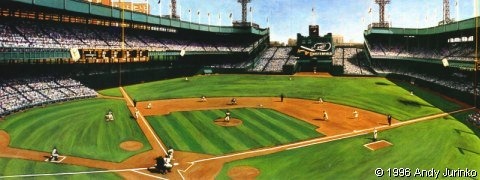
Such adjustments might, for example, knock Mel Ott from his second-place perch because Ott (a left-handed batter) played his entire career (about one-half of his games) at the Polo Grounds, with its short foul lines (only 258 feet down the right-field line) and cavernous center field:

But Ott had to pull the ball sharply to take advantage of the peculiar geometry of the Polo Grounds, which meant that he had to adopt and perfect a peculiar batting style (a matter of skill). Because of that style, pitchers could more easily avoid throwing him pitches that he could pull, and fielders could more readily position themselves to defend the outfield gaps. In spite of that, Ott compiled a lifetime batting average of .304 while leading his league in HR/AB 10 times! Ott stays on the list, as do the other odd-balls:

  • Barry Bonds and Mark McGwire, with their weight-training and performance-enhancing substances.
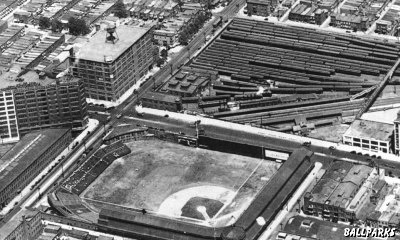
  • Cy Williams, a left-handed batter who compiled a lot of his home runs in the friendly confines of Baker’s Bowl, with its “short porch” in right field — only 280 feet down the line, and not much more than that into right-center:

But Willams wasn’t a fluke. He led his league in AB/HR five times in a 12-season span (1916-1927), and batted .292 over the course of his career, almost half of which was in the “dead ball” era.

It’s impossible, really, to compare players who were not contemporaries. That’s why I like Table 5. It affords the best picture of home-run prowess across time. Ruth still stands at the top of the list; the long-forgotten Mel Ott and Cy Williams are restored to the prominence they enjoyed when they played; and Ralph Kiner, Harmon Killebrew, Ted Williams, Mike Schmidt, and Willie McCovey re-gain their proper places of pre-eminence, unshadowed by players who racked up home runs through sheer longevity. Should McGwire and Bonds really be listed among the greats? Certainly they were the greats of their era, however they got there. That’s all I have to say about that — for now.

And so, with the help of Table 5, we can trace the succession of pre-eminent home-run hitters who played most or all of their careers in the “lively ball” era:

  • American League — Babe Ruth (13 times in the span from 1918 through 1931), Jimmie Foxx (4 times during 1932-1939), Ted Williams (6, 1941-1957), Harmon Killebrew (6, 1959-1970), Mark McGwire (6, 1987-1997), and Manny Ramirez (4, 1999-2005). Those six players combined to lead the league in HR/AB in 39 of the 88 seasons from 1918 through 2005.

    Go back to hitters who played mostly in the “dead ball” era and you find Frank (Home Run Baker) and Harry Davis, who dominated the AL’s home run lists (such as they were). Davis was a 4-time leader in HR/AB, from 1904 through 1907; Baker, a 4-time leader in the span from 1911 through 1916. Throw in, from the “lively ball” era, Lou Gehrig (2 times), Hank Greenberg (3), Gus Zernial (3), Mickey Mantle (2), Norm Cash (2), Dick Allen (2), Gorman Thomas (2), Reggie Jackson (2), Ron Kittle (2), Jose Canseco (2), Ken Griffey (2), and Jim Thome (2). Now you have a list of 20 players who combined to lead the AL in 73 of the 102 seasons from 1904 through 2005. That’s a select group of fearsome sluggers.

  • National League — Cy Williams (5 times in the span of 1916 through 1927), Mel Ott (10 times, 1929-1944), Ralph Kiner (7, 1947-1952), Willie Mays (4, 1955-1965), Willie McCovey (5, 1963-1970), Mike Scmidt (6, 1974-1986), and Barry Bonds (8, 1992-2004). Those seven players combined to lead the league in HR/AB in 45 of 90 seasons from 1916 through 2005.

    Now add Gavvy Cravath, another name from the “dead ball” era. Cravath — Ruth’s predecessor as all-time leader in total home runs — led the NL in HR/AB 6 times during the seven seasons of 1912 through 1918. Throw in, from the “lively ball” era, Rogers Hornsby (2), Hack Wilson (2), Wally Berger (2), Eddie Matthews (3), Hank Aaron (3), Dave Kingman (3), George Foster (2), Darryl Strawberry (3), and Mark McGwire (2, his 70 and 65 HR seasons) and you have a mere 17 players who combined to lead the NL in 73 of the 94 seasons from 1912 through 2005. Another select group of dominating sluggers.

To see who filled the gaps, go here.

ACKNOWLEDGEMENTS: Players’ statistics from Baseball-Reference.com; ballpark stats and photos from Ballparks by Munsey and Suppes.

A Belloc Anthology

My son has compiled an anthology of previously uncollected short stories by the English writer, Hilaire Belloc. You can buy the book here.

The Best Revenge

I have just learned of the recent death of a former colleague — a man who was my nemesis for most of the thirteen years of our association. That he was a nemesis is evident from his actions toward me; for example:

  • He tried, in vain, to block my promotion to the senior position that he sought for himself in order to justify his presence in the company. (He had been kicked out of what was then our parent organization and given the courtesy title of general counsel of the company that employed both of us.)
  • When I was trying to block a “sweetheart” real-estate deal — one that resulted in the relocation of our company to inferior quarters — he pretended to side with me and then informed the chairman of our board of the blocking effort, thus putting an end to it.
  • Years later, while I was working to relocate our company to more suitable quarters, he tried — clandestinely but unsuccessfully — to block my efforts.
  • He insisted on involving himself in legal matters affecting my operation, even though he was incompetent in those matters.
  • Although he was nominally our general counsel, that title was a “cover” for his role as our lobbyist on Capitol Hill. He failed spectacularly at that job except when he called, reluctantly, for the help of me and others who were knowledgeable, competent, and articulate.
  • He consistently sought compromise on issues where compromise would weaken the company’s reputation for integrity and management’s ability to manage. He and I were invariably opposed in such matters.

There is much more to our history, but you get the picture. He was an incompetent, inarticulate lawyer who held what was essentially a “political” appointment in a hard-nosed, non-political research organization. When he ran up against a competent, articulate, organized, and tenacious non-lawyer whom he saw as a competitor for leadership, his envy and resentment got the better of him. Being unable to compete openly, he resorted to treachery, regardless of the cost to the company and its effects on those touched by his treachery.

I last saw him almost nine years ago, on the occasion of my retirement. He was true to form even then, trying to put a good face on our relationship, which had become openly hostile. Soon after my retirement, however, he tried to sully my name, which only earned him a rebuke from our mutual boss, the CEO.

What do I feel now that he is gone? Nothing more than a vague sense of closure. Because I had prevailed over him on the issues that mattered most to me, the news of his death did not come as a kind of vicarious victory for me. Rather, the news simply drained from me the last, faint traces of bitterness I had felt toward him. Those traces were faint because when I retired I simply walked away from my job and looked back only to keep an eye on my final project — relocating the company to a better place — which came to a successful conclusion within a few years. And then I moved away from the dank environs of the D.C. area to a warm, sunny clime, where I lead a relaxed and serene life.

The best revenge is doing a good job and then living well after the job is done. I have done both.

Baseball Realignment

If I were the “czar” of Major League Baseball (TM), I would add two teams and create four leagues of eight teams each. Gone would be the designations American League and National League, which have become less and less meaningful with free agency and the standardization of umpiring practices. The remaining distinction that makes a difference — the designated-hitter rule — has been blunted by interleague play, and it would be simple enough for a “czar” to say “make it so” across the board.

My criterion for realignment would be to cluster natural rivalries, which would be a boon to fans and, thus, to owners and players because of greater attendance and media coverage. Think of the New York Giants and Brooklyn Dodgers, subway rivals for decades. Think of the attendance at Yankees-Mets interleague games. Then consider the demands of Peter Angelos, owner of the American League Baltimore Orioles, for compensation because the National League Montreal Expos were relocated to Washington, D.C., a mere 30 miles or so from Baltimore. Having a Baltimore team and a Washington team in the same division wouldn’t be a threat to Baltimore’s attendance, it would be a boon.

Anyway, here’s how I’d realign MLB (current league assignments in parentheses):

Pacific League
Seattle Mariners (A)
Portland ? (new)
San Francisco Giants (N)
Oakland Athletics (A)
Los Angeles Dodgers (N)
Los Angeles Angels (A)
San Diego Padres (N)
Arizona Diamondbacks (N)

Central League
Colorado Rockies (N)
Kansas City Royals (A)
St. Louis Cardinals (N)
Minnesota Twins (A)
Milwaukee Brewers (N)
Chicago Cubs (N)
Chicago White Sox (A)
Detroit Tigers (A)

Northeastern League
Cincinnati Reds (N)
Cleveland Indians (A)
Toronto Blue Jays (A)
Pittsburgh Pirates (N)
Philadelphia Phillies (N)
Boston Red Sox (A)
New York Yankees (A)
New York Mets (N)

Southern League
Texas Rangers (A)
Houston Astros (N)
Baltimore Orioles (A)
Washington Nationals(N)
Charlotte ? (new)
Atlanta Braves (N)
Tampa Bay Devil Rays (A)
Florida Marlins (N)

Yeah, a few old (but not very intense) rivalries would be broken up (e.g., Tigers and Indians, Tigers and Blue Jays), but look at all the new pairings: Mariners and Portland, Giants and As, Angels and Dodgers, Angels and Padres, Royals and Cardinals, Reds and Indians, Indians and Pirates, Yankees and Mets, Rangers and Astros, Orioles and Nationals, Charlotte and the Braves, Devil Rays and Marlins.

A return to eight-team leagues would allow for a shorter regular season. In my ideal MLB, there would be no interleague play until the end of the season, so that each team would play every other team in its league 22 times during the regular season — 11 games at home and 11 games away — just like the good old days from 1901 through 1960. That would reduce the regular season from 162 games to 154 games.

The season would be further shortened by eliminating the (yawn) All-Star Game. So, the season could start in mid-April instead of early April, when so many games are rained-, snowed-, and frozen-out.

Post-season play? Simple:

  • The league champ with the best W-L record faces the league champ with the worst W-L record,* leaving the division champs with the second- and third-best records to face each other. Both series are best-of-seven.
  • In the first round, the team with the better regular-season record is the home team for the first three games and the last two games (as they are necessary).
  • The first-round winners meet in the World Series (best-of-seven, of course). The team with the better regular-season record is the home team for the first three games and the last two games (as they are necessary).

The two-round playoff (vice the present three-round format) would cut a week off the end of the season. Games could be postponed when the weather is truly foul, instead of forcing players and fans to endure cold, rainy nights.

Would postseason play determine the best team? Probably not, for the reasons spelled out here. But my scheme would eliminate the possibility that a World Series could be won by a weak division winner or wild-card team.
__________
* Throughout the playoffs, ties for best/better-worst/worse record are decided by coin tosses.

Liberty, Human Nature, and the State

Liberty — simply defined — is the ability to do as one wishes, as long as one does not harm others. It follows that the members of a society can enjoy liberty only to the extent that each of them refrains from doing harm to the others. The exercise of such mutual restraint requires that each member of society must

1. agree to the same definition of harm; and

2. trust that other persons will not harm him, so that (a) he is not tempted to act pre-emptively against them or (b) he is not quick to decide that he has been harmed when there is ambiguity about the intent of effect of another’s actions; and

3. given 1 and 2, be unwilling to do harm to other persons, out of (a) respect or affection for them, (b) a desire for respect or affection from them, or (c) empathy for them; or

Alternatively, given condition 1 (an agreed definition of harm), each member of society must

4. be deterred from causing harm by the likelihood of being punished.

Conditions 1, 2, and 3 are the pillars of civil society — a society that regulates itself and operates without interference by a state. The fragility of civil society can be seen in the fragility of the conditions for its existence. There is no room in those conditions for

5. disagreement about harm, except to the extent that members of society are willing to compromise their views in return for something of value from others (e.g., respect, affection, mutual defense).

6. persons who are untrusting, untrustworthy, sociopathic, or unempathic.

But, given the likelihood of conditions 5 and 6, it is futile to expect civil society to arise absent condition 4. And condition 4 cannot arise as an agreement among all members of society as long as conditions 5 and 6 persist. (Anarchists and anarcho-capitalists seem blind to this contradition, which is inherent in their philosophies.)

Society therefore quickly devolves into a “warre of every man against every man,” or at least a war of faction against faction. Or it does so unless enough “men” band together to impose upon all a uniform definition of harms and a state that is capable of enforcing that definition. “Enough” may be a majority or even a super-majority, but it is unlikely ever to be a consensus. Human nature is too varied for that.

The best one may hope for, then, is a state that is (a) accountable to all members of society (even those who do not endorse its ruling faction or its existence) and (b) liberal (in the old, anti-statist meaning of that word). Minarchism prescribes such a state. It follows, therefore, that minarchism is the only viable libertarian philosophy.

Related posts:
Defense, Anarcho-Capitalist Style
But Wouldn’t Warlords Take Over?
My View of Warlordism, Seconded
Anarcho-Libertarian Stretching
QandO Saved Me the Trouble
Sophomoric Libertarianism
Nock Reconsidered
The Meaning of Liberty
The Harm Principle
Footnotes to “The Harm Principle”
The Harm Principle, Again
Actionable Harm and the Role of the State
Rights and “Cosmic Justice”
A Flawed Defense of Anarcho-Capitalism
Mises on Liberty and the State
Varieties of Libertarianism

A New Constitution, Revised Again

I have further revised my re-write of the Constitution of the United States. You can read the whole thing at “A New Constitution.”

Another blogger once said of such efforts that

[a]ll the Constitution really needs is some well-placed “And we mean it!” clauses:

–The Ninth Amendment…and we mean it!

Privileges or Immunities…and we mean it!

–Taking property only for public use…and we mean it!

And so on.

Maybe abolish the well-intentioned but subsequently corrupted Necessary & Proper Clause, clarify the meaning of “regulate” in the Commerce Clause to return it to its intended denotation (i.e., “to make regular,” or “to standardize”) and of “commerce” to “that which is not agriculture or manufacturing” (i.e., trade).

The rest is all bells and whistles.

Not quite. The devil, as they say, is in the details. The main problem with the Constitution is not what it means but what meanings can be imputed to it because of its vagueness and ambiguity. What the Constitution really needs is a lot of loophole-closing and more checks on Congress and the Supreme Court, both of which have subverted and twisted the Constitution’s intended meanings.

My “new Constitution” is not only far more specific than the original — and more restrictive of the powers of government — but it also includes more checks on those powers. Specifically, there is this provision in Article V:

A judgment of any court of the United States of America may be revised or revoked by an act of Congress, provided that such any revision or revocation is approved by two-thirds of the members of each house and leads to a result that conforms to this Constitution.

Then there is Article VII, Conventions of the States, which opens with this:

Delegations of the States shall convene every four years for the purpose of considering revisions to and revocations of acts of Congress and/or holdings of the Supreme Court of the United States of America. Such conventions (hereinafter “convention of the States”) may revise and/or revoke any act or acts and/or any holding or holdings, in the sole discretion of a majority of State delegations present and voting.

Read the whole thing.

A Man-Bites-Dog Story

What got into the highest court of the State of New York? Today it actually deferred to the legislature on the question of same-sex marriage:

We hold that the New York Constitution does not compel recognition of marriages between members of the same sex. Whether such marriages should be recognized is a question to be addressed by the Legislature.

How can that be? Isn’t it the job of the courts to impose untruth, injustice, and the un-American way when the elected representatives of the people fail to do so? But a majority of the New York supremes refused to bow to Leftish wisdom. According to The New York Times:

The decision called the idea of same-sex marriage “a relatively new one” and said that for most of history, society has conceived of marriage exclusively as a bond between a man and a woman. “A court should not lightly conclude that everyone who held this belief was irrational, ignorant or bigoted,” the decision stated.

“There are at least two grounds that rationally support the limitation on marriage that the legislature has enacted,” the court said, “both of which are derived from the undisputed assumption that marriage is important to the welfare of children.”

First, the court said, marriage could be preserved as an “inducement” to heterosexual couples to remain in stable, long-term, and child-bearing relationships. Second, lawmakers could rationally conclude that “it is better, other things being equal, for children to grow up with both a mother and the father.”

Jennifer Roback Morse couldn’t have said it better.

UPDATE: Less of a surprise is today’s unanimous ruling by the Supreme Court of Georgia, reversing a trial court and upholding a constitutional amendment barring gay marriage. That amendment was approved in 2004 by 76 percent of the voters of Georgia. How dare they?

Related posts:
Libertarianism, Marriage, and the True Meaning of Family Values
“Equal Protection” and Homosexual Marriage

What Would We Do Without the UN?

UPDATED, 11:20 PM

The lede of an AP story:

UNITED NATIONS – Japan said Wednesday it is considering sanctions against North Korea in a U.N. resolution that would condemn the reclusive communist nation’s missile tests and call for a return to six-party talks on its nuclear program.

Maybe if North Korea were less reclusive . . . (Hah!)

UPDATE: In case you were wondering whether Russia and China are our allies:

UNITED NATIONS – China and Russia resisted an attempt in the U.N. Security Council to impose sanctions against North Korea for its missile launches Wednesday, saying only diplomacy could halt the isolated regime’s nuclear and rocket development programs.

Seems to me that what brought the USSR to its knees wasn’t diplomacy.

Sic ’em, George.

The First Roosevelt

Bryan Caplan notes that

Time has put Teddy Roosevelt on the cover of its 5th Annual Special Issue, and the coverage stretches the limits of sycophancy. It reminds me of my high school history textbook, which praised any President who backed new regulations or started a war.

Thomas Sowell weighs in:

Theodore Roosevelt was indeed a landmark figure in the development of American politics and government, but in a very different sense from the way he is portrayed in Time magazine. In fact, the way that Theodore Roosevelt has been celebrated by many in the media and among the intelligentsia tells us more about them than about the first President Roosevelt. . . .

According to Time magazine, TR believed that “government had the right to moderate the excesses of free enterprise.” Just what were these excesses? According to Time, “poverty, child labor, dreadful factory conditions.”

All these things were attributed to the growth of industrial capitalism — without the slightest evidence that any of them was better before the growth of industrial capitalism. Nothing is easier than to imagine some ideal past or future society or to imagine that the net result of government intervention is bound to be a plus.

Sowell goes on to put the boot into that belief.

My own views about TR’s influence on America can be found in two posts. Here I point to the beginnings of the regulatory-welfare state during TR’s presidency (1901-9):

What happened around 1906? First, the regulatory state began to encroach on American industry with the passage of the Food and Drug Act and the vindictive application of the Sherman Antitrust Act, beginning with Standard Oil (the Microsoft of its day).

And here — in my antidote to standard history texts for schoolchildren — I have more to say about the First Roosevelt; for example:

Roosevelt was an “activist” President. Roosevelt used what he called the “bully pulpit” of the presidency to gain popular support for programs that exceeded the limits set in the Constitution. Roosevelt was especially willing to use the power of government to regulate business and to break up companies that had become successful by offering products that consumers wanted. Roosevelt was typical of politicians who inherited a lot of money and didn’t understand how successful businesses provided jobs and useful products for less-wealthy Americans.

It ran in the family.

Certain Unalienable Rights . . .

. . . that among these are Life, Liberty and the pursuit of Happiness.–That to secure these rights, Governments are instituted among Men, deriving their just powers from the consent of the governed, –That whenever any Form of Government becomes destructive of these ends, it is the Right of the People to alter or to abolish it, and to institute new Government, laying its foundation on such principles and organizing its powers in such form, as to them shall seem most likely to effect their Safety and Happiness. Prudence, indeed, will dictate that Governments long established should not be changed for light and transient causes; and accordingly all experience hath shewn, that mankind are more disposed to suffer, while evils are sufferable, than to right themselves by abolishing the forms to which they are accustomed. But when a long train of abuses and usurpations, pursuing invariably the same Object evinces a design to reduce them under absolute Despotism, it is their right, it is their duty, to throw off such Government, and to provide new Guards for their future security.

Whatever your view of the origin of rights or the necessity of a state, today is a day to reflect on the central argument of the Declaration of Independence:

That to secure these rights, Governments are instituted among Men, deriving their just powers from the consent of the governed, –That whenever any Form of Government becomes destructive of these ends, it is the Right of the People to alter or to abolish it, and to institute new Government, laying its foundation on such principles and organizing its powers in such form, as to them shall seem most likely to effect their Safety and Happiness.

That argument remains as valid today as it was 230 years ago. It is time for a constitutional convention to redeem the promise of liberty made in the Declaration of Independence.

Related posts:
The Erosion of the Constitutional Contract
The Constitution in Exile

Varieties of Libertarianism

There are four basic models of libertarianism, which I sketch in this table:

Origin of Rights

Proper Role of the State

Innate

Consensual

None

We are naturally endowed with rights, and our only assurance of retaining them is to rely solely on voluntary associations and institutions for such ends as justice and self-defense. The state is therefore illegitimate; we own ourselves and should not be accountable to the state.

Rights arise from experiential consensus about the allowable limits of human behavior consistent with general well-being. Our only assurance of retaining our rights is to rely solely on voluntary associations and institutions for such ends as justice and self-defense.

Minimal for defense of life, liberty, and property

We are naturally endowed with rights, but our best assurance of being able to exercise them is to rely on a minimal state, which is created and sustained by the consent of the people (or at least a super-majority of them), and is accountable to them. Such a state is a necessary safeguard against predators, who arise naturally, ignoring and exploiting the voluntary institutions of statelessness.

Rights arise from experiential consensus about the allowable limits of human behavior consistent with general well-being. Our best assurance of exercising our rights them is to rely on a minimal state, which is created and sustained by the consent of the people (or at least a super-majority of them), and is accountable to them. Such a state is a necessary safeguard against predators who arise naturally, ignoring and exploiting the voluntary institutions of statelessness.

You will find many assumptions and ambiguities in those sketches — just as you will find them among the the four schools of libertarianism that they represent. For example:

  • If rights are innate, how do they become innate? Do they float freely in the air, somewhat like Platonic ideals, just waiting to descend upon us?
  • What is harm (the boundary of rights), and who defines it?
  • If the state is illegitimate, why is that so? By what meta-criterion does one judge the legitimacy or illegitimacy of the state (or any particular state)?
  • If there is a consensus about rights, what drives the consensus? And what if there isn’t a consensus but a majority view?
  • Are rights valuable simply for their own sake or because their exercise produces better outcomes (happiness, income, wealth) for most if not all persons? And if not all persons, how does one decide who “loses”?
  • When does a minimal state cease being minimal? For example, can it defend its citizens from foreign invaders but not from the byproducts of domestic activity, such as pollution, some of which might be impossible to control through market mechanisms or the common law?
  • At what point does the initiation of action in self-defense become permissible — only when one sees “the whites of their eyes” (when it may be too late), or when a known enemy is planning to build a weapon that could harm us?

The answers to such questions not only demarcate the four schools but also point to divisions of opinion within each school. Libertarianism isn’t a monolithic belief system. If it were, it wouldn’t be libertarianism.

The school of libertarianism in the upper-left cell of the matrix usually is called anarcho-capitalism. It is associated mainly with Murray Rothbard.

There also are anarcho-capitalists who take a consequentialist view of rights (e.g., David Friedman). They would be described in the upper-right cell of the matrix.

The lower-left cell of the matrix more or less describes the Founders and Framers of the United States and its Constitution. More generally it describes what might be called “religious” libertarians — persons who believe in the innateness of rights (perhaps as God-given) but who believe also in the necessity of a state to ensure the exercise of those rights. The philosopher Robert Nozick was of this persuasion, although (as far as I can tell) he is murky about the mechanism by which rights devolve upon humans. (The lower-left cell also gives a fair summary of Objectivism, even though most Objectivists eschew the “libertarian” label. I am indebted to a reader for correcting me on this point. Originally, I had associated Objectivism with the upper-left quadrant.)

The lower-right cell describes most minarchists, whose exemplar is Friedrich Hayek. Minarchists of Hayek’s ilk generally see rights as man-made, and they see the state as an inevitable and necessary but nevertheless dangerous institution, to be kept closely in check.

What the four schools of libertarianism have in common is a commitment to greater individual freedom (absent the freedom to do harm) and less interference by the state in human affairs. Modern “liberalism,” by contrast, views greater individual freedom as requiring more interference by the state.

I am more or less a Hayekian minarchist (perhaps more of a minarchist than was Hayek). My views on rights and liberty are spelled out in many posts on this blog. See especially “Practical Libertarianism” (a series), “The Meaning of Liberty” (a series), and “Actionable Harm and the Role of the State” (a long post with links to many relevant posts).