The Anti-Hall of Fame and Baseball "Immortals"

Baseball’s Hall of Fame is cluttered with pitchers and batters who plainly do not belong there. I hereby present my Anti-Hall of Fame: players who do not belong in the Hall of Fame.

A Hall of Fame pitcher will have

  • at least 300 wins
  • or, at least 250 wins and an ERA+ of 120 or higher. (Go here and scroll down for the definition of ERA+.)
  • or, at least 200 wins and a W-L average of .600 or better and an ERA+ of 120 or higher.
  • or, for relief pitchers, an ERA+ of 120 or higher.

The following pitchers therefore belong in my Anti-Hall of Fame:

Chief Bender
Jim Bunning
Jack Chesbro
Dizzy Dean
Don Drysdale
Dennis Eckersley
Red Faber
Rollie Fingers
Pud Galvin
Lefty Gomez
Burleigh Grimes
Jesse Haines
Waite Hoyt
Catfish Hunter
Fergie Jenkins
Addie Joss
Sandy Koufax
Bob Lemon
Ted Lyons
Rube Marquard
Hal Newhouser
Satchel Paige
Herb Pennock
Eppa Rixey
Robin Roberts
Red Ruffing
Dazzy Vance
Rube Waddell
Ed Walsh
John Ward
Vic Willis

With the removal of those 31 names, 35 pitchers would remain in the Hall of Fame.

The selection of batters for my Anti-Hall of Fame is a somewhat trickier business. Consider Johnny Bench: a lifetime .267 hitter but a great catcher and a leader on the field. Should I place a Bench in my Anti-Hall of Fame? What about Luis Aparicio, a fine shortstop who stole a lot of bases relative to his peers? The list could go on and on. So I decided to construct an anti-Hall of Fame that applies only to batting. Some players in this Anti-Hall of Fame might belong in the Hall of Fame for their other exploits, but they do not belong there for their batting skills. My batting criteria:

  • an OPS+ of at least 150 (Go here and scroll down for the definition of OPS+, which is a measure of offensive prowess that adjusts for a player’s ballpark and the era in which he played.)
  • or, at least 2,800 lifetime hits and a lifetime batting average of at least .300
  • or, an OPS+ of at least 120 and at least 2,000 lifetime base hits or a lifetime batting average of at least .300

My Anti-Hall of Fame for batters:

Luis Aparicio
Luke Appling
Richie Ashburn
Earl Averill
Frank Baker
Dave Bancroft
Lou Boudreau
Lou Brock
Willard Brown
Roy Campanella
Max Carey
Gary Carter
Frank Chance
Jimmy Collins
Joe Cronin
Larry Doby
Bobby Doerr
Johnny Evers
Carlton Fisk
Nellie Fox
Gabbby Hartnett
Billy Herman
Harry Hooper
Monte Irvin
Travis Jackson
Hughie Jennings
George Kell
George Kelly
Ralph Kiner
Tony Lazzeri
Freddie Lindstrom
Rabbit Maranville
Bill Mazeroski
Tommy McCarthy
Bid McPhee
PeeWee Reese
Phil Rizzuto
Brooks Robinson
Ryne Sandberg
Ray Schalk
Red Schoendienst
Joe Sewell
Ozzie Smith
Joe Tinker
Pie Traynor
Bobby Wallace
Lloyd Waner
John Ward
Ross Youngs
Robin Yount

The deletion of those 50 names would leave 91 batters in the Hall of Fame, including . . . Johnny Bench.

You can consult the Hall of Fame listings for pitchers and batters to see who would remain in my Hall of Fame after excluding those listed above.

But which of the 35 pitchers and 91 batters who qualify for my Hall of Fame are true baseball “immortals” who belong in a select inner circle? My criteria for “immortality” are somewhat more stringent than my criteria for membership in the Hall of Fame. An “immortal” pitcher will have at least 250 wins, a winning average of at least .600, and an ERA+ of at least 120. (A reliever qualifies with an ERA+ of at least 120.) An “immortal” batter will have an OPS+ of at least 150 or at least 2,800 hits and a lifetime batting average of at least .300.

Herewith the “immortal” pitchers:

Pete Alexander
John Clarkson
Bob Feller
Lefty Grove
Carl Hubbell
Walter Johnson
Tim Keefe
Christy Mathewson
Kid Nichols
Jim Palmer
Eddie Plank
Charley Radbourn
Tom Seaver
Bruce Sutter
Hoyt Wilhelm
Cy Young

And the “immortal” batters:

Hank Aaron
Cap Anson
Jake Beckley
Wade Boggs
George Brett
Dan Brouthers
Jesse Burkett
Rod Carew
Roberto Clemente
Ty Cobb
Eddie Collins
Roger Connor
Sam Crawford
Ed Delehanty
Joe DiMaggio
Jimmie Foxx
Frankie Frisch
Lou Gehrig
Charlie Gehringer
Hank Greenberg
Rogers Hornsby
Willie Keeler
Nap Lajoie
Mickey Mantle
Willie Mays
Johnny Mize
Paul Molitor
Stan Musial
Mel Ott
Sam Rice
Frank Robinson
Babe Ruth
Al Simmons
George Sisler
Tris Speaker
Honus Wagner
Paul Waner
Zack Wheat
Ted Williams

Thus my Hall of Fame would have an inner circle of “immortals”: 16 of 35 pitchers (vice the present number of 66) and 39 of batters 91 (vice the present number of 141). La crème de la crème.
Terrorists’ "Rights" and the Military Commissions Act of 2006

Cato’s Mark Moller finds that the Military Commissions Act of 2006 “is not patently unconstitutional—but it is hardly on uncontrovertible constitutional footing, either.” That is not a surprising conclusion, coming as it does from a member of the “libertarian” camp that cannot seem to focus on a key purpose of the Constitution: the protection of the liberties of American citizens.

Andrew McCarthy, writing at National Review Online, is well focused — as usual. As McCarthy points out,

Congress has already given al Qaeda detainees the very rights the critics claim have been denied [by the Military Commissions Act of 2006].

Last December, Congress enacted the Detainee Treatment Act (DTA). It requires that the military must grant each detainee a Combatant Status Review Tribunal (CSRT) at which to challenge his detention. Assuming the military’s CSRT process determines he is properly detained, the detainee then has a right to appeal to our civilian-justice system — specifically, to the U.S. Court of Appeals for the D.C. Circuit. And if that appeal is unsuccessful, the terrorist may also seek certiorari review by the Supreme Court.

McCarthy explains that, under the Constitution, terrorists have no habeas corpus rights or treaty rights:

Congress cannot “suspend” habeas corpus by denying it to people who have no right to it in the first place. The right against suspension of habeas corpus is found in the Constitution (art. I, 9). Constitutional rights belong only to Americans — that is, according to the Supreme Court, U.S. citizens and those aliens who, by lawfully weaving themselves into the fabric of our society, have become part of our national community (which is to say, lawful permanent resident aliens). To the contrary, aliens with no immigration status who are captured and held outside the territorial jurisdiction of the United States, and whose only connection to our country is to wage a barbaric war against it, do not have any rights, much less “basic rights,” under our Constitution. . . .

Isn’t habeas corpus necessary so that the terrorists can press the Geneva Convention rights with which the Court most recently vested them in its 2006 Hamdan case? Wrong again.

To begin with, although its reasoning was murky, the Hamdan majority seems technically to have held that Geneva’s Common Article 3 applied to military commissions because of a congressional statute, the Uniform Code of Military Justice. Again, if a right is rooted in a statute, not in the Constitution, Congress is at liberty to withdraw or alter the right simply by enacting a new statute. Such a right is not in any sense “basic.”

If the Supreme Court were to decide that the Military Commissions Act of 2006 is unconstitutional, it would be high time for President Bush to take a Jacksonian stance: “The Supreme Court has made its decision, now let them enforce it.” I would base that stance on an earlier holding by the Court:

The provisions of the Constitution which confer on the Congress and the President powers to enable this country to wage war are as much part of the Constitution as provisions looking to a nation at peace. And we have had recent occasion to quote approvingly the statement of former Chief Justice Hughes that the war power of the Government is “the power to wage war successfully.” . . . Therefore, the validity of action under the war power must be judged wholly in the context of war. That action is not to be stigmatized as lawless because like action in times of peace would be lawless.

— Justice Felix Frankfurter, concurring in Korematsu v. United States (1944)

Apropos Paternalism

Will Wilkinson, in a TCS Daily review of John Cassidy’s New Yorker article about neuronomics, writes:

Paternalism is the use of coercion to force people to do or refrain from something against their will for their own good. Liberals of all stripes generally reject paternalism for reasons most lucidly laid out in J.S. Mill’s masterpiece On Liberty. First, we assume the individual is the best judge of her own good. Second, whether or not the individual is the best judge of her own good, we rightly doubt that another individual (or assembly thereof) has the legitimate moral authority to substitute their judgment for the individual’s by force — especially in light of widespread disagreement about the nature of a good life. Third, truth is hard to come by, and none of us can be fully certain we’ve pinned it down. Allowing people to act on diverse opinions about morality (or rationality) broadens the search for truth about good lives by setting up a decentralized system of social laboratories where experiments in living succeed or fail in plain view. So, unless an action harms somebody else, people should be at liberty to satisfy their preferences, whether saintly or sinful, coolly rational or impulsively emotional.

The conceit of the new paternalism is that the state isn’t going to be in the business of telling us which beliefs and desires we are allowed to act on, but will simply nudge people into doing what we wanted to do anyway, but couldn’t manage by ourselves. The idea is that there are things we want to do, but, due to some foible of mind, we are unable to do it without a little outside help. . . .

Some of the new so-called “soft” paternalistic measures, such as employers helping workers to increase their rate of savings by requiring them to opt out of, rather than opt into, a retirement plan aren’t paternalistic in any sense; that’s a part of a fully voluntary labor contract. [ED: This is not true when government, through tax incentives, encourages the widespread adoption by employers of such practices.] And policies like increasing the taxes on cigarettes or fatty foods in order to discourage potentially harmful consumption choices, are straightforwardly paternalistic in the old sense, requiring a one-size-fits-all value judgment about how much and for what reason we should consume certain goods.

Those kinds of judgments aren’t the proper work of government. In any case, if you really think people make systematic “mistakes” in judgment and choice, there is no reason to believe that democratic voters — who have less at stake when casting their ballots than when choosing what to have for lunch — will be especially good at populating the government with Spock-like rational legislators interested in tweaking cognition through expertly targeted policy rather than with well-coiffed primates interested in hoarding status and power.

As Michael Munger puts it, in an essay at The Library of Economics and Liberty,

The boundary we fight over today divides what is decided collectively for all of us from what is decided by each of us. You might think of it as a property line, dividing what is mine from what is ours. And all along that property line is a contested frontier in a war of ideas and rhetoric.

For political decisions, “good” simply means what most people think is good, and everyone has to accept the same thing. In markets, the good is decided by individuals, and we each get what we choose. This matters more than you might think. I don’t just mean that in markets you need money and in politics you need good hair and an entourage. Rather, the very nature of choices, and who chooses, is different in the two settings. P.J. O’Rourke has a nice illustration of the way that democracies choose.

Imagine if all of life were determined by majority rule. Every meal would be a pizza. Every pair of pants, even those in a Brooks Brothers suit, would be stone-washed denim. Celebrity diets and exercise books would be the only thing on the shelves at the library. And—since women are a majority of the population, we’d all be married to Mel Gibson. (Parliament of Whores, 1991, p. 5).

O’Rourke was writing in 1991. Today, we might all be married to Ashton Kutcher, instead. But you get the idea: Politics makes the middle the master. The average person chooses not just for herself, but for everyone else, too. . . .

The thing to keep in mind is that market processes, working through diverse private choice and individual responsibility, are a social choice process at least as powerful as voting. And markets are often more accurate in delivering not just satisfaction, but safety. We simply don’t recognize the power of the market’s commands on our behalf. As Ludwig von Mises famously said, in Liberty and Property, “The market process is a daily repeated plebiscite, and it ejects inevitably from the ranks of profitable people those who do not employ their property according to the orders given by the public.”

Paternalism — when it is sponsored or enforced by government — deprives us of the ability to think for ourselves, to benefit from our wise decisions, and to learn from our mistakes. It all adds up to regress, not progress.

Related posts:
The Rationality Fallacy
Libertarian Paternalism
A Libertarian Paternalist’s Dream World
The Short Answer to Libertarian Paternalism
Second-Guessing, Paternalism, Parentalism, and Choice
Another Thought about Libertarian Paternalism
Back-Door Paternalism
Another Voice Against the New Paternalism
A Further Note about “Libertarian” Paternalism

The Big Bang and Atheism

From a press release issued yesterday by The Royal Swedish Academy of Sciences:

The [academy] has decided to award the Nobel Prize in Physics for 2006 jointly to John C. Mather NASA Goddard Space Flight Center, Greenbelt, MD, USA, and George F. Smoot University of California, Berkeley, CA, USA “for their discovery of the blackbody form and anisotropy of the cosmic microwave background radiation”. . . .

This year the Physics Prize is awarded for work that looks back into the infancy of the Universe and attempts to gain some understanding of the origin of galaxies and stars. It is based on measurements made with the help of the COBE satellite launched by NASA in 1989.

The COBE results provided increased support for the Big Bang scenario for the origin of the Universe, as this is the only scenario that predicts the kind of cosmic microwave background radiation measured by COBE. These measurements also marked the inception of cosmology as a precise science. . . .

According to the Big Bang scenario, the cosmic microwave background radiation is a relic of the earliest phase of the Universe. Immediately after the big bang itself, the Universe can be compared to a glowing “body emitting radiation in which the distribution across different wavelengths depends solely on its temperature. The shape of the spectrum of this kind of radiation has a special form known as blackbody radiation. When it was emitted the temperature of the Universe was almost 3,000 degrees Centigrade. Since then, according to the Big Bang scenario, the radiation has gradually cooled as the Universe has expanded. The background radiation we can measure today corresponds to a temperature that is barely 2.7 degrees above absolute zero. The Laureates were able to calculate this temperature thanks to the blackbody spectrum revealed by the COBE measurements. . . .

The success of COBE was the outcome of prodigious team work involving more than 1,000 researchers, engineers and other participants. John Mather coordinated the entire process and also had primary responsibility for the experiment that revealed the blackbody form of the microwave background radiation measured by COBE. George Smoot had main responsibility for measuring the small variations in the temperature of the radiation.

According to Wikipedia, “[m]ost cosmologists consider [cosmic microwave background] radiation to be the best evidence for the hot big bang model of the universe.” That model, and the observations which support it, suggest

that the universe has expanded from a state in which all the matter and energy in the universe was at an immense temperature and density. Physicists do not widely agree on what happened before this, although general relativity predicts a gravitational singularity (for reporting on some of the more notable speculation on this issue, see cosmogony).

What preceded and caused the Big Bang? The possibility of a creation by an intelligent force cannot be ruled out. Atheism, therefore, is an unscientific stance because it posits an unfalsifiable hypothesis: the non-existence of an intelligent creator.

Related posts:
Atheism, Religion, and Science
The Limits of Science
Three Perspectives on Life: A Parable
Beware of Irrational Atheism
The Creation Model
Science, Logic, and God

The Dow and the Stock Market

There is much ado today about the Dow Jones Industrial Average, which hit an all-time high. That’s nice, but the Dow is a narrow, price-weighted index of stock prices. It does not include gains from reinvested dividends, and it is not adjusted for inflation.

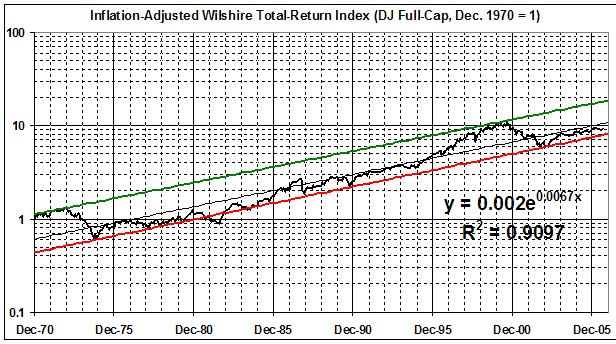
Far better is the Dow Jones Wilshire 5000 Composite Index (better known as the Wilshire 5000), which now tracks about 5,400 U.S. stocks and is weighted by the market capitalization of those stocks. There is a total-return version of the index that includes gains from reinvested dividends, as opposed to price gains only. (I obtain monthly values for the total-return index here.)

When adjusted for inflation, the total-return index gives a good indication of the state of the U.S. stock market as a long-term investment vehicle. (I use the CPI-U, available here, as the measure of inflation.)

The green and red lines trace the “trading channel” around the long-term trend (black line), the equation for which is shown on the chart. The long-term trend represents a real, annual gain of 8.4 percent a year, with dividends reinvested.

It’s evident that the cumulative value of U.S. stocks, in real terms, remains well below the speculative peak of six years ago. That’s just as well. We are seeing steady, restrained growth in the inflation-adjusted cumulative index — much like that of the late ’80s and early ’90s — which is a good sign for the stock market and for the economy.