Always Prepare for the Next War

McQ, in a post at QandO, says:

I’d like to see someone actually do a real defense review and tell me why submarines and strategic bombers at the level we have them today are still necessary. Our future military conflicts are much more likely to be low-tech light infantry combat and not high-tech near peer battles.

I don’t know what a “real defense review” is, but I do know that if we don’t maintain our strategic nuclear forces we’ll be at the mercy of this guy (and his successors):

Anarchistic Balderdash

Writing at Ludwig von Mises Institute, F.A. Harper says:

Liberty is the absence of coercion of a human being by any other human being; it is a condition where the person may do whatever he desires, according to his wisdom and conscience.

This means that to have liberty one must be free without qualification or modification, so far as his social relationships are concerned. Nature will still impose its restrictions on him, of course; but his fellow men shall impose none.

In order to bring this definition more clearly into focus, consider as an alternative a definition which seems to be the only possible one to be selected in its stead:

Liberty is a condition where the person must do whatever another person desires that he shall do, according to the other person’s wisdom and conscience.

This is the sole alternative, because for any one act under consideration there are only two possibilities:

  1. you determine what you shall do, or
  2. you are prohibited from determining what you shall do.

The last of these two possibilities means that some other person or persons will decide what you shall do, and force you to do it. That seems to be a definition of slavery rather than of liberty, and therefore I must reject it. And since there is no other alternative — since a person must act voluntarily by his own wisdom and conscience or involuntarily according to the mandate of another person — the first definition seems to me to be the only tenable one.

Harper’s proposed definition fails a simple test of logic. Imagine a population of three entities: A, B, and C. (Three is a more problematic number than two, as I’ll show.) Suppose that A, B, and C covet each other’s possessions and that each might, as a result, murder the others to gain their possessions. After all, Harper’s definition of liberty would allow them to do just that. Thus the logical fallacy in Harper’s definition:

  • If A kills B, B is no longer able to do as he wishes. Similarly with B and C, C and A, or any combination of two against one or one against two.
  • It follows that neither A, nor B, nor C enjoys liberty. Why? Because, even though each is free to do as he wishes without regard for the others, that very freedom stands to deprive each of his life.
  • Without life, liberty — the freedom to do entirely as one wishes (in Harper’s definition) — is a nullity.

What about Harper’s “sole alternative,” which is “where the person must do whatever another person desires that he shall do”? Harper, in his zeal to propound anarchy, omits the real alternative, the one that flows from my negation of Harper’s definition of liberty:

  • A, B, and C — knowing that it is dangerous to each of them to allow the others to live by Harper’s definition of liberty — agree that (among other things) murder is a forbidden activity, and that one may not murder another except in self-defense. (They further agree as to the ways and means of enforcing their prohibition of murder, of course.)
  • That is liberty, for it enables each of them to live and, therefore, to “pursue happiness” within their respective means.

What if A and B agree, honorably, not to kill each other, whereas C “leaves his options open”? It then behooves A and B to reach a further agreement, which is that they will defend each other against C. (This is analogous to the decision of the original States to adopt the Constitution because it bound each of them to provide men, matériel, and money for the defense of all of them.) A and B therefore agree to live in liberty (the liberty of self-restraint and mutual defense), whereas C stands outside that agreement. He has forfeited the liberty of self-restraint and mutual self-defense. How so? A and B, knowing that C has “left his options open,” might honorably kill or imprison C when they have good reason to believe that C is planning to kill them or acquire the means to kill them.

It boils down to this: Liberty requires mutual restraint, tacitly or explicitly agreed, which is based on self-interest. Liberty is not a condition in which one may “do whatever he desires, according to his wisdom and conscience.” Nor is liberty a condition in which a “person must do whatever another person desires that he shall do, according to the other person’s wisdom and conscience.” It is, rather, a condition in which each person adheres to agreed rules of behavior, rules that serve his interest as well as the interests of others.

Now, Harper might say that the liberty of mutual restraint is consistent with his statement that

[l]iberty as I have defined it does not preclude as guidance for one’s acts any form or degree of advice and influence, if voluntarily accepted, which, originates elsewhere than within himself. This guidance might be religious influences, evidence from historical records, scientific knowledge, the advice of another person, or even processes of mental telepathy or clairvoyance or insight from mystical origins, to whatever extent these may occur. If willingly accepted, the act resulting from such influences is as much an act of liberty as would be any other.

But I am talking about more than “advice and influence…voluntarily accepted” as “guidance for one’s acts.” I am talking about liberty as the result of mutual restraint (tacit or explicit). Such restraint is no more voluntary than, say, eating; it is necessary to the preservation of life and, therefore, of liberty. (You may choose to fast or to kill, but you may do neither with impunity, for very long.) of In a society of liberty, those who do not abide by the edict of mutual restraint stand to forfeit their own liberty.

Related posts:
The Meaning of Liberty
Libertarianism and Preemptive War: Part I
Libertarianism and Preemptive War: Part II

Related reading: Arnold Kling, writing at EconLog about this exchange at Cato Unbound.

Democracy and the Irrational Voter

It is well understood that voters, by and large, vote irrationally: emotionally, on the basis of “buzz” instead of facts, and inconsistently. (See this, this, and this, for example.) Voters are prone to vote against their own long-run interests because they do not understand the consequences of the sound-bite policies advocated by politicians (nor do politicians, for that matter). American “democracy,” by indiscriminately granting the franchise — as opposed to limiting it to, say, married property owners over the age of 30 who have children — empowers the run-of-the-mill politician who seeks office (for the sake of prestige, power, and perks) by pandering to the standard, irrational voter.

Essentially, then, democracy is an enemy of liberty, as I have explained several times in various ways:
Democracy vs. Liberty
Something Controversial
Yet Another Look at Democracy
More about Democracy and Liberty

If Liberty Depends on Democracy, We’re Doomed to Slavery
Conservatism, Libertarianism, Socialism, and Democracy

Anthony Kennedy: Useless Idiot

According to the Associated Press:

Supreme Court Justice Anthony Kennedy painted a dismal picture of injustice and lack of opportunity in much of the world, then told lawyers Monday [August 13] that they must do something.

Kennedy used a ceremony in which the American Bar Association presented him its highest award to talk about the plight of rape victims who must pay a fee before they file a complaint, young girls used by their families to have sex with tourists, prisoners who develop gangrene because they get no medical care.

”The rule of law and your own freedom are not secure unless you address problems in those countries,” Kennedy said.

Given the audience (lawyers) and the setting (San Francisco) I am sure that Kennedy’s remarks were received warmly. I am confident that the same audience in the same setting would soundly reject this truth: The police and armed forces of the United States are far more necessary to the preservation of the rule of law and the freedoms of Americans than a bunch of well-heeled Left-wing lawyers.

Presidential Legacies

UPDATED, WHERE NOTED

I have written several times about presidents and the presidency. This time I focus on the dual legacy of the presidents: the legacy they brought to the presidency and the legacy they bestowed on it. I begin with a selection of pre-twentieth century presidents, then rip through the Teddy Roosevelt-George W. Bush succession. (I indicate parenthetically the years of each president’s birth and death, and the years in which his presidency began and ended.)

George Washington (1732-99, 1789-97) — a Virginia plantation owner of a “middling” social rank who learned at an early age to take responsibility for large endeavors. Without his fierce determination to succeed, the United States might never have been born. His natural dignity set the standard for all presidents, a standard met by too few (if any) of his successors.

Thomas Jefferson (1743-1826, 1801-09) — born of circumstances similar to those of Washington, but an architect of ideas and a political schemer more than a straightforward man of action. The range of Jefferson’s erudition and intellectual curiosity set the standard for all presidents, a standard that has yet to be met by any of his successors.

Andrew Jackson (1767-1845, 1829-37) — a brawling, backwoods populist. Jackson’s mythical status unfortunately helped to make a virtue of vulgarity, and it set the stage for the “populism” that plagues us still.

Abraham Lincoln (1809-64, 1861-65) — the quintessential American: from humble beginnings to the nation’s highest office. Lincoln’s brilliance as a wartime leader and rhetorician validates his iconic status. Lincoln wavered on the issue of slavery — insofar as allowing slavery to continue in some parts of the nation might have preserved the Union. In the end, Lincoln preserved the Union and led the way to the abolition of slavery. (Lincoln’s current “libertarian” detractors, notably one Thomas DiLorenzo, would have had him sacrifice the Union because — they claim wrongly — slavery would soon have ended out of economic necessity.) UPDATE: A comment by my son stirs me to add that the revealed preference of libertarian extremists is for States’ rights over emancipation, when it comes to a choice between the two. Now, I generally favor States’ rights, but I draw the line at slavery (if not other things). As I wrote here, in a different connection, “an attack on States’ rights isn’t always a vice.”

Ulysses S. Grant (1822-85, 1869-77) — a farmer’s son and career soldier who rose to greatness during the Civil War, when the nation most needed greatness. Grant’s presidency coincided with the upheaval and rancor of Reconstruction, and so he should be remembered as being — with Lincoln — a savior of the Union.

Theodore Roosevelt
(Jr.) (1858-1919, 1901-09) — a busy-body from “old money” with crackpot ideas. Roosevelt’s image as “man of the people” rests on his constitutional inability to stick to the proper business of government, unlike his predecessor but one in the presidency, (Stephen) Grover Cleveland. TR’s trust-busting meddlesomeness put us on the road to the regulatory-welfare state (i.e., socialism).

William Howard Taft (1857-1930, 1909-13) — TR’s temperamental negative in every way but money (if Ohio money can be called “old money”). Taft did not scapegoat business in the way that TR did, but Taft was not a small-government conservative. (He pushed for the Sixteenth Amendment, which authorized the federal income tax, for example.) Taft simply restored some semblance of dignity to the presidency, both during his term of office and, by association, through his later service as Chief Justice of the United States.

(Thomas) Woodrow Wilson (1856-1924, 1913-21) — a preacher’s son whose sense of self-worth was vastly inflated by his acquisition of a Ph.D., a professorship, and the presidency of Princeton University. Wilson won re-election on his promise not to enter the Great War, a promise on which he soon reneged. Wilson — through his championship of the League of Nations — injected into American politics the naive, dangerous, and persistent belief that international strife can be averted and alleviated through super-national organizations.

Warren Gamaliel Harding (1865-1923, 1921-23) — a bourgeois vulgarian who was in over his head. Harding’s perceived weakness — his reliance on unscrupulous cronies — overshadows the fact that, for a time, the nation had a respite from the regulatory activism of Wilson’s regime. Harding, by his death in office, bequeathed us…

(John) Calvin Coolidge (1872-1933, 1923-29) — Harding’s dignified, reticent successor. Had Coolidge chosen to run for re-election in 1928 he probably would have won. And if he had won, his inbred conservatism probably would have kept him from trying to “cure” the recession that began in 1929. Thus, we might not have had the Great Depression, FDR, the New Deal, etc., etc., etc.

Herbert Clark Hoover (1874-1964, 1929-33) — a bright, rich technocrat whose people skills were less than zero. Hoover’s bass-ackward efforts to bring the economy out of recession (e.g., signing the Smoot-Hawley tariff bill) contributed in large part to the onset of the Great Depression. Thus came FDR, the New Deal, etc., etc., etc. UPDATE: My son reminds me that Hoover “was a great anti-Communist and left an important legacy for many later conservatives.” Indeed, he did. That legacy includes the establishment, by Hoover, of the Hoover Institution at Stanford University. The Hoover Institution was for many decades the only conservative American think-tank. It is, to this day, a redoubt for scholars and writers of the conservative-libertarian strain.

Franklin Delano Roosevelt (1882-1945, 1933-45) — a professional pol with old money who fell in with professors and communists and became a more dangerous version of his cousin Teddy. FDR was a “man of the people” only because the people were desperate for a father figure. He was, in fact, a thinly disguised dictator whose New Deal worsened the Depression and established the regulatory-welfare state as a permanent fixture in America. FDR’s imperious style set the tone for presidencies to come. His conciliatory gestures toward Stalin were aped by…

Harry S Truman (1884-1972, 1945-53) — the feisty, “common man” in the White House. Truman’s vaunted folksiness and decisiveness overshadow the flaw he shared with FDR: blindness to the foreign and domestic threat of Communism. Truman’s unwillingness to respond effectively to Communist China’s aggression in Korea emboldened the USSR to tighten its grip on Eastern Europe and test America’s resolve through third-world proxies.

Dwight David Eisenhower (1890-1969, 1953-61) — a popular general whose ready smile and garbled syntax belied his natural dignity, steely determination, and cunning. If Ike had been had been a conservative (in the mold of Robert A. Taft) and not a middle-of-the road Republicrat, he might have deployed his popularity in the service of smaller government. As it was, his main legacies were (a) the vast pork-barrel program known as the Interstate Highway System, (b) a tacit acceptance of the “containment strategy” (e.g., inaction in the face of the Soviet’s brutal suppression of the Hungarian uprising of 1956), and (c) the repudiation of what he called the military-industrial complex. The second and third actions served to encourage the Soviet Union’s imperial aims.

John Fitzgerald Kennedy (1917-63, 1961-63) — a bootlegger’s son whose “charisma” and displays of “vigah” belied his moral sleaziness and poor health. JFK’s good relations with the media led to the creation of the myth that he was somehow acted courageously in resolving the so-called Cuban missile crisis. But Kennedy’s actions actually had dire, long-run consequences for the U.S. As I wrote here:

[T]he Bay of Pigs invasion, which the Kennedy administration botched, would make Castro more popular in Cuba. The botched invasion pushed Castro closer to the USSR, which led to the Cuban missile crisis.

JFK’s inner circle was unwilling to believe that Soviet missile facilities were enroute to Cuba, and therefore unable to act before the facilities were installed. JFK’s subsequent unwillingness to attack the missile facilities made it plain to Kruschev that the the Berlin Wall (erected in 1961) would not fall and that the U.S. would not risk armed confrontation with the USSR (conventional or nuclear) for the sake of the peoples behind the Iron Curtain. Thus the costly and tension-ridden Cold War persisted for almost another three decades.

I should add that Kennedy’s willingness to withdraw missiles from Turkey — a key element of the settlement with the USSR — played into Nikita Krushchev‘s hands, further emboldening the Soviet regime. Some legacy.

Lyndon Baines Johnson (1908-73, 1963-69) — a corrupt, vulgar man of humble beginnings, whose deep-seated feelings of inferiority manifested themselves (as they often do) in power-lust and egomania. It is impossible to say whether LBJ or his successor, Richard Nixon, was the most loathsome person ever to become president. LBJ’s main “gifts” to the nation were (a) the extension and entrenchment of the New Deal, via the Great Society, and (b) a half-hearted commitment to the unnecessary war in Vietnam, from which anti-war (i.e., pro-appeasement-and-surrender) forces in the U.S. have been drawing sustenance for 40 years.

Richard Milhous Nixon (1913-94, 1969-74) — the Republican Party’s LBJ, who – because he was a Republican — garners more loathing than LBJ. Nixon, following Johnson as he did, multiplied the scorn that Americans had begun to develop for the “imperial” presidency. (It was too little, too late, however. Americans would be more free and prosperous today had TR and FDR been subjected to popular scorn for their imperiousness.) More specifically, Nixon failed to bring a timely or honorable end to the war in Vietnam; he imposed price controls in a (misguided) effort to deal with inflation; and he legitimated the brutal regime of China’s dictator, Mao Zedong. Nixon’s singular legacies are (a) the Nixon Halloween mask, (b) the line “I am not a crook,” and (c) the not-so-mysterious mystery of the 18-1/2 minute gap. (For the youngsters among you, that gap was found in a tape of Nixon’s conversation with his henchmen about covering up his role in the Watergate break-in and subsequent effort to cover up the White House’s involvement.)

Gerald Rudolph Ford (born Leslie King Jr.) (1913-2006, 1974-77) — a son of the Middle West, as moderate in politics as he was mild in manner. Ford, whose life’s ambition was to serve as Speaker of the House of Representatives, had to settle for the presidency that devolved upon him when Nixon resigned in disgrace. Had Ford allowed Nixon to be punished for his role in Watergate, Ford might have been elected president in his own right, thus sparing us the regime of…

James Earl Carter (1924-, 1977-81) — a wealthy businessman who exudes false humility and suffers from the “guilt” of being a white, Christian American. He therefore became a white, Christian, anti-American — a trait that has become glaringly obvious in his post-presidential years. Carter’s signal “accomplishments” as president were two. First, he deepened the country’s “malaise” by whining about it. Second, he did too little, too late, in reaction to the seizure of America’s embassy, and the Americans in it, by Iranian thugs. Carter’s ineffectual response to those Iranian thugs encouraged the belief that Americans would accede to terrorists’ demands.

Ronald Wilson Reagan (1911-2004, 1981-89) — a man of innate dignity (belying his career as a second-rate film star) and thoughtful, articulate conservatism (belying the portrayal of him as a “dunce” by his liberal detractors). Reagan was unable to dismantle (or even do much damage to) the welfare-regulatory state that arose from the New Deal and Great Society, but he was able to vanquish the Soviet Union, without firing a shot.

George Herbert Walker Bush (1924-, 1989-93) — born to wealth and verbal ineptitude (a trait inherited by his son George W.). Bush’s presidency was notable mainly for the Gulf War of 1991 and, in particular, Bush’s failure to oust Saddam Hussein when given an opportunity to do so easily and decisively. (I need say no more about that.) Bush’s betrayal of his promise of “no new taxes,” a brief recession that had ended before he left office, and his inability to play the “common man” with any degree of verisimilitude caused him to lose his bid for re-election to…

William Jefferson Clinton (born William Jefferson Blythe) (1946-, 1993-2001) — our trailer trash president, known mainly for sexual predation (if not worse) and an ability to cry on cue. The latter trait caused him to be popular among bleeding-heart types (though he was twice elected with a minority of the popular vote). The former trait was forgiven readily by the same hard-core liberals who would have called for the castration of a Republican with Clinton’s sexual track record. Clinton’s legacy is two-fold: the emasculation (no pun intended) of the armed forces (that’s how he erased the budget deficit) and the elevation of his (oft-betrayed) wife to the status of “serious politician.”

George Walker Bush (1946-, 2001-) — a big-government “conservative” whose track record on fiscal matters is no worse and no better than that of his post-World War II predecessors. As I see it now, Bush will leave us with two main accomplishments. First, his tax cuts will prove to have helped the economy, thus shoring up the case for so-called supply-side economics. Second, he did what his father should have done in 1991: depose Saddam Hussein. Third, and most importantly, unlike Truman, Carter, Reagan (yes, Reagan), and Clinton, he has refused steadfastly to cut and run in the face of inferior but troublesome enemy forces in Iraq. If the situation in Iraq and the Middle East stabilizes — as it could well do — the nation and the world (eventually) will be grateful to G.W. Bush for his resolve in the face of fanatical terrorists, fanatical Leftists (at home and abroad), inconstant conservatives (of the cut-and-run variety), and fickle public opinion.

Related: Presidents of the United States at American History Since 1900

And Your Point Is?

Alex Tabarrok of Marginal Revolution approvingly quotes this:

The central fact is that overwhelmingly suicide-terrorist attacks are not driven by religion as much as they are by a clear strategic objective: to compel modern democracies to withdraw military forces from the territory that the terrorists view as their homeland. From Lebanon to Sri Lanka to Chechnya to Kashmir to the West Bank, every major suicide-terrorist campaign—over 95 percent of all the incidents—has had as its central objective to compel a democratic state to withdraw.

And so? Should we withdraw from the Middle East? Does Tabarrok believe that our withdrawal would placate Islamic fundamentalists? If it would placate Osama bin Laden (or his successor), which I very much doubt, would it placate our imported and home-grown terrorists who have found in their religion an excuse to terrorize, just for the sake of doing so?

The counsel of Tabarrok and his ilk is not only to withdraw from Iraq, but also to withdraw from the Middle East. Their counsel is a counsel of appeasement and surrender.

Surrender in Iraq, and withdrawal from the Middle East generally, holds dire consequences for Americans. I have addressed the true nature of the enemy, the idea of withdrawal, the consequences of withdrawal, and the consequences of appeasement in these posts:
9/11 and Pearl Harbor
What Anonymous Really Meant to Say
Getting It All Wrong about the Risk of Terrorism
September 11: A Postscript for Peace Lovers
Riots, Culture, and the Final Showdown
What If We Lose?
Moussaoui and “White Guilt”
Parsing Peace
I Have an Idea
The Best Defense…
A Skewed Perspective on Terrorism

Blame It on the Commerce Clause

There is much sound and fury about the en banc decision by the D.C. Circuit Court of Appeals in the case of Abigail Alliance v. Eschenbach. The majority opinion begins:

This case presents the question whether the Constitution provides terminally ill patients a right of access to experimental drugs that have passed limited safety trials but have not been proven safe and effective. The district court held there is no such right. A divided panel of this Court held there is. Because we conclude that there is no fundamental right “deeply rooted in this Nation’s history and tradition” of access to experimental drugs for the terminally ill…we affirm the judgment of the district court.

The quotation is from a post by Jonathan Adler at The Volokh Conspiracy. Adler’s “conspiratorial” colleague, David Bernstein, vents his rage in a later post. He begins with a passage from the Declaration of Independence:

We hold these truths to be self-evident, that all men are created equal, that they are endowed by their Creator with certain unalienable Rights, that among these are Life, Liberty and the pursuit of Happiness. — That to secure these rights, Governments are instituted among Men, deriving their just powers from the consent of the governed, — That whenever any Form of Government becomes destructive of these ends, it is the Right of the People to alter or to abolish it, and to institute new Government, laying its foundation on such principles and organizing its powers in such form, as to them shall seem most likely to effect their Safety and Happiness.

Bernstein continues:

The right to life, then, is indeed a “fundamental” right, recognized as such at the nation’s birth. Our founding document states that government exists to secure this right, and that any government that becomes destructive to this right is illegitimate. You can’t get much more “fundamental” than that.

Which is about a logical as saying that a vacation in Tahiti is a fundamental right because it brings Happiness.

Seriously, Bernstein’s excesses aside, I’m sympathetic to the view that the majority in Abigail Alliance ought to be drawn and quartered.

Actually, who ought to be drawn and quartered are those majorities of the U.S. Supreme Court that beginning in 1905 — and especially during the New Deal — upheld the power of the central government to regulate just about anything done anywhere by anyone (unless it involves abortion and homosexuality). The source of that power is — you guessed it — the so-called Commerce Clause (Article I, Section 8, Clause 3 of the Constitution), which reads

The Congress shall have Power…To regulate Commerce with foreign Nations, and among the several States, and with the Indian Tribes….

And so it goes. The D.C. Circuit simply followed precedent, as all “good” subordinate courts must do.

Related post: The Erosion of the Constitutional Contract

Fore — uh — word

UPDATED AT 5:58 P.M.

The estimable Arnold Kling blogs at EconLog (with Bryan Caplan), which is a must-read for me. Today, Arnold stumbles a bit on spelling. He writes “foreward” where he means “foreword“: “a short introductory essay preceding the text of a book.”

“Foreward” might seem to be a conflation of “foreword” and “forward” (a relative direction). But, no, “foreward” is a word, if an archaic one, which is only tangentially related to “foreword” and “forward.” It means “the van; the front,” as in a battle. (It’s a new one on me.)

Given the context, however, the word Arnold wants is “foreword.”

UPDATE: Arnold has corrected his spelling error. I thank him for the acknowledgment, and for the opportunity to learn a new word (“foreward”).

The Upside-Down World of Liberalism

A few examples:

  • Mutually beneficial economic exchange is a zero-sum game, thus the legalization of labor unions, opposition to free trade, and so on.
  • Punishment is excessive, except when it comes to white-collar crime.
  • The absence of war is the “peace” of appeasement and surrender.
  • The enemies of Western values and capitalism have rights.
  • The concept of man-made global warming must be defended because…well, because it is a stick with which to beat the very capitalism that enables many rich liberals to bankroll anti-Western, anti-capitalist movements.

The failure of liberalism to come to grips with reality convinces me that most liberals are either dumb or “victims” of arrested emotional development.

Related posts:

Libertarian-Conservatives Are from the Earth, Liberals Are from the Moon
The Worriers
More about the Worrying Classes
The Party of the “Little People”
Left, Right, What’s the Difference?
Case Dismissed
Shall We All Hang Separately?
Foxhole Rats
Foxhole Rats, Redux
Thoughts That Liberals Should Be Thinking
More Thoughts That Liberals Should Be Thinking
Ethics and the Socialist Agenda
A Dissonant Vision
Anti-Western Values in the West
The Adolescent Rebellion Syndrome
Calling a Nazi a Nazi
A Political Compass
Post-Americans and Their Progeny
What to Do about Liberal Error
An Ideal World
Diagnosing the Left
Liberal Claptrap

The Psychology of Extremism

Extremists of the Right and Left (same thing) have much in common with extreme libertarians. What is that? A tenacious attachment to a set of values that defies reality.

Extremists of all stripes find their happiness in an inner world of their own making. They interact with the rest of the world mainly for two reasons: (a) to satisfy basic needs (making a living, having sex, etc.) and (b) to manipulate others (to the extent that they can) in furtherance of their world-views.

The extremist personality seems to contain one or more of these traits: Alexithymia, autism spectrum disorder, lack of empathy (arising from autism spectrum disorder), and even psychopathy. Except for the more pronounced variants of autism, these are not crippling disorders.

To the contrary, such disorders enable an extremist to maintain an emotional distance — an inner coldness — and thus to pursue his aims without conscience, even while simulating “normality.” The more intelligent, cunning, and socially adaptable the extremist, the more likely he is to accomplish his aims.

Timely Material

Apropos yesterday’s post, “Positive Rights and Cosmic Justice: Part IV,” today I came across these pieces:

In “The downside of diversity,” at The Boston Globe, Michael Jonas reports on a study by Harvard political scientist Robert Putnam (“E Pluribus Unum: Diversity and Community in the Twenty-first Century,” The 2006 Johan Skytte Prize Lecture Scandinavian Political Studies 30 (2), 137–174.). Putnam, according to Jonas,

has found that the greater the diversity in a community, the fewer people vote and the less they volunteer, the less they give to charity and work on community projects. In the most diverse communities, neighbors trust one another about half as much as they do in the most homogenous settings. The study, the largest ever on civic engagement in America, found that virtually all measures of civic health are lower in more diverse settings.

John Leo, writing at City Journal (“Bowling with Our Own“), first discusses Putnam’s findings; e.g.:

Putnam’s study reveals that immigration and diversity not only reduce social capital between ethnic groups, but also within the groups themselves. Trust, even for members of one’s own race, is lower, altruism and community cooperation rarer, friendships fewer. The problem isn’t ethnic conflict or troubled racial relations, but withdrawal and isolation. Putnam writes: “In colloquial language, people living in ethnically diverse settings appear to ‘hunker down’—that is, to pull in like a turtle.”…

Neither age nor disparities of wealth explain this result. “Americans raised in the 1970s,” he writes, “seem fully as unnerved by diversity as those raised in the 1920s.” And the “hunkering down” occurred no matter whether the communities were relatively egalitarian or showed great differences in personal income. Even when communities are equally poor or rich, equally safe or crime-ridden, diversity correlates with less trust of neighbors, lower confidence in local politicians and news media, less charitable giving and volunteering, fewer close friends, and less happiness….

Leo then discusses the fact that Putnam had delayed announcing his findings:

Putnam has long been aware that his findings could have a big effect on the immigration debate. Last October, he told the Financial Times that “he had delayed publishing his research until he could develop proposals to compensate for the negative effects of diversity.” He said it “would have been irresponsible to publish without that,” a quote that should raise eyebrows. Academics aren’t supposed to withhold negative data until they can suggest antidotes to their findings…

Though Putnam is wary of what right-wing politicians might do with his findings, the data might give pause to those on the left, and in the center as well. If he’s right, heavy immigration will inflict social deterioration for decades to come, harming immigrants as well as the native-born. Putnam is hopeful that eventually America will forge a new solidarity based on a “new, broader sense of we.” The problem is how to do that in an era of multiculturalism and disdain for assimilation.

Myron Magnet, also writing at City Journal (“In the Heart of Freedom, in Chains“), addresses “elite hypocrisy, gangsta culture, and failure in black America.” Magnet asks

how can there still exist a large black urban underclass imprisoned in poverty, welfare dependency, school failure, nonwork, and crime? How even today can more black young men be entangled in the criminal-justice system than graduate from college? How can close to 70 percent of black children be born into single-mother families, which (almost all experts agree) prepare kids for success less well than two-parent families?

And answers:

The legacy of slavery and racism isn’t the reason, economist Thomas Sowell has long argued [link added]….

Beginning around 1964, the rates of black high school graduation, workforce participation, crime, illegitimacy, and drug use all turned sharply in the wrong direction. While many blacks continued to move forward, a sizable minority solidified into an underclass, defined by self-destructive behavior that all but guaranteed failure.

What was going on in the mid-sixties that could explain such a startling development? Political scientist Charles Murray gave the first answer to that question: welfare benefits sharply rose just at that moment. Offering more purchasing power than a minimum-wage job, the dole, he argued, provided an economic incentive for women to have out-of-wedlock babies and for their boyfriends to live off their welfare payments, too.

A decade after Murray, I suggested that, though welfare was part of the answer, the real explanation was larger. It was cultural, not economic. Begun by the elites, vast changes reshaped mainstream attitudes in the 1960s. Sex became fine outside marriage, and illegitimacy lost its stigma. Drugs were cool; social authority and tradition weren’t. America was deemed a racist, unjust society that victimized and impoverished blacks, who could rarely better their condition and who therefore deserved generous welfare benefits as reparations for past and present oppression. If blacks committed crime, the system that drove them to it, out of poverty or as an act of protest, was at fault: we shouldn’t blame the victim, as the saying went—meaning the poor criminal, not his prey. Since people shape their actions according to the ideas and beliefs they hold, when these new attitudes reached the inner cities, what could result but an epidemic of social dysfunction?

(Regarding the importance of social “signaling” — and the blocking or reinforcement of it by the state — read this, this, this, this, and this.)

Finally, here’s Tyler Cowen of Marginal Revolution, writing about

Charles Karelis’s truly intriguing The Persistence of Poverty: Why the Economics of the Well-Off Can’t Help the Poor….

It can make more sense to give money to people on the verge of leaving poverty, rather than people deeply mired in poverty. The former transfer will get people onto “normal” marginal utility curves, but the deeply poor will just squander their new wealth, as it doesn’t much alleviate their unhappiness.

That’s today’s food for thought.

Postive Rights and Cosmic Justice: Part IV

I have published at Liberty Corner II a very long post: “Positive Rights and Cosmic Justice: Part IV.” Here is the bottom line:

Redistribution in an effort to make us “more equal” is not only counterproductive and unfair, it is futile. Or if not entirely futile, largely wasteful. All human beings (or at least those who are citizens and lawful residents of the U.S.) deserve equal rights. But the equal rights they deserve are the negative rights of the original Constitution, not the positive rights sought by generations of so-called liberals and progressives. There is nothing “liberal” or “progressive” (in the root meanings of those words) about redistribution.

I back that up with a long, substantiated argument. Go there and read.

Positive Rights and Cosmic Justice: Part IV

The prologue is here, part I is here, part II is here, and part III is here. In this post — probably the last in the series — I argue that cosmic justice (a.k.a. redistributionism) is largely futile. Those who are created less-than-equal — with respect to the attributes that yield material success — cannot be made equal by handouts, “head starts,” or affirmative action. UPDATE: For a long, well-substantiated survey about the validity of intelligence as a concept, the validity of race as a concept, persistent differences in IQ between races, and related matters, go here.
BACKGROUND
I say in Part II that

[l]iberals’ arrogant willingness to play at being gods [i.e., meting out cosmic justice through redistributionism]…rests on these deep[] (and usually unacknowledged) assumptions:

  • One person’s well-being can be measured against another person’s well-being through interpersonal comparisons of utility.
  • There is a kind of cosmic justice — or social welfare function — that is advanced by harming some persons for the benefit of other persons. That is, a benefit cancels a harm — at least when the benefit and harm are decided by liberals.
  • Taking wealth and income from those who have “too much” does not, on balance, harm those who have “too little” by dampening economic growth and voluntary charity….

(The first and second assumptions enable [liberal redistributionists] to assert that “positive freedom entails negative freedom.” To [liberal redistributionists], there is one big “welfare pie” in sky, in which we all somehow share — despite the obvious fact that A is made worse off when some of his wealth or income is confiscated and given to B.)
…Given the foregoing, liberals see it as necessary and desirable to redistribute wealth and income from persons who have “too much” to persons who have “too little” — or “too little” of the things that wealth and income can buy. Otherwise, those who have “too little” wealth or income (or the things they can buy) would enjoy only “theoretical” freedom. But the use of the word “theoretical” is a rhetorical trick, a bit of verbal sleight-of-hand. It implies, without proof, that anyone who does not enjoy a certain “minimal” state of health, wealth, etc. — as “minimal” is defined by a liberal — simply lacks the wherewithal to strive toward ends that he or she values….
The liberal argument for redistribution, therefore, is really a circular argument intended to justify liberals’ particular sense of fitting outcomes.

A “liberal” (or “progressive”) would be quick to proclaim that most of the poor are not poor simply for lack of wherewithal (i.e., education and training); rather, they are victims of discrimination based on race, ethnicity, or gender. That is, they are “trapped by the system,” and it is the duty of liberals to rectify the system’s wrongs.
TOUGH QUESTIONS, UNPOPULAR ANSWERS
But are the poor (and other groups favored by liberals) really trapped by the system, that is, by prejudicial discrimination? Or are they generally lacking in wherewithal because they are trapped by their genetic and cultural inheritance? If the latter, as I argue here, the quest for cosmic justice through redistribution is counterproductive, largely futile, and unfair. How so?
The quest for cosmic justice through redistribution is counterproductive for three reasons

  • Redistribution is like giving a person a fish instead of teaching him how to fish; if he becomes dependent on the handout he is less likely to better himself, within the scope of his ability.
  • Because redistribution reduces the rewards that accrue to superior achievement it leads to a lower rate of economic growth — to the detriment of all, including those for whom liberals’ hearts bleed. (For more about the counterproductive effects of redistribution, see this, this, and this.)
  • The lowering of rewards for superior achievement (i.e., taxation) reduces voluntary charity. And yet it is voluntary charity that is most likely to help those in need better themselves. Why? Because voluntary donors, operating through truly non-governmental organizations (i.e., not the Red Cross, United Way, and their ilk) are personally committed to — and vigilant about — the effective use of their contributions.

The quest is largely futile because — contrary to liberal rhetoric and political correctness (which are much the same thing) — all races, ethnic groups, and genders are not equal when it comes to mental and behavioral inheritance. (Races, ethnic groups, and genders differ broadly in their mental and behavioral traits, but each race, ethnic group, and gender is not And it is one’s mental and behavioral inheritance that largely determines one’s income. homogeneous, even though liberals like to treat them as if they were.) Redistribution — in any form (e.g., welfare payments, preferential hiring and promotion of “protected” groups) — does not offset the “barriers” of race, ethnicity, and gender because, in the main, it cannot do so. Because liberals will not admit the futility of redistribution they are bound to redouble and perpetuate it, as they have done for more than 70 years.
As to the unfairness of redistribution, I think Anthony de Jasay hits it on the head in “Risk, Value, and Externality“:

Stripped of rhetoric, an act of social justice (a) deliberately increases the relative share….of the worse-off in total income, and (b) in achieving (a) it redresses part or all of an injustice….This implies that some people being worse off than others is an injustice and that it must be redressed. However, redress can only be effected at the expense of the better-off; but it is not evident that they have committed the injustice in the first place. Consequently, nor is it clear why the better-off should be under an obligation to redress it….

For more about the counterproductive and unfair nature of redistribution, see parts II and III (linked above). My focus, from here on, is the essential futility of the redistrutionist urge.
BEGINNING AT THE BEGINNING
Hypotheses
The rest of this post summarizes some of the evidence that is available with respect to relationships between genes, intelligence, and behavior. Much of the evidence is controversial not because it is false but because (a) some of its authors are controversial* and (b) it tells a politically incorrect story:

  • There are heritable differences in behavior and intelligence.
  • Those differences show up in education and income.
  • Those differences run (generally) along the lines of race, ethnicity, and gender.

Those who deny such evidence do so, I believe, because their political leanings preclude objectivity. They are committed to the dispensation of cosmic justice in the service of “equality.” They are therefore committed to the enforcement of discrimination in favor of certain classes of persons. Their first, loudest, and everlasting reaction to evidence which indicates that races, ethnic groups, and genders are not created equal when it comes to income-producing aptitudes is to cry “racism” and “sexism.”
Disclaimer
Thus this anticipatory disclaimer:

I anticipate — and reject — accusations that I am a racist and a misogynist. A racist is “a person with a prejudiced belief that one race is superior to others.” A misogynist hates women. I hew to neither trait.
I am very far from being a woman-hater; women are (among other things) essential to civil society, without which liberty is impossible (e.g., see this). More generally, I do not believe that a particular race, ethnic group, or gender is a superior one — in the sense of being entitled to a position of power over other races or ethnic groups or another gender. I do believe, based on evidence of the kind I sample below, that there are very real, measurable, and persistent differences in aptitudes across races, ethnic groups, and genders, and that those differences underlie persistent differences in the average incomes earned by various races, ethnic groups, and genders.
My belief is based not on prejudice: “an adverse judgment or opinion formed beforehand or without knowledge or examination of the facts.” I was once a prejudiced (i.e., ignorant) liberal, a believer in cosmic justice. Facts, experience, and reason have led me away from that benighted persuasion.
The careful reader will observe that the evidence I sample here most decidedly does not support any claim of “white supremacy.” White supremacy in the United States involves the presumption that whites are superior to blacks. But there is more to it than that. White supremacy also encompasses anti-Semitism and prejudice against such “non-white” groups as Arabs and Asians. Moreover, white supremacists in the United States usually are anti-Catholic, and they consider persons of Eastern and Southern European origin to be of inferior stock. The IQ measures I cite here decidedly favor Ashkenazi Jews and East Asians over the particular kinds “whites” favored by white supremacists (e.g., the “Herrenvolk“).

Intelligence, a Central Concept
I should now elaborate on the concept of intelligence — in particular, IQ or “general intelligence” — and its importance in the context of this post. I do not deny the possibility of “multiple intelligences.” But, for the purpose of this post, the relevant kind of intelligence is

a property of mind that encompasses many related abilities, such as the capacities to reason, plan, solve problems, think abstractly, comprehend ideas and language, and learn….

Despite the variety of concepts of intelligence, the most influential approach to understanding intelligence (i.e., with the most supporters and the most published research over the longest period of time) is based on psychometric testing. Such intelligence quotient (IQ) tests include the Stanford-Binet, Raven’s Progressive Matrices, the Wechsler Adult Intelligence Scale and the Wechsler-Bellevue.

All forms of IQ tests correlate highly with one another. The traditional view is that these tests measure g or “general intelligence factor“. g can be derived as the principal factor using the mathematical method of factor analysis.

Why is IQ the relevant kind of intelligence? Arnold Kling explains:

[T]he reality is that the intelligences that feed into IQ are what drive economic success. I have an unwritten essay on the meadow and the food court. It’s a way of capturing Gregory Clark’s economic history in a metaphor.
In a meadow economy, the human race is a grazing herd. The naturalists are the ones who eat the best. This was the economy up until about 1800 everywhere, and it still applies in the underdeveloped world today.
In the West since 1800, we’ve been moving to the food court economy, where we use complex recipes and convoluted trading mechanisms to translate basic ingredients into fancy consumption goods. Overall, most of the value nowadays is in the recipes, not in the ingredients.

SAMPLES OF THE EVIDENCE
Nature Outweighs Nurture
Bruce Sacerdote’s “What Happens When We Randomly Assign Children to Families?” (October 2004) directly addresses the issue of nature versus nurture. Wading through the statistics, we come to this key conclusion:

[T]ransmission of education and income for adoptees is much less strong than for non-adoptees. Hence, by definition, either initial endowments [i.e., genetically transmitted traits] or the interaction between family environment and initial endowments must be driving a large portion of the transmission of income and education to children.

In sum, according to “Nature versus nurture” at Wikipedia,

[e]vidence suggests that family environmental factors may have an effect upon childhood IQ, accounting for up to a quarter of the variance. On the other hand, by late adolescence this correlation disappears, such that adoptive siblings are no more similar in IQ than strangers.[5] Moreover, adoption studies indicate that, by adulthood, adoptive siblings are no more similar in IQ than strangers (IQ correlation near zero), while full siblings show an IQ correlation of 0.6. Twin studies reinforce this pattern: monozygotic (identical) twins raised separately are highly similar in IQ (0.86), more so than dizygotic (fraternal) twins raised together (0.6) and much more than adoptive siblings (~0.0). [6] Consequently, in the context of the “nature versus nurture” debate, the “nature” component appears to be much more important than the “nurture” component in explaining IQ variance in the general adult population of the United States.

Cultural Differences That Influence Income Are Heritable
I turn now to Nicholas Wade of The New York Times, whose International Herald Tribune article (“Cultural Differences: A DNA Link?,” March 2006) suggests that an

explanation for such long- lasting character traits [as social interdependence] may be emerging from the human genome. Humans have continued to evolve throughout prehistory and perhaps to the present day, according to a new analysis of the genome reported last week by Jonathan Pritchard, a population geneticist at the University of Chicago.
So human nature may have evolved as well.
If so, scientists and historians say, a fresh look at history may be in order. Evolutionary changes in the genome could help explain cultural traits that last over many generations as societies adapted to different local pressures….
In a study of East Asians, Europeans and Africans, Pritchard and his colleagues found 700 regions of the genome where genes appear to have been reshaped by natural selection in recent times. In East Asians, the average date of these selection events is 6,600 years ago….
Some of the genes are active in the brain and, although their role is not known, may have affected behavior….
Some geneticists believe the variations they are seeing in the human genome are so recent that they may help explain historical processes.
“Since it looks like there has been significant evolutionary change over historical time, we’re going to have to rewrite every history book ever written,” said Gregory Cochran, a population geneticist at the University of Utah.
“The distribution of genes influencing relevant psychological traits must have been different in Rome than it is today,” he added. “The past is not just another country but an entirely different kind of people.”
John McNeill, a historian at Georgetown University in Washington, said “it should be no surprise to anyone that human nature is not a constant” and that selective pressures have probably been stronger in the last 10,000 years than at any other epoch in human evolution….
The political scientist Francis Fukuyama has distinguished between high-trust and low-trust societies, arguing that trust is a basis for prosperity. Since his 1995 book on the subject, researchers have found that oxytocin, a chemical active in the brain, increases the level of trust, at least in psychological experiments.
Oxytocin levels are known to be under genetic control in other mammals.
It is easy to imagine that in societies where trust pays off, generation after generation, the more trusting individuals would have more progeny and the oxytocin-promoting genes would become more common in the population.
If conditions should then change, and the society be engulfed by strife and civil warfare for generations, oxytocin levels might fall as the paranoid produced more progeny.
Napoleon Chagnon for many decades studied the Yanomamo, a warlike people who live in the forests of Brazil and Venezuela. He found that men who had killed in battle had three times as many children as those who had not. Since personality is heritable, this would be a mechanism for Yanomamo nature to evolve and become fiercer than usual.
Since the agricultural revolution, humans have to a large extent created their own environment. But that does not mean the genome has ceased to evolve. The genome can respond to cultural practices as well as to any other kind of change.
Northern Europeans, for instance, are known to have responded genetically to the drinking of cow’s milk, a practice that began in the Funnel Beaker Culture that thrived 5,000 to 6,000 years ago. They developed lactose tolerance, the unusual ability to digest lactose in adulthood….
The most recent example of a society’s possible genetic response to its circumstances is one advanced by Cochran and Henry Harpending, an anthropologist at the University of Utah.
In an article last year they argued that the unusual pattern of genetic diseases found among Ashkenazi Jews (those of Central and Eastern Europe) was a response to the demands for increased intelligence imposed when Jews were largely confined to the intellectually demanding professions of money lending and tax collection.
Though this period lasted only from A.D. 900 to about 1700, it was long enough, the two scientists argue, for natural selection to favor any variant gene that enhanced cognitive ability….
But the variant genes common among the Ashkenazi do not protect against any known disease. In the Cochran and Harpending thesis, the genes were a response to the demanding social niche into which Ashkenazi Jews were forced and the nimbleness required to be useful to their unpredictable hosts.
No one has yet tested the Cochran-Harpending thesis, which remains just an interesting, though well worked out, conjecture. But one of its predictions is that the same genes should be targets of selection in any other population where there is a demand for greater cognitive skills. That demand might have well have arisen among the first settled societies where people had to deal with the quite novel concepts of surpluses, property, value and quantification.
And indeed Pritchard’s team detected strong selection among East Asians in the region of the gene that causes Gaucher’s disease, one of the variant genes common among Ashkenazim.

Intelligence and Race
To this point I have reviewed evidence that nature (i.e., genetic inheritance) generally outweighs nurture (i.e., environmental factors) in determining intelligence and income. Also, I have reviewed evidence that suggests the heritability of certain cultural traits (e.g., the kind of group solidarity that leads to economic betterment). Consider, now, some evidence about intelligence as it relates directly to race.

From “Race and Intelligence” at Wikipedia:

The modern controversy surrounding intelligence and race focuses on the results of IQ studies conducted during the 20th century, mainly in the United States and some other industrialized nations. In almost every testing situation where tests were administered and evaluated correctly, the mean IQ of Blacks was approximately one standard deviation below that of Whites. [That is, the average white person has an IQ higher than about two-thirds of all black persons: ED.]….

It is a matter of debate whether IQ differences between races in the U.S. are…entirely environmental or…partly genetic. Several published consensus statements agree that the large differences between the average IQ scores of Blacks and Whites in the U.S. cannot be attributed to biases in test construction, nor can they be explained just by simple differences in socio-economic status, however they are still well with in the range that may be attributed to other environmental factors….

But are inter-racial IQ differences “well within the range that may be attributed to…environmental factors”? Charles Murray, writing in Commentary about two years ago (article now behind paywall), reviews what had been learned about gender, race, and IQ since the publication of his (and the late Richard Herrnstein’s) The Bell Curve (1994). As for race, Murray reviews the evidence at length and concludes

that we know two facts beyond much doubt. First, the conventional environmental explanation of the black-white difference [in IQ] is inadequate. Poverty, bad schools, and racism, which seem such obvious culprits, do not explain it. Insofar as the environment is the cause, it is not the sort of environment we know how to change, and we have tried every practical remedy that anyone has been able to think of. Second, regardless of one’s reading of the competing arguments, we are left with an IQ difference that has, at best, narrowed by only a few points over the last century. I can find nothing in the history of this difference, or in what we have learned about its causes over the last ten years, to suggest that any faster change is in our future.

John J. Ray, an Australian psychometrician, observes that

[McElwain and Kearney] constructed a test that WAS biased — but biased towards blacks rather than towards whites. They included in their test (the Queensland Test or QT) only those items that blacks responded well to and which actually could be shown to be valid predictors of problem solving performance among blacks. In effect, blacks constructed the test themselves — by providing the responses used to select the individual questions within the test.

But you know what happened, don’t you? On a test intrinsically biased against them, whites still greatly outperformed blacks. So there really is an underlying difference between blacks and whites. The difference is not just the result of naively constructed tests.

Some (e.g., Thomas Sowell) have argued that the persistence of the inter-racial IQ gap is owed to black culture — “black redneck” culture, in Sowell’s words. But, as I say here,

[i]f “black redneck” culture is the cause of the inter-racial gap in IQ, and if blacks choose to perpetuate the “black redneck” culture, then the perpetuation of the IQ gap might as well be genetic. For, it will be the result of blacks’ self-imposed servitude to the forces of ignorance.

And it well may be that the “black redneck” culture has become a genetically heritable trait.

Finally, on this topic, let us hear again from Rushton. In a review of Lynn’s book, Race Differences in Intelligence: An Evolutionary Analysis (2006), he says:

Lynn’s book represents the culmination of more than a quarter of a century’s work on race differences in intelligence. It was in 1977 that he first ventured into this field – some would say minefield – with the publication of two papers on the IQ in Japan and Singapore. Both showed that the East Asians obtained higher means than white Europeans in the United States and Britain….

His conclusions are that the East Asians (Chinese, Japanese and Koreans) have the highest mean IQ at 105. These are followed by the Europeans (IQ 100). Some way below these are the Inuit (Eskimos) (IQ 91), South East Asians (IQ 87), Native American Indians (IQ 87), Pacific Islanders (IQ 85), South Asians and North Africans (IQ 84). Well below these come the sub-Saharan Africans (IQ 67) followed by the Australian Aborigines (IQ 62). The least intelligent races are the Bushmen of the Kalahari desert together with the Pygmies of the Congo rain forests (IQ 54).

After the ten chapters setting out the evidence for each of the ten races there follows a chapter on the reliability and validity of the measures. These show that the studies have high reliability in the sense that different studies of racial IQs give closely similar results. For instance, East Asians invariably obtain high IQs, not only in their own native homelands but in Singapore, Malaysia, Hawaii and North America. To establish the validity of the racial IQs he shows that they have high correlations with performance in the international studies of achievement in mathematics and science. Racial IQs also have high correlations with national economic development, providing a major contribution to the problem of why the peoples of some nations are rich and others poor. He argues further that the IQ differences between the races explain the differences in achievement in making the Neolithic transition from hunter-gathering to settled agriculture, the building of early civilizations, and the development of mature civilizations during the last two thousand years.

Lynn tackles the problem of the environmental and genetic determinants of race differences in intelligence and concludes that these contribute about equally to the phenotypic differences. He argues that the consistency of racial IQs in many different locations can only be explained by powerful genetic factors….

He elaborates the argument he has advanced over the last fifteen years that the race differences in intelligence have evolved as adaptations to colder environments as early humans migrated out of Africa. In North Africa and South Asia, and even more in Europe and Northeast Asia, these early humans encountered the problems of having to survive during cold winters when there were no plant foods and they had to hunt big game to survive. They also had to solve the problems of keeping warm. These required greater intelligence than was needed in tropical and semi-tropical equatorial Africa where plant foods are plentiful throughout the year….His analysis relating race differences in intelligence to exposure to low winter temperatures has recently been independently corroborated by Templer and Arikawa (2005)….

To the arguments presented by Jensen (1998) for a substantial genetic determination of the difference in intelligence between blacks and whites in the United States, Lynn adds a more general one. He advances the general principle of evolutionary biology that wherever subspecies, strains or races have evolved in different environments they invariably develop differences in all characteristics for which there is genetic variation as a result of mutations occurring in some subspecies and of adaptations to different environments, and asserts that intelligence cannot be an exception. He concludes witheringly that:

“The position of environmentalists that over the course of some 100,000 years peoples separated by geographical barriers in different parts of the world evolved into ten different races with pronounced genetic differences in morphology, blood groups and the incidence of genetic diseases, and yet have identical genotypes for intelligence, is so improbable that those who advance it must either be totally ignorant of the basic principles of evolutionary biology or else have a political agenda to deny the importance of race. Or both.”

Intelligence and Gender

On to the gender gap in IQ. There is a male-female gap, in favor of males, but it is much smaller than the black-white gap. In “Sex differences on the progressive matrices: A meta-analysis,” Intelligence, September-October 2004) Richard Lynn and Paul Irwing report this:

A meta-analysis…of 57 studies of sex differences in general population samples on [Raven’s] Progressive Matrices….showed that there is no difference among children aged 6–14 years, but that males obtain higher means from the age of 15 through to old age. Among adults, the male advantage is…equivalent to 5 IQ points. These results disconfirm the frequent assertion than there are no sex differences on the progressive matrices and support a developmental theory that a male advantage appears from the age of 15 years….

Given that [an] increasing female advantage in educational achievement coexists with somewhat lower scores among adult women on the progressive matrices, it can be inferred that there are other factors predominantly possessed by women that facilitate this achievement. Possibly, this may be stronger work motivation. Thus, it has been found in the United States that women obtain lower mean scores on the SAT-M [Scholastic Aptitude Test for Mathematics] but they did not obtain lower math grades (Wainer & Steinberg, 1992). The most probable explanation is that women’s stronger work motivation compensates for their lower test scores.

Rushton and Douglas N. Jackson confirm the male-female IQ gap in “Males have greater g: Sex differences in general mental ability from 100,000 17- to 18-year olds on the Scholastic Assessment Test” (Intelligence, September-October 2006). This is from the abstract:

In this study we found that 17- to 18-year old males averaged 3.63 IQ points higher than did their female counterparts on the 1991 Scholastic Assessment Test (SAT). We analysed 145 item responses from 46,509 males and 56,007 females (total N=102,516) using a principal components procedure. We found (1) the g factor [general intelligence] underlies both the SAT Verbal (SAT-V) and the SAT Mathematics (SAT-M) scales with the congruence between these components greater than 0.90; (2) the g components predict undergraduate grades better than do the traditionally used SAT-V and SAT-M scales; (3) the male and the female g factors are congruent in excess of .99; (4) male–female differences in g have a point-biserial effect size of 0.12 favoring males (equivalent to 3.63 IQ points); (5) male–female differences in g are present throughout the entire distribution of scores; (6) male–female differences in g are found at every socioeconomic level; and (7) male–female differences in g are found across several ethnic groups. We conclude that while the magnitude of the male–female difference in g is not large, it is real and non-trivial.

Jennifer Roback Morse, writing at Townhall.com on the concept of male-female equality, adds this:

Cambridge professor of Psychology and Psychiatrist Simon Baron-Cohen [who] reports on numerous studies that have found differences in skill levels between men and women. In his book, The Essential Difference: the Truth about the Male and Female Brain, Dr. Baron-Cohen explains that sex differences in math have been documented in children as young as seven years old. And when you look at the different aspects of math, an even more interesting fact emerges. There is no difference in the ability to calculate, or the “primary mathematical abilities.” The difference shows up in the “secondary abilities,” such as geometry, spatial relationships and problem-solving.
For instance, boys tend to perform better than girls at a test called the Mental Rotation Test. The examiner shows someone two shapes and asks whether they are mirror images of each other. This ability to visualize a shape even when rotated in space helps in a whole variety of other skills, including building things from plans, interpreting schematic drawings, tying knots or reading maps.

That is to say, males generally outperform females in key dimensions of intelligence, such as the capacity to reason, solve problems, and think abstractly. Why? Because male and female brains differ in fundamental ways. To put it another way, the female genome produces a somewhat different brain structure than that of the male genome.

Intelligence and Income: Intra-National Differences
Intelligence correlates with income and race on two levels: intra-nationally (within the U.S.) and internationally. Looking at the U.S., let us begin here:

Relation between IQ and earnings in the U.S.
IQ <75 75–90 90–110 110–125 >125
Age 18 2,000 5,000 8,000 8,000 21,000
Age 26 3,000 10,000 16,000 20,000 42,000
Age 32 5,000 12,400 20,000 27,000 48,000
Values are the average earnings (1993 US Dollars) of each IQ sub-population.

Next, consider this, from La Griffe du Lion, writing in March 2000:

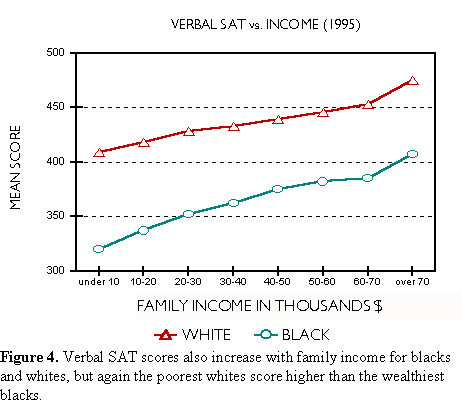
Figure 3 shows how math SAT scores increase with family income for both whites and blacks….However, black students from families earning more than $70,000 (1995 dollars) score lower than white students whose families earned less than $10,000. Figure 4 shows more of the same for the verbal SAT. Here too, the wealthiest blacks score below the poorest whites. (Complete data can be found in Appendix B.)


For more, we go to the abstract of Anne Case and Christine Paxson’s NBER Working Paper No. 12466 (“Stature and Status: Height, Ability, and Labor Market Outcomes,” August 2006):

On average, taller people earn more because they are smarter. As early as age 3 — before schooling has had a chance to play a role — and throughout childhood, taller children perform significantly better on cognitive tests. The correlation between height in childhood and adulthood is approximately 0.7 for both men and women, so that tall children are much more likely to become tall adults. As adults, taller individuals are more likely to select into higher paying occupations that require more advanced verbal and numerical skills and greater intelligence, for which they earn handsome returns. Using four data sets from the US and the UK, we find that the height premium in adult earnings can be explained by childhood scores on cognitive tests. Furthermore, we show that taller adults select into occupations that have higher cognitive skill requirements and lower physical skill demands.

Finally, on the intra-national level, there is Jay L. Zagorsky’s paper, “Do you have to be smart to be rich? The impact of IQ on income, wealth, and financial distress.” (The paper, which has received much publicity, is still “in press” at the journal, Intelligence.) Zagorsky confirms the positive relationship between IQ and income but then, anomalously, posits no relationship between IQ and wealth (i.e., net worth):

How important is intelligence to financial success? Using the NLSY79, which tracks a large group of young U.S. baby boomers, this research shows that each point increase in IQ test scores raises income by between $234 and $616 per year after holding a variety of factors constant. Regression results suggest no statistically distinguishable relationship between IQ scores and wealth. Financial distress, such as problems paying bills, going bankrupt or reaching credit card limits, is related to IQ scores not linearly but instead in a quadratic relationship. This means higher IQ scores sometimes increase the probability of being in financial difficulty.

How could IQ positively affect income but not wealth, given that (for most of us) wealth is derived from income? Zagorsky doesn’t know, and admits as much; all he offers are non-quantitative guesses. Many others have made much of Zagorsky’s “findings” (envious Leftists, for the most part), but I have not yet found a critique of it by an academic economist. (It may be too soon for that; the paper was published only a few months ago.)

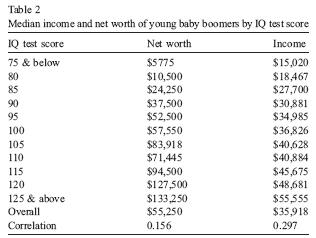
Here are some of my reactions to the paper. To begin with, IQ, wealth, and income are highly correlated, as you might expect. This is from Zagorsky’s paper:
The correlations at the bottom of the table are Zagorsky’s stated correlations between between IQ and net worth and IQ and income, respectively. Those correlations are for the entire data set (N=7403). But the correlations for the data given in table are as follows:

IQ and net worth — 0.981
IQ and income — 0.984
Net worth and income — 0.970

The point is that the low correlations reported by Zagorsky are, in fact, significant. There is a lot of “noise” in the data, but the underlying trends are what you would expect. That leads me to suspect that Zagorsky set out to find what he found. Here are some of my concerns and objections about what he found and how he found it:

  • There is the obvious anomaly in table 2, at the cell represented by IQ 110, where (a) net worth is lower than at IQ 105 and (b) income is barely higher than at IQ 105. How could that be if there are about 700 for that IQ cell, as one would expect given 11 IQ cells and a sample size >700?
  • For married persons, Zagorsky divided family income and wealth by two, so as to avoid a “bias” toward married persons. What that does, of course, is bias the results toward single persons, who generally earn less and have less wealth than married persons. (See, for example, the correlations for “ever married” and “divorced” in table 1 of the paper.) The income and wealth of a married person is his or her income and wealth, legal fictions aside. Family income and wealth is higher but not fully accounted for because the income and wealth contributed by a “non-working” spouse generally goes unrecognized. Dividing the income and wealth of married persons in half is a shady trick and/or an indication of Zagorsky’s incompetence.
  • In any event, Zagorsky wasn’t satisfied with the obviously strong relationships between IQ, income and wealth, so he used regression analysis to “control” for other factors other than income that might determine wealth. In the end, Zagorsky simply runs regression after regression, most of them meaningless because he uses the “kitchen sink” style of analysis: throwing in every variable at hand (e.g., siblings, ever married, ever divorced, heavy smoker, light smoker, and self-esteem(?)). It is regression analysis at its worst: a data-mining fishing expedition, pure and simple.
  • Where Zagorsky reports the results of regressions on a limited number of (mostly) relevant variables (table 3), the regression that best fits the data (highest r-squared) yields a positive coefficient on IQ.
  • Zagorsky draws largely on self-reported survey data (a major weakness, in itself) for persons aged 40 to 47 years. That is, Zagorsky’s sample represents persons who, for the most part, are a decade or three from their peak earnings and wealth. And persons with higher IQs will tend to accumulate wealth more rapidly than those with lower IQs because (a) they will have learned more from their past mistakes and (b) over a decade or three wealth usually grows at a rate that is closer to exponential than linear (compound interest, stocks for the long run, and all that).
  • Finally, it is clear that Zagorsky is in over his head. He is not an economist or statistician but, rather, some kind of sociologist. His home base is Ohio State’s Center for Human Resource Research. Some of his other research (if you can call it that) undermines the so-called findings that I have summarized here.

In sum, Zagorsky’s paper is junk. I felt obliged to acknowledge it because the “finding” about IQ and wealth garnered a lot of attention when the paper was published earlier this year.
Intelligence and Income: International Differences
I return to Rushton’s review of Lynn’s Race Differences: An Evolutionary Analysis:

Lynn’s book…tak[es] a global perspective and consists of a review more than 500 studies published world wide from the beginning of the twentieth century up to the present. He devotes a chapter to each of ten races, differentiated by Cavalli-Sforza, Menozzi and Piazza (1994) into “genetic clusters”, which he regards as a transparent euphemism for races.

His conclusions are that the East Asians (Chinese, Japanese and Koreans) have the highest mean IQ at 105. These are followed by the Europeans (IQ 100). Some way below these are the Inuit (Eskimos) (IQ 91), South East Asians (IQ 87), Native American Indians (IQ 87), Pacific Islanders (IQ 85), South Asians and North Africans (IQ 84). Well below these come the sub-Saharan Africans (IQ 67) followed by the Australian Aborigines (IQ 62). The least intelligent races are the Bushmen of the Kalahari desert together with the Pygmies of the Congo rain forests (IQ 54).

After the ten chapters setting out the evidence for each of the ten races there follows a chapter on the reliability and validity of the measures. These show that the studies have high reliability in the sense that different studies of racial IQs give closely similar results. For instance, East Asians invariably obtain high IQs, not only in their own native homelands but in Singapore, Malaysia, Hawaii and North America. To establish the validity of the racial IQs he shows that they have high correlations with performance in the international studies of achievement in mathematics and science. Racial IQs also have high correlations with national economic development, providing a major contribution to the problem of why the peoples of some nations are rich and others poor. He argues further that the IQ differences between the races explain the differences in achievement in making the Neolithic transition from hunter-gathering to settled agriculture, the building of early civilizations, and the development of mature civilizations during the last two thousand years.

Lynn tackles the problem of the environmental and genetic determinants of race differences in intelligence and concludes that these contribute about equally to the phenotypic differences. He argues that the consistency of racial IQs in many different locations can only be explained by powerful genetic factors. He works out the genetic contribution in most detail for the sub-Saharan Africans. His argument is that sub-Saharan Africans in the United States experience the same environment as whites, as regards determinants of intelligence. He argues that they have as good nutrition as whites, as shown by their having the same average height in studies going back to World War 1, and they have approximately the same education as whites. He presents evidence that blacks in the southern states have very little white ancestry and have an IQ of about 80, and that proposes that this can be adopted as the genotypic IQ of blacks, i.e. the IQ that blacks attain when they are reared in the same environment as whites. The IQ of blacks in sub-Saharan Africa is a good deal lower at 67. Hence, the adverse environment in sub-Saharan Africa, which he regards as consisting principally of poor nutrition and health, contributes about 13 IQ points to the low IQ in sub-Saharan Africa. Lynn’s estimate is not too different from that advanced in 1969 by Jensen to the effect that about two thirds of the low IQ of blacks in the United States is attributable to genetic factors, and the more recent estimate of Rushton and Jensen (2005) that the figure is around 80 percent. Lynn has (unsurprisingly for those familiar with his work) put a bit more weight on the genetic factor.

Lynn (with Tatu Vanhannen) had earlier (2002) written IQ and the Wealth of Nations (summary and criticisms, here). That book seems to be an outgrowth of a Lynn-Vanhannen article in The Mankind Quarterly (“National IQ and Economic Development: A Study of Eighty-One Developing Nations,” Summer 2001). (For corroboration of Lynn and Vanhannen’s findings about the positive influence of IQ on national output, see Garrett Jones and W. Joel Schneider’s “Intelligence, Human Capital, and Economic Growth: A Bayesian Averaging of Classical Estimates (BACE) Approach,” June 2005.)
Gerhard Meisenberg, writing in “IQ Population Genetics: It’s Not as Simple as You Think” (The Mankind Quarterly, Winter 2003), offers a comprehensive view of the evolutionary causes of IQ differences across geographic regions and the effects of those differences on GDP. Meisenberg draws on the Lynn-Vanhannen data and many other sources. Meisenberg says that

[s]ome scholars, most notably Richard Lynn and Philippe Rushton, propose climate and ecology as selective forces. According to Lynn, the dependence on big-game hunting in northern climates necessitated complex social organization with efficient cooperation and intelligent planning, while tropical populations could always fall back on cognitively undemanding food gathering (Lynn, 1991).

Rushton emphasizes the need for close family ties and high parental investment in harsh climates. While most childhood mortality in the tropics was caused by uncontrollable endemic diseases, most childhood mortality in the arctic was due to the predictable challenges of seasonal food shortages and the rigors of the climate. These challenges demanded intelligent planning in addition to stable families (Rushton, 1995).

These theories postulate that physical and cognitive race differences evolved at roughly the same time, starting about 100,000 years ago when modern humans first ventured out of the tropics and into the inhospitable wastelands of central and northern Asia. Thus both Lynn and Rushton predict that intelligence genes cluster with climate-selected physical traits such as skin color. Both make the specific prediction that intelligence is highest in Mongoloids, lowest in Negroids, and intermediate in Caucasoids.

This prediction is borne out by the data in Table 1. The average IQ is 97.1 for Mongoloids, 93.9 for Caucasoids, and 69.6 for Negroids. IQ also correlates with latitude (Pearson’s r = 0.7559) and per-capita GDP (r = 0.7348). However, in multiple regression models with either latitude or GDP or both as copredictors of IQ, race remains a statistically significant predictor at the P

La Griffe du Lion has solved the puzzle. First, some background. La Griffe’s analysis of March 2002, highlights the “puzzle”:

In Figure 2, the [Lynn-Vanhannen] data [table here] is [sic] divided into contributions from four groups: blacks, (European) whites, East Asians and “others.” I did not include the outliers: South Africa, Barbados, Qatar and China.
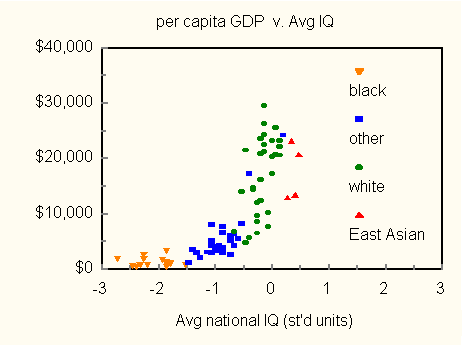
Figure 2. Per capita GDP by racial group. “White” here means European white; “East Asian” means the racially homogenous polities: Taiwan, South Korea, Hong Kong, and Japan.

La Griffe, in a later post (May 2004) addresses the seeming anomaly in the relationship between IQ and GDP. As shown in the figure directly above, four East Asian (or Northeast Asian) countries (Hong Kong, South Korea, Japan, and Taiwan), which have the highest average IQs, do not have the highest per capita GDPs. The short of it is this: GDP is best explained by verbal IQ, as opposed to a measure of IQ that encompasses both verbal and quantitative skills. Thus figure 7:
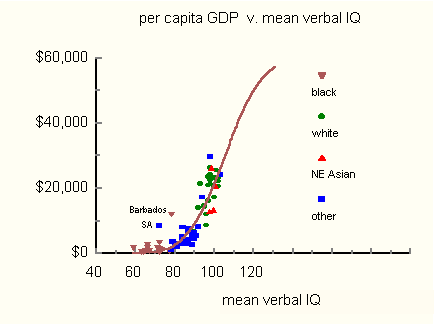
La Griffe observes that the IQ of (North)east Asians

is bifurcated. NE Asians have the highest IQ of all peoples other than Ashkenazim. They owe that superior IQ, however, to extraordinary visuospatial ability, which, despite verbal shortcomings, lifts their IQ above that of Europeans….

Among the races, only NE Asians and Amerindians exhibit this particular kind of verbal-nonverbal cognitive split. For other races verbal and general IQ averages have similar values, making the distinction between the two transparent to smart fraction theory. In the 12 studies reporting both general and verbal IQ for NE Asians, the general-verbal gap averaged 6.5 IQ points….

[T]he spectacular visuospatial ability of NE Asians, while accounting for their high [overall] IQ scores, does not necessarily make them good capitalists. Hunting strategies have little to do with wealth production. And a new tool, irrespective of point of origin, is now soon available worldwide. The structure of NE Asian intelligence did not come about in response to pressures to be attorneys or editors or production managers or copywriters or salesmen or programmers or systems analysts or insurance adjusters or purchasing agents or account executives.

In sum, IQ strongly determines both personal income and, therefore, per capita GDP. Verbal IQ turns out to be an important (negative) determinant of income in those (few) cases where it is a relatively weak component of overall IQ.

But what about the influence of income on IQ? Let’s return to Meisenberg’s article:

The massive rise of IQ that took place in many countries over the past century shows conclusively that environmental effects can have a powerful effect on the average intellectual level of large populations. Presumably one or another aspect of “standard of living” is responsible for this secular trend: education, nutrition, health care, mass media, or, most likely, a combination of all of these.

Gross domestic product adjusted for purchasing power (GDP in Table 1) is an indicator for the population’s “standard of living”. If a high standard of living does indeed raise IQ test performance, then GDP should be an independent predictor of national IQ even when the effects of race and latitude are partialled out.

When race, latitude and GDP are used as co-predictors, GDP does indeed have an independent effect in predicting national IQ (P = 0.0007). In this model, race and latitude remain powerful independent predictors, each with P Flynn effect [link added: ED] these results suggest that the causal arrow points both ways. High intelligence produces a high standard of living, which in turn raises intelligence even more. Thus intelligence and economic development are mutually reinforcing in a positive feedback loop….

This feedback loop explains…the rise in mental test performance that has become known as the Flynn effect.

This feedback loop between intelligence and standard of living can explain the great magnitude of the IQ differences between nations. It predicts that even in cases where genetic differences affecting mental ability are small, the observed phenotypic differences become amplified because the slightly more gifted populations achieve a higher standard of living which raises their measured intelligence even more, which in turn raises their standard of living yet further. Similar “amplifier effects” have previously been proposed as explanations for the Flynn effect (Dickens and Flynn, 2001).

There you have it: The smarter get richer and the richer get smarter, not at the expense of the poorer and not-as-smart but by virtue of their genes and the material advantages afforded by those genes. Forceful transfers of income and wealth from the smarter and richer to the not-so-mart and poorer might be helpful to the latter — but more likely not, as I argue earlier. But such transfers definitely diminish the ability of the smarter and richer to help the not-so-smart in more lastingly productive ways: through technological advancement, job creation, mutually beneficial trade, and well-targeted charity.
CONCLUSION
Redistribution in an effort to make us “more equal” is not only counterproductive and unfair, it is futile. Or if not entirely futile, largely wasteful. All human beings (or at least those who are citizens and lawful residents of the U.S.) deserve equal rights. But the equal rights they deserve are the negative rights of the original Constitution, not the positive rights sought by generations of so-called liberals and progressives. There is nothing “liberal” or “progressive” (in the root meanings of those words) about redistribution.
Some related posts:
The Cost of Affirmative Action
Affirmative Action: A Modest Proposal
Race, Intelligence, and Affirmative Action
Affirmative Action: Two Views from the Academy
Affirmative Action, One More Time
Much Food for Thought
After the Bell Curve
A Footnote . . .
The Main Causes of Prosperity
Why Class Warfare Is Bad for Everyone
Fighting Myths with Facts
Debunking More Myths about Income Inequality
A Century of Progress?
Socialist Calculation and the Turing Test
Taxes, Charitable Giving, and Republicanism
Productivity Growth and Tax Cuts
Zero-Sum Thinking
Liberty, General Welfare, and the State
The Causes of Economic Growth
Republicanism, Economic Freedom, and Charitable Giving
The Last(?) Word about Income Inequality
Status, Spite, Envy, and Income Redistribution
Things to Come
__________
* The more controversial scientists whose work I sample here are Charles Murray, J. Phillipe Rushton, Richard Lynn, and Napoleon Chagnon.
Murray is controversial mainly for The Bell Curve, which brought to a wide audience the large body of long-standing evidence of persistent inter-racial differences in IQ. Rushton and Lynn are controversial because of their findings on race, gender, and intelligence, and because of their affiliation with the Pioneer Fund. The Fund’s roots and some of its current connections are tainted with the label “white supremacist.” The Fund (website here) has responded to those allegations. Whether Rushton, Lynn, and others who produce similar research are white supremacists is beside the question of the validity of their research. Judge for yourself.
Chagnon is controversial for other reasons, namely the ethics (or purported lack thereof) in his field work. (For Chagnon’s statements about the controversy, go here. See also Steven Malanga’s review of Chagnon’s Noble Savages, “Welcome to the Jungle,” City Journal,  April 13, 2014.) In the “small world” department, I note that Chagnon hails from the village where my maternal grandparents raised ten children. The doctor who delivered many of those children bore the name Napoleon Chagnon. The sketchy biographical information about the anthropologist (p. 6, here) indicates that he was not the son of the medical doctor, but given the village’s small population (perhaps 500 when the anthropologist was born), it seems likely that he was related to and named for the medical doctor (a grandson, perhaps). And it was in honor of “old Doc Chagnon” that my maternal grandparents chose Napoleon as the middle name of the tenth and last of their children.

Sunday Reading

UPDATED, BELOW

I’m working on a blockbuster post, but it won’t be ready for another day or two. In the meantime, check out these blog bits:

Greg Mankiw points to a column by one of his Harvard colleagues, Kenneth Rogoff, who warns that

Healthcare pressures may cause the trend towards free-market capitalism to reverse, with a large chunk of the economy reverting to a socialist system.

I like Arnold Kling’s prescription for dealing with spam-scams:

Perhaps instead of trying to attack the problem by going after spammers, what we should be doing is going after the woodheads. It is almost impossible to enforce a law against sending spam. So we should try to pass a law against responding to spam.

What I propose is that any American who makes a purchase based on unsolicited email be fined $10,000 and jailed for 30 days. The law would be enforced by undertaking random audits of companies that are successful at attracting business by using spam. The law would be highly publicized by internet service providers and corporate CIO’s, who have a strong interest in reducing the volume of spam. Thus, everyone with an Internet account would be on notice that purchasing from a spammer can get you in trouble.

If we can deter Americans from responding to spam, then spammers will stop routing spam to domains in the U.S. That’s my solution.

Remind me again why (it is alleged) so many people fear warming. Tyler Cowen points to “Extreme Weather Events, Mortality, and Migration,” by Olivier Deschenes and Enrico Moretti. The authors write:

We estimate that the number of annual deaths attributable to cold temperature is 27,940 or 1.3% of total deaths in the US. This effect is even larger in low income areas. Because the U.S. population has been moving from cold Northeastern states to the warmer Southwestern states, our findings have implications for understanding the causes of long-term increases in life expectancy. We calculate that every year, 5,400 deaths are delayed by changes in exposure to cold temperature induced by mobility. These longevity gains associated with long term trends in geographical mobility account for 8%-15% of the total gains in life expectancy experienced by the US population over the past 30 years.

Finally, Jonathan Adler weighs in on the issue of abstinence-only education. Adler and the authors of the studies that he cites are simply barking up the wrong type of abstinence education. Such education, to be effective, must begin at home, must begin around the onset of puberty, and must be reinforced constantly — at home. It is unsurprising, therefore, to learn that formal, government-sponsored abstinence-only programs are ineffective.

UPDATE (9:30 p.m.): Greg Mankiw offers this:

Perhaps the skills that make a good economist are, for some reason, negatively correlated with the attributes associated with being an agreeable human being. That is, economics may attract people with a particular set of personality attributes, and perhaps these attributes are not the same set of attributes you might choose for your next dinner party.

This is not entirely conjecture on my part. For example, this study

explores the relationship between student’s personality types, as measured by the Myers-Briggs Personality Type Indicator, and their performance in introductory economics. We find that students with the personality types ENTP, ESTP, and ENFP do significantly worse in Principles of Macroeconomics than identical students with the personality type ISTJ.

What is this personality type ISTJ that excels in economics class? Check out this description, which says in part:

The ISTJ is not naturally in tune with their own feelings and the feelings of others.

Sounds like any economist you know?

Yes, most of them. As in INTJ economist who has suffered many an ISTJ economist, I should know.

"If You Don’t Like It Here…"

“…leave.” That was for a long time the usual (and proper) response by an employer to an employee who had complained about working conditions.

Now — after decades of legislation and court rulings that have destroyed freedom of contract, employment at will, and employers’ property rights — the employee can say with impunity “I don’t like it here, so I’m going to sue you.” And the employee, all too often, will prevail.

Lou Michels offers a case in point. Read it and weep.

The (Relatively) Rich Get Richer

UPDATED, BELOW

Proof, if more were needed, of the symbiotic relationship between politicians and bureaucrats. From two posts by Cato’s Chris Edwards:

[N]ew data for 2006 show that 1.8 million federal civilian workers earned an average $111,180 in total compensation (wages plus benefits). That is more than double the $55,470 average earned by U.S. workers in the private sector.

Looking just at wages, federal workers earned an average $73,406, which is 60 percent greater than the $45,995 average earned by private sector workers.

* * *

[N]ew data for 2006 show that the nation’s 16 million state and local government workers earned an average $61,727 in total compensation (wages plus benefits). That is 11 percent more than the $55,470 average earned by U.S. private sector workers.

Looking just at wages, state and local workers earned an average $46,937, which is similar to the $45,995 average earned by private sector workers. Thus the primary state and local advantage is the generous fringe benefits.

Whereas, federal workers — with the help of their friends in Congress — enjoy abundant fringe benefits as well as inflated base salaries.

Government compensation is like Social Security and Medicare. Politicians secure the allegiance of “seniors” by bestowing windfall returns on FICA “contributions” (e.g., the prescription drug benefit). Similarly, politicians secure the allegiance of government workers by bestowing on them above-market compensation.

UPDATE (4:45 p.m.): Arnold Kling wonders “if we’ve seen some redistribution of wealth away from the private sector and toward government workers and contractors since 2001.” I have no doubt of it, given the rate at which government workers’ compensation grew in the early 2000s.

According the Chris Edwards (first link above), “Average federal pay has soared in recent years, growing much faster than private sector pay between 2001 and 2005.” So, yes, there was a redistribution of wealth away from the private sector — “thanks” to federal, state, and local legislatures, which took from non-government workers and gave to government workers. Robin Hood in reverse.

I don’t begrudge increases in pay and benefits for members of military and police forces, to the extent that such increases were necessary for effective recruitment and retention efforts. As for other government “workers,” I say “get a job.”

The Golden Rule, for Libertarians

Permissible acts should coincide with responsible acts. Responsible acts are those that you would have done unto you or the consequences of which you would have done unto you.

You must, in other words, consider

  • the immediate effect of an act on others, and
  • its long-term effect on yourself or others,
  • including its effect on the social and legal restraints that now prevent (or deter) others from doing harm to yourself or others.

Recent related posts:
Metaethical Moral Relativism: Is It Valid?
A Critique of Extreme Libertarianism
Libertarian Whining about Cell Phones and Driving
Eugenics

Prof. Mankiw’s "D"

Harvard’s Greg Mankiw, responding to a reader’s request for “three [key] economic concepts,” offers this:

1. Comparative advantage and the gains from trade.

2. Supply, demand, and the efficiency of market equilibrium.

3. Market failure, such as externalities, and the role for government.

The lesson is that we can all gain from economic interdependence and that markets are a good, but not always perfect, way to coordinate people in an interdependent world.

Two out of three is only 67 percent. Where I went to school, that’s a “D” — at best.

Where’d Mankiw go wrong? By touting “market failure” as a legitimate concept. As I’ve said (here and here, at #16):

There’s no such thing as “market failure.” Rather, there is only failure of the market to provide what some people think it should provide.

* * *

Those who invoke market failure are asserting that certain social and economic outcomes should be “fixed” (as in a “fixed” boxing match) to correct the “mistakes” and “oversights” of the market. Those who seek certain outcomes then use the political process to compel those outcomes, regardless whether those outcomes are, on the whole, beneficial. The proponents of compulsion succeed (most of the time) because the benefits of government intervention are focused and therefore garner support from organized constituencies (i.e. interest groups and voting blocs), whereas the costs of government intervention are spread among taxpayers and/or buyers of government debt.

Mankiw — one of that rare breed: the Republican economist — reveals himself as a big-government conservative. (That’s not surprising, given his service as chairman of the Council of Economic Advisers under G.W. (“no child left behind”) Bush.) For example, here is a post about Giuliani’s health giveaway plan in which Mankiw seem to relish the fact that Giuliani’s plan resembles Bush’s giveaway plan.

The U.S. Postal "Service": Inaction

The following is actual correspondence between me and USPS.

UPDATED, BELOW

From me to USPS – 07/25/2007 05:36 PM:

On Tuesday, July 17, I handed a hold mail authorization form to a letter carrier as he delivered mail to my address. In that form, I authorized the holding of my mail beginning Thursday, July 19, and the delivery of all held mail on Wednesday, July 25.

[My local post office] failed to comply with my request. A neighbor checked my mail box on Saturday, July 21, and found it full of mail, which she kindly collected and held for me. When I returned late in the day on Tuesday, July 24, I checked my mailbox and found mail in it. All I received today, July 25, when all of my held mail was to be delivered, was three pieces of junk mail.

It is evident that the mail collected by my neighbor on July 21 and by me on July 24 comprised all of the mail that was delivered from July 19 through July 24, when [my local post office] was supposed to be holding my mail.

It is possible, of course, that some of the mail delivered from July 19 through July 24 was stolen. Why? Because [my local post office] failed to hold my mail from July 19 through July 24 as I had requested in writing on July 17.

From USPS to me – 07/26/2007 12:06 AM

Thank you for contacting us regarding your Hold Mail Request.

I apologize your request was not honored, and thank you for taking the time to let us know about your situation.

I will be happy to document this complaint. However, I need some additional information so this can be sent to the correct office and you can be contacted. Please reply to this email with the following information:

– Your home telephone number
– Whether you would like to receive a call regarding this issue (There is no guarantee that further information can be provided via email.)

If I can be of assistance to you in the future, please don’t hesitate to contact me.

Thank you for choosing the United States Postal Service®.

Regards,

Patricia S

(Dig that part about “choosing” USPS.)

From me to USPS – 07/26/2007 8:25 PM

My home telephone number is xxx-xxx-xxxx.

I may be contacted by phone, if necessary.

The purpose of my complaint is not to place blame on anyone, for I do not know precisely where the fault lies. But I would like to know what steps will be taken to prevent a recurrence of the problem. It is unacceptable for mail to be delivered when I have requested a hold. This is not the first such failure. I have not logged previous failures, but I have begun to keep a log, beginning with the events of July 19-24.

From USPS to me – 7/26/2007 08:34 PM

Thank you for responding with the requested information.

I am sending this information to your Post Office™ for immediate attention. You should receive a call by the end of the next business day. If you need to contact me again regarding this issue, please refer to the following confirmation number: xxxxxxxxxx.

If I can be of assistance to you in the future, please don’t hesitate to contact me.

Thank you for choosing the United States Postal Service®.

Regards,

Patricia S

(There’s that “choosing” bit again. Note, also, that “Patricia S” replied to me at 12:06 a.m. and 8:34 p.m. of the same day. “Patty” sure does work long hours — hah! If there is really a “Patricia S,” she probably works the night shift, shoveling the s____ that rains on USPS at the end of each day from the many “satisfied” customers who “chose” USPS.)

From me to USPS – 08/01/07 03:58 PM

Four business days have elapsed since your most recent missive, in which you said that I “should receive a call by the end of the next business day.” As I said in an earlier e-mail, I would like to know what steps will be taken to prevent the delivery of my mail after I have requested a hold. I really would.

From USPS to me – 08/01/07 03:58 PM [How’s that for “responsiveness”?]

Thank you for contacting the United States Postal Service. We have received your inquiry and will be sending a detailed response to you within 1-2 business days.

I’m not holding my breath. Updates may or may not follow.

UPDATE (08/02/07, 3:50 p.m.): I was finally contacted, today, by someone from my local post office. The short of it is this: There is a system (something called “notification cards”) for informing carriers (substitutes as well as regulars) about hold-mail requests. But…surprise, surprise…notification cards aren’t always used or, if used, heeded by all the carriers who might be assigned to cover a route.

What will be done about the problem? “We’ll try to do better in the future and give you the service you deserve,” saith the representative of my local post office.

I bet there’s mail in my mailbox the next time I return from a trip. Anyone want to take that bet?

How Much Jail Time?

That’s the question asked by Anna Quindlen, in the current issue of Newsweek, about the punishment for abortion. Quindlen observes that

[i]f the Supreme Court decides abortion is not protected by a constitutional guarantee of privacy, the issue will revert to the states. If it goes to the states, some, perhaps many, will ban abortion. If abortion is made a crime, then surely the woman who has one is a criminal.

The aim of Quindlen’s column is to scorn the idea of jail time as punishment for a woman who procures an illegal abortion. In fact, Quindlen’s “logic” reminds me of the classic definition of chutzpah: “that quality enshrined in a man who, having killed his mother and father, throws himself on the mercy of the court because he is an orphan.” The chutzpah, in this case, belongs to Quindlen (and others of her ilk) who believe that a woman should not face punishment for an abortion because she has just “lost” a baby.

Balderdash! If a woman illegally aborts her child, why shouldn’t she be punished by a jail term (at least)? She would be punished by jail (or confinement in a psychiatric prison) if she were to kill her new-born infant, her toddler, her ten-year old, and so on. What’s the difference between an abortion and murder? None. (Read this, then follow the links in this post.)

Quindlen (who predictably opposes capital punishment) asks “How much jail time?” in a cynical effort to shore up the anti-life front. It ain’t gonna work, lady.