A Footnote to a Footnote

In “A Footnote…” I say this about black Americans’ persistent achievement deficit:

If East Asians and Azhkenazic Jews could rise to the top of the IQ charts, as they have, why can’t blacks rise too? [Thomas] Sowell would answer [e.g., here] that they could rise, if only they would break the bonds of the “black redneck” culture, which hinders so many of them. The law cannot break those bonds, for, as Sowell argues, the law only reinforces those bonds by making blacks dependent on the affirmative action, welfare programs, and other “white liberal” contrivances.

Whether blacks can break the bond of “black redneck” culture, is a good question. (Though, even if they could, it might not improve* their relative economic standing, on the whole.) Kerwin Kofi Charles, Erik Hurst, and Nikolai Roussanov, writing in an NBER working paper (“Conspicuous Consumption and Race“), say:

A large body of anecdotal evidence suggests that Blacks devote a larger share of their overall expenditure to consumption items that are readily visible to outside observers than do Whites. Automobiles, clothing, and jewelry are examples of these forms of “visible” consumption. There has to date, however, been little formal analysis by economists of the degree to which these racial differences in consumption patterns actually exist in the data, what accounts for them if they do, and what the consequences of any such differential expenditure might be. We address these questions in this paper.

The first part of our paper documents differences by race in expenditures devoted to visible consumption items. Using data from the Consumer Expenditure Survey (CEX) from the period of 1986-2002 [sample here: LC], we show that although, unconditionally, racial minorities and Whites spend approximately the same fraction of their resources on visible consumption, Blacks and Hispanics spend about thirty percent more on visible goods, after accounting for differences in permanent income. These expenditure differences are found within all sub-groups, except older households.

We find that these racial gaps have been relatively constant over the past seventeen years. And, we show that spending on housing or differential treatment in the housing market cannot explain these patterns. Finally, the gaps are economically large: the absolute level annual dollar differential for visible consumption is on the order of $2300, which is a non-trivial quantity given Black and Hispanic average income.

Because household spending must satisfy an inter-temporal budget constraint, spending devoted to visible consumption must be diverted from some alternative use. Reduced spending on specific types of current consumption on the one hand and lower savings (future consumption) on the other are the two possibilities. We show that the higher visible spending of racial minorities seems to come out of both future consumption and all other categories of current consumption: Blacks consume less than Whites in essentially every other expenditure category (aside from housing) to maintain higher visible consumption….

Strikingly, we find that, consistent with the status argument, there is a strong negative association between visible spending and the mean income of one’s reference group within all races….

We then turn to the obvious next step: Do differences in…income explain the racial expenditure gaps that are our main focus? In a series of regressions, we show that accounting for [relative income] explains most of the racial gap in visible spending…

Controlling for the mean income of one’s reference group at the state/race level dramatically reduces the measured difference in wealth holdings between similar Blacks and Whites. Specifically, roughly 60% of the unexplained racial gap in wealth holdings after controlling for permanent income and demographics is accounted for by average differences in reference group income…[I]t does appear that the mechanism that leads Blacks to consume more conspicuous
goods than their White counter parts could also explain some of the well documented Black-
White wealth gap.

So, the propensity for visible (exhibitionist) consumption varies inversely with socio-economic status. But, socio-economic status explains only 60 percent of the black-white wealth gap. That leaves a lot of room for the influence of “black redneck” culture. My question stands: Can blacks (on the whole) break the bonds of “black redneck” culture?
__________
* This is a subtle reference to inherent racial differences in IQ, which I examine at length in the linked post. Following the lead of Arnold Kling, I hereby abandon subtlety.

I further direct you to this post by John Ray.

Liberal Condescension…

…by Hillary Clinton. Nailed by Walter Williams.

There’s Always Solitude

Eliezer Yudkowsky, of Overcoming Bias, writes:

…I suspect the vast majority of Overcoming Bias readers could not achieve the “happiness of stupidity” if they tried. That way is closed to you. You can never achieve that degree of ignorance, you cannot forget what you know, you cannot unsee what you see.

The happiness of stupidity is closed to you. You will never have it short of actual brain damage, and maybe not even then. You should wonder, I think, whether the happiness of stupidity is optimal – if it is the most happiness that a human can aspire to – but it matters not. That way is closed to you, if it was ever open.

All that is left to you now, is to aspire to such happiness as a rationalist can achieve. I think it may prove greater, in the end. There are bounded paths and open-ended paths; plateaus on which to laze, and mountains to climb; and if climbing takes more effort, still the mountain rises higher in the end.

Climbing the mountains of the mind is aided immensely by solitude. It need not take the form of physical isolation; indeed, physical isolation often is impossible. But, with practice and determination, mental solitude is attainable, even in the midst of tumult.

Monopoly

This article at the website of the Ludwig von Mises Institute reinforces what I say in “Monopoly and the General Welfare.” Both items are fairly short. Read them and overcome your fear of Microsoft.

Austin: Not the Live Music Captial of the World

The City of Austin likes to claim that Austin is “The Live Music Capital of the World.” I suppose that’s a more palatable claim than the more apt description, “The People’s Republic of Austin.” That moniker is owed to the predilections of Austin’s all-Democrat city council, which dispenses taxpayers’ money like manna from city hall, itself a monstrous monument to Austin’s commissariat:


In any event, Austin is not the live music capital of the world. It isn’t even the live music capital of the U.S., according to a new study of the music industry in the nation’s 50 most populous metropolitan areas:

  • Figure 4 of that study indicates that Austin ranks fourth in the number of musicians employed in the music industry per 1,000 residents. The top three: Nashville (first by a wide margin), New York, Los Angeles.
  • Figure 6 indicates that Austin ranks fourth in the total number of persons directly employed in the music industry per 1,000 residents. The top three: Nashville (first by a wide margin), Los Angeles, New York.
  • Austin is among the laggards in absolute numbers of musicians, other industry employees, number of establishments, payrolls, and revenues (figures 2, 3, 7, 9, 10, 11).

It’s evident that Austin is not the capital of anything, when it comes to music. It may be the capital of smugness, though San Francisco, Manhattan, and a few other places are probably in Austin’s class (and I don’t mean “classy”).

Austin is the capital of Texas. Well, more precisely, the Capitol of Texas is in Austin. But that’s a historical accident. Austin is to the rest of Texas (Houston excepted) as George W. Bush is to MoveOn.org.

Why Ohio Is Getting Bluer

A post at RealClearPolitics notes that “Ohio Is Looking Blue” for election 2008. That’s not surprising, given that enterprising Ohioans have been fleeing the Buckeye State for decades; for example:

So, Ohio turns Blue, while sun-belt Red States (e.g., Texas and Georgia) turn a deeper shade of Red. Quelle surprise!

P.S. See also.

Compare and Contrast

On the one hand, we have Bryan Caplan’s naïve anarcho-libertarianism:

I…think that the best way for Americans to reduce the risk of terrorist attacks on Americans is to imitate the Swiss by minding our own business. Or to be more blunt, the U.S. should buy peace in the Middle East and elsewhere the same way that Britain, France, Holland, Belgium, and Portugal bought peace with their colonies after World War II: leave them to their own devices.

So, we mind our own business and terrorists do what, reciprocate? Hah!

On the other hand, we have Kay S. Hymowitz’s realism about the limits of libertarianism:

A libertarian, according to Brian Doherty, “has to believe” that “the instincts and abilities for liberty . . . are innate,” that we possess “an ability to fend for ourselves in the Randian sense and to form spontaneous orders of fellowship and cooperation in the Hayekian sense.” But this view of the relationship between the individual and society is profoundly and demonstrably false, especially when applied to the family.

Children do not come into the world respecting private property. They do not emerge from the womb ready to navigate the economic and moral complexities of an “age of abundance.” The only way they learn such things is through a long process of intensive socialization–a process that we now know, thanks to the failed experiments begun by the Aquarians and implicitly supported by libertarians, usually requires intact families and decent schools.

Libertarianism did not have to take this unfortunate turn. Ludwig von Mises himself warned that the attempt (of socialists) to undermine the family was a ploy to strengthen the state. Hayek, too, grasped the family’s role in upholding the free market. Coming of age in Europe around the time of World War I, he stressed the state’s inefficiency but also warned, more generally, of the limits of human reason. “Hayek’s economics was rooted in man’s ignorance,” Mr. Doherty writes; so were his political views, which included both an enthusiasm for freedom and a Burkean respect for customs and institutions.

It is difficult to say why this aspect of libertarianism has faded away, but the sociologist Seymour Martin Lipset once provided a partial answer. In Europe and elsewhere, he observed, modern radicals have tended to be of a Marxist, collectivist bent; in America, with its peculiar Lockean legacy and Jeffersonian ideals, radicals have gone to the other extreme, searching for absolute freedom. It is a quest that has left little room for the confining demands of family and other unchosen social bonds.

Good things don’t just happen, they must be made to happen. If they are not, bad things will prevail because the anti-social aspects of human nature — dominance, enviousness, and aggressiveness — outweigh the pro-social ones.

Related posts:
Social Norms, State Action, and Liberty
Anarchistic Balderdash
The Meaning of Liberty

Testing for Steroids

UPDATED TO INCLUDE FINAL STATS FOR 2007 REGULAR SEASON

Here are the top eleven home-run hitters in the history of major league baseball,* based on home runs as a percentage of times at bat over the course of a career:

Mark McGwire

9.42%

Babe Ruth

8.50%

Barry Bonds

7.74%

Jim Thome

7.41%

Ralph Kiner

7.09%

Alex Rodriguez

7.05%

Harmon Killebrew

7.03%

Manny Ramirez

6.94%

Sammy Sosa

6.91%

Ted Williams

6.76%

Ken Griffey Jr.

6.72%

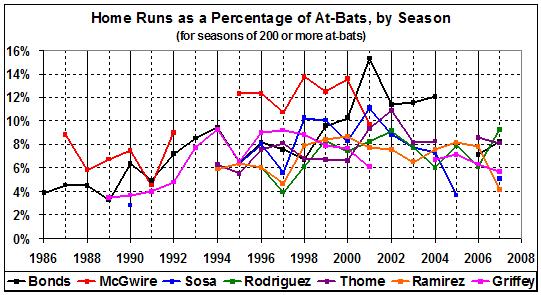
The list includes six active players (Bonds, Thome, Rodriguez, Ramirez, Sosa, Griffey) and one retired player (McGwire) who was a contemporary of the active players. Here are the stats for those seven players, by season:

Note McGwire’s “explosion” from 1995 through 2000, and Bonds’s me-too binge from 1999 through 2004. Were McGwire and Bonds — who were born less than a year apart — simply “peaking” in those years? I don’t think so.

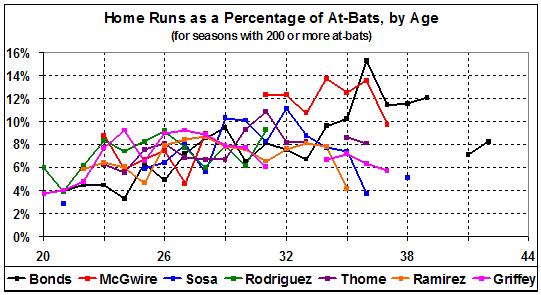
Here’s why I don’t think so, namely, the stats for the same seven players, by age:

So, we have five sluggers (Sosa, Rodriguez, Thome, Ramirez, Griffey) who seem to have aged more or less normally (allowing for injuries). Then, we have the “big two” (McGwire and Bonds) whose late-career “accomplishments” stand out from the rest.

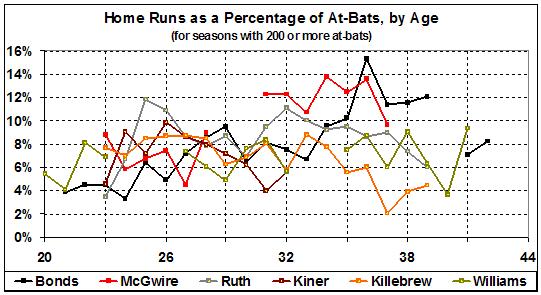
Perhaps the “big two” really aren’t that unusual. How do they compare with the older members of the top-eleven club, for instance? Here’s how:

As the late Phil Rizzuto would say, “Holy cow, would you look at that!” Or, as Detective Delvecchio (of Barney Miller) used to say, “What an amazing coincidence!” Two guys who “peaked” late, one right after the other.
__________
*Source and notes: All statistics are derived from Baseball-Reference.com and are current through the end of the 2007 regular season. I have excluded two active players — Adam Dunn (career, 7.04%) and Albert Pujols (career, 6.96%) — who are less than 30 years of age and have compiled far fewer at-bats than the players whose records I analyze here.

The Shoe Is on the Other Foot

UPDATED THRICE, BELOW

From Law Blog – WSJ.com: The O.C.:

According to Brian Leiter’s Law School Reports, a blog on comings-and-goings in legal academia, UC Irvine, which recently got approval to start a law school, reached an agreement with Duke’s Erwin Chemerinsky (pictured), a prominent constitutional law scholar, to have Chemerinsky be its inaugural dean — and then rescinded the offer yesterday because of his [liberal] political views….

“I’ve been a liberal law professor for 28 years,” Chemerinsky said. “I write lots of op-eds and articles, I argue high-profile cases, and I expected there would be some concern about me. My hope was that I’d address it by making the law school open to all viewpoints.”…

He added: “Obviously I’m sad because it’s something I was exciting about. I’m angry because I don’t believe anyone liberal or conservative should be denied a position like this because of political views.”

I must here admit to a bit of schadenfreude, given that academia is ruled mainly by Leftists who are in the habit of not hiring and not promoting conservatives.

But, but, but…many (even some conservatives) will say “two wrongs don’t make a right.” Actually, thousands of wrongs have been committed against conservative academics, but the un-hiring of Chemerinsky isn’t a wrong. I have encountered his view of the Constitution, and have found it highly unconstitutional. He shouldn’t have been hired for the deanship in the first place. The man has no place teaching constitutional law, anywhere. It has been his good luck (and our misfortune) that many law schools (like most of academia) are dominated by the Left.

UPDATE (09/17/07): Conservatives just play too nice. UC Irvine has been suckered into hiring Chereminsky as law dean, after all.

See the new law school open next year. Hear the new dean promise “to respect all points of view.” Wait for the new law school to begin veering to the Left. Peer into the not-so-distant future as the school drives out the few conservative-libertarian profs it was willing and able to recruit.

You can what’s going to happen because Brian Leiter, a Marxist who parades as a law prof, is happy about the news of Chereminsky’s hiring. (For more about Leiter, see this, this, this, and this.)

UPDATE (09/18/07): Chereminsky, I now learn, has been representing Rachel Corrie’s family in its suit against Caterpillar, Inc. Corrie, as you will remember, was the pro-Palestinian protester who failed to get out of the way of an Israeli-wielded Cat. So, Corrie’s family sued the company. “This is a case about direct commercial sales,” Chemerinsky said. “It’s about holding corporations liable when they aid and abet violations of human rights.”

Corrie’s family has a right to representation, but Chemerinsky wasn’t obliged to represent the family. In choosing to do so, he revealed his anti-U.S., anti-Israeli bias.

Fortunately, in this case, the Ninth Circuit (surprisingly) did the right thing: It affirmed the dismissal of the family’s suit by a district court judge. A telling passage from the court’s ruling:

It is not the role of the courts to indirectly indict Israel for violating international law with military equipment the United States government provided and continues to provide. . . . Plaintiffs may purport to look no further than Caterpillar itself, but resolving their suit will necessarily require us to look beyond the lone defendant in this case and toward the foreign policy interests and judgments of the United States government itself.

Which is precisely what the Corrie family, their supporters, and Chemerinsky sought: judicial intervention in what are essentially political questions. Isn’t that the Left’s preferred way? You bet it is. And that’s part of the mindset Chemerinsky will bring to the deanship of the new law school.

UPDATE (09/19/07): See this related post by Gail Heriot of The Right Coast.

A Mini-Fest of Links

It’s time to disgorge some of the links that I’ve been hoarding.

First up is Arnold Kling’s “Religion, Government, and Civil Society.” I had missed it because it was published in February of this year, when I was neither blogging nor reading blogs. Kling compresses much wisdom into a relatively short essay. (For my views on the importance of civil society — as opposed to statism — read “On Liberty” in the sidebar and go here.)

Relatedly, here is Tyler Cowen’s post about philanthropy. (I hereby apologize for having thought bad thoughts about Cowen.)

Next is a piece (reproduced here) by Douglas Kmiec about the (now-stayed) ruling by an Iowa judge, in which he struck down Iowa’s defense-of-marriage act. That is to say, the judge ruled in favor of same-sex marriage. (My views on the subject are in this post, among others.)

“Crunchy cons” — love ’em or hate ’em — always stir the pot. Here are two posts by Mr. Crunchy Con himself, Rod Dreher. It seems, on the surface, that Dreher is a “civil societarian,” as Arnold Kling defines it. But do not be deceived by the reasonable tone of Dreher’s posts (linked above). Dreher is, in fact, a pseudo-civil-societarian with a statist agenda. For more on that, go back and read this post (toward the bottom) and this one.

I wrote recently about “The Slippery Slope of Constitutional Revisionism.” The U.S. may not have traveled as far down the slope toward vicious statism as has the U.K. But it could do so, quite easily. Let this be a warning to you.

September 11, 2001

I cannot add to what I have said before.

But Arnold Kling, as usual, says it best. I like all of Arnold’s points, especially this one:

I believe that civilization is a fragile thing. It is easy to imagine a more peaceful world. It is easy to imagine a less nationalistic world. But I find it even easier to imagine a world that is worse along both dimensions. My guess is that if the United States becomes less nationalistic and less assertive, then the world as a whole will take a turn for the worse rather than for the better.

Yankees vs. Red Sox: The End Games (2)

UPDATED, BELOW


The Red Sox remaining games at home through the end of the season

Devil Rays — 2 games — home vs. Devil Rays: 5-2 to date
Yankees — 3 games — home vs. Yankees: 4-2
Athletics — 2 games — home vs. Athletics: 1-1
Twins — 4 games — home vs. Twins: 0-0

The Red Sox away

Blue Jays — 3 games — away vs. Blue Jays: 5-1
Devil Rays — 3 games — away vs. Devil Rays: 4-2

The Yankees at home

Orioles — 3 games — home vs. Orioles: 2-4
Blue Jays — 4 games — home vs. Blue Jays: 3-2

The Yankees away

Blue Jays — 3 games — away vs. Blue Jays: 3-3
Red Sox — 3 games — away vs. Red Sox: 2-4
Devil Rays — 3 games — away vs. Devil Rays: 3-3
Orioles — 3 games — away vs. Orioles: 2-4

Combined home and away records against remaining opponents

Red Sox: 19-8
Yankees: 15-20

Current standings

Red Sox lead Yankees by 5 games (The Yankees’ deficit is the same as it was after the games of August 30. That’s zero progress by the Yankees in a span of 11 days. Plus, the remaining schedule is more favorable to the Red Sox now than it was 11 days ago.)

Conclusion

Draw your own, bearing in mind that “past performance is no guarantee of future results.”

Here’s mine:

  • The three-game series between New York and Boston (in Boston) this coming weekend (Sept. 14-16) will be decisive.
  • If the Yankees trail the Red Sox by 5 games or less when the two teams meet, the Yankees will win the American League East title if (and only if) they sweep the Red Sox.
  • Conversely, no matter where the Sox and Yankees stand entering the series, the Sox will take the title if they beat the Yankees at least twice.

UPDATE (09/14/07, 11:30 a.m. CT): The Yankees trail the Red Sox by 5.5 games going into their three-game series. So, the Yankees still have a shot at the AL East title, but only if they sweep the Red Sox.

Reasons Not to Read…

Tyler Cowen and Megan McArdle any more. Not a word in either post about the most likely scenario: “Global warming” (i.e., the warm episode of the past 30-some years) is not caused by human activity.

If two of the (supposedly) brighter lights of blogdom can’t even acknowledge that possibility, why should I bother reading their stuff? On the other hand (as economists are wont to say), one or the other of them occasionally offers up a gem or a link to a gem.

P.S. Thomas Sowell (on the other, other hand) never disappoints. Par example.

UPDATE (09/13/07): McArdle admits that she voted Democrat in 2006, and says that she’ll vote either for Obama or an independent in 2008. Proof that I can no longer take her seriously. How can she mouth (mostly) free-market economics and then vote for those who would complete the destruction of free markets in this country? Perhaps she is voting with her hormones instead of her brain. Anyway, she’s outta here, that is, off the blogroll and off the list of blogs that I follow via Bloglines.

The Better Half or the Worse Half?

Arnold Kling, writing about a post of Robin Hanson’s, says:

My guess is that if Robin were to try to make this argument to a general audience, he would get a hostile response.

Hanson’s argument?

Cutting half of medical spending would seem to cost little in health, and yet would free up vast resources for other health and utility gains. To their shame, health experts have not said this loudly and clearly enough.

…The claim is not that there would be no harmful health effects of such a policy, but rather that harmful effects would be roughly balanced by helpful effects. And the claim is not that harmful and helpful effects would exactly balance, but rather that any net health harm will be small compared to the health gains possible by spending the savings on other health influences, and to the utility gains possible from spending the savings in other ways.

Kling continues:

However, the opposition would be almost entirely emotional, with little or no rational component….The intensity of the emotions is probably a sign that Hanson is onto something.

I don’t think it’s emotional to ask two questions:

1. Who does the cutting?

2. How does the cutter know, for each affected individual, whether the cut removes the better half or worse half of that individual’s health care?

Cato Unbound (where Hanson’s post appears) seems to be off-line. Perhaps I’ll have more to say when I’m able to read the whole post.

Okay, I’ve now read Hanson’s post. Hanson’s point about over-spending on medical care is well supported, but here’s the key passage about how to cut spending:

How should we cut medical spending? There are many possibilities, and I may prefer some possibilities to others….The obvious first place to cut would be our government and corporate subsidies for medicine, including direct payments, tax exemptions, and regulatory requirements. Socially, we should also try to give medicine far less prestige than we now do. After these one could consider taxing medicine, limiting it by law, or nationalizing the industry and using agency budgets to limit spending.

Yes, I know, these are not politically realistic proposals.

The least realistic proposals, politically, are to cut government and corporate subsidies, tax exemptions, and regulatory requirements. Such changes would be the most beneficial because they would restore income and discretion to the actual recipients and beneficiaries of medical care.

The politically realistic proposals (taxing medicine, limiting it by law, or nationalizing the industry) would be ruinous. Necessary medical care would become more expensive and harder to come by.

Does Hanson seriously endorse taxes, government-imposed rationing, and nationalization as substitutes for the the judgments of individuals who actually need medical attention? Perhaps he would prefer to live in Canada or the UK.

The Rational Voter?

To act rationally is:

(a) to apply sound reasoning and pertinent facts to the pursuit of an objective, or

(b) to apply sound reasoning and pertinent facts to the pursuit of a realistic objective (one that does not contradict the laws of nature or human nature).

Answer: (b).

It’s true that voters often reason poorly and are largely ignorant of particular facts when they cast their ballots. But voters mainly fail to vote rationally because their objectives are wanting in reality. They (and the candidates for whom they vote) tend to believe in “six impossible things before breakfast” (the White Queen to Alice, in Alice in Wonderland).

Given that, the likelihood of finding a rational voter in a polling booth is vanishingly small. That most voters are irrational is certainly my view, and that of Bryan Caplan of EconLog and George Mason University‘s economics department.

Ilya Somin (of The Volokh Conspiracy and the George Mason University School of Law) argues, on the other hand, that American voters are “rationally ignorant.” Somin spells out his theory of rational ignorance in “Knowledge of Ignorance: New Directions in the Study of Political Information,” the abstract of which reads, in part:

For decades, scholars have recognized that most citizens have little or no political knowledge, and that it is in fact rational for the average voter to make little effort to acquire political information. This article shows that rational ignorance is fully compatible with the so-called paradox of voting because it will often be rational for citizens to vote, but irrational for them to become well-informed….

Somin, however, offers a naïve view of rationality; for example:

Assume that Uv = the expected utility of voting; Cv = the cost of voting; and D = the expected difference in welfare per person if the voter’s preferred candidate defeats her opponent. Let us further assume that this is a presidential election in a nation with 300 million people; that the voter’s ballot has only a 1 in 100 million chance of being decisive….

If we assume that Cv is $10 (a reasonable proxy for the cost of voting) and that D is $5000 (this can incorporate monetary equivalents of noneconomic benefits as well as actual income increases), then Uv equals $5, a small but real positive expected utility.

To be sure, actual voters are unlikely to calculate the costs and benefits of voting this precisely, but they might make an intuitive judgment incorporating very rough estimates of D and C. Furthermore, the fact that voting is a low-cost, low-benefit activity ensures that there is little
benefit to engaging in precise calculations such as these, so voters might rationally choose to go with a default option of voting and forego any detailed analysis….

By contrast, the acquisition of political information in any significant quantity is a vastly more difficult and time-consuming enterprise than is voting itself. Assume that Upi = the utility of acquiring sufficient political information to make a “correct” decision, and Cpi = the cost of acquiring political information…

If we conservatively estimate Cpi at $100 by assuming that the voter need only expend 10 hours to acquire and learn the necessary information, while suffering opportunity costs of just $10 per hour, then the magnitude of D would have to be nearly seven times greater — $33,333 per citizen — in order for the voter to choose to make the necessary expenditure on information acquisition. It is unlikely that many otherwise ignorant voters will perceive such an enormous potential difference between the opposing candidates as to invest even the equivalent of $100 in information acquisition. And this theoretical prediction is consistent with the empirical observation that most citizens in fact know very little about politics and public policy, but do vote.

The analysis changes only slightly if the voter does not care about the welfare of the entire nation, but only about that of a subset, such as her racial or ethnic group. Alternatively, she may care about everyone in the nation to at least some extent, but value the utility of some groups more than others. Similarly, it may be that the voter believes that her preferred candidates’ policies will benefit some groups more than others….

For example,…the result that obtains if…a voter…cares far more about the welfare of a subgroup of the population numbering 50 million than about the rest of the public, valuing members of the group five times as much as the rest….

…Uv will turn out to be $8.33, a slightly higher figure than [$5, calculated above]. At the same time, it would still be irrational for the voter to pay the costs of becoming adequately informed….[T]he per-person difference in welfare would have to be over $20,000 in order to justify a decision to pay the price of becoming informed.

Most of that is rote, simple-minded cost-benefit analysis. Aside from being no more than a vague, non-operational description of how voters choose to vote, it ignores the fundamental question: What do voters want? Or, in Somin’s terminology, what is “D” — the “welfare” (i.e., objective) that the voter is trying to attain by voting in a certain way?

Many voters can perceive (and long have perceived), in Somin’s words, “enormous potential difference[s] between…opposing candidates,” without making any special “expenditure on information acquisition.” Voters certainly knew, without benefit of research, the essential differences between Franklin D. Roosevelt and Alfred M. Landon, between Lyndon B. Johnson and Barry M. Goldwater, and between Ronald W. Reagan and James Earl Carter — to take a few, obvious examples from the annals of presidential elections.

In such cases, which are a-plenty, voters eschew Somin-ized gyrations. They simply “know” whether they “like” the policies advocated by a candidate. That is, they “feel good” about what the candidate seems to “stand for”: peace through diplomacy, “social justice” through higher taxes on the rich, better health care through greater government control of it, and so on. (Alternatively, they are “put off” by candidate A’s opponent’s views on such matters, and vote for A as the lesser of two evils.)

That’s where the irrationality comes in. Many (a majority of? most?) voters are guilty of voting irrationally because they believe in such claptrap as peace through diplomacy, “social justice” through high marginal tax rates, or better health care through government regulation. To be perfectly clear, the irrationality lies not in favoring peace, “social justice” (whatever that is), health care, and the like. The irrationality lies in knee-jerk beliefs in such contradictions as peace through unpreparedness for war, “social justice” through soak-the-rich schemes, better health care through complete government control of medicine, etc., etc., etc. Voters whose objectives incorporate such beliefs simply haven’t taken the relatively little time it requires to process what they already know or have experienced about history, human nature, and social and economic realities. (Consider, for example, rich liberals who strive to get richer so as to leave wealth to their privately educated children, all the while propounding higher taxes that will hinder the efforts of the less-rich to do the same.)

Why do such voters not “know” what they know? Because they “feel” certain ways about certain things. They feel — for example — that higher defense spending is likely to lead to war, even though (in the America of the twentieth and twenty-first centuries) defense spending has risen only after we have been attacked or an avowed enemy is already well armed. Voters who know such things, but nevertheless reject their policy implications, prefer to view history and human nature through the lens of their emotional preferences. They compartment what they know from what they feel, and they succumb to what they feel.

Another way to put it is this: Voters too often are rationally irrational. They make their voting decisions “rationally,” in a formal sense (i.e., as outlined by Somin). But those decisions are irrational because they are intended to advance perverse objectives (e.g., peace through unpreparedness for war).

Related posts:
IQ and Personality
IQ and Politics
The Right Is Smarter Than the Left
Things to Come

See also this post by Don Boudreaux.

Socialized Medicine in the U.S.A.

Cato‘s Michael Cannon has it exactly right in “Socialized Medicine Is Already Here” (TCS Daily). Go and read it.

Insofar as medicine is concerned, we have traveled all the way down the slippery slope, following one and then another of the paths I trace in “The Slippery Slope of Constitutional Revisionism.”

Can it get worse? Yes. See:

Thomas Sowell, “No Health Care?”
These three posts at Cato-at-Liberty

Note, also, the planned presence of U.S. Senator Bernie Sanders (“Independent”-VT) at the convention of Democratic Socialists of America. Were they honest about their true political orientation, almost all Democrats in Congress and far more than a few Republicans would join Sen. Sanders at the convention.

It’s the Little Things That Count

From World Science:

A re­nowned sci­ent­ist has backed off a find­ing that he, joined by oth­ers, long touted as ev­i­dence for what they called a prov­en fact: that ra­cial dif­fer­ences among peo­ple are im­ag­i­nary.

That idea—en­trenched to­day in ac­a­dem­ia, and of­ten used to cast­i­gate schol­ars who study race—has drawn much of its sci­en­tif­ic back­ing from a find­ing that all peo­ple are 99.9 per­cent ge­net­ic­ally alike.

But ge­net­icist Craig Ven­ter, head of a re­search team that re­ported that fig­ure in 2001, backed off it in an an­nounce­ment this week. He said hu­man varia­t­ion now turns out to be over sev­en times great­er than was thought, though he’s not chang­ing his po­si­tion on race.

Some oth­er sci­ent­ists have dis­put­ed the ear­li­er fi­gure for years as un­der­est­i­mat­ing hu­man va­ri­ation. Ven­ter, in­stead, has cit­ed the num­ber as key ev­i­dence that race is im­ag­i­nary. He once de­clared that “no se­ri­ous schol­ar” doubts that, though again, some re­cent stud­ies have con­tra­dicted it.

Whether people are 99.9 percent alike, 99 percent alike, or 9 percent alike isn’t (or shouldn’t be) the question. The question is: What are the systematic differences between groups of people, and how do those differences reveal themselves in such things as intelligence, physical skills, and culture?

Suppose that I (a white male of French-English-Scots-Irish-German descent) possess a genome that is, in 99.995 percent of its particulars, the same as that of, say, Frankie Frisch (a Hall of Famer who was, in his prime, about my height and weight). Why couldn’t I have become a Hall of Famer like Frisch? I had good upper body strength, could run fast, had good hand-eye coordination, could throw far and accurately, etc. I have loved baseball since I was about six years old, and — as an adolescent — played PONY Baseball to the best of my ability.

But my ballplaying ability was (and is) limited by an eye condition that keeps me from focusing well enough to hit a baseball, unless it is thrown rather slowly by the standards of professional baseball. The condition also hinders my ability to track a fly ball. (I am hopeless when it comes to tracking a golf shot of mine that travels more than about 150 yards.) Eyeglasses help, but not enough. Contact lenses are out of the question, given the nature of my condition.

So, perhaps one gene out of the 20,000-25,000 in my genome kept me from becoming a professional ballplayer — possibly even a Hall of Famer. What’s one gene? Well, if I possess 20,000 genes, then I probably have 99.995 percent of the genes required to a good-to-great ballplayer. But what counts, in this case, is that other 0.005 percent.

Related post: Positive Rights and Cosmic Justice: Part IV

Right On!

Linking Immigration and Poverty,” by Robert J. Samuelson, supports this and this.

Students, Beware!

UPDATED, BELOW

I’m speaking especially to the students of Kevin Quinn, who teaches economics at Bowling Green State University in Ohio. Quinn also blogs at EconoSpeak. His first substantive entry there, “Safety,” leads me to fear that his students — if they do not question and challenge him — will learn socialism rather than economics.

Consider the example that Quinn uses to show how workers are “forced” to accept a high level of risk (breaks added for clarity):

Suppose there are two types of jobs, safe and risky, and 2 workers. Safe jobs have a safety index of 2 and pay $20,000, while risky jobs have a safety index of 1 and pay $30,000. Further suppose workers utility is the product of three factors: income measured in thousands of dollars, safety( measured by the index), and relative income. Now we have a standard prisoner’s dilemma [link added: LC]:

If you take the safe job, [my] taking the safe job as well gives me utility of (20)(2)(1) = 40. [My t]aking the risky job gives me (30)(1)(3/2) = 45, so I take the risky job.

If you take the risky job, I get (20)(2)(2/3) = 26.67 if I take the safe job and (30)(1)(1) [=30] if I take the risky job, so I take the risky job in this case too.

Each of us does better choosing the risky job whatever the other does, but when we choose the risky job we are worse off, with utility of 30 each, than had we both taken the safe job and gotten utility of 40 each.

Putting it more directly and explicitly, here are the “payoffs” to “you” and “I” (calling them “A” and “B,” respectively):

A takes a safe job and B takes a safe job — A = 40, B = 40
A takes a safe job and B takes a risky job — A = 26.67, B = 45

A takes a risky job and B takes a safe job — A = 45, B = 26.67
A takes a risky job and B takes a risky job — A = 30, B = 30

These results, when displayed in a 2×2 table, make it obvious (granting many assumptions, discussed below) that both A and B minimize their losses (the strategy of the game of prisoner’s dilemma) by choosing a risky job. If A chooses a safe job, his payoff could be as low as 26.67, instead of 30; if B chooses a safe job, his payoff could be as low as 26.67, instead of 30. Both therefore choose a risky job to ensure themselves of the “less bad” payoff: 30.

But prisoner’s dilemma rests on the assumption of non-cooperation. In fact, there is an alternative, known as a coordination game, in which A and B cooperate to their mutual benefit. In that instance, both A and B would choose a safe job. They needn’t cooperate explicitly; each of them could calculate that the best result for both is to choose a safe job.

In any event, Quinn’s conclusion rests on many convenient assumptions, explicit and implicit:

  • Utility is a simple, multiplicative function of three factors: pay, safety, and pay relative to that of a particular person (or class of persons).
  • Relative pay for the two jobs is as specified by Quinn.
  • Relative pay is an important determinant of utility — as opposed to the enjoyment one derives from one’s own pay, for example.
  • The pay of the other person (or class of persons) is determined by riskiness of his job, not by such factors as his productivity or the market value of the good or service he is involved in producing.
  • Safety can be indexed as in Quinn’s example.
  • The indices of safety for the two jobs are precisely 1 and 2 (or a multiple thereof).
  • A and B must choose jobs simultaneously and irrevocably, each without knowledge of the other’s choice, according to the stylized logic of prisoner’s dilemma.

Just like real life, eh?

Even if Quinn’s utility formula is realistic (which it isn’t), and even if prisoner’s dilemma is a valid model (which it isn’t), the outcome is sensitive to the values chosen for pay, safety, and the importance of relative pay. Different values yield different outcomes: A takes a risky job, B takes a safe job; both A and B take safe jobs; etc.

Here’s the bottom line:

  • Prisoner’s dilemma is a dubious model of behavior.
  • Quinn’s utility model is dubious.
  • Quinn’s example uses numerical values that conveniently support a certain conclusion.
  • That conclusion? A labor market that is unregulated with respect to safety “forces” workers to take risky jobs.

Why does Quinn want to reach that conclusion? Answer: So that he can make a case for mandatory safety measures. How does he do that? By rigging his example (as I have discussed), and then by asserting this:

Making safety level 2 mandatory makes both workers better off and has no effect on employers (the pay differential is assumed to reflect the cost of making the workplace safer) and is thus a Pareto-improvement.

Here, Quinn assumes that the pay differential between the safe and risky jobs is determined solely by “the cost of making the workplace safer.” That is:

  • The marginal cost of safety measures is constant ($10,000 per worker per year). (There might be one-time costs, as well, and those might drive the employer out of business or make the employers’ type of business less attractive to new entrants, thus eliminating a source of jobs for new entrants to the labor market. But I’ll let that go, for now.)
  • The employer simply reduces each worker’s annual wage by $10,000 to compensate for the cost of the safety measures, thus holding output, total cost, and profit at their “pre-safety” levels.
  • Given Quinn’s earlier (rigged) assumptions, workers gladly accept lower wages in return for greater safety, or…
  • Workers do not “gladly” accept lower wages, but they accept lower wages, anyway, because there are no other jobs for them, anywhere, or…
  • Other employers are unwilling to “exploit” the workers’ pay cuts by offering them more than they make as a result of Quinn’s government-enforced safety measures.

In other words, what Quinn dismisses, without discussion, is the likely effect of safety regulations: raising the cost of employing workers in jobs affected by those regulations and, therefore, reducing employment and wages in those jobs, in the longer run if not immediately. Safety regulations, in other words, narrow workers’ options by forcing them to accept certain levels of risk — set by regulators — regardless of how those levels affect workers’ jobs and pay, and regardless of workers’ own risk-reward schedules.

Why should government narrow workers’ options and force them to accept fewer jobs and less pay? After all, workers are not literally forced to take risky jobs. The choice is theirs, no matter how Quinn rigs his example. Perhaps Quinn thinks he’s living in the Soviet Union, where workers actually were forced by the “dictatorship of the proletariat “to take certain jobs — many of them risky ones.

What Quinn wants is an end to “injustice.” But he has a strange formula for ending it: Cut jobs, cut pay, and narrow workers’ options. Why? Because, in effect, Quinn doesn’t believe that workers should take certain risks, even if they voluntarily choose to do so.

Quinn, in other words, is a paternalist or a socialist. Actually, it doesn’t matter which of those he is (in his heart of hearts) because government-enforced paternalism is just socialism in a Santa Claus costume. Both regimes attempt to substitute the preferences and judgments of élites (the Quinns of this world) and their minions for the preferences and judgments of the millions of workers and businesspersons who face the actual risks and rewards of daily life.

The judgments can be made by fiat, but they can’t be made correctly by socialists or by “libertarian” paternalists; viz.:

Practical Libertarianism for Americans: Part I (especially the paragraph that begins “Whether or not you subscribe to the abstraction of self-ownership…”)
Practical Libertarianism for Americans: Part II (especially the synopsis of Friedrich Hayek’s views toward the end of the section on “The Evolution of Libertarian Thought: The Unification of Economic and Personal Liberty”) and the Addendum (especially the first three block quotations)
Socialist Calculation and the Turing Test
The Social Welfare Function
Libertarian Paternalism
A Libertarian Paternalist’s Dream World
The Short Answer to Libertarian Paternalism
Second-Guessing, Paternalism, Parentalism, and Choice
Another Thought about Libertarian Paternalism
Ten Commandments of Economics
A Little Putdown of Politically Correct Shopping
More Commandments of Economics
Three Truths for Central Planners
Risk and Regulation
A Further Note about “Libertarian” Paternalism
Apropos Paternalism

UPDATE (10/04/07): Interesting paper here about the positive relationship between cooperation and IQ. (Thanks to Arnold Kling for the pointer.) That the relationship is weaker now that it was about 40 years ago supports the thesis that the rise of socialism leads to the breakdown of civil society. How? The state rips asunder socially evolved norms and networks and replaces them with impersonal laws and bureaucracies.

The Slippery Slope of Constitutional Revisionism

In “The Erosion of the Constitutional Contract,” I attribute the accretion of government power to the misapplication of four elements of the U.S. Constitution:

  • the phrase “promote the general welfare” in the Preamble [and in Article I, Section 8, Clause 1]. This was a desired result of the adoption of the Constitution, not an edict to redistribute income and wealth [or an unbounded power to tax and spend].
  • the power of Congress “to regulate commerce…among the several states [Article I, Section 8, Clause 3].” This power was meant to prevent the States from restricting or distorting the terms of trade across their borders, not to enable the federal government to dictate what is traded, how it is made, or how businesses operate.
  • the authority of Congress “[t]o make all Laws which shall be necessary and proper for carrying into execution the foregoing powers, and all other powers vested by this Constitution in the Government of the United States, or in any department or officer thereof [Article I, Section 8, Clause 18].” The words “necessary and proper” have been wrenched out of their context and used to turn the meaning of this clause upside down. It was meant to limit Congress to the enactment of constitutional legislation, not to give it unlimited legislative authority.
  • the “equal protection” clause of Amendment XIV: “…nor shall any State…deny to any person within its jurisdiction the equal protection of the laws.” Amendment XIV was meant to secure the legal equality of those former slaves whose freedom had been secured by Amendment XIII. Amendment XIV became, instead, the basis for Supreme Court decisions and federal laws and regulations that have given special “rights” to specific, “protected” groups by curtailing the constitutional rights of the many who cannot claim affiliation with one or another of the “protected” groups. As the proponents of such groups might ask, is it fair?

Here, with the help of Wikipedia, I sketch our path down the slippery slope to our present state, which I once captured in these questions:

If liberty is so bounteous, why don’t we enjoy it in full? Why are our lives so heavily regulated and legislated by so many federal, State, and local agencies at such a high cost? What happened to the promise of liberty given in the Declaration of Independence and Constitution?

Our way down the slope has been led, of course, by the U.S. Supreme Court. I restrict the following quotations from Wikipedia to historically accurate background material and summaries of the Court’s actions. My notes and comments are in brackets and initialed LC.

The General Welfare Clause (a.k.a. the Taxing and Spending Clause)

Two theories of the taxing power have been advocated by constitutional scholars: (A) the narrower Madisonian view that taxation must be tied to one of the other specifically enumerated powers such as regulating commerce or providing for the military, and (B) the broader Hamiltonian view that taxation is a separately enumerated, independent power, and that Congress may tax and spend in any way that will benefit the general welfare….

[The Madisonian view was] overturned in United States v. Butler, 297 U.S. 1 (1936)[3]. In that case the Court held that the power to tax and spend is an independent power; that is, that the Taxing and Spending Clause gives Congress power it might not have anywhere else. [See also the history of Social Security, which cites other instances — most notably, the passage of the Social Security Act — in which the Court conveniently adapted its tune to the times, as if Madison’s long-prevailing view of the “tax and spend clause” had been a mere whim of the Court. John Eastman, in “Restoring the General to the General Welfare Clause,” argues at length and convincingly “that the blank check interpretation given to the clause since Butler simply cannot be squared with the original understanding of either Hamilton or Madison.”: LC.]

The modern Supreme Court has interpreted this clause to give Congress a plenary power to impose taxes and to spend money for the general welfare, including the power to force the states to abide by national standards by threatening to withhold federal funds. See South Dakota v. Dole, 483 U.S. 203 (1987)[4]. [I need say no more: LC.]

The Commerce Clause

In Gibbons v. Ogden (1824), Chief Justice John Marshall ruled that….[contrary to Amendment X: LC] “[T]he power of Congress does not stop at the jurisdictional lines of the several states. It would be a very useless power if it could not pass those lines.”…

In Swift v. United States (1905), the Court ruled that the clause covered meatpackers; although their activity was geographically “local,” they had an important effect on the “current of commerce” and thus could be regulated under the Commerce Clause….

The clause was the subject of conflict between the U.S. Supreme Court and the Administration of Franklin D. Roosevelt in 1935-37 when the Court struck down several of the President’s “New Deal” measures on the grounds that they encroached upon intrastate matters. After winning the 1936 election, FDR proposed a plan to appoint an additional justice for each unretired Justice over 70. Given the age of the current justices this permitted a court population of up to 15….

There was widespread opposition to this “court packing” plan, but in the end the New Deal did not need it to succeed. In what became known as “the switch in time that saved nine,” Justice Owen Josephus Roberts and Chief Justice Charles Evans Hughes switched sides in 1937 and, in National Labor Relations Board v. Jones & Laughlin Steel Corporation, upheld the National Labor Relations Act, which gave the National Labor Relations Board extensive power over unions across the country.

In 1941 the Court upheld the Fair Labor Standards Act which regulated the production of goods shipped across state lines. In Wickard v. Filburn, (1942) the Court upheld the Agricultural Adjustment Act, stating that the act of growing wheat on one’s own land, for one’s own consumption, affected interstate commerce, and therefore under the Commerce Clause was subject to federal regulation….

The wide interpretation of the scope of the commerce clause continued following the passing of the Civil Rights Act of 1964, which aimed to prevent business from discriminating against black customers. In Heart of Atlanta Motel v. United States (1964), the Court ruled that Congress could regulate a business that served mostly interstate travelers; in Katzenbach v. McClung (1964) the Court ruled that the federal government could regulate Ollie’s Barbecue, which served mostly local clientele but sold food that had previously moved across state lines; and in Daniel v. Paul (1969), the Court ruled that the federal government could regulate a recreational facility because three out of the four items sold at its snack bar were purchased from outside the state….

Many described the Rehnquist Court’s commerce clause cases [links added: LC] as a doctrine of “new federalism”. The outer limits of that doctrine were delineated by Gonzales v. Raich (2005), in which Justices Scalia and Kennedy departed from their previous positions as parts of the Lopez and Morrison majorities to uphold a federal law regarding marijuana. The court found the federal law valid, although the marijuana in question had been grown and consumed within a single state, and had never entered interstate commerce. [Thus giving Congress the power to regulate anything done anywhere within the United States: LC.]

The Necessary and Proper Clause

Strict constructionists interpret the clause to mean that Congress may make a law only if the inability to do so would cripple its ability to apply one of its enumerated powers (“foregoing powers”). Others argue that the elastic clause expands the authority of Congress to all areas tangentially related to one of its enumerated powers. It is often known as the elastic clause because of the great amount of leeway in interpretation it allows….

In McCulloch v. Maryland [1819],…the court held that because the Congress has the power to control national economic policy [a power not specified or enumerated in the Constitution: LC], creating a national bank is necessary and proper to carry out its duties….

The clause has been paired with the commerce clause to provide the constitutional basis for a wide variety of laws. For example, Congress may make it a crime to transport a kidnapped person across state lines, because the transportation would be an act of interstate activity over which the Congress has power. A series of Supreme Court decisions resulting in the desegregation of private businesses, such as hotels and restaurants, were supported on the basis that these business establishments, although not directly engaged in interstate commerce, no doubt had an effect on it. Since the New Deal the Supreme Court has been reluctant to limit the scope of authority allowed under the combination of these clauses. United States v. Lopez was the first modern case finding limits to Congress’s authority in this regard. [Those limits were short-lived, as discussed in the last paragraph of the section on the Commerce Clause: LC.]

The Equal Protection Clause

[T]he Equal Protection Clause, along with the rest of the Fourteenth Amendment, marked a great shift in American constitutionalism. Before the enactment of the Fourteenth Amendment, the Bill of Rights protected individual rights only from invasion by the federal government. After the Fourteenth Amendment was enacted, the Constitution also protected rights from abridgement by state governments, even including some rights that arguably were not protected from abridgement by the federal government. In the wake of the Fourteenth Amendment, the states could not, among other things, deprive people of the equal protection of the laws. What exactly such a requirement means, of course, has been the subject of great debate; and the story of the Equal Protection Clause is the gradual explication of its meaning [and the gradual corruption of its meaning: LC].

The next important post[-Civil W]ar case was the Civil Rights Cases (1883), in which the constitutionality of the Civil Rights Act of 1875 was at issue. The Act provided that all persons should have “full and equal enjoyment of … inns, public conveyances on land or water, theatres, and other places of public amusement.” In its opinion, the Court promulgated what has since become known as the “State Action Doctrine,” which limits the guarantees of the equal protection clause only to acts done or otherwise “sanctioned in some way” by the state….

The Supreme Court has [ruled] that the equal protection clause itself does not forbid policies which lead to racial disparities, but that Congress may by legislation prohibit such policies. [What the Court taketh away with one hand it giveth back with the other: LC.]

Take, for example, Title VII of the Civil Rights Act of 1964, which forbids job discrimination on the basis of race, national origin, sex or religion. Title VII applies both to private and to public employers. (While Congress applied Title VII to private employers using its interstate commerce power, it applied Title VII to public employers under its power to enforce the Fourteenth Amendment…. [What Congress cannot do under one judicially created loophole it can do under another: LC.]

Although the Supreme Court had ruled in Nixon v. Herndon (1927) that the Fourteenth Amendment prohibited denial of the vote based on race, the first modern application of the Equal Protection Clause to voting law came in Baker v. Carr (1962), where the Court ruled that the districts that sent representatives to the Tennessee state legislature were so malapportioned (with some legislators representing ten times the number of residents as others) that they violated the Equal Protection Clause. This ruling was extended two years later in Reynolds v. Sims (1964), in which a “one man, one vote” standard was laid down: in both houses of state legislatures, each resident had to be given equal weight in representation. [Thus undoing arrangements that the Framers implicitly accepted when they guaranteed each State a republican form of government: LC.]

It may seem counterintuitive that the equal protection clause should provide for equal voting rights; after all, it would seem to make the Fifteenth Amendment and the Nineteenth Amendment redundant. Indeed, it was on this argument, as well as on the legislative history of the Fourteenth Amendment, that Justice John M. Harlan (the grandson of the earlier Justice Harlan) relied in his dissent from Reynolds. Harlan quoted the congressional debates of 1866 to show that the framers did not intend for the Equal Protection Clause to extend to voting rights….[But a majority of the Court is not to be persuaded by the logic and meaning of the Constitution when it has a result to accomplish: LC.]

And so it goes, down the slippery slope of constitutional revisionism toward a dystopian future, in which Congress may recklessly (but with impunity) herd us into absolute, collectivist conformity. What has been done by the Supreme Court is likely to remain done, given stare decisis. And so what has been done will become precedent for the few remaining leaps down the slippery slope. Dystopia, we’re almost there!

Related post: Slopes, Ratchets, and the Death Spiral of Liberty (among many others in the category Constitution – Courts – Law – Justice)