PC Madness

“Dumbleore was gay,” says J.K Rowling.

Pinocchio was Chucky‘s father,” say I.

Both statements bear the same relation to reality, which is none. Mine, at least, isn’t tritely au courant.

UPDATE: For a hilarious parody of Rowling’s PC “revelation,” see this post at The Needle.

Worth Revisiting

I sometimes use Site Meter to determine which of the posts at this blog have been of special interest to visitors. Pleasantly surprised am I to find that “Science, Axioms, and Economics” has been drawing some traffic. I consider it to be among Liberty Corner‘s best offerings.

Friday’s Best Reading

Links and excerpts:

The Laffer Curve Straw Man,” by Daniel Mitchell (Cato-at-Liberty)

The real issue is whether certain changes in tax policy will have some impact on economic activity. If an increase (decrease) in tax rates changes behavior and causes a reduction (increase) in taxable income, then revenues will not rise (fall) as much as “static” revenue-estimating models would predict. This is hardly a radical concept, and evidence of Laffer-Curve effects is very well established in the academic literature.

Sociologists Discover Religion,” by Heyecan Veziorglu (campusreportonline.net)

Associate Professor Dr. Jeffrey Ulmer from Pennsylvania State University examines the degree to which religiosity increases self-control. He points out that religious observance builds self-control and substance use is lower in stronger moral communities.

Eminent Scientist Censored for Truth-Telling [about genes and IQ],” by John J. Ray (Tongue Tied 3)

…There is no inconsistency in saying that blacks as a whole are less intelligent while also acknowledging that some individual blacks are very intelligent. What is true of most need not be true of all.

Scientists have spent decades looking for holes in the evidence [Dr. James] Watson [of DNA fame] was referring to but all the proposed “holes” have been shown not to be so. There is NO argument against his conclusions that has not been meticulously examined by skeptics already. And all objections have been shown not to hold up. There is an introduction to the studies concerned here.

Some commentators have mentioned that old Marxist propagandist, Stephen Jay Gould, as refuting what Watson said. Here is just one comment pointing out what a klutz Gould was. And for an exhaustive scientific refutation of Gould by an expert in the field, see here. [Highly recommended: LC.] Gould’s distortions of the facts really are quite breathtaking.

Hanson Joins Cult,” by Robin Hanson (Overcoming Bias)

Rumors of a weird cult of “Straussians” obsessed with hidden meanings in classic texts have long amused me. Imagine my jaw-dropping surprise then to read an articulate and persuasive Straussian paper by Arthur Melzer in the November Journal of Politics:

Leo Strauss…argued that, prior to the rise of liberal regimes and freedom of thought in the nineteenth century, almost all great thinkers wrote esoterically: they placed their most important reflections “between the lines” of their writings, hidden behind a veneer of conventional pieties. They did so for one or more of the following reasons: to defend themselves from persecution, to protect society from harm, to promote some positive political scheme, and to increase the effectiveness of their philosophical pedagogy….

Melzer convinced me with data:

By now we have seen a good number of explicit statements by past thinkers acknowledging and praising the use of esoteric writing for pedagogical purposes. What is perhaps even more striking in this context is that I have been unable to find any statements, prior to the nineteenth century, criticizing esotericism for the aforementioned problem, or indeed for any other.

This great transition is my best bet for the essential change underlying the industrial revolution:

In The Flight from Ambiguity, the distinguished sociologist Donald Levine writes: “The movement against ambiguity led by Western intellectuals since the seventeenth century figures as a unique development in world history. There is nothing like it in any premodern culture known to me”. This remarkable transformation of our intellectual culture was produced by a variety of factors, but most obviously by the rise of the modern scientific paradigm of knowledge which encouraged the view that, in all fields, intellectual progress required the wholesale reform of language and discourse, replacing ordinary parlance with an artificial, technical, univocal mode of communication

Modern growth began when enough intellectuals gained status not from ambiguity but from clarity, forming a network of specialists exchanging clear concise summaries of new insights.

Adolescents Will Be Adolescents, Even When They’re Grown

Bookworm (of Bookworm Room) plays a theme that I explore in “The Adolescent Rebellion Syndrome.” Writing about an episode of Frontline, she says,

those who oppose Cheney and the Neocons are outraged that all those guys had the temerity to take so seriously the 9/11 attacks and their aftermath. The opposers clearly want to view these matters as Kerry once did: police matters, with the crime scene encompassing a few thousand, rather than one or two…. And to them, to these opposers, it just seems ridiculous that Cheney et al are trying to put in place systems that enable the Commander in Chief to try to nip any future attacks in the bud.

Listening to this outrage, outrage that’s certainly not unique to this Frontline episode, I couldn’t help but think of the difference between your average teenager and your average grownup. To the grownup, things such as mortgages, insurance, and other life security matters are of overriding importance. To the teenager in the house, “Dad is, like, so totally stupid, because he’s, you know, like, always sitting at his desk worrying about the bills, you know. So, I’m all, ‘Dude, stop thinking about that. You know, I’m like trying to score some tickets to the Ugly Red Rash concert, and I need, like, oh, $200 dollars. Right?’”

All of which is both amusing and irritating when you’re in the house with the teenager, but remarkably less interesting when the teenagers are trying to run your country.

As I say in “…Syndrome,”

adolescent rebellion and other forms of intellectual immaturity…are to be found mainly — but not exclusively — among “artists,” academicians, and the Left generally.

I leave room in that indictment for anarcho-libertarians, though they’re so ineffectual that their adolescent petulance is of no account (but of some intellectual interest).

Mark Steyn…

…is always on target. Today he writes:

When the family dies, the nation follows: We’ve all seen heartwarming Hollywood movies about plucky waitress moms struggling to do the best for their kids against the odds. But that’s the point: It’s against the odds. In Britain, a quarter of all children are being raised by single parents – which is to say a lot of them aren’t being raised at all, which is why many a quaint old English market town transforms after dusk into a desolate dystopia preyed on by packs of feral 14-year olds. And, as always, it’s easier to fall into the hole than to climb out. The Scottish journalist Andrew Neil recently pointed out that, in Glasgow, government spending now accounts for 70% of GDP, and in the poorest part of the city life is nasty, brutish and as short as in the Third World. Male life expectancy in North Korea: 60 years; Bangladesh: 58; Yemen: 57; Gabon: 55; Calton, Scotland: 54 years. Middle-aged Torontonians live with their parents but middle-aged Glaswegians live with their ancestors.

This is what you might call trickle-down morality: In the space of 40 years, the middle-class abolished “living in sin” and embraced “long-term partners”, and the working class stopped worrying about “broken homes” and accepted the sociological designation of “alternative families”. And reversing it will take a lot more than targeted tax breaks and entitlements: It’s the stupidity, economists.

Tell me again why we should further hasten the breakdown of society by legitimating* illegitimacy, quick-and-easy divorce, homosexual “marriage,” and involuntary euthanasia.

We reap what we sow. We are about to reap chaos, right here at home. Mark my words.
__________
* The correct word (see “legitimate“), not the barbarous “legitimizing,” from the neologism, “legitimize.”

Re: Election 2008

I salivate at the thought of an all-New York — Giuliani-Clinton — race for president. A real New Yorker vs. a carpet-bagger. A prosecutor vs. an almost-prosecutee. (Remember Whitewater, the missing records, the cattle futures, Travel-gate, etc.? I do.)

Do Better Teams Finish First?

The answer to the title question might seem obvious. But it is not.

For reasons I discuss here, here, and here, post-season play is of no account when it comes to assessing a baseball team’s quality. The acid test of quality is the ability to finish first at the end of a regular season’s play. The acid test of quality over the long haul is the ability to amass first-place finishes, measured in terms of first-place finishes per season.

But what about quality as measured by the proportion of games won by a franchise over the long haul? Is there a good correlation between that overall record and the number of first-place finishes garnered per season of play? I will here answer that question — and question some of the answers — with a look at the American League.

Before plunging into the numbers, I must note that value of a first-place finish has fluctuated, given expansion and, then, divisional play. A first-place finish in the years before expansion, when the AL had 8 teams, ought to count for more than, say, a first-place finish in the AL West since it became a 4-team circuit.

Accordingly, I value first-place finishes according to the number of teams competing for first place in the league (before divisional play) and in a division (from the onset of divisional play). I use the number of original teams (8) to index the value of each first-place finish. Thus:

1901-1960 (8 teams, no divisions) — 8/8 = 1.000
1961-1968 (10 teams, no divisions) — 10/8 = 1.250
1969-1976 (6 teams in each of 2 divisions) — 6/8 = 0.750
1977-1993 (7 teams in each of 2 divisions) — 7/8 = 0.875
1994-2007, AL East (5 teams) — 5/8 = 0.625
1994-2007, AL Central (5 teams) — 5/8 = 0.625
1994-2007, AL West (4 teams) — 4/8 = 0.500

Drawing on statistics available at Baseball-Reference.com, I derived for each AL franchise its overall record and number of weighted first-place finishes per season:

Franchise

Record

1st/season

Devil Rays

0.399

0.000

Rangers

0.468

0.043

Mariners

0.473

0.048

Orioles

0.476

0.078

Twins

0.481

0.082

Brewers

0.482

0.030

Athletics

0.486

0.179

Royals

0.487

0.131

Angels

0.491

0.088

Blue Jays

0.496

0.141

White Sox

0.505

0.092

Tigers

0.506

0.100

Indians

0.511

0.069

Red Sox

0.516

0.120

Yankees

0.567

0.375

I then regressed first-place finishes per season against overall record, including only those teams with any first-place finishes. (In other words, I omitted the hapless and perhaps hopeless Devil Rays; the Brewers, late of the AL, escaped oblivion only by dint of their 1982 division title.) The result:
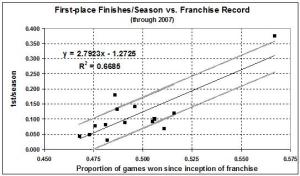
The gray lines bound the standard error of the regression and highlight the outliers: the Athletics and Yankees on the high side, the Indians on the low side. (The plot points, going from left to right, correspond with the franchises listed in the table above, reading downward from Rangers through Yankees.)

Inspection of the graph suggests at least three questions:

  1. Who has fared better, original teams or expansion teams?
  2. Why have the A’s outshone the Indians?
  3. With the Yankees out of the picture, would there still be a positive relationship between overall record and first-place finishes?
  4. Which is more important, overall record or frequency of first-place finishes?

A 1. The expansion teams — on the whole and even including the Devil Rays — have slightly outperformed the original teams.

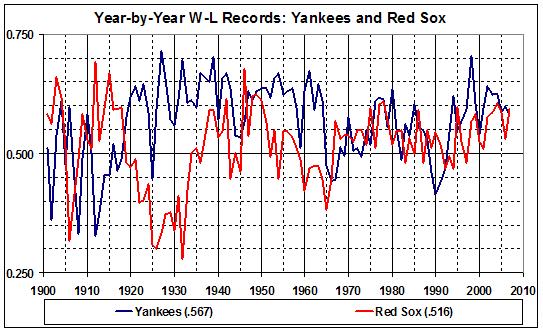
A 2. The Indians have been more consistent, with fewer highs and lows than the A’s. The A’s more frequent highs have enabled them to garner more first-place finishes than the Indians. The A’s more frequent lows, of course, don’t count against them when it comes to tallying first-place finishes. Graphically:

A 3. By taking the Yankees out of the picture, I get this:
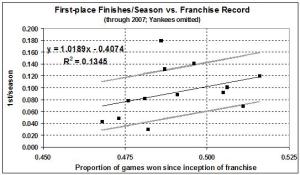
There’s still a positive relationship between overall record and first-place finishes, albeit a weaker one. However, if the Yankees did not exist, it would be necessary to invent them. Oops, I mean that if there had been no Yankees franchise, the White Sox, Tigers, and Red Sox (especially the Red Sox) would have had more first-place finishes. (The Indians might have had more, as well.) That is to say, there would be a stronger positive relationship than the one depicted immediately above.

A4. Frequency of first place finishes is more important than overall record. A winning record — as in the case of the Indians, with the third-best overall record in the AL — means only that a franchise has had more good years than bad ones. Look at the Red Sox, with their second-best overall record and their general frustration at the hands of the Yankees over the years:
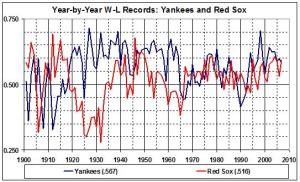
Before 1967, the Red Sox’ overall record was only 0.499; the Yankees’, 0.575. From 1967 through 2007, however, the Yankees played 0.555 ball, as against 0.542 for the Red Sox. The Red Sox, in other words, have become a much stronger team — almost as strong as the Yankees. And the graph shows it. But from 1967 through 2007 the Yankees earned 16 league/division titles to 7 for the Red Sox. (Har, har!)

Finishing first is the measure of a team’s quality, regardless of the team’s fate in post-season play.

Note to baseball purists: I write 0.xxx instead of .xxx because I am a purist when it comes to style. I follow A Manual of Style, published by The University of Chicago Press (twelfth edition, revised, section 13.13).

Perry for Vice President?

Rick Perry, purported conservative and governor of Texas, has endorsed Rudy Giuliani’s bid for the Republican presidential nomination. Giuliani currently leads the GOP race, having opened a comfortable lead over Mitt Romney at Iowa Electronic Markets. (McCain’s spike seems to coincide with Thompson’s slide and the possibility — as I see it — that Thompson will withdraw from the race before long.)

Why has Perry endorsed front-runner Giuliani? Perry’s term as governor runs until January 20, 2011. But why play on the Texas stage — big as it is — when you have a shot at national office? Perry, as a purported conservative and known Texan, would “balance” Giuliani’s watery Republicanism and Noo Yawk accent. Perry’s “clout” as a big-State governor and presumed appeal to Southern and Southwestern conservatives might just garner him the number-two spot on a Giuliani ticket.

P.S. As a Giuliani-Clinton race has become increasingly likely, bettors at Iowa Electronic Markets have begun to see a closer race in November ’08. The odds still favor the Democrat nominee, but the gap is narrow in the vote-share market, where the current betting is 0.516 Democrat to 0.489 Republican.

Scratch Another One

I haven’t found much of interest at QandO lately. Now Jon Henke wades in with this:

The Right likes to cast its leaders in the role of Churchill in 1938 – a visionary, warning the world of a gathering threat on the horizon. The US invaded Iraq because of an uncertain risk that we thought it important to guard against, spending thousands of US lives, tens/hundreds of thousands of Iraqi lives, and around a trillion dollars so far.

Well, climate change – to some extent or another – is a far more certain threat to the world than was Iraq, and Gore is genuinely playing the role of Churchill to warn the public of the risk.

That’s worse than boring; it’s dead wrong. “Global warming” is a natural, short-run phenomenon, not a “threat” about which we can or should do anything — unlike the possibility of an oil-rich Middle East under the thumb of Islamofascists.

A boring and wrong-headed blog: lethally trivial and not even worth a glance at the RSS feed.

Bye, bye, QandO.

Baseball’s Losers

UPDATED, 10/28/07

The Colorado (Denver) Rockies won the National League Championship Series for 2007, taking four straight games from the Arizona Diamondbacks. The Rockies thus left the short list of franchises that have never won a league championship. The remaining perennial losers and also-rans are:

Seattle Mariners, American League 1977-2007 (best record in 2001, but lost AL pennant to NY Yankees)
Tampa Bay Devil Rays, American League 1998-2007
Texas Rangers (formerly the expansion Washington Senators), American League 1961-2007
Washington Nationals (formerly the Montreal Expos), National League 1969-2007

The Milwaukee Brewers (originally the Seattle Pilots) joined the American League in 1969 and won a pennant there in 1982. But the Brewers have gone pennantless since becoming a National League team in 1998.

The Mariners, Devil Rays, Rangers, and Nationals (and their predecessors, if any) have not won a World Series, of course. Four other franchises have won league championships but have failed to win a World Series:

Colorado Rockies (2007)
Houston Astros (2005)
Milwaukee Brewers (1982)
San Diego Padres (1984, 1998)

Related posts:
Can Money Buy Excellence in Baseball?
The Meaning of the World Series
Pennant Winner vs. Best Team

The Sveriges Riksbank Prize in Economic Sciences for 2007

The Royal Swedish Academy of Sciences has awarded The Sveriges Riksbank Prize in Economic Sciences in Memory of Alfred Nobel 2007 to Leonid Hurwicz, University of Minnesota; Eric S. Maskin, Institute for Advanced Study, Princeton; and Roger B. Myerson, University of Chicago, for having initiated and developed “mechanism design theory,” which (according to the Academy),

has greatly enhanced our understanding of the properties of optimal allocation mechanisms in such situations, accounting for individuals’ incentives and private information. The theory allows us to distinguish situations in which markets work well from those in which they do not. It has helped economists identify efficient trading mechanisms, regulation schemes and voting procedures.

(For more, read this.)

“Mechanism design theory” is, in fact, a tool for centralized planning. It assumes, among other things, that there is such a thing as a “social welfare function,” when there is not. It assumes, also, that there are such things as “public goods,” and that markets “fail” to provide such goods, when there are not such failures (or would not be in the absence of government intervention). (See, for example, #15 and #16 here.) The provision of defense as a public good, for example, arises not out of economic necessity but out of political prudence. (For more on that point, see this and this, and the posts linked therein.)

Recommended reading: a post by Justin Ptak at Mises Economics Blog, and an article by Alex Tabarrok at reasononline (the only flaw of which is a too-willing acceptance of the idea of “public goods”).

Other related posts at Liberty Corner:
Socialist Calculation and the Turing Test
Second-Guessing, Paternalism, Parentalism, and Choice
Whose Incompetence Do You Trust?
Joe Stiglitz, Ig-Nobelist
Three Truths for Central Planners
Risk and Regulation
Back-Door Paternalism
Liberty, General Welfare, and the State
Science, Axioms, and Economics
Mathematical Economics
Economics: The Dismal (Non) Science
Positive Rights and Cosmic Justice: Part IV

Punctuation

David Bernstein of The Volokh Conspiracy writes:

I frequently have disputes with law reviewer editors over the use of dashes. Unlike co-conspirator Eugene, I’m not a grammatical expert, or even someone who has much of an interest in the subject.

But I do feel strongly that I shouldn’t use a dash between words that constitute a phrase, as in “hired gun problem”, “forensic science system”, or “toxic tort litigation.” Law review editors seem to want to generally want to change these to “hired-gun problem”, “forensic-science system”, and “toxic-tort litigation.” My view is that “hired” doesn’t modify “gun”; rather “hired gun” is a self-contained phrase. The same with “forensic science” and “toxic tort.”

Most of the commenters (thus far) are right in advising Bernstein that the “dashes” — he means hyphens — are necessary. Why? To avoid confusion as to what is modifying the noun “problem.”

In “hired gun,” for example, “hired” (adjective) modifies “gun” (noun, meaning “gunslinger” or the like). But in “hired-gun problem,” “hired-gun” is a compound adjective which requires both of its parts to modify “problem.” It is not a “hired problem” or a “gun problem,” it is a “hired-gun problem.” The function of the hyphen is to indicate that “hired” and “gun,” taken separately, are meaningless as modifiers of “problem,” that is, to ensure that the meaning of the adjective-noun phrase is not misread.

A hyphen isn’t always necessary in such instances. But the consistent use of the hyphen in such instances avoids confusion and the possibility of misinterpretation.

The consistent use of the hyphen to form a compound adjective has a counterpart in the consistent use of the serial comma, which is the comma that precedes the last item in a list of three or more items (e.g., the red, white, and blue). Newspapers (among other sinners) eschew the serial comma for reasons too arcane to pursue here. Thoughtful counselors advise its use. Why? Because the serial comma, like the hyphen in a compound adjective, averts ambiguity. It isn’t always necessary, but if it is used consistently, ambiguity can be avoided. (Here’s a great example, from the Wikipedia article linked in the first sentence of this paragraph: “To my parents, Ayn Rand and God.” The writer means, of course, “To my parents, Ayn Rand, and God.”)

This all reminds me of the unfortunate demise of the comma in adjectival phrases. If “hired” and “gun” were meant to modify “problem” separately, the expression would (should) be written “hired, gun problem.” Not that “hired, gun problem” means anything, but if it did, the proper use of a comma between “hired” and “gun” would ensure against misreading the phrase as “hired gun problem” (unpunctuated, as Bernstein prefers) as “hire-gun problem.”

A little punctuation goes a long way.

Sports, Illustrated

Hockey: a Three Stooges film with many extras

Basketball: a video game

Football: a feature-length cartoon

Baseball: a novel that sometimes becomes a trilogy

Leftists I Know

I know some Leftists. They’re not Leftists of the loony, venomous, conspiracy-theory variety who hang out in the comment threads of Left-wing blogs. They’re you’re garden-variety, conservatives-are-mean, government-is-good, Bush-is-bad, pull-out-of-Iraq, global-warming-is real, Social Security-Medicare-and-universal-health-care-are-necessary type of Leftist. But they’re generally quiet about it, unless they’re talking to each other, in mutual support.

The thinking of the Leftists I know was shaped by “educators” and is constantly reinforced by selective (i.e., biased) reading, listening, and viewing. In other words, they have never matured mentally. They’re stuck on the themes they were force-fed before and during their college years. I would say “stuck on stupid,” but they’re not stupid — just ignorant and mentally lazy.

The hard part is: Most of them are nice. So, it’s hard to dislike a garden-variety Leftist, in spite of his or her views. Of course, it will be a different story if any of them starts hanging around the comment threads of Leftist blogs.

Is It Sexist…

…to say that women are more cooperative than men? Not if it’s true. Nor am I surprised.

Related posts:
Students, Beware!
The Ultimatum Game and Genes

The Ultimatum Game and Genes

Greg Mankiw points to research which suggests that our sense of “fairness” may be genetic:

The paper, published in the Oct. 1 advanced online issue of the Proceedings of the National Academy of Sciences, looked at the ultimatum game, in which a proposer makes an offer to a responder on how to divide a sum of money. This offer is an ultimatum; if the responder rejects it, both parties receive nothing.

Because rejections in the game entail a zero payoff for both parties, theories of narrow self-interest predict that any positive amount will be accepted by a responder. The intriguing finding in the laboratory is that responders routinely reject free money, presumably in order to punish proposers for offers perceived as unfair.

To study genetic influence in the game, Cesarini and colleagues took the unusual step of recruiting twins from the Swedish Twin Registry, and had them play the game under controlled circumstances. Because identical twins share the same genes but fraternal twins do not, the researchers were able to detect genetic influences by comparing the similarity with which identical and fraternal twins played the game.

The researchers’ findings suggest that genetic influences account for as much as 40 percent of the variation in how people respond to unfair offers. In other words, identical twins were more likely to play with the same strategy than fraternal twins.

More than three years ago I said this about the ultimatum game:

Being offered only one of 10 dollars [in the ultimatum game] is an insult, and accepting an insult isn’t worth a dollar, to most people. When someone who is holding 10 dollars offers you only one dollar, that person is sending you a signal about your worth in his or her eyes.

I don’t know whether the typical rejection of an insulting offer is genetic. But rejection makes sense, if you consider how people act in “real life” as opposed to being the wealth-maximizers portrayed in economics texts.

It *Is* the Oil

Jim Holt says it, loud and clear. And why not?

Racism among the Deracinated

John Ray points to a story at Telegraph.co.uk:

Student’s ‘English bash’ deemed racist

A student at a university that prides itself on being among the most multicultural in Britain has been branded “racist” after distributing invitations to an “English party”.

Rugby captain Timothy McLellan has been forced to apologise after pinning up posters around the campus promising the event would have “no bongos, shisha pipes or Arabic music”.

The 20-year-old law student had intended the flyer to be a joke poking fun at parties held at the School of Oriental and African Studies in London, which typically have an ethnic theme.

McLellan apologized, of course, saying (in part):

The choice of the word ‘English’, which I now regret, was not intended to mean that it was a party for white English students but was rather intended to express that the party’s vibe reflected England’s mainstream culture, which in itself is not racially exclusive.

Well, mainstream English culture may or may not be “racially exclusive,” but it is (as McLellan clearly implies) substantially different than the cultures celebrated at the School of Oriental and African Studies.

The incident reminds me of one that I witnessed 25 years ago, when I was, for a while, taking a bus to work. The regular bus driver was a white gentleman of Southern extraction. Most of the passengers were Asians and West Indian blacks who attended a community college located near a stop toward the end of the bus route. My stop was the last one on the route.

It was usual for everyone on the bus but me to disgorge at the stop located near the community college. One day, after the students has swarmed from the bus, the driver turned to me and said “I think I’ll go to Germany, where I can see some Americans.” (This was, of course, before the Muslim invasion of Western Europe.)

I understand what the bus driver felt, just as I sympathize with Timothy McLellan. There is — or was — a mainstream American culture,* just as there is — or was — a mainstream English culture. It is now de rigeur to deride those cultures and to say that their proponents and practitioners are insensitive racists. What does that make the proponents and practitioners of sub-cultures and imported cultures, especially those whose aim is the overthrow of the mainstream culture?

Mainstream Americans and Englishmen, arise. Shake off your apologetic airs. Assert your cultural pride. Illegitimi non carborundum.
_________
* The American mainstream was: upper lower-class (i.e., non-redneck) to upper middle-class; against welfare (charity was for the helpless and hopeless, and it began at home); for punishment (as opposed to excuses about poverty, etc.); overtly religious or respectful of religion (and, in either case, generally respectful of the last six of the Ten Commandments); personally responsible (stuff happens, and it’s rarely someone else’s fault); polite and helpful to strangers; patriotic (the U.S. was better than other countries and not beholden to international organizations, wars were to be fought to victory); and anti-socialist (being anti-communist was a given). Racist views, to the extent they were held, were expressed only to people one knew well (and who were of a like mind); such views were not acted upon violently or even impolitely. The “f” word and similar expletives were closeted, as well. Homosexuality and “shacking up” were disgraceful novelties, not “lifestyles” to be venerated.

Mainstream Americans might have been white or black, Christian or Jewish, rural or urban, college-educated or not, but the mainstream was wide. I knew mainstreamers well. They were to be found on main street, in side streets, and even in universities — often among the faculty. They abounded in public education, where they taught mainstream values.

The mainstream began to dry up when universities began to spew forth “educators” whose beliefs run contrary to those recited above (i.e., for welfare, against punishment, etc., etc., etc.). Those “educators” have long since done the bidding of anti-mainstream élites, in and out of academia. Thus the mainstream is now a relative trickle in an arid valley of Leftist sentiments, which have become so commonplace that they are parroted even by persons who do not consider themselves Leftists.

Affirmative Action for Conservatives and Libertarians?

Greg Mankiw and Ilya Somin raise the issue. Mankiw says:

Question to think about: If right-wingers are underrepresented in universities relative to the population and discriminated against by the left-wing majority, as Larry suggests, should there be affirmative action for right-leaning academics? It seems that, on principle, those on the left (who favor affirmative action to promote diversity and correct past injustice) should endorse such a university policy, and those on the right (who more often oppose affirmative action) would be against.

Somin comments:

The underrepresentation of conservatives (and, I would add, libertarians) is almost certainly not all due to ideological discrimination. But evidence suggests that discrimination is probably at least a part of the story. In this excellent Econlog post, economist Bryan Caplan explained why ideological discrimination is more likely to flourish in academia than in most other employment markets. Even aside from discrimination, the ideological homogeneity of much of academia causes a variety of problems, such as reducing the diversity of ideas reflected in research, skewing teaching agendas, and generating the sorts of “groupthink” pathologies to which ideologically homogenous groups are prone.

However, whether or not [ideological] discrimination is the cause of the problem, affirmative action for conservative academics (or libertarian ones) is a poor solution. Among other things, it would require universities to define who counts as a “conservative” for affirmative action purpose, a task that they aren’t likely to do well. Affirmative action for conservatives would also give job candidates an incentive to engage in deception about their views in the hopes of gaining professional advancement. Moreover, conservative professors hired on an affirmative basis despite inferior qualifications would find it difficult to get their ideas taken seriously by colleagues and students. They might therefore be unable to make a meaningful contribution to academic debate – the very reason why we want to promote ideological diversity in hiring to begin with.

Somin’s argument is correct, as far as it goes. I would add this: Left-dominated disciplines (primarily the so-called liberal arts) will become less and less rewarding, relative to other (non-ideological) disciplines) as they become less and less relevant, economically. Left-dominated disciplines, therefore, will attract (proportionally) fewer and fewer students — because students (especially grad students) tend to go where the money is. As a result, the number of faculty supported by such disciplines will shrink (relatively, if not absolutely), and the academic influence of Leftists will diminish (relatively, if not absolutely).

In other words, the market will take care of the problem, albeit over a longish period of time. Market signals will influence tax-funded universities, as well as private ones, because tax-funded universities do compete with each other and with private ones for the “best and the brightest” students.

Achilles and the Tortoise: A False Paradox

According to Aristotle (restating Zeno):

In a race, the quickest runner [Achilles] can never overtake the slowest [Tortoise], since the pursuer must first reach the point whence the pursued started [i.e. the pursued has a head start], so that the slower must always hold a lead.

Can anyone really believe that Achilles fails to catch the Tortoise? Yes. See this, this, this, and this, for example.

To show what’s wrong with Aristotle’s analysis, I begin with an example:

  • Achilles (A), a quasi-god with a tricky tendon, runs at a mortal speed of 15 miles an hour (a 4-minute miler, he).
  • Tortoise (T) “runs” at a speed of 1 mile an hour. (I exaggerate for simplicity of illustration.)
  • If A gives T a 15-mile lead, A reaches T’s starting point in 1 hour. T has, in that hour, moved ahead by 1 mile.
  • A covers that mile in 1/15 of an hour, in which time T has moved ahead by 1/15 of a mile.
  • A runs the 1/15 of a mile in 16 seconds, in which time T has moved ahead by another 23.47 feet.
  • And so on.
  • Therefore, A can never catch T.

What’s the catch? It’s verbal sleight-of-hand, much like the “proof” that 1 + 1 = 3. We know that A must be able to catch T, but we are trapped in a fallacious argument which seems to prove that A can’t catch T.

The trick lies in the presentation of A’s and T’s movements as occurring alternately instead of simultaneously. A is always described as going to where T was, not to where T will be when A catches him.

Such reasoning contradicts what we know of reality. Fast runners often catch (relatively) slow runners on the football field. The best sprinter on any high-school track team could give me a 25-yard head start and beat me to the finish line of a 100-yard dash. And so on.

When a real A catches a real T, the real A does so by covering a greater distance than the real T, but the real A covers that distance by running for exactly the same length of time as the real T runs. Along the way, A will pass points already passed by T, but A will not pause at any of those points and allow T to move a bit farther ahead — which is the trick that lies behind the Aristotelian “proof” of A’s inability to catch T.

Going back to the example (A runs 15 miles an hour, etc.), we can determine when and where A catches T simply by describing the race correctly:

  • A’s time (in hours) x A’s velocity (in miles per hour) = A’s distance (in miles).
  • If A catches T, T’s time = A’s time; T’s distance (including his head start) = A’s distance.
  • Therefore, when A has run for 15/14 hours at 15 miles an hour he has covered a distance of 225/14 miles (16 and 1/14 miles).
  • In that same 15/14 hours, T (moving at 1 mile an hour) has covered a distance of 1-1/14 mile.
  • Adding the distance T has traveled in 15/14 hours to T’s head start of 15 miles, we see that T is, at the end of those 15/14 hours, exactly 16-1/4 miles from A’s starting point.
  • In sum, A catches T after both have been running for 15/14 hours, and at a distance of 16-1/4 miles from A’s starting point.
  • A, having caught T, then moves farther ahead of him with each stride because A is running at 15 miles an hour, whereas T is moving at only 1 mile and hour.
  • Therefore, it is true that T, having been caught and surpassed by A, can never catch A as long as A and T continue to run at their respective velocities of 15 miles an hour and 1 mile an hour.

Generally, if A is able to overtake T at time t and distance d (from A’s starting point):

ta = tt = t, where ta is A’s time since the start of the race and tt is T’s time since the start of the race
da = dt = d, where da is A’s distance from his starting point and dt is T’s distance from A’s starting point, which include’s T’s head start: h
da = (va)(t), where va is A’s speed
dt = h + (vt)(t), where vt is T’s speed

If da = dt = d:

(va)(t) = h + (vt)(t)
(va)(t) – (vt)(t) = h
(vavt)(t) = h
t = h/(vavt)

Having solved this equation for t — given h, va, and vt — it is then trivial to solve the equations for da and dt, and to show that both yield the same result, which is d.

Meaningful values can be found for t and d only if va > vt. Otherwise, t and d take meaningless negative values. This null possibility means that the answer “A catches T” is not assumed in the algebraic statement of the problem; that is, the algebraic formulation given here is not a circular proof of A’s ability to catch T.