A Belated Labor Day Message

The good news:


Derived from “Union Membership, Coverage, Density, and Employment Among Private Sector Workers, 1973-2010,” © 2010 by Barry T. Hirsch and David A. Macpherson.

Why is this good news? Read on: “The Truth about Labor Day,” from the Ludwig von Mises Institute; “Toward a Capital Theory of Value,” “A Very Politically Incorrect Labor Day Post,” and “Your Labor Day Reading,” by me. (NB: Some of the links in these old posts may be broken, and some of the quoted Wikipedia articles may have been revised by “contributors” eager to whitewash the labor-union movement.)

A Mere Coincidence?

UPDATED 09/10/10

On this morning after Barack Obama indulged in the politics of envy and class warfare by rejecting the continuation of the “Bush tax cuts” for high-income individuals, his unpopularity rating fell to a new low: -24.

By my estimate, rejection of Obama by conservative-libertarian-independent voters gives him a baseline unpopularity rating of -10. Ratings lower than that require the disapproval of Obama by disaffected Democrats who think he isn’t “doing enough.”

Well, if this morning’s poll results are any indication, there are some well-to-do and aspiring-to-do-well Democrats out there who think Obama would be “doing too much” if he succeeds in raising their marginal tax rates.

UPDATE: Despite today’s slight improvement, from -24 to -21, Obama’s unpopularity rating has hit new lows: 28-day average = -17.4; 7-day average = -20.7.

Macroeconomics and Microeconomics

Macroeconomic aggregates (e.g., aggregate demand, aggregate supply) are essentially meaningless because they represent disparate phenomena.

Consider A and B, who discover that, together, they can have more clothing and more food if each specializes: A in the manufacture of clothing, B in the production of food. Through voluntary exchange and bargaining, they find a jointly satisfactory balance of production and consumption. A makes enough clothing to cover himself adequately, to keep some clothing on hand for emergencies, and to trade the balance to B for food. B does likewise with food. Both balance their production and consumption decisions against other considerations (e.g., the desire for leisure).

A and B’s respective decisions and actions are microeconomic; the sum of their decisions, macroeconomic. The microeconomic picture might look like this:

  • A produces 10 units of clothing a week, 5 of which he trades to B for 5 units of food a week, 4 of which he uses each week, and 1 of which he saves for an emergency.
  • B, like A, uses 4 units of clothing each week and saves 1 for an emergency.
  • B produces 10 units of food a week, 5 of which she trades to A for 5 units of clothing a week, 4 of which she consumes each week, and 1 of which she saves for an emergency.
  • A, like B, consumes 4 units of food each week and saves 1 for an emergency.

Given the microeconomic picture, it is trivial to depict the macroeconomic situation:

  • Gross weekly output = 10 units of clothing and 10 units of food
  • Weekly consumption = 8 units of clothing and 8 units of food
  • Weekly saving = 2 units of clothing and 2 units of food

You will note that the macroeconomic metrics add no useful information; they merely summarize the salient facts of A and B’s economic lives — though not the essential facts of their lives, which include (but are far from limited to) the degree of satisfaction that A and B derive from their consumption of food and clothing.

The customary way of getting around the aggregation problem is to sum the dollar values of microeconomic activity. But this simply masks the aggregation problem by assuming that it is possible to add the marginal valuations (i.e., prices) of disparate products and services being bought and sold at disparate moments in time by disparate individuals and firms for disparate purposes. One might as well add two bananas to two apples and call the result four bapples.

The essential problem is that A and B will derive different kinds and amounts of enjoyment from clothing and food, and that those different kinds and amounts of enjoyment cannot be summed in any meaningful way. If meaningful aggregation is impossible for A and B, how can it be possible for an economy that consists of millions of economic actors and an untold variety of goods and services? And how is it possible when technological change yields results such as this?

GDP, in other words, is nothing more than what it seems to be on the surface: an estimate of the dollar value of economic output. It is not a measure of “social welfare” because there is no such thing.

Given that, why do I sometimes use GDP statistics? And, if GDP is really a meaningless aggregate, is there a valid, alternative way of depicting aggregate well-being? To be continued.

Related posts:
Greed, Cosmic Justice, and Social Welfare
Utilitarianism, “Liberalism,” and Omniscience
Utilitarianism vs. Liberty
Accountants of the Soul
Rawls Meets Bentham
Enough of “Social Welfare”
The Case of the Purblind Economist

Why Outsourcing Is Good: A Simple Lesson for “Liberal” Yuppies

You work in Manhattan, at the headquarters of a company whose product is sold throughout the U.S. and overseas. You live in Connecticut and commute to Manhattan by train. You drive to and from the train station in an SUV that was assembled in Tennessee; the parts came from many places, including Japan and Korea.

Shazam! Outsourcing is outlawed. You can’t buy a new SUV unless it’s assembled in Connecticut and all its parts are made in Connecticut of raw materials that are native to Connecticut.

Wait, it gets worse. You can’t work for a Manhattan-based firm if you live in Connecticut. Only Manhattanites need apply. The good news is that you won’t need an SUV if you move to Manhattan, so that you can keep your job. The bad news is that you can’t afford to live in Manhattan. The good news is that you wouldn’t want to live there anyway, because the only raw materials native to Manhattan are soot and dog droppings.

Missing Bloggers

Ilkka, the owner of The Fourth Checkraise, has not posted since August 1.

Alan, the owner of Occam’s Carbuncle (no longer online) has not posted in more than a year.

I hope that both bloggers will once again take up their keyboards. I have missed their perceptive and wickedly entertaining commentaries.

Comments are enabled for this post, so that the bloggers in question (or someone who knows the whereabouts of either of them) can enlighten me.

UPDATE (09/06/10): Ilkka comments: “I’m on a break until I get the spark to write something good again.”

Youthful Wisdom

A recent e-mail from my 15-year-old grandson includes this:

I am great lover of industry and I fume when I hear people complain about the chemical plants in __________, but without industry you cannot have the comforts of home….

I was in my 30s before I even began to think about the preciousness of the intellectualoids. Here is a 15-year-old who already sees through their cant.

I am proud to be his grandfather.

Obama’s Short-Lived “Peace Dividend”

UPDATED 09/05/10

On August 31, BHO declared an end to U.S. combat operations in Iraq. In anticipation of that declaration, and for a few days following it, BHO enjoyed what (for him) is a surge in popularity. His approval index (per Rasmussen Reports) went from -20 on August 25 to -12 on August 28. It dropped to -14 on August 31, but returned to -12 on September 1 (the morning after BHO’s declaration). It has been all downhill since: -13 on September 2, -16 on September 3, -21 on September 4, -23 on September 5.

Our boy president has recorded an unpopularity rating of -20 or lower only33 times in the 579 polling days that began with his inauguration. Nine of those low marks (more than a fourth of them) have come in the most recent 10 weeks of BHO’s 85 weeks in office.

In fact, Obama has earned a zero or positive rating 27 percent of the time; a negative rating, 73 percent of the time. More than half of his ratings have been -10 and lower. His last zero or positive rating came on June 29, 2009 — 62 weeks ago. That shouldn’t be surprising, given that he peaked two days after his inauguration. It has been mostly downhill and in a negative trough since then. Obama’s 28-day average rating hit -10 on November 7, 2009, and has stayed below -10 (usually well below) for the past 10 months.

It seems that BHO will have to keep looking for a way to become popular. Resignation might do the trick.

A Moral Dilemma

A classic moral dilemma goes like this:

You are at a train track and see five people tied to the track ahead. A switch is in front of you which will divert the train, but as you look down you see a man is strapped to that track and will be killed. Is it permissible to flip the switch and save the five people at the expense of one?

If you are like most people, you said yes.

Now imagine in order to save the five people, you have to push a stranger in front of the train to stop it. You know for certain it would stop the train in time to save the five people tied to the tracks. Is it permissible to push the man and save the five people at the expense of one?

You probably said no. But the results are the same — the only difference is the method (passive vs. impassive). But in both cases you sacrifice one life to save five.

The problem is squeamishness. It is easier to be passive than active, even if being active has the same result as passivity.

Politicians in Washington face an analogous moral dilemma, to which I will come after setting the stage.

Government debt is rising, and will continue to rise unless the laws governing Social Security, Medicare, and Medicaid are changed to reduce future benefits from “promised” levels. (It has long been understood that the “promises” are not legally binding, and may be changed at any time.) Alternatively, taxes must rise considerably.

Barring benefit reductions or tax increases, government debt will reach a point at which it becomes unsustainable. That is, it would become impossible for government to borrow, except at extremely high rates of interest. Those high rates would spill over into the private sector and make corporate borrowing an unattractive source of capital for business expansion. At the same time, stock prices would drop, in response to higher interest rates, therefore making stock issuance an unattractive source of capital for business expansion.

The developments I have just outlined would lead to prolonged (perhaps permanent) economic stagnation, such as Japan has experienced. Stagnation would, in turn, magnify the burden on future workers, who will (no matter what) foot the bill for Social Security, Medicare, and Medicaid. At some point, politicians would confront two stark options: cut benefits even more deeply than they would if action hadn’t been postponed; maintain “promised” benefits and drive future generations into penury.

In a nutshell:

  • Today’s “promises” to future recipients of Social Security, Medicare, and Medicaid cannot be kept without doing harm,  in the form of onerous taxes and/or economic stagnation (at best), in the not-too-distant future.
  • Despite the certainty of that harm, most politicians are afraid to suggest that today’s “promises” cannot be kept. And they are equally afraid to raise taxes to the levels required to keep those “promises.” They are afraid because they believe that the truth will cost them their jobs.

Politicians who are unwilling to acknowledge the facts about Social Security, Medicare, and Medicaid are like the squeamish bystander who refuses to save five persons by pushing one person onto the train tracks. The one person, of course, is the politician, who fears that he would lose his job for the simple act of doing it.

For most politicians, there is no moral dilemma. Their course of action is preordained by their lack of morality. They will save themselves and sacrifice the well-being of millions of Americans.

Related posts:
Presidential Chutzpah
Can Markets Force Fiscal Discipline?
As Goes Greece . . .

How the Great Depression Ended

Don Boudreaux writes:

No modern myth dies harder than the familiar claim – today repeated in the Los Angeles Times by one Joan Mortenson – that “It was the massive spending of World War II that finally ended the Depression.”

Between 1941 and 1945 Uncle Sam drew into his military 16 million persons – that was 22 percent of the pre-war labor force.  With so many workers then militarized, mostly through conscription, there’s no evidence that wartime spending restored the labor market to health.  And while real GDP did rise during those years because of military spending, the private economy shrank.  As Robert Higgs notes, “Real civilian consumption and private investment both fell after 1941, and they did not recover fully until 1946.  The privately owned capital stock actually shrank during the war.

It is true that the private economy shrank during World War II. But the important thing is what happened after that, and why. Here is a more complete picture, which I have lifted from an old post of mine:

Conventional wisdom has it that the entry of the United States into World War II caused the end of the Great Depression in this country. My variant is that World War II led to a “glut” of private saving because (1) government spending caused full employment, but (2) workers and businesses were forced to save much of their income because the massive shift of output toward the war effort forestalled spending on private consumption and investment goods. The resulting cash “glut” fueled post-war consumption and investment spending.

Robert Higgs, research director of the Independent Institute, has a different theory, which he spells out in “Regime Uncertainty: Why the Great Depression Lasted So Long and Why Prosperity Resumed After the War” (available here), the first chapter his new book, Depression, War, and Cold War. (Thanks to Don Boudreaux of Cafe Hayek for the pointer.) Here, from “Regime Change . . . ” is Higgs’s summary of his thesis:

I shall argue here that the economy remained in the depression as late as 1940 because private investment had never recovered sufficiently after its collapse during the Great Contraction. During the war, private investment fell to much lower levels, and the federal government itself became the chief investor, directing investment into building up the nation’s capacity to produce munitions. After the war ended, private investment, for the first time since the 1920s, rose to and remained at levels sufficient to create a prosperous and normally growing economy.

I shall argue further that the insufficiency of private investment from 1935 through 1940 reflected a pervasive uncertainty among investors about the security of their property rights in their capital and its prospective returns. This uncertainty arose, especially though not exclusively, from the character of federal government actions and the nature of the Roosevelt administration during the so-called Second New Deal from 1935 to 1940. Starting in 1940 the makeup of FDR’s administration changed substantially as probusiness men began to replace dedicated New Dealers in many positions, including most of the offices of high authority in the war-command economy. Congressional changes in the elections from 1938 onward reinforced the movement away from the New Deal, strengthening the so-called Conservative Coalition.

From 1941 through 1945, however, the less hostile character of the administration expressed itself in decisions about how to manage the warcommand economy; therefore, with private investment replaced by direct government investment, the diminished fears of investors could not give rise to a revival of private investment spending. In 1945 the death of Roosevelt and the succession of Harry S Truman and his administration completed the shift from a political regime investors perceived as full of uncertainty to one in which they felt much more confident about the security of their private property rights. Sufficiently sanguine for the first time since 1929, and finally freed from government restraints on private investment for civilian purposes, investors set in motion the postwar investment boom that powered the economy’s return to sustained prosperity notwithstanding the drastic reduction of federal government spending from its extraordinarily elevated wartime levels.

Higgs’s explanation isn’t inconsistent with mine, but it’s incomplete. Higgs overlooks the powerful influence of the large cash balances that individuals and corporations had accumulated during the war years. It’s true that because the war was a massive resource “sink” those cash balances didn’t represent real assets. But the cash was there, nevertheless, waiting to be spent on consumption goods and to be made available for capital investments through purchases of equities and debt.

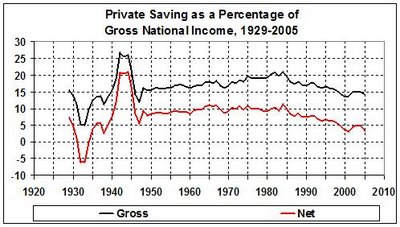
It helped that the war dampened FDR’s hostility to business, and that FDR’s death ushered in a somewhat less radical regime. Those developments certainly fostered capital investment. But the capital investment couldn’t have taken place (or not nearly as much of it) without the “glut” of private saving during World War II. The relative size of that “glut” can be seen here:

Derived from Bureau of Economic Analysis, National Income and Product Accounts Tables: 5.1, Saving and Investment. Gross private saving is analagous to cash flow; net private saving is analagous to cash flow less an allowance for depreciation. The bulge in gross private saving represents pent-up demand for consumption and investment spending, which was released after the war.

World War II did bring about the end of the Great Depression, not directly by full employment during the war but because that full employment created a “glut” of saving. After the war that “glut” jump-started

  • capital spending by businesses, which — because of FDR’s demise — invested more than they otherwise would have; and
  • private consumption spending, which — because of the privations of the Great Depression and the war years — would have risen sharply regardless of the political climate.

UPDATE: Robert Higgs, in an e-mail to me dated 06/24/06, submitted the following comment:

I happened upon your blog post that deals with my ideas about why the depression lasted so long and about the way in which the war related to the genuine prosperity that returned in 1946 for the first time since 1929. I appreciate the publicity, of course. I suggest, however, that you read my entire book, especially, with regard to the points you make on your blog, its chapter 5, “From Central Planning to the Market: The American Transition, 1945-47” (originally published in the Journal of Economic History, September 1999. I show there that the “glut of savings” idea, which is an old one, indeed perhaps even the standard theory of the successful postwar reconversion, does not fit the facts of what happened in 1945-47.

Here is my reply of 10/12/06:

I apologize for the delay in replying to your e-mail about my post… Your book, Depression, War, and Cold War, has not yet made it to the top of my Amazon.com wish list, but I have found “From Central Planning to the Market: The American Transition, 1945-47” on the Independent Institute’s website (here). If the evidence and arguments you adduce there are essentially the same as in chapter 5 of your book, I see no reason to reject the “glut of savings” idea, which is an old one, as I knew when I wrote the post. But, because it is not necessarily an old one to everyone who might read my blog, it is worth repeating — to the extent that it has merit.

At the end of the blog post I summarized the causes of the end of the Great Depression, as I see them:

World War II did bring about the end of the Great Depression, not directly by full employment during the war but because that full employment created a “glut” of saving. After the war that “glut” jump-started

  • capital spending by businesses, which — because of FDR’s demise — invested more than they otherwise would have; and
  • private consumption spending, which — because of the privations of the Great Depression and the war years — would have risen sharply regardless of the political climate.

In the web version of chapter 5 of your book you attribute increased capital spending to an improved business outlook (owing to FDR’s demise) and (in the section on the Recovery of the Postwar Economy, under Why the Postwar Investment Boom?) to “a combination of the proceeds of sales of previously acquired government bonds, increased current retained earnings (attributable in part to reduced corporate-tax liabilities), and the proceeds of corporate securities offerings” to the public. It seems that those “previously acquired government bonds” must have arisen from the “glut” of corporate saving during World War II.

What about the “glut” of personal saving, which you reject as the main source of increased consumer demand after World War II? In the online version of chapter 5 (in the section on the Recovery of the Postwar Economy, under Why the Postwar Consumption Boom?) you say:

The potential for a reduction of the personal saving rate (personal saving relative to disposable personal income) was huge after V-J Day. During the war the personal saving rate had risen to extraordinary levels: 23.6 percent in 1942, 25.0 percent in 1943, 25.5 percent in 1944, and 19.7 percent in 1945. Those rates contrasted with prewar rates that had hovered around 5 percent during the more prosperous years (for example, 5.0 percent in 1929, 5.3 percent in 1937, 5.1 percent in 1940). After the war, the personal saving rate fell to 9.5 percent in 1946 and 4.3 percent in 1947 before rebounding to the 5 to 7 percent range characteristic of the next two decades. After having saved at far higher rates than they would have chosen in the absence of the wartime restrictions, households quickly reduced their rate of saving when the war ended.

That statement seems entirely consistent with the proposition that consumers spent more after the war because they had the money to spend — money that they had acquired during the war when their opportunities for spending it were severely restricted. Not so fast, you would say: What about the fact that “individuals did not reduce their holdings of liquid assets after the war” (your statement)? They didn’t need to. Money is fungible. If consumers had more money coming in (as they did), they could spend more while maintaining the same level of liquid assets — because they had a “backlog” of saving. Here’s my take:

  • Higher post-war incomes didn’t just happen, they were the result of higher rates of investment and consumption spending.
  • The higher rate of investment spending was due, in part, to corporate saving during the war and, in part, to individuals’ purchases of corporate securities and equities.
  • At bottom, the wartime “glut” of personal saving enabled the postwar saving rate to decline to a more normal level, thus allowing consumers to buy equities and securities — and to spend more — without drawing down on their liquid assets.

Granted, business and personal saving during World War II was not nearly as large in real terms as it was on paper — given the very high real cost of the war effort. But it was the availability of paper savings that strongly influenced the behavior of businesses and consumers after the war….

The Case of the Purblind Economist

Purblind: lacking in insight or understanding; obtuse

Steven Landsburg just doesn’t get it. Uwe Reinhardt lectures him about the folly of “efficiency” (or “social welfare”), and Landsburg continues to act as if there were such a thing:

Suppose you live next door to Bill Gates. Bill likes to play loud music at night. You’re a light sleeper. Should he be forced to turn down the volume?

An efficiency analysis would begin, in principle (though it might not be so easy in practice) by asking how much Bill’s music is worth to him (let’s say we somehow know that the answer is $10,000) and how much your sleep is worth to you (let’s say $25). It is important to realize from the outset that no economist thinks those numbers in any way measure Bill’s subjective enjoyment of his music or your subjective annoyance. Only a crazy person would think such a thing, and I’ve never met anybody who’s that crazy in that particular way. Instead, these numbers primarily reflect the fact that Bill is a whole lot richer than you are. Nevertheless, the economist will surely declare it inefficient to take $10,000 worth of enjoyment from Bill in order to give you $25 worth of sleep. We call that a $9,975 deadweight loss.

The problem with this kind of thinking should be obvious to anyone with the sense God gave a goose. The value of Bill’s enjoyment of loud music and the value of “your” enjoyment of sleep, whatever they may be, are irrelevant because they are incommensurate. They are separate, variably subjective entities. Bill’s enjoyment (at a moment in time) is Bill’s enjoyment. “Your” enjoyment (at a moment in time) is your enjoyment. There is no way to add, subtract, divide, or multiply the value of those two separate, variably subjective things. Therefore, there is no such thing (in this context) as a deadweight loss because there is no such thing as “social welfare” — a summation of the state of individuals’ enjoyment (or utility, as some would have it).

Landsburg persists:

Take a more realistic example: Should we spend, say, a billion dollars a year to subsidize end-of-life health care for poor people? It would be, I think, a terrible mistake to settle this question without at least asking whether the recipients might prefer that we spend our billion dollars some other way — say by subsidizing their groceries or just giving them cash. If so, the difference in value between what they’re getting and what they could be getting (as measured by the recipients) is a deadweight loss. The bigger that deadweight loss, the more we should reconsider our spending priorities.

Who is “we,” Prof. Landsburg? Do you presume to speak for me, one of the taxpayers who would share in the cost of subsidizing end-of-life health care for poor people? The “recipients” have no right to prefer anything. It is my money you’re talking about, not some pot of “social welfare” that sits in the sky, waiting to be distributed by omniscient economists like you. The deadweight loss, as far as I’m concerned, is whatever you take from me to “give” to others, in your omniscience. I have better things to do with my money, thank you, and whether or not they’re “charitable” (they are, in part), is no business of yours. Who made you the accountant of my soul?

Related posts:
Greed, Cosmic Justice, and Social Welfare
Positive Rights and Cosmic Justice
Inventing “Liberalism”
Utilitarianism, “Liberalism,” and Omniscience
Utilitarianism vs. Liberty
Beware of Libertarian Paternalists
Landsburg Is Half-Right
Negative Rights, Social Norms, and the Constitution
Rights, Liberty, the Golden Rule, and the Legitimate State
The Mind of a Paternalist
Accountants of the Soul
Rawls Meets Bentham
Enough of “Social Welfare”

A True Flat Tax

REVISED 08/30/10

Don Boudreaux writes:

I do not grant that government’s decision to refrain from taking X‘s money means that government subsidizes X. The tax-exemption might be unwise policy, and it might be unfair (by some plausible guideposts) – and it almost certainly gives the tax-exempt organizations an advantage that they would otherwise not possess.

But tax-exemption does not involve taking money from Y and giving it to X. That fact is vital.

I’m not so sure.

The reason I’m not so sure is that “tax-exemption … almost certainly gives the tax-exempt organizations an advantage that they would otherwise not possess.” In other words, X‘s revenues are greater than they would be absent X’s tax-exempt status. By the same token, Y‘s revenues are less than they would be absent X‘s tax-exempt status. It may be true that X’s greater revenues do not accrue as profits, but they do accrue in some form. For example, in the defense-analysis industry, with which I am familiar, the employees of tax-exempt organizations — known as federally funded research and development centers (FFRDCs)– enjoy more luxurious offices; higher compensation, mainly in the form of benefits (e.g., more vacation time, larger company contributions to health insurance premiums, better retirement plans); and more stable employment (because FFRDCs operate under long-term, sole-source contracts that tend to be renewed decade after decade). The benefits that accrue to X‘s employees because of X‘s tax-exempt status are, in effect, a subsidy paid by Y‘s shareholders and employees.

Another way to look at it is this: In a balanced-budget world, the cost of government would be defrayed entirely by tax revenues. Given a government of a certain size, the exemption of some firms from paying taxes requires that other firms’ shareholders and employees pay higher taxes. That is a subsidy, if I ever saw one.

Going one step further, consider the proper function of government, which is to protect the lives, liberty, and property of citizens. It is none of government’s business what a citizen does when his life, liberty, and property are secure, as long as he doesn’t use it to impinge on the lives, liberty, and property of others. Whether a person makes a billion dollars a year or one dollar a year is really not the government’s concern, nor is it the government’s concern whether a person lives in a castle or a cardboard box. Such things, if they are of concern to anyone other than the person in question, are of concern to that person’s family, friends, neighbors, private charities, and so on.

It follows that government has no proper claim on the amount of income or wealth that a person acquires through the legitimate use of his liberty (such as it is). Warren Buffet and Bill Gates owe the government no more than a panhandler. Buffet and Gates simply have made better use of the protection afforded them by government, at least with respect to the acquisition of income and wealth.

The proper level of taxation, therefore, is that which defrays the cost of the governmental functions which protect the lives, liberty, and property of citizens: defense, courts, and law-enforcement. The cost of those functions is about $3,000 a year for every person aged 21 and older.* Everyone (21 and older) whose annual tax bill includes more than $3,000 for “liberty” services is subsidizing everyone (21 and older) whose annual tax bill for the same things is less than $3,000. All taxes for other services, regardless of who pays them, are forms of theft.**

__________
* The annual cost of national defense, the courts, and law-enforcement agencies is about $600 billion. That amount, divided by 200 million (the approximate number of persons in the United States aged 21 and older) yields an annual per-person cost of $3,000. I exclude persons under 21 because most of them still depend on adults for their subsistence, and have not yet advanced to the stage of making the most of the protections afforded by government.

** Some taxes underwrite regulatory functions, which are counterproductive. Some taxes underwrite services that are used by varying percentages of the populace (e.g., parks, highways), which (a) burdens those taxpayers who do not use the services in question, (b) subsidizes those taxpayers who do use the services in question, and (c) substitutes inefficient, unresponsive political-bureaucratic entities for more efficient, more responsive private firms. A large proportion of taxes (especially for Social Security and Medicare) simply take money from workers and give it to non-workers — an open-and-shut case of theft.

Enough of “Social Welfare”

I once wrote this:

How can a supposedly rational economist, politician, pundit, or “liberal” imagine that the benefits accruing to some persons (commuters, welfare recipients, etc.) somehow cancel the losses of other persons (taxpayers, property owners, etc.)? There is no valid mathematics in which A’s greater happiness cancels B’s greater unhappiness.

Yet, that is how cost-benefit analysis (utilitarianism) works, if not explcitly then implicitly. It is the spirit of utilitarianism (not to mention power-lust, arrogance, and ignorance) which enables Barack Obama and his ilk throughout the land to impose their will upon us — to our lasting detriment.

Uwe E. Reinhardt, an economics professor at Princeton, puts it this way:

The problem with welfare analysis is not so much that ethical dimensions typically enter into it, but that economists pretend that is not so. They do so by justifying their normative dicta with appeal to the seemly scientific but actually value-laden concept of efficiency….

[E]conomists lean on a welfare criterion first proposed in the late 1930s by the eminent British economists Nicholas Kaldor and Sir John Hicks. It is an intuitively appealing criterion, if one does not think too deeply about it….

…As the economist Steven E. Landsburg explains it bluntly to students in “Price Theory and Applications” :

In applications, the Kaldor-Hicks criterion and the efficiency criterion amount to the same thing. When Jack gains $10 and Jill loses $5, social gains increase by $5, so the policy is a good one. When Jack gains $10 and Jill loses $15, there is a deadweight loss of $5, so the policy is bad.

Evidently, on the Kaldor-Hicks criterion one need not know who Jack and Jill are, nor anything about their economic circumstances. Furthermore, a truly stunning implication of the criterion is that if a public policy takes $X away from one citizen and gives it to another, and nothing else changes, then such a policy is welfare neutral. Would any non-economist buy that proposition?

Readers will notice an irony in the widespread acceptance of the Kaldor-Hicks criterion by economists. On the one hand, they claim that their science is rooted strictly in the personal preferences of individuals in society, which seems democratic. In their application of the Kaldor-Hicks criterion to real-world problems, however, economists act like collectivists who seek to allocate society’s resources under a preferred moral doctrine. Economists take on the role of a benevolent dictator presumed to be empowered by someone to redistribute welfare among individual members of society for a larger social purpose — increases in what economists call efficiency and the maximization of what they call overall social welfare.

“Social welfare” (“efficiency”) is an excuse for politicians to play God. An economist who abets such behavior is a shill, not a scientist.

Line-Drawing and Liberty

The controversy about the ground-zero mosque illustrates an important aspect of liberty, namely, that its preservation requires line-drawing. There are times when government intervention in private matters is required to preserve liberty, in its fullest sense: life and the pursuit of happiness.

A libertarian purist would disagree. He would say that property rights are property rights, period. The owners of the land on which the mosque is to be situated have the right to decide what to build on their land. Further, if that right is compromised by government intervention, then it is possible for government to dictate how anyone may use his land.

Ignoring that fact that government already dictates how land may be used — through zoning laws, building codes, environmental restrictions, and other forms of regulation — I concede readily that the purist is correct, in principle. We know from long experience that as politicians and bureaucrats acquire the power to intervene in private transactions, they will apply that power in arbitrary and capricious ways.

Does that mean government should never intervene in private transactions? Imagine the following situation: A convicted car thief, having served his sentence, buys a defunct auto-repair shop with backing from some unsavory friends. If the police get word of this setup, what should happen?

1. Nothing, because the shop hasn’t begun to operate, and so there is no evidence that it will be used for criminal activity.

2. Keep watch on the shop, on the reasonable suspicion that the convicted felon and his unsavory associates are setting up a front for a stolen-car operation.

3. Find a legal pretext for closing down the shop.

What are the likely consequences of the three options?

1. The ex-convict will set up a stolen-car operation, and many cars will be stolen, causing great inconvenience to the owners of the stolen cars and higher insurance premiums for the owners of all cars in the area. Justice may prevail, but much harm has been done.

2. The stolen-car operation will be detected quickly, and shut down quickly, thus preventing most of the harm that would arise under option 1. Further, prison terms for the ex-convict and his unsavory associates will prevent them from doing further harm — for a while at least.

3. Allowing the police to shut down the shop without evidence of wrong-doing will encourage the police to persecute legitimate businesses and innocent individuals who happen to incur their disapproval.

If you are a libertarian purist (or a reflexive, anti-police “liberal”), you will prefer option 1; you are a one-day-at-a-time rationalist who adopts a pose of studied agnosticism. If you are a reflexive, law-and-order “conservative” you will prefer option 3. Option 2 is reserved for those who are willing to acknowledge the ex-convict’s history and its implications for his future behavior, but who want to preserve the bulwark of due process against the power of the state.

The question of where to draw the line around the authority of the state should not be decided by simplistic rules. Libertarian purists want to draw the line in the wrong place because their focus in on narrow issues — such as privacy and property rights — and not on the broader issue of liberty.

The Meaning of the Mosque Controversy

The controversy about the ground-zero mosque — which is summarized here — reminds me of an old post of mine, “Losing Sight of the Objective”:

Those who are so keen to bestow constitutional rights on terrorists have lost sight of a key purpose — perhaps the key purpose — of the Constitution: to provide for the common defense. Of Americans. Against their enemies: foreign and domestic, overt and covert.

Whether the mosque will serve as a front for terrorist activity remains to be seen. But there is good reason to suspect that it will. And if it does, it will be further evidence that America’s “leaders” have lost sight of the objective in their rush to display “tolerance” for everyone — well, tolerance for everyone but heterosexual, white Christians and Jews; for example:

St. Nicholas Greek Orthodox Church, which once sat right across the street from the World Trade Center, was crushed under the weight of the collapse of Tower Two on September 11, 2001. St. Nicholas was the only church to be lost in the attacks, and nine years later, while City of New York officials are busy removing every impediment to the building of the Cordoba mosque two blocks from the site, St. Nicholas’ future remains unclear.

The last bit of hopeful news for St. Nicholas came two years ago, in July 2008, when church officials and the Port Authority of New York and New Jersey announced a deal which would have allowed the church to be rebuilt about two blocks from its original location….

Trouble emerged after St. Nicholas announced its plans to build a traditional Greek Orthodox church building, 24,000 square feet in size, topped with a grand dome. Port Authority officials told the church to cut back the size of the building and the height of the proposed dome, limiting it to rising no higher than the World Trade Center memorial. The deal fell apart for good in March 2009, when the Port Authority abruptly ended the talks after refusing to allow church officials to review plans for the garage and screening area underneath. Sixteen months later, the two sides have still not met to resume negotiations.

St. Nicholas Church’s difficulty in getting approvals to rebuild stands in stark contrast to the treatment that the developers of the proposed Cordoba mosque have received. New York City Mayor Mike Bloomberg, state Atty. Gen. Andrew Cuomo, and a raft of city officials have all come out publicly in favor of building the mosque, and the city’s Landmarks and Preservation Commission recently voted unanimously to deny protection to the building currently occupying the site where the mosque is to be built.

The mosque is proposed to rise 13 stories, far above the height of the World Trade Center memorial, with no height restrictions imposed. (Mark Imponemi, “Mosque Moves Forward, Yet Church in Limbo“)

The case of the ground-zero mosque is only a symptom of the larger problem, which is denial and appeasement. Bill Whittle spells it out in a 13-minute video, “Ground Zero Mosque Reality Check.” Denial and appeasement arise from what Thomas Sowell calls one-day-at-a-time rationalism:

One-day-at-a-time rationalism [addresses] the immediate implications of each issue as it arises, missing wider implications of a decision…. A classic example was a French intellectual’s response to the Czechoslovakian crisis that led to the Munich conference of 1938:

…Joseph Barthélemy, who taught constitutional law at the University of Paris and was French representative at the League of Nations, asked in Le Temps the question French leaders had to answer: “Is it worthwhile setting fire to the world in order to save the Czechoslovak state… ? Is it necessary that three million Frenchman …. would be sacrificed to maintain three million Germans under Czech sovereignty?

Since it was not France that was threatening to set fire to the world, but Hitler, the larger question was whether someone who was threatening to set fire to the world if he didn’t get his way was someone who should be appeased in this one-day-at-a time approach, without regard to what this appeasement could do to encourage a never-ending series of escalating demands. By Contrast, Winston Churchill had pointed out, six years earlier, that “every concession which has been made” to Germany “has been followed immediately by a fresh demand.” Churchill clearly rejected one-day-at-a-time rationalism. (Intellectuals and Society, p. 31)

Leftists will embrace the cause of the ground-zero mosque because it is in their nature to embrace anything that undermines civil society. Libertarian purists will embrace it because they embrace one-day-at-a-time rationalism (e.g., this blogger).

As a libertarian realist, I am prepared to say that the mosque should not rise if it is likely to become a front for terrorist activity. I am keeping my eyes on the objective, which is the defense of Americans’ lives, liberty, and property: against their enemies foreign and domestic, overt and covert.

Delusions of Preparedness

The current push to trim the defense budget is foolish on two counts. First, the huge deficits projected for the federal government arise mainly from commitments to continue and expand three major entitlement programs: Social Security, Medicare, and Medicaid (Obamacare represents an expansion of all three). Second, the defense budget should be geared to external threats, not to the federal government’s fiscal problems. Cutting the defense budget to fund profligate spending on “social services” is like preparing for a street brawl by spending money on a new suit instead of brass knuckles.

There is, nevertheless, a tendency in political-punditry circles to bemoan the amounts spent on defense. Anti-defense zealots get it into their heads that the government spends “too much” on defense — period. What they mean, of course, is that the government spends money to execute wars of which they disapprove, and to prepare for wars that they would rather not think about. There is also the fear — now that the looming bankruptcy of entitlement programs cannot be denied — that money will be taken from “social services” rather than defense.

On that score, it is well to remember the words of Marshal of the Royal Air Force Sir John Slessor:

It is customary in democratic countries to deplore expenditures on armaments as conflicting with the requirements of the social services. There is a tendency to forget that the most important social service that a government can do for its people is to keep them alive and free.

Rather than take money from defense, our “leaders” should be thinking about how to spend more on defense. Nothing is more inviting to an aggressor than his intended victim’s lack of preparedness.

A common mistake, even among students of war, is to assume that there will be time to mobilize American’s economic engine, as in World War II. But that was before the advent of nuclear weapons, long-range missiles, and the ability of terrorists and cyber-warriors to create economic and military chaos. I submit that America’s strength vis-a-vis its actual and potential enemies now requires the following:

1. secured/hardened/redundant telecommunications (including internet), transportation, and energy networks

2. effective strategic and tactical intelligence (necessarily more intrusive than desired by civil-liberties purists)

3. quick response (at home and abroad) to tactical intelligence via special operations units (including some that can respond in kind to cyber-attacks)

4. a large “standing army,” with a broad range of strategic and conventional forces that are fully manned and trained, well-maintained and supplied, and technologically advanced — to deter and, as necessary, fight hostile regimes that pose threats to Americans and their overseas interests.

It is my sense that our current and planned defenses do not measure up to those requirements. The talk of cutting the defense budget should be scuttled, as should the “social services” that are the real cause of the government’s fiscal problems.

If Today Were Election Day…

…the GOP would gain 7 seats in the Senate, bringing its total there to 48 seats. Over in the House, the GOP would win 264 seats, giving it a 93-seat majority.

In any event, the GOP is likely to gain in the Senate, thus enabling it to filibuster almost anything, despite the lingering presence of a few RINOs.

Whatever happens in the Senate, the GOP seems assured of a large majority in the House — barring an “October surprise.”

In sum, the GOP will control the legislative agenda for the final two years of Obama’s term.

Gridlock, here we come — I hope.

The Republican Party will then have to articulate and sell its own vision for America. Lack of success in that department will enable Obama to campaign against a “do nothing” Congress, just as Truman did (successfully) in 1948.

So, in addition to gridlock in D.C., the next two years will see a battle for the soul of the Republican Party. Will small-government conservatism emerge triumphant, or will the GOP continue to be the “Democrat Lite” party? Stay tuned.

Rationalism, Social Norms, and Same-Sex “Marriage”

Judge Vaughn Walker’s recent decision in Perry v. Schwarnenegger, which manufactures a constitutional right to same-sex marriage, smacks of Rationalism. Judge Walker distorts and sweeps aside millennia of history when he writes:

The right to marry has been historically and remains the right to choose a spouse and, with mutual consent, join together and form a household. Race and gender restrictions shaped marriage during eras of race and gender inequality, but such restrictions were never part of the historical core of the institution of marriage. Today, gender is not relevant to the state in determining spouses’ obligations to each other and to their dependents. Relative gender composition aside, same-sex couples are situated identically to opposite-sex couples in terms of their ability to perform the rights and obligations of marriage under California law. Gender no longer forms an essential part of marriage; marriage under law is a union of equals.

Judge Walker thereby secures his place in the Rationalist tradition. A Rationalist, as Michael Oakeshott explains,

stands … for independence of mind on all occasions, for thought free from obligations to any authority save the authority of ‘reason’. His circumstances in the modern world have made him contentious; he is the enemy of authority, of prejudice, of the merely traditional, customary or habitual. His mental attitude is at once sceptical and optimistic: sceptical, because there is no opinion, no habit, no belief, nothing so firmly rooted or so widely held that he hesitates to question it and to judge it by what he calls his ‘reason’; optimistic, because the Rationalist never doubts the power of his ‘reason … to determine the worth of a thing, the truth of an opinion or the propriety of an action. Moreover, he is fortified by a belief in a ‘reason’ common to all mankind, a common power of rational consideration…. But besides this, which gives the Rationalist a touch of intellectual equalitarianism, he is something also of an individualist, finding it difficult to believe that anyone who can think honestly and clearly will think differently from himself….

…And having cut himself off from the traditional knowledge of his society, and denied the value of any education more extensive than a training in a technique of analysis, he is apt to attribute to mankind a necessary inexperience in all the critical moments of life, and if he were more self-critical he might begin to wonder how the race had ever succeeded in surviving. (“Rationalism in Politics,” pp. 5-7, as republished in Rationalism in Politics and Other Essays)

At the heart of Rationalism is the view that “a problem” can be analyzed and “solved” as if it were separate and apart from the fabric of life.  On this point, I turn to John Kekes:

Traditions do not stand alone: they overlap, and the problems of one are often resolved in terms of another. Most traditions have legal, moral, political, aesthetic, stylistic, managerial, and multitude of other aspects. Furthermore, people participating in a tradition bring with them beliefs, values, and practices from other traditions in which they also participate. Changes in one tradition, therefore, are likely to produce changes in others; they are like waves that reverberate throughout the other traditions of a society. (“The Idea of Conservatism“)

Edward Feser puts it this way:

Tradition, being nothing other than the distillation of centuries of human experience, itself provides the surest guide to determining the most rational course of action. Far from being opposed to reason, reason is inseparable from tradition, and blind without it. The so-called enlightened mind thrusts tradition aside, hoping to find something more solid on which to make its stand, but there is nothing else, no alternative to the hard earth of human experience, and the enlightened thinker soon finds himself in mid-air…. But then, was it ever truly a love of reason that was in the driver’s seat in the first place? Or was it, rather, a hatred of tradition? Might the latter have been the cause of the former, rather than, as the enlightened pose would have it, the other way around?) (“Hayek and Tradition“)

Same-sex marriage will have consequences that most libertarians and “liberals” are unwilling to consider. Although it is true that traditional, heterosexual unions have their problems, those problems have been made worse, not better, by the intercession of the state. (The loosening of divorce laws, for example, signaled that marriage was to be taken less seriously, and so it has been.) Nevertheless, the state — pursuant to Judge Walker’s decision — may create new problems for society by legitimating same-sex marriage, thus signaling that traditional marriage is just another contractual arrangement in which any combination of persons may participate.

Heterosexual marriage — as Jennifer Roback Morse explains — is a primary and irreplicable civilizing force. The recognition of homosexual marriage by the state will undermine that civilizing force. The state will be saying, in effect, “Anything goes. Do your thing. The courts, the welfare system, and the taxpayer — above all — will “pick up the pieces.” And so it will go.

In Morse’s words:

The new idea about marriage claims that no structure should be privileged over any other. The supposedly libertarian subtext of this idea is that people should be as free as possible to make their personal choices. But the very nonlibertarian consequence of this new idea is that it creates a culture that obliterates the informal methods of enforcement. Parents can’t raise their eyebrows and expect children to conform to the socially accepted norms of behavior, because there are no socially accepted norms of behavior. Raised eyebrows and dirty looks no longer operate as sanctions on behavior slightly or even grossly outside the norm. The modern culture of sexual and parental tolerance ruthlessly enforces a code of silence, banishing anything remotely critical of personal choice. A parent, or even a peer, who tries to tell a young person that he or she is about to do something incredibly stupid runs into the brick wall of the non-judgmental social norm. (“Marriage and the Limits of Contract“)

The state’s signals are drowning out the signals that used to be transmitted primarily by voluntary social institutions: family, friendship, community, church, and club. Accordingly, I do not find it a coincidence that loud, loutish, crude, inconsiderate, rude, and foul behaviors have become increasingly prominent features of “social” life in America. Such behaviors have risen in parallel with the retreat of most authority figures in the face of organized violence by “protestors” and looters; with the rise of political correctness; with the perpetuation of the New Deal and its successor, the Great Society; with the erosion of swift and sure justice in favor of “rehabilitation” and “respect for life” (but not for potential victims of crime); and with the legal enshrinement of infanticide and buggery as acceptable (and even desirable) practices.

Thomas Sowell puts it this way:

One of the things intellectuals [his Rationalists] have been doing for a long time is loosening the bonds that hold a society together. They have sought to replace the groups into which people have sorted themselves with groupings created and imposed by the intelligentsia. Ties of family, religion, and patriotism, for example, have long been treated as suspect or detrimental by the intelligentsia, and new ties that intellectuals have created, such as class — and more recently “gender” — have been projected as either more real or more important….

Under the influence of the intelligentsia, we have become a society that rewards people with admiration for violating its own norms and for fragmenting that society into jarring segments. In addition to explicit denigrations of their own society for its history or current shortcomings, intellectuals often set up standards for their society which no society has ever met or is likely to meet.

Calling those standards “social justice” enables intellectuals to engage in endless complaints about the particular ways in which society fails to meet their arbitrary criteria, along with a parade of groups entitled to a sense of grievance, exemplified in the “race, class and gender” formula…. (Intellectuals and Society, pp. 303, 305)

And so it will go —  barring a sharp, conclusive reversal of Judge Walker and the movement he champions.

Related posts:
“Equal Protection” and Homosexual Marriage
Social Norms and Liberty
The Fallacy of Particularism
History Lessons
On Liberty
Civil Society and Homosexual “Marriage”
Perry v. Schwarzenegger, Due Process, and Equal Protection

The Decline of the Slugger

Are sluggers becoming more or less prevalent?

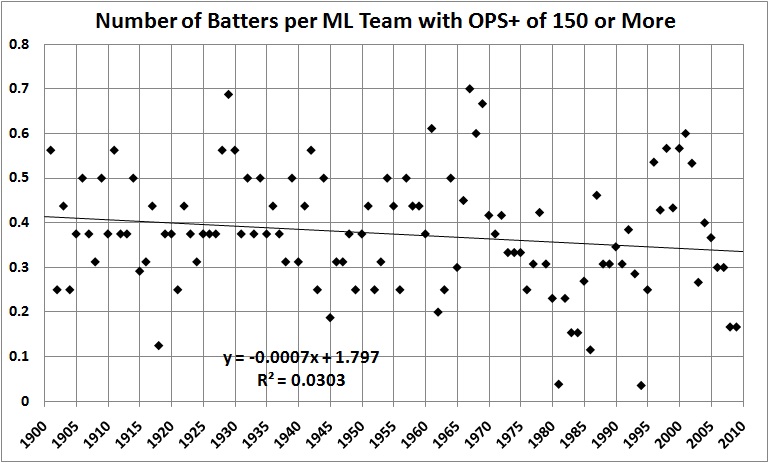
To answer that question, I went to the Play Index feature of Baseball-Reference.com. I was able to find (thanks to a paid subscription to Play Index) the number of players, by season, with an OPS+ statistic* of 150 or more, from 1901 through 2009. Dividing each season’s number by the number of major-league teams, I obtained the following result:


Observations:

1. There has been a slight but noticeable decline in the average number of players per team with an OPS+ of 150 or more, especially following the second round of expansion in 1969.

2. The surge from 1996 to 2002 probably marks the peak use of performance-enhancing drugs.

3. The decline resumed after 2002.

Thus, for whatever reason(s), slugging seems to be in decline.

__________
* Definition: “OPS+ is OPS [on-base plus slugging percentage] adjusted for the park and the league in which the player played,” where the league average for a given year is 100. Thus “An OPS+ of 150 or more is excellent and 125 very good, while an OPS+ of 75 or below is poor.”

Cornered by Gender?

Tanya Khovanova, writing at her math blog, plays a variation on a theme introduced by her guest blogger, Rebecca Frankel, about three weeks ago. Frankel, as I note in “Sexist Nonsense,” wants to redefine gender to exclude two things that make a big difference between males and females: testosterone and estrogen. By Frankel’s logic, males and females would be equal in ability, if only it weren’t for that pesky matter of gender. As I put it in “Sexist Nonsense,”

So “ability” now has a new definition. It is a hypothetical state of equality that is disturbed by a natural difference between males and females. And the fact that this natural difference has an influence on performance is somehow “proof” that males and females are born equally able. By that kind of reasoning, the fact that I cannot see well enough to hit a major-league fastball proves that I belong in the Hall of Fame, along with Babe Ruth. If you’re looking for “sexist nonsense,” look no further than Rebecca Frankel’s hypothesis.

In “Math Careers and Choices,” Khovanova laments that some women choose not to pursue academic careers because they are “cornered” into making such choices. She gives as evidence the cases of three women, plus her own case (described in an earlier post to which she links).

These are the main features of the cases:

  • All four women (including Khovanova) had academic ambitions.
  • In the all cases except Khovanova’s, actions by husbands (pursuit of their own academic careers) made it difficult or impossible for the women to pursue their own academic careers. (Khovanova’s description of her own situation suggests that she, in effect, abandoned her husband by choosing not to return to Israel with him at the end of their family’s visit to the U.S.)
  • Financial considerations and parental responsibilities led all of the women to drop out of academia.

How were these women “cornered”? And if they were in some sense “cornered,” why is it any more lamentable because of their gender?

As far as I can tell, they entered freely into marriage or freely abandoned it (in Khovanova’s casse), and (in this day of “a woman’s right to choose”) bore their children willingly.

Although one husband allegedly played a psychological power game to get his way, that kind of game-playing (as almost any husband can tell you) is far from the sole province of ambitious male academics.

That the husbands had better academic prospects should come as no surprise, given the findings that Frankel attempts (and fails) to refute in the post I discuss in “Sexist Nonsense.”

In each case (except Khovanova’s) the woman and her husband made a joint decision that furthered their family’s financial security. Khovanova made a similar decision, in order to advance her son’s education.

That is to say, the women were not “cornered.” They were acting in ways that seemed best in view of the circumstances in which they found themselves as a result of preceding choices, which they made freely.

If any of the women (including Khovanova) was “cornered,” then so are the countless men and women who are unable to pursue their fondest dreams because ugly reality intrudes.

Who promised us a rose garden? Who promised women (or men) an academic career, a career as a major-league baseball player, or a seat in a space shuttle? No one, that’s who.

Khovanova — a mathematician who loves logic puzzles — has committed the Nirvana fallacy:

the logical error of comparing actual things with unrealistic, idealized alternatives. It can also refer to the tendency to assume that there is a perfect solution to a particular problem.

The Decision to Drop the Bomb

The final words with respect to the bombing of Hiroshima and Nagasaki — as far as I am concerned — were written five years ago by Richard B. Frank in The Weekly Standard (“Why Truman Dropped the Bomb“) and Victor Davis Hanson at National Review Online (“Considering Hiroshima“). Here’s an excerpt of Frank’s piece:

The sixtieth anniversary of Hiroshima seems to be shaping up as a subdued affair–though not for any lack of significance. A survey of news editors in 1999 ranked the dropping of the atomic bomb on August 6, 1945, first among the top one hundred stories of the twentieth century. And any thoughtful list of controversies in American history would place it near the top again. It was not always so. In 1945, an overwhelming majority of Americans regarded as a matter of course that the United States had used atomic bombs to end the Pacific war. They further believed that those bombs had actually ended the war and saved countless lives. This set of beliefs is now sometimes labeled by academic historians the “traditionalist” view. One unkindly dubbed it the “patriotic orthodoxy.”

But in the 1960s, what were previously modest and scattered challenges of the decision to use the bombs began to crystallize into a rival canon. The challengers were branded “revisionists,” but this is inapt. Any historian who gains possession of significant new evidence has a duty to revise his appreciation of the relevant events. These challengers are better termed critics.

The critics share three fundamental premises. The first is that Japan’s situation in 1945 was catastrophically hopeless. The second is that Japan’s leaders recognized that fact and were seeking to surrender in the summer of 1945. The third is that thanks to decoded Japanese diplomatic messages, American leaders knew that Japan was about to surrender when they unleashed needless nuclear devastation. The critics divide over what prompted the decision to drop the bombs in spite of the impending surrender, with the most provocative arguments focusing on Washington’s desire to intimidate the Kremlin. Among an important stratum of American society–and still more perhaps abroad–the critics’ interpretation displaced the traditionalist view….

[I]t is clear [from a review of the evidence now available] that all three of the critics’ central premises are wrong. The Japanese did not see their situation as catastrophically hopeless. They were not seeking to surrender, but pursuing a negotiated end to the war that preserved the old order in Japan, not just a figurehead emperor. Finally, thanks to radio intelligence, American leaders, far from knowing that peace was at hand, understood–as one analytical piece in the “Magic” Far East Summary stated in July 1945, after a review of both the military and diplomatic intercepts–that “until the Japanese leaders realize that an invasion can not be repelled, there is little likelihood that they will accept any peace terms satisfactory to the Allies.” This cannot be improved upon as a succinct and accurate summary of the military and diplomatic realities of the summer of 1945.

The final words go to Hanson:

The truth . . is that usually in war there are no good alternatives, and leaders must select between a very bad and even worse choice. Hiroshima was the most awful option imaginable, but the other scenarios would have probably turned out even worse.