Does Liberalism Destroy Liberty?

That’s the title question of an essay by Arnold Kling, a sensible economist with whom I usually agree. Not this time, however.

Kling begins with Patrick Dineen’s Why Liberalism Failed. In Kling’s account of Dineen’s argument, modern liberalism (state-interventionism) is an outgrowth of classical liberalism (individualism). Evidently, Dineen takes that view because classical liberralism doesn’t account for civic virtue, and it is a lack of civic virtue (i.e., community) that invites statism.Near the end of the essay, Kling says that

I would not concede that liberalism has failed. But it certainly seems to be going through a rough patch, and we can still wonder why this is the case.

Kling is wrong — the “rough patch” is nothing less than the death of liberalism at the hands of its natural enemies: statists. But liberalism bore the seeds of its own destruction, as Dineen evidently believes, and as I will argue in what follows.

Civic virtue, to my way of thinking, is really just an aspect virtue: general adherence to widely accepted social norms (including religious ones). Adherence to those norms, among other things, binds a community in mutual trust, respect, and beneficial cooperation. That, by the way, is liberty, which isn’t a free-floating essence that can be attained by putting words on paper but a modus vivendi that can only be attained by continued adherence to social norms.

Anyway, here is Kling, commenting on and quoting Dineen:

According to Deneen, classical philosophers focused on the importance of virtue. Individuals must have the virtue of self-restraint to function well in personal realms. They must have civic virtue to have thriving communities.

Liberalism, Deneen argues, disregards this need for virtue.

The classical and Christian emphasis upon virtue and the cultivation of self-limitation and self-rule relied upon reinforcing norms and social structures arrayed extensively throughout political, social, religious, economic, and familial life. What were viewed as the essential supports for a training in virtue—and hence, preconditions for liberty from tyranny—came to be viewed as sources of oppression, arbitrariness, and limitation. (page 25)

Instead, he says,

A succession of thinkers in subsequent decades and centuries [have been] redefining liberty as the liberation of humans from established authority, emancipation from arbitrary culture and tradition, and the expansion of human power and dominion over nature through advancing scientific inquiry and economic prosperity. (page 27)

Deneen says that liberalism departed from classical and Christian values.

What was new is that the default basis for evaluating institutions, society, affiliations, memberships and even personal relationships became dominated by considerations of individual choice based on the calculation of self-interest, and without broader consideration of the impact of one’s choices upon the community, one’s obligations to the created order, and ultimately to God. (pages 33-34)

In Deneen’s view, liberalism’s faith in the free market, constitutional government, and science led us to tolerate and even to encourage purely self-interested behavior on the part of individuals. We trust that economic cohesiveness will come from the incentives that operate in the free market. Political cohesiveness we believe will be ensured by checks and balances embedded in an electoral process that functions under a constitution. Challenges posed by our natural environment we think will be met by scientific discovery and technology. But Deneen thinks we’re wrong.

And you (liberals) are wrong because markets, constitutions, and science are amoral formalisms. What’s “good” is what works, or seems to work. The shallowness of that conceit can be seen in the contrast between prostitution (a market transaction) and marriage (a non-market commitment for the vast majority of Westerners). If prostitution were to become a substitute for marriage, what would happen to the emotional bonds and moral commitments that (for the most part) typify marriages and families? What would the loss of those bonds commitments mean for economic and social relations between people generally?

Well, we are seeing the answer unfold before our eyes, as marriage becomes rarer and the bearing of children becomes an inconvenience to be prevented murderous means.

The shallowness of the conceit that what is “good is what works can be seen more generally in a correct understanding of liberalism as it was defined by one of its leading proponents, John Stuart Mill. I have written about Mill’s philosophical folly many times. (There is a list of links at the end of this post.) The following is based from my first essay about Mill, “On Liberty“.

Mill, in On Liberty (1869), offers a definition of liberty which has nothing to do with the real thing (see above):

It comprises, first, the inward domain of consciousness; demanding liberty of conscience, in the most comprehensive sense; liberty of thought and feeling; absolute freedom of opinion and sentiment on all subjects, practical or speculative, scientific, moral, or theological. The liberty of expressing and publishing opinions may seem to fall under a different principle, since it belongs to that part of the conduct of an individual which concerns other people; but, being almost of as much importance as the liberty of thought itself, and resting in great part on the same reasons, is practically inseparable from it. Secondly, the principle requires liberty of tastes and pursuits; of framing the plan of our life to suit our own character; of doing as we like, subject to such consequences as may follow: without impediment from our fellow-creatures, so long as what we do does not harm them, even though they should think our conduct foolish, perverse, or wrong. Thirdly, from this liberty of each individual, follows the liberty, within the same limits, of combination among individuals; freedom to unite, for any purpose not involving harm to others: the persons combining being supposed to be of full age, and not forced or deceived.[1]

That description, strangely, follows Mill’s prescription for the realization of liberty, which is his “harm principle” beloved of both libertarians and modern liberals. It is as if Mill began with the harm principle in mind, then concocted a description of liberty to justify it.

In any event, the source of liberalism’s failure can be found in the harm principle:

That principle is [according to Mill], that the sole end for which mankind are warranted, individually or collectively in interfering with the liberty of action of any of their number, is self-protection. That the only purpose for which power can be rightfully exercised over any member of a civilized community, against his will, is to prevent harm to others.

Given the individualistic thrust of this passage and the surrounding text, the only plausible interpretation of the harm principle is as follows: An individual may do as he pleases, as long as he does not believe that he is causing harm to others. That is Mill’s prescription for liberty. It is, in fact, an invitation to license and anarchy.

Libertarians and liberals, even those who claim to reject license and anarchy, embrace the harm principle, for all of its simple-mindedness.

Enter Theodore Dalrymple, writing in his In Praise of Prejudice:
The Necessity of Preconceived Ideas:

It has long been an objection to Mill that, except for the anchorite in the Syrian desert who subsists on honey and locusts, no man is an island (and even an anchorite may have a mother who is disappointed by her son’s choice of career); and therefore that the smallest of his acts may have some impact or consequences for others. If one amends the [harm] principle to take that part of a man’s conduct that concerns principally himself, rather than only himself, one will be left with endless and insoluble disputes as to which part of his conduct that is….

But, as the great historian Lord Acton said, “Ideas have a radiation and development, an ancestry and posterity of their own, in which men play the part of godfathers and godmothers more than that of legitimate parents.” Who can doubt that many people have forgotten, for very obvious reasons, Mill’s qualifications of personal sovereignty, namely that it applies to conduct that “merely concerns himself”?

The main appeal of On Liberty to libertarians and modern liberals is Mill’s defense of conduct that (in his view) only offends social norms:

Society can and does execute its own mandates: and if it issues wrong mandates instead of right, or any mandates at all in things with which it ought not to meddle, it practises a social tyranny more formidable than many kinds of political oppression, since, though not usually upheld by such extreme penalties, it leaves fewer means of escape, penetrating much more deeply into the details of life, and enslaving the soul itself. Protection, therefore, against the tyranny of the magistrate is not enough: there needs protection also against the tyranny of the prevailing opinion and feeling; against the tendency of society to impose, by other means than civil penalties, its own ideas and practices as rules of conduct on those who dissent from them; to fetter the development, and, if possible, prevent the formation, of any individuality not in harmony with its ways, and compel all characters to fashion themselves upon the model of its own. There is a limit to the legitimate interference of collective opinion with individual independence: and to find that limit, and maintain it against encroachment, is as indispensable to a good condition of human affairs, as protection against political despotism.

Thus Mill rejects the enforcement of social norms, “except [in] a few of the most obvious cases,” by either the state or “society.” Lest anyone mistake Mill’s position, he expands on it a few paragraphs later:

These are good reasons for remonstrating with [a person who acts contrary to social custom], or reasoning with him, or persuading him, or entreating him, but not for compelling him, or visiting him with any evil [including social censure] in case he do otherwise. To justify that, the conduct from which it is desired to deter him, must be calculated to produce evil to some one else. The only part of the conduct of any one, for which he is amenable to society, is that which concerns others. In the part which merely concerns himself, his independence is, of right, absolute. Over himself, over his own body and mind, the individual is sovereign.

In Mill’s usage, “calculated” means “intended.” By that logic, which is implicit throughout On Liberty, an individual is (except in “a few of the most obvious cases”) a law unto himself, and may do as he pleases as long as he believes (or claims to believe) that his conduct is not harmful to others.

Mill’s bias against the enforcement of social norms, in all but a few “obvious cases” (murder? theft? rape?), ignores the civilizing influence of those norms. That influence is of no account to Mill, as Dalrymple explains:

For Mill, custom is an evil that is the principle obstruction to progress and moral improvement, and its group on society is so strong that originality, unconventionality, and rebellion against it are goods in themselves, irrespective of their actual content. The man who flouts a convention ipso facto raises society from its torpor and lets everyone know that there are different, and better, ways of doing things. The more such people there are, the greater the likelihood of progress….

Of radical evil, in which the [twentieth] century was to abound, [Mill] has nothing to say, and therefore he had no idea that a mania for progress could result in its very antithesis, or that some defense against such radical evil, of which the commission was not possible without the co-operation and participation of many men, was necessary. The abandonment of customary restraint and inverted moral prejudice was not necessarily followed by improvement.[9]

There is a high price to be paid for the blind rejection of long-standing social norms, whether by individuals, organized groups, legislatures, or courts wishing to “do their own thing”, exact “social justice”, make life “fair”, or just “shake things up” for the sake of doing so. The price is liberty; that is, the destruction of social norms that make it possible for people to live in mutual trust, respect, and beneficial cooperation.

So, yes, liberalism — even of the antique kind that was preached by Mill and his ilk, and more or less supported by Western governments until statist “isms” began to hold sway — does destroy liberty. It does so by undermining social norms, which then requires an ever-enlarged state to do what strong communities could do for themselves. States inevitable fail, but statists are clever arguers for the proposition that failure requires more state action. And so it goes until true community — and thus true liberty — has been ground under the heel of the state.
Old News Incites a Rant

A correspondent sent me a link to a video about Greenland ice core records. He called the video an eye opener, which is rather surprising to me because the man is a trained scientist and an experienced analyst of quantitative data. The video wasn’t at all an eye-opener for me. Here is my reply to the correspondent:

I began to look seriously at global warming ~2005, and used to write extensively about it. The info provided in the video is consistent with other observations, including icc-core measurements taken at Vostok, Antarctica. Here’s a related post, which includes the Vostok readings and much more: http://libertycorner.blogspot.com/2007/08/more-climate-stuff.html. Some of the other evidence that I have accrued is summarized here: https://politicsandprosperity.com/climate-change/.

Findings like those presented in the video seem to have no effect on the politics of “climate change”. It is a chimera, concocted by “scientists” who manipulate complex models (which have almost no predictive power) and, on the basis of those models, constantly adjust historical temperature readings to comport with what should have happened according to the models. (Thus “proving” the correctness of the models.) This kind of manipulation is widely known and well documented, as is the predictive failure of the models. But there is a “climate change” industry — a government-academic-media complex if you will — that has a life of its own, and it has transformed what should be a scientific issue into a secular religion. Due in no small part to the leftist leanings of public-school and university educators, tens of millions of American children and young adults have been brainwashed into believing that Earth is headed for a fiery denouement if “evil” things like fossil fuels aren’t banned. Being impressionable — not to mention scientifically and economically illiterate — they don’t question the pseudo-science that underlies “climate change” or the consider the economic consequences of drastic anti-warming measures, which would yield (at best) a lowering of Earth’s average temperature by ~0.1 degree by 2100 in exchange for a return to the horse-and-buggy age.

Here’s what I left unsaid:

The only possible way to defeat the “climate change” industry is to elect politicians who firmly reject its “intellectual” foundations and its draconian prescriptions. There was one such politician who managed to claw his way to the top in the U.S., but he was turned out of office, due in large part to the efforts a powerful cabal (https://time.com/5936036/secret-2020-election-campaign/) which is heavily invested in an all-powerful central government that can shape the U.S. to its liking. It didn’t help that the politician was rude and crude, which turned off fastidious voters (like you) who didn’t think about or care about the consequences of a Democrat return to power.

End of rant.

The Minimum Wage Revisited

A post by Arnold Kling (askblog) reminds me of a post of mine from 2009. Kling begins noting the Nobel prize that was awarded to David Card and two others. It was Card and his late collaborator, Alan Krueger, who “proved” that the minimum wage doesn’t cause unemployment.

Kling notes that

Noah Smith goes way overboard in praise of the new laureates. He makes it sound as though the results that David Card and Alan Krueger claimed about the minimum wage were only controversial because they were surprising. But they were also controversial because they were wrong.

Here is the abstract of the paper to which the second link in the block quotation leads:

We re-evaluate the evidence from Card and Krueger’s (1994) New Jersey-Pennsylvania minimum wage experiment, using new data based on actual payroll records from 230 Burger King, KFC, Wendy’s, and Roy Rogers restaurants in New Jersey and Pennsylvania. We compare results using these payroll data to those using CK’s data, which were collected by telephone surveys. We have two findings to report. First, the data collected by CK appear to indicate greater employment variation over the eight-month period between their surveys than do the payroll data. For example, in the full sample the standard deviation of employment change in CK’s data is three times as large as that in the payroll data. Second, estimates of the employment effect of the New Jersey minimum wage increase from the payroll data lead to the opposite conclusion from that reached by CK. For comparable sets of restaurants, differences-in-differences estimates using CK’s data imply that the New Jersey minimum wage increase (of 18.8 percent) resulted in an employment increase of 17.6 percent relative to the Pennsylvania control group, an elasticity of 0.93. In contrast, estimates based on the payroll data suggest that the New Jersey minimum wage increase led to a 4.6 percent decrease in employment in New Jersey relative to the Pennsylvania control group. This decrease is statistically significant at the five-percent level and implies an elasticity of employment with respect to the minimum wage of -0.24.

That’s far from the only time that Card and Krueger’s “proof” has been demolished.

I joined the bandwagon in 2009, with an analysis documented in this post, which ends thus:

On the basis of the robust results [derived from data for 1959 – 2009,] I draw the following conclusions:

  • The baseline unemployment rate for 16-19 YO [year-olds] is about 9 percent.
  • Unemployment around the baseline changes by about 1.5 percentage points for every percentage-point change in the unemployment rate for 20+ YO.
  • The minimum wage, when effective, raises the unemployment rate for 16-19 YO by 0.6 percentage points.

Therefore, given the current number of 16 to 19 year old males in the labor force (about 3.3 million), some 20,000 will lose or fail to find jobs because of yesterday’s boost in the minimum wage. Yes, 20,000 is a small fraction of 3.3 million (0.6 percent), but it is a real, heartbreaking number — 20,000 young men for whom almost any hourly wage would be a blessing.

But the “bleeding hearts” who insist on setting a minimum wage, and raising it periodically, don’t care about those 20,000 young men — they only care about their cheaply won reputation for “compassion.”

The minimum wage is just another blow to liberty and prosperity from the left, which holds that Americans must be impoverished to battle the chimera of anthropogenic global warming, that police (who protect the poor as well as the rich) must be defunded, that people should be paid not to work, that the expression of views contrary to leftist dogma is criminal, and that human life may be disposed of like garbage.

Recommended Reading

I knew only the bare bones of General of the Army Douglas MacArthur’s life and accomplishments until I read Francis P. Sempa’s “Why MacArthur Was America’s Greatest General of the 20th Century” (The American Spectator, October 10, 2021). Brief as it is, Sempa’s piece adds greatly to my knowledge of MacArthur.

The article piqued my interest in MacArthur, so I acquired a copy of William Manchester’s American Caesar, purportedly the definitive biography of MacArthur. A review of that book — and an assessment of Sempa’s praise for MacArthur — might appear here someday.

In any case, I fully agree with these passages in Sempa’s article:

There is serious talk of war in the South China Sea, as Chinese air incursions into Taiwan’s air defense space increase and the rhetoric of war becomes all too commonplace. What political scientist Graham Allison called the “Thucydides Trap” (war produced by a rising power’s challenge to the current leading power) may have been tripped. It may once again be a time when America needs great generals and admirals….

When war broke out … on the Korean peninsula, MacArthur was chosen to lead U.S. and UN forces against the communists…. He conceived the brilliantly successful Inchon landing of September 15, 1950, once again overcoming the doubts and opposition of the military hierarchy in Washington. When China massively intervened in the war in October-November 1950, MacArthur urged political leaders in Washington to allow him to achieve victory over Chinese forces. “In war,” MacArthur wrote, “there is no substitute for victory.” The Truman administration, which had basked in the general’s victory at Inchon and had authorized him to liberate all of North Korea from communist rule, now decided that Korea was the wrong war in the wrong place at the wrong time, and they blamed MacArthur for trying to start World War III. When MacArthur publicly noted his disagreement with a policy that sought stalemate instead of victory, he was relieved of command by President Truman. Liberal historians universally side with Truman in this dispute, but settling for stalemate meant continued misery and tyranny in North Korea, emboldened the Chinese Communist Party that today is our greatest geopolitical challenger, and set a precedent that helped lead to our subsequent defeat in Vietnam [emphasis added]….

Today, as we face a possible war with China over Taiwan, we may need more generals like MacArthur because “there is no substitute for victory.”

Amen.


Related post: The Way Ahead?

Irrational Exuberance

It’s everywhere, but most notably in the stock market and in election returns.

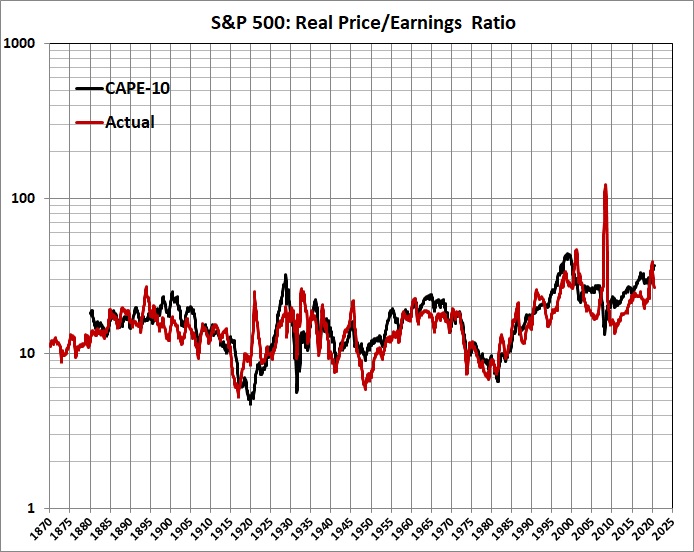
In the stock market, as exemplified by the S&P 500 index, there have been wild swings in the price-earnings ratio:


Derived from Robert Shiller’s data set. CAPE-10 is the cyclically adjusted price/earnings ratio, where the cyclical adjustment amounts to a 10 year average of the ratio.

In a world where stock buyers weren’t driven by irrational exuberance — and irrational pessimism — the PE ratio would follow something like a straight line. It might be a rising straight line because, as some analysts have noted, stock buyers have acquired an increasingly greater tolerance for risk-taking. But it would be close to a straight line.

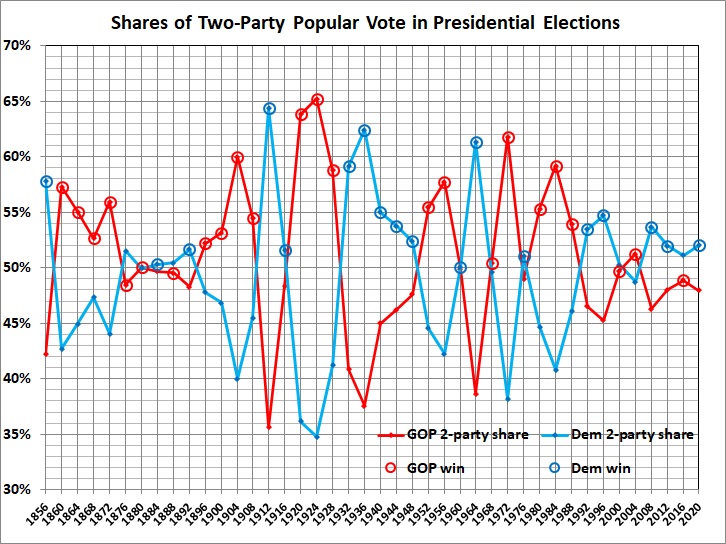
The zigs and zags of the stock market are echoed in the outcomes of presidential elections:


Derived from Dave Leip’s Atlas of U.S. Presidential Elections.

To put it bluntly, almost every American who values his liberty and prosperity would in most elections have preferred the Republican candidate as the lesser of two evils. The success of Democrats testifies to the gullibility of many voters, who are swayed by — among other things — asymmetrical ideological warfare:

Leftists have the advantage of saying the kinds of things that people like to hear, especially when it comes to promising “free” stuff and visions of social perfection….

[L]eftists have another advantage: they’re ruthless. Unlike true conservatives (not Trumpsters) and most libertarians, leftists can be ruthless, unto vicious. They pull no punches; they call people names; they skirt the law — and violate it — to get what they want (e.g., Obama’s various “executive actions”); they use the law and the media to go after their ideological opponents; and on and on.

Why the difference between leftists and true conservatives? Leftists want to rearrange the world to fit their idea of perfection. They have it all figured out, and dissent from the master plan will not be tolerated. (This is very Hitleresque and Stalinesque.) Conservatives and libertarians want people to figure out for themselves how to arrange the world within the roomy confines of simple morality (don’t cheat, don’t steal, don’t murder, etc.).

The left’s ruthlessness was in full spate last year, when the election was bought and probably stolen as well.

In the same post (published on July 23, 2016), my prescience was on display:

If Trump wins in November — a very big “if” — it should be an object lesson to true conservatives and libertarians. Take the gloves off and don brass knuckles. This isn’t a contest for hockey’s Lady Byng Trophy. To change the sports metaphor, we’re in the late rounds of a brutal fight, and well behind on points. It’s time to go for the knockout.

The good news is that recent elections reflect the effects of political polarization. The swings have become less pronounced because the electorate’s “squishy center” has shrunk. The challenge before the GOP is to convince what remains of the “squishy center” that it is in their best interest to reject the anti-libertarian and anti-prosperity policies of the Democrat Party, which has become nothing more than a mouthpiece for an (anti) American brand of Hitlerism and Stalinism.

How Two Wrongs (Do Not) Make a Right

The essential aim of Black Lives Matter and its many allies in the woke-o-sphere is to serve a hot, heaping dish of revenge to whites who meet certain specifications (non-woke, straight, white, male, conservatives of European descent) and to anyone else who doesn’t grovel at the altar of wokeism.

Why revenge? Because, in the world of wokeism, two wrongs do make a right. The wrongs of slavery and Jim Crow weren’t wrongs because they denied fundamental rights to persons of a certain class (i.e., most blacks in the South). If that were the case, wokesters would believe that it’s wrong to deny fundamental rights (e.g., freedom of speech) to certain whites just because of their whiteness or the views that they hold about wokeism.

But wokesters evidently don’t believe that its wrong to deny fundamental rights to persons. Their actions demonstrate this belief: It’s wrong to deny fundamental rights to blacks, but the rest of the world can go to hell.

That this belief exemplifies racism, tribalism, and other isms decried by wokesters is evident to non-wokesters. Thus the backlash against wokeism and its various manifestations — critical race theory being the most obvious and pernicious of the lot.