A Third Party?

Cui bono?

A commenter said that

the real rulers of the US and the world weren’t scared of Trump for the reason you think [because he threatened the deep state]. They were scared he unintentionally would encourage a certain segment of the US population to create a third party. Not that this would have been the end of the elites/deep state, but this would have created a major headache for them, since they would need to invest resources and propaganda to this (un)expected problem.

If you’re mystified by this, you’re not alone.

I wonder what segment of the U.S. population the commenter meant. If he meant the Trump “base”, that would have been good news for the “real rulers”. They are, presumably, global elites (e.g., Klaus Schwab and the inner circle of his World Economic Forum) who are pushing economically and socially destructive policies on America and the West.

The rise of a third party consisting of the Trump “base” would cripple but not destroy the GOP. The Democrat Party — the tool of the elites in the U.S. — would then have an open road to firm control of the White House and Congress.

Perhaps the commenter will enlighten us.

Stats and Commentary: January 31, 2023

Presidential popularity, GDP, CPI, and whatever else strikes my fancy.

Presidential Popularity: Obama, Trump, Biden

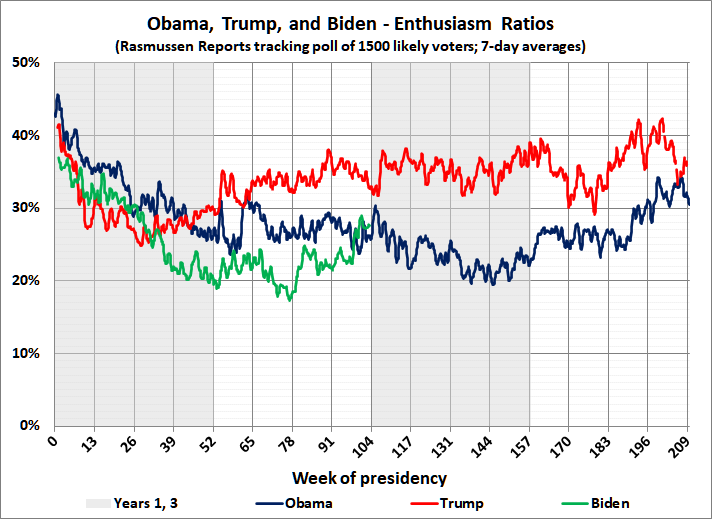
I have followed the Presidential Tracking Poll at Rasmussen Reports* since Obama was elected in 2008. The straightforward Approval Index (strongly approve minus strongly disapprove) doesn’t quite capture the way that likely voters assess a president’s performance. So I concocted an “enthusiasm ratio” — the number of likely voters who strongly approve as a percentage of the number of likely voters who venture an opinion one way or the other (thus omitting the voters who are non-committal). Here’s a comparison of the enthusiasm ratios for Obama (first term), Trump, and Biden:

You might ask how Biden caught up with Obama. I have no answer other than the fact that most voters have short memories and care little about the consequences of leftist governance. The recent dip in Biden’s standing is probably the result of the discovery of classified documents in various locations — and the growing awareness that those documents were used in the influence-peddling business fronted by Hunter Biden.

Right Direction or Wrong Track

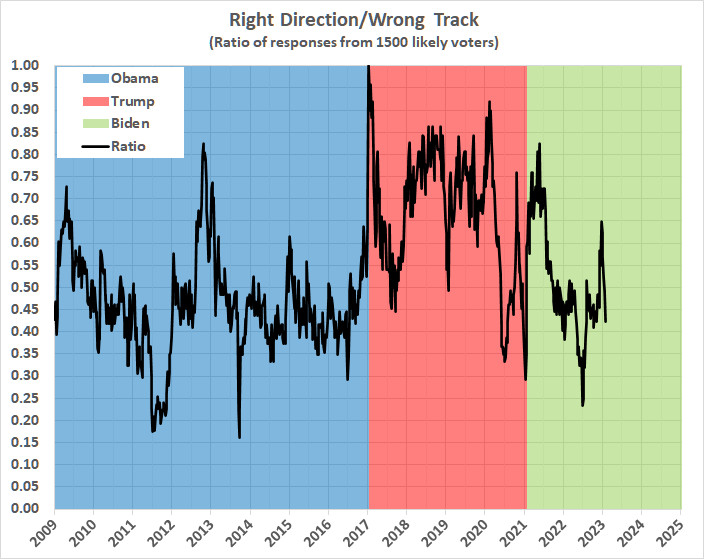
Rasmussen Reports also publishes a weekly poll in which 1,500 likely voters are asked whether the country is going in the right direction or is on the wrong track. The results, as you would expect, are volatile — reflecting the recent headlines and media spin. Government shutdowns, for example, which are actually good news, are widely viewed as bad news. Here are the weekly results since Obama took office in January 2009:

The mood of the voters polled during Trump’s term in office never reached the depths that it reached under Obama. Biden is following in Obama’s footsteps, and he has two more years in which to reach a new low — unless he is impeached and removed from office for his influence-peddling business.

GDP Trends

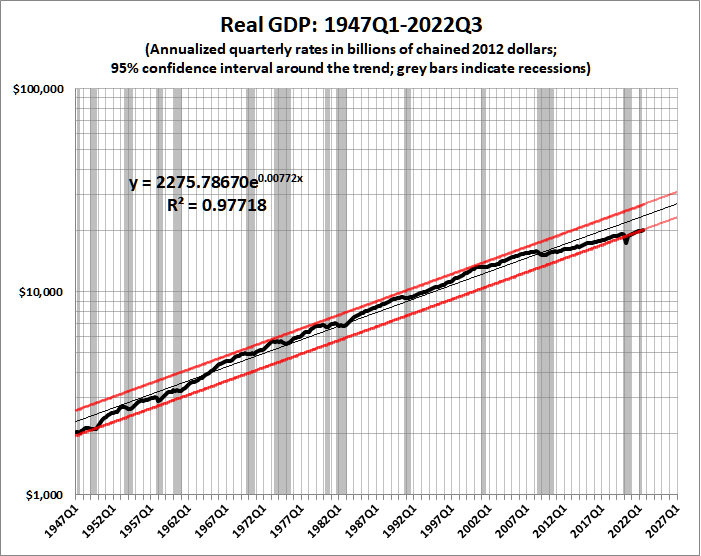
The exponential trend line indicates a constant-dollar (real) growth rate for the entire period of 0.77 percent quarterly, or 3.1 percent annually. The actual beginning-to-end annual growth rate is also 3.1 percent.

The red bands parallel to the trend line delineate the 95-percent (1.96 sigma) confidence interval around the trend. GDP has been below the confidence interval since the government-induced pandemic recession of 2020. Come to think of it, the back-to-back recessions of 1980-1982 and the Great Recession of 2008-2010 were also government-caused — the government in those cases being the Federal Reserve. The short recession of 2022, which may soon be followed by another one, can also be chalked up to the Fed.

Here’s another depiction of the general decline in real economic growth:

And here’s another view:

The trend lines, which reflect the rate of growth during each business cycle, are getting progressively “flatter”, that is, the rate of growth (with a few exceptions) is dropping from cycle to cycle.

However you look at it, the steady decline in real GDP growth is the handiwork of government spending and regulatory policies. For much more about that plague, which has existed for more than a century, see this and this.

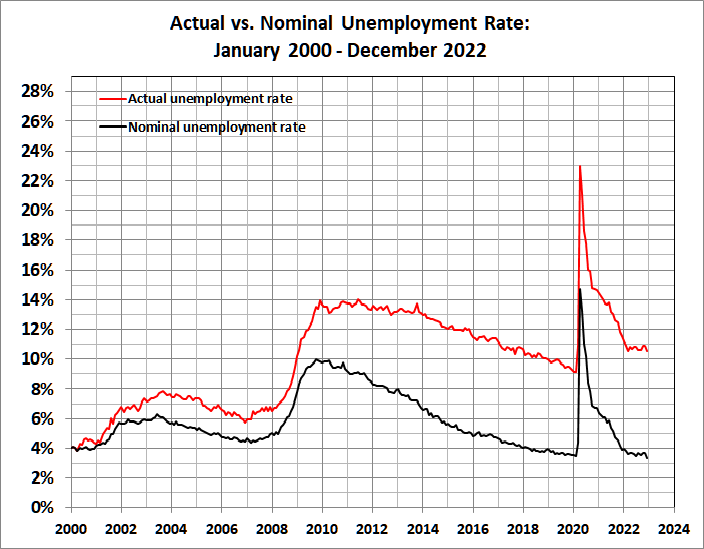
That’s enough for today. I’ll update this occasionally, and come back to the unemployment rate and CPI, which I discussed in the first edition of this post.


* I follow Rasmussen Reports because of its good track record — here and here, for example. Though the Rasmussen polls are generally accurate, they are out of step with the majority of polls, which are biased toward Democrats. This has caused Rasmussen Reports to be labeled “Republican-leaning”, as if the other polls aren’t “Democrat-leaning”.

What Is Tribalism?

I am a tribe of one.

These four things are not the same:

  1. hating persons who are different because they’re different racially, ethnically, etc.

  2. fearing persons of a certain type (e.g., young black males) because that type is highly correlated with danger

  3. holding persons in contempt because their views, however sincerely held, are dangerous to the lives, liberty, and livelihoods of others

  4. belonging to a deeply rooted and close-knit group of persons (a clan, if you will) who share a distinctive culture.

“Tribalism” is widely misused as a descriptor of case number 3. I have misused it myself. I vow not to do it again.

Number 1 is a symptom of bigotry, of which racism is a subset. Number 2 is a sign of prudence. Number 3 is a rational reaction to views that a person believes are badly mistaken and can have dire consequences. Number 4 refers to tribalism.

I don’t believe that I’m guilty of number 1.

There are circumstances, which I avoid assiduously, where number 2 would apply to me.

I am definitely aligned with number 3.

I am not a tribalist (number 4) because I am not a member of a clan with a distinct culture. I am close only to my immediate family — my wife, children, and grandchildren. I have untold numbers of nieces, nephews, and cousins with whom I have had no contact for decades or ever. I haven’t been a member of a religious denomination for more than 60 years. The customs that I observe are generic ones (“thank you”, “you’re welcome”) not exotic ones associated with particular religions, ethnic groups, or tribes (in the traditional sense). My moral beliefs are generic; the Golden Rule predominates. I have no particular feelings about people with whom I might agree politically; I’m pleased that they agree with me (there is strength in numbers), but — as an extreme introvert with upper-middle-class tastes — I suspect that I would enjoy the company of only a tiny fraction of them, and then it would be for reasons other than politics (e.g., a liking for Bourbon).

I am, in sum, a lone wolf who disdains affiliation or identification with any kind of tribe.

But I have chosen a side (scroll to “The Importance of Taking Sides”). The side isn’t a tribe because it is bound only by a narrow range of beliefs, not by a deep and abiding culture.

Tribalism has deep evolutionary-psychological roots in mutual aid and mutual defense — survival. The idea that tribalism can be erased by sitting in a circle, holding hands, and singing Kumbaya — or the equivalent in social-diplomatic posturing — is as fatuous as the idea that all human beings enter this world with blank minds and equal potential. Saying that tribalism is wrong is like saying that breathing and thinking are wrong. It’s a fact of life that can’t be undone without undoing the bonds of mutual trust and respect that are the backbone of a society.

Tribes are good things per se. Poisonous ideas are bad things per se. I am on the side of those who seek to expose and discredit the poisonous ideas of the left and the “woke”. But — to repeat — I am not a tribalist.

Psychobabble

Parsing homosexuality and pedophilia.

This Substack post by Scott Alexander (Astral Codex Ten) caught my eye — especially this passage:

[F]rom … a … biological … point … of … view … , homosexuality … and … pedophilia … are probably … pretty … similar. Both are “sexual targeting errors”: from an evolutionary point of view, our genes get passed down through couplings with sexually mature opposite-sex partners, and our instincts probably evolved to promote this. But instincts are hard – ducks sometimes decide humans are their mother and imprint on them – so sexual targeting errors are pretty common….

If this is accurate, the … relevant … difference … between … homosexuality … and … pedophilia … is … moral … , not … biological. Both are sexual targeting errors, but one re-targets sexuality onto other people who can consent and won’t be harmed, so it’s fine. The other targets people who can’t consent and will be harmed, so it’s bad.

The ellipses replace Ns, which Alexander placed in the quoted sentences in the hope that they wouldn’t be taken out of context. I am not about to take the quoted sentences out of context. I am going to use them as a springboard for a different perspective on homosexuality and pedophilia.

Human beings aren’t ducks. Human homosexuals and pedophiles don’t make “sexual targeting errors”, they make deliberate choices about the kinds of persons with whom they want to have sexual relations.

In the case of homosexuality, a “real” homosexual may find a willing partner in a neophyte of the same sex. The neophyte may be a psychologically immature person who is

  • too shy to approach a member of the opposite sex;

  • in need of emotional comfort and sexual release; or

  • just “trying it out” because non-binary is trendy.

In any case, the person may be deflected (temporarily or permanently) from heterosexuality, with resulting feelings of shame, guilt, and remorse. (The blithe assumption that “consent” means “won’t be harmed” is utterly stupid.)

I take the statement that pedophiles target “people who can’t consent” to mean that the “people” in question are minors who are either raped (i.e., don’t consent) or are too young to make make informed judgements about engaging in sexual relations. In either case they will have been harmed physically, emotionally, or both.

Rape is rape, and the fact of it doesn’t depend on the age of the victim or the sexual preferences of the rapist.

That leaves us with the seduction of a same-sex minor. The seducer finds a willing partner (willing at the moment) who may be in need of emotional comfort or who badly wants whatever “gift” the seducer may be offering. Depending on the psychological age of the seduced minor, willingness might also have a sexual component (including curiosity about homosexuality).

In sum, the only bright line between homosexual seduction of a neophyte of any age and homosexual pedophilia is whether there is rape (physically, not statutorily):

  • If there is rape, any distinction between homosexuality and pedophilia is irrelevant, morally.

  • If there is no rape, there is no essential difference between homosexual seduction and homosexual pedophilia. They belong in the same moral bin.

Intelligence, Personality, Politics, and Happiness

A classic from my old blog.

Reproduced here with very light editing. Some links may be broken. “An Interesting Review of the ‘Well-Being Gap’ between Liberals [sic] and Conservatives” (HotAir, March 21, 2023) underscores my conclusions and those of the writers whose articles I list at the end.

INTRODUCTION

Web pages that link to this post usually consist of a discussion thread whose participants’ views of the post vary from “I told you so” to “that doesn’t square with me/my experience” or “MBTI is all wet because…”.  Those who take the former position tend to be persons of above-average intelligence whose MBTI types correlate well with high intelligence. Those who take the latter two positions tend to be persons who are defensive about their personality types, which do not correlate well with high intelligence. Such persons should take a deep breath and remember that high intelligence (of the abstract-reasoning-book-learning kind measured by IQ tests) is widely distributed throughout the population. As I say below, ” I am not claiming that a small subset of MBTI types accounts for all high-IQ persons, nor am I claiming that a small subset of MBTI types is populated entirely by high-IQ persons.” All I am saying is that the bits of evidence which I have compiled suggest that high intelligence is more likely — but far from exclusively — to be found among persons with certain MBTI types.

The correlations between intelligence, political leanings, and happiness are admittedly more tenuous. But they are plausible.

Leftists who proclaim themselves to be more intelligent than persons of the right do so, in my observation, as a way of reassuring themselves of the superiority of their views. They have no legitimate basis for claiming that the ranks of highly intelligent persons are dominated by the left. Leftist “intellectuals” in academia, journalism, the “arts”, and other traditional haunts of leftism are prominent because they are vocal. But they comprise a small minority of the population and should not be mistaken for typical leftists, who seem mainly to populate the ranks of the civil service, labor unions, public-school “educators”, and the unemployed. (It is worth noting that public-school teachers, on the whole, are notoriously dumber than most other college graduates.)

Again, I am talking about general relationships, to which there are many exceptions. If you happen to be an exception, don’t take this post personally. You’re probably an exceptional person.

IQ AND PERSONALITY

Some years ago I found statistics about the personality traits of high-IQ persons (those who are in the top 2 percent of the population).* The statistics pertain to a widely used personality test called the Myers-Briggs Type Indicator (MBTI), which I have taken twice. In the MBTI there are four pairs of complementary personality traits, called preferences: Extraverted/Introverted, Sensing/iNtuitive, Thinking/Feeling, and Judging/Perceiving. Thus, there are 16 possible personality types in the MBTI: ESTJ, ENTJ, ESFJ, ESFP, and so on. (For an introduction to MBTI, summaries of types, criticisms of MBTI, and links to other sources, see this article at Wikipedia. A straightforward description of the theory of MBTI and the personality traits can be found here. Detailed descriptions of the 16 types are given here.)

In summary, here is what the statistics indicate about the correlation between personality traits and IQ:

  • Other personality traits being the same, an iNtuitive person (one who grasps patterns and seeks possibilities) is 25 times more likely to have a high IQ than a Sensing person (one who focuses on sensory details and the here-and-now).

  • Again, other traits being the same, an Introverted person is 2.6 times more likely to have a high IQ than one who is Extraverted; a Thinking (logic-oriented) person is 4.5 times more likely to have a high IQ than a Feeling (people-oriented) person; and a Judging person (one who seeks closure) is 1.6 times as likely to have a high IQ than a Perceiving person (one who likes to keep his options open).

  • Moreover, if you encounter an INTJ, there is a 22% probability that his IQ places him in the top 2 percent of the population. (Disclosure: I am an INTJ.) Next are INTP, at 14%; ENTJ, 8%; ENTP, 5%; and INFJ, 5%. (The next highest type is the INFP at 3%.) The  five types (INTJ, INTP, ENTJ, ENTP, and INFJ) account for 78% of the high-IQ population but only 15% of the total population.**

  • Four of the five most-intelligent types are NTs, as one would expect, given the probabilities cited above. Those same probabilities lead to the dominance of INTJs and INTPs, which account for 49% of the Mensa membership but only 5% of the general population.**

  • Persons with the S preference bring up the rear, when it comes to taking IQ tests.**

A person who read an earlier version of this post claims that “one would expect to see the whole spectrum of intelligences within each personality type.” Well, one does see just that, but high intelligence is skewed toward the five types listed above. I am not claiming that a small subset of MBTI types accounts for all high-IQ persons, nor am I claiming that a small subset of MBTI types is populated entirely by high-IQ persons.

I acknowledge reservations about MBTI, such as those discussed in the Wikipedia article. An inherent shortcoming of psychological tests (as opposed to intelligence tests) is that they rely on subjective responses (e.g., my favorite color might be black today and blue tomorrow). But I do not accept this criticism:

[S]ome researchers expected that scores would show a bimodal distribution with peaks near the ends of the scales, but found that scores on the individual subscales were actually distributed in a centrally peaked manner similar to a normal distribution. A cut-off exists at the center of the subscale such that a score on one side is classified as one type, and a score on the other side as the opposite type. This fails to support the concept of type: the norm is for people to lie near the middle of the subscale.

Why was it expected that scores on a subscale (E/I, S/N, T/F, J/P) would show a bimodal distribution? How often does one encounter a person who is at the extreme end of any subscale? Not often, I wager, except in places where such extremes are likely to be clustered (e.g., Extraverts in politics, Introverts in monasteries). The cut-off at the center of each subscale is arbitrary; it simply affords a shorthand characterization of a person’s dominant traits. But anyone who takes an MBTI (or equivalent instrument) is given his scores on each of the subscales, so that he knows the strength (or weakness) of his tendencies.

Regarding other points of criticism: It is possible, of course, that a person who is familiar with MBTI tends to see in others the characteristics of their known MBTI types (i.e., confirmation bias). But has that tendency been confirmed by rigorous testing? Such testing would examine the contrary case, that is, the ability of a person to predict the type of a person whom he knows well (e.g., a co-worker or relative).

The supposed vagueness of the descriptions of the 16 types arises from the complexity of human personality; but there are differences among the descriptions, just as there are differences among individuals. According to a footnote to an earlier version of the Wikipedia article about MBTI, half of the persons who take the MBTI are able to guess their types before taking it. Does that invalidate MBTI or does it point to a more likely phenomenon, namely, that introspection is a personality-related trait, one that is more common among Introverts than Extraverts? A good MBTI instrument cuts through self-deception and self-flattery by asking the same set of questions in many different ways, and in ways that do not make any particular answer seem like the “right” one.

IQ AND POLITICS

It is hard to find clear, concise analyses of the relationship between IQ and political leanings. I offer the following in evidence that very high-IQ individuals lean strongly toward libertarian positions.

The Triple Nine Society (TNS) limits its membership to persons with IQs in the top 0.1% of the population. In an undated survey (probably conducted in 2000, given the questions about the perceived intelligence of certain presidential candidates), members of TNS gave their views on several topics (in addition to speculating about the candidates’ intelligence): subsidies, taxation, civil regulation, business regulation, health care, regulation of genetic engineering, data privacy, death penalty, and use of military force.

The results speak for themselves. Those members of TNS who took the survey clearly have strong (if not unanimous) libertarian leanings.

THE RIGHT IS SMARTER THAN THE LEFT

I count libertarians as part of the right because libertarians’ anti-statist views are aligned with the views of the traditional (small-government) conservatives who are usually Republicans. Having said that, the results reported in “IQ and Politics” lead me to suspect that the right is smarter than the left, left-wing propaganda to the contrary notwithstanding. There is additional evidence for my view.

A site called Personality Page offers some data about personality type and political affiliation. The sample is not representative of the population as a whole; the average age of respondents is 25, and introverted personalities are over-represented (as you might expect for a test that is apparently self-administered through a website). On the other hand, the results are probably unbiased with respect to intelligence because the data about personality type were not collected as part of a study that attempts to relate political views and intelligence, and there is nothing on the site to indicate a left-wing bias. (Psychologists, who tend toward leftism, have a knack for making conservatives look bad, as discussed here, here, and here. If there is a strong association between political views and intelligence, it is found among so-called intellectuals, where the herd mentality reigns supreme.)

The data provided by Personality Page are based on the responses of 1,222 individuals who took a 60-question personality test that determined their MBTI types (see “IQ and Personality”). The test takers were asked to state their political preferences, given these choices: Democrat, Republican, middle of the road, liberal, conservative, libertarian, not political, and other. Political self-labelling is an exercise in subjectivity. Nevertheless, individuals who call themselves Democrats or liberals (the left) are almost certainly distinct, politically, from individuals who call themselves Republicans, conservatives, or libertarians (the right).

Now, to the money question: Given the distribution of personality types on the left and right, which distribution is more likely to produce members of Mensa? The answer: Those who self-identify as persons of the right are 15 percent more likely to qualify for membership in Mensa than those who self-identify as persons of the left. This result is plausible because it is consistent with the pronounced anti-government tendencies of the very-high-IQ members of the Triple Nine Society (see “IQ and Politics”).

REPUBLICANS (AND LIBERTARIANS) ARE HAPPIER THAN DEMOCRATS

That statement follows from research by the Pew Research Center (“Are We Happy Yet?”, February 13, 2006) and Gallup (“Republicans Report Much Better Health Than Others”, November 30, 2007).

Pew reports:

Some 45% of all Republicans report being very happy, compared with just 30% of Democrats and 29% of independents. This finding has also been around a long time; Republicans have been happier than Democrats every year since the General Social Survey began taking its measurements in 1972….

Of course, there’s a more obvious explanation for the Republicans’ happiness edge. Republicans tend to have more money than Democrats, and — as we’ve already discovered — people who have more money tend to be happier.

But even this explanation only goes so far. If one controls for household income, Republicans still hold a significant edge: that is, poor Republicans are happier than poor Democrats; middle-income Republicans are happier than middle-income Democrats, and rich Republicans are happier than rich Democrats.

Gallup adds this:

Republicans are significantly more likely to report excellent mental health than are independents or Democrats among those making less than $50,000 a year, and among those making at least $50,000 a year. Republicans are also more likely than independents and Democrats to report excellent mental health within all four categories of educational attainment.

There is a lot more in both sources. Read them for yourself.

Why would Republicans be happier than Democrats? Here’s my thought, Republicans tend to be conservative or libertarian (at least with respect to minimizing government’s role in economic affairs). Consider Thomas Sowell’s A Conflict of Visions:

He posits two opposing visions: the unconstrained vision (I would call it the idealistic vision) and the constrained vision (which I would call the realistic vision). As Sowell explains, at the end of chapter 2:

The dichotomy between constrained and unconstrained visions is based on whether or not inherent limitations of man are among the key elements included in each vision…. These different ways of conceiving man and the world lead not merely to different conclusions but to sharply divergent, often diametrically opposed, conclusions on issues ranging from justice to war.

Idealists (“liberals”) are bound to be less happy than realists (conservatives and libertarians) because idealists’ expectations about human accomplishments (aided by government) are higher than those of realists, and so idealists are doomed to disappointment.

All of this is consistent with findings reported by law professor James Lindgren:

[C]ompared to anti-redistributionists, strong redistributionists have about two to three times higher odds of reporting that in the prior seven days they were angry, mad at someone, outraged, sad, lonely, and had trouble shaking the blues. Similarly, anti-redistributionists had about two to four times higher odds of reporting being happy or at ease. Not only do redistributionists report more anger, but they report that their anger lasts longer. When asked about the last time they were angry, strong redistributionists were more than twice as likely as strong opponents of leveling to admit that they responded to their anger by plotting revenge. Last, both redistributionists and anti-capitalists expressed lower overall happiness, less happy marriages, and lower satisfaction with their financial situations and with their jobs or housework. [Northwestern Law and Economics Research Paper 06-29, “What Drives Views on Government Redistribution and Anti-Capitalism: Envy or a Desire for Social Dominance?”, March 15, 2011]

THE BOTTOM LINE

If you are very intelligent — with an IQ that puts you in the top 2 percent of the population — you are most likely to be an INTJ, INTP, ENTJ, ENTP, or INFJ, in that order. Your politics will lean heavily toward libertarianism or small-government conservatism. You probably vote Republican most of the time because, even if you are not a card-carrying Republican, you are a staunch anti-Democrat. And you are a happy person because your expectations are not constantly defeated by reality.


Related reading:

Jeff Allen, “Conservatives: The Smartest (and Happiest) People in the Room“, Barbed Wire, February 20, 2014

James Thompson, “Election Special: Are Republicans Smarter than Democrats?”, The Unz Review, November 3, 2016

Dennis Prager, “Liberals and Conservatives are Unhappy for Different Reasons“, Townhall, February 13, 2018

John J. Ray, “Leftists Are Born Unhappy“, Dissecting Leftism, February 14, 2018


Related posts:

Intelligence and Intuition

Intelligence As a Dirty Word


Footnotes:

* I apologize for not having documented the source of the statistics that I cite here. I dimly recall finding them on or via the website of American Mensa, but I am not certain of that. And I can no longer find the source by searching the web. I did transcribe the statistics to a spreadsheet, which I still have. So, the numbers are real, even if their source is now lost to me.

** Estimates of the distribution of  MBTI types  in the U.S. population are given in two tables on page 4 of “Estimated Frequencies of the Types in the United States Population”, published by the Center for Applications of Psychological Type. One table gives estimates of the distribution of the population by preference (E, I, N, S, etc.). The other table give estimates of the distribution of the population among all 16 MBTI types. The statistics for members of Mensa were broken down by preferences, not by types; therefore I had to use the values for preferences to estimate the frequencies of the 16 types among members of Mensa. For consistency, I used the distribution of the preferences among the U.S. population to estimate the frequencies of the 16 types among the population, rather than use the frequencies provided for each type. For example, the fraction of the population that is INTJ comes to 0.029 (2.9 percent) when the values for I (0.507), N (0.267), T (0.402), and J (0.541) are multiplied. But the detailed table has INTJs as 2.1 percent of the population. In sum, there are discrepancies between the computed and given values of the 16 types in the population. The most striking discrepancy is for the INFJ type. When estimated from the frequencies of the four preferences, INFJs are 4.4 percent of the population; the table of values for all 16 types gives the percentage of INFJs as 1.5 percent.

Using the distribution given for the 16 types leads to somewhat different results:

  • There is a 31-percent probability that an INTJ’s IQ places him in the top 2 percent of the population. Next are INFJ, at 14 percent; ENTJ, 13 percent; and INTP, 10 percent. (The next highest type is the ENTP at 4 percent.) The  four types (INTJ, INFJ, ENTJ, AND INTP) account for 72 percent of the high-IQ population but only 9 percent of the total population. The top five types (including ENTPs) account for 78 percent of the high-IQ population but only 12 percent of the total population.

  • Four of the five most-intelligent types are NTs, as one would expect, given the probabilities cited earlier. But, in terms of the likelihood of having an IQ, this method moves INFJs into second place, a percentage point ahead of ENTJs.

  • In any event, the same five types dominate, and all five types have a preference for iNtuitive thinking.

  • As before, persons with the S preference generally lag their peers when it comes to IQ tests.

A Picture Is Worth …

… these observations.

The Supreme Court of the United States:

From left to right in the photo: Amy Vivian Coney Barrett, Neil McNeil Gorsuch, Sonia Maria Sotomayor, Clarence Thomas, John Glover Roberts, Ketanji Oniyka Brown Jackson, Samuel Anthony Alito Jr., Elena Kagan, and Brett Michael Kavanaugh.

The conservative justices (Coney Barrett, Gorsuch, Thomas, Alito, and Kavanaugh) are taller than the “liberals” (Sotomayor, Brown Jackson, and Kagan). That’s hardly a surprise, given that the “liberals” are women. But Barrett is much taller than all of the “liberal” women — and a lot better looking, too.

Roberts, who has moved to the center over the years, is shorter than all of the conservatives, with the possible exception of Thomas.

Taller people tend to be more intelligent than shorter ones. And beautiful people are generally more intelligent than less-beautiful ones.

God save the honorable (conservative members) of the Court.


Related post: Intelligence, Personality, Politics, and Happiness

Dystopian Prospects

Going to hell in a handbasket.

I write here of ways to combat crimes of violence and crimes against liberty, both of which are on the rise. Barring an electoral revolution (against the left) in the next few years, extraordinary measures will be required to halt the nation’s decline into an morass of anarchy mixed with oppression. I also believe, as I discuss below, that extraordinary measures are unlikely to be tried or to succeed if they are tried. Dystopia looms.

CRIMES OF VIOLENCE

A Case in Point

You may have read about the case of a juvenile who was driving a stolen car and struck a mother pushing her baby in a stroller:

Surveillance video recorded the entire Aug. 6, 2021, hit-and-run incident in Venice, California. The woman injured blasted Los Angeles County District Attorney George Gascon during an early release hearing for the teen driver in June 2022. 

That image is from a Fox News story about the juvenile’s sudden death. Here’s the background:

The case made national headlines last year when Los Angeles District Attorney George Gascon’s office sought a five- to seven-month sentence in juvenile probation camp, a punishment for young offenders described as less severe than military school but harsher than summer camp….

The teen was already on felony probation for poisoning a high school girl’s drink at the time of the hit-and-run, which surveillance cameras captured on Aug. 6, 2021.

The video shows a stolen vehicle speeding the wrong way down a one-way backstreet. It plowed into a woman walking her infant son in a stroller. Then he hit the gas, accelerating away from the scene, where a good Samaritan in a pickup truck rammed the suspect vehicle head-on.

Los Angeles police responded and found drugs in the driver’s system and marijuana in the car, according to an incident report obtained by Fox News.

The good news is in the lead paragraph:

A Los Angeles 17-year-old who ran over a mother walking her baby in a stroller in 2021 and received just a few months of diversionary camp as punishment was gunned down in Palmdale, California, this week.

It is my fervent hope that the juvenile, named in the story as Kevin Braca, was gunned down in act act of revenge for the young mother, and that the killer isn’t caught.

Generalizing from the Case

The news of Braca’s untimely death (i.e., several years too late) led me think about how to exact vengeance (i.e., justice) and combat crime despite prosecutors and judges who are unwilling to protect the citizenry from violent criminals.

Here’s an example of what I have in mind:

  • When a heinous crime occurs, a local police chief or sheriff with some guts and a strong sense of justice would be prepared to exact swift and certain justice.

  • The chief or sheriff would have a trusted team of officers capture the perp alive and hustle him away from the scene.

  • Well away from witnesses, the vehicle carrying the perp would be intercepted and the officers holding him would be “forced” to release him to the interceptors.

  • The perp would later be found hanging from a tree. There would be no useful leads from the rope used to hang him, from DNA, from shoe prints, from stray objects left behind, or even from satellite coverage.

  • The perpetrator would have been grabbed and hanged in the dark of night, and his executioners would have left the scene on foot under cover of darkness, wearing unidentifiable clothing and footwear. The vehicle they used, which would be left behind, would have been stolen hundreds of miles away by well-disguised persons and kept under cover until it was used in the capture and hanging of the perp. For that purpose, it would have appeared suddenly from a covered position unrelated to anyone involved in the hanging of the perp.

The success such an operation could inspire similar acts by other sheriffs and chiefs of police who are dedicated to justice and not bound by allegiance to a “justice system” that is becoming a haven for criminals. If enough sheriffs and chiefs of police take up the cause, there would be a noticeable reduction in violent crime (and, indeed, most types of crime) — at least in the regions where justice is swift and certain.

Assessment

It’s possible that some mass shooters who are said to have committed suicide were in fact executed by law-enforcement officers. But the circumstances have been murky enough to make suicide believable. An execution under such circumstances has no deterrent effect. An execution must stand out as one to have a deterrent effect.

But an obvious execution invites an intensive investigation — if not by local and State prosecutors, then by federal ones. That prospect alone would challenge the wits and guts of anyone who is thinking about staging an obvious execution. If there are any such executions, they will be few and far between, and therefore will not have a daunting effect on violent criminals.

CRIMES AGAINST LIBERTY

The State of Play

Paradoxically, the abettors of violence — leftist government executives, legislators, judges, and prosecutors — are also on the side of oppression against “ordinary” citizens: hard-working, law-abiding taxpayers. The oppression is justified by appealing to “the narrative”, which boils down to this: Humanity is beset by many threats and dysfunctions: public-health emergencies, climate change, white supremacy, racism, over-incarceration, sexism, arbitrary “assignment” of “gender” at birth, patriarchy, inequities, income and wealth inequality, market failures, transgression of “rights” of all kinds, disregard of “the science”, etc., etc., etc.

The oppressors argue that government must combat and rectify those phenomena, regardless of the consequences for liberty and prosperity. To that end, persons who question the existence or severity of the threats and dysfunctions, the necessity or efficacy of government programs that address them, or the power of government in general are guilty of spreading “misinformation” and must be silenced (at least).

As I (and many others) have amply documented, the road to serfdom is paved with (ostensibly) good intentions. Sir Ernest Benn put it this way:

Politics is the art of looking for trouble, finding it whether it exists or not, diagnosing it incorrectly, and applying the wrong remedies.

“Orwellian” is an over-used but accurate appellation for the present state of affairs in America and much of the Western world. If Americans were to find a way out of the nightmare, the rest of the West might follow suit.

How can Americans overturn the present regime, given its reach, power, and methods?

The left is after everyone who opposes its agenda…. It would be disastrous (for the left) if its opponents could muster enough electoral support to overwhelm the combination of hard-left voters, squishy centrists, and stuffed ballot boxes (and their electronic equivalents).

The left thrives on control. The left therefore seeks every opportunity to transfer power from civil society and the States to the central government; disproportionately engages in electoral fraud; and seeks to undermine social norms and shape them to their own view of how the world should be. Anything that delays or thwarts the left’s march toward totalitarianism is called a threat to “democracy”. What leftists want is “democratic”; anything else is profoundly wrong or plain evil.

… The conspiracy includes not only most Democrat politicians but also vast portions of government bureaucracies throughout the land; most of the public education indoctrination industry; most institutions of higher learning advanced indoctrination; most media outlets; most “entertainers”; far too many corporate executives and administrator; and, of course, Big Tech (owners, managers, and employees alike).

As these various institutions slid to the left, they formed an informal but tight alliance that moves in lockstep to attain left-wing objectives. Their combined power enables them to advance the left’s agenda by shaping (distorting) perceptions of issues, and controlling the making and enforcement of laws and regulations. The whole thing is a classic Stalinist operation: scapegoat, shame, suppress and prosecute the opposition, and — above all keep — an iron grip on power. (The left loves to project its own feelings and methods onto its opponents.)

The broader conspiracy is an open one, but no less dangerous to liberty than subversion by agents of a foreign power.

Here, my recommended remedy isn’t to operate in secrecy until the enemy relents, but to operate openly in massive resistance to the regime.

A Possible Solution (for Some): A National Divorce

The form of resistance would be the simultaneous secession of several States, which I call a national divorce. The case for it is made in the introductory paragraphs of this post. The formal instrument of secession, which makes the case for the legality of secession, can be found by scrolling to section E.

There are twenty-two States whose governorships and legislatures are controlled by the Republican Party. If a dozen or more of those States simultaneously seceded and created a new nation, what could Washington do? A suit in the Supreme Court wouldn’t work because the States would no longer consider themselves subject to the decisions of the Court — or of any other component of the government that sits in Washington.

A threat of violence would be that government’s only recourse. The national guard units of seceding States would no longer be controlled by Washington, and most of them would either desert or rally to the cause of secession. It seem unlikely that they would turn on their native States.

That would leave it up to the president and Congress (what remained of it) to invoke existing laws (e.g., the Enforcement Acts) or make up new ones to justify the invasion and occupation of seceding States by U.S. armed forces. Such a move wouldn’t be universally popular in Congress; large numbers of U.S. senators and representatives who oppose the leftist regime would still be there. And there could even be some opposition from the few remaining leftists who are actually opposed to the oppression of ideological enemies.

At that point, the president would have to choose between (a) maintaining a façade of reasonableness by deferring to Congress or (b) ignoring Congress and proceeding with military action against the seceding States. Contrary to the secession that sparked the Civil War, this secession would be a peaceful one. An incumbent Democrat could be expected to invoke the memory of Abraham Lincoln and order the use of force without first consulting Congress. (Fort Sumter fell to Confederate forces on April 13, 1861. Lincoln waited until July 1, 1861, to ask Congress to approve and augment his actions against the Confederacy, which included calling up 75,000 troops and revoking habeas corpus.)

Assessment

The president and Congress would be well prepared for an act of secession. It couldn’t be kept a secret. It would dominate the news for weeks before its consummation. The president would issue stern warnings. The congressional delegations of non-seceding States would pass legislation authorizing the president to use force against seceding States. The effect would be to daunt all but a few determined governors and legislatures — and they must believe that force would be threatened but not used. The secession movement, thus reduced to a token showing, would fizzle.

(For assessments of other options, see sections A, B, C, D, and F of “A National Divorce”.)

A Look Back at a Look Forward

From the vault.

Published originally in 1999. Edited lightly.

The punctilious say that the century won’t end until midnight on the 31st of December 2000. Meanwhile, the other 99.99 percent of Earth’s denizens prepares to celebrate the end of the decade, century, and millennium on December 31, 1999. Contrary to our custom, we bow here to the popular will, but just long enough to offer this paean to the Twentieth Century. After boldly diagnosing the last 100 years in a few hundred words, we also thrown in a prognosis for the next 100 years.

The American Century?

The Twentieth Century, like any other complex phenomenon, cannot be judged one-dimensionally. Let us begin by comparing it with the other centuries of our nationhood.

Yes, the Twentieth Century has been called the American Century, but that soubriquet reflects one of the least of our achievements as a nation, namely, our dominant role in world affairs. In any event, the American Century was the Eighteenth Century, when the greatest heroes of American history gave us liberty and framed the Constitution to assure liberty’s blessings unto their posterity. (Well, that’s how they talked in those days — you can look it up.)

The Nineteenth Century was decidedly less stellar than the Eighteenth. The Nineteenth started well enough, with Mr. Jefferson in the White House, the purchase of Louisiana Territory, and the expedition of Lewis and Clark. Then the British burned the Executive Mansion, causing it to be painted white (whence the White House). That was one of the first — but far from the last — whitewashings in Washington.

If the history of the presidency counts for anything in rating centuries, the Nineteenth weighs in with one great (Lincoln) and a whole flock of losers and nonentities: Van Buren, Harrison I (he of the 30-day term of office), Tyler (the “too” in “Tippecanoe and…”), Polk, Taylor, Fillmore (later an avowed Know-Nothing as that party’s candidate for President), Pierce (a New Hampshire dipsomaniac), Buchanan, Johnson I (he of the first impeachment trial), Grant (the denizen of Grant’s Tomb), Hayes, Garfield, Arthur (call me Chet), Cleveland (who, unlike Billy-boy, fessed up to his sins before he was caught lying about them), Harrison II, and McKinley.

In the Twentieth Century, there have been three honorable Presidents — Coolidge, Truman, and Reagan — surrounded by a sea of fools and scoundrels: Roosevelt I (a Napoleonic nut-case); Taft (the answer to two trivia questions: heaviest and only one to become Chief Justice; Wilson (architect of the administrative state), Harding (sex-Clinton I); Hoover and Carter (two humorless engineers); Roosevelt II (first socialist president); Eisenhower (principle-Clinton I); Kennedy (sex-Clinton II); Johnson II (wager of disastrous wars on poverty and Vietnamese civilians); Nixon (truth-Clinton I); Ford (duh!); Bush I (principle-Clinton II); and Clinton (combining the worst of Harding, Eisenhower, Kennedy, Nixon, and Bush I — oversexed, unprincipled, and a congenital liar).

The Twentieth Century may have been the century of American power, but it has not been a century to be proud of if you still have any principles.

Major Themes of Century XX

The century’s dominant theme was established in its first decade: Capitalism became evil incarnate and — in the name of fighting evil — the federal government began to usurp the socializing roles of family, friends, neighborhood, and church. The second and third decades should have disillusioned the true believers in progress through government, as Wilson led us into the charnel-house called Europe and the sons and daughters of Carrie Nation led us into Prohibition. But prosperity casts a rosy glow on the sordid truth, as attests Clinton’s survival of l’affaire Lewinsky.

The fourth decade — specifically, the Great Depression — legitimated the federal government’s seizure of power in the name of “good”. The president and other elected officials became Santa Claus incarnate, doling largesse and special privileges to the masses in return for their votes, at the expense of the objects of the masses’ envy. Judges briefly and episodically resisted the power grab, then joined their executive and legislative brethren in the rape of the Constitution.

Succeeding decades saw more wars (perhaps only one of them was not a senseless exercise in presidential megalomania), more “social progress” (read aggrandizement of government), more “freedom” (read erosion of moral and ethical standards), more crime, and less civility. More crime and less civility being the direct result of moral and ethical erosion; moral and ethical erosion being a by-product of aggrandized government (the “nanny” state).

Other than that, it’s been a peachy 100 years. Somehow, our high standard of living (which would be even higher were it not for senseless wars and aggrandized government) doesn’t make up for all the rest. But perhaps the prospect of the “grand nanny” of them all — Ms. Rodham-Clinton — lecturing us from the well of the Senate is makes us just a bit peevish.

Inside and Outside

Each decade’s foreign adventures reflected the home front’s view of the world outside. In the first decade, government could do no wrong: it busted trusts, stole Panama, and sailed the Great White Fleet — all to great acclaim from the masses. A decade later it was time to assuage national guilt and get into a serious war, but only after much vacillation about what side to join. As if in atonement for trust-busting days of the first decade, the Marines were enlisted to the aid of capitalism in the “Banana Republic” skirmishes of the 1920s.

In the 1930s, the hangover from the Great War and the cancer of the Great Depression sapped our willingness to confront the most potent (but nevertheless distant) threat to national sovereignty since 1812. But Roosevelt II, with the unwitting help of the foolhardy Nipponese, managed to drag us into another foreign war. The feat of vanquishing not one but two legitimate powerhouses, awakened the will to power that lurks just below the skin of every politician and policy wonk.

The poobahs on the Potomac — who reap vicarious ego gratification (and perhaps sexual gratification) from the very thought of being at the center of world power — demanded that we stay in the arena so that we could shape the world in the American image. (Well, in the self-image of an all-wise, all-powerful effete stratum of the Eastern establishment and its acolytes, who come from all regions and walks of life to sniff at the seat of power.) Whence the misbegotten Korean War, the utterly tragic Vietnam War, and the various travesties, gunboat diplomacies, and chest-thumpings known as the invasion of Grenada, “peacekeeping” in Lebanon, the bombing of Tripoli, the confrontation with Iran, the Persian Gulf War, the feckless “humanitarian” excursion into Somalia, and the “humanitarian” bombing of Kosovar civilians so that the “good” thugs of the country formerly known as Yugoslavia can take their turn at savagery.

Thus has self-interested isolationism — like constitutional government — given way to the self-indulgent whims of the “wizards” behind the curtain of the omniscient, omnipotent state.

Historical Determinism Revisited

Moralists would say that the Great Depression was the price that we paid for the Roaring Twenties. If that is so, think what might lie beyond the turn of the millennium. In any event, there may be something to the theory that what we sow in one decade we reap in the next.

The “gay” 1890s gave way to the “uplifting” 1900s, when such moralists as Frank Norris, Ida Tarbell, and Roosevelt I strode the land. Their moral vigor gave way to the next decade’s Great War and the disillusionment it wrought. What could follow moral disillusionment but the amoral and “immoral” goings on the the materialistic 1920s? We paid for that holiday from reality with the plunge into the Great Depression and the rise of fascism.

Our indifference to fascism led to the next decade’s Greater War and thence to the Cold War. Fatigue set in, and the 1950s became the decade of “complacency”, featuring such entertainments as “Ozzie and Harriet”, “I Love Lucy”, and President Eisenhower’s studiedly incoherent ramblings at press conferences.

“Down with complacency”, said the children of the 1960s. “Up with the people (of all colors), down with imperialistic, paranoid foreign adventures, up with sex and drugs and rock and roll”, they chanted. And then they became power-hungry lawyers and politicians.

If the 1960s began in hope and ended in despair, the 1970s began in despair and ended in despondency. It was a decade of unremitting bad news, from the presidency and resignation of Nixon to the “oil shock” to double-digit inflation to the seizure of American hostages by Iran. There was nowhere to go but up, and up we went, through most of the 1980s and — with a breather for another foreign adventure and a brief recession — on into the 1990s: ever more prosperous, ever more hopeful of the future — materially if not spiritually.

And so here we are in what should be called — for more than one reason — the “gay” 1990s: where “rights” flourish and responsibilities diminish; where more and more parents neglect their children and blame the schools (if not society) for the tragic results of that neglect; where gratuitous sex and violence pass for entertainment; where reading, writing, coherent speech, and good manners are practiced more in the breach than in the observance; where those who believe in and practice personal responsibility are simply sick and tired of giving a free ride to the indolent and self-indulgent (of all colors, genders, and political persuasions across all socio-economic strata).

Century XXI

Just when you think things can’t get worse, they do. It’s not hard to imagine a United States in which the following new “rights” have been legislated and/or adjudicated:

  • Animals may not be kept as pets without a license from the Department of Animal Rights & Welfare (DARW), whose inspectors may enter any home at any time in order to ensure that pets are being treated in accordance with the Animal Bill of Rights.

  • Animals and their produce (e.g., meat, eggs, feathers, manure) may be raised and processed only on “reservations” controlled by the DARW.

  • Guns may not be kept for any purpose — not for self-defense and (of course) not for hunting — by anyone other than law enforcement officers and members of the armed forces.

  • Because criminals are merely misguided or genetically defective products of society they may not be punished. Rather, society must be punished by turning criminals loose to exact their vengeance on it.

  • Because incessant media attention to every politician’s peccadilloes merely demoralizes the public — and because politicians are merely misguided or genetically defective products of society — the media may no longer report news about politics or politicians without a license from the Department of Happiness. Licenses are granted only to Hollywood producers who agree to produce uplifting “documentaries” of politicians in action (e.g., “Mr. Smith Goes to Washington” with James Stewart but without Claude Rains and his cronies).

  • Health care is socialized — no more ifs, ands, or buts; no more half-baked efforts to screw up the world’s best system of health care. It’s socialized and screwed up for good because Republicans — weary of being called “meanies” — give in on the last issue on which they differ from Democrats.

“How,” you ask, “could all of that happen?” Easily. Al Gore is elected President in 2000 and re-elected in 2004, with Ms. Rodham-Clinton as his running mate the second time. Ms. R-C shoots Gore at his second swearing in. She pardons herself (as a misguided product of society) and the Chief Justice swears her in — at gunpoint. In case you’re wondering, Ms. R-C was authorized to carry a gun because, following her unsuccessful Senate race in 2000, she became Gore’s Attorney General. (That’s called “first the good news, then the bad news.”)

And it goes downhill from there.

I believe that I correctly predicted the spirit of Century XXI, if not the precise details.

Not-So-Random Thoughts: II

Echoes of my own thoughts.

At my previous blog, Politics & Prosperity, I published 26 posts in a series that I called “Not-So-Random Thoughts”. The hook upon which the series hung was my discovery and quotation of pieces by other writers on subjects that I had addressed at my blog. The entries in the series, though they date back to 2011, seem to have retained their freshness, so I am republishing them here, with some light editing. I will leave the links as they are in the original posts, so some of them may be broken.

Atheism

Philip Kitcher reviews Alex Rosenberg’s The Atheist’s Guide to Reality:

The evangelical scientism of “The Atheist’s Guide” rests on three principal ideas. The facts of microphysics determine everything under the sun (beyond it, too); Darwinian natural selection explains human behavior; and brilliant work in the still-young brain sciences shows us as we really are. Physics, in other words, is “the whole truth about reality”; we should achieve “a thoroughly Darwinian understanding of humans”; and neuroscience makes the abandonment of illusions “inescapable.” Morality, purpose and the quaint conceit of an enduring self all have to go.

The conclusions are premature. Although microphysics can help illuminate the chemical bond and the periodic table, very little physics and chemistry can actually be done with its fundamental concepts and methods, and using it to explain life, human behavior or human society is a greater challenge still. Many informed scholars doubt the possibility, even in principle, of understanding, say, economic transactions as complex interactions of subatomic particles. Rosenberg’s cheerful Darwinizing is no more convincing than his imperialist physics, and his tales about the evolutionary origins of everything from our penchant for narratives to our supposed dispositions to be nice to one another are throwbacks to the sociobiology of an earlier era, unfettered by methodological cautions that students of human evolution have learned: much of Rosenberg’s book is evolutionary psychology on stilts. Similarly, the neuroscientific discussions serenely extrapolate from what has been carefully demonstrated for the sea slug to conclusions about Homo sapiens.

And David Albert gets rough with Lawrence M. Krauss’s A Universe from Nothing:

Look at how Richard Dawkins sums it up in his afterword: “Even the last remaining trump card of the theologian, ‘Why is there something rather than nothing?,’ shrivels up before your eyes as you read these pages. If ‘On the Origin of Species’ was biology’s deadliest blow to super­naturalism, we may come to see ‘A Universe From Nothing’ as the equivalent from cosmology. The title means exactly what it says. And what it says is ­devastating.”

Well, let’s see. There are lots of different sorts of conversations one might want to have about a claim like that: conversations, say, about what it is to explain something, and about what it is to be a law of nature, and about what it is to be a physical thing. But since the space I have is limited, let me put those niceties aside and try to be quick, and crude, and concrete.

Where, for starters, are the laws of quantum mechanics themselves supposed to have come from?…

Never mind. Forget where the laws came from. Have a look instead at what they say. It happens that ever since the scientific revolution of the 17th century, what physics has given us in the way of candidates for the fundamental laws of nature have as a general rule simply taken it for granted that there is, at the bottom of everything, some basic, elementary, eternally persisting, concrete, physical stuff….

The fundamental laws of nature generally take the form of rules concerning which arrangements of that stuff are physically possible and which aren’t, or rules connecting the arrangements of that elementary stuff at later times to its arrangement at earlier times, or something like that. But the laws have no bearing whatsoever on questions of where the elementary stuff came from, or of why the world should have consisted of the particular elementary stuff it does, as opposed to something else, or to nothing at all.

The fundamental physical laws that Krauss is talking about in “A Universe From Nothing” — the laws of relativistic quantum field theories — are no exception to this. The particular, eternally persisting, elementary physical stuff of the world, according to the standard presentations of relativistic quantum field theories, consists (unsurprisingly) of relativistic quantum fields. And the fundamental laws of this theory take the form of rules concerning which arrangements of those fields are physically possible and which aren’t, and rules connecting the arrangements of those fields at later times to their arrangements at earlier times, and so on — and they have nothing whatsoever to say on the subject of where those fields came from, or of why the world should have consisted of the particular kinds of fields it does, or of why it should have consisted of fields at all, or of why there should have been a world in the first place. Period. Case closed. End of story….

[Krauss] has an argument — or thinks he does — that the laws of relativistic quantum field theories entail that vacuum states are unstable. And that, in a nutshell, is the account he proposes of why there should be something rather than nothing.

But that’s just not right. Relativistic-quantum-field-theoretical vacuum states — no less than giraffes or refrigerators or solar systems — are particular arrangements of elementary physical stuff…. And the fact that particles can pop in and out of existence, over time, as those fields rearrange themselves, is not a whit more mysterious than the fact that fists can pop in and out of existence, over time, as my fingers rearrange themselves. And none of these poppings — if you look at them aright — amount to anything even remotely in the neighborhood of a creation from nothing.

None of that is news to me. This is from my post, “The Atheism of the Gaps“:

The gaps in scientific knowledge do not prove the existence of God, but they surely are not proof against God. To assert that there is no God because X, Y, and Z are known about the universe says nothing about the creation of the universe or the source of the “laws” that seem to govern much of its behavior.

(See also the many posts linked at the bottom of “The Atheism of the Gaps”.)

Caplan’s Perverse Rationalism

Regular readers of this blog will know that I have little use for the psuedo-libertarian blatherings of Bryan Caplan, one of the bloggers at EconLog. (See also this and this.) Caplan, in a recent post, tries to distinguish between “pseudo output” and “real output”:

1. Some “output” is actually destructive.  At minimum, the national “defense” of the bad countries you think justifies the national defense of all the other countries.

2. Some “output” is wasted.  At minimum, the marginal health spending that fails to improve health.

3. Some “output” doesn’t really do what consumers think it does.  At minimum, astrology.

Note: None of these flaws have any definitional libertarian component.  Even if there’s no good reason for tax-supported roads, existing government roads really are quite useful.  Still, coercive support is often a credible symptom of pseudo-output: If the product is really so great, why won’t people spend their own money on it?

Once you start passing output through these filters, the world seems full of pseudo-output.  Lots of military, health, and education spending don’t pass muster.  Neither does a lot of finance.  Or legal services. In fact, it’s arguably easier to name the main categories of “output” that aren’t fake.  Goods with clear physical properties quickly come to mind:

  • Food.  People may be mistaken about food’s nutritional properties.  But they’re not mistaken about its basic life-preserving and hunger-assuaging power – or how much they enjoy the process of eating it.

  • Structures.  People may overlook a structure’s invisible dangers, like radon.  But they’re not mistaken about its comfort-enhancing power – or how aesthetically pleasing it is.

  • Transportation.  People may neglect a transport’s emissions.  But they’re not mistaken about how quickly and comfortably it gets them from point A to point B.

Lest this seem horribly unsubjectivist, another big category of bona fide output is:

  • Entertainment.  People may be misled by entertainment that falsely purports to be factual.  But they’re not mistaken about how entertained they are.

Caplan is on to something when he says that “coerc[ed] support is often a credible symptom of pseudo-output”, but he gives away the game when he allows entertainment but dismisses astrology. In other words, if Caplan isn’t “entertained” (i.e., made to feel good) by something), it’s of no value to anyone. He is a pacifist, so he dismisses the value of defense. He (rightly) concludes that the subsidization of health care means that a lot of money is spent (at the margin) to little effect, but the real problem is not health care — it is subsidization.

Once again, I find Caplan to be a muddled thinker. Perhaps, like his colleague Robin Hanson, he is merely being provocative for the pleasure of it. Neither muddle-headedness nor provocation-for-its-own-sake is an admirable trait.

The Sociopaths Who Govern Us

I prefer “psychopath” to “sociopath”, but the words are interchangeable; thus:

(Psychiatry) a person afflicted with a personality disorder characterized by a tendency to commit antisocial and sometimes violent acts and a failure to feel guilt for such acts Also called sociopath

In “Utilitarianism and Psychopathy”, I observe that the psychopathy of law-makers is revealed “in their raw urge to control the lives of others”. I am not alone in that view.

Steve McCann writes:

This past Sunday, The Washington Post ran a lengthy front-page article on Obama’s machinations during the debt ceiling debate last summer.  Rush Limbaugh spent a considerable amount of his on-air time Monday discussing one of the highlights of the piece: Barack Obama deliberately lied to the American people concerning the intransigence of the Republicans in the House of Representatives.  The fact that a pillar of the sycophantic mainstream media would publish a story claiming that their hero lied is amazing….

What I say about Barack Obama I do not do lightly, but I say it anyway because I fear greatly for this country and can — not only from personal experience, but also in my dealing with others — recognize those failings in a person whose only interests are himself and his inbred radical ideology, which as its lynchpin desires to transform the country into a far more intrusive state by any means possible….

… Obama is extremely adept at exploiting the celebrity culture that has overwhelmed this society, as well as the erosion of the education system that has created a generation or more of citizens unaware of their history, culture, and the historical ethical standards based on Judeo-Christian teaching….

The reality is that to Barack Obama lying, aka “spin,” is normal behavior. There is not a speech or an off-the cuff comment since he entered the national stage that does not contain some falsehood or obfuscation. A speech on energy made last week and repeated on March 22 is reflective of this mindset. He is now attempting to portray himself as being in favor of drilling in order to increase oil production and approving pipeline construction, which stands in stark contrast to his stated and long-term position on energy and reiterated as recently as three weeks ago. This is a transparent and obvious ploy to once again fool the American people by essentially lying to them….

[T]here has been five years of outright lies and narcissism that have been largely ignored by the media, including some in the conservative press and political class who are loath to call Mr. Obama what he is, in the bluntest of terms, a liar and a fraud. That he relies on his skin color to intimidate, either outright or by insinuation, those who oppose his radical agenda only adds to his audacity. It is apparent that he has gotten away with his character flaws his entire life, aided and abetted by the sycophants around him; thus, he is who he is and cannot change.

Obama: Sociopath-in-Chief. [Biden, too.]

Poetic Justice

Newspaper Ad Revenues Fall to 60-Yr. Low in 2011” [The trend continues, despite inflation.]

Docugate

What did Joe Biden know and when did he know it?

There should be no mystery about the “sudden” appearance of classified documents at various locations owned by or linked to Joe Biden.

Joe gave the documents to Hunter, for Hunter’s use in the family’s influence-peddling operation. Some of them were held, illegally, at the Penn Biden Center for Diplomacy and International Engagement (i.e., take money from China in return for secrets and influence). They were being held in reserve for use by the family business or had already been used for that purpose.

Another batch, having been “loaned” to Hunter for use in the business, were left behind by him when he vacated his father’s home, which he was renting for almost $50,000 a month. That, of course, was a rather transparent way of funneling business proceeds to Joe.

Why did Joe’s personal lawyers find the documents? They must have been looking for incriminating evidence about the family business, at Joe’s behest or at the behest of someone who still has her marbles. Discretion being the better part of valor, the classified documents were turned over to the National Archives and Records Administration (NARA).

What wasn’t turned over to NARA? The truly incriminating evidence that Joe or his puppeteers have probably by now destroyed — notes and records of meetings, transactions, and payments that inculpate Joe.

With that out of the way (possibly), Joe may weather the storm. After all, he has most of the media, the Department of Justice, the FBI, a Democrat-controlled Senate, and scores of unrepentant NeverTrumpers on his side.


Related post: Obamagate and Beyond

Not-So-Random Thoughts: I

Echoes of my own thoughts.

At my previous blog, Politics & Prosperity, I published 26 posts in a series that I called “Not-So-Random Thoughts”. The hook upon which the series hung was my discovery and quotation of pieces by other writers on subjects that I had addressed at my blog. The entries in the series, though they date back to 2011, seem to have retained their freshness, so I am republishing them here, with some light editing. I will leave the links as they are in the original posts, so some of them may be broken.

Secession

Ilya Somin, writing at The Volokh Conspiracy, on secession:

The US Constitution, of course, is one of many where secession is neither explicitly banned or explicitly permitted. As a result, both critics and defenders of a constitutional right of secession have good arguments for their respective positions. Unlike the preceding Articles of Confederation, the Constitution does not include a Clause stating that the federal union is “perpetual.” While the Articles clearly banned secession, the Constitution is ambiguous on the subject.

Even if state secession is constitutionally permissible, the Confederate secession of 1861 was deeply reprehensible because it was undertaken for the profoundly evil purpose of perpetuating and extending slavery. But not all secession movements have such motives. Some are undertaken for good or at least defensible reasons. In any event, there is nothing inherently contradictory about the idea of a legal secession.

Of course, whether or not a secession is legal, it may be morally justified. Conversely, a legal secession may be morally unjustified, as was the case with the Southern secession. But the history of the Southern secession does not taint the legal and moral grounds for secession. As I say here,

The constitutional contract is a limited grant of power to the central government, for the following main purposes: keeping peace among the States, ensuring uniformity in the rules of inter-State and international commerce, facing the world with a single foreign policy and a national armed force, and assuring the even-handed application of the Constitution and of constitutional laws. That is all.

It is clear that the constitutional contract has been breached. It is clear that the Constitution’s promise to “secure the Blessings of Liberty to ourselves and our Posterity”  has been blighted.

Desperate times require desperate measures. I suggest that we begin at the beginning, with a new Declaration of Independence, and proceed from there to a new Constitution [link updated].

Obamacare

In a post at The American, John F. Gaski writes:

On the central issue of ObamaCare’s notorious mandate—i.e., whether it is constitutional for the federal government to compel a consumer purchase—everything hinges on the U.S. Constitution’s Commerce Clause. That element of the Constitution gives the federal government authority to regulate interstate commerce or activities affecting it. So far, so reasonable.

But the crux of the issue is whether forcing Americans to buy healthcare is regulation of commerce in the first place. Opponents note that non-purchase of healthcare should not be considered commerce or commerce-related activity. ObamaCare apologists, including some federal judges, make the remarkable claim that a decision not to purchase qualifies as interstate commerce or activity affecting interstate commerce, the same as a decision to purchase or a purchase itself. But even the non-partisan Congressional Research Service, in its 2009 assessment of likely PPACA constitutionality, acknowledged that Commerce Clause-based federal regulatory authority targets genuine activities that affect interstate commerce, not inactivity.

How to resolve this disagreement? The answer is staring us in the face, but has remained obscure to some lawyers and jurists who cannot quite see the forest for the trees. All you really need to know is what the word “commerce” means. To wit, commerce is “exchange of goods, products, or property . . . ; extended trade” (Britannica World Language Dictionary, 1959); “the buying and selling of goods . . .; trade” (Webster’s New World Dictionary, 1964); “the buying and selling of commodities; trade” (The Merriam-Webster Dictionary, 1974); “interchange of goods or commodities, especially on a large scale . . . ; trade; business” (Dictionary.com, 2012). Uniformly, we see, the definition of commerce involves activity, not just a decision to act, and certainly not a decision to not act. The meaning of the concept of commerce presumes action, and always has. Moreover, even casual philology will confirm that the accepted meaning of “commerce” at the time of the Constitution’s drafting referenced activity, not inactivity, at least as much then as it does now (see C. H. Johnson, William & Mary Bill of Rights Journal, October 2004). In the same way, the Commerce Clause has long been construed to apply to action in or affecting commerce, from the 1824 Gibbons v. Ogden Supreme Court case onward.

I am in complete agreement:

[T]he real issue … comes down to this: Does Congress’s power to regulate interstate commerce extend to “health care” generally, just because some aspects of it involve interstate commerce? In particular, can Congress constitutionally impose the individual mandate under the rubric of the Commerce Clause or the Necessary and Proper Clause?…

It is safe to say that a proper reading of the Constitution, as exemplified in the authoritative opinions excerpted above, yields no authority for Obamacare. That monstrosity — the official, Orwellian title of which is the Patient Protection and Affordable Care Act (PPACA) — attempts to reach an aggregation known as “health care,” without any differentiation between interstate commerce, intrastate commerce, and activities that are part of neither, namely, the choices of individuals with respect to health insurance.

It may be a valid exercise of Congress’s power to regulate actual interstate commerce that touches on the provision of health care. It is not a valid exercise to aggregate everything called “health care” and to regulate it as if it were all within the reach of Congress. When that happens, there is no room left — in “health care” nor, by extension, any other loose aggregation of activities — for State action or individual choice.

In sum, Obamacare is neither a valid regulation of interstate commerce nor necessary and proper to a valid regulation of interstate commerce. It is a governmental seizure of 1/9th of the economy. The individual mandate — which is a central feature of that seizure — is nothing more than coercion. It is no less peremptory than the military draft.

Freedom of Conscience

Yes, Virginia, there is freedom of conscience in Virginia:

A bill that ensures that faith-based adoption agencies in the state of Virginia won’t be forced to place children in households led by same-sex couples has passed both houses of the General Assembly and is heading to the desk of Gov. Robert McDonnell, a supporter of the legislation, who is expected to sign it soon.

Gov. McDonnell and the majorities in the Virginia legislature are standing up for freedom of conscience, which is among the negative rights that is trampled by grants of  “positive rights” (i.e., privileges). These

are the products of presumption — judgments about who is “needy” and “deserving” — and they are bestowed on some by coercing others. These coercions extend not only to the seizure of income and wealth but also to denials of employment (e.g., affirmative action), free speech (e.g., campaign-finance “reform”), freedom of contract (e.g., mandatory recognition of unions), freedom of association (e.g., forced admission of certain groups to private organizations), freedom of conscience (e.g., forced participation in abortions), and on and on.

[As far as I can tell, the sensible act of the Virginia legislature was undone — by executive fiat — when the Governor’s Mansion was seized by Terry McAuliffe.)

Income Inequality

Thomas A. Garrett, a sensible economist, says good things about income inequality:

The apparent increase in U.S. income inequality has not escaped the attention of policymakers and social activists who support public policies aimed at reducing income inequality. However, the common measures of income inequality that are derived from the census statistics exaggerate the degree of income inequality in the United States for several reasons. Furthermore, although income inequality is seen as a social ill by many people, it is important to understand that income inequality has many economic benefits and is the result of, and not a detriment to, a well-functioning economy….

[O]ver time, a significant number of households move to higher positions along the income distribution and a significant number move to lower positions along the income distribution. Common reference to “classes” of people (e.g., the lowest 20 percent, the richest 10 percent) is very misleading because income classes do not contain the same households and people over time….

The unconstrained opportunity for individuals to create value for society, which is reflected by their income, encourages innovation and entrepreneurship. Economic research has documented a positive correlation between entrepreneurship/innovation and overall economic growth.9 A wary eye should be cast on policies that aim to shrink the income distribution by redistributing income from the more productive to the less productive simply for the sake of “fairness.” 10 Redistribution of wealth would increase the costs of entrepreneurship and innovation, with the result being lower overall economic growth for everyone.

I am losing track of the posts in which I have made the same points. See this one and this one, and the posts linked in each of them.

The Left-Libertarian (“Liberal”) Personality vs. Morality

Will Wilkinson, a left-libertarian (i.e., modern “liberal”) if ever there was one, writes about his score on the Big-Five Personality Test:

I score very high in “openness to experience” and worryingly low in “conscientiousness”.

A true libertarian (i.e., a Burkean) would score high on “openness to experience” and on “conscientiousness” — as I do.

As I have said, differences

between various libertarian camps and between libertarians, Burkean conservatives, yahoo conservatives, “liberals”, and so on — are due as much to differences of temperament as they are to differences in knowledge and intelligence.

But temperament is a reason for political error, not an excuse for it:

[T]he desirability or undesirability of state action has nothing to do with the views of “liberals”, “libertarians”, or any set of pundits, “intellectuals”, “activists”, and seekers of “social justice”. As such, they have no moral standing, which one acquires only by being — and acting as — a member of a cohesive social group with a socially evolved moral code that reflects the lessons of long coexistence. The influence of “intellectuals”, etc., derives not from the quality of their thought or their moral standing but from the influence of their ideas on powerful operatives of the state.

See also:
Libertarianism and Morality
Libertarianism and Morality: A Footnote

Stats and Commentary: January 14, 2023

Presidential popularity, GDP, CPI, and whatever else strikes my fancy.

Presidential Popularity: Obama, Trump, Biden

I have followed the Presidential Tracking Poll at Rasmussen Reports* since 2008. The straightforward Approval Index (strongly approve minus strongly disapprove) doesn’t quite capture the way that likely voters assess a president’s performance. So I concocted an “enthusiasm ratio” — the number of likely voters who strongly approve as a percentage of the number of likely voters who venture an opinion one way or the other (thus omitting the voters who are non-committal). Here’s a comparison of the enthusiasm ratios for Obama (first term), Trump, and Biden:

You might ask how Biden has caught up with Obama. I have no answer other than the fact that most voters have short memories and care little about the consequences of leftist governance. Some of those consequences are in evidence below.

GDP Trends

The exponential trend line indicates a constant-dollar (real) growth rate for the entire period of 0.77 percent quarterly, or 3.1 percent annually. The actual beginning-to-end annual growth rate is also 3.1 percent.

The red bands parallel to the trend line delineate the 95-percent (1.96 sigma) confidence interval around the trend. GDP has been below the confidence interval since the government-induced pandemic recession of 2020. Come to think of it, the back-to-back recessions of 1980-1982 and the Great Recession of 2008-2010 were also government-caused — the government in those cases being the Federal Reserve. The short recession of 2022, which may soon be followed by another one, can also be chalked up to the Fed.

In any event, the tailing off of real GDP growth since 2000 is the handiwork of government spending and regulatory policies. For much more about that plague, which has existed for more than a century, see this and this.

Unemployment

The government-reported unemployment rate of 3.3 percent for December 2022 is actually 10.5 percent. What the government doesn’t publicize is the labor-force participation rate, which has dropped from its January 2000 peak of 67.3 percent to 62.2 percent. See this post for details of the calculation. Here’s an up-to-date graph of nominal vs. actual unemployment rates:

Consumer Price Index

The index of prices for urban consumers (CPI-U) is the one that gets the headlines. There has been much ado in recent days about the drop in the rate of inflation, which only means that prices (as measured by the Bureau of Labor Statistics) aren’t rising quite as rapidly as they had been.

Here’s how things looked as of December 2022:

I don’t take any solace in the fact that the most recent year-over-year rate — 6.45 percent — means that prices double every 11 years. Back in the good old days when inflation was running in the neighborhood of 2 percent, prices would be expected to double every 36 years. An average Joe — not the idiot in the White House — could live with that. Now, he’s scrambling to pay his bills, probably with credit debt that is becoming more expensive to carry.

That’s enough for today. I’ll update this occasionally — and add to it.


* I follow Rasmussen Reports because of its good track record — here and here, for example. Though the Rasmussen polls are generally accurate, they are out of step with the majority of polls, which are biased toward Democrats. This has caused Rasmussen Reports to be labeled “Republican-leaning”, as if the other polls aren’t “Democrat-leaning”.

A Third-World Country?

Not yet, but headed in that direction.

Donald Trump said recently that the U.S. is like a third-world country. I have been thinking along the same lines for the past few years. But I see America’s third-world-ness as a trend, not (yet) an actuality. In any event, the trend is real and it irks me.

I don’t care about air-travel snafus, which seem to have become more frequent and extensive in recent years. I last flew in September 2021, and it was the last time that I will fly anywhere. The last time that I flew and enjoyed the experience was in 1964, when my bride-to-be and I traveled from Dulles to Orly an a Pan American flight. (Our wedding was to be in Germany, where the parents of my fiancée then lived.) The stewardesses (as they were then called) were young to youngish, trim, smartly uniformed, and definitely female. The tasty meals were served on plates, and the flatware was the real thing — not plastic. And we were in the coach section (now called economy). Oh, well.

What I do care about are the many ways in which service has deteriorated in the past few years. Take my local Post Office — please! Word has it that there are ten unfilled positions for letter carriers, with the result that mail delivery is hit and miss. And to be sure that a mailpiece is picked up, I take it to the Post Office. (Yes, there are still some good reasons to use first-class mail.) How could there not be qualified applicants for those ten slots when the real unemployment rate is about three times the government-approved one? Hold that question; I’ll come back to it.

Shopping at a grocery store has become more of a challenge to my (admittedly) thin veneer of patience. Where are the carts? Scattered around the parking lot because there are too few persons willing to work for the wage that cart-corralling commands. Where is that or that item? Not in its assigned space on the shelves because the “supply chain” problem hasn’t gone away. Where are the cashiers who used to man (generic word) the many, now unused, scanners (formerly known as cash registers)? See “carts”, above. How are my groceries bagged when the semi-competent checker-outer has sent them past the scanner? Not very well. (I speak as an expert, whose first job was bagging groceries — a not-so-simple task for which I was actually trained many decades ago. I must also add that the cashiers for whom I bagged groceries were so fast at their jobs — without the benefit of scanners — that it was a challenge for me to keep up with them and bag groceries correctly. And I was a whiz at bagging.)

I would go on and on about the adventures of shopping in brick-and-mortar stores, but almost all of my non-grocery shopping now consists of adding to the astronomical number of items that I have bought at Amazon (and other online retailers) in the past 25 years. Even there, however, there has been some deterioration in recent years: more frequent returns of shoddy items, more misdeliveries and failures to deliver on time. But online shopping still beats the other kind for ease of comparison-shopping, ease of finding the right item, the avoidance of incompetent clerks (if one of any description can be found), and the avoidance of driving to and from a shopping mall and milling around in it (usually to no good end). It usually costs less, too.

But automation has its limits. In addition to shopping for groceries of the kind that require first-hand inspection and the assurance of freshness, there are things like haircuts and dining out.

Dining out — even at upscale restaurants — has become a game of chance. Once again, the main problem (as with shopping) has become the availability and competence of the people who work directly with the public; in this case, the waiters (to use another appropriate but now verboten word). Are they attentive but not pushy? Usually, but they are too often not in sight when needed, which suggests that management is unable to hire enough competent waiters. (Again, see “carts”.) Do they know how to serve properly? It’s close call, even at what is arguably the best restaurant in the city where I live.

The bigger problem with dining out these days is noise. Except at very expensive restaurants, the level of noise has become so ear-shattering that it has become a challenge (for me, at least) to carry on a conversation while dining. And it’s a problem only in restaurants. Even grocery stores have succumbed to the trend of playing “background” music of a kind that is appropriate only among the set whose primary occupation seems to be rioting and looting.

There are many other indicators of social decline — mass shootings, rampant road-rage, red-light running as a habitual practice, F-bombs on broadcast TV, children shooting school teachers, rioting in the name of the “right” to kill unborn children, and on and on and on.

What’s behind it all? The “shortage” of workers that plagues retail outlets (and other kinds of establishments) can be attributed directly to the ever-growing number and munificence of government handouts. (For a partial tally, see the note at the end of “The Myth of the Red-Hot Labor Market”.) But the willingness to accept handouts instead of working is just a symptom of the broader decline in America. The same goes for the view that abortion should be a “right”.

It’s all part of the general decline of personal responsibility, which is concomitant with and a direct (if subtle) result of the rise in dependence on government. Beginning in the so-called Progressive Era of the late 1800s, there has been an unremitting and largely successful campaign to usurp and destroy the institutions of civil society that used to transmit, inculcate, and enforce civilizing norms. That campaign has been waged by the same “elites” who have conspired in recent years to destroy their most powerful opponent (Trump); to disrupt economic and social intercourse in a foolish, fruitless, counterproductive, and hysterical effort to defeat a pandemic; to suppress and censor persons and groups who challenge their destructive economic, political, and social nonsense; and to disarm America in the face of growing military challenges from Russia, China, and others, while wasting America’s treasure on an irrelevant sideshow war.


Other related posts:

The Bitter Fruits of America’s Disintegration

Convergence Theory Revisited

The Culture War

The Death of a Nation

The Great Resignation in Perspective

Is the Police State Here?

Leftism as Crypto-Fascism

Leftism in America

A Man on Horseback?

Mass Murder: Reaping What Was Sown

Peak Civilization

The Slippery Slope from Liberty to Tyranny

The State of the World

Thomas Sowell’s Intellectuals and Society

Turning Points in America’s History

What Happened to America?

What’s the Use?

When in the Course of Human Events …

Where Will It All End?

Whither (Wither) America?

The World Turned Upside Down

The World Turned Upside Down

FDR’s fingerprints are all over it.

Of World War II and the Cold War, I once wrote:

The Third Reich and Empire of the Rising Sun failed to dominate the world only because of (a) Hitler’s fatal invasion of Russia, (b) Japan’s wrong-headed attack on Pearl Harbor, and (c) the fact that the United States of 1941 had time and space on its side…

[The subsequent Cold War was a] necessary, long, and costly “war” of deterrence through preparedness [that] enabled the U.S. to protect Americans’ legitimate economic interests around the world by limiting the expansion of the Soviet empire.

I now suspect that the Cold War was unnecessary — and therefore a vast waste of lives and resources — because World War II took a wrong turn.

Bear in mind that the USSR, our Cold War enemy, survived World War II, went on to seize Eastern Europe, and became a power to be reckoned with largely because of

  • vast deliveries of American aid to the USSR during the war

  • the adoption of the policy of unconditional surrender, which probably prolonged the war in Europe, enabling the USSR to move its forces farther to the west

  • the Anglo-American invasion of Europe through northern France on D-Day, rather than through southern Europe earlier in the war, which also enabled Soviet forces to move farther to the west

  • FDR’s concessions to Stalin, late in the war at the Yalta Conference, which set the stage for the USSR’s seizure of Eastern Europe (the scope of which was ratified at the Potsdam Conference)

  • Soviet influence and espionage, exerted through and conducted by U.S. government officials, which abetted the foregoing and hastened the USSR’s acquisition of nuclear weapons.

But there is more: several foregone opportunities to end the war early and turn the tide against the USSR.

The first such opportunity is described in a news story by Jasper Copping, (“Nazis ‘Offered to Leave Western Europe in Exchange for Free Hand to Attack USSR’”, The Telegraph, September 26, 2013):

[Rudolf] Hess’s journey to Britain by fighter aircraft to Scotland has traditionally been dismissed as the deranged solo mission of a madman.

But Peter Padfield, an historian, has uncovered evidence he says shows that, Hess, the deputy Fuhrer, brought with him from Hitler, a detailed peace treaty, under which the Nazis would withdraw from western Europe, in exchange for British neutrality over the imminent attack on Russia.

The existence of such a document was revealed to him by an informant who claims that he and other German speakers were called in by MI6 to translate the treaty for Churchill….

The informant said the first two pages of the treaty detailed Hitler’s precise aims in Russia, followed by sections detailing how Britain could keep its independence, Empire and armed services, and how the Nazis would withdraw from western Europe. The treaty proposed a state of “wohlwollende Neutralitat” – rendered as “well wishing neutrality”, between Britain and Germany, for the latter’s offensive against the USSR. The informant even said the date of the Hitler’s coming attack on the east was disclosed….

Mr Padfield, who has previously written a biography of Hess as well as ones of Karl Dönitz and Heinrich Himmler, believes the treaty was suppressed at the time, because it would have scuppered Churchill’s efforts to get the USA into the war, destroyed his coalition of exiled European governments, and weakened his position domestically, as it would have been seized on by what the author believes was a sizeable “negotiated peace” faction in Britain at that time. At the same time, since the mission had failed, it also suited Hitler to dismiss Hess as a rogue agent….

Mr Padfield added….

“This was a turning point of the war. Churchill could have accepted the offer, but he made a very moral choice. He was determined that Hitler, who could not be trusted, would not get away with it. He wanted the US in the war, and to defeat Hitler.”

Mr Padfield has also assembled other evidence to support the existence of the treaty and its contents – as well as the subsequent cover-up….

Hess’s aborted mission took place in 1941, and — purportedly — with Hitler’s blessing. After the failure of Hess’s mission, however, a lot happened without Hitler’s blessing. What follows are excerpts of Diana West’s American Betrayal: The Secret Assault on Our Nation’s Character (St. Martin’s Press, 2013):

… When Louis Lochner, for many years the AP bureau chief in Berlin, attempted to file a story on the activities of anti-Nazi Germans operating out of France in October 1944, U.S. military censors blocked the story. Why? “The government official in charge of censorship was forthcoming enough to confide to Lochner that there was a personal directive from the president of the United States ‘in his capacity of commander in chief forbidding all mention of the German resistance,’” writes Klaus P. Fischer in his 2011 book, Hitler and America. Drawing from Lochner’s 1956 memoir Always the Unexpected, Fischer quotes Lochner’s explanation for this seemingly inexplicable and outrageous censorship: “Stories of the existence of a resistance movement did not fit into the concept of Unconditional Surrender!” …

Turns out, Lochner knew Roosevelt personally, and both men had a mutual friend in Prince Louis Ferdinand of Prussia. Lochner had been in contact with the anti-Hitler opposition in Germany since 1939. In November 1941, German anti-Nazis asked Lochner, heading home on leave, to contact the president on their behalf, to ask Roosevelt to speak out about what form of government he would like to see take shape in post-Hitler Germany, and to provide the president with secret radio codes so that Americans and German anti-Nazis could communicate directly with each other. So writes Peter Hoffman in The History of the German Resistance, 1933– 1945, which first appeared in Germany in 1969, drawing from the 1955 German edition of Lochner’s memoir, certain details of which Hoffman says are not in the English version.

Lochner was interned by the Nazi regime at the outbreak of the war in December 1941 and didn’t reach Washington until the summer of 1942. This would have been shortly after “unconditional surrender” was affirmed and reaffirmed by the president’s postwar advisory council subcommittee, and shortly after Roosevelt had promised a “second front” to Soviet minister Molotov. Lochner immediately informed the White House that he had personal and confidential messages for the president from the prince “and secret information on resistance groups in Germany that he might not confide to anyone else.”

No answer. No interest.

Lochner’s attempts at gaining an audience in June 1942 failed. Lochner followed up with a letter and received no reply. Finally, he was informed by the White House through the AP bureau in Washington, Hoffman writes, that “there was no desire to receive his information and he was requested to refrain from further efforts to transmit it.” …

… Hoffman reveals an important piece of the puzzle in a footnote. Lochner’s final attempt to reach Roosevelt on June 19, 1942, was in a letter addressed to a trusted presidential aide. That aide was [Soviet agent] Lauchlin Currie….

***

In his 1958 memoir, Wedemeyer Reports!, General [Albert C.] Wedemeyer picks up on George H. Earle’s series of secret negotiations with the German underground, which began with [Hitler’s chief spy Adm. Wilhelm] Canaris….

According to Earle’s account, he sent Canaris’s initial query regarding a negotiated peace to the White House via diplomatic pouch in early 1943….

… Just before Earle departed the United States to become FDR’s special emissary in Istanbul (officially, naval attaché), he wrote the following letter on December 19, 1942, from New York City on Ritz-Carlton stationery.

Dear Harry: If you don’t mind I’m going to report to you direct my activities. I like the way your mind works and I know you will sort out what you think of importance enough for the President.

[Canaris’s query went nowhere, of course, given Hopkins’s position as a pro-Soviet agent of influence — de facto if not de jure.]

***

The next approach to Earle, also in that spring of 1943, came from Baron Kurt von Lersner, a German aristocrat of Jewish extraction who lived in virtual exile in Turkey. He, too, had a proposal for the Allies. Earle wrote, “According to Lersner— and I could not doubt him; he had placed his life in my hands— some of the highest officials in Germany, [ambassador to Turkey Franz von] Papen included, loved their country but hated Hitler. They wanted to end the war before he bled Germany of all her youth, all her strength and resources. At the same time, they were deeply concerned about Russia’s growing might and power.” …

Earle sent off another dispatch to FDR at the White House marked “Urgent.” Again, Earle received no reply. “I pressed the matter with every ounce of my persuasion and judgment,” Earle wrote, “but I sensed the old trouble. Lersner’s call for an overt stand against Communist expansion distressed Roosevelt.” …

Earle wrote that his German contacts came back to him with another more specific plan, laying out the involvement of Field Marshal Ludwig Beck; Count Wolf Heinrich von Helldorf, chief of police of Berlin; Prince Gottfried Bismarck, a Potsdam official and grandson of the “Iron Chancellor”; and a well-known cavalry officer, Freiherr von Boeselager. Again, the plan was to stage a coup, turn over Hitler and his top henchmen to the Allies, and bring about Germany’s “unconditional surrender, with one condition”: The Russians were not to be allowed into Central Europe, including Germany or territory at that time controlled by Germany.

Earle sent this dispatch off with high hopes, he wrote….

Earle doesn’t specify how much time went by, but finally an answer from the president came through. It was stiff and impersonal. “All such applications for a negotiated peace should be referred to the Supreme Allied Commander, General Eisenhower,” Roosevelt wrote…. Earle explains, “In diplomatic language, this was the final runaround. Even if we did get to Eisenhower, the matter would be referred back to Roosevelt for a decision. The President’s answer was therefore a clear indication of his complete disinterest in this plan to end the war….

As for “unconditional surrender”:

Quite notably, … the very first use of the phrase “unconditional surrender” at Casablanca was by Harry Hopkins himself. In a January 23, 1943, meeting, one day ahead of the president’s sensational announcement, Hopkins told the grand vizier of Morocco, “The war will be pursued until Germany, Italy, and Japan agree to unconditional surrender.” …

… [U]nconditional surrender may well be the policy that ensured Soviet dominion over half of Europe. It was also, as Ian Colvin noted in the preface to a 1957 edition of his Canaris biography, a “pivotal point” in the tragedy of the German underground. “Unconditional surrender” would set the strategy of “total war” (Allied) as the only appropriate response to “total guilt” (German). Such a strategy presumed, indeed, drew inspiration from, a belief in the unwavering, monolithic German support for Nazism and Hitler, which the very existence of a significant anti-Nazi German resistance movement belied. For the sake of the policy then, the significant anti-Nazi German resistance movement had to be denied, shut out. Otherwise, “total war,” and the total destruction it required, wasn’t justified. Otherwise, I say, Stalin wouldn’t win.

General Wedemeyer devotes an entire chapter of his memoir to making the devastating strategic case against unconditional surrender. The general did not mince words: “We annulled the prospect of winning a real victory by the Casablanca call for unconditional surrender,” he wrote. 39 Why? “Our demand for unconditional surrender naturally increased the enemy’s will to resist and forced even Hitler’s worst enemies to continue fighting to save their country.” …

Wedemeyer elaborated, “We failed to realize that unconditional surrender and the annihilation of German power would result in a tremendous vacuum in Central Europe into which the Communist power and ideas would flow.”

About that vacuum in Central Europe: Is it the case that “we” simply “failed” to realize that a vacuum would emerge? Or had enough of us instead bought the Moscow line that Stalin wanted “nothing more than security for his country,” as Roosevelt, invoking Harry Hopkins, told William Bullitt at this same fateful moment? What about those among us in positions of power who had already decided that Stalin in Europe would be a good thing?

Remember Hanson Baldwin’s Numero Uno “great mistake of the war”: the belief “that the Politburo had abandoned  … its policy of world Communist revolution and was honestly interested in the maintenance of friendly relations with capitalist governments.”

Where did that belief — propaganda — come from?

Wedemeyer explains, “We poisoned ourselves with our own propaganda and let the Communist serpent we took to our bosom envenom our minds and distort our ideals.” Baldwin is more matter-of-fact. “We became victims of our own propaganda,” he wrote. “Russian aims were good and noble. Communism had changed its spots.”

We were victims, all right, but not of “our own” propaganda; it was their propaganda. It was propaganda conceived in Moscow and disseminated by bona fide Kremlin agents, mouthpieces and organizers of Communist parties, fellow travelers, and many, many dupes (“ liberals,” “all the best people,” opinion makers, etc.). …

This puts a cap on it:

Now, the question: What if Lochner’s query had been received with natural interest and acted on in mid-1942? What if the U.S. government had initiated contact with the anti-Hitler opposition at that point and supported a successful coup against Hitler in Germany? Or, what if six months later, Canaris, Hitler’s secret opponent, had been encouraged to produce the defection of the German army and negotiate its surrender to the Allies? What if one of the subsequent, serious attempts that other opponents of Hitler made through various Anglo-American emissaries in 1942, 1943, and 1944 had been able to overthrow the Führer, close down the concentration camps, abort the Final Solution, thwart Soviet conquests in Europe and Asia, call off every battle from Monte Cassino to D-day to the Warsaw Uprising to the Battle of the Bulge, avoid the destruction of city centers from Hamburg to Dresden, and save the lives of millions and millions and millions of people in between? …

… [B]ut there it is: World War II could have ended years earlier had Communists working for Moscow not dominated Washington, quashing every anti-Nazi, anti-Communist attempt, beginning in late 1942, throughout 1943 and 1944, to make common cause with Anglo-American representatives….

It’s not as if the true nature and intentions of the Soviet regime were unknown. As West points out, the peace feelers from Canaris et al.

began … at about the same time former U.S. ambassador to the USSR William C. Bullitt presented FDR with his prophetic blueprint of what the postwar world would look like if Anglo-American appeasement of Stalin didn’t stop….

Specifically:

Bullitt’s first memo to FDR was written on January 29, 1943. He began by acknowledging that many observers in the United States believed that Stalin shared the president’s post-war vision expressed in the Atlantic Charter and the Four Freedoms. Bullitt countered that no “factual evidence” existed to support the view that Stalin was a changed man. “We find no evidence,” he wrote, “but we find in all democratic countries an intense wish to believe that Stalin has changed….” This view of a changed Stalin, therefore, was “a product of the fatal vice in foreign affairs—the vice of wishful thinking.” U.S. and British admiration for the valor demonstrated by the Russian people in the defense of their homeland was causing policymakers to overlook “both basic Russian Nationalist policy and Soviet Communist policy.”

“The reality,” Bullitt explained,

is that the Soviet Union, up to the present time, has been a totalitarian dictatorship in which there has been no freedom of speech, no freedom of the press, and a travesty of freedom of religion; in which there has been universal fear of the O.G.P.U. [secret police] and Freedom from Want has been subordinated always to the policy of guns instead of butter.

Stalin controls “in each country of the world,” Bullit further explained, “a 5th column” composed of “public or underground Communist Parties.” Stalin uses this Fifth Column for “espionage, propaganda, character assassination of opponents, and political influence….”

“[T]here is no evidence,” Bullitt emphasized, “that [Stalin] has abandoned either the policy of extending communism or the policy of controlling all foreign communist parties.” The Soviet Union “moves where opposition is weak, [but] stops where opposition is strong.” The United States must, advised Bullitt,

demonstrate to Stalin—and mean it—that while we genuinely want to cooperate with the Soviet Union, we will not permit our war to prevent Nazi domination of Europe to be turned into a war to establish Soviet domination of Europe. We have to back democracy in Europe to the limit, and prove to Stalin that, while we have intense admiration for the Russian people and will collaborate fully with a pacific Soviet State, we will resist a predatory Soviet State just as fiercely as we are now resisting a predatory Nazi State.

Bullitt provided FDR with a brief history lesson to show that Russia had always been an expansionist power…. Therefore, Bullitt opined, “[e]ven if Stalin had become a mere Russian nationalist—which he has not—that would be no guarantee of pacific behavior; indeed, it would be a guarantee of aggressive imperialism.”

Bullitt then listed Stalin’s “avowed” aims, which included the annexation of Bukovina, eastern Poland, Besserabia, Lithuania, Estonia, Latvia, and parts of Finland, and his secret goals, which included establishing communist governments in Romania, Bulgaria, Yugoslavia, Poland and northern Iran, and expanding the influence communist parties in France and Germany. Bullitt feared that a Soviet Union victorious in Europe would try to take geopolitical advantage of the fact that the United States and Great Britain still had to contend with Japan in the Far East. In such circumstances, Bullitt wrote, “[t]here will be no single power or coalition in Europe to counterbalance the Soviet Union. The Soviet Union will be in a position to devote all its strength to overrunning Europe….” He sketched the following scenario:

While the United States and Great Britain are engaged in defeating Japan, the Red Army … will sweep through Europe from east to west, being welcomed by the Soviet 5th columns already organized in every European country. Then will follow the familiar comedy. There will be no talk of “annexation by the Soviet Union.” There will be a “freely chosen form of government” (Soviet); “free expression of the people’s will” (under occupation by the Red Army); and out will be trotted again all the obscene lies that accompanied the “freely expressed desire of the Baltic Republics, to be received into the Soviet Union.”

To prevent Soviet domination of Europe after the war, Bullitt counseled, the United States must establish in “occupied or liberated countries in Europe democratic administrations which, working together, will be strong enough to provide the requisite defense against invasion by the Soviet Union.” … ” The United States, he advised Roosevelt, must “lay the ground work for a combination of democratic governments in Europe strong enough to preserve democracy in Europe and keep the Bolsheviks from replacing the Nazis as masters of Europe.”

The United States, argued Bullitt, should not rely on agreements with the Soviet Union to preserve peace and the balance of power in Europe and the world. “The onward flow of the Soviet Union,” he explained, “has never been impeded by any written agreement…. Soviet invasion finds barriers in armed strength, not in Soviet promises.” That armed strength, according to Bullitt, should consist of an integrated, democratic and armed Europe backed by Great Britain and the United States….

Four months later, on May 12, 1943, Bullitt wrote a short follow-up memo to the president. He urged FDR to get commitments from the Soviet Union and Britain to help us in our war against Japan, and repeated his call for a military invasion of the Balkans to liberate Eastern and Central Europe before Soviet forces occupied the region. U.S. power was at its zenith, according to Bullitt, so it was essential that we translate that power to achieve our political goals.

On August 10, 1943, Bullitt wrote a final letter to the president on this subject. Echoing the great theorist of war, Karl von Clausewitz, Bullitt emphasized to Roosevelt that “[w]ar is an attempt to achieve political objectives by fighting; and political objectives must be kept in mind in planning operations.” The political objectives of the United States, he explained, “require the establishment of British and American forces in the Balkans and eastern and central Europe. Their first objective should be the defeat of Germany, their second, the barring to the Red Army of the way into Europe….”

A Soviet dominated Europe would be as great a threat to the United States and Britain as a German dominated Europe, wrote Bullitt. The dilemma of U.S. policy was to find a way to “prevent the domination of Europe by the Moscow dictatorship without losing the participation of the Red Army in the war against the Nazi dictatorship.” The most important elements of such a policy were, he wrote, the “creation of a British-American line in Eastern Europe,” and the establishment of “democratic governments behind” that line. [From the entry for William C. Bullitt at the University of North Carolina’s site, American Diplomacy: Foreign Service Dispatches and Periodic Reports on U.S. Foreign Policy; links no longer available.]

Roosevelt ignored Bullitt, and the rest is history. The war in Europe was prolonged, unnecessarily and at great cost in lives and treasure. (Bear in mind that if the war in Europe had ended sooner, the Allies could then have focused their efforts on the war in the Pacific — with the resultant saving of many more lives and much more treasure.)

Perhaps the failure to seize an early victory can be chalked up to stubbornness and near-sightedness. I would believe that if there had been only one failure, or even two of them. But several failures look like a pattern to me: a pattern of preference for the survival of the Communist regime in Russia, and a willingness to abide Communist expansion in Europe. The best that can be said is that FDR’s outlook was blinkered by his commitment to Germany’s unconditional surrender, and that his views about the long run were (a) unduly optimistic, (b) insouciant, or (c) actively pro-Soviet. Given the degree of influence wielded by Harry Hopkins with respect to unconditional surrender and Soviet success, I opt for (c). Dupe or not, FDR sat in the Oval Office and made the decisions that turned the world upside down.

The prolongation of World War II is perhaps the biggest government failure in the history of the United States. There is one other that might rival it, though its proximate cause was inadvertent.


Related post: World War II in Retrospect

Jonathan Swift Redux

The price of everything and the value of nothing.

Once upon a time, Bryan Caplan — a professor of economics — trod (unwittingly) on Jonathan Swift‘s literary territory: satire. I have in mind Caplan’s post “Murder Equivalents”:

Economists’ [sic] have long struggled to get non-economists to put a dollar value on human life.  We’ve almost completely failed.  No matter how high the dollar value you use, non-economists hear callous minimization of human suffering.  Is there any way to quantify the magnitude of Awful without seeming awful yourself?

I say there is.  From now on, let us measure each horror in “Murder Equivalents.”  The Murder Equivalent of X, by definition, is the number of ordinary murders that would be just as bad as X.  The concept allows for the reasonable possibility that some deaths are less bad than a normal murder.  The Murder Equivalent of an accidental death, for example, might only be .5  The concept also allows for the reasonable possibility than some deaths are worse than a normal murder.  The Murder Equivalent for a death by terrorism, for example, might be 2.  A terrible war that lays a country waste might be twice the number of deaths from war crimes, plus the number of civilian deaths, plus .5 times the number of soldier deaths, plus one per $10 M in property damage.

Logically, this re-scaling is no better than a sophisticated Value of Life calculation.  Psychologically, however, it’s far better.  Comparing something to murder doesn’t sound callous.  Nor does it minimize the badness.  It only puts the world in perspective.  Many salacious front-page horror headlines are clearly less bad than one murder.  Thinking in terms of Murder Equivalents would help diffuse such distractions, reducing the risk of costly crusades against relatively minor problems.

Yes, I know that many people will angrily reject any metric that potentially implies their gut emotional reactions are unreasonable.  As usual, I’m working at the margin.  How can we get more people to think numerately about the horrors of the world?  Murder Equivalents is the best idea I’ve got.

Caplan’s modest proposal is Swiftian, even if it’s not meant to be. I refer, of course, to Dean Swift’s A Modest Proposal for Preventing the Children of Poor People From Being a Burthen to Their Parents or Country, and for Making Them Beneficial to the Publick, wherein the author (an Anglo-Irishman) suggests that the impoverished Irish might ease their economic troubles by selling their children as food for rich gentlemen and ladies.

Death by old age is death by old age. Death by accident is death by accident. Death by murder or terrorism is neither of those things, and can’t be equilibrated with them by an arbitrarily assigned coefficient. Caplan’s proposal is scientism on steroids.

Murder is an intentional act that can be deterred and avenged. The best way yet devised of deterring murder is by executing murderers swiftly — no pun intended — and surely. Not only does execution send a “message” to would-be murderers, many of whom will heed it, but it prevents murderers from murdering again.

Similarly, terrorism is an intentional act that can be prevented, deterred, and avenged. It’s not just another “risk” — like being struck by lightning — as some fatuous economists would have it.

In any event, how would the coefficient (relative value) of death by murder or terrorism be assigned? By a know-it-all professor of economics like Bryan Caplan? Even a first-year student of economics should be able to tell you that the only meaningful relative value is the one that results from a market exchange between willing sellers (prospective murderers and terrorists) and willing buyers (prospective victims of murder and terror). In a word: price.

The problem (for Caplan) is that every murder would have a different price, and most murders would have a price of infinity, because the prospective victims would be unwilling to be murdered at any price.


Other posts about Bryan Caplan:

A Moralist’s Moral Blindness

Tolerance

When in the Course of Human Events …

… they are made to conform to power there is human suffering.

Human beings have ends (objectives) that they pursue by applying resources (means) through various social arrangements (ways). The ends, means, and ways vary greatly across social units (including political ones), both in time and across time.

Here’s a simplified sketch of the major components of means, ways, and ends and of the influences on them:

The ends can be characterized broadly as survival (e.g., the acquisition of food, clothing, shelter and health care) and the attainment of emotional fulfillment. The latter may include such things as sex, a loving marriage, children, wealth, social prominence, and political power — none of which necessarily precludes the pursuit of some or all of the rest (and other desiderata).

The means include availability of resources (their existence and affordability), innate ability (including intelligence and particular skills), knowledge, temperament and psychological fitness (e.g., ambition, social skills), and knowledge and belief (e.g., learning from various sources, ability to sort fact from fiction).

The ways are the the social norms that may constrain and direct action (e.g., an ethic of sharing vs. an ethic of entitlement); the social connections that enable (or hinder) cooperation between persons and social units in the pursuit of ends; and the political (or power) arrangements that shape norms and inhibit or foster social connections (e.g., laissez-faire vs. a plethora of restrictive and prescriptive regulations).

All of those things vary in and across time, both in the scope and scale of their applicability. Many of the changes are the result of experience (feedback and learning), including but far from limited to the experience of failures incurred in the pursuit of ends. Inventions and innovations lead to changes in resources, in methods of production (through economic units, which are social connections), and in the particular ends that are pursued.

Forces outside a particular social unit or polity will affect relations and accomplishments within the unit or polity. Such forces include natural disasters and war, for example. More broadly, there is chance or randomness. Things don’t go according to plan because of lack of knowledge or foresight, an accident, a foreseen disaster that does more damage than expected, etc. Life is full of such events and they have effects that don’t lend themselves to learning or prudent planning. Life sometimes (or often) just happens.

Given all of the many possibilities — in time and across time — that are contained in each of the broad concepts and relationships outlined above, it should be evident that there is no “social science” (a risible term) that can validly explain or predict the course and outcome of human affairs, except perhaps in small, narrowly defined ways. Even then, if immediate effects can be anticipated with some certainty (a bloodied nose as a result of a punch), possible ramifications may be many and unpredictable (e.g., a retaliatory punch, a retaliatory murder, a feud of many years’ duration).

Most “social scientists” would demur. Economists, for example, would say that the “law” of supply and demand is reliable. It may be, but it is reliable only in a general way (and not infallibly): The higher the price of a product or service, the less of it will be demanded by consumers, for example. Something that should be easy to predict, but isn’t, is the change in GDP during the next calendar quarter (e.g., see this). In general, and with respect to climate in particular, modeling of almost any kind that ventures beyond well defined physical phenomena is a fool’s game.

There is however, a way to force human events to follow a certain course, which is the desideratum of those who place deadening certainty against thriving liberty. That way is to gain control of the apparatus of the state, to coerce the subjects of the state to act according to its dictates (through force, censorship, and and to say that whatever follows is “good” and just what the regime intended.

That, in effect, is the direction in which the United States seems to be headed. Regardless of dire outcomes (e.g., general inflation, soaring energy and food prices, the suppression of science that gets the “wrong” answers), the regime presses on with heavy handed regulation, the weaponization of intelligence and law-enforcement agencies, the empowerment of private actors (e.g., Big Tech) to suppress the regime’s enemies, and much more.

There is no learning from experience in this regime. Belief — uninformed and ends-driven — rules all. Every failure is met not with an honest reappraisal of policy failures but with the reassertion and expansion of failed policies.

It is the Sovietization of America: the exercise of power for its own sake, justified by the betterment of the people (or some of them), with the effect of impoverishing the people and setting them against one another. Its only “virtue” is the predictability of its results.

Certainty (or something like it) in human affairs is possible only by paying an extremely high price in liberty and prosperity.


Related reading: Glenn Ellmers, “Federal Foes”, The New Criterion, January 2023

Where Are Standards?

I can’t find them anywhere.

I dined this evening in an elegant restaurant in an elegant hotel. The meal, excellent as it was, was marred by occasional raucous outbursts from a nearby table. You’d think that the surroundings and the price tag would deter riff-raff. But you’d be wrong in this age of vulgarity and noise.

I reached the hotel and restaurant by driving along what was once one of America’s most beautiful boulevards. The boulevard — like the restaurant — has been degraded by riff-raff who believe that the desecration of elegance and beauty raises them up. It simply reveals them for the savages that they are.

For your visual pleasure, here are a few photos of the hotel, the restaurant, and the boulevard (before its desecration):

That’s the statue of Robert E. Lee, which with several of its kind used to grace the traffic circles along the boulevard. The boulevard was and is called Monument Avenue, but the name now rings hollow.

The hotel (The Jefferson Hotel), the restaurant (Lemaire), and Monument Avenue are in Richmond, Virginia. Richmond has gone a long haul in the wrong direction.

The State of the World

It turns and churns.

Here we are — whoever “we” are — at the end of another year. But what’s another year, anyway? Earth has made another circuit (more or less) around the Sun, and has revolved on its axis about 365.25 times.

Then there are many types of recurring event on Earth:

  • birth

  • childhood

  • adolescence

  • schooling

  • work

  • marriage

  • child-bearing

  • child-rearing

  • aging

  • death

And much more that is the common lot of too many humans: political discord, hate, crime, and war, for example.

At the end of 2022, I must add to those lists an encroaching fact of life: political repression, which has spread from East to West at the speed of an unchecked wildfire. It operates in different ways and for ostensibly different reasons in various nations and reasons, but the end is the some: strong (if not always absolute) control of the expression of ideas and the outcomes of political processes. I have called it, elsewhere, the Sovietization of America (not to mention Canada and most of Europe).

I have been saying for years that the United States is only an election away from total domination by the left. That remains true, unfortunately, because large swaths of the populace seem indifferent to what is happening to their liberty and prosperity.

If (or when) America falls fully into the grip of the left, there is one thing that Americans will no longer have to fear: war. Despite the anti-Russian posturing that is fashionable (and foolish), the future path of a leftist-controlled America is clear: accommodation with its enemies. That this can only lead to more oppression and economic deprivation is of no consequence to the left in America, just as it was of no consequence to Hitler, Stalin, and Mao.

Absolute power corrupts absolutely.