Communism vs. "Communism"

Never the twain shall meet.

This is a sequel to “‘Capitalism’ Is a Smear-Word” and “Socialism, Communism, and Three Paradoxes”.

“Communism” — the totalitarian ideology — borrows its name from the communal ideal but is nothing like it. The communal ideal cannot be applied to whole nations or even to sizeable regions within nations. In application, the communal ideal is limited to a group of about 150 persons, which is Dunbar’s number:

a suggested cognitive limit to the number of people with whom one can maintain stable social relationships—relationships in which an individual knows who each person is and how each person relates to every other person.

Don’t just take Dunbar’s word for it:

Hunter-gatherer bands in the [Pleistocene] were in the range of 25 to 150 individuals: men, women, and children. These small bands would have sometimes formed larger agglomerations of up to a few thousand for the purpose of mate-seeking and defense, but this would have been unusual. The typically small size for bands meant that interactions within the group were face-to-face, with everyone knowing the name and something of the reputation and character of everyone else. Though group members would have engaged in some specializa­tion of labor beyond the normal sex distinctions (men as hunters, women as gatherers), specialization would not have been strict: all men, for example, would haft adzes, make spears, find game, kill, and dress it, and hunt in bands of ten to twenty individuals. [From Denis Dutton’s review of Paul Rubin’s Darwinian Politics: The Evolutionary Origin of Freedom.]

Nor is the limit of 150 unique to hunter-gatherer bands:

[C]ommunal societies — like those our ancestors lived in, or in any human group for that matter — tend to break down at about 150. Such is perhaps due to our limited brain capacity to know any more people that intimately, but it’s also due to the breakdown of reciprocal relationships like those discussed above — after a certain number (again, around 150).

A great example of this is given by Richard Stroup and John Baden in an old article about communal Hutterite colonies. (Hutterites are sort of like the Amish — or more broadly like Mennonites — but settled in different areas of North America.) Stroup, an economist at Montana State University, shared with me his Spring 1972 edition of Public Choice, wherein he and political scientist John Baden write:

In a relatively small colony, the proportional contribution of each member is greater. Likewise, surveillance of him by each of the others is more complete and an informal accounting of contribution is feasible. In a colony, there are no elaborate systems of formal controls over a person’s contribution. Thus, in general, the incentive and surveillance structures of a small or medium-size colony are more effective than those of a large colony and shirking is lessened.

Interestingly, according to Stroup and Baden, once the Hutterites reach Magic Number 150, they have a tradition of breaking off and forming another colony. This idea is echoed in Gladwell’s The Tipping Point, wherein he discusses successful companies that use 150 in their organizational models.

Had anyone known about this circa 1848, someone might have told Karl Marx that his theory [communism] could work, but only up to the Magic Number. [From Max Borders’s post, “The Stone Age Trinity“.]

Socialism, Communism, and Three Paradoxes

More reasons to prefer “capitalism”.

This is a sequel to “‘Capitalism’ Is a Smear-Word” and a prequel to “Communism vs. ‘Communism’”.

According to Wikipedia (as of October 7, 2019), socialism

is a range of economic and social systems characterised by social ownership of the means of production and workers’ self-management, as well as the political theories and movements associated with them. Social ownership can be public, collective[,] or cooperative ownership, or citizen ownership of equity.

Communism (as of the same date)

is the philosophical, social, political, and economic ideology and movement whose ultimate goal is the establishment of the communist society, which is a socioeconomic order structured upon the common ownership of the means of production and the absence of social classes, money, and the state.

The only substantive difference between socialism and communism, in theory, is that communism somehow manages to do away with the state. This, of course, never happens, except in real communes, most of which were and are tiny, short-lived arrangements. (In what follows, I therefore put communism in “sneer quotes”.)

The common thread of socialism and “communism” is collective ownership of “equity”, that is, assets (including the means of production). But that kind of ownership eliminates an important incentive to invest in the development and acquisition of capital improvements that yield more and better output and therefore raise the general standard of living. The incentive, of course, is the opportunity to reap a substantial reward for taking a substantial risk. Absent that incentive, as has been amply demonstrated by the tragic history of socialist and “communist” regimes, the general standard of living is low and economic growth is practically (if not actually) stagnant.*

So here’s the first paradox: Systems that, by magical thinking, are supposed to make people better off do just the opposite: They make people worse off than they would otherwise be.

All of this because of class envy. Misplaced class envy, at that. “Capitalism” (a smear word) is really the voluntary and relatively unfettered exchange of products and services, including labor. Its ascendancy in the West is just a happy accident of the movement toward the kind of liberalism exemplified in the Declaration of Independence and Constitution. People were liberated from traditional economic roles and allowed to put their talents to more productive uses, which included investing their time and money in capital that yielded more and better products and services.

Most “capitalists” in America were and still are workers who make risky investments to start and build businesses. Those businesses employ other workers and offer things of value that consumers can take or leave, as they wish (unlike the typical socialist or “communist” system).

So here’s the second paradox: Socialism and “communism” actually suppress the very workers whom they are meant to benefit, in theory and rhetoric.

The third paradox is that socialist and “communist” regimes like to portray themselves as “democratic”, even though they are quite the opposite: ruled by party bosses who bestow favors on their protegees. Free markets are in fact truly democratic, in that their outcomes are determined directly by the participants in those markets.
__________
* If you believe that socialist and “communist” regimes can efficiently direct capital formation and make an economy more productive, see “Socialist Calculation and the Turing Test“, “Monopoly: Private Is Better Than Public“, and “The Bad News about Economic Growth“, which quantifies the stultifying effects of government spending and regulation.

As for China, imagine what an economic powerhouse it would be if, long ago, its emperors (including its “communist” ones, like Mao) had allowed its intelligent populace to become capitalists. China’s recent emergence as an economic dynamo is built on the sand of state ownership and direction. China, in fact, ranks low in per-capita GDP among industrialized nations. Its progress is a testament to forced industrialization, and was bound to better than what had come before. But it is worse than what could have been had China not suffered under autocratic rule for millennia.

Share this:

"Capitalism" Is a Smear-Word

Don’t knock “capitalism” before you know what it really is.

This is a prequel to “Socialism, Communism, and Three Paradoxes” and “Communism vs. ‘Communism’”.


Dyspepsia Generation points to a piece at reason.com, which explains that capitalism is a Marxist coinage. In fact, “capitalism”

is what the Dutch call a geuzennaam—a word assigned by one’s sneering enemies, such as Quaker or Tory or Whig, but later adopted proudly by the victims themselves.

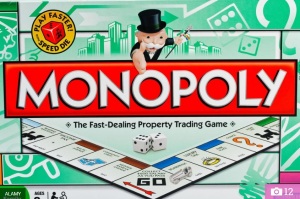
I have long viewed it that way. “Capitalism” conjures the greedy, coupon-clipping, fat-cat of Monopoly:

Thus did a board-game that vaulted to popularity during the Great Depression signify the identification of “capitalism” with another “bad thing”: monopoly. And, more recently, “capitalism” has been conjoined with yet another “bad thing”: income inequality.

In fact, “capitalism”

is a misnomer for the system of free markets that could deliver abundant prosperity and happiness, were markets left free. Free does not mean unfettered; competition for the favor of consumers exerts strong discipline on markets. And laws against theft, deception, and fraud would serve amply to keep markets honest, the worrying classes to the contrary notwithstanding.

What the defenders of (true) capitalism are defending — or should be — is voluntary, market-based exchange. It doesn’t roll off the tongue, but that’s no excuse for continuing to use a Marxist smear-word for the best of all possible economic systems.

Is the Constitution a Contract? Addendum

No, but it comes in handy sometimes.

I ended “Is the Constitution a Contract?” with this:

In sum, the Constitution is neither a compact between States (as sovereign entities) nor a law adopted by “the people”. It is a contract that was drawn up by a small fraction of the populace of twelve States, and put into effect by a small fraction of the populace of nine States. Its purpose, in good part, was to promote the interests of many of the Framers, who cloaked those interests in the glowing rhetoric of the Preamble (“We the People”, etc.). The other four of the original thirteen States could have remained beyond the reach of the Constitution, and would have done so but for the ratifying acts of small fractions of their populations.

In other words, the Constitution was a contract among a relatively small number of long-dead persons. And that’s exactly how the left treats it, intentionally or not.

Conservatives, on the other hand, cling to the original document because it affords ample room for the social and economic arrangements to be arrived at with little or no interference by the central government. The political differences between States would be even more marked than they are now, and some of them would be bastions of liberty.

What that would mean for the citizens of many States — in addition to lower taxes and less regulation — is respect for property rights, freedom of contract, freedom of association, and several other things; for example:

  • Public schools, to the extent that they still existed, would focus on education (“reading, writing, and arithmetic”) instead of indoctrination in globalism, “climate change”, CRT, etc.

  • Public universities, to the extent that they still existed, would be similarly focused on utilitarian subjects (in addition to “liberal arts” in the old-fashioned sense), and professors would be predominantly conservative or neutral because trendy “studies” programs and anti-scientific agendas (e.g., “climate change”) wouldn’t be tolerated.

  • Both kinds of institutions would be short on administrators and long on teachers.

  • Religion wouldn’t be scorned by public officials, teachers, and professors.

  • Punishments for crime would be delivered swiftly and certainly, and there would be capital punishment.

I am all for using the Constitution as a rallying point for those conservatives —Ron DeSantis, for example — who seek to restore the kind of federalism that the original Constitution promised. The result would be a more dramatic contrast between the worst of the worst (e.g., California) and the best of the best (e.g., Florida).

But none of that is possible unless the GOP (led by someone like DeSantis) retakes the White House and Congress. Time is running out.

Is the Constitution a Contract?

Yes and no. But the original one is worth saving.

The Constitution is a contract of sorts. The 1,648 delegates who voted in the thirteen constitutional conventions represented about two-tenths of one percent of the free white males aged 16 and older at the time (and presumably far less than one-half of one percent of the free-white males considered eligible for a convention).

The ratifying conventions were held in the States because it was left to each State whether to join the new union or remain independent. The conventions were conducted under the auspices of the State legislatures. They were, in effect, special committees with but one duty: to decide for each State whether that State would join the union.

This view is supported by Madison’s contemporaneous account of the ratification process:

[I]t appears, on one hand, that the Constitution is to be founded on the assent and ratification of the people of America, given by deputies elected for the special purpose; but, on the other, that this assent and ratification is to be given by the people, not as individuals composing one entire nation, but as composing the distinct and independent States to which they respectively belong. It is to be the assent and ratification of the several States, derived from the supreme authority in each State, the authority of the people themselves. The act, therefore, establishing the Constitution, will not be a national, but a federal act. [The Federalist No. 39, as published in the Independent Journal, January 16, 1788]

The ratification of the Constitution was not the “will of the people” of the entire nation. It was the will of a tiny fraction of the people of each State that ratified it, and which might well have chosen to reject it.

The Constitution is positive law, that is, law constructed by formal institutions (e.g., Congress, the Supreme Court), as opposed to natural law, which arises from human coexistence — the Golden Rule, for example. Natural law has moral standing because it appeals to and flows from human nature. Positive law may, by chance, be derived from natural law (e.g., murder is a crime), but it is a contrivance that can just as easily contravene natural law (e.g., the murder of an unborn human being is not a crime).

The myriad statutes, ordinances, regulations, executive orders, and judicial judgments that proscribe the behavior of Americans are positive law. Most of this body of positive law is designed to benefit or satisfy special interests or political ideologies. It has little to do with how human beings would behave were they free to do so, and were mindful of how their behavior would affect others and the behavior of others toward themselves. A great deal of this positive law exists because it has been imposed in the name of the Constitution or some “emanation” from it.

But the Constitution had no moral claim on most of the Americans living at the time of its adoption. And it has no moral claim on any American now living.

On this point, I turn to I turned to Lysander Spooner, anarchist extraordinaire. He begins No Treason (1867) with this:

The Constitution has no inherent authority or obligation. It has no authority or obligation at all, unless as a contract between man and man. And it does not so much as even purport to be a contract between persons now existing. It purports, at most, to be only a contract between persons living eighty years ago. And it can be supposed to have been a contract then only between persons who had already come to years of discretion, so as to be competent to make reasonable and obligatory contracts. Furthermore, we know, historically, that only a small portion even of the people then existing were consulted on the subject, or asked, or permitted to express either their consent or dissent in any formal manner. Those persons, if any, who did give their consent formally, are all dead now. Most of them have been dead forty, fifty, sixty, or seventy years. And the constitution, so far as it was their contract, died with them. They had no natural power or right to make it obligatory upon their children. It is not only plainly impossible, in the nature of things, that they could bind their posterity, but they did not even attempt to bind them. That is to say, the instrument does not purport to be an agreement between any body but “the people” then existing; nor does it, either expressly or impliedly, assert any right, power, or disposition, on their part, to bind anybody but themselves. Let us see. Its language is:

We, the people of the United States (that is, the people then existing in the United States), in order to form a more perfect union, insure domestic tranquillity, provide for the common defense, promote the general welfare, and secure the blessings of liberty to ourselves and our posterity, do ordain and establish this Constitution for the United States of America.

It is plain, in the first place, that this language, as an agreement, purports to be only what it at most really was, viz., a contract between the people then existing; and, of necessity, binding, as a contract, only upon those then existing. In the second place, the language neither expresses nor implies that they had any right or power, to bind their “posterity” to live under it. It does not say that their “posterity” will, shall, or must live under it. It only says, in effect, that their hopes and motives in adopting it were that it might prove useful to their posterity, as well as to themselves, by promoting their union, safety, tranquillity, liberty, etc.

In sum, the Constitution is neither a compact between States (as sovereign entities) nor a law adopted by “the people”. It is a contract that was drawn up by a small fraction of the populace of twelve States, and put into effect by a small fraction of the populace of nine States. Its purpose, in good part, was to promote the interests of many of the Framers, who cloaked those interests in the glowing rhetoric of the Preamble (“We the People”, etc.). The other four of the original thirteen States could have remained beyond the reach of the Constitution, and would have done so but for the ratifying acts of small fractions of their populations.

In other words, the Constitution was a contract among a relatively small number of long-dead persons. And that’s exactly how the left treats it, intentionally or not.

Conservatives, on the other hand, cling to the original document because it affords ample room for the social and economic arrangements to be arrived at with little or no interference by the central government. The political differences between States would be even more marked than they are now, and some of them would be bastions of liberty.

What that would mean for the citizens of many States — in addition to lower taxes and less regulation — is respect for property rights, freedom of contract, freedom of association, and several other things; for example:

  • Public schools, to the extent that they still existed, would focus on education (“reading, writing, and arithmetic”) instead of indoctrination in globalism, “climate change”, CRT, etc.

  • Public universities, to the extent that they still existed, would be similarly focused on utilitarian subjects (in addition to “liberal arts” in the old-fashioned sense), and professors would be predominantly conservative or neutral because trendy “studies” programs and anti-scientific agendas (e.g., “climate change”) wouldn’t be tolerated.

  • Both kinds of institutions would be short on administrators and long on teachers.

  • Religion wouldn’t be scorned by public officials, teachers, and professors.

  • Punishments for crime would be delivered swiftly and certainly, and there would be capital punishment.

I am all for using the Constitution as a rallying point for those conservatives —Ron DeSantis, for example — who seek to restore the kind of federalism that the original Constitution promised. The result would be a more dramatic contrast between the worst of the worst (e.g., California) and the best of the best (e.g., Florida).

But none of that is possible unless the GOP (led by someone like DeSantis) retakes the White House and Congress. Time is running out.