A More Perfect Constitution: Excerpt 2

A possible cure for what ails America.

Several months ago I published “A More Perfect Constitution”. Its language in many places is directed at abuses that have arisen in America’s governance. Because of its daunting length, I suspect that few readers have digested it whole, and that even fewer reader have been taken notice of the many places in which the document strives to undo the damage that has been done to Americans’ liberties. This series of posts highlights that language in bite-size chunks. Links to all excerpts are given at the end of this post.

III. RIGHTS AND PRIVILEGES OF CITIZENS

Rights and privileges conferred by and reserved under this Constitution apply equally to citizens of the United States but not to persons who are not citizens, except as provided herein. Neither the government of the United States nor any State may abridge any rights conferred by or reserved under this Constitution.

A. Equality and Guarantee of Rights and Privileges

Neither the government of the United States nor that of any State may do any of the following things:

1. Deprive any person, corporation, or other private entity living or operating lawfully within the jurisdiction of the government of the United States or any State of life, liberty, or property without due process of law. Due process, for this purpose, shall be understood as the disposition of a civil suit or criminal charge by verdict or settlement, and not any other act of government.

2. Prohibit the free exercise of religion, except where a particular religious activity would result in the commission of an act that otherwise is criminal, irrespective of its religious connotations or provenance (Article III, Section A, Clause 6 pertains). The free exercise of religion includes but is not limited to the use of government-owned, -operated, or -funded property — including institutions of learning — for brief periods of meditation and for teaching about religion, as long as such teaching is comparative. Such property, when not in use by a governmental unit, may be used for religious activities or observances of any lawful kind, as long as such functions are not endorsed or sponsored by a governmental unit, and as long as the same property is made available under the same terms and conditions to other users. It is a denial of the free exercise of religion for any governmental unit to bar the invocation or mention of a deity or other religious figure by any person at any time or place.

3. Establish religion, either directly or by funding or giving material aid to any religion, religious activity, or any activity conducted by or on behalf of a religion or religious institution. Allowing the free exercise of religion in accordance with the preceding clause is not an establishment of religion. Further, this clause shall not be construed to prohibit the giving of funds or material support directly to individual persons, even though such funding or support might be used by those persons to underwrite a religious purpose — including but not limited to religious education — as long as such funding or support is given for a non-religious purpose, including but not limited to education, and is made generally available to all eligible persons without regard for their religious affiliations or lack thereof.

4. Abridge, influence, shape, restrict, or give preference to the expression of ideas or information for any purpose by any citizen of the United States or on behalf of a business or other private organization operating lawfully within the United States. Congress may nevertheless enact laws prohibiting and punishing the release of information by any person, whether or not affiliated with the press, that would endanger the security of the United States or any State or citizen (including their businesses wherever located), or that would jeopardize the ability of the armed forces of the government of the United States to perform their missions. Congress may also enact laws prohibiting and punishing the utterance or publication of ideas that would circumscribe the economic or social liberties of citizens of the United States, as they are recognized in this Constitution.

5. Abridge the right of citizens to assemble peaceably and to petition government for the redress of grievances. This right does not include acts that threaten or harm persons or their property or which impede or obstruct the access of any person to any place, public or private. Neither the government of the United States nor any State shall incur or reimburse any expense related to or arising from acts of assembly and petition, except to indemnify or rectify damage that may have arisen pursuant to such acts.

6. Establish or delineate special classes of citizens or special rights or privileges for classes of citizens within its jurisdiction, for any purpose. Prohibited delineations include but are not limited to race, ethnicity, religion, gender, sexual orientation or preference, and status as a veteran of the armed forces of the government of the United States or any State. But this clause does not limit the ability of Congress to provide by law for the treatment by employers of members of the armed forces when they are called to active duty, or to compensate or provide material support to veterans of the armed forces. Veterans of the armed forces otherwise may not by law be granted special rights or privileges, such as preferential treatment in hiring or promotion based on their status as veterans.

7. Abridge the right of any citizen, business, or other private entity operating lawfully within the United States to choose freely the persons or organizations they will associate with, employ, or do business with, notwithstanding any contractual or funding relationship with the government of the United States or any State. This clause specifically, though not exclusively, bars any form of governmental interference in the decisions of private employers to hire, promote, transfer, or terminate employees. Also barred specifically, though not exclusively, is any governmental act that requires, enables, or recognizes the formation of any organization of employees for the purpose of bargaining with employers about the terms or conditions of employment.

8. As an employer, discriminate or authorize discrimination, in any explicit or implicit way, for any reason, with respect to gender, race, ethnicity, national origin, language, religion, sexual orientation, or veteran status, except that a governmental unit may by law be authorized to practice such discrimination for the sole purpose of ensuring the effective performance of that unit. This clause may not be construed to prohibit the establishment of mental and physical standards of performance, as long as those standards are job-related and applied impartially to all classes of employees and persons eligible for employment.

9. Nullify, alter, or otherwise affect any contract, either expressed or implied, that does not contravene this Constitution or otherwise constitute or suborn a crime against any third party. This clause applies to any voluntary transaction of any kind, where the parties to such a transaction are adult persons, corporations, or other private entities authorized by law, or any combination of these. This clause does not apply to marriage, civil unions, or similar arrangements, which shall be regulated by the States, individually.

10. Grant any rights, benefits, or privileges to non-citizens, except that non-citizens, including persons and corporations or other private entities operated by non-citizens, shall be entitled to due process of law for civil and criminal proceedings of the government of the United States or any State to which they may be subject. This clause does not apply to enemy combatants, the definition and treatment of which are prescribed elsewhere in this Constitution.


Excerpt 1, from Article II: CITIZENSHIP, VOTING, AND RELIGIOUS TESTS FOR OFFICE

A More Perfect Constitution: Excerpt 1

A possible cure for what ails America.

Several months ago I published “A More Perfect Constitution”. Its language in many places is directed at abuses that have arisen in America’s governance. Because of its daunting length, I suspect that few readers have digested it whole, and that even fewer reader have been taken notice of the many places in which the document strives to undo the damage that has been done to Americans’ liberties. This series of posts highlights that language in bite-size chunks. Links to all excerpts are given at the end of this post.

II. CITIZENSHIP, VOTING, AND RELIGIOUS TESTS FOR OFFICE

. . . .

B. Citizenship by Birth

A person who is born after the ratification of this Constitution becomes a citizen of the United States, regardless of that person’s place of birth, if at the time of birth that person has a least one parent who is a citizen of the United States (including a parent who was a citizen of the United States but who died before the birth). Birth within the territory of the United States, within any of its States, or within a territory, possession, or foreign installation of the United States does not, in itself, convey citizenship.

. . . .

D. Voting

1. Only citizens of the United States may cast ballots in elections, referenda, recalls, or other matters pertaining to the governance of the United States or any State.

2. The minimum attained age of a voter shall be at least twenty-one, although a State may by law set a higher minimum age. The minimum age established by a State shall apply to voting within that State, including voting in elections for offices of the government of the United States.

. . . .

5. The ballots for all elections, referenda, recalls, or other matters pertaining to the governance of the United States shall be cast on a consecutive Saturday and Sunday on dates established by Congress for the election of the president, vice president, and members of the Congress of the United States. The legislatures of the respective States shall establish by law the dates for voting on all matters pertaining to the governance of the States, except that the dates for each election, referendum, recall, or other matters pertaining to the governance of a State must span two consecutive days, the first being a Saturday.

6. All ballots shall be cast in person at polling places designated in accordance with the laws of each State, except that a State legislature may by law allow the casting of absentee ballots by persons who are disabled (as provided by State law), over the age of sixty-five, or who will at the time of an election be absent from the districts in which they are registered to vote. Persons casting absentee ballots shall deliver them or cause them to be delivered to locations designated by State law. Absentee ballots may not be made available to an eligible voter except upon written request by that voter or his legally authorized agent; may not be made available to an eligible voter more than thirty days before the date of the pertinent election, referendum, recall or other matter pertaining to governance; and may not be counted until the beginning of the first day of voting in an eligible voter’s State.

7. All ballots cast in each State shall be counted no less than seventy-two hours after the close of in-person voting in the State. The results of each election, referendum, recall, etc., shall be certified by the official designated by State law to make such certification no later than ninety-six hours after the close of in-person voting in the State, unless there is a recount of ballots conducted in accordance with State law, in which case the results shall be certified no less than one hundred and forty-four hours after the close of in-person voting in the State.

8. All ballots for all elections in the United States shall be printed on paper. Each ballot must be marked by the eligible voter who is casting the ballot, except where a voter’s physical handicap requires the marking of a ballot by another person, who shall sign, under penalty of perjury, attesting to his identity, the identity of the person for whom he is marking a ballot, and the conformity of the completed ballot with the instructions of the voter.

9. No person or organization may collect more than five absentee ballots for delivery to a place designated by a State legislature for the collection of absentee ballots.

10. No non-governmental organization may plan, oversee, or administer any aspect of any election, referendum, recall, or other matter pertaining to the governance of the United States or any State. This provision includes but is not limited to the creation or maintenance of registries of eligible voters, the review of eligibility to cast absentee ballots, the preparation and transmission of such ballots, and the collection and delivery of such ballots to such places as may be designated by State law.


Excerpt 2, from Article II: RIGHTS AND PRIVILEGES OF CITIZENS

Neo-Utilitarianism

It’s worse than the original

Jeremy Bentham (1748-1832) devised utilitarianism, which is best captured in the John Stuart Mill‘s phrase “the greatest amount of happiness altogether” (Chapter II of Utilitarianism).

From Bentham’s facile philosophy grew the ludicrous notion that it might be possible to quantify each person’s happiness and, then, to arrive at an aggregate measure of total happiness for everyone (or at least everyone in England). Utilitarianism, as a philosophy, has gone the way of Communism: It is discredited but many people still cling to it, under other names.

Modern utilitarianism lurks in the guise of cost-benefit analysis. Governments often subject proposed projects and regulations (e.g., new highway construction, automobile safety requirements) to cost-benefit analysis. The theory of cost-benefit analysis is simple: If the expected benefits from a government project or regulation are greater than its expected costs, the project or regulation is economically justified.

Cost-benefit analyses is deeply flawed in two ways. In the first instance, it’s a simple matter for the proponents of a government program to jigger the numbers to proved that a project is justified economically. (The ease with which numbers can be jiggered is illustrated here, here, and here.)

The second flaw is fundamental, but ignored: One person’s benefit can’t be compared with another person’s cost. Suppose, for example, that the City of Los Angeles conducted a cost-benefit analysis that “proved” the wisdom of constructing yet another freeway through the city in order to reduce the commuting time of workers who drive into the city from the suburbs.

Before constructing the freeway, the city would have to take residential and commercial property. The occupants of those homes and owners of those businesses (who, in many cases would be lessees and not landowners) would have to start anew elsewhere. The customers of the affected businesses would have to find alternative sources of goods and services. Compensation under eminent domain can never be adequate to the owners of taken property because the property is taken by force and not sold voluntarily at a true market price. Moreover, others who are also harmed by a taking (lessees and customers in this example) are never compensated for their losses. Now, how can all of this uncompensated cost and inconvenience be “justified” by, say, the greater productivity that might accrue to those commuters who would benefit from the construction of yet another freeway.

Yet, that is how cost-benefit analysis works. It assumes that group A’s cost can be offset by group B’s benefit: “the greatest amount of happiness altogether”. To put it more crudely, the pleasure A obtains when he punches B’s nose cannot compensate B for the pain and humiliation he suffers at A’s hands.

The Roots of Statism in America

Getting down to cases.

Government — measured by its real cost, share of the economy, and power over the citizenry — has never been larger. The regulatory state thrives and its hidden costs grow apace. Why, why, why?

First, most Americans — individuals, families, and businesses — are locked into a cycle of dependency on government, which began in earnest in the 1930s. The government way of life has acquired powerful and vocal constituencies, which few politicians dare to offend.

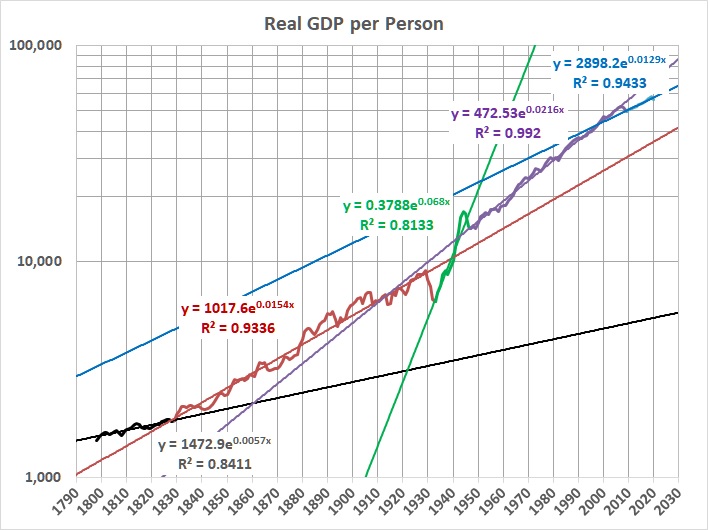
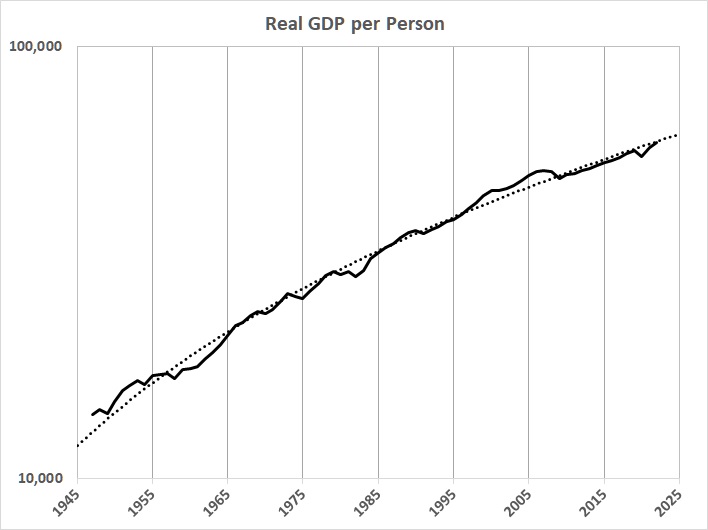
Second, there’s a widespread but mistaken belief in the affordability of government. Thanks in large part to three eras of rapid technological progress (in the early 1800s, the late 1800s, and the late 1900s), real per capita GDP has grown more than 50-fold since 1790. Thus most Americans don’t know (or don’t care) how much better off they would be if, for example, Social Security were privatized or the mountain of economic regulations was reduced to a molehill.

Third, Americans have become worldlier and less wedded to traditional sources of moral authority, namely, family and church. The family has dwindled in size, split with greater frequency, and drifted apart geographically. The church — with the notable exception of counter-cultural fundamentalism — has become more secular and less prone to the teaching of behavioral absolutes. Family and church have been displaced, in large part, by an increasingly paternalistic government, one that compels charity through taxation, one that enforces “right” behavior (e.g., bestowing special treatment on “disadvantaged” classes of people, banning smoking in most public and many private places, dictating the design of automobiles in the name of safety and environmentalism), and one that fosters the redress of grievances through legislatures and courts rather than directly or the good offices of friends, family, and clergy.

Like teen-age cultists, most Americans have renounced their faith in voluntary (and relatively costless) institutions. They have instead become addicted to the adoration of the state, which compels obeisance and demands a high price for the privilege.

Measuring the Urban Heat Island Effect

Another reason to flee cities.

Dr. Roy Spencer writes:

[F]or the average “suburban” (100-1,000 persons per sq. km) [weather] station [in the lower 48 States], UHI is 52% of the calculated temperature trend, and 67% of the urban station trend (>1,000 persons per sq. km). This means warming has been exaggerated by at least a factor of 2 (100%).

This also means that media reports of record high temperatures in cities must be considered suspect, since essentially all those cities have grown substantially over the last 100+ years, and so has their urban heat island.

To put a point on it: The “average” temperature of the U.S. (a meaningless statistic in itself) is dominated by readings taken at urban and suburban weather stations. It follows that the “average” is greatly inflated by the UHI effect, which prevails in about 2 percent of the area of the lower 48 States. It also follows that the cause of real “warming” (if there is any) is unknown because climate models are scientifically invalid.

Dr. Spencer’s result comes as no surprise to me. I wrote this four years ago:

The average annual temperature in the city of Austin, Texas, rose by 3.7 degrees F between 1960 and 2019, that is, from 67.2 degrees to 70.9 degrees. The increase in Austin’s population from 187,000 in 1960 to 930,000 in 2019 accounts for all of the increase. (The population estimate for 2019 reflects a downward adjustment to compensate for an annexation in 1998 that significantly enlarged Austin’s territory and population.)

My estimate of the effect of Austin’s population increase on temperature is based on the equation for North American cities in T.R. Oke’s “City Size and the Urban Heat Island”. The equation (simplified for ease of reproduction) is

T’ = 2.96 log P – 6.41

Where,

T’ = change in temperature, degrees C

P = population, holding area constant

The author reports r-squared = 0.92 and SE = 0.7 degrees C (1.26 degrees F).

I plugged the values for Austin’s population in 1960 and 2019 into the equation, took the difference between the results, and converted that difference to degrees Fahrenheit, with this result: The effect of Austin’s population growth from 1960 to 2019 was to increase Austin’s temperature by 3.7 degrees F. What an amazing non-coincidence.

How about them apples?

Affirmative Action: A Modest Proposal

Reparations with a beneficial twist.

Two posts by Alex Tabarrok at Marginal Revolution discuss a study that reveals the effects of nature and nurture on income. (Tabarrok’s original post is here. He posted some clarifying remarks here.) The study shows that the income of a Korean orphan who was adopted in the U.S. between 1970 and 1980, through a process of random selection, is about the same regardless of the income of the adoptive parents. On the other hand, the income of the biological children of the same parents is highly correlated with the parents’ income; that is, low -income parents tend to produce low-income children, whereas high-income parents tend to produce high-income children. The obvious implication of these findings is that intelligence (and hence income) is a heritable trait, one that remains differentiated along racial lines (a consistent but controversial finding documented here, for example). Thus the findings give further evidence, if any were needed, that affirmative action policies — whether government-prescribed or voluntarily adopted — tend to undermine the quality of workplaces and educational institutions. (I am speaking here of the quality of effort and thought, not the value of workers and students as human beings.)

The premise of affirmative action finds expression in a 1986 speech to the Second Circuit Judicial Conference by Justice Thurgood Marshall, where he urged Americans to

face the simple fact that there are groups in every community which are daily paying the cost of the history of American injustice. The argument against affirmative action is … an argument in favor of leaving that cost to lie where it falls. Our fundamental sense of fairness, particularly as it is embodied in the guarantee of equal protection under the laws, requires us to make an effort to see that those costs are shared equitably while we continue to work for the eradication of the consequences of discrimination. Otherwise, we must admit to ourselves that so long as the lingering effects of inequality are with us, the burden will be borne by those who are least able to pay.

In sum, affirmative action is a way of exacting reparations from white Americans for the sins of their slave-owning, discriminating forbears — even though most of those forbears didn’t own slaves and many of them didn’t practice discrimination. Those reparations come at a cost, aside from the resentment toward the beneficiaries of affirmative action and doubt about their qualifications for a particular job or place in a student body. As I wrote here:

Because of affirmative action — and legal actions brought and threatened under its rubric — employers do not always fill every job with the person best qualified for the job. The result is that the economy produces less than it would in the absence of affirmative action….

[A]ffirmative action reduces GDP by about 2 percent. That’s not a trivial amount. In fact, it’s just about what the federal government spends on all civilian agencies and their activities — including affirmative action….

Moreover, that effect is compounded to the extent that affirmative action reduces the quality of education at universities, which it surely must do. But let us work with 2 percent of GDP, which (in current dollars) comes to about $540 billion a year, or about $14,000 a year for every black American.

Thus my modest proposal to improve the quality of education and the productivity of the workforce: End affirmative action in all of its various guises (not just in the limited way of Students for Fair Admissions v. Harvard) and give every black American an annual voucher for, say, $10,000 (adjusted annually for inflation). The vouchers could be redeemed for educational expenses (tuition, materials, books, room and board, and mandatory fees). Recipients who didn’t need or want their vouchers could sell them to others (presumably at a discount), give them away, or bequeath them for use by later generations. The vouchers would be issued for a limited time (perhaps the 25 years envisioned by Justice O’Connor in Grutter), but they would never expire.

That would settle affirmative action, reparations, and school vouchers (for blacks) at a stroke. If only the Social Security mess could be settled as easily.


“A modest proposal” alludes to Jonathan Swift’s classic essay, A Modest Proposal, because mine — like Swift’s — is ironic and not meant seriously. To understand why, see these posts:

“White Privilege”

Critical Race Theory: Where It Really Leads

IQ, Political Correctness, and America’s Present Condition

Intelligence: Selected Readings

War, Slavery, and Reparations

That Which Dare Not Be Named

Leftism As Adolescent Rebellion

In case you hadn’t noticed.

A post at Bookworm Room caught my eye:

Andy McCarthy writes about the elephant in the liberal living room; namely, Islamic attitudes towards rape:  Women are almost always asking for it, especially Western women, and, once having forced an innocent man to give in to his base animal nature, they deserve to be beaten, arguably to death.

That analysis, of course, must get paired with CBS’s muted and delayed reporting of the horrific rape that its reporter, Lara Logan, suffered at the hands of an Islamic mob.  CBS tries to spin it as a normal tale of a mob that’s gotten out of control, but people paying attention to the Islamic world understand that, while Western mobs attack cars and shops, Islamic mobs attack women.

Why have American leftists so eagerly embraced Islam, with all of its ugly features, while rejecting pro-Western Israel? What is the left’s agenda with respect to Islam and Israel? What is the left’s agenda, period?

Don’t expect to understand the left by looking for rational explanations of leftist beliefs and behavior. The left is in an arrested state of adolescent rebellion: “If it’s ‘bad’ or dangerous, I want it, just to be ‘different’ (well, not different from my peers, whose approval I seek) and to express my ‘independence’ (as long as ‘Daddy government’ gives me an allowance, birthday presents, cell phones, etc.).”

To put it bluntly — and this is entirely consistent with my experience — persons of the left are like unthinking, selfish adolescents who want what they want, regardless of the consequences for themselves or others.

It seems natural for adolescents and young adults to flirt with leftism. The persistence of leftism beyond one’s twenties is a sign of arrested emotional development.

Like a Fish in Water

A few bubbles alarm a leftist.

Some years ago, A.O. Scott of The New York Times sought to prove that the myth of a “liberal” movie industry was dead. How? By citing two current box-office hits, Just Like Heaven and The Exorcism of Emily Rose, and a few other films that were putatively conservative or libertarian in outlook. In “Reading Hollywood, from Left to Right“, Scott asserts that

the studios themselves, especially after the stunning success of Mel Gibson’s independently financed “The Passion of the Christ,” have tried to strengthen their connection with religious and social conservatives, who represent not only a political constituency but a large and powerful segment of the market.

All this tells me is that Hollywood is interested in making money, which is fair enough. (Unlike Hollywood hypocrites who make big money with movies that criticize making big money, I don’t begrudge the money that Hollywood makes.) But Scott’s assertion says nothing about the determinedly leftish politics of most Hollywood stars and big-wigs.

Scott’s evidence for the demise of leftism in Hollywood is the supposed pro-life stance of Just Like Heaven, which apparently has a slapstick finale; an appeal to open-mindedness about religion, which is evidently the message to be taken from The Exorcism . . . ; Mel Gibson’s surprisingly successful The Passion of the Christ, which I recall being anathema to Hollywood before it became a hit; and a rather dumb action-hero animation known as The Incredibles, which I found to be an inferior version of Superman, Captain Marvel, and Batman comic books. And that’s about it, out of the hundreds of movies churned out by Hollywood and the so-called independent studios in the same span of time.

Scott’s problem is that, like most “liberals”, he can’t see the leftism that surrounds him because it’s his natural milieu. He’s like a fish in water who has been shocked by a small infusion of additional oxygen. It’s not enough to affect his environment significantly, but it causes a brief spasm of alarm.

The Modern Presidency, from TR to JRB

Slime seldom sleeps.

This is a revision and expansion of a post that I published at another blog late in 2007. The didactic style of this post reflects its original purpose, which was to give my grandchildren some insights into American history that aren’t found in standard textbooks. Readers who consider themselves already well-versed in the history of American politics should nevertheless scan this post for its occasionally provocative observations.

Theodore Roosevelt Jr. (1858-1919) was elected Vice President as a Republican in 1900, when William McKinley was elected to a second term as President. Roosevelt became President when McKinley was assassinated in September 1901. Roosevelt was re-elected President in 1904, with 56 percent of the “national” popular vote. (I mention popular-vote percentages here and throughout this post because they are a gauge of the general popularity of presidential candidates, though an inaccurate gauge if a strong third-party candidate emerges to distort the usual two-party dominance of the popular vote. There is, in fact, no such thing as a national popular vote. Rather, it is the vote in each State which determines the distribution of that State’s electoral votes between the various candidates. The electoral votes of all States are officially tallied about a month after the general election, and the president-elect is the candidate with the most electoral votes. I have more to say more about electoral votes in several of the entries that follow this one.)

Theodore Roosevelt (also known as TR) served almost two full terms as President, from September 14, 1901, to March 4, 1909. (Before 1937, a President’s term of office began on March 4 of the year following his election to office.)

Roosevelt was an “activist” President. Roosevelt used what he called the “bully pulpit” of the presidency to gain popular support for programs that exceeded the limits set in the Constitution. Roosevelt was especially willing to use the power of government to regulate business and to break up companies that had become successful by offering products that consumers wanted. Roosevelt was typical of politicians who inherited a lot of money and didn’t understand how successful businesses provided jobs and useful products for less-wealthy Americans.

Roosevelt was more like the Democrat Presidents of the Twentieth Century. He did not like the “weak” government envisioned by the authors of the Constitution. The authors of the Constitution designed a government that would allow people to decide how to live their own lives (as long as they didn’t hurt other people) and to run their own businesses as they wished to (as long as they didn’t cheat other people). The authors of the Constitution thought government should exist only to protect people from criminals and foreign enemies.

William Howard Taft (1857-1930), a close friend of Theodore Roosevelt, served as President from March 4, 1909, to March 4, 1913. Taft ran for the presidency as a Republican in 1908 with Roosevelt’s support. But Taft didn’t carry out Roosevelt’s anti-business agenda aggressively enough to suit Roosevelt. So, in 1912, when Taft ran for re-election as a Republican, Roosevelt ran for election as a Progressive (a newly formed political party). Many Republican voters decided to vote for Roosevelt instead of Taft. The result was that a Democrat, Woodrow Wilson, won the most electoral votes. Although Taft was defeated for re-election, he later became Chief Justice of the United States, making him the only person ever to have served as head of the executive and judicial branches of the U.S. Government.

Thomas Woodrow Wilson (1856-1924) served as President from March 4, 1913, to March 4, 1921. (Wilson didn’t use his first name, and was known officially as Woodrow Wilson.) Wilson is the only President to have earned the degree of doctor of philosophy. Wilson’s field of study was political science, and he had many ideas about how to make government “better”. But “better” government, to Wilson, was “strong” government of the kind favored by Theodore Roosevelt. In fact, it was government by executive decree rather than according to the Constitution’s rules for law-making, in which Congress plays the central role.

Wilson was re-elected in 1916 because he promised to keep the United States out of World War I, which had begun in 1914. But Wilson changed his mind in 1917 and asked Congress to declare war on Germany. After the war, Wilson tried to get the United States to join the League of Nations, an international organization that was supposed to prevent future wars by having nations assemble to discuss their differences. The U.S. Senate, which must approve America’s membership in international organizations, refused to join the League of Nations. The League did not succeed in preventing future wars because wars are started by leaders who don’t want to discuss their differences with other nations.

Warren Gamaliel Harding (1865-1923), a Republican, was elected in 1920 and inaugurated on March 4, 1921. Harding asked voters to reject the kind of government favored by Democrats, and voters gave Harding what is known as a “landslide” victory; he received 60 percent of the votes cast in the 1920 election for president, one of the highest percentages ever recorded. Harding’s administration was about to become involved in a major scandal when Harding died suddenly on August 3, 1923, while he was on a trip to the West Coast. The exact cause of Harding’s death is unknown, but he may have had a stroke when he learned of the impending scandal, which involved Albert Fall, Secretary of the Interior. Fall had secretly allowed some of his business associates to lease government land for oil-drilling, in return for personal loans.

There were a few other scandals, but Harding probably had nothing to do with any of them. Because of the scandals, most historians say that they consider Harding to have been a poor President. But that isn’t the real reason for their dislike of Harding. Most historians, like most college professors, favor “strong” government. Historians don’t like Harding because he didn’t use the power of government to interfere in the nation’s economy. An important result of Harding’s policy (called laissez-faire, or “hands off”) was high employment and increasing prosperity during the 1920s.

John Calvin Coolidge (1872-1933) , who was Harding’s Vice President, became President upon Harding’s death in 1923. (Coolidge didn’t use his first name, and was known as Calvin.) Coolidge was elected President in 1924. He served as President from August 3, 1923, to March 4, 1929. Coolidge continued Harding’s policy of not interfering in the economy, and people continued to become more prosperous as businesses grew and hired more people and paid them higher wages. Coolidge was known as “Silent Cal” because he was a man of few words. He said only what was necessary for him to say, and he meant what he said. That was in keeping with his approach to the presidency. He was not the “activist” that reporters and historians like to see in the presidency; he simply did the job required of him by the Constitution, which was to execute the laws of the United States. He continued Harding’s hands-off policy, and the country prospered as a result. Coolidge chose not run for re-election in 1928, even though he was quite popular.

Herbert Clark Hoover (1874-1964), a Republican who had been Secretary of Commerce under Coolidge, was elected to the presidency in 1928. He served as President from March 4, 1929, to March 4, 1933.

Hoover won 58 percent of the popular vote, an endorsement of the hands-off policy of Harding and Coolidge. Hoover’s administration is known mostly for the huge drop in the price of stocks (shares of corporations, which are bought and sold in places known as stock exchanges), and for the Great Depression that was caused partly by the “Crash” — as it became known. The rate of unemployment (the percentage of American workers without jobs) rose from 3 percent just before the Crash to 25 percent by 1933, at the depth of the Great Depression.

The Crash had two main causes. First, the prices of shares in businesses (called stocks) began to rise sharply in the late 1920s. That caused many persons to borrow money in order to buy stocks, in the hope that the price of stocks would continue to rise. If the price of stocks continued to rise, buyers could sell their stocks at a profit and repay the money they had borrowed. But when stock prices got very high in the fall of 1929, some buyers began to worry that prices would fall, so they began to sell their stocks. That drove down the price of stocks, and caused more buyers to sell in the hope of getting out of the stock market before prices fell further. But prices went down so quickly that almost everyone who owned stocks lost money. Prices of stocks kept going down. By 1933, many stocks had become worthless and most stocks were selling for only a small fraction of prices that they had sold for before the Crash.

Because so many people had borrowed money to buy stocks, they went broke when stock prices dropped. When they went broke, they were unable to pay their other debts. That had a ripple effect throughout the economy. As people went broke they spent less money and were unable to pay their debts. Banks had less money to lend. Because people were buying less from businesses, and because businesses couldn’t get loans to stay in business, many businesses closed and people lost their jobs. Then the people who lost their jobs had less money to spend, and so more people lost their jobs.

The effects of the Great Depression were felt in other countries because Americans couldn’t afford to buy as much as they used to from other countries. Also, Congress passed a law known as the Smoot-Hawley Tarrif Act, which President Hoover signed. The Smoot-Hawley Act raised tarrifs (taxes) on items imported into the United States, which meant that Americans bought even less from foreign countries. Foreign countries passed similar laws, which meant that foreigners began to buy less from Americans, which put more Americans out of work.

The economy would have recovered quickly, as it had done in the past when stock prices fell and unemployment increased. But the actions of government — raising tariffs and making loans harder to get — only made things worse. What could have been a brief recession turned into the Great Depression. People were frightened. They blamed President Hoover for their problems, although President Hoover didn’t cause the Crash. Hoover ran for re-election in 1932, but he lost to Franklin Delano Roosevelt, a Democrat.

Franklin Delano Roosevelt (1882-1945), known as FDR, served as President from March 4, 1933 until his death on April 12, 1945, just a month before V-E Day. FDR was elected to the presidency in 1932, 1936, 1940, and 1944 — the only person elected more than twice. Roosevelt was a very popular President because he served during the Depression and World War II, when most Americans — having lost faith in themselves — sought reassurance that “someone was in charge”. FDR was not universally popular; his share of the popular vote rose from 57 percent in 1932 to 61 percent in 1936, but then dropped to 55 percent in 1940 and 54 percent in 1944. Americans were coming to understand what FDR’s opponents knew at the time, and what objective historians have said since:

FDR’s program to end the Great Depression was known as the New Deal. It consisted of welfare programs, which put people to work on government projects instead of making useful things. It also consisted of higher taxes and other restrictions on business, which discouraged people from starting and investing in businesses, which is the cure for unemployment.

Roosevelt did try to face up to the growing threat from Germany and Japan. However, he wasn’t able to do much to prepare America’s defenses because of strong isolationist and anti-war feelings in the country. Those feelings were the result of America’s involvement in World War I. (Similar feelings in Great Britain kept that country from preparing for war with Germany, which encouraged Hitler’s belief that he could easily conquer Europe.)

When America went to war after Japan’s attack on Pearl Harbor, Roosevelt proved to be an able and inspiring commander-in-chief. But toward the end of the war his health was failing and he was influenced by close aides who were pro-communist and sympathetic to the Soviet Union (Union of Soviet Socialist Republics, or USSR). Roosevelt allowed Soviet forces to claim Eastern Europe, including half of Germany. Roosevelt also encouraged the formation of the United Nations, where the Soviet Union (now the Russian Federation) has had a strong voice because it was made a permanent member of the Security Council, the policy-making body of the UN. As a member of the Security Council, Russia can obstruct actions proposed by the United States. (In any event, the UN has long since become a hotbed of anti-American, left-wing sentiment.)

Roosevelt’s appeasement of the USSR caused Josef Stalin (the Soviet dictator) to believe that the U.S. had weak leaders who would not challenge the USSR’s efforts to spread Communism. The result was the Cold War, which lasted for 45 years. During the Cold War the USSR developed nuclear weapons, built large military forces, kept a tight rein on countries behind the Iron Curtain (in Eastern Europe), and expanded its influence to other parts of the world.

Stalin’s belief in the weakness of U.S. leaders was largely correct, until Ronald Reagan became President. As I will discuss, Reagan’s policies led to the end of the Cold War.

Harry S Truman (1884-1972), who was Vice President in FDR’s fourth term, became President upon FDR’s death. Truman was re-elected in 1948, so he served as President from April 12, 1945 until January 20, 1953 — almost two full terms.

Truman made one right decision during his presidency. He approved the dropping of atomic bombs on Japan. Although hundreds of thousands of Japanese were killed by the bombs, the Japanese soon surrendered. If the Japanese hadn’t surrendered then, U.S. forces would have invaded Japan and millions of Americans and Japanese lives would have been lost in the battles that followed the invasion.

Truman ordered drastic reductions in the defense budget because he thought that Stalin was an ally of the United States. (Truman, like FDR, had advisers who were Communists.) Truman changed his mind about defense budgets, and about Stalin, when Communist North Korea attacked South Korea in 1950. The attack on South Korea came after Truman’s Secretary of State (the man responsible for relations with other countries) made a speech about countries that the United States would defend. South Korea was not one of those countries.

When South Korea was invaded, Truman asked General of the Army Douglas MacArthur to lead the defense of South Korea. MacArthur planned and executed the amphibious landing at Inchon, which turned the war in favor of South Korea and its allies. The allied forces then succeeded in pushing the front line far into North Korea. Communist China then entered the war on the side of North Korea. MacArthur wanted to counterattack Communist Chinese bases and supply lines in Manchuria, but Truman wouldn’t allow that. Truman then “fired” MacArthur because MacArthur spoke publicly about his disagreement with Truman’s decision. The Chinese Communists pushed allied forces back and the Korean War ended in a deadlock, just about where it had begun, near the 38th parallel.

In the meantime, Communist spies had stolen the secret plans for making atomic bombs. They were able to do that because Truman refused to hear the truth about Communist spies who were working inside the government. By the time Truman left office the Soviet Union had manufactured nuclear weapons, had strengthened its grip on Eastern Europe, and was beginning to expand its influence into the Third World (the nations of Africa and the Middle East).

Truman was very unpopular by 1952. As a result he chose not to run for re-election, even though he could have done so. (The “Lame Duck” amendment to the Constitution, which bars a person from serving as President for more than six years was adopted while Truman was President, but it didn’t apply to him.)

Dwight David Eisenhower (1890-1969), a Republican, served as President from January 20, 1953 to January 20, 1961. Eisenhower (also known by his nickname, “Ike”) received 55 percent of the popular vote in 1952 and 57 percent in 1956; his Democrat opponent in both elections was Adlai Stevenson. The Republican Party chose Eisenhower as a candidate mainly because he had become famous as a general during World War II. Republican leaders thought that by nominating Eisenhower they could end the Democrats’ twenty-year hold on the presidency. The Republican leaders were right about that, but in choosing Eisenhower as a candidate they rejected the Republican Party’s traditional stand in favor of small government.

Eisenhower was a “moderate” Republican. He was not a “big spender” but he did not try to undo all of the new government programs that had been started by FDR and Truman. Traditional Republicans eventually fought back and, in 1964, nominated a small-government candidate named Barry Goldwater. I will discuss him when I get to President Lyndon B. Johnson.

Eisenhower was a popular President, and he was a good manager, but he gave the impression of being “laid back” and not “in charge” of things. The news media had led Americans to believe that “activist” Presidents are better than laissez-faire Presidents, and so there was by 1960 a lot of talk about “getting the country moving again” — as if it was the job of the President to “run” the country instead of execution laws duly enacted in accordance with the Constitution.

John Fitzgerald Kennedy (1917-1963), a Democrat, was elected in 1960 to succeed President Eisenhower. Kennedy, who became known as JFK, served from January 20, 1961, until November 22, 1963, when he was assassinated in Dallas, Texas.

One reason that Kennedy won the election of 1960 (with 50 percent of the popular vote) was his image of “vigorous youth” (he was 27 years younger than Eisenhower). In fact, JFK had been in bad health for most of his life. He seemed to be healthy only because he used a lot of medications. Those medications probably impaired his judgment and would have caused him to die at a relatively early age if he hadn’t been assassinated.

Late in Eisenhower’s administration a Communist named Fidel Castro had taken over Cuba, which is only 90 miles south of Florida. The Central Intelligence Agency then began to work with anti-Communist exiles from Cuba. The exiles were going to attempt an invasion of Cuba at a place called the Bay of Pigs. In addition to providing the necessary military equipment, the U.S. was also going to provide air support during the invasion.

JFK succeeded Eisenhower before the invasion took place, in April 1961. JFK approved changes in the invasion plan that resulted in the failure of the invasion. The most important change was to discontinue air support for the invading forces. The exiles were defeated, and Castro has remained firmly in control of Cuba.

The failed invasion caused Castro to turn to the USSR for military and economic assistance. In exchange for that assistance, Castro agreed to allow the USSR to install medium-range ballistic missiles in Cuba. That led to the so-called Cuban Missile Crisis in 1962. Many historians give Kennedy credit for resolving the crisis and avoiding a nuclear war with the USSR. The Russians withdrew their missiles from Cuba, but JFK had to agree to withdraw American missiles from bases in Turkey.

The myth that Kennedy had stood up to the Russians made him more popular in the U.S. His major accomplishment, which Democrats today like to ignore, was to initiate tax cuts, which became law after his assassination. The Kennedy tax cuts helped to make America more prosperous during the 1960s by giving people more money to spend, and by encouraging businesses to expand and create jobs.

The assassination of JFK on November 22, 1963, in Dallas was a shocking event. It also led many Americans to believe that JFK would have become a great President if he had lived and been re-elected to a second term. There is little evidence that JFK would have become a great President. His record in Cuba suggests that he would not have done a good job of defending the country.

Lyndon Baines Johnson (1908-1973), also known as LBJ, was Kennedy’s Vice President and became President upon Kennedy’s assassination, which he probably engineered. LBJ was re-elected in 1964; he served as President from November 22, 1963, to January 20, 1969. LBJ’s Republican opponent in 1964 was Barry Goldwater, who was an old-style Republican conservative, in favor of limited government and a strong defense. LBJ portrayed Goldwater as a threat to America’s prosperity and safety, when it was LBJ who was the real threat. Americans were still in shock about JFK’s assassination, and so they rallied around LBJ, who won 61 percent of the popular vote.

LBJ is known mainly for two things: his “Great Society” program and the war in Vietnam. The Great Society program was an expansion of FDR’s New Deal. It included such things as the creation of Medicare, which is medical care for retired persons that is paid for by taxes. Medicare is an example of a “welfare” program. Welfare programs take money from people who earn it and give money to people who don’t earn it. The Great Society also included many other welfare programs, such as more benefits for persons who are unemployed. The stated purpose of the expansion of welfare programs under the Great Society was to end poverty in America, but that didn’t happen. The reason it didn’t happen is that when people receive welfare they don’t work as hard to take care of themselves and their families, and they don’t save enough money for their retirement. Welfare actually makes people worse off in the long run.

America’s involvement in Vietnam began in the 1950s, when Eisenhower was President. South Vietnam was under attack by Communist guerrillas, who were sponsored by North Vietnam. Small numbers of U.S. forces were sent to South Vietnam to train and advise South Vietnamese forces. More U.S. advisers were sent by JFK, but within a few years after LBJ became President he had turned the war into an American-led defense of South Vietnam against Communist guerrillas and regular North Vietnamese forces. LBJ decided that it was important for the U.S. to defeat a Communist country and stop Communism from spreading in Southeast Asia.

However, LBJ was never willing to commit enough forces in order to win the war. He allowed air attacks on North Vietnam, for example, but he wouldn’t invade North Vietnam because he was afraid that the Chinese Communists might enter the war. In other words, like Truman in Korea, LBJ was unwilling to do what it would take to win the war decisively. Progress was slow and there were a lot of American casualties from the fighting in South Vietnam. American newspapers and TV began to focus attention on the casualties and portray the war as a losing effort. That led a lot of Americans to turn against the war, and college students began to protest the war (because they didn’t want to be drafted). Attention shifted from the war to the protests, giving the world the impression that America had lost its resolve. And it had.

LBJ had become so unpopular because of the war in Vietnam that he decided not to run for President in 1968. Most of the candidates for President campaigned by saying that they would end the war. In effect, the United States had announced to North Vietnam that it would not fight the war to win. The inevitable outcome was the withdrawal of U.S. forces from Vietnam, which finally happened in 1973, under LBJ’s successor, Richard Nixon. South Vietnam was left on its own, and it fell to North Vietnam in 1975.

Regarding LBJ’s role in the assassination of JFK, and LBJ’s corruption and obscene vulgarity, see (for example) Roger Stone’s The Man Who Killed Kennedy: The Case against LBJ.

Richard Milhous Nixon (1913-1994) was a Republican. He won the election of 1968 by beating the Democrat candidate, Hubert H. Humphrey (who had been LBJ’s Vice President), and a third-party candidate, George C. Wallace. Nixon and Humphrey each received 43 percent of the popular vote; Wallace received 14 percent. If Wallace had not been a candidate, most of the votes cast for him probably would have been cast for Nixon.

Even though Nixon received less than half of the popular vote, he won the election because he received a majority of electoral votes. Electoral votes are awarded to the winner of each State’s popular vote. Nixon won a lot more States than Humphrey and Wallace, so Nixon became President.

Nixon won re-election in 1972, with 61 percent of the popular vote, by beating a Democrat (George McGovern) who would have expanded LBJ’s Great Society and cut America’s armed forces even more than they were cut after the Vietnam War ended. Nixon’s victory was more a repudiation of McGovern than it was an endorsement of Nixon. His second term ended in disgrace when he resigned the presidency on August 9, 1974.

Nixon called himself a conservative, but he did nothing during his presidency to curb the power of government. He did not cut back on the Great Society. He spent a lot of time on foreign policy. But Nixon’s diplomatic efforts did nothing to make the USSR and Communist China friendlier to the United States. Nixon had shown that he was essentially a weak President by allowing U.S. forces to withdraw from Vietnam. Dictatorial rulers like do not respect countries that display weakness.

Nixon was the first (and only) President who resigned from office. He resigned because the House of Representatives was ready to impeach him. An impeachment is like a criminal indictment; it is a set of charges against the holder of a public office. If Nixon had been impeached by the House of Representatives, he would have been tried by the Senate. If two-thirds of the Senators had voted to convict him he would have been removed from office. Nixon knew that he would be impeached and convicted, so he resigned.

The main charge against Nixon was that he ordered his staff to cover up his involvement in a crime that happened in 1972, when Nixon was running for re-election. The crime was a break-in at the headquarters of the Democratic Party in Washington, D.C. Because the Democratic Party’s headquarters was located in the Watergate Building in Washington, D.C., this episode became known as the Watergate Scandal.

The purpose of the break-in was to obtain documents that might help Nixon’s re-election effort. The men who participated in the break-in were hired by aides to Nixon. Details about the break-in and Nixon’s involvement were revealed as a result of investigations by Congress, which were helped by reporters who were doing their own investigative work.

But there is good reason to believe that Nixon was unjustly forced from office by the concerted efforts of the news media (most of which had long been biased against Nixon), Democrats in Congress, and many Republicans who were anxious to rid themselves of Nixon, who was a magnet for controversy.

Gerald Rudolph Ford (born Leslie King Jr.) (1913 – 2007), who was Nixon’s Vice President at the time Nixon resigned, became President on August 9, 1974 and served until January 20, 1977. Ford succeeded Spiro T. Agnew, who had been Nixon’s Vice President until October 10, 1973, when he resigned because he had been taking bribes while he was Governor of Maryland (the job he had before becoming Vice President).

Ford became the first Vice President chosen in accordance with the Twenty-Fifth Amendment to the Constitution. That amendment spells out procedures for filling vacancies in the presidency and vice presidency. When Vice President Agnew resigned, President Nixon nominated Ford as Vice President, and the nomination was approved by a majority vote of the House and Senate. Then, when Ford became President, he nominated Nelson Rockefeller to fill the vice presidency, and Rockefeller was elected Vice President by the House and Senate.

Ford ran for re-election in 1976, but he was defeated by James Earl Carter, mainly because of the Watergate Scandal. Ford was not involved in the scandal, but voters often cast votes for silly reasons. Carter’s election was a rejection of Richard Nixon, who had left office two years earlier, not a vote of confidence in Carter.

James Earl (“Jimmy”) Carter Jr. (1924 – ), a Democrat who had been Governor of Georgia, received only 50 percent of the popular vote. He was defeated for re-election in 1980, so he served as President from January 20, 1977 to January 20, 1981.

Carter was an ineffective President who failed at the most important duty of a President, which is to protect Americans from foreign enemies. His failure came late in his term of office, during the Iran Hostage Crisis. The Shah of Iran had ruled the country for 38 years. He was overthrown in 1979 by a group of Muslim clerics (religious men) who disliked the Shah’s pro-American policies. In November 1979 a group of students loyal to the new Muslim government of Iran invaded the American embassy in Tehran (Iran’s capital city) and took 66 hostages. Carter approved rescue efforts, but they were poorly planned. The hostages were still captive by the time of the presidential election in 1980. Carter lost the election largely because of his feeble rescue efforts.

In recent years Carter has become an outspoken critic of America’s foreign policy. Carter is sympathetic to America’s enemies and he opposes strong military action in defense of America.

Ronald Wilson Reagan (1911-2004), a Republican, succeeded Jimmy Carter as President. Reagan won 51 percent of the popular vote in 1980. Reagan would have received more votes, but a former Republican (John Anderson) ran as a third-party candidate and took 7 percent of the popular vote. Reagan was re-elected in 1984 with 59 percent of the popular vote. He served as President from January 20, 1981, until January 20, 1989.

Reagan had two goals as President: to reduce the size of government and to increase America’s military strength. He was unable to reduce the size of government because, for most of his eight years in office, Democrats were in control of Congress. But Reagan was able to get Congress to approve large reductions in income-tax rates. Those reductions led to more spending on consumer goods and more investment in the creation of new businesses. As a result, Americans had more jobs and higher incomes.

Reagan succeeded in rebuilding America’s military strength. He knew that the only way to defeat the USSR, without going to war, was to show the USSR that the United States was stronger. A lot of people in the United States opposed spending more on military forces; they though that it would cause the USSR to spend more. They also thought that a war between the U.S. and USSR would result. Reagan knew better. He knew that the USSR could not afford to keep up with the United States. Reagan was right. Not long after the end of his presidency the countries of Eastern Europe saw that the USSR was really a weak country, and they began to break away from the USSR. Residents of Berlin demolished the Berlin Wall, which the USSR had erected in 1961 to keep East Berliners from crossing over into West Berlin. East Germany was freed from Communist rule, and it reunited with West Germany. The USSR collapsed, and many of the countries that had been part of the USSR became independent. We owe the end of the Soviet Union and its influence President Reagan’s determination to defeat the threat posed by the Soviet Union.

George Herbert Walker Bush (1924 – 2019), a Republican, was Reagan’s Vice President. He won 54 percent of the popular vote when he defeated his Democrat opponent, Michael Dukakis, in the election of 1988. Bush lost the election of 1992. He served as President from January 20, 1989 to January 20, 1993.

The main event of Bush’s presidency was the Gulf War of 1990-1991. Iraq, whose ruler was Saddam Hussein, invaded the small neighboring country of Kuwait. Kuwait produces and exports a lot of oil. The occupation of Kuwait by Iraq meant that Saddam Hussein might have been able to control the amount of oil shipped to other countries, including Europe and the United States. If Hussein had been allowed to control Kuwait, he might have moved on to Saudi Arabia, which produces much more oil than Kuwait. President Bush asked Congress to approve military action against Iraq. Congress approved the action, although most Democrats voted against giving President Bush authority to defend Kuwait. The war ended in a quick defeat for Iraq’s armed forces. But President Bush decided not to allow U.S. forces to finish the job and end Saddam Hussein’s reign as ruler of Iraq.

Bush’s other major blunder was to raise taxes, which helped to cause a recession. The country was recovering from the recession in 1992, when Bush ran for re-election, but his opponents were able to convince voters that Bush hadn’t done enough to end the recession. In spite of his quick (but incomplete) victory in the Persian Gulf War, Bush lost his bid for re-election because voters were concerned about the state of the economy.

William Jefferson Clinton (born William Jefferson Blythe III) (1946 – ), a Democrat, defeated George H.W. Bush in the 1992 election by gaining a majority of the electoral vote. But Clinton won only 43 percent of the popular vote. Bush won 37 percent, and 19 percent went to H. Ross Perot. Perot, a third-party candidate, who received many votes that probably would have been cast for Bush.

Clinton’s presidency got off to a bad start when he sent to Congress a proposal that would have put health care under government control. Congress rejected the plan, and a year later (in 1994) voters went to the polls in large number to elect Republican majorities to the House and Senate.

Clinton was able to win re-election in 1996, but he received only 49 percent of the popular vote. He was re-elected mainly because fewer Americans were out of work and incomes were rising. This economic “boom” was a continuation of the recovery that began under President Reagan. Clinton got credit for the “boom” of the 1990s, which occurred in spite of tax increases passed by Congress while it was still controlled by Democrats.

Clinton was perceived as a “moderate” Democrat because he tried to balance the government’s budget; that is, he tried not to spend more money than the government was receiving in taxes. He was eventually able to balance the budget, but only because he cut defense spending. In addition to that, Clinton made several bad decisions about defense issues. In 1993 he withdrew American troops from Somalia, instead of continuing with the military mission there after some troops were captured and killed by natives. In 1994 he signed an agreement with North Korea that was supposed to keep North Korea from developing nuclear weapons, but the North Koreans continued to work on building nuclear weapons because they had fooled Clinton. By 1998 Clinton knew that al Qaeda had become a major threat when terrorists bombed two U.S. embassies in Africa, but Clinton failed to go to war against al Qaeda. Only after terrorists struck a Navy ship, the USS Cole, in 2000 did Clinton declare terrorism to be a major threat. By then, his term of office was almost over.

Clinton was the second President to be impeached. The House of Representatives impeached him in 1998. He was charged with perjury (lying under oath) when he was the defendant (the person being charged with wrong-doing) in a law suit. The Senate didn’t convict Clinton because every Democrat senator refused to vote for conviction, in spite of overwhelming evidence that Clinton was guilty. The day before Clinton left office he acknowledged his guilt by agreeing to a five-year suspension of his law license. A federal judge later found Clinton guilty of contempt of court for his misleading testimony and fined him $90,000.

Clinton was involved in other scandals during his presidency, but he remains popular with many people because he is good at giving the false impression that he is a nice, humble person.

Clinton’s scandals had more effect on his Vice President, Al Gore, who ran for President as the nominee of the Democrat Party in 2000. His main opponent was George W. Bush, a Republican. A third-party candidate named Ralph Nader also received a lot of votes. The election of 2000 was the closest presidential election since 1876. Bush and Gore each won about 48 percent of the popular vote (Gore’s percentage was slightly higher than Bush’s); Nader won 3 percent. The winner of the election was decided by outcome of the vote in Florida. That outcome was the subject of legal proceedings for six weeks. It had to be decided by the U.S. Supreme Court.

Initial returns in Florida gave that State’s electoral votes to Bush, which meant that he would become President. But the Supreme Court of Florida decided that election officials should violate Florida’s election laws and keep recounting the ballots in certain counties. Those counties were selected because they had more Democrats than Republicans, and so it was likely that recounts would favor Gore, the Democrat. The case finally went to the U.S. Supreme Court, which decided that the Florida Supreme Court was wrong. The U.S. Supreme Court ordered an end to the recounts, and Bush was declared the winner of Florida’s electoral votes.

George Walker Bush (1946 – ), a Republican, was the second son of a President to become President. (The first was John Quincy Adams, the sixth President, whose father, John Adams, was the second President. Also, Benjamin Harrison, the 23rd President, was the grandson of William Henry Harrison, the ninth President.) Bush won re-election in 2004, with 51 percent of the popular vote. He served as President from January 20, 2001, to January 20, 2009.

President Bush’s major accomplishment before September 11, 2001, was to get Congress to cut taxes. The tax cuts were necessary because the economy had been in a recession since 2000. The tax cuts gave people more money to spend and encouraged businesses to expand and create new jobs.

The terrorist attacks on September 11, 2001, caused President Bush to give most of his time and attention to the War on Terror. The invasion of Afghanistan, late in 2001, was part of a larger campaign to disrupt terrorist activities. Afghanistan was ruled by the Taliban, a group that gave support and shelter to al Qaeda terrorists. The U.S. quickly defeated the Taliban and destroyed al Qaeda bases in Afghanistan.

The invasion of Iraq, which took place in 2003, was also intended to combat al Qaeda, but in a different way. Iraq, under Saddam Hussein, had been an enemy of the U.S. since the Persian Gulf War of 1990-1991. Hussein was trying to acquire deadly weapons to use against the U.S. and its allies. Hussein was also giving money to terrorists and sheltering them in Iraq. The defeat of Hussein, which came quickly after the invasion of Iraq, was intended to establish a stable, friendly government in the Middle East.

The invasion of Iraq produced some of the intended results, but there was much unrest there because of long-standing animosity between Sunni Muslims and Shi’a Muslims. There was also much defeatist talk about Iraq — especially by Democrats and the media. That defeatist talk helped to encourage those who were creating unrest in Iraq. It gave them hope that the U.S. would abandon Iraq, just as it abandoned Vietnam more than 30 years earlier. The country had become almost uncontrollable until Bush authorized a military “surge” — enough additional troops to quell the unrest.

However, Bush, like his father, failed to take a strategically decisive course of action. He should have ended the pretense of “nation-building”, beefed up U.S. military presence, and installed a compliant Iraqi government. That would have created a U.S. stronghold in the Middle East and stifled Iran’s moves toward regional hegemony, just as the presence of U.S. forces in Europe for decades after World War II kept the USSR from seizing new territory and eventually wore it down.

With Iraq as a U.S. base of operations, it would have been easier to quell Afghanistan and to launch preemptive strikes on Iran’s nuclear-weapons program while it was still in its early stages.

But the early failures in Iraq — and the futility of the Afghan operation (also done on the cheap) — meant that Bush had no political backing for bolder military measures. Further, the end of his second term was blighted by a financial crisis that led a stock-market crash, the failure of some major financial firms, the bailout of some others, and thence to the Great Recession.

The election of 2008 coincided with the economic downturn, and it was no surprise that the Democrat candidate handily beat the feckless Republican (in-name-only) candidate, John Sidney McCain III.

Barack Hussein Obama II (1961 – ) was the Democrat who defeated McCain. Obama, like most of his predecessors, was a professional politician, but most of his political experience was as a “community organizer” (i.e., rabble-rouser and shakedown artist) in Chicago. He was still serving in his first major office (as U.S. Senator from Illinois) when he vaulted ahead of Hillary Rodham Clinton and seized the Democrat nomination for the presidency. He served as President from January 20, 2009, until January 20, 2017.

Obama’s ascendancy was owed in large part to the perception of him as youthful and energetic. He was careful to seem moderate in his campaign rhetoric, though those in the know (party leaders and activists) were well aware of his strong left-wing leanings, which were revealed in his Senate votes and positions. Clinton, by contrast, was perceived as middle-of the-road, but only because the road had shifted well to the left over the years. It was she, for example, who propounded the health-care nationalization scheme known as HillaryCare. The scheme was defeated in Congress, but it was responsible in large part for massive swing of House seats in 1994, which returned the House to GOP control for the first time in 42 years.

Obama’s election was due also to a health dose of white “guilt”. Here was an opportunity for many voters to “prove” (and to brag about) their lack of racism. And so, given the experience of Iraq, the onset of the Great Recession, and a me-too Republican candidate, they did the easy thing by voting for Obama, and enjoyed the feel-good sensation that went with it.

At any rate, Obama served two terms (the second was secured by defeating Willard Mitt Romney, another feckless RINO). His presidency throughout both terms was marked by disastrous policies; for example:

  • Obamacare, which drastically raised health-care costs and insurance premiums and added millions of freeloaders to Medicaid

  • encouragement of illegal immigration, which imposes heavy burdens on middle-class taxpayers and is intended to swell the rolls of Democrat voters through amnesty schemes

  • increases in marginal tax rates for individuals and businesses

  • issuance of economically stultifying regulations at an unprecedented page

  • nomination of dozens of left-wing judges and two left-wing Supreme Court Justices, partly to ensure “empathic” (leftist) rulings rather than rulings in accordance with the Constitution

  • sharp reductions in defense spending

  • meddling in Libya, which through Hillary Clinton’s negligence cost the lives of American diplomats

  • Clinton’s use of a private e-mail server, in which Obama was complicit, and which resulted in the compromise of sensitive, classified information.

  • a drastic military draw-down in Iraq, with immediately dire consequences (and a just-in-time reversal by Obama)

  • persistent anti-white and anti-American rhetoric (the latter especially on foreign soil and at the UN)

  • persistent anti-business rhetoric that, together with tax increases and regulatory excesses, killed the recovery from the Great Recession and put the U.S. firmly on the road to economic stagnation.

It should therefore have been a simple matter for voters to reject Obama’s inevitable successor: Hillary Clinton. But the American public has been indoctrinated in leftism for decades by public schools, the mainstream media, and a plethora TV shows and movies, with the result that Clinton acquired 5 million more popular votes, nationwide, than did her Republican opponent. The foresight of the Framers of the Constitution proved providential because her opponent carefully chose his battlegrounds and was handily won in the electoral college. Thus …

Donald John Trump (1946 – ), a Republican, succeeded Obama and was inaugurated as President on January 20, 2017. He is only in the third year of his presidency, but has accomplished much despite a “resistance” movement that began as soon as his election was assured in the early-morning hours of November 9, 2016. (The “resistance”, which I discuss here, is a continuation of political and social trends that are rooted in the 1960s.)

Trump’s record deserves special attention because he is wrongly accused of being something other than a conservative. These are among Trump’s accomplishments (borrowed from this source), many of them the result of a successful collaboration with Congress:

  • Tax Cuts and Jobs Act — a massive tax reduction

  • 21 percent top-corporate tax rate, down from 35 percent

  • Eight regulations erased for every new one imposed

  • School voucher program for Washington, D.C., reauthorized and funded

  • Three constitutionalist justices added to the U.S. Supreme Court

  • Some 200 conservative judges placed in lower federal courts

  • Keystone XL Pipeline approved

  • Oil drilling in a small, specific portion of the Arctic National Wildlife Refuge authorized

  • U.S. energy independence achieved

  • Critical race theory in federal programs dumped

  • Paris Climate Agreement abandoned

  • Iran Nuclear Deal ditched

  • Islamic State group caliphate obliterated

  • U.S. embassy in Israel moved from Tel Aviv to Jerusalem

  • Four Middle Eastern peace deals with Israel and its neighbors signed

  • About 500 miles of southern-border wall constructed

  • Some 8,000 Opportunity Zones to revitalize low-income areas through market incentives activated

  • Planned Parenthood partially defunded

  • Free trade agreement with South Korea launched

  • Right to Try law allowing terminally ill patients access to experimental drugs signed

  • American military prowess restored and funded

  • Operation Warp Speed’s three COVID-19 vaccines delivered in record time via White House collaboration with the private sector. (I can only fault Trump for his support of masking and lockdowns.)

For daring to win the election of 2016, Trump has been for more than seven years the target of a hoax perpetrated by Hillary Clinton, the CIA, and FBI; and “legal” harassment by Congress, prosecutors, and private parties (see this). His loss in the election of 2020 was the result of a concerted effort by Democrats and well-heeled “liberals” to overturn existing election laws, harvest ballots, and commit enough fraud in key jurisdictions to swing the election to ….

Joseph Robinette Biden Jr. (1942 – ), a Democrat, is the most corrupt, divisive, and destructive president discussed here, with the possible exception of LBJ.

Biden has undone or strived to undo almost all of Trump’s accomplishments, leaving the country militarily and economically weaker — and weaker than its enemies in both respects for the first time since the 1930s. He has allowed millions of illegal immigrants to enter the country, with resulting criminality, tax burdens, strains on social services, and political acrimony. His economic policies are squeezing the middle class through higher marginal tax rates, onerous regulations, and inflation. His support of programs meant to combat “climate change” (a pseudo-scientific hoax) has contributed to inflation and to the replacement of reliable and relatively cheap fossil fuels with unreliable and expensive “renewables” (solar and wind farms). He has supported socially divisive “woke” programs that undermine traditional social values and replace merit with “equity” (something for nothing) — for which America will pay a high social and economic cost for decades to come unless those policies are quickly reversed. He has committed the U.S. to the support of a corrupt regime in Ukraine, at the cost of more than $100 billion and the loss of a vast source of cheap energy.

As for Biden’s corruption, which has much to with his Ukraine policy, read this, this, and this — and keep up with the news about the impeachment inquiry that has been authorized by the Speaker of the House.

Biden: Blood and Money Revisited

Dov Fischer weighs in.

From “Biden Has Money in the Bank and Blood on His Hands”:

It’s as simple as this:

Volodymyr Zelenskyy has the goods on Joe Biden. If he were to affirm what is already known, but denied by Democrats, the whole world — including corporate media — would pay attention. And that would be the end of Biden.

What is already known? That the Bidens reaped at least $10 million in bribes from Burisma, the huge Ukrainian oil producer, for access to U.S. officials and for arranging the firing of Ukraine’s attorney general, who was probing the corrupt dealings of Burisma.

Why is Zelenskyy holding back? Because as long as he holds back, and as long as Biden remains in the White House, the U.S. will continue to support Ukraine. With that support — hundreds of billions of dollars in arms and aid — Zelenskyy has been able to reject a peace offering from Russia and to prolong the war with Russia?

Now comes Dov Fischer, with this:

As 1985 approached, it devolved on me to produce the [Herut Zionists of America’s] largest-ever national convention. I reserved the hotel Pierre, hired the most exquisite kosher caterer in New York, assured we would have strong national representation in attendance, and lined up speakers like Israeli ambassador to America, Meir Rosenne, and my big coup: the charismatic Ariel Sharon, thanks to our personal friendship going back a few years. Next, my biggest task of all: get one Republican U.S. senator and one Democrat U.S. senator, each with impeccable pro-Israel credentials. The person assigned to get the Republican (my boss) flaked on me. I personally got the Democrat: the junior senator from Delaware, newly reelected to a second term, Joseph Robinette Biden Jr.

In those mid-1980s days, as I recall, a reasonable speaking honorarium included paying $5,000 plus airfare, a top-flight hotel, and all kinds of related living accoutrements. When I sealed the deal with Sen. Biden’s office, I was, frankly, relieved: I had secured a big name, up-coming star to speak at our convention. This reinforced HZA as a major player with Jewish newsmedia and in American Zionism.

And then I got a phone call from a Biden staffer in D.C. I do not remember his name.  The quotes that follow are not precisely verbatim after 38 years, but I remember the gist incredibly well. I skip the phatic language and cut to the chase:

Staffer: The senator is looking forward to speaking to your group.
Me: Wonderful.
Staffer: I am calling about the senator’s $5,000 honorarium.
Me: Yes?
Staffer: The senator has a practice that he prefers not leaving a footprint or record of certain groups he has spoken for.
Me: I’m sorry. What does that mean?
Staffer: We are wondering: Many of the Zionist organizations have young people’s groups that are schooled in the groups’ ideologies and viewpoints. Do you have any?
Me: Yes, we have a teens group called Betar and a new college group called Tagar.
Staffer: OK. That college group: Do they have chapters on college campuses?
Me: I have just been launching the thing. We have a few so far.
Staffer: Do you have any of that college group’s chapters at a campus near the Pierre hotel where the senator will be speaking for your group?
Me: I think we may have one, maybe at NYU or a bit farther away at Brooklyn College.
Staffer: The senator would like to have his $5,000 honorarium paid by that college group of yours for a speech at the college chapter nearest the Pierre hotel.
Me: I don’t understand. Are you saying Sen. Biden would like to speak to our college group, too?
Staffer: No, the senator cannot fit that college group in his plans while he is in New York. He just wants the honorarium to be made to appear as though he spoke to them, not to Herut Zionists of America.
Me: Again, I apologize. I am new at all this. Are you asking me to falsify the source of payment for Sen. Biden’s honorarium?
Staffer: You are not falsifying anything. You are getting the speech you want by the senator you want for the price you agreed on. The senator is getting the $5,000 you agreed to pay him. It’s just a bookkeeping matter, to make it look like the college students are paying him for speaking at their campus instead of him speaking at the Pierre to your group. But, don’t worry, it will be your group that he speaks to.

It was a terrible lie.  It was a young rabbi’s sharpest introduction to the world of lies and deceit that is Washington, D.C….

Joseph Robinette Biden Jr. is a crook. He is a liar. For nearly half a century, I have known first-hand he plays games with money: how he gets it, who gives it to him, how its source is disguised, how it later can be re-characterized if it is uncovered. If he finagled with me, how many other speaking honoraria has he camouflaged these past 38 years? And what else? Biden’s is a lifelong pattern of deceit. It is sleight of hand: scoop in the cash, but don’t leave crumbs, cover the tracks, let the curious and suspicious exhaust themselves on wild goose chases trying to find out how the money got from Point A to Point B to Point C to its ultimate destination at Point JRB (Jr.). It is part felony, part magic show. Nothing up his sleeve.

Fire a prosecutor investigating Burisma. The laptop a Russian ploy. Never talked to Hunter about his businesses. Buy a Hunter Biden painting….

If Joe Biden would go to that much trouble to cover-up and hide a purely legitimate every-day honorarium — reasonably priced for a U.S. senator at $5,000, paid by a significant organization that often hosted Israeli prime ministers and a distinguished constituent of the Conference of Presidents of Major American Jewish Organizations, and negotiated with a rabbi then already somewhat prominent and listed in Who’s Who in American Jewry — to what lengths would he go to cover up tens of millions obtained wrongfully from sources in China, Ukraine, Russia, and G-d knows where else while leveraging his power as vice president of the United States, enriching his family while possibly compromising American national interests?

We may never know where the Biden family money is, or how they got it, or who remitted it, who cashed it, who transferred it, where it went, where it next went, where it went after that, where it is now, where it will be after this article is published — but Xi and Zelensky and Putin know “too much.” To what degree is Biden’s present foreign policy dictated by his consuming fear they will reveal what House investigators and bogus special counsel David Weiss cannot — or deliberately will not — unearth? Has Biden sent Ukraine more than $110 billion because that is in our national interest or as “hush money” to keep Zelensky quiet? Do we nevertheless send Ukraine significantly less than needed to beat Russia outright or to drive her back, assuring a never-ending faucet leak of tens of billions, because Biden needs to keep Putin quiet, too? And is our weak foreign policy toward China dictated by Biden’s need to keep Xi quiet?

Read the final paragraph again … and again. It says what I have believed (and said to correspondents) for many months.

Trump vs. Biden: 1

The wind blows uncertainly.

Neither Trump nor Biden may be his party’s nominee for president next year. But they’re the most likely candidates for now, so let’s see how the race stacks up about a year before early voting begins.

The RealClearPolitics poll of polls gives Trump a whisker-thin and meaningless lead of 0.5 percentage point over Biden. But, given the impending impeachment hearings and the daily dose of outrages emanating from Washington, the polls likely overstate future standing among voters. On the other hand, the negative publicity that Trump has reaped since January 6, 2021, and will reap as his trials get underway (if they do), will turn off independent and fickle Republican voters.

For now, in the absence of solid polling results, I choose to look at Trump and Biden’s relative popularity among voters during their presidencies. For that purpose, I use an “enthusiasm ratio”: the number of likely voters who strongly approve a president as a percentage of the number of likely voters who venture an opinion one way or the other (thus omitting the voters who are non-committal). Here’s a comparison of the enthusiasm ratios for Trump and Biden:

Derived from Rasmussen Reports Daily Presidential Tracking Polls for Trump and Biden from January 20, 2017, through September 15, 2023.

If Trump hasn’t lost too many of his supporters because of his antics and legal problems, and if Biden continues to slip (literally, verbally, and in policy making), Trump should win in 2024.

But in the realms of politics, war, economics — and life in general — the unpredictable far outweighs the predictable.

Stay tuned….

Leftism: The Nirvana Fallacy on Stilts

“Intellectualism” breeds in a vaccum.

The nirvana fallacy is “is the … fallacy of comparing actual things with unrealistic, idealized alternatives.” Its natural breeding grounds are the academy, the punditry, and government, where there is no true accountability for the fabrication and application of destructive ideas.

I was reminded of this fact of life by an article at The American Spectator, where Matthew Xaio makes these observations:

Thomas Sowell, a renowned economist and social theorist, describes academia as “the natural habitat of half-baked ideas” in his book The Vision of the Anointed, noting that “the most fundamental fact about the ideas of the political left is that they do not work.” So it’s not surprising, Sowell argues, that we “find the left concentrated in institutions [not just the academy] where ideas do not have to work in order to survive.”…

It goes deeper that that, however, as Xaio continues:

[T]here’s a deeper psychological reason to consider, one that has been largely ignored by all but a few prominent scholars: the sense of authority and superiority conferred upon professors who champion liberal policies. 

In The Vision of the Anointed, Sowell denounces a particular elite group consisting of left-leaning professors, policymakers, and journalists. He calls these elites “the anointed” because they anoint themselves as the rescuers of the “benighted” masses and are firmly convinced of their own moral and intellectual superiority….

Similarly, [the late] Sir Roger Scruton, one of the most influential philosophers and social critics, noted that people who “think about politics in an intellectual way” are more likely to be on the political left because liberal policies allow them to assume “a rather dignified and self-congratulatory place in the system.”

When commenting on the tendency of intellectuals to gravitate toward centralized planning, Scruton said, “It is not the truth of Marxism that explains the willingness of intellectuals to believe it, but the power it confers on intellectuals, in their attempts to control the world.” He added that “Marxism owes its remarkable power to survive every criticism to the fact that it is not a truth-directed but a power-directed system of thought.”

Truth is found in the acid test of use, not in the pronouncements of academics, pundits, and self-serving bureaucrats like Anthony Fauci.

The Real Story about Economic Growth

It’s not good.

Sort-of-economist Timothy Taylor, who edits the Journal of Economic Perspectives and blogs as the Conversable Economist, has posted “The Remarkable Steadiness of Economic Growth”, in which he asserts:

It is remarkable but true that per capita US economic growth has hewed close to a trendline of 2% per year for the last 150 years. Here’s a recent figure showing this pattern from Charles Jones in his paper “The Outlook for Long-Term Economic Growth,” as prepared for the annual symposium at Jackson Hole hosted by the Federal Reserve Bank of Kansas City (August 2023, full symposium proceedings including Jones’s paper available here, Jones’s paper also available as NBER Working Paper #31648).

Notice that the left-hand axis of the figure is a logarithmic (that is, a proportional) scale. On such a scale, a 2% growth rate appears as the straight dashed red line. The path of the US economy has sometimes been a little above this line, and sometimes a little below below. But the fact that the 2% annual growth rate fits the long-term pattern so well is quite remarkable.

I would laugh at the “path of the US. economy sometimes has been … a little below” the regression line, if the downward deviations were of little consequence to actual persons. But all of them were consequential. The “dip” from 1929 to 1933 (a.k.a. the first years of the Great Depression) marks a drop in real GDP per person of 29 percent. Other dips, which look small on a graph, were also large and damaging to the well-being of tens of millions of Americans: 1891-94, 14 percent; 1907-08, 12 percent; 1945-47, 17 percent; 2009-10, 3.5 percent; and 2019-20, 3 percent. Those percentages mask the greater pain which befell Americans who bore the brunt of economic downturns — almost always Americans who were already in the bottom tiers of the economic scale.

More to the point of Taylor’s post, he should know better than to claim that a regression line says anything about long-term growth. If you start at 1790 instead of 1870 (as Taylor’s source does), you get a regression line which suggests that long-term real growth has been 1.7 percent:

Derived from U.S. GDP statistics at Measuring Worth.

That’s significantly different than 2 percent. Over a span of 100 years for example, total growth at 1.7 percent is only 75 percent of total growth at 2 percent.

Moreover, it’s naïve (or disingenuous) to claim that long-term growth approximates any particular rate. It all depends on the period of interest. For example, if I select 1796-1829, 1829-1933, 1933-1947, 1947-2009, and 2009-2020, as periods of interest, I get significantly different rates of growth for each of them — and significant fluctuations in actual growth during each period:

Source: As above.

Translating the regression equations:

  • 1796-1829, 0.6 percent

  • 1829-1933, 1.5 percent

  • 1933-1947 (which reflects recovery from a devastation depression and the huge growth in defense spending during World War II), 6.8 percent

  • 1947-2009, 2.2 percent

  • 2009-2020, 1.3 percent

Most of those values are significantly different from 1.7 percent for the 1790-2022 span (second graph above).

Here’s another way to look at it. If Taylor had been writing about 1870-1944 (and ignored the meaningless jump in GDP during World War II), he would have said the long-term rate of real GDP growth per person has been 2.3 percent a year. That’s a lot higher than the 2 percent that he “brags” about. But … the subsequent rate for 1944-2022 was only 1.6 percent, which is a lot lower than the 2 percent that he “brags” about. (Remember the example of the cumulative difference between rates of 2 percent and 1.7 percent.)

Finally, what’s really happening is that GDP growth is slowing because of the cumulative effects of government spending and regulation, which I document here. The decline in the rate of growth is evident here:

And it isn’t going to get better until (and unless) the leftists who are ruining the nation are taken out and shot.

A Measure of Political Polarization: The Decline of Collegiality in the Confirmation of Justices

It’s as bad as you’d expect it to be.

Since the end of World War II there have been 36 floor votes in the Senate to confirm or reject Supreme Court nominees. Unsurprisingly, the outcome of the 36 votes reveals a striking decline in the Senate’s collegiality in the confirmation of justices.

To quantify the decline, I constructed an index of collegiality (C):

C = Fraction of votes in favor of confirming a nominee/fraction of Senate seats held by the nominating president’s party

A C score greater than 1 implies some degree of (net) support from the opposing party. The higher the C score, the greater the degree of support from the opposing party.

Examples:

  1. Tom Clark, nominated by Democrat Harry Truman, was confirmed on August 18, 1949, by a vote of 73-8; that is, he received 90 percent of the votes cast. Democrats then held a 54-42 majority in the Senate, just over 56 percent of the Senate’s 96 seats. Dividing Clark’s share of the vote by the Democrats’ share of Senate seats yields C = 1.60. Clark, in other words, received 1.6 times the number of votes controlled by the party of the nominating president.

  2. Samuel Alito, nominated by Republican George W. Bush, was confirmed on January 31, 2006, by a vote of 58-42; that is, he received 58 percent of the votes cast. Republicans then held 55 percent of the Senate’s 100 seats. The C score for Alito’s nomination is 1.05 (0.58/0.55).

Nine nominees were approved by acclamation, that is, by a unanimous voice vote. In such cases, the value of the numerator in C is 1. But C varies, even in cases of acclamation, because of variations in the fraction of seats held by the party of the nominating president. In any event, the last confirmation by acclamation was in 1965 — an ill omen for collegiality.

Three nominations were rejected in an “up or down” vote. (Several others failed, by withdrawal or lack of cloture, before reaching a final vote.) Two of the rejections were of Nixon nominees: Clement Haynsworth (1969) and G. Harold Carswell (1970). One was a Reagan nominee: Robert Bork (1987). Because the GOP held such a small fraction of Senate seats in 1969 and 1970, the C values for Haynsworth and Carswell actually exceed 1. But Bork was so roundly defeated that the C value for his nomination is less than 1 — the only such case. Kavanaugh’s nomination came close, at 1.004 — the lowest C value for a confirmation in the past 73 years.

All of this, and more, is captured in the following graph:

C peaked in 1975 with the confirmation of John Paul Stevens, a nominee of Republican Gerald Ford. (One of many disastrous nominations by GOP presidents.) It has gone downhill since then. The treatment of Brett Kavanaugh capped four decades of generally declining collegiality.

The decline began in Reagan’s presidency, and gained momentum in the presidency of Bush Sr. Clinton’s nominees fared about as well (or badly) as those of his two predecessors. But new lows (for successful nominations) were reached during the presidencies of Bush Jr., Obama, Trump, and Biden.

None of this is surprising given the deterioration of political discourse over the past several decades — and especially given the demonization of Republicans by Democrats and their allies in the media.

Thoughts about 9/11

Personal and political.

I turned on my TV on the morning of September 11, 2001, and tuned in to CNBC to get my morning fix of stock-market news and analysis. The picture on my TV screen showed an aircraft embedded in the North Tower of the World Trade Center. My initial reaction — a common one at that point — was that a horrible accident had just occurred.

But several minutes later, I saw a second plane glide across the sky into the South Tower of the World Trade Center. CNBC’s on-air host at that time, Mark Haines, put into words what every viewer must have instantly concluded: The “horrible accident” was really an act of terrorism.

My wife soon joined me in front of the TV. And it wasn’t long until we heard, over a distance of three miles, a “whump” as a third plane slammed into the Pentagon.

Our thoughts for the next several hours were with our daughter, whom we knew to be at work in the World Financial Center when the planes struck the adjacent World Trade Center. Was her building struck by debris? Did she flee her building only to be struck by or trapped in debris? Had she smothered in the huge cloud of dust that enveloped lower Manhattan as the Twin Towers collapsed? Because telephone communications were badly disrupted, we didn’t learn for several hours that she had made it home safely. She was one of the lucky ones who walked straight to a dock and onto a ferry that took her across the Hudson to Hoboken, New Jersey, where she then lived.

Her good fortune, and ours, was not shared by the victims in Manhattan, the Pentagon, and western Pennsylvania, and their legions of parents, grandparents, brothers, sisters, husbands, wives, children, grandchildren, lovers, and good friends.

Never forgive, never forget, never relent. That was, is, and will always be my view of the war on terror.

* * *

Nine days later, on September 20, 2021, President George W. Bush addressed a joint session of Congress. I watched reluctantly because I cannot abide the posturing, pomposity, and wrong-headedness that are the usual ingredients of politicians’ speeches, even those politicians whose policies I support. (Churchill’s rallying speeches during World War II are another thing: masterworks of candid but inspirational oratory.)

In any event, Bush’s performance was creditable (thanks, no doubt, to his writers and ample preparation). The vigorous and evidently sincere applause that greeted Bush’s applause lines — applause that arose from Democrats as well as Republicans — seemed to confirm the prevailing view that Americans (or their political leaders, at least) were defiantly united in the fight against terrorism.

But I noted then, and have never forgotten, the behavior of Hillary Clinton, who was then a freshman senator. Some of Clinton’s behavior is captured in this video clip (11:45 to 12:15). The segment opens with Bush saying

Terror unanswered can not only bring down buildings, it can threaten the stability of legitimate governments. And you know what, we’re not going to allow it.

The assemblage then rises in applause. The camera zooms to Clinton, who seems aware of it and stares briefly at the camera while applauding tepidly. (Compare her self-centered reaction with that of the noted camera-hog Chuck Shumer, who is standing next to her, applauding vigorously, and looking toward Bush.) Clinton then turns away from the camera and, while still applauding tepidly, directs a smirk at someone near her. I also noted — but cannot readily find on video — similar behavior, include eye-rolling, at the conclusion of Bush’s speech.

Clinton — as a veteran political campaigner who knew that her behavior would draw attention — was sending a clear signal of her disdain for the president’s pronouncement. Why? Because he had an opportunity for leadership that her husband had squandered through his lame responses to the 1993 bombing of the World Trade Center, the downing of U.S. helicopters in Somalia, and the bombings of U.S. embassies in East Africa? Because Bush was a Republican who had won the presidency after great controversy? Because she resented not being at the center of attention after having been there for eight years, as an influential FLOTUS?

Yes Clinton was “hawkish” on the wars in Afghanistan and Iraq. But that does not erase her public display of disdain for George W. Bush — or his remarks — on an occasion when such a display was inappropriate. No president should be given leave to do as he will, but neither should his unexceptionable remarks on a solemn occasion be mocked.

Clinton’s behavior on January 20, 2011, signaled that the war on terror would become a partisan occasion for Democrats. And it became just that.

Victor's Justice

It’s back.

From the Wikipedia article about victor’s justice:

Victor’s justice is a term which is used in reference to a distorted application of justice to the defeated party by the victorious party after an armed conflict. Victor’s justice generally involves the excessive or unjustified punishment of defeated parties and the light punishment of or clemency for offenses which have been committed by victors. Victors’ justice can be used in reference to manifestations of a difference in rules which can amount to hypocrisy and revenge or retributive justice leading to injustice. Victors’ justice may also refer to a misrepresentation of historical recording of the events and actions of the losing party throughout or preceding the conflict.

There is a well-known application of victor’s justice, in which the U.S. government played a leading role. After World War II

the Nuremberg Criminal Court for war crimes (and subsidiary courts like the Dachau International Military Tribunal) prosecuted only Axis nationals or collaborators, and did not prosecute Allied war crimes. This led to the paradox that no one from the Soviet Union was charged although the USSR had participated in the Invasion of Poland on September 17, 1939. So while German defendants were charged with waging war of aggression for Germany’s attack on Poland, no one from the Soviet Union was charged even though the USSR had attacked Poland as well. Indeed, the Soviets even sat in judgment, as one of the four Allied judges was Soviet. Similarly, one of the indictments was “conspiracy to wage aggressive war”, but the Soviets who conspired with the Nazis to wage aggressive war against Poland were not indicted.

It should be noted that the “crime” of waging aggressive war was concocted for the purpose of conducting the Nuremberg trials.

Now, after having “won” the presidential election of 2020, Joe Biden, his puppeteers, and their allies in the Democrat party and its auxiliaries in the “justice” system, are in the process of delivering victor’s justice upon Donald Trump. The real reasons for the various indictments against Trump (plus a State-assisted civil complaint) are these:

  • Trump dared to win the election of 2016, thus denying the presidency to the vindictive Hillary Clinton (who staged the Trump-Russia hoax in the hope of beating him) and threatening the exposure of Obama, Clinton, and Biden’s criminal activities.

  • Trump dared to challenge the validity of the 2020 election.

  • Trump’s supporters dared to rally in protest and to conduct something resembling a mob scene (which was a pale and short-lived imitation of the violence that authorities had allowed BLM rioters).

  • Trump stands to be the GOP’s nominee in 2024, and must therefore be discredited to ensure that he loses.

Dark times, indeed.

Old Wisdom Revisited

It is possible to be too rich.

An esteemed correspondent refers to Stefan Imhoff’s gloss on Rudyard Kipling’s “The Gods of the Copybook Headings”.

Kipling’s poem conveys a message that I have delivered in some of my posts: Great prosperity breeds ideas that wouldn’t stand the acid test in simpler, poorer times when mistakes meant death. Common sense will return to the political scene only when the mistakes afforded by great prosperity have put an end to it.