Trump vs. Biden: 15 (Counting Chickens That Haven’t Hatched)

Tonight’s debate could undo Trump’s momentum — or it could reinforce it. Whatever the case, Biden is facing formidable odds against re-election (as of now).

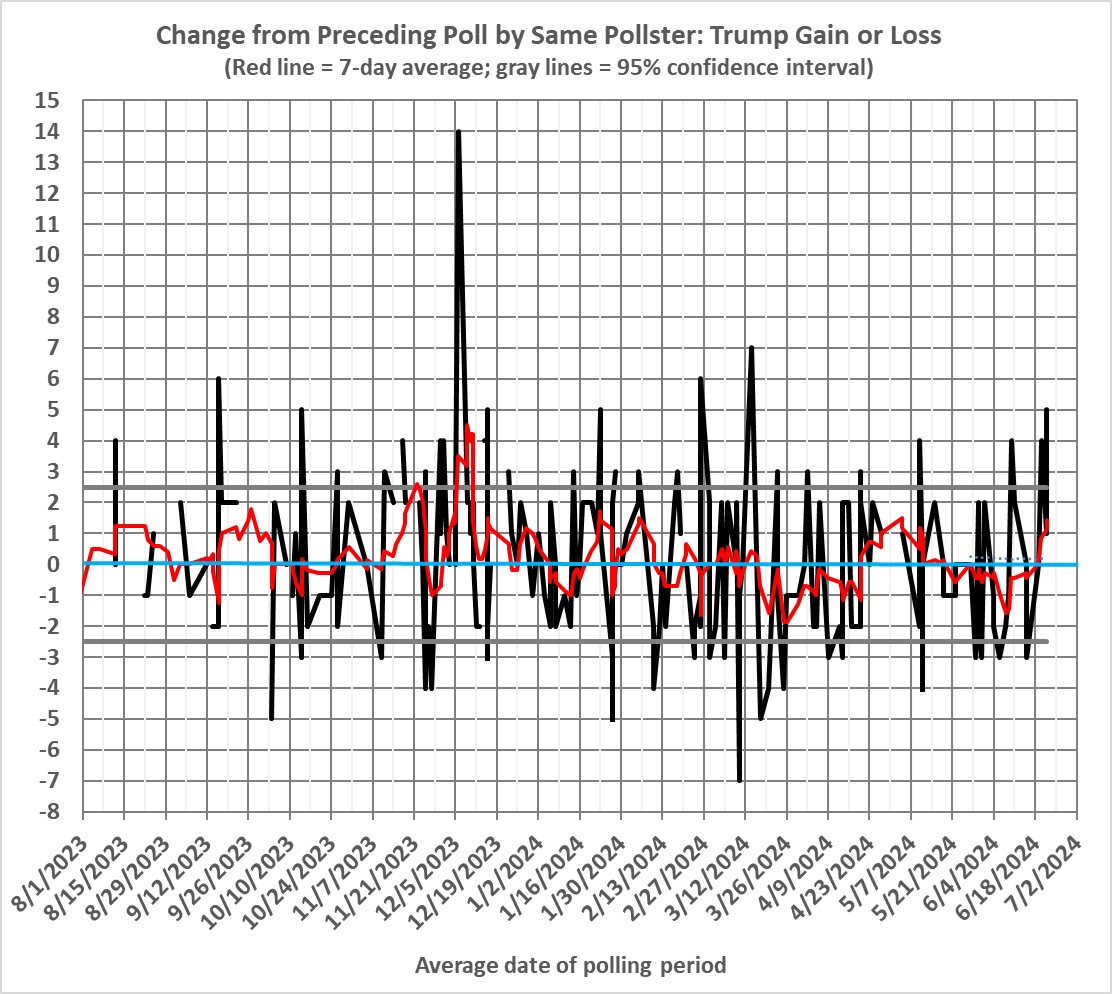
The first piece of evidence is general direction of the polls, as measured by changes in each pollster’s results:

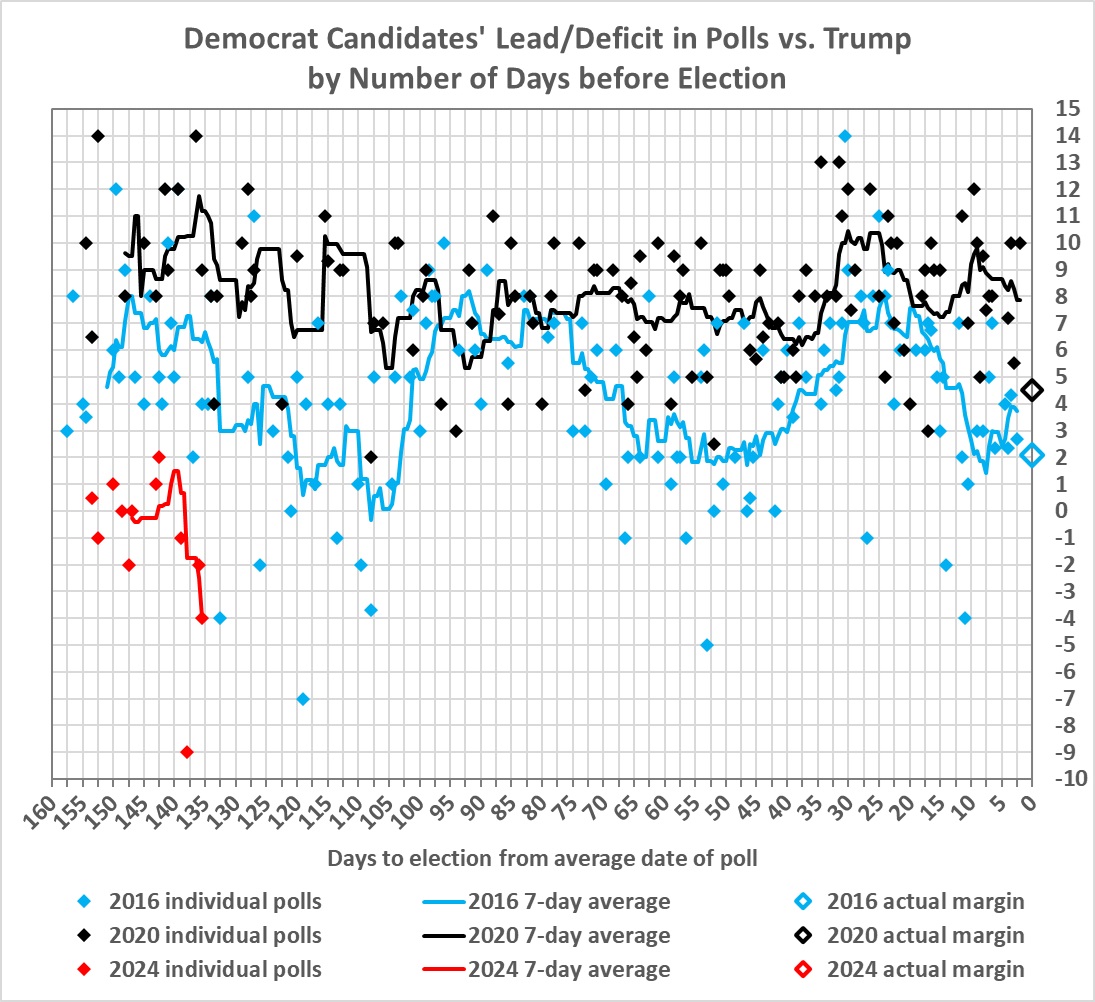
That looks good for Trump. This looks even better:

Biden is running well behind his pace of four years ago. And four years ago, despite “winning” the (mythical) nationwide popular vote by 4.5 percentage points, Biden eked out an electoral-vote victory on the basis of narrow wins in key States. That’s because Biden’s “victory” by 7 million votes was accounted for by his popular-vote margins in two solid-Blue States: California and New York. The huge — and superfluous victories — in those States masked a tie in the rest of the country. That’s why Biden had to rely on chicanery to squeak by in Arizona, Georgia, Pennsylvania, and Wisconsin. If Biden continues to under-perform his 2020 showing, the elections in key States won’t be close enough to steal.

Does History Repeat Itself? Stalin Is Resurrected in the USA

Whether history repeats itself or merely rhymes, human nature can be counted upon to make history seem repetitive or rhythmic.

Stephen Kotkin concludes Stalin: Paradoxes of Power, 1878-1928 with this observation: “History, for better and for worse, is made by those who never give up.”

Stalin never gave up. He had succeeded in subduing his enemies within the USSR by 1928, but he would continue to imprison and execute anyone whose words or actions he deemed threatening to his dictatorship or to the cause that he had embraced.

That cause was state socialism, “collective” control by the Communist Party (acting through the state) of the economy of the nation (in the name of the people, of course). To succeed in that cause, it was necessary to stifle and eradicate any dissent — real, imagined, actual, or potential — from the edicts of the Party (i.e., Stalin).

One of those edicts was collectivization of agriculture, a program that Stalin announced in January 1928 and began to implement in 1929. The rest, as they say, is history — a grim history in which Ukraine figured largely (though not exclusively):

The Ukrainian famine—known as the Holodomor, a combination of the Ukrainian words for “starvation” and “to inflict death”—by one estimate claimed the lives of 3.9 million people, about 13 percent of the population. And, unlike other famines in history caused by blight or drought, this was caused when a dictator wanted both to replace Ukraine’s small farms with state-run collectives and punish independence-minded Ukrainians who posed a threat to his totalitarian authority.

“The Ukrainian famine was a clear case of a man-made famine,” explains Alex de Waal, executive director of the World Peace Foundation at Tufts University and author of the 2018 book, Mass Starvation: The History and Future of Famine. He describes it as “a hybrid…of a famine caused by calamitous social-economic policies and one aimed at a particular population for repression or punishment.”

In those days, Ukraine—a Texas-sized nation along the Black Sea to the west of Russia—was a part of the Soviet Union, then ruled by Stalin. In 1929, as part of his plan to rapidly create a totally communist economy, Stalin had imposed collectivization, which replaced individually owned and operated farms with big state-run collectives. Ukraine’s small, mostly subsistence farmers resisted giving up their land and livelihoods.

In response, the Soviet regime derided the resisters as kulaks—well-to-do peasants, who in Soviet ideology were considered enemies of the state. Soviet officials drove these peasants off their farms by force and Stalin’s secret police further made plans to deport 50,000 Ukrainian farm families to Siberia, historian Anne Applebaum writes in her 2017 book, Red Famine: Stalin’s War on Ukraine.

“Stalin appears to have been motivated by the goal of transforming the Ukrainian nation into his idea of a modern, proletarian, socialist nation, even if this entailed the physical destruction of broad sections of its population,” says Trevor Erlacher, an historian and author specializing in modern Ukraine and an academic advisor at the University of Pittsburgh’s Center for Russian, East European, & Eurasian Studies.

Collectivization in Ukraine didn’t go very well. By the fall of 1932 … it became apparent that Ukraine’s grain harvest was going to miss Soviet planners’ target by 60 percent. There still might have been enough food for Ukrainian peasants to get by, but, as Applebaum writes, Stalin then ordered what little they had be confiscated as punishment for not meeting quotas.

The Ukrainian famine, as catastrophic as it was, was just one thread in the tapestry of death, torture, impoverishment, and virtual enslavement to the state that was woven by leftist dictators like Stalin, Hitler (yes, a leftist), Mao, Tito Pol Pot, Castro, and on and on.

But — smug billionaires, corporate media types, academics and most politicians and bureaucrats will say — it can’t happen here because we have “our democracy” to protect us from the ravages of dictatorship. Spouting such nonsense, if it were a capital offense, would soon rid us of the aforementioned apologists for the dictatorial state that has assumed power in the United States.

“Our democracy” has become nothing more than a vast conspiracy of the same aforementioned apologists for statism. They are alike in their commitment to the attainment of perfection (as they define it) through the power of the state. (In that respect, it is deeply dismaying that six fellow-travelers and cowards who occupy seats on the Supreme Court today decreed that the central government may continue to use Big Tech to propagandize for its statist agenda.)

Evidence of “our democracy” acting in concert to deprive Americans of liberty and prosperity has been accumulating for more than a century. I won’t burden you with a recitation of examples (for that you can start here and here, and then comb through the index of posts). I will merely point to the fact that the central government’s most onerous actions (these days) are lawless. They are being conducted through administrative and executive edicts and sometimes in open defiance of laws enacted in accordance with the Constitution. I have in mind, of course, the effort- to kill off fossil fuels, the failure to enforce immigration laws, discrimination in favor of blacks and mentally ill LGBTQ+ persons.

The irony of it all is that almost every American (though not all) would claim to revile Stalin, whereas about half of them adore the machinations of the central government and the policies represented by the left’s puppet in the White House.

The difference between Joe Stalin and Joe Biden is one of degree, not one of kind. Biden doesn’t overtly kill,impoverish, and enslave people; his policies are having that effect, however.

A Machiavellian I Have Known

In the popular sense, to be Machiavellian is to becharacterized by expediency, deceit, and cunning”. An objective is hidden behind a facade of friendship, cheerfulness, or cooperation and pursued by obtaining the (usually unwitting) help of persons who might then be betrayed when the objective is attained.

The alternative to deceit is forthrightness. If you want something, you say what it is and you ask for it or work for it, without disguising your objective.

Most human beings, I daresay, are forthright. Forthright persons are easy prey for deceivers. First, the deceiver strives to seem forthright so that he is trusted. Second, the forthright person — usually having no experience of deceptiveness (except when dated a two-timer or bought a used car) — assumes that the deceiver is what he seems to be. Thus a forthright person easily becomes a deceiver’s unwitting accomplice.

The deceiver knows what he is. He also knows that his penchant for deceit might be uncovered, most likely be another deceiver. This results in a kind of paranoia where the deceiver suspects deceit where there is none. He is therefore prone to project his deceiving ways onto forthright persons.

Here’s an example from my working life. An incompetent lawyer who had been promoted over his head several times was dumped into the tax-funded organization where I worked. He had some political connections (thanks to a brother-in-law who was a successful and respected politician). Although he was styled as corporate counsel, he did no legal work for us (we paid a firm of sharp lawyers for that). He was supposed to use his political connections to represent us on Capitol Hill, but he failed at that, too, with the result that we endured some large budget cuts in the early 1990s.

At any rate, early in his tenure at the organization, which lasted (amazingly) more than 20 years, he vied for the job to which I was appointed. He presented himself to me as a wise, experienced adviser, all the while sizing me up and (unbeknownst to me) using his knowledge of me to put himself forward for the job that I got. I didn’t learn of his perfidy until after the fact, but I let it slide off my back. I had the job that I wanted and he was, outwardly, a likeable person.

But as the years rolled by I became aware of his constant sniping and criticism — behind my back — of the way I did my job. Enough became enough and I became outwardly hostile toward him. My break with him became final when I learned about his failure on the Hill.

But over the years before our final break — in ways large and small, overt and implicit — he suggested that it was I who was out to “get” him.

Deceivers deceive themselves as much as they deceive others. They are morally weak persons who cannot accept their shortcomings. Others are to blame for their failures. They can’t see it any other way.

Trump vs. Biden: 14 (Another Way to Read the Polls)

In 2016, Clinton’s lead over Trump in the final seven days of polling averaged 2.5 percentage points (or those polls covered by RealClearPolitics (RCP). Clinton’s edge in the nationwide tally of popular votes was 2.1 percentage points. Despite her (meaningless) nationwide edge, she lost to Trump because he won Michigan, Pennsylvania, and Wisconsin — each by less than 1 percentage point. Those states’ 46 electoral votes gave Trump the win over Clinton.

In 2020, Biden’s lead over Trump in the final seven days of polling averaged 7.9 percentage points for those polls covered by RCP. Biden’s edge in the nationwide tally of popular votes was 4.5 percentage points; that is, slightly below the bottom of the 95-percent confidence interval around the apparent 7.9-point lead. Despite his (meaningless) 4.5-point lead in the popular vote, Biden won the election only because he edged out Trump in both Georgia and Wisconsin by less that 1 percentage point and in Pennsylvania by a little more than 1 percentage point. Those states’ electoral votes gave Biden his win over Trump.

Hypothesis: Clinton and Biden underperformed at the ballot box vs. their poll numbers because the polls (on average) were biased somewhat toward Clinton in 2016 and much more so toward Biden in 2020. This hypothesis is supported by a report issued by the American Association for Public Opinion Research (https://aapor.org/wp-content/uploads/2022/11/AAPOR-Task-Force-on-2020-Pre-Election-Polling_Report-FNL.pdf):

● The 2020 polls featured polling error of an unusual magnitude: It was the highest in 40 years for the national popular vote….

● The polling error was much more likely to favor Biden over Trump. Among polls conducted in the last two weeks before the election, the average signed error on the vote margin was too favorable for Biden by 3.9 percentage points in the national polls and by 4.3 percentage points in statewide presidential polls.

● The polling error for the presidential election was stable throughout the campaign. The average error matched closely for polls conducted in the last two weeks, in the final week, and even in the final three days. The challenges polls faced in 2020 did not diminish as Election Day approached.

● Beyond the margin, the average topline support for Trump in the polls understated Trump’s share in the certified vote by 3.3 percentage points and overstated Biden’s share in the certified vote by 1.0 percentage point. When undecided voters are excluded from the base, the two-candidate support in the polls understated Trump’s certified vote share by 1.4 percentage points and overstated Biden’s vote share by 3.1 percentage points.

The report also concludes that the bias wasn’t due to the massive surge in early voting and mail-in voting in 2020.

The foregoing suggests that if the polls remain strongly biased toward Biden in 2024, and if he polls much worse than he did in 2020, his candidacy is doomed.

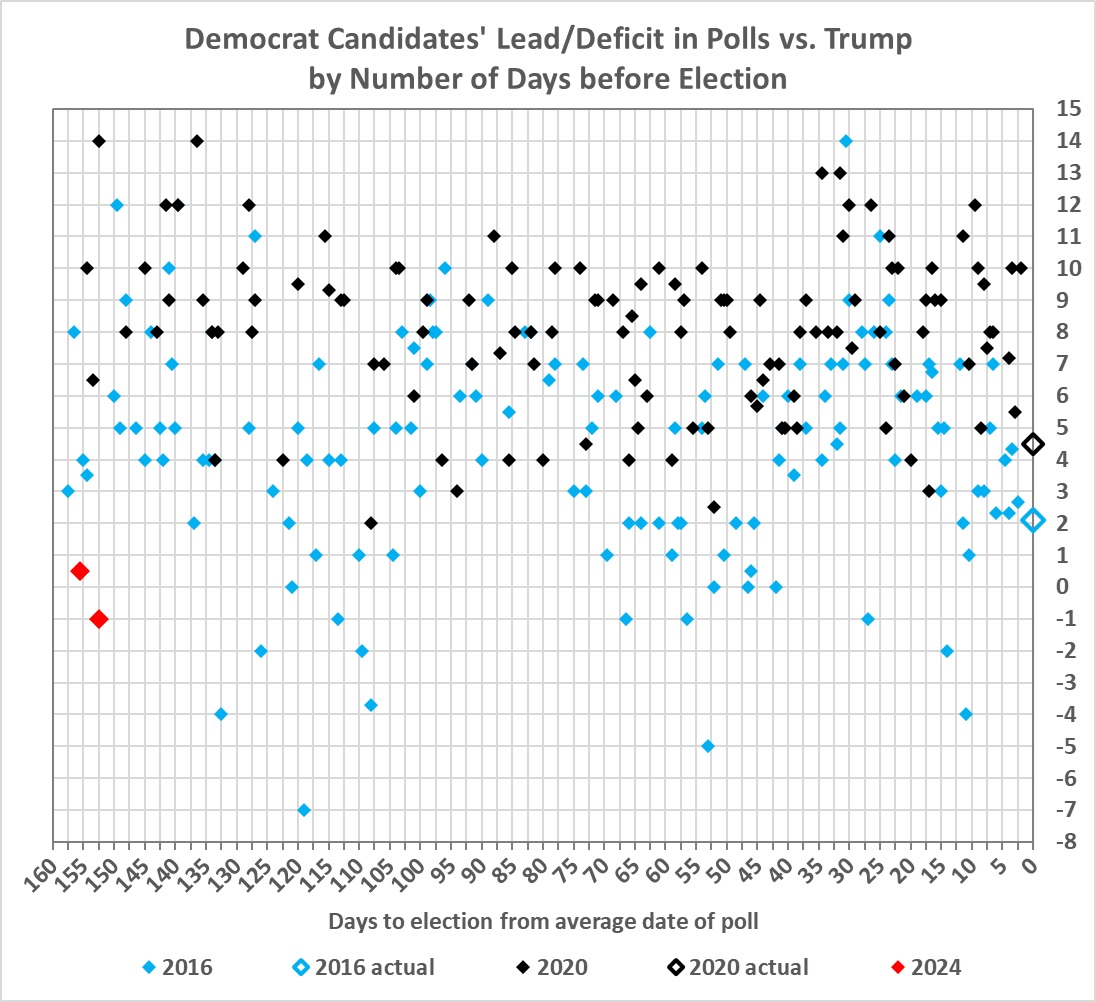
With that background, I refer you to the following graph, which compares results of polls reported by RCP for the elections of 2016, 2020, and 2024. The results represent polls conducted between June 1 and election day of each election year. We’re a long way from election day 2024, but the results to date are ominous for Biden; he is running behind Clinton’s losing pace of 2016. Stay tuned.

The Arithmetic of Disunion

In some of my several posts about a national divorce (see thisthisthisthis, this, and this), I have opined that the new union formed by conservative States

could easily afford a robust defense after having shed the many useless departments and agencies — and their policies — that burden taxpayers and the economy.

(Many of the policies, especially those that regulate economic activity, are worse than useless: they are economically destructive; see this and this).

Let’s examine the proposition that the new union could easily afford a robust defense. For this exercise, I assume that the new union, which I have elsewhere dubbed Freedomland, consists of 25 States (listed in order of population): Texas, Florida, Ohio, North Carolina, Tennessee, Indiana, Missouri, South Carolina, Alabama, Louisiana, Kentucky, Oklahoma, Utah, Iowa, Arkansas, Kansas, Mississippi, Nebraska, Idaho, West Virginia, Montana, South Dakoto, North Dakota, Alaska, and Wyoming. (A shift of one or two States in either direction won’t change the thrust of this analysis.)

Those 25 States comprise 43 percent of the population of the United States. But they account for only 38 percent of U.S. GDP. (The discrepancy shouldn’t be surprising given the composition of the list.)

The cost of the federal government in 2022 (the latest year for which estimates are available at bea.gov) was just over $6 trillion, including $725 billion in interest payments on federal debt. The operating cost of the federal government was therefore about $5.3 trillion, including $727 billion for national defense. (It’s telling national defense, a key element of the impetus for the Constitution, accounts for only 12 percent of federal spending and is about the same as the cost of financing the federal debt.) Assuming that the cost of the federal government, less debt service, is shared in proportion to the distribution of GDP, the citizens of Freedomland are pumping more than $2 trillion a year into the federal treasury.

Now, what to do about the federal government? Team Blue, in a spirit of “fairness”, might propose keeping it intact and sharing costs and benefits according to Team Blue’s and Freedomland’s respective shares of GDP. Team Blue would (of course) continue to operate the federal government and would (of course) honestly account for the distribution of costs and benefits. It would be up to Team Blue (of course) to decide the level of costs and benefits.

Freedomland would reject the deal out of hand, not wanting its fiscal future to be hijacked by the cost of an ever-growing and ever-interfering central government. Freedomland’s leaders would make the following calculations:

  • 38 percent of $6 trillion = $2.3 trillion.
  • Freedomland’s share of federal outlays on health benefits and income security is $1.5 trillion a year. In exchange for giving up its share of those outlays, Freedomland will set up its own system of health benefits and income security. (The initial costs will be offset and reduced over time by robust economic growth; the reduction of benefits flowing to able-bodied persons below retirement age; rolling back the expansion of Medicare; denying benefits (direct or indirect) to illegal aliens; raising the retirement age; increasing work requirements; etc.)
  • Freedomland will take responsibility for defense of the 50 States and the District of Columbia. (It would be far more costly to defend Team Blue and Freedomland separately. Team Blue could trust Freedomland to mount a robust defense of the continent. And Freedomland would be assured of border security by doing the job itself.)

Freedomland’s total (initial) cost to defend the nation and ensure the health and income security of its citizens: the same $2.3 trillion a year it now sends to DC. But in the long run, the citizens of Freedomland would be far better off economically and relieved of the oppressive government in DC.

But the citizens of Freedomland should never forget that eternal vigilance is the price of liberty — and prosperity.

Trump vs. Biden: 13 (A Glimmer of Hope)

If you have read “Election 2024: The Bottom Line” or “Election 2024 in Perspective” you will understand why I use “glimmer of hope” to refer to a possible Trump victory in November. The glimmer of hope that I see is Trump’s standing in the polls this time around compared with his standing in the polls at this point in 2016 and 2020. Specific

I collected all of the two-way polling results reported at realclearpolitics.com for the elections of 2016 and 2020. I weeded out all of the polls that were conducted before June of each election year and plotted the numbers for the rest: the Democrat candidates’ polling lead or deficit vs. number of days before the election. I have also begun to plot similar numbers for this year’s election. Here are the results as of today:

The plot points represent the Democrat candidates’ lead or deficit vs. Trump. Two polls with the same average date (June 4) gave Biden and average lead of 0.5 point. A third poll with an average date gave Trump a narrow lead of 1 point, which converts to a Biden deficit of 1 point.

Clearly, Trump is doing a lot better in the polls this year than he was doing at this time in 2016 and 2020. But a lot can happen between now and when voting starts. A lot did happen to Clinton (2016) and Biden (2020) — and it wasn’t good for them.

Clinton’s polling was all over the place, but she ended up 2.9 points ahead of Trump for polls conducted in the seven days before the election. She “won” the nationwide popular vote by 2.1 percentage points (plotted on the right axis). But she lost the electoral vote because of Trump’s narrow wins in a few key States.

Biden never relinquished his lead in the polls. He ended up 7.6 points ahead of Trump for polls conducted in the seven days before the election. He “won” the nationwide popular vote by 4.6 percentage points (plotted on the right axis). But he won the electoral vote only because of narrow wins in a few key States.

If there’s a pattern, it’s this: Polls, in the aggregate, overstate Democrats’ shares of the nationwide popular vote — at least when they’re up against Trump. Further, because of the electoral college, it takes a large margin in the final polls to be certain of victory — if you’re a Democrat. The necessary margin is greater than final Biden’s 7.6-point lead in the 2020 polls.

Conclusion: Biden is in deep trouble, as of now. But election day is five months away. Thus: a glimmer of hope.

Living the American Dream

My late father-in-law grew up in a shack like this:

He picked cotton to help his widowed mother care for the five children she was left to raise when his father died young.

He worked his way through two years of college before joining the Army Air Corps aviation cadet program in 1939. He earned his wings and was commissioned a second lieutenant in September 1941. He proposed to my future mother-in-law on December 6, 1941 — the day before the Japanese bombed Pearl Harbor.

After training many Air Corps pilots for combat, he was sent to the Pacific Theater in 1944, where he flew many combat missions. He stayed in the Air Force (as it became) after the war ended and flew many more combat missions in the Korean War.

He rose to the rank of colonel at a relatively early age and ended his 30-year career as commander of an award-winning wing. (He would have made brigadier general, but Lyndon Johnson gave the slot to his Air Force One pilot.) His drive to excel and his leadership skills carried over into a successful and stressful civilian career.

He retired for good at the age of 63 and lived out his life happily and comfortably in his adopted hometown.

He died at the age of 96, loved and mourned by family and friends.

He hated Democrats — he called them demoncrats — not because of what Lyndon Johnson did to him but because of what they were doing to the country.

Now, almost ten years after my father-in-law’s passing, the demoncrats have redoubled their efforts to destroy the American dream. The dream for which he worked and fought — and which he was able to live.

Election 2024 in Perspective

The federal government, since the latter part of the 19th century has grown vastly in size, cost, and power. It has done so by blatantly exceeding the limited role for it that is set forth in the Constitution.

The growth of the federal government (which has necessitated and spurred the growth of state and local governments) absorbs resources that (with the exception of national defense) could be put to better use by private companies responding to the needs of consumers.

One aspect of government growth, at all levels, has been the promulgation of an ever-growing number of regulations, ordinances, and codes (they must number in the millions). The net effect of those regulations, ordinances, and codes is to stifle entrepreneurship and innovation. This comes at great cost to American workers and consumers.

The economic effect of government spending and regulation (by its various names) is the loss of well over a trillion dollars a year in economic output. Given the many years in which Americans have lived with big, heavy-handed government, the overall cost of its unconstitutional aggrandizement has been almost unimaginable – it is certainly in the tens of trillions of dollars. The arrogation of legislative, prosecutorial, and judicial functions by regulatory agencies adds the loss of liberty to that massive economic cost.

The heavy burden of regulation has been compounded in recent years by the emphasis on so-called renewable sources of energy. The shift away from fossil fuels – according to the models used and touted by climate “scientists” – will have almost no effect on global temperatures. Yet, the cost in dollars and misery will be huge. As for those models, they are simplistic relative to the many and complex (and little understood) factors that influence climate. And they do a poor job of reconstructing the past, so how can they possibly produce accurate forecasts of the future? Also overlooked in the rush to substitute models for science is the fact that the geological and historical record – despite the efforts of some climate “scientists” to revise and erase it – clearly shows that Earth has been warmer in the past 2000 years than it is now, and that it often warmed more rapidly in the past than it has been warming in the past 40 years.

Another recent development has been the failure to enforce immigration laws, which has resulted in a flood of illegal immigrants. Whatever reasons those immigrants may have for entering the U.S., it is a fact that they are in many places overwhelming various social services (hospitals, public housing, etc.) at a heavy cost to taxpayers. Regardless of the law-abiding nature of most illegal immigrants, the flood has brought with it violent criminals, dangerous drugs, drug dealers, and quite possibly spies and terrorists. It is no secret – though Democrats tend to deny it – that the impetus for untrammeled immigration is to create new voters, by amnesty and other means, most of whom are expected to vote for Democrats. One dire effect of such a development would be even bigger government, even lower economic growth, and even higher taxes.

Then there are the social changes that have been embraced and pushed by Democrats. Same-sex marriage is now a given, so I won’t bother to discuss it (though I could write an essay about the legal persecution of tradespeople who have been penalized for their refusal to “celebrate” it). But I will discuss transgenderism, with its various ill effects: allowing and encouraging impressionable and not-yet-developed children to undergo life-changing medical treatments and surgeries; forcing girls and women to compete with so-called transgender women, who seem not to have lost the superior size and strength that goes with being male; allowing the same “women” to invade the privacy and bodies of girls and women in locker rooms, dormitories, prison cells, etc.

There is also a strong push by government institutions to discriminate in favor of blacks (by means ranging from special loans to easy grading to re-segregation to protect them from feeling “different” or “inferior”). If discrimination solely on the basis of race is wrong, it is wrong when it favors blacks just as much as when it favors whites. Reverse discrimination and special treatment are also condescending toward blacks – which hasn’t gone unnoticed by some of them.

Another development – and a dangerous one for liberty and the advancement of knowledge – is the use of government power (or the implied threat to use that power) to censor views that government officials dislike. This kind of censorship, which is carried out through Big Tech firms and broadcast media, may be meant to protect the public from potentially harmful “misinformation”. But the urge to control information knows no bounds and it can just as easily be used to construct “narratives” that are favorable to the regime in power by suppressing valid information that would discredit the regime. Big Tech and broadcast media already do this to a great extent, though mainly because of the political leanings of the executives in charge of those institutions. But it would take almost no effort on the part of government officials to turn many news and information outlets into a government propaganda machine. (Shades of Hitler, Stalin, Mao, and many other despicable tyrants.)

Finally, China, Russia, and Iran have relentlessly built military capabilities that can be used to blackmail the U.S. government into granting military and economic concessions to those nations. (Russia’s war in Ukraine hasn’t stopped its development of sophisticated weaponry, such as its hypersonic missiles and new space weapon.) There is no indication that our adversaries will settle for “peaceful coexistence”; their aim is dominance. Despite that, the U.S. government has persisted in allowing U.S. armed forces to become relatively weaker than those of its adversaries. (Clinton’s budget-balancing at the cost of defense, and the coddling of the Iranian regime by the Obama-Biden administrations are underreported scandals.)

In sum, beginning in the late years of the 19th century, government in America began to lose its way: imposing huge costs on American citizens through growth in size and power, while also failing to maintain the forces necessary to deter potential enemies.

None of that has changed in the 21st century, but the burden on Americans has redoubled because of a quixotic effort to control the climate, a similarly quixotic effort to erase gender differences, and the possibly successful quest to build a permanent Democrat majority.

It has taken more than a century for America to make the transition to what the proverbial man from Mars would describe as a regulatory-welfare state run by a cabal of power-lusting politicians and bureaucrats and their mentors and enablers in the “education”-media-information complex. Too many Americans, unfortunately, don’t see America for what it has become because it has changed gradually. And at every step along the way, those with a stake in the regulatory-welfare state have declared it to be in the public interest and defended it as the product of “our democracy”. Their version of democracy amounts to this: Do as we say, we know what’s best for you. No side has a monopoly on that kind of thinking, but the regulatory-welfare state enables its realization through the extra-constitutional enactment and enforcement of rules that micromanage the economic and social affairs of Americans. That is the darkness in which democracy dies.

Everything written above represents my long-held views. They predate by two decades the emergence of Donald Trump as a candidate for president in 2015.

Trump is (undeservedly) vain, crude, and inarticulate, and he has a disgraceful sexual history. But despite those things, he is the only president since Ronald Reagan who has tried to stem the tide of government overreach and under preparedness. Trump’s record as president was far from perfect, but he got some things going in the right direction; for example, less regulation, more (real) military spending, and a serious effort to stem illegal immigration. You may dislike his Supreme Court appointments because of the effect they have had on certain issues, but the overall effect of those appointments has been and will be to restrain government power, which has grown far beyond its constitutional bounds.

It is Democrats, for the most part, who favor the policies that I abhor. Because Trump is viewed as a threat to those policies, and to Democrats’ hold on power in DC, there has been since he announced his first run for the presidency a “get Trump” movement. It began in earnest with the false “Steele dossier” that was ordered up by Hillary Clinton’s campaign. It continued with the Mueller investigation, two impeachments, and incessantly negative reporting about Trump’s presidency by pro-Democrat media outlets. It has culminated in what are not coincidental civil and criminal charges against Trump.

In the case of E. Jean Carroll, her suit against Trump was made possible by the passage of law in New York that extended the statute of limitations on Trump’s alleged acts against Carroll — for the obvious purpose of bringing a case against Trump. Would Carroll’s charges, or any of the other charges, been brought against a former president who was a Democrat? I doubt it very much. But to keep Trump out of power, various Democrat officials (in an amazing concert of legal synchronization) have put into practice the Stalinist-era slogan “show me the man and I’ll show you the crime”. Almost anyone can be charged with and found guilty of a crime. It’s just a matter of digging into his record, cherry-picking it for items that can be made to seem sinister, ignoring and suppressing exculpatory evidence, stretching the law to fit the supposedly incriminating facts, and finding a compliant judge and jury. The Carroll case fit that template, as did the “hush money” case, and as do the other legal actions against Trump.

What has happened and is happening to Trump can happen to anyone. It is of a piece with Democrats’ no-holds-barred approach to the Constitution and laws stand in the way of gaining and holding onto power. If Trump is stopped and if Democrats retain power – and reinforce it by importing voters, censoring the opposition, vote-buying (what else is student-debt cancellation?), assuaging blacks, and who knows what else – opposition to the regime itself will become criminalized. You can bet on it because the only thing that has kept America from becoming a despotism isn’t a mythical thing called the “American character”, it has been the rule of law and the willingness of opposing factions to abide by it. That willingness disappeared in the run up to the Civil War. It is disappearing again.

All of that is why, if Trump is on the ballot in November, I will vote for him. As imperfect as he is as a person and political operator, he would nudge America in the right direction. If there were a better GOP candidate than Trump – one who is less obnoxious, more articulate, and with less personal baggage, but who is dedicated to the Constitution, to prosperity and liberty for Americans, and to military preparedness – I would vote for him or her. But there doesn’t seem to be such a candidate on the horizon.

In sum, my preference for Trump has nothing to do with the man and everything to do with restoring prosperity, liberty, and safety from domestic and foreign predators. To put it another way, a vote for Trump is a vote to make America great again. It is also a vote to save democracy — the real kind in which citizens are sovereign.

I have said nothing about Biden because his sins – though many and possibly greater than Trump’s – are beside the point. As a politician, he is no better or worse than any Democrat who might replace him on the ticket or succeed him if he is elected and fails to finish his second term.

My devout wish it to have a Republican (Trump if necessary) occupy the White House and try, with the help of a Republican-controlled Congress, to prevent America from going down the drain. This may be the last chance for America’s reprieve from the dustbin of history.