
I follow the presidential polling summaries published at Real Clear Politics (RCP). I analyze the polling results in various ways. Three of those ways are highlighted here.
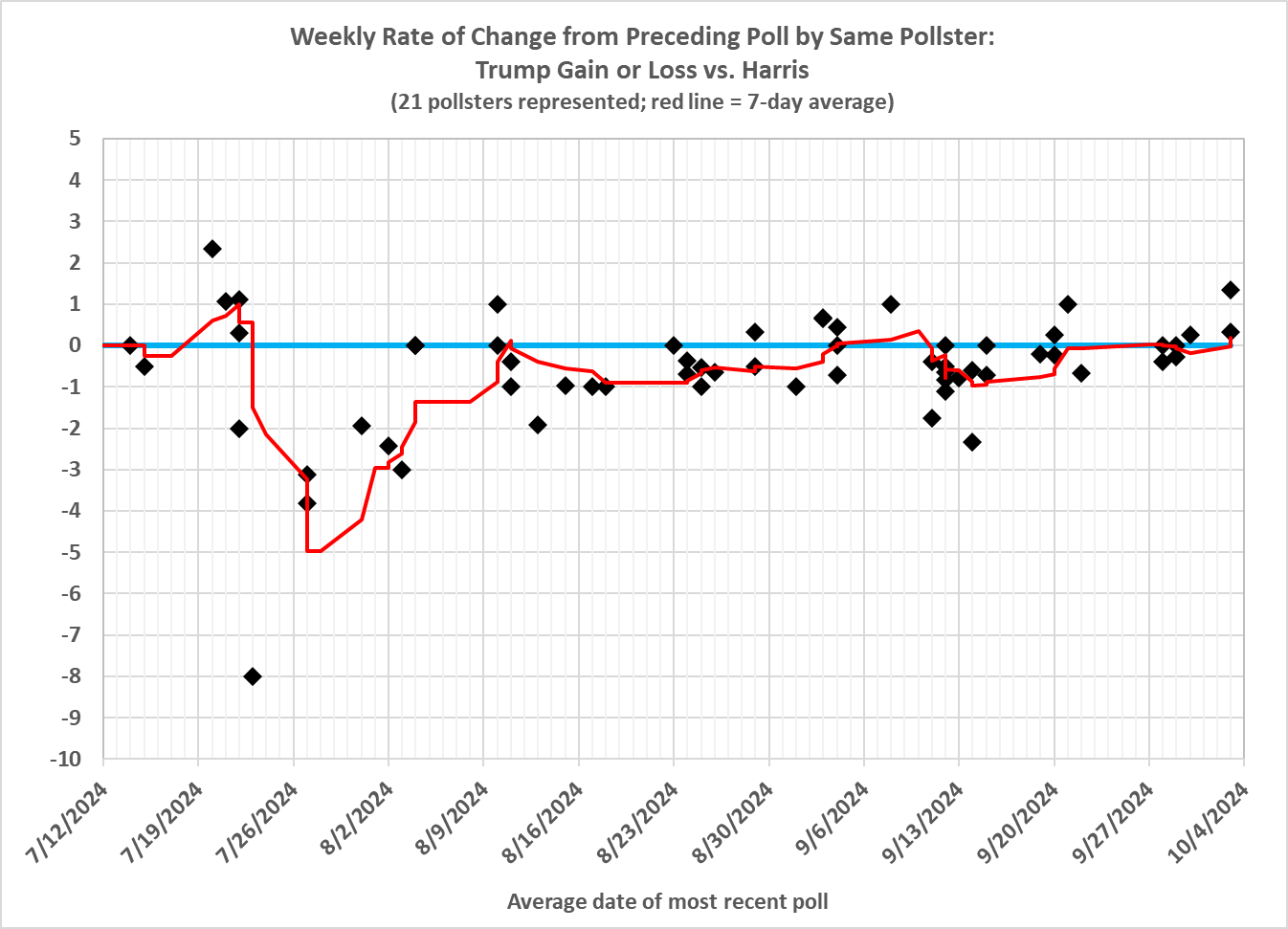
First, I track each pollster’s poll-to-poll change in Trump’s lead or deficit. Assuming that each pollster’s bias for or against Trump (mostly against) remains about the same, the poll-to-poll changes indicate the direction of momentum. The “Harris Honeymoon” seems to have ended:
Second, I adjust polling averages for anti-Trump bias. Of the polling organizations surveyed by RCP, 17 released polls in the final week before the 2020 election. Fourteen of the polls overestimated Biden’s popular-vote margin, with overestimates ranging from 0.5 to 7.5 percentage points. Only three pollsters underestimated Biden’s margin, with a range of 0.5 to 3.5 points. The overall average for the 17 pollsters was an overestimate (for Biden) of 3.7 points.
Given that Trump is again the GOP nominee, I see no reason to assume that the pro-Democrat bias this year is any smaller than it was in 2020. So I simply add 3.7 points to Trump’s 7-day polling average to get a truer picture of Trump’s electoral appeal. I then compute a 95-percent confidence interval around the current 7-day average. As of now, the range is from a deficit of 1 percentage point to a lead of 6 percentage points.
How does that range translate into electoral votes? Here’s how, Trump would win 312 to 343 electoral votes if the election were held today:

(See “Trump vs. Biden: 16” for an explanation of the relationship between popular vote/polling margin and electoral votes.)
Third, I compare Harris’s performance in the polls (unadjusted) with the performances of Clinton in 2016 and Biden in 2020.
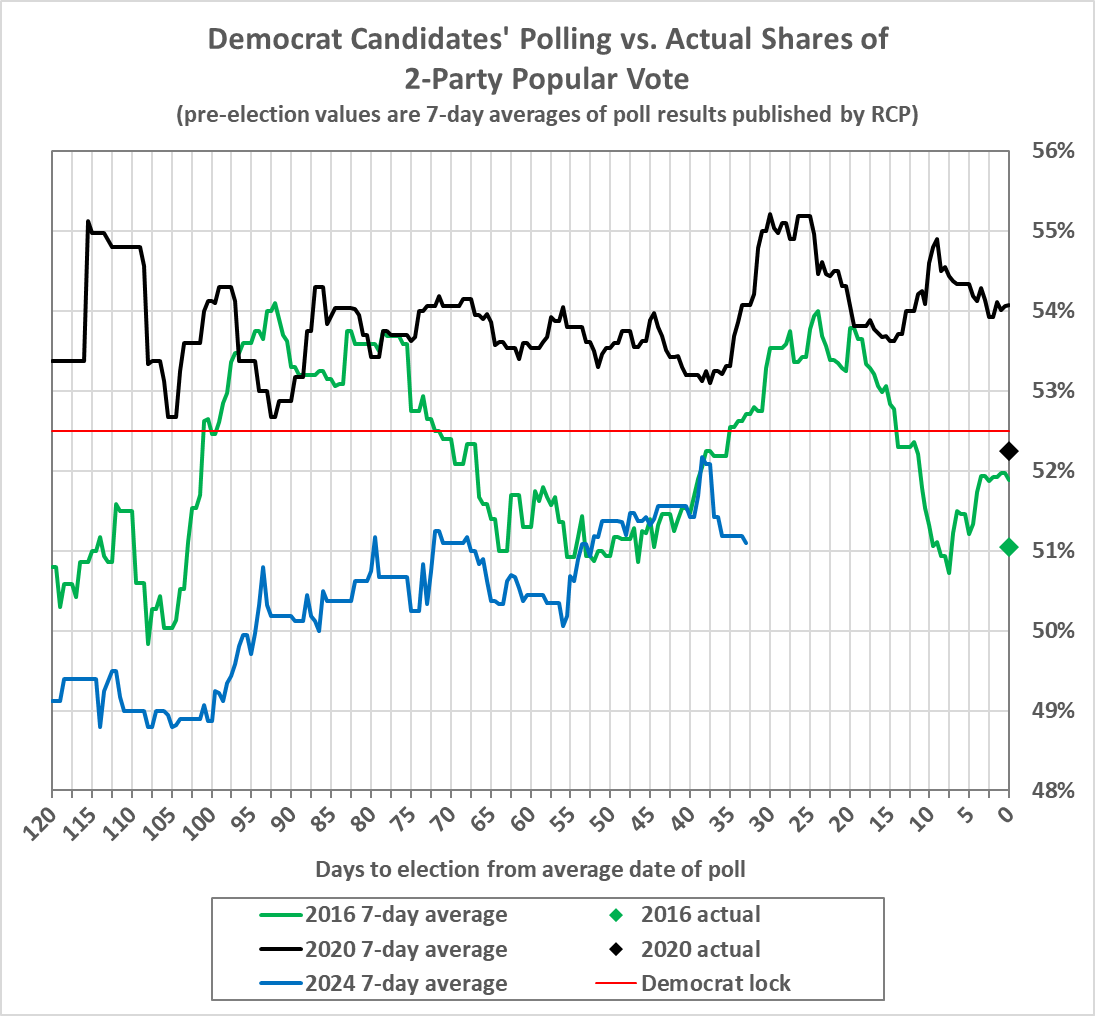
Note the pro-Democrat (or anti-Trump biases in 2016 and 2020). The biases are reflected in the differences between the final 7-day polling averages (green and black lines) and the final shares of the nationwide two-party vote (green and black diamonds at 0 days). Clinton lost despite garnering 51.05 percent of the nationwide two-party vote. Biden won narrowly — because of razor-thin victories in several states — even though he got 52.25 percent of the two-party vote. Harris’s performance currently lags Clinton’s, which is a good sign for Trump.
The red line at 52.5 percent is my estimate of what it will take for Harris to register a clear victory over Trump. Harris is still a long way from that number.
 Politics and Prosperity