UPDATED 11/05/24 @ 12:00 PM (ET)
This post posits two scenarios: an easy win for Trump and a squeaker for Trump. In either case, court actions will probably delay final resolution of the outcome.
In the original version of this post, I failed to emphasize my belief that Trump will win an easy victory. That belief rests not only on the evidence provided here but also on the many signs of disaffection with Harris among traditional sources of support (e.g., minority voters and labor unions). There is also this omen from the midnight votes at Dixville Notch, New Hampshire: 4-2 against Trump in 2016, 5-0 against Trump in 2020, and a 3-3 tie this year. That shift is of a piece with widespread discontent with the course of the nation under the Biden-Harris regime.
Other than that, there’s a slight change in what I expect to be the irrelevant scenario: a squeaker won by Trump. The change is that it will be less of a squeaker than I had expected it to be.
A funny thing happened on the way to November 5, 2024: A bunch of pollsters decided that the race between Trump and Harris is a lot closer than the race between Trump and Biden.
In 2020, for example, the final polls issued by CNN, CNBC, Fox News, Harvard-Harris, Quinnipiac, New York Times/Siena, and USA Today/Suffolk had Biden ahead of Trump by an average of 9.6 points. Those polls overstated Biden’s popular-vote margin by an average of 5 percentage points. It was polling like that which produced an average error of 4.5 points in favor of Biden for polls conducted in the final two weeks of the 2020 campaign. (See this report by the American Association for Public Opinion Research.)
Now, the 2024 iterations of the polls mentioned above have Harris ahead of Trump by an average of 0 (that’s zero) points. And widely cited polling averages (e.g., Real Clear Polling and Silver Bulletin) depict the Trump-Harris race as a virtual dead heat.
Why the dead heat? Did a bunch of pollsters figure out how to reach “shy” Trump supporters, or how to adjust for the fact that Trump supporters are disproportionately unreachable? Or do most polls simply understate Trump’s support, as they did in 2016 and — more egregiously — in 2020?
I believe that the polls continue to understate Trump’s support — and by quite a bit. I base my belief on a relationship that I unveiled in “Trump vs. Harris: 4 (More Good News for Trump)“. It is the relationship between party leanings, as estimated by Gallup, and the allocation of the vote between Democrat and Republican candidates in the presidential elections of 2004 through 2020. (Gallup’s party-affiliation numbers can be found here. Gallup has produced other analyses that also portend a shift toward the GOP).
When Gallup allocates independents based on their leanings toward Democrats or Republicans, the two-party split looks like this:
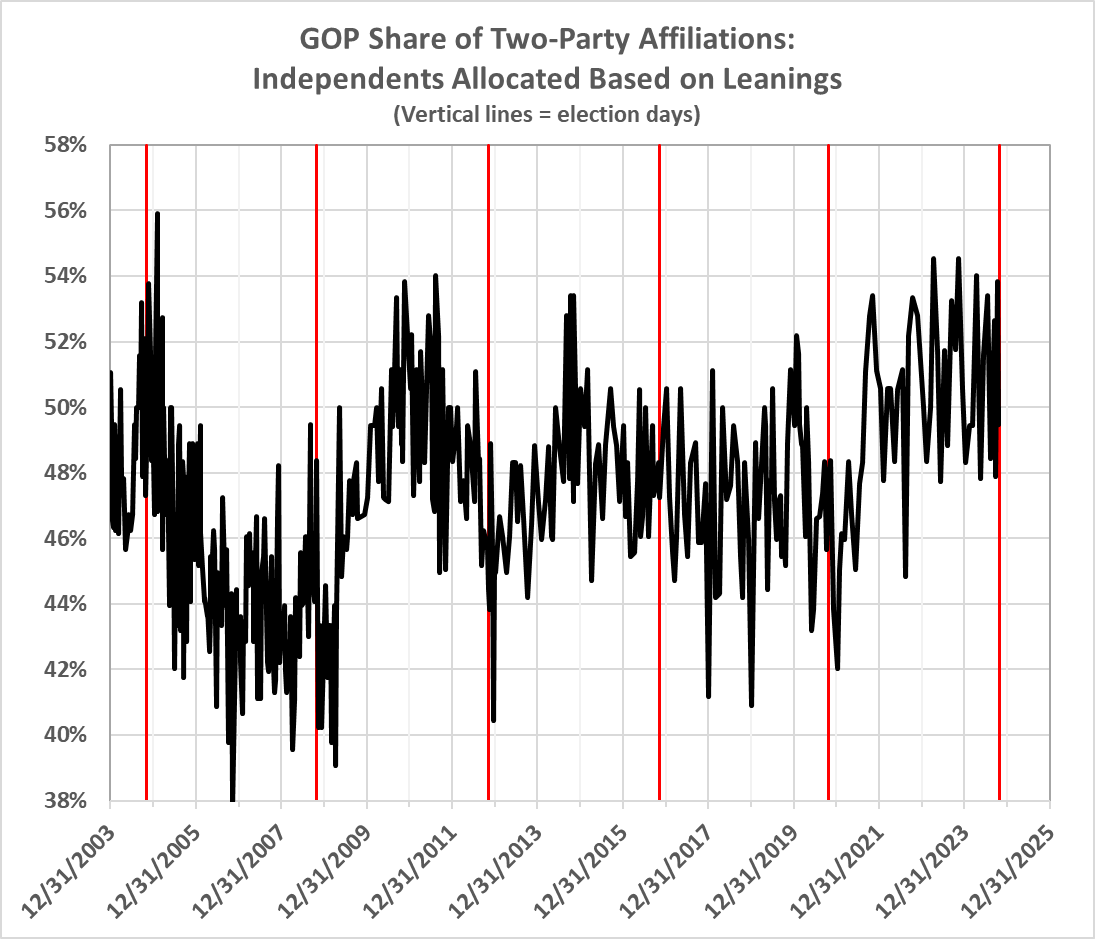
I plotted the average results for the month before the elections of 2004, 2008, 2012, 2016, and 2020 against the GOP candidates’ shares of the two-party vote in those elections. The result is spuriously precise, given the small number of observations. But it supports the view that the recent high level of GOP-leaning adults (52 percent in October 2024) portends a solid popular-vote majority for Trump:
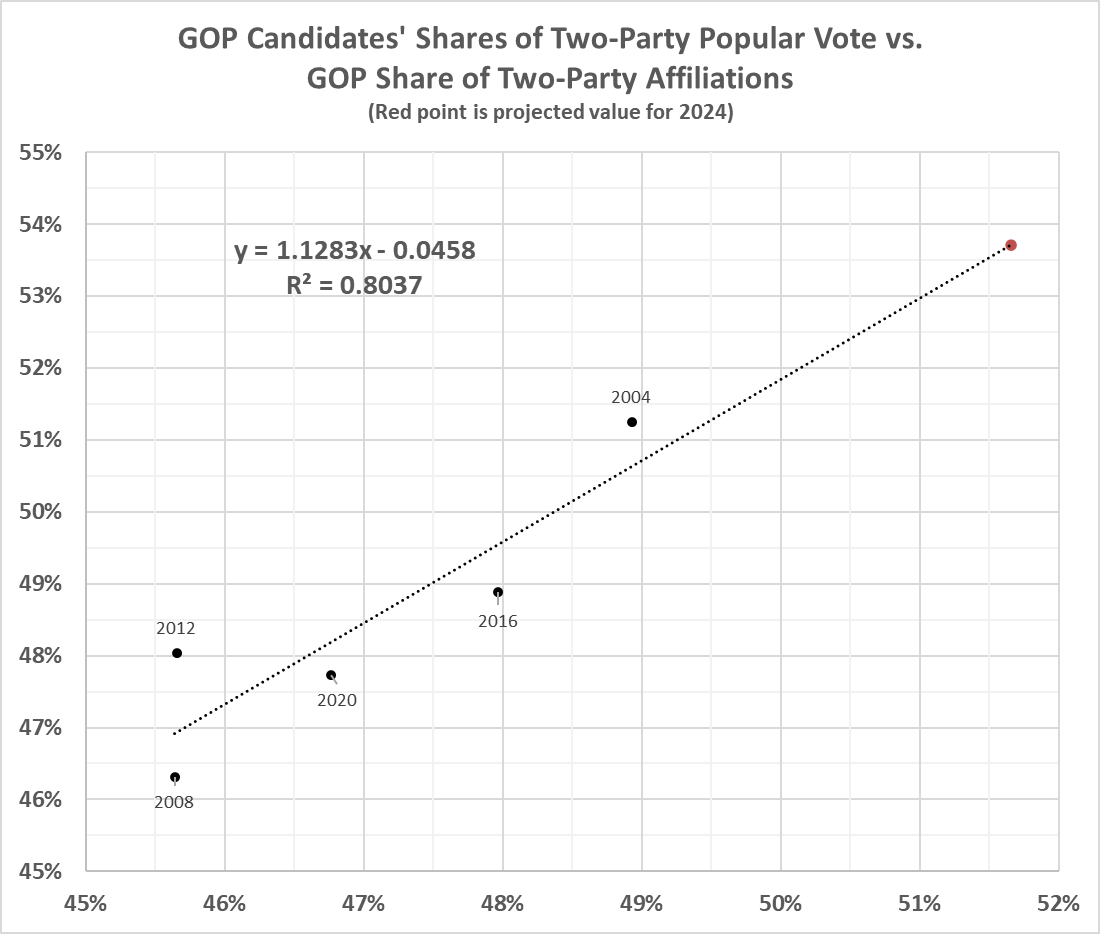
The projection for the 2024 election (red dot) is that Trump will receive more than 53 percent of the nationwide two-party popular vote. With that share, Trump would win a second term handily.
Why? Suppose that Harris were to win 70 million of 150 million votes (about 47 percent), leaving Trump with 80 million votes. That’s a winning margin of 10 million votes, which is amplified by the fact that an outsized fraction of the Democrat candidate’s vote comes from California and New York. In 2020, Biden won those two states by a total of 7 million votes. That’s 7 million more votes than he needed to secure the electoral votes of those two States. Any total higher than a bare majority in any State can be thought of as a wasted vote. Republicans hold a decided edge in that respect: In 2020, there were 15 million wasted Democrat votes to 8 million wasted Republican votes. I don’t expect that ratio to change markedly in 2024 (or thereafter).
What this means is that with 53 percent of the popular vote, Trump would have an effective margin of not 10 million votes but 20 million votes. There would be no razor-thin finishes to secure 270 electoral votes; the razor-thin finishes (e.g., in New Hampshire and Minnesota) would merely determine the size of Trump’s electoral-vote victory.
To underscore the likelihood of a comfortable margin favoring Trump, I offer the following graph (changed slightly from the original post):
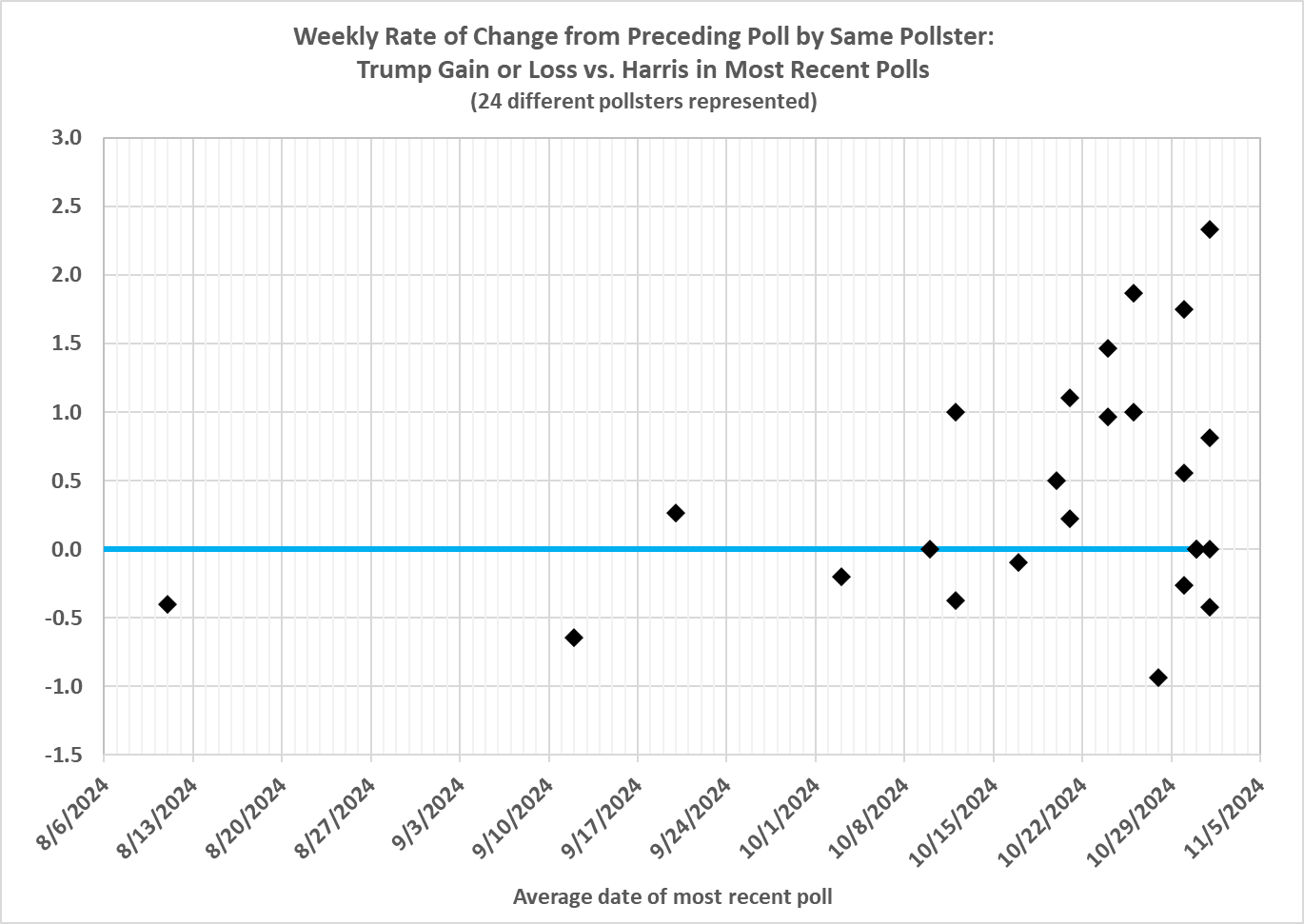
It reeks of pro-Trump momentum.
But let’s not get too excited about the prospect of an easy win. Let’s go back to the polls and accept the premise that there is roughly an even split in the two-party nationwide popular vote. The following graph puts that split in perspective. Harris’s final position, based on the average of polls conducted within seven days of the election is a 50.4-percent share of the two-party vote (down 0.1 percent from the original post).
Can Harris, at 50.4 percent, do what Clinton failed to do with better polling numbers and what Biden barely did with much better polling numbers? Probably not.
Let’s flip the problem and focus on Trump and stipulate that he will get 49.6 percent of the vote. That number comes with a range of statistical uncertainty (to say nothing of built-in bias). The range is from 48.3 percent to 50.8 percent. How does that range translate into electoral votes? Here’s how, Trump would win 291 to 313 electoral votes:
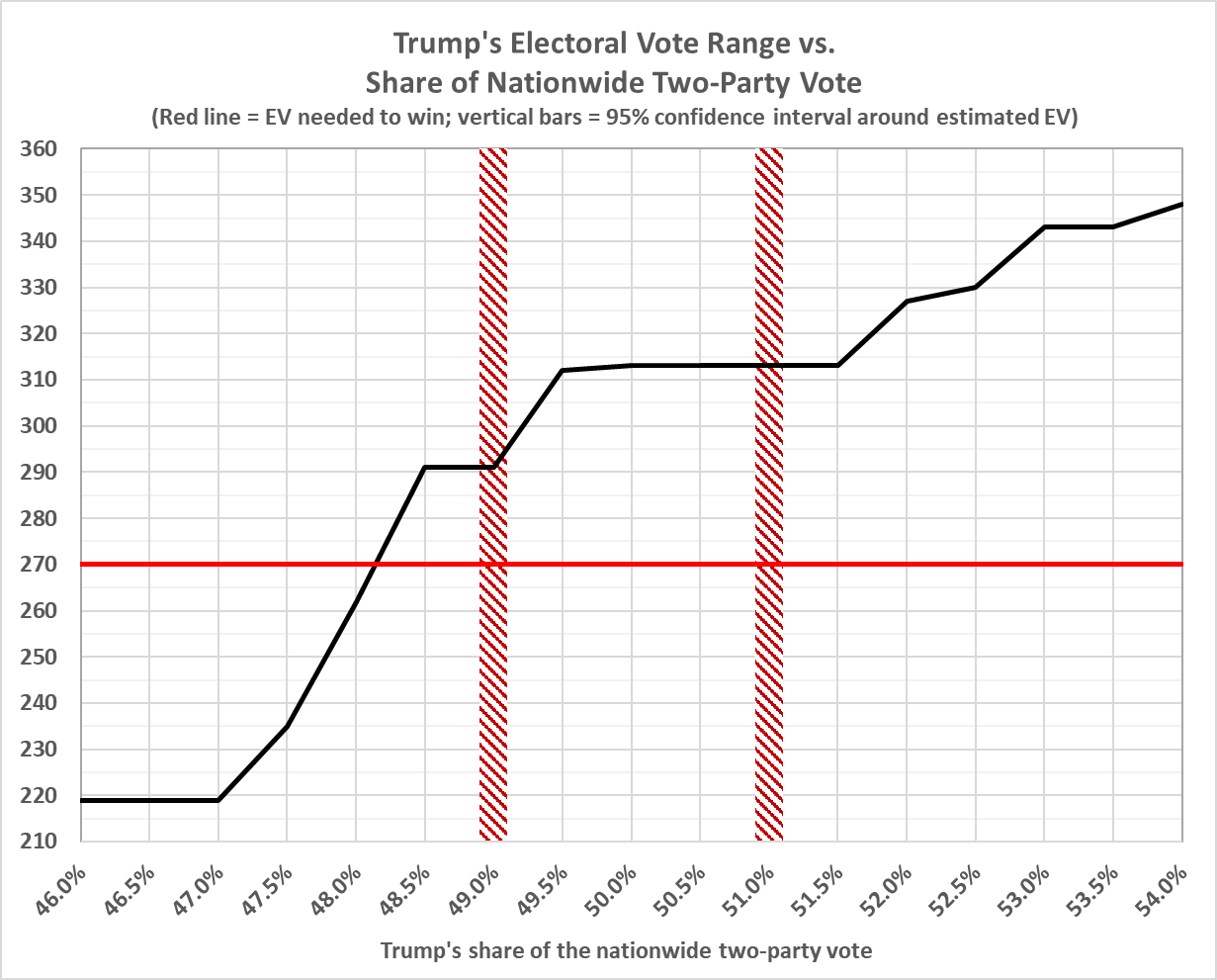
(See “Trump vs. Biden: 16” for an explanation of the relationship between popular vote/polling margin and electoral votes.)
To get to 291, Trump’s “Red Wall” must hold. (The “Red Wall” comprises the 219 electoral votes that Trump can count on unless there’s an unexpected — and well-concealed — Harris landslide in the offing.) Trump would get to 291 by augmenting the “Red Wall” with wins in Arizona, Georgia, North Carolina, Pennsylvania, and Wisconsin, while losing Michigan and Nevada. Trump could also hold on for a win, with 272 electoral votes, while losing Georgia as well as Michigan and Nevada. Other winning scenarios include losing Pennsylvania and Michigan while winning Arizona, Georgia, Nevada, North Carolina, and Wisconsin (278 electoral votes). There are other possibilities that I will leave as an exercise for the reader.
What’s my take? Looking at State-by-State polls, and (only for the purpose of this exercise) taking them at face value, I would write off Michigan and mark Georgia as uncertain. The loss of Georgia (in addition to Michigan) would cut Trump’s EV total to 281 — still enough for the win.
On the upside, Trump could get to 313 electoral votes by winning all seven of the swing States and Nebraska’s 2nd Congressional District.


 Politics and Prosperity