More Fool He

David Brooks, The New York Times‘s ersatz conservative, writes:

When the president unveiled the second half of his stimulus it became clear that this package has nothing to do with helping people right away or averting a double dip. This is a campaign marker, not a jobs bill….

This wasn’t a speech to get something done. This was the sort of speech that sounded better when Ted Kennedy was delivering it. The result is that we will get neither short-term stimulus nor long-term debt reduction anytime soon, and I’m a sap for thinking it was possible.

Yes, I’m a sap. I believed Obama when he said he wanted to move beyond the stale ideological debates that have paralyzed this country. I always believe that Obama is on the verge of breaking out of the conventional categories and embracing one of the many bipartisan reform packages that are floating around….

Being a sap, I still believe that the president’s soul would like to do something about the country’s structural problems. I keep thinking he’s a few weeks away from proposing serious tax reform and entitlement reform. But each time he gets close, he rips the football away.

No s***, Sherlock. Being a bit smarter than Charlie Brown isn’t exactly a mark of distinction.

Welcome to the party David, even if it has taken you three years to get here.

Oh, but wait…

The White House has decided to wage the campaign as fighting liberals. I guess I understand the choice, but I still believe in the governing style Obama talked about in 2008. I may be the last one. I’m a sap.

Fool David once, Obama’s to blame. Fool David twice, David’s to blame. Fool David thrice (at least), and you know that David’s no sap — he’s a fool.

True Libertarianism, One More Time

I recently engaged a left-libertarian (oxymoron) in the comments section of “What Is Libertarianism.” The exchange prompts me to offer a condensed treatment of true libertarianism vs. pseudo-libertarianism. The former is really a kind of conservatism, which is why I call it Burkean libertarianism. The latter — which is the kind of “libertarianism” much in evidence on the internet — rests on the Nirvana fallacy and posits dangerously false ideals.

A “true” libertarian respects socially evolved norms because those norms evidence and sustain the mutual trust, respect, forbearance, and voluntary aid that — taken together — foster willing, peaceful coexistence and beneficially cooperative behavior. And what is liberty but willing peaceful coexistence and beneficially cooperative behavior?

If socially evolved norms include the condemnation of abortion (because it involves the murder of a living human being) and the rejection of same-sex “marriage” (because it mocks and undermines the institution through which children are born and raised by an adult of each gender, fate willing), the “true” libertarian will accept those norms as part and parcel of the larger social order — as long as it is a peaceful, voluntary order.

The “pseudo” libertarian — in my observation — will reject those norms because they interfere with the “natural rights” (or some such thing) of the individuals who want to abort fetuses and/or grant same-sex “marriage” the same status as heterosexual marriage. But to reject and reverse norms as fundamental as the condemnation of abortion and same-sex “marriage”  is to create strife and distrust, therefore undermining the conditions upon which liberty depends.

The pseudo-libertarian looks down upon society as a self-appointed judge, then swoops in to admonish society when its members do not embrace his particular views about rights. How a pseudo-libertarian, who is usually an atheist, can do this has long been a mystery to me. He cannot refer to Divine writ; his religion-substitute is “natural rights,” whose composition is known to him, but not to lesser beings. The source of his knowledge of “natural rights” is either innate in his superior intellect (how convenient) or else it arises from a strained interpretation of human evolution. The latter, somehow, has yielded up a set of inborn natural rights, the contours of which the pseudo-libertarian is privileged to perceive. (None of this is meant to denigrate Judeo-Christianity, the foundational tenets of which foster liberty.)

The pseudo-libertarian, in other words, is afraid to admit that the long evolution of rules of conduct by human beings who must coexist  might just be superior to the rules that he would arbitrarily impose, reflecting as they do his “superior” sensibilities. I say “arbitrarily” because pseudo-libertarians have not been notably critical of the judicial impositions that have legalized abortion and same-sex marriage, or of the legislative impositions that have corrupted property rights in the pursuit of “social justice.”

All in all, it seems that pseudo-libertarians believe in the possibility of separating the warp and woof of society without causing the disintegration of the social fabric. The pseudo-libertarian, in that respect, mimics the doctrinaire socialist who wants prosperity but rejects one of its foundation stones: property rights.

A true libertarian will eschew the temptation to prescribe the details of social conduct. He will, instead, take the following positions:

  • The role of the state is to protect individuals from deceit, coercion, and force.
  • The rules of social conduct are adopted voluntarily within that framework are legitimate and libertarian.

*   *   *

The foregoing is a terse summary of the detailed analysis of liberty and rights that I have offered in many posts, including these:

On Liberty
Greed, Cosmic Justice, and Social Welfare
Positive Rights and Cosmic Justice
Democracy and Liberty
Parsing Political Philosophy
Inventing “Liberalism”
Civil Society and Homosexual “Marriage”
What Is Conservatism?
Utilitarianism, “Liberalism,” and Omniscience
Utilitarianism vs. Liberty
The Principles of Actionable Harm
The Indivisibility of Economic and Social Liberty
Beware of Libertarian Paternalists
Law and Liberty
Negative Rights
Negative Rights, Social Norms, and the Constitution
Rights, Liberty, the Golden Rule, and the Legitimate State
Tocqueville’s Prescience
The Mind of a Paternalist
Accountants of the Soul
The Unreality of Objectivism
“Natural Rights” and Consequentialism
Rawls Meets Bentham
More about Consequentialism
Perry v. Schwarzenegger, Due Process, and Equal Protection
Rationalism, Social Norms, and Same-Sex “Marriage”
Line-Drawing and Liberty
The Divine Right of the Majority
Our Enemy, the State
Pseudo-Libertarian Sophistry vs. True Libertarianism
Positivism, “Natural Rights,” and Libertarianism
What Are “Natural Rights”?
The Golden Rule and the State
Libertarian Conservative or Conservative Libertarian?
Liberty, Equality, Fraternity: Part I
Nature Is Unfair
Social Justice
Bounded Liberty: A Thought Experiment
The Left’s Agenda
Evolution, Human Nature, and “Natural Rights”
More Pseudo-Libertarianism
More about Conservative Governance
The Meaning of Liberty
Taxing the Rich
More about Taxing the Rich
Peter Presumes to Preach
Positive Liberty vs. Liberty
More Social Justice
On Self-Ownership and Desert
In Defense of Marriage
Luck-Egalitarianism and Moral Luck
Empathy Is Overrated
Understanding Hayek
Union-Busting
The Left and Its Delusions
Corporations, Union, and the State
The Golden Rule as Beneficial Learning
Why I Am Not an Extreme Libertarian
Facets of Liberty
Burkean Libertarianism
Crimes against Humanity
Rights: Source, Applicability, How Held
Blackmail, Anyone?
The Ideal as a False and Dangerous Standard
About Democracy
The Arrogance of (Some) Economists
What Is Libertarianism?

Where’s the (Intellectual) Beef?

That’s what Virgina Postrel asks, in effect (“Harvard Pledge Values ‘Kindness’ Over Learning“):

When the members of the class of 2015 arrived at Harvard College this fall, they encountered a novel bit of moral education. Their dorm proctors — the grad students who live with freshmen to provide guidance and enforce discipline — invited each student to sign a pledge developed by the Freshman Dean’s Office. It reads, in full:

“At Commencement, the Dean of Harvard College announces to the President, Fellows, and Overseers that ‘each degree candidate stands ready to advance knowledge, to promote understanding, and to serve society.’ That message serves as a kind of moral compass for the education Harvard College imparts. In the classroom, in extracurricular endeavors, and in the Yard and Houses, students are expected to act with integrity, respect, and industry, and to sustain a community characterized by inclusiveness and civility.

“As we begin at Harvard, we commit to upholding the values of the College and to making the entryway and Yard a place where all can thrive and where the exercise of kindness holds a place on par with intellectual attainment.”…

Kindness isn’t a public or intellectual virtue, but a personal one. It is a form of love. Kindness seeks, above all, to avoid hurt. Criticism — even objective, impersonal, well- intended, constructive criticism — isn’t kind. Criticism hurts people’s feelings, and it hurts most when the recipient realizes it’s accurate. Treating “kindness” as the way to civil discourse doesn’t show students how to argue with accuracy and respect. It teaches them instead to neither give criticism nor tolerate it….

Consider a common argument in favor of the pledge. It starts with a survey last spring in which then-freshmen were asked to indicate how they believed Harvard ranked various values, and then to do the same ranking for themselves….

Where in the list of ranked values are curiosity, discovery, reason, inquiry, skepticism or truth? (Were these values even options?) Where is critical thinking? No wonder the pledge talks about “attainment.” Attainment equals study cards and good grades — a transcript to enable the student to move on to the next stage. Attainment isn’t learning, questioning or criticizing. It’s getting your ticket punched.

Harvard is the strongest brand in American higher education, and its identity is clear. As its students recognize, Harvard represents success. But, it seems, Harvard feels guilty about that identity and wishes it could instead (or also) represent “compassion.” These two qualities have a lot in common. They both depend on other people, either to validate success or serve as objects of compassion. And neither is intellectual.

Harvard’s emphasis on “kindness” reminds me that empathy is overrated:

[T]here is a crying need for unsociable introverts, who tend (more than other types) to be thinkers, strivers, organizers, defenders, and justice-dispensers. If we did not exist, the world would be full of ill-fed, ill-housed, untutored savages. I suspect that their vaunted empathy would not survive the stress of existence and coexistence.

Say’s Law, Government, and Unemployment

“Supply creates its own demand,” or so goes the popular interpretation of Say’s law. (More about that, below.) But if what you have on offer is not in demand by others, you are out of luck.

That is the point of Megan McArdle’s post, “The New New New Economy.” McArdle writes:

One of my first jobs out of school, way back in 1994, was as a secretary.  I’d be shocked to find that any of the executives at that organization still have secretaries–maybe the executive director, but maybe not even him.  Already at the time there wasn’t really enough for me to do; my boss had a secretary because, well, people in his position did.  That’s not because the work was being outsourced to Bangalore, but because computers and the internet were eliminating much of the coolie labor that secretaries used to take care of.  And of course, the recession is accelerating the pace of change–and leaving the people who are displaced fewer options to transition.

Government interventions that destroy jobs — the minimum wage, capital gains taxes, progressive taxation, etc. — exacerbate the problem because they prevent low-skilled workers (teenagers, mainly) from stepping onto the bottom rung of the employment ladder and eventually acquiring skills (or the money with which to acquire skills) that enable them to compete in an increasingly cyber-mated economy.

Which brings me back to Say’s law, explained succinctly by Steven Horwitz in “Understanding Say’s Law of Markets“:

Say was making the claim that production is the source of demand. One’s ability to demand goods and services from others derives from the income produced by one’s own acts of production. Wealth is created by production not by consumption. My ability to demand food, clothing, and shelter derives from the productivity of my labor or my nonlabor assets. The higher (lower) that productivity, the higher (lower) is my power to demand.

When a firm adopts a more productive technology — one that enables it to reduce the price of a product or service and/or offer a better product or service for the same price — the firm benefits and its customers and potential customers benefit. The firm can reap higher profits (if it is in a competitive position to do so) by “sharing” the productivity gains with customers through its pricing strategy. Customers and potential customers, by the same token reap the benefit of a better and/or less expensive product or service.

Who is made worse off? The workers whose skills are such that they cannot produce things that are valued by consumers. Or, if they can produce them, they cannot produce them as cheaply as, say, an automated system. And that system may well have been introduced because government policies of the kind mentioned above make it less profitable for firms to employ labor.

Whose “fault” is that? In a free-market economy, it would be no one’s fault; it would be what it is: an unfortunate subset of the populace lacking the wherewithal to produce what others want. It follows that governmental interventions have created a large (and growing) additional subset of the populace who could — and should — blame their fate upon the minimum wage; capital gains taxes; progressive taxation; regulations that restrict inputs, processes, and outputs; and all other government policies that discourage employment, saving, capital formation, and business expansion.

Related posts:
The Causes of Economic Growth
Economic Growth since WWII
A Short Course in Economics
Addendum to a Short Course in Economics
The Price of Government
Gains from Trade
Does the Minimum Wage Increase Unemployment?
The Commandeered Economy
The Price of Government Redux
Trade
The Mega-Depression
The Real Burden of Government
Toward a Risk-Free Economy
The Rahn Curve at Work
The Illusion of Prosperity and Stability
Estimating the Rahn Curve: Or, How Government Inhibits Economic Growth
Competition Shouldn’t Be a Dirty Word
The Stagnation Thesis
America’s Financial Crisis Is Now
Money, Credit, and Economic Fluctuations
A Keynesian Fantasy Land
The Keynesian Fallacy and Regime Uncertainty
Creative Destruction, Reification, and Social Welfare
Why the “Stimulus” Failed to Stimulate
The “Jobs Speech” That Obama Should Have Given

The Planning Fallacy

David Brooks, sounding (unusually) like the conservative that he claims to be, writes about the planning fallacy:

…Most people overrate their own abilities and exaggerate their capacity to shape the future….

The planning fallacy is failing to think realistically about where you fit in the distribution of people like you….

Over the past three years, the [government of the: ED] United States has been committing the planning fallacy on stilts. The world economy has been slammed by a financial crisis. Countries that are afflicted with these crises typically experience several years of high unemployment. They go deep into debt to end the stagnation, but the turnaround takes a while.

This historical pattern has been universally acknowledged and universally ignored. Instead, leaders in both parties have clung to the analogy that the economy is like a sick patient who can be healed by the right treatment.

The Democrats, besotted by the myth that the New Deal ended the Great Depression, have consistently overestimated their ability to turn the economy around….

Combine the planning fallacy with the Nirvana fallacy — comparing actual things with unrealistic, idealized alternatives– and you have governance at its worst: politicians making an inevitably imperfect and messy world even less perfect and messier.

Creepy Doings at BarackObama.com

Obama for America is “an Authorized Committee of a Candidate For the Office of President or Vice President.” The website barackobama.com is “paid for by Obama for America.” There is (as of this writing) a post at barackobama.com dated September 13, 2011, “Launching AttackWatch.com,” which announces a “new resource,” namely AttackWatch.com. Among the features of that site is Report an attack:

This rather unsophisticated stab at compiling an enemies list will come back to haunt the O. Although the effort has just begun, it already has garnered some attention. I expect the snowball effect to kick in tomorrow.

P.S. I will be proud if I am placed on the enemies list, though I will leave it to the creeps at barackobama.com to find for themselves the large number of attacks that I have posted on this blog. Grrrr.

P.P.S. (09/23/11) It seems that Attack Watch was mortally wounded by the attacks (and ridicule) it drew.

About

I have updated, expanded, and reorganized “About.” Go there if you’re curious about this blogger.

NEVER FORGIVE, NEVER FORGET, NEVER RELENT!

For an egregious view of 9/11 and events since, see Robin Hanson’s post,”Forget 9/11.” Read my comment.* And then forget Robin Hanson. What a jerk.

P.S. Hanson can shove Krugman up his a**, and vice versa. They make a nice couple. Bill Vallicella, on the other hand, is a voice of reason, as is another Hanson (Victor Davis).

P.P.S. See also my previous post about 9/11, “September 20, 2001: Hillary Clinton Signals the End of ‘Unity’.”

P.P.P.S. If you wonder why I react so strongly to Hanson and Krugman, see “September 11: A Remembrance.” I despise the likes of Hanson and Krugman, whose extreme libertarianism and extreme statism seem unbounded by taste and reality.
__________
* Defense against terrorists, not solidarity with victims, explains the “pissing away” of three trillion dollars. But you are not in a position to say that it was “pissed away,” unless you happen to know, with some certainty, just how much or how little physical and economic security was bought with the three trillion dollars. I detect a bias on your part against defense spending. Or do you believe that the U.S. wouldn’t have been attacked if only (insert your favorite gripe against U.S. foreign policy here)?

What does the fact that half a billion persons have died since 9/11 have to do with the deaths of the three thousand victims of 9/11? If your spouse was murdered, I suppose you’d say “Oh well, people die every day.” Same thing, right?

Were long-standing legal principles trashed? Maybe. But the ACLU is hardly an unbiased judge of such things. Try this for some balance: http://originalismblog.typepad.com/the-originalism-blog/2011/09/comment-on-911.html.

Finally, I second Adam’s comment that you are looking down on a natural human reaction to what was seen (quite properly) as a dramatic event. Actually, “dramatic” is an understatement. It was a concerted act of barbarism, not the everyday occurrence that you liken it to.

September 20, 2001: Hillary Clinton Signals the End of “Unity”

This is my 9/11 post, a day early. For my remembrance of 9/11, go here.

I reluctantly watched George W. Bush’s post-9/11 speech before a joint session of Congress. I say “reluctantly” because I cannot abide the posturing, pomposity, and wrong-headedness that are the usual ingredients of political speeches — even speeches that follow events like the attack on Pearl Harbor and the atrocities of 9/11. (Churchill’s rallying speeches during World War II are another thing: masterworks of inspirational oratory.)

In any event, Bush’s performance was creditable (thanks, no doubt, to his writers and ample preparation). And I found nothing to fault in what he said, inasmuch as I am a libertarian hawk. The vigorous and evidently sincere applause that greeted Bush’s applause lines — applause that arose from Democrats as well as Republicans — seemed to confirm the prevailing view that Americans (or their political leaders, at least) were defiantly united in the fight against terrorism.

But I noted then, and have never forgotten, the behavior of Hillary Clinton, who was a freshman senator. Some of Clinton’s behavior is captured in this video clip, from 11:44 to 12: 14. The segment opens with Bush saying

Terror unanswered can not only bring down buildings, it can threaten the stability of legitimate governments. And you know what, we’re not going to allow it.

The assemblage then rises in applause. The camera zooms to Hillary Clinton, who seems aware of it and stares at the camera briefly while applauding tepidly. (Compare her self-centered reaction with that of the noted camera-hog Chuck Shumer, who is standing next to her, applauding vigorously, and looking toward Bush.) Clinton then turns away from the camera and, while still applauding tepidly, directs a smirk at someone near her. I also noted — but cannot readily find on video — similar behavior, include eye-rolling, at the conclusion of Bush’s speech.

Clinton — as a veteran political campaigner who knew that her behavior would draw attention — was sending a clear signal of her reluctance to support Bush because … because why? Because he had an opportunity for leadership that her husband had squandered through his lame responses to the 1993 bombing of the World Trade Center, the downing of U.S. helicopters in Somalia, and the bombings of U.S. embassies in East Africa? Because Bush was a Republican who had won the presidency after great controversy? Because she resented not being at the center of attention after having been there for eight years, as an influential FLOTUS?

Yes Clinton was “hawkish” on the wars in Afghanistan and Iraq. But I will always suspect that her hawkishness was, in part, a kind of atonement for her public display of disdain for George W. Bush on an occasion when such a display was inappropriate. No president should be given leave to do as he will, for any reason, but neither should his unexceptionable remarks on a solemn occasion be mocked.

Regardless of Clinton’s later stances, her behavior on January 20, 2011, signaled that the war on terror would become a partisan feast for Democrats and head-in-the clouds pseudo-libertarians. And it became just that.

The Repealer

The State of Kansas this year established the office of State Repealer. The Repealer’s job is to

  1. …investigate the system of governance of the State of Kansas including its laws, regulations, and other governing instruments to determine instances in which those laws, regulations, or other governing instruments are unreasonable, unduly burdensome, duplicative, onerous, or in conflict.
  2. … cause to be created at the earliest possible date a system for receiving public comment suggesting various laws, regulations, and other governing instruments to be considered for possible repeal by the Office of the Repealer.  This system shall include an online portal for the receipt of such public comment [here].
  3. …cause a recommendation for either outright repeal or for modification to be delivered to the originating body of such law, regulation, or other governing instrument [which meets the standard set forth in paragraph 1 above]…. The recommendation shall set forth with specificity the justification for the requested repeal or modification.  Any recommendation made by the … Repealer shall carry the full weight and force of this Administration.
  4. …implement a tracking system to follow the action taken by any originating body on any recommendation made by the State Repealer in order to prepare regular reports to the Office of the Governor regarding the progress of repeal or modification.

I wonder if the idea of a Repealer was stimulated by my proposal to establish a Keeper of the U.S. Constitution (go here and scroll down to Article VII). It is true that the Keeper of the Constitution, as I define the job, would have considerably more power than the Kansas Repealer; to wit:

A. Responsibility and Authority

1. The responsibility for ensuring that the legislative, executive, and judicial branches adhere to this Constitution in the exercise of their respective powers shall be vested in a Keeper of the Constitution. The Keeper may review acts of Congress, the executive branch, and judicial branch that have the effect of making law and appropriating monies. The term “making law” includes — but is not limited to — a legislative, executive, or judicial interpretation of an existing law or laws. Covered acts of the judicial branch include — but are not limited to — denials of appeals or writs of certiorari. The Keeper’s purview does not extend to the ratification of or amendments to this Constitution; the admission of States to the Union, or the secession of States from it; declarations of war; statutes, appropriations, regulations, or orders pertaining directly to the armed forces or intelligence services of the United States; or the employment of the armed forces or intelligence services of the United States. Nor does the Keeper’s purview extend to appointments made by or with the consent of the legislative, executive, or judicial branches.

2. The Keeper may revoke any act that lies within his purview, as defined in section A.1 of this Article VII, provided that the act occurred no more than one year before the date on which he nullifies it. The Keeper shall signify each revocation by informing the Speaker of the House of Representatives, President pro tempore of the Senate, President of the United States, and Chief Justice of the Supreme Court of the United States of his decision and the reason(s) therefor. The Keeper shall, at the same time, issue a public notice of his decision and the reason(s) therefor.

3. The affected branch(es) of government shall, in each case, act promptly to implement the Keeper’s decision. Each implementing act shall be subject to review, as specified in sections A.1 and A.2 of this Article VII.

The establishment of the office of Repealer is, nevertheless, a step in the right direction. Perhaps the idea will spread, and perhaps a State’s constitution will be amended to give a Repealer the kind of authority that I would vest in the Keeper of the Constitution. That would be a bold and instructive experiment in governance.

The “Jobs Speech” That Obama Should Have Given

The following actions will restore jobs by giving confidence to America’s businesses, will ensure robust economic growth over the long haul, and will ensure that future generations are not burdened with crushing debt:

  • Social Security, Medicare, Medicaid (and the expansions known as Obamacare) should be phased out. By the time today’s youngest workers are ready for retirement, those programs would no longer exist. The ability of individuals to enjoy comfortable, healthy retirement years would depend on their assiduous prudence, financially and physically. (I am not a stranger’s keeper, and vice versa.) Private financial institutions and insurers would be allowed to compete across State lines for the savings and premiums of newly empowered individuals. States and municipalities would maintain any “safety net” for the truly needy (including those who cannot afford the care associated with serious illnesses and disabilities). Profligate grants of aid, leading to higher State and local taxes, would be  punished at the ballot box and by emigration to locales where income and property are not targets of opportunity for demagogic politicians.
  • All other activities of the federal government that are not authorized by the Constitution should be phased out within ten years. That is to say, all “independent” agencies (especially including the Federal Reserve) would be abolished, along with every department but Defense, Justice, State, and Treasury. Any legitimate functions of the other departments and agencies would be folded into the four that remain, and those four would be thoroughly cleansed of illegitimate functions.
  • The preceding actions would negate most regulatory authority. That which remains would revert to Congress, which would no longer be able to delegate law-making to the executive branch, and which would have to make law strictly within the four corners of the Constitution. Specific targets for termination: regulation of resource extraction, “anti-discrimination” programs that in fact discriminate in favor of certain classes of individuals, environmental regulation (except for truly major environmental threats, and only then as authorized by an amendment to the Constitution), anything having to do with “global warming.” the Food and Drug Administration, and federal involvement in occupational licensing.
  • The streamlining of the federal government would be accompanied by a sale of all assets not required for the execution of constitutional functions. Thus would land and buildings become available for private use, personal and commercial.
  • The federal budget would be in balance — at a much lower level — within a decade. A tough balanced-budget amendment would keep it there. Such an amendment would cap federal spending at 10 percent of GDP, with a minimum of 6 percent of GDP going to defense. There would be an exception for a war (or wars) authorized by Congress, if the combat deployment of more than one-fourth of the personnel of the U.S. armed forces. Then, federal spending could exceed 10 percent of GDP, but only to the extent of the additional costs of the authorized war (or wars). Federal revenues would have to match spending in every 10-year period, plus or minus 1 percent of GDP.

By taking immediate steps to initiate these changes, we will be telling Americans — individuals and businesspersons — two important things. First, they are at long last free in their “pursuit of Happiness.” Second, because they are free, they do not have to worry about government changing the “rules of the game” capriciously or swooping in to take away what they’ve earned.

Only with such freedom and certainty can Americans, once again, confidently strive to make better lives for themselves and, in so doing, help their compatriots to make better lives.

Union Thuggery…

…of which there has been so much in recent months, seems to be spreading.

The development comes as no surprise to this unprivileged native of Michigan, where unions have long held disproportionate power, due (in part) to their ability to inflict financial and physical harm. I was a “beneficiary” of that power in the 1950s when, as a 16- and 17-year old, I was required to join the Retail Clerks International Union so that I could bag groceries after school and on weekends for the munificent wage of about 90 cents an hour. I went to one union meeting, out of curiosity, and even my 16- or 17-year old self was amused by the sight of grown men calling each other “brother,” like members of the Mystic Knights of the Sea Lodge. Most of those present at the meeting were employees of low-grade, low-margin grocery chains, whose mostly working-class customers they sought to gouge for higher wages. (Of course, the union members didn’t think of it in that way.) The chorus of “brotherhood” was led by a handful of full-time union officials (including a decidedly shifty character), whose customer-financed salaries undoubtedly exceeded the earnings of the workers whom they purported to represent.

Henry Ford was a man of many parts, not all of them praiseworthy, but he was right about labor unions:

Ford was adamantly against labor unions. He explained his views on unions in Chapter 18 of My Life and Work.[33] He thought they were too heavily influenced by some leaders who, despite their ostensible good motives, would end up doing more harm than good for workers. Most wanted to restrict productivity as a means to foster employment, but Ford saw this as self-defeating because, in his view, productivity was necessary for any economic prosperity to exist.

He believed that productivity gains that obviated certain jobs would nevertheless stimulate the larger economy and thus grow new jobs elsewhere, whether within the same corporation or in others. Ford also believed that union leaders (particularly Leninist-leaning ones) had a perverse incentive to foment perpetual socio-economic crisis as a way to maintain their own power. Meanwhile, he believed that smart managers had an incentive to do right by their workers, because doing so would maximize their own profits. (Ford did acknowledge, however, that many managers were basically too bad at managing to understand this fact.) But Ford believed that eventually, if good managers such as he could fend off the attacks of misguided people from both left and right (i.e., both socialists and bad-manager reactionaries), the good managers would create a socio-economic system wherein neither bad management nor bad unions could find enough support to continue existing.

Given that the Wagner Act was an unconstitutional usurpation of property rights, I cannot entirely condemn Ford’s bare-knuckles method of dealing with union organizers, who were bare-knuckles men themselves.

And then there were Jimmy Hoffa and his namesake son, to name but a few “icons” of the “peaceful” labor movement and its habit of wrenching above-market wages and lucrative pensions from the honest workers of America.

*   *   *

Related posts: here and here.

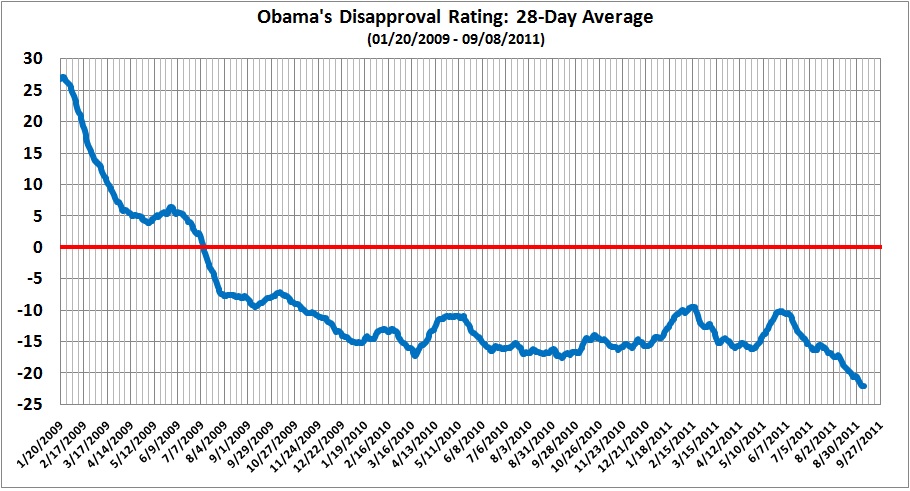
Can Obama Erase the Deficit?

I don’t mean the federal government’s deficit or the jobs deficit. I mean Obama’s popularity deficit, which is s-o-o big:


Derived from Rasmussen Reports, Daily Presidential Tracking Poll.

When it comes to jobs, Don Boudreaux pegs it:

The problem isn’t that consumers aren’t spending; it’s that businesses aren’t investing.  And businesses aren’t investing because Congress and, especially, the administration exhibit a ceaseless fetish for top-down, command-and-control, debt-financed ‘governance’ of the economy – an enterprise-quashing recipe made only more poisonous by Mr. Obama’s soak-the-rich speechifying.

But that won’t keep the O from speechifying about “the rich” and trying to spend and regulate his way out of a recession that he has made worse by enlarging government and its reach, instead of shrinking both.

Related posts:
Taxing the Rich
More about Taxing the Rich
A Keynesian Fantasy Land
The Keynesian Fallacy and Regime Uncertainty
The Great Recession Is Not Over
Why the “Stimulus” Failed to Stimulate

Nature Is Unfair

The Almighty is not a liberal… The Almighty is the driving force for the entire universe and the universe is not a very liberal place. That is what the modern world seems not to understand….

Simon Mawer, The Gospel of Judas

*   *   *

Matt Ridley‘s recent article in The Wall Street Journal, “A Truce in the War Over Smarts and Genes,” is about the heritability of intelligence. The article, which is behind WSJ’s paywall, is available on Ridley’s personal website, The Rational Optimist, under the title “Goldilocks Heritability.” Here are some relevant bits:

Hardly any subject in science has been so politically fraught as the heritability of intelligence. For more than a century, since Francis Galton first started speculating about the similarities of twins, nature-nurture was a war with a stalemated front and intelligence was its Verdun—the most hotly contested and costly battle.

So would it not be rather wonderful if a scientific discovery came along that called a truce and calmed all the fury? I think this is about to happen. Call it the Goldilocks theory of intelligence: not too genetic, not too environmental—and proving that intelligence is impossible to meddle with, genetically.

The immediate cause of this optimism is a recent paper in Molecular Psychiatry, which confirms that genes account for about half of the difference in IQ between any two people in a modern society….

So far, so good. But Ridley goes off the rails with this:

…Some of the more extreme “nurturists,” especially those who dominated the debate in the 1960s to 1980s, might not welcome the new confirmation of the nearly 50% role of genes in determining IQ differences, even though it has been blindingly clear for a long time now.

They should, though. A world in which intelligence is 100% genetic would be horribly unfair….

What does “fairness” have to do with it? Is there a master gene-dispenser in the sky to whom one can complain about not having received a “fair share” of smart genes? I think not.

There would be nothing “unfair” about a world in which intelligence is 100 percent genetic. That’s just the way it would be, and nothing could — or should — be done about it.

But that wouldn’t stop leftists from trying to do something about it. As I say here,

[t]he search for cosmic justice — the rectification of all that is “unfair” in the world — is relentless, knows no bounds, and is built upon the resentment and punishment of success.

“Unfair” is the battle cry of the envious and the rabble-rouser, who derive great satisfaction from apportioning blame where no blame is due. I expect better of Ridley.

Related posts:
Positive Rights and Cosmic Justice
Intelligence, Personality, Politics, and Happiness
Social Justice
Positive Liberty vs. Liberty
More Social Justice
On Self-Ownership and Desert
Luck-Egalitarianism and Moral Luck
Intelligence as a Dirty Word
The Ideal as a False and Dangerous Standard
An Economist’s Special Pleading: Affirmative Action for the Ugly

What Is Libertarianism?

Many definitions of libertarianism are available online. I like this one for its depth:

Although there is much disagreement about the details, libertarians are generally united by a rough agreement on a cluster of normative principles, empirical generalizations, and policy recommendations. Libertarians are committed to the belief that individuals, and not states or groups of any other kind, are both ontologically and normatively primary; that individuals have rights against certain kinds of forcible interference on the part of others; that liberty, understood as non-interference, is the only thing that can be legitimately demanded of others as a matter of legal or political right; that robust property rights and the economic liberty that follows from their consistent recognition are of central importance in respecting individual liberty; that social order is not at odds with but develops out of individual liberty; that the only proper use of coercion is defensive or to rectify an error; that governments are bound by essentially the same moral principles as individuals; and that most existing and historical governments have acted improperly insofar as they have utilized coercion for plunder, aggression, redistribution, and other purposes beyond the protection of individual liberty. (“Libertarianism,” Internet Encyclopedia of Philosophy)

Two aspects of this definition merit closer examination. The first is “that individuals have rights against certain kinds of forcible interference on the part of others.” Whence these rights, and how extensive are they? I say here that

[r]ights, as products of social evolution, are strictures on interpersonal behavior, not “essences” that emanate from individuals. Rights, therefore, are culturally variable in their precise contours, but certain constants of human nature (empathy, self-interest) lead most cultures in the direction of a modus vivendi like the Golden Rule.

Specifically:

There’s a mainstream interpretation of the Golden Rule — one that still holds in many places — which rules out certain kinds of behavior, except in extreme situations, and permits certain other kinds of behavior. There is, in other words, a “core” Golden Rule that comes down to this:

  • Murder is wrong, except in self-defense. (Capital punishment is just that: punishment. It’s also a deterrent to murder. It isn’t “murder,” muddle-headed defenders of baby-murder to the contrary notwithstanding.)
  • Various kinds of unauthorized “taking” are wrong, including theft (outright and through deception). (This explains popular resistance to government “taking,” especially when it’s done on behalf of private parties. The view that it’s all right to borrow money from a bank and not repay it arises from the mistaken beliefs that (a) it’s not tantamount to theft and (b) it harms no one because banks can “afford it.”)
  • Libel and slander are wrong because they are “takings” by word instead of deed.
  • It is wrong to turn spouse against spouse, child against parent, or friend against friend. (And yet, such things are commonly portrayed in books, films, and plays as if they are normal occurrences, often desirable ones. And it seems to me that reality increasingly mimics “art.”)
  • It is right to be pleasant and kind to others, even under provocation, because “a mild answer breaks wrath: but a harsh word stirs up fury” (Proverbs 15:1).
  • Charity is a virtue, but it should begin at home, where the need is most certain and the good deed is most likely to have its intended effect.

Adherence to the Golden Rule is vestigial because in the past century — since the advent of the regulatory-welfare state and the seizure of state power by social “activists” — eons of socially evolved behavioral norms have been distorted and swept aside. Thus the phenomena of broad support for abortion and growing support for same-sex “marriage” — both of which are due to the anti-social combination of “activism” and sponsorship by an anti-religious state.

This leads me to the second aspect of the definition of libertarianism that merits closer attention: “social order is not at odds with but develops out of individual liberty.” The ranks of self-styled libertarians abound with social engineers who would, if they could, override the social order with their own visions of how that order should look. These pseudo-libertarians do not hesitate to prescribe a social order aligned with their effete sensibilities.

To the many examples of pseudo-libertarianism that I have adduced in previous posts (e.g., here and here), I will add two. First comes Charles Johnson, one of the Bleeding Heart Libertarians, points with pride to his article, “The Many Monopolies” (Freeman, September 2011). Regulations, according to Johnson,

fundamentally restructure markets, inventing the class structures of ownership, ratcheted costs, and inhibited competition that produce wage labor, rent, and the corporate economy we face….

A fully freed market means liberating essential command posts in the economy from State control, to be reclaimed for market and social entrepreneurship. The market that would emerge would look profoundly different from anything we have now.

What it would look like — in Johnson’s dreams — is a kind  of leftist Utopia: “Independent contracting, co-ops, and worker-managed shops.” This, of course, is pure guesswork — and wishful thinking — about the effects of abolishing all regulations, whether they superficially favor labor, business, or consumers. (I have more to say about such guesswork in this post.)

The subtitle of Johnson’s analysis should be “Small is beautiful.” It reads like a nostalgic lament for pre-industrial America, as if large corporations are evil per se.

Then there is the reliably leftist libertarian, Will Wilkinson, who says that

there are other legitimate public goods beyond the police protection of property rights. The need to finance the provision of these goods can justifiably limit our property rights, just as a system of property can justifiably limit our right to free movement. The use of official coercion to collect necessary taxes is no more or less problematic than the use of official coercion to enforce claims to legitimate property. Of course, those who suffer most from the absence of adequate public goods are the poor and powerless. (“A Libertarian’s Lament: Why Ron Paul Is an Embarrassment to the Creed,” The New Republic, September 2, 2011)

What are those other “public goods” to which Wilkinson refers? One of them is public schooling. It may seem strange for a so-called libertarian to endorse public schooling, but — in Wilkinson’s view — the cause is just if it benefits “poor kids.” Well, then, why not tax “the rich” to put everyone in the lower half of the income distribution on the dole? Where does one draw the line? Where Wilkinson says to draw the line, I suppose. After all, one mustn’t allow social outcomes that displease Mr. Wilkinson.

The point of these examples is that they illustrate a decided antagonism to a “social order [that] develops out of individual liberty.” They are consistent with “positive liberty,” which — as I have written — is not liberty at all.

Libertarianism — true libertarianism — does not presume to prescribe the outcome of social activity, only its conditions: peaceful and voluntary. It is inevitable and unavoidable that peaceful, voluntary social activity will yield outcomes that are unequal — in terms of income, wealth, and social status — and even distasteful — in terms of inter-group antipathies and discriminatory behavior.  But unequal and distasteful outcomes are rooted in the reality of human nature, which Michael Schermer summarizes quite well in his essay, “Liberty and Science,” at Cato Unbound:

  1. The clear and quantitative physical differences among people in size, strength, speed, agility, coordination, and other physical attributes that translates into some being more successful than others, and that at least half of these differences are inherited.
  2. The clear and quantitative intellectual differences among people in memory, problem solving ability, cognitive speed, mathematical talent, spatial reasoning, verbal skills, emotional intelligence, and other mental attributes that translates into some being more successful than others, and that at least half of these differences are inherited.
  3. The evidence from behavior genetics and twin studies indicating that 40 to 50 percent of the variance among people in temperament, personality, and many political, economic, and social preferences are accounted for by genetics.
  4. The failed communist and socialist experiments around the world throughout the 20th century revealed that top-down draconian controls over economic and political systems do not work.
  5. The failed communes and utopian community experiments tried at various places throughout the world over the past 150 years demonstrated that people by nature do not adhere to the Marxian principle “from each according to his ability, to each according to his need.”
  6. The power of family ties and the depth of connectedness between blood relatives. Communities have tried and failed to break up the family and have children raised by others; these attempts provide counter evidence to the claim that “it takes a village” to raise a child. As well, the continued practice of nepotism further reinforces the practice that “blood is thicker than water.”
  7. The principle of reciprocal altruism—I’ll scratch your back if you’ll scratch mine”—is universal; people do not by nature give generously unless they receive something in return, even if what they receive is social status.
  8. The principle of moralistic punishment—I’ll punish you if you do not scratch my back after I have scratched yours—is universal; people do not long tolerate free riders who continually take but almost never give.
  9. The almost universal nature of hierarchical social structures—egalitarianism only works (barely) among tiny bands of hunter-gatherers in resource-poor environments where there is next to no private property, and when a precious game animal is hunted extensive rituals and religious ceremonies are required to insure equal sharing of the food.
  10. The almost universal nature of aggression, violence, and dominance, particularly on the part of young males seeking resources, women, and especially status, and how status-seeking in particular explains so many heretofore unexplained phenomena, such as high risk taking, costly gifts, excessive generosity beyond one’s means, and especially attention seeking.
  11. The almost universal nature of within-group amity and between-group enmity, wherein the rule-of-thumb heuristic is to trust in-group members until they prove otherwise to be distrustful, and to distrust out-group members until they prove otherwise to be trustful.
  12. The almost universal desire of people to trade with one another, not for the selfless benefit of others or the society, but for the selfish benefit of one’s own kin and kind; it is an unintended consequence that trade establishes trust between strangers and lowers between-group enmity, as well as produces greater wealth for both trading partners and groups.

Efforts to channel human nature in contrary directions — whether those efforts are “liberal” or “libertarian” —  can lead only in one direction: the stifling of liberty:

The recognition of the insuperable limits to his knowledge ought indeed to teach the student of society a lesson of humility which should guard him against becoming an accomplice in men’s fatal striving to control society – a striving which makes him not only a tyrant over his fellows, but which may well make him the destroyer of a civilization which no brain has designed but which has grown from the free efforts of millions of individuals. (Friedrich A. Hayek, “The Pretence of Knowledge,” Nobel Prize lecture, December 11, 1974)

Related posts:
Beware of Libertarian Paternalists
Columnist, Heal Thyself
The Mind of a Paternalist
Accountants of the Soul
Rawls Meets Bentham
Enough of “Social Welfare”
Our Enemy, the State
Pseudo-Libertarian Sophistry vs. True Libertarianism
Positivism, “Natural Rights,” and Libertarianism
What Are “Natural Rights”?
The Golden Rule and the State
Libertarian Conservative or Conservative Libertarian?
Evolution, Human Nature, and “Natural Rights”
More Pseudo-Libertarianism
More about Conservative Governance
The Meaning of Liberty
Positive Liberty vs. Liberty
In Defense of Marriage
Understanding Hayek
We, the Children of the Enlightenment
Why I Am Not an Extreme Libertarian
Facets of Liberty
Burkean Libertarianism
Crimes against Humanity
Rights: Source, Applicability, How Held
The Ideal as a False and Dangerous Standard
The Arrogance of (Some) Economists

Labor Day Reading

Here and here.

Abortion and Logic

Peter Smith, a British philosopher and proprietor of Logic Matters, offers some thoughts about abortion. Passages from Smith’s post (in italics) are followed by my comments (in bold).

As the human zygote/embryo/foetus slowly develops, its death slowly becomes a more serious matter. At the very beginning, its death is of little consequence; as time goes on, its death is a matter it becomes appropriate to be gradually more concerned about.

This statement is presumptuous and, in many cases, wrong. A couple who want to have a child can be devastated by the miscarriage of a fetus, even at an early stage of pregnancy

After all, very few of us are worried by the fact that a very high proportion of conceptions quite spontaneously abort…

Again, very few of us are scandalized if a woman who finds she is pregnant by mistake in a test one week after conception is then mightily pleased when she discovers that the pregnancy has naturally terminated some days later (and even has a drink with a girl friend to celebrate her lucky escape). Compare: we would find it morally very inappropriate, in almost all circumstances, for a woman in comfortable circumstances to celebrate the death of an unwanted young baby.

What do “we” and “worry” have to do with it? The issue is the morality of abortion, not whether many individuals are emotionally involved in the natural termination of a pregnancy.

Suppose a woman finds she is a week or two pregnant, goes horse riding, falls badly at a jump, and as a result spontaneously aborts. That might be regrettable, but we wouldn’t think she’d done something terrible by going riding and running the risk.

Speak for yourself, not “we.” There are many who would condemn the woman who knowingly risked the life of her fetus by jumping a horse or doing something similarly risky.

So: our very widely shared attitudes to the natural or accidental death of the products of conception do suggest that we do in fact regard them as of relatively lowly moral status at the beginning of their lives, and of greater moral standing as time passes. We are all (or nearly all) gradualists in these cases. [Assumptions not granted, but pray continue.]

It is then quite consistent with such a view to take a similar line about unnatural deaths. For example, it would be consistent to think that using the morning-after pill is of no moral significance, while bringing about the death of an eight month foetus is getting on for as serious as killing a neonate, with a gradual increase in the seriousness of the killing in between.

At what point, then, does it become morally significant to kill a fetus? At one week, one month, three months, three months and a day, five months, six months, seven months? If killing a eight-month fetus is “getting on for as serious as killing a neonate,” then killing a seven-month, three-week fetus is as serious as killing an eight-month fetus, and so on.

Some, at any rate, of those of us who are pro (early) choice are moved by this sort of gradualist view. The line of thought in sum is: the killing of an early foetus has a moral weight commensurate with the moral significance of the natural or accidental death of an early foetus. And on a very widely shared view, that’s not very much significance. So from this point of view, early abortion is of not very much significance either. But abortion gradually gets [sic] a more significant matter as time goes on.

The popularity-contest view of morality aside, this is asinine “logic.” By Smith’s “reasoning,” the murder of a 90-year-old white, male American (who was expected to live for another four years) has less moral weight than the death by heart attack of a seemingly healthy 70-year-old white male American (who was expected to live for another fourteen years. Only a proponent of Britain’s “death panels” would believe such a thing.

You might disagree. But then it seems that you either need (a) an argument for departing from the very widely shared view about the moral significance of the natural or accidental miscarriage of the early products of conception. Or (b) you need to have an argument for the view that while the natural death of a zygote a few days old is of little significance, the unnatural death is of major significance. Neither line is easy to argue. To put it mildly.

Smith’s “logical” sleight-of-hand is revealed. His trick is to treat unintended and intended acts having the same consequences as if they were equivalent. But they are not. The unintentional death of a fetus by wholly natural causes is not the same as the intentional death of a fetus by abortion. In the first instance, a life ended prematurely but under (presumably) unavoidable circumstances; there is no one to blame for the death of a prenatal human being. In the second instance, a prenatal human being of untold potential is deliberately murdered; blame for that murder can be readily fixed. This is an easy line to argue, to put it vehemently.

P.S. Steven Landsburg seems to endorse Smith’s position.

Related posts:
Law, Liberty, and Abortion
Substantive Due Process and the Limits of Privacy
Crimes against Humanity

The Arrogance of (Some) Economists

Paul Krugman, former economist, writes:

Think of the government budget as involving tradeoffs similar to those an individual household makes. On one side, there are all kinds of things the government could be doing, from dropping freedom bombs to providing children with dental care; think of each of these things as involving a certain marginal benefit per additional dollar spent, with the marginal benefit declining in the total amount spent on each concern. On the other side, raising revenue has a cost, both the direct cost of the money taken from taxpayers and the possible reduction in incentives from higher tax rates.

What the government should do, in this case, is set all the marginals equal: the marginal benefit of an additional dollar spent on bombs, dental work, national parks, soup kitchens, etc, should all be equal, and this common marginal benefit should equal the marginal cost of raising an additional dollar of revenue.

Krugman must know that the benefits of government programs are unlikely to flow to the persons who bear the costs of those programs. Even if the benefits were to be allocated in such a manner, it would be pure arrogance to assume that income-allocation decisions should be taken from individuals and placed in the hands of government official and bureaucrats. That, of course, is precisely the assumption that underlies government spending. And those who share that assumption, are guilty of the same arrogance. Krugman is so guilty that he should be serving time in a special hell of his own — being forced to listen to the recorded lectures of Milton Friedman, for example.

What is the problem with the kind of cost-benefit analysis prescribed by Krugman? It is this: If you take a dollar from me to make X happier, you have made me less happy, and X’s greater happiness doesn’t compensate for my greater unhappiness. I don’t even have to be a selfish curmudgeon to object to the transfer of my dollar to X. It could be that I wanted to give the dollar to one of my grandchildren, which would have made both me and my grandchild happy. As for X, I couldn’t care less. And it is presumptuous of Krugman (or anyone else) to suggest (even by implication) that it is okay to take a dollar from me just to make X (or a government bureaucrat) happier.

Government, in short, is a tool used by arrogant, self-serving individuals to impose their preferences on others. That is why government should be restricted to a night-watchman role — protecting citizens from predators, foreign and domestic. Anything more than that is social engineering.

Related posts:
Greed, Cosmic Justice, and Social Welfare
Positive Rights and Cosmic Justice
Utilitarianism, “Liberalism,” and Omniscience
Utilitarianism vs. Liberty
The Indivisibility of Economic and Social Liberty
Beware of Libertarian Paternalists
Negative Rights
Negative Rights, Social Norms, and the Constitution
Rights, Liberty, the Golden Rule, and the Legitimate State
The Near-Victory of Communism
Tocqueville’s Prescience
Accountants of the Soul
The Case of the Purblind Economist
Rawls Meets Bentham
The Left
The Divine Right of the Majority
Our Enemy, the State
Government vs. Community
Social Justice
The Left’s Agenda
Positive Liberty vs. Liberty
Taxing the Rich
More about Taxing the Rich
More Social Justice
Luck-Egalitarianism and Moral Luck
The Left and Its Delusions

Why the “Stimulus” Failed to Stimulate

This post examines practical reasons for the failure of “stimulus” to stimulate and the “multiplier” to multiply. The deeper truth is that the Keynesian multiplier is a mathematical fiction, as explained here, and government spending is in fact destructive of economic growth, as discussed here and in some of the posts listed at the end.

I spell out the reasons in “A Keynesian Fantasy Land.” There are six of them, including the timing-targeting problem (number 3).

[In an earlier version of this post, I also mentioned Ricardian equivalence, which is an aspect of reason number 2, the disincentivizing aspects of government borrowing and spending. I referred to a post by Steven Landsburg, which I had read hastily and misinterpreted as a discussion of Ricardian equivalence. When Dr. Landsburg graciously pointed out that I had the wrong end of the stick, I deleted the brief discussion of Ricardian equivalence from this post.]

A key component of the timing-targeting problem is the strong possibility that “stimulus” money will be spent on already-employed resources, thus bidding up their prices but doing little or nothing to stimulate real economic activity. Tyler Cowen recaps two papers that document the misdirection of “stimulus” money:

My colleagues Garett Jones and Daniel Rothschild conducted extensive field research (interviewing 85 organizations receiving stimulus funds, in five regions), asking simple questions such as whether the hired project workers already had had jobs.  There are lots of relevant details in the paper but here is one punchline:

…hiring people from unemployment was more the exception than the rule in our interviews.

In a related paper by the same authors (read them both), here is more:

Hiring isn’t the same as net job creation. In our survey, just 42.1 percent of the workers hired at ARRA-receiving organizations after January 31, 2009, were unemployed at the time they were hired (Appendix C). More were hired directly from other organizations (47.3 percent of post-ARRA workers), while a handful came from school (6.5%) or from outside the labor force (4.1%)(Figure 2).

One major problem with ARRA was not the crowding out of financial capital but rather the crowding out of labor.  In the first paper there is also a discussion of how the stimulus job numbers were generated, how unreliable they are, and how stimulus recipients sometimes had an incentive to claim job creation where none was present.  Many of the created jobs involved hiring people back from retirement.  You can tell a story about how hiring the already employed opened up other jobs for the unemployed, but it’s just that — a story.  I don’t think it is what happened in most cases, rather firms ended up getting by with fewer workers.

There’s also evidence of government funds chasing after the same set of skilled and already busy firms.  For at least a third of the surveyed firms receiving stimulus funds, their experience failed to fit important aspects of the Keynesian model.

The Keynesian model is deeply flawed because it is a simplistic model based on simplistic assumptions about the behavior of human beings and human institutions. I say in “A Keynesian Fantasy Land,” models are supposed to mirror reality, not the other way around. The Keynesian model — or the version embraced by Paul Krugman and his fellow leftists — is a version of the reality that they would prefer: a reality in which government runs the economy.

Related posts:
The Causes of Economic Growth
A Short Course in Economics
Addendum to a Short Course in Economics
The Indivisibility of Economic and Social Liberty
The Price of Government
The Fed and Business Cycles
The Price of Government Redux
The Mega-Depression
Ricardian Equivalence Reconsidered
The Real Burden of Government
Toward a Risk-Free Economy
The Rahn Curve at Work
How the Great Depression Ended
Microeconomics and Macroeconomics
The Illusion of Prosperity and Stability
Experts and the Economy
We’re from the Government and We’re Here to Help You
Estimating the Rahn Curve: Or, How Government Inhibits Economic Growth
Our Enemy, the State
Competition Shouldn’t Be a Dirty Word
The Stagnation Thesis
The Evil That Is Done with Good Intentions
Money, Credit, and Economic Fluctuations
A Keynesian Fantasy Land
“Tax Expenditures” Are Not Expenditures
The Keynesian Fallacy and Regime Uncertainty

An Economist’s Special Pleading: Affirmative Action for the Ugly

It’s hard to tell whether economist Dan Hamermesh is pulling our collective leg, or if he’s serious. In either event, here’s a portion of his proposal to instigate affirmative action for the uglies among us (“Ugly? You May Have a Case,” The New York Times, August 27, 2011):

While extensive research shows that women’s looks have bigger impacts in the market for mates, another large group of studies demonstrates that men’s looks have bigger impacts on the job.

Why this disparate treatment of looks in so many areas of life? It’s a matter of simple prejudice. Most of us, regardless of our professed attitudes, prefer as customers to buy from better-looking salespeople, as jurors to listen to better-looking attorneys, as voters to be led by better-looking politicians, as students to learn from better-looking professors. This is not a matter of evil employers’ refusing to hire the ugly: in our roles as workers, customers and potential lovers we are all responsible for these effects.

How could we remedy this injustice? With all the gains to being good-looking, you would think that more people would get plastic surgery or makeovers to improve their looks. Many of us do all those things, but as studies have shown, such refinements make only small differences in our beauty. All that spending may make us feel better, but it doesn’t help us much in getting a better job or a more desirable mate.

A more radical solution may be needed: why not offer legal protections to the ugly, as we do with racial, ethnic and religious minorities, women and handicapped individuals?

Why would Hamermesh take a special interest in the advancement of ugly persons? It’s probably a case of special pleading:

(I knew Hamermesh when he was in his early 20s. The beard is a cosmetic improvement.)

Hamermesh’s curriculum vitae is fairly impressive, but it is evident that he failed to make the grade in the Ivy League. If Hamermesh blames his looks for his inability to rise higher in his profession, he should not. As economists go — and I’ve known dozens of them — his looks fall in the mid-range.  So, if Hamermesh is disappointed in his professional standing, he should blame it on the inner man, not on his looks.

He should consider, also, that there is a high correlation between looks and intelligence. Good-looking individuals are not more successful, on average, than their less-blessed peers; they are more successful because they generally are smarter than their peers.

But none of this will matter to Hamermesh, if he is serious, or to those who are serious about combating what they call look-ism or beauty-ism. The search for cosmic justice — the rectification of all that is “unfair” in the world — is relentless, knows no bounds, and is built upon the resentment and punishment of success.

Related posts:
The Cost of Affirmative Action
Positive Rights and Cosmic Justice
How to Combat Beauty-ism