America, Love It or Leave It?

In a truly consensual society, where everyone must agree beforehand to rules that can affect everyone, even a (potential) offender can agree beforehand to punishment for certain acts. Take reckless driving, for instance. Even a person who becomes reckless behind the wheel can agree that recklessness endangers lives (including his own) and ought to be deterred by non-trivial punishment of some kind (a steep fine, some jail time, etc.) The person who is prone to be reckless driving may be chagrined and angry at being caught and punished, but he cannot say that he didn’t consent to the punishment.

The problem is that a truly consensual society is unlikely to be very large. Quoting from “The Golden Rule and the State”:

Self-governance by mutual consent and mutual restraint — by voluntary adherence to the Golden Rule — is possible only for a group of about 25 to 150 persons: the size of a hunter-gatherer band or Hutterite colony. It seems that self-governance breaks down when a group is larger than 150 persons.

That observation suggests an experiment in government (one that is unlikely to be allowed), which I discuss in “Zones of Liberty”:

A zone of liberty would be something like a “new city” — with a big difference. Uninhabited land would be acquired by a wealthy lover (or lovers) of liberty, who would establish a development authority for the sole purpose of selling the land in the zone. The zone would be populated initially by immigrants from other parts of the United States. [This is followed by a detailed description of political arrangements in zones of liberty, and arrangements with federal, State, and local governments.]

A person’s ability to opt out of undesirable governance was much greater when the federal government remained (somewhat) within its constitutional bounds, back in the 19th century. The open frontier also helped, because a person or group could simply pack up and go in search of a more congenial place — often one without a pre-existing government or a with a government that was distant and inattentive to remote goings-on.

America today is not a voluntary community by any stretch of the imagination. Given the vast, unconstitutional powers assumed by the federal government in the past 100 years (it all goes back to Teddy Roosevelt) — and the mimicking of those powers by most State and large municipal governments (often coerced mimicry, but mimicry nonetheless) — most Americans who oppose overwhelming government have no place to go, because the cost of going is extremely high, in terms of income and ties of family and friendship.

In effect, we Americans have become hostages in our own land.  (On that point, see “Law and Liberty,” and a follow-up post, “The Real Constitution and Civil Disobedience.”) Why? Because the Constitution, which was designed (in part) to protect minorities from the tyranny of the majority, has been perverted to enable coalitions of minorities to run roughshod over the “silent majority” and, ironically, each other to some extent. (See “The Interest-Group Paradox.”)

Government in the U.S. now resembles the gangster who makes an offer that his victim can’t refuse. American’s can’t refuse government’s “offer” for the reason that the gangster’s victim can’t: the vastly superior firepower of the government/gangster. Some might say that the gangster’s victim tacitly agrees to pay for “protection.” I wouldn’t say that. I’d say that he’s been extorted. Similarly, Americans have been extorted by gangster governments that have, for practical purposes, cut off all but a few escape routes, and those are open only to the relatively small number of persons who can afford to traverse them.

I agree tacitly and explicitly to the Constitution. I disagree explicitly with what it has become in the hands of rapacious interest groups and power-hungry politicians.

It seems that most Americans agree with me: “New Low: 17% Say U.S. Government Has Consent of the Governed” (from Rasmussen Reports). But many (most?) of them are hypocrites whose idea of “consent” is that others should “consent” to their power- and money-lust.

The Economic Effects of Taxes and Regulations, in Pictures

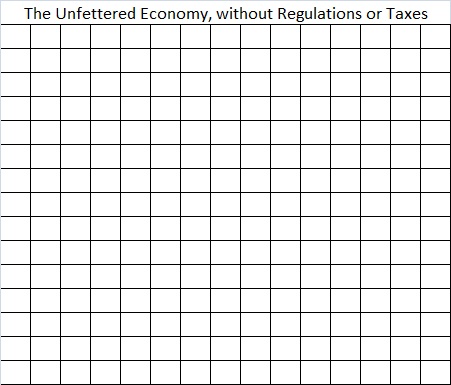
Specialization by economic units and trade between them enables all of them to enjoy more material things than they would if each of the units stood alone. This is “before,” where relatively inefficient economic units stand alone (indicated by the interstices):

With specialization and trade, there can be more economic units, and each of them can make a greater contribution to the output of others:

Taxes shrink the output of economic units by reducing incentives to produce, and by diverting resources to nonproductive, and counterproductive governmental uses. Regulations effectively eliminate many of the units that would otherwise exist and whose products would enable the expansion of all units:

And so, with regulations and taxes as they are today, the economy realizes a fraction of its potential output.

Related posts:
The Price of Government
The Fed and Business Cycles
The Commandeered Economy
The Price of Government Redux
The Mega-Depression
Ricardian Equivalence Reconsidered
The Real Burden of Government
Toward a Risk-Free Economy
The Rahn Curve at Work
The Illusion of Prosperity and Stability
Estimating the Rahn Curve: Or, How Government Inhibits Economic Growth
The Stagnation Thesis
America’s Financial Crisis Is Now
A Keynesian Fantasy Land
The Keynesian Fallacy and Regime Uncertainty

Tax Collector for the Welfare State

That used to be Bob Dole’s informal moniker, because he favored a balanced budget, even if it meant raising taxes to fund the welfare state. It seems that Megan McArdle is stepping into Dole’s shoes. She endorses Standard & Poor’s downgrading of U.S. government debt from AAA to AA+, and S&P’s reasons for the downgrading, including these:

Standard & Poor’s takes no position on the mix of spending and revenue measures that Congress and the Administration might conclude is appropriate for putting the U.S.’s finances on a sustainable footing.

The act calls for as much as $2.4 trillion of reductions in expenditure growth over the 10 years through 2021. These cuts will be implemented in two steps: the $917 billion agreed to initially, followed by an additional $1.5 trillion that the newly formed Congressional Joint Select Committee on Deficit Reduction is supposed to recommend by November 2011. The act contains no measures to raise taxes or otherwise enhance revenues, though the committee could recommend them. (Emphasis added: ED.)

In other words, as far as McArdle is concerned:

  • It doesn’t matter that the federal government’s long-term fiscal path is unsustainable.
  • It doesn’t matter that the path is unsustainable because of present commitments to “entitlement” programs.
  • It doesn’t matter that Republicans have succeeded in pushing the “debate” toward recognition of these facts.

This is not only unprincipled but also stupid.

It’s unprincipled because it means that McArdle — who sometimes calls herself a libertarian, but often talks like a big-government stooge — is willing to sacrifice the financial future of unborn Americans on the altar of a AAA credit rating.

It’s stupid because the debt of the U.S. government will become worthless — AAA rating or not — if it tries to stay the unsustainable course and drives America into the poorhouse by taxing its most productive citizens for the sake of its least productive ones.

The Next 9/11?

Obama has released a paper titled “Empowering Local Partners to Prevent Violent Extremism in the United States.” It ends — as one would expect of a screed bearing Obama’s imprimatur — with a statement of “guiding principles”:

We must continually enhance our understanding of the threat posed by violent extremism and the ways in which individuals or groups seek to radicalize Americans, adapting our approach as needed….

We must do everything in our power to protect the American people from violent extremism while protecting the civil rights and civil liberties of every American….

We must build partnerships and provide support to communities based on mutual trust, respect, and understanding….

We must use a wide range of good governance programs—including those that promote immigrant integration and civic engagement, protect civil rights, and provide social services—that may help prevent radicalization that leads to violence….

We must support local capabilities and programs to address problems of national concern….

Government officials and the American public should not stigmatize or blame communities because of the actions of a handful of individuals….

Strong religious beliefs should never be confused with violent extremism….

Though we will not tolerate illegal activities, opposition to government policy is neither illegal nor unpatriotic and does not make someone a violent extremist….

That must set a record for the highest number of treacly, politically correct, operationally useless and self-defeating statements made in the span of a typewritten page.

If this is how the Obama administration sets about protecting Americans from terrorism, I fear that the next 9/11 isn’t far off.

For example, I challenge the administration to tell me that the following has not happened and cannot happen in the United States:

  • A large but dispersed collection of improvised weapons for improvised, mortar-style attacks has been gathered in and around major U.S. cities and transportation and energy nodes.
  • These weapons are positioned so that their activation, on a massive scale would create havoc and panic — and might well disrupt transportation and communication networks. (With a massive salvo, not every weapon must reach its target.)
  • These weapons can be activated remotely — perhaps through signals transmitted from a single point — so that they can be fired in coordinated waves. Each successive wave disrupts and complicates rescue and recovery efforts that ensue from preceding waves, heightens confusion and panic, and lays the groundwork for economic disaster and political repression.

Obama’s political correctness, I fear, goes hand-in-hand with his demonstrated fecklessness in matters of national security. The intelligence and special operations forces of the United States should be capable of detecting and dismantling a threat of the kind outlined above. But will they be given the necessary resources and leeway? I doubt it.

UPDATE (10/15/15): There are plenty of other cheap and easy ways of killing Americans en masse, making their lives unbearable, or crippling economic activity; for example:

A 2013 attack on an electric substation near San Jose that nearly knocked out Silicon Valley’s power supply was initially downplayed as vandalism by Pacific Gas & Electric Co., the facility’s owner. Gunfire from semiautomatic weapons did extensive damage to 17 transformers that sent grid operators scrambling to avoid a blackout.

But this week, a former top power regulator offered a far more ominous interpretation: The attack was terrorism, he said, and if circumstances had been just a little different, it could have been disastrous.

Jon Wellinghoff, who was chairman of the Federal Energy Regulatory Commission when the shooting took place, said that attack was clearly executed by well-trained individuals seeking to do significant damage to the area, and he fears it was a test run for an even larger assault.

“It would not be that hard to bring down the entire region west of the Rockies if you, in fact, had a coordinated attack like this against a number of substations,” Wellinghoff said Thursday. “This [shooting] event shows there are people out there capable of such an attack.”

Wellinghoff’s warning about the incident at PG&E’s Metcalf substation was reported this week by the Wall Street Journal, expanding on a December report by Foreign Policy magazine.

FBI officials said they are taking the shooting very seriously.

“Based on the information we have right now, we don’t believe it’s related to terrorism,” said Peter Lee, an FBI spokesman in San Francisco. But, he added, “Until we understand the motives, we won’t be 100% sure it’s not terrorism.”

Months after the shooting, the bureau has named no suspects.

Potential terrorism scenarios usually involve elaborate cyberattacks, expertly executed hijackings or smuggled nuclear weapons. But concern grows that California may have come unnervingly close to learning that calamity might just as easily be inflicted by a few well-trained snipers.

As law enforcement tries to piece together who fired at the electricity facility, lawmakers and analysts express bewilderment that little is being done to protect against a repeat performance….

The classified report was completed in 2007 and became public two years ago. Asked what has happened since then to protect the nation’s electricity system, Morgan replied that very little has been done.

The attack on the PG&E facility targeted the sophisticated transformers that are at the backbone of the nation’s electricity grid. The giant pieces of equipment are essential, costly and could take months to replace. Knock out enough of them, experts warn, and an entire region can be crippled for an extended period. They are also typically out in the open like sitting ducks.

On that April night, the attackers managed to disable 17 of them just by shooting through a chain-link fence. The bullet holes caused the transformers to leak thousands of gallons of oil, and ultimately overheat. Grid operators scrambled to reroute power from elsewhere to keep the system from collapse. The power stayed on, but just barely, because it happened during a time when demand for electricity was very low.

“Fortunately it was spring and we did not have air conditioners running full throttle in the morning,” said Stephanie McCorkle, a spokeswoman for the California Independent System Operator in Folsom, which runs most of the state’s electrical grid. “That’s why the situation was manageable.”

Wellinghoff, now a partner at the San Francisco law office Stoel Rives, said the grid’s interdependence on substations across large swaths of the country — and a scarcity of spare equipment — makes it possible to trigger an enduring blackout across several states simply by destroying key transformers in one of them.

Days after the April shooting, Wellinghoff flew out to review the damage with experts from the Pentagon and the FBI. They noticed piles of stones had been set up outside the site, apparently by someone who had scoped it out to guide the snipers. [Evan Halper and Mark Lifsher, “Attack on Electric Grid Raises Alarm,” Los Angeles Times, February 6, 2015]

So, What Now?

The title of this post echoes the title of a post by Victor Davis Hanson. I don’t agree entirely with Hanson’s diagnosis of America’s economic woes and prescription for curing them, but he points in the right general direction. If I were king, this is what I would do to put the U.S. back on the track to long-term economic health:

  • Social Security, Medicare, Medicaid (and the expansions known as Obamacare) would be phased out. By the time today’s youngest workers are ready for retirement, those programs would no longer exist. The ability of individuals to enjoy comfortable, healthy retirement years would depend on their assiduous prudence, financially and physically. (I am not a stranger’s keeper, and vice versa.) Private financial institutions and insurers would be allowed to compete across State lines for the savings and premiums of newly empowered individuals. States and municipalities would maintain any “safety net” for the truly needy (including those who cannot afford the care associated with serious illnesses and disabilities). Profligate grants of aid, leading to higher State and local taxes, would be  punished at the ballot box and by emigration to locales where income and property are not targets of opportunity for demagogic politicians.
  • All other activities of the federal government that are not authorized by the Constitution would be phased out within ten years. That is to say, all “independent” agencies (especially including the Federal Reserve) would be abolished, along with every department but Defense, Justice, State, and Treasury. Any legitimate functions of the other departments and agencies would be folded into the four that remain, and those four would be thoroughly cleansed of illegitimate functions.
  • The preceding actions would negate most regulatory authority. That which remains would revert to Congress, which would no longer be able to delegate law-making to the executive branch, and which would have to make law strictly within the four corners of the Constitution. Specific targets for termination: regulation of resource extraction, “anti-discrimination” programs that in fact discriminate in favor of certain classes of individuals, environmental regulation (except for truly major environmental threats, and only then as authorized by an amendment to the Constitution), anything having to do with “global warming.” the Food and Drug Administration, and federal involvement in occupational licensing.
  • The streamlining of the federal government would be accompanied by a sale of all assets not required for the execution of constitutional functions. Thus would land and buildings become available for private use, personal and commercial.
  • The federal budget would be in balance — at a much lower level — within a decade. A tough balanced-budget amendment would keep it there. Such an amendment would cap federal spending at 10 percent of GDP, with a minimum of 6 percent of GDP going to defense. There would be an exception for a war (or wars) authorized by Congress, if the combat deployment of more than one-fourth of the personnel of the U.S. armed forces. Then, federal spending could exceed 10 percent of GDP, but only to the extent of the additional costs of the authorized war (or wars). Federal revenues would have to match spending in every 10-year period, plus or minus 1 percent of GDP.

These actions would tell Americans — individuals and businesspersons — two important things. First, they are at long last free in their “pursuit of Happiness.” Second, because they are free, they do not have to worry about government changing the “rules of the game” capriciously or swooping in to take away what they’ve earned.

Only with such freedom and certainty can Americans, once again, confidently strive to make better lives for themselves and, in so doing, help their compatriots to make better lives.

This — not speeches, laws, regulations, taxes, spending, debt-ceiling compromises, etc. — is the stuff of a brighter future, a future that fulfills the promise of the Declaration of Independence.

“Insane” Is Overused

Theodore Dalrymple on Anders Behring Breivik, the Norwegian mass-murderer:

It is always hazardous to pronounce on the mental state of someone one had not met, and about whom one knows only a little and third-hand. But all the same, one is tempted…

The first trap to avoid is to say person x did act y because [he] is or has z, and we know he is or has z because he did y. This is circular.

But there does seem to be evidence that Breivik was narcissistic, grandiose, paranoid, socially and sexually inept, and deeply resentful. This is a horrible mixture, though any explanation will always be incomplete and not pluck out the heart of his mystery.

I think it unlikely he is legally insane according to the M’Naghten rules that govern legal insanity in a lot of the English-speaking world. He knew the nature…[a]nd quality of his act and that [it] was (legally) wrong, to use the wording of the rules, and therefore would not be entitled to a verdict of not guilty by reason of insanity. (Posted at The Skeptical Doctor on July 26, 2011.)

Hitler and Stalin often are called “madmen” and “insane” because of the utterly depraved acts that they ordered and condoned. But they were not insane. They were evil.

Evil should not be allowed to hide behind the cloak of insanity.

In Defense of Subjectivism

Andrew Cohen’s latest post at Bleeding Heart Libertarians (“Against Subjectivism“) left me scratching my head, for a while. After a bit of pondering, I was able to sort it out. Here’s the gist of Cohen’s argument:

  • “Many people seem to think that whether a particular act is wrong cannot be determined objectively. Many, indeed, seem to think it is a purely subjective matter….”
  • “[T]he truth of a claim does not depend on my opinion, your opinion, or even our opinion.”
  • “[D]oes the fact—and I now assume we all agree it is a fact—that people have different opinions about whether God exists matter to the objectivity (or lack thereof) of the claim that God exists?”
  • “[T]he answer is obvious: none whatsoever. It is either the case that God exists or it is the case that he does not. One of those is the objective truth.”
  • Therefore, “why should morality … be any different? “

The only logically valid conclusion that one can draw from this disjointed argument is that there is or is not an objective morality: one that holds at all times, in all places, regardless of the varied and differing opinions of individuals. If that is Cohen’s point, I cannot disagree with him.

But Cohen seems to be defending the proposition that there is an objective morality. Consider the title of his post, and consider the following statement from the post:

Others think [morality] is a cultural matter: our society thinks the act is wrong so it is wrong for us; yours does not, so it is not for you. Obviously, I think this is misguided. Indeed, I think we should be seeking truth, where that should be read as “objective truth.”

Regarding morality, I fear that the only objective truths are these:

  • There are differing opinions about the source of morality.
  • There are varying, group-dependent conceptions of morality.
  • Despite the differing opinions and conceptions, moral codes may have key features in common (e.g., the prevalence of the Golden Rule across religions and even among irreligious people).

The commonality of key features proves nothing about the source of morality or its objective existence. It may be God-given; it may reflect an eternal Platonic form, which has an existence of its own; or it may be an culturally transmitted phenomenon that reflects certain “constants” human nature, namely, empathy and self-interest.

Somewhere in there lies an objective truth. My money is on human nature.

Related posts:
Positivism, “Natural Rights,” and Libertarianism
What Are “Natural Rights”?
The Golden Rule and the State
Evolution, Human Nature, and “Natural Rights”
Evolution and the Golden Rule

Who Won the “Debt Debate”?

The first match in the current showdown over government spending goes to the GOP. Not that all Republicans favor the deal that has now been approved by the House and Senate, but it’s clear that Republicans are generally happier than Democrats about the deal.

The votes of House Republicans split 174-66 (for-against), while House Democrats voted 95-95. Senate Republicans voted 28-19; Senate Democrats 46-7 (counting Lieberman and Sanders as Democrats). Senate Republicans who voted against the deal had the comfort of knowing that (a) it had been approved by the House and (b) it was widely expected to be approved by the Senate.

On the whole, Republicans in Congress gave the deal far more support than Democrats:

  • Republican votes in favor — 72 percent of House Republicans, 60 percent of Senate Republicans, and 69 percent of Republicans in the two chambers.
  • Democrat votes in favor — 50 percent of House Democrats; 87 percent of Senate Democrats, and 58 percent of Democrats in the two chambers.

The overall results, I think, are a good gauge of the attitudes in the parties. Republicans have good reason to be happier than Democrats. Obama had to pay a price for getting the debt ceiling raised, and that price (at least for now) consists entirely of spending cuts (inasmuch as reductions in planned spending increases can be called cuts).

Chalk up a victory for Republicans, especially the Tea Party kind. Yes, Tea Partiers would have preferred real spending cuts, but without the pressure they brought to bear on Republican leaders, the outcome would have been far worse — perhaps even Obama’s preferred “clean” increase in the debt ceiling, without any strings attached.

Another thing Tea Partiers should be proud of is that “liberal” Democrats are enraged by the debt deal. (Jonah Goldberg’s take is here.) Their rage is the clearest indication of a Tea-Party-inspired Republican victory.

There are several matches yet to come in this running “debate” about the size of government and its role in the lives of Americans. The most important match will conclude on November 6, 2012, with the election of a president, 435 U.S. representatives, and one-third of U.S. senators. The replacement of Obama by a Republican, coupled with the GOP’s retention of the House and capture of the Senate, would put an end to the “gridlock” in Washington and put the U.S.

The Great Recession Is Not Over

Here is my definition of a recession:

  • two or more consecutive quarters in which real GDP lower than real GDP in an earlier quarter, and
  • the year-over-year change in real GDP is negative in at least one quarter.

The latest GDP estimates from the Bureau of Economic Analysis indicate that the recession continues. By my definition, it has now lasted 14 quarters: 2008Q1 through 2011Q2. Real GDP for 2011Q2 was $13,270.1 billion (annualized rate, chained 2005 dollars), which is lower than the pre-recession peak of $13,326.0, which was reached in 2007Q4. Average annual real growth over the 3.5 years from 2007Q4 to 2011Q2 was -0.12 percent.

If real growth had continued at the 2007Q4 rate of 2.2 percent, real GDP in 2011Q2 would have been about $14,381 billion. That is to say, the shortfall in real GDP, was about 8 percent. Even worse, if real growth had continued at the 1866-1907 rate of 4.3 percent, real GDP would now be about three times its present level. But that is another story, which is told at the preceding link and several of the links at the bottom of this post.

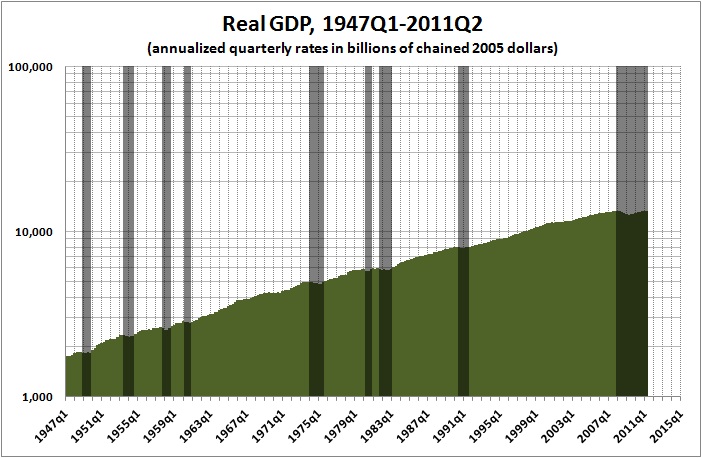
Returning to the main theme of this post, here is how real GDP has fared from 1947Q1 through 2011Q2 (recessions are denoted by vertical bars):

(I have excluded the recession that was in progress as of 1947Q1 for lack of quarterly GDP estimates before that quarter.)

Here is a closer look at the depth and duration of post-war recessions:

Finally, here are year-over-year changes in real GDP, from the first quarter of 1948 through the third quarter of 2010:

This graph, by the way, updates the one I used in “The Price of Government: More Evidence,” where I say:

You will notice two things about the graph. First, the economy is cyclical, thanks in part to the actions of government (e.g., the low-interest, housing-bubble recession). Second, economic growth has declined from an annual rate of around 4 percent to an annual rate of about 2 percent, because of government.

“Because of government” refers to the unrelenting assault on the private (real) economy, in the form of transfers from productive persons to unproductive ones, other government spending, and ever-growing regulatory restrictions.

Related posts:
The Price of Government
The Fed and Business Cycles
The Commandeered Economy
The Price of Government Redux
The Mega-Depression
Ricardian Equivalence Reconsidered
The Real Burden of Government
Toward a Risk-Free Economy
The Rahn Curve at Work
The Illusion of Prosperity and Stability
Estimating the Rahn Curve: Or, How Government Inhibits Economic Growth
The Stagnation Thesis
America’s Financial Crisis Is Now
A Keynesian Fantasy Land
The Keynesian Fallacy and Regime Uncertainty

Stan Greenberg’s Tin Ear

UPDATED 08/08/11

Lefty pollster Stan Greenberg whines that

Barack Obama can’t catch a break from the American public on the economy, even though he prevented a depression and saved global capitalism.

I must have missed something, because all Barack Obama has done for the economy is to dig a deeper debt hole for our descendants — in the form of Obamacare — and waste a lot of resources on his misguided and ineffective “stimulus.” Unemployment remains high because businesses are reluctant to add jobs in the face of Obama’s commitment to environmental correctness and heavy-handed regulation.

All of that aside, Greenberg reveals his political incompetence with this:

When unemployment is high, and the rich are getting richer, you would think that voters of average means would flock to progressives, who are supposed to have their interests in mind — and who historically have delivered for them.

This is the typical leftist’s zero-sum, stagnationist view of economics. Zero-sum because of the implicit belief that the rich are getting richer at the expense of the less-rich. Stagnationist because of the implicit — and mistaken — belief that today individuals and households remain mired in a particular range of the income “distribution,” to which they are assigned for life. Never mind that all ranges of the “distribution” are better off than they were a generation ago, two generations ago, etc. More importantly, individuals and households move freely up and down the “distribution.”*

Greenberg is wrong on an even deeper level. He wants to enlist voters to the “progressive” cause by appealing to class-envy. It might work in desperate times, as it did to some degree during the Great Depression. But it won’t work in these times, which remain hopeful for most Americans. A person who is striving to become richer — even modestly so — doesn’t want to hear lectures about the evil of his striving.

UPDATE: Michael Barone agrees:

[O]rdinary Americans don’t want money as much as they want honor. They want what the chance to achieve what American Enterprise Institute President Arthur Brooks calls “earned success.”

__________
* I put “distribution” in quotation marks because most incomes are not distributed by some power on high, but earned by individuals, who strike bargains with employers and customers. The success of an individual’s bargaining depends heavily on an assessment of the individual’s contributions to the output of products and services. That assessment is delivered by markets for outputs and markets for the labor that contributes to those outputs.

Income is distributed, in the real meaning of the word, when it comes to government employees. They are the recipients of government largesse, and are sheltered from competition and market evaluations of their outputs. (Here is but one example of the general condition of government-employee compensation.)

Creative Destruction, Reification, and Social Welfare

I was prompted to write this post by Mark Perry’s reprise of Walter Williams’s post about creative destruction.

Joseph Schumpeter used the term creative destruction

to describe the process of transformation that accompanies radical innovation. In Schumpeter’s vision of capitalism, innovative entry by entrepreneurs was the force that sustained long-term economic growth, even as it destroyed the value of established companies and laborers that enjoyed some degree of monopoly power derived from previous technological, organizational, regulatory, and economic paradigms.

The Wikipedia article about creative destruction (just quoted) offers an elaboration:

Companies that once revolutionized and dominated new industries – for example, Xerox in copiers or Polaroid in instant photography have seen their profits fall and their dominance vanish as rivals launched improved designs or cut manufacturing costs. Wal-Mart is a recent example of a company that has achieved a strong position in many markets, through its use of new inventory-management, marketing, and personnel-management techniques, using its resulting lower prices to compete with older or smaller companies in the offering of retail consumer products. Just as older behemoths perceived to be juggernauts by their contemporaries (e.g., Montgomery Ward, FedMart, Woolworths) were eventually undone by nimbler and more innovative competitors, Wal-Mart faces the same threat. Just as the cassette tape replaced the 8-track, only to be replaced in turn by the compact disc, itself being undercut by MP3 players, the seemingly dominant Wal-Mart may well find itself an antiquated company of the past. This is the process of creative destruction in its technological manifestation.

Other examples are the way in which online free newspaper sites such as The Huffington Post and the National Review Online are leading to creative destruction of the traditional paper newspaper. The Christian Science Monitor announced in January 2009 that it would no longer continue to publish a daily paper edition, but would be available online daily and provide a weekly print edition. The Seattle Post-Intelligencer became online-only in March 2009.  Traditional French alumni networks, which typically charge their students to network online or through paper directories, are in danger of creative destruction from free social networking sites such as Linkedin and Viadeo.

In fact, successful innovation is normally a source of temporary market power, eroding the profits and position of old firms, yet ultimately succumbing to the pressure of new inventions commercialised by competing entrants. Creative destruction is a powerful economic concept because it can explain many of the dynamics or kinetics of industrial change: the transition from a competitive to a monopolistic market, and back again….

So far, so good. But then the article implicitly adopts the reification (or hypstatization) fallacy and explicitly endorses the idea of a social-welfare function:

Creative destruction can cause temporary economic distress. Layoffs of workers with obsolete working skills can be one price of new innovations valued by consumers. Though a continually innovating economy generates new opportunities for workers to participate in more creative and productive enterprises (provided they can acquire the necessary skills), creative destruction can cause severe hardship in the short term, and in the long term for those who cannot acquire the skills and work experience.

However, some believe that in the long-term society as a whole (including the descendants of those that experienced short-term hardship) enjoys a rise in overall quality of life due to the accumulation of innovation – for example, 90% of Americans were farmers in 1790, while 2.6% of Americans were farmers in 1990. Over those 200 years farm jobs were destroyed by exponential productivity gains in agricultural technology and replaced by jobs in new industries. Present day farmers and non-farmers alike enjoy much more prosperous lifestyles than their counterparts in 1790.

The reification (or hypostatization) fallacy, which is implicit in the first paragraph of the preceding quotation, is that creative destruction is an actual force which is responsible for good and bad things: better jobs for some workers, worse jobs or none for other workers. But creative destruction is merely a term that refers to the consequences of innovation and entrepreneurship. And these are merely labels for types of activity that are as old as mankind — normal, non-pathological behavior. The results may seem “good” or “bad” to particular individuals, but creative destruction is neither “good” nor “bad.” To evaluate creative destruction in such terms makes no more sense than calling the results of evolution “good” or “bad.” The results of creative destruction, like the results of evolution, are what they are — nothing more, nothing less.

Which points to the second fallacy, which is  explicit in the second paragraph of the preceding quotation. The writer attempts to reconcile the “good” and “bad” results of creative destruction by appealing to the net effect of those results on social welfare (“quality of life”). On that subject, I borrow from myself:

How can a supposedly rational [commentator] imagine that the benefits accruing to some persons … somehow cancel the losses of other persons … ? There is no valid mathematics in which A’s greater happiness cancels B’s greater unhappiness.

By the same token, there is no valid mathematics by which the happiness of a group, or nation, can be summed over time, to justify past hardships in terms of present comforts. Individuals can, and do, make such calculations for themselves when they decide whether or not to postpone current consumption for the sake of obtaining a future goal (a house, retirement, etc.). But those individual calculations cannot be summed, because each individual is making decisions for the sake of his or her unique vision of happiness.

The farm laborers of the past, whose jobs went a-glimmering with the rise of mechanization and other agricultural advances, cannot be compensated by the consumers of today. Those jobs went a-glimmering, in the way that species go extinct, and that is that.

If you (or I) choose to think privately of such outcomes in terms of “bad” and “good,” and react accordingly (e.g., with charitable contributions to help the jobless), the thought and action are legitimate, but personal. “Bad” and “good” have no place in characterizations of unintentional phenomena, such as (the badly named) creative destruction.

Related posts:
Greed, Cosmic Justice, and Social Welfare
Positive Rights and Cosmic Justice
The Interest-Group Paradox
Inventing “Liberalism”
Freedom of Will and Political Action
Law and Liberty
Rights, Liberty, the Golden Rule, and the Legitimate State
Line-Drawing and Liberty
The Divine Right of the Majority
Our Enemy, the State
The Golden Rule and the State
A Not-So-Fine Whine
Social Justice
The Meaning of Liberty
Taxing the Rich
More about Taxing the Rich
Peter Presumes to Preach
More Social Justice
Positive Liberty vs. Liberty
On Self-Ownership and Desert
Luck-Egalitarianism and Moral Luck

Compromise, Democrat Style

David P. Barash — a professor of psychology at the University of Washington and the co-author of Payback: Why We Retaliate, Redirect Aggression and Seek Revenge — unwittingly reveals his psyche in a NYT op-ed, “Washington’s Rogue Elephants.” In Barash’s unsubtle symbolism, “rogue elephants” refers to Republicans, as he views their role in the present debate (if you can call it that) about the debt ceiling and how to avoid a default by the federal government.

Barash seems, not unsurprisingly given his profession and political leanings, to be plagued by prolonged adolescent rebellion. The rebellion, in this case, is against fiscally responsible authority figures in the Republican Party. The giveaway is Barash’s concluding comments:

[G]iven the Republicans’ continued insistence on an unobtainable wish list of spending cuts and constitutional amendments, it’s fair to conclude that Mr. Obama is facing the political equivalent of an elephant in must — a player who simply won’t play the game.

In the 1983 movie “WarGames,” an errant military supercomputer has a final moment of lucidity in which it notes, “The only winning move is not to play.” The president is best advised to do the same: declare that the other side has foregone all pretense at rational legitimacy, and simply proceed to govern as best he can for the good of the country.

This is leftist fantasizing. Obama can’t simply “govern” without Congress; it’s not up to him to decide how much to spend, nor can he constitutionally ignore the debt ceiling.

More generally, Barash hews to the typical leftist view that it’s up to Republicans to compromise; thus “the Republicans’ continued insistence on an unobtainable wish list of spending cuts and constitutional amendments.” But those things aren’t unobtainable or mere wishes; Democrats simply refuse to agree to them.

The current crisis is a spending problem. Republicans helped to create the problem, but most of them are adult enough to face up to it and offer ways to deal with it. Democrats seem unable to detach themselves from their vision of government as Santa Claus.

Democrats are suffering from a delusional disorder, but it’s evident that Barash doesn’t have the psychological chops to cure them of it.

Related posts:
Conservatism, Libertarianism, and “The Authoritarian Personality”
The F-Scale, Revisited
The Psychologist Who Played God
America’s Financial Crisis Is Now
Questioning the National Debt
Tax Expenditures Are Not Expenditures
My Negotiating Position on the Federal Debt
Miss Brooks’s “Grand Bargain”
A Tax Is a Tax Is a Tax

A Tax Is a Tax Is a Tax

Some people just don’t get it. A closed loophole is a tax increase, not the end of a tax expenditure. See this.

Now, to be clear, I’m not defending the fact that some people benefit from “loopholes.” I would just as soon abolish all tax codes throughout the U.S., and start over from scratch. I would finance federal, State, and local governments entirely with income taxes, and have one tax rate with no exemptions, deductions, etc. There would be a basic federal rate, to which States and localities could add their own rates. Clarity about the effective tax rates of various States and localities would help businesses and individuals make better decisions about where to locate.

Maybe I’ll start a petition for a constitutional amendment that implements my modest proposal.

The Golden Rule as Beneficial Learning

I have argued that cooperative behavior and mutual restraint — the bulwarks of civil society and liberty — arise from observance of the Golden Rule. (See this, this, and this, for example.)  There is some new evidence for the importance of the Golden Rule as a regulatory mechanism:

Despite the fact that cooperation in one-shot interactions is viewed as both biologically maladaptive and economically irrational, it is nonetheless behaviorally widespread in our species. This apparent anomaly has posed a challenge to well-established theories in biology and economics, and it has motivated the development of a diverse array of alternatives—alternatives that seem to either conflict with known selection pressures or sensitively depend on extensive sets of untested assumptions.

These alternatives all assume that one-shot cooperation is an anomaly that cannot be explained by the existence of cooperative architectures that evolved for direct reciprocity. Our main results show that this assumption is false: organisms undergoing nothing but a selective regime for direct reciprocity typically evolved to cooperate even in the presence of strong evidence that they were in one-shot interactions. Indeed, our simulated organisms can form explicit beliefs that their interactions are one-shot and, nonetheless, be very likely to cooperate. By explicitly modeling the informational ecology of cooperation, the decision-making steps involved in operating in this ecology, and selection for efficiently balancing the asymmetric costs of different decision errors, we show that one-shot cooperation is the expected expression of evolutionarily well-engineered decision-making circuitry specialized for effective reciprocity.

This cooperation-elevating effect is strong across broad regions of parameter space. Although it is difficult to precisely map parameters in simplified models to real-world conditions, we suspect that selection producing one-shot generosity is likely
to be especially strong for our species. The human social world—ancestrally and currently—involves an abundance of high-iteration repeat interactions and high-benefit exchanges. Indeed, when repeated interactions are at least moderately long, even modest returns to cooperation seem to select for decision architectures designed to cooperate even when they believe that their interaction will be one-shot. We think that this effect would be even stronger had our model included the effects of forming reputations among third parties. If defection damages one’s reputation among third parties, thereby precluding cooperation with others aside from one’s current partner, defection would be selected against far more strongly (44). Therefore, it is noteworthy that cooperation given a one-shot belief evolves even in the simple case where selection for reputation enhancement cannot help it along. It is also worth noting that a related selection pressure—defecting when you believe your partner will not observe you—should be subject to analogous selection pressures. Uncertainty and error attach to judgments that one’s actions will not be observed, and the asymmetric consequences of false positives and misses should shape the attractiveness of defection in this domain as well.

In short, the conditions that promote the evolution of reciprocity—numerous repeat interactions and high-benefit exchanges—tend to promote one-shot generosity as well. Consequently, one-shot generosity should commonly coevolve with reciprocity. This statement is not a claim that direct reciprocity is the only force shaping human cooperation—only that if reciprocity is selected for (as it obviously was in humans), its existence casts a halo of generosity across a broad
variety of circumstances.

According to this analysis, generosity evolves because, at the ultimate level, it is a high-return cooperative strategy. Yet to implement this strategy at the proximate level, motivational and representational systems may have been selected to cause generosity even in the absence of any apparent potential for gain.Human generosity, far from being a thin veneer of cultural conditioning atop a Machiavellian core, may turn out to be a bedrock feature of human nature. (Andrew W. Delton, Max M. Krasnow, Leda Cosmides, and John Tooby, “Evolution of direct reciprocity under uncertainty can
explain human generosity in one-shot encounters
,” Proceedings of the National Academy of Science, Early Edition, July 25, 2011.)

The authors assume but offer no evidence that one-shot cooperation is an evolutionarily acquired trait. A stronger position  is that one-shot cooperation is a culturally transmitted trait. In any event, the authors’ findings underscore the importance of the Golden Rule to liberty. As I say in ““Evolution, Human Nature, and ‘Natural Rights,”

the Golden Rule represents a social compromise that reconciles the various natural imperatives of human behavior (envy, combativeness, meddlesomeness, etc.). Even though human beings have truly natural proclivities, those proclivities do not dictate the existence of “natural rights.” They certainly do not dictate “natural rights” that are solely the negative rights of libertarian doctrine. To the extent that negative rights prevail, it is as part and parcel of the “bargain” that is embedded in the Golden Rule; that is, they are honored not because of their innateness in humans but because of their beneficial consequences.

Does “Pent Up” Demand Explain the Post-War Recovery?

Russ Roberts wonders about the meaning of “pent up” demand:

The usual way that Keynesians explain the post-[World War II] expansion despite the huge cut in government spending is to say, well of course the economy boomed, there was a lot of pent-up demand. What does that mean? There is always pent-up demand in the sense there is a stuff I wish I could have but can’t. But the standard story is that people couldn’t buy washing machines or cars during the war–they were rationed or simply unavailable or unaffordable. So when the war ended, and rationing and price controls ended, people were eager to buy these things. But the reason these consumer goods were rationed or unavailable is because all the steel went into the tanks and planes during the war. So when the war ended, there was steel available to the private sector. That’s why cutting government activity can stimulate the private sector. Fewer resources are being commandeered by the public sector.

Roberts refers to an earlier post of his, in which he rightly ridicules Keynesians for believing in the magical multiplier:

One of the most mindless aspects of the multiplier is to treat is as a constant, such as 1.52. It can’t be a constant, not in any meaningful way. If the government conscripted half of the US population to dig holes all day and conscripted the other half to fill them back in, and paid each of us a billion dollars a day for the task, and valued holes that were dug and holes that were filled in at a trillion dollars a hole, then GDP would be very very large, unemployment would be zero and there would be no stimulating effect and we would soon be dead from starvation.

Priceless.

I share Roberts’s disdain for the multiplier. (See this and this.)

Nevertheless, the availability of resources for private use after the war ended is only half the story. Consumers and businesses had to demand things — not just want them, but demand them with money in hand. That is where pent-up demand comes into play, as I explain here:

Conventional wisdom has it that the entry of the United States into World War II caused the end of the Great Depression in this country. My variant is that World War II led to a “glut” of private saving because (1) government spending caused full employment, but (2) workers and businesses were forced to save much of their income because the massive shift of output toward the war effort forestalled spending on private consumption and investment goods. The resulting cash “glut” fueled post-war consumption and investment spending.

Robert Higgs, research director of the Independent Institute, has a different theory, which he spells out in “Regime Uncertainty: Why the Great Depression Lasted So Long and Why Prosperity Resumed After the War” (available here), the first chapter his new book, Depression, War, and Cold War. (Thanks to Don Boudreaux of Cafe Hayek for the pointer.) Here, from “Regime Change . . . ” is Higgs’s summary of his thesis:

I shall argue here that the economy remained in the depression as late as 1940 because private investment had never recovered sufficiently after its collapse during the Great Contraction. During the war, private investment fell to much lower levels, and the federal government itself became the chief investor, directing investment into building up the nation’s capacity to produce munitions. After the war ended, private investment, for the first time since the 1920s, rose to and remained at levels sufficient to create a prosperous and normally growing economy.

I shall argue further that the insufficiency of private investment from 1935 through 1940 reflected a pervasive uncertainty among investors about the security of their property rights in their capital and its prospective returns. This uncertainty arose, especially though not exclusively, from the character of federal government actions and the nature of the Roosevelt administration during the so-called Second New Deal from 1935 to 1940. Starting in 1940 the makeup of FDR’s administration changed substantially as probusiness men began to replace dedicated New Dealers in many positions, including most of the offices of high authority in the war-command economy. Congressional changes in the elections from 1938 onward reinforced the movement away from the New Deal, strengthening the so-called Conservative Coalition.

From 1941 through 1945, however, the less hostile character of the administration expressed itself in decisions about how to manage the warcommand economy; therefore, with private investment replaced by direct government investment, the diminished fears of investors could not give rise to a revival of private investment spending. In 1945 the death of Roosevelt and the succession of Harry S Truman and his administration completed the shift from a political regime investors perceived as full of uncertainty to one in which they felt much more confident about the security of their private property rights. Sufficiently sanguine for the first time since 1929, and finally freed from government restraints on private investment for civilian purposes, investors set in motion the postwar investment boom that powered the economy’s return to sustained prosperity notwithstanding the drastic reduction of federal government spending from its extraordinarily elevated wartime levels.

Higgs’s explanation isn’t inconsistent with mine, but it’s incomplete. Higgs overlooks the powerful influence of the large cash balances that individuals and corporations had accumulated during the war years. It’s true that because the war was a massive resource “sink” those cash balances didn’t represent real assets. But the cash was there, nevertheless, waiting to be spent on consumption goods and to be made available for capital investments through purchases of equities and debt.

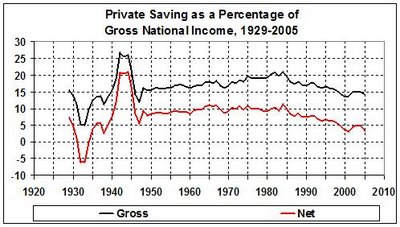
It helped that the war dampened FDR’s hostility to business, and that FDR’s death ushered in a somewhat less radical regime. Those developments certainly fostered capital investment. But the capital investment couldn’t have taken place (or not nearly as much of it) without the “glut” of private saving during World War II. The relative size of that “glut” can be seen here:

Derived from Bureau of Economic Analysis, National Income and Product Accounts Tables: 5.1, Saving and Investment. Gross private saving is analagous to cash flow; net private saving is analagous to cash flow less an allowance for depreciation. The bulge in gross private saving represents pent-up demand for consumption and investment spending, which was released after the war.

World War II did bring about the end of the Great Depression, not directly by full employment during the war but because that full employment created a “glut” of saving. After the war that “glut” jump-started

  • capital spending by businesses, which — because of FDR’s demise — invested more than they otherwise would have; and
  • private consumption spending, which — because of the privations of the Great Depression and the war years — would have risen sharply regardless of the political climate.

The post continues with an exchange between Higgs and me. The bottom line is the same.

What is the answer to the title question, then? It is that a period of forced, nominal saving can create pent-up demand, which can result in the employment of resources that had theretofore been unavailable. The pent-up demand at the end of World War II was, in great measure, responsible for the post-war recovery.

This rare phenomenon has nothing to do with the multiplier, and probably has nothing to do with the current economic situation. Government has commandeered a large chunk of the American economy, but so gradually that Americans have not acquire a “glut” of nominal savings, as they did in World War II.

Temporal and Spatial Agreement

A headline reads, “Gunman kills self, 5 others, at Texas roller rink.” It can’t be done that way, unless the gunman kills himself and the fiver others are killed later by a mechanism that the gunman had activate. But that’s not what happened. The gunman killed fiver persons, then turned the gun on himself. A headline or sentence should give clear and accurate description of an event by “mapping” the event, temporally or spatially. In this case, the correct temporal mapping is “Gunman kills 5, then self, at Texas roller rink,” which puts events in their correct  order.

A mapping error that I encounter often is the to-from locution, as in “the average price of gasoline rose to $3.88 a gallon from $3.79 a gallon.” That’s backwards. To be clear, a sentence should treat time sequentially; that is, the first thing that happens should precede the second thing that happens, and so on. In this case, clarity is achieved by writing or saying “the price of gasoline rose from $3.79 a gallon to $3.88 a gallon.” Doing it the other way around forces the reader or listener to go to the trouble of mentally unscrambling the statement. This is especially troublesome for a listener, who may then miss what comes next.

The to-from locution also is frequently (mis)applied to spatial relations, as in “X went to Chicago from New York.” If New York is the starting point of a journey, then New York should be mentioned first: “X went from New York to Chicago.” Again, doing it the other way around forces the reader or listener to unscramble the statement.

In sum, temporally and spatially backward statements cause  readers and listeners to do the work that is properly done by writers and speakers — if they care about the clarity and accuracy of what they write and say. It is all too evident that many writers and speakers do not care about being understood; they prefer to deliver verbiage and let the audience sort it.

The Social Security Trust Fund Is Not a “Get Out of Jail Free Card”

UPDATED BELOW

David Friedman, drawing on an op-ed by Thomas Saving, suggests that

Obama may have a $2.7 trillion dollar get out of jail free card, a way of spending that much additional money without exceeding the debt limit.

How does that work? Friedman explains:

Suppose no agreement is reached on raising the debt limit. Obama instructs the relevant people to spend the income from Social Security on the war in Afghanistan, bailouts, whatever he thinks needs money. He then instructs the Social Security system to cash in as many bonds as are required to meet its obligations to Social Security recipients, say $700 billion. He then instructs the treasury, since the national debt is now $700 billion below the debt limit, to borrow $700 billion. The net effect is that he has increased total expenditure, Social Security included, by $700 billion without exceeding the debt limit. The trust fund is currently at about $2.7 trillion, so he can do it for four more years.

Friedman’s scheme would work only if total federal receipts (including Social Security taxes) remain greater than or equal to total federal outlays (including SS benefits), from the point at which federal indebtedness hits the statutory ceiling. But that is not the situation.

Let us say, for the sake of argument, that the ceiling will be reached at the end of FY 2011. The president’s budget for FY 2012 shows total outlays of $3.729 trillion (including SS benefits of $0.761 T) and total revenues of $2.626 T (including SS taxes of $0.660 T). (See tables S-1 and S-3, here.) In other words, if Congress passes the president’s budget exactly as it stands, the debt ceiling must rise by $1.103 T ($3.729 T – $2.626 T) in FY 2012. And the SS trust fund, no matter how large it is, cannot alter the arithmetic.

Here is why. Suppose the feds spend all $0.660 T in SS taxes on things other than SS benefits (as they will, in effect). From an accounting standpoint, that reduces the non-SS deficit for FY 2012 from $1.001 T (non-SS spending less non-SS receipts) to $0.341 T. But the folks at SS are faced with a bill for $0.761 T in SS benefits. To pay the bill without having received a dime in SS taxes, the SS folks must go to the SS trust fund and grab U.S. treasury bonds with a value of $0.761 T, which they must then present to Tim Geithner for payment. Geithner thinks, “Who are these fools? Do they imagine that I’ve got that much unencumbered cash lying around, when I’m over my head in debt and sinking fast?” But being a good Obamanite, Geithner gives the SS folks their $0.761 T, and they go away happy.

If the analysis stops there, Friedman is correct. The treasury has just redeemed $0.761 T in bonds held by the SS trust fund, and the total debt of the federal government has magically dropped by $0.761 T. But the analysis cannot stop there, because the treasury does not have the $0.761 T in unencumbered cash. It must now borrow $0.761 T, to cover the redemption of the SS trust fund bonds, plus another $0.341 T, to cover the amount by which non-SS outlays exceed total receipts (including the SS taxes that it intercepts). With rounding, that comes to $1.103 T, which just happens to be the amount by which total federal outlays exceed total federal receipts.

Under what conditions would Friedman’s fix work? Here is a list (perhaps not an exhaustive one):

  • The debt ceiling will not be reached, given current projections of federal outlays and receipts (including SS benefits and taxes).
  • The debt ceiling has been reached but will not be exceeded, given current projections of federal outlays and receipts (including SS benefits and taxes).
  • The debt ceiling has been reached, but the surplus from non-SS programs will offset the deficit in SS accounts, or vice versa.

What about the SS trust fund? As long as the federal government is in debt by at least the face value of the SS trust fund, the trust fund has no real value. There is one (unlikely) saving condition, which is that the government’s net worth — represented by real assets — is equal to or greater than the face value of the trust fund. Such assets would have to be authorized for sale, by law, and would have to be valued at their quick-sale price on the open market. Given the reluctance with which Congress and federal agencies part with valuable assets (mainly land), it will be a cold day on the Equator before the SS trust fund is more than a valueless collection of accounting entries.

UPDATE (07/25/11)

The crux of my objection to Friedman’s scheme is found in the original post and my reply to his first comment; viz.:

If the analysis stops there, Friedman is correct. The treasury has just redeemed $0.761 T in bonds held by the SS trust fund, and the total debt of the federal government has magically dropped by $0.761 T. But the analysis cannot stop there, because the treasury does not have the $0.761 T in unencumbered cash….

*     *     *

3. This intra-governmental transaction does not affect the revenues that SS and non-SS receive from third parties.

4. Total spending by SS and non-SS must therefore equal their total receipts from third parties.

I ended my reply with this observation:

If you disagree with this analysis, then you and/or I must be making some assumptions (perhaps inadvertently) that remain hidden from view….

As it turns out, Friedman was making a hidden assumption that allows his scheme to work. That hidden assumption is revealed in a note appended to Friedman’s original post. The note was not there when I published this post, and I was unaware of it when I replied to Friedman’s first comment. In fact, I was unaware of it until late yesterday, when I revisited this post and Friedman’s after receiving his second comment. The note reads:

Some readers seem puzzled as to where the Treasury, in my story, is to find the $700 billion that it is to pay to the Social Security Administration, once the debt limit is reached. The answer is straightforward. With or without a debt limit, the federal government is continually collecting money and spending it. In my scenario, the government takes (say) $50 billion that it was supposed to pay as salary to federal employees, pays it to SSA instead. SSA cancels $50 billion in trust fund bonds. The national debt, which includes the debt owed by the federal government to the SSA, is now $50 billion below the limit, so the Treasury borrows $50 billion and pays out salaries to federal employees. Rinse and repeat as many times as necessary.

This is too clever by half. It requires exquisite timing on the part of the Treasury; otherwise, payrolls are not met, vendors are not paid, and existing debt is not serviced. In other words, the federal government would be in constructive default and violation of the debt limit. Moreover, it most certainly would not allow the federal government’s outlays to exceed its revenues over an extended period, which is why Obama seeks a higher debt limit in the first place. I could stop there, but there’s more to say about the scheme.

It resembles check-kiting, and may be just as illegal. But even if it is not illegal, it amounts to a patent evasion of the debt limit, and the evasion soon would be obvious to knowledgeable observers. Among other things, financial markets probably would react as if the federal government were in default — because the scheme could sooner or later result in a default of some kind (especially if outlays are rising as revenues stay flat). It would not take an act of Congress (over Obama’s veto) to put an end to the scheme; financial markets would do the job, as Treasury would be unable to refinance existing debt, except (possibly) at exorbitant interest rates.

In the best case, climbing interest payments would eat up revenues and force the federal government to cut back on the actual operations and programs. The result would be exactly opposite the one desired by Obama and company, which is real expansion of government. In the worst case, the Federal Reserve would pick up the tab, if it could scrape together a voting majority with the stomach for wading into a political firestorm. But that is another deus ex machina — of dubious durability — and not a surefire way of getting around the debt limit.

I am through with this subject. Comments are closed.

UPDATE (06/08/14)

I note, very belatedly, that Friedman later amended his post to add this:

A friend who knows much more law than I do writes:

It turns on, on further research, that Congress anticipated and prevented the very trick you have devised. Public Law 104-121, section 107(a), prohibits redemption of Social Security trust fund securities prior to maturity for any purpose other than the payment of benefits or administrative expenses.So it’s still true that the debt limit cannot block social security payments, at least until the trust fund runs out. But my multi-trillion dollar get out of jail free card has been cancelled.

Curses, foiled again.

Friedman later wrote a post that is properly focused on the ability of the federal government to continue paying SS benefits, regardless of the debt ceiling, as long as the trust fund is sufficiently large. The trustees expect the fund to be exhausted in 2033.

Miss Brooks’s “Grand Bargain”

The idiot known as David Brooks — The New York Times‘s idea of a conservative — is true to form today:

Imagine you’re a member of Congress. You have your own preferred way to reduce debt. If you’re a Democrat, it probably involves protecting Medicare and raising taxes. If you’re a Republican, it probably involves cutting spending, reforming Medicare and keeping taxes low.

Your plan is going nowhere. There just aren’t the votes. Meanwhile, the debt ceiling is fast approaching and a national catastrophe could be just weeks away.

At the last minute, two bipartisan approaches heave into view. In the Senate, the “Gang of Six” produces one Grand Bargain. Meanwhile, President Obama and John Boehner, the House speaker, have been quietly working on another. They suddenly seem close to a deal.

There’s a lot you don’t know about these two Grand Bargains….

You are being asked to support a foggy approach, not a specific plan. You are being asked to do this even though you have no faith in the other party and limited faith in the leadership of your own. You are being asked to risk your political life for an approach that bears little resemblance to what you would ideally prefer.

Do you do this? I think you do….

You do it because while the Grand Bargains won’t solve most of our fiscal problems. They will produce some incremental progress. We won’t fundamentally address the debt until we control health care inflation….

Both Grand Bargains produce real fiscal progress. They aim for $3 trillion or $4 trillion in debt reduction. Boehner and Obama have talked about raising the Medicare eligibility age and reducing Social Security benefit increases. The White House is offering big cuts in exchange for some revenue increases, or small cuts in exchange for few or none. The Gang of Six has a less-compelling blend of cuts, but it would repeal the Class Act, a health care Ponzi scheme. It would force committees across Congress to cut spending, and it would introduce an enforcement mechanism if they don’t. Sure there’s chicanery, but compared with any recent real-life budget, from Republican or Democratic administrations, these approaches are models of fiscal rectitude.

You do it because both bargains would boost growth. The tax code really is a travesty and a drag on the country’s economic dynamism. Any serious effort to simplify the code, strip out tax expenditures and reduce rates would have significant positive effects — even if it raised some tax revenues along the way….

In other words, Republicans should simply give in, on Miss Brooks’s say-so.

But Miss Brooks doesn’t know what he’s talking about.

First, with respect to “health care inflation,” government is the problem, not the solution. There are two key reasons for rising health-care prices, aside from innovation that yields expensive but effective drugs, procedures, and equipment. They are (a) the tax break that enables employers to subsidize employees’ health plans and (b) the subsidization of old folks’ health care via Medicare and (indirectly) SS. Those two interventions result in the overuse of health-care products and services. (There’s a 25-year old but still valid RAND study on the subject.) A far better system — if one insists on government involvement — would be to provide means-tested vouchers that can be redeemed for a  limited menu of vital medical products and services (e.g., critical surgeries, cardiovascular medications, chemotherapy). That’s it — no more Medicare, Medicaid, or their expansion via Obamacare.

Second, with respect to “tax expenditures” — there ain’t no such thing. Any action that results in higher taxes is a tax increase, no matter what Miss Brooks and his fellow Democrats choose to call it. And tax increases are growth inhibitors, not growth stimulators.

So much for the wisdom of The New York Times‘s pet “conservative.”

Related posts:
The Laffer Curve, “Fiscal Responsibility,” and Economic Growth
Our Miss Brooks
Rationing and Health Care
The Perils of Nannyism: The Case of Obamacare
More about the Perils of Obamacare
Health-Care Reform: The Short of It
Toward a Risk-Free Economy
Undermining the Free Society
The Constitution: Original Meaning, Corruption, and Restoration
The Unconstitutionality of the Individual Mandate
Does the Power to Tax Give Congress Unlimited Power?
Does Congress Have the Power to Regulate Inactivity?
“Tax Expenditures” Are Not Expenditures
My Negotiating Position on the Federal Debt

My Negotiating Position on the Federal Debt

Democrats’ insistence on ramming Obamacare through  Congress is a key ingredient of the dire long-term fiscal outlook. The supposed 10-year “savings” from Obamacare are phony — a matter of timing and “cuts” that will never happen.

Therefore, if I were at the negotiating table, I would insist on rescinding the O-bomanation or taking the equivalent in cuts to Medicare, Medicaid, and/or Social Security. My argument would run like this: Obamacare cost Democrats the House and it has yet to kick in, except in small ways. So, if you Democrats agree to rescind Obamacare — or, to save face, agree to cuts of equal magnitude in Medicare, Medicaid, and Social Security — we Republicans will allow you to take credit for averting a default while undoing a politically poisonous act.

With that out of the way, we can talk about the rest of the deficit-reduction package. I am open to changes in the tax code (e.g. elimination of certain deductions and loopholes), as long as long as total tax revenues do not exceed 19 percent of GDP. You Democrats can choose ways to meet that target with cuts in addition to those I’ve already discussed. Defense is off-limits, but everything else is on the table, including farm subsidies and corporate welfare.

Finally, as a bonus, I’m giving you a chance to sign on to a balanced-budge amendment. You don’t have to campaign in support of it when it goes to the States for ratification, but most of you would reap a political dividend by voting for its passage by Congress.

Don’t say I never did you a favor.

The Keynesian Fallacy and Regime Uncertainty

In “A Keynesian Fantasy Land,” I gave six reasons for the failure of “stimulus” spending to stimulate the economy, despite the insistence of leftists and left-wing economists that economic salvation is to be found in bigger government. The reasons, which I elaborate in the earlier post, are these:

1. “leakage” to imports

2. disincentivizing effects of government borrowing and spending (regime uncertainty)

3. timing and targeting problems (spending that is too late and misdirected)

4. reversed causality (lower aggregate demand as symptom, not cause)

5. the negative consequences of bail-outs

6. the unaccounted for complexity of human behavior

An article by Casey B. Mulligan, “Simple Analytics and Empirics of the Government Spending Multiplier and Other ‘Keynesian’ Paradoxes,” underscores the futility of “stimulus” spending. These are among Mulligan’s conclusions:

From a partial equilibrium perspective, it would be surprising if government purchases did not crowd out at least some private consumption, and that a reduction in factor supply did not result in less output. Yet some “New Keynesian” models, not to mention much public policy commentary, claim that today’s economy has turned this partial equilibrium reasoning on its head, even while it might have been historically valid. Among other things, individual firms and the aggregate private sector are alleged to leave their production invariant to changes in factor supply conditions during this recession. This paper shows how the government spending multiplier and the “paradox of toil” are related in theory, and examines evidence from this recession on the output effects of factor supply…

This paper does not contain a numerical estimate of the government purchases multiplier. However, its examination of data exclusively from the 2008-9 recession suggests that sectoral and aggregate employment and output vary with supply conditions in much the same way they did before the recession. The results contradict Keynesian claims that the government purchases multiplier would be significantly greater during the recession than it was before 2008, suggesting instead that historical estimates of the effects of fiscal policies are informative about fiscal policy effects in more recent years. Moreover, the supply incentives created by government spending cannot be ignored merely because 2008 and 2009 were recession years; rather incentives mattered as much as ever. Government purchases likely moved factors away from activities that would have supported private purchases. Unemployment insurance, food stamps, and other expanding means-tested government programs likely reduced employment and output during this recession, in much the same way they did in years past.

Compounding the futility of “stimulus” spending is the general climate of economic fear that Obama’s policies have engendered; for example:

Thanks to Regulatory Burdens, We’ve Got Both A Creditless Recovery and A Jobless Recovery (at Carpe Diem)

Why aren’t we seeing a jobs recovery? Maybe it’s ObamaCare’s fault (at Questions and Observations)

Home Depot Founder: Obama’s Regulations Are Killing Businesses (at Commentary)

As John Steele Gordon points out,

[t]he greatest periods of American economic growth came when taxes were very low—such as in the 19th century—or being lowered and simplified, as in the 1920s, 60s, and 80s. Inescapably, to tax wealth creation is to discourage it. But there is a large and politically potent segment of the population that, because its interests are now aligned with those of the government, seek to promote dependency through entitlements. This segment favors ever higher taxes (although they disguise the fact by demanding that only “the rich” pay their “fair share.”) But, as with regulation, high taxes inevitably produce low growth—and low growth threatens entitlements in the long term. If the United States remains in the doldrums for several more years without hope of a real turnaround, Medicare as it is currently constituted will go bankrupt in 2019. Raising taxes to prevent that will only slow overall growth, and that will actually defeat the purpose of saving Medicare.

So there is really no alternative to pursuing policies that encourage economic growth through private action by liberating the forces of the free market. A presidential candidate who finds a way to ground his economic policies in this core truth—and harnesses the idea to a larger and more optimistic understanding of the United States, both past and future, and resists the take-your-medicine tone that dominates the conservative policy discussion of the present moment—will be able to draw a sharp and effective contrast with the failures of the Obama years. (“Growth: The Only Way out of This Mess,” Commentary, July 2011)

But there is no point in cutting taxes unless government spending is cut — and cut drastically — for government spending, along with regulation, is the real drag on the economy. Only in the left’s magical thinking is government spending a good thing. In reality, it is a destructive force — even during recessions and depressions.

Related posts:
The Causes of Economic Growth
A Short Course in Economics
Addendum to a Short Course in Economics
The Indivisibility of Economic and Social Liberty
The Price of Government
The Fed and Business Cycles
The Price of Government Redux
The Mega-Depression
Ricardian Equivalence Reconsidered
The Real Burden of Government
Toward a Risk-Free Economy
The Rahn Curve at Work
How the Great Depression Ended
Microeconomics and Macroeconomics
The Illusion of Prosperity and Stability
Experts and the Economy
We’re from the Government and We’re Here to Help You
Estimating the Rahn Curve: Or, How Government Inhibits Economic Growth
Our Enemy, the State
Competition Shouldn’t Be a Dirty Word
The Stagnation Thesis
The Evil That Is Done with Good Intentions
Money, Credit, and Economic Fluctuations