
In recent news:
The Ethics of Publishing Cease-and-Desist Letters
Which is old news for Leiter “fans”:
In recent news:
The Ethics of Publishing Cease-and-Desist Letters
Which is old news for Leiter “fans”:
If the political mood of the country (or much of it) doesn’t change markedly in the next several months, don’t be surprised if there’s an anti-Obama insurgency in the Democrat party. The Democrats my lose the White House no matter the party’s nominee for president, but a landslide loss would create an anti-Democrat bandwagon effect that lasts for years or decades.
For the history challenged among you, I point to the post-Civil War succession of Republican administrations from 1869 to 1913, broken only by the two terms of Grover Cleveland — a pro-business, gold-standard, small-government, northern Democrat. Then, there was the reaction to the Great Depression, which yielded Democrat presidencies from 1933 to 1969, broken only by the two terms of Dwight Eisenhower — a middling Republican known mainly to the public as the general in charge of the D-Day invasion and subsequent defeat of Hitler’s armies.
With those precedents in mind, there must be a goodly number of influential Democrats who are thinking about alternatives to Obama. If they are not, they should be. BO’s net popularity index has returned to the slough of despond, after having risen somewhat in the post-election “honeymoon” that followed BO’s cave-in on the extension of the Bush tax cuts:

Each plot-point represents the 7-day trend in BO’s net popularity (or lack thereof). Net popularity is measured as the percentage of likely voters who strongly approve of BO, minus the percentage of likely voters who strongly disapprove of BO. The approval and disapproval statistics are derived from Rasmussen Reports’ Daily Presidential Tracking Poll. I use Rasmussen’s polling results because Rasmussen has a good track record with respect to presidential-election polling.
Then there is Obamacare, which has never been popular, and has just receded to its lowest rating since congressional Democrats committed collective suicide by ramming it through:

Derived from this article and its predecessors at Rasmussen Reports. Poll results before passage of Obamacare represent strong approval minus strong disapproval. Poll results after passage of Obamacare represent strong approval of repeal minus strong disapproval of repeal.
The probability of an event can be the probability that it will (or could) happen, or the relative occurrence of the event as that occurrence is observed in nature or experiment.
It is known, for example, that the following prior probabilities attach to the outcome of a single roll of a pair of fair dice:

And if a single person rolled a pair of dice 1,000,000 times or 1,000,000 persons each rolled a pair of dice once, the result would be close (but not necessarily identical) to this:
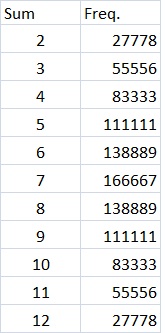
But the fact that a single player, on a single roll, throws a 2, 5, 9, 12, or any other sum tells us nothing about the number of rolls the player has made or will make, nor does it tell us anything about the number of players who may have rolled dice at the same moment. All it tells us is that the player has attained a particular result on that particular roll of the dice.
This is at odds with the view that there is life as we know it — an outcome with a low, prior probability given the (theoretical) multitude of possible configurations of the universe — only because there are vastly many actual or possible universes with vastly many configurations. In this view, life as we know it is an improbable phenomenon that we are able to witness only because we happen to exist in one of the multitude of possible or actual universes.
So, is our universe and the life that has arisen in it a consequence of design, or is it all a matter of “luck”? And if it is due to “luck,” what created the material of which the universe is made and what determined the laws that are evident in the actions of that material?
Related posts:
Atheism, Religion, and Science
The Limits of Science
Three Perspectives on Life: A Parable
Beware of Irrational Atheism
The Creation Model
The Thing about Science
Evolution and Religion
Words of Caution for Scientific Dogmatists
Science, Evolution, Religion, and Liberty
The Legality of Teaching Intelligent Design
Science, Logic, and God
Capitalism, Liberty, and Christianity
Is “Nothing” Possible?
A Dissonant Vision
Debunking “Scientific Objectivity”
Science’s Anti-Scientific Bent
Science, Axioms, and Economics
The Big Bang and Atheism
The Universe . . . Four Possibilities
Einstein, Science, and God
Atheism, Religion, and Science Redux
Pascal’s Wager, Morality, and the State
Evolution as God?
The Greatest Mystery
What Is Truth?
The Improbability of Us
Many (most?) “deficit hawks” invoke China as a reason to reduce government debt. The hawks say something like this: “China holds a lot of our debt and, presumably, will buy more of it, which means that ‘we’ are beholden to China.”
By that logic, China is beholden to “us” because China’s purchases of U.S. government debt are financed by Americans’ purchases of Chinese products. Moreover, there is not (as far as I know) a provision in U.S. securities that enables the holder to demand payment before the securities mature.
The real “threat” is that U.S. securities will become unattractive to China (and others), and so China (and others) will quit buying them. But that possibility has nothing to do with China (or any other foreign nation), and everything to do with prospective debt-buyers’ views about the soundness of U.S. government securities. A case in point is PIMCO, a huge investment company. Bloomberg News reports:
Bill Gross, who runs the world’s biggest bond fund at Pacific Investment Management Co., eliminated government-related debt from his flagship fund last month as the U.S. projected record budget deficits.
The economic threat to the U.S. doesn’t come from China, it comes from the U.S. government.
If you were a physicist who was writing about Einstein’s special theory of relativity, would you bother to list the ways in which non-physicists define the concept? I doubt it.
But at least one of the bloggers at Bleeding Heart Libertarians — a new group blog whose eight contributors (thus far) are professors of law and/or philosophy — advances the proposition that “liberty” means whatever non-philosophers think it means. The contributor in question, Jason Brennan, justifies his preference by saying that liberty “is a concept philosophers are interested in, but it’s a not a philosopher’s technical term.”
That may be so, but I would think that philosophers who are going to use a term that is central to the theme of their blog — the connection of libertarianism to social justice — would begin by searching for a relevant and logically consistent definition of liberty. Brennan, instead, casts a wide net and hauls in a list of seven popular definitions, one of which (negative liberty) has three sub-definitions. That may be a useful starting point, but Brennan leaves it there, thus implying that liberty is whatever anyone thinks it is.
His evident purpose in doing so is to leave the door open to a positive definition of liberty, while dismissing those who maintain that logic demands a negative definition of liberty. Consider Brennan’s list, which he calls partial and in which he uses “freedom” for “liberty”:
- Freedom as Absence of Obstacles: Someone is free to the extent that no obstacles impede her ability to do as she pleases.
[a.] Freedom as Absence of Deliberate Interference: Someone is free to the extent that no one deliberately interferes with her ability to do as she pleases.
[b.] Freedom as Absence of Interference: Someone is free to the extent that no one interferes with her ability to do as she pleases.
[c.] Freedom as Absence of Wrongful Interference: Someone is free to the extent that no one wrongfully interferes with her ability to do as she pleases.- Freedom as Capacity: Someone is free to the extent that she has the power, ability, capacity, or means to do as she pleases.
- Freedom as Autonomous Self–Control: Someone is free to the extent that she exhibits sufficient deliberative self-control, such that she is authentically the author of her actions.
- Freedom as Non-Domination: A person is free to the extent she is not subject to another person’s or group’s arbitrary will.
- Freedom as Moral Virtue: A person is free to the extent she has the power to recognize and act upon her moral obligations.
- Freedom as Absence of Pressure: A person is free to the extent she feels no social pressure to do anything.
- Freedom as Absence of Reasons: A person is free to the extent she has no grounds or reasons for making decisions.
And so on. Notice that 1a–1c are just more specific version[s] of 1.
[A person who insists on using the politically correct “she” in place of the traditional and, in truth, gender-neutral “he” is likely to be a person who is driving toward an acceptable answer instead of the right answer.]
I am struck by the fact that none of the definitions offered by Brennan is a good definition of liberty (about which, more below). This suggests to me that Brennan and (possibly) the other contributors to Bleeding Heart Libertarianism will offer views about the connection of libertarianism and social justice that have nothing to do with liberty, but which merely reflect their various visions of preferred socioeconomic arrangements* and the uses (or non-uses) of state power in the attainment thereof. I therefore humbly suggest that the next order of business at Bleeding Heart Libertarianism ought to be a concerted effort to define the concept that is part of the blog’s raison d’etre.
To help Brennan & Co. in their quest, I offer the following definition of liberty, which is from the first post at this blog, “On Liberty“:
peaceful, willing coexistence and its concomitant: beneficially cooperative behavior
The problem with the definitions listed by Brennan should now be obvious. Those definitions focus on the individual, whereas the relevant definition of liberty is a social one. That is to say, one cannot address social justice and its connection to liberty unless liberty is viewed as a modus vivendi for a group of individuals. There is no such thing as the ability to do as one pleases — the dominant motif of Brennan’s list — unless
The first condition is irrelevant to the matter of social justice. The second is implausible. The third takes the point of view of a dictator, and omits the point of view of his subjects.
The implausibility of the second condition is critical to a proper understanding of liberty. Brennan says (in “Positive Liberty and Legal Guarantees“) that “[w]e often equate freedom with an absence of constraints, impediments, or interference.” In a political context (i.e., where two or more persons coexist), there are always constraints on the behavior of at least one person, even in the absence of coercion or force. Coexistence requires compromise because (I daresay) no two humans are alike in their abilities, tastes, and preferences. And compromise necessitates constraints on behavior; that is, compromise means that the parties involved do not do what they would do if they were isolated from each other or of like minds about everything.
In sum, “peaceful, willing coexistence” does not imply “an absence of constraints, impediments, or interference.” Rather, it implies that there is necessarily a degree of compromise (voluntary constraint) for the sake of “beneficially cooperative behavior.” Even happy marriages are replete with voluntary constraints on behavior, constraints that enable the partners to enjoy the blessings of union.
The specific landscape of liberty — the rights and obligations of individuals with respect to one another — depends on the size and composition of the social group in question. It is there that the question of positive vs. negative liberty (really positive vs. negative rights) takes on importance. I will tackle that question in a future post.
__________
* Sure enough, only a few hours after I posted this, we hear from the newest recruit to Bleeding Heart Libertarianism, Roderick Long (a left-libertarian whom I have addressed before). Long’s is a left-libertarian because he is against state power but, at the same time, against outcomes that can occur in the absence of state power:
On the one hand, I’m committed to libertarianism in a fairly standard sense: self-ownership, the non-aggression principle, Lockean homesteading, private property, and free markets. On the other hand, I’m committed to a fairly standard set of traditionally leftist concerns, including opposition to such social evils as worker exploitation, plutocratic privilege, racism, homophobia, gender inequality, militarism, environmental degradation, and the prison-industrial complex. (Call them all “oppression” for short.)
“Worker exploitation” is what happens when workers and employers are free to agree about the terms and conditions of employment, which is good for competent, productive workers and bad for incompetent, unproductive ones (the ones that unions protect). “Plutocratic privilege” is bad only if it is the result of crony capitalism; otherwise, it is merely a case of well-to-do individuals enjoying the fruits of what they have earned. “Racism” is a inescapable aspect of human nature, and it cuts in all directions; typical efforts to compensate for it result in the theft of property rights and the hiring and promotion of less-qualified persons. “Homophobia” is a personal choice, and efforts by the state to squelch it will surely result in the theft of property rights and denial of freedom of speech. “Gender inequality” is mostly a figment of the imagination of leftists who always fail to take into account differences in age, experience, and aptitude when lamenting the fact that women generally earn less than men and are “underrepresented” in certain occupations. “Militarism” is what has kept many a Roderick Long from going to the concentration camps of Nazi Germany and the gulags of Soviet Russia. “Environmental degradation” is vastly overrated, to the point where Americans pay more for a lot of things than they should (oil among them), and is becoming an excuse for prohibitively costly and needless regulations aimed at fighting a myth and scientific fraud: anthropogenic global warming. The “prison-industrial complex” has, in fact, kept violent criminals off the streets and led to a reduction in the rate of violent crimes.
I am surprised that Long doesn’t have “universal health care” and “living wage” on his list.
Roderick Long is to libertarianism as Adolf Hitler was to capitalism. Long wants a stateless world, but only if the “free” people in it have “correct” attitudes and beliefs.
There is something about Texas that irritates lib’ruls — especially those who write for The New York Times. The latest case in point is a column by Gail Collins (“Mrs. Bush, Abstinence and Texas,” Feb. 16, 2011), in which Ms. Collins notes that Texas “ranks third in teen pregnancies — always the children most likely to be in need of extra help. And it is No. 1 in repeat teen pregnancies.” Why? According to Collins, it’s because “Texas is doing as little as possible to help women — especially young women — avoid unwanted pregnancy,” and “it’s extremely tough for teenagers to get contraceptives in Texas.”
There is one thing to be said for lib’rul columnists — they don’t need facts, especially when they “know” that the world’s problems are caused by callous Republicans like Gov. Rick Perry. Ms. Collins was in such a hate-filled rush to blame the high teen pregnancy rate in Texas on its Republican governor (a busy man, he) that she overlooked the real cause of the high rate: the large Hispanic population of Texas.
Here are the facts, according to the 2011 Statistical Abstract, an official publication of the U.S. government (a.k.a. the omniscient, benevolent institution to which lib’ruls bow thrice daily):
Putting two and two together — a trick that Ms. Collins evidently has not mastered — yields the less-than-startling conclusion that teen-pregnancy rates are determined not by the political affiliation of a State’s governor but by the State’s demographic composition.
Incidentally, the demographic determinant is backed (unwittingly) be left-leaning PolitiFact Texas (PFT). Today’s PFT emission merely quibbles with Collins by pointing out that she “incorrectly referred to Texas’ teen birth rate as a pregnancy rate — Texas actually ranks fourth in teen pregnancies, not third.” Which States hold down the number 1, 2, and 3 spots? According to PFT, they are Arizona, Nevada, and New Mexico. Guess what? Those States rank 4th, 5th, and 1st in percentage of population of Hispanic origin.
Get the picture? Gail Collins doesn’t. That’s what happens when your left-wing heart is filled with hate for Republicans.
P.S. to Ms. Collins: If you happen across this post, pass it along to your colleague, Mr. Krugman. He is another factually challenged, hate-filled leftist.
Related posts:
The Left
Our Enemy, the State
Is the Anger Gone?
A Not-So-Fine Whine
Social Justice
The Left’s Agenda
In “Evolution, Human Nature, and ‘Natural Rights’,” I address the proposition that humans have natural ends that have arisen through evolution and which imply the necessity of negative “natural rights.” My purpose here is not to revisit the proposition, which I firmly reject for the reasons given in “Evolution, Human Nature, and ‘Natural Rights’,” but to focus on my reasons for rejecting the linchpin of the proposition: evolutionary teleology, or teleonomy. This is the
apparent purposefulness and of goal-directedness of structures and functions in living organisms that derive from their evolutionary history, adaptation for reproductive success, or generally, due to the operation of a program.
Francisco Ayala offers a specific example in his essay, “Teleology and Teleological Explanations,” at Evolutionary Biology:
The wings of birds call for teleological explanation: the genetic constitutions responsible for their configuration came about because wings serve to fly and flying contributes to the reproductive success of birds. But there was nothing in the constitution of the remote ancestors of birds that would necessitate the appearance of wings in their descendants. Wings came about as the consequence of a long sequence of events, where at each stage the most advantageous alternative was selected among those that happened to be available; but what alternatives were available at any one time depended, at least in part, on chance events.
In short, the end (survival of the species through reproductive success) dictates the means (the development of wings). Nonsense. “Contingent teleology” is nothing more than “what happened as a result of breeding, random mutation, geophysical processes, and survival of the fittest and/or luckiest, as the case may be.” The usual shorthand for all of that is “natural selection.” But “selection” is inappropriate because — unless there is such a thing as Intelligent Design — no one (or no thing) is selecting anything.
Evolutionary zoologist John O. Reiss exposes the fallacy of teleology in Not by Design: Retiring Darwin’s Watchmaker. This is from the first chapter:
The general mode of thinking that I object to goes as follows: “character x plays a useful (‘adaptive’) role in the life of organism y; therefore, character x must have evolved by natural selection for this role.” The definitional equation of adaptations and past natural selection is fairly standard in evolutionary biology today: “a feature is an adaptation for a particular function if it has evolved by natural selection for that function” (Futuyma 2005, 265). When combined with the assumption that useful features or characters are in fact adaptations by this definition, a teleological role for natural selection results. In this role, natural selection is inferred to have directed evolution from an unimproved (poorly adapted) past state toward an improved (well-adapted) present state, merely on the basis that the present state exists and is well adapted….
While the best solution might be to do what Wallace suggested so long ago—to completely extirpate the term natural selection from the lexicon of evolutionary biology—the term is by now too well established to replace….
…I believe that the continued teleological use of the concept of natural selection, in spite of the obvious problems involved, is due primarily to the absence of another evolutionary principle that can be used to interpret patterns of macroevolutionary transformation. Fundamental to my restriction of the term natural selection will be the reintroduction of another principle, related to and often confused with that of natural selection. This principle is founded on the concept of the necessary conditions for an organism’s (or other evolutionary entity’s) continued existence; it states that (by definition) the existence of any organism is contingent on its satisfaction of these conditions.
Of particular relevance is Reiss’s observation that “natural selection is inferred to have directed evolution from an unimproved (poorly adapted) past state toward an improved (well-adapted) present state, merely on the basis that the present state exists and is well adapted.” That formulation of evolutionary teleology exposes it as an instance of the hypostatization fallacy:
Hypostatization (together with the closely related fallacy of reification) may be the most common of all fallacies. Whole systems of philosophy, politics, religion, science, and social theories are built on or supported by this fallacy.11
Examples:
“Nature’s purposes are always pure, therefore we should always accede to her.” Nature has no purposes.
“The only just laws are those that relieve a society’s suffering.” Laws do not “relieve” anything, and “societies,” do not suffer.
“Industry is a danger to both nature and society.” Here are three hypostatized abstractions, industry, nature, and society. Industry is not a “thing” that does anything, and neither nature or society are things to which anything is done. Some industries might do something that is harmful to some natural things or some persons in some society, but treating any of these as entities, even collective entities, is fallacious.
“What are personal considerations in the face of the needs of society, the fate of the nation, the preservation of culture?” Since, society has no needs, nations do not have fates, and there is no such thing as culture to preserve, personal considerations are all that are left.
“My fellow Americans, ask not what your country can do for you: Ask what you can do for your country.” -(John F. Kennedy) Obviously rhetorical, and therefore, all the more subtle. Behind the rhetoric is the insidious concept that citizens exist for the sake of a country (state or government), the opposite of the intention of the American Constitutional, that government exists for the sake of the citizens.
Evolutionary teleology boils down to this: Species seek survival, therefore species acquire characteristics that improve their chances of surviving. In fact:
The preceding analysis points to another, more subtle, fallacy in evolutionary teleology, a fallacy known as observation selection bias. Philosopher Nick Bostrom illustrates it, in “A Primer on the Anthropic Principle“:
[S]uppose you’re a young investor pondering whether to invest your retirement savings in bonds or equity. You are vaguely aware of some studies showing that over sufficiently lengthy periods of time, stocks have, in the past, substantially outperformed bonds (an observation which is often referred to as the “equity premium puzzle”). So you are tempted to put your money into equity. You might want to consider, though, that a selection effect might be at least partly responsible for the apparent superiority of stocks. While it is true that most of the readily available data does favor stocks, this data is mainly from the American and British stock exchanges, which both have continuous records of trading dating back over a century. But is it an accident that the best data comes from these exchanges? Both America and Britain have benefited during this period from stable political systems and steady economic growth. Other countries have not been so lucky. Wars, revolutions, and currency collapses have at times obliterated entire stock exchanges, which is precisely why continuous trading records are not available elsewhere. By looking at only the two greatest success stories, one would risk overestimating the historical performance of stocks. A careful investor would be wise to factor in this consideration when designing her portfolio….
The focus of evolutionary teleology is on evolutionary success. The ultimate success is survival, which — in a teleological explanation of evolution– is the ultimate purpose of a species, the end toward which it “acquires” characteristics. Does this imply that extinct species had the ultimate purpose of extinction, thus “acquiring” characteristics that ensured extinction? More plausibly, some species happen to survive (and some to die out) because their characteristics — along with the “luck” of not being (or being) in the wrong places at the wrong times — help to ensure their survival (or extinction) in the face of threats beyond their control: geophysical changes (abrupt and gradual), predators, diseases.
The focus on success ignores the fact that extinct species evolved to some degree before meeting with threats that they could not surmount. It also assumes that success to date ensures success in the future. Imagine an adherent of evolutionary teleology who is transported to a time when dinosaurs roamed the earth. By his reckoning, dinosaurs would have “selected” their characteristics in order to ensure their survival. The same person, thrust a million years into the future, might conclude that cockroaches were destined to inherit the earth.
UPDATE: The urgency of re-forming the United States is underscored by “Our Perfect, Perfect Constitution.” The author, Michael Stokes Paulsen (Distinguished University Chair and Professor of Law at the University of St. Thomas (Minnesota) School of Law), restates the entire Constitution in the form of twenty provisions that reflect the current state of constitutional law as established by decisions of the Supreme Court. Paulsen’s version of the Constitution is true, depressing, and enraging.
Paulsen wrote his paper before U.S. District Judge Gladys Keesler opined that the central government may regulate mental activity. Judge Keesler’s view, which is applauded on the left, is the last straw. The juggernaut that rules from Washington is nothing more than an alien occupying force. It should be treated accordingly by liberty-loving Americans.
The specter of constitutional revitalization haunts “liberals”:
Imagine that, a few years from now, Americans are suddenly plunged into a constitutional crisis. Imagine an economy still muddling in recession; a government rendered inept by the complete collapse of the Senate as a serious institution of deliberation or a continued division between House and Senate; a conservative Supreme Court gripped by a passion to restore the pre-New Deal version of the Commerce Clause (which treated commerce merely as the physical movement of goods across state lines); a militant Tea Party movement convinced that the Tenth Amendment imposes real limits on the lawmaking power of Congress, and is not simply a hollow “truism” saying that Congress can only do what it is constitutionally empowered to do. These days, conjuring up such a vision is not so hard. Imagine that somehow the belief took hold that what the Constitution needed was not a revision here or there, but wholesale replacement. (Jack Rakove of Stanford University, in “American Ratification,” Harvard Magazine, January-February 2011)
How much misrepresentation and distortion is packed into that paragraph? Let’s see:
1. The United States has been in constitutional crisis since the 1930s, when the Supreme Court — frightened by the Great Depression, cowed by FDR, and then reshaped by him — allowed Congress and the States to exceed their constitutional authority. To the Rakoves of this world, a constitutional crisis is what happens when there’s a movement to honor the spirit and letter of the Constitution.
2. The state of the economy, the state of the Senate, and a “divided” House and Senate (i.e., not both controlled by Democrats) are hardly the stuff of a constitutional crisis. The standing of the Constitution is — and should be — unaffected by such things, unless one believes (with the New Deal Supreme Court) that the law should bend with economic winds, and that it is the rightful place of Congress to actively involve itself in every nook and cranny of Americans’ lives.
3. The pre-New Deal version of the Commerce Clause is the correct one, contrary to Rakove’s desire for an all-powerful state.
4. The Tenth Amendment isn’t “hollow.” It underscores — for the benefit of the willfully obtuse, like Rakove — the express limits that the original Constitution places on Congress’s power. In leaving no doubt that the States and the people retain the powers not specifically assigned to Congress, it removes (or should remove) any ambiguity about the limited role that Congress (and the federal government) should play in the lives and businesses of Americans. It says that the Constitution means what it says. It is “hollow” to Rakove and his ilk only because they don’t want the Constitution to mean what it says.
5. In that vein, I must add that the “militant Tea Party” movement seeks to honor the entire Constitution, not just the important Tenth Amendment. Rakove wants to believe — or wants his readers to believe — that the Tea Party movement is made up of morons who don’t understand what’s in the original Constitution. Well, the true morons are the Rakoves, who believe that their expansive view of governmental power can’t be turned against them.
6. Rakove posits two options for dealing with the so-called crisis: a revision here or there, or wholesale replacement of the Constitution. There’s a third option: wholesale rewriting to reassert, in no uncertain terms, the meaning and purposes of the Constitution. That’s what Rakove and his ilk really fear, because they’re wedded to the judicially created, left-statist version of the Constitution that has replaced the real thing without benefit of an amendment.
For non-Rakovians — that is, for devotees of the real Constitution — I counsel the following steps:
With regard to the second point, Article V of the new Constitution would include this:
A judgment of any court of the United States of America may be revised or revoked by an act of Congress, provided that such any revision or revocation is approved by two-thirds of the members of each house and leads to a result that conforms to this Constitution.
There is this, in Article VI:
Each State retains the right to secede from this Union, but secession shall in each case be approved by three-fourths of the members of each house of a State’s legislature and ratified by the executive of the State within thirty days of its approval by both houses of the State’s legislature.
Articles VII and VIII, Keeper of the Constitution and Conventions of the States, open thusly:
The responsibility for ensuring that the legislative, executive, and judicial branches adhere to this constitution in the exercise of their respective powers shall be vested in a Keeper of the Constitution. The Keeper may review acts of Congress, the executive branch, and judicial branch that have the effect of making law and appropriating monies.
* * *
Delegations of the States shall convene every four years for the purpose of considering revisions to and revocations of acts of the government that is established by this constitution. Such conventions (hereinafter “convention of the States”) may revise and/or revoke any act or acts and/or any holding or holdings, in the sole discretion of a majority of State delegations present and voting.
Article IX would authorize petitions and subsequent elections for the revocation of a broad range of governmental acts and the expulsion of members of Congress, the President, Vice President and justices of the Supreme Court. Also, a constitutional convention may be called pursuant to a successful petition.
I understand that I am proposing a radical step, but I believe that it is impossible to reinstate the real Constitution in any other way. Perhaps the threat of radical measures would have a sobering effect on those who are content with the status quo or incremental progress… but probably not.
In “Evolution, Human Nature, and ‘Natural Rights‘,” I quote at length from Michael Oakeshott’s essay “On Being Conservative (Rationalism in Politics and Other Essays, New and Expanded Edition). The point served by the quotation is that it is unnecessary to erect a regime of liberty on a deep philosophical foundation of the kind proffered by “natural rights” theorists. Conservatism, properly understood, is an attitude toward life, in general, and the role of government, in particular; it is not a political ideology.
There is much more to be said, and Oakeshott says it exceedingly well:
To some people, ‘government’ appears as a vast reservoir of power which inspires them to dream of what use might be made of it. They have favourite projects, of various dimensions, which they sincerely believe are for the benefit of mankind, and to capture this source of power, if necessary to increase it, and to use it for imposing their favourite projects upon their fellows is what they understand as the adventure of governing men. They are, thus, disposed to recognize government as an instrument of passion; the art of politics is to inflame and direct desire. In short, governing is understood to be just like any other activity — making and selling a brand of soap, exploiting the resources of a locality, or developing a housing estate — only the power here is (for the most part) already mobilized, and the enterprise is remarkable only because it aims at monopoly and because of its promise of success once the source of power has been captured….
Now, the disposition to be conservative in respect of politics reflects a quite different view of the activity of governing. The man of this disposition understands it to be the business of a government not to inflame passion and give it new objects to feed upon, but to inject into the activities of already too passionate men an ingredient of moderation; to restrain, to deflate, to pacify and to reconcile; not to stoke the fires of desire, but to damp them down. And all this, not because passion is vice and moderation virtue, but because moderation is indispensable if passionate men are to escape being locked in an encounter of mutual frustration. A government of this sort does not need to be regarded as the agent of a benign providence, as the custodian of a moral law, or as the emblem of a divine order. What it provides is something that its subjects (if they are such people as we are) can easily recognise to be valuable; indeed, it is something that, to some extent, they do for themselves in the ordinary course of business or pleasure…. Generally speaking, they are not averse from paying the modest cost of this service; and they recognize that the appropriate attitude to a government of this sort is loyalty … , respects and some suspicion, not love or devotion or affection. Thus, governing is understood to be a secondary activity; but it is recognised also to be a specific activity, not easily to be combined with any other…. The subjects of such a government require that it shall be strong, alert, resolute, economical and neither capricious nor over-active: they have no use for a referee who does not govern the game according to the rules, who takes sides, who plays a game of his own, or who is always blowing his whistle; after all, the game’s the thing, and in playing the game we neither need to be, nor at present are disposed to be, conservative.
But there is something more to be observed in this style of governing than merely the restraint imposed by familiar and appropriate rules. Of course, it will not countenance government by suggestion or cajolery or by any other means than by law…. But the spectacle of its indifference to the beliefs and substantives activities of its subjects may itself by expected to provoke a habit of restraint. Into the heat of our engagements, into the passionate clash of beliefs, into our enthusiasm for saving the souls of our neighbours or of all mankind, a government of this sort injects an ingredient, not of reason … , but of the irony that is prepared to counteract one vice by another, of the raillery that deflates extravagance without itself pretending to wisdom: indeed, it might be said that we keep a government of this sort to do for us the scepticism we have neither the time nor the inclination to do for ourselves. It is like the cool touch of the mountain that one feels in the plain even on the hottest summer day. Or, to leave metaphor behind, it is like the ‘governor’ which, by controlling the speed at which its marts move, keeps an engine from racketing itself to pieces.
It is not, then, mere stupid prejudice disposes a conservative to take this view of the activity of governing; nor are any highfalutin metaphysical beliefs necessary to provoke it or make it intelligible. It is connected merely with the observation that where activity is bent upon enterprise the indispensable counterpart is another order of activity, bent upon restraint, which is unavoidably corrupted (indeed, altogether abrogated) when the power assigned to it is used for advancing favourite projects. An ‘umpire’ what at the same time is one of the players is no umpire; ‘rules’ about which we are not disposed to be conservative are not rules but incitements to disorder; the conjunction of dreaming and ruling generates tyranny.
Political conservatism is, then, not at all unintelligible in a people disposed to be adventurous and enterprising, a people in love with change and apt to rationalise their affections in terms of ‘progress’. And one does not need to think that the belief in ‘progress’ is the most cruel and unprofitable of all beliefs, arousing cupidity without satisfying it, in order to think it inappropriate for a government to be conspicuously ‘progressive’. Indeed, a disposition to be conservative in respect of government would seem to be pre-eminently appropriate to men who have something to do and something to think about on their own account, who have a skill to practise or an intellectual fortune to make, to people whose passions do not need to be inflamed, whose desires do not need to be provoked and whose dreams of a better world need no prompting. Such people know the value of a rule which imposes orderliness without irecting enterprise, a rule which concentrates duty so that room is left for delight…. (Id., pp. 431-5)
Contrast the conservative attitude to the attitude of left-wing intellectuals, do-gooders, and politicians to whom government “appears as a vast reservoir of power which inspires them to dream of what use might be made of it.” It may be true, as Oakeshott charitably asserts, that some of them “sincerely believe [that their favorite projects] are for the benefit of mankind.” But, in my observation, the left is largely animated by the will to power, for its own sake.
Related posts:
Fascism with a “Friendly” Face
Democracy and Liberty
The Interest-Group Paradox
Parsing Political Philosophy
Is Statism Inevitable?
Inventing “Liberalism”
What Is Conservatism?
Utilitarianism, “Liberalism,” and Omniscience
Utilitarianism vs. Liberty
Fascism and the Future of America
The Indivisibility of Economic and Social Liberty
Law and Liberty
Negative Rights
Negative Rights, Social Norms, and the Constitution
The Devolution of American Politics from Wisdom to Opportunism
Rights, Liberty, the Golden Rule, and the Legitimate State
The Near-Victory of Communism
Tocqueville’s Prescience
Accountants of the Soul
Invoking Hitler
“Natural Rights” and Consequentialism
Rawls Meets Bentham
Is Liberty Possible?
The Left
More about Consequentialism
Special Interests, Good and Bad
Line-Drawing and Liberty
The Divine Right of the Majority
An Encounter with a Marxist
Our Enemy, the State
Pseudo-Libertarian Sophistry vs. True Libertarianism
Positivism, “Natural Rights,” and Libertarianism
What Are “Natural Rights”?
The Golden Rule and the State
Libertarian Conservative or Conservative Libertarian?
Liberty, Equality, Fraternity: Part I
Bounded Liberty: A Thought Experiment
Evolution, Human Nature, and “Natural Rights”
More Pseudo-Libertarianism
A reader asks what I think of the Free State Project. If you haven’t heard of it, here are some key points (taken from the FSP web site):
The main goal of the Free State Project is to recruit 20,000 liberty-friendly Americans to move to New Hampshire over the next several years. The purpose of this cooperative migration is to create a freer, better society through the electoral process and cultural change. Those of us who believe government in the U.S. is far too involved in our daily lives and far too removed from the control and influence of ordinary people represent a substantial minority in the U.S., but a minority nonetheless. In all our political efforts to date, we have been thwarted by powerful special interests in D.C., by the ignorance or apathy of many Americans, and by the self-interest of politicians themselves. The idea behind the Free State Project, therefore, is that by concentrating pro-freedom resources in a single, friendly state we will leverage our influence more effectively while also enjoying immediately the benefits of a freer state culture.
So much is clear. But why 20,000? What is the logic behind this number? There is certainly nothing magical about it. When the FSP started, 20,000 signatures seemed like an attainable goal, and one that would mean something. Further research showed that 20,000 people could significantly influence several states, assuming that they were all active in politics or civil society, not just passive onlookers. This essay expands on that research to consider exactly what 20,000 Free Staters could accomplish in the state we’ve chosen, New Hampshire….
…[P]urely by the numbers, well organized Free Staters could have a significant effect on state-level politics in New Hampshire even if they numbered just eight, ten, or twelve thousand. However, this purely statistical analysis also does not take into account the specific circumstances of our state. Many of the advantages of New Hampshire for freedom-seeking Americans are well known features that sold the state to thousands of FSP members, but I intend to take the well-known lists of “desirable features” to induce a more general picture of the state, a “Theory of New Hampshire” if you will.
I class New Hampshire’s advantages in two categories, cultural and institutional. Cultural aspects of New Hampshire relate to the friendliness of Granite Staters to our ideas….
…[N[o state sales or income tax, the lowest state and local tax burden in the continental U.S., no adult seatbelt law, no helmet law, very few gun laws, a governor and many state legislators who’ve been explicitly welcoming, a large percentage of political independents, extremely low dependence on federal subsidies, low government employment, and so forth….
…The town meeting system allowed citizens to keep their government officials close enough to “grab them by the scruff of their necks” if they overstepped their power….
Economically, New Hampshire has the advantage of a dynamic economy centered around knowledge-based and service industries. Such industries tend to favor the global economy and a leaner scale of government that makes rapid adaptation possible. New Hampshire’s high per capita income also means that residents pay much more to the federal government in taxes than they receive in expenditures. New Hampshire is thus quite different from neighboring Vermont and Maine, which have struggled economically….
Socially, New Hampshire has always ranked as one of the more tolerant states in the country….
New Hampshire thus combines the best of all worlds and ends up with an ideal socioeconomic and cultural mix. Most of the states that are socially tolerant and economically advanced tend to be heavily urbanized and leftist, while most of the states that are not heavily urbanized tend to be poor or too rightist. New Hampshire is the only state in the country that I can identify that is tolerant, advanced, not federally dependent, not too urbanized, and historically libertarian-oriented. If a libertarian movement were to succeed anywhere in the country, maybe in the world, it would be in New Hampshire.
As of this writing — ten years after the founding of the FSP — the movement has acquired fewer than 11,000 members, as against the goal of 20,000. In the meantime, from 2000 to 2008, a majority of New Hampshire’s new voters (young voters and in-comers) identified themselves as Democrats. New Hampshire’s swing to the left led to the election of Democrats to both of the State’s U.S. House seats in 2006. They remained in office until the nation-wide resurgence of the GOP in 2010, when New Hampshire’s voters replaced them with Republicans, while also turning the Senate seat of Judd Gregg (a retiring RINO) over to Kelly Ayotte, a conservative Republican. None of this bodes well for the kind of libertarian sought by the Free State Project.
So this is my advice to that kind of libertarian. If you think you can make a difference in New Hampshire, don’t wait, move there now. But think long and hard before you make the move. You are unlikely to have much effect on New Hampshire’s policies, especially because that State — like all 50 of them — is bound by onerous national policies that are founded on expansive and erroneous readings of the U.S. Constitution.
As for what New Hampshire has to offer — aside from long, hard winters and short, cool summers — I give you this, from the latest edition of Freedom in the 50 States: An Index of Personal and Economic Freedom (Mercatus Center, George Mason University, February 2009):
New Hampshire is by our count the freest state in the country. Depending on weights, however, it really shares the first, second and third slots with Colorado and South Dakota. New Hampshire does much better on economic (#2) than personal freedom (#13). Taxes and spending are among the lowest in the country, but the tax regime is highly skewed. New Hampshire has the third highest property and corporate income taxes in the United States. These should be high priorities for cutting. On the spending side, the likeliest suspect for cutting is transportation, which is higher than average once one controls for federal grants and population density (less dense states spend more on roads). Once state population is controlled for, New Hampshire is one of the most fiscally decentralized states in the country. Local governments also must raise two-thirds of what they spend with their own taxes. Gun laws are among the most liberal in the country, but the state has a weak “peaceable journey” regime (carrying a firearm in a car requires a concealed carry permit). Its alcohol regime is relatively free. Despite state control of retail distribution of wine and spirits, the effective tax rates on these products are zero, according to the Tax Foundation. Marijuana laws are middling; low-level possession could be decriminalized like Maine, while low-level cultivation could be made a misdemeanor like both Maine and Vermont. New Hampshire is the only state in the country with no seat-belt law for adults. It lacks a motorcycle helmet law but does have a bicycle helmet law and authorizes sobriety checkpoints. New Hampshire is one of three states that permit self-insurance for auto liability. Gambling is relatively controlled: Most gaming must take place under a charitable license, social gaming is prohibited, and aggravated gambling is a felony. State approval is required to open a private school. Home school laws are about average on the whole, but the standardized testing and recordkeeping requirements are more onerous than most states. Labor laws are generally market-friendly, but it is not a right-to-work state. Occupational licensing is worse than average. Both eminent domain and asset forfeiture have been thoroughly reformed. The state’s liability system is one of the best, but campaign finance regulations are quite strict. As of 2006, smoking bans allowed many exemptions, but a thoroughgoing ban has since passed (not captured by our index).
Frankly, moving to New Hampshire is probably a waste of money and energy. The real battle for liberty is a national one. In that regard, the turnaround in 2010 bodes well for true libertarianism: laissez-faire economic policies combined with a social conservatism rooted in traditional social norms (pro-life, heterosexual marriage, etc.).
Related posts:
On Liberty
Greed, Cosmic Justice, and Social Welfare
Positive Rights and Cosmic Justice
Parsing Political Philosophy
The Price of Government
Fascism and the Future of America
Negative Rights
Negative Rights, Social Norms, and the Constitution
The Commandeered Economy
Rights, Liberty, the Golden Rule, and the Legitimate State
The Price of Government Redux
Landsburg Is Half-Right
The Mega-Depression
The Unreality of Objectivism
The Real Burden of Government
“Natural Rights” and Consequentialism
More about Consequentialism
Modeling, Science, and Physics Envy
Atheism, Agnosticism, and Science
Line-Drawing and Liberty
Estimating the Rahn Curve: Or, How Government Inhibits Economic Growth
Our Enemy, the State
Pseudo-Libertarian Sophistry vs. True Libertarianism
Positivism, “Natural Rights,” and Libertarianism
What Are “Natural Rights”?
The Golden Rule and the State
Libertarian Conservative or Conservative Libertarian?
Liberty, Equality, Fraternity: Part I
Social Justice
Bounded Liberty: A Thought Experiment
Society and Culture
Government Failure: An Example
More Pseudo-Libertarianism
How Many Fallacies?
The length of “Evolution, Human Nature, and ‘Natural Rights’” seems to have discouraged readers. In the hope of enticing you to venture below the fold, I have annotated the outline that appears above the fold. Also, there is now a direct link to the 31 related posts that are listed and linked to at the bottom of “Evolution, Human Nature, and ‘Natural Rights’.”
How many fallacies can you find in this Facebook post by a firefighter in a small Colorado town?
I’m a public employee. I am NOT the problem. The rich who created this crisis are putting middle class families against each other. Teachers, police officers, paramedics, firefighters, road workers etc. are NOT the enemy. If you’re jealous of our benefits, FIGHT FOR YOUR OWN, not against ours! We live here, pay taxes, work hard & try ……to support our families too.
Here’s my tally:
1. I assume that “this crisis” is the Great Recession, which has led to reductions in tax revenues, thus pushing some governments into the red. Well the Great Recession wasn’t created by “the rich.” It followed from the housing bubble, which was created by the Fed’s loose-money policy and lax mortgage-lending policies pushed by Democrat politicians and their pet agencies: Fannie & Freddie. Moreover, as far as “this crisis” has made it harder for governments to pay their bills, it is because (in part) they have had open-handed policies toward the compensation of government employees.
2. “The rich” aren’t pitting families against each other. Public employees are doing it by their greedy insistence on being paid above-market compensation at the expense of other workers.
3. “Teachers, police officers,” etc. ARE the enemy of taxpayers because they are able to extract above-market compensation from taxpayers with the help of politicians who are, in fact, counting on those teachers, etc., for votes.
4. Jealousy is not the issue. The issue is that teachers, etc., are extracting above-market compensation from taxpayers at the point of a gun, that is, through the government-run system of tax, spend, and elect. In other words, theft is the issue.
5. Public employees aren’t the only ones who work hard to support their families. Taxpayers also work hard to support their families — and to support public employees and their families.
I am often gobsmacked by left-libertarian obtuseness, several examples of which I proffer in “Pseudo-Libertarian Sophistry vs. True Libertarianism.” As I say in that post,
[a] left-libertarian wants “liberty,” but only if it yields outcomes favorable to certain groups, and to hell with the liberty and property rights of others. Theirs is a dangerous flirtation with political correctness (PCness), which includes unblinking support of open borders, head-in-the-sand opposition to defense spending, “gay rights,” and premature infanticide.
I have, in the past few days, encountered some left-libertarian “reasoning” that compels comment. I begin with an old “favorite,” Bryan Caplan, whose post “The Libertarian Penumbra” at EconLog offers these bits of “wisdom”:
[L]ibertarians have many beliefs in common that have little to do with the consequences of liberty. They’re just part of our vibrant, iconoclastic intellectual subculture. A few examples:
- Most libertarians accept the validity of IQ testing. A perfectly good libertarian could reject IQ tests as “culturally biased,” but few do.
- Libertarians have favorable views of home schooling – even though conventional private schooling is equally consistent with libertarian principles.
- Libertarianism implies opposition to government population control, but it doesn’t imply another view common among libertarians: that population growth has major economic benefits because people are “the ultimate resource.” Notice: A statist who took this idea seriously could easily argue for government intervention to raise the birth rate.
Why should one reject IQ tests as “culturally biased,” and under what conditions? I have no doubt that there is some degree of cultural bias in IQ tests, but so what? As an employer, I may want employees who are not only capable of carrying out certain kinds of mental tasks but who also are attuned to the culture in which I operate my business. If that rules out, say, inner-city blacks who prefer rap to Bach, who wear outré clothing, and who speak a language other than standard English, so be it. Thanks to the kind of PCness that has been foisted upon American business by leftists (libertarian and otherwise), it is difficult for private employers to be selective about whom they hire, and therefore to serve consumers and shareholders as well as they should. There is no hope at all for governments and universities, where the rule of PCness gobbles up tax dollars and inures to the benefit of third-rate minds.
Caplan’s second item — about home-schooling — puzzles me. Is one supposed to have a less-than-favorable view of home-schooling just because “conventional private schooling is equally consistent with libertarian principles”? Perhaps he is unable to fathom the (libertarian) tenet of subjective value. Some persons prefer home-schooling for their own, perfectly legitimate, reasons (e.g., greater control over the content of what their children are taught). If Caplan has a point, it is on the top of his head.
Caplan’s third point — about population control and growth — is a marvelous non sequitur. Libertarians oppose government population control because it is anti-libertarian. The fact that population growth has economic benefits should be of no consequence to a libertarian qua libertarian.
Another “libertarian” economist, Scott Sumner, weighs in with a comment about Caplan’s post. Sumner offers a list of “libertarian tendencies that make [him] cringe.” One of them is “global warming denial.” First, I object to his use of “denial”; “skepticism” is the operative word. A reasonable basis of skepticism — aside from the fact that there is no “settled science” about global warming — is that the proponents of anthropogenic global warming would use it as an excuse to reshape economic activity along lines that they prefer. That is to say, the proponents of AGW have a strong, unconcealed dictatorial agenda. Any libertarian worthy of the name should “cringe” at that, not at skepticism about AGW.
Sumner also “cringes” at “distrust of democracy.” Does he not understand the history of American politics in the twentieth century? It can be summarized, quite accurately, as follows: promise, elect, spend, tax, regulate, promise, elect, spend, tax, regulate, etc., etc., etc.
The rest of Sumner’s list is even worse, so…
I turn to Will Wilkinson’s defense of unions in “Libertarian unionism” at The Economist‘s Democracy in America column. I will not bother to recite and refute all of Wilkinson’s claims with respect to unions, when it will suffice to strike at the heart of his argument:
The right of workers to band together to improve their bargaining position relative to employers is a straightforward implication of freedom of association, and the sort of voluntary association that results is the beating heart of the classical liberal vision of civil society. I unreservedly endorse what I’ll call the “unionism of free association”.
Freedom of association is all well and good, but a union is not a social club. It is an organization formed for the purpose of collective bargaining, backed by the threat and use of the labor strike. Accordingly, Wilkinson’s glib defense of unionism omits several of its anti-libertarian features:
These objections hold even where the employer is a corporation. Corporate status is not a “gift” of the state, Wilkinson’s implication to the contrary notwithstanding. The essential features of incorporation — the pooling of assets and limited liability — are available through private, contractual arrangements involving insurance pools. The belief that corporations owe their existence to the beneficence of the state is due to the use of the corporation to advance state interests in the era of mercantilism.
I can only shake my head in amazement at the delusions of left-libertarians. I must come up with a new name for them, inasmuch as they are not libertarians.
John Goodman’s post about “Government Failure” is chock-full of wisdom. Among other things, Goodman nails the model of “market failure” used by some economists and many politicians:
When economists talk about “market failure” they begin with a model in which consumer welfare is maximized. “Market failure” arises when imperfections cause outcomes that fall short of the ideal. If we were to do the same thing in politics, we would begin with a model in which the political system produced ideal outcomes and then consider factors that take us away from the ideal.
The model “in which consumer welfare is maximized” — perfect competition — is unattainable in most of the real world, given constant shifts in tastes, preferences, technologies, the availability of factors of production. “Market failure” is nothing more than a label that a left-wing economist or politician pins out market a outcome of which he or his constituents (e.g., labor unions) happen to disapprove. (The long version of my case against “market failure” is here.)
Goodman continues:
[W]hereas in economics, “market failure” is considered an exception to the norm, in politics, “government failure” is the norm. In general, there is no model of political decision making that can reliably produce ideal outcomes.
I offer an example of a not-unusual kind of government failure: the scam perpetrated by Dennis Montgomery on intelligence officials, and the subsequent effort to cover up the gullibility of those officials. This is from “Hiding Details of Dubious Deal, U.S. Invokes National Security” (The New York Times, February 19, 2011):
For eight years, government officials turned to Dennis Montgomery, a California computer programmer, for eye-popping technology that he said could catch terrorists. Now, federal officials want nothing to do with him and are going to extraordinary lengths to ensure that his dealings with Washington stay secret.
The Justice Department, which in the last few months has gotten protective orders from two federal judges keeping details of the technology out of court, says it is guarding state secrets that would threaten national security if disclosed. But others involved in the case say that what the government is trying to avoid is public embarrassment over evidence that Mr. Montgomery bamboozled federal officials….
Interviews with more than two dozen current and former officials and business associates and a review of documents show that Mr. Montgomery and his associates received more than $20 million in government contracts by claiming that software he had developed could help stop Al Qaeda’s next attack on the United States. But the technology appears to have been a hoax, and a series of government agencies, including the Central Intelligence Agency and the Air Force, repeatedly missed the warning signs, the records and interviews show.
Mr. Montgomery’s former lawyer, Michael Flynn — who now describes Mr. Montgomery as a “con man” — says he believes that the administration has been shutting off scrutiny of Mr. Montgomery’s business for fear of revealing that the government has been duped.
“The Justice Department is trying to cover this up,” Mr. Flynn said. “If this unravels, all of the evidence, all of the phony terror alerts and all the embarrassment comes up publicly, too. The government knew this technology was bogus, but these guys got paid millions for it.”
Similar cases abound in the unrecorded history of government contracting. Most of them don’t involve outright scams, but they do involve vain, gullible, and pressured government officials who tolerate — and even encourage — shoddy work on the part of contractors. Why? Because (a) they have money to spend, (b) they’re expected to spend it, and (c) there’s no bottom-line accountability.
If the flaws in government programs and systems are detected, it’s usually years or decades after their inception, by which time the responsible individuals have gone on (usually) to better jobs or cushy pensions. And when the flaws are detected, the usual response of the politicians, officials, and bureaucrats with a stake in a program is to throw more money at it. It’s not their money, so what do they care?
I offer an illustrative example from my long-ago days as a defense analyst. There was an ambitious rear admiral (as they all are) whose “shop” in the Pentagon was responsible for preparing the Navy’s long-range plan for the development and acquisition of new ships, aircraft, long-range detections systems, missiles, and so on.
The admiral — like many of his contemporaries in the officer corps of the armed forces — had been indoctrinated in the RAND-McNamara tradition of quantitative analysis. Which is to say that most of them were either naïve or opportunistic believers in the reductionism of cost-effectiveness analysis.
By that time (this was in the early 1980s) I had long outgrown my own naïveté about the power of quantification. (An account of my conversion is here.) But I was still naïve about admirals and their motivations. Having been asked by the admiral for a simple, quantitative model with which he could compare the effectiveness of alternative future weapon systems, I marched into his office with a presentation that was meant to convince him of his folly. (This post contains the essence of my presentation.)
For my pains, I was banished forever from the admiral’s presence and given a new assignment. (I was working for a non-profit advisory organization with fixed funding, so my employment wasn’t at stake.) The admiral wanted to know how to do what he had made up his mind to do, not why he had chosen to do something that couldn’t be done except by committing intellectual fraud.
Multiply this kind of government-contractor relationship by a million, throw in the usual kind of contractor who is willing to sell the client what the client wants — feasible or not — and you have a general picture of the kind of failure that pervades government contracting. Adapt that picture to inter-governmental relationships, where the primary job of each bureaucracy (and its political patrons) is to preserve its funding, without regard for the (questionable) value of its services to taxpayers, and you have a general picture of what drives government spending.
In sum, what drives government spending is not the welfare of the American public. It is cupidity, ego, power-lust, ignorance, stupidity, and — above all — lack of real accountability. Private enterprises pay for their mistakes because, in the end, they are held accountable by consumers. Governments, by contrast, hold consumers accountable (as taxpayers).
Perhaps — just perhaps — the era of governmental non-accountability is coming to an end. We shall see.
My daughter-in-law and son home-school their children, with excellent results, as far as I am able to tell from occasional visits to their home 1500 miles away. It takes loving dedication and vast outlays of time and energy to educate several children in subjects ranging from the “three Rs” to French, German, and Latin, while also arranging extramural music lessons and other educational activities and transporting the children to and from those activities. The effort will have continued, without pause, for about three decades by the time the youngest child has completed the equivalent of 12 grades of schooling. To put it simply, I am in awe of my daughter-in-law and son for what they are doing to ensure that their children are thoroughly and roundly educated.
I was prompted to write this by a couple of posts at EconLog by David Henderson. In “Home Schooling and Socialization,” Henderson writes:
We should become modern abolitionists, like the abolitionists of the nineteenth century who demanded the end of slavery, and for similar reasons. Abolition brings an end to the government’s role in schools, which means four things: the end of compulsory attendance; the end of government control of content; the end of government control of who teaches; and the end of the government’s practice of taxing some people to pay for other people’s children to go to school. With the end of government’s role, learning would flourish. I can’t tell you how. No one can. I can tell you what I think is unlikely: classes every day in big buildings from 8:30 to 3:00, or, in the case of our local government middle school, from 8:13 to 2:40. The beauty and the power of freedom is that different people use their freedom differently to produce all kinds of results, results that they themselves, and certainly the rest of us, can’t predict.
He follows up with some horror stories about the goings on in the public schools of his youth. They remind me, too much, of the public schools of my own youth. I would have given anything to have been placed in an environment where the emphasis was on learning, not on suffering through hours, days, months, and years of classes with packs of pre-adolescent and adolescent animals.
That is the reality of public schools for most American children, who don’t attend the idealized schools of Hollywood teen movies, where the bullies are well-groomed, drive sports cars, and are put down by beautiful blonds with hearts of gold who prefer nerds to jocks. Nor do most American children attend exclusive private schools (and their “public” counterparts), which are mainly the preserves of the children of the upper professional classes, high government officials, well-paid senior civil servants, and public-school teachers.
This post is so long that I have put the main text below the fold. The following annotated outline may tempt you to read on or prompt you to move along:
I. Why This Post: Background and Issues
Do humans have natural ends that have arisen through evolution? If so, does this somehow imply the necessity of negative “natural rights”?
II. Natural Teleology –> Negative “Natural Rights”?
A. Evolution as God-Substitute
A supernatural explanation of “natural rights” will not do for skeptics and atheists, who find that such rights inhere in humans as products of evolution, and nothing more. Pardon a momentary lapse into cynicism, but this strikes me as a way of taking God out of the picture while preserving the “inalienable rights” of Locke and Jefferson.
B. Teleology as Tautology
Survival is the ultimate end of animate beings. Everything that survives has characteristics that helped to ensure its survival. What could be more obvious or more trivial?
C. Whence the Tautology?
Evolutionary teleology boils down to “what happened as a result of breeding, random mutation, geophysical processes, and survival of the fittest and/or luckiest, as the case may be.” The term “natural selection” is inappropriate because — unless there is such a thing as Intelligent Design — no one (or no thing) is selecting anything.
III. Persisting in the Search for Negative “Natural Rights” in Human Nature
A. Pro: Evolution Breeds Morality
“Darwin saw that social animals are naturally inclined to cooperate with one another for mutual benefit. Human social and moral order arises as an extension of this natural tendency to social cooperation based on kinship, mutuality, and reciprocity. Modern Darwinian study of the evolution of cooperation shows that such cooperation is a positive-sum game…”
B. Con: Human Nature Is Too Complex and Contradictory to Support Biologically Determined Rights
The account of human nature drawn from evolutionary psychology suggests that there is much in human nature which conflicts with negative rights in general (whether or not they are “natural”). And who needs a treatise on evolutionary psychology to understand the depth of that conflict? All it takes is a quick perusal of a newspaper, a few minutes of exposure to broadcast news, or a drive on a crowded interstate highway.
IV. A Truly Natural Explanation of Negative Rights
A. The Explanation
The Golden Rule represents a social compromise that reconciles the various natural imperatives of human behavior (envy, combativeness, meddlesomeness, etc.). To the extent that negative rights prevail, it is as part and parcel of the “bargain” that is embedded in the Golden Rule; that is, they are honored not because of their innateness in humans but because of their beneficial consequences.
B. The Role of Government
Government can provide “protective cover” for persons who try to live by the Golden Rule. This is especially important in a large and diverse political entity because the Golden Rule — as a code of self-governance — is possible only for a group of about 25 to 150 persons.
V. What Difference Does It Make?
The assertion that there are “natural rights” (“inalienable rights”) makes for resounding rhetoric, but (a) it is often misused in the service of positive rights and (b) it makes no practical difference in a world where power routinely accrues to those who make the something-for-nothing promises of positive rights.
See especially:
Negative Rights
Negative Rights, Social Norms, and the Constitution
Rights, Liberty, the Golden Rule, and the Legitimate State
“Natural Rights” and Consequentialism
More about Consequentialism
Positivism, “Natural Rights,” and Libertarianism
What Are “Natural Rights”?
The Golden Rule and the State
* * *
Continue reading “Evolution, Human Nature, and “Natural Rights””
In “Social Justice,” I say:
A true society or community is one in which persons are bound by more than merely residing in the same nation, state, city, or other geographic entity. A true society is one whose members voluntarily commit acts of kindness and charity toward one another, as part of the social “bargain” that is known as the Golden Rule.
This is but a superficial introduction to the concept of society. Deeper insights, as always, come from Roger Scruton, an English philosopher. I have just finished reading Scruton’s An Intelligent Persons Guide to Modern Culture (a birthday gift from my son), which — as always with Scruton — is densely packed with ideas and insights. Early in the book, Scruton makes these trenchant observations:
[Culture] is the life-blood of a people, the flow of moral energy that holds society intact….
…The ‘common culture’ of a tribe is a sign of its inner cohesion. But tribes are vanishing from the modern world, as are all forms of traditional society. Customs, practices, festivals, rituals an beliefs have acquired a fluid and half-hearted quality which reflects our nomadic and rootless existences…. Despite this … modern city-dwellers are as much social beings as were traditional tribesmen. They are unable to live in peace until furnished with a social identity, an outward garb which, by prepresenting them to others, gives them confidence in themselves. This search for ‘identity’ pervades modern life. Althought it is a fluid thing, and may change direction several times in a lifetime, or even twice in a year, it has much in common with the tribesman’s attachment to a common culture….
It goes without saying that a common culture binds a society together. But it does so in a special way. The unity of a great society can be achieved by terror, by confronting people with a common danger or an ‘enemy within’ — by variously playing with the threat of death, in the manner of modern dictators. A common culture is an altogether more peaceful method, which unites the present members by dedicating them to the past and future of the community. Death is not a terror, but the benign catalyst of the social order, the transition which ensures that all of us, in time, will join the community of ancestors and become sacred and transfigured as they are….
…Modern people long for membership, but membership exists only among people who do not long for it, who have no real conception of it, who are so utterly immersed in it that they find it inscribed on the face of nature itself. Such people have immediate access, through common culture, to the ethical vision of man.
If you have to proclaim that a nation or other geopolitical entity is a “society,” then it isn’t one.
A post at Bookworm Room caught my eye:
Andy McCarthy writes about the elephant in the liberal living room; namely, Islamic attitudes towards rape: Women are almost always asking for it, especially Western women, and, once having forced an innocent man to give in to his base animal nature, they deserve to be beaten, arguably to death.
That analysis, of course, must get paired with CBS’s muted and delayed reporting of the horrific rape that its reporter, Lara Logan, suffered at the hands of an Islamic mob. CBS tries to spin it as a normal tale of a mob that’s gotten out of control, but people paying attention to the Islamic world understand that, while Western mobs attack cars and shops, Islamic mobs attack women.
Why have American leftists so eagerly embraced Islam, with all of its ugly features, while rejecting pro-Western Israel? What is the left’s agenda with respect to Islam and Israel? What is the left’s agenda, period?
Don’t expect to understand the left by looking for rational explanations of leftist beliefs and behavior. The left is in an arrested state of adolescent rebellion: “If it’s ‘bad’ or dangerous, I want it, just to be ‘different’ (well, not different from my peers, whose approval I seek) and to express my ‘independence’ (as long as ‘Daddy government’ gives me an allowance, birthday presents, cell phones, etc.).”
To put it bluntly — and this is entirely consistent with my experience — persons of the left are like unthinking, selfish adolescents who want what they want, regardless of the consequences for themselves or others.
It seems natural for adolescents and young adults to flirt with leftism. The persistence of leftism beyond one’s twenties is a sign of arrested emotional development. (By the way, I would say the same thing about doctrinaire libertarian extremists, the kind who believe in fairy tales about stateless societies.)
Related posts:
The Left
Intelligence, Personality, Politics, and Happiness
Bounded Liberty: A Thought Experiment
Imagine an anarcho-capitalist enclave in which membership and all interpersonal transactions are voluntary. (Assume, for the sake of simplicity, that the enclave is populated only by sane adults.) Disputes that cannot be resolved by the parties are resolved through arbitration, to which all members of the enclave subscribe as a condition of membership. As a further condition of membership, contractual obligations and adherence to the decisions of arbitrators are enforced by a private agent, which is appointed for the sole purpose of such enforcement by the unanimous consent of the members of the enclave. In the alternative, individuals or groups of individuals would hire their own private agents to negotiate disputes. (That the agent or agents might assume state-like power or act like warlords are possibilities too realistic to be admitted by anarcho-capitalists.)
The libertarian spirit which reigns in this Anarcho-topia implies, among other things, absolute freedom of speech. There wouldn’t be laws against aggressive speech — slander, libel, harassment, and threats, for example. In fact, there wouldn’t be laws against (or about) anything because laws arbitrarily constrain the voluntary actions of consenting parties. In the absence of laws, aggrieved parties would seek relief and/or restitution through arbitration. At the direction of an arbitrator, an offending party would be expected to grant relief and/or restitution voluntarily. Failure to do so would be grounds for action by the enforcement agency, which has every person’s prior consent to act. Arbitration and enforcement would yield precedents, of course, but precedents would be informational rather than binding.
Now, suppose that a persuasive orator — one who commits no slander, harasses no one, and threatens no one — is able to convince a majority of the enclave’s denizens that the older members of the enclave should be supported by the younger members, all of whom must “contribute” to the support of the elders, like it or not. It’s true that the orator is proposing a course of action that is tantamount to aggression. But it’s entirely possible that an arbitrator would allow speech that isn’t directly aggressive, on the ground that to do so might set a dangerous, anti-libertarian precedent.
Suppose further that the majority forthwith hires a powerful agent — one even more powerful than the one designated as the enforcer of arbitration decisions — to force everyone to “contribute” to the support of elders. (Such an outcome, which effectively destroys liberty in Anarcho-topia, is roughly parallel to the demise of America’s relatively libertarian economic order because of the anti-constitutional regulatory and welfare schemes that have been enacted since the onset of the Progressive Era.)
Perhaps, in hindsight, Anarcho-topians should have adopted and enforced a restraint on liberty for the sake of preserving it. The restraint might have been that no one could advocate or conspire in the coercion of the populace for any purpose other than the defense of Anarcho-topians.
Why an exception for defense? Imagine the long-term consequences for the enclave if it were to dither as a marauding band approached, or if too few members of the society were to volunteer the resources needed to defeat the marauding band. What’s the good of a commitment to liberty if it leads to the demise of liberty?
Here, then, is the paradox for libertarians: Some aspects of liberty must be circumscribed in order to preserve most aspects of liberty. As always, the question is where to draw the line.
Related reading: As I was polishing this post, which is a remake of “A Paradox for Libertarians” (2005), I happened upon “Libertarianism and Asteroid Defense,” by Ilya Somin at The Volokh Conspiracy. Somin’s post hits the same theme: the foolishness of rights-absolutism.
Related posts:
On Liberty
Parsing Political Philosophy
First Principles
The State of the Union: 2010
The Shape of Things to Come
I Want My Country Back
The Constitution: Original Meaning, Corruption, and Restoration
A Conversation with Uncle Sam
Does the Power to Tax Give Congress Unlimited Power?
Does Congress Have the Power to Regulate Inactivity?
Is the Constitution True?
Is the Constitution True? An Addendum
The Indivisibility of Economic and Social Liberty
Law and Liberty
The Devolution of American Politics from Wisdom to Opportunism
Tocqueville’s Prescience
Line-Drawing and Liberty
The Divine Right of the Majority
Cato’s Usual Casuistry on Matters of War and Peace
The Media, the Left, and War
Torture
The “Predator War” and Self-Defense
The National Psyche and Foreign Wars
Delusions of Preparedness
Inside-Outside
A Moralist’s Moral Blindness
The Folly of Pacifism
Economic Growth since WWII
The Price of Government
The Commandeered Economy
The Price of Government Redux
The Mega-Depression
The Real Burden of Government
Toward a Risk-Free Economy
The Rahn Curve at Work
The Illusion of Prosperity and Stability
Estimating the Rahn Curve: Or, How Government Inhibits Economic Growth
Robert Blumen, writing at Mises Economics Blog, asks “Why Do We Hate Modern Classical Music?” Blumen opens with this:
Modern classical music is primarily a project of the classical music industry’s managerial elites which has no basis in consumer demand. Despite decades of proof that audiences do not like this music, the managerial elites continue to push this agenda. When questioned, their response is to blame the classical music audience for not liking the music.
It’s not only the managerial élites who are to blame:
In the early decades of the twentieth century, the visual, auditory, and verbal arts became an “inside game.” Painters, sculptors, composers (of “serious” music), choreographers, and writers of fiction began to create works not for the enjoyment of audiences but for the sake of exploring “new” forms. Given that the various arts had been perfected by the early 1900s, the only way to explore “new” forms was to regress toward primitive ones — toward a lack of structure…. Aside from its baneful influence on many true artists, the regression toward the primitive has enabled persons of inferior talent (and none) to call themselves “artists.” Thus modernism is banal when it is not ugly.
Painters, sculptors, etc., have been encouraged in their efforts to explore “new” forms by critics, by advocates of change and rebellion for its own sake (e.g., “liberals” and “bohemians”), and by undiscriminating patrons, anxious to be au courant. Critics have a special stake in modernism because they are needed to “explain” its incomprehensibility and ugliness to the unwashed.
The unwashed have nevertheless rebelled against modernism, and so its practitioners and defenders have responded with condescension, one form of which is the challenge to be “open minded” (i.e., to tolerate the second-rate and nonsensical). A good example of condescension is heard on Composers Datebook, a syndicated feature that runs on some NPR stations. Every Composers Datebook program closes by “reminding you that all music was once new.” As if to lump Arnold Schoenberg and John Cage with Johann Sebastian Bach and Ludwig van Beethoven.
All music, painting, sculpture, dance, and literature was once new, but not all of it is good. Much (most?) of what has been produced since 1900 is inferior, self-indulgent crap.
In other words, if you can’t readily do better than your predecessors, you take the easy way out by doing something different — ugly as it may be. And you call it “progress.”
My observation of the “arts” in the modern age leads me to the following conclusions:
 Politics and Prosperity