The Illusion of Prosperity and Stability

For reasons I outlined in “The Price of Government,” the post-Civil War boom of 1866-1907 finally gave way to the onslaught of Progressivism. Real GDP grew at the rate of 4.3 percent annually during the post-Civil War boom; it has since grown at an annual rate of 3.3 percent. The difference between the two rates of growth, compounded over a century, is the difference between $13 trillion (2009’s GDP in 2005 dollars) and $41 trillion (2009’s potential GDP in 2005 dollars).

As I said in “The Price of Government,” this disparity

may seem incredible, but scan the lists here and you will find even greater cross-national disparities in per capita GDP. Go here and you will find that real, per capita GDP in 1790 was only 4.6 percent of the value it had attained 218 years later. Our present level of output seems incredible to citizens of impoverished nations, and it would seem no less incredible to an American of 1790. In sum, vast disparities can and do exist, across nations and time.

The main reason for the disparity is the intervention of the federal government in the economic affairs of Americans and their businesses. I put it this way in “The Price of Government”:

What we are seeing [in the present recession and government’s response to it] is the continuation of a death-spiral that began in the early 1900s. Do-gooders, worry-warts, control freaks, and economic ignoramuses see something “bad” and — in their misguided efforts to control natural economic forces (which include business cycles) — make things worse. The most striking event in the death-spiral is the much-cited Great Depression, which was caused by government action, specifically the loose-tight policies of the Federal Reserve, Herbert Hoover’s efforts to engineer the economy, and — of course — FDR’s benighted New Deal. (For details, see this, and this.)

But, of course, the worse things get, the greater the urge to rely on government. Now, we have “stimulus,” which is nothing more than an excuse to greatly expand government’s intervention in the economy. Where will it lead us? To a larger, more intrusive government that absorbs an ever larger share of resources that could be put to productive use, and counteracts the causes of economic growth.

One of the ostensible reasons for governmental intervention is to foster economic stability. That was an important rationale for the creation of the Federal Reserve System; it was an implicit rationale for Social Security, which moves income to those who are more likely to spend it; and it remains a key rationale for so-called counter-cyclical spending (i.e., “fiscal policy”) and the onerous regulation of financial institutions.

Has the quest for stability succeeded? If you disregard the Great Depression, and several deep recessions (including the present one), it has. But the price has been high. The green line in the following graph traces real GDP as it would have been had economic growth after 1907 followed the same path as it did in 1866-1907, with all of the ups and down in that era of relatively unregulated “instability.” The red line, which diverges from the green one after 1907, traces real GDP as it has been since government took over the task of ensuring stable prosperity.

Only by overlooking the elephant in the room — the Great Depression — can one assert that government has made the economy more stable. Only because we cannot see the exorbitant price of government can we believe that it has had something to do with our “prosperity.”

What about those fairly sharp downturns along the green line? If it really is important for government to shield us from economic shocks, there are much better ways of getting the job done that they ways now employed. There was no federal income tax during the post-Civil War boom (one of the reasons for the boom). Suppose that in the early 1900s the federal government had been allowed to impose a small, constitutionally limited income tax of, say, 0.5 percent on gross personal incomes over a certain level, measured in constant dollars (with an explicit ban on exemptions, deductions, and other adjustments, to keep it simple and keep interest groups from enriching themselves at the expense of others). Suppose, further, that the proceeds from the tax had a constitutionally limited use: the payment of unemployment benefits for a constitutionally limited time whenever real GDP declined from quarter to quarter.

Perhaps that’s too much clutter for devotees of constitutional simplicity. But wouldn’t the results have been worth the clutter? The primary result would have been growth at a rate close to that of 1866-1907, but with some of the wrinkles ironed out. The secondary result — and an equally important one — would have been the diminution (if not the elimination) of the “need” for governmental intervention in our affairs.

Related posts:
Basic Economics
The Economic and Social Consequences of Government

The Winningest Managers

Thanks to Baseball-Reference.com, I have compiled the following table:

Managers with at least 1000 wins after 1900, sorted by W-L record
Yrs From To G W L W-L% ▾
Joe McCarthy 24 1926 1950 3487 2125 1333 .615
Billy Southworth 13 1929 1951 1770 1044 704 .597
John McGraw 33 1899 1932 4769 2763 1948 .586
Al Lopez 17 1951 1969 2425 1410 1004 .584
Earl Weaver 17 1968 1986 2541 1480 1060 .583
Fred Clarke 19 1897 1915 2829 1602 1181 .576
Davey Johnson 14 1984 2000 2039 1148 888 .564
Steve O’Neill 14 1935 1954 1879 1040 821 .559
Walter Alston 23 1954 1976 3658 2040 1613 .558
Bobby Cox 29 1978 2010 4508 2504 2001 .556
Miller Huggins 17 1913 1929 2570 1413 1134 .555
Billy Martin 16 1969 1988 2267 1253 1013 .553
Charlie Grimm 19 1932 1960 2368 1287 1067 .547
Sparky Anderson 26 1970 1995 4030 2194 1834 .545
Hughie Jennings 16 1907 1925 2203 1184 995 .543
Danny Murtaugh 15 1957 1976 2068 1115 950 .540
Leo Durocher 24 1939 1973 3739 2008 1709 .540
Joe Cronin 15 1933 1947 2315 1236 1055 .540
Joe Torre 29 1977 2010 4329 2326 1997 .538
Tony LaRussa 32 1979 2010 4934 2638 2293 .535
Whitey Herzog 18 1973 1990 2409 1281 1125 .532
Tom Lasorda 21 1976 1996 3041 1599 1439 .526
Bill McKechnie 25 1915 1946 3647 1896 1723 .524
Red Schoendienst 14 1965 1990 1999 1041 955 .522
Clark Griffith 20 1901 1920 2918 1491 1367 .522
Dusty Baker 17 1993 2010 2690 1405 1284 .522
Dick Williams 21 1967 1988 3023 1571 1451 .520
Jack McKeon 15 1973 2005 1952 1011 940 .518
Lou Piniella 23 1986 2010 3548 1835 1713 .517
Ralph Houk 20 1961 1984 3157 1619 1531 .514
Frankie Frisch 16 1933 1951 2246 1138 1078 .514
Bobby Valentine 15 1985 2002 2189 1117 1072 .510
Chuck Dressen 16 1934 1966 1990 1008 973 .509
Casey Stengel 25 1934 1965 3766 1905 1842 .508
Mike Hargrove 16 1991 2007 2363 1188 1173 .503
Felipe Alou 14 1992 2006 2054 1033 1021 .503
Wilbert Robinson 19 1902 1931 2819 1399 1398 .500
Art Howe 14 1989 2004 2266 1129 1137 .498
Jim Leyland 19 1986 2010 3013 1493 1518 .496
Chuck Tanner 19 1970 1988 2738 1352 1381 .495
Bruce Bochy 16 1995 2010 2574 1274 1300 .495
Bucky Harris 29 1924 1956 4410 2158 2219 .493
Lou Boudreau 16 1942 1960 2404 1162 1224 .487
Connie Mack 53 1894 1950 7755 3731 3948 .486
John McNamara 19 1969 1996 2395 1160 1233 .485
Bill Rigney 18 1956 1976 2561 1239 1321 .484
Jim Fregosi 15 1978 2000 2123 1028 1095 .484
Gene Mauch 26 1960 1987 3942 1902 2037 .483
Tom Kelly 16 1986 2001 2386 1140 1244 .478
Jimmy Dykes 21 1934 1961 2962 1406 1541 .477
Frank Robinson 16 1975 2006 2242 1065 1176 .475

Provided by Baseball-Reference.com: View Original Table
Generated 10/6/2010.

I will take a stab at assessing the “greatness” of the top ten in a future post.

The Yankees’ 2010 Season, in One Graph

Here:


The Yankees’ season didn’t fall apart until September 5. Despite some ups and downs, the Yankees’ season record stood at .632 after the game of Saturday, September 4. At that point, the Yankees had a lead of 2.5 games — their largest lead since July 26.

And then the bottom dropped out. The Yankees went 9-17 (.346) in the last four weeks of the season, finishing second in the AL East, with a final record of .586. The “stretch drive” was just too much for New York’s aging position players and shaky pitching staff.

The Resurgence of Obamacare

Rasmussen’s weekly poll of likely voters’ views of Obamacare reveals a sharp turnaround in attitudes. Here’s what has happened in the last three polls:

  • September 18-19 — 25 percent strongly oppose repeal of Obamacare; 50 percent strongly favor repeal; net disapproval index = -25 (not far from the all-time low of -32 recorded in January 2010)
  • September 24-25 — 25 percent strongly oppose repeal; 46 percent strongly favor it; net disapproval index = -21.
  • October 2-3 — 34 percent strongly oppose repeal; 41 percent strongly favor it; net disapproval index = -7 (the highest value yet recorded).

What is going on? In a word: bribery.

Millions of $250 checks have been sent to Medicare beneficiaries in recent weeks — and more will be sent in the four weeks remaining until election day.

There’s more to the bribery than $250 checks. Here are excerpts of the letter that accompanies the checks:

The Affordable Care Act, a new law passed by Congress and signed by President Obama on March 30, 2010, provides a one-time rebate to help with your drug cots. The rebate is sent automatically to most people enrolled in Medicare Part D who reach the Medicare drug plans coverage gap (“doughnut hole”) in 2010….

As part of this new law, starting next year, you will get a 50% discount on covered brand name drugs if you reach the coverage gap. On top of this, Medicare will add even more savings over the next several years until the coverage gap is closed by 2020.

The Affordable Care Act has many other provisions that protect and strengthen your Medicare, reduce your costs, and give you and your familymore control over health care….

It’s the old “something for nothing” trick. In this case, millions of old folks are getting something for nothing, while millions of younger folks will be getting nothing for something — their tax dollars. But the tax bill hasn’t come due yet because the federal government is still able to borrow money from abroad. And so, most of the people have been fooled — for the time being. By the time they understand what’s happening, it will be too late for them to do anything about it.

Republicans face a daunting challenge, if they return to power. They must repeal Obamacare while convincing the electorate that the result will be more, better, and cheaper health care.  This, I fear, is a task well beyond the power of today’s GOP, or the GOP of any day. “Something for nothing” wins every time.

*     *     *

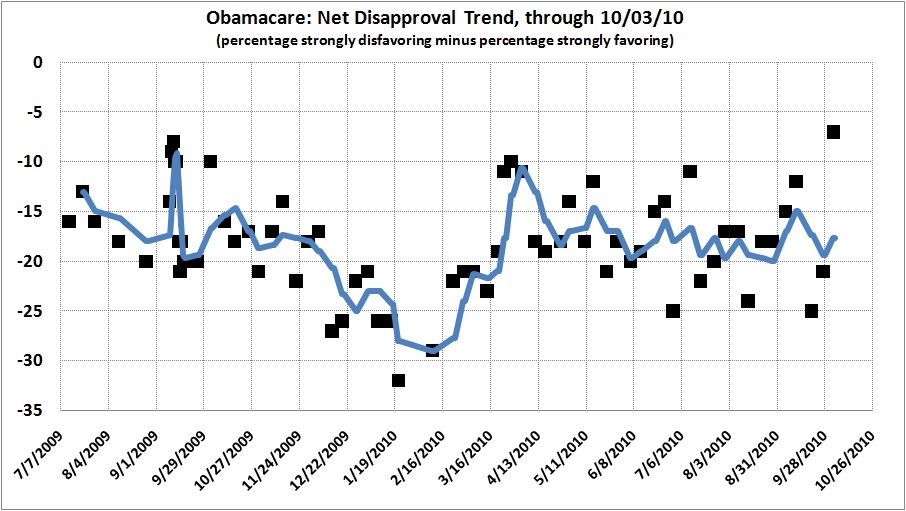
The following graph gives a longer view of the unpopularity of Obamacare. Individual polls are represented by black squares; the blue line indicates the average for the three most recent polls.


Derived from this article and its predecessors at Rasmussen Reports. Poll results before passage of Obamacare represent strong approval minus strong disapproval. Poll results after passage of Obamacare represent strong approval of repeal minus strong disapproval of repeal.

Related posts:
Rationing and Health Care
The Perils of Nannyism: The Case of Obamacare
More about the Perils of Obamacare
Health-Care Reform: The Short of It
Presidential Chutzpah
Can Markets Force Financial Discipline?
As Goes Greece…
A Moral Dilemma

The Return of the Missing Bloggers

In “Missing Bloggers,” I lamented the lapse of posting at The Fourth Checkraise and the disappearance of Occam’s Carbuncle. I am happy to report that posting has resumed at The Fourth Checkraise, and that Occam’s Carbuncle is back, in a new location: http://occamscarbuncle.wordpress.com/. (“Occam” hasn’t had much to say yet, but give him time.)

Our Miss Brooks

Some time back, Tom Smith referred to the NYT columnist and pseudo-conservative David Brooks as “prissy little Miss Brooks.” Smith’s recycling of the appellation has not diminished its satirical effect — or its substantive accuracy.

Miss Brooks recently cringed when she contemplated an America without government, in the aftermath of a victorious Tea Party movement. Miss Brooks, it seems, is besotted with the manliness of limited-but-energetic governments

that used aggressive [emphasis added] federal power to promote growth and social mobility. George Washington used industrial policy, trade policy and federal research dollars to build a manufacturing economy alongside the agricultural one. The Whig Party used federal dollars to promote a development project called the American System.

Abraham Lincoln supported state-sponsored banks to encourage development, lavish infrastructure projects, increased spending on public education. Franklin Roosevelt provided basic security so people were freer to move and dare. The Republican sponsors of welfare reform increased regulations and government spending — demanding work in exchange for dollars.

Throughout American history, in other words, there have been leaders who regarded government like fire — a useful tool when used judiciously and a dangerous menace when it gets out of control. They didn’t build their political philosophy on whether government was big or not. Government is a means, not an end. They built their philosophy on making America virtuous, dynamic and great. They supported government action when it furthered those ends and opposed it when it didn’t.

I am surprised that Miss Brooks was able to recover from her swoon and finish writing the column in question. I am less surprised that Miss Brooks omitted to mention Thomas “Louisiana Purchase” Jefferson and Theodore “I Can Do Whatever I Please” Roosevelt, given that Jefferson was an effete Francophile and Roosevelt was a squeaky-voiced nutcase.

Other than that, there are only two problems with Brooks’s prescription for beneficent government: The first is the impossibility of electing only those leaders who know how to use government power judiciously. The second problem is the assumption that the things wrought by Washington, Lincoln, et al. were judicious uses of government power.

As to the first problem, all I can do is note the number of times that a majority of Americans has been convinced of the goodness of a candidate, only to be disappointed — when not outraged — by his performance in office. Take LBJ, Nixon, Carter, G.H.W. Bush, Clinton, G.W. Bush, and Obama — please take them! –not to mention myriad Congress-critters and State and local office-holders.

The second problem is a problem for reasons that are evidentlybeyond Miss Brooks’s comprehension:

  • Government action isn’t cost-less. It absorbs resources that the private sector could have put to use.
  • Government officials, despite their (occasional) great deeds, are not gifted with superior knowledge about how to put those resources to use.
  • Private firms — when not shielded from competition and failure by governments — put resources to uses that satisfy the actual needs of consumers, as opposed to the whims (however high-minded) of politicians.
  • Private firms — when not shielded from competition and failure by government — use resources more efficiently than government.

In short, Miss Brooks, Washington may have been a great man for having led a rag-tag army to victory over the British, and Lincoln may have been a great man for having preserved the Union and (incidentally) freed the slaves, but neither man — and certainly no other man or collection of men exercising the arbitrary power of government — was or ever will be equal to the task of simulating the irreproducibly complex set of signals and decisions that are embedded in free markets.

In the end, Miss Brooks works herself into hysterics at the prospect of less government:

The social fabric is fraying. Human capital is being squandered. Society is segmenting. The labor markets are ill. Wages are lagging. Inequality is increasing. The nation is overconsuming and underinnovating. China and India are surging. Not all of these challenges can be addressed by the spontaneous healing powers of the market.

The social fabric is fraying precisely because government has pushed social institutions aside and made millions of Americans its dependents. Society is segmenting for the same reason, and also because millions of Americans are fed up with government and its dominance of their lives. Labor markets are ill and wages are lagging (compared to what?) because of various government actions that have slowed economic growth and caused (not for the first time) a deep recession. The nation is overconsuming (i.e., underinvesting) and underinnovating because of the aforesaid government-caused economic malaise, which (among other things) has reduced the demand for money (seen in the form of low interest rates) and the potential returns on innovative investments. That China and India are surging is no skin off our teeth; the more productive they are the less Americans have to pay for the goods and services they produce, and the more Americans can produce of other things — if government will only get off the back of American business.

None of these “challenges” would be challenges were it not for governmental interference in private social institutions and markets. As Ronald Reagan said in his first inaugural address, “In this present crisis, government is not the solution to our problem, government is the problem.” Amen.

So, Miss Brooks, I advise you to take two Valium and read Friedrich Hayek’s Nobel Prize lecture, “The Pretence of Knowledge.” Then pass it on to your politician friends.

Related posts:
Columnist, Heal Thyself
The Economic and Social Consequences of Government
The Mind of a Paternalist, Revisited

If there was any doubt that Richard Thaler is not a “libertarian,” even though he implies that he is one when he calls himself a “libertarian paternalist,” read this:

There is another possible argument for including the rich in these tax cuts, one based on “fairness.” By this reasoning, the wealthy are entitled to low tax rates because they have temporarily had them, and it would now be unfair to take them back.

But by that same argument, unemployment insurance should never expire, and every day should be your birthday. “Temporary” has no meaning if it bestows a permanent right.

By Thaler’s convoluted logic, the money one earns is a gift from government, and those who pay taxes have no greater claim on their own money than those to whom the government hands it. How is this “libertarian,” by any reasonable interpretation of that word?

As I have said in various ways, Thaler is a paternalist but not a libertarian. One cannot be both.

Related posts:
Beware of Libertarian Paternalists
Columnist, Heal Thyself
Discounting and “Libertarian” Paternalism
The Mind of a Paternalist

A Moralist’s Moral Blindness

Bryan Caplan restates his version of the Golden Rule, which is that “we” ought to be treated just as “we” would treat others. (My take on Caplan’s earlier post is here.) Much as I like the Golden Rule, for its civilizing influence on humans, I am not a simple-minded moralist like Caplan and other libertarian purists.

Caplan objects to the “double standard” by which Americans, for example, would praise the killing of enemy civilians, were it a necessary act of war, but condemn the killing of 3,000 Americans by an enemy who proclaims his act necessary in the service of some objective. I wonder if Caplan would object to the “double standard” when faced with the prospect of his children being among the 3,000 Americans killed.

The Golden Rule also is known as the ethic of reciprocity, and for a good reason. For the Golden Rule to operate effectively, it must be accompanied by a reasonable expectation that your mundane acts of self-restraint and helpfulness will be returned in kind by persons whose lives touch yours, or with whom you share a bond of kinship or culture.

The Golden Rule simply doesn’t operate very well across personal, familial, or cultural boundaries, Caplan’s wishful thinking to the contrary. (Consider, for example, the rudeness that often prevails in anonymous encounters over the internet and on the highway.) And there is no inherent reason that the Golden Rule should operate well across those boundaries, just because Caplan (or any other intellectual) asserts that it should. Who died and left him (and his ilk) in charge?

There are other moral considerations at work, aside from reciprocity. One of them, which I discussed in my previous post, is the ethic of mutual defense:

[W]ho better to help you defend yourself than the people with whom you share space, be it a neighborhood, a city-state, a principality, or even a vast nation? As a member of one or the other, you may be targeted for harm by outsiders who wish to seize your land and control your wealth, or who simply dislike your way of life, even if it does them no harm.

If, like Caplan, you are willing to allow an enemy to obliterate some of your fellow citizens because you have obliterated some enemy citizens, you are not to be trusted. You might as well be an enemy.

More generally, Caplan’s moral blindness betrays his Rationalism. As Michael Oakeshott explains,

the Rationalist never doubts the power of his ‘reason … to determine the worth of a thing, the truth of an opinion or the propriety of an action. Moreover, he is fortified by a belief in a ‘reason’ common to all mankind, a common power of rational consideration….

… And having cut himself off from the traditional knowledge of his society, and denied the value of any education more extensive than a training in a technique of analysis, he is apt to attribute to mankind a necessary inexperience in all the critical moments of life, and if he were more self-critical he might begin to wonder how the race had ever succeeded in surviving. (“Rationalism in Politics,” pp. 5-7, as republished in Rationalism in Politics and Other Essays)

Thomas Sowell puts it this way:

One of the things intellectuals [his Rationalists] have been doing for a long time is loosening the bonds that hold a society [or a nation] together. They have sought to replace the groups into which people have sorted themselves with groupings created and imposed by the intelligentsia. Ties of family, religion, and patriotism, for example, have long been treated as suspect or detrimental by the intelligentsia….

Under the influence of the intelligentsia, we have become a society that rewards people with admiration for violating its own norms and for fragmenting that society into jarring segments. In addition to explicit denigrations of their own society for its history or current shortcomings, intellectuals often set up standards for their society which no society has ever met or is likely to meet.

Calling those standards “social justice” enables intellectuals to engage in endless complaints about the particular ways in which society fails to meet their arbitrary criteria, along with a parade of groups entitled to a sense of grievance, exemplified in the “race, class and gender” formula…. (Intellectuals and Society, pp. 303, 305)

Sowell’s attack is aimed at left-wing intellectuals, but it could just as well be aimed at libertarian purists like Caplan and his ilk.

The Divine Right of the Majority

From “Fun For Clio,” an essay in Hilaire Belloc’s The Silence of the Sea (1941):

An older generation marvelled that men should unquestioningly obey a King, who claimed absolute Divine authority for his mandates. To-day you find men falling into exactly that state of mind in the presence of what they call a majority. All sorts of evidence is shouting at them to show them that this word “majority” has no meaning because it may be of any kind whatsoever — a majority of men or a majority of women or a majority of men and women combined, or a majority of those who care, or a majority of those who want to express an opinion, or a majority of those who are bored stiff with having to express an opinion, or a majority of those who don’t express an opinion but simly make a mark on a bit of paper. It may mean a majority of a thousand and one to a thousand, or a majority of nine out of ten, a majority of citizens or a majority of professional politicians, a majority of murderers, a majority of savages, a majority of lunatics, a majority which changes in a few hours or a majority which is fixed — it is all one, majority is worshipped as of Divine Right. (p. 88, Glendalough Press edition)

Plus ça change, plus c’est la même chose.

Related posts:
Democracy and Liberty
Greed, Cosmic Justice, and Social Welfare
Utilitarianism, “Liberalism,” and Omniscience
Utilitarianism vs. Liberty
Accountants of the Soul
Rawls Meets Bentham
Enough of “Social Welfare”
The Case of the Purblind Economist

The End of a Dynasty

UPDATED

The Yankees’ recent record [written 09/26/10] — 4 straight losses, 6-12 in the past three weeks, .529 since the All-Star break — suggests that their third dynasty may be drawing to a close [but not quite, see below]. It would be unsurprising if that turns out to be so. Where are the replacements for Jeter, Posada, Pettitte, and Rivera, whose average age is 38? A-Rod is close behind, at 34, and not the A-Rod of a few years ago. Tex, at 30, is on the cusp of decline, and his numbers show it. Of the younger generation of position players, only Robinson Cano exudes star quality. Curtis Granderson is no Bernie Williams; Nick Swisher, no Paul O’Neill.

The only reliable starter is CC Sabathia. A.J. Burnett and Javier Vasquez don’t belong on a championship-calibre team. Phil Hughes isn’t convincing, despite his 17 wins. The bullpen reminds me of a rowboat in a hurricane. Even Mariano has become a question mark.

Given the evident dearth of outstanding young players, the end of the present dynasty seems to be in sight — or perhaps visible in the rear-view mirror. The 2009 World Series may have marked the end of Yankees Dynasty III.

Dynasty I lasted from 1921, the year of the Yankees’ first AL championship, to 1964, the year of their 29th AL championship. There were some “down” years sprinkled throughout the period — most notably, 1925, the year of the Babe’s big stomach ache, when the Yankees finished seventh in the days of the eight-team league. But the Yankees never went more than four seasons without a pennant, and finished below third (in eight- and ten-team leagues) only twice. Overall record in 44 seasons: 29 league championships and 20 World Series championships.

Dynasty II lasted only six seasons: 1976-1981. The Yankees led their division in four of those years, and wound up with the AL crown in 1981, despite an overall fourth-place finish, thanks to the split season (due to a players’ strike) and a post-season playoff to determine the division winner. Overall record in six seasons: 5 division championships, 4 league championships, and 2 World Series championships.

Dynasty III (on the current evidence) lasted 16 19 seasons: 1994-2009 2012. Overall record: 14 17 appearances in post-season play, 12 14 division championships, 7 league championships, and 5 World Series championships. (Don’t forget that in 1994 the Yankees had no opportunity to compete for a league or World Series championship because a players’ strike wiped out post-season play.) That’s a lot better than Dynasty II and a lot worse than Dynasty I.

In the following graph [updated to include the 2011-13 seasons], the black line indicates the Yankees’ finishes in the American League (1901-1968) or Eastern Division of the AL (1969-2013). The red, horizontal bars indicate the number of teams in the league or division, for each season. The blue shading highlights the years of the Yankees’ dynasties, to date. It looks like the end for Dynasty III — and end that coincides with the retirements of Mariano Rivera and Andy Pettite, the final declines of Jeter and A-Rod.

The Mood of the Country

UPDATED 09/25/10

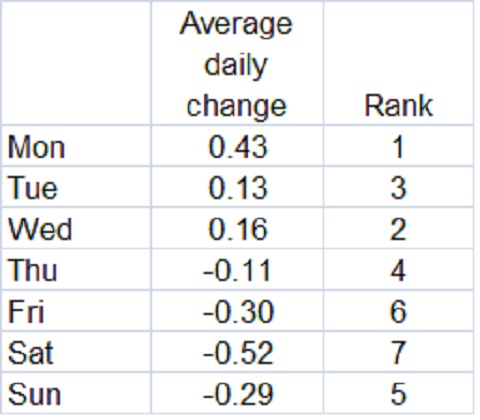
From the morning of January 21, 2009, through this morning, Obama’s net popularity rating has dropped from +28 to -13 (according to Rasmussen Reports). That’s an average daily decline of 0.07 rating points. But how Obama’s rating fares on a given day depends, in part, on the day of the week; thus:

As the week wears on, the likely voters polled by Rasmussen become less satisfied — or more dissatisfied — with Obama’s performance in office. Irascibility peaks on Saturday, then begins to recede on Sunday. Blue Monday, oddly enough, is Obama’s best day in the eyes of Rasmussen’s survey group. Conversely, the first day of the weekend — a day eagerly anticipated by most working persons — is Obama’s worst day. Go figure.

UPDATE: Saturday continues to be Obama’s blue polling day. With today’s 2-point drop, Saturday’s average change is now -0.54.

Inside-Outside

Bryan Caplan seems to think that the tendency of geographically proximate groups to band together in self-defense is a kind of psychological defect. He refers to it as “group-serving bias.”

It is nothing of the kind, however. It is a simple case of self-defense. And who better to help you defend yourself than the people with whom you share space, be it a neighborhood, a city-state, a principality, or even a vast nation? As a member of one or the other, you may be targeted for harm by outsiders who wish to seize your land and control your wealth, or who simply dislike your way of life, even if it does them no harm.

The cause of Caplan’s confusion is his adherence to a kind of libertarian idealism. In the anti-war argot of the 1960s, it was expressed as “Why can’t we all just get along?” But hope is not reality, Caplan notwithstanding.

Not getting along, to Caplan, is a moral defect. He therefore considers the differential treatment of insiders and outsiders to be an unmitigated wrong. But group cohesion is a prudential social instinct that no amount of rationalism can obliterate. Differential treatment of insiders and outsiders is an inevitable aspect of that prudential social instinct. It is not, at bottom, a moral issue.

If Caplan were logically consistent, he would focus his moral lens on the animal kingdom. There is plenty of inter-group conflict to condemn there: shark vs. tuna, cheetah vs. antelope, spider vs. fly, and so on. In the case of man vs. cattle (hog, fish, fowl, or other living thing), I wonder if Caplan opts for veganism? It would be the proper choice — for him.

Related posts:
Parsing Political Philosophy
“Natural Rights” and Consequentialism
More about Consequentialism
Line-Drawing and Liberty

Venus vs. Mars

Excerpts of a typically excellent post at Public Discourse, “Women, Abortion, and the Brain“:

Women’s brains are, of course, in many fundamental ways the same as men’s. Men and women think and reason in similar ways. But recent research shows that there are some significant differences in the brain and brain-related psychology of the two sexes. And a few of these differences can make a very large difference with regard to decision-making and its emotional consequences.

The part of the brain that processes emotion, generally called the limbic system, of women functions differently than that of men. Women experience emotions largely in relation to other people: what moves women most is relationships. Females are more personal and interpersonal than men. (Differences show up as early as a day after an infant’s birth: newborn baby girls look at faces relatively more than boys, who focus more on moving robotic figures.) There is wide consensus among scientists and researchers on this fundamental issue.

Recent research has also studied the ways in which males and females cope with stress. Whereas men’s behavior under stress is generally characterized by what is called “fight or flight,” women respond to stress by turning toward nurturing behavior, nicknamed “tend and befriend.”

Men’s and women’s brains also work differently in handling memory and memories. Men are more apt to recall facts of all kinds, on the one hand, and a global picture of events, on the other. By contrast, women remember people (for example, faces), details of all kinds, and emotion-laden narratives—and they may return to them obsessively.

I am only passingly familiar with the research that supports these observations, but they comport well with what I have seen in five decades as an adult. I offer, as just one of many possible examples, my daughter, who — untypically, for a woman — is much better with numbers than with words, and who has succeeded in the male-dominated field of investment banking. She is nevertheless strongly “feminine” in her emotions.

Radical feminists and egalitarians to the contrary, women aren’t just men with different anatomical features. There is a good case to be made for the injection of “feminine” traits into the worlds of business and politics. But there is no case to be made for enforced equality of pay or representation.

Individuals should be dealt with as individuals, not as “group members.” It is the levelers who are guilty of group bias, given their insistence that males and females are alike in their stock of mental and physical abilities — except that females are superior, of course.

Related posts:
Sexist Nonsense
Cornered by Gender?

A Conversation with Uncle Sam

Uncle Sam graciously granted me a telephone interview. Here is a complete transcript of the conversation between Uncle Sam (S) and me (T):

S: Sam here.

T: Hello, uncle, it’s Thomas.

S: It’s good to hear your voice, Mr. Jefferson.

T: Sorry, not that Thomas. I’m just a humble blogger. Do you know about blogs?

S: Oh, yes. I follow all the blogs about politics and economics. It’s quite a chore, but very enlightening. The things some people think about me are shocking.

T: How so?

S: Well, there are a lot of people out there who think that I hold the solution to all economic and social problems.

T: Don’t you?

S: Of course not. People are responsible for solving their own problems. All I can do is try to create a safe environment in which they can get on with the business of life.

T: Before we explore that idea further, tell me about yourself. How did you get your job?

S: I was hired by nine of the original States in 1788, when the Constitution was ratified. The other four soon joined them, and others came along later.

T: What was your job description when you were hired?

S: Pretty much what I said a minute ago: to keep the people safe, which includes refereeing squabbles among the States and ensuring that they don’t erect barriers to keep out people and goods from other States.

T: But you seem to have acquired a lot of additional duties since 1788.

S: Sad, but true. And it’s wearing me down. I have to pretend to be a lot wiser and more capable than any one person can be. I wish the States would get together and pare my job description down to its original specifications.

T: It seems unlikely, though. A lot of people have come to depend on you to do things they could do for themselves.

S: And it’s getting very expensive — like having 300 million dependents. The only way I’ll be able to support them all is to raise their taxes. I could borrow money from foreigners, but the more I borrow, the more expensive it will become. Eventually, foreigners will look at my balance sheet and cut me off.

T: So what it boils down to is this: In the end, your dependents must pay for the things that you do for them. Correct?

S: That’s exactly right. I’m just running a big Ponzi scheme. And most of the people who sign up for it are fools who believe that they’re getting something for nothing.

T: What’s in it for you?

S: Well, I must admit that I get a cut of the action.

T: So, when all the dust settles, your dependents don’t even get all of their money back from you?

S: Are you kidding? Of course they don’t. If they want me to do all of this extra work, they have to pay me for my trouble.

T: Do you think it’s possible to cut your job back to its original size?

S: Only if a lot more people get wise to me. Most of them seem to think I’m Santa Claus or the Tooth Fairy.

T: But the politicians who give you your orders don’t believe such things, do they?

S: Some of them do. Most of them are just using me to make things work the way they want them to. It’s called “control.” I’ve seen all the presidents, members of Congress, and Supreme Court jutices — from great to mediocre — and almost every one of them was, or is, a control freak. Washington had to be one in order to get things off the ground. Without him, I wouldn’t have a job. Ditto Lincoln, who had to be a control freak in order to save the Union. Not that that was a bad thing, mind you, especially because it brought an end to slavery. But how many presidents since Lincoln have tried to stuff the genie (me) back in the bottle? Cleveland, Coolidge, and Reagan — that’s about it. And whatever success they enjoyed was only temporary. The people are good at fooling themselves, and politicians excel at helping them along.

T: You seem pessimistic.

S: I am. What’s needed is another Revolution, but a peaceful one. Those are hard to come by.

T: I’ll end our conversation on that note. Thanks very much, Sam.

S: Thank you for listening. And give my best wishes to the Tea Party.

Team W-L Histories: 1901-2009

In the course of preparing the three preceding posts, I compiled the table below. Note that the American League’s overall record is slightly better than the National League’s. That’s because of the AL’s edge in interleague play, which continues into 2010.

Won-Lost records, 1901-2009
(franchise histories at bottom of table)
National League
Team Games Won Lost W-L%
Giants 16994 9070 7834 .537
Dodgers 16995 8841 8065 .523
Cardinals 17006 8774 8128 .519
Pirates 16993 8607 8292 .509
Cubs 17012 8545 8367 .505
Reds 17010 8484 8436 .501
Diamondbacks 1944 970 974 .499
Astros 7652 3812 3835 .498
Braves 16983 8168 8708 .484
Mets 7644 3655 3981 .479
Marlins 2686 1283 1403 .478
Nationals 6511 3098 3409 .476
Rockies 2692 1281 1411 .476
Phillies 16955 7830 9051 .464
Padres 6518 3008 3508 .462
Brewers 1943 889 1053 .458
NL totals 173538 86315 86455 .4996
American League
Team Games Won Lost W-L%
Yankees 16962 9575 7294 .568
Red Sox 16973 8730 8160 .517
Indians 16987 8622 8274 .510
Tigers 17013 8564 8356 .506
White Sox 16982 8540 8339 .506
Angels 7811 3887 3921 .498
Blue Jays 5224 2589 2632 .496
Athletics 16947 8189 8671 .486
Royals 6505 3143 3360 .483
Twins 16995 8138 8748 .482
Brewers 4570 2200 2367 .482
Orioles 16986 8013 8863 .475
Mariners 5223 2461 2760 .471
Rangers 7797 3657 4134 .469
Rays 1941 826 1115 .426
AL totals 174916 87134 86994 .5004
Franchise histories:
National League
Giants in San Francisco, 1958- ; in New York (also as Gothams), 1883-1957
Dodgers in Los Angeles, 1958 – ; in Brooklyn (also as Robins, Bridegrooms, Grooms), 1890-1957); previously in American Association (as Bridegrooms, Grays, Atlantics), 1884-1889
Cardinals in St. Louis (also as Perfectos, Browns), 1892- ; previously in American Association (as Browns, Brown Stockings), 1882-1891
Pirates in Pittsburgh (also as Alleghenys), 1887- ; previously in American Association (as Alleghenys), 1882-1886
Cubs in Chicago (also as Orphans, Colts, White Stockings), 1876-
Reds in Cincinnati (also as Redlegs), 1890- ; previously in American Association (as Red Stockings), 1882-1889
Diamondbacks in Arizona (Phoenix), 1998-
Astros in Houston (also as Colt .45’s), 1962-
Braves in Atlanta, 1966- ; in Milwaukee, 1953-1965; in Boston (also as Bees, Rustlers, Doves, Beaneaters, Red Caps), 1876-1952
Mets in New York, 1962-
Marlins in Florida (Miami), 1993-
Nationals in Washington, 2005- ; in Montreal (as Expos), 1969-2004
Rockies in Colorado (Denver), 1993-
Phillies in Philadelphia (also as Quakers), 1883-
Padres in San Diego, 1969-
Brewers in Milwaukee, 1998- (see AL entry for previous history)
American League
Yankees in New York (also as Highlanders), 1903- ; in Baltimore (as Orioles), 1901-1902
Red Sox in Boston (also as Americans), 1901-
Indians in Cleveland (also as Naps, Bronchos, Blues), 1901-
Tigers in Detroit, 1901-
White Sox in Chicago, 1901-
Angels in Anaheim, 1961- , but indentified variously as Los Angeles Angels of Anaheim, Anaheim Angels, California Angels, Los Angeles Angels
Blue Jays in Toronto, 1977-
Athletics in Oakland, 1968- ; in Kansas City, 1955-1967; in Philadelphia, 1901-1954
Twins in Minnesota (Minneapolis), 1961- ; in Washington (as Senators), 1901-1960
Royals in Kansas City, 1969-
Brewers in Milwaukee, 1970-1997; in Seattle (as Pilots), 1969
Orioles in Baltimore, 1954- ; in St. Louis (as Browns), 1902-1953; in Milwaukee (as Brewers), 1901
Rangers in Texas (Arlington), 1972- ; in Washington (as Senators) 1961-1971
Mariners in Seattle, 1977-
Rays in Tampa Bay (St. Petersburg, also as Devil Rays), 1998-

Enough of Krugman

Paul Krugman, who has descended to the use of survey statistics, declares that small businesses aren’t hiring because their sales are down (“It’s Demand, Stupid“). Krugman has two points to make:

  • Small businesses aren’t cowed by regime uncertainty, taxes, and red tape, and all of those other “wonderful” things about which Krugman knows nothing.
  • The way to get out of the recession is to double down on “stimulus.”

Krugman’s first point aligns with  his stubborn insistence — against mountains of evidence  to the contrary– that government is benign and free-markets are malign.

Krugman’s second point aligns with his simplistic Keynsian view of the world, in which GDP is a homogeneous substance, like water, the level of which can be raised or lowered in a trice by government spending or the lack thereof. There’s no room in the Krugmanesque view of the world for real firms, run by real people, staffed by real people, producing myriad goods and services in myriad ways, and subject to the whims of Washington and thousands of State and local governments.

To say that small-businesspersons are reluctant to hire because there is inadequate demand for their products is like saying that a sick person is lying down because he doesn’t feel well. It’s a banal and incomplete interpretation of the situation. In any event, the fact that small businesses — and businesses in general — haven’t resumed hiring at the pre-recession rate is not an argument for mindless pump-priming. If it is an argument for anything, it is an argument for government to get out of the way.

Were the government a business, with a strong incentive to perform services of value to willing buyers, it would get out of the business of managing the economy and stick to what it does best: dispense justice and defend the nation. That it often fails to do those things well should be a clue to the Krugmans of the world about their risible faith in the wise, omniscient, and efficient government of their imagining.

There’s plenty more out there to indict and convict Krugman and his insistently wrong-headed view of the world. Here’s a minute sample:

Krugman and DeLong, a Prevaricating Pair
Professor Krugman Flunks Economics
The Negative Consequences of Government Expenditure
Regime Uncertainty: Behind the Reports of Economic Doom
Finally, Some Evidence from Krugman
Reviewing Krugman
In Pursuit of Empirical Macroeconomics
Krugman: Republicans Are Fiscally Irresponsible for Pushing Smaller Tax Cut, Threatening Much Larger One

To write about Krugman is to grant him the favor of being taken seriously. Basta!

Today Is Constitution Day

The members of the Constitutional Convention approved the new Constitution on this day in 1787. The Constitution then went to the old Confederation Congress, which approved the submission of the Constitution to conventions of the States.

The Constitution took effect on June 21, 1788, when it was ratified by a ninth State (New Hampshire), though it bound only the nine States that had thus far ratified it. The other four States followed suit, but the Constitution was not ratified by — and did not become binding on — all thirteen States until Rhode Island joined the Union on May 29, 1790. By then, more than a year had passed since the first Congress of the United States had assembled and George Washington had been inaugurated.

In honor of the original Constitution — which has been shredded by generations of legislative, executive, and judicial malfeasance — I refer you to these posts:

A New, New Constitution
The Real Constitution and Civil Disobedience
A Declaration of Independence
First Principles
The Constitution: Original Meaning, Corruption, and Restoration

A Simpler Pythagorean Formula

According to an article posted in the “Bullpen” at Baseball-Reference.com, the Pythagorean Theorem of Baseball

relates the number of runs a team has scored and surrendered to its actual winning percentage….

There are two ways of calculating Pythagorean Winning Percentage (W%). The more commonly used, and simpler version uses an exponent of 2 in the formula.

W%=[(Runs Scored)^2]/[(Runs Scored)^2 + (Runs Allowed)^2]

More accurate versions of the formula use 1.81 or 1.83 as the exponent.

W%=[(Runs Scored)^1.81]/[(Runs Scored)^1.81 + (Runs Allowed)^1.81]

An analysis of statistics available at Baseball-Reference.com, which include expected W%, yields the following straightforward version of the Pythagorean expectation:

W% = 1.8195*RS% – 0.4098, where

W% = games won/(games won + games lost),

RS% = runs scored/(runs scored + runs allowed), and

* indicates multiplication.

The Pythagorean formula used by Baseball-Reference.com bears a strong resemblance to the long-term (1901-2009) relationship between W% and RS%, which is:

W% = 1.8372*RS% – 0.4191

This equation is no longer accurate, however. Nor is any equation that neglects the evolution of the game through its six “modern” eras: Deadball (1901-1919), Lively Ball I (1920-1941), Wartime Lull (1942-1946), Lively Ball II (1947-1961), High Plateau (1962-1993), and Juiced Player (1994-2xxx). Here are the formulae for each of the six eras:

Deadball

W% = 1.7679 * RS% – 0.3843

Lively Ball I

W% = 1.8965 * RS% – 0.4482

Wartime Lull

W% = 1.7389 * RS% – 0.3686

Lively Ball II

W% = 1.8704*RS% – 0.4377

High Plateau

W% = 1.7521*RS% – 0.3760

Juiced Player

W% = 1.9882*RS% – 0.4940

This final equation seems like the one to use, until there is a marked change in the style of play. Results will vary from year to year, of course. Here, for example, is the equation for 2009:

W% = 1.9419*RS% – 0.4707

Related post: Explaining a Team’s W-L Record

The Six Eras of Baseball

In the preceding post, I identified six eras of “modern” baseball:

1901-1919 — Deadball (“modern”)

1920-1941 — Lively Ball I

1942-1946 — Wartime Lull

1947-1961 — Lively Ball II

1962-1993 — High Plateau

1994-2xxx — Juiced Player

These six eras have distinctive characters, which are captured in the following table:

Change from 1901-1919
Runs per HR per Add’l runs Add’l HR Runs per
Era # Teams game game per game per game add’l HR
1901-1919 16 7.84 0.30
1920-1941 16 9.69 0.97 1.85 0.67 2.76
1942-1946 16 8.14 0.88 0.30 0.58 0.52
1947-1961* 18 8.91 1.62 1.07 1.32 0.81
1962-1993** 26 8.37 1.56 0.53 1.26 0.42
1994-2009*** 30 9.62 1.63 1.78 1.33 1.34
1994-2009 “old 16” 9.73
1901-2009 30 8.82
1901-2009 “old 16” 8.85
* 2 expansion teams in 1961
** 2 expansion teams in 1962; 4 in 1969; 2 in 1977; 2 in 1993
*** 2 expansion teams in 1998

Lively Ball Era I was the most dynamic era to date. There were more home runs than in the Deadball era, to be sure, but it is evident that much of the “small ball” action of the Deadball era carried over into Lively Ball I.

The Wartime Lull was just that. There were more home runs than in the Deadball era, but every home run netted only 0.52 runs on the scoreboard. Think of batters reaching base and mostly waiting around for a home run to be hit, usually to no avail.

The next two eras — Lively Ball II and High Plateau — saw a resurgence of home-run hitting, but run production didn’t return to the level of Lively Ball II. Again, there was a lot of waiting around for home runs, usually to no avail.

The era of the Juiced Player rivals (but falls short of) the dynamism of Lively Ball I. Yes, a lot more home runs per game (what would you expect?), but not quite the same number of runs per game.

I have always had the impression that baseball in the 1920s and 1930s was baseball at its exciting best: power added to the “small ball” wiles of the Deadball era. The numbers seem to confirm that impression.

EXTRA INNINGS:

The runs-per-game figures for the “old 16” teams — the franchises in existence from 1901 through 1960 — suggest that those teams have done better than the expansion upstarts. In fact, for the Juiced Player era (1994-2009), the “old 16” have a W-L record of .512.

But not all of the “old 16” have fared well. Here are the W-L rankings of the “old 16” for the period 1994-2009:

Rank (of 30) Team G W L W-L%
1 NYY 2524 1514 1007 .601
2 ATL 2525 1456 1068 .577
3 BOS 2526 1409 1117 .558
4 CLE 2523 1353 1170 .536
5 STL 2525 1347 1176 .534
7 LAD 2526 1336 1190 .529
9 OAK 2524 1312 1212 .520
10 CHW 2527 1312 1212 .520
11 SFG 2526 1310 1215 .519
14 PHI 2526 1260 1266 .499
17 MIN 2525 1251 1273 .496
19 CIN 2530 1232 1295 .488
20 CHC 2524 1230 1294 .487
24 BAL 2525 1175 1347 .466
27 DET 2526 1108 1418 .439
28 PIT 2523 1091 1431 .433

“Old 16” teams occupy the top five spots and 10 of the top 15 spots. But Baltimore (13 straight losing seasons, 1998-2010), Detroit (12 straight losing seasons, 1994-2005), and Pittsburgh (18 straight losing seasons, 1993-2010) have turned in especially embarrassing performances.

The Lively Ball Eras

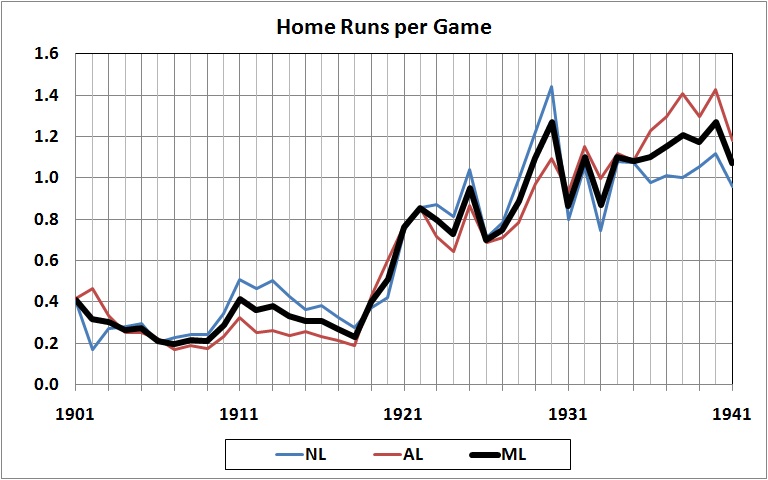
It is generally thought that the lively ball era began in 1920. In that year, the number of home runs per major-league game jumped to 0.511, eclipsing the previous “modern” high of 0.411, set in 1911. But the home-run barrage was only beginning in 1920. It jumped to 0.762 per game in 1921 — nearly double the 1911 mark — and continued around a rising trend through the rest of the pre-World War II era:

Despite Babe Ruth’s dominance in the early years of the lively ball era — he hit almost 9 percent of ML home runs in 1920, and more than 6 percent in 1927 — it wasn’t until 1931 that the AL began to outslug the NL every year. But there was plenty of slugging to go around, as the peaks and high valleys of 1930-1941 attest. I attribute the higher home-run output of those years to arrival of a new generation of players, who were selected more often than not for their slugging ability and encouraged to cultivate that ability.

But the real lively ball eras were yet to come:

Following a lull from 1942 through 1946, the home-run barrage resumed in 1947, with the post-war return of slugging veterans and the influx of newcomers raised in the slugging tradition. The second lively ball era peaked in 1961. It subsided with the “era of the pitcher” and the first waves of expansion. But even at its lowest ebb in the 1970s and 1989s, the pace of home-run production exceeded the peaks of the first lively ball era, with only a few exceptions.

Then came 1994 and a third era. This one, sad to say, probably owed its existence not to a “juiced” baseball but to “juiced” baseball players. Given the crackdown on performance-enhancing substances, the rate of home-run production in 2010 (to date) has dropped to that of 1961 — when the “juice” in the game came from a performance-inhibiting substance known as alcohol.

I hereby declare the following eras:

1901-1919 — Deadball (“modern”)

1920-1941 — Lively Ball I

1942-1946 — Wartime Lull

1947-1961 — Lively Ball II

1962-1993 — High Plateau

1994-2xxx — Juiced Player