The Population Mystery

Despite the doomsayers, past and present, the world’s population has grown and will grow:


Estimates for 10,000 B.C. through 1940 derived from U.S. Census Bureau, “Historical Estimates of World Population” (left column). Estimates for 1950 through 2050 derived from U.S. Census Bureau, “Total Midyear Population for the World: 1950-2050.” Intervals between years are irregular because of variations in the intervals in the Census tables.

Is it possible that the world’s population will reach an unsustainable level, after which it must shrink and/or plunge the world into abysmal poverty?

Donald Boudreaux, in a 2008 post, writes:

In his new book, Common Wealth, Jeffrey Sachs expresses his concern about population growth.  Worried by a U.N. prediction that global population will rise to 9.2 billion by the year 2050, from 6.6 billion today, Sachs says (on page 23 of his new book) the following about these additional 2.6 billion persons:

I will argue at some length that this is too many people to absorb safely, especially since most of the population increase is going to occur in today’s poorest countries.  We should be aiming….to stabilize the world’s population at 8 billion by midcentury.

Eight billion.  I’m not sure where Sachs got that number.  And, to be frank, I’m not curious about where he got it….

A … problem with Sachs’s eight-billion number is that, in calculating it, there is no way to predict how human creativity will alter the world during the next 42 years.  It’s ludicrous to pretend that we can know now what, say, the average MPG will be for internal-combustion engines in 2050.  Hell, we don’t even know if automobiles and lawnmowers and the like will still use such engines then.

Will another Norman Borlaug arise, between now and 2050, to spark another green revolution?  Will someone invent a way to efficiently power automobiles with air?  Will someone develop new and better techniques for defining and enforcing private property rights in ocean-going fish stocks so that the tragedy of the commons called “over-fishing” is eliminated?  Will an enterprising entrepreneur invent a means for ordinary households to power their homes with mulch or autumn leaves or small fragments of fingernail clippings?

Think back 42 years to 1966.  Who in that year imagined personal computers in nearly every home in America?  The Internet?  Digital cameras?  Cell phones?  Quality wines sold in screw-top bottles?  Buying music with literally the click of a button (and not having to burn fossil fuels in driving to the record store).  Aluminum cans that contain only a fraction of the metal that cans contained back then?  The Kindle (that will reduce the number of trees cut down to enable people to read books)?  Medical advances that make hip-replacements about as routine as getting cavities filled by the dentist?  Microfiber?

There is no way — literally, no way — to know how technology and social institutions will change between now and 2050.  Given this impossibility — and given the fact that we can nevertheless predict with confidence that technology will advance and that social institutions will change — to assert that “optimal” population in the year 2050 will be eight-billion persons is ludicrous in the extreme.  It’s faux-science, and deserves only ridicule.

Here’s Bryan Caplan, writing today:

I finally got around to reading Matt Ridley’s The Rational Optimist. Highlights….

2. How non-renewable energy is more abundant than renewable energy:

The Atlantic Ocean is not infinite, but that does not mean you have to worry about bumping into Newfoundland if you row a dingy out of a harbour in Ireland.  Some things are finite but vast; some things are infinitely renewable, but very limited.  Non-renewable resources such as coal are sufficiently abundant to allow an expansion of both economic activity and population to the point where they can generate sustainable wealth for all the people of the planet without hitting a Malthusian ceiling, and can then hand the baton to some other form of energy.

3. The fallacy of pessimistic extrapolation:

[T]he pessimists are right when they say that, if the world continues as it is, it will end in disaster for humanity.  If all transport depends on oil, and oil runs out, then transport will cease.  If agriculture continues to depend on irrigation and aquifers are depleted, then starvation will ensue.  But notice the conditional: if.  The world will not continue as it is.  That is the whole point of human progress, the whole message of cultural evolution, the whole import of dynamic change – and the whole thrust of this book….

5. Declining flu mortality is not dumb luck.

The modern way of life, with lots of travel but also rather more personal space, tends to encourage mild, casual-contact viruses that need their victims to be healthy enough to meet fresh targets fleetingly…

[W]hy then did H1N1 flu kill perhaps fifty million people in 1918?  Ewald and others think the explanation lies in the trenches of the First World War.  So many wounded soldiers, in such crowded conditions, provided a habitat ideally suited to more virulent behaviour by the virus: people could pass on the virus while dying….

The main argument I wish Ridley pursued more: How the very existence of civilization creates a mighty presumption against pessimism in all its forms.  But I view his omission optimistically: The arguments for optimism are so numerous that no one book can contain them all.

Doomsayers are simple-minded extrapolators. I suspect that they have an aesthetic objection to population growth, which they wrap in pseudo-scientific garb. Like their close kin, anti-market politicians and pundits, doomsayers seem to have no conception of the power of human ingenuity to make life more livable — when that ingenuity is not stifled by government.

Related posts:
The Causes of Economic Growth
A Short Course in Economics
Addendum to a Short Course in Economics
The Price of Government
The Price of Government Redux

The Birth of “Urban Legend”

The term “urban legend,” according to Wikipedia (citing the OED),

has appeared in print since at least 1968. Jan Harold Brunvand, professor of English at the University of Utah, introduced the term to the general public in a series of popular books published beginning in 1981.

I have news for the editors of the OED and the contributors to Wikipedia: Hilaire Belloc (1870-1953) got there first. In “Fun for Clio,” one of the essays collected in The Silence of the Sea (1941), Belloc writes:

Our great urban masses swallow the most fantastic legends and become furious if they hear the absurdity denied. (p. 87  in the Glendalough Press reprint)

In my book, that is close enough to count as the proximate source of “urban legend.”

What Is Truth?

There are four kinds of truth: physical, logical-mathematical, psychological-emotional, and judgmental. The first two are closely related, as are the last two. After considering each of the two closely related pairs, I will link all four kinds of truth.

PHYSICAL AND LOGICAL-MATHEMATICAL TRUTH

Physical truth is, seemingly, the most straightforward of the lot. Physical truth seems to consist of that which humans are able to apprehend with their senses, aided sometimes by instruments. And yet, widely accepted notions of physical truth have changed drastically over the eons, not only because of improvements in the instruments of observation but also because of changes in the interpretation of data obtained with the aid of those instruments.

The latter point brings me to logical-mathematical truth. It is logic and mathematics that translates specific physical truths — or what are taken to be truths — into constructs (theories) such as quantum mechanics, general relativity, the Big Bang, and evolution. Of the relationship between specific physical truth and logical-mathematical truth, G.K. Chesterton said:

Logic and truth, as a matter of fact, have very little to do with each other. Logic is concerned merely with the fidelity and accuracy with which a certain process is performed, a process which can be performed with any materials, with any assumption. You can be as logical about griffins and basilisks as about sheep and pigs. On the assumption that a man has two ears, it is good logic that three men have six ears, but on the assumption that a man has four ears, it is equally good logic that three men have twelve. And the power of seeing how many ears the average man, as a fact, possesses, the power of counting a gentleman’s ears accurately and without mathematical confusion, is not a logical thing but a primary and direct experience, like a physical sense, like a religious vision. The power of counting ears may be limited by a blow on the head; it may be disturbed and even augmented by two bottles of champagne; but it cannot be affected by argument. Logic has again and again been expended, and expended most brilliantly and effectively, on things that do not exist at all. There is far more logic, more sustained consistency of the mind, in the science of heraldry than in the science of biology. There is more logic in Alice in Wonderland than in the Statute Book or the Blue Books. The relations of logic to truth depend, then, not upon its perfection as logic, but upon certain pre-logical faculties and certain pre-logical discoveries, upon the possession of those faculties, upon the power of making those discoveries. If a man starts with certain assumptions, he may be a good logician and a good citizen, a wise man, a successful figure. If he starts with certain other assumptions, he may be an equally good logician and a bankrupt, a criminal, a raving lunatic. Logic, then, is not necessarily an instrument for finding truth; on the contrary, truth is necessarily an instrument for using logic—for using it, that is, for the discovery of further truth and for the profit of humanity. Briefly, you can only find truth with logic if you have already found truth without it. [Thanks to The Fourth Checkraise for making me aware of Chesterton’s aperçu.]

To put it another way, logical-mathematical truth is only as valid as the axioms (principles) from which it is derived. Given an axiom, or a set of them, one can deduce “true” statements (assuming that one’s logical-mathematical processes are sound). But axioms are not pre-existing truths with independent existence (like Platonic ideals). They are products, in one way or another, of observation and reckoning. The truth of statements derived from axioms depends, first and foremost, on the truth of the axioms, which is the thrust of Chesterton’s aperçu.

It is usual to divide reasoning into two types of logical process:

  • Induction is “The process of deriving general principles from particular facts or instances.” That is how scientific theories are developed, in principle. A scientist begins with observations and devises a theory from them. Or a scientist may begin with an existing theory, note that new observations do not comport with the theory, and devise a new theory to fit all the observations, old and new.
  • Deduction is “The process of reasoning in which a conclusion follows necessarily from the stated premises; inference by reasoning from the general to the specific.” That is how scientific theories are tested, in principle. A theory (a “stated premise”) should lead to certain conclusions (“observations”). If it does not, the theory is falsified. If it does, the theory lives for another day.

But the stated premises (axioms) of a scientific theory (or exercise in logic or mathematical operation) do not arise out of nothing. In one way or another, directly or indirectly, they are the result of observation and reckoning (induction). Get the observation and reckoning wrong, and what follows is wrong; get them right and what follows is right. Chesterton, again.

PSYCHOLOGICAL-EMOTIONAL AND JUDGMENTAL TRUTH

A psychological-emotional truth is one that depends on more than physical observations. A judgmental truth is one that arises from a psychological-emotional truth and results in a consequential judgment about its subject.

A common psychological-emotional truth, one that finds its way into judgmental truth, is an individual’s conception of beauty.  The emotional aspect of beauty is evident in the tendency, especially among young persons, to consider their lovers and spouses beautiful, even as persons outside the intimate relationship would find their judgments risible.

A more serious psychological-emotional truth — or one that has public-policy implications — has to do with race. There are persons who simply have negative views about races other than their own, for reasons that are irrelevant here. What is relevant is the close link between the psychological-emotional views about persons of other races — that they are untrustworthy, stupid, lazy, violent, etc. — and judgments that adversely affect those persons. Those judgments range from refusal to hire a person of a different race (still quite common, if well disguised to avoid legal problems) to the unjust convictions and executions because of prejudices held by victims, witnesses, police officers, prosecutors, judges, and jurors. (My examples point to anti-black prejudices on the part of whites, but there are plenty of others to go around: anti-white, anti-Latino, anti-Asian, etc. Nor do I mean to impugn prudential judgments that implicate race, as in the avoidance by whites of certain parts of a city.)

A close parallel is found in the linkage between the psychological-emotional truth that underlies a jury’s verdict and the legal truth of a judge’s sentence. There is an even tighter linkage between psychological-emotional truth and legal truth in the deliberations and rulings of higher courts, which operated without juries.

PUTTING TRUTH AND TRUTH TOGETHER

Psychological-emotional proclivities, and the judgmental truths that arise from them, impinge on physical and mathematical-logical truth. Because humans are limited (by time, ability, and inclination), they often accept as axiomatic statements about the world that are tenuous, if not downright false. Scientists, mathematicians, and logicians are not exempt from the tendency to credit dubious statements. And that tendency can arise not just from expediency and ignorance but also from psychological-emotional proclivities.

Albert Einstein, for example, refused to believe that very small particles of matter-energy (quanta) behave probabilistically, as described by the branch of physics known as quantum mechanics. Put simply, sub-atomic particles do not seem to behave according to the same physical laws that describe the actions of the visible universe; their behavior is discontinuous (“jumpy”) and described probabilistically, not by the kinds of continuous (“smooth”) mathematical formulae that apply to the macroscopic world.

Einstein refused to believe that different parts of the same universe could operate according to different physical laws. Thus he saw quantum mechanics as incomplete and in need of reconciliation with the rest of physics. At one point in his long-running debate with the defenders of quantum mechanics, Einstein wrote: “I, at any rate, am convinced that He [God] does not throw dice.” And yet, quantum mechanics — albeit refined and elaborated from the version Einstein knew — survives and continues to describe the sub-atomic world with accuracy.

Ironically, Einstein’s two greatest contributions to physics — special and general relativity — were met with initial skepticism by other physicists. Special relativity rejects absolute space-time; general relativity depicts a universe whose “shape” depends on the masses and motions of the bodies within it. These are not intuitive concepts, given man’s instinctive preference for certainty.

The point of the vignettes about Einstein is that science is not a sterile occupation; it can be (and often is) fraught with psychological-emotional visions of truth. What scientists believe to be true depends, to some degree, on what they want to believe is true. Scientists are simply human beings who happen to be more capable than the average person when it comes to the manipulation of abstract concepts. And yet, scientists are like most of their fellow beings in their need for acceptance and approval. They are fully capable of subscribing to a “truth” if to do otherwise would subject them to the scorn of their peers. Einstein was willing and able to question quantum mechanics because he had long since established himself as a premier physicist, and because he was among that rare breed of humans who are (visibly) unaffected by the opinions of their peers.

Such are the scientists who, today, question their peers’ psychological-emotional attachment to the hypothesis of anthropogenic global warming (AGW). The questioners are not “deniers” or “skeptics”; they are scientists who are willing to look deeper than the facile hypothesis that, more than two decades ago, gave rise to the AGW craze.

It was then that a scientist noted the coincidence of an apparent rise in global temperatures since the late 1800s (or is it since 1975?) and an apparent increase in the atmospheric concentration of CO2. And thus a hypothesis was formed. It was embraced and elaborated by scientists (and others) eager to be au courant, to obtain government grants (conveniently aimed at research “proving” AGW), to be “right” by being in the majority, and — let it be said — to curtail or stamp out human activities which they find unaesthetic. Evidence to the contrary be damned.

Where else have we seen this kind of behavior, albeit in a more murderous guise? At the risk of invoking Hitler, I must answer with this link: Nazi Eugenics. Again, science is not a sterile occupation, exempt from human flaws and foibles.

CONCLUSION

What is truth? Is it an absolute reality that lies beyond human perception? Is it those “answers” that flow logically or mathematically from unproven assumptions? Is it the “answers” that, in some way, please us? Or is it the ways in which we reshape the world to conform it with those “answers”?

Truth, as we are able to know it, is like the human condition: fragile and prone to error.

Future Hall of Famers?

The induction of Andre Dawson into the Hall of Fame provides a new benchmark for admission:

  • a career OPS+* of at least 119 and
  • a career BA of at least .279

By that standard, there are 45 players (past and present) with substantial careers (at least 8,000 plate appearances) who deserve (or will deserve) membership in the Hall of Fame. Here they are, ranked by career OPS+ and then by career BA:

OPS+ rank Player OPS+ BA
1 Barry Bonds 181 .298
2 Frank Thomas 156 .301
3 Manny Ramirez 155 .313
4 Jeff Bagwell 149 .297
5 Edgar Martinez 147 .312
6 Alex Rodriguez 146 .303
7 Jason Giambi 143 .282
8 Vladimir Guerrero 143 .320
9 Chipper Jones 142 .306
10 Gary Sheffield 140 .292
11 Larry Walker 140 .313
12 Todd Helton 138 .324
13 Carlos Delgado 138 .280
14 Bob Johnson 138 .296
15 Will Clark 137 .303
16 Reggie Smith 137 .287
17 Sherry Magee 136 .291
18 Ken Griffey 135 .284
19 Fred McGriff 134 .284
20 Rafael Palmeiro 132 .288
21 Ken Singleton 132 .282
22 Bobby Abreu 130 .296
23 John Olerud 128 .295
24 Keith Hernandez 128 .296
25 Joe Torre 128 .297
26 Ellis Burks 126 .291
27 Bernie Williams 125 .297
28 Bobby Bonilla 124 .279
29 Rusty Staub 124 .279
30 Bob Elliott 124 .289
31 Jimmy Ryan 124 .308
32 Jeff Kent 123 .290
33 Tim Raines 123 .294
34 Cesar Cedeno 123 .285
35 Hal McRae 122 .290
36 Ed Konetchy 122 .281
37 Dave Parker 121 .290
38 Al Oliver 121 .303
39 George Van Haltren 121 .316
40 Harold Baines 120 .289
41 Paul O’Neill 120 .288
42 Jose Cruz 120 .284
43 Derek Jeter 119 .314
44 Mark Grace 119 .303
45 Stan Hack 119 .301

BA rank Player OPS+ BA
1 Todd Helton 138 .324
2 Vladimir Guerrero 143 .320
3 George Van Haltren 121 .316
4 Derek Jeter 119 .314
5 Manny Ramirez 155 .313
6 Larry Walker 140 .313
7 Edgar Martinez 147 .312
8 Jimmy Ryan 124 .308
9 Chipper Jones 142 .306
10 Alex Rodriguez 146 .303
11 Will Clark 137 .303
12 Al Oliver 121 .303
13 Mark Grace 119 .303
14 Frank Thomas 156 .301
15 Stan Hack 119 .301
16 Barry Bonds 181 .298
17 Jeff Bagwell 149 .297
18 Joe Torre 128 .297
19 Bernie Williams 125 .297
20 Bob Johnson 138 .296
21 Bobby Abreu 130 .296
22 Keith Hernandez 128 .296
23 John Olerud 128 .295
24 Tim Raines 123 .294
25 Gary Sheffield 140 .292
26 Sherry Magee 136 .291
27 Ellis Burks 126 .291
28 Jeff Kent 123 .290
29 Hal McRae 122 .290
30 Dave Parker 121 .290
31 Bob Elliott 124 .289
32 Harold Baines 120 .289
33 Rafael Palmeiro 132 .288
34 Paul O’Neill 120 .288
35 Reggie Smith 137 .287
36 Cesar Cedeno 123 .285
37 Ken Griffey 135 .284
38 Fred McGriff 134 .284
39 Jose Cruz 120 .284
40 Jason Giambi 143 .282
41 Ken Singleton 132 .282
42 Ed Konetchy 122 .281
43 Carlos Delgado 138 .280
44 Bobby Bonilla 124 .279
45 Rusty Staub 124 .279

___
* OPS+ is on-base percentage plus slugging average (OPS) adjusted for where and when a batter compiled his statistics.

Statistics derived from the Play Index at Baseball-Reference.com.

September 11

Never forgive, never forget, never relent.

Related post: September 11: A Remembrance

A Belated Labor Day Message

The good news:


Derived from “Union Membership, Coverage, Density, and Employment Among Private Sector Workers, 1973-2010,” © 2010 by Barry T. Hirsch and David A. Macpherson.

Why is this good news? Read on: “The Truth about Labor Day,” from the Ludwig von Mises Institute; “Toward a Capital Theory of Value,” “A Very Politically Incorrect Labor Day Post,” and “Your Labor Day Reading,” by me. (NB: Some of the links in these old posts may be broken, and some of the quoted Wikipedia articles may have been revised by “contributors” eager to whitewash the labor-union movement.)

A Mere Coincidence?

UPDATED 09/10/10

On this morning after Barack Obama indulged in the politics of envy and class warfare by rejecting the continuation of the “Bush tax cuts” for high-income individuals, his unpopularity rating fell to a new low: -24.

By my estimate, rejection of Obama by conservative-libertarian-independent voters gives him a baseline unpopularity rating of -10. Ratings lower than that require the disapproval of Obama by disaffected Democrats who think he isn’t “doing enough.”

Well, if this morning’s poll results are any indication, there are some well-to-do and aspiring-to-do-well Democrats out there who think Obama would be “doing too much” if he succeeds in raising their marginal tax rates.

UPDATE: Despite today’s slight improvement, from -24 to -21, Obama’s unpopularity rating has hit new lows: 28-day average = -17.4; 7-day average = -20.7.

Macroeconomics and Microeconomics

Macroeconomic aggregates (e.g., aggregate demand, aggregate supply) are essentially meaningless because they represent disparate phenomena.

Consider A and B, who discover that, together, they can have more clothing and more food if each specializes: A in the manufacture of clothing, B in the production of food. Through voluntary exchange and bargaining, they find a jointly satisfactory balance of production and consumption. A makes enough clothing to cover himself adequately, to keep some clothing on hand for emergencies, and to trade the balance to B for food. B does likewise with food. Both balance their production and consumption decisions against other considerations (e.g., the desire for leisure).

A and B’s respective decisions and actions are microeconomic; the sum of their decisions, macroeconomic. The microeconomic picture might look like this:

  • A produces 10 units of clothing a week, 5 of which he trades to B for 5 units of food a week, 4 of which he uses each week, and 1 of which he saves for an emergency.
  • B, like A, uses 4 units of clothing each week and saves 1 for an emergency.
  • B produces 10 units of food a week, 5 of which she trades to A for 5 units of clothing a week, 4 of which she consumes each week, and 1 of which she saves for an emergency.
  • A, like B, consumes 4 units of food each week and saves 1 for an emergency.

Given the microeconomic picture, it is trivial to depict the macroeconomic situation:

  • Gross weekly output = 10 units of clothing and 10 units of food
  • Weekly consumption = 8 units of clothing and 8 units of food
  • Weekly saving = 2 units of clothing and 2 units of food

You will note that the macroeconomic metrics add no useful information; they merely summarize the salient facts of A and B’s economic lives — though not the essential facts of their lives, which include (but are far from limited to) the degree of satisfaction that A and B derive from their consumption of food and clothing.

The customary way of getting around the aggregation problem is to sum the dollar values of microeconomic activity. But this simply masks the aggregation problem by assuming that it is possible to add the marginal valuations (i.e., prices) of disparate products and services being bought and sold at disparate moments in time by disparate individuals and firms for disparate purposes. One might as well add two bananas to two apples and call the result four bapples.

The essential problem is that A and B will derive different kinds and amounts of enjoyment from clothing and food, and that those different kinds and amounts of enjoyment cannot be summed in any meaningful way. If meaningful aggregation is impossible for A and B, how can it be possible for an economy that consists of millions of economic actors and an untold variety of goods and services? And how is it possible when technological change yields results such as this?

GDP, in other words, is nothing more than what it seems to be on the surface: an estimate of the dollar value of economic output. It is not a measure of “social welfare” because there is no such thing.

Given that, why do I sometimes use GDP statistics? And, if GDP is really a meaningless aggregate, is there a valid, alternative way of depicting aggregate well-being? To be continued.

Related posts:
Greed, Cosmic Justice, and Social Welfare
Utilitarianism, “Liberalism,” and Omniscience
Utilitarianism vs. Liberty
Accountants of the Soul
Rawls Meets Bentham
Enough of “Social Welfare”
The Case of the Purblind Economist

Why Outsourcing Is Good: A Simple Lesson for “Liberal” Yuppies

You work in Manhattan, at the headquarters of a company whose product is sold throughout the U.S. and overseas. You live in Connecticut and commute to Manhattan by train. You drive to and from the train station in an SUV that was assembled in Tennessee; the parts came from many places, including Japan and Korea.

Shazam! Outsourcing is outlawed. You can’t buy a new SUV unless it’s assembled in Connecticut and all its parts are made in Connecticut of raw materials that are native to Connecticut.

Wait, it gets worse. You can’t work for a Manhattan-based firm if you live in Connecticut. Only Manhattanites need apply. The good news is that you won’t need an SUV if you move to Manhattan, so that you can keep your job. The bad news is that you can’t afford to live in Manhattan. The good news is that you wouldn’t want to live there anyway, because the only raw materials native to Manhattan are soot and dog droppings.

Missing Bloggers

Ilkka, the owner of The Fourth Checkraise, has not posted since August 1.

Alan, the owner of Occam’s Carbuncle (no longer online) has not posted in more than a year.

I hope that both bloggers will once again take up their keyboards. I have missed their perceptive and wickedly entertaining commentaries.

Comments are enabled for this post, so that the bloggers in question (or someone who knows the whereabouts of either of them) can enlighten me.

UPDATE (09/06/10): Ilkka comments: “I’m on a break until I get the spark to write something good again.”

Youthful Wisdom

A recent e-mail from my 15-year-old grandson includes this:

I am great lover of industry and I fume when I hear people complain about the chemical plants in __________, but without industry you cannot have the comforts of home….

I was in my 30s before I even began to think about the preciousness of the intellectualoids. Here is a 15-year-old who already sees through their cant.

I am proud to be his grandfather.

Obama’s Short-Lived “Peace Dividend”

UPDATED 09/05/10

On August 31, BHO declared an end to U.S. combat operations in Iraq. In anticipation of that declaration, and for a few days following it, BHO enjoyed what (for him) is a surge in popularity. His approval index (per Rasmussen Reports) went from -20 on August 25 to -12 on August 28. It dropped to -14 on August 31, but returned to -12 on September 1 (the morning after BHO’s declaration). It has been all downhill since: -13 on September 2, -16 on September 3, -21 on September 4, -23 on September 5.

Our boy president has recorded an unpopularity rating of -20 or lower only33 times in the 579 polling days that began with his inauguration. Nine of those low marks (more than a fourth of them) have come in the most recent 10 weeks of BHO’s 85 weeks in office.

In fact, Obama has earned a zero or positive rating 27 percent of the time; a negative rating, 73 percent of the time. More than half of his ratings have been -10 and lower. His last zero or positive rating came on June 29, 2009 — 62 weeks ago. That shouldn’t be surprising, given that he peaked two days after his inauguration. It has been mostly downhill and in a negative trough since then. Obama’s 28-day average rating hit -10 on November 7, 2009, and has stayed below -10 (usually well below) for the past 10 months.

It seems that BHO will have to keep looking for a way to become popular. Resignation might do the trick.

A Moral Dilemma

A classic moral dilemma goes like this:

You are at a train track and see five people tied to the track ahead. A switch is in front of you which will divert the train, but as you look down you see a man is strapped to that track and will be killed. Is it permissible to flip the switch and save the five people at the expense of one?

If you are like most people, you said yes.

Now imagine in order to save the five people, you have to push a stranger in front of the train to stop it. You know for certain it would stop the train in time to save the five people tied to the tracks. Is it permissible to push the man and save the five people at the expense of one?

You probably said no. But the results are the same — the only difference is the method (passive vs. impassive). But in both cases you sacrifice one life to save five.

The problem is squeamishness. It is easier to be passive than active, even if being active has the same result as passivity.

Politicians in Washington face an analogous moral dilemma, to which I will come after setting the stage.

Government debt is rising, and will continue to rise unless the laws governing Social Security, Medicare, and Medicaid are changed to reduce future benefits from “promised” levels. (It has long been understood that the “promises” are not legally binding, and may be changed at any time.) Alternatively, taxes must rise considerably.

Barring benefit reductions or tax increases, government debt will reach a point at which it becomes unsustainable. That is, it would become impossible for government to borrow, except at extremely high rates of interest. Those high rates would spill over into the private sector and make corporate borrowing an unattractive source of capital for business expansion. At the same time, stock prices would drop, in response to higher interest rates, therefore making stock issuance an unattractive source of capital for business expansion.

The developments I have just outlined would lead to prolonged (perhaps permanent) economic stagnation, such as Japan has experienced. Stagnation would, in turn, magnify the burden on future workers, who will (no matter what) foot the bill for Social Security, Medicare, and Medicaid. At some point, politicians would confront two stark options: cut benefits even more deeply than they would if action hadn’t been postponed; maintain “promised” benefits and drive future generations into penury.

In a nutshell:

  • Today’s “promises” to future recipients of Social Security, Medicare, and Medicaid cannot be kept without doing harm,  in the form of onerous taxes and/or economic stagnation (at best), in the not-too-distant future.
  • Despite the certainty of that harm, most politicians are afraid to suggest that today’s “promises” cannot be kept. And they are equally afraid to raise taxes to the levels required to keep those “promises.” They are afraid because they believe that the truth will cost them their jobs.

Politicians who are unwilling to acknowledge the facts about Social Security, Medicare, and Medicaid are like the squeamish bystander who refuses to save five persons by pushing one person onto the train tracks. The one person, of course, is the politician, who fears that he would lose his job for the simple act of doing it.

For most politicians, there is no moral dilemma. Their course of action is preordained by their lack of morality. They will save themselves and sacrifice the well-being of millions of Americans.

Related posts:
Presidential Chutzpah
Can Markets Force Fiscal Discipline?
As Goes Greece . . .

How the Great Depression Ended

Don Boudreaux writes:

No modern myth dies harder than the familiar claim – today repeated in the Los Angeles Times by one Joan Mortenson – that “It was the massive spending of World War II that finally ended the Depression.”

Between 1941 and 1945 Uncle Sam drew into his military 16 million persons – that was 22 percent of the pre-war labor force.  With so many workers then militarized, mostly through conscription, there’s no evidence that wartime spending restored the labor market to health.  And while real GDP did rise during those years because of military spending, the private economy shrank.  As Robert Higgs notes, “Real civilian consumption and private investment both fell after 1941, and they did not recover fully until 1946.  The privately owned capital stock actually shrank during the war.

It is true that the private economy shrank during World War II. But the important thing is what happened after that, and why. Here is a more complete picture, which I have lifted from an old post of mine:

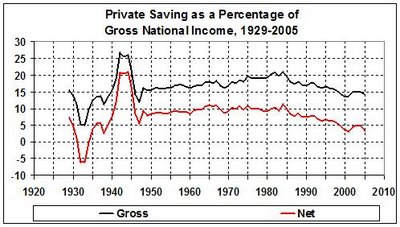
Conventional wisdom has it that the entry of the United States into World War II caused the end of the Great Depression in this country. My variant is that World War II led to a “glut” of private saving because (1) government spending caused full employment, but (2) workers and businesses were forced to save much of their income because the massive shift of output toward the war effort forestalled spending on private consumption and investment goods. The resulting cash “glut” fueled post-war consumption and investment spending.

Robert Higgs, research director of the Independent Institute, has a different theory, which he spells out in “Regime Uncertainty: Why the Great Depression Lasted So Long and Why Prosperity Resumed After the War” (available here), the first chapter his new book, Depression, War, and Cold War. (Thanks to Don Boudreaux of Cafe Hayek for the pointer.) Here, from “Regime Change . . . ” is Higgs’s summary of his thesis:

I shall argue here that the economy remained in the depression as late as 1940 because private investment had never recovered sufficiently after its collapse during the Great Contraction. During the war, private investment fell to much lower levels, and the federal government itself became the chief investor, directing investment into building up the nation’s capacity to produce munitions. After the war ended, private investment, for the first time since the 1920s, rose to and remained at levels sufficient to create a prosperous and normally growing economy.

I shall argue further that the insufficiency of private investment from 1935 through 1940 reflected a pervasive uncertainty among investors about the security of their property rights in their capital and its prospective returns. This uncertainty arose, especially though not exclusively, from the character of federal government actions and the nature of the Roosevelt administration during the so-called Second New Deal from 1935 to 1940. Starting in 1940 the makeup of FDR’s administration changed substantially as probusiness men began to replace dedicated New Dealers in many positions, including most of the offices of high authority in the war-command economy. Congressional changes in the elections from 1938 onward reinforced the movement away from the New Deal, strengthening the so-called Conservative Coalition.

From 1941 through 1945, however, the less hostile character of the administration expressed itself in decisions about how to manage the warcommand economy; therefore, with private investment replaced by direct government investment, the diminished fears of investors could not give rise to a revival of private investment spending. In 1945 the death of Roosevelt and the succession of Harry S Truman and his administration completed the shift from a political regime investors perceived as full of uncertainty to one in which they felt much more confident about the security of their private property rights. Sufficiently sanguine for the first time since 1929, and finally freed from government restraints on private investment for civilian purposes, investors set in motion the postwar investment boom that powered the economy’s return to sustained prosperity notwithstanding the drastic reduction of federal government spending from its extraordinarily elevated wartime levels.

Higgs’s explanation isn’t inconsistent with mine, but it’s incomplete. Higgs overlooks the powerful influence of the large cash balances that individuals and corporations had accumulated during the war years. It’s true that because the war was a massive resource “sink” those cash balances didn’t represent real assets. But the cash was there, nevertheless, waiting to be spent on consumption goods and to be made available for capital investments through purchases of equities and debt.

It helped that the war dampened FDR’s hostility to business, and that FDR’s death ushered in a somewhat less radical regime. Those developments certainly fostered capital investment. But the capital investment couldn’t have taken place (or not nearly as much of it) without the “glut” of private saving during World War II. The relative size of that “glut” can be seen here:

Derived from Bureau of Economic Analysis, National Income and Product Accounts Tables: 5.1, Saving and Investment. Gross private saving is analagous to cash flow; net private saving is analagous to cash flow less an allowance for depreciation. The bulge in gross private saving represents pent-up demand for consumption and investment spending, which was released after the war.

World War II did bring about the end of the Great Depression, not directly by full employment during the war but because that full employment created a “glut” of saving. After the war that “glut” jump-started

  • capital spending by businesses, which — because of FDR’s demise — invested more than they otherwise would have; and
  • private consumption spending, which — because of the privations of the Great Depression and the war years — would have risen sharply regardless of the political climate.

UPDATE: Robert Higgs, in an e-mail to me dated 06/24/06, submitted the following comment:

I happened upon your blog post that deals with my ideas about why the depression lasted so long and about the way in which the war related to the genuine prosperity that returned in 1946 for the first time since 1929. I appreciate the publicity, of course. I suggest, however, that you read my entire book, especially, with regard to the points you make on your blog, its chapter 5, “From Central Planning to the Market: The American Transition, 1945-47” (originally published in the Journal of Economic History, September 1999. I show there that the “glut of savings” idea, which is an old one, indeed perhaps even the standard theory of the successful postwar reconversion, does not fit the facts of what happened in 1945-47.

Here is my reply of 10/12/06:

I apologize for the delay in replying to your e-mail about my post… Your book, Depression, War, and Cold War, has not yet made it to the top of my Amazon.com wish list, but I have found “From Central Planning to the Market: The American Transition, 1945-47” on the Independent Institute’s website (here). If the evidence and arguments you adduce there are essentially the same as in chapter 5 of your book, I see no reason to reject the “glut of savings” idea, which is an old one, as I knew when I wrote the post. But, because it is not necessarily an old one to everyone who might read my blog, it is worth repeating — to the extent that it has merit.

At the end of the blog post I summarized the causes of the end of the Great Depression, as I see them:

World War II did bring about the end of the Great Depression, not directly by full employment during the war but because that full employment created a “glut” of saving. After the war that “glut” jump-started

  • capital spending by businesses, which — because of FDR’s demise — invested more than they otherwise would have; and
  • private consumption spending, which — because of the privations of the Great Depression and the war years — would have risen sharply regardless of the political climate.

In the web version of chapter 5 of your book you attribute increased capital spending to an improved business outlook (owing to FDR’s demise) and (in the section on the Recovery of the Postwar Economy, under Why the Postwar Investment Boom?) to “a combination of the proceeds of sales of previously acquired government bonds, increased current retained earnings (attributable in part to reduced corporate-tax liabilities), and the proceeds of corporate securities offerings” to the public. It seems that those “previously acquired government bonds” must have arisen from the “glut” of corporate saving during World War II.

What about the “glut” of personal saving, which you reject as the main source of increased consumer demand after World War II? In the online version of chapter 5 (in the section on the Recovery of the Postwar Economy, under Why the Postwar Consumption Boom?) you say:

The potential for a reduction of the personal saving rate (personal saving relative to disposable personal income) was huge after V-J Day. During the war the personal saving rate had risen to extraordinary levels: 23.6 percent in 1942, 25.0 percent in 1943, 25.5 percent in 1944, and 19.7 percent in 1945. Those rates contrasted with prewar rates that had hovered around 5 percent during the more prosperous years (for example, 5.0 percent in 1929, 5.3 percent in 1937, 5.1 percent in 1940). After the war, the personal saving rate fell to 9.5 percent in 1946 and 4.3 percent in 1947 before rebounding to the 5 to 7 percent range characteristic of the next two decades. After having saved at far higher rates than they would have chosen in the absence of the wartime restrictions, households quickly reduced their rate of saving when the war ended.

That statement seems entirely consistent with the proposition that consumers spent more after the war because they had the money to spend — money that they had acquired during the war when their opportunities for spending it were severely restricted. Not so fast, you would say: What about the fact that “individuals did not reduce their holdings of liquid assets after the war” (your statement)? They didn’t need to. Money is fungible. If consumers had more money coming in (as they did), they could spend more while maintaining the same level of liquid assets — because they had a “backlog” of saving. Here’s my take:

  • Higher post-war incomes didn’t just happen, they were the result of higher rates of investment and consumption spending.
  • The higher rate of investment spending was due, in part, to corporate saving during the war and, in part, to individuals’ purchases of corporate securities and equities.
  • At bottom, the wartime “glut” of personal saving enabled the postwar saving rate to decline to a more normal level, thus allowing consumers to buy equities and securities — and to spend more — without drawing down on their liquid assets.

Granted, business and personal saving during World War II was not nearly as large in real terms as it was on paper — given the very high real cost of the war effort. But it was the availability of paper savings that strongly influenced the behavior of businesses and consumers after the war….

The Case of the Purblind Economist

Purblind: lacking in insight or understanding; obtuse

Steven Landsburg just doesn’t get it. Uwe Reinhardt lectures him about the folly of “efficiency” (or “social welfare”), and Landsburg continues to act as if there were such a thing:

Suppose you live next door to Bill Gates. Bill likes to play loud music at night. You’re a light sleeper. Should he be forced to turn down the volume?

An efficiency analysis would begin, in principle (though it might not be so easy in practice) by asking how much Bill’s music is worth to him (let’s say we somehow know that the answer is $10,000) and how much your sleep is worth to you (let’s say $25). It is important to realize from the outset that no economist thinks those numbers in any way measure Bill’s subjective enjoyment of his music or your subjective annoyance. Only a crazy person would think such a thing, and I’ve never met anybody who’s that crazy in that particular way. Instead, these numbers primarily reflect the fact that Bill is a whole lot richer than you are. Nevertheless, the economist will surely declare it inefficient to take $10,000 worth of enjoyment from Bill in order to give you $25 worth of sleep. We call that a $9,975 deadweight loss.

The problem with this kind of thinking should be obvious to anyone with the sense God gave a goose. The value of Bill’s enjoyment of loud music and the value of “your” enjoyment of sleep, whatever they may be, are irrelevant because they are incommensurate. They are separate, variably subjective entities. Bill’s enjoyment (at a moment in time) is Bill’s enjoyment. “Your” enjoyment (at a moment in time) is your enjoyment. There is no way to add, subtract, divide, or multiply the value of those two separate, variably subjective things. Therefore, there is no such thing (in this context) as a deadweight loss because there is no such thing as “social welfare” — a summation of the state of individuals’ enjoyment (or utility, as some would have it).

Landsburg persists:

Take a more realistic example: Should we spend, say, a billion dollars a year to subsidize end-of-life health care for poor people? It would be, I think, a terrible mistake to settle this question without at least asking whether the recipients might prefer that we spend our billion dollars some other way — say by subsidizing their groceries or just giving them cash. If so, the difference in value between what they’re getting and what they could be getting (as measured by the recipients) is a deadweight loss. The bigger that deadweight loss, the more we should reconsider our spending priorities.

Who is “we,” Prof. Landsburg? Do you presume to speak for me, one of the taxpayers who would share in the cost of subsidizing end-of-life health care for poor people? The “recipients” have no right to prefer anything. It is my money you’re talking about, not some pot of “social welfare” that sits in the sky, waiting to be distributed by omniscient economists like you. The deadweight loss, as far as I’m concerned, is whatever you take from me to “give” to others, in your omniscience. I have better things to do with my money, thank you, and whether or not they’re “charitable” (they are, in part), is no business of yours. Who made you the accountant of my soul?

Related posts:
Greed, Cosmic Justice, and Social Welfare
Positive Rights and Cosmic Justice
Inventing “Liberalism”
Utilitarianism, “Liberalism,” and Omniscience
Utilitarianism vs. Liberty
Beware of Libertarian Paternalists
Landsburg Is Half-Right
Negative Rights, Social Norms, and the Constitution
Rights, Liberty, the Golden Rule, and the Legitimate State
The Mind of a Paternalist
Accountants of the Soul
Rawls Meets Bentham
Enough of “Social Welfare”

A True Flat Tax

REVISED 08/30/10

Don Boudreaux writes:

I do not grant that government’s decision to refrain from taking X‘s money means that government subsidizes X. The tax-exemption might be unwise policy, and it might be unfair (by some plausible guideposts) – and it almost certainly gives the tax-exempt organizations an advantage that they would otherwise not possess.

But tax-exemption does not involve taking money from Y and giving it to X. That fact is vital.

I’m not so sure.

The reason I’m not so sure is that “tax-exemption … almost certainly gives the tax-exempt organizations an advantage that they would otherwise not possess.” In other words, X‘s revenues are greater than they would be absent X’s tax-exempt status. By the same token, Y‘s revenues are less than they would be absent X‘s tax-exempt status. It may be true that X’s greater revenues do not accrue as profits, but they do accrue in some form. For example, in the defense-analysis industry, with which I am familiar, the employees of tax-exempt organizations — known as federally funded research and development centers (FFRDCs)– enjoy more luxurious offices; higher compensation, mainly in the form of benefits (e.g., more vacation time, larger company contributions to health insurance premiums, better retirement plans); and more stable employment (because FFRDCs operate under long-term, sole-source contracts that tend to be renewed decade after decade). The benefits that accrue to X‘s employees because of X‘s tax-exempt status are, in effect, a subsidy paid by Y‘s shareholders and employees.

Another way to look at it is this: In a balanced-budget world, the cost of government would be defrayed entirely by tax revenues. Given a government of a certain size, the exemption of some firms from paying taxes requires that other firms’ shareholders and employees pay higher taxes. That is a subsidy, if I ever saw one.

Going one step further, consider the proper function of government, which is to protect the lives, liberty, and property of citizens. It is none of government’s business what a citizen does when his life, liberty, and property are secure, as long as he doesn’t use it to impinge on the lives, liberty, and property of others. Whether a person makes a billion dollars a year or one dollar a year is really not the government’s concern, nor is it the government’s concern whether a person lives in a castle or a cardboard box. Such things, if they are of concern to anyone other than the person in question, are of concern to that person’s family, friends, neighbors, private charities, and so on.

It follows that government has no proper claim on the amount of income or wealth that a person acquires through the legitimate use of his liberty (such as it is). Warren Buffet and Bill Gates owe the government no more than a panhandler. Buffet and Gates simply have made better use of the protection afforded them by government, at least with respect to the acquisition of income and wealth.

The proper level of taxation, therefore, is that which defrays the cost of the governmental functions which protect the lives, liberty, and property of citizens: defense, courts, and law-enforcement. The cost of those functions is about $3,000 a year for every person aged 21 and older.* Everyone (21 and older) whose annual tax bill includes more than $3,000 for “liberty” services is subsidizing everyone (21 and older) whose annual tax bill for the same things is less than $3,000. All taxes for other services, regardless of who pays them, are forms of theft.**

__________
* The annual cost of national defense, the courts, and law-enforcement agencies is about $600 billion. That amount, divided by 200 million (the approximate number of persons in the United States aged 21 and older) yields an annual per-person cost of $3,000. I exclude persons under 21 because most of them still depend on adults for their subsistence, and have not yet advanced to the stage of making the most of the protections afforded by government.

** Some taxes underwrite regulatory functions, which are counterproductive. Some taxes underwrite services that are used by varying percentages of the populace (e.g., parks, highways), which (a) burdens those taxpayers who do not use the services in question, (b) subsidizes those taxpayers who do use the services in question, and (c) substitutes inefficient, unresponsive political-bureaucratic entities for more efficient, more responsive private firms. A large proportion of taxes (especially for Social Security and Medicare) simply take money from workers and give it to non-workers — an open-and-shut case of theft.

Enough of “Social Welfare”

I once wrote this:

How can a supposedly rational economist, politician, pundit, or “liberal” imagine that the benefits accruing to some persons (commuters, welfare recipients, etc.) somehow cancel the losses of other persons (taxpayers, property owners, etc.)? There is no valid mathematics in which A’s greater happiness cancels B’s greater unhappiness.

Yet, that is how cost-benefit analysis (utilitarianism) works, if not explcitly then implicitly. It is the spirit of utilitarianism (not to mention power-lust, arrogance, and ignorance) which enables Barack Obama and his ilk throughout the land to impose their will upon us — to our lasting detriment.

Uwe E. Reinhardt, an economics professor at Princeton, puts it this way:

The problem with welfare analysis is not so much that ethical dimensions typically enter into it, but that economists pretend that is not so. They do so by justifying their normative dicta with appeal to the seemly scientific but actually value-laden concept of efficiency….

[E]conomists lean on a welfare criterion first proposed in the late 1930s by the eminent British economists Nicholas Kaldor and Sir John Hicks. It is an intuitively appealing criterion, if one does not think too deeply about it….

…As the economist Steven E. Landsburg explains it bluntly to students in “Price Theory and Applications” :

In applications, the Kaldor-Hicks criterion and the efficiency criterion amount to the same thing. When Jack gains $10 and Jill loses $5, social gains increase by $5, so the policy is a good one. When Jack gains $10 and Jill loses $15, there is a deadweight loss of $5, so the policy is bad.

Evidently, on the Kaldor-Hicks criterion one need not know who Jack and Jill are, nor anything about their economic circumstances. Furthermore, a truly stunning implication of the criterion is that if a public policy takes $X away from one citizen and gives it to another, and nothing else changes, then such a policy is welfare neutral. Would any non-economist buy that proposition?

Readers will notice an irony in the widespread acceptance of the Kaldor-Hicks criterion by economists. On the one hand, they claim that their science is rooted strictly in the personal preferences of individuals in society, which seems democratic. In their application of the Kaldor-Hicks criterion to real-world problems, however, economists act like collectivists who seek to allocate society’s resources under a preferred moral doctrine. Economists take on the role of a benevolent dictator presumed to be empowered by someone to redistribute welfare among individual members of society for a larger social purpose — increases in what economists call efficiency and the maximization of what they call overall social welfare.

“Social welfare” (“efficiency”) is an excuse for politicians to play God. An economist who abets such behavior is a shill, not a scientist.

Line-Drawing and Liberty

The controversy about the ground-zero mosque illustrates an important aspect of liberty, namely, that its preservation requires line-drawing. There are times when government intervention in private matters is required to preserve liberty, in its fullest sense: life and the pursuit of happiness.

A libertarian purist would disagree. He would say that property rights are property rights, period. The owners of the land on which the mosque is to be situated have the right to decide what to build on their land. Further, if that right is compromised by government intervention, then it is possible for government to dictate how anyone may use his land.

Ignoring that fact that government already dictates how land may be used — through zoning laws, building codes, environmental restrictions, and other forms of regulation — I concede readily that the purist is correct, in principle. We know from long experience that as politicians and bureaucrats acquire the power to intervene in private transactions, they will apply that power in arbitrary and capricious ways.

Does that mean government should never intervene in private transactions? Imagine the following situation: A convicted car thief, having served his sentence, buys a defunct auto-repair shop with backing from some unsavory friends. If the police get word of this setup, what should happen?

1. Nothing, because the shop hasn’t begun to operate, and so there is no evidence that it will be used for criminal activity.

2. Keep watch on the shop, on the reasonable suspicion that the convicted felon and his unsavory associates are setting up a front for a stolen-car operation.

3. Find a legal pretext for closing down the shop.

What are the likely consequences of the three options?

1. The ex-convict will set up a stolen-car operation, and many cars will be stolen, causing great inconvenience to the owners of the stolen cars and higher insurance premiums for the owners of all cars in the area. Justice may prevail, but much harm has been done.

2. The stolen-car operation will be detected quickly, and shut down quickly, thus preventing most of the harm that would arise under option 1. Further, prison terms for the ex-convict and his unsavory associates will prevent them from doing further harm — for a while at least.

3. Allowing the police to shut down the shop without evidence of wrong-doing will encourage the police to persecute legitimate businesses and innocent individuals who happen to incur their disapproval.

If you are a libertarian purist (or a reflexive, anti-police “liberal”), you will prefer option 1; you are a one-day-at-a-time rationalist who adopts a pose of studied agnosticism. If you are a reflexive, law-and-order “conservative” you will prefer option 3. Option 2 is reserved for those who are willing to acknowledge the ex-convict’s history and its implications for his future behavior, but who want to preserve the bulwark of due process against the power of the state.

The question of where to draw the line around the authority of the state should not be decided by simplistic rules. Libertarian purists want to draw the line in the wrong place because their focus in on narrow issues — such as privacy and property rights — and not on the broader issue of liberty.

The Meaning of the Mosque Controversy

The controversy about the ground-zero mosque — which is summarized here — reminds me of an old post of mine, “Losing Sight of the Objective”:

Those who are so keen to bestow constitutional rights on terrorists have lost sight of a key purpose — perhaps the key purpose — of the Constitution: to provide for the common defense. Of Americans. Against their enemies: foreign and domestic, overt and covert.

Whether the mosque will serve as a front for terrorist activity remains to be seen. But there is good reason to suspect that it will. And if it does, it will be further evidence that America’s “leaders” have lost sight of the objective in their rush to display “tolerance” for everyone — well, tolerance for everyone but heterosexual, white Christians and Jews; for example:

St. Nicholas Greek Orthodox Church, which once sat right across the street from the World Trade Center, was crushed under the weight of the collapse of Tower Two on September 11, 2001. St. Nicholas was the only church to be lost in the attacks, and nine years later, while City of New York officials are busy removing every impediment to the building of the Cordoba mosque two blocks from the site, St. Nicholas’ future remains unclear.

The last bit of hopeful news for St. Nicholas came two years ago, in July 2008, when church officials and the Port Authority of New York and New Jersey announced a deal which would have allowed the church to be rebuilt about two blocks from its original location….

Trouble emerged after St. Nicholas announced its plans to build a traditional Greek Orthodox church building, 24,000 square feet in size, topped with a grand dome. Port Authority officials told the church to cut back the size of the building and the height of the proposed dome, limiting it to rising no higher than the World Trade Center memorial. The deal fell apart for good in March 2009, when the Port Authority abruptly ended the talks after refusing to allow church officials to review plans for the garage and screening area underneath. Sixteen months later, the two sides have still not met to resume negotiations.

St. Nicholas Church’s difficulty in getting approvals to rebuild stands in stark contrast to the treatment that the developers of the proposed Cordoba mosque have received. New York City Mayor Mike Bloomberg, state Atty. Gen. Andrew Cuomo, and a raft of city officials have all come out publicly in favor of building the mosque, and the city’s Landmarks and Preservation Commission recently voted unanimously to deny protection to the building currently occupying the site where the mosque is to be built.

The mosque is proposed to rise 13 stories, far above the height of the World Trade Center memorial, with no height restrictions imposed. (Mark Imponemi, “Mosque Moves Forward, Yet Church in Limbo“)

The case of the ground-zero mosque is only a symptom of the larger problem, which is denial and appeasement. Bill Whittle spells it out in a 13-minute video, “Ground Zero Mosque Reality Check.” Denial and appeasement arise from what Thomas Sowell calls one-day-at-a-time rationalism:

One-day-at-a-time rationalism [addresses] the immediate implications of each issue as it arises, missing wider implications of a decision…. A classic example was a French intellectual’s response to the Czechoslovakian crisis that led to the Munich conference of 1938:

…Joseph Barthélemy, who taught constitutional law at the University of Paris and was French representative at the League of Nations, asked in Le Temps the question French leaders had to answer: “Is it worthwhile setting fire to the world in order to save the Czechoslovak state… ? Is it necessary that three million Frenchman …. would be sacrificed to maintain three million Germans under Czech sovereignty?

Since it was not France that was threatening to set fire to the world, but Hitler, the larger question was whether someone who was threatening to set fire to the world if he didn’t get his way was someone who should be appeased in this one-day-at-a time approach, without regard to what this appeasement could do to encourage a never-ending series of escalating demands. By Contrast, Winston Churchill had pointed out, six years earlier, that “every concession which has been made” to Germany “has been followed immediately by a fresh demand.” Churchill clearly rejected one-day-at-a-time rationalism. (Intellectuals and Society, p. 31)

Leftists will embrace the cause of the ground-zero mosque because it is in their nature to embrace anything that undermines civil society. Libertarian purists will embrace it because they embrace one-day-at-a-time rationalism (e.g., this blogger).

As a libertarian realist, I am prepared to say that the mosque should not rise if it is likely to become a front for terrorist activity. I am keeping my eyes on the objective, which is the defense of Americans’ lives, liberty, and property: against their enemies foreign and domestic, overt and covert.

Delusions of Preparedness

The current push to trim the defense budget is foolish on two counts. First, the huge deficits projected for the federal government arise mainly from commitments to continue and expand three major entitlement programs: Social Security, Medicare, and Medicaid (Obamacare represents an expansion of all three). Second, the defense budget should be geared to external threats, not to the federal government’s fiscal problems. Cutting the defense budget to fund profligate spending on “social services” is like preparing for a street brawl by spending money on a new suit instead of brass knuckles.

There is, nevertheless, a tendency in political-punditry circles to bemoan the amounts spent on defense. Anti-defense zealots get it into their heads that the government spends “too much” on defense — period. What they mean, of course, is that the government spends money to execute wars of which they disapprove, and to prepare for wars that they would rather not think about. There is also the fear — now that the looming bankruptcy of entitlement programs cannot be denied — that money will be taken from “social services” rather than defense.

On that score, it is well to remember the words of Marshal of the Royal Air Force Sir John Slessor:

It is customary in democratic countries to deplore expenditures on armaments as conflicting with the requirements of the social services. There is a tendency to forget that the most important social service that a government can do for its people is to keep them alive and free.

Rather than take money from defense, our “leaders” should be thinking about how to spend more on defense. Nothing is more inviting to an aggressor than his intended victim’s lack of preparedness.

A common mistake, even among students of war, is to assume that there will be time to mobilize American’s economic engine, as in World War II. But that was before the advent of nuclear weapons, long-range missiles, and the ability of terrorists and cyber-warriors to create economic and military chaos. I submit that America’s strength vis-a-vis its actual and potential enemies now requires the following:

1. secured/hardened/redundant telecommunications (including internet), transportation, and energy networks

2. effective strategic and tactical intelligence (necessarily more intrusive than desired by civil-liberties purists)

3. quick response (at home and abroad) to tactical intelligence via special operations units (including some that can respond in kind to cyber-attacks)

4. a large “standing army,” with a broad range of strategic and conventional forces that are fully manned and trained, well-maintained and supplied, and technologically advanced — to deter and, as necessary, fight hostile regimes that pose threats to Americans and their overseas interests.

It is my sense that our current and planned defenses do not measure up to those requirements. The talk of cutting the defense budget should be scuttled, as should the “social services” that are the real cause of the government’s fiscal problems.