If Today Were Election Day…

…the GOP would gain 7 seats in the Senate, bringing its total there to 48 seats. Over in the House, the GOP would win 264 seats, giving it a 93-seat majority.

In any event, the GOP is likely to gain in the Senate, thus enabling it to filibuster almost anything, despite the lingering presence of a few RINOs.

Whatever happens in the Senate, the GOP seems assured of a large majority in the House — barring an “October surprise.”

In sum, the GOP will control the legislative agenda for the final two years of Obama’s term.

Gridlock, here we come — I hope.

The Republican Party will then have to articulate and sell its own vision for America. Lack of success in that department will enable Obama to campaign against a “do nothing” Congress, just as Truman did (successfully) in 1948.

So, in addition to gridlock in D.C., the next two years will see a battle for the soul of the Republican Party. Will small-government conservatism emerge triumphant, or will the GOP continue to be the “Democrat Lite” party? Stay tuned.

Rationalism, Social Norms, and Same-Sex “Marriage”

Judge Vaughn Walker’s recent decision in Perry v. Schwarnenegger, which manufactures a constitutional right to same-sex marriage, smacks of Rationalism. Judge Walker distorts and sweeps aside millennia of history when he writes:

The right to marry has been historically and remains the right to choose a spouse and, with mutual consent, join together and form a household. Race and gender restrictions shaped marriage during eras of race and gender inequality, but such restrictions were never part of the historical core of the institution of marriage. Today, gender is not relevant to the state in determining spouses’ obligations to each other and to their dependents. Relative gender composition aside, same-sex couples are situated identically to opposite-sex couples in terms of their ability to perform the rights and obligations of marriage under California law. Gender no longer forms an essential part of marriage; marriage under law is a union of equals.

Judge Walker thereby secures his place in the Rationalist tradition. A Rationalist, as Michael Oakeshott explains,

stands … for independence of mind on all occasions, for thought free from obligations to any authority save the authority of ‘reason’. His circumstances in the modern world have made him contentious; he is the enemy of authority, of prejudice, of the merely traditional, customary or habitual. His mental attitude is at once sceptical and optimistic: sceptical, because there is no opinion, no habit, no belief, nothing so firmly rooted or so widely held that he hesitates to question it and to judge it by what he calls his ‘reason’; optimistic, because the Rationalist never doubts the power of his ‘reason … to determine the worth of a thing, the truth of an opinion or the propriety of an action. Moreover, he is fortified by a belief in a ‘reason’ common to all mankind, a common power of rational consideration…. But besides this, which gives the Rationalist a touch of intellectual equalitarianism, he is something also of an individualist, finding it difficult to believe that anyone who can think honestly and clearly will think differently from himself….

…And having cut himself off from the traditional knowledge of his society, and denied the value of any education more extensive than a training in a technique of analysis, he is apt to attribute to mankind a necessary inexperience in all the critical moments of life, and if he were more self-critical he might begin to wonder how the race had ever succeeded in surviving. (“Rationalism in Politics,” pp. 5-7, as republished in Rationalism in Politics and Other Essays)

At the heart of Rationalism is the view that “a problem” can be analyzed and “solved” as if it were separate and apart from the fabric of life.  On this point, I turn to John Kekes:

Traditions do not stand alone: they overlap, and the problems of one are often resolved in terms of another. Most traditions have legal, moral, political, aesthetic, stylistic, managerial, and multitude of other aspects. Furthermore, people participating in a tradition bring with them beliefs, values, and practices from other traditions in which they also participate. Changes in one tradition, therefore, are likely to produce changes in others; they are like waves that reverberate throughout the other traditions of a society. (“The Idea of Conservatism“)

Edward Feser puts it this way:

Tradition, being nothing other than the distillation of centuries of human experience, itself provides the surest guide to determining the most rational course of action. Far from being opposed to reason, reason is inseparable from tradition, and blind without it. The so-called enlightened mind thrusts tradition aside, hoping to find something more solid on which to make its stand, but there is nothing else, no alternative to the hard earth of human experience, and the enlightened thinker soon finds himself in mid-air…. But then, was it ever truly a love of reason that was in the driver’s seat in the first place? Or was it, rather, a hatred of tradition? Might the latter have been the cause of the former, rather than, as the enlightened pose would have it, the other way around?) (“Hayek and Tradition“)

Same-sex marriage will have consequences that most libertarians and “liberals” are unwilling to consider. Although it is true that traditional, heterosexual unions have their problems, those problems have been made worse, not better, by the intercession of the state. (The loosening of divorce laws, for example, signaled that marriage was to be taken less seriously, and so it has been.) Nevertheless, the state — pursuant to Judge Walker’s decision — may create new problems for society by legitimating same-sex marriage, thus signaling that traditional marriage is just another contractual arrangement in which any combination of persons may participate.

Heterosexual marriage — as Jennifer Roback Morse explains — is a primary and irreplicable civilizing force. The recognition of homosexual marriage by the state will undermine that civilizing force. The state will be saying, in effect, “Anything goes. Do your thing. The courts, the welfare system, and the taxpayer — above all — will “pick up the pieces.” And so it will go.

In Morse’s words:

The new idea about marriage claims that no structure should be privileged over any other. The supposedly libertarian subtext of this idea is that people should be as free as possible to make their personal choices. But the very nonlibertarian consequence of this new idea is that it creates a culture that obliterates the informal methods of enforcement. Parents can’t raise their eyebrows and expect children to conform to the socially accepted norms of behavior, because there are no socially accepted norms of behavior. Raised eyebrows and dirty looks no longer operate as sanctions on behavior slightly or even grossly outside the norm. The modern culture of sexual and parental tolerance ruthlessly enforces a code of silence, banishing anything remotely critical of personal choice. A parent, or even a peer, who tries to tell a young person that he or she is about to do something incredibly stupid runs into the brick wall of the non-judgmental social norm. (“Marriage and the Limits of Contract“)

The state’s signals are drowning out the signals that used to be transmitted primarily by voluntary social institutions: family, friendship, community, church, and club. Accordingly, I do not find it a coincidence that loud, loutish, crude, inconsiderate, rude, and foul behaviors have become increasingly prominent features of “social” life in America. Such behaviors have risen in parallel with the retreat of most authority figures in the face of organized violence by “protestors” and looters; with the rise of political correctness; with the perpetuation of the New Deal and its successor, the Great Society; with the erosion of swift and sure justice in favor of “rehabilitation” and “respect for life” (but not for potential victims of crime); and with the legal enshrinement of infanticide and buggery as acceptable (and even desirable) practices.

Thomas Sowell puts it this way:

One of the things intellectuals [his Rationalists] have been doing for a long time is loosening the bonds that hold a society together. They have sought to replace the groups into which people have sorted themselves with groupings created and imposed by the intelligentsia. Ties of family, religion, and patriotism, for example, have long been treated as suspect or detrimental by the intelligentsia, and new ties that intellectuals have created, such as class — and more recently “gender” — have been projected as either more real or more important….

Under the influence of the intelligentsia, we have become a society that rewards people with admiration for violating its own norms and for fragmenting that society into jarring segments. In addition to explicit denigrations of their own society for its history or current shortcomings, intellectuals often set up standards for their society which no society has ever met or is likely to meet.

Calling those standards “social justice” enables intellectuals to engage in endless complaints about the particular ways in which society fails to meet their arbitrary criteria, along with a parade of groups entitled to a sense of grievance, exemplified in the “race, class and gender” formula…. (Intellectuals and Society, pp. 303, 305)

And so it will go —  barring a sharp, conclusive reversal of Judge Walker and the movement he champions.

Related posts:
“Equal Protection” and Homosexual Marriage
Social Norms and Liberty
The Fallacy of Particularism
History Lessons
On Liberty
Civil Society and Homosexual “Marriage”
Perry v. Schwarzenegger, Due Process, and Equal Protection

The Decline of the Slugger

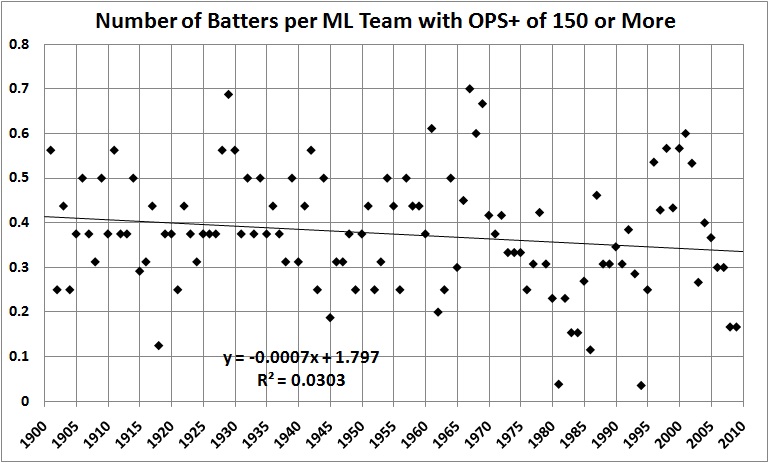
Are sluggers becoming more or less prevalent?

To answer that question, I went to the Play Index feature of Baseball-Reference.com. I was able to find (thanks to a paid subscription to Play Index) the number of players, by season, with an OPS+ statistic* of 150 or more, from 1901 through 2009. Dividing each season’s number by the number of major-league teams, I obtained the following result:


Observations:

1. There has been a slight but noticeable decline in the average number of players per team with an OPS+ of 150 or more, especially following the second round of expansion in 1969.

2. The surge from 1996 to 2002 probably marks the peak use of performance-enhancing drugs.

3. The decline resumed after 2002.

Thus, for whatever reason(s), slugging seems to be in decline.

__________
* Definition: “OPS+ is OPS [on-base plus slugging percentage] adjusted for the park and the league in which the player played,” where the league average for a given year is 100. Thus “An OPS+ of 150 or more is excellent and 125 very good, while an OPS+ of 75 or below is poor.”

Cornered by Gender?

Tanya Khovanova, writing at her math blog, plays a variation on a theme introduced by her guest blogger, Rebecca Frankel, about three weeks ago. Frankel, as I note in “Sexist Nonsense,” wants to redefine gender to exclude two things that make a big difference between males and females: testosterone and estrogen. By Frankel’s logic, males and females would be equal in ability, if only it weren’t for that pesky matter of gender. As I put it in “Sexist Nonsense,”

So “ability” now has a new definition. It is a hypothetical state of equality that is disturbed by a natural difference between males and females. And the fact that this natural difference has an influence on performance is somehow “proof” that males and females are born equally able. By that kind of reasoning, the fact that I cannot see well enough to hit a major-league fastball proves that I belong in the Hall of Fame, along with Babe Ruth. If you’re looking for “sexist nonsense,” look no further than Rebecca Frankel’s hypothesis.

In “Math Careers and Choices,” Khovanova laments that some women choose not to pursue academic careers because they are “cornered” into making such choices. She gives as evidence the cases of three women, plus her own case (described in an earlier post to which she links).

These are the main features of the cases:

  • All four women (including Khovanova) had academic ambitions.
  • In the all cases except Khovanova’s, actions by husbands (pursuit of their own academic careers) made it difficult or impossible for the women to pursue their own academic careers. (Khovanova’s description of her own situation suggests that she, in effect, abandoned her husband by choosing not to return to Israel with him at the end of their family’s visit to the U.S.)
  • Financial considerations and parental responsibilities led all of the women to drop out of academia.

How were these women “cornered”? And if they were in some sense “cornered,” why is it any more lamentable because of their gender?

As far as I can tell, they entered freely into marriage or freely abandoned it (in Khovanova’s casse), and (in this day of “a woman’s right to choose”) bore their children willingly.

Although one husband allegedly played a psychological power game to get his way, that kind of game-playing (as almost any husband can tell you) is far from the sole province of ambitious male academics.

That the husbands had better academic prospects should come as no surprise, given the findings that Frankel attempts (and fails) to refute in the post I discuss in “Sexist Nonsense.”

In each case (except Khovanova’s) the woman and her husband made a joint decision that furthered their family’s financial security. Khovanova made a similar decision, in order to advance her son’s education.

That is to say, the women were not “cornered.” They were acting in ways that seemed best in view of the circumstances in which they found themselves as a result of preceding choices, which they made freely.

If any of the women (including Khovanova) was “cornered,” then so are the countless men and women who are unable to pursue their fondest dreams because ugly reality intrudes.

Who promised us a rose garden? Who promised women (or men) an academic career, a career as a major-league baseball player, or a seat in a space shuttle? No one, that’s who.

Khovanova — a mathematician who loves logic puzzles — has committed the Nirvana fallacy:

the logical error of comparing actual things with unrealistic, idealized alternatives. It can also refer to the tendency to assume that there is a perfect solution to a particular problem.

The Decision to Drop the Bomb

The final words with respect to the bombing of Hiroshima and Nagasaki — as far as I am concerned — were written five years ago by Richard B. Frank in The Weekly Standard (“Why Truman Dropped the Bomb“) and Victor Davis Hanson at National Review Online (“Considering Hiroshima“). Here’s an excerpt of Frank’s piece:

The sixtieth anniversary of Hiroshima seems to be shaping up as a subdued affair–though not for any lack of significance. A survey of news editors in 1999 ranked the dropping of the atomic bomb on August 6, 1945, first among the top one hundred stories of the twentieth century. And any thoughtful list of controversies in American history would place it near the top again. It was not always so. In 1945, an overwhelming majority of Americans regarded as a matter of course that the United States had used atomic bombs to end the Pacific war. They further believed that those bombs had actually ended the war and saved countless lives. This set of beliefs is now sometimes labeled by academic historians the “traditionalist” view. One unkindly dubbed it the “patriotic orthodoxy.”

But in the 1960s, what were previously modest and scattered challenges of the decision to use the bombs began to crystallize into a rival canon. The challengers were branded “revisionists,” but this is inapt. Any historian who gains possession of significant new evidence has a duty to revise his appreciation of the relevant events. These challengers are better termed critics.

The critics share three fundamental premises. The first is that Japan’s situation in 1945 was catastrophically hopeless. The second is that Japan’s leaders recognized that fact and were seeking to surrender in the summer of 1945. The third is that thanks to decoded Japanese diplomatic messages, American leaders knew that Japan was about to surrender when they unleashed needless nuclear devastation. The critics divide over what prompted the decision to drop the bombs in spite of the impending surrender, with the most provocative arguments focusing on Washington’s desire to intimidate the Kremlin. Among an important stratum of American society–and still more perhaps abroad–the critics’ interpretation displaced the traditionalist view….

[I]t is clear [from a review of the evidence now available] that all three of the critics’ central premises are wrong. The Japanese did not see their situation as catastrophically hopeless. They were not seeking to surrender, but pursuing a negotiated end to the war that preserved the old order in Japan, not just a figurehead emperor. Finally, thanks to radio intelligence, American leaders, far from knowing that peace was at hand, understood–as one analytical piece in the “Magic” Far East Summary stated in July 1945, after a review of both the military and diplomatic intercepts–that “until the Japanese leaders realize that an invasion can not be repelled, there is little likelihood that they will accept any peace terms satisfactory to the Allies.” This cannot be improved upon as a succinct and accurate summary of the military and diplomatic realities of the summer of 1945.

The final words go to Hanson:

The truth . . is that usually in war there are no good alternatives, and leaders must select between a very bad and even worse choice. Hiroshima was the most awful option imaginable, but the other scenarios would have probably turned out even worse.

The Death of the Democrat Party?

Democracy is incompatible with liberty. But democracy is nevertheless considered a “good thing.” To call a political party “Democratic” imparts to that party an unwarranted veneer of beneficence. I refuse to lend this blog to that bit of moral confusion. Thus, on these pages, the “Democratic Party” is and always will be the “Democrat Party. End of mini-rant.

“Liberalism,” “progressivism,” and their variants are incompatible with liberty and progress. That is why I always enclose those terms in quotation marks.

If you see opposition to same-sex marriage as anti-libertarian, I suggest that you re-think your position, beginning with this.

James Taranto, of WSJ‘s Opinion Journal, opines:

If the Ninth Circuit upholds Walker’s decision [for same-sex marriage, in Perry v. Schwarzenegger], the Supreme Court would almost certainly agree to hear an appeal….

…When the Supreme Court takes up Perry v. Schwarzenegger … the justices will rule 5-4, in a decision written by Justice Kennedy, that there is a constitutional right to same-sex marriage.

This accepts the conventional assumption that the court’s “liberal” and “conservative” wings will split predictably, 4-4. Yet while Kennedy cannot be pigeonholed in terms of “ideology,” on this specific topic, he has been consistent in taking a very broad view of the rights of homosexuals. He not only voted with the majority but wrote the majority opinions in two crucial cases: Romer v. Evans (1996) and Lawrence v. Texas (2003).

Romer struck down an amendment to the Colorado Constitution that nullified state or local ordinances barring discrimination on the basis of “homosexual, lesbian or bisexual orientation, conduct, practices or relationships.” This provision, adopted by ballot initiative, violated the Equal Protection Clause of the 14th Amendment, Justice Kennedy wrote for the court….

In Lawrence, the court overturned a 1986 ruling and held that state laws criminalizing consensual homosexual sodomy violated the constitutional right of privacy….

Proposition 8 was adopted in “liberal” California by a margin of 52-48.  This is the same California that has preferred the Democrat candidate over his Republican opponent in the last five presidential elections, culminating in an Obama-slide of 61 percent vs. 39 percent for McCain and assorted wing-nuts.

Clearly, same-sex marriage is not beloved by all Democrats, or even an overwhelming majority of them. Voters in 31 States have blocked same-sex marriage in their States by rejecting proposals to allow it or (in most cases) approving constitutional amendments banning it. Only five States and the District of Columbia recognizes same-sex marriage. Needless to say, the deeds were done in those six jurisdictions by legislative or judicial fiat, and not by consulting voters about one of the rare issues that merits “democratic” consultation because it impinges directly on deep-rooted social norms.

If/when Judge Vaughn Walker’s judicial abomination is upheld by Justice Kennedy, voters will know where the blame lies: with the left wing of the Democrat Party and the gay-rights lobby, which is one of the Democrat Party’s favored constituencies. The resulting backlash among not-so-leftish Democrats would spell electoral disaster for the Democrat Party. Party leaders would then have two options:

  • Overtly move the party back from the extreme edge of American political opinion, in the hope that enough voters are taken in by such a cynical ploy to avert long-term disaster for the party.
  • Remain on the left edge of American political opinion, in the hope and belief that voters will (before too long) slide toward that edge.

My money is on the second option, because the leaders of the Democrat Party are deeply committed, in thought and word, to the “progressive” agenda: the cultivation of radical ideas and constituencies. (Why? Read this exquisite rant by Tom Smith.) And that, in the face of growing discontent about the power and cost of government, is a recipe for political suicide.

One can only hope.

Related posts:
Civil Society and Homosexual “Marriage”
Perry v. Schwarzenegger, Due Process, and Equal Protection

Perry v. Schwarzenegger, Due Process, and Equal Protection

The decision of federal district judge Vaughn Walker in the case of Perry v. Schwarzenegger finds California’s Proposition 8 unconstitutional. Judge Walker’s decision is notable for two things:

  • It affirms substantive due process.
  • It stands in the tradition of circular reasoning with respect to equal protection.

With respect to due process, Judge Walker says:

The Due Process Clause provides that no “State [shall] deprive any person of life, liberty, or property, without due process of law.” … Due process protects individuals against arbitrary governmental intrusion into life, liberty or property….

The freedom to marry is recognized as a fundamental right protected by the Due Process Clause….

To determine whether a right is fundamental under the Due Process Clause, the court inquires into whether the right is rooted “in our Nation’s history, legal traditions, and practices.”

Judge Walker thereby adopts the logic of the U.S. Supreme Court in Lochner v. New York (1905), a case that upheld the right of private parties to enter into employment agreements that run contrary to the labor laws of a State. Lochner, in a roundabout way, upheld liberty of contract, which is a right specifically recognized in the Constitution of the United States (Article I, Section 10).

Lochner epitomizes substantive due process, a juridical concept that has been in bad odor for decades, but which ought not to be. The essence of Lochner — and substantive due process — is exactly as stated by Judge Walker: “Due process protects individuals against arbitrary governmental intrusion into life, liberty or property.” (For more about Lochner, see my post, “Substantive Due Process, Liberty of Contract, and the States’ Police Power.”)

Judge Walker goes on to address equal protection:

The Equal Protection Clause of the Fourteenth Amendment provides that no state shall “deny to any person within its jurisdiction the equal protection of the laws.”…

Proposition 8 targets gays and lesbians in a manner specific to their sexual orientation and, because of their relationship to one another, Proposition 8 targets them specifically due to sex. Having considered the evidence, the relationship between sex and sexual orientation and the fact that Proposition 8 eliminates a right only a gay man or a lesbian would exercise, the court determines that plaintiffs’ equal protection claim is based on sexual orientation, but this claim is equivalent to a claim of discrimination based on sex.

The circularity of Judge Walker’s reasoning with respect to equal protection begins much earlier in his decision, where he writes that

The right to marry has been historically and remains the right to choose a spouse and, with mutual consent, join together and form a household. Race and gender restrictions shaped marriage during eras of race and gender inequality, but such restrictions were never part of the historical core of the institution of marriage. Today, gender is not relevant to the state in determining spouses’ obligations to each other and to their dependents. Relative gender composition aside, same-sex couples are situated identically to opposite-sex couples in terms of their ability to perform the rights and obligations of marriage under California law. Gender no longer forms an essential part of marriage; marriage under law is a union of equals.

But the right to marry, historically, has been the right to choose a spouse of the opposite sex, not merely to choose a spouse. Judge Walker even acknowledges that fact, inadvertently, when he puts aside “relative gender composition,” as if it were a mere trifle and not central to a social tradition that dates back millennia and should not be swept aside casually by a judge because he finds it “irrational,” on the basis of spurious social science. Walker then says that “gender is not relevant,” thus circularly assuming that which is to be proved. As if in support of that assertion he asserts, laughably, that “gender restrictions … were never part of the historical core of the institution of marriage.”

In sum, Judge Walker approaches the constitutional matter of equal protection by assuming that gays have the right to marry. Given that assumption, it is easy to assert that Proposition 8 amounts to a denial of equal protection for gays who seek to marry. (For more about the perversion of the Equal Protection Clause through circular reasoning, see my post, “‘Equal Protection” and Homosexual Marriage.”)

The Constitution: Original Meaning, Corruption, and Restoration

See “The Constitution: Myths and Realities“.

Special Interests, Good and Bad

I am indebted to my son for suggesting the theme of this post. Any failures of execution are mine alone.

There is a tendency to think of special-interest groups as “bad” things. But that isn’t necessarily so. As I pointed out in “The National Psyche and Foreign Wars,”

[t]wo, relatively small, interlocking groups of strong-willed individuals were responsible for the Revolution and the Constitution, and those groups were bound by two special interests (at least): independence from Britain (not a universally popular idea at the time) and freedom from Britain’s interference in the colonies’ commerce. (The second interest is a “bad thing” only if one view commercial interests as a “bad thing.” Unlike the historians of the Beard school, I do not.)

In sum, Americans — even those who disdain “dead white men” — owe what liberty they still enjoy to those “dead white men” who founded this nation and wrote its Constitution. The Constitution is not a perfect document because it the product of fallible human beings, and to assert that it should have done thus-and-such is to indulge in the Nirvana fallacy.

The Constitution represents compromises among special interests, some of them bent on preserving the institution of slavery in their own States. But, thanks to the framers’ understanding that the world changes, the Constitution could be changed — and eventually was changed — to codify the abolition of slavery.

Only a wise (and rare) élite could have done what the framers did in 1787. That the citizens of the United States, for a time, enjoyed the fruits of the framers’ efforts was due not only to those efforts but also to luck. The right élite appeared on the stage of history at just about the right time, and that élite’s wisdom managed to prevail for a while.

The framers’ work has been largely undone by a succession of special interests — Progressives, Populists, and their progeny — whose work continues unto this very day. Their stated aims are laudable, of course, but so were many of the stated aims of Lenin, Stalin, Hitler, and Mao. Politicians and political movements should not be judged by what they promise, but by what they deliver. What has been delivered to Americans in the past century? The answer — less liberty and economic privation — is detailed in many of the posts linked below.

It is long past time for a new special-interest group to seize the levers of power and revive the Constitution.

Related posts:
The State of the Union: 2010
The Shape of Things to Come

On Liberty
Parsing Political Philosophy
The Indivisibility of Economic and Social Liberty
Greed, Cosmic Justice, and Social Welfare
Positive Rights and Cosmic Justice
Fascism and the Future of America
Inventing “Liberalism”
Utilitarianism, “Liberalism,” and Omniscience
Utilitarianism vs. Liberty
Beware of Libertarian Paternalists
Secession
Secession Redux
Negative Rights, Social Norms, and the Constitution
Rights, Liberty, the Golden Rule, and the Legitimate State
The Mind of a Paternalist
Accountants of the Soul
Rawls Meets Bentham
Is Liberty Possible?
The Left
The National Psyche and Foreign Wars
The Constitution: Original Meaning, Corruption, and Restoration

The Commandeered Economy
The Price of Government
The Mega-Depression
Does the CPI Understate Inflation?
Ricardian Equivalence Reconsidered
The Real Burden of Government
The Rahn Curve at Work

Down with “We”

Whenever a politician says “we,” I reach for my wallet to be sure his hand isn’t already in it.

Count me out of the “we.” I don’t expect the state to force others to take care of me, I don’t want the state to force me to take care of others. I’ll decide who is worthy of my help, thank you very much, and I will give them as much help as I can afford while taking care of myself and my immediate family.

Yes, there is a nation called the United States, which comprises the States and their political subdivisions. But none of those political entities is a family, a community (in the sense of a voluntary association of individuals with voice and exit), or a society bound by shared cultural traditions. Whatever their origins in history, the United States and its components are now nothing more than mere political contrivances, whose governments have usurped the functions of family, community, and society.

If there ever was a “we the people,” it was long ago and in a different America.

Related posts:
Is There Such a Thing as Society?
Negative Rights, Social Norms, and the Constitution
Rights, Liberty, The Golden Rule, and the Legitimate State
Law and Liberty
The Real Constitution and Civil Disobedience
A Declaration of Independence
Is Liberty Possible?
The National Psyche and Foreign Wars

The National Psyche and Foreign Wars

I belong to a Google Group whose active members are retired scientists, engineers, mathematicians, and economists — some in their upper 80s — who worked on defense issues from the 1940s to the 2000s. The issues ranged in scope from devising improved tactics for naval, air, and ground operations to assessing the costs and effectiveness of proposed new weapon systems.

Most members of the group were government employees and/or employees of government contractors. Their attraction to government service — and its steady and rather handsome paychecks — derives, in good part, from their belief in the power of government to “solve problems,” and in the need for government to do just that. It is only natural, then, that many members of the group hold an unrealistically exalted view of the power of quantitative methods to “solve problems,” while holding naive views about the machinations of government, human nature, and history. (The pioneers of military operations research in the United States, by contrast, were realistic about the relative impotence of quantitative analysis of complex, dynamic processes.)

Here, for example, is a slightly edited exchange I had with an older member of the group:

Older member (OM):

Does anyone know whether the people of the U.S. were as little involved in the Indian Wars and the opening of the west (some would say stealing) as we seem to be involved with the wars in the Middle East and South Asia.

The greatest asset of our military is its “can do” attitude. The greatest weakness of our military is its “can do” attitude.

Me (Thomas):

I’m not sure what it means for a people to be “involved” in a war. If by “involved” you mean the popularity or unpopularity of the various wars, I have no relevant facts to offer.

But the transient popularity or unpopularity of a war (or any governmental action) shouldn’t matter. If public policy responded to the whims of the “man in the street,” we would be in deep trouble. That’s why there are prescribed processes for making governmental policy. Following the processes doesn’t ensure wise policies, but it beats the alternative of capricious governance.

Our present wars were duly authorized by Congress, and are funded by appropriations made by Congress. Given that the members of Congress are elected representatives of the people, then the people are as involved as they can be under any sensible system of government.

As for the military’s “can do” attitude, decisions about going to war — and staying at war — are the province of civilian authority. When given a war to fight, the only sensible way for the military to approach it is with a “can do” attitude. Does the military’s “can do” attitude color the advice it gives when civilian authority is considering whether to go to war, how to prosecute a war, and whether to persevere in a war? Or are military leaders duly cautious in the advice they give civilian authority, knowing the consequences for their troops and the nation if a war goes badly? I haven’t been close enough to the “inside” — nor have I read deeply enough into military history — to essay answers to those questions.

OM:

I wanted to go a little beyond what might be called the legalities and into the national psyche. The decision to go to war is an awesome political and moral  decision. It has often been said that “old men send young men to war”. In our modern adventures only a fraction of the Country has other than a remote financial involvement in our wars. A small fraction of our Legislative Branch have direct Military Service experience (the smallest in history). An even smaller number has sons or daughters in the Armed Services. We are much moe detached than when the Signers of the Declaration of Independence pledged their honor, their fortune, and their good right hand. (Quote not quite accurate).

During the Vietnam War the Country lowered its support as the costs and casualties rose. Now we do not have the draft though even so military leaders warn the political entities that we must not lose the confidence of the people even as we seem to drift away from the “Powell” Doctrine. We certainly see the heavy imprint of the Military-Industrial Complex against which President Eisenhower warned. (That speech is still on Wikipedia).

During Vietnam we had the bugbear of the “Domino Theory”. There are some who argue along those lines now regarding threats to Israel and other major American Interests. Can a small special interests group lead American policy?

I was wondering what other precedents in American History might apply. Most of the 19th Century was dominated by America’s Manifest Destiny (and losses were modes). Then came the War to end all wars. Then the Era of Good Feeling punctuated by the Washington Naval Conference, the Great Depression, and then the rise of Nazi Germany and its Axis with Italy and Japan. Have we found a bizarre combination of of Depression and Manifest Destiny with a liberal dose of hubris as we dismantle our Navy having already essentially worn out much of our Armour and still at the mercy of land mines and IED (a form of landmine).

One parallel that seems to track from the 19th Century is the corruption of the Suttlers [sic] that has transformed nicely into the Military Industrial Complex.

Thomas:

I have great difficulty with the concept of “national psyche,” and thus with generalizations about what “we” (as a nation) have done and should do. I cannot describe my own psyche, let alone the psyches of millions of other Americans, dead and alive, who differ from me (often greatly) in nature and nurture.

In any event, you come close to answering your own questions in your third paragraph, where you ask “Can a small special interests group lead American policy?” My answer is a resounding “yes.” Two, relatively small, interlocking groups of strong-willed individuals were responsible for the Revolution and the Constitution, and those groups were bound by two special interests (at least): independence from Britain (not a universally popular idea at the time) and freedom from Britain’s interference in the colonies’ commerce. (The second interest is a “bad thing” only if one view commercial interests as a “bad thing.” Unlike the historians of the Beard school, I do not.)

Various and shifting coalitions of special-interest groups have determined the foreign and domestic policies of the United States government from its beginning, and always will do so. There is no escape from such an arrangement, given our system of government — the “legalities” to which you refer. Those “legalities” — and the absence of a national psyche which somehow translates the consolidated wisdom of “the nation” into governmental policy — make it inevitable that governmental policy will be the product of various and shifting coalitions of special-interest groups. You (I mean the generic “you” and not you, [OM]) may like the resulting policies in some cases (e.g., if you are a fan of British-style health care you will consider Obamacare a great leap forward) and dislike them in other cases (e.g., if you are an opponent of foreign wars except those that in retrospect seem worthwhile, you will generally oppose foreign wars).

The “dismantling” of the Navy to which you refer is the specific policy of a specific administration (or administrations). It was not the policy of the Reagan administration, nor was it a policy of the Kennedy administration. And, I hope, it will not be the policy of the next administration. In any case, governmental policy toward the Navy is part of a larger set of policies, the combination of which is dictated by the complex interplay of various special interests and the particular psyches of elected and appointed officials. In the present case, the “dismantling” of the Navy arises from a particular view of how to defend Americans and their property and, not coincidentally, also makes certain kinds of domestic government programs more affordable. It should go without saying that the particular view of how to defend Americans (diplomacy, good will, lower defense budgets) finds opposition in millions of Americans’ psyches, as does the present administration’s commitment to various domestic programs. Liberal hawks — to the extent that they still exist — must be having a hard time digesting the present administration’s combination of domestic and foreign policies, just as conservative hawks — whose are legion — had a hard time digesting the previous administration’s combination of domestic and foreign policies.

As for the military-industrial complex, there is a coalition of interests that can be described broadly by that term, though it is a coalition fraught with internal conflicts and rivalries. If that coalition deserves blame for any excesses in defense spending and misadventures in foreign fields, it also deserves a large share of the credit for the outcomes of World War II and the Cold War.

Tip O’Neill said that all politics is local. I say that all political developments reflect the clash, compromise, and collaboration of special interests — and thus cannot be ascribed to a national psyche.

The Recession Lingers…

…by my definition of a recession:

  • two or more consecutive quarters in which real GDP (annualized) is below real GDP (annualized) for an earlier quarter, during which
  • the annual (year-over-year) change in real GDP is negative in at least one quarter.

Here’s how real GDP has fared from the first quarter of 1947 through the second quarter of 2010 (recessions are denoted by vertical bars):


Derived from “Current dollar and real GDP” spreadsheet published by the Bureau of Economic Analysis, U.S. Department of Commerce.

This picture is misleading, of course, because it fails to depict the length and depth of America’s mega-depression, which is now more than a century old and deepening every day.

Atheism, Agnosticism, and Science

I just came across Ron Rosenbaum’s “An Agnostic Manifesto.” Much of what Rosenbaum says accords with my many posts on the subject of atheism, agnosticism, and science:

Atheism, Religion, and Science
The Limits of Science
Three Perspectives on Life: A Parable
Beware of Irrational Atheism
The Creation Model
The Thing about Science
Evolution and Religion
Words of Caution for Scientific Dogmatists
Science, Evolution, Religion, and Liberty
The Legality of Teaching Intelligent Design
Science, Logic, and God
Capitalism, Liberty, and Christianity
Is “Nothing” Possible?
A Dissonant Vision
Debunking “Scientific Objectivity”
Science’s Anti-Scientific Bent
Science, Axioms, and Economics
The Big Bang and Atheism
The Universe . . . Four Possibilities
Einstein, Science, and God
Atheism, Religion, and Science Redux
Pascal’s Wager, Morality, and the State
Evolution as God?
The Greatest Mystery

Modeling, Science, and Physics Envy

Climate Skeptic notes the similarity of climate models and macroeconometric models:

The climate modeling approach is so similar to that used by the CEA to score the stimulus that there is even a climate equivalent to the multiplier found in macro-economic models. In climate models, small amounts of warming from man-made CO2 are multiplied many-fold to catastrophic levels by hypothetical positive feedbacks, in the same way that the first-order effects of government spending are multiplied in Keynesian economic models. In both cases, while these multipliers are the single most important drivers of the models’ results, they also tend to be the most controversial assumptions. In an odd parallel, you can find both stimulus and climate debates arguing whether their multiplier is above or below one.

Here is my take, from “Modeling Is Not Science“:

The principal lesson to be drawn from the history of massive government programs is that those who were skeptical of those programs were entirely justified in their skepticism. Informed, articulate skepticism of the kind I counsel here is the best weapon — perhaps the only effective one — in the fight to defend what remains of liberty and property against the depredations of massive government programs.

Skepticism often is met with the claim that such-and-such a model is the “best available” on a subject. But the “best available” model — even if it is the best available one — may be terrible indeed. Relying on the “best available” model for the sake of government action is like sending an army into battle — and likely to defeat — on the basis of rumors about the enemy’s position and strength.

With respect to the economy and the climate, there are too many rumor-mongers (“scientists” with an agenda), too many gullible and compliant generals (politicians), and far too many soldiers available as cannon-fodder (the paying public).

Scientists and politicians who stand by models of unfathomably complex processes are guilty of physics envy, at best, and fraud, at worst.

More about Consequentialism

In “‘Natural Rights’ and Consquentialism” I attacked (with logic) the concept of natural rights, and observed that

rights — when properly understood as man-made bargains — are consequentialist to their core, arising as they do (in part) from empathy and (in part) from self-interestedness.

This observation squares with something I said in “Rights, Liberty, the Golden Rule, and the Legitimate State“:

Liberty — rightly understood as the universal application of negative rights — is possible only when the Golden Rule is, in fact, the rule. The Golden Rule, which is the quintessential social norm, encapsulates a lesson learned over the eons of human coexistence. That lesson? If I desist from harming others, they (for the most part) will desist from harming me.

It seems that these observations, which I have made in one way or another in many posts, put me in good company. Don Boudreaux of Cafe Hayek, notes that

Adam Smith … [i]n The Theory of Moral Sentiments (1759) … wrote that “Our continual observations upon the conduct of others insensibly lead us to form to ourselves certain general rules concerning what is fit and proper either to be done or to be avoided.”

Just as workable economic arrangements are not, and cannot be, designed and imposed by a higher power, so too, Smith explained, workable morality itself is the product not of any grand design but of the everyday actions, reactions, observations, and practical assessments of ordinary people going about their daily business.

Which is not to say that I am necessarily right just because I am on the same wavelength as Adam Smith (in this and other respects). For, as The New Rambler says,

we have a chicken-and-egg problem. We must measure consequentialism against some value outside itself to see if the results we get are what we want. At the same time, any ideal must be tested by everyday experience to see if it is worth pursuing or in what way we can best attain it.

I admit that when I argue in favor of consequentialism, I am arguing for it (in part) because I believe — with justification (e.g., here, here, and here) — that the consequences of ordered liberty are superior to those of its alternatives: statism (even the statism of our supposedly benign “soft despotism”) and anarchy (which necessarily devolves into something worse than “soft despotism”). But, at the same time, liberty is a value unto itself (an ideal), which can be attained only under a political system with the following characteristics:

  • the general observance of evolved and evolving social norms and, accordingly, their enforcement through social censure
  • an accountable, minimal state, dedicated to the protection of its citizens and the enforcement of those social norms — and only those norms — that rise to the level of statutory law (e.g., acts that are generally recognized as fraudulent, coercive, and aggressive)
  • voice, the opportunity for dissent from social norms and laws (though not the right to have one’s dissent honored)
  • exit, the right to leave without penalty.

Those, of course, are the characteristics of civil society operating freely under the aegis of a minimal state, which is what I mean by ordered liberty. Whether rights are pre-existing entities or social bargains unshaped by the state (but sometimes enforced by it), they will emerge and flourish under ordered liberty.

In sum, The New Rambler‘s “chicken and egg” comment has led me to a reconciliation of natural rights and consequentialism. Liberty is to be sought for its own sake and because of its consequences, among which is the emergence of rights — whatever their source — whose exercise redounds to the benefit of the people who share in those rights.

Will the GOP Take the House? — Update 2

The GOP, once again, enjoys a 10 percentage-point lead in Rasmussen’s generic congressional ballot. Accordingly, the GOP stands to add 70 seats and take a 61-seat majority — a far better performance than the “Republican revolution” of 1994, which vaulted the GOP to a 25-seat majority.  See “Will the GOP Take the House?” for the details of my estimate.

The Vanishing Complete Game

Drawing on statistics available at Baseball-Reference.com, I have plotted complete games as a percentage of games started, by league and for both major leagues, at five-year intervals from 1904 through 2009. (It would have been too cumbersome and not worth the effort to have transcribed the statistics for every season from 1901 through 2010).

The result:


Observations:

The rise of complete games in the American League following the introduction of the designated hitter was a transitory phenomenon.

The statistics for the National League are therefore more indicative of long-term trends.

The complete game has been on the wane since the early 1900s, but the trend has accelerated since 1970. (The use of the logarithmic scale for the vertical axis highlights that acceleration.)

It is likely that the incidence of complete games has reached a minimum, at around three percent of games started. That is to say, the percentage is unlikely to drop further because there will always be those (infrequent) occasions on which a starter is still throwing well and has thrown fewer than 100 pitches as he goes into the eighth and ninth innings of a game in which his team is leading, tied, or only a run or two behind.

Monday Musings

Seven years ago yesterday I became a resident of Austin, Texas. To put it differently, yesterday was the seventh anniversary of my residency in Texas. Note well that I say “seventh anniversary,” not “seven-year anniversary,” in the usage of the day.  Why? The word “anniversary” means “the annually recurring date of a past event.” To write or say “x-year anniversary” is redundant as well as graceless. To write or say “x-month anniversary” is nonsensical; what is meant is that such-and-such happened “x” months ago.

A long life is a good thing if it is lived well and in good health. Among my male ancestors, I have a paternal great, great, great, great (g-g-g-g) grandfather who lived to the age of 92. Perhaps he owed his longevity to a vigorous life; he emigrated from Dusseldorf to the colony of Pennsylvania, and fought on the wrong side in the Revolutionary War, for which he was rewarded with a tract of land in Canada. One of his grandsons (my paternal g-g-grandfather) lived to the age of 80. On my mother’s side, I can claim a g-grandfather who made it to 84 and a g-g-grandfather who lived to the age of 87. I do not know how well these ancestors lived, or the state of their health as old men, but they have (in some measure) bequeathed to me a good chance for a long life. Living well and to doing what I can to stay healthy are my responsibilities.

Speaking of genealogy, if you want to trace your “roots” without spending a lot of money, buy a software package (like Legacy Family Tree), consult your relatives and whatever materials they may have compiled, and hit the internet, where there is a wealth of free information. It takes a lot of searching and cross-checking to make connections and fill gaps, and what you find may not be well documented, but in the end you will have a much richer picture of your origins. I have traced 16 generations of my family, from Orne, France, in the 1500s to Virginia, U.S.A., in the 2000s.

All of this revelatory rambling reminds me of Facebook. I acquired a Facebook account so that I can follow the remarks of my daughter-in-law, who posts (usually) funny notes about events in the life her and my son’s household. Unfortunately, I have acquired a few other Facebook “friends” whose musings are of no interest to me. I have solved that problem by (a) hiding them on my home page and (b) going directly to my daughter-in-law’s Facebook “wall.”

Facebook “friends,” in most cases, are like work “friends.” It is possible to have a real, long-standing friendship with a work “friend,” but (in my experience) almost all work “friendships” end when “friends” no longer share an employer. Moreover, the older one gets, the less interested one is in acquiring friends (work-related or otherwise). I have two long-standing friendships; both started at work, but a long time ago (40 and 38 years, respectively), and neither is a close or deep one. I made my last work “friend” (and last friend of any kind) about 25 years ago, and that “friendship” dissolved about 15 years ago, even while both of us were still working at the same place. Other friendships — with neighbors, school-mates, and fellow collegians — have long since died of geographic, economic, and intellectual distance. I  have a small circle of acquaintances in Austin; they are good for a laugh over dinner and drinks, but I have no wish to become close to any of them (nor would I, even if they weren’t lefties, which is about all you can find in Austin). Given what I have just said, it is possible that I owe my dearth of friendships to my aloof personality (see this, this, and this). Friendships are said to contribute to good health and longevity, to which I say “bah, humbug!”

Which brings me to families. Tolstoy opens Anna Karenina with this famous sentence: “Happy families are all alike; every unhappy family is unhappy in its own way.” I believe that happy families are as rare as close, long-standing friendships. I have a rough model of family relationships and the degree of lovingness and mutual regard that is to be found in them. From closeness to distance, it goes like this:

Spouse-children-grandchildren (all about the same)

Grandparents

Parents

Nieces and nephews

Cousins

Siblings

There are, of course, exceptions for those members of a family who are especially sunny, gloomy, nice, nasty, hard-working, indolent, temperate, drunken, etc. But my money is on a model in which sibling relationships are the most fraught of any.

You may have noticed the absence of in-laws from my model. I am loath to generalize about them. In my own case, I have a highly esteemed daughter-in-law. But it is easy to imagine cases in which many of one’s in-laws are at or near the bottom of the list.

Happy Monday.

Is Obama a Racist?

Obama, by his own standards, is a racist:

By the standard of “disparate impact,” Obama is a racist because the effect of his soak-the-rich economics is to punish high-income individuals for the sin of making a lot of money. It should go without saying that whites are disproportionately represented among high-income individuals. Q.E.D., Obama’s soak-the-rich policy is racist.

But, but… haven’t I said many times that the ultimate effect of soak-the-rich schemes is to harm the poor, because soak-the-rich schemes hamper economic growth and job creation? True. But what counts in Obama’s world of justice is not the effect of one’s actions but the motives behind them. (“Hate crimes” anyone?) If Obama hates “the rich” — as he evidently does — it must be because they are overwhelmingly white. Q.E.D. Obama is a racist.

Sexist Nonsense

Rebecca Frankel, writing at Tanya Khovanova’s Math Blog, says:

The article Daring to Discuss Women in Science by John Tierney in the New York Times on June 7, 2010 purports to present a dispassionate scientific defense of Larry Summers’s claims, in particular by reviewing and expanding his argument that observed differences in the length of the extreme right tail of the bell curves of men’s and women’s test scores indicate real differences in their innate ability. But in fact any argument like this has to acknowledge a serious difficulty: it is problematic to assume without comment that the abilities of a group can be inferred from the tail of a bell curve….

[I]magine that you had a large group which you divided in half totally at random. At this point their bell curve of test scores looks exactly the same. Lets call one of the group “boys” and the other group “girls”. But they are two utterly randomly selected groups. Now lets inject the “boys” with a chemical that gives the ones who are very good already a burning desire to dominate any contest they enter into. And let us inject the “girls” with a chemical that makes the ones who are already good nonetheless unwilling to make anyone feel bad by making themselves look too good. What will happen to the two bell curves? Of course the upper tail of the “boys’” curve will stretch out, while the “girls’” tail will shrink in. It will look like the “boys” whipped the “girls” on the right tail of ability hands down, no contest. But the tail has nothing to do with ability. Remember they started out with the same distribution of abilities, before they got their injections. It is only the effect of the chemicals on motivation that makes it look like the “boys” beat the “girls” at the tail.

So, when you see different tails, you can’t automatically conclude that this is caused by difference in underlying innate ability. It is possible that other factors are at play — especially since if we were looking to identify these hypothetical chemicals we might find obvious candidates like “testosterone” and “estrogen”.

The first comment, by Sue VanHattum:

There is also the work of Janet Mertz et al, showing massive cultural variability in the percentage of women in the far right tail, making it clear that there is more nurture than nature in this.

Thank you for this post. I hadn’t known about Tierney joining Summers in this sexist nonsense.

My comment:

So “ability” now has a new definition. It is a hypothetical state of equality that is disturbed by a natural difference between males and females. And the fact that this natural difference has an influence on performance is somehow “proof” that males and females are born equally able. By that kind of reasoning, the fact that I cannot see well enough to hit a major-league fastball proves that I belong in the Hall of Fame, along with Babe Ruth. If you’re looking for “sexist nonsense,” look no further than Rebecca Frankel’s hypothesis.