
For my views about the present effort to bail out home buyers who borrowed money foolishly and lenders who lent money foolishly, see this and this. Just change the subject from bankruptcy to default.
Author: Loquitur Veritatem
See https://politicsandprosperity.com/about/.
An Honest Woman Speaks Out
The “My Turn” feature in the April 14 issue of Newsweek offers “I Am Not the Enemy,” by Felicia J. Nu’Man. She writes so compellingly and wisely that I am tempted to reproduce her every word. But I won’t. Here’s a sample:
I battle crime every day, and I defend myself every day, too. I’m a [__] prosecutor in Louisville, Ky. I have presented cases before juries, but from my first day on the job I have felt that I have been on trial in the court of public opinion. Even my maternal grandmother once asked if I was a Republican (I’m not), while others just asked the ultimate question: how can you put our [__] men in jail?
Depending on my mood, the answer can be a three-part speech on the decay of moral values, educational-attainment levels and teenage motherhood. Other times I simply tell them the defendants put themselves in the penitentiary and I facilitated their exodus from the community. Or better yet, my favorite answer: I didn’t put the crack in their pocket and a gun in the other….
My job is not that of a social worker or a social scientist. I was hired to enforce the laws as drafted. I have a duty to the citizens of the Commonwealth of Kentucky, including all the [__] victims of the drug culture. These victims are not just the dead rival drug dealers but the addicted mothers who neglect their children, the neglected children themselves and the overburdened extended families who care for these addicts and their children.
…Race does not enter the equation for me. My question to these [__] people who believe me to be a traitor is, when will you connect the dots? Please realize, the police and the prosecutors are not the problem; it is the criminals in these depressed neighborhoods who are.
…Of course, [__] people are treated unfairly. Of course, the inner cities have a decaying infrastructure. But there is absolutely no reason to break a reasonable, appropriate law. None. The alternative is chaos.
If you hadn’t guessed, my underscoring replaces the word “black.” And Nu’Man is a brave and wise woman who happens to be black:

James Chance / Rapport for Newsweek
The "Thin" Constitution
Not long ago I came across Louis Michael Seidman’s “Can Constitutionalism Be Leftist?” The paper is an encomium, of sorts, to Seidman’s mentor, Mark Tushnet, who seems to be something oxymoronic, namely, a constitutionalist-socialist. How one could claim to be both things with a straight face is beyond me. It is true, however, that lawyers, politicians, and deluded citizens have conspired (often unwittingly, always in the name of “good,” and seldom admitting their socialism) to replace the Constitution with a socialist manifesto (e.g., see this and this).
In any event, Seidman remarks (on page 5) that
Most of the great goals of the Constitution’s preamble that form the center of Tushnet’s thin constitution — to “establish Justice … promote the general Welfare, and secure the Blessings of Liberty….”
Which is to admit that Tushnet does not honor the Constitution. For the Constitution is not its preamble, it is the text that follows. That text specifies, in some detail, how justice, the general welfare, and the blessings of liberty are to be realized under law.
Tushnet’s “thin” Constitution, then, is no Constitution at all. It is a do-it-yourself approach to law, in which the majority may steal the minority’s property, and vice versa, as long as it is done in the name of “social justice.” (See also this.)
Politicizing Economic Growth
UPDATED (04/09/08, 04/10/08)
According to economist Dani Rodrik, the author of the following graph (one Larry Bartels) claims to have shown that
[w]hen a Republican president is in power, people at the top of the income distribution experience much larger real income gains than those at the bottom–a difference of 1.5 percent per year going from the bottom to the top quintile in the income distribution. The situation is reversed when a Democrat is in power: those who benefit the most are the lower income groups.
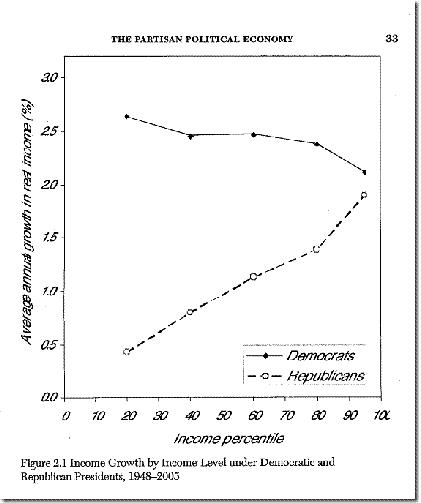
Source: Dani Rodrik’s Weblog, “American political economics in one picture.”
As I discuss below, the graph is deceptive because of the period it encompasses. Taking into account the downward trend in real GDP growth that began a century ago, and the timing of Democrat and Republican presidencies from Truman’s second term onward, the graph shows only this: Republican presidents (when they had congressional support) enacted tax and regulatory policies that encouraged economic growth. The rewards of stronger growth, naturally, went mainly (though not exclusively) to those who contributed the most to growth, namely, risk-takers and highly skilled persons. Conversely, Democrat presidents (when they had congressional support, which was more often) enacted tax and regulatory policies that discouraged economic growth, which harmed high earners more than low earners.
Nor is this table conclusive of anything:
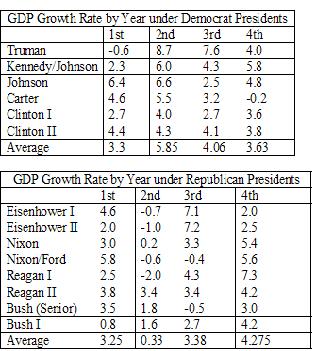
Source: Marginal Revolution, “More on Bartels“
The preceding graph and table both mask the long, downward trend in the real rate of GDP growth, which I document in this post. Thus:

Why the downward trend in real GDP growth? See this post. In sum, the downward trend is due to the policies of (most) presidents and Congresses since the early 1900s: deliberate expansion of the regulatory-welfare state, with almost no opposition from the Supreme Court after the mid-1930s.
Here’s a closer look at the GDP trend since Truman’s first year as an elected president:
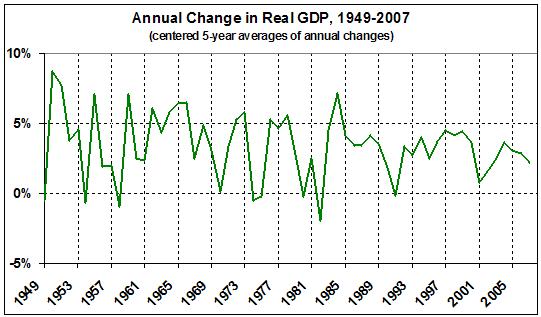
Source: Year-over-year changes in real GDP computed from estimates of real GDP available at Louis D. Johnston and Samuel H. Williamson, “What Was the U.S. GDP Then?“ MeasuringWorth.Com, 2008.
Given the long, downward trend in the real rate of GDP growth, it is statistical nonsense to pin the growth rate in any given year to a particular year of a particular president’s term. It is evident that GDP growth has been influenced mainly by the cumulative, anti-growth effects of government regulation. And GDP growth, in any given year, has been an almost-random variation on a downward theme.
As an additional piece of evidence for that proposition, I offer this: The strongest correlation between the year of a presidential term (i.e., first, second, etc.) and real GDP growth during 1949-2007 does not involve a one-year lag (as Dani Rodrik’s post suggests) but a one-year lead. There is a positive statistical relationship between growth rate and Democrat presidencies for the period 1949-2007 only because Democrats sat in the White House in half of the years from 1949 through 1981 and less than a third of the years after that. But Democrats weren’t responsible for the higher growth rate of those earlier years. They were, if anything, responsible for the lower growth rate of the later years. It took decades for the cumulative regulatory and redistributive effects of the New Deal, Fair Deal, and Great Society to be felt. But felt they were, eventually, even during the years of the so-called Clinton boom — when the liar-in-chief compounded them.
A more useful analysis of the influence of government policy on growth is found in this post. It is about the Laffer curve and the real stimulus afforded by tax cuts, regardless of the president’s party affiliation.
UPDATE: Paul Krugman, of course, is eager to believe the pseudo-relationship “discovered” by Bartels.
SECOND UPDATE: An analysis by The Corner‘s Jim Manzi corroborates my points.
Left "Libertarianism" and Child-Bearing
I once wrote that “[l]iberty, to … the ‘libertarian’ Left, is the ‘right’ to believe as they do.” One “libertarian” Leftist is Will Wilkinson, who invites the wrath of Arnold Kling by invoking happiness research in support of his (Wilkinson’s) evident bias against child-bearing. (See for example, this dissection of Wilkinson’s position by Bryan Caplan.)
Wilkinson is so hard up for an argument against child-bearing that he ignores the libertarian doctrine of personal responsibility and falls back on “happiness research.” Thus Kling’s rightful wrath.
The Fed: Unconstitutional and Worse than Useless
Democracy vs. Liberty, in a Paragraph
Colin McGinn writes:
In order for democracy to be acceptable, it needs to be combined with legal protections for the rights of minorities (gays, atheists, et al), or else there will be a tyranny of majority rule. But these protections cannot be made subject to the will of the majority or they lose their point and force. So, they must stay in place even if the majority opposes them–which is undemocratic. Therefore, democracy is acceptable only if it is not absolute. A tolerable form of democracy cannot be consistently democratic. The problem is that democracy and individual rights are at odds with each other.
My own views about democracy and its insidious effect on liberty are here, here, here, here, here, here, here, and here.
(Thanks to Maverick Philosopher for the pointer.)
Cringing before the Enemy
Craven cringing in the face of Muslim threats is a European way of life. There’s no news there. And, given that, there’s no surprise here:
President Vladimir V. Putin, after meeting with NATO members in Bucharest on Friday, bluntly declared that an expansion that included Ukraine and Georgia, former Soviet republics with deep historical links to Russia, would constitute a threat.
NATO rebuffed pleas by Mr. Bush and some other NATO allies to extend a preliminary “membership action plan” to Ukraine and Georgia, a major step toward full membership. Many have seen the move as a result of Russia’s warnings.
The obvious move is to invite Russia into NATO, because an alliance that includes your likeliest enemy is no alliance at all. Which seems to be the aim of “sophisticated” Europeans. They’ll continue to surrender their liberty, chunk by chunk, rather than confront any threat to it. Not surprising, in that they evidently haven’t the faintest idea what liberty is.
What, No Cattle Futures?
I noted last week that Senator Obama has for some reason not taken the opportunity to put some of his Schedule C income into a tax-deferred retirement account. Now that Senator Clinton and her husband have released their tax return, I see they also passed up the chance…. I believe each of them could have put $44,000 into a SEP-IRA, but apparently, … they chose not to.
Why? I suggested two hypotheses for Senator Obama: bad tax advice or the expectation of much higher future tax rates. For the Clintons, a third hypothesis is possible: Given their substantial income ($16 million in 2006), the chance of sheltering $88,000 may be too trivial to bother with.
There is a fourth hypothesis: Bill spent the money at Emperors Club VIP or somewhere north of Bear Mountain Ridge. And a fifth one: He is still paying hush money to Susan McDougal and Webster Hubbell.
(I objected to muckraking about Sen. Debbie Stabenow’s husband, Thomas Athans, because he is not on a government payroll, as far as I know. Ex-president (fortunately) Bill Clinton receives a large government pension, a munificent expense account, lavish offices, a pre-humous memorial in the form of a presidential library, and costly Secret Service protection because of the office he once held, thanks (not) to H. Ross Perot. Clinton (born William Jefferson Blyth III) is a “public figure” of the second-worst sort: in a class with James Earl “Jimmy” Carter, though not as foul as Mohammed Abdel Rahman Abdel Raouf Arafat al-Qudwa al-Husseini, Mao Tse-tung, Ioseb Vissarionovich Jugashvili, or Adolf (Schicklgruber) Hiedler. Given Clinton’s detestable performance as governor, president and ex-president — and the fact that he is the only president to have plea-bargained his way out of a perjury charge — he deserves more ridicule than any thousand writers could heap on him in a millennium of trying.)
Religion in Public Schools: The Wrong and Right of It
Below the Beltway scorns a lawsuit, which (as FoxNews reports)
demand[s] that a popular European history teacher at California’s Capistrano Valley High School be fired for what they say were anti-Christian remarks he made in the classroom….
[Chad] Farnan recorded his teacher telling students in class: “What country has the highest murder rate? The South! What part of the country has the highest rape rate? The South! What part of the country has the highest rate of church attendance? The South!”
Scorn is the wrong reaction. If employees of public schools are forbidden, as they are, to proselytize for religion (or to allow students to do so through voluntary activities that might somehow be related to school), then employees of public schools, by the same token, should be forbidden to proselytize against religion. And that is evidently what the “popular” teacher did.
Classical Values, on the other hand, has it right. First, the relevant bits from another FoxNews story:
A Tomah [Wisconsin] High School student has filed a federal lawsuit alleging his art teacher censored his drawing because it featured a cross and a biblical reference….
According to the lawsuit, the student’s art teacher asked his class in February to draw landscapes. The student, a senior identified in the lawsuit by the initials A.P., added a cross and the words “John 3:16 A sign of love” in his drawing.
His teacher, Julie Millin, asked him to remove the reference to the Bible, saying students were making remarks about it. He refused, and she gave him a zero on the project.
Millin showed the student a policy for the class that prohibited any violence, blood, sexual connotations or religious beliefs in artwork. The lawsuit claims Millin told the boy he had signed away his constitutional rights when he signed the policy at the beginning of the semester.
The boy tore the policy up in front of Millin, who kicked him out of class. Later that day, assistant principal Cale Jackson told the boy his religious expression infringed on other students’ rights.
Jackson told the boy, his stepfather and his pastor at a meeting a week later that religious expression could be legally censored in class assignments. Millin stated at the meeting the cross in the drawing also infringed on other students’ rights.
Here’s what Classical Values has to say about that:
This is a public school, and the state is not supposed to take positions on religion. It would be one thing had the school told students that they must depict or display images of the cross, but here a student acted on his own, and in a constitutionally protected manner.
Precisely.
More about "Libertarian" Paternalism…
I Object
The follies of Thomas Athans, husband of Senator Debbie Stabenow (D-Mich.), shouldn’t be an occasion for gloating by right-wing outlets (e.g., Newsmax.com and Michelle Malkin’s eponymous blog). Athans is not a government official. Stabenow, who is an egregious senator in her own right, shouldn’t be judged by or held to account for her husband’s peccadilloes.
Malkin quite rightly points out, however, that Republicans — who in the election campaign of 2006 were accused of fomenting a “culture of corruption” — have no monopoly on corruption. Never did have. Never will have.
Post-Season Play, Atheism, and the Worrying Classes
Stephen Dubner of Freakonomics yesterday published an interview of Bill James, founder of sabermetrics (statistical analysis of baseball). The interview reveals James as a no-nonsense purveyor of wisdom, and not just about baseball. Some examples:
Q: Billy Beane, G.M. for the Oakland A’s, has made sabermetric stats a major part of his “value” philosophy when building a baseball team. He’s frequently said that his method will build regular season winners but it doesn’t seem to work in the playoffs. Do you think that this is simply a result of a small sample size or the wrong statistics being used, or is it something more fundamental about “unmeasurable” statistics, like the ability to perform under pressure and “heart?”
A: Oh, I thought people had stopped asking that. Blast from the past there. Look, there’s a lot of luck in winning in post-season. You’re up against a really good team, by definition, and you’ve only got a few days to get it right. It takes some luck.
Are there also types of players and factors that are helpful in that situation? Of course. It’s like asking a physics professor whether there is a God. Scientists don’t know anything more about whether there is a God than morons do, because it’s not a scientific issue. This isn’t something I can measure. It’s a matter of faith.
James agrees with me about the meaning of post-season play, or, rather, its meaninglessness. James also reveals himself as a true scientist when he rejects “scientific” atheism.
Q: What unanswered questions (either baseball-related or not) are you thinking about right now?
A: Why does American society always perceive itself as becoming constantly more and more dangerous — and thus devote ever more and more effort to increasing security — even though almost all measurable dangers, including crime rates, have been falling throughout most of my lifetime? And … is this a good thing?
There speaks a man who seems to understand that we are over-regulated because of the “worrying classes” and their fear of the free market.
Orwell’s Television
Guest post:

Orwell got it partly right. But it’s not the use of two-way monitors that would impose social uniformity and mental numbness in modern society. Rather, I think it is the sheer ubiquity of the old-fashioned one-way idiot box. Granted I’m not a Luddite and enjoy watching DVDs. But the difference here is that I have control over what’s in my house.
The problem I’m talking about is finding TVs in banks, post offices, doctors’ offices, restaurants and even restrooms. My Orwellian experience of the week was discovering that a giant TV had been installed in our employee cafe. Whenever I have a frozen lunch I go there before the place gets crowded around noon. Now with the TV on it’s always crowded. The omnipresent screen is worse than physical claustrophobia; it’s a kind of mental suffocation. Worse yet, there is a kind of collectivism in that we are all forced to hear the same media pabulum 24/7.
Perhaps the real metaphor is not Orwell’s Oceania but Huxley’s Brave New World, with its comfortable big-brotherism enforced by mass entertainment. I think the lesson here is that civilization is only possible with civility. It cannot be enforced directly by the state, though it can be assisted a great by the upholding of the basic laws on the books. As for the marketplace, it is no more than a mirror of a society’s morals. Yet it seems to me that real liberty is possible only where we draw a line as to where others may intrude in our personal space. I have nothing against marketing in a store, but I don’t like it on my doorstep or on my phone. As for public places, that becomes a little trickier. I’m not sure I can point to an objective standard here. It’s mainly intuitive.
But one thing I am sure of—a hallmark of totalitarian society is that the public sphere crowds out the private and it becomes increasingly difficult to achieve a degree of detachment in daily life where one’s thoughts are truly one’s own.
More Grammatical Anarchy
I noted in the previous post that Mark Liberman of Language Log is a grammatical anarchist. Perhaps grammatical anarchism is a condition of blogging at Language Log. Arnold Zwicky of that blog corrects a writer who refers to the subjunctive mood as the “subjective tense.” So far, so good. But Zwicky then goes on to excuse those who insist on using
the ordinary past rather than a special counterfactual form (often called “the subjunctive” or “the past subjunctive”) for expressing conditions contrary to fact….
…There’s absolutely nothing wrong with using the special counterfactual form — I do so myself — but there’s also nothing wrong with using the ordinary past to express counterfactuality. It’s a matter of style and personal choice, and no matter which form you use, people will understand what you are trying to say.
But somehow preserving the last vestige of a special counterfactual form has become a crusade for some people. There are surely better causes.
There may be “better causes,” but Zwicky’s ceding of grammatical ground to “personal choice” leads me to doubt that he will fight for those causes.
Missing the Point
Mark Liberman of Language Log has devoted at least three posts to James J. Kilpatrick’s supposed linguistic socialism. Kilpatrick stands accused (gasp!) of trying to propound rules of English grammar. Given that Kilpatrick can’t enforce such rules, except in the case of his own writing, it seems to me that Liberman is overreacting to Kilpatrick’s dicta.
I am not surprised by Liberman’s reaction to Kilpatrick, given that Liberman seems to be a defender of grammatical anarchy. Liberman tries to justify his anarchistic approach to grammar by quoting from Friedrich Hayek’s Law, Legislation and Liberty, Volume 1: Rules and Order; for example:
Man … is successful not because he knows why he ought to observe the rules which he does observe, or is even capable of stating all these rules in words, but because his thinking and acting are governed by rules which have by a process of selection been evolved in the society in which he lives, and which are thus the product of the experience of generations.
All of which is true, but misinterpreted by Liberman.
First, given that Kilpatrick cannot dictate the rules of grammar, he is a mere participant in the “process of selection” which shapes those rules. In a world that valued effective communication, Kilpatrick’s views would be given more weight than those of, say, a twenty-something who injects “like, you know,” into every sentence. But whether or not Kilpatrick’s views are given more weight isn’t up to Kilpatrick. However much Kilpatrick might like to be a linguistic authoritarian, he is not one.
Second, Hayek’s observation has nothing to do with anarchy, although Liberman wants to read into the passage an endorsement of anarchy. Hayek’s real point is that rules which survive, or survive with incremental modifications, do so because they are more efficient (i.e., more effective, given a resource constraint) than rules that fall by the wayside.
Kilpatrick, and other “strict constructionists” like him, can’t dictate the course of the English language, but they can strive to make it more efficient. Certainly the thought that they give to making English a more efficient language (or forestalling its devolution toward utter inefficiency) should be praised, not scorned.
Language games can be fun, but language is much more than a game, contra Liberman’s approach to it. Language is for communicating ideas — the more efficiently, the better. But, in the three posts linked here, Liberman (strangely) has nothing to say about the efficiency of language. He seems more concerned about James J. Kilpatrick’s “linguistic socialism” than about the ability of writers and speakers to deploy a version of English that communicates ideas clearly.
Well, at least Liberman recognizes socialism as a form of authoritarianism.
The Best of Liberty Corner
Go to “Favorite Posts” at Politics & Prosperity.
Morality and Consequentialism
The text for this post comes from Freespace:
…Many [libertarians] are purely consequentialists—that is, they believe that morality simply cannot be the subject of disciplined inquiry, and that all that a libertarian can talk about is practical reasoning. In other words, they can’t argue that liberty is morally right; they can only argue about how as a practical matter free social and economic networks are organized. I have argued that if consistently followed, this practice will lead them to default on the responsibility of moral judgment, and ultimately they [will] fall into … cultural relativism….
I have argued in many posts that libertarianism properly understood must be based on an objective, universal morality….
The aim of this disciplined (albeit brief) inquiry is to show that “objective, universal morality” is a philosophical delusion. It follows that libertarianism must justified by its consequences.
First, Some Words about Philosophical Moral Absolutism and Religion
I cannot resist observing that philosophical moral absolutism seems to be a religion-substitute for libertarian moral absolutists, who tend to be atheists (e.g., the authors of Freespace, A Stitch in Haste, Dispatches from the Culture Wars, and various of the bloggers at The Panda’s Thumb).
Libertarian moral absolutists, especially so-called libertarians of the Left, exude a “more moral than thou” attitude. I take it as a way of saying “Look at me, I’m an atheist but I’m a moral person, my religion-bashing notwithstanding.” As I say here,
[i]t is disheartening … when libertarians join the anti-religio[n] chorus. They know not what they do when they join the Left in tearing down a bulwark of civil society, without which liberty cannot prevail….
[A]s time passes the moral lessons … older Americans learned through religion will attenuate unless those lessons are taught, anew, to younger generations.
Rather than join the [anti-libertarian] Left in attacking the Judeo-Christian tradition, libertarians ought to accommodate themselves to it and even encourage its acceptance — for liberty’s sake.
See also this post and the links therein.
Philosophical Moral Absolutism as a Logical Fallacy
Returning to the matter of philosophical moral absolutism, let us consider murder: the taking of a human life, absent the motive of self-defense (be it individual or communal). According to proponents of natural rights based on self-ownership (i.e, philosophical moral absolutists), murder is wrong because it is a denial of the natural right to life (the ownership of one’s own life). (As I discuss below, it is an inconvenient fact that not all libertarian absolutists agree about the specific implications of their absolutism.)
But the argument from natural rights is both circular and consequential. It is circular in that it seeks to prove that murder is wrong by citing the unprovable axiom that humans possess natural (innate) rights, from which (the absolutist argues) the wrongness of murder flows. The argument is consequential (albeit circular) because the wrongness of murder is characterized in terms of its consequence: the denial of a natural right.
In fact, philosophical moral absolutists are hard-pressed to avoid invoking consequences. The author of Freespace, for example, says that
the framers were right to believe that government is limited by our natural rights, and that our natural rights protect our right to act so long as we harm no other person. This last observation was hardly new or unique to Mill; it is in Locke’s Second Treatise, for instance….
Putting it negatively (“our natural rights protect our right to act so long as we harm no other person”) is just another way of saying that natural rights do not include the right to harm another person. The writer would be quick to add, of course, “except in self-defense or in the course of preventing harm to a third party.”
And, for another example, we have the author of Dispatches from the Culture Wars asserting that
[u]nder libertarian standards, each individual is free to live their [sic] life as they [sic] see fit as long as they [sic] do not impose harm on another person against their [sic] will.
“Harm” is to “consequence” as apple is to fruit. That is, “harm” just a more specific (though still vague) term for an act’s effect on another person or persons. Philosophical moral absolutists, having conceded that libertarianism rests on the harm principle (whether Mill’s or Locke’s) have conceded that it rests on the consequences of acts.
It is impossible to label a specific act as an immoral one merely by stating that it is a violation of natural rights. Instead, the libertarian absolutist is forced to confront the consequences (actual or potential) of the act (event if he does so inwardly).
In sum, a libertarian absolutist’s invocation of natural rights is a ritual: an intellectual genuflection, if you will.
The Indeterminacy of Philosophical Moral Absolutism
It is telling that libertarian absolutists cannot always agree that an axiomatic principle translates into a unique set of moral judgments about particular acts. For example, some absolutists not only claim that there are natural rights, but that those rights lead to the certain moral prescriptions; for example: preemptive war is wrong; abortion is a justifiable act of self-ownership; and income redistribution is just in that it “actualizes” the otherwise theoretical liberty of its beneficiaries. (These are just examples; not all absolutists claim the same three things.)
The problem, for absolutists, is that a given axiomatic principle can be interpreted to justify almost any act, depending on the judgment of the individual who espouses that act. I could, for example, assert that I believe in self-ownership or natural rights and thence argue to the following conclusions: preemptive war is just when it averts an attack on innocent civilians; abortion is an unconscionable act, legally distinguished from murder only by the instant between gestation and birth; income redistribution harms its intended beneficiaries by making them dependent on it and by penalizing growth-inducing activities, such as invention, innovation, entrepreneurship, and capital investment.
My assertions would be no less valid than those of any absolutist, and might (as a set) even coincide with the assertions of some absolutists. How would those concurring absolutists know that I am not of their ilk, except by my own admission? They wouldn’t.
Q.E.D.: Philosophical moral absolutism is indeterminate.
Philosophical Moral Absolutism as a Semantic Illusion
The consequential aspect of morality tends to be overlooked because words for heinous acts (murder, rape, etc.) merely imply the consequences of the acts to which they refer (consequences such as involuntary death, involuntary sexual intimacy, etc.). It is that semantic subtlety which allows philosophical moral absolutists (usually deontolgists and Objectivists) to believe — mistakenly — that they are morally superior to consequentialists because they (the absolutists) have an a priori method for deducing morality.
In denouncing certain acts, philosophical absolutists are in fact denouncing the consequences of those acts, as I have discussed. Absolutists delude themselves by proclaiming that such denunciations really flow from an axiomatic principle, such as natural rights.
The Psychological and Sociological Sources of Moral Judgments
Concepts such as self-ownership and natural rights are, at best, after-the-fact justifications of one’s moral judgments about particular acts. Less charitably, they are shibboleths spouted by sophomoric pretenders to philosophical profundity.
Jim Manzi of The Corner puts it this way:
Any … moral argument, however, will ultimately rest on a set of beliefs that could be characterized as being “coughed up by an unconscious emotion”. We might call these, in a less loaded term, moral axioms. You don’t get a free pass out of this game [as a libertarian absolutist] by just saying you favor any non-coercive behavior, because either the restriction on coercion must itself be a moral axiom, or it must, in turn, rest upon some other more fundamental moral axioms.
The funny thing about axioms is that if they are so basic that pretty much everybody agrees with them, then reasoning from them to conclusions about specific policies will often lead different people to very different conclusions. If, on the other hand, they are highly developed, then lots of people won’t agree that they are axioms.
So, in the end, we are left with judgments about acts whose consequences repulse us, not free-floating universals that exist apart from human nature. Those judgments often are instinctive, and also are “built into” evolved social norms, which reflect accrued knowledge of the consequences of various acts. Thus:
We (most of us) flinch from doing things to others that we would not want done to ourselves. Is that because of inbred (“hard wired”) empathy? Or are we conditioned by social custom? Or is the answer “both”?
If inbred empathy is the only explanation for self-control with regard to other persons, why is it that our restraint so often fails us in interactions with others are fleeting and/or distant? (Think of aggressive driving and rude e-mails, for just two examples of unempathic behavior.) Empathy, to the extent that it is a real and restraining influence, seems most to work best (but not perfectly) in face-to-face encounters, especially where the persons involved have more than a fleeting relationship.
If behavior is (also) influenced by social custom, why does social custom favor restraint? Here is where consequentialism enters the picture.
We are taught (or we learn) about the possibility of retaliation by a victim of our behavior (or by someone acting on behalf of a victim). In certain instances, there is the possibility of state action on behalf of the victim: a fine, time in jail, etc. So we are taught (or we learn) to restrain ourselves (to some extent) in order to avoid punishments that flow directly and (more or less) predictably from our unrestrained actions.
More deeply, there is the idea that “what goes around comes around.” In other words, bad behavior can beget bad behavior, whereas good behavior can beget good behavior. (“Well, if so-and-so can get away with X, so can I.” “So-and-so is rewarded for good behavior; it will pay me to be good, also.” “If so-and-so is nice to me, I’ll be nice to him so that he’ll continue to be nice to me.”)
Why do we care that “what goes around comes around”? First, we humans are imitative social animals; what others do — for good or ill — cues our own behavior. Second, there is an “instinctive” (taught/learned) aversion to “fouling one’s own nest.”
Unfortunately, our aversion to nest-fouling weakens as our interactions with others become more fleeting and distant — as they have done since the onset of industrialization, urbanization, and mass communication. Bad behavior then becomes easier because its consequences are less obvious or certain; it becomes a model for imitation and, perhaps, even a norm. Good behavior then flows from the fear of being retaliated against, not from socialized norms, or even from fear of state action. Aggression — among the naturally aggressive — becomes more usual.
Social Norms (Including Those Inculcated by Religion) Are All That We Have
The Millian concept of harm, so blithely invoked by philosophical moral absolutists (among others), is a chimera. Harm, as an act of one person against another, cannot be defined by individuals; it can be defined only by social agreement.
The philosophical moral absolutist would like to find something “better than” social norms. Thus the accusation that one defends murder, rape, slavery, etc., if one rejects philosophical moral absolutism. It is as if morality cannot be grounded in human nature. But it can be, and it is.
Murder and other anti-social acts arise from human nature. Murder and other anti-social acts are condemned almost universally because of human nature. It is human nature that makes such acts easier to commit when social relations become less personal and more anonymous.
To the extent that human actions are influenced positively by religious precepts (and they are, on the whole), the general goodness of human beings testifies to the mostly benign influence of religion on human behavior.
Conclusion
In sum, consequentialist libertarianism is not a kind of moral relativism. Rather, it is based on realism about (a) the non-existence of philosophical moral absolutes and (b) human nature. It accepts the morality that has arisen from human experience (as influenced by religion), while rejecting absolutists’ Platonic mysticism. Consequentialism is therefore the only possible form of libertarianism, in the real world:
The virtue of [consequentialist] libertarianism … is not that it must be taken on faith but that, in practice, it yields superior consequences [e.g., here and here]. Superior consequences for whom, you may ask. And I will answer: for all but those who don’t wish to play by the rules of libertarianism; that is, for all but predators and parasites.
predators … would take liberty from others, either directly (e.g., through murder…) or through the coercive power of the state (e.g., through smoking bans and licensing laws)…. [P]arasites … seek to advance their self-interest through the coercive power of the state rather than through their own efforts (e.g., through corporate welfare and regulatory protection).
Liberty, in the real world, is freedom (however elusive and episodic it may be) from predators and parasites. That freedom is to be found not through the invocation of philosophical moral absolutes (or anarchy), but through politics, policing, and war — as befits the circumstances.
Related posts:
“The Origin and Essence of Rights” (01 Jan 2005)
“A Non-Paradox for Libertarians” (15 Aug 2005)
“The Paradox of Libertarianism” (05 Jan 2006)
“Liberty as a Social Compact” (28 Feb 2006)
“This Is Objectivism?” (01 Mar 2006)
“Social Norms and Liberty” (02 Mar 2006)
“A Footnote about Liberty and the Social Compact” (06 Mar 2006)
“Finding Liberty” (25 Mar 2006)
“The Source of Rights” (06 Sep 2006)
“The Fear of Consequentialism” (26 Nov 2007)
“Pascal’s Wager, Morality, and the State” (09 Oct 2007)
“Religion and the Inculcation of Morality” (12 Nov 2007)
” ‘Family Values,’ Liberty, and the State” (07 Dec 2007)
“On Prejudice” (28 Feb 2008)
“In Search of Consistency” (12 Mar 2008)
“Objectivism: Tautologies in Search of Reality” (14 Mar 2008)
Related reading:
“What’s Right vs. What Works” (an undated colloquy on objective morality vs. consequentialism, with Charles Murray, David Friedman, David Boaz, and R.W. Bradford)
“Religion, Government, and Civil Society,” by Arnold Kling (21 Feb 2007)
“Is Atheism Only a Bundle of Sentiments?” by Mike Adams (24 Mar 2007)
The Wright Effect
UPDATED 03/27/08
Scott Rasmussen’s tracking poll was the best of the bunch in 2004. Given Rasmussen’s credibility, I turn to his polls about general-election matchups for an accurate view of what the Rev. Wright hath wrought, with respect to Barack Obama’s presidential prospects. Obama’s chance of winning the Democrat nomination hasn’t fallen much (which says a lot about Democrats), but he has fallen behind Hillary Clinton as a prospective opponent of John McCain.
- As recently as February 20-21, Obama led McCain by4 percentage points (46-42).
- At that time, McCain led Clinton by 4 percentage points (47-43).
- McCain now leads Obama by 10 percentage points (51-41), and Clinton by
710 percentage points(50-43)(51-41).
In other words, Clinton has (prospectively) become the tougher opponent for McCain, but mainly because of Obama’s slippage. McCain has gained significant ground against both Democrats. — adding 6 points to his lead over Clinton and notching a positive 14-point swing in his matchup with Obama. It isn’t due to MCain’s words or deeds, but to the Rev. Wright, Obama’s defense of black racism, and the Clinton-Obama mud-fest. (Cackle! Cackle!)
Panhandling as Speech?
That’s right, panhandling is a form of speech, according to a Travis County, Texas, judge:
A city [of Austin] ordinance designed to keep people from begging for money or jobs on the side of some Austin roads has been declared unconstitutional for the second time in less than three years.
In an opinion that criticizes the ordinance as overly broad and questions the city’s argument that it is necessary to ensure traffic safety, Travis County Court-at-Law Judge J. David Phillips upheld a 2005 Municipal Court decision that overturned the city’s sidewalk solicitation rules.
“This ordinance reaches conduct that has little or nothing to do with traffic safety and very much to do with constitutionally protected speech,” Phillips said in an opinion issued Thursday.
Travis County, of course, is dominated by Austin. It is, in other words, a Blue enclave in a Red State.
I would bet that Judge Phillips, as a defender of panhandlers’ “free speech” right to distract drivers (and worse), also subscribes to the Orwellian idea that freedom of speech is served by the McCain-Feingold Act.
That’s the way it is in the People’s Republic of Austin.
You might wonder why the true-Blue denizens of Austin are so “heartless” as to restrict panhandling (via their Leftist city council). It’s a white-liberal-yuppie kind of thing. (And Austin is chockablock with white-liberal-yuppie persons.) One “feels for” the homeless, etc., but one don’t want them to get too close to one’s shiny $60k SUV.
 Politics and Prosperity