Race and the Crossover Vote

Guest post:

Does this article from Friday’s issue of The Washington Times validate my earlier comments on race and the election?

…20 percent of white Democratic voters say they would defect to Mr. McCain if Mr. Obama is the Democratic Party’s nominee — twice the number who would cross over if Sen. Hillary Rodham Clinton wins the nomination, Pew [Research Center] found.

Clearly Obama is getting lots of white support because Hillary is so unsavory, yet it is clear that the ethnocentric bloc is out there.

Another Reason to Love Global Warming

Garry Reed (The Price of Liberty) gives ten reasons to love global warming. I found an eleventh reason in yesterday’s paper:

© Copyright 2007 King Features Syndicate.

P.S. Ten more reasons to love global warming.

Election 2008: Seventh Forecast

UPDATED (03/12/08)

My eighth forecast is here.

The Presidency – Method 1

Intrade posts State-by-State odds odds on the outcome of the presidential election in November. I assign all of a State’s electoral votes to the party whose nominee that is expected to win that State. Where the odds are 50-50, I split the State’s electoral votes between the two parties.

As of today, the odds point to this result:

Democrat — 306 302 electoral votes (EVs)

Republican — 232 236 EVs

That’s a loss of 7 EVs for the GOP candidate since my sixth forecast, which I issued 18 days ago.

The Presidency – Method 2

I have devised a “secret formula” for estimating the share of electoral votes cast for the winner of the presidential election. (The formula’s historical accuracy is described in my second forecast.) The formula currently yields these estimates of the outcome of this year’s presidential election:

Democrat nominee — 286 to 333 226 to 263 EVs

Republican nominee — 205 to 252 265 to 312 EVs

That’s a loss for the GOP nominee of 8 or 9 EVs since my sixth forecast. Methods 1 and 2 are tracking well with each other have diverged. I suspect that the betting at Intrade doesn’t yet reflect the swing toward McCain. That swing has been precipitated by the Clinton-Obama mud-fest and, for many white Democrats, the prospect of Obama at the head of the ticket.

U.S. Senate

Democrats will pick up four Senate seats, one each in Colorado, New Hampshire, New Mexico, and Virginia. The gain will change the balance from 51 Democrats (including Lieberman and Sanders, both nominally independent) and 49 Republicans to 55 Democrats and 45 Republicans.

Why Legal Ethics Is an Oxymoron (II)

In an earlier post I merely linked (without comment) to a post by Eugene Volokh (The Volokh Conspiracy). There, Volokh defends a technically ethical (but blatantly wrong) act on the part of two lawyers. The act? Volokh quotes a report by CBS:

Alton Logan doesn’t understand why two lawyers with proof he didn’t commit murder were legally prevented from helping him. They had their reasons: To save Logan, they would have had to break the cardinal rule of attorney-client privilege to reveal their own client had committed the crime. But Logan had 26 years in prison to try to understand why he was convicted for a crime he didn’t commit….

Lawyers Jamie Kunz and Dale Coventry were public defenders when their client, Andrew Wilson, admitted to them he had shot-gunned a security guard to death in a 1982 robbery. When a tip led to Logan’s arrest and he went to trial for the crime, the two lawyers were in a bind. They wanted to help Logan but legally couldn’t….

The lawyers did get permission from Wilson, to reveal upon his death his confession to the murder Logan was convicted for. Wilson died late last year and Coventry and Kunz came forward. Next Monday, a judge will hear evidence in a motion to grant Logan a new trial.

This is Volokh’s initial defense of Kunz and Coventry’s failure to prevent the injustice to Logan:

[M]y understanding is that there is indeed no exception from attorney-client confidentiality in such cases. (If a client tells you that he intends to commit a crime in the future, you may be able to turn him in, but not when he admits that he has committed a crime in the past.)

Why should lawyer-client confidentiality trump justice? One line of thought (suggested by various commenters at Volokh) is that a breach of lawyer-client confidentiality might deter some clients from seeking legal counsel. Well, yes, it might deter guilty clients from seeking legal counsel. But how often is a guilty client candid about his guilt, anyway? Lawyers often defend guilty clients who haven’t been candid about their guilt. Suspecting that a client is guilty and knowing that he is guilty are two different things. A lawyer who doesn’t know that his client is guilty is probably better prepared, psychologically, to defend the client.

What about the excuse that professional ethics prevent lawyers from breaching attorney-client privilege? That excuse merely begs the question, in that codes of ethics are written and approved by lawyers.

Volokh has since penned a second post on the subject:

Some reactions to my “a classical ethical bind for lawyers” post suggested that the ethical question was easy:

The lawyers whose client had said he committed a murder should have revealed that information in order to free the person who was wrongly imprisoned for that murder, even assuming that would have meant disbarment or long-term suspension for violating lawyer-client confidentiality. If they didn’t do this, they’d be acting unethically.

But even assuming that the underlying confidentiality rule is unsound, surely it’s not so clear that people have an ethical duty to save another’s life at such great expense. My guess is that if you spent $10,000, you could likely save the life of some sick child in Africa; if you spent $50,000, I imagine this would be even likelier (and perhaps the number is actually a lot less). If you donated a kidney — which will expose you to a roughly 0.03% risk of death, and a slightly larger but still very small risk of complications — you could dramatically reduce a roughly 20% or more risk of death for someone on the kidney waiting list (since that’s how risky it is for him to be on long-term dialysis while he’s waiting for a new kidney). If you find someone who’s near the tail of the waiting list, you might reduce a still greater risk. Yet most of us wouldn’t say, I think, that it’s really your ethical obligation to run such a risk, or bear such a cost, to save a stranger’s life.

Likewise, I don’t think that it’s really your ethical obligation to lose what is likely hundreds of thousands of dollars in future income, by giving up a profession that you spent over a hundred thousand dollars to train for. You might deserve credit for making such a choice (assuming we conclude that the ethical rule you’re violating is indeed unsound). But that’s different from saying that you have an ethical duty to make that choice.

So, the bottom line (for Volokh) seems to be the “bottom line.” But this still begs the question. Lawyers could change their code of ethics to allow for cases similar to that of Alton Logan. Having thusly changed the code, a breach of attorney-client privilege (where warranted) would not result in disbarment and might not cause a loss of income. (Even where it might cause a loss of income, there is no argument in equity for Volokh’s position, as I explain below.)

Moreover, a change in the legal code of ethics to allow exculpatory breaches of confidentiality would instill greater confidence, not less, in the legal system. The public, on the whole, would be more inclined to believe that lawyers (especially criminal defense lawyers) serve justice. The case of Alton Logan reinforces the contrary perception, namely, that law is not justice.

I would go one step further in the interest of justice. I would make it a crime for a lawyer to withhold information that might exculpate a non-client for the sake of protecting a client. The law would then serve justice.

What about Volokh’s argument that lawyers (among others) do not have “an ethical duty to save another’s life at … great expense”? Suppose, for example, that lawyers who breach confidentiality in a circumstance allowed by their profession’s (revised) code of ethics and mandated by (revised) statutory law would nevertheless lose all of their remaining clients. Given that, Volokh argues (in effect), it would be equitable to force the rich to save the lives of starving African children, and to force anyone who has two healthy kidneys to donate one of them to a person who is on a kidney waiting-list.

Here’s my answer: A lawyer who withholds exculpatory information commits a harm; that is, he causes someone to be punished wrongly for a crime. That is not the case with a person who doesn’t give money to starving African children or who doesn’t donate a kidney to a person in need of one. The harm (starvation or kidney failure) isn’t caused by the person who withholds the money or kidney.

In sum, Volokh’s defense of Kunz, Coventry, and their ilk is fatally flawed. It begs the question and poses false analogies. One might say that Volokh is being lawyerly.

A Huge "Welcome Back"…

…to “Feddie” of Southern Appeal.

It Depends on Where You Stand

The New York Times has an article about Martin Amis’s estrangement from the English left, on the issue of Islam:

[Amis’s] “slogan on [the] distinction [between Islamophobia and Islamismophobia] is, ‘We respect Muhammad, we do not respect Mohamed Atta.’ ” Jihadism, he said, is “racist, homophobic, totalitarian, genocidal, inquisitorial and imperialistic. Surely there should be no difficulty in announcing one’s hostility to that, but there is.”

Indeed there is if, like Amis, you are out of synch with “England’s left-leaning intellectual culture, [which is] traditionally somewhat hostile toward Israel and the United States.” “Somewhat”? Now there’s an understatement for you.

In fact, as the article continues, it becomes clear that Amis sees English “intellectualism” for what it is:

“The anti-Americanism is really toxic in this country, and the anti-Zionism,” he said, attributing the sentiments to empire envy. “I think we ceased to be a world power just as America was unignorably taking on that role.” The dominant ideology “told us that we don’t like empires, we’re ashamed of ever having one.” In England, he continued, “we’ve infantilized ourselves, stupefied ourselves, through a kind of sentimental multiculturalism,” Amis said. He called for open discussion “without self-righteous cries of racism. It’s not about race, it’s about ideology.”

What the Times calls a “transAtlantic divide” is really a chasm between the Left (everywhere) and the remnants of minarchist libertarianism-cum-Burkean conservatism. The Left in this country is every bit as toxically anti-American as the Left in England (and elsewhere). Leftists of all nations stand opposed to liberty. Islamism is merely the Left’s “poster child” du jour.

For more, see the posts in the category “Leftism – Statism – Democracy.”

Democrats and Trade

A post at The New York Times Blog reminds me of an old post of mine:

What U.S. consumers should (and do) care about is getting the most for their money. If more of their dollars happen to flow across international borders as American companies strive for efficiency, so what? If American companies “send jobs” to Juan in Nuevo Laredo, Mexico, and Pierre in St. Stephen, New Brunswick, Juan and Pierre wil use the extra dollars they earn to buy things of good value to them that are made in the U.S., things that they couldn’t afford before. That’s called job creation.

In sum, Juan and Pierre outsource to us because we outsource to them, just as you outsource auto repair to your local mechanic and he outsources, say, computer programming to you. And if Juan and Pierre don’t spend all of their dollars on consumer goods, they put some of their dollars (directly or indirectly) into U.S. stocks and bonds, which helps to finance economic growth in the U.S.

Outsourcing, which is really the same thing as international trade, creates jobs, creates wealth, and raises real incomes — for all. Economics is a positive-sum “game.”

If you’re not convinced, think of it this way: If product X is a good value, does it matter to you whether it was made in Poughkeepsie or Burbank? Well, then, there’s nothing wrong with Laredo, Texas, or Calais, Maine, is there?

Now imagine that the Rio Grande River shifts course and, poof, Nuevo Laredo, Mexico, becomes Nuevo Laredo, Texas. Or suppose that the Saint Croix River between Maine and New Brunswick shifts course and the former St. Stephen, New Brunswick, becomes St. Stephen, Maine. Juan and Pierre are now Americans. Feel better?

What’s in a border? A border is something to be defended against an enemy. But do you want a border to stand between you and lower prices, more jobs, and economic growth? I thought not.

See also this, this, and this (#17).

A Fighting Frenchman

Yesterday I watched La Môme (a.k.a. La Vie en Rose), a sad film about the sad life of Édith Piaf. Watching the film, I was reminded that Piaf had an affair with boxer Marcel Cerdan, a French pied-noir.

Cerdan won several boxing titles as a welterweight and middleweight, including the world middleweight championship. Cerdan’s career came to a tragic end in October 1949, when he was killed in a plane crash while enroute to meet Piaf in New York, where she was then performing.

Having been reminded of Cerdan, it occurred to me that he may have been the last Frenchman who (a) fought and (b) won.

Why Legal Ethics Is an Oxymoron

Read this post, at The Volokh Conspiracy.

Spot-On

WFB’s obituary of Murray Rothbard. Well, it’s not entirely spot-on. Buckley is wrong about lighthouses, but that’s all.

Hope vs. Experience

Wolf Howling captures it neatly, in his review of Obama’s foreign policy.

Election 2008: Bad News, Good News

The bad news about Super Tuesday II is the Clinton resurgence.

The good news is a veritable dead heat between Clinton and Obama, which probably guarantees a mud-fest between now and the Pennsylvania primary on April 22.

The bad news is the amount of air time that will be devoted to Clinton and Obama.

The good news is that either Clinton’s or Obama’s “base” will be ticked off by what is said about their favorite candidate, and by the outcome of the Pennsylvania primary. The other good news: possible Obama-Clinton fatigue among all but die-hard Democrats.

The bad news is that Clinton and Obama might then quickly cut a deal, that is, Clinton for president, Obama for vice president.

The good news is that Obama’s “black base” will be ticked off by being pushed to the back of the bus by an uppity white woman.

The bad news is that John McCain will be almost invisible to swing voters until the GOP convention (September 1-4).

The good news is John McCain may seem like a fresh face to a lot of swing voters by the time he becomes the GOP’s official nominee.

I Hate This Kind of Talk

Do presidents “run the country”? I think not, and hope not. But a blogger at The Moderate Voice says, in a long pro-Hillary post, “I believe that Hillary is the best person to run the country.”

I guess the blogger in question is willing to take dictation from Mme. Clinton about eating habits, smoking habits, auto purchases, job preferences, medical care, etc., etc., etc.

No one should “run the country.” And if anyone were to “run the country,” a Democrat (or other fascist type) would be my last choice for the job.

Income and Diminishing Marginal Utility

David Friedman (Ideas) subscribes to the mistaken notion that the utility (enjoyment) gained from additional income diminishes as income increases; for example:

Consider a program such as social security which collects money and pays out money. Dollars collected from the richer taxpayer probably cost him less utility than dollars collected from the poorer taxpayer cost him. But dollars paid to the richer taxpayers also provide less utility than dollars paid to the poorer.

Friedman’s mistake is a common one. It is one misapplication of the concept of diminishing marginal utility (DMU): the entirely sensible notion that the enjoyment of a particular good or service declines, at some point, with the quantity consumed during a given period of time. For example, a second helping of chocolate dessert might be more enjoyable than a first helping, but a third helping might not be as enjoyable as the second one.

The misapplication of DMU arises from an error of logic, an error of observation, and an error of arrogance. (Friedman doesn’t make all three errors, but avowed redistributionists do.)

The error of logic is to assume (implicitly) that as one’s income rises one continues to consume the same goods and services, just at a higher rate. But, in fact, having more income enables a person to consume goods and services of greater variety and higher quality. Given that, it is possible always to increase one’s enjoyment by shifting from a “third helping” of a cheap product to a “first helping” of an expensive one, and to keep on doing so as one’s income rises.

As for the error of observation, look around you. As I explain here,

diminishing marginal utility, DMU, is a key postulate of microeconomic theory. Therefore, the [rich] Xs of the world must be “sated” by having “so much” money, whereas the [poorer] Ys remain relatively “unsated.”

If that were true, why would Bill Gates, Warren Buffet, and partners in Wall Street investment banks (not to mention most of you who are reading this) seek to make more money and amass more wealth? Perhaps the likes of Gates and Buffet do so because they want to engage in philanthropy on a grand scale. But their happiness is being served by making others happy through philanthropy; the wealthier they are, the happier they can make others and themselves.

In other words, should you run out of new and different things to consume (an unlikely event), you can make yourself happier by acquiring more income to amass more wealth and (if it makes you happy) by giving away some of your wealth.

Is there a point at which one opts for leisure (or other non-work activities) over income? Yes, but that point varies widely from person to person and, for some, isn’t really a marginal preference for leisure over work and income. The committed workaholic sleeps, at times, but only in order to sustain himself in his quest for more income and wealth. Even non-workaholics generally say “yes” to better-paying jobs. And most of them keep saying “yes” until the offers stop coming. Why “yes”? Because the extra effort involved in earning a higher salary (and there usually is some extra effort), is worth it. Where’s the diminishing marginal utility in that?

Why do most people try to save some of their income instead of spending it all on current consumption? For a “rainy day,” a new house, the kids’ education, retirement, the kids’ legacy, etc. How do they do it? By choosing investments that (they hope) will yield a high return (given the risk involved); that is, by earning more income (and amassing more wealth) than one is able to do just by working. How much is enough? For almost everyone (the main exceptions being super-rich hypocrites like Warren Buffet), there’s never enough. Where’s the diminishing marginal utility in that?

Except for the rare bird who truly prefers less to more, the marginal utility of income per se does not diminish. That is why we accept promotions, invest our savings, and (irrationally) buy lottery tickets.

I come now to the error of arrogance:

…[H]ow much wealth is “enough” for one person? I cannot answer that question for you; you cannot answer it for me. (I may have a DMU for automobiles, cashew nuts, and movies, but not for wealth, in and of itself.) And that’s the bottom line: However much we humans may have in common, each of is happy (or unhappy) in his own way and for his own peculiar reasons.

In any event, even if individual utilities (states of happiness) could be measured, there is no such thing as [a] social welfare function: X’s and Y’s utilities are not interchangeable. Taking income from X makes X less happy. Giving some of X’s income to Y may make Y happier (in the short run), but it does not make X happier. It is the height of arrogance for anyone — liberal, fascist, communist, or whatever — to assert that making X less happy is worth it if it makes Y happier.

Thus endeth today’s lesson in economics and humility.

Religious Discrimination or Free Exercise?

Eugene Volokh is exercised about a ruling by the Supreme Court of Michigan in a child-custody case, which he characterizes as unconstitutional:

Michigan parents know that, to maximize their chances of keeping custody of their children, they need to go to church more often. A solid violation of the Establishment Clause, I think, plus of the Michigan Constitution’s religious freedom provision:

Every person shall be at liberty to worship God according to the dictates of his own conscience. No person shall be compelled to attend … any place of religious worship …. The civil and political rights, privileges and capacities of no person shall be diminished or enlarged on account of his religious belief.

Volokh’s real beef is with the Michigan statute (Child Custody Act of 1970), which spells out the “best interest” factors to be considered in child-custody cases. He specifically objects to the italicized portion of section 3(b):

The capacity and disposition of the parties involved to give the child love, affection, and guidance and to continue the education and raising of the child in his or her religion or creed, if any (emphasis added).

I cannot grasp the basis of Volokh’s objection. Neither the statute nor (in what I have read) any court’s interpretation of it seems to violate the relevant portion of the First Amendment:

Congress [and by incorporation through the Fourteenth Amendment, the States] shall make no law respecting an establishment of religion, or prohibiting the free exercise thereof….

The Michigan statute wisely gives proper recognition to the importance of religion (among several other factors) in the upbringing of a child. That’s all it does.

The clause at issue is not an establishment of religion. It does not force anyone to practice a religion. It simply gives due credit to a parent who continues to raise his or her child in the religion in which the child already was being raised, if any.

The clause at issue does not bar the free exercise of religion. Contrary to what Volokh seems to think, it is not a child’s place to dictate his or her religious upbringing. Would Volokh think it good to allow a child to decide (against parental command) to drop out of school at the age of, say, ten? I don’t think so. What makes religion different than education? Nothing, except that Volokh finds it objectionable that Michigan’s legislature and courts recognize the value of religion in the upbringing of a child.

Volokh, like so many other determined secularists, cannot countenance any governmental act that seems to approve of religion. But, contrary to Thomas Jefferson, there is no “wall of separation” between church and state, as Justice Antonin Scalia reminds us:

The same week that Congress submitted the Establishment Clause as part of the Bill of Rights for ratification by the States, it enacted legislation providing for paid chaplains in the House and Senate…. The day after the First Amendment was proposed, the same Congress that had proposed it requested the President to proclaim “ a day of public thanksgiving and prayer, to be observed, by acknowledging, with grateful hearts, the many and signal favours of Almighty God.”… President Washington offered the first Thanksgiving Proclamation shortly thereafter, devoting November 26, 1789 on behalf of the American people “ ‘to the service of that great and glorious Being who is the beneficent author of all the good that is, that was, or that will be,’ ”… thus beginning a tradition of offering gratitude to God that continues today…. The same Congress also reenacted the Northwest Territory Ordinance of 1787,… Article III of which provided: “Religion, morality, and knowledge, being necessary to good government and the happiness of mankind, schools and the means of education shall forever be encouraged.”… And of course the First Amendment itself accords religion (and no other manner of belief) special constitutional protection.

These actions of our First President and Congress … were not idiosyncratic; they reflected the beliefs of the period. Those who wrote the Constitution believed that morality was essential to the well-being of society and that encouragement of religion was the best way to foster morality.

And they were right.

On Prejudice

I have just finished reading Theodore Dalrymple’s In Praise of Prejudice: The Necessity of Preconceived Ideas. Dalrymple’s thesis is simple but profound: We cannot (and do not) operate in this world without the benefit of preconceived ideas about how the world works. If we tried to do so, we would be as helpless as babes in the wood.

To state Dalrymple’s thesis so baldly is to do a grave injustice to the lucidity, incisiveness, elegance, and ruthless logic of his short book. At the outset, Dalrymple makes it clear that he holds no brief for racial and ethnic prejudice. As he points out: “No prejudice, no genocide.” But he adds that

If the existence of a widespread prejudice is necessary for the commission of genocide, it is certainly not a sufficient one. Nor does it follow from the fact that all who commit genocide are prejudiced that all who are prejudiced commit genocide.

Dalrymple spends many pages (fruitfully) eviscerating John Stuart Mill’s simplistic liberalism, which holds that that one may do as one pleases as long as (in one’s own opinion) one does no harm to others. This belief (itself a prejudice) has led to what Dalrymple calls “radical individualism” — and it is just that, despite the efforts of libertarian apologists to demonstrate otherwise. Dalrymple offers a spot-on diagnosis of the wages of radical individualism:

What starts out as a search for increased if not total individualism ends up by increasing the power of government over individuals. It does not do so by the totalitarian method of rendering compulsory all that is not forbidden … but by destroying all moral authority that intervenes between individual human will and governmental power…. “There is no law against it” becomes an unanswerable justification for conduct that is selfish and egotistical.

This, of course, makes the law, and therefore those who make the law, the moral arbiters of society. It is they who, by definition, decide what is permissible and what is not….

Given the nature of human nature, it hardly needs pointing out that those who are delegated the job of moral arbiter for the whole of society enjoy their power and come to thing that they deserve it, and that they have been chosen for their special insight into the way life should be lived. It is not legislators who succumb to this temptation but judges also….

Dalrymple, an admitted non-believer, also slices through the pretensions of Peter Singer and Richard Dawkins, strident atheists both. He exposes their prejudices, which they try to conceal with the language of science and bombastic certitude.

There is much more in this delightful book. I offer a final sample:

In order to prove to ourselves that we are not prejudiced, but have thought out everything for ourselves, as fully autonomous (if not responsible) human beings should, we have to reject the common maxims of life that in many, though not in all, cases, preserve civilized relations. Enlightenment, or rather, what is so much more important for many people, a reputation for enlightenment, consists in behaving in a way contrary to those maxims. And once a common maxim of life is overthrown in this fashion, it is replaced by another — often, though of course not always, a worse one.

Social norms that have passed the test of time are more likely than not to be beneficial. And, so, we owe them the benefit of the doubt, instead of discarding them for the sake of change, that is, for the sake of new prejudices.

I urge you to buy In Praise of Prejudice, to read it, and to re-read it (as I will do).

Related:
The Meaning of Liberty” (25 Mar 2006)
Atheism, Religion, and Science Redux” (01 Jul 2007)

How Attractive Is Your State?

REVISED (02/29/08)

Americans are known for “voting with their feet,” that is, for moving to a more congenial locale, often across State lines. The reasons for doing so are many (e.g., being near family, getting away from family, taking a new job, retiring to a warmer climate, retiring to a climate and terrain conducive to winter sports). One of the reasons, of course, is to reduce one’s State and local tax burden.

But moves based on tax reasons aren’t tabulated in the 2008 Statistical Abstract, Table 31 (Movers by Type of Move and Reason for Moving: 2006), which seems (in my view) to understate the frequency of moves related to climate and retirement. A comparison of the totals in Table 31 with the corresponding totals in Table 33 (Mobility Status of Resident Population by State: 2005) suggests that Table 31 is incomplete, to the tune of about 6 million Americans out of the 45 million or so who change houses, counties, States, and countries every year.

So, it’s up to me to quantify the extent to which decisions about interstate moves are influenced by State and local taxes, among other things.

1. Drawing on Table 33 (linked above), I found the rate at which Americans moved from one State to another in 2005. The answer is 2.47 percent. That is, 7.1 million of the 284.4 million Americans age 1 or older in 2005 were residents of a different State in 2004.

2. Every State gains some new residents from other States, but some States are net gainers and others are net losers. To measure a particular State’s net gain or loss, I subtracted 2.47 percent (the all-State average) from the percentage of residents who moved into that State from other States. Nevada is at one extreme, with a net gain of 3.07 percent; New York is at the other extreme, with a net loss of 1.24 percent.

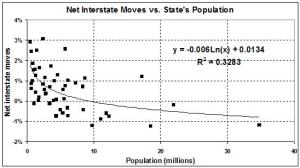
3. Overall, there is a negative correlation (-0.399) between net gain and tax burden; the lower the tax burden, the greater the gain. Graphically:
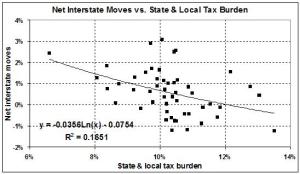
Sources: Net moves = net percentage of a State’s population gained from/lost to other States. Net moves are computed at described in the text. Tax burdens for 2004 are from this table, available via this page at the website of The Tax Foundation.

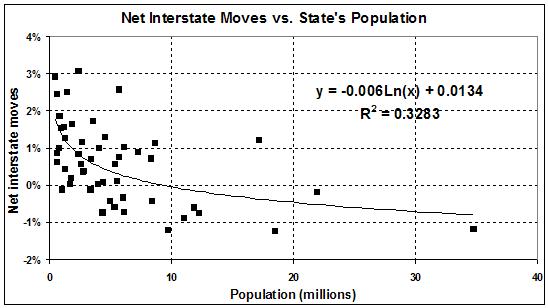
4. Tax policy evidently has a strong effect on decisions to move from State to State. Another quantifiable factor to be accounted for is population. As it turns out, the less populous a State, the greater its attraction:
REVISED PORTION:

5. I took the obvious next step and ran a regression with natural logarithms of tax burden and population as explanatory variables, with this result:

Net population gain or loss (as a decimal fraction of previous year’s population) =
-0.049256
-0.027145 x natural logarithm of State + local tax burden (as a decimal fraction)
-0.005241 x natural logarithm State’s population (in millions)

The R-squared of the equation is 0.420. The F-test on the regression and the t-statistics on the intercept and explanatory variables all are significant at the 0.995 level of confidence, or better.

In other words, after adjusting for population, a 1-percentage point increase in the tax burden from the mean rate of 10.29 percent yields a net population loss of 0.25 percent.

6. The regression equation, as indicated by its fairly low R-squared, leaves much to be explained by factors other than tax burden and population (the latter of which may be a rough proxy for work and family connections). The difference between a State’s actual net gain or loss and the net gain or loss estimated by the equation tells us something about that State’s inherent attractiveness (or unattractiveness). For example, the actual net population gain for Arizona is 2.57 percent; the estimated net gain, 0.25 percent. The difference (known as the residual) is 2.32 percent, which is the largest residual for any State. Arizona is therefore (and for obvious reasons, given its climate) an inherently attractive State. At the other end of the spectrum is Michigan, with a residual of -1.19 percent, which makes it the least inherently attractive State (for entirely fathomable reasons, given its economy).

7. So, I have two measures of a State’s attractiveness

  • overall attractiveness — net percentage of population gained from or lost to other States
  • inherent (natural) attractiveness — the portion of overall attractiveness that is not explained by taxes or population

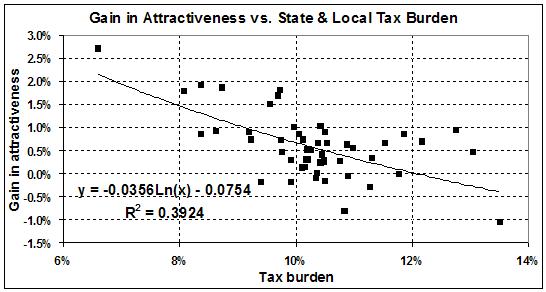
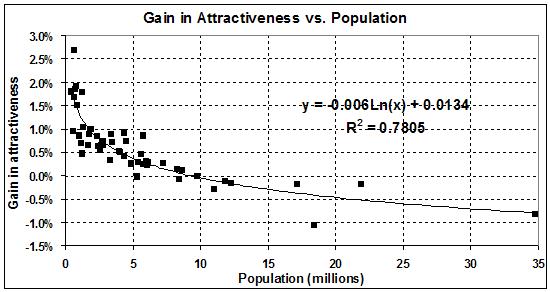
What really matters, of course, is overall attractiveness, or the lack thereof. Unsurprisingly, the upper Midwest and Northeast dominate the list of 15 least-attractive States (those with negative values in the left panel of the table below). Inherent attractiveness (the right panel of the table below) is, nevertheless, an interesting property. The difference between overall attractiveness and inherent attractiveness is a good measure of the gain (or loss) in a State’s attractiveness because of its tax burden and/or population. Thus:
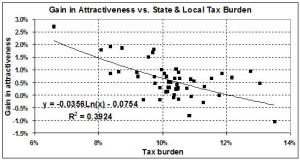
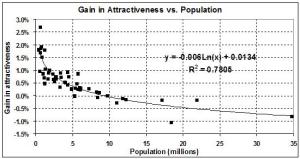
The two graphs immediately above underscore the importance of taxes and population (that is, the lack thereof) to a State’s overall attractiveness.

States that gain or lose significantly (more than a standard deviation from the mean of 0.59%) fall into three categories:

  • Less-populous States that make themselves significantly more attractive through below-average tax burdens: Alaska (gain of 2.70%, tax burden of 6.6%), Delaware (1.92%, 8.4%), Montana (1.50%, 9.6%), New Hampshire (1.78%, 8.1%), North Dakota (1.68%, 9.7%), South Dakota (1.86%, 8.7%), and Wyoming (1.79%, 9.7%).
  • More-populous States that make themselves significantly less attractive through above-average tax burdens: California (-0.82%, 10.8%), Illinois (-0.11%, 10.5%), New York (-1.07%, 13.5%), Ohio (-0.30%, 11.3%), and Pennsylvania (-0.11%, 10.3%).
  • Populous States with below-average tax burdens whose rapid growth seems to be undermining their attractiveness: Florida (-0.19%, 9.9%) and Texas (-0.18%, 9.4%).

How does your State stack up? See for yourself:

Overall attractiveness

Inherent attractiveness

1

Nevada

3.07%

1

Arizona

2.32%

2

Wyoming

2.91%

2

Nevada

2.22%

3

Arizona

2.57%

3

Idaho

1.46%

4

Idaho

2.50%

4

Florida

1.41%

5

Alaska

2.44%

5

Wyoming

1.12%

6

Delaware

1.85%

6

Georgia

1.02%

7

Oregon

1.72%

7

Oregon

1.01%

8

New Mexico

1.64%

8

Hawaii

0.87%

9

Hawaii

1.55%

9

Washington

0.79%

10

Montana

1.52%

10

New Mexico

0.65%

11

Colorado

1.30%

11

Virginia

0.61%

12

New Hampshire

1.28%

12

North Carolina

0.58%

13

Florida

1.21%

13

Colorado

0.57%

14

Arkansas

1.16%

14

South Carolina

0.51%

15

Georgia

1.14%

15

Arkansas

0.51%

16

Washington

1.02%

16

Maryland

0.28%

17

South Carolina

1.01%

17

Utah

0.21%

18

South Dakota

0.99%

18

Montana

0.02%

19

Virginia

0.88%

19

Texas

0.01%

20

Vermont

0.86%

20

Kansas

0.00%

21

Utah

0.83%

21

Maine

-0.03%

22

Tennessee

0.75%

22

Delaware

-0.07%

23

North Carolina

0.71%

23

Vermont

-0.09%

24

Oklahoma

0.69%

24

Tennessee

-0.11%

25

North Dakota

0.62%

25

New York

-0.17%

26

Maryland

0.56%

26

Oklahoma

-0.20%

27

Kansas

0.55%

27

Alaska

-0.26%

28

Maine

0.44%

28

Iowa

-0.28%

29

Iowa

0.38%

29

Missouri

-0.35%

30

Mississippi

0.36%

30

California

-0.36%

31

West Virginia

0.19%

31

Mississippi

-0.37%

32

Missouri

0.11%

32

New Jersey

-0.38%

33

Alabama

0.08%

33

Connecticut

-0.46%

34

Kentucky

0.04%

34

Kentucky

-0.48%

35

Nebraska

0.03%

35

Pennsylvania

-0.50%

36

Rhode Island

-0.13%

36

New Hampshire

-0.51%

37

Connecticut

-0.13%

37

Wisconsin

-0.58%

38

Texas

-0.17%

38

Ohio

-0.59%

39

Indiana

-0.33%

39

Illinois

-0.60%

40

Minnesota

-0.44%

40

Indiana

-0.63%

41

New Jersey

-0.44%

41

Nebraska

-0.63%

42

Wisconsin

-0.60%

42

West Virginia

-0.69%

43

Pennsylvania

-0.60%

43

Minnesota

-0.70%

44

Massachusetts

-0.72%

44

Alabama

-0.85%

45

Louisiana

-0.75%

45

South Dakota

-0.86%

46

Illinois

-0.77%

46

Rhode Island

-0.98%

47

Ohio

-0.89%

47

Massachusetts

-1.02%

48

California

-1.18%

48

North Dakota

-1.07%

49

Michigan

-1.20%

49

Louisiana

-1.16%

50

New York

-1.24%

50

Michigan

-1.19%

The Folly of Centrism

Paul Silver, writing at The Moderate Voice, opines:

Most of us like talk and performance that is moderate in tone and balanced in application. And it is a useful exercise to continually reflect on what we mean by moderate, extreme and balanced.

It seems to me that each issue can be laid out along a spectrum from one extreme to another. e.g. Nationalized businesses on one end and unfettered markets on the other with gradations of regulation in the middle. I am drawn to the gradations in the middle. For me the compelling debate is about what kind of regulation and how much.

Similarly on Taxes: Socialism on one end and Libertarianism on the other with various philosophies of taxation in the middle. For me the attractive debate is about how much taxes are necessary to provide some agreed upon level of wellbeing for our citizens. I think it is a canard to talk about any significant reduction in overall tax burdens. Even with scrupulous management, our Federal budget might only shrink from $3 Trillion to $2.5 Trillion. The real issue is how the burden is shared by those to whom much has been given.

This is political philosophy as an extension of personality. It has nothing to do with moral judgments or the weighing of consequences. It is compromise, for the sake of compromise.

The “middle” has shifted so far leftward since 1929 that Silver cannot imagine a much smaller government, even though we had a much smaller one until the government-caused and government-prolonged Great Depression.

Silver reveals himself not as a “moderate” or “centrist” but as a class-warring socialist when he invokes “those to whom so much has been given.” “Those” are, in fact, people who have done much to provide goods and services of value to others. What “those” have has not been given to them; they have earned it. But that matters not to Silver and his ilk, who see income disparities as an excuse for government-enforced theft.

As I say, the “middle” has shifted far leftward.

Quotation of the Day

Hate speech IS free speech. Leftists would be almost completely muzzled otherwise.

John Ray, at Tongue Tied 3

Levant vs. Soharwardy

The infamous case of Ezra Levant takes a new twist. Levant, as you will recall, was the subject of a Canadian human rights complaint filed by Syed Soharwardy because, in 2005, Levant published the Danish cartoons of Mohammed cartoons in Western Standard magazine. (The magazine, once a print and web publication, in now only a web publication.)

A recent article by Soharwardy seems conciliatory enough (he has withdrawn his complaint), but it doesn’t address all of Levant’s allegations (here) about Soharwardy’s vindictive use of Canadian officialdom against Levant. Will the twain ever meet? Stay tuned.