The Libertarian Culture Clash

David Friedman (Ideas) is right:

There are a lot of different things going on in libertarian reactions to Ron Paul in general and the quotes from the Ron Paul newsletters in particular. One of them, I think, is a culture clash between different sorts of libertarians….

Loosely speaking, I think the clash can be described as between people who see non-PC speech as a positive virtue and those who see it as a fault–or, if you prefer, between people who approve of offending liberal sensibilities (“liberal” in the modern sense of the term) and those who share enough of those sensibilities to prefer not to offend them. The former group see the latter as wimps, the latter see the former as boors.

What else is going on? Well, for one thing, a bunch of moralist scolds have leaped at the opportunity to preach their respective, often contradictory, and sometimes wacky visions of libertarian purity. When they have finished with Ron Paul and his gaggle of white supremacists and conspiracy theorists, they will return to bashing each other. Political purity may be self-satisfying, but it wins few converts and fewer elections.

Just to be clear about it, I hold no brief for Ron Paul.

On This Date

Wikipedia has several lists of events associated with January 21.

The Arts: Where Regress is "Progress"

Bookworm (of Bookworm Room) shares my disdain of modern art forms, some of which I express and explain here:

Speaking of Modern Art” (24 Jul 2004)
Making Sense about Classical Music” (23 Aug 2004)
An Addendum about Classical Music” (24 Aug 2004)
My Views on ‘Classical’ Music, Vindicated” (02 Feb 2005)
A Quick Note about Music” (29 Jun 2005)
All That Jazz” (03 Nov 2006)

In the early decades of the twentieth century, the various arts became an “inside game.” Painters, sculptors, composers (of “serious” music), and choreographers began to create works not for the enjoyment of audiences but for the sake of exploring “new” forms. Given that the various arts had been perfected by the early 1900s (at the outside), the only way to explore “new” forms was to regress toward primitive ones — toward a lack of structure, as Bookworm calls it. Aside from its baneful influence on many true artists, the regression toward the primitive has enabled persons of inferior talent (and none) to call themselves “artists”. Thus modernism is banal when it is not ugly.

Painters, sculptors, etc., have been encouraged in their efforts to explore “new” forms by critics, by advocates of change and rebellion for its own sake (e.g., “liberals” and “bohemians”), and by undiscriminating patrons, anxious to be au courant. Critics have a special stake in modernism because they are needed to “explain” its incomprehensibility and ugliness to the unwashed.

The unwashed have nevertheless rebelled against modernism, and so its practitioners and defenders have responded with condescension, one form of which is the challenge to be “open minded” (i.e., to tolerate the second-rate and nonsensical). A good example of condescension is heard on Composers Datebook, a syndicated feature that runs on some NPR stations. Every Composers Datebook program closes by “reminding you that all music was once new.” As if to lump Arnold Schoenberg and John Cage with Johann Sebastian Bach and Ludwig van Beethoven.

All music, painting, sculpture, and dance were once new, but new doesn’t necessarily mean good. Much (most?) of what has been produced since 1900 (if not before) is inferior, self-indulgent crap.

How to Think about Secession

At the risk of being called a “Doughface libertarian,” which I am not, I must express some reservations about Timothy Sandefur’s paper, “How Libertarians Ought to Think about the U.S. Civil War.”

Sandefur avers that “the Constitution does prohibit secession”; therefore, the States do not have the power to secede under the Tenth Amendment, which says:

The powers not delegated to the United States by the Constitution, nor prohibited by it to the States, are reserved to the States respectively, or to the people.

But the Constitution nowhere expressly prohibits secession. Sandefur’s argument that the Constitution does prohibit secession is an inferential one that rests on his conclusion that the action of a State (qua State)

cannot change the nature of the federal Constitution as adopted in 1787: it is a binding government of the whole people of the United States. No state may unilaterally leave the union.

Actually, the people of the each State were at liberty not to adopt the Constitution. The Constitution could have gone into effect upon being ratified by the conventions of nine of the thirteen States:

The ratification of the conventions of nine states, shall be sufficient for the establishment of this constitution…

In which case, however, the Constitution would have been binding only upon the States whose people ratified it; that is,

…between the states so ratifying the same.

That the people of all thirteen States did, eventually, ratify the Constitution is another matter. Four of the States could have remained outside the Union; that is, they could have “seceded” preemptively.

How could a State have the right to decline membership in the Union but not to withdraw from membership in the Union? Was the act of ratification equivalent to a Christian marriage vow (before Henry VIII)? It would seem so, according to the U.S. Supreme Court, which in Texas v. White (1868) anticipated Sandefur’s arguments; for example:

When…Texas became one of the United States, she entered into an indissoluble relation. All the obligations of perpetual union, and all the guaranties of republican government in the Union, attached at once to the State. The act which consummated her admission into the Union was something more than a compact; it was the incorporation of a new member into the political body. And it was final. The union between Texas and the other States was as complete, as perpetual, and as indissoluble as the union between the original States. There was no place for reconsideration, or revocation, except through revolution, or through consent of the States.

Considered therefore as transactions under the Constitution, the ordinance of secession, adopted by the convention and ratified by a majority of the citizens of Texas, and all the acts of her legislature intended to give effect to that ordinance, were absolutely null. They were utterly without operation in law. The obligations of the State, as a member of the Union, and of every citizen of the State, as a citizen of the United States, remained perfect and unimpaired. It certainly follows that the State did not cease to be a State, nor her citizens to be citizens of the Union.

But such fine reasoning, which echoes the pre-Civil War position of Union loyalists, did not prevent the secession (or rebellion) of eleven States. It would have been bad — bad for slaves, bad for the defense of a diminished Union — had the South prevailed in its effort to withdraw from the Union. But the failure of the South’s effort, in the end, was due to the force of arms, not the intentions of the Framers of the Constitution. Justice Grier fully grasped that point in his dissent from the majority in Texas v. White:

Is Texas one of these United States? Or was she such at the time this [case] was filed, or since?
This is to be decided as a political fact, not as a legal fiction. This court is bound to know and notice the public history of the nation….
It is true that no organized rebellion now exists there, and the courts of the United States now exercise jurisdiction over the people of that province. But this is no test of the State’s being in the Union; Dacotah is no State, and yet the courts of the United States administer justice there as they do in Texas. The Indian tribes, who are governed by military force, cannot claim to be States of the Union. Wherein does the condition of Texas differ from theirs?… I can only submit to the fact as decided by the political position of the government; and I am not disposed to join in any essay to prove Texas to be a State of the Union, when Congress have decided that she is not. It is a question of fact, I repeat, and of fact only. Politically, Texas is not a State in this Union. Whether rightfully out of it or not is a question not before the court.

Legalistic arguments about secession are irrelevant, even if they are intellectually entertaining. Secession is a political issue, and as Clausewitz said, “war is the continuation of politics by other means.” In paraphrase of Stalin, I ask: How many divisions does the Supreme Court (or a blogging lawyer) have?

For a deeper analysis of secession, see “How Libertarians Ought to Think about the Constitution.”

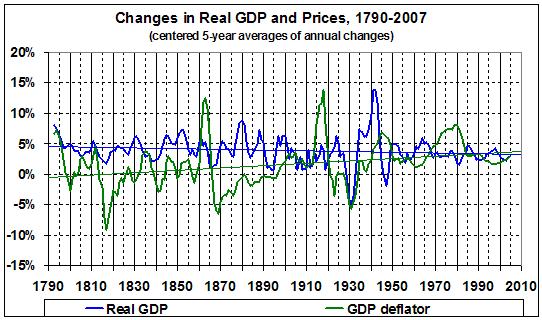
Is Inflation Inevitable?

Inflation is inevitable as long as government spending, taxation, and regulation continue to inhibit productivity gains by stifling innovation, entrepreneurship, and risk-taking. The historical record shows as much:

Real GDP is nominal (current-dollar) GDP divided by the GDP deflator, a measure of changes in the overall level of prices for the goods and services that make up GDP. I derived five-year averages from the estimates of real GDP and the GDP deflator for 1790 through 2006, as provided by Louis D. Johnston and Samuel H. Williamson, “The Annual Real and Nominal GDP for the United States, 1790 – Present.” Economic History Services, July 27, 2007, URL : http://eh.net/hmit/gdp/. UPDATE (01/30/08): The averages for 2005 include estimates of real GDP and the GDP deflator for 2007, as issued by the Bureau of Economic Analysis on January 30, 2008.

Before the early 1900s — before federal income taxes were made constitutional, before government spending rose from less than 10 percent to about 30 percent of GDP, before the Federal Reserve was created, and before the nation’s businesses were engulfed in a regulatory tsunami — the U.S. experienced prolonged periods of deflation, accompanied by rapid economic growth.

The only sustained periods of deflation since 1900 occurred in conjunction with the deep (but relatively brief) recession of the early 1920s and the Great Depression of the 1930s.

The real issue is not inflation per se, it is government. Inflation is a symptom of chronic, government-induced, economic weakness. There is no way, really, to “fight inflation” but to remove the heavy hand of government from the economy.

Related posts:
The Destruction of Income and Wealth by the State” (01 Jan 2005)
Why Government Spending Is Inherently Inflationary” (18 Sep 2005)
Ten Commandments of Economics” (02 Dec 2005)
More Commandments of Economics” (06 Dec 2005)
Liberty, General Welfare, and the State” (06 Feb 2006)
Monopoly and the General Welfare” (25 Feb 2006)
The Causes of Economic Growth” (08 Apr 2006)
Slopes, Ratchets, and the Death Spiral of Liberty” (03 Aug 2006)
The Anti-Phillips Curve” (25 Aug 2006)
Median Household Income and Bad Government” (18 Sep 2006)
Toward a Capital Theory of Value” (12 Jan 2007)
Things to Come” (27 Jun 2007)
The Laffer Curve, “Fiscal Responsibility, and Economic Growth” (26 Oct 2007)
A Political Compass: Locating the United States” (13 Nov 2007)
Intellectuals and Capitalism” (15 Jan 2008)

Religion and the Inculcation of Values

Apropos the preceding post and “Religion and the Inculcation of Morality,” I offer these thoughts by Christopher Dawson:

[T]he Liberal movement, with its humanitarian idealism and its belief in the law of nature and the rights of man, owes its origin to an irregular union between the humanist tradition and a religious ideal that was inspired by Christian moral values, though not by Christian faith…. [T]he whole development of liberalism and humanitarianism, which has been of such immense importance in the history of the modern world, derived its spiritual impetus from the Christian tradition that it attempted to replace, and when that tradition disappears this spiritual impetus is lost, and liberalism in its turn is replaced by the crudity and amoral ideology of the totalitarian state.

“Europe in Eclipse” (1954), compiled in
The Dynamics of World History

UPDATE (01/19/08): Relatedly, Mark Steyn writes today:

…Jonah Goldberg has a brilliant new book out called Liberal Fascism, which I hope to address at length in the weeks ahead. I note, however, that American liberals, not surprisingly, don’t care for the title. As it happens, the phrase is H.G. Wells’s, and he meant it approvingly. Unity [Mitford]’s dreamboat Fuhrer described himself as “a man of the left.”… Even when they’re not in thrall to the personality dictators, a big chunk of Western elites have a strange yen for the sterner ways of distant cultures, from Hillary Clinton’s Hallmark sentimentalization (“It Takes A Village,” etc.) of a tribal existence that’s truly nasty, brutish and short to Germaine Greer’s more explicit defence of “female genital mutilation.” Late in life, Miss Greer has finally found a form of patriarchal oppression that gets her groove back as much as National Socialism did Unity Mitford’s.

If you’re unlucky, it’s not just the elites who fall for ideologically exotic suitors. It would seem to me, given how easily the Continent embraced all the most idiotic “isms” three-quarters of a century ago, that it will surely take up some equally unlovely ones as it faces its perfect storm of an aging native population, a surging Muslim immigrant population, and an unsustainable welfare state…

A Western nation voluntarily embracing sharia? Sounds silly. But so does Unity Mitford. Liberal democracy is squaresville and predictable, small-scale and unheroic, deeply unglamorous compared to the alternatives. And kind of boring. Until it’s gone.

A Sensible Atheist Speaks

David Friedman (Ideas) writes:

Part of my skepticism with regard to the efforts of my fellow atheists [e.g., Richard Dawkins and Sam Harris] to demonstrate how absurd the opposing position is comes from knowing a fair number of intelligent, reasonable, thoughtful people who believe in God–including one I am married to. Part comes from weaknesses I can perceive in the foundations for my own view of the world. At some point, I think, each of us is using the superb pattern recognition software that evolution has equipped us with to see a coherent pattern in the world around us–and since the problem is a harder one than the software was designed to deal with, it isn’t that surprising that we sometimes get different answers.

UPDATE (01/20/08): Friedman ends a follow-up post with this thought:

My own conclusion, as before, is that I do not think God exists. But neither do I think that conclusion so obviously true that all reasonable people ought to accept it.

Amen.

Related posts:
The Universe…Four Possibilities” (07 Jan 2007)
The Greatest Mystery” (24 Dec 2007)
Religion and the Inculcation of Morality,” which links to many other related posts (12 Nov 2007)

Whither the Stock Market? (II)

UPDATED (03/12/08)

On November 14, 2007, I wrote:

Is it possible that the current bull market reached a temporary peak in May of this year, and is now descending toward a secondary bottom that it will not reach for a few years?

This was my tentative answer, then:

A reversal that lasts a year or two seems entirely possible to me.

My less tentative answer, now, is that the stock market (as measured by the Dow Jones Wilshire 5000 Composite Index) has crossed into “bear country.” That is, it has met the two conditions which indicate a “correction” or bear market that will last for months or years:

  • the index has dropped below its 250-trading-day average, and
  • the 250-day average is moving downward (if imperceptibly).

To see that this is so, go to BigCharts.

1. At the top of the page, in the box for symbol or keyword, type “DWC” and click on the “advanced chart” button.

2 A list of “companies” will appear. Select “Dow Jones Wilshire 5000 Composite Index” by clicking on the icon for that item which is labeled “A.”

3. Then, make the following entries or selections in the panel on the left side of the screen:

Time Frame
Time — select “1 year”
Frequency — select “daily”

Indicators
Moving averages — select “SMA” and type “250” in the box to the right of that

Chart style
Price display — select “logarithmic”
Chart size — select “medium”

At the bottom, click on “save chart settings.” Then, return to the top of the panel and click “draw chart.” Change the length of time to “1 month, “2 months, “3 months,” and “6 months,” then redraw the chart each time.

What you will see in each chart (as of today) is a dip in the 250-trading-day average. More obviously, you will see that the value of the index has moved below the 250-day average. It is therefore likely that the market has entered a downward phase that could last for months or years.

To see why, change your “Time” selection to “all data” and redraw the chart. The resulting graphic shows 25 years of the index and its 250-day average for the last 24 years. You can see that a market downturn of several months’ or years’ duration has ensued whenever the index has dropped below its 250-day average and the 250-day average has turned down.

On the other side of the coin, how can you know — for sure — when a downturn has ended and the market is in recovery? Answer: The end of a downturn is confirmed when the index rises upward through the 250-day average and the 250-day average is rising.

Regardless of the current state of the market, please remember this:

Don’t bail out now, unless you absolutely, positively need the money. I could be wrong about the reversal. In any event, stocks are for the long run.

P.S. By my reckoning, every downturn in the 250-day average since 1970 has signaled every recession since 1970.

Conspicuous Consumption and Race

Conspicuous Consumption and Race” is a paper by Kerwin Kofi Charles, Erik Hurst, and Nikolai Roussanov, which I have summarized and addressed here. Now comes Ray Fisman, writing at Slate, to add his $0.02 worth:

A few years ago, Bill Cosby set off a firestorm with a speech excoriating his fellow African-Americans for, among other things, buying $500 sneakers instead of educational toys for their children. In a recent book, Come On People, he repeats his argument that black Americans spend too much money on designer clothes and fancy cars, and don’t invest sufficiently in their futures….

If signaling [conspicuous consumption] is just part of a deeper human impulse to seek status in our communities, what’s wrong with that, anyway? If a household chooses to spend a lot on visible consumption because it gets happiness from achieving high standing among its neighbors, why should we care? To return to [Bill] Cosby’s concerns, if blacks are spending more on shoes and cars and jewelry, they must be spending less on something else. And that something else turns out to be mostly health and education. According to the study, black households spend more than 50 percent less on health care than whites of comparable incomes and 20 percent less on education. Unfortunately, these are exactly the investments that the black families need to make in order to close the black-white income gap.

Okay, so far, but in his next (and concluding) paragraph Fisman says this:

In his controversial speech, Bill Cosby appealed to the African-American community to start investing in their futures. What’s troubling about the message of this study is that Cosby and others may not be battling against a black culture of consumption, but a more deeply seated human pursuit of status. In this sense, Cosby’s critics may be right—only when black incomes catch up to white incomes will the apparent black-white gap in spending on visible goods disappear.

Here, Fisman reveals himself as a racial paternalist. “Deeply seated culture” may be a reason for conspicuous consumption, but it is not an excuse for it. We are not dumb animals; we are human beings, capable of thinking about our future and how to make it better, and capable of acting on our thoughts.

Fisman’s article is a thinly disguised apology for income redistribution and affirmative action. To which I say this: Those who have chosen to rise above their cultural and “instinctual” disadvantages should not be forced to subsidize those who have chosen to be bound by those disadvantages.

Index of Economic Freedom, 2008

The Heritage Foundation has published the 2008 Index of Economic Freedom. I am not impressed by the degree of economic freedom in the world, given that the United States ranks fifth; Canada, sixth, and the UK, tenth.

Intellectuals and Capitalism

Why is “capitalism” a dirty word in academia?

Andrew Norton notes that disaffected intellectuals since Rousseau have been attacking capitalism for its failure to meet ‘true human needs.’(26) The claim is unfounded, so what is it about capitalism that so upsets them?

Joseph Schumpeter offered part of the answer. He observed that capitalism has brought into being an educated class that has no responsibility for practical affairs, and that this class can only make a mark by criticising the system that feeds them.(27) Intellectuals attack capitalism because that is how they sell books and build careers.

More recently, Robert Nozick has noted that intellectuals spend their childhoods excelling at school, where they occupy the top positions in the hierarchy, only to find later in life that their market value is much lower than they believe they are worth. Seeing ‘mere traders’ enjoying higher pay than them is unbearable, and it generates irreconcilable disaffection with the market system.(28)

But the best explanation for the intellectuals’ distaste for capitalism was offered by Friedrich Hayek in The Fatal Conceit.(29) Hayek understood that capitalism offends intellectual pride, while socialism flatters it. Humans like to believe they can design better systems than those that tradition or evolution have bequeathed. We distrust evolved systems, like markets, which seem to work without intelligent direction according to laws and dynamics that no one fully understands.

Nobody planned the global capitalist system, nobody runs it, and nobody really comprehends it. This particularly offends intellectuals, for capitalism renders them redundant. It gets on perfectly well without them. It does not need them to make it run, to coordinate it, or to redesign it. The intellectual critics of capitalism believe they know what is good for us, but millions of people interacting in the marketplace keep rebuffing them. This, ultimately, is why they believe capitalism is ‘bad for the soul’: it fulfils human needs without first seeking their moral approval.

Why Capitalism Is Good for You,” by Peter Saunders

Related posts:
Lefty Profs” (21 Feb 2006)
Why So Few Free-Market Economists?” (12 Oct 2006)
Academic Bias” (22 Oct 2007)

Hillary Admits Error

Error, in this case, being Democrats’ opposition to deficit spending (when it’s the result of GOP tax cuts) because it’s “fiscally irresponsible.” Now that she’s running (scared) for president, Hillary has changed her tune:

“Stimulus shouldn’t be paid for,” declared Mrs. Clinton on NBC’s “Meet the Press” on Sunday. “The stimulus, by the very nature of the economic problems we’re facing, is going to require an injection of federal funding.”

You will notice, however, that she’s calling for more spending (for the children, I presume), not further tax cuts. How cynical can you get?

Related posts:

Curing Debt Hysteria in One Easy Lesson” (21 Apr 2004)
Debt Hysteria, Revisited” (17 Sep 2005)

The Current Crop of Candidates

If you have read my posts “Presidential Legacies” and “The Modern Presidency: A Tour of American History since 1900” it will not surprise you to know that I find little to admire in the current crop of presidential candidates. The candidate who comes closest to matching my views on a range of issues (seven points of agreement on eleven issues) is Fred Thompson, who has the proverbial “snowball’s chance in hell” of winning anything.

All I can hope for, at this point, is a GOP winner in November. That’s not because I much like any of the GOP candidates (I don’t), but because I would rather have Supreme Court appointments in the hands of a Republican president. From that perspective, even Rudy Giuliani looks good.

UPDATE (01/21/08): A McCainClinton presidential contest seems most likely at this point. A President McCain might very well subject prospective Supreme Court nominees to a McCain-Feingold litmus test. George Will writes:

McCain says he would nominate Supreme Court justices similar to Antonin Scalia, Clarence Thomas, John Roberts and Sam Alito. But how likely is he to nominate jurists who resemble those four: They consider his signature achievement constitutionally dubious.

When the Supreme Court upheld McCain-Feingold 5-4, Scalia and Thomas were in the minority. That was before Alito replaced Sandra Day O’Connor, who was in the majority. Two years later, McCain filed his own brief supporting federal suppression of a right-to-life group’s issue advertisement in Wisconsin because it mentioned a candidate for federal office during the McCain-Feingold blackout period prior to an election. The court ruled 5-4 against McCain’s position, with Alito in the majority.

McCain and Clinton: Not a dime’s worth of difference as far as I can see. Both are statists to the core.

If the LP comes up with a candidate who’s better than Michael Badnarik (the LP’s 2004 nominee), I might just waste my vote on that candidate.

If You Like Old Comic Strips…

…read this and this, and go here.

Quotation of the Day

Mark Steyn quotes Arnold Toynbee’s A Study of History

Civilizations die from suicide, not murder.

Precisely.

There are valid, libertarian reasons not to accept everything that is claimed to be a libertarian cause (e.g., sodomistic “marriage,” abortion on demand, and absolute freedom of speech). Those reasons are libertarian in that they go to the foundation of liberty, which can exist only in a civil society founded on the mutual respect, trust, and restraint that arise from the observance of socially evolved norms. The undoing of those norms by the state in the name of liberty is a form of civilizational suicide.

Related posts:
Rights and Liberty” (12 Dec 2007)
Optimality, Liberty, and the Golden Rule” (18 Dec 2007)

Drinking and Voting

Is it necessary to drink heavily before voting for a Democrat? The answer seems to be “yes,” based on the results of the 2004 presidential election:

Sources: Share of popular vote, by State, derived from this page at Dave Leip’s Atlas of U.S. Presidential Elections. Index of alcohol consumption (total of beer, wine, and spirits) in 2005, by State, derived from “Per capita ethanol consumption for States, census regions, and the United States, 1970–2005” at the website of the National Institute on Alcohol Abuse and Alcoholism of the National Institutes of Health.

The four most bibulous (not Bible-reading) jurisdictions are Delaware (index of 2.59), Nevada (2.83), the District of Columbia (3.05), and New Hampshire (3.26). New Hampshirites should change their motto, “Live Free or Die,” to “Live Hard and Die Cold.”

Ron Paul: Anticipating the Smoking Gun

My guest blogger, Postmodern Conservative, was on the right track in these posts (dated 12/13/07 and 12/20/07). James Kirchick of TNR published his “smoking gun” article on 01/08/08.

France, Happiness, and Socialism

What price happiness? French President Nicolas Sarkozy is seeking an answer to the eternal question — so that happiness can be included in measurements of French economic growth.

That’s the lede of an AP story, “French Use Happiness As Economic Measure” (January 10, 2008). The story continues:

Sarkozy said he asked U.S. economist Joseph Stiglitz, winner of the 2001 Nobel economics prize and a critic of free market economists, and Armatya Sen of India, who won the 1998 Nobel prize for work on developing countries, to lead the analysis in France….

Richard Layard, a professor at the London School of Economics and author of the 2005 book “Happiness: Lessons from a New Science,” said Sarkozy may be seeking recognition for policies, popular in Europe, that promote well-being but don’t show up in the GDP statistics….

Jean-Philippe Cotis, the former OECD chief economist who took over as head of France’s statistics office Insee two months ago, said Wednesday that a measure of happiness would complement GDP by taking into account factors such as leisure time — something France has a lot of.

France’s unemployment rate is stubbornly high, and when French people do work they spend less time on the job — 35.9 hours per week compared with the EU average of 37.4.

In other words, if you don’t have the political clout (or stomach) to repeal France’s state-imposed limit on the length of the workweek (35 hours), then you justify it by “proving” that it makes the French happier. (Pourquoi pas?)

And who better to do the job than Stiglitz and Sen, socialists both? Layard’s endorsement of the effort is a dead giveaway, for Layard is a leading proponent of the politics of envy and leveling.

Joseph Sobran: Final Verdict

Guest post:

Aristotle famously said: “I love Plato, but I love truth even more.” Can defenders of Joseph Sobran say the same?

While I don’t wish to make a blanket condemnation of paleocons, I am disappointed how many of them are wedded to an “old boys’ club” mentality. One sees this in the emotive rebuttal by Scott P. Richert (published on Taki Theodoracopulos’ blog) to James Hitchock’s criticism of Sobran and other paleocons in Human Life Review. Richert waxes nostalgic over Sobran’s essays for past issues of Human Life Review. But this is a case of resting on past laurels. Sobran may have done some good in the past but, if like Ezra Pound, a brilliant mind suddenly takes up with bizarre attitudes, this does not mean we should do the same.

What also bothers me is Richert’s mudslinging. He treats Hitchcock like a sophomoric upstart. Never mind that Hitchcock is a veteran conservative commentator and university professor (with a 1965 doctorate from Princeton), who has been in print at least as long as Sobran (who got started with National Review in 1972). To put Richert’s argument as simplistically as it deserves: “Hitchcock is just another neo-con hack. Neo-cons are stupid. Therefore, Hitchcock’s criticism is invalid.” This is the sort of ideological denunciation and deflection that one expects from Marxists.

Here are Hitchcock’s accusations (all documented in the article):

During the 2006 election campaign… Joseph Sobran, a Catholic who considers himself one of the few remaining spokesmen for authentic conservatism… characterized James Webb, the Democratic candidate for senator from Virginia,… as someone “who commanded my immediate trust and respect”….

Despite [Howard] Phillips’ obvious lack of interest in the abortion issue, Sobran has often endorsed the Constitution Party, which he says is the only reliably prolife party in America, and after the election (November 16 [2006]) he found it impossible to distinguish between two “factions” pretending to be two different political parties, but he expressed great satisfaction that Webb’s opponent, the “arrogant” Senator George Allen (who happened to be anti-abortion), had been defeated; then he declared (December 21) that Bush was a worse president than William J. Clinton (who happened to be by far the most zealously pro-abortion president ever to occupy the White House).

[Sobran] praised the pro-abortion Democratic Senator Joseph Biden as “someone who takes his faith very seriously”….

Sobran questions the justice and wisdom of American involvement in World War II.

After the attack on the World Trade Center in 2001, Sobran wrote a series of articles questioning (and sometimes ridiculing) the fear that al-Qaeda constitutes a threat to American security, and five years later… he reported that for him the real experience of terror was having to undergo a security check at Dulles Airport.

Does Richert address these? Not that I can tell.

I had my own dispute with a Sobran supporter recently. I was told that the controversial columnist was witty and incisive (it is his selling point against humdrum mainstream conservatives). But when I pointed out his collaboration with holocaust revisionists, this was chalked up to sheer guilelessness. So which is it? Either Sobran is a genius, in which case he must be right to get cozy with far-right racialists and anti-war leftists, or he’s a political naïf whose contributions to the conservative cause are extremely limited…. in fact, non-existent at this point.

Previous post: “Sobran’s Intellectual Decline and Fall

A Misdirected Apology

American Thinker Blog notes that Columbia University professors are apologizing to Ahmadinejad for the “insulting remarks” (i.e., factual statements) aimed at the Iranian nut-case by Columbia’s president, Lee Bollinger, on September 24.

Would the same Leftist grovelers think to apologize to conservative academics whom they have barred from or driven out of Columbia? I don’t think so.

What is it with Leftists and anti-American regimes? The question answers itself.