Where Left is Right, and Right is Outta Here

Where’s that? At the Austin American-Statesman, which today

welcome[s] the comic strip “Prickly City” by Scott Stantis to our lineup. During a trial run last year, “Prickly City” was a hit with many of our readers, and we’ve had our eye on it ever since. Like “Mallard Fillmore,” which it replaces, “Prickly City” is a conservative social and political strip, but with a little more levity.

I grant that Mallard Fillmore is an un-funny, heavy-handed strip. But it was conservative, that is, against political correctness and Leftism. But I do not grant that Prickly City is a conservative strip (though it is somewhat funnier than Mallard).

Today’s Prickly City exemplifies paranoic Bush Derangement Syndrome, as do several of the recent strips that are currently available on the Prickly City site. Their common theme: Big Brothers Bush and Cheney are spying on all of us, everywhere. Then there’s a strip that buys into “global warming,” and a rather lame series about The Huffington Post, which attacks Arianna Huffington (the person) but not the political lunacy that prevails at HuffPo‘s blog.

This is the Statesman‘s idea of conservative? It just goes to show you how far to the Left the Statesman is these days. But the Statesman‘s editors probably consider themselves “moderate,” just like this guy.

The Greatest Mystery

It is fitting, at Christmas, to contemplate the greatest mystery of all: the mystery of existence.

Monotheists say that God exists and existence is God:

I am Alpha and Omega, the beginning and the end, saith the Lord God, who is, and who was, and who is to come, the Almighty. (The Apocalypse of Saint John, 1:8)

Atheists say that things simply exist, that’s all. But atheism is a faith, not a scientific proposition. As a noted scientist and anti-religionist, Richard Dawkins, puts it:

I believe, but I cannot prove, that all life, all intelligence, all creativity and all “design” anywhere in the universe, is the direct or indirect product of Darwinian natural selection (emphasis added). It follows that design comes late in the universe, after a period of Darwinian evolution. Design cannot precede evolution and therefore cannot underlie the universe.

Even that seemingly forthright statement is evasive. It glosses over the atheistic assumption — faith — that the universe and its ingredients — the stuff of life — simply came to be. Atheism is a faith because the question of God’s existence is beyond the grasp of science, untestable by scientific methods.

The mystery of existence always will be the greatest mystery. But our mode of grappling with the mystery reveals much about ourselves: religious belief is affirmative, atheism is cynical, and agnosticism is cautious.

(For a list of related posts at Liberty Corner, go here.)

This Is Too Much

What is? Eliezer Yudkowsky’s post, “The Amazing Virgin Pregnancy,” at Overcoming Bias. It is the nadir of tastelessness and offensiveness. Overcoming Bias is off the blogroll and off my list of RSS feeds.

The "Southern Strategy": A Postscript

I conclude “The ‘Southern Strategy’” by saying that

it is plain that the South’s attachment to the GOP since 1964, whatever its racial content, is much weaker than was the South’s attachment to the Democrat Party until 1948, when there was no question that that attachment had a strong (perhaps dominant) racial component.

[Paul] Krugman’s condemnation [in The Conscience of a Liberal] of racial politics in a major political party [the GOP] comes 60 years too late, and it’s aimed at the wrong party.

Case closed.

Bruce Bartlett decisively slams the door on Krugman’s case in “Whitewash: The racist history the Democratic Party wants you to forget“; for example:

[I]f a single mention of states’ rights 27 years ago [by Ronald Reagan] is sufficient to damn the Republican Party for racism ever afterwards, what about the 200-year record of prominent Democrats who didn’t bother with code words? They were openly and explicitly for slavery before the Civil War, supported lynching and “Jim Crow” laws after the war, and regularly defended segregation and white supremacy throughout most of the 20th century.

Bartlett then gives many examples of racist statements by prominent Democrats, beginning with Thomas Jefferson (1787) and ending with Joseph Biden (2007), with several stops in between at the Democrats’ platform and the pronouncements of prominent Democrats, including FDR, Hugo Black, Robert Byrd, Lyndon Johnson, Jimmy Carter, and Chris Dodd.

As I say in my earlier post,

Krugman’s real complaint… is that Republicans have been winning elections far too often to suit him. His case of Republican Derangement Syndrome is so severe that he can only pin the GOP’s success on racism. I will refrain from references to Freud and Pinocchio and note only that Krugman’s anti-GOP bias seems to have grown as his grasp of economics has shrunk.

Amen.

My "Favorite" Candidates

I went here, answered eleven questions, and found the three presidential candidates whose positions on various issues come closest to mine:

Fred Thompson (3 of 3 on Iraq, 1 of 2 on immigration, 1 of 2 on health care, 2 of 4 on other topics; overall, 7 of 11)

Rudy Giuliani (3 of 3 on Iraq, 0 of 2 on immigration, 1 of 2 on health care, 2 of 4 on other topics; overall, 6 of 11)

Ron Paul (0 of 3 on Iraq, 1 of 2 on immigration, 2 of 2 on health care, 2 of 4 on other topics; overall, 5 of 11)

Not a close match in the bunch. I like Thompson and Giuliani on Iraq (stay the course); Paul is right about health care (it’s a matter for markets, not government); and the rest is a mixed bag. The best combination of the three candidates’ positions matches mine on only 8 of 11 issues. It’s not a field of dreams.

Moreover, none of the three seems destined to head the GOP ticket at the rate things are going. Which means that the likely nominee (e.g., Romney or Huckabee) will hold positions even further from mine.

Of course, it could be a lot worse: Hillary Clinton, John Edwards, Dennis Kucinich, or Barack Obama, for example.

The Republican field (as usual) is simply the lesser of two evils, which is why I vote GOP — when I bother to vote. (No, I don’t waste my vote on the Libertarian Party.)

At this point, I’m thinking of staying home on election day 2008. The GOP candidate is almost certain to win Texas without my help.

(Thanks to Bookworm for the tip.)

"Global Warming," Close to Home

Arnold Kling writes:

My view of climate change is that we have about three data points–an increase in temperatures from 1900-1940, and slight decrease from 1940-1970, and a recent increase. There are a lot of variables that could affect climate, and I wonder how we can be confident about our understanding of the process, given that we have only those three data points to work with.

The weather station nearest my home has been recording temperatures since 1854. The average annual data reported for that station are consistent with Kling’s statement: a warming trend from 1854 through 1933, a cooling trend from 1934 through 1979, and a warming trend from 1980 through 2007. Like Kling, I wonder how that pattern supports the theory that “global warming” is caused mainly by the rise in atmospheric CO2, a rise that could not have been reversed for 30-40 years if caused by human activity.

There are, in any event, many more relevant observations than those gleaned by weather stations. And those observations (from geological deposits and ice cores) cover much longer spans than 150 years. (See this post, for example.) What it all adds up to is this:

  • The current warm period is neither exceptionally warm nor caused by human activity.
  • We are in a phase of a climatic cycle that is determined mainly by solar activity and the position of our solar system within the Milky Way.
  • That phase probably will end relatively soon (a matter of years or decades, not centuries or millenia).
  • All we see when we look at (flawed and inconsistently recorded) temperature data from the past 100-150 years is the tail end of the phase through which we are passing.

By the way, the highest average monthly temperatures recorded by my local weather station are as follows (in degrees Fahrenheit):

January, 59.6 (1923)
February, 62.3 (1999)
March, 68.4 (1907)
April, 75.9 (1967)
May, 80.6 (1996)
June, 86.4 (1998)
July, 89.1 (1860)
August, 88.3 (1999)
September, 84.2 (1911)
October, 77.0 (1931)
November, 68.2 (1927)
December, 65.5 (1889)

Note the lack of record highs after 1999.

Also, half of the eighteen warmest years on record (years with an average temperature more than one standard deviation above the mean for 1854-2007) occurred before 1980.

Related reading, from around the web:
The Courage to Do Nothing” (14 Dec 2007)
Has Global Warming Stopped?” (19 Dec 2007)
U.S. Senate Report: Over 400 Prominent Scientists Disputed Man-Made Global-Warming Claims in 2007” (20 Dec 2007)
Good News! Earth Not Flat” (21 Dec 2007)

Posts at Liberty Corner:
“‘Warmism’: The Myth of Anthropogenic Global Warming” (23 Aug 2007)
Re: Climate ‘Science’” (19 Sep 2007)
More Evidence against Anthropogenic Global Warming” (25 Sep 2007)
Yet More Evidence against Anthropogenic Global Warming” (04 Oct 2007)

Plus, many more in this category.

Christmas in Iran: Foreign Affairs According to Planet Rockwell

Guest post:

Maybe this time it’s a case of too much eggnog at LewRockwell.com. But I could pull up dozens of articles which illustrate the jejune quality of much of that site’s political analysis over the years. I can remember one item from awhile back which held up the Balkans as a good example of political decentralization and self-determination. The Balkans!? Well, never mind.

Instead, how about this slush piece on Iran (no pun intended): “A Christian Christmas in Snowy Iran” by William Wedin (December 20, 2007). Synopsis: the author sets out to prove that there is social normalcy and religious tolerance in Iran after “surfing the web for photos of Iran.” An amazing depth of research from a college professor. Has he been to Iran? Does he take into account reports from just about everyone on the planet, including Amnesty International (not exactly “neo-con central”) about the totalitarian abuses in Iran? Dr. Wedin also runs a site called Photo Activists for Peace. He wants to bring 1960s “flower power” pacifism back to the U.S. Didn’t we already have enough of that? Apparently he didn’t learn the lesson that the rest of us did, that the peace movements since World War II were largely tools for totalitarian apologists, bankrolled by rogue nations, and championed by ideological nitwits.

“Photos are egalitarian….” Wedin proclaims. “They are the most libertarian mode of communication that we have in common.” The photos of a winter resort town in Iran are indeed charming to look at, but this a rather hasty assertion. Recent history demonstrates that there is probably no more potentially manipulative form of communication that the photograph. While browsing in libraries over the years I’ve found similar depictions of normalcy in the photojournalism of Soviet Russia and Nazi Germany: people shopping, playing games, joking, eating, flirting, etc. In the case of the Third Reich one can even find pictures of Christians attending Church (just like the ones Dr. Wedin shows in his essay). The sensible deduction is not that Iran is an absolute social wasteland in which every single inhabitant is killed or locked-up. Not even Stalin managed that much. But a government doesn’t have to be 100% bad to be a threat to its inhabitants or its neighbors.

Most of the hype is on Dr. Wedin’s side. There may be some lowbrows who think we should “murder” Iran (as Rockwell puts it on his homepage). I don’t think annihilation is the aim of the U.S. government now, anymore than it was when we were fighting Hitler in the 1940s. There were some nut-jobs advocating the extermination of the German people back then, but no one listened to them. In conclusion, while the Rockwell crowd likes to boast of its economic rationalism—and no doubt has some very sensible things on that score—the commentary on most every other subject is so consistently distraught one feels that the Rockwellians should stick to their core subject.

P.S. For a very different commentary that shows how Christians can work with non-fanatical Muslims (thanks to a little armed American intervention) see Chris Blosser’s recent post on Christmas in Iraq.

Related comments, see: “Mike Huckabee and the View from Planet Rockwell.”

Anthropogenic Global Warming Is Dead, Just Not Buried Yet

From around the web:

The Courage to Do Nothing” (14 Dec 2007)
Has Global Warming Stopped?” (19 Dec 2007)
U.S. Senate Report: Over 400 Prominent Scientists Disputed Man-Made Global-Warming Claims in 2007” (20 Dec 2007)
Good News! Earth Not Flat” (21 Dec 2007)

Related posts at Liberty Corner:

“‘Warmism’: The Myth of Anthropogenic Global Warming” (23 Aug 2007)
Re: Climate ‘Science’” (19 Sep 2007)
More Evidence against Anthropogenic Global Warming” (25 Sep 2007)
Yet More Evidence against Anthropogenic Global Warming” (04 Oct 2007)

Plus, many more in this category.

Culture Watch: Adolescent Marxism

Guest post:

UK environmentalist Paul Dickinson says in an interview:

School didn’t agree with me at all so I left at 17. Having done one year of politics A-level [high school graduation exam course] I decided I was a Marxist.

Ideologically precocious fellow. It’s not clear if Dickinson ever graduated from his teenage Communist views. Perhaps another interview?

Ron Paul, Continued

Guest post:

I’ve heard that Ron Paul has publicly distanced himself from his extremist followers, although I’ve yet to see a report about it. Certainly I hope the rumor is true. However, even the ultra-libertarians at Liberal Values make the sensible observation that

After pulling in another six million dollars you would think that Ron Paul could afford to do the right thing and return that $500 contribution from [neo-Nazi] Stormfront founder Don Black. At very least you would think that… he would at least realize that returning such a contribution is what any other candidate would do and what he must also do if he wants to be credible. Failure to do so also fuels the suspicions of racism and anti-Semitism on Paul’s part which has been noted in some of his writings.

In my last post on the topic, I discussed critical coverage from the “neo-cons” at National Review. In all fairness to Paul, I agree with many of his positions, especially on economics, morals and the family. But that leaves some major gaps. The one point that will lose him the broad base of Republic/conservative support is his position on the war. Personally, I don’t mind a little elbow room on policy. Foreign affairs are a prudential matter, unlike abortion, which deals with moral absolutes. I can agree with paleo-cons that Wilsonian interventionism is both unnecessary and risky. But I disagree with their dogmatic isolationism; the idea that there’s a one-size-fits-all pattern to political exigencies.

The libertarian Volokh Conspiracy makes this point with reference to Paul’s views on federal policy and racism. While traditional conservatives would agree that left-wing statist policies have exacerbated the problem, it simply not true that state government is inherently better than the federal level (perhaps that is why the Founders wanted a balance between the two). Volokh points out that “It was, after all, state governments that took the lead in defending slavery, segregation, and other forms of discrimination against blacks and (in the Western states) Asian-Americans.”

Some others have pitched in with their constructive criticism, showing that a cautious view of Paul is hardly the product of neo-con persecution. The most impressive of these is Dave Nalle’s Blogcritics Magazine commentary of December 14. In it, Nalle comes across as very sympathetic. Yet he cautions against the the direction that Paul’s “largely uncontrolled campaign is taking and the people who are infiltrating it and shaping it….” He condemns the more fanatical supporters: “Self-righteous ideologues make terrible politicians, they don’t win elections and they’re dragging Ron Paul down with them.” Yet it is Paul’s campaign, after all, and if he can’t control that then one wonders how well he would control the presidency. However, the latter scenario seems highly unlikely, despite the recent record-breaking intake of campaign money.

Earlier post on Ron Paul.

At the Movies: The Best and Worst Years

Further thoughts on the decline of the movie industry. (Earlier thoughts, replete with details, here.) Base on my ratings of films released since 1930, these are the best vintages:

1933 (56 percent rated 8 or higher on 10-point scale)
1934 (63%)
1936 (55%)
1938 (75%)
1939 (59%)
1941 (65%)
1954 (57%)*
1974 (60%)**

And these are the worst (also see footnote ***):

1963 (16%)
1969 (15%)
1976 (12%)
1978 (6%)
1985 (15%)
1996 (16%)
2007 (8%)

Excellent films (rating of 8 or higher) as a percentage of films seen, by decade of release:

1930s – 52%
1940s – 36%
1950s – 32%
1960s – 31%
1970s – 28%
1980s – 27%
1990s – 22%
2000s – 22%

Some things have improved markedly over the years (e.g., the quality of automobiles and personal computers). Some things have not: government and entertainment, especially.

Movies are no longer as compelling and entertaining as they used to be. Why? For me, it’s film-makers’ growing reliance on profanity, obscenity, violence, unrealistic graphics, and “social realism” (i.e., depressing situations, anti-capitalist propaganda). To rent a recently released movie (even one that has garnered good reviews) is to play “Hollywood roulette.”
__________
* An aberration in what I call the “Abysmal Years”: 1943-1965.
** An aberration in what I call the “Vile Years”: 1966-present.
*** Tied at 17% are 1943, 1944, 1975, 1991, 1998, and 2005 — all among the Abysmal and Vile Years.

Optimality, Liberty, and the Golden Rule

I ended a recent post by saying that

the only rights that can be claimed universally are negative rights (the right not be attacked, robbed, etc.). Positive rights (the right to welfare benefits, a job based on one’s color or gender, etc.) are not rights, properly understood, because they benefit some persons at the expense of others. Positive rights are not rights, they are privileges.

Liberty, in other words, can be understood as Pareto-optimality, in which a right should be recognized only when doing so makes “at least one individual better off without making any other individual worse off.”

This is not an argument for preserving the status quo. It is, rather, an argument against having gone as far down the road to serfdom as we have gone in the United States. The regulatory-welfare state, to which we have evolved, is rife with privileges: the harming of some persons for the benefit of others. Those privileges have been bestowed in two essential ways: (a) the redistribution income, and (b) the regulation of economic and social affairs to the economic and social benefit of narrow interests (“bootleggers and Baptists“).

Liberty — rightly understood as a Pareto-optimal endowment of rights — is possible only when the Golden Rule is, in fact, the rule. As I say here,

the Golden Rule… encapsulates a lesson learned over the eons of human coexistence. That lesson? If I desist from harming others, they (for the most part) will desist from harming me…. The exceptions usually are dealt with by codifying the myriad instances of the Golden Rule (e.g., do not steal, do not kill) and then enforcing those instances through communal action (i.e., justice and defense).

Why communal (state) action and not purely private, contractual arrangements for justice and defense, as anarcho-capitalists propose? Because there is, now, no alternative to state action. The state has been commandeered by Leftist ideals. It feeds parasites, coddles criminals, and verges on acquiescence to our enemies. The restoration of liberty (or something more like it) is, therefore, impossible unless and until

social and fiscal conservatives… recapture the levers of power and undo the damage that the state has done to liberty over the past century.

There will always be a state. The real issues are these: Who will control the state, and to what ends?

Related posts:
But Wouldn’t Warlords Take Over?” (24 Jul 2005)
Liberty As a Social Compact” (28 Feb 2006)
The Source of Rights” (06 Sep 2006)
The Golden Rule, for Libertarians” (02 Aug 2007)
Anarchistic Balderdash” (17 Aug 2007)
The Fear of Consequentialism” (26 Nov 2007)
‘Family Values,’ Liberty, and the State (07 Dec 2007)
Rights and Liberty” (12 Dec 2007)

An Exercise in Futility

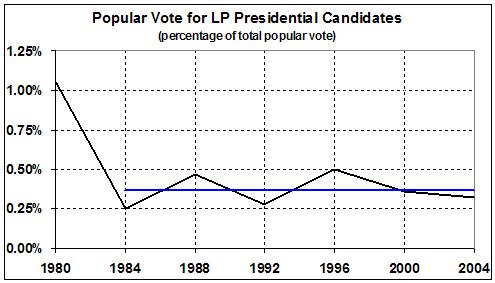
The Libertarian Party’s presidential candidate in 1980, Ed Clark, received about 1.1 percent of the popular votes cast in the presidential election. That election marked the first appearance of the LP candidate on the ballots of 50 States, up from 2 States in 1972 and 32 States in 1976. The LP candidate has been on the ballot of 50 States, or nearly that, in every election since 1980, excepting the election of 1984 (39 States).

The LP’s “breakthrough” in 1980 proved not to be a breakthrough at all. The following graph tells the story. The black line represents the percentage of popular votes received by the LP candidate in each election. The blue line represents the average percentage (0.36) for the elections from 1984 through 2004.

Sources:
http://en.wikipedia.org/wiki/Libertarian_Party_(United_States) http://www.lp.org/organization/history.shtml
http://uselectionatlas.org/

Remember 1980, that year of great disaffection for Jimmy Carter and the boomlet for John Anderson, who wound up with 6.6 percent of the popular vote? The LP was still a novelty, and the LP ballot line was new to many voters. “A libertarian (whatever that is), why not?” Thus the wastage of almost 1 million votes on Ed Clark.

Voters haven’t been as generous to the LP since 1980. Not even in 1992, when Ross Perot capitalized on the disaffection for G.H.W. Bush and drew 19 percent of the popular vote, probably swinging the election to Bill (not-fit-for the Supreme Court) Clinton.

Why does the LP keep wasting its money on presidential candidates, potentially causing the defeat of a Republican: just as the votes cast by Floridians for Ralph Nader in 1980 cost the Democrats that year’s election? Stubborn pride. Too “pure” to play in the same sandbox as Republicans? Who knows?

I’ll vote for a Republican — any Republican, even a Bush-type — before wasting my vote on a Libertarian Party candidate.

P.S. (12/17/07): Ron Paul seems to understand. The erstwhile LP candidate for president (0.47 percent of the popular vote in 1988) has won and held his seat in the U.S. House by running as a Republican. Paul’s candidacy for the GOP nomination makes him visible to the public, and will do far more to inject libertarian ideas into the political mainstream than would another futile run on the Libertarian ticket. If Paul were to run on the LP ticket after losing the GOP nomination, he might do even better than Ed Clark did in 1980, but only because of his (Paul’s) exposure to the public via the GOP race.

P.P.S. (12/17/07): What’s my position on Ron Paul? I like his federalist, limited-government principles. I don’t like his extreme isolationism. And I don’t like his apparent willingness to accept the support of kooks, conspiracy theorists, and racists. UPDATE (12/20/07): On the third point, this doesn’t look good.) One out of three isn’t a good average, in my book. I pass on Paul. UPDATE (12/27/07): The item linked in the previous update has since been updated. Paul probably is not playing footsie with racist whites. That said, I’m still against him because of his extreme isolationism. UPDATE (01/11/08): There are so many smoking guns about Ron Paul in this piece that it is impossible for me to believe that the man is, in any way, a libertarian. For evidence that he is just plain nuts, see this.

Related posts:
I Wish It Were Thus
My Advice to the LP
Great Minds Agree, More or Less
Good Advice for the Libertarian Party

An Immodest Journalistic Proposal

This one is touted by David Hazinski, an associate professor at the University of Georgia’s Grady School of Journalism:

Supporters of “citizen journalism” argue it provides independent, accurate, reliable information that the traditional media don’t provide. While it has its place, the reality is it really isn’t journalism at all, and it opens up information flow to the strong probability of fraud and abuse. The news industry should find some way to monitor and regulate this new trend (emphasis added).

The “news industry” (a.k.a. the mainstream media) isn’t already a hotbed of “fraud and abuse”? How about Rather-gate? How about anti-war propaganda that’s thinly disguised as news? How about the daily contributions to global-warming hysteria? How about the MSM’s pervasive anti-Republican, big-government slant? And on, and on.

As Hazinski observes, “without any real standards, anyone has a right to declare himself or herself a journalist.” And “anyone” does just that — every day — on ABC, CBS, CNN, NBC, MSNBC; in the pages of The New York Times, The Washington Post, Newsweek; etc., etc., etc.

Hazinski proposes this:

Journalism schools such as mine at the University of Georgia should create mini-courses to certify citizen journalists in proper ethics and procedures, much as volunteer teachers, paramedics and sheriff’s auxiliaries are trained and certified.

How can he say, with a straight face, that J-schools are fit to certify anyone’s “proper ethics”? By that standard, Osama bin Laden would be qualified to certify the borders of Israel.

Hazinski acknowledges the argument that “standards could infringe on freedom of the press and journalism shouldn’t be regulated. But,” he adds, “we have already seen the line between news and entertainment blur enough to destroy significant credibility.” Actually, the line between truth and reality has been blurred — nay, obliterated — by the MSM.

Citizen journalism is precisely what’s needed to push the MSM in the direction of accuracy, honesty, and balance. “Professional journalists” like Hazinski don’t want that. They want to keep feeding us their Left-biased distortions and lies — without fear of contradiction.

UPDATE (12/17/07): There’s a related post at The Future of News.

A Superficially Sensible Proposal

Cato’s Tom Firey warms to the idea of raising taxes:

[R]eaders of this blog probably won’t like last weekend’s column [in The New York Times‘s “Economic View”], penned by Cornell economist Robert Frank. Frank argues that “realistic proposals for solving our budget problems must include higher revenue,” i.e., new taxes or tax increases. However, he says, those proposals are being blocked by “powerful anti-tax rhetoric [that] has made legislators at every level of government afraid to talk publicly about a need to raise taxes.”…

Frank has spent much of his academic career arguing for raising taxes on wealthier people so as to create greater income equality (some of his work can be found here, here, and here). It would thus be expected that a Cato analyst would bash Frank’s column like a piñata. But I believe there’s merit to what he writes….

Why have the tax cuts not slowed government growth? Because Uncle Sam is quite happy to borrow money. Frank points out that the national debt has increased $3 trillion since 2002, and it will likely rise an additional $5 trillion over the next decade. As NYU law professor Dan Shaviro notes in this 2004 Regulation cover story, that debt is future taxes….

This leads to the core problem of borrow-and-spend public finance: Because today’s taxpayers receive government services without paying the full cost, they (and their political leaders) are not forced to consider:

  • Is this service worth its cost?
  • Would we be better off if government spent its money differently?
  • Would we be better off if government did not tax that money away from us, but we instead spent it privately?

Instead, borrow-and-spend lets both the Big Government crowd and the Anti-Taxes crowd get what they want: the Big Government folks can keep expanding government and the Anti-Taxes folks pay lower taxes — for now.

That’s why there’s merit to Frank’s column — if we were to pay, today, the full cost of government, we’d give much more thought to the opportunity cost of government spending. I strongly suspect there’d be much less demand for government services and much stronger outcry against current spending and spending proposals….

So, Prof. Frank, I say bully for you! If we follow your proposal, I think we’ll move several steps closer to limited government.

Firey’s argument makes sense if you read it quickly and uncritically. But three things are wrong with it. First, more borrowing today doesn’t necessarily require a proportionate increase in taxes tomorrow. As I discuss here, the government’s debt can rise interminably in a growing economy. (See also this and this for my views about the notion that government borrowing “crowds out” private investment.)

Second, tax increases usually mean higher marginal tax rates. (“Soak the rich.”) But economic growth is financed and fueled by people at the high end of the income distribution, and by people who strive for the high end. Higher taxes = slower economic growth. It’s as simple as that.

Third, higher tax rates won’t change the political equation. Government spending comprises myriad specific programs, each with its own constituency (in and out of government). Voters and interest groups support politicians who promise (and deliver) specific programs that seem desirable (like the proverbial free lunch). Firey lists some of those programs:

Medicare Part D, the proposed farm bill, the latest round of energy subsidies, more and more corporate welfare, No Child Left Behind, and a whole new, giant federal agency

Would the supporters of Medicare Part D have backed off had they thought that taxes would rise in order to fund Part D? I very much doubt it. Despite the prospect of a tax increase, Part D would have yielded a net financial gain for its beneficiaries, psychic gains and political clout for the private interest groups that pushed it, a larger government bureaucracy (which is a plus, in Washington), and so on. In the perverse world of government, higher spending is an excuse for raising taxes. (Harry Hopkins, FDR’s close adviser, is said to have put it this way: “We shall tax and tax, and spend and spend, and elect and elect.“)

The real villain of the piece is the Supreme Court, for its failure to enforce the constitutional doctrine of limited and enumerated powers — a failure that, in large part, can be traced to the New Deal era. The Court has allowed the federal government to do things for which the federal government has no constitutional mandate. Moreover, the unleashed federal government has fostered (through mandates and grants) the transformation of State and local governments from being providers of basic services (e.g., schools, streets, police, and courts) to being providers of a panoply of “social services.”

In sum, the rise of big government cannot be traced to low taxes. It can be traced, instead, to the failure of the executive and legislative branches of the federal government to honor the Constitution, and the failure of the Supreme Court to enforce it.

Economists As Moral Relativists

Russell Roberts — an econ prof at George Mason University with whom I usually agree — says this about the use of performance-enhancing drugs by baseball players:

When everyone cheats, it’s not cheating any more.

First, not “everyone” cheated. Second, cheating is cheating.

One example does not prove that all economists are moral relativists. But, in more than forty years of associating with economists and reading their work, I have observed that most economists focus on efficiency to the exclusion of morality.

How’s that for a generalization?

An FDR Reader

Thanks to John Ray for bringing my attention to these items:

How FDR Made the Depression Worse,” by Robert Higgs (Feb 1995)
Tough Questions for Defenders of the New Deal,” by Jim Powell (06 Nov 2003)
The Real Deal,” by Amity Shlaes (25 Jun 2007)

Related posts at Liberty Corner include:

Getting it Perfect” (04 May 2004)
The Economic Consequences of Liberty” and an addendum, “The Destruction of Income and Wealth by the State” (01 Jan 2005)
Calling a Nazi a Nazi” (12 Mar 2006)
Things to Come” (27 Jun 2007)
FDR and Fascism” (30 Sep 2007)
A Political Compass: Locating the United States” (13 Nov 2007)
The Modern Presidency: A Tour of American History since 1900” (01 Dec 2007)

Our descent into statism didn’t begin with FDR. (His cousin Teddy got the ball rolling downhill.) But FDR compounded an economic crisis, then exploited it to put us firmly on the path to the nanny state. The rest, as they say, is history.

Thus we now have a “compassionate conservative” as president, and several “Republican” candidates for president who would have been comfortable as New Deal Democrats. Calvin Coolidge must be spinning in his grave at hypersonic speed.

Ron Paul Roundup

Guest post:

A perusal of NRO commentary puts the Ron Paul campaign in perspective. It’s acknowledged that he is reaching an audience that no else is. The question is, what is that audience?

On May 28, Jim Geraghty observes that “while supporters of the ten non-Ron-Paul GOP candidates tend to like at least some other Republican candidates besides their favorite, Ron Paul supporters only like Ron Paul.” This kind of exclusivism is never a good thing. One senses that fans of Paul are so fixated on a few key points (opposition to the war and some far-reaching free-market views) that they can’t see the forest for the trees.

On October 21, Geraghty says “with some begrudging admiration” that “Ron Paul is, like Howard Dean in 2004, the only candidate who could spawn a movement that will last beyond his candidacy.” It sounds like a replay of Buchanan in 2000. Wouldn’t it be better if Paul and his people were willing to work with other Republicans and push them in the right direction on certain issues? When they insist on being divisive (a tactic that favors the left in the long run) then I have to question their intentions.

On December 10, Jonah Goldberg refers to the militant optimism of Ron Paul supporters. They can’t accept the fact that he won’t win the presidency. It’s a not a question of enthusiasm, it’s a detachment from reality. Paul fans think their candidate’s woes are the fault of a media conspiracy. This overlooks the fact that “Huckabee is much, much more popular than Ron Paul. And he got there with less money and, until recently, arguably less media exposure.”

Finally, there is Mona Charen’s article, “What Paul Is Running For.” Now, unlike her, I admit that Paul’s pro-life credentials (no small item these days) are impressive. Personally, the man appears impeccable. But he lacks political savvy. As Charen says:

Ron Paul is too cozy with kooks and conspiracy theorists. As syndicated radio host Michael Medved has pointed out, Ron Paul’s newspaper column was carried by the American Free Press (a parent publication of the Hitler-praising Barnes Review). Paul may not have been aware of this. But though invited by Medved to disavow any connection, Paul has so far failed to respond.

I’ve heard the same complaint from friends who are staunch social conservatives. When Paul’s campaign received a contribution from notorious racist Don Black, Paul did nothing to distance himself from the fringe element.

Rights and Liberty

The most quoted sentence of the Declaration of Independence, I daresay, is this one:

We hold these truths to be self-evident, that all men are created equal, that they are endowed by their Creator with certain unalienable Rights, that among these are Life, Liberty and the pursuit of Happiness.

The Founders’ trinity of rights (life, liberty, and the pursuit of happiness) really constitute a unitary right, which I simply call liberty. I do so because liberty (as a separate right) is meaningless without life and the ability to pursue happiness. Thus we have this: rights ≡ liberty (rights and liberty are identical). The identity of rights and liberty is consistent with this definition of liberty:

3. A right or immunity to engage in certain actions without control or interference.

The odd thing about the Founders’ equation (rights ≡ liberty) is that they believed in “natural rights” (“unalienable rights”). Today’s believers in “natural rights” would argue that such rights exist independently of liberty; that is, one always has one’s “natural rights” (whatever those might be), regardless of the state of one’s liberty.

I have put paid to that notion here, here, here, and here. The only rights that a person has are those which he can claim through social custom, common law, statutory law, contract, or constitution — depending on which of them applies and prevails in a given situation. Moreover, rights have no reality unless they are enforceable and can be restored after having been violated.

I do not mean to imply that the restoration of rights is automatic, even in a polity where the rule of law generally prevails. Rights sometimes cannot be restored; for example:

  • A victim of murder no longer has any rights (though his estate might). The victim’s murderer is prosecuted and punished for the sake of the living — for justice (i.e., vengeance) and its deterrent effect.
  • A person who permanently loses something to a criminal (e.g., an eye or a fortune), no longer has the use of that which was lost. His pursuit of happiness is, therefore, impaired permanently.

Further, the restoration of the rights lost by most Americans over the past century is highly doubtful. Rights vanish as liberty recedes. Liberty recedes as the state broadens its scope beyond justice and defense, expands its regulatory regime, redistributes income, and “enables” some citizens at the expense of others.

Finally, but most importantly, the only rights that can be claimed universally are negative rights (the right not be attacked, robbed, etc.). Positive rights (the right to welfare benefits, a job based on one’s color or gender, etc.) are not rights, properly understood, because they benefit some persons at the expense of others. Positive rights are not rights, they are privileges.

(See also Part II of “Practical Libertarianism.”)

Election 2008: Third Forecast

My eighth forecast is here.

The Presidency – Method 1

Intrade posts odds on which party’s nominee will win in each State and, therefore, take each State’s electoral votes. I assign all of a State’s electoral votes to the party that is expected to win that State. Where the odds are 50-50, I split the State’s electoral votes between the two parties.

As of today, the odds point to this result:

Democrat, 306 electoral votes

Republican, 232 electoral votes

(A slight gain for the Dems since the first forecast, 11/16/07, and second forecast, 11/18/07.)

The Presidency – Method 2

I have devised a “secret formula” for estimating the share of electoral votes cast for the winner of the presidential election. I describe the formula’s historical accuracy in my second forecast. The formula currently yields these estimates of the outcome of next year’s presidential election (CORRECTED, 12/13/07):

Democrat nominee — 274 to 313 EVs

Republican nominee — 225 to 264 EVs

This is a much better outlook for the Dems than the one I issued on November 18. It is attributable mainly to the decline of Hillary Clinton’s prospects for her party’s nomination. Clinton, in spite of her strength within the Democrat Party, would be a weaker nominee than Barack Obama. As Obama gains ground on Clinton, a Democrat victory becomes more likely — as of now. Obama could become damaged goods by the time he emerges from a bitterly fought contest for his party’s nomination.

U.S. House and Senate

Later.

* * *
How did I do in 2004? See this and this.