Election 2008: First Forecast

My eighth forecast is here.

The Presidency

Intrade posts odds on which party’s nominee will win in each State and, therefore, take each State’s electoral votes. I assign all of a State’s electoral votes to the party that is expected to win that State. Where the odds are 50-50, I split the State’s electoral votes between the two parties.

As of today, the odds point to this result: Democrat, 302 electoral votes; Republican, 236 electoral votes.

U.S. House and Senate

Later.

* * *
How did I do last year? See this and this.

Dig This

The trailer for Indoctrinate U, a film about the suppression of speech on today’s campuses.

Academia has been quick to validate the film’s message. This is from the producers of Indoctrinate U:

Due to a threatened lawsuit from a major taxpayer-funded university, the Indoctrinate U homepage has been taken down temporarily. On The Fence Films LLC is deciding how best to proceed, and we will not be commenting on anything until after our final response has been executed.

Don’t worry, though, this will not derail the film.

One can only hope.

Worth Reading

This. See also this and the links therein.

"The War": A Third Reaction

My first and second reactions.

I write this post after having watched the first six episodes of Ken Burns’s The War. I will not repeat what I’ve already said; it still applies.

I focus here on the fifth episode because it features three new themes. The first:

“No plan survives contact with the enemy.” –Field Marshal Helmuth von Moltke (1800-91)

That’s a reasonable observation, especially given its source. But the fifth episode of The War, after making that observation (in slightly different words and with the wrong attribution), goes on to conflate it with a second theme about defective leadership. To that end, the episode leans heavily on scenes about a few dunderhead commanders (notably this one) who wasted men’s lives to no good end.

The fact that war is an unpredictable endeavor is a thing entirely apart from the fact that some commanders aren’t fit to lead men in battle. We can thank The War for reminding us that the unpredictability and bad decisions can be part of any war, including a necessary one. But the fifth episode focuses too much on bad leadership, and slights the unpredictability of war and the necessity of working through it to the end, which is victory. It is almost as if the possibility of a few bad leaders coming to the fore should preclude our going to war for any reason.

The idea that war is unconscionable is underscored by a third theme: disgust with the horrors of war, especially as expressed by Eugene Sledge and Paul Fussell. Fussell has become an outspoken critic of the military, and of the war in Iraq. He seems to have forgotten, conveniently, that it can be a necessary thing. In any event, the parts of the fifth episode that focus on the horrors of World War II are unleavened by any clear reference to the necessity of war. They stand on their own, denying the message of the first episode, “A Necessary War.”

The sixth episode, though generally balanced, gives a lot of attention to the fire-bombings that took the lives of so many Japanese and Germans. But the episode glosses over — or misrepresents — the military rationale for those fire-bombings.

I reserve judgment on the entire series, pending the seventh episode. But the trend does not bode well for a good final grade.

Whither the Stock Market?

UPDATED (12/14/07)

I have, for several years, been tracking what is now called the Dow Jones Wilshire 5000 Total Market Index, in particular, the D-J Wilshire 5000 Full Cap, a capitalization-weighted index of U.S. stocks. The index now, and since its inception, has included more than 5,000 stocks, and is reputed to offer the best measure of the overall performance of U.S. stocks, in terms of price. (See this paper about the origin and calculation of the index, and this chart for a broad comparison of the Wilshire 5000 some other U.S. stock indices.)

My spreadsheet on the D-J Wilshire 5000 Full Cap goes back to December 1970, the first month for which the index was calculated. (The official site no longer provides data for the period December 1970 through December 1987.) In addition to tracking the current-dollar value of the index, I have converted it to an inflation-adjusted index by applying the CPI-U (available here, among other places). Here is a picture of the inflation-adjusted index from December 1970 through September 2007 (to enlarge, right-click and select “open in new tab”):

The black line at the left covers the period from December 1970, through the bull-market peak in December 1972, to the bear-market bottom in September 1974. (There was a secondary bottom in July 1982, but its inflation-adjusted value was 49 percent higher than that of the bottom in September 1974.) The green line covers the period from the bear-market bottom in September 1974, through the bull-market peak in March 2000, to the bear-market bottom in September 2002. The black line at the right covers the period from the bear-market bottom in September 2002 to September 2007 (the latest month for which I have the CPI-U).

The regression line fits the entire period, December 1970-September 2007, and indicates real growth in stock prices of 10.4 percent annually. The real rate of price growth from the bottom in September 1974 to the peak in March 2000 was 12.1 percent. But how many investors get in at the bottom and out at the top? A more realistic measure of long-run returns to stock investors during the past 30-odd years is the real rate of price appreciation from the bottom in September 1974 to the bottom in September 2002: 8.5 percent annually. That’s nothing to sneeze at, mind you; patience pays off when it comes to the stock market. (UPDATE: The real rate of return on the index from September 1974 through November 2007 was 9.0 percent, which is almost identical to the exponential trend for the period after removing the “bubble” that began late in 1996 and ended early in 2001. This underscores the idea that it is reasonable to expect something like an 8.5 real rate of return, in the long run.)

In light of the stock market’s recent volatility, which reminds me of the volatility that preceded the crash of 2000-2002, I have had second thoughts about the sustainability of the current bull market. (My first thoughts are here.) The market’s recovery since the bottom in September 2002 has brought it back to the inflation-adjusted peak reached in March 2000. As a result, the market may now be meeting some “resistance” (in addition to other factors that may be roiling it, such as the price of oil, uncertainty about the economy, and uncertainty about interest rates). The resistance, if it is that, would be led by those investors who were in the market at its peak in 2000, and held on through the bottom in 2002. Many of them may now be trying to cash out as they break even (in real terms), especially after having reaped (on average) a real, annual gain of more than 13 percent since the market bottomed five years ago.

If I am right about the import of volatility and the possibility of resistance , the broad market may be headed toward a secondary bottom, one not as deep as the bottom reached in September 2002. Long bull markets often are interrupted by dips (see graph above). (In fact, in the long view, the U.S. stock market has been a bull market since its inception — a bull market punctuated by dips known as crashes. See this table and this graph, for example.) The first dip in the bull market of 1974-2000 began in earnest around November 1980. That dip did not end until 20 months later, when the market reached a secondary bottom in July 1982.

Is it possible that the current bull market reached a temporary peak in May of this year, and is now descending toward a secondary bottom that it will not reach for a few years? Consider the parallels between the market of 1970-1982 and the market of the past nine years:

A reversal that lasts a year or two seems entirely possible to me.

I have only one thing to add: Don’t bail out now, unless you absolutely, positively need the money. I could be wrong about the reversal. In any event, stocks are for the long run.

Related post: “Whither the Stock Market? (II)” (16 Jan 2008)

A Political Compass: Locating the United States

This post builds on “A Political Compass” and its predecessor, “The Inevitability of the Communitarian State, or What’s a Libertarian to Do?” I apply the concept of the political compass to assess, harshly but realistically, our present location. Most of the links herein point to supporting posts at Liberty Corner.

Introduction

The left-right, liberal-conservative taxonomies of the political spectrum are inadequate because they are linear and lacking in subtlety. The political spectrum is more usefully thought of as a compass, with anarchy, libertarianism, communitarianism, and statism as its four main directions.

In the history of the United States, the compass’s needle has swung from a point near libertarianism, through communitarianism, and toward statism.

To change the metaphor, the tide of communitarianism — which began to swell around the turn of the twentieth century — rose inexorably to engulf the United States in the aftermath of the Great Depression and World War II. The tide has continued to rise, slowly and silently engulfing us in statism.

But let us begin with anarchy, the point of the compass that, thankfully, we have not visited.

Anarchy

According to anarchists (or anarcho-libertarians, as I call them), an individual’s freedom of action should be limited only by (a) voluntary observance of social norms and (b) contracts (enforced by third parties) that bind the members of a group to observe certain restraints and to pay certain penalties for failing to observe those restraints. Who keeps the third parties honest? Who arbitrates inter-group disputes in cases where the different groups clearly have different norms, interests, or objectives? What happens when a person or faction within a group or a faction outside any group attains superior force and decides to employ that force in the service of its norms, interests, or objectives. (See this and this for more in that vein.)

Anarchy, in other words, boils down to “might makes right,” even though its adherents would like it to be otherwise.

We in the United States have been spared anarchy. Our founding experience, in fact, held the promise of libertarianism.

Libertarianism

Given the inconsistency of anarchy with liberty (for liberty cannot thrive where might makes right), we turn to the only political arrangement that (if it is nurtured) can assure liberty, namely, minarchy.

Rights and liberty, it must be understood, are not Platonic abstractions; they are, rather, social phenomena. They are the best “deal” we can make with those around us — the set of compromises that define acceptable behavior, which is the boundary of liberty. Those compromises are not made by a philosopher-king but through an evolving consensus about harms — a consensus that flows from reason, experience, persuasion, and necessity.

Minarchism is true libertarianism because it provides a minimal state for the protection of the lives, liberty, and property of those who adhere to it; a state that otherwise remains neutral with respect to its adherents’ affairs; a state that does not distort the wisdom embedded in tradition, that is, in voluntarily evolved social norms; a state that is nevertheless sufficiently powerful to protect its willing adherents‘ interests from predators, within and without.

Minarchy, unlike anarchy, is possible, given sufficient luck and vigilance. As I wrote here,

[t]here must…be an overarching, non-market institution which enables markets to operate efficiently, that is, to reach outcomes that are seen as beneficial by all those willingly operate within markets. The necessary supervening institution is the minimal state (a minarchy) that is vested with enough authority to protect market participants from force and fraud, but not so much authority so as to enable its interference with market outcomes.

Only a wise (and rare) élite can establish such a state. The existence of such an élite — and its success in establishing a lasting minarchy — depends on serendipity, determination, and (yes) even force. That we, in the United States, came close (for a time) to having such a minarchy was due to historical accident (luck). We had just about the right élite at just about the right time, and the élite‘s wisdom managed to prevail for a while.

The dichotomy between anarcho-capitalism and minarchy is a false one. The true dichotomy is between minarchy and warlordism (which follows from anarchy).

That we have moved on to something worse than minarchy is not proof of the superiority of anarcho-capitalism. It is, rather, proof that our luck ran out.

For the 100-plus years between the ratification of the Constitution and the rise of the first Roosevelt, we had something close to minarchy here in the United States: a “night watchman” state of limited powers, standing guard over a collection of quasi-independent States. The people of those States (all of them, since the Civil War) were free — in the world of reality that lies beyond the ken of anarchists — to choose the most amenable State and locality in which to make the best possible “deal” for themselves.

We had nothing to fear but…that the minimal state would exceed its charter and descend into

Communitiarianism

Communitarianism is the regulation by the state of private institutions for the purpose of producing certain outcomes desired by controlling élites (e.g., income redistribution, “protection” from learning by our mistakes, “protection” from things deemed harmful by the worrying classes, and “social (or cosmic) justice“). Such outcomes, contrary to their stated purposes, are unwise, inefficient, and harmful to their intended beneficiaries.

Communitarianism is the stage that we passed through as our “luck ran out.” Which is to say, our vigilance faltered and we succumbed to the ruinous despotism of democracy: the voterenabled substitution of state-imposed and state-endorsed behavioral norms for socially evolved ones — always in the name of “liberality” or “progress.”

The communitarian state simply is too seductive. It co-opts its citizens through progressive corruption: more spending and regulation, to curry favor with certain voting blocs, higher taxes to fund more spending and to perpetuate the regulatory mechanisms of the state; still more taxation, spending, and regulation; and so on.

Each voting bloc insists on sustaining its benefits, and increasing them at every opportunity, for one of three reasons. Many voters actually believe that the largesse of the communitarian state is free to them, and some of them are right (but only for the short run). Other voters know better, but they grab what they can get because others will grab it if they don’t. Then there are those voters (and well-heeled political contributors) who exude noblesse oblige toward the “less fortunate” and “oppressed.” Such voters (and contributors), who now are predominant among the very-to-super rich, view the paying of taxes as a sacred duty (even a privilege), and consider the state a massive charitable and social-leveling organization.

Whatever the motivation for the communitarian state, those who vote for it and those who enable it through their political contributions are profoundly irrational. This irrational, communitarian urge began to dominate American politics with the rise of the first Roosevelt. Our descent into full-blown communitarianism was hastened by the Great Depression, a government-made and government-prolonged tragedy, exploited (then and now) by the proponents of communitarianism and statism.

Statism

We were, for decades, poised on the brink of the abyss of statism, which is outright state control of most social and economic institutions (e.g., medicine, notably but far from exclusively). I have concluded that we have gone over the brink and slid, silently and docilely, into the abyss.

Statism may be reached either as an extension of communitarianism or via post-statist anarchy or near-anarchy, as in Stalin’s Russia, Hitler’s Germany, and Mao’s China. We have come to statism via communitarianism, which leads inevitably to statism because the appetite for largesse is insatiable, as is the desire (in certain circles) to foster “social (or cosmic) justice.”

I was once optimistic that our transition to all-out statism would lead, in turn, to overthrow of statism:

[S]tatism is an easier target for reform than communitarianism. The high price of statism becomes obvious to more voters as more facets of economic and personal behavior are controlled by the state. In other words, statism’s inherent weakness is that it creates more enemies than communitarianism.

That weakness becomes libertarians’ opportunity. Persistent, reasoned eloquence in the cause of liberty may, at last, slow the rise of statism and hasten its rollback. And who knows, perhaps libertarianism will gain adherents as the rollback gains momentum.

My optimism has vanished, as I have come to understand that politicians their enablers (voters and contributors) are profoundly irrational. They prefer statism to liberty, regardless of what they say. They (most of them) mean to be benign, but statism is not benign. Statism may seem benign — as it does to Europeans, for example — but it is dehumanizing, impoverishing, and — at bottom — destructive of the social fabric upon which liberty depends.

Conclusion

Our statism is better-disguised than Europe’s, but it is there, in the insidious, voter-supported machinery of government that has caused us to be so heavily regulated and legislated by so many federal, State, and local agencies. Try to think of an aspect of your life — what you can do, what you can buy, what you can afford to buy, the income you earn as an employer or employee, and so on — that is not dictated by government, either directly or through taxation and regulation. As you think about your life, consider these things:

  • how zoning and building codes affect the cost, location, and specifications of your dwelling
  • how licensing and zoning affect the numbers and types of businesses that offer the goods and services you seek
  • the availability (or non-availability) to you of beneficial drugs because of testing mandates that result in more death and illness, not less
  • limitations on the numbers and types of doctors and other health-care providers from which you can choose
  • where you may smoke (even if the venue is private property)
  • whether or not you may own and carry a firearm with which to defend yourself
  • the security of your property from arbitrary seizure by government
  • the provision of myriad government “social services” (e.g, bike trails and nature preserves for yuppies, hippies, and tree-huggers) for which you have no need but for which you are nevertheless taxed because such services have voting constituencies and politicians who benefit from catering to those constituencies
  • relatedly, the provision of so-called federal money to your State and local governments, which money comes from taxes imposed by the federal government, over which you have even less control than you do of your State and local governments
  • the number, location, and characteristics of highways (which often are built as pork-barrel projects), none of which monitor or restrict the of entry or incompetent, drunk, or cell-phone-using drivers (as could be the case with private highways for selective users who are willing to pay the price to be able to drive sanely and safely)
  • the failure of government to defend you adequately against enemies and likely enemies, foreign and domestic, so that it may fund “social services” and cosset criminals
  • the number of public-utility providers who can serve you, and the rates that they may charge you
  • the persons whom you (or your employer) may hire, fire, and promote — almost regardless of their credentials and performance, and certainly regardless of how they affect your performance (or your employer’s ability to continue your employment)
  • the benefits that you (or your employer) must provide employees, regardless of the effect of such mandates on your ability (or that of your employer) to start or stay in business
  • how much you may contribute to a political campaign, and what may be said on the air about an upcoming election
  • the provision of “government” funding to political campaigns
  • the provision of your tax dollars to “scholars” who scoff at your morality and propound schemes to further regulate and impoverish you
  • whether, how, and where your children must be schooled

The list could go on and on. But you get the idea — I hope.

If you believe in the necessity of the things I have listed, and believe that you are better off because of them, you haven’t been paying attention — or you are an enabler of statism.

A bit of taxation here and a bit of regulation there, and before you know it you are living under the thumb of the state.

Religion and the Inculcation of Morality

Read this, by Maverick Philosopher.

Related posts at Liberty Corner:
Same Old Story, Same Old Song and Dance
Atheism, Religion, and Science
The Limits of Science
Beware of Irrational Atheism
Religion and Personal Responsibility
Religion and Liberty
Science, Evolution, Religion, and Liberty
Science, Logic, and God
Capitalism, Liberty, and Christianity
Debunking “Scientific Objectivity”
The Big Bang and Atheism
The Universe . . . Four Possibilities
Einstein, Science, and God
Atheism, Religion, and Science Redux
Religion as Beneficial Evolutionary Adaptation
A Reminder
Collegiate Crap-ola
A Non-Believer Defends Religion
Evolution as God?

The Bill of Rights and Kelo v. City of New London

REVISED, 11/11/07

I hereby recant my earlier argument that the Bill of Rights was meant, originally, to apply to the States. It is now clear to me that it was meant to apply only to the central government, even though Madison had hoped that the passage of a federal Bill of Rights would cause the States to more jealously safeguard the liberties of their citizens. (On the latter point, see Irving Brant’s The Bill of Rights: Its Origin and Meaning, 1965 edition, pp. 49-50. For more about the history of the Bill of Rights, go here.)

Having recanted, I must now ask whether the Fourteenth Amendment really “incorporatesany of the rights enumerated in the Bill of Rights; that is, whether any article of the Bill of Rights properly applies to the States. I am now persuaded that the first eight articles of the Bill of Rights (the First through Eighth Amendments) were meant to apply to the States by the framers of the Fourteenth Amendment.

First, there is Justice Hugo L. Black’s dissent in Adamson v. California; for example:

My study of the historical events that culminated in the Fourteenth Amendment, and the expressions of those who sponsored and favored, as well as those who opposed, its submission and passage persuades me that one of the chief objects that the provisions of the Amendment’s first section, separately and as a whole, were intended to accomplish was to make the Bill of Rights, applicable to the states. [n5] With full knowledge of the import of the Barron decision, the framers and backers of the Fourteenth Amendment proclaimed its purpose to be to overturn the constitutional rule that case had announced. This historical purpose has never received full consideration or exposition in any opinion of this Court interpreting the Amendment.

In construing other constitutional provisions, this Court has almost uniformly followed the precept of Ex parte Bain, 121 U.S. 1, 12, that

It is never to be forgotten that, in the construction of the language of the Constitution . . . , as indeed in all other instances where construction becomes necessary, we are to place ourselves as nearly as possible in the condition of the men who framed that instrument.

See also Everson v. Board of Education, 330 U.S. 1, 8, 28, 33; Thornhill v. Alabama, 310 U.S. 88, 95, 102; Knowlton v. Moore, 178 U.S. 41, 89, 106; Reynolds v. United States, 98 U.S. 145, 162; Barron v. Baltimore, supra, at 250-251; Cohens v. Virginia, 6 Wheat. 264, 416-420.

Second, there is Richard L. Aynes’s article, “On Misreading John Bingham and the Fourteenth Amendment” (Yale Law Journal, October 1993); for example:

Shortly after the Fourteenth Amendment had been proposed, John Norton Pomeroy authored a treatise entitled An Introduction to the Constitutional Law of the United States. At the time, Pomeroy was Dean of the Law School and Griswold Professor of Political Science at the University of New York. [203]

In this treatise, Pomeroy described the provisions of the first eight amendments as “the immunities and privileges guarded by the Bill of Rights.” [204] He suggested that the generality of the language used in the first eight amendments could be read to indicate the amendments applied to the states as well as to the national government. [205] Pomeroy recognized that Barron v. Baltimore [206] and state cases following it held the first eight amendments applied only to the federal government. [207] He declared this result “an unfortunate one” [208] which called for a remedy. [209] According to Pomeroy “[s]uch a remedy is easy, and the question of its adoption is now pending before the people.” [210] Citing the portion of the Fourteenth Amendment drafted by Bingham–all of Section One but the Citizenship Clause–Pomeroy considered this provision “by far more important” than any other amendment except the Thirteenth Amendment. [211] Echoing Bingham’s views that the Amendment infringed on no right of the states, Pomeroy wrote: [Page 90]

[The Fourteenth Amendment] would give the nation complete power to protect its citizens against local injustice and oppression; a power which it does not now adequately possess, but which, beyond all doubt, should be conferred upon it. Nor would this amendment interfere with any of the rights, privileges, and functions which properly belong to the individual states. [212]

Pomeroy’s publications, like those of Farrar and Paschal, were known nationally. [213] Secretary of State Elihu Root, a student of Pomeroy’s, remembered him as possessing “broad and accurate learning and a powerful and discriminating mind, capable of the most accurate analysis, and a strong sense of proportion.” [214] Pomeroy was an important Republican theoretician who, like Paschal, has been described as a “state-rights nationalist.” [215] Illinois Senator Lyman Trumbull relied on Pomeroy on the issue of voting qualifications in congressional elections. [216] Furthermore, West Point and various other colleges used his treatise as a textbook. [217]

In a contemporary review of Pomeroy’s volume, the Nation praised it as a “statesmanlike” investigation of the Constitution and labelled the author “so impartial a writer.” [218] The Nation endorsed Pomeroy’s view that the Bill of Rights was not as yet enforceable against the states and, consequently, argued that the pending Fourteenth Amendment should be adopted. [219]…

[Representative John Armor] Bingham [principal author of the Fourteenth Amendment] was a respected lawyer and congressman; his reasoning was cogent and consistent; and his view that the Fourteenth Amendment applied the Bill of Rights to the states was widely shared by contemporary politicians and legal scholars. An analysis of the initial judicial interpretations concerning the Fourteenth Amendment reveals that several judges also believed that the Fourteenth Amendment applied the Bill of Rights against the states….

In United States v. Cruikshank, [270] the Court, in an opinion by Justice Waite, held that the Fourteenth Amendment did not apply the Bill of Rights to the states. [271] This was a repudiation of original intent rather than an attempt to apply it.

Indeed, many contemporary observers of the Court’s decisions agreed with this assessment. [272] In 1876, Senator Oliver Morton suggested that the Supreme Court had distorted the intent of the Fourteenth Amendment: “The fourteenth and fifteenth amendments which we supposed broad, ample, and specific, have, I fear, been very much impaired by construction, and one of [Page 100] them in some respects almost destroyed by construction.” [273] Similarly, in 1886 former Congressman and U.S. Senator James Blaine lamented that as a result of Supreme Court decisions:

[T]he Fourteenth Amendment has been deprived in part of the power which Congress no doubt intended to impart to it….

Undoubtedly a large proportion of the members of the Congress, while following the lead of those who constructed the Fourteenth Amendment, sincerely believed that it possessed a far greater scope than judicial inquiry and decision have left to it. [274]…

Although Bingham had his critics, his colleagues in the House of Representatives and the leaders of his party respected him and frequently commended his reasoning ability. Moreover, Bingham’s view that the Privileges or Immunities Clause of the Fourteenth Amendment applied the Bill of Rights to the states was not “singular.” Many of his contemporaries shared this view, including three highly-regarded legal treatise writers. The first federal courts to apply the Fourteenth Amendment decided cases consistently with Bingham’s position. In fact, as Michael Kent Curtis found, no contemporary source explicitly denied the contention of Bingham and his allies that the Fourteenth Amendment would enforce the Bill of Rights against the states. [296] Immediately after Senator Howard’s speech in the Senate stating that the Bill of Rights constituted a major portion of Fourteenth Amendment privileges and immunities, the Chicago Tribune reported that the caucus of Union Republican Senators agreed to limit debate on the Fourteenth Amendment. This action was taken because the Amendment had “already [been] thoroughly discussed and understood.” [297] Likewise, Governor Reuben E. Fenton of New York urged speedy ratification of the Amendment insisting that its provisions “are understood, appreciated and approved.” [298]

In sum, the first eight amendments to the Constitution, in their entirety, apply to the States. And they do so without resort to the kind of piecemeal “incorporation” that has failed to apply some of the amendments (or portions thereof).

With regard to the Fifth Amendment’s Takings (or Public Use) Clause, the application of which was at issue in Kelo v. City of New London (2005), many libertarians (myself included) were outraged by the Court’s decision to allow the seizure of private property for the benefit of private parties. My view, at the time, was that the Fifth Amendment (in toto) applies to the States because it was meant to at the time of its adoption (along with the rest of the Bill of Rights). That the Fifth Amendment actually applies because of the intent of the framers of the Fourteenth Amendment (as discussed above), does nothing to alleviate my outrage at the Kelo Court’s action. The Court’s 5-4 majority found for the city and against the persons (Susette Kelo et al.) whose property had been seized. In doing so, the pro-government majority (led by Justice John Paul Stevens) applied dubious precedent:

This Court’s authority…extends only to determining whether the City’s proposed condemnations are for a “public use” within the meaning of the Fifth Amendment to the Federal Constitution. Because over a century of our case law interpreting that provision dictates an affirmative answer to that question, we may not grant petitioners the relief that they seek.

The majority opinion is a transparently statist and unconstitutional screed. As Justice Clarence Thomas wrote in dissent,

[t]he disagreement among state courts, and state legislatures’ attempts to circumvent public use limits on their eminent domain power, cannot obscure that the Public Use Clause is most naturally read to authorize takings for public use only if the government or the public actually uses the taken property.

Our current Public Use Clause jurisprudence, as the Court notes, has rejected this natural reading of the Clause. Ante, at 8-10. The Court adopted its modern reading blindly, with little discussion of the Clause’s history and original meaning, in two distinct lines of cases: first, in cases adopting the “public purpose” interpretation of the Clause, and second, in cases deferring to legislatures’ judgments regarding what constitutes a valid public purpose. Those questionable cases converged in the boundlessly broad and deferential conception of “public use” adopted by this Court in Berman v. Parker, 348 U. S. 26 (1954), and Hawaii Housing Authority v. Midkiff, 467 U. S. 229 (1984), cases that take center stage in the Court’s opinion. See ante, 10-12. The weakness of those two lines of cases, and consequently Berman and Midkiff, fatally undermines the doctrinal foundations of the Court’s decision. Today’s questionable application of these cases is further proof that the “public purpose” standard is not susceptible of principled application. This Court’s reliance by rote on this standard is ill advised and should be reconsidered…

The “public purpose” test applied by Berman and Midkiff also cannot be applied in principled manner. “When we depart from the natural import of the term ‘public use,’ and substitute for the simple idea of a public possession and occupation, that of public utility, public interest, common benefit, general advantage or convenience … we are afloat without any certain principle to guide us.” Bloodgood v. Mohawk & Hudson R. Co., 18 Wend. 9, 60-61 (NY 1837) (opinion of Tracy, Sen.). Once one permits takings for public purposes in addition to public uses, no coherent principle limits what could constitute a valid public use-at least, none beyond Justice O’Connor‘s (entirely proper) appeal to the text of the Constitution itself. See ante, at 1-2, 8-13 (dissenting opinion). I share the Court’s skepticism about a public use standard that requires courts to second-guess the policy wisdom of public works projects. Ante, at 16-19. The “public purpose” standard this Court has adopted, however, demands the use of such judgment, for the Court concedes that the Public Use Clause would forbid a purely private taking. Ante, at 7-8. It is difficult to imagine how a court could find that a taking was purely private except by determining that the taking did not, in fact, rationally advance the public interest. Cf. ante, at 9-10 (O’Connor, J., dissenting) (noting the complicated inquiry the Court’s test requires). The Court is therefore wrong to criticize the “actual use” test as “difficult to administer.” Ante, at 8. It is far easier to analyze whether the government owns or the public has a legal right to use the taken property than to ask whether the taking has a “purely private purpose”-unless the Court means to eliminate public use scrutiny of takings entirely. Ante, at 7-8, 16-17. Obliterating a provision of the Constitution, of course, guarantees that it will not be misapplied.

For all these reasons, I would revisit our Public Use Clause cases and consider returning to the original meaning of the Public Use Clause: that the government may take property only if it actually uses or gives the public a legal right to use the property.

Thus:

  • I was right about the applicability of the Bill of Rights to the States, even though I was wrong about the circumstances under which the Bill of Rights became applicable to them.
  • I was right about Kelo v. City of New London for the right reasons, namely, that (contra some States’ rights absolutists) it was a proper issue for the U.S. Supreme Court to decide, and the Court decided it wrongly.

Crime, Explained


Background

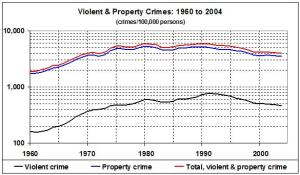
As defined by the FBI, violent crime comprises murder, forcible rape, robbery, and aggravated assault; property crime comprises burglary, larceny-theft, and motor-vehicle theft. Here are the numbers:
Steven Levitt, of Freakonomics fame, has hypothesized thusly about the drop in the violent-crime rate: more abortion (because legal), therefore fewer illegitimate babies, therefore fewer “unwanted” babies, therefore fewer young men (about 18 years later) whose upbringing was bound to have included more than a normal share of neglect and abuse, therefore less violent crime.

Levitt focuses on violent crime, which (conveniently for him) peaked just as the first abortion generation failed to come of age. But property crime, which is eight times more prevalent than violent crime, peaked about ten years earlier. Property crime, if Levitt is right, must be the preserve of pre-adolescent or middle-aged criminals. It is far more likely that Levitt is wrong.

Several months before I became aware of Levitt’s hypothesis, I said this:

According to an article in today’s NYTimes.com, “Most Crimes of Violence and Property Hover at 30-Year Lows.” Three important things happened after 1995 — the year in which the rate of violent crime began to drop markedly. First, the incarceration rate continued to rise: Persistence pays off. Second, the percentage of the population that is male and 20-24 years old continued to drop, in keeping with the general aging of the population. (Age usually brings with it a greater degree of maturity, stability, and aversion to committing criminal acts.) At the same time, spending on criminal justice functions (police, corrections, and courts) continued to rise, especially spending on police.

I’m sure there are other causal factors, but those are probably the big ones. The first and third of those factors — incarceration and spending on the criminal justice system — go hand in hand. And they are the public-policy weapons of choice in a society that values individual responsibility. (May 15, 2005)

I later backed it up with this:

Rather than rehash all the debates about Levitt’s work…, I decided to take a fresh look at the numbers. I drew on the U.S. Census Bureau’s “Mini-Historical Statistics” to derive the following statistics for the United States (each descriptor links to the Excel spreadsheet from which I derived the relevant statistics):

Violent crimes per 100,000 persons
Percentage of population aged 15-24
Births and illegitimate births per 100,000 women aged 15-19
Blacks as a percentage of the population
Persons incarcerated per 100,000

I selected the 15-24 year age range because persons in that age bracket are most prone to the commission of violent crimes. Because the midpoint of that age bracket is approximately 19, I lagged the birth statistics by 19 years so that birth rates in a particular year are measured against crime statistics 19 years later (e.g., births in 1960 vs. crime in 1977, births in 1973 vs. crime in 1990). I used the overall rate of incarceration rather than a rate for violent offenders because locking up offenders of any kind must ensure that persons who would otherwise commit violent crimes are unable to do so.

Before plunging into a regression analysis, I indexed the series to 1960 (the first year in the violent-crime series) and plotted them (again, with a 19-year lag on the birth-rate series). Here are the plots:

The relationships suggest strongly that the legalization of abortion did not have a significant effect on the rate of violent crime in the U.S. The violent-crime rate rose almost steadily from 1960 until 1991, when it peaked. The lagged rate of illegitimate births for women aged 15-19 (probably the best available proxy for “unwanted” children) leveled off about when the crime rate peaked, but the illegitimacy rate then resumed its steady rise, even as the violent-crime rate dropped dramatically. It is therefore improbable (if not impossible) that abortion — as measured by the rate of illegitimate births — had anything to do with the drop in the crime rate. Using the total rate of births for women aged 15-19 as a proxy for “unwantedness” yields even more problematic results: the lagged rate peaked in 1976, fully 15 years before the crime rate peaked.

I nevertheless ran many regressions on the violent-crime rate and various combinations of the key variables. Only one regression yields credible results (high R-squared, standard error of estimate among the lowest, intuitively correct signs on all coefficients, and high t-statistics on all coefficients). That regression takes the following form:

Number of violent crimes per 100,000 persons =
– 3723
+ 37058 x number of Blacks as a decimal fraction of the population
– 0.568 x number of persons incarcerated per 100,000 of population

The t-statistics on the intercept and coefficients are 15.854, 17.047, and 5.042, respectively; the adjusted R-squared is 0.936; [the standard error of the estimate/mean value of dependent variable = 0.097].

(January 3, 2006)

New Numbers

I have since extended my analysis, in time and in scope. I have looked at the rate of violent-plus-property crimes; I have added data for the five years from 2000 through 2004; and I have considered as explanatory variables the existence of mandatory federal sentencing guidelines (1989-2004), number of male enlisted personnel in the armed forces (in proportion to population), and year-over-year growth in real GDP per capita — in addition to the number of persons aged 15-24, number of prisoners, and number of blacks in proportion to total population, as before. (For sources, see the footnote to this post.) Here’s a graphical depiction of the crime rates and all of the variables I considered:
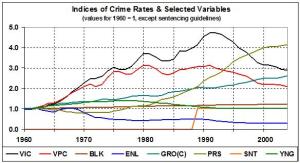
Key: VIC, violent crimes per 100,000 persons; VPC, violent+property+crimes per 100,000 persons; BLK, blacks as a proportion of population; ENL (active-duty, male, enlisted personnel as a proportion of population aged 15-24; GRO(C), growth of real GDP per capita as a proxy for year-to-year growth (GRO) used in the regression analysis; PRS, prisoners in federal and State penitentiaries as a proportion of population; SNT, mandatory sentencing guidelines in effect (0 = no, 1 = yes); YNG, persons aged 15-24 as a proportion of population.

A few comments about each of the explanatory variables: BLK, unfortunately, stands for a segment of the population that has more than its share of criminals — and victims. Having more men in the armed forces (ENL) should reduce, to some extent, the number of crime-prone men in the civilian population. (It would also help to alleviate our self-inflicted impotence, by putting moreboots on the ground” — and missiles in readiness.) I use the annual rate of real, per-capita economic growth (GRO) to capture the rate of employment — or unemployment — and the return on employment, namely, income. (The use of year-over-year growth vice cumulative growthavoids collinearity with the other variables.) PRS encompasses not only the effects of taking criminals off the streets, but the means by which that is done: (a) government spending on criminal justice and (b) juries’ and courts’ willingness to put criminals behind bars and keep them there for a good while. SNT ensures that convicted criminals are put away for a good while.

I focused on violent-plus-property crime (VPC) as the dependent variable, for two reasons. First, there is a lot more property crime than violent crime (VIC); that is, VPC is a truer measure of the degree to which crime affects Americans. Second, exploratory regression runs on VPC yielded more robust results than those on VIC.

Even at that, it is not easy to tease meaningful regressions from the data, given high correlations among several of the variables (e.g., mandatory sentencing guidelines and prison population, number of blacks and prison population, male enlistees and number of blacks). The set of six explanatory variables — taken one, two, three, four, five, and six at a time — can be used to construct 63 different equations. I estimated all 63, and rejected all of those that returned coefficients with counterintuitive signs (e.g., negative on BLK, positive on GRO).

Result and Discussion

Of the 63 equations, I chose the one that has the greatest number of explanatory variables, where the sign on every explanatory variable is intuitively correct, and — given that — also has the greatest explanatory power (as measured by its R-squared):

VPC (violent+property crimes per 100,000 persons) =

-33174.6

+346837BLK (number of blacks as a decimal fraction of the population)

-3040.46GRO (previous year’s change in real GDP per capita, as a decimal fraction of the base)

-1474741PRS (the number of inmates in federal and State prisons in December of the previous year, as a decimal fraction of the previous year’s population)

The t-statistics on the intercept and coefficients are 19.017, 21.564, 1.210, and 17.253, respectively; the adjusted R-squared is 0.923; the standard error of the estimate/mean value of VPC = 0.076.

The minimum, maximum, and mean values of the dependent and explanatory variables:

VPC: 1887, 5950, 4773 (violent-plus-property crimes/100,000 persons)

BLK: 0.1052, 0.1300, 0.1183 (blacks/population)

GRO: -0.02866, 0.06263, 0.02248 (growth in real GDP per capita during year n-1/real GDP per capita in year n-2)

PRS: 0.0009363, 0.004842, 0.002243 (federal and State prisoners in December of year n-1/average population in year n-1)

Even though the coefficient on GRO isn’t strongly significant, it isn’t negligible, and the sign is right — as are the signs on BLK and PRS. The sign on the intercept is counterintuitive — the baseline rate of crime could not be negative. The negative sign indicates the omission of key variables. But forcing variables into a regression causes some of them to have counterintuitive signs when they are highly correlated with other, included variables.

In any event, the equation specified above does a good job of explaining variations in the crime rate:

I especially like the fact that the equation accounts for two policy-related variables: GRO and PRS:

1. Crime can be reduced if economic growth is encouraged by rolling back tax rates. Crime will rise if growth is inhibited by raising tax rates (even for the very rich).

2. Crime can be reduced by increasing the rate at which it is prosecuted successfully, and by ensuring that prisoners do not receive lenient sentences. Therefore, we need to (a) spend even more on the pursuit of criminal justice and (b) restore mandatory sentencing guidelines, which had been in effect (and effective) from 1989 to 2004. (Look at the relationship between SNT and the indices of crime, in the next-to-last graph, and you will have no doubt that mandatory sentencing guidelines were effective and are represented in the equation — to some extent — by the variable PRS.)

ENL and YNG, like SNT, are key determinants of the crime rate. Each of the three variables appears, with the right sign, in many of the 63 equations. So, I am certainly not ruling out ENL and YNG as important variables. To the contrary, they are important variables. But, just as with SNT, I can’t satisfactorily quantify their importance because of the limitations of regression analysis.

Crime, then, depends mainly on two uncontrollable variables (BLK and YNG), and four controllable ones: ENL, GRO, PRS, and SNT. The controllable variables are salutary means of reducing crime, and the record shows that they work. Whatever else abortion is, it is not a crime-fighting tool; those who herald abortion as such are flirting with genocide.

Related posts:
Does Capital Punishment Deter Homicide?
Libertarian Twaddle about the Death Penalty
Crime and Punishment
Abortion and Crime
Saving the Innocent?
Saving the Innocent?: Part II
More on Abortion and Crime
More Punishment Means Less Crime
More About Crime and Punishment
More Punishment Means Less Crime: A Footnote
Clear Thinking about the Death Penalty
Let the Punishment Fit the Crime
Another Argument for the Death Penalty
Less Punishment Means More Crime
__________
Sources

Crimes per 100,000 persons, 1960-2002: Historical Statistical Abstracts, No. HS–23. Crimes and Crime Rates by Type of Offense: 1960 to 2002 (http://www.census.gov/statab/hist/02HS0023.xls).

Crimes per 100,000 persons, 2003-04: Statistical Abstracts, Table 295. Crimes and Crime Rates by Type of Offense: 1980 to 2004 (http://www.census.gov/compendia/statab/tables/07s0295.xls).

U.S resident population, 1960-99: Historical Statistical Abstracts, No. HS-2. Population Characteristics: 1900 to 2002 (http://www.census.gov/statab/hist/02HS0002.xls).

U.S. resident population, 2000-05: Statistical Abstracts, Table 13. Resident Population by Sex, Race, and Hispanic Origin Status: 2000 to 2005 (http://www.census.gov/popest/national/asrh/NC-EST2005/NC-EST2005-03.xls).

Persons aged 15-24, 1960-2002: Historical Statistical Abstracts, No. HS-3. Population by Age: 1900 to 2002 (http://www.census.gov/statab/hist/02HS0003.xls).

Persons aged 15-24, 2003-04: Statistical Abstracts, Table 11. Resident Population by Age and Sex: 1980 to 2005 (http://www.census.gov/compendia/statab/tables/07s0011.xls).

Blacks, 1960-99: Historical Statistical Abstracts, No. HS-2. Population Characteristics: 1900 to 2002 (http://www.census.gov/statab/hist/02HS0002.xls).

Blacks, 2000-04: Statistical Abstracts, Table 13. Resident Population by Sex, Race, and Hispanic Origin Status: 2000 to 2005 (http://www.census.gov/compendia/statab/tables/07s0013.xls). Specifically, I used the entry “Black or African American,” under “Race alone or in combination.” Regardless of the entry for “black” chosen from the table, there is a discontinuity between the number of blacks in 1999 (preceding source) and the number of blacks in 2000. To eliminate the discontinuity, I derived the growth rate for the number of blacks during 2000-05 (about 0.04 percent/year) and applied that rate to the number of blacks in 1999, for a consistent and continuous estimate of blacks as a percentage of population.

Real GDP per Capita, 1960-2004: What Was GDP Then? (Louis D. Johnston and Samuel H. Williamson, “The Annual Real and Nominal GDP for the United States, 1790 – Present.” Economic History Services, July 27, 2007, URL : http://eh.net/hmit/gdp/).

Federal and State prisoners, 1960-2001: Historical Statistical Abstracts, No. HS-24. Federal and State Prisoners by Jurisdiction and Sex: 1925-2001 (http://www.census.gov/statab/hist/02HS0024.xls).

Federal and State prisoners, 2002-04: Statistical Abstracts, Table 337. Federal and State Prisoners by Sex: 1980 to 2004 (http://www.census.gov/compendia/statab/tables/07s0337.xls).

Male enlisted personnel in the armed forces, 1960-2004: Statistical Abstracts, Table 500. Department of Defense Personnel: 1960 to 2005 (http://www.census.gov/compendia/statab/tables/07s0500.xls).

Sentencing guidelines: Start here: United States Sentencing Commission.

The Way to Look at Inflation

Lew Rockwell, touting the gold standard, plots the cumulative consumer price index on an arithmetic scale, thus making it seem as if inflation is rampant. It’s not.

The best way to depict the change of a cumulative quantity over time is to depict the quantity logarithmically. On a logarithmic scale, a change of “x” percent covers the same vertical distance, regardless of the base from which the change occurs. That is not so for an arithmetic scale, where a change of, say, 10 percent from 100 (10) looks much smaller than a change of 10 percent from 1,000 (100). If the figure of interest is the percentage change (as it is in the case of inflation), the use of an arithmetic scale is bound to overstate recent inflation, relative to inflation in earlier years.

Here’s a more realistic picture of inflation from 1913 to the present:

Source: U.S. Department of Commerce, Bureau of Labor Statistics, Consumer Price Index, All Urban Consumers (CPI-U) (U.S. city average, all items, 1982-84 = 100), available here.

Compared with the 1910s, 1940, and 1970s, inflation has been rather tame for the past 25 years.

UPDATE: Rockwell’s blogging colleague, Jeffrey Tucker, plots a measure of the money supply in the same, dishonest way: arithmetically.

A Concurring Opinion

The opinion is by Steve Boriss (The Future of News), and it’s about Cass Sunstein and his twisted view of the First Amendment.

I have similar things to say about Sunstein and “unfree speech.” Here I quote the gist of Sunstein’s argument for “unfree speech” (which he offers in the name of freedom, of course). And here I subject him to an (imaginary) interview about his proposal.

Political Calculus

Slice it any way you want…

Pct. of tax returns for 2005

No adjusted gross income……………..

1.3106

43.1

89.3

99.8

97.3

$1 under $5,000…………………………..

8.5407

$5,000 under $10,000…………………..

9.0154

$10,000 under $15,000…………………

8.6593

$15,000 under $20,000…………………

8.2804

$20,000 under $25,000…………………

7.2814

$25,000 under $30,000…………………

6.5029

46.2

$30,000 under $40,000…………………

10.3744

$40,000 under $50,000…………………

7.9023

$50,000 under $75,000…………………

13.6568

$75,000 under $100,000……………….

7.7769

$100,000 under $200,000……………..

8.0451

10.5

10.5

$200,000 under $500,000……………..

2.0375

2.6

$500,000 under $1,000,000…………..

0.3903

$1,000,000 under $1,500,000………..

0.0952

0.2

0.2

0.2

$1,500,000 under $2,000,000………..

0.0004

$2,000,000 under $5,000,000………..

0.0626

$5,000,000 under $10,000,000………

0.0019

$10,000,000 or more…………………….

0.0011

…it spells envy at the low end and political perversity at the high end.

(Extracted and derived from this IRS table. More here and here.)

Another One Goes off the Blogroll

This is paranoid bull-crap. Any blog that strays far from reality — as Agoraphilia has, too many times — cannot stay on my blogroll. Bye-bye.

"The War": A Second Reaction

I have now watched the first three episodes of Ken Burns’s The War. The second episode reinforced my reaction to the first episode:

War is not glorified (nor should it be), but Burns makes a strong case that war can be necessary — contrary to the anti-war mantra that substitutes for thought on the Left.

The War illustrates that, however necessary a war, victory may be attainable only at a very high price. (That illustration is especially valuable for the generations whose only war was the seemingly quick-and-easy Gulf War of 1990-91.) The War also makes the case, graphically, that there can be no alternative but to pay that very high price when one is faced with brutal, fanatical enemies.

The third episode further supports that view. But the third episode also spends a lot of time on issues with racial dimensions; specifically:

  • “the forced removal and internment of approximately 120,000 Japanese and Japanese Americans (62 percent of whom were United States citizens) from the West Coast of the United States during World War II.” (Wikipedia)
  • government-enforced racial segregation in the armed forces (and, sometimes, among workers in defense plants), against a backdrop of racial tension.

The internment of Japanese and Japanese Americans remains controversial. I have no doubt that racial hatred (inflamed by the attack on Pearl Harbor) enabled the decision to remove Japanese nationals and persons of Japanese origin and descent from the West Coast. But The War neglects to mention the military considerations that justified the action. (See these three posts, for example.) The War, in other words, engages in the kind of second-guessing eschewed by the U.S. Supreme Court when it opined in the case of Korematsu v. United States (1944). Justice Black, writing for the 6-3 majority:

To cast this case into outlines of racial prejudice, without reference to the real military dangers which were presented, merely confuses the issue. Korematsu was not excluded from the Military Area because of hostility to him or his race. He was excluded because we are at war with the Japanese Empire, because the properly constituted military authorities feared an invasion of our West Coast and felt constrained to take proper security measures, because they decided that the military urgency of the situation demanded that all citizens of Japanese ancestry be segregated from the West Coast temporarily, and finally, because Congress, reposing its confidence in this time of war in our military leaders — as inevitably it must — determined that they should have the power to do just this. There was evidence of disloyalty on the part of some, the military authorities considered that the need for action was great, and time was short. We cannot — by availing ourselves of the calm perspective of hindsight — now say that at that time these actions were unjustified.

It is right to give time to the internment; it was a significant (and temporary) event arising out of our prosecution of the war. But it is wrong to give a one-sided presentation of that event.

The segregation of blacks — and black-white conflict — on the other hand, were nothing new in America. Racial segregation had been (and would remain, for some years), a government policy. Would it have been too much to expect a government that was battling ferocious enemies abroad to take time out to desegregate the armed forces, desegregate civilian life, and deal with the resulting racial conflict (of which there was already enough)? The short answer is “yes.” That is not to excuse government-sponsored and government-enforced segregation. It is simply to call, once again, for perspective and balance, which The War does not offer. A viewer lacking historical perspective (and there are many out there) might well conclude that segregation and racial tension arose from the war effort.

The War redeems itself, to some extent, by giving expression (perhaps too subtly) to these truths: However imperfect the United States of 1941-45, it was far more perfect than its militaristic, inhumane enemies. Americans of Japanese and African descent could hope for (and would realize) a better future here; they could have had no such hope for a world dominated by Japan and Germany.

Ahead of His Time

The problem that faces us today … is due to the inherent contradictions of an abnormal state of culture. The natural tendency … is for … society to give itself up passively to the machinery of modern cosmopolitan life. But this is no solution. It leads merely to the breaking down of the old structure of society and the loss of the traditional moral standards without creating anything which can take their place.

As in the decline of the ancient world, the family is steadily losing its form and its social significance, and the state absorbs more and more of the life of its members. The home is no longer a centre of social activity; it has become merely a sleeping place for a number of independent wage-earners. The functions which were formerly fulfilled by the head of the family are now being taken over by the state, which educates the children and takes the responsibility for their maintenance and health.

From Christopher Dawson’s essay, “The Patriarchal Family in History” (1933), collected in The Dynamics of World History (1956). (Paragraph break added: LC.)

Let us hope for an incremental bit of progress on one front: parental choice in the schooling of children. (By progress, of course, I don’t mean the kind of “progress” sought by regressive “progressives,” who would have us and our progeny bow to the almighty state — as long as they control it.)

Evolution as God?

In a lot of ways, evolution is like unto theology. “Gods are ontologically distinct from creatures,” said Damien Broderick, “or they’re not worth the paper they’re written on.” And indeed, the Shaper of Life is not itself a creature. Evolution is bodiless, like the Judeo-Christian deity. Omnipresent in Nature, immanent in the fall of every leaf. Vast as a planet’s surface. Billions of years old. Itself unmade, arising naturally from the structure of physics. Doesn’t that all sound like something that might have been said about God? (Eliezer Yudkowsky, “An Alien God,” Overcoming Bias)

Whence the stuff of which evolution was made, and the structure (i.e., laws) of physics that enabled it to be made? Answer that, Mr. Yudkowsky, before you get too invested in the claim that “Science has already discovered the sort-of-godlike maker of humans – but it wasn’t what the religionists wanted to hear.”

Yudkowsky wants to believe in only the first of four logical possibilities about the Universe:

1. Everything just is — without an outside cause or overarching design. Scientists claim to find “laws” governing the behavior of matter, energy, time, and space. But such laws only partly explain the universe; there is no grand unifying theory of everything. And those laws are subject to change as science unveils new aspects of matter, energy, time, and space — as it does continuously.

He ought to consider the other possibilities, including this one:

4. There is an external force or consciousness that brought everything into being. That force or consciousness may merely have set things in motion, or it may play a continuing role in some or all aspects of existence. The intentions of the external force or consciousness are known to religionists, by revelation and/or faith; science is inadequate to fathom those intentions or to prove that the universe conforms to an underlying “design.” Those who reject this fourth possibility as “unscientific” — that is, most scientists as well as the typical libertarian/Objectivist — can do so only by accepting one of the equally unscientific (i.e., untestable) possibilities outlined above.

In a sequel (“The Wonder of Evolution“) Yudkowsky reveals (in so many words) his fear of considering that fourth possibility. He does us a service, however, by adverting to a sentence from Thomas Henry Huxley‘s “Ethics and Evolution” (The Romanes Lecture, Oxford University 1893). Here is the sentence in full:

Let us understand, once for all, that the ethical progress of society depends, not on imitating the cosmic process, still less in running away from it, but in combating it.

Elsewhere, we find this commentary on Huxley’s observation:

As his critics were not slow to point out, however, Huxley’s supposition that man can combat cosmic processes comes strangely from a Darwinian. For Darwin’s principal thesis is that man is part of Nature and subject, therefore, to its “cosmic forces,” in no sense standing outside or above them.

The subsequent explanation — that ethical progress is part and parcel of evolution — leads to this question: How do we “know” that we should move in a certain direction, ethically, in order to be more nearly perfect? Assigning evolution the role of judge is tantamount to assuming the answer, namely, “evolution is all.” But that cannot be the answer (except in the mind of an obdurate atheist), because there remains this scientifically unanswerable question: Whence the stuff of which evolution was made, and the laws (structure) of physics that enabled it to be made?

If you want to disbelieve in the fourth possibility, just say so. But don’t cloak your disbelief in the language of science, for science can neither prove nor disprove any of the possibilities.

Related posts:
Atheism, Religion, and Science
The Limits of Science
Beware of Irrational Atheism
Religion and Personal Responsibility
Science, Evolution, Religion, and Liberty
Science, Logic, and God
Capitalism, Liberty, and Christianity
Debunking “Scientific Objectivity”
The Big Bang and Atheism
The Universe . . . Four Possibilities
Einstein, Science, and God
Atheism, Religion, and Science Redux
Religion as Beneficial Evolutionary Adaptation
A Reminder
Collegiate Crap-ola
A Non-Believer Defends Religion

And Your Point Is?

Jim Harper (Cato-at-Liberty) says:

The story [this story: LC] says that unlicensed driving dropped by a third when New Mexico de-linked driver licensing and immigration status. Actually, unlicensed driving dropped by two thirds, from 33% to 11%, lower than the national average.

Which means that a lot of illegal aliens are driving legally in New Mexico. Is that supposed to be a good thing?

Here We Go Again

David Friedman, in “When Is a War Not a War?,” writes:

The problem is that the “War on Terror” is at least in part a metaphor. It is in some ways more like the War on Drugs or the War on Poverty, a project given emotional force by analogizing it to a military conflict, than it is like WW II or the Korean War.

Suppose the President declared a War on Crime–as, for all I know, some President at some point has. Is he then entitled to arrest people he claims are criminals and hold them without trial for an indefinite period of time–as prisoners of war?

The analogy is not perfect. The attack on the World Trade Center was more like an act of war than it was like a bank robbery. But it was less like an act of war than the Pearl Harbor attack was, not only because the targets were not primarily military but because the attackers were not agents of a hostile state. The War on Terror is not as metaphorical as the War on Drugs. But it fits the pattern of war as usually and literally understood poorly enough to make a policy of taking people prisoners and holding them without trial until the war is over at best problematical.

Friedman tries to equate war-fighting and crime-fighting by relying on the surface similarity between the phrases “war on terror” and “war on crime.” But a war on crime, if such there were such a thing, would exercise an entirely separate and distinct aspect of the president’s constitutional authority than does the War on Terror. The president cannot, under the rubric of a war on crime, “arrest people he claims are criminals and hold them without trial for an indefinite period of time–as prisoners of war.” A president might well announce a war on crime,” but it would not be a war (in the constitutional sense), it would an exercise of executive authority conducted by the non-military apparatus of government within constitutional bounds, that is, respecting Amendments I, II, IV, V, VI, and VIII of the Bill of Rights. The Framers of the Constitution understood the difference between war and crime (even if Friedman does not), and did a very nice job of distinguishing them in the Constitution.

The War on Terror is a real war, given that its components (e.g., operations in Afghanistan and Iraq, clandestine operations elsewhere overseas) are conducted under authority granted by Congress (i.e., the functional equivalent of a declaration of war). The president, as long as he acts under that authority — and as long as the U.S. Supreme Court sides with his interpretation of that authority — is conducting a war, not fighting crime.

The president’s authority to conduct the various components of the War on Terror was granted as a result of the attack on the World Trade Center. Friedman is playing word games when he suggests that that attack “was less like an act of war than the attack on Pearl Harbor, not only because the targets were not primarily military but because the attackers were not agents of a hostile state.” Since when do attacks on civilians not count as acts of war? (The dropping of A-bombs on Hiroshima and Nagasaki, for example were ultimate acts of war, aimed at forcing Japan’s surrender.) Since when do anarcho-libertarians (as is Friedman) view acts by non-state entities as somehow lacking authority because they were not explicitly authorized by a state (as far as we know). Is cold-blooded murder somehow less of a crime if it is committed by an anarchist gypsy, as opposed to a fascist functionary, for example?

Friedman seems dismayed by the prospect of enemy combatants being held indefinitely because there might be no end to the War on Terror. But why the dismay, if they are enemies? Friedman would answer: Because they have not been tried and found to be enemies. Friedman (along with his fellow anarchos and the anti-war Left) argues from one erroneous premise (the War on Terror isn’t really a war) to another (therefore, it must be an exercise in criminal justice), in order to reach a desired conclusion (prisoners in the War on Terror are entitled to the protections of the Bill of Rights). This they do, even though those prisoners are enemies who would spit on the Bill of Rights.

What to do about those enemy combatants who might be held indefinitely? My take: If military necessity dictates indefinite detention, so be it. The alternative? Take no prisoners.

War and justice are two different things, as the Framers wisely understood, and as Friedman — and his fellow anarchos and their brethren on the Left — cannot seem to understand. Wars are fought to protect the rights of U.S. citizens, not to strengthen our enemies in their quest to harm U.S. citizens and their legitimate economic interests.

We do not live in “one world.” And even if everyone in the world were endowed with equal rights (a concept that I reject), no one would be entitled to attack what we in the U.S. enjoy. To rephrase what I wrote here,

the sovereignty of the United States is inseparable from the benefits afforded Americans by the U.S. Constitution, most notably the enjoyment of civil liberties, the blessings of more-or-less free markets and free trade, and the protections of a common defense. To cede sovereignty — by allowing other nations a say in our laws or by treating our enemies as equals under the Constitution — is to risk the loss of the benefits we derive from the Constitution. That is why we must always be cautious in our commitments to international organizations and laws, and resist the temptation to treat enemies as if they were entitled to the very benefits they would deny us.

“War” is not “justice”; “nationalism” is not a dirty word.

"The War": An Initial Reaction

I taped Ken Burns’s The War for later viewing. Later is now; I watched the first episode last night.

My initial reaction: War is not glorified (nor should it be), but Burns makes a strong case that war can be necessary — contrary to the anti-war mantra that substitutes for thought on the Left.

The War illustrates that, however necessary a war, victory may be attainable only at a very high price. (That illustration is especially valuable for the generations whose only war was the seemingly quick-and-easy Gulf War of 1990-91.) The War also makes the case, graphically, that there can be no alternative but to pay that very high price when one is faced with brutal, fanatical enemies.

The series could not have been aired at a better time. Perhaps it has (in a small way) contributed to Americans’ somewhat more optimistic views about the war on terror and the war in Iraq. The main reason for optimism, of course, is the impression that the anti-insurgency campaign is succeeding.

More later.

Bum Dope

An econblogger whose posts I read regularly says:

At this website (WHOIS Search database), you can look up the real name of the owner of any website on the Internet.

Via Reason.

It doesn’t work if a site’s URL is xxx.blogspot.com, xxx.typepad.com, or the like. Nor does it work if the owner of a site has masked his or her identity.