Oxymoron at Work

Someone named Reihan is pinch-hitting for Ross Douthat. Reihan writes,

better to have a smart, coherent welfare system at the federal or at least state level than a patchwork that encourages the arbitrary and often harmful shifting around of the poor.

A politically designed, state-run “smart, coherent welfare system.” There’s an oxymoron, in spades. What does that say about Reihan? I report, you decide.

Hurry back, Ross.

Pascal’s Wager, Morality, and the State

David Friedman addresses Pascal’s wager:

Pascal famously argued that, as long as there was any probability that God existed, a rational gambler should worship him, since the cost if he did exist and you failed to worship him was enormously greater than the cost if it went the other way around.

A variety of objections can be made to this, most obviously that a just God would reject a worshiper who worshiped on that basis.

That is my view, also. But Friedman goes on to say that he has “a variant on the argument” that he “find[s] more persuasive.” Thus:

The issue is not God but morality. Most human beings have a strong intuition that some acts are good and some bad–that one ought not to steal, murder, lie, bully, torture, and the like. Details of what is covered and how it is defined vary a good deal, but the underlying idea that right and wrong are real categories and one should do right and not wrong is common to most of us.

There are two categories of explanation for this intuition. One is that it is a perception–that right and wrong are real, that we somehow perceive that, and that our feel for what is right and what is wrong is at least very roughly correct. The other is that morality is a mistake. We have been brainwashed by our culture, or perhaps our genes, into feeling the way we do, but there is really no good reason why one ought to feed the hungry or ought not to torture small children.

Suppose you are uncertain which of the two explanations is correct. I argue that you ought to act as if the first is. If morality is real and you act as if it were not, you will do bad things–and the assumption that morality is real means that you ought not to do bad things. If morality is an illusion and you act as if it were not, you may miss the opportunity to commit a few pleasurable wrongs–but since morality correlates tolerably well, although not perfectly, with rational self interest, the cost is unlikely to be large.

I think this version avoids the problems with Pascal’s. No god is required for the argument–merely the nature of right and wrong, good and evil, as most human beings intuit them. And, by the morality most of us hold, the fact that you are refraining from evil because of a probabilistic calculation does not negate the value of doing so–you still haven’t stolen, lied, or whatever. One of the odd features of our intuitions of right and wrong is that they are not entirely, perhaps not chiefly, judgements about people but judgements about acts.

Friedman actually changes the subject from Pascal’s wager (why one should believe in God) to the basis of morality. As I say above, I agree with Friedman’s observation about Pascal’s wager: God might well reject a cynical believer.

But it seems to me that Pascal’s wager has nothing much to do with the origin of morality. Not all worshipers are moral; not all moral persons are worshipers.

Moreover, Friedman overlooks two important (and not mutually exclusive) explanations of morality. The first is empathy; the second is consequentialism.

We (most of us) flinch from doing things to others that we would not want done to ourselves. Is that because of inbred (“hard wired”) empathy? Or are we conditioned by social custom? Or is the answer “both”?

If inbred empathy is the only explanation for self-control with regard to other persons, why is it that our restraint so often fails us in interactions with others are fleeting and/or distant? (Think of aggressive driving and rude e-mails, for just two examples of unempathic behavior.) Empathy, to the extent that it is a real and restraining influence, seems most to work best (but not perfectly) in face-to-face encounters, especially where the persons involved have more than a fleeting relationship.

If behavior is (also) influenced by social custom, why does social custom favor restraint? Here is where consequentialism enters the picture.

We are taught (or we learn) about the possibility of retaliation by a victim of our behavior (or by someone acting on behalf of a victim). In certain instances, there is the possibility of state action on behalf of the victim: a fine, time in jail, etc. So we are taught (or we learn) to restrain ourselves (to some extent) in order to avoid punishments that flow directly and (more or less) predictably from our unrestrained actions.

More deeply, there is the idea that “what goes around comes around.” In other words, bad behavior can beget bad behavior, whereas good behavior can beget good behavior. (“Well, if so-and-so can get away with X, so can I.” “So-and-so is rewarded for good behavior; it will pay me to be good, also.” “If so-and-so is nice to me, I’ll be nice to him so that he’ll continue to be nice to me.”)

Why do we care that “what goes around comes around”? First, we humans are imitative social animals; what others do — for good or ill — cues our own behavior. Second, there is an “instinctive” (taught/learned) aversion to “fouling one’s own nest.”

Unfortunately, our aversion to nest-fouling weakens as our interactions with others become more fleeting and distant — as they have done since the onset of industrialization, urbanization, and mass communication. Bad behavior then becomes easier because its consequences are less obvious or certain; it becomes a model for imitation and, perhaps, even a norm. Good behavior then flows from the fear of being retaliated against, not from socialized norms, or even from fear of state action. Aggression — among the naturally aggressive — becomes more usual.

And so we become ripe for rule by a “protective” state, and by rival warlords if the state fails to protect us.

Rothbard: Sometimes Right

Here, for instance. (See this related post of mine.)

No Kidding!

“Threat of punishment can deter bad behaviour,” says this article.

I agree, wholeheartedly. See:
Does Capital Punishment Deter Homicide?
Crime and Punishment
More Punishment Means Less Crime
More About Crime and Punishment
More Punishment Means Less Crime: A Footnote
Less Punishment Means More Crime

The Best and Worst of the American League

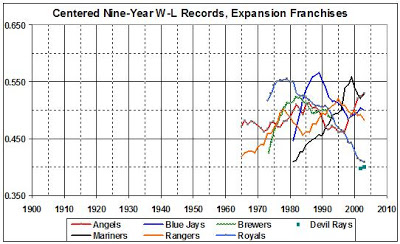
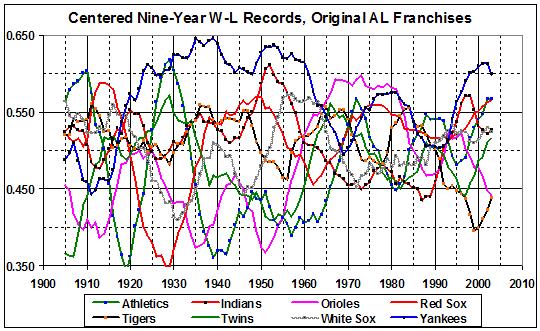
This is my first follow-up to “Has Baseball Become More Competitive?” Here I draw on the first two graphs from that post to make some observations about the best and worst teams in the history of the American League. My metric is the centered, nine-year won-lost (W-L) record (see “…Competitive?” for more about the metric). For reasons given here and here, I eschew performance in post-season play as a measure of excellence.

The graphs (to enlarge, right click and select “open in new tab”):

Remember, I am measuring performance over nine-year spans — not individual seasons — so the following lists will not always correspond with lists of teams having the best and worst W-L record, by season. Using the nine-year, I present the best (E = expansion team)…

Athletics (then of Philadelphia), 1905-11
Red Sox, 1912-1917
White Sox, 1918
Yankees, 1919-62
White Sox, 1963
Yankees, 1964
Orioles, 1965-81
Yankees, 1982-85
Blue Jays (E), 1986-90
Athletics (then of Oakland), 1991-92
White Sox, 1993
Yankees, 1994-2003

…and the worst (E = expansion team)…

Twins (then the original Washington Senators), 1905-08
Orioles (then the St. Louis Browns), 1909-15
Athletics (then in Philadelphia), 1916-22
Red Sox, 1923-32
Orioles (still the Browns), 1933-37
Athletics (still in Philadelphia), 1938-47
Orioles (still the Browns), 1948-54 (tied with Athletics in ’54)
Athletics, 1954-64 (tied with Browns in ’54) (A’s in Philadelphia through 1954; in Kansas City, 1955-67)
Rangers (E), 1965-72 (as the expansion Washington Senators, 1965-71; as the Texas Rangers, 1972)
Brewers (E), 1973-74
Indians, 1975
Angels (E), 1976
White Sox, 1977
Twins, 1978-79
Athletics (in Oakland), 1980
Mariners (E), 1981-85
Indians, 1986-89
Mariners (E), 1990-91
Tigers, 1992-2001
Devil Rays (E), 2002-03

I take these lists (especially the list of worst teams) as further evidence that baseball has become more competitive since the onset of expansion and free agency. Just look at the number of original franchises at the bottom of the heap since 1965.

There’s more to come, in future posts.

Yet More Evidence against Anthropogenic Global Warming

Here and here. The first item is interesting mainly for what it reveals about global-warming zealots. The second article offers strong, scientific evidence of the key role of cosmic radiation, which is influence by solar activity and the galactic position of the solar system.

See, also, this and this.

P.S. There’s a related piece, here, on the high cost of minimal reductions in CO2 emissions.

P.P.S. My son adds this quotation, from Evelyn Waugh’s Love Among the Ruins:

Despite their promises at the last Election, the politicians had not
yet changed the climate.

Michigan’s Economic Suicide

See this, then this, then this.

Telling Odds

As of this evening, Iowa Electronic Markets has Hillary Clinton as a better than two-to-one favorite for the Democrat nomination in 2008. Rudy Giuliani, Mitt Romney, and Fred Thompson are in a close race for the Republican nomination; therefore, none is better than a one-in-three favorite.

In spite of the Republican elephant race, and because of Frau Clinton’s dominance of Democrats, the IEM odds on the outcome of the election give only a slight edge to the Democrat nominee: 52-48. And that’s before Republicans unite to attack Clinton and her Soviet-style agenda.

Has Baseball Become More "Competitive"?

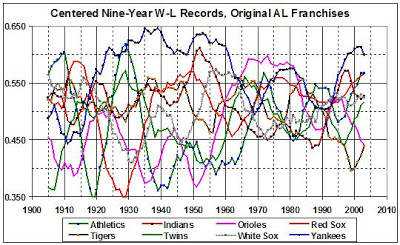
I begin to answer the question by presenting the following graphs. They show the nine-year, centered won-lost (W-L) record (a.k.a. winning percentage) of each of the franchises that has had teams in the American League. (To enlarge an image, right-click on it and select “open in a new tab.”)

Source: Statistics derived from information available at Baseball-Reference.com.

Each franchise is identified by the nickname of its current team. Some franchises have changed cities, of course, and some teams’ nicknames have changed, even when the teams have stayed put.

I chose to plot nine-year, centered W-L records for three reasons. First, a team’s record over nine years should obliterate aberrations: unusually bad or good years. Second, the selection of nine years (rather than ten, for instance) allows for the computation of a centered average. Third, a centered average gives a better indication of a team’s success (or failure) in the year for which the average is plotted.

I plotted the original eight franchises separately from the seven expansion franchises for two reasons. First, a graph that plots the records of all the franchises would be too cluttered to read easily. Second, I wanted to highlight the effects of expansion (if any) on the success (or failure) of the original franchises. (Note that the records of the seven expansion teams include those of the Milwaukee Brewers, now a National League team. The Brewers entered the AL in 1969 as the Seattle Pilots, moved to Milwaukee in 1970, and moved to the National League after the 1997 season. Accordingly, I computed and plotted nine-year, centered averages only for the years that the Pilots/Brewers were an AL team.)

Now, for some relevant history:

  • Expansion of the AL occurred in three increments: two teams in 1961 (Angels and Senators/Rangers), two teams in 1969 (Pilots/Brewers and Royals), and two teams in 1977 (Blue Jays and Mariners). For the AL, the addition of the Devil Rays in 1998 offset the transfer of the Brewers to the NL. Expansion of the NL occurred in 1962 (Mets and Astros), 1969 (Expos/Nationals and Padres), 1993 (Marlins and Rockies), and 1998 (Brewers and Diamondbacks). Thus the number of major league teams, which had been 16 from 1901 through 1960, rose to 18 in 1961, 20 in 1962, 24 in 1969, 26 in 1977, 28 in 1993, and 30 in 1998.
  • “Free agency” began officially in 1976, just before the third wave of expansion, Free agency enables a player with six or more years of major-league experience to sign with a team of his choice, following the expiration of his current contract or his current team’s failure to exercise a contract-extension option.

Given that, what can one glean from the two charts above? One obvious fact (obvious to me, anyway) is that the AL has become more competitive since the onset of expansion and free agency. (By “competitive” I mean that the teams’ W-L records have become more tightly bunched around .500.) The following graph confirms that observation. (To enlarge the image, right-click on it and select “open in a new tab.”)

Source: Statistics derived from information available at Baseball-Reference.com.

This graph plots, for each season from 1901 through 2007, the average absolute value of the deviation of team W-L records from the league’s overall record. For example, a W-L record of .400 and a W-L record of .600 both deviate by .100 from a league W-L record of .500. (The AL”s overall record was, of necessity, .500 in each year through 1996, when there was no interleague play during the regular season. Since the advent of interleague play after 1996, the overall W-L record of the AL has ranged from a low of .495 in 1997 to a high of .512 in 2006.)

It seems indisputable that baseball, represented here by the AL, has become more competitive since the advent of expansion and the establishment of free agency. (The “blip” around 2002 seems to be an anomaly caused by the confluence of several unusually abysmal and outstanding seasons.)

Why? I suggest the following:

  • Expansion has not “diluted” the quality of baseball, for two reasons. First, the U.S. population of males aged 20-44 has more than tripled since 1901, while the number of teams in the two major leagues (30) is still less than double the number that existed in 1901 (16). Moreover, given the additional competition for talent since expansion, teams have become more willing to recruit players from among the black and Hispanic populations of the U.S. and Latin America. That is to say, teams have come to draw more heavily on sources of talent that they had (to a large extent) neglected before expansion. (True, it takes time for a new franchise to become competitive, but — with the possible exception of the Devil Rays — new franchises have become competitive, for a while, at least.)
  • Free agency has made baseball more competitive by enabling less successful teams to attract high-quality players by offering them more money than other, more successful, teams. Money can, in some (many?) cases, compensate a player for the loss of psychic satisfaction of playing on a team that, on its record, is likely to be successful.
  • The competitive ramifications of expansion and free agency have been reinforced by the limited size of team rosters (e.g., each team may carry only 25 players until September 1). No matter how much money an owner has, the limit on the size of his team’s roster constrains his ability to sign all (even a small fraction) of the best players.

In a future post I will discuss the records of certain teams — the Athletics and their wild swings between excellence and dysfunction, for example.

More (of the Same) Reasons to Vote Republican in ’08

I linked to some here. There’s more in that vein here.

A Century of Regress

If this is true, so is this.

The Ruinous Despotism of Democracy

Not long ago, in “‘Liberalism,’ as Seen by Liberals,” I quoted from a review in The Washington Post of Paul Starr’s Freedom’s Power: The True Force of Liberalism. Here is an especially telling paragraph from the review:

By opening up power to progressively broader participation, liberal constitutions have subjected government to scrutiny, criticism and even resistance, and thus have helped to protect citizens against overweening bureaucracies. At the same time, they have made democratic states more legitimate and have enabled them to borrow, tax and, until recently, conscript more and more. Paradoxically, then, constitutionally limited states historically have wielded more power than despotic ones.

I was reminded of that passage by one that I have just came upon in Christopher Dawson’s The Dynamics of World History (a compilation of Dawson’s essays written 1921-55):

Today the common traditions [of religion and culture] have been abandoned by the rulers of the modern [s]tate and the planners of modern society, while at the same time the latter have come to exercise a more complete control over the thought and life of the whole population than the most autocratic and authoritarian powers of the past ever possessed.

Dawson wrote that in 1949. Though he was writing about Britain, he might just as well have been writing about the United States. And matters have only worsened here (as in Britain). Consider the economic realm, for example:


Of course, there’s more to it than that. There are social consequences aplenty (e.g., higher rates of violent crime) arising from the voterenabled substitution of state-imposed and state-endorsed behavioral norms for socially evolved ones — always in the name of “liberality” or “progress.” For example, as I wrote here:

[A]bortion-on-demand and same-sex marriage are not manifestations of liberality, they are manifestations of statism because they are (or would be) state-imposed — which is what “liberals” want.

If abortion-on-demand and same-sex marriage were manifestations of liberality, they would have arisen from voluntarily evolved social norms. That they have not done so means that they are destructive of the social order — of civil society — upon which liberty depends.

If my position makes me out to be a reactionary, I stand with Barry Goldwater:

I would remind you that extremism in the defense of liberty is no vice. And let me remind you also that moderation in the pursuit of justice is no virtue.

To put it more baldly, todays “democratic statism” is antithetical to liberty, justice, and progress. For our sake and the sake of our progeny, it must by replaced by the founding principles of limited-government republicanism.

There’s more — much more — in the following categories:
Affirmative Action – Immigration – Race
Constitution – Courts – Law – Justice
Economics: Principles and Issues
Leftism- Statism – Democracy
Liberty – Libertarianism – Rights
Religion – Science – Pseudoscience
Self-Ownership… – Gender – Etc.
War – Peace – Foreign Affairs

DoJ on Net Neutrality

According to K. Lloyd Billingsley, writing at TCS Daily, the Department of Justice has taken exactly the right stance on “net neutrality”:

Net neutrality means government regulation of the Internet, specifically a prohibition of differential charges for priority traffic. The Department of Justice thinks this is a bad idea, and would harm the development of the Internet.

“Free market competition, unfettered by unnecessary governmental regulatory restraints, is the best way to foster innovation and development of the Internet,” says the DoJ filing [with the FCC on September 6]….

“There is reason to believe that the type of regulatory restraints proposed by some commenters under the mantle of ‘neutrality’ could actually deter and delay investment and innovation, and result in less choice and higher prices to consumers of Internet services,” the Department said.

In the lexicon of net neutrality, differential or priority pricing is called “discrimination,” but the DoJ does not buy this rhetorical effort to seize the moral high ground. “Differentiating service levels and pricing, for example, is a common and often efficient way of allocating scarce resources and meeting consumer preferences,” the filing explains, using the United States Postal Service as an example.

DoJ might have used a better example than USPS. Nor is differential pricing restricted to service. The most expensive items purchased by consumers (houses and cars) are price-differentiated to a fare-thee-well. Imagine the furore if government regulators decreed that all houses and cars had to be the same and sell for the same price.

The bottom line: DoJ has it right about “net neutrality.” As I wrote here:

By the “logic” of net neutrality, everyone would be forced to accept goods and services of the same quality. That quality would be poor because there would be no incentive to produce better goods and services to earn more money in order to buy better goods and services — because they couldn’t be bought. Reminds me of the USSR.

Read the whole thing. It’s on the mark, if I do say so myself.

FDR and Fascism

A blogger (to whom I will not link) once tried to disparage me by referring to my position that (in his words) “Franklin Roosevelt, Adolph Hitler and Joseph Stalin were all essentially dictators.” I suppose that the blogger in question believes Hitler and Stalin to have been dictators. His poorly expressed complaint, therefore, is my lumping of FDR with Hitler and Stalin.

I doubt that the not-to-be-named blogger considers FDR a saint, or even a praiseworthy president. Such a view would be inconsistent with the blogger’s (rather murky) paleo-conservative/libertarian views. The blogger’s apparent aim was not to defend FDR but to discredit me by suggesting that my view of FDR is beyond the pale.*

To the contrary, however, the perception of FDR as a dictator (or dictator manqué) with a fascistic agenda is of long standing and arises from respectable sources. Albert Jay Nock, an early and outspoken opponent of the New Deal — and a paleo-libertarian of the sort admired by the blogger in question — certainly saw Roosevelt’s fascistic agenda for what it was. Many mainstream politicians also attacked Roosevelt’s aims; for example:

While the First New Deal of 1933 had broad support from most sectors, the Second New Deal challenged the business community. Conservative Democrats, led by Al Smith, fought back with the American Liberty League, savagely attacking Roosevelt and equating him with Marx and Lenin.[21]

That Smith and others were unsuccessful in their opposition to FDR’s agenda does not alter the essentially fascistic nature of that agenda.

Now comes David Boaz’s “Hitler, Mussolini, Roosevelt: What FDR had in common with the other charismatic collectivists of the 30s,” a review of Wolfgang Schivelbusch’s Three New Deals: Reflections on Roosevelt’s America, Mussolini’s Italy, and Hitler’s Germany, 1933–1939. Toward the end of the review, Boaz writes:

Why isn’t this book called Four New Deals? Schivelbusch does mention Moscow repeatedly…. But Stalin seized power within an already totalitarian system; he was the victor in a coup. Hitler, Mussolini, and Roosevelt, each in a different way, came to power as strong leaders in a political process. They thus share the “charismatic leadership” that Schivelbusch finds so important.

…B.C. Forbes, the founder of the eponymous magazine, denounced “rampant Fascism” in 1933. In 1935 former President Herbert Hoover was using phrases like “Fascist regimentation” in discussing the New Deal. A decade later, he wrote in his memoirs that “the New Deal introduced to Americans the spectacle of Fascist dictation to business, labor and agriculture,” and that measures such as the Agricultural Adjustment Act, “in their consequences of control of products and markets, set up an uncanny Americanized parallel with the agricultural regime of Mussolini and Hitler.” In 1944, in The Road to Serfdom, the economist F.A. Hayek warned that economic planning could lead to totalitarianism. He cautioned Americans and Britons not to think that there was something uniquely evil about the German soul. National Socialism, he said, drew on collectivist ideas that had permeated the Western world for a generation or more.

In 1973 one of the most distinguished American historians, John A. Garraty of Columbia University, created a stir with his article “The New Deal, National Socialism, and the Great Depression.” Garraty was an admirer of Roosevelt but couldn’t help noticing, for instance, the parallels between the Civilian Conservation Corps and similar programs in Germany. Both, he wrote, “were essentially designed to keep young men out of the labor market. Roosevelt described work camps as a means for getting youth ‘off the city street corners,’ Hitler as a way of keeping them from ‘rotting helplessly in the streets.’ In both countries much was made of the beneficial social results of mixing thousands of young people from different walks of life in the camps. Furthermore, both were organized on semimilitary lines with the subsidiary purposes of improving the physical fitness of potential soldiers and stimulating public commitment to national service in an emergency.”

And in 1976, presidential candidate Ronald Reagan incurred the ire of Sen. Edward Kennedy (D-Mass.), pro-Roosevelt historian Arthur M. Schlesinger Jr., and The New York Times when he told reporters that “fascism was really the basis of the New Deal.”

You get the idea by now, I hope. The correlation of FDR’s regime with those of Hitler and Mussolini (not to mention Stalin’s) is hardly discredited or beyond the pale.

Boaz writes, also, about the ends and means of the New Deal:

On May 7, 1933, just two months after the inauguration of Franklin Delano Roosevelt, the New York Times reporter Anne O’Hare McCormick wrote that the atmosphere in Washington was “strangely reminiscent of Rome in the first weeks after the march of the Blackshirts, of Moscow at the beginning of the Five-Year Plan.…America today literally asks for orders.” The Roosevelt administration, she added, “envisages a federation of industry, labor and government after the fashion of the corporative State as it exists in Italy.”

That article isn’t quoted in Three New Deals, a fascinating study by the German cultural historian Wolfgang Schivelbusch. But it underscores his central argument: that there are surprising similarities between the programs of Roosevelt, Mussolini, and Hitler….

The dream of a planned society infected both right and left. Ernst Jünger, an influential right-wing militarist in Germany, reported his reaction to the Soviet Union: “I told myself: granted, they have no constitution, but they do have a plan. This may be an excellent thing.” As early as 1912, FDR himself praised the Prussian-German model: “They passed beyond the liberty of the individual to do as he pleased with his own property and found it necessary to check this liberty for the benefit of the freedom of the whole people,” he said in an address to the People’s Forum of Troy, New York.

American Progressives studied at German universities, Schivelbusch writes, and “came to appreciate the Hegelian theory of a strong state and Prussian militarism as the most efficient way of organizing modern societies that could no longer be ruled by anarchic liberal principles.” The pragmatist philosopher William James’ influential 1910 essay “The Moral Equivalent of War” stressed the importance of order, discipline, and planning….

In the North American Review in 1934, the progressive writer Roger Shaw described the New Deal as “Fascist means to gain liberal ends.” He wasn’t hallucinating. FDR’s adviser Rexford Tugwell wrote in his diary that Mussolini had done “many of the things which seem to me necessary.” Lorena Hickok, a close confidante of Eleanor Roosevelt who lived in the White House for a spell, wrote approvingly of a local official who had said, “If [President] Roosevelt were actually a dictator, we might get somewhere.” She added that if she were younger, she’d like to lead “the Fascist Movement in the United States.” At the National Recovery Administration (NRA), the cartel-creating agency at the heart of the early New Deal, one report declared forthrightly, “The Fascist Principles are very similar to those we have been evolving here in America.

Roosevelt himself called Mussolini “admirable” and professed that he was “deeply impressed by what he has accomplished.”…

Schivelbusch argues that “Hitler and Roosevelt were both charismatic leaders who held the masses in their sway—and without this sort of leadership, neither National Socialism nor the New Deal would have been possible.” This plebiscitary style established a direct connection between the leader and the masses. Schivelbusch argues that the dictators of the 1930s differed from “old-style despots, whose rule was based largely on the coercive force of their praetorian guards.” Mass rallies, fireside radio chats—and in our own time—television can bring the ruler directly to the people in a way that was never possible before.

To that end, all the new regimes of the ’30s undertook unprecedented propaganda efforts. “Propaganda,” Schivelbusch writes “is the means by which charismatic leadership, circumventing intermediary social and political institutions like parliaments, parties, and interest groups, gains direct hold upon the masses.” The NRA’s Blue Eagle campaign, in which businesses that complied with the agency’s code were allowed to display a “Blue Eagle” symbol, was a way to rally the masses and call on everyone to display a visible symbol of support. NRA head Hugh Johnson made its purpose clear: “Those who are not with us are against us.”…

Program and propaganda merged in the public works of all three systems. The Tennessee Valley Authority, the autobahn, and the reclamation of the Pontine marshes outside Rome were all showcase projects, another aspect of the “architecture of power” that displayed the vigor and vitality of the regime.

If FDR’s aims were fascistic — and clearly they were — why didn’t the U.S. become a police state, in the mold of Germany, Italy, and the Soviet Union? Boaz concludes:

To compare is not to equate, as Schivelbusch says. It’s sobering to note the real parallels among these systems. But it’s even more important to remember that the U.S. did not succumb to dictatorship. Roosevelt may have stretched the Constitution beyond recognition, and he had a taste for planning and power previously unknown in the White House. But he was not a murderous thug. And despite a population that “literally waited for orders,” as McCormick put it, American institutions did not collapse. The Supreme Court declared some New Deal measures unconstitutional. Some business leaders resisted it. Intellectuals on both the right and the left, some of whom ended up in the early libertarian movement, railed against Roosevelt. Republican politicians (those were the days!) tended to oppose both the flow of power to Washington and the shift to executive authority.

Germany had a parliament and political parties and business leaders, and they collapsed in the face of Hitler’s movement. Something was different in the United States. Perhaps it was the fact that the country was formed by people who had left the despots of the Old World to find freedom in the new, and who then made a libertarian revolution. Americans tend to think of themselves as individuals, with equal rights and equal freedom. A nation whose fundamental ideology is, in the words of the recently deceased sociologist Seymour Martin Lipset, “antistatism, laissez-faire, individualism, populism, and egalitarianism” will be far more resistant to illiberal ideologies.

In other words, Americans eluded fascism not because of FDR’s intentions but (in part) because FDR wasn’t “a murderous thug” and (in the main) because of the strength of our “national character.”

Will our character enable us to resist the next FDR? Given the changes in our character since the end of World War II, I very much doubt it.

(For more about FDR’s regime, its objectives, and its destructive consequences, see this, this, and this.)
__________
* That the blogger was trying to discredit me in order to discredit someone related to me is only one bit of evidence of the blogger’s intellectual ineptitude. Further evidence is found in his resort to name calling and logical inconsistency. For example, I am, in one sentence, guilty of “extreme libertarianism” and, in another, an attacker of extreme libertarians, that is, those who “adhere[] to the [non-aggression] principle with deranged fervor” (my words).

As for my so-called extreme libertarianism, if the blogger had bothered to read my blog carefully he would have found plenty of evidence that I am far from being an extreme, individualistic, anti-state libertarian. See, for example, this post and the compilation of posts referenced therein, both of which I published more than a month before the blogger attacked me and my views about FDR.

I could say much more about the blogger’s rabid irrationality, but the main point of this post is FDR’s barely contained fascistic agenda, so I will stop here. Happily for the blogosphere, the blogger-not-to-be-named-here seems to have suspended his blogging operation.

Election 2008

Your best “bet” for forecasting the outcome of election 2008 is to follow the Iowa Electronic Markets, in particular, the IEM odds for the presidential nominations and election. I have placed three important IEM links at the bottom of the sidebar. I go there daily.

Now, It’s Over

The Red Sox have clinched the AL East title, thanks largely to another blown save by the Yankees’ Mariano Rivera in tonight’s 9-10, 10-inning loss to the Orioles.

It was over, effectively, when the Yankees failed to hold a 5-1 lead against the Devil Rays, and lost 6-7 in 10 innings on September 25. That loss put the Yankees 3 games behind the Red Sox, with only 5 games to play.

Contrary to the mindless mathematical manipulations of a blogger who shall remain nameless here, it was not over following the games of July 4, when the Yankees trailed the Red Sox by 11.5 games (not 12 games as asserted by said blogger).

But the Yankees rallied to come within 1.5 games of the Red Sox on September 19 and again on September 24. Which just goes to show you: “It ain’t over ’til it’s over.” *

Now, it’s over.

Related posts:
Overcoming Adversity
Are the Yankees in Meltdown?
Yankees vs. Red Sox: The End Games
Yankees vs. Red Sox: The End Games (2)
As I Was Saying…
__________
* Said byYogi Berra in 1973 when his New York Mets were, on August 7, 9.5 games behind the leader of the NL Eastern division. The Mets rallied to win the division title by 1.5 games, and went on to take the NL title before losing the World Series to the Oakland A’s. The Mets took the A’s to the seventh game of the Series. It was over for the Mets only when they lost that seventh game.

The 2007 Mets, by contrast, led their division from May 16 through September 26. As of this morning, the Mets trail the Phillies by 1 game, with 2 games left to play. To wrest the division title from the Phillies, the Mets must win both of their final games while the Phillies lose both of theirs. There will be a one-game playoff if the teams finish in a tie.

Moreover, even if the Mets win both of their final games they can be eliminated from post-season play, as follows. First, the Phillies win both of their final games to take the NL East title outright. Then, both the Diamondbacks and Padres win at least one of their two final games, which gives the wild-card slot to the Padres.

The best the Mets can do is tie the Padres and/or the Rockies in the W-L department. (That outcome requires the Padres to lose both of their final games.) The Mets and Padres and/or Rockies would then have a playoff game (or games) to determine the NL’s wild-card team for 2007.

It’s almost over for the Mets. But it ain’t over ’til it’s over — ain’t it?

P.S. (09/30/07): Now, it’s over for the Mets. Amazing.

On the morning of September 13 the Mets had a .572 record and led the Phillies by 7 games with only 17 games remaining. A mindless prognosticator might then have opined that the Mets would have to play only .500 ball the rest of the season in order to win the NL East title — as if that would be a cinch.

Well, the Mets could have won the title by playing .412 ball the rest of the way, even had they lost their 3 remaining games with the Phillies (as the Mets did). But the Mets played only .294 ball the rest of the way. In the process, their 7-game lead became a 1-game deficit, as the Phillies won 13 of 17 while the Mets were dropping 12 of 17. Thus the Mets fell 2 games short of taking the NL East title outright, and 1 game short of entering a playoff (with the Padres and Rockies) for the NL wild-card slot.

C’est la vie en baseball.

Compare and Contrast, Again

In praise of Kay S. Hymowitz’s realism about the limits of libertarianism, I say in “Compare and Contrast” that

Good things don’t just happen, they must be made to happen. If they are not, bad things will prevail because the anti-social aspects of human nature — dominance, enviousness, and aggressiveness — outweigh the pro-social ones.

Hymowitz’s “libertarian” critics (e.g., Ilya Somin), just don’t get it. Somin thusly ends a post about Hymowitz’s response to his critique of her stance on libertarianism:

Hymowitz concludes her response by criticizing what she calls the libertarian “tendency to view individual personal liberty as The Good that should swallow up all others.” In reply, I can only reiterate a point I made in my critique of her original essay: believing that protecting liberty is the highest or even the sole legitimate purpose of government does not require libertarians to conclude that it is the highest good for all institutions. Still less does it commit us to believing that it is a good that “swallows up all others.” To the contrary, libertarians have long contended that liberty actually facilitates the achievement of other important values and does so far more effectively than government coercion.

What Somin (and other so-called libertarians) fail to understand is this: Liberty doesn’t just happen; it is not innate in human nature.

The true choice is not between liberty and government coercion, it is between ordered liberty, in which government does not (by omission or commission) undermine morality, and social dissolution, in which it does precisely that.

It is quite clear that we have been, for quite some time, in a state of government-condoned and government-sponsored social dissolution. As civil society dissolves, government takes over its functions, in ways that no self-styled libertarian could possibly endorse.

The key defect of libertarian absolutism (of the kind preached by Somin et al.) is its adherents’ blindness to its consequences. They cannot seem to grasp the fact that wanting liberty and having it are two different things. They are fixated on “what ought to be” and blind to “what is possible,” given human nature.

Related posts:
A Century of Progress?
The Case against Genetic Engineering
Eugenics
Social Norms, State Action, and Liberty
A Critique of Extreme Libertarianism
Anarchistic Balderdash
The Meaning of Liberty

Collegiate Crap-ola

When I was a freshman in college, Voltaire was held up as an exemplar of wit and clear thinking. This is Voltaire, at (perhaps) his best, that is to say, his worst:

“The Bible,” sighed Voltaire. “That is what fools have written, what imbeciles command, what rogues teach, and young children are made to learn by heart.”

This nonsensical generalization bears scant resemblance to the truth. (It does not, for instance, credit the civilizing influence of the Bible, as it is conveyed through Judaism and Christianity.) Voltaire’s statement is nothing more than propaganda for anti-religionism.

It is no wonder that so many young minds were irretrievably corrupted by their exposure to the “heroes” of collegiate “open-mindedness.” I was corrupted for a while, but I began to see the world as it is, not as Voltaire and his ilk would have it seem.

Katie Couric: Post-American

What is a post-American? From Mark Krikorian of NRO, via an earlier post:

Let me be clear [as to] what I mean by a post-American. He’s not an enemy of America — not Alger Hiss or Jane Fonda or Louis Farrakhan. He’s not necessarily even a Michael Moore or Ted Kennedy. A post-American may actually still like America, but the emotion resembles the attachment one might feel to, say, suburban New Jersey — it can be a pleasant place to live, but you’re always open to a better offer. The post-American has a casual relationship with his native country, unlike the patriot, “who more than self his country loves,” as Katharine Lee Bates wrote. Put differently, the patriot is married to America; the post-American is just shacking up.

What makes Katie Couric a post-American? This:

“The whole culture of wearing flags on our lapel and saying ‘we’ when referring to the United States and, even the ‘shock and awe’ of the initial stages, it was just too jubilant and just a little uncomfortable. And I remember feeling, when I was anchoring the ‘Today’ show, this inevitable march towards war and kind of feeling like, ‘Will anybody put the brakes on this?’ And is this really being properly challenged by the right people? And I think, at the time, anyone who questioned the administration was considered unpatriotic and it was a very difficult position to be in.” (Quotation from Jonah Goldberg of NRO, via many bloggers.)

Katie, Katie, Katie, how could anyone possibly question your patriotism after reading that?

Actually, one cannot fault the patriotism of a person who questions how the administration pursues the enemy, as long as that person offers a reasonable alternative in good faith. But the loony Left and whacky Right simply assert that “we” are the enemy and “we” had it coming to “us,” when they are not peddling the notion that “we” did it to ourselves — as in “inside job.”

But Couric is, by her own admission, unpatriotic. She is more than unpatriotic, however. She is, at best, a dupe for the loony Left and whacky Right. She is, at worst (I think), a witting dupe (to coin an oxymoron).

Related post: Depressing But True (and the links at the end)

More Evidence Against Anthropogenic Global Warming

Add “Scientists Counter AP Article Promoting Computer Model Climate Fears” and “Questioning 20th Century Warmth” to what I say in “Warmism: The Myth of Anthropogenic Global Warming.” The second item is especially damaging to warmist hysteria.

P.S. See also “A Whole New World: Climate Change Debate Could Be Changing,” here.