A Critique of Extreme Libertarianism

EXTREME LIBERTARIANISM: MARXISM OF THE RIGHT?

A few years ago I would have joined Daniel McCarthy’s defense of libertarianism (“In Defense of Freedom“) against Robert Locke’s attack on it (“Marxism of the Right“). Upon mature reflection, I find some of Locke’s arguments persuasive; for example:

If Marxism is the delusion that one can run society purely on altruism and collectivism, then libertarianism is the mirror-image delusion that one can run it purely on selfishness and individualism. . . .

The most fundamental problem with libertarianism is very simple: freedom, though a good thing, is simply not the only good thing in life. Simple physical security, which even a prisoner can possess, is not freedom, but one cannot live without it….

Libertarians try to get around this fact that freedom is not the only good thing by trying to reduce all other goods to it through the concept of choice, claiming that everything that is good is so because we choose to partake of it. Therefore freedom, by giving us choice, supposedly embraces all other goods. But this violates common sense by denying that anything is good by nature, independently of whether we choose it. Nourishing foods are good for us by nature, not because we choose to eat them. Taken to its logical conclusion, the reduction of the good to the freely chosen means there are no inherently good or bad choices at all, but that a man who chose to spend his life playing tiddlywinks has lived as worthy a life as a Washington or a Churchill….

Libertarians rightly concede that one’s freedom must end at the point at which it starts to impinge upon another person’s, but they radically underestimate how easily this happens….

[I]f limiting freedom today may prolong it tomorrow, then limiting freedom tomorrow may prolong it the day after and so on, so the right amount of freedom may in fact be limited freedom in perpetuity….If all we want is limited freedom, then mere liberalism will do, or even better, a Burkean conservatism that reveres traditional liberties.

The extreme libertarian, on the other hand, resorts to intellectual sleight-of-hand by asserting that libertarianism has only to do with the conduct of the state. Here is McCarthy:

Libertarianism is a political philosophy, not a complete system of ethics or metaphysics. Political philosophies address specifically the state and, more generally, justice in human society. The distinguishing characteristic of libertarianism is that it applies to the state the same ethical rules that apply to everyone else….

Yes, the state seizes tax money and jails those who do not pay, actions that would be denounced as gangsterism if undertaken by a private organization. But if the only way life can go on is to have the government provide defense and other necessities, such expropriations might have to be called something other than robbery.

Moderate libertarians say just that. They propose that the state should do those necessary things that it alone can do—and only those things. Radical libertarians contend there is nothing good that only the state can provide—even its seemingly essential functions are better served by the market and voluntary institutions. The differences between thoroughgoing libertarians and moderates are profound, but the immediate prescriptions of each are similar enough: cut taxes, slash spending, no more foreign adventurism.

McCarthy reveals that he is a radical, “thoroughgoing” libertarian when he assails “foreign adventurism” — a cheap rhetorical trick aimed at excluding libertarian hawks from the ranks of libertarianism.

THREE ERRORS OF EXTREME LIBERTARIANISM

I take issue with McCarthy and his fellow travelers on the “right wing” of libertarianism. I argue, specifically, that

  • libertarianism is more than a “political philosophy” that addresses the state, it is a prescription for how individuals should live their lives;
  • it is pure sophistry (or naïveté) to assert that “there is nothing good that only the state can provide”; and
  • the state, properly understood, is not a discrete “thing,” it is simply the inevitable means by which a group or society regulates relations among its members when there are too many of them to act by consensus.

LIBERTARIANISM AS A PRESCRIPTION FOR LIVING ONE’S LIFE

A political philosophy — any political philosophy — has implications for how individuals live their lives. Consider national defense, a subject about which McCarthy evidently has strong views. He calls taxation for the purpose of providing defense a form of robbery; he sees preemptive warfare as foreign adventurism. Libertarians of McCarthy’s ilk argue against preemptive war from the non-aggression principle. The problem with the non-aggression principle in the hands of radical libertarians is that it becomes a non-preemption principle. But preemption may in fact be necessary to the defense of liberty, as I have argued here and here.

A political philosophy that would do away with the state most certainly is a prescription for how people will be forced to live their lives — and it is a poisonous prescription: We can rely on “private defense agencies” to keep the peace, at home and abroad, and we would have fewer enemies abroad if we only “minded our own business.”

THE “GOOD” THAT ONLY A STATE CAN PROVIDE

Before addressing private defense agencies, I must say a thing or two about the notion of “minding our own business,” which is a naïvely dangerous view of the world on two counts. First, it assumes that having and defending overseas economic interests is, somehow, not “our own business.” Second, it entrusts the safekeeping of those interests to the beneficence of others. It is as if Hitler, Stalin, bin Laden, and their ilk did not, do not, and could not exist.

Now, to private defense agencies. I once wrote this about extreme libertarianism (known also as anarcho-capitalism):

Among the important particulars not accounted for by anarcho-capitalists is the method of resolving disputes between those who agree to settle their differences without resorting to violence and those persons (foreign as well as domestic) who simply refuse to be bound by such agreements. Anarcho-capitalists, in their blindness to that bit of reality, insist on applying the non-aggression principle to inter-state relations, thus effectively granting immunity to lawless states simply because they have not yet attacked us.

Anarcho-capitalists, in effect, have created a fantasy world in which the American state is unnecessary because anarcho-capitalists do not like what it sometimes does. Anarcho-capitalists believe that, somehow or other, the absence of the state will culminate in the advent of nirvana.

. . . The real question . . . is how to channel the power of the American state toward the defense of liberty. The Constitution of the United States, in its original meaning, offers the best practical answer to that question. Anarcho-capitalists will object that the original Constitution was imperfect (e.g., it condoned slavery) and that its desirable provisions (e.g., the Bill of Rights) have been implemented imperfectly. Such arguments assume that perfection would have overtaken us in a stateless world.

Anarcho-capitalism, in sum, is a belief in the impossible. It is the wrong standard by which to judge the possible. The right standard, simply stated, is this: When faced with politically feasible policy options, support the ones that advance liberty rather than those which detract from it.

Incremental but real steps toward liberty are infinitely superior to the self-indulgent but politically irrelevant fantasies of anarcho-capitalism.

McCarthy doesn’t go so far as to offer the extreme libertarian’s usual alternative to state power, which is the creation of “private defense agencies,” but I can tell that he is itching to do so. I have addressed that pipe-dream in several posts, including this one, in which I commented on an article by one Robert Murphy, who

assumes that if the vast majority of people agree that it’s wrong to use violence to settle disputes, then that won’t happen. Do the vast majority of people believe that it’s wrong to use violence to settle disputes? Perhaps, but it doesn’t take a vast majority to inject violence into a society; it takes only a relatively small number of renegades, who may be then be able to coerce others into condoning or supporting their criminal activities. . . .

What Murphy doesn’t entertain is the possibility that a small but very rich cabal could create a dominant defense agency that simply refuses to recongize other defense agences, except as enemies. In other words, there’s nothing in Murphy’s loose logic to prove that warlords wouldn’t arise. In fact, he soon gives away the game:

Imagine a bustling city, such as New York, that is initially a free market paradise. Is it really plausible that over time rival gangs would constantly grow, and eventually terrorize the general public? Remember, these would be admittedly criminal organizations; unlike the city government of New York, there would be no ideological support for these gangs.

We must consider that in such an environment, the law-abiding majority would have all sorts of mechanisms at their [sic] disposal, beyond physical confrontation. Once private judges had ruled against a particular rogue agency, the private banks could freeze its assets (up to the amount of fines levied by the arbitrators). In addition, the private utility companies could shut down electricity and water to the agency’’s headquarters, in accordance with standard provisions in their contracts.

Pardon me while I laugh at the notion that lack of “ideological support” for the gangs of New York would make it impossible for gangs to grow and terrorize the general public. That’s precisely what has happened at various times during the history of New York, even though the “law-abiding majority [had] all sorts of mechanisms at [its] disposal.” Murphy insists on hewing to the assumption that the existence of a law-abiding majority somehow prevents the rise a powerful, law-breaking minorities, capable of terrorizing the general public. Wait a minute; now he admits the converse:

Of course, it is theoretically possible that a rogue agency could overcome these obstacles, either through intimidation or division of the spoils, and take over enough banks, power companies, grocery stores, etc. that only full-scale military assault would conquer it. But the point is, from an initial position of market anarchy, these would-be rulers would have to start from scratch. In contrast, under even a limited government, the machinery of mass subjugation is ready and waiting to be seized.

Huh? It’s certainly more than theoretically possible for a “rogue agency” to wreak havoc. A “rogue agency” is nothing more than a fancy term for a street gang, the Mafia, or al Qaeda cells operating in the U.S. A “rogue agency” run by and on behalf of rich and powerful criminals — for their own purposes — would somehow be preferable to police forces and courts operated by a limited government that is accountable to the general public, rich and poor alike? I don’t think so. However much the American state engages in “mass subjugation” — and it does, to a degree — it is also held in check by its accountability to the general public under American law and tradition. A “rogue agency,” by definition, would be unbound by law and tradition.

Murphy’s analysis takes place in a land called “Erewhon.” He chooses to ignore the fact that he lives in the United States because he wasn’t a party to the Constitution. Yet that Constitution provides for a limited government, which in more than 200 years has yet to engage in systematic, mass subjugation of the kind practiced in the Third Reich and the Soviet Union, except in the case of slavery. And guess what? The American state ended slavery. How’s that for mass subjugation?

Anyone can conjure a Utopia, as Murphy has. But no one can guarantee that it will work. Murphy certainly hasn’t made the case that his Utopia would work.

In any event, by focusing on intra-societal violence Murphy ignores completely two crucial questions: (1) Can an anarchistic society effectively defend itself against an outside force? (2) Can it do so better than a society in which the state has a monopoly on the use of force with respect to outside entities? Murphy implies that the answer to both questions is “yes,” though he fails to explore those questions. Here is my brief answer: The cost of mounting a credible defense of the United States from foreign enemies probably would support only one supplier; that is, national defense is a natural monopoly. It is better for the American state — given its accountability to the general public — to be that supplier. . . .

A wasteful, accountable, American state is certainly preferable to an efficient, private, defense agency in possession of the same military might. Hitler and Stalin, in effect, ran private defense agencies, and look where that landed the Germans and Russians. Talk about subjugation.

THE STATE: AN INEVITABLE CREATURE OF SOCIETY

Contrary to Murphy and his ilk, there is no such thing as statelessness, at least not for groups larger than, say, hunter-gatherer bands or Hutterite colonies. Why? Because it is impossible for a group of more than a few dozen or a dozen-dozen persons to live together in pure consensus. In the end, a faction will dominate the group (a shifting faction, perhaps). And that faction will define harms that may be punished, punish those harms (i.e., administer justice), and take responsibility for the group’s defense.

The state is not a “thing” to be kept at bay; it is the mechanism by which a people enforces justice and defends itself against outsiders.The questions facing a group always are these: Upon what principles shall we found and guide the state, and to whom shall we entrust the the functions of the state?

Consider this:

A group of persons may be said to live in anarchy only if all of the rules that affect everyone in the group (e.g., where to live, how best to defend the group against predators) are made by unanimous, informed consent, which might be tacit. It follows, then, that a group might — by unanimous, informed consent — give a subset of its members the authority to make such decisions. The group’s members might delegate such authority, willingly and unanimously, because each member believes it to be in his or her best interest to do so. (The reasons for that belief might vary, but they probably would include the notion of comparative advantage; that is, those who are not in the governing subset would have time to pursue those activities at which they are most productive.) With a governing subset — or government — the group would no longer live in anarchy, even if the group remains harmonious and membership in it remains voluntary.

The government becomes illegitimate only when it exceeds its grant of authority and resists efforts to curb those excesses or to redefine the grant of authority. The passage of time, during which there are changes in the group’s membership, does not deligitimate the government as long as the group’s new members voluntarily assent to governance. Voluntary assent, as discussed above, may consist simply in choosing to remain a member of the group.

Now, ask yourself how likely it is that a group larger than, say, a nuclear family or a band of hunter-gatherers might choose to go without a government. Self-interest dictates that even relatively small groups will choose — for reasons of economy, if nothing else — to place certain decisions in the hands of a government.

All talk of anarchy as a viable option to limited government is nothing more than talk. Empy talk, at that.

EXTREME LIBERTARIANISM’S FATAL FLAW: THE “ANNE FRANK SYNDROME”

The political view that there should not be a state, if followed to its logical conclusion, would leave most Americans prey to the very real predators who lurk at home and abroad. Those very real predators care not one whit about non-aggression principles and contractual obligations, contrary to the assertions of Gustave de Molinari, a favorite of anarcho-capitalists, who wrote this:

Under a regime of liberty, the natural organization of the security industry would not be different from that of other industries. In small districts a single entrepreneur could suffice. This entrepreneur might leave his business to his son, or sell it to another entrepreneur. In larger districts, one company by itself would bring together enough resources adequately to carry on this important and difficult business. If it were well managed, this company could easily last, and security would last with it. In the security industry, just as in most of the other branches of production, the latter mode of organization will probably replace the former, in the end.

The “customers would not allow themselves to be conquered”? Tell that to those who pay gangsters for “protection,” and to the residents of gang-ridden areas. Molinari conveniently forgets that the ranks of “competitors” are open to those who, in their viciousness, will and do attack the persons and property of their rivals. If not everyone is honorable, as Molinari admits elsewhere in his essay, why would we expect private providers of security be honorable? Why would they not extort their customers while fighting each other? The result is bound to be something worse than life under an accountable state monopoly (such as we have in the U.S.) — something fraught with violence and fear. Think of The Roaring Twenties without the glossy coat of Hollywood glamour.

Molinari and his anarcho-libertarian descendants exhibit the Anne Frank syndrome. About three weeks before Frank and her family were betrayed and arrested, she wrote:

It’’s a wonder I haven’’t abandoned all my ideals, they seem so absurd and impractical. Yet I cling to them because I still believe, in spite of everything, that people are truly good at heart.

McCarthy, Murphy, Molinari, and their ilk do not proclaim the jejune belief that all “people are truly good at heart,” yet they persist in the belief that the security can be achieved in the absence of an accountable state. That is, like Anne Frank, they assume — contrary to all evidence — that “people are truly good at heart.” But competition, by itself, does not and cannot prevent criminal acts.

Competition, to be beneficial, must be conducted within the framework of a rule of law. That rule of law must be enforced by a state which is accountable to its citizens for the preservation of their liberty. The present rule of law in the United States is far from perfect, but it is far more perfect than the alternative that is dreamt of by extreme libertarians.

THE PROPER LIBERTARIAN AGENDA

As I wrote here, extreme libertarianism

rests on invalid conceptions of human nature and the state. Contrary to the evidence of history, it presumes that no one would or could accrue and exercise enough power to flout the common law and treat other persons coercively. Contrary to the evidence of history — especially American history — it presumes that a properly constituted and governed state cannot increase the quotient of liberty.

There is no choice between anarchy and the state. Anarchy leads inexorably to coercion — except in a dreamworld. The real choice…is between the toughest guy on the block or a state whose actions are capable of redirection through our representative democracy.

The proper task at hand for American libertarians isn’t to do away with the state but to work toward a state that defends free markets, property rights, the common law, and freedom of contract.

Another task for American libertarians is to work toward devolution of power back to the individual States and, within the States, to the lowest possible level. The key to liberty is the ability of the individual to pick and choose among a variety of “experiments” in government. That is true federalism.

Related posts:
Libertarian Nay-Saying on Foreign and Defense Policy (06/29/04)
Libertarianism and Preemptive War: Part I (07/10/04)
Libertarian Nay-Saying on Foreign and Defense Policy, Revisited (07/23/04)
An Aside about Libertarianism and War (08/02/04)
More about Libertarian Hawks and Doves (09/24/04)
Defense, Anarcho-Capitalist Style (09/26/04)
The State of Nature (12/05/04)
Getting Neolibertarianism Wrong (04/19/05)
Fundamentalist Libertarians, Anarcho-Capitalists, and Self-Defense (04/22/05)
The Legitimacy of the Constitution (05/09/05)
Another Thought about Anarchy (05/10/05)
Anarcho-Capitalism vs. the State (05/26/05)
Rights and the State (06/13/05)
The Essential Case for Consequentialist Libertarianism (07/10/05)
But Wouldn’t Warlords Take Over? (07/26/05)
Sorting Out the Libertarian Hawks and Doves (07/27/05)
A Paradox for Libertarians (08/04/05)
A Non-Paradox for Libertarians (08/15/05)
Common Ground for Conservatives and Libertarians? (09/04/05)
Liberty or Self-Indulgence? (10/10/05)
Some Thoughts about Liberty (11/23/05)
Libertarianism and Preemptive War: Part II (11/27/05)
Give Me Liberty or Give Me Non-Aggression? (12/08/05)
My View of Warlordism, Seconded (12/15/05)
Anarchy: An Empty Concept (12/20/05)
The Paradox of Libertarianism (01/05/06)
The Fatal Naïveté of Anarcho-Libertarianism (01/28/06)
Liberty as a Social Compact (02/28/06)
Social Norms and Liberty (03/02/06)
A Footnote about Liberty and the Social Compact (03/06/06)
Liberty and Federalism (03/12/06)
Finding Liberty (03/25/06)

See also (at Favorite Posts):
Libertarianism and Other Political Philosophies
War, Self-Defense, and Civil Liberties
The Firing of Ward Churchill…

…was long overdue and is entirely fitting. Hank Brown, president of the University of Colorado, explains his decision to fire Churchill (at last):

Controversy — especially self-sought controversy — doesn’t immunize a faculty member from adhering to professional standards. If you are a responsible faculty member, you don’t falsify research, you don’t plagiarize the work of others, you don’t fabricate historical events and you don’t thumb your nose at the standards of the profession. More than 20 of Mr. Churchill’s faculty peers from Colorado and other universities found that he committed those acts. That’s what got him fired.

Precisely. As I once wrote, apropos l’affaire Churchill,

[e]ducators are paid not only to educate but also to educate well. Perhaps the Churchill affair will serve as a reminder that gratuitous titillation isn’t education.

But l’affaire Churchill holds a broader lesson than that:

[A]lthough Ward Churchill and his ilk are despicable human beings, I don’t care what they say as much as I care that they represent what seems to pass for “thought” in large segments of the academic community. Clearly, universities are failing in their responsibility to uphold academic standards. Left-wing blather isn’t knowledge, it’s prejudice and hate and adolescent rebellion, all wrapped up in a slimy package of academic pretentiousness.

The larger marketplace of ideas counteracts much of what comes out of universities — in particular the idiocy that emanates from the so-called liberal arts and social sciences. But that’s no reason to continue wasting taxpayers’ money on ethnic studies, gender studies, and other such claptrap. State legislatures can and should tell State-funded universities to spend less on liberal arts and social sciences and spend more on the teaching of real knowledge: math, physics, chemistry, engineering, and the like. That strikes me as a reasonable and defensible stance.

It isn’t necessary for State legislatures to attack particular individuals who profess left-wing blather. All the legislatures have to do is insist that State-funded schools spend taxpayers’ money wisely, by focusing on those disciplines that advance the sum of human knowledge. Isn’t that what universities are supposed to do?

Yes, it is.

More from the Apocalyptic Left

This article in the current issue of Newsweek carries the subhed “If humans were evacuated, the Earth would flourish.” The final graph of the article puts the idea in perspective: “Too bad there’s no one there to see it.”

Actually, the central figure of the piece — one Alan Weisman — proposes more than evacuation. He’s trying to organize a voluntary human extinction movement. Weisman’s Leftist pedigree is quite evident in his affiliation with Homelands Productions.

Weisman is an extreme example of what I said here:

The emphasis on social restraints — to a Leftist… — means social engineering writ large. He wants a society that operates according to his strictures. But society refuses to cooperate, and so he conjures historically and scientifically invalid explanations for the behavior of man and nature. By doing so he is able to convince himself and his fellow travelers that the socialist vision is the correct one. He and his ilk cannot satisfy their power-lust in the real world, so they retaliate by imagining a theoretical world of doom. It is as if they walk around under a thought balloon which reads “Take that!”

Weisman isn’t content to foresee the apocalypse. He wants to rush toward it and embrace it.

A Case in Point

I wrote yesterday about the arrogance that underlies the redistributive urge:

It is liberals who empower the state to dictate the redistribution of income, even though redistribution is a violation of the very autonomy that liberals claim to value. Liberals are willing and ready to draw arbitrary lines between those who (in their view) deserve more income and those who deserve less of it. And liberals are more than willing and ready to use the power of the state to enforce their arbitrariness.

By the same token, liberals are unwilling to allow free institutions to determine who fares well and who fares poorly. And their unwillingness to do so undermines the ability of those free institutions to enable the “cold/sick/hungry/stupid/isolated” to better their lot by their own efforts, and to care for those who are unable to do so.

My only regret is the exclusive use of “liberals.” The arrogant attitude that “no one deserves to be so rich” extends beyond liberals. A good case in point is Sen. Chuck Grassley (R-IA). According to an article in the current issue of Newsweek, Grassley

has a profound frustration with superrich businesses and corporations that do not pay their fair share of taxes. Now the senior senator from Iowa is fighting to eliminate what he sees as a giant tax loophole by co-sponsoring legislation that would raise the tax rates (from 15 to 35 percent) on publicly traded partnerships like the private-equity giant Blackstone. To Grassley, the bill would help prevent ultrarich financiers from conspiring with their lawyers to “screw the taxpayer.” To his opponents, it’s a wrong-headed means of stunting economic growth.

Wrong-headed is right. (See below for a sample of the consequences of “soaking” the “super rich.”)

The Newsweek piece about Grassley is a sidebar to another article in the same issue of Newsweek, namely, “Taxing the Super Rich.” From the lede:

In Wall Street’s pecking order the partners in private-equity firms are the true aristocrats…Global in reach, able to marshal billions to buy big companies…Private-equity partners are not just in it for the money (though the successful ones make tons of it), but for the power to reshape whole industries. Unlike corporate CEOs, who are shackled by the short-term focus of shareholders, private-equity managers can swoop in and transform a troubled industry to create efficiency and growth. [Emphasis added: ED]

But that isn’t enough for the class-warfare crowd. Returning to the article:

Ever since the rise of the populists in the late 1800s, lawmakers have periodically threatened to soak the rich. Usually, these movements fizzle, partly because Americans hope that they, too, might one day become rich, and partly because there are good economic arguments against discouraging investment and the accumulation of wealth. But from time to time comes a tipping point. In the early 20th century, the Progressive Movement managed to impose a federal income tax, partly in reaction to the vast fortunes made during the late-19th-century Gilded Age.

Those vast fortunes were made because those who made them were responsible for the rapid economic growth of the late 1800s. Productivity rose so rapidly during that era that prices fell, even as the economy grew.

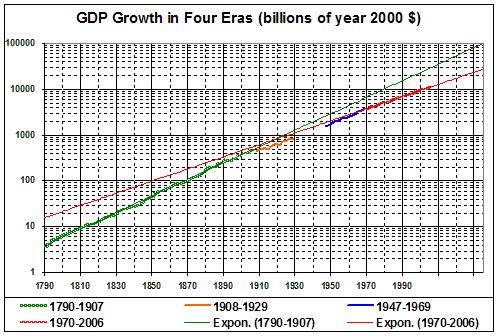
As for the fruits of the Progressive Movement — which imposed a federal income tax and punitive anti-trust and regulatory policies — read this, in which I point out:

  • Had the economy continued to grow at the rate of 1790-1907 (the era of laissez-faire, more or less), real GDP in 2035 would be $107 trillion (in year 2000 dollars).
  • If the economy continues to grow at the rate of 1970-2005 (the era of entrenched big government), real GDP in 2035 will be $27 trillion (in year 2000 dollars).
  • Thus the average American will “enjoy” about one-fourth the real output that would be his absent big government.

We owe the sharp drop in economic growth after 1907 to the Progressive Movement. The great-grandchildren of last century’s “progressives” haven’t seen enough. In their ignorance and arrogance, the wish to redouble our economic pain by “soaking” the “super rich” whose efforts — as even Newsweek admits — create efficiency and growth.

Related post: More Commandments of Economics (see #13)

Positive Rights and Cosmic Justice: Part III

The prologue is here, part I is here, and part II is here. This post focuses on the redistribution of income and wealth, specifically, its counterproductive effects and its roots in class warfare and “liberal” arrogance.

INTRODUCTION

In a libertarian regime, everyone is entitled to negative rights: the free enjoyment of one’s own life, liberty, and property as long as one does no harm to others. With negative rights there is no taking from anyone else, except to underwrite those state functions (justice and defense) that protect negative rights. (An extreme libertarian — i.e., anarcho-capitalist — would say that the functions of justice and defense can be provided through voluntary contractual relationships.)

Positive rights, on the other hand, are assigned selectively by a regime that takes from some and gives to others. How much the “donees” receive from the “donors” depends only on the dictates of those who create and enforce postive rights, namely, paternalists (usually “liberals”) and power-seeking politicians.

Joe Miller (Bellum et Mores) is a liberal who supports positive rights:

…I still hold on to one core insight of liberalism: respect for autonomy means more than just non-interference. I can have all sorts of freedoms from various things, but those freedoms don’t mean a damn thing if I’m too cold/sick/hungry/stupid/isolated to exercise them. And I remain convinced that, at least for right now, the only way to ensure that everyone has the shelter, medicine, food, education, and access needed to enjoy his/her freedom is through some form of redistribution. Insisting that you redistribute part of your wealth is no more a violation of your autonomy than is insisting that you refrain from hitting me in the nose. Both hitting me in the nose and refusing to help those too poor to exercise their freedoms are violations of autonomy.

(I addressed the argument about autonomy in parts I and II.)

Believers in positive rights seek “cosmic justice” (though they may not realize it). What is cosmic justice? I like this example from Thomas Sowell’s speech, “The Quest for Cosmic Justice“:

A fight in which both boxers observe the Marquis of Queensberry rules would be a fair fight, according to traditional standards of fairness, irrespective of whether the contestants were of equal skill, strength, experience or other factors likely to affect the outcome– and irrespective of whether that outcome was a hard-fought draw or a completely one-sided beating.

This would not, however, be a fair fight within the framework of those seeking “social justice,” if the competing fighters came into the ring with very different prospects of success — especially if these differences were due to factors beyond their control….

In a sense, proponents of “social justice” are unduly modest. What they are seeking to correct are not merely the deficiencies of society, but of the cosmos. What they call social justice encompasses far more than any given society is causally responsible for. Crusaders for social justice seek to correct not merely the sins of man but the oversights of God or the accidents of history. What they are really seeking is a universe tailor-made to their vision of equality. They are seeking cosmic justice.

In an earlier post, “Rights and Cosmic Justice,” I wrote:

Those who seek cosmic justice are not content to allow individuals to accomplish what they can, given their genes, their acquired traits, their parents’ wealth (or lack of it), where they were born, when they live, and so on. Rather, those who seek cosmic justice cling to the Rawlsian notion that no one “deserves” better “luck” than anyone else. But “deserves” and “luck” are emotive, value-laden terms. Those terms suggest that there is some kind of great lottery in the sky, in which each of us participates, and that some of us hold winning tickets — which equally “deserving” others might just have well held, were it not for “luck.”

That is not what happens, of course. Humankind simply is varied in its genetic composition, personality traits, accumulated wealth, geographical distribution, etc. Consider a person who is born in the United States of brilliant, wealthy parents — and who inherits their brilliance, cultivates his inheritance (mental and monetary), and goes on to live a life of accomplishment and wealth, while doing no harm and great good to others. Such a person is neither “lucky” nor less “deserving” than anyone else. He merely is who he is, and he does what he does. There is no question of desert or luck.

As Anthony de Jasay writes in “Risk, Value, and Externality,”

Stripped of rhetoric, an act of social justice (a) deliberately increases the relative share . . . of the worse-off in total income, and (b) in achieving (a) it redresses part or all of an injustice. . . . This implies that some people being worse off than others is an injustice and that it must be redressed. However, redress can only be effected at the expense of the better-off; but it is not evident that they have committed the injustice in the first place. Consequently, nor is it clear why the better-off should be under an obligation to redress it….

There is the view, acknowledged by de Jasay, that the better-off are better off merely because of luck. But, as he points out,

Nature never stops throwing good luck at some and bad luck at others, no sooner are [social] injustices redressed than some people are again better off than others. An economy of voluntary exchanges is inherently inegalitarian….Striving for social justice, then, turns out to be a ceaseless combat against luck, a striving for the unattainable, sterilized economy that has built-in mechanisms….for offsetting the misdeeds of Nature.

Most seekers of cosmic justice simply claim that they want only what is “fair” for those who “deserve better.” They overlook or simply choose to ignore the evidence that the quest for cosmic justice harms those whom it is intended to benefit. I address that matter in the section “Does Redistribution Work?.”

Then there are those who claim that redistribution can be made to work because it is possible to calibrate well-being across individuals, thereby maximizing “social welfare.” I address that claim in the section “The Roots of Redistribution: Class Warfare and Arrogance.”

DOES REDISTRIBUTION WORK?

The redistribution of income (and thus of wealth) is an integral function of the regulatory-welfare state (i.e., big government). Redistribution not only harms those who are taxed for that purpose but it also does not lastingly help its intended beneficiaries. In fact, it works to their detriment in the long run.

Liberals are unable to grasp that reality because they, more than most Americans, suffer from economic ignorance. Because of economic ignorance, liberals are unable to grasp the subtle, corrosive effects of big government on those things that drive economic progress: invention, innovation, entrepreneurship, the saving that funds those activities, and the hard work that enables the rest.

We Americans are far better off materially than our antecedents of a century ago — but very few of us (especially liberals) understand how much better off we would in the absence of big government. In this post, for example, I assessed how much worse off Americans will be a generation hence because of big government. The bottom line:

  • Had the economy continued to grow at the rate of 1790-1907 (the era of laissez-faire, more or less), real GDP in 2035 would be $107 trillion (in year 2000 dollars).
  • If the economy continues to grow at the rate of 1970-2005 (the era of entrenched big government), real GDP in 2035 will be $27 trillion (in year 2000 dollars).
  • Thus the average American will “enjoy” about one-fourth the real output that would be his absent big government.
  • And more than 50 percent of that greatly diminished output will be taxed to support the state’s regulatory mechanisms and the growing numbers of persons (especially the elderly) who have become dependent on the state.

In sum, redistribution does not work. As part of liberalism’s “package deal” (tax, regulate, spend, and elect) it harms those whom it is supposed to help by undermining economic growth and thus depriving the “cold/sick/hungry/stupid/isolated” of jobs and (for those who simply cannot support themselves) vast amounts of voluntary charity.

The astute reader will have noticed that I have not mentioned programs that are designed to favor particular groups. The most intrusive and controversial of such programs is affirmative action, which is simply an indirect form of redistribution. All I need say about affirmative action I have said here, here, here, here, and here. The bottom line: Affirmative action costs us dearly.

The astute reader will have noticed, also, that I have not mentioned the issue of dependency on the welfare state. There is little to say but this: A guarantee of income (or income-in-kind benefits) for not working is a disincentive to better one’s self through work. Dependency on the welfare state is — and has been — so well recognized as a real and destructive force that even Bill Clinton signed welfare reform into law (the Personal Responsibility and Work Opportunity Reconciliation Act of 1996). And that law has worked.

THE ROOTS OF REDISTRIBUTION: CLASS WARFARE AND ARROGANCE

Liberals wage class warfare on behalf of the “cold/sick/hungry/stupid/isolated” and any “oppressed” or “disadvantaged” group (i.e., one that is not white, male, employed without benefit of affirmative action, law-abiding, and heterosexual). It is a wonder that Jews remain, for the most part, in the liberal camp, but that habitual tendency may arise from liberal guilt (see below).

Liberal politicians are abetted in their cause by the votes that they attract from those groups on whose behalf they wage class warfare. Liberals and their constituencies, for the most part, do not understand the undesirable economic consequences of redistribution. There are many, of course, who simply choose not to understand — choosing class warfare over reason.

It is strange that liberals can claim to believe in the benefits of intellectual liberty (the competition of ideas) but not in the benefits of economic liberty. Liberals’ token adherence to intellectual liberty often is hypocritical. (Consider campus speech codes, for example.) In any event:

  • Liberals prize talk (especially when it is their kind of talk). But talk is cheap. Economic achievement requires action, not talk. The liberal imagination cannot value that which it does not understand.
  • Rich liberals either don’t understand how they came to be rich (if they did so on their own) and/or they feel guilty about their wealth. They are therefore quite willing to infringe the autonomy of others (through taxation) in the service of their ignorance and their consciences.
  • Liberals, who claim to prize autonomy, are nevertheless quite willing to tell others how to lead their lives. Witness the decades of regulation and taxation imposed upon Americans by “compassionate” liberals.
  • Liberals are quite willing to decide precisely who is deserving of “compassion” and who is not. That is, they (and only they) are fit to decide where to draw the dividing lines between those who are “too cold/sick/hungry/stupid/isolated” and those who are not.

In other words, liberals are strong believers in positive rights and, therefore, dispensers of cosmic justice. It is liberals who empower the state to dictate the redistribution of income, even though redistribution is a violation of the very autonomy that liberals claim to value. Liberals are willing and ready to draw arbitrary lines between those who (in their view) deserve more income and those who deserve less of it. And liberals are more than willing and ready to use the power of the state to enforce their arbitrariness.

By the same token, liberals are unwilling to allow free institutions to determine who fares well and who fares poorly. And their unwillingness to do so undermines the ability of those free institutions to enable the “cold/sick/hungry/stupid/isolated” to better their lot by their own efforts, and to care for those who are unable to do so.

Some proponents of positive rights (e.g., Joe Miller) nevertheless defend their position by asserting that they are not drawing arbitrary lines between those who deserve more and those who deserve less. For it is possible (according to Joe, among others) to make valid interpersonal comparisons of utility (hereafter interpersonal utility comparisons, or IUCs). The implication is that the ability to make valid IUCs enables someone (them? bureaucrats? politicians?) to make valid judgments about how to redistribute income so as to foster the maximization of a social welfare function (SWF), that is, to exact cosmic justice. (Joe does not refer to the SWF, but there is no point in making IUCs unless it is for the purpose of increasing the value of the SWF.)

The validity of the SWF, then, depends on these assumptions:

  • It is possible to make interpersonal utility comparisons (IUCs), that is, to determine whether and when it hurts X less than it benefits Y when the state takes a dollar from X and gives it to Y.
  • Having done that, the seekers of cosmic justice are able to conclude that the Xs should be forced to give certain amounts of their income to the Ys.
  • Making the Xs worse off doesn’t, in the longer run, also make the Ys worse off than they would have been absent redistribution. (This critical assumption is flat wrong, as discussed above.)

All of this is arrogant moonshine. Yes, one may safely assume that Y will be made happier if you give him more money or the things that money can buy. So what? Almost everyone is happier with more money or the things it can buy. (I except the exceptional: monks and the like.) And those who don’t want the money or the things it can buy can make themselves happier by giving it away.

What one cannot know and can never measure is how much happier more money makes Y and how much less happy less money makes X. Some proponents of IUCs point to the possibility of measuring brain activity, as if such measurement could or should be made — and made in “real time” — and as if such measurements could somehow be quantified. We know that brains differ in systematic ways (as between men and women, for instance), and we know a lot about the ways in which they are different, but we do not know (and cannot know) precisely how much happier or less happy a person is made — or would be made — by a change in his income or wealth. Happiness is a feeling. It varies from person to person, and for a particular person it varies from moment to moment and day to day, even for a given stimulus. (For more about the impossibility of making IUCs, see these posts by Glen Whitman of Agoraphilia. For more about measuring happiness, see these posts by Arnold Kling of EconLog.)

One answer to such objections is that an individual’s utility must diminish at the margin. (After all, diminishing marginal utility, DMU, is a key postulate of microeconomic theory.) Therefore, the Xs of the world must be “sated” by having “so much” money, whereas the Ys remain relatively “unsated.”

If that were true, why would Bill Gates, Warren Buffet, and partners in Wall Street investment banks (not to mention most of you who are reading this) seek to make more money and amass more wealth? Perhaps the likes of Gates and Buffet do so because they want to engage in philanthropy on a grand scale. But their happiness is being served by making others happy through philanthropy; the wealthier they are, the happier they can make others and themselves.*

Most of us, I suspect, simply become happier as we accrue wealth because. But how much wealth is “enough” for one person? I cannot answer that question for you; you cannot answer it for me. (I may have a DMU for automobiles, cashew nuts, and movies, but not for wealth, in and of itself.) And that’s the bottom line: However much we humans may have in common, each of is happy (or unhappy) in his own way and for his own peculiar reasons.

In any event, even if individual utilities (states of happiness) could be measured, there is no such thing as the social welfare function: X’s and Y’s utilities are not interchangeable. Taking income from X makes X less happy. Giving some of X’s income to Y may make Y happier (in the short run), but it does not make X happier. It is the height of arrogance for anyone — liberal, fascist, communist, or whatever — to assert that making X less happy is worth it if it makes Y happier.

CONCLUSION

There is a liberal urge to exact cosmic justice through positive rights — primarily redistribution in various forms. But redistribution harms those whom it is intended to help because it curtails economic growth and discourages work.

The urge to exact cosmic justice arises from arrogance, that is, from a penchant for dictating economic outcomes (and social relationships) that cannot be justified by pseudo-scientific appeals to IUCs and the SWF.

If there is anything unjust or unfair in this world, it is the effort to exact cosmic justice. Robert Nozick put it this way in Anarchy, State, and Utopia:

We are not in the position of children who have been given portions of pie by someone who now makes last-minute adjustments to rectify careless cutting. There is no central distribution, no person or group entitled to control all the resources, jointly deciding how they are to be doled out. What each person gets, he gets from others who give to him in exchange for something, or as a gift. In a free society, diverse persons control different resources, and new holdings arise out of the voluntary exchanges and actions of persons. (Quoted by Gregory Mankiw in “Fair Taxes? Depends on What You Mean by Fair,” The New York Times, July 15, 2007.)

The urge to exact cosmic justice is more than harmful and arrogant. It is futile, as I will explain in part IV.

Other related posts:
Why Class Warfare Is Bad for Everyone
Fighting Myths with Facts
Debunking More Myths of Income Inequality
Socialist Calculation and the Turing Test
The Social Welfare Function
Taxes, Charitable Giving, and Republicanism
Ten Commandments of Economics
More Commandments of Economics
Zero-Sum Thinking
On Income Inequality
The Causes of Economic Growth
The Last(?) Word about Income Inequality
Democrats: The Anti-People People
Median Household Income and Bad Government

__________
* I want to underscore the essential difference between government-enforced charity and voluntary charity. Government-enforced charity may make liberals happier, and it may make Ys happier (in the short run), but it does not make Xs happier (except for liberal Xs who actually enjoy paying taxes as well as controlling others’ lives). Acts of voluntary charity, on the other hand, make the donors happier. That such acts (might) also make the donees happier is incidental.

It may seem that I am arguing for a position known as psychological egoism (PE), which Joe Miller summarizes (here) thusly: “PE maintains that, as a matter of fact, all human beings are always selfish.” Joe goes on to argue that PE is a false concept. He proffers altruism as the alternative; that is, people actually do unselfish things, things that make them worse off. I will not revisit all of the arguments pro and con PE and altruism, there is plenty of food for thought in Joe’s post, my first comment on the post, and this paper by Keith Burgess-Jackson.

I come down here:

There is no essential difference between altruism, defined properly, and the pursuit of self-interest, even if that pursuit does not “seem” altruistic. In fact, the common belief that there is a difference between altruism and the pursuit of self-interest is one cause of (excuse for) purportedly compassionate but actually destructive government intervention in human affairs.

And here:

The implication of calling another person’s act a “sacrifice” [i.e., altruistic] is that someone can get into that person’s mind and determine whether the act was a gain or a loss for the person. I say that someone must be able to get into the person’s mind because I don’t know how else you one determines whether or not an act is altruistic unless (a) one takes the person’s word for it or (b) one assembles a panel of judges, each of whom holds up a card that says “altruistic” or “selfish” upon the completion of an a particular act.

To illustrate my point I resort to the following bits of caricature:

1. Suppose Mother Teresa’s acts of “self-sacrifice” were born of rebellion against parents who wanted her to take over their business empire. That is, suppose Mother Teresa derived great satisfaction in defying her parents, and it is that which drove her to impoverish herself and suffer many hardships. The more she “suffered” the more her parents suffered and the happier she satisified her personal values.

2. Suppose Bill Gates really wanted to become a male version of Mother Teresa but his grandmother — on her deathbed — said “Billy, I want you to make the world safe from the Apple computer.” So, Billy went out and did that, for his grandmother’s sake, even though he really wanted to be the male Mother Teresa. Then he wound up being immensely wealthy, much to his regret. But “Billy” obviously put his affection for or fear of his grandmother above his desire to become a male version of Mother Teresa. He satisfied his personal values.

Now, tell me, who is the altruist, my fictional Mother Teresa or my fictional Bill Gates? You might now say Bill Gates. I would say neither; each acted in accordance with her and his personal values. One might call the real Mother Teresa altruistic because her actions seem altruistic, in the common meaning of the word. But one can’t say (for sure) why she took those actions. Don’s definition of altruism nevertheless requires such knowledge. Suppose the real Mother Teresa acted as she did not only because she wanted to help the poor but also because she sought spiritual satisfaction or salvation. Would that negate her acts? No, her acts would still be her acts, but we would understand them as acts arising from her values. That’s the best we can do absent the ability to read minds.

My argument rests on the proposition that human actions are, by definition, driven by the service of personal values, which come to us in many and mysterious (but not supernatural) ways. As a consequentialist, I prefer to look at results, not motivations. (“The road to hell,” and all that.) I eschew terms like altruism and egoism because they imply that a given result is somehow better if it’s “properly” motivated. A result is a result.

And redistribution yields very bad results, indeed.

Why Stay the Course?

Victor Davis Hanson gives five excellent reasons.

UPDATE: Thomas Sowell offers some more, plus some thoughts about bringing “democracy” to the Middle East.

Categories

You may in the past have tried, unsuccessfully, to see the posts in one (or more) of the categories listed in the sidebar. I have fixed the glitch, partly. By clicking on a category you can now see the twenty most recent posts in that category. But it seems that Blogger will not display more than the twenty most recent posts in a category. Boo! Hiss!

UPDATE: Well, Blogger might display all of the posts in a category if I customize my template. It’s too late for that, today. Demain, peut-être.

UPDATE 2 (07/18/07): Done, except for some fine-tuning of the sidebar.

Metaethical Moral Relativism: Is It Valid?

I recently quoted this definition of Methaethical Moral Relativism (MMR):

The truth or falsity of moral judgments, or their justification, is not absolute or universal, but is relative to the traditions, convictions, or practices of a group of persons.

I found the definition useful, regardless of the validity of MMR. I now address its validity.

The “traditions, convictions, or practices of a group of persons” are not ends in themselves. Rather, they are (or were originally) aimed at the attainment of a “greater good” — a moral imperative — which is (or was) served by such traditions, convictions, or practices.

The moral impetus for those traditions, convictions, or practices becomes tenuous with the passage of time. As the generations roll by, the members of a group turn their focus from the original moral imperative to the traditions, convictions, or practices that once served it. That is to say, the group’s morality becomes rote.
Because of this rote morality, the moral framework of the group becomes falsely identified with its particular traditions, convictions, or practices. (A good analogy can be found in the widespread practice of celebrating the Fourth of July without giving more than a moment’s thought — then or during the rest of the year — to the struggle for independence or to the meaning of liberty.)

MMR is valid only to the extent that there is no moral imperative that cuts across groups of persons: nations, races, ethnicities, clans, tribes, religions, political parties, and the like. (I disregard — for the moment — exceptions to the rule, that is, sociopaths, who (a) are likely to be found in any group of more than a few members, (b) quite often force or connive their way into positions of power (it goes with sociopathy), and (c) surround themselves with sociopathic henchmen.)

The crucial issue, then, is the existence (or non-existence) of a universal moral imperative, one that is common to the people (if not to the leaders) of nations, races, ethnicities, clans, tribes, religions, and the like. Kant would say that there is such an imperative, his categorical imperative (in its first formulation): “Act only according to that maxim whereby you can at the same time will that it should become a universal law.” [1]

Kant’s categorical imperative, however, is a Platonic universal: something that just is, a deontological duty. Kant, himself, distinguishes it from The Golden Rule, which (because of its commonality to so many forms of religion and philosophy) can be understood as a man-made utilitarian or consequentialist command. The Zoroastorian version, for example goes: “”Whatever is disagreeable to yourself do not do unto others.”

Why is The Golden Rule utilitarian or consequentialist? Because people have learned — from experience over the eons — that if most everyone follows the command to “do unto others as you would have them do unto you,” most everyone will benefit from doing so. One’s self-restraint with respect to others encourages (almost all) others to practice self-restraint toward one’s self. The Golden Rule does not apply to rule-breakers, who must face consequences (or one kind or another) for their rule-breaking. (That there are rule-breakers only underscores the humanness of The Golden Rule.)

Now, to answer the question of the title: Metaethical Moral Relativism, as defined above, is neither neither a valid concept nor an invalid one; it is an irrelevant concept. It treats different groups as if they had different moral imperatives. By and large, they do not; most groups (or, more exactly, most of their members) have the same moral imperative: The Golden Rule.

There are, of course, groups that seldom if ever observe The Golden Rule. Such groups are ruled by force and fear, and they deny voice and exit to their members. The rulers of such groups are illegitimate because they systematically try to suppress observance of The Golden Rule, which is deep-seated in human nature. Other groups may therefore justly seek to oust and punish those despotic rulers.

There is a relevant — but logically and factually invalid — form of Metaethical Moral Relativism:

The United States is imperfect. It is, therefore, no better than its enemies.

Such is the relativism we see in those who excuse despotic, murderous regimes and movements because “we asked for it” or “we are no better than they are” or “war is never the answer” or “one man’s terrorist is another man’s freedom fighter” or “terrorists deserve the protections of the Geneva Convention.” That kind of relativism empowers the very despots and terrorists whose existence is an affront to The Golden Rule.

America Has Grown More Libertarian?

It has, according to Cato’s Brink Lindsey:

[G]rading on a global and historical curve, America is a distinctively libertarian country. And despite the best efforts of ideologues on both the left and right, it has grown more libertarian, on the whole, over the past few decades.

Lindsey supports that conclusion by citing (among other things) specific changes in our laws and mores. (Many of those specific changes are signs not of liberty but of license.) Lindsey fails to reckon with the big picture: the ceaselessly growing burden of taxation and regulation that has pushed us further from the degree of health, wealth, and happiness that we would enjoy absent the regulatory-welfare state.

For more about the huge and growing cost of the regulatory-welfare state, see this. Also, go here and here.

The End of Global Warming

Here:

[W]e have been unable to find a scientific forecast to support the currently widespread belief in “global warming.”

Religion As Beneficial Evolutionary Adaptation

I have written thrice (here, here, and here) about Richard Dawkins’s apoplectic views on religion. Dawkins — in a nutshell — views religion as a bad thing because, in his view, (a) many bad things are done its name and (b) it is anti-scientific. Now, (a) does not prove that religion causes people to do bad things (people just do bad things), nor does (b) prove that religion is anti-scientific (many religious persons are and have been excellent scientists).

Now comes an article by David Sloan Wilson (“Beyond Demonic Memes: Why Richard Dawkins Is Wrong about Relgion,” eSkeptic.com, July 4, 2007). Wilson, an evolutionary biologist and professor of anthropology and biology at Binghamton University, assesses Dawkins’s The God Delusion. Wilson begins:

Richard Dawkins and I share much in common. We are both biologists by training who have written widely about evolutionary theory. We share an interest in culture as an evolutionary process in its own right. We are both atheists in our personal convictions who have written books on religion. In Darwin’s Cathedral [link added: ED] I attempted to contribute to the relatively new field of evolutionary religious studies. When Dawkins’ The God Delusion was published I naturally assumed that he was basing his critique of religion on the scientific study of religion from an evolutionary perspective. I regret to report otherwise. He has not done any original work on the subject and he has not fairly represented the work of his colleagues. Hence this critique of The God Delusion and the larger issues at stake.

Later, after summarizing his points of agreement with Dawkins, Wilson turns to the evidence for religion as an evolutionary adaptation that helps groups to survive and thrive. He observes, for example, that

On average, religious believers are more prosocial than non-believers, feel better about themselves, use their time more constructively, and engage in long-term planning rather than gratifying their impulsive desires. On a moment-by-moment basis, they report being more happy, active, sociable, involved and excited. Some of these differences remain even when religious and non-religious believers are matched for their degree of prosociality. More fine-grained comparisons reveal fascinating differences between liberal vs. conservative protestant denominations, with more anxiety among the liberals and conservatives feeling better in the company of others than when alone. Religions are diverse, in the same way that species in ecosystems are diverse. Rather than issuing monolithic statements about religion, evolutionists need to explain religious diversity in the same way that they explain biological diversity.

Wilson writes, later in the article, that

In Darwin’s Cathedral, I initiated a survey of religions drawn at random from the 16-volume Encyclopedia of World Religions, edited by the great religious scholar Mircia Eliade. The results are described in an article titled “Testing Major Evolutionary Hypotheses about Religion with a Random Sample,” which was published in the journal Human Nature and is available on my website. The beauty of random sampling is that, barring a freak sampling accident, valid conclusions for the sample apply to all of the religions in the encyclopedia from which the sample was taken. By my assessment, the majority of religions in the sample are centered on practical concerns, especially the definition of social groups and the regulation of social interactions within and between groups. New religious movements usually form when a constituency is not being well served by current social organizations (religious or secular) in practical terms and is better served by the new movement. The seemingly irrational and otherworldly elements of religions in the sample usually make excellent practical sense when judged by the only gold standard that matters from an evolutionary perspective — what they cause the religious believers to do.

What religions do (on the whole) is to cause their adherents to live more positive and productive lives, as Wilson notes in the passage quoted earlier.

Now, this says nothing one way or the other about the truth of religious belief. But it does underscore the irrationality and unscientific nature of the virulent anti-religious emissions of Richard Dawkins and his ilk. Religion is, in the main, a beneficial social institution.

Why Vote Republican in 2008?

For one excellent reason, if no other.

The Case against Genetic Engineering

Slate‘s William Saletan, writing at The New York Times, reviews Michael J. Sandel’s The Case against Perfection: Ethics in the Age of Genetic Engineering. I have not read Sandel’s book, nor do I plan to read it. My case against genetic engineering, to which I will come, may bear no resemblance to Sandel’s. But there’s no way of learning what Sandel’s case is, given Saletan’s rather glib criticism of Sandel’s book.

Saletan’s glibness is evident in passages such as these:

[G]enetic engineering is too big for ethics. It changes human nature, and with it, our notions of good and bad.

When norms change, you can always find old fogeys who grouse that things aren’t the way they used to be….But eventually, the old fogeys die out, and the new norms solidify.

Once gene therapy becomes routine, the case against genetic engineering will sound as quaint as the case against running coaches [a practice apparently unknown before the 1924 Olympics].

In a world…controlled by bioengineering, we would dictate our nature as well as our practices and norms. We would gain unprecedented power to redefine the good. In so doing, we would strip perfection of its independence. Its meaning would evolve as our nature and our ideals evolved.

Saletan, in so many words, professes a tautology: The future will bring what it will bring, and whatever it brings will be the future. Saletan might as well write this: If murder is widely accepted in the future, murder will be acceptable in the future. I doubt very much that Saletan would endorse such a statement. I suspect, rather, that an effort to be clever at Sandel’s expense led Saletan down a moral blind alley of his own construction.

What is that moral blind alley? If it is not obvious to you, consider this passage from the entry for moral relativism at the Stanford Encyclopedia of Philosophy:

Metaethical Moral Relativism (MMR). The truth or falsity of moral judgments, or their justification, is not absolute or universal, but is relative to the traditions, convictions, or practices of a group of persons.

The definition of MMR* points to Saletan’s error. He treats the same (or very much the same) group of persons as being a different group because of the passage of time. In other words, the future just “happens” — as if people cannot make judgments in the present about the consequences, for them, of pending or reversible decisions.

To come at it a different way, Saletan conflates what could be with what should be. There could be a market for genetic engineering, but should there be such a market? There are, after all, markets for murder, arson, and the fruits of theft (among other such things), but I doubt that Saletan would condone such markets.

The real issue, then, is whether to allow genetic engineering, in light of its consequences. Saletan finally approaches that question when he says that “self-engineering….seizes control of humanity so radically that humanity can no longer judge it.”

But Saletan waits until the final paragraph of his review to say even that much. He then quickly closes the review with with smart-alecky observations instead of pursuing the consequences of genetic engineering. Perhaps he thinks that he has done so when, earlier in the review, he writes this:

The older half of me shares [Sandel’s] dismay that some parents feel blamed for carrying babies with Down syndrome to term. But my younger half cringes at his flight from the “burden of decision” and “explosion of responsibility” that come with our expanding genetic power. Given a choice between a world of fate and blamelessness [without genetic engineering] and a world of freedom and responsibility [with genetic engineering], I’ll take the latter. Such a world may be, as Sandel says, too daunting for the humans of today. But not for the humans of tomorrow.

There again, Saletan assumes that the future will be what it will be. More importantly, he badly mischaracterizes the world of today. Our present world, contra Saletan, is (relative to the brave new world of genetic engineering) one of freedom and responsibility. To use the example of a baby with Down syndrome (properly Down’s syndrome), parents who choose to abort such a baby (for that is what Saletan means) have every bit as much “freedom” to make that choice (under today’s abortion laws) and are just as responsible (morally) for their decision as they would be if they were to choose bioengineering instead. Genetic engineering simply introduces different “freedoms.”

Thus we come to the real issue, which is the wisdom (or not) of allowing genetic engineering in the first place. For, as we know from our experience with the regulatory-welfare state, once an undesirable practice gains the state’s approbation and encouragement it becomes the norm.

And that is the broad case against allowing genetic engineering: If it gains a government-approved foothold it will become the norm. It will result in foreseeable (and unforeseeable) changes in the human condition. It will cause most of us who are alive today to wish that it had never been allowed in the first place.

How so? Consider the specific case against genetic engineering:

  • Following upon (but not supplanting) abortion, it would enable humans to retreat further from the acceptance of responsibility for the consequences of the procreative act. The prospective acceptance of responsibility for our actions is a restraining influence upon which civil society depends. That restraining influence has been lessened enough by such elitist initiatives as the legalization of abortion, leniency in the punishment of criminals, and permissiveness in the face of disruptive speech and behavior in public schools.
  • It would reinforce the attitude — inherent in abortion — that humans are mere machines to be overhauled or junked at will. It would, in other words, take us another giant step down the slippery slope toward state-condoned (if not state-conducted) euthanasia.
  • From there it would be an easy step for the state (controlled by “liberal” elites) to dictate who may have children, how many children they may have, the gender-mix of the children, the occupations those children may pursue, etc., etc., etc.

Yes, genetic engineering could have some positive consequences (e.g., reducing the number of children born with Down’s syndrome). But the prospect of such consequences should not eclipse the broad, fundamental, negative consequences for human dignity and liberty.
__________
* The validity of MMR is a matter for another post…sometime, perhaps.

Mindsets

Authoritarian (i.e., “liberal,” fascist, or communist): The greater good (“social welfare”) lies in the conformity of all (elites excepted, of course) to rules set down by elites.

Conservative: The greater good lies in conformity to well-established traditions — modes of living together that have stood the test of time. Such norms must arise from society and not be imposed on it by elites, though leaders will arise whose wisdom and foresight helps to shape constructive changes in social norms.

Libertarian: There is no greater good; the welfare of individuals cannot be summed. Neither elites nor traditions should dictate how individuals choose to live, as long as they do not harm others by their choices. Individuals may choose to adopt broadly accepted social norms, but only insofar as those norms are consistent with their own (harmless) behavioral preferences.

Conservative libertarian: There is no greater good, but individuals are generally better off if they respect social norms that have stood the test of time. To violate those norms willy-nilly (as a libertarian would do) or to efface those norms through fiat (as an authoritarian would do) is to undo the bonds of trust that enable peaceful and prosperous coexistence and mutual self-defense of that modus vivendi.

Overcoming Adversity

UPDATED (BELOW), 07/08/07, 07/09/07, 07/12/07, 07/25/07, 08/28/07

Keith Burgess-Jackson proclaims that it’s over for the New York Yankees. He buttresses his conviction (wish, really) by constructing four “suppositions,” based on the state of play through July 4:

1. Boston plays .500 ball the rest of the way. The Yankees will have to go 53-28 (.654) to tie. Projected over a season, that’s 106 victories.

2. Boston plays .550 ball the rest of the way. The Yankees will have to go 56-25 (.691) to tie. Projected over a season, that’s 112 victories.

3. Boston plays .600 ball the rest of the way. The Yankees will have to go 60-21 (.740) to tie. Projected over a season, that’s 120 victories.

4. Boston plays .626 ball the rest of the way. The Yankees will have to go 62-19 (.765) to tie. Projected over a season, that’s 124 victories.

I have two comments:

  • The outcome of a pennant race cannot be foreshadowed by constructing hypothetical outcomes. Strange and wondrous (or devastating) events can (and do) intervene.
  • Keith’s “suppositions” are therefore irrelevant. Keith’s (negative) hopes for the Yankees aside, it is quite possible for the Bronx Bombers to improve their record vastly, and for the perennial fold-up team from Boston to fold once more.

Cases in point (found here):

1914 Boston Braves — 15 games out on July 6 with a 26-40 won-lost record — went 68-19 [.782] in the final 87 games of the season to win the N.L. pennant by 10 games over the New York Giants.

1930 St. Louis Cardinals — 12 games behind on August 9 with a 53-52 record — won 39 of their final 49 games [.796] to win the N.L. pennant by two games over the Cubs.

1935 Chicago Cubs — 10 and a half games behind the Giants on July 5 with a 38-32 record — won 62 of their final 84 games [.738] , including a 21-game winning streak from September 4 through September 27, to win the N.L. pennant by four games over St. Louis and eight and a half ahead of the Giants.

1936 New York Giants — in fifth-place in the N.L. with a 42-41 won-lost record (10 and a half games behind the Cubs) — went 50-21 [.704] to capture the NL. pennant by five games over the Cubs, who went 36-38 [.486] in their final 74 games.

1942 St. Louis Cardinals — 10 games behind on August 5 with a 62-39 mark — won 44 of their last 53 games [.830] to overtake the Dodgers and win the N.L. pennant by two games.

1951 New York Giants — behind the Dodgers by 13 games on August 12 with a 59-51 record — went 37-8 [.822] while Brooklyn went 27-24 [.529] over the rest of the season (including the three-game playoff won by the Giants on Bobby Thomson’s historic home run).

1964 St. Louis Cardinals — 11 games behind the Phillies on August 24 with a 65-58 record — but the Phillies went 16-23 [.410] in the final 39 games while the Cardinals went 28-11 [.718] and took the N.L pennant.

1969 New York Mets — 10 games behind the Chicago Cubs on August 14 with a 62-51 won-lost mark — ended the season with a 38-11 run [.776] as the Cubs went 18-27 [.400]. The Mets won the N.L. East division by eight games.

1973 New York Mets — 11 and a half games behind the Cardinals in the N.L. East division on August 5 with a 48-60 won-lost mark — finished with a 34-19 record [.642] in the final 53 games while the Cardinals went 20-31 [.392] during the same span.

1973 Cincinnati Reds — 11-games behind the Dodgers on July 1 with a 39-37 record — finished 60-26 [.698] while Los Angeles went 44-39 [.537] over the same stretch and lost the N.L. West division to the Reds by three and a half games.

1978 New York Yankees — trailing by 14 games in the A.L. East division on July 20 with a 48-42 record — won 52 of their remaining 73 games [.712] (including a one-game playoff over the Red Sox) to win the AL. East.

1989 Toronto Blue Jays — in sixth-place in a seven-team A.L. East division with a 38-45 won-lost record — went 51-28 [.646] in the final 12 weeks of the season to win the division by two games over the Orioles.

1993 Atlanta Braves — 10 games behind on July 23 with a 55-42 record — finished 49-16 [.754] to win the N.L. West division over the Giants by one game.

1995 Seattle Mariners — 13 games behind the California Angels on August 3 with a 44-46 record — went 35-20 [.636] to win the A.L. West title, while the Angels finished 22-33 [.400].

“It ain’t over ’til it’s over.” *

UPDATE (07/08/07): Since Keith posted his proclamation, the Red Sox have gone 1-3 (.250) while the Yankees have gone 3-1 (.750). Four games do not a season decide, but the assertion that the Red Sox cannot fold and the Yankees cannot surpass them borders on hubris.

UPDATE (07/09/07): Keith asks: “Where did I say that the New York Yankees ‘cannot’ overtake the Boston Red Sox?” Answer: Here, where he says: “I have two words for fans of the New York Yankees: It’s over.” The implication of that statement is clear: The Yankees will not overtake the Red Sox because the Yankees cannot do so. (If the Yankees could, they would, unless they are taking a dive this year. I assume that even as rabid a Yankees-hater as Keith doesn’t believe that.) I So is it “over” or is it just “improbable” that the Yankees will fail to win the A.L. East Division title this year (as Keith now says)? Keith wants to bet me $1,000 on the outcome. If I didn’t have eight grandchildren to think of, I’d take his bet.

UPDATE (07/12/07): Keith continues to play with numbers, proving nothing other than his ability to do arithmetic. On August 31 of last year, for example, he held out hope that the Tigers would hold on to win the 2006 A.L. Central crown:

Chicago is 78-55 and Minnesota 77-55. If the Tigers split their remaining 28 games, they’ll finish 97-65. The White Sox will have to go 19-10 to tie them. The Twins will have to go 20-10 to tie.

In the comment thread, Keith added:

For the Twins or White Sox to catch the Tigers, the Tigers, who have had the best record in Major League Baseball all season, will have to continue playing terrible baseball. How likely is that? I predict that the Tigers will win the division by at least six games.

Well, as it turned out, the Tigers did continue to play something like “terrible” baseball (12-16, .428). As a result, the Twins didn’t have to play 20-10 to tie the Tigers. Instead, the Twins were able finish one game ahead of the Tigers by going 19-11. So much for the Tigers’ six-game margin of victory.

UPDATE (07/25/07): Since July 4 the Red Sox have gone 9-9 (.500) while the Yankees have gone 15-4 (.789). The Yankees have, in just three weeks, gained 5.5 games on the Sox. I find no portent in such results, just as I found no portent in the results through July 4. What a difference a few weeks can make — as KBJ should have learned in 2006.

UPDATE (08/28/07): See this.
__________
* Said byYogi Berra in 1973 when his New York Mets were still nine and a half games behind the division leader.

Who Visits Liberty Corner?

According to my Sitemeter stats, most visitors to Liberty Corner arrive via a search engine (Google, Yahoo, etc.). So, although I’m pleased that some of you arrive via Bloglines, other RSS readers, and the occasional link from another blog, I’m especially pleased that web searches often point to Liberty Corner.

P.S. A standard Google search on “Liberty Corner” yields this result (as of a few minutes ago):

Results 1100 of about 2,500,000 for liberty corner. (0.13 seconds)

Liberty Corner Church – Welcome!

A growing, bible-based, family-oriented 1100+ member church in Liberty Corner, NJ.
www.libertycorner.org/ – 30k – Jul 3, 2007 – CachedSimilar pagesNote this

Liberty Corner

Yahoo! reviewed these sites and found them related to New Jersey > Liberty Corner.
dir.yahoo.com/Regional/U_S__States/New_Jersey/Cities/Liberty_Corner/ – 7k – CachedSimilar pagesNote this

Travel and Transportation < Liberty Corner

Yahoo! reviewed these sites and found them related to New Jersey > Liberty Corner > Travel and Transportation.
dir.yahoo.com/Regional/U_S__States/New_Jersey/Cities/Liberty_Corner/Travel_and_Transportation/ – 6k – CachedSimilar pagesNote this

See results for: liberty corner hedge fund

Refco’s Empty Requiem
Bennett’s subterfuge allegedly included a series of $335 million loans made by
Refco Capital Markets to Liberty Corner. The hedge fund then turned around
http://www.thestreet.com/_tscs/markets/matthewgoldstein/10247702.html

New Focus in Refco Inquiry
In the early days of the scandal, investigators suspected that other hedge funds
may have been employed in the debt-hiding scheme besides Liberty Corner.
http://www.thestreet.com/pf/stocks/brokerages/10277682.html

InvestmentSeek.com – Investment Managers > Hedge Fund > Fixed
Liberty Corner Asset Management. QVT Financial. Did we miss a fixed income
arbitrage hedge fund manager? Tell us and we’ll add them.
http://www.investmentseek.com/Investment_Managers/Hedge_Fund/fia.htm

Also see liberty corner capital


Liberty Corner

The rational person’s guide to politics, economics, and culture.
libertycorner.blogspot.com/ – 147k – Jul 5, 2007 – CachedSimilar pagesNote this

Liberty Corner

Liberty Corner. Acts deemed harmless by an individual are not harmless if they subvert social norms and, thus, the mutual trust and self-restraint upon
libertycorner.blogspot.com/2005/11/substantive-due-process-liberty-of.html – 40k – CachedSimilar pagesNote this
[ More results from libertycorner.blogspot.com ]

Etc. Pretty close to the top, wouldn’t you say?

Then there’s the advanced search on “Liberty Corner” as an exact phrase:

Results 1100 of about 278,000 for liberty corner. (0.21 seconds)


Sponsored Links

Liberty corner
Find info on Liberty Corner
Great guide for Liberty Corner
http://www.americantowns.com

Shopping Just Got Easier
Shop & Save – New Quality Furniture
Store Ratings. Consumer Reviews.
http://www.Shopping.com


Liberty Corner Church – Welcome!

A growing, bible-based, family-oriented 1100+ member church in Liberty Corner, NJ.
http://www.libertycorner.org/ – 30k – Jul 3, 2007 – CachedSimilar pagesNote this

Liberty Corner

Yahoo! reviewed these sites and found them related to New Jersey > Liberty Corner.
dir.yahoo.com/Regional/U_S__States/New_Jersey/Cities/Liberty_Corner/ – 7k – CachedSimilar pagesNote this

Travel and Transportation < Liberty Corner

Yahoo! reviewed these sites and found them related to New Jersey > Liberty Corner > Travel and Transportation.
dir.yahoo.com/Regional/U_S__States/New_Jersey/Cities/Liberty_Corner/Travel_and_Transportation/ – 6k – CachedSimilar pagesNote this

Liberty Corner

The rational person’s guide to politics, economics, and culture.
libertycorner.blogspot.com/ – 147k – Jul 5, 2007 – CachedSimilar pagesNote this

Liberty Corner

Liberty Corner. Acts deemed harmless by an individual are not harmless if they subvert social norms and, thus, the mutual trust and self-restraint upon
libertycorner.blogspot.com/2005/11/substantive-due-process-liberty-of.html – 40k – CachedSimilar pagesNote this
[ More results from libertycorner.blogspot.com ]

Etc. Even closer to the top.

Both outcomes indicate the frequency with which searches on a wide range of topics yield hits for Liberty Corner (the blog).

What the Fourth of July Means to Me

The Fourth of July, as a political event, is two things. It is, first, a celebration of an eventually successful — if dimly remembered — fight for independence from British rule. It is, second, an occasion for invoking the principles which animated that fight for independence. Those principles, as enunciated in the Declaration of Independence are

that all men are created equal, that they are endowed by their Creator with certain unalienable Rights, that among these are Life, Liberty and the pursuit of Happiness.–That to secure these rights, Governments are instituted among Men, deriving their just powers from the consent of the governed, –That whenever any Form of Government becomes destructive of these ends, it is the Right of the People to alter or to abolish it, and to institute new Government, laying its foundation on such principles and organizing its powers in such form, as to them shall seem most likely to effect their Safety and Happiness.

The original Constitution gave form to the Declaration’s rather vague statement of principles. The corruption of the Constitution — especially in the twentieth and twenty-first centuries — by the deadly combination of democracy and demagoguery has taken us far from what the Founders meant by “created equal,” “endowed by their Creator with certain unalienable rights,” and “consent of the governed.” Those phrases do not imply — contrary to current “wisdom” — that all God’s creatures deserve a minimum wage and an internet connection, that it is legitimate to pursue happiness through abortion and homosexual “marriage,” or that coalitions of the governed may legitimately conspire to rob the majority of their property, income, freedom of association, and freedom of contract (among many other things).

What did the Founders wish for themselves and their progeny? This: a central government of limited powers, devoted mainly to the defense of the nation, the regulation of relations with other nations, and the free movement of people and goods across the nation’s internal borders. The people could, within those broad parameters, govern themselves at the State and local level. Liberty — which, in large part, is a personal conception — was to be found in the freedom to live and work in the locality and State of one’s choosing; each State and locality was “an experiment in living” (e.g., see this, by David Boaz). The continuation of slavery was the signal flaw in that scheme, but that flaw was long ago rectified.

The limited right to vote that prevailed at the Founding and for generations thereafter was not a flaw. It was, rather, a prudent safeguard against majoritarianism. Decisions about the scope and functions of government should be made with those who have to bear the cost of those decisions, not by those who seek to have others bear the cost.

What the Fourth of July means to me, then, is that the promise of liberty made in the Declaration and (largely) redeemed by the Constitution has been betrayed. The federal behemoth has smothered our sundry experiments in living under a heavy burden of regulation and taxation. The measurable economic cost has been huge; the social cost, commensurate. As I wrote here,

you are unique — no one but you knows your economic and social preferences. If you are left to your own devices you will make the best decisions about how to run the “business” of getting on with your life. When everyone is similarly empowered, a not-so-miraculous thing happens: As each person gets on with the “business” of his or her own of life, each person tends to make choices that others find congenial. As you reward others with what you produce for them, economically and socially, they reward you in return. If they reward you insufficiently, you can give your “business” to those who will reward you more handsomely. But when government meddles in your affairs — except to protect you from actual harm — it damages the network of voluntary associations upon which you depend in order to run your “business” most beneficially to yourself and others. The state can protect your ability to run the “business” of your life, but once you let it tell you how to run your life, you compromise your ability to make choices that are right for you.

The American state has long since become “destructive” of our liberty. Thus, according to our Founding document, “it is the Right of the People to alter or to abolish” that state.

Illogic from the Pro-Immigration Camp

UPDATED BELOW (07/04/07)

The usually sensible Don Boudreaux, writing at Cafe Hayek, says:

James D. Miller is not alone in arguing that the existence of the U.S. welfare state means that more open immigration — particularly of unskilled foreign workers — is unwise policy. My reasons for rejecting this argument are several, but at the top of the list is this reason: If immigrants come to America to suckle on the tits of American taxpayers, why does Uncle Sam spend so much effort trying to prevent these immigrants from working?

Boudreaux’s argument amounts to this:

  1. Some (including James D. Miller) argue that open (i.e., illegal) immigration is unwise because the existence of the U.S. welfare state attracts immigrants whose presence imposes a (net) cost on taxpaying Americans.
  2. The cost arises because the U.S. government spends “so much effort trying to prevent these [illegal] immigrants from working” instead of getting jobs and paying taxes.
  3. Therefore, if the U.S. government made it easier for illegal immigrants to work, their presence would not impose a (net) cost on taxpaying Americans.

Boudreaux’s simplistic response to Miller (et al.) omits these considerations:

  • Illegal immigration is…illegal. For the U.S. government to condone it (openly) by making it easier for illegal immigrants to work would create yet another excuse for the U.S. government to bestow special privileges (monetary, most likely) on yet some other “downtrodden” group (e.g., subsidies for U.S workers “displaced” by immigrants). Boudreaux, in effect, counsels behavior that would encourage the expansion of the welfare state.
  • Relatively few illegal immigrants have skills that are marketable at an above-subsistence wage. Legalizing the immigration of their ilk would only encourage the entry of even more unskilled workers, thus further increasing the burden on taxpaying Americans.

For a detailed analysis of the folly of open immigration, please read “An Immigration Roundup.”

UPDATE: Boudreaux, in this post, points to his article at TCS Daily (“Absorption Nation“), in which he argues that

America today can better absorb immigrants [than in the great wave of immigration that ended in the 1920s]. For example, compared to 1920, per person today we:

  • have 10 times more miles of paved roads
  • have more than twice as many physicians
  • have three times as many teachers
  • have 540 percent more police officers
  • have twice as many firefighters
  • produce 2.4 times more oil — as known reserves of oil grow
  • produce 2.67 times more cubic feet of lumber — as America’s supply of lumber stands grows
  • have conquered most of the infectious diseases that were major killers in the past.

Boudreaux conveniently overlooks (forgets?) the fact that the welfare state was almost non-existent in 1920: no Social Security, no Medicare, no Medicaid, no tax-funded courses in “English as a second language,” no AFDC (or little of its equivalent), no tax-funded day-care centers for the children of illegal immigrants, etc., etc., etc. America can absorb immigrants who pay their own way — as did the immigrants of yore (or their friends and families). But American should not absorb the type of immigrant Boudreaux seems so willing to subsidize — at my expense.

Atheism, Religion, and Science Redux

In which I expose the intellectual sloppiness (or chicanery) of strident atheists in general and Richard Dawkins (noted scientist and virulent anti-religionist) in particular.

UPDATED 07/02/07 (addendum at the end of the post)

I posit this range of possible positions about God (from “Atheism, Religion, and Science“):

A. I believe that there is a God; that is, an omniscient, omnipotent being who created the universe, and who remains involved in the events of the universe, including the lives of humans. (Theism)

B. I believe that there is some kind of force or intelligence created the universe, but that force or intelligence has since had no involvement in the universe. (Deism)

C. I believe that there is no God, force, or intelligence of the kind posited in A or B. (Strong atheism)

D.1. I choose not to believe in a God, force, or intelligence of the kind posited in A or B, even though His or its existence cannot be proved or disproved. (Weak atheism)

D.2. I choose to believe in a God, force, or intelligence of the kind posited in A or B, even though His or its existence cannot be proved or disproved. (Weak theism or deism)

E. I take no position on the existence of a God, force, or intelligence of the kind posited in A or B because His or its existence can never be proved or disproved. (Agnosticism)

None of those statements implies a position about religion; thus:

A. A theist need not adhere to a religion. A theist might, for example, believe that religions have their roots in myth, superstition, power-seeking — or some combination of these — and that they too often foment evil. But a theist may nevertheless believe that the existence of the universe and (at least some) documented events or natural phenomena are consistent with the possibility of an intervening Creator. Such a theist would be a “believer,” even though not affiliated with an organized religion.

B. A deist need not adhere to a religion. A deist might, for example, believe that all religions have their roots in myth, superstition, power-seeking — or some combination of these — and that they too often foment evil. But a deist may nevertheless believe that the existence of the universe is owed to an intelligent Creator. Such a deist would be a “believer,” even though not affiliated with an organized religion.

C. Strong atheism and religious adherence — seemingly contradictory positions — can be found in the same person under certain circumstances. Such a person doesn’t accept the religious doctrines that proclaim God’s existence or demand that he be obeyed and worshiped. Such a person does believe, however, that certain religious traditions are valuable socializing influences which should be perpetuated; that is, his reasons for adherence might be called “non-religious.”

D.1. A weak atheist, like a strong one, may adhere to a religion for “non-religious” reasons.

D.2. A weak theist or deist, like his strong counterpart, might be a “believer” while rejecting organized religion.

E. An agnostic might adhere to a religion because he is “hedging his bets” or because he, like some atheists, values the “non-religious” benefits of religion. Contrarily, an agnostic might spurn religion because, like some theists and deists, he believes that religions have their roots in myth, superstition, power-seeking — or some combination of these — and that they too often foment evil.

It should now be obvious that one’s views about God and one’s views about religion are entirely separable.
Atheists — like some theists, deists, and agnostics — may reject religion because it is founded on myth, superstition, power-seeking — or some combination of these — or because it too often foments evil. But the rejection of religion neither proves nor disproves the existence of God. God exists (or not) regardless of the origins of religion, its value, or one’s beliefs about the existence of God.

Think of it this way: An atheist who rejects the idea of God because he rejects religion is (unwittingly perhaps) guilty of making this kind of circular argument:

  1. There can be no God if religion is based on myth, superstition, power-seeking — or some combination of these — and is sometimes conducive to evil.
  2. Religion (in the atheists’ view) is based on myth, superstition, power-seeking — or some combination of these — and is sometimes conducive to evil.
  3. Therefore, there is no God.

Yes, the conclusion follows from the premises, but only because the conclusion is assumed in the first premise. Such reasoning is a type of logical fallacy known as “begging the question.” One’s disbelief in the existence of God or the possibility of God’s existence does not disprove God’s existence or the possibility of God’s existence.

There are multitudes (e.g., many theists, even more deists, and most agnostics) who — preferring not to beg the question — accept the existence of God, or the possibility of the existence of God, even though they reject religion. They understand (perhaps intuitively) that the atheist who rejects God because he rejects religion is guilty of begging the question.

There are, nevertheless, strident atheists (strong, vociferously virulent atheists) who believe that their arguments against religion somehow bear on the question of God’s existence. Christopher Hitchens — a non-scientist — is an exemplar of this brand of strident atheism. Hitchens and his ilk disdain religion for one reason or another (sometimes validly), which (invalidly) leads them to pronounce that there is no God. They simply adopt atheism as a matter of faith. Atheism is their religion.

What about scientists who are strident atheists, and who claim not to be “religious” atheists but scientific ones? An exemplar of that breed is Richard Dawkins, a noted British ethologist, evolutionary biologist, and popular science writer who holds the Charles Simonyi Chair for the Public Understanding of Science at Oxford University. In spite of all that, Dawkins is guilty of the same kind of unscientific (and illogical) thinking as that of non-scientists like Hitchens.

Dawkins — like Hitchens and his ilk — is virulently anti-religious. But Dawkins tries to deny his “religious” atheism by asserting that the question of God’s existence is a scientific one.

Dawkins expresses his hostility to religion in A Devil’s Chaplain (inter alia), where he latches onto “Russell’s teapot“:

The reason organized religion merits outright hostility is that, unlike belief in Russell’s teapot,[“] religion is powerful, influential, tax-exempt and systematically passed on to children too young to defend themselves. Children are not compelled to spend their formative years memorizing loony books about teapots. Government-subsidized schools don’t exclude children whose parents prefer the wrong shape of teapot. Teapot-believers don’t stone teapot-unbelievers, teapot-apostates, teapot-heretics and teapot-blasphemers to death. Mothers don’t warn their sons off marrying teapot-shiksas whose parents believe in three teapots rather than one. People who put the milk in first don’t kneecap those who put the tea in first. [Quoted here.]
__________
* A hypothetical, undetectable object in space, the existence of which cannot be disproved. The teapot (in Russell’s view) is analogous to God: ED.

Dawkins, like other strident atheists, is guilty of citing instances of evil committed in the name of (but not necessarily because of) religion, and then generalizing from those instances to the conclusion that he wishes to reach: Religion is evil because it is the cause of much evil. Dawkins, like other strident atheists, simply chooses to ignore all the good that is done in the name of (and even because of) religion (e.g., the humanitarian works of myriad Christian groups through the ages; the rescue of Jews from the Holocaust by many Christians — including Pope Pius XII). Or perhaps Dawkins — unscientifically — assumes that the evil outweighs the good. In any case, Dawkins’s anti-religious prejudices are evident.

Dawkins attacks religion because religion is founded on God — if not by God — and Dawkins simply doesn’t want to believe in God. His “faith” consists of a unfounded disbelief in God — and he admits it:

I believe, but I cannot prove, that all life, all intelligence, all creativity and all “design” anywhere in the universe, is the direct or indirect product of Darwinian natural selection. It follows that design comes late in the universe, after a period of Darwinian evolution. Design cannot precede evolution and therefore cannot underlie the universe. [Emphasis added.]

But Dawkins never ceases in his quest to disprove God “scientifically.” Here are some relevant passages from a recent colloquy between Dawkins and eminent physicist Lawrence Krauss (“Should Science Speak to Faith,” ScientificAmerican.com, June 19, 2007):

Dawkins: …I agree with you [Krauss] that it might be surprisingly hard to detect, by observation or experiment, whether we live in a god-free universe or a god-endowed one. Nevertheless, I still maintain that there is a cogent sense in which a scientist can discuss the question. There still is a sense in which we can have an interesting and illuminating scientific discussion about whether X is the case, even if we can’t demonstrate it one way or the other by observation or experiment. How can I argue this and still claim to be doing science?

In The God Delusion, I made the distinction between two kinds of agnosticism. Permanent Agnosticism in Principle (PAP) is exemplified by that philosophical chestnut, “Do you see red the way I see red, or might your red be my green or some completely different hue (‘sky-blue-pink’) that I cannot imagine?” Temporary agnosticism in practice (TAP) refers to things that we cannot (or cannot yet) know in practice but nevertheless have a true scientific reality in a way that the ‘sky-blue-pink’ conundrum does not. Bertrand Russell’s hypothetical orbiting teapot might be an example. Some people think the question of God’s existence is equivalent to ‘sky-blue-pink’ (PAP), and they wrongly deduce that his existence and non-existence are equiprobable alternatives. I think we should be TAP agnostic about God, and I certainly don’t think the odds are 50/50.

Statements such as ‘There are (or are not) intelligent aliens elsewhere in the universe’ are clearly TAP statements insofar as we are talking about the observable universe this side of our event horizon. At any time, a flying saucer or a radio transmission could clinch the matter in one direction (it can never be clinched in the other). What, though, of statements about the existence of intelligent aliens in those parts of the universe that are beyond our event horizon, where the galaxies are receding from us so fast that information from them can never in principle reach us because of the finite speed of light? In this case, at least according to the physicists I have read, the aliens would forever be undetectable by any means whatever. On the face of it, therefore, we would have to be PAP agnostic about them, not just TAP agnostic.

Yet I would resent it as a scientist, not just as a person, if you tried to rule out any scientific discussion of aliens beyond our event horizon, on the grounds that it is beyond the reach of empirical test (PAP). Suppose we take the Drake equation for calculating the odds of alien intelligences existing, and apply it to the whole universe rather than just our galaxy. Clearly it will yield very different results depending on whether we hold to a finite or infinite model of the universe. Those two models of the universe are discriminable by empirical evidence, and that empirical evidence would therefore have some bearing on the probability of alien life existing somewhere in the universe. Hence the probability of alien life is a question of TAP rather than PAP agnosticism, even though direct empirical experience of the aliens might be impossible. It is not obvious to me that gods are beyond such probability estimates, any more than aliens are. And a probability estimate is the limit of my aspiration.

What Dawkins wants us to accept is this: He is a scientist; therefore, any speculation on his part about the existence (or non-existence) of God is scientific if it is couched in the language of science (however devoid of empirical content). That is, of course, pure balderdash.

Science — the accumulation, interpretation, and organization of knowledge — may benefit from speculation, if speculation yields testable hypotheses. But the analysis suggested by Dawkins is nothing more than speculation. It does not and cannot advance our knowledge regarding the existence or non-existence of God. An article in Wikipedia says this about the Drake equation:

The Drake equation (rarely also called the Green Bank equation or the Sagan equation) is a famous result in the speculative fields of exobiology, astrosociobiology and the search for extraterrestrial intelligence.

This equation was devised by Dr Frank Drake (now Emeritus Professor of Astronomy and Astrophysics at the University of California, Santa Cruz) in the 1960s in an attempt to estimate the number of extraterrestrial civilizations in our galaxy with which we might come in contact. The main purpose of the equation is to allow scientists to quantify the uncertainty of the factors which determine the number of extraterrestrial civilizations. [Emphasis added.]

The Drake equation says nothing about the actual possibility of extraterrestrial civilizations — or of God — as Krauss explains in response to Dawkins:

First, I have to say that I have nothing against trying to think about phenomena that might never be directly measurable. I do this all the time in my work in cosmology, where I consider the possibilities of other causally disconnected universes. Of course I do this to see if I can resolve outstanding puzzles in the physics of our universe. If this approach turns out not to work, then I find the issue less interesting. I also agree with you that probabilities are important, but I think your example of the Drake equation is quite relevant here, but perhaps not in the way you intended. First of all, the Drake Equation is really applied locally, within our galaxy. If the probabilities turn out to be small that there is more than one intelligent life form in our galaxy, I think most astrophysicists will not be particularly interested in worrying about the civilizations that might exist in other galaxies but which will be forever removed from us. But more important is that fact that the probabilities associated with the Drake equation are almost all so poorly known that the equation really hasn’t driven much useful research. Varying each of the conditional probabilities in the equations by an order of magnitude or so, one can derive results that either argue strongly in favor of extraterrestrial intelligence, or strongly against it. The proof is likely to come from empirical searches. As bad as this is, I would argue it is far worse when attempting to quantify probabilities for the existence of divine intelligence or purpose in the universe.

Krauss is being too kind to Dawkins. Or, perhaps I should say that Krauss skewers Dawkins politely. One can hypothesize until the cows come home, but hypothesizing about phenomena that cannot be quantified empirically is not science. It’s nothing more than college-dorm bull-sh*****g with a veneer of (pseudo) scientific precision. It is an appeal to authority — the authority of (in this case) an eminent scientist. But it is an appeal founded on two pre-conceived ideas: There is no God. Religion is evil.

There is no “probability” that God exists, as Dawkins would have it. God either does or does not exist. And the existence of God is a question beyond the grasp of science. To use Dawkins’s terms, the question of God’s existence is permanently agnostic in principle (PAP); intellectual sleight-of-hand cannot convert it to a question that is temporarily agnostic in practice (TAP). Whatever we might know (or suspect) about the foundations of religion and its influence on human behavior has no bearing on the question of God’s existence.

Related posts:
Same Old Story, Same Old Song and Dance
Atheism, Religion, and Science
The Limits of Science
Beware of Irrational Atheism
The Creation Model
Evolution and Religion
Science, Evolution, Religion, and Liberty
Science, Logic, and God
The Universe . . . . Four Possibilities

ADDENDUM

After publishing this post, I came across a post by Keith Burgess-Jackson that led me to this article by Thomas Nagel (B.Phil., Oxford; Ph.D., Harvard; University Professor, professor of law, and professor of philosophy at New York University). Among many other things, Nagel has this to say about Dawkins’s efforts to make atheism seem scientific:

The theory of evolution through heritable variation and natural selection reduces the improbability of organizational complexity by breaking the process down into a very long series of small steps, each of which is not all that improbable. But each of the steps involves a mutation in a carrier of genetic information—an enormously complex molecule capable both of self-replication and of generating out of surrounding matter a functioning organism that can house it. The molecule is moreover capable sometimes of surviving a slight mutation in its structure to generate a slightly different organism that can also survive. Without such a replicating system there could not be heritable variation, and without heritable variation there could not be natural selection favoring those organisms, and their underlying genes, that are best adapted to the environment.

The entire apparatus of evolutionary explanation therefore depends on the prior existence of genetic material with these remarkable properties. Since 1953 we have known what that material is, and scientists are continually learning more about how DNA does what it does. But since the existence of this material or something like it is a precondition of the possibility of evolution, evolutionary theory cannot explain its existence. We are therefore faced with a problem analogous to that which Dawkins thinks faces the argument from design: we have explained the complexity of organic life in terms of something that is itself just as functionally complex as what we originally set out to explain. So the problem is just pushed back one step: how did such a thing come into existence?…

The fear of religion leads too many scientifically minded atheists to cling to a defensive, world-flattening reductionism. Dawkins, like many of his contemporaries, is hobbled by the assumption that the only alternative to religion is to insist that the ultimate explanation of everything must lie in particle physics, string theory, or whatever purely extensional laws govern the elements of which the material world is composed….

It is natural to try to take any successful intellectual method [i.e., modern science] as far as it will go. Yet the impulse to find an explanation of everything in physics has over the last fifty years gotten out of control. The concepts of physical science provide a very special, and partial, description of the world that experience reveals to us. It is the world with all subjective consciousness, sensory appearances, thought, value, purpose, and will left out. What remains is the mathematically describable order of things and events in space and time.

…The reductionist project usually tries to reclaim some of the originally excluded aspects of the world, by analyzing them in physical—that is, behavioral or neurophysiological—terms; but it denies reality to what cannot be so reduced. I believe the project is doomed—that conscious experience, thought, value, and so forth are not illusions, even though they cannot be identified with physical facts….

We have more than one form of understanding. Different forms of understanding are needed for different kinds of subject matter. The great achievements of physical science do not make it capable of encompassing everything, from mathematics to ethics to the experiences of a living animal.We have no reason to dismiss moral reasoning, introspection, or conceptual analysis as ways of discovering the truth just because they are not physics….

A religious worldview is only one response to the conviction that the physical description of the world is incomplete. Dawkins says with some justice that the will of God provides a too easy explanation of anything we cannot otherwise understand, and therefore brings inquiry to a stop. Religion need not have this effect, but it can. It would be more reasonable, in my estimation, to admit that we do not now have the understanding or the knowledge on which to base a comprehensive theory of reality.

Amen.

Things to Come

Revised, 09/24/07

Arnold Kling observes, in an article in the June 1 edition of TCS Daily, that

[according to The Forgotten Man by Amity Shlaes, Franklin] Roosevelt’s vaunted brain trust was divided as well as misguided. Some shared an outlook that one might trace back to Jefferson and Jackson, of hostility toward Wall Street finance and concentrated economic power. They wanted to break up large businesses and create a level playing field for the common man.

Others, however, were ready to embrace bigness. This group held that a modern economy was characterized by great economies of scale. They viewed laissez-faire capitalism as “horse-and-buggy economics.” They saw a future of collectivization and central planning. For this group, Italy and the Soviet Union represented successful role models.

Roosevelt turned to his populist advisers for campaign rhetoric and for tax proposals that would punish wealthy individuals and large corporations. But most of the New Deal, including the alphabet-soup agencies like the NRA and the TVA, reflected the influence of the collectivist-planners.

In the June 26 edition of TCS Daily, Kling predicts that

[t]he Democratic Party base does not want to see a rerun of President Clinton’s budget-balancing approach. They are looking instead at Franklin Roosevelt [the New Deal] and Lyndon B. Johnson [the Great Society] as models for the next Administration. In addition to socialized medicine, they want major new initiatives and dramatic spending increases in anti-poverty programs, education, and so on. They are not willing to be thwarted by questions about where the money might come from to pay for this….

My prediction is that we will see tax increases on estates, high incomes, and other popular targets….

If the economy remains strong, so that tax revenues are healthy, then the big spenders probably will get a lot of their wish list, such as government day-care programs, more money to throw down the public school drain, and job training programs. The only thing that can stop the next wave of taxpayer-funded feel-goodism would be a recession in 2008-2009.

Kling is right about Roosevelt, the Democrat Party, and the likely outcome of the 2008 election. Moreover, the economy is likely to remain strong — or to seem as if it remains strong — thus opening the way to a further expansion of the New Deal-Great Society. What will go unheeded is the insidious long-term effect of Rooseveltian-Johnsonian policies on the economy. As I wrote here and here,

  • Real GDP (in year 2000 dollars) was about $10.7 trillion in 2004.
  • If government had grown no more meddlesome after 1906 [when the modern regulatory state began, under the first Roosevelt], real GDP might have been $18.7 trillion….
  • That is, real GDP per American would have been about $63,000 (in year 2000 dollars) instead of $36,000.
  • That’s a deadweight loss to the average American of more than 40 percent of the income he or she might have enjoyed, absent the regulatory-welfare state.*
  • That loss is in addition to the 40-50 percent of current output which government drains from the productive sectors of the economy.

A principal result of economic ignorance is an inability to grasp the subtle, corrosive effects of big government on those things that drive economic progress: invention, innovation, entrepreneurship, the saving that funds those activities, and the hard work that makes possible the rest. Americans of today are far better off materially than Americans of a century ago — but very few Americans (and policymakers) understand how much better off they would be had they not clamored for (and delivered) bigger government.

Now, the question is how much worse off Americans will be a generation hence. To answer that question, I revisited the estimates of real GDP that underlie my earlier work. I used the new estimates in the following chart, dividing the data into four eras (described below) and indicating the exponential trends for two eras (1790-1907, 1970-2006).

This graph is based on new estimates of real GDP from Louis D. Johnston and Samuel H. Williamson, “The Annual Real and Nominal GDP for the United States, 1790 – Present.” Economic History Services, URL : http://eh.net/hmit/gdp/. The new estimates cover the period through 2006 (vice 2003 in my earlier work). On re-examining the data, I decided that 1907 (vice 1906) was the last year of the laissez-faire era; that is, the effects of TR’s anti-business policies did not begin to affect GDP growth seriously until 1908.

The four distinct eras and the annual rate of growth in real GDP during each of them:

  • 1790-1907: laissez-faire reigns (more or less) — 4.3% growth
  • 1908-1929: even though the peacetime tax burden remains about 10 percent of GDP, the modern regulatory state emerges — 3.3% growth
  • 1947-1969: post-Depression/post-WWII recovery underwrites the extension of the New Deal to the Great Society, imposing a heavier burden of taxation and regulation — 4.2% growth
  • 1970-2006: New Deal-Great Society policies are entrenched and extended through greater regulatory control of economic activity and an even greater tax burden — 3.1% growth

(I have omitted 1930-1946 because the GDP figures for World War II grossly overstate the value of goods and services available to the civilian population and (falsely) suggest a high rate of growth for era.)

For more about the effects of taxation and regulation on GDP growth, and the failure of the New Deal to bring the country out of the Great Depression, go here and here.

The bottom line (all GDP estimates are in year 2000 dollars):

  • Had the economy continued to grow after 1907 at the 1790-1907 rate, real GDP in 2006 would have been $32 trillion, vice the actual value of $11 trillion.
  • Thus my earlier work, linked above, vastly understates the deadweight loss owed to big government: I had estimated that loss at 40 percent of potential GDP; it was, in fact, about two-thirds of potential GDP.
  • Had the economy continued to grow after 1907 at the 1790-1907 rate, real GDP in 2035 (a generation hence) would be $108 trillion (in year 2000 dollars).
  • If the economy continues to grow at the 1970-2006 rate, real GDP in 2035 will be $30 trillion (in year 2000 dollars).
  • However, growth is very likely to be less than 3.1% annually, given the advent of a new New Deal-Great Society under a new, anti-business, pro-regulation Democrat regime.
  • Thus the average American will “enjoy” (at best) about 28 percent of the income that would be his absent the advent of the regulatory-welfare state.

That — I am sorry to say — is the shape of things to come economically.

I have discussed, in these posts, the shape of things to come socially.