How the Great Depression Ended

UPDATED BELOW

Conventional wisdom has it that the entry of the United States into World War II caused the end of the Great Depression in this country. My variant is that World War II led to a “glut” of private saving because (1) government spending caused full employment, but (2) workers and businesses were forced to save much of their income because the massive shift of output toward the war effort forestalled spending on private consumption and investment goods. The resulting cash “glut” fueled post-war consumption and investment spending.

Robert Higgs, research director of the Independent Institute, has a different theory, which he spells out in “Regime Uncertainty: Why the Great Depression Lasted So Long and Why Prosperity Resumed After the War” (available here), the first chapter his new book, Depression, War, and Cold War. (Thanks to Don Boudreaux of Cafe Hayek for the pointer.) Here, from “Regime Change . . . ” is Higgs’s summary of his thesis:

I shall argue here that the economy remained in the depression as late as 1940 because private investment had never recovered sufficiently after its collapse during the Great Contraction. During the war, private investment fell to much lower levels, and the federal government itself became the chief investor, directing investment into building up the nation’s capacity to produce munitions. After the war ended, private investment, for the first time since the 1920s, rose to and remained at levels sufficient to create a prosperous and normally growing economy.

I shall argue further that the insufficiency of private investment from 1935 through 1940 reflected a pervasive uncertainty among investors about the security of their property rights in their capital and its prospective returns. This uncertainty arose, especially though not exclusively, from the character of federal government actions and the nature of the Roosevelt administration during the so-called Second New Deal from 1935 to 1940. Starting in 1940 the makeup of FDR’s administration changed substantially as probusiness men began to replace dedicated New Dealers in many positions, including most of the offices of high authority in the war-command economy. Congressional changes in the elections from 1938 onward reinforced the movement away from the New Deal, strengthening the so-called Conservative Coalition.

From 1941 through 1945, however, the less hostile character of the administration expressed itself in decisions about how to manage the warcommand economy; therefore, with private investment replaced by direct government investment, the diminished fears of investors could not give rise to a revival of private investment spending. In 1945 the death of Roosevelt and the succession of Harry S Truman and his administration completed the shift from a political regime investors perceived as full of uncertainty to one in which they felt much more confident about the security of their private property rights. Sufficiently sanguine for the first time since 1929, and finally freed from government restraints on private investment for civilian purposes, investors set in motion the postwar investment boom that powered the economy’s return to sustained prosperity notwithstanding the drastic reduction of federal government spending from its extraordinarily elevated wartime levels.

Higgs’s explanation isn’t inconsistent with mine, but it’s incomplete. Higgs overlooks the powerful influence of the large cash balances that individuals and corporations had accumulated during the war years. It’s true that because the war was a massive resource “sink” those cash balances didn’t represent real assets. But the cash was there, nevertheless, waiting to be spent on consumption goods and to be made available for capital investments through purchases of equities and debt.

It helped that the war dampened FDR’s hostility to business, and that FDR’s death ushered in a somewhat less radical regime. Those developments certainly fostered capital investment. But the capital investment couldn’t have taken place (or not nearly as much of it) without the “glut” of private saving during World War II. The relative size of that “glut” can be seen here:
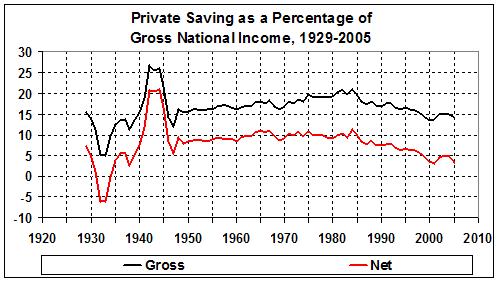
Derived from Bureau of Economic Analysis, National Income and Product Accounts Tables: 5.1, Saving and Investment. Gross private saving is analagous to cash flow; net private saving is analagous to cash flow less an allowance for depreciation. The bulge in gross private saving represents pent-up demand for consumption and investment spending, which was released after the war.

World War II did bring about the end of the Great Depression, not directly by full employment during the war but because that full employment created a “glut” of saving. After the war that “glut” jump-started

  • capital spending by businesses, which — because of FDR’s demise — invested more than they otherwise would have; and
  • private consumption spending, which — because of the privations of the Great Depression and the war years — would have risen sharply regardless of the political climate.

UPDATE: Robert Higgs, in an e-mail to me dated 06/24/06, submitted the following comment:

I happened upon your blog post that deals with my ideas about why the depression lasted so long and about the way in which the war related to the genuine prosperity that returned in 1946 for the first time since 1929. I appreciate the publicity, of course. I suggest, however, that you read my entire book, especially, with regard to the points you make on your blog, its chapter 5, “From Central Planning to the Market: The American Transition, 1945-47” (originally published in the Journal of Economic History, September 1999. I show there that the “glut of savings” idea, which is an old one, indeed perhaps even the standard theory of the successful postwar reconversion, does not fit the facts of what happened in 1945-47.

Here is my reply of 10/12/06:

I apologize for the delay in replying to your e-mail about my post… Your book, Depression, War, and Cold War, has not yet made it to the top of my Amazon.com wish list, but I have found “From Central Planning to the Market: The American Transition, 1945-47” on the Independent Institute’s website (here). If the evidence and arguments you adduce there are essentially the same as in chapter 5 of your book, I see no reason to reject the “glut of savings” idea, which is an old one, as I knew when I wrote the post. But, because it is not necessarily an old one to everyone who might read my blog, it is worth repeating — to the extent that it has merit.

At the end of the blog post I summarized the causes of the end of the Great Depression, as I see them:

World War II did bring about the end of the Great Depression, not directly by full employment during the war but because that full employment created a “glut” of saving. After the war that “glut” jump-started

  • capital spending by businesses, which — because of FDR’s demise — invested more than they otherwise would have; and
  • private consumption spending, which — because of the privations of the Great Depression and the war years — would have risen sharply regardless of the political climate.

In the web version of chapter 5 of your book you attribute increased capital spending to an improved business outlook (owing to FDR’s demise) and (in the section on the Recovery of the Postwar Economy, under Why the Postwar Investment Boom?) to “a combination of the proceeds of sales of previously acquired government bonds, increased current retained earnings (attributable in part to reduced corporate-tax liabilities), and the proceeds of corporate securities offerings” to the public. It seems that those “previously acquired government bonds” must have arisen from the “glut” of corporate saving during World War II.

What about the “glut” of personal saving, which you reject as the main source of increased consumer demand after World War II? In the online version of chapter 5 (in the section on the Recovery of the Postwar Economy, under Why the Postwar Consumption Boom?) you say:

The potential for a reduction of the personal saving rate (personal saving relative to disposable personal income) was huge after V-J Day. During the war the personal saving rate had risen to extraordinary levels: 23.6 percent in 1942, 25.0 percent in 1943, 25.5 percent in 1944, and 19.7 percent in 1945. Those rates contrasted with prewar rates that had hovered around 5 percent during the more prosperous years (for example, 5.0 percent in 1929, 5.3 percent in 1937, 5.1 percent in 1940). After the war, the personal saving rate fell to 9.5 percent in 1946 and 4.3 percent in 1947 before rebounding to the 5 to 7 percent range characteristic of the next two decades. After having saved at far higher rates than they would have chosen in the absence of the wartime restrictions, households quickly reduced their rate of saving when the war ended.

That statement seems entirely consistent with the proposition that consumers spent more after the war because they had the money to spend — money that they had acquired during the war when their opportunities for spending it were severely restricted. Not so fast, you would say: What about the fact that “individuals did not reduce their holdings of liquid assets after the war” (your statement)? They didn’t need to. Money is fungible. If consumers had more money coming in (as they did), they could spend more while maintaining the same level of liquid assets — because they had a “backlog” of saving. Here’s my take:

  • Higher post-war incomes didn’t just happen, they were the result of higher rates of investment and consumption spending.
  • The higher rate of investment spending was due, in part, to corporate saving during the war and, in part, to individuals’ purchases of corporate securities and equities.
  • At bottom, the wartime “glut” of personal saving enabled the postwar saving rate to decline to a more normal level, thus allowing consumers to buy equities and securities — and to spend more — without drawing down on their liquid assets.

Granted, business and personal saving during World War II was not nearly as large in real terms as it was on paper — given the very high real cost of the war effort. But it was the availability of paper savings that strongly influenced the behavior of businesses and consumers after the war.

Perhaps I am misinterpreting the evidence you present in chapter 5. And perhaps there is more in other chapters of your book that I should take into account. I will be grateful for a reply, if and when you have the time.

I will further update this post if Mr. Higgs replies to my note of October 12, 2006.

I Wish I’d Said That

A few choice bits from today’s reading:

Skating on the floor of the roller rink is an example of what Friedrich Hayek called spontaneous order. The process is beneficial and orderly, but also spontaneous. No one plans or directs the overall order. Decision making is left to the individual skater. It is decentralized.

— Daniel B. Klein, “Rinkonomics: A Window on Spontaneous Order,” The Library of Economics and Liberty

Killing the #2 man in al Qaida just means everybody in the organization moves up one notch. The former #3 guy is the new #2 guy, the former #10 guy is now the #9 guy, and the new #48 guy is Howard Dean.

Just so you know, I’m ashamed that the Dixie Chicks are from America.

— Ann Coulter, in an interview at FrontPageMag.com

If the fact that a man who regards his son’s butcher as a better man than the American president is rewarded with a party’s nomination to Congress does not tell you all you need to know about the morally twisted world of the Greens, nothing will.

— Dennis Prager, writing of Michael Berg, the father of Nick Berg, at FrontPageMag.com

The beauty of doing nothing is that you can do it perfectly. Only when you do something is it almost impossible to do it without mistakes. Therefore people who are contributing nothing to society except their constant criticisms can feel both intellectually and morally superior.

“”We are a nation of immigrants,” we are constantly reminded. We are also a nation of people with ten fingers and ten toes. Does that mean that anyone who has ten fingers and ten toes should be welcomed and given American citizenship?”

— Thomas Sowell, “Random thoughts,” Townhall.com

After the London tube bombings, Angus Jung sent the Aussie pundit Tim Blair a note-perfect parody of the typical newspaper headline:

“British Muslims fear repercussions over tomorrow’s train bombing.”

An adjective here and there, and that would serve just as well for much of the coverage by the Toronto Star and the CBC, where a stone through a mosque window is a bigger threat to the social fabric than a bombing thrice the size of the Oklahoma City explosion.

— Mark Steyn, “You can’t believe your lyin’ eyes,” Macleans.ca

Carnival of Liberty XLIX

Welcome to the 49th Carnival of Liberty. These Carnivals celebrate the “unalienable” rights of life, liberty, and property — all of which are essential to the pursuit of happiness.

Carnivals (of the real kind) attract a motley cross-section of humanity. Carnivals of Liberty similarly attract a varied cross-section of blogdom. This 49th Carnival of Liberty offers as many views of life, liberty, and property as there are entries — 35 of them, by my count. Instead of simply giving you the basics (blogger’s name and links to his or her blog and Carnival entry), I am including brief excerpts of most entries, to entice you to read further.

The good news is that you’ll find much that conforms to and confirms your own views. The better news is that you’re sure to find much that challenges you and makes you think more deeply about liberty: what it is and whence it comes, how best to defend it, the role of government in defending it (or suppressing it), who its friends and enemies are, how it fares abroad, and how the blogosphere fosters it.

Now, on with the show . . .

FIRST PRINCIPLES

Francois Tremblay of The Radical Libertarian argues (in Using “the poor” as a moral totem) for “market anarchy” as the source of liberty. For example:

What it boils down to is, who gets to dictate how you live your life? You, or someone else? In a market anarchy, the answer is “me”. . . .

Only states can force me to accept their rule, because states, as monopolies of force, are not accountable to anyone except their leaders’ own basic sense of decency.

A direct answer to Francois comes from Nick of The Liberty Papers. In Why Any Rights At All? he offers “a classical liberal’s response to the challenge of anarchy.” In the course of a thoughtful and carefully argued post Nick says that the “anarchist turns a blind eye to the difference between the perfect world of their assumptions and the real world.”

I must admit my agreement with Nick. See, for example, A Flawed Defense of Anarcho-Capitalism, where I give some of my reasons for rejecting the viability of market anarchy. I also link there to several earlier posts in which I challenge various tenets of anarcho-capitalism.

Dana, the proprietor of Principled Discovery, sees liberty as a birthright that is secured by social processes. In Freedom: An Ancient Custom of Rights and Responsibilities she writes: “It . . . stems from our belonging to a group of free people governed by law. Our connection to one another is as important as our rights.”

The importance of Christian morality to liberty is a subject of TF Stern’s post, Are We Fully Ripe With Iniquity?, at T. F. Stern’s Rantings. For example, he quotes Robert Bork, who points out that

[r]eligion accounts for civility and self-restraint in our society, which is vanishing as religion has been marginalized and pushed to the sidelines of the debate. The Supreme Court has played a large role in doing this.

NStalker of Pragmatic Speak, in a post titled Their Rights In Exchange For Mine And Yours? addresses the question “How can the rights of one individual or group impinge on the rights of another?” His legitimate concern is about the ability of protestors to impose costs on the rest of us through the exercise of their speech rights. I must say — as a former resident of the D.C. area — that I’m quite sympathetic to his case.

IN DEFENSE OF LIFE, LIBERTY, AND PROPERTY

In D-day & Reflection on the War on Terror at ROFASix, NOTR takes exception to the idea that U.S. forces are in Iraq and Afghanistan for the purpose of exporting democracy:

D-day is . . . a good time to reflect and question whether the evil that threatens us today will rob us of our freedom, liberty, and way of life if we should not defeat it. Why else would we fight in Iraq and Afghanistan? If is for the people of those countries then we need to question why we fight there. If we are in those countries attempting to foster the growth of new nations for our national interest, then the cause is right. If the people there benefit, then it is a freebie for them, but ultimately we must do it only for us, for America, not them.

Bull Jones at The Bull Speaks! presents Salute to our Flag, our Sailors, a Victory, & Franklin. Bull pays special tribute to “MA1 Anthony LaFrenier, USN. . . . He is even now on duty somewhere over in the Sandbox protecting our Freedoms and bringing those Freedoms to the Oppressed.” Who is Franklin? Read the Bull’s short post to find out.

Remember the Second Amendment? The Framers saw the right to bear arms as a bulwark of liberty, as does Stan at Free Constitution, where he posts a feature called Second Amendment Saturday. Apparently there is an effort by our “friends” at the U.N. “to finalize a U.N. treaty that would strip all citizens of all nations of their right to self-protection, and strip you of your rights under the Second Amendment.”

Peter Porcupine thinks that in our preoccupation with the Mexican border we are Looking in the Wrong Direction: “It is worth noting that so far, every successful terrorist has entered the United States from Canada.” Why? Peter has some thoughts about that. Go there.

Enough of war, guns, and borders. As we were reminded rudely by last year’s infamous Supreme Court decision in Kelo v. City of New London, the power of eminent domain poses an omnipresent threat to property rights. Ogre, of Ogre’s Politics and Views, discusses the efforts of the NC Property Rights Coalition toward “a state Constitutional amendment to ensure that North Carolinians’ private property is safe from eminent domain abuse.”

On that topic, Carola Von Hoffmannstahl-Solomonoff of Mondo QT offers Revitalization, My Lovely: Chapter 7. She says:

It’s the latest chapter of a serial satire drawn from personal experience in, and observation of, political life in the northeast’s post industrial cities. Though fiction, every word is true.

Then there’s the issue of jury nullification, which is the subject of Warning About Nullification by Dave at Tucents. You should read Dave’s post to find out why he favors nullification, but here’s a peek at what he has to say: “If the government is violating your civil rights (in this case, your right to judge the law), why are you morally obligated to obey the law and cooperate with the violation?”

Matt Barr of New World Man has more to say about jury nullification in Buying a juror’s vote to acquit: A primer. Here’s a sample of what you’ll find there:

Is incentivizing a juror to exercise his or her right to nullify a verdict “corrupt”? I have a feeling the consensus would be that it is. But it isn’t a slam dunk. As long as you don’t do any of this in writing.

Housing Bubble Death Trap, by Dan Melson of Searchlight Crusade, is about property — but not about property rights. I include it nevertheless because it’s analytical and well written. Here’s a key paragraph:

This then, is what I call the Housing Bubble Death Trap. People who bought too much house with unstable loans, then had the market recede a little on them. Now they are upside down (owe more on the property than it is worth) with a loan they cannot refinance and cannot afford, and they can’t sell for as much money as they paid.

Dan explains how this happens and offers some advice about how to avoid it.

YOUR GOVERNMENT AT WORK (AND OTHERWISE)

Michael Hampton at Homeland Stupidity asks What’s an essential government service? It’s evident that government doesn’t know the answer. As Michael says, with due sarcasm, “it’s so comforting to know that FEMA is watching out for the public libraries in the event of a nuclear or terorrist attack.” Public libraries?

MIchael also takes a swing at the publication of classified information (On publishing secrets). He’s scornful of the government’s claims that such actions harm national security. That’s all I’ll say about that.

Could it possibly be that the people of California are growing tired of the nanny state?” TKC of The Pubcrawler asks that question (and answers it) in his analysis of a typically unbalanced op-ed by E.J. Dionne of The Washington Post. Go to Voting in California gets the quote of the day for the whole story.

Meanwhile, Colorado seems to have lost sight of the right to bear arms. Richard G. Combs (Combs Spouts Off) tells us, in Denver gun control upheld — sort of, that the “Colorado Supreme Court split 3-3 on the question of whether Denver’s status as a “home rule” city trumps state law.” He notes that

the legal battle was over Denver’s “rights” versus the state’s “rights.” The rights of us peons apparently didn’t enter into the debate, even though the state constitution says our right to bear arms can’t even be “call[ed] into question.”

Avant News – Tomorrow’s news today makes light of the recently defeated Defense of Marriage Amendment in Bush Calls for Constitutional Amendment Protecting Pandering:

During a speech delivered in the White House Rose Garden, President George W. Bush today made the case for an important new proposed constitutional amendment, the “Defense of Pandering Amendment”. Under the terms of the proposed amendment, it would become unlawful for journalists, lawmakers and private citizens to publicly identify election-year pandering as election-year pandering during the course of an election-year pandering cycle.

John of hell’s handmaiden offers a sober, federalist take on the same issue, in Bush Fights to Limits Rights:

Bush argues that we need to “take this issue [of gay marriage] out of the hands of overreaching judges and put it back where it belongs: in the hands of the American people” and claims that the [Defense of Marriage Amendment] is needed because “judges insist on imposing their arbitrary will on the people”. His position is fairly well absurd primarily because this issue was not taken from the people by the courts, but by federal state and local law and the courts, in acting to protect same-sex marriage, are acting to return it to those people.

And from Rick Sincere News and Thoughts comes Republicans Oppose Anti-Marriage Amendment, which begins with this observation: “Republicans, like gay men and lesbians, do not all think alike. Neither group marches in lockstep with its leaders, nor do they agree monolithically on all major public policy issues.” Rick documents that statement with quotations from several “dissenting” Republican sources.

As a reminder of the days when some of us believed in the possibility of the restoration of limited government, here’s a personal recollection of the Reagan years. Jack Yoest opens Ronald Reagan Dead, The Greatest American with this: “Two years ago Ronald Reagan died. Charmaine and I watched the funeral with other Reaganites in Washington, DC. And watched the big black Cadillac carry RR away.”

Back to the present, I learn in NYPD’s mission: to subjugate and harass that Perry Eidelbus (Eidelblog) really, really doesn’t care much for the “pigs” of the NYPD. He begins on this note:

To subjugate and harass” as opposed to “To protect and serve.” I expect the following will offend some of you. “Law and order” is great, but as with all things, at what cost? What price are you willing to pay to have it? . . . I’ve really come to distrust and even hate so-called “law enforcement.” In fact, my natural skepticism and cynicism of any authority is largely responsible for my libertarian leanings.

I link, you decide.

THE LEFT (AND RIGHT) AT WORK

LeslieCarbone opens Strange Bedfellows with this: “When the Christian Coalition and MoveOn team up, it’s bound to be bad. The two special interest groups announced their unlikely marriage via an ad in Friday’s New York Times.” That’s all I’m giving away. You must read the post to find out what the strange bedfellows are up to.

Dan Kauffman (Committees of Correspondence) wants to know When Will They Make Up Their Minds? Who are “they”? I’m not telling; you have to read it.

Is Kos a libertarian? Michael Hampton at Homeland Stupidity doesn’t think so. Michael, making his third appearance here, begins Kos is no libertarian with this:

Markos “Kos” Moulitsas writes today that he’s a “Libertarian Democrat.” You won’t believe what he means by that. But then he goes on to demolish his own argument. Kos is not a libertarian anything, just the same state-loving, corporation-empowering Democrat as all the rest.

And Michael tells you why.

FOREIGN AFFAIRS

Let’s begin a whirlwind world tour close to home. Mapmaster at The London Fog presents Canada Post: the power and the glory in one convenient package. I was quite taken by this passage:

Notwithstanding its own added business at the cost of lost jobs for its competitors, elimination of choice for consumers, and the net loss of wealth in the economy, Canada Post still somehow manages to cast itself not as an unscrupulous over-sized agressor but as a defender of Canadian virtue.

Jonn at The Sharpener, in a post titled In defence of small government liberalism, “worries . . . about the structure of British government: it makes a single voice too strong.” He contrasts Britain’s system with that of the U.S.; for example:

Compare it to the carefully constructed checks and balances of the US constitution. In the US, power is dispersed between the presidency, two houses of Congress elected by different constituencies on different election cycles, and the states themselves. The whole thing is overseen by a judiciary which owes its first loyalty to the constitution itself.

There’s a lot more. Americans should read it to gain a better appreciation of the American system — for all its flaws.

Jorg at Atlantic Review addresses the “World Cup brothels” in Congressman Accuses Germany of “Complicity in Promoting Sex Trafficking”. He offers what seems a balanced view of the issue, from a German perspective. There’s more to it than prostitution. Thanks Jorg, and thanks also for your invitation to participate in the third Carnival of German-American Relations on July 2 (information here).

Doug Mataconis (Below The Beltway) remembers Tiananmen Square, in Seventeen Years Later. He recalls an article of his that was published in the September 1991 edition of The Freeman, which begins with this:

Every so often, an event occurs that stands as a monument to the continuing struggle for human freedom and serves as a reminder to all who work for liberty that even when success seems farthest from reach, they can make a difference.

And then there was Tiananmen Square, where “a lone man ran into the middle of the street and stood in front of the lead tank, preventing the entire column from moving.” But it’s a moving post. Read it.

Reporting directly from the China of today, Lonnie Hodge of One Man Bandwith gives us a flavor of the current regime, in New Mysteries of the DaVinci Code in China. A tidbit:

. . . Chinese authorities detained 28 Christians in a raid on an unauthorized church service at a private home in Shanghai.

Three members of the unregistered non-denominational Protestant congregation, including the host and the presiding minister are still behind bars according to the Texas-based China Aid Association.

Meanwhile, in Iran, things are much the same — if not worse. In The Seventh Seal, a second entry from Committees of Correspondence, Dan Kauffman observes that

we take much for granted here in the West, such as Freedom of Speech. We hear some talking glibly of “Speaking Truth to Power” and they have NO idea what that means. They believe a reduction in CD sales makes them martyrs.

Kauffman contrasts that attitude with the sudden demise of a dissident Iranian blog.

THE POWER OF THE BLOGOSPHERE

I could have placed IRAN: Must Free Journalists and Bloggers! (from Mensa Barbie Welcomes You) under “Foreign Affairs” because it picks up where Dan Kauffman’s post leaves off. But the suppression of bloggers (and journalists) in Iran is grim evidence of the threat they pose to the Iranian regime. As a result of that perceived threat,

scores of Journalists and Bloggers, are being subjected to imprisonment, due to a censorship sweep in Iran. Many were arrested while calling for greater personal freedoms. Some imprisoned while delivering relevant news “found to be inconvenient” by their governmental regimes, and others refusing to follow an imposed line. In fact, many face informal hearings which could impose a death sentence.

Brad Warbiany at The Unrepentant Individual reviews Glenn Reynolds’s An Army of Davids in the aptly titled Book Review: An Army of Davids. Reynolds’s book isn’t only about bloggers; it’s more generally about the growing power of individuals, as individuals, to influence events. But bloggers (and the internet) play a key role. A taste of Brad’s post:

Reynolds uses the example of the creation of the internet as a global information warehouse, pointing out the naysayers– had they been asked 10 years ago if our current access to information was even possible– would never have thought it could occur. The argument of “it would take every librarian in the world decades to input all that information” doesn’t make sense when you have millions of individuals willing to do it for them, for free, simply because they find it interesting.

Read all of Brad’s post, then buy the book, as I plan to do.

NOTA BENE

TuCents will host Carnival of Liberty L. Material for that Carnival and future Carnivals may be submitted via Conservative Cat or Blog Carnival.

If you’re in search of additional education or inspiration, links to past Carnivals can be found on Blog Carnival‘s index page.

Carnival of Links

Tomorrow I will post Carnival of Liberty XLIX. While you’re waiting for that, try these:

Cornel West’s Favorite Communist
, by David Horowitz (FrontPageMag.com)

Guest workers aren’t cheap; they’re expensive, by Phyllis Schlafly (Townhall.com)

Clinton Links GOP Policies to More Storms (wrongly, of course), from the Associated Press (via Breitbart.com)

A review of Not Even Wrong: The Failure of String Theory and the Continuing Challenge to Unify the Laws of Physics, by John Cornwell (Times Online)

Libertarianism and Poverty
, by Arnold Kling (TCS Daily)

Coulter clash on LI, at Newsday

Favorite passage:

New York Sen. Hillary Rodham Clinton called the book a “vicious, mean-spirited attack,” and said, “Perhaps her book should have been called ‘Heartless.'”

Coulter responded to Clinton on the radio show yesterday: “I think if she’s worried about people being mean to women she should have a talk with her husband.”

(More here and here.)

Why Do We Spend So Much on Defense?, by Justin Logan (Cato@Liberty)

Answer: Because, in addition to fighting terrorists, which you wrongly think can be done on the cheap, we must be prepared to ensure that the next generation of ambitious regimes (e.g., Russia) doesn’t try to pull a “Munich” on us. That’s why, you libertarian nay-sayer.

Starving the Beast, by Greg Mankiw (Greg Mankiw’s Blog)

See especially this linked article. See also my post, Starving the Beast, Updated.

More Saddam Terrorist Ties Discovered, by Lorie Byrd (Wizbang!)

Next: WMD. Bush lied?

Motives, by Don Boudreaux (Cafe Hayek)

Haditha: Backtrack Baby, Backtrack
, by Mary Katharine Ham (Hugh Hewitt)

Why I cannot trust the Democrats
, by Jon Henke (QandO)

Heat Got You Down?

Here in central Texas we have been enjoying unseasonably warm temperatures for a month or so. Daytime highs aren’t in the 100s, but they’re close. I’m not complaining; I enjoy the persistently sunny and dry weather, and the relatively low humidity that accompanies it. For those of you who have been experiencing similar weather but are less enamored of it than I am, here’s a poem that might cause you to bless the bright, blazing Sun:

The Cremation of Sam McGee
By Robert Service (1874-1958)

There are strange things done in the midnight sun
By the men who moil for gold;
The Arctic trails have their secret tales
That would make your blood run cold;
The Northern Lights have seen queer sights,
But the queerest they ever did see
Was that night on the marge of Lake Lebarge
I cremated Sam McGee.

Now Sam McGee was from Tennessee, where the cotton blooms and blows.
Why he left his home in the South to roam ’round the Pole, God only knows.
He was always cold, but the land of gold seemed to hold him like a spell;
Though he’d often say in his homely way that “he’d sooner live in hell.”

On a Christmas Day we were mushing our way over the Dawson trail.
Talk of your cold! through the parka’s fold it stabbed like a driven nail.
If our eyes we’d close, then the lashes froze till sometimes we couldn’t see;
It wasn’t much fun, but the only one to whimper was Sam McGee.

And that very night, as we lay packed tight in our robes beneath the snow,
And the dogs were fed, and the stars o’erhead were dancing heel and toe,
He turned to me, and “Cap,” says he, “I’ll cash in this trip, I guess;
And if I do, I’m asking that you won’t refuse my last request.”

Well, he seemed so low that I couldn’t say no; then he says with a sort of moan:
“It’s the cursèd cold, and it’s got right hold, till I’m chilled clean through to the bone.
Yet ’tain’t being dead — it’s my awful dread of the icy grave that pains;
So I want you to swear that, foul or fair, you’ll cremate my last remains.”

A pal’s last need is a thing to heed, so I swore I would not fail;
And we started on at the streak of dawn; but God! he looked ghastly pale.
He crouched on the sleigh, and he raved all day of his home in Tennessee;
And before nightfall a corpse was all that was left of Sam McGee.

There wasn’t a breath in that land of death, and I hurried, horror-driven,
With a corpse half hid that I couldn’t get rid, because of a promise given;
It was lashed to the sleigh, and it seemed to say: “You may tax your brawn and brains,
But you promised true, and it’s up to you, to cremate those last remains.”

Now a promise made is a debt unpaid, and the trail has its own stern code.
In the days to come, though my lips were dumb, in my heart how I cursed that load.
In the long, long night, by the lone firelight, while the huskies, round in a ring,
Howled out their woes to the homeless snows — Oh God! how I loathed the thing.

And every day that quiet clay seemed to heavy and heavier grow;
And on I went, though the dogs were spent and the grub was getting low;
The trail was bad, and I felt half mad, but I swore I would not give in;
And I’d often sing to the hateful thing, and it hearkened with a grin.

Till I came to the marge of Lake Lebarge, and a derelict there lay;
It was jammed in the ice, but I saw in a trice it was called the “Alice May.”
And I looked at it, and I thought a bit, and I looked at my frozen chum;
Then “Here,” said I, with a sudden cry, “is my cre-ma-tor-eum.”

Some planks I tore from the cabin floor, and I lit the boiler fire;
Some coal I found that was lying around, and I heaped the fuel higher;
The flames just soared, and the furnace roared — such a blaze you seldom see;
And I burrowed a hole in the glowing coal, and I stuffed in Sam McGee.

Then I made a hike, for I didn’t like to hear him sizzle so;
And the heavens scowled, and the huskies howled, and the wind began to blow.
It was icy cold, but the hot sweat rolled down my cheeks, and I don’t know why;
And the greasy smoke in an inky cloak went streaking down the sky.

I do not know how long in the snow I wrestled with grisly fear;
But the stars came out and they danced about ere again I ventured near;
I was sick with dread, but I bravely said: “I’ll just take a peep inside.
I guess he’s cooked, and it’s time I looked”; … then the door I opened wide.

And there sat Sam, looking cool and calm, in the heart of the furnace roar;
And he wore a smile you could see a mile, and said: “Please close that door.
It’s fine in here, but I greatly fear, you’ll let in the cold and storm —
Since I left Plumtree, down in Tennessee, it’s the first time I’ve been warm.”

There are strange things done in the midnight sun
By the men who moil for gold;
The Arctic trails have their secret tales
That would make your blood run cold;
The Northern Lights have seen queer sights,
But the queerest they ever did see
Was that night on the marge of Lake Lebarge
I cremated Sam McGee.

(Source: Poem of the Week)

Just Say When

Left-wing dingbat Jeralyn Merritt has a problem with the successful anti-terrorist operation that led to the death of Abu Musab al-Zarqawi:

It was an act of retaliatory terrorism. By our government. And I don’t want it to be in my name. Even if he was, as we’re told, the devil incarnate. Violence begets violence. It’s time for the war and the killing to stop.

I guess she wouldn’t want U.S. forces to rescue her if she were being held by terrorists, if it meant that terrorists had to die as a result.

If you bother to read Merritt’s post, you must also read this one.

Free Market Environmentalism? Not This Time

Cato’s Jerry Taylor — a smart, no-nonsense fellow — comments about a current environmental lawsuit:

We don’t need no stinkin’ environmental regulations to save the earth — all we need are well functioning property rights for environmental resources and common law courts to protect that property against trespass. Pollution is simply a neighbor’s garbage dumped in your backyard without permission. If we simply recognize and enforce property rights for nature, the need for most environmental regulation goes away.

That’s the libertarian pitch anyway, and it goes by the moniker “Free Market Environmentalism,” or “FME” to its acolytes. FME was given a firm theoretical foundation by Ronald Coase, embellished and blessed by libertarian economist Murray Rothbard, given academic life by the Political Economy Research Center and the Foundation for Research on Economics and the Environment, popularized in Washington by the Competitive Enterprise Institute, and even pitched by yours truly to the Board of Trustees of the Natural Resources Defense Council about nine years ago.

Alas, there has never been much evidence to suggest that libertarians were making much headway with these arguments and I have come to believe that they have less promise than I had once imagined. But what do you know? FME is now all the rage amongst environmentalists who have discovered that suing polluters for tresspass is easier than passing satisfactory laws against the same.

Jerry nevertheless finds a glimmer of hope in the case at hand, in which

eight states, New York City and conservation groups pressed for reduced greenhouse gas emissions from the nation’s five largest electric utilities.

Jerry concludes with this:

Sure, one can argue that the plaintiffs don’t have proper standing, that there is really no nuisance here to begin with, that the tort system is so messed up that employing it in such cases is problematic, etc. But nonetheless, this is a growing trend and libertarians seem surprisingly ambivalent about it.

You said it, Jerry, the plaintiffs don’t have proper standing. The case has nothing to do with FME. It’s just another attempt to legislate through litigation, which has been tried in the case of tobacco (with success) and gun control (without success). FME is about private parties seeking redress under the common law. That’s not what’s happening here. Find a better example — if you can.

In Defense of Ann Coulter

You’ve read about Ann Coulter’s book, Godless: The Church of Liberalism, and the controversy that surrounds it because of a passage quoted by Today‘s Matt Lauer in his recent interview of Coulter. The passage is embedded in one of Lauer’s questions (quoted at this Leftist site):

LAUER: On the 9-11 widows, an in particular a group that had been critical of the administration: “These self-obsessed women seem genuinely unaware that 9-11 was an attack on our nation and acted like as if the terrorist attack only happened to them. They believe the entire country was required to marinate in their exquisite personal agony. Apparently, denouncing bush was part of the closure process.” And this part is the part I really need to talk to you about: “These broads are millionaires, lionized on TV and in articles about them, reveling in their status as celebrities and stalked by griefparrazies. I have never seen people enjoying their husband’s death [sic] so much.” Because they dare to speak out?

In the aftermath of the Today interview much has been said about what Coulter wrote — and about the reactions to what she wrote. See, for example, this, this, this, this, this, and especially this, where Fran Porretto of Eternity Road quotes from Godless to put in context the infamous “enjoying their husbands’ deaths” passage:

After 9/11, four housewives from New Jersey whose husbands died in the attack on the World Trade Center became media heroes for blaming their husbands’ deaths on George Bush and demanding a commission to investigate why Bush didn’t stop the attacks. Led by all-purpose scold Kristen Breitweiser, the four widows came to be known as “the Jersey Girls.” (Original adorable name: “Just Four Moms From New Jersey.”) The Jersey Girls weren’t interested in national honor, they were interested in a lawsuit. They first came together to complain that the $1.6 million average settlement to be paid to 9/11 victims’ families by the government was not large enough.

After getting their payments jacked up, the weeping widows took to the airwaves to denounce George Bush, apparently for not beaming himself through space from Florida to New York and throwing himself in front of the second building at the World Trade Center. These self-obsessed women seemed genuinely unaware that 9/11 was an attack on our nation and acted as if the terrorist attacks happened only to them. The whole nation was wounded, all of our lives reduced. But they believed the entire country was required to marinate in their exquisite personal agony. Apparently, denouncing Bush was an important part of their closure process. These broads are millionaires, lionized on TV and in articles about them, reveling in their status as celebrities and stalked by grief-arazzis. I’ve never seen people enjoying their husbands’ deaths so much.

Ed Morrissey’s reaction (linked above) exemplifies that of the conservative tut-tut brigade:

[I]f one ever needed proof that the political spectrum resembles a circle where the extremes meet, this should provide it. In fact, it reminded me of another pundit whom the Left lionizes and the Right reviles: Ted Rall. Why Rall? Three years ago, Rall made essentially the same point in one of his crude cartoons and got rightly panned for it. It became one of the reasons that the Washington Post ended its association with Rall in 2004.

Whether Rall or Coulter says it, impugning the grief felt by 9/11 widows regardless of their politics is nothing short of despicable. It denies them their humanity and disregards the very public and horrific nature of their spouses’ deaths. The attacks motivated a lot of us to become more active in politics in order to make sure our voices contribute to the debate, and it is impossible to argue that the 9/11 widows (and widowers, and children, and parents) have less standing to opine on foreign policy than Ann Coulter or Ted Rall.

It is simply absurd to link Coulter and Rall. Coulter writes in defense of America and its ideals. Rall disdains America and its ideals; he roots for the bad guys.

More importantly, Coulter did not impugn the grief of 9/11 widows in general, she impugned the self-centered, money-grubbing, partisan actions of “the Jersey Girls.” Their grief gives them no license to tax Americans. Life is full of tragedies — preventable and unpreventable — but why should the survivors of the victims of one particular tragedy be singled out for special attention and recompense? Was there a “12/7 Fund” in the aftermath of Pearl Harbor? Have we lavished millions on each of the widows of the servicemen killed in Iraq and Afghanistan? Where did we (or so many of us) get the idea that we are owed munificent recompense for every bad thing that happens to us? Stuff happens — that’s why we buy insurance.

But demanding tribute was not enough for the Jersey Girls. They went on to scold the 9/11 Commission and then to engage in partisan politics, as if wisdom accompanies grief. It is true that the Jersey Girls have no less standing than anyone else to speak their minds. But neither do they have more standing than anyone else. But that is what they have claimed — and been granted, by many. Their “credibility” arises solely from the fact that they are 9/11 widows, not because they have thought long, hard, and productively about issues of war and peace. Ann Coulter, by contrast, has done the long, hard, thinking — which she does convey in a rather polemical style. (Ted Rall’s thinking, on the other hand, is as deep as the ink on a page of The New York Times.)

With that out of the way, I will explain why Coulter is right to say that “I’ve never seen people enjoying their husbands’ deaths so much.” Enjoy means (among other things) “have benefit from; ‘enjoy privileges’.” And that’s precisely what the Jersey Girls have done. They have exacted tribute from us and exercised unwarranted influence in politics — simply because of the manner of their husbands’ deaths. Boobs who criticize Coulter would do well to improve their command of English.

Good Advice for the Libertarian Party

I offered my advice to the LP here. Now, Bill Niskanen of the libertarian Cato Institute offers his, which is similar to mine; for example:

The Libertarian Party’s effectiveness in promoting their policy positions is often counter-productive when running a candidate, reducing the vote for the most preferred of the major party candidates. A disciplined group that is prepared to endorse one or the other major party candidate in a close election, however, can have a substantial effect on the issue positions of both major party candidates. . . .

This is a strategy to increase the approval of libertarian policy positions rather than the usually counter-productive effort to increase the number of votes for Libertarian candidates. Maybe it is better to term the organization that I have described as a libertarian political action group, not a libertarian party.

Precisely.

Another Argument for the Death Penalty

From the Associated Press via Yahoo! News:

A registered sex offender confessed to killing a Clemson University student and to sexual assaults in Alabama and Tennessee, authorities said Wednesday. . . .

“He didn’t know the victim,” [Jefferson County, Tenn., Sheriff David] Davenport said Wednesday. “It is our information he was driving around in the (victim’s) neighborhood and saw her and he liked her looks.”

In Rainsville, Ala., Inman was charged with attempted rape, burglary, robbery and theft of property in a May 23 incident in which authorities said he broke into a home and tried to attack a 24-year-old woman after she came home for lunch. Davenport said he expects Inman also will be charged with a May 24 rape in Sevierville, Tenn.

“It seems like he was just wandering around, finding vulnerable people — women — and preying on them and conducting sexual assaults and getting progressively worse,” Davenport said. “This may be just the tip of the iceberg.”

If incarceration rates in the U.S. are too high (hah!), it’s because we’re not executing enough predators.

Related posts:
Does Capital Punishment Deter Homicide?
Libertarian Twaddle about the Death Penalty
Crime and Punishment
Abortion and Crime
Saving the Innocent?
Saving the Innocent?: Part II
More on Abortion and Crime
More Punishment Means Less Crime
More About Crime and Punishment
More Punishment Means Less Crime: A Footnote
Clear Thinking about the Death Penalty
Let the Punishment Fit the Crime
Less Punishment Means More Crime
Crime, Explained

Jihad in Canada

The Globe and Mail reports (yesterday):

A plan to storm the House of Commons, take politicians hostage and behead Prime Minister Stephen Harper is among the sensational allegations to emerge yesterday after 15 men and youths charged in an anti-terrorism sweep appeared in court.

The startling revelations include purported plans to bomb power plants in Southern Ontario and take control of the CBC building in Toronto. The targets were on a shortlist the group had allegedly discussed in brainstorming sessions, before deciding on three: an unspecified Canadian military base, the Toronto Stock Exchange and the Canadian Security Intelligence Service building in downtown Toronto.

Who are these people? Michael Barone nails it:

Canadian officials deserve great credit for breaking up this terrorist ring. But they and all of us need to state plainly what we are up against. “Islamofascist-
murderingnutjobs” is not elegant, but it has the advantage of accuracy.

There’s a certain amount of denial, however, as Michelle Malkin reports:

Canadian law enforcement officials should be proud of busting a reputed Islamic terrorist network that may span seven nations. Instead, our northern neighbors are trying their damnedest to whitewash the jihadi ties that bind the accused plotters and their murder-minded peers around the world.

We live on a doomed continent of ostriches.

A Royal Canadian Mounted Police official coined the baneful phrase “broad strata” to describe the segment of Canadian society from whence Qayyum Abdul Jamal and his fellow adult suspects Fahim Ahmad, Zakaria Amara, Asad Ansari, Shareef Abdelhaleen, Mohammed Dirie, Yasim Abdi Mohamed, Jahmaal James, Amin Mohamed Durrani, Abdul Shakur, Ahmad Mustafa Ghany and Saad Khalid came. . . .

Undeterred by the obvious, Toronto police chief Bill Blair assured the public that the Muslim suspects “were motivated by an ideology based on politics, hatred and terrorism, and not on faith. . . . I am not aware of any mosques that these individuals were influenced by.” Well, Chief Blindspot, try the Al-Rahman Islamic Center for Islamic Education. That’s the Canadian storefront mosque where eldest jihadi suspect Qayyum Abdul Jamal is, according to his own lawyer, a prayer leader and active member — along with many of the other Muslim males arrested in the sweep.

Ralph Kinney Bennett addresses the “profiling” aspect of the case:

Hooray for Canadian law enforcement!

Hooray for profiling!

As the story unfolds of the arrest of 17 suspected Islamic terrorists and the seizure of a huge cache of explosive materials, Canadians, Americans, and free men everywhere can be thankful that the Canadian police and intelligence services had the courage to profile. . . .

As we have pointed out before here despite all the pretended piety over profiling, it continues to be one of the most important tools of preventive law enforcement. . . .

[T]he fact is law enforcement must discriminate as never before. It must make clear distinctions. It must differentiate. It must perceive the distinguishing features of terrorists and would-be terrorists. Unfortunately, thanks to the Islamofascists and the indelible and undeniable fingerprints they have left in New York, Washington, London, Madrid and elsewhere around the globe, square one in this exercise is usually at some mosque, where Muslims, usually of Arabic descent, gather.

In this particular case, a “store front” mosque in Mississauga, Ontario, the Al Rahman Islamic Center for Islamic Education, has been reported as the regular meeting place of 6 of the 17 persons arrested in the alleged terrorist plot to blow up various important sites in and around Toronto. . . .

The imam of a suburban Toronto mosque told the New York Times “we are being targeted not because of what we’ve done, but because of who we are and what we believe in.”

Well… no. And… yes. Canadian Muslims are not being “targeted.” Certain Muslims in Canada are being singled out because they appear to have been targeting the Canadian people and their institutions. They are being singled out because they believe in the cold-blooded murder of anyone who does not share their beliefs. They are being singled out because of their quaint belief that a solidly packed container of ammonium nitrate with a detonator attached is somehow a petition for redress of imagined grievances. They are the profile within the profile.

Just as many innocent Muslims must put up with the unfair onus of guilt by association and the blind anger of a small corner of the public (mosques vandalized etc.), so Canadian law enforcement must put up with the unfair and ignorant accusations that they are somehow, preying on Muslims as a whole. In the fetid atmosphere of political correctness that seems to have settled over much of Canada, that takes real courage.

The point is, even if this whole Canadian investigation somehow were to unravel, the grim, quiet, veiled and sometimes untidy life-and-death struggle that the security services have been waging — a struggle that involves profiling and skillful discrimination — is right, vital and necessary and must continue.

The defense of life, liberty, and property requires us to address hard facts. One of those hard facts is that a certain subset of the populace is more likely than other subsets to indulge a peculiar taste for bombing and beheading its chosen enemies. Remember, they chose us as enemies, not vice versa.

Bloggerly Overreach

Radley Balko, writing at Cato@Liberty, applauds Pejman Yousefzadeh’s piece at TCS Daily, “Legal Overkill.” Balko highlights the phrase “mistakes of lawyerly overreach,” as if Yousefzadeh were supportive of Balko’s rather hysterical fear that the Fourth Reich is upon us. All Yousefzadeh does is point out that

[t]hese efforts at overreach are being made in order to enhance the power of the Executive Branch, power that Bush Administration lawyers — not without reason — believe has been circumscribed over recent decades. But in making untenable claims in favor of the broadening of executive power, the Bush Administration lawyers are not only setting themselves up for failure regarding the specific claims involved, they are also setting up the Executive Branch to have its power circumscribed anew; exactly the opposite approach that is intended.

Yousefzadeh’s counsel is a matter of tactical disagreement, not strategic dissent. He homes in on the treatment of enemy combatants, concluding that

[i]f the Administration relied on the traditional laws of war as . . . codified by the Geneva Conventions it could have achieved its purpose of writing a legal justification for treating Taliban combatants — and for that matter, irregular Iraqi insurgents — differently from traditional POWs.

Nor should Balko and his ilk take comfort in Yousefzadeh’s bottom line:

There are a great many good-faith reasons to fear that the power of the Executive Branch has been unnecessarily diluted in recent years. But as a result of the Bush Administration’s overreach, those who seek to expand the powers of the Presidency may inadvertently end up helping to dilute it.

Well, Balko et al. might take comfort in the possibility of ham-stringing the commander-in-chief, given their apparent aversion to the actual defense of liberty. It is that defense, and not their puerile posturing, which enables them to indulge their suicidal devotion to the non-agression principle.

Other related posts:
Libertarian Nay-Saying on Foreign and Defense Policy
Libertarian Nay-Saying on Foreign and Defense Policy, Updated
Libertarians and the Common Defense
Libertarianism and Preemptive War: Part I
Libertarianism and Preemptive War: Part II

62 Years Ago Today

June 6, 1944:
If we Americans could be united against Nazi Germany, why can we not be united against equally evil Islamic terrorists and their enablers, at home and abroad? What has happened to us in the last 62 years? Think about it. The answers will come to you, if you let them. (Here’s a hint.)

(Photo courtesy of Hot Air.)

Quick Takes

The real meaning of the Supreme Court’s decision in Garcetti v. Ceballos. It’s not an anti-whistleblowing decision; it’s an employer-rights decision. He who pays the piper calls the tune.

An irrelevant, cross-national comparison of incarceration rates by a knee-jerk libertarian, who thinks that the U.S. rate is “absurd.” There’s no “right” rate. Each country must do as its circumstances dictate. Perhaps other countries’ rates are too low.

The Strata-Sphere links to “Thomas Sowell’s analysis on how the liberal mind set is built upon a pile of self aggrandizing fantasies. It is in four easy parts at RCP (I, II, III, IV).”

Some of the coverage — and coverage of the coverage — of the Toronto terrorists. And, relatedly, how “NSA Style Snooping Saved Lives.”

Gay marriage “looms as battle of our times.” Well, maybe along with immigration and after the war on terror.

Parenting, Religion, Culture, and Liberty

I once wrote the following, apropos abstinence education.

A few weeks ago, in a comment thread at Catallarchy, I made this observation:

Less teen sex = less disease + fewer unwanted children + fewer early (and often unhappy) marriages

Parents who want to protect their children therefore try to teach them to eschew sex because of its potential consequences. Abstinence — by definition — works better than prophylaxis and contraception.

That evoked a response in a later comment thread that I had “list[ed] only the harm caused by sex and not the benefit.” Well, there were plenty of hedonistic voices arguing the benefit side. What was needed was someone to argue the cost side, and that’s what I did. Moreover, my point — which seems to have been missed in all the shouting — was about the responsibility of parents to teach their children about the cost side.

The usual argument goes like this: Kids will do it anyway. Well, kids are less likely to do it “anyway” if they’re brought up to believe that they shouldn’t do it “anyway.” And the bringing-up isn’t done in public schools, it’s done in the home by parents who teach their children not only about sex but also about responsible (i.e., moral) behavior.

The critics of abstinence education focus on the results of studies (e.g., here and here) about the sexual practices of groups of public-school students. They conclude that abstinence education in public schools is ineffective and perhaps even counterproductive in its effects on teen pregnancy and sexually transmitted diseases. But such studies aren’t above criticism; see this, from The Heritage Foundation, for instance. Moreover, what those studies don’t tell us is what happens to teens who are predisposed (by their parents) to eschew sex. Here’s one bit of relevant information (from a research paper published by The Heritage Foundation):

[T]aking a virginity pledge in adolescence…is associated with a substantial decline in STD rates in young adult years. Across a broad array of analysis, virginity pledging was found to be a better predictor of STD reduction than was condom use. Individuals who took a virginity pledge in adolescence are some 25 percent less likely to have an STD as young adults, when compared with non-pledgers who are identical in race, gender, and family background.

More tellingly, there’s this, from the National Institutes of Health:

Teens — particularly girls — with strong religious views are less likely to have sex than are less religious teens, largely because their religious views lead them to view the consequences of having sex negatively. According to a recent analysis of the NICHD-funded Add Health Survey, religion reduces the likelihood of adolescents engaging in early sex by shaping their attitudes and beliefs about sexual activity . . . .

Sexual intercourse places teens at risk for sexually transmitted diseases, including HIV, and unintended pregnancy. The information provided by the study may prove important for health researchers and planners devising programs that help prevent teens from engaging in sexual activity.

Hmm . . . isn’t that what I said at the outset?

I now turn to this story about a letter published in the British Medical Journal (available only by subscription):

A letter by Australian bioethicist Dr. Amin Abboud published in the July 30 edition of the British Medical Journal notes that “A regression analysis done on the HIV situation in Africa indicates that the greater the percentage of Catholics in any country, the lower the level of HIV.”

Dr. Abboud’s letter comes in response to an article published in the journal’s June 4 issue which wonders if newly elected Pope Benedict XVI will alter the Church’s teaching on condoms in light of the burgeoning HIV/AIDS epidemic. Abboud asserts that “On the basis of statistical evidence it would seem detrimental to the HIV situation in Africa if he did authorise such a change.”

“On the basis of data from the World Health Organization,” reports Abboud, “in Swaziland where 42.6% have HIV, only 5% of the population is Catholic. In Botswana, where 37% of the adult population is HIV infected, only 4% of the population is Catholic. In South Africa, 22% of the population is HIV infected, and only 6% is Catholic. In Uganda, with 43% of the population Catholic, the proportion of HIV infected adults is 4%.” . . .

Abboud concludes his letter stating, “The causes of the HIV crisis in Africa need to be found elsewhere. The solutions must go beyond latex. If anything, the holistic approach to sexuality that Catholicism advocates, based on the evidence at hand, seems to save lives. I would welcome an editorial on that or, as a minimum, some evidence based advice on HIV.”

It all boils down to personal responsibility, which is taught by parents (especially those who bring up their children in a traditional religion) and undermined by government programs. I thought libertarianism was all about personal responsibility, but for many libertarians it seems to be all about hedonism.

Now there’s more evidence for my position.

A recent report by the Centers for Disease Control indicates that a male’s first age for sexual intercourse depends very much on whether he was raised in a two-parent or one-parent household. Specifically, Table 14 of the report indicates that a male who comes from a dual-parent household experiences first intercourse at age 17.0, as against age 15.8 for a male who comes from a single-parent household.

Moreover, religion — but not just any old religion — makes a difference. Catholics and other non-Protestants (largely Jewish, I assume) experience first intercourse later than males whose religious backgrounds are “none,” fundamentalist Protestant, or “other” Protestant.*

Parenting, religion, and culture do make a difference in the way children are raised and in how they behave — as children, and then as adults. Two parents raising a family within a deep-rooted, Western religion (e.g., Catholicism and Judaism) do a better job of teaching respect for life, liberty, and property.

Related posts:
I Missed This One
A Century of Progress?
Feminist Balderdash
Libertarianism, Marriage, and the True Meaning of Family Values
Religion and Personal Responsibility
The Consequences and Causes of Abstinence
Science, Evolution, Religion, and Liberty
Consider the Children
Marriage and Children
Same-Sex Marriage
“Equal Protection” and Homosexual Marriage
Equal Time: The Sequel
The End of Women’s “Liberation” and the Return of Patriarcy?

__________
* It is unsurprising that males from fundamentalist Protestant backgrounds lead the pack in “getting there first,” given that the same is true of males whose mothers have relatively little education and who gave birth relatively early. That is to say, there is a cultural divide that includes — on one side of the divide — “rednecks” of all races. As Thomas Sowell writes here,

[d]isparities between Southern whites and Northern whites extended across the board from rates of violence to rates of illegitimacy.

. . . The people who settled in the South came from different regions of Britain than the people who settled in the North–and they differed as radically on the other side of the Atlantic as they did here–that is, before they had ever seen a black slave.

The culture of the people who were called “rednecks” and “crackers” before they ever got on the boats to cross the Atlantic was a culture that produced far lower levels of intellectual and economic achievement, as well as far higher levels of violence and sexual promiscuity. That culture had its own way of talking, not only in the pronunciation of particular words but also in a loud, dramatic style of oratory with vivid imagery, repetitive phrases and repetitive cadences.

Although that style originated on the other side of the Atlantic in centuries past, it became for generations the style of both religious oratory and political oratory among Southern whites and among Southern blacks–not only in the South but in the Northern ghettos in which Southern blacks settled. It was a style used by Southern white politicians in the era of Jim Crow and later by black civil rights leaders fighting Jim Crow. Martin Luther King’s famous speech at the Lincoln Memorial in 1963 was a classic example of that style.

While a third of the white population of the U.S. lived within the redneck culture, more than 90% of the black population did. Although that culture eroded away over the generations, it did so at different rates in different places and among different people. It eroded away much faster in Britain than in the U.S. and somewhat faster among Southern whites than among Southern blacks, who had fewer opportunities for education or for the rewards that came with escape from that counterproductive culture.

Fundamentalist Protestantism is strongly (though not exclusively) associated with “redneck” culture. It bears a strong inverse relationship to socio-economic status, and — for a lot of its adherents — it is more about escapism than morality.

A Flawed Defense of Anarcho-Capitalism

Here’s yet another flawed defense of anarcho-capitalism, by yet another of the Rothbardians who write at the Mises Economics Blog:

We tend to assume that without an interventionist government, life would fall into chaos. Nothing could be farther from the truth.

In the nineteenth century, French economist Frédéric Bastiat remarked on the wonder of that phenomenon by exclaiming, “Paris gets fed!” The same can be said of New York, Tokyo, Mexico City, etc. It’s doesn’t take the intervention of a governmental planning board to ensure adequate food for all of us. Entrepreneurs seeking profit make certain that eggs and milk are readily available for tomorrow’s breakfast.

Consider the alternative:

In the late 1970’s and early 1980’s I spent three weeks in the then-socialist countries of Yugoslavia and East Germany. If it wasn’t for the illegal food market there would have been nothing to eat other than cookies, Vodka, and stale bread. Keep in mind that the brightest minds planned these economies. Not much to be said for central planning.

But we tend to forget these real-world examples of governmental planning. Maybe we assume that our bureaucrats are more omnificent and brighter than those of Yugoslavia and East Germany. Ludwig von Mises of the Austrian School of Economics proved over 80 years ago that all attempts at central planning lead to chaos. He was correct then, and he is still correct today. . . .

Remember, it’s the entrepreneur who will truck the eggs and milk so that you can eat tomorrow.

First, interventionist government isn’t the only possible kind of government. There’s the nightwatchman state that exists only to defend life, liberty, and property. It’s the kind of state envisioned by the Framers. It’s the kind of state toward which we could return with the replacement of a few more Supreme Court justices.

Second, being well and reliably fed, clothed, housed, etc., by market institutions depends very much on the protection of life, liberty, and property. That is to say, markets operate far more effectively in an environment where the rule of law is enforced.

Third, private institutions cannot enforce the rule of law without descending into warlordism. It is far better to rely on an accountable state than it is to empower “private defense agencies” to enforce contracts and settle disputes. People are people, and power is power. Private defense agencies are run by the same kinds of power-hungry people who gravitate toward government. The result of competition among such people can be seen in gang warfare. Constitutionally limited power — entrusted to a few accountable institutions — affords a more stable environment for the effective operation of market forces than does a regime of competing warlords private defense agencies.

Related posts:
Defense, Anarcho-Capitalist Style
But Wouldn’t Warlords Take Over?
My View of Warlordism, Seconded
Anarcho-Libertarian Stretching
QandO Saved Me the Trouble
Sophomoric Libertarianism
Nock Reconsidered

Mortality

I graduated from a Michigan high school almost 50 years ago. My graduating class numbered 117 persons, 64 males and 53 females. The male-female ratio (1.2:1) strikes me as unusually high for a non-technical, public high school. The national ratio for the relevant age-race cohort was then about 1.03:1 (Table 17, here).

In any event, if we 64 males had been typical white, male, Americans of our time, only 60 percent of us would be alive today (derived from Table 10, here). How many of us are still alive? Based on certain knowledge and a search of the Social Security Death Index, I estimate that 70 to 80 percent of us remain among the quick (adjective, definition 6a, here).

Have we survivors lived longer than the “average” white, male, American born around 1940 because (a) we grew up in a cold climate or (b) there were relatively few females in our environment.

Doctrinaire Libertarianism vs. Reality

Julian Sanchez says:

In response to immigration minimalists who worry about the stress influxes of poor immigrants put on social programs, libertarians are fond of responding that the problem, then, is with the programs and not the immigrants.

Yeah, but it’s easier (though not easy) to fix the immigration problem than it is to roll back the welfare state.

Sanchez’s comment and my response illustrate perfectly the difference between doctrinaire libertarianism and neolibertarianism.

(Thanks to Glen Whitman for the link to Sanchez’s post.)

Today’s Climate Report

UPDATED BELOW

From The New York Times, via The American Thinker:

The first detailed analysis of an extraordinary climatic and biological record from the seabed near the North Pole shows that 55 million years ago the Arctic Ocean was much warmer than scientists imagined — a Floridian year-round average of 74 degrees.

The findings, published today in three papers in the journal Nature, fill in a blank spot in scientists’ understanding of climate history. And while they show that much remains to be learned about climate change, they suggest that scientists have greatly underestimated the power of heat-trapping gases to warm the Arctic.

Previous computer simulations, done without the benefit of seabed sampling, did not suggest an ancient Arctic that was nearly so warm, the authors said. So the simulations must have missed elements that lead to greater warming. . . .

The new analysis confirms that the Arctic Ocean warmed remarkably 55 million years ago, which is when many scientists say the extraordinary planetwide warm-up called the Paleocene Eocene Thermal Maximum must have been caused by an enormous outburst of heat-trapping, or greenhouse, gases like methane and carbon dioxide. But no one has found a clear cause for the gas discharge. . . .

The samples also chronicle the subsequent cooling, with many ups and downs, that the researchers say began about 45 million years ago and led to the cycles of ice ages and brief warm spells of the last several million years. . . .

The temperatures recorded in the samples, right through the peak of warming 55 million years ago, were consistently about 18 degrees higher than those projected by computer models trying to “backcast” what the Arctic was like at the time, according to one of the papers.

You should note these points:

  • There was no human activity 55 million years ago.
  • There seems to be no evidence that the warming 55 million years ago resulted from “greenhouse gases.” That explanation is obviously a leap of faith, made for the purpose of legitimating the “conventional wisdom” (or lack thereof) that human activity is an important cause of the current episode of warming.
  • Computer simulations have failed to estimate Arctic temperatures 55 million years ago. So much for computer simulations.
  • When things get hot they eventually cool down, and vice versa. Climate change is cyclical.

Recommended reading: World Climate Report

UPDATE (06/03/06): See also these posts by Arnold Kling and this article by Dave Kopel. The moral of their musings is that we cannot infer secular trends from data for a few years, decades, or centuries.

Related posts:
Climatology
Global Warming: Realities and Benefits
Words of Caution for the Cautious
Scientists in a Snit
Another Blow to Climatology?
Bad News for Politically Correct Science
Another Blow to Chicken-Little Science
Bad News for Enviro-nuts
The Hockey Stick Is Broken
Science in Politics, Politics in Science
Global Warming and Life
Words of Caution for Scientific Dogmatists
Hurricanes and Global Warming
Global Warming and the Liberal Agenda
Debunking “Scientific Objectivity”
Hurricanes and Glaciers
Remember the “Little Ice Age”?
Science’s Anti-Scientific Bent
A Possibly Useful Idiot
The Climate Debate: A Postscript

International Law vs. Homeschooling

An international treaty — which the U.S. Senate has not ratified — could nevertheless be used to bar parents from homeshooling their children. An article at LifeSite explains:

The Home School Legal Defense Association’s (HSLDA) Chairman and General Counsel, Michael Farris, warns that even though the U.S. has never ratified the United Nations Convention on the Rights of the Child, the convention may still be binding on citizens because of activist judges.

According to a new “interpretation” of what is known as “customary international law,” some U.S. judges have ruled that, even though the U.S. Senate and President have never ratified the Convention, it is still binding on American parents. “In the 2002 case of Beharry v. Reno, one federal court said that even though the Convention was never ratified, it still has an ‘impact on American law’,” Farris explained. “The fact that virtually every other nation in the world has adopted it has made it part of customary international law, and it means that it should be considered part of American jurisprudence.”

Under the Convention, severe limitations are placed on a parent’s right to direct and train their children. As explained in a 1993 Home School Court Report by the HSLDA, under Article 13, parents could be subject to prosecution for any attempt to prevent their children from interacting with material they deemed unacceptable. Under Article 14, children are guaranteed “freedom of thought, conscience and religion” – in other words, children have a legal right to object to all religious training. And under Article 15, the child has a right to “freedom of association.” “If this measure were to be taken seriously, parents could be prevented from forbidding their child to associate with people deemed to be objectionable companions,” the HSLDA report explained.

The HSLDA report points out that

the U.N. Convention would:

[1] transfer parental rights and responsibilities to the [s]tate,
[2] undermine the family by vesting children with various fundamental rights which advance notions of the child’s autonomy and freedom from parental guidance; and
[3] establish bureaucracies and institutions of a national and international nature designed to promote “the ideas proclaimed in the Charter of the United Nations” and to investigate and prosecute parents who violate their children’s rights. . . .

The State Will Determine the Child’s “Best Interest’

Article 3: “In all actions concerning children,” the courts, social service workers and bureaucrats are empowered to regulate families based on their subjective determination of “the best interest of the child.” This article shifts the responsibility of parental judgment and decision making from the family to the State (and ultimately the United Nations).

There is hope, however, thanks to the U.S. Supreme Court’s opinion in Pierce v. Society of Sisters (1925) (summary here, full opinion here). The summary:

Facts of the Case

The Compulsory Education Act of 1922 required parents or guardians to send children between the ages of eight and sixteen to public school in the district where the children resided. The Society of Sisters was an Oregon corporation which facilitated care for orphans, educated youths, and established and maintained academies or schools. This case was decided together with Society of Sisters v. Hill Military Academy.

Question Presented

Did the Act violate the liberty of parents to direct the education of their children?

Conclusion

Yes. The unanimous Court held that “the fundamental liberty upon which all governments in this Union repose excludes any general power of the State to standardize its children by forcing them to accept instruction from public teachers only.”

In reaching its decision, the Court wrote that

we think it entirely plain that the Act of 1922 unreasonably interferes with the liberty of parents and guardians to direct the upbringing and education of children under their control. As often heretofore pointed out, rights guaranteed by the Constitution may not be abridged by legislation which has no reasonable relation to some purpose within the competency of the state. The fundamental theory of liberty upon which all governments in this Union repose excludes any general power of the state to standardize its children by forcing them to accept instruction from public teachers only. The child is not the mere creature of the state; those who nurture him and direct his destiny have the right, coupled with the high duty, to recognize and prepare him for additional obligations.

Pierce v. Society of Sisters dates from the era of Lochnerian (substantive) due process, which ended during the New Deal. But a new era of substantive due process may be upon us. Moreover, given the Court’s present makeup (four conservatives, one waffler, and five Catholics) I am hopeful that a test of parents’ rights would be decided in favor of parents. Given Justice Kennedy’s quirkiness, I would be even more sanguine if Justice Stevens or Justice Ginsburg were to retire soon.

(Thanks to my daughter-in-law for the link to the LifeNet article.)