Keynes the Arrogant

This evening I recalled this statement of John Maynard Keynes:

The ideas of economists and political philosophers, both when they are right and when they are wrong, are more powerful than is generally understood. Indeed, the world is ruled by little else. Practical men, who believe themselves to be quite exempt from any intellectual influences, are usually the slaves of some defunct economist.

The General Theory of Employment, Interest and Money (Macmillan, London, 1949), p. 383

What Keynes should have said is this:

Economists and political philosophers — on those rare occasions when they succeed in modeling human behavior — are the slaves of the living and dead persons whose behavior they observed and happened (luckily) to explain correctly.

Nock Reconsidered

I mistakenly wrote in “Nock-ing Collectivism” that I was re-reading Albert Jay Nock’s Our Enemy the State (available online here). As it turns out, I had owned the book for several years, but hadn’t read deeply into it. Upon finally finishing it I said basta! Nock (1870-1945) was a crank. Yes, Nock was against the New Deal, and that’s in his favor. But beyond that he was simply a precursor of Murray Rothbard, a political naïf of the first order.

To begin with, Nock tried to draw a fine distinction between “government” and “state.” He defined “government” as a voluntary social institution through which individuals protect their lives and property. The “state,” by distinction, he saw as an institution that is imposed upon people for the purpose of controlling their lives and confiscating their property.

But a state is a state, no matter what it’s called. An institution with the power to enforce peace at home and to defend against foreign enemies is a state, even if Nock chose to call it “government.” Nock’s fine distinction merely expressed a preference for a minimal state over an expansive, intrusive state. But the only way to ensure that a state remains minimal (if it begins that way) is to be vigilant against the expansion of its power, as the Framers intended in the Constitution. There is no magical formula by which a “government” perpetuates itself in the face of inevitable pressure for the expansion of governmental power.

The false distinction between government and state was the least of Nock’s errors. Where the man truly proved himself a crank was in his embrace of the doctrines of Professors Aaron M. Sakolski and Charles A. Beard. Nock wrote this in 1933 (two years before OETS) about Sakolski’s book, The Great American Land Bubble:

Professor Sakolski’s recent book . . . is the first attempt, as far as I know, at a history of land-speculation in America, and is correspondingly valuable. For [those] who have been bred to the notion that “human nature” is perfectible, or even measurably improvable, it is rather dispiriting reading, for it shows two hundred years of supposedly human society motivated precisely like Carlyle’s “Egyptian pitcher of tamed vipers, each struggling to get its head above the others,” or as we ourselves have observed it in the days of the Florida land-boom or the “Coolidge market.”

Nock, in other words, saw human striving for wealth (at least in the form of land values) as a kind of “greed.” As I will show, Nock saw the Founders as nothing better than land-hungry predators who happened to talk a good game — as if there were something wrong in wanting land or in declaring independence from Great Britain in order to pursue one’s economic betterment.

Nock’s attachment to Beard confirms Nock’s essential Leftism. At the time Nock wrote OETS, Beard was a leading academic light of the “progressive” movement. According to Wikipedia,

Beard’s reputation today rests on his wide-ranging and bestselling The Rise of American Civilization (1927) and its two sequels, America in Midpassage (1939), and The American Spirit (1943), all written in collaboration with his wife, Mary Ritter Beard whose own interests lay in feminism and the labor union movement (Woman as a Force in History, 1946). Together they wrote a popular survey, The Beards: Basic History of the United States. Disciples of Beard such as Howard Beale and C. Vann Woodward focused on greed and economic causation and downplayed the centrality of corruption. They argued that the rhetoric of equal rights was a smokescreen hiding their true motivation, which was promoting the interests of industrialists in the Northeast. The basic flaw was the assumption that there was a unified business policy. Scholars in the 1950s and 1960s demonstrated that businessmen were widely divergent on monetary or tariff policy. While Pennsylvania businessmen wanted high tariffs, those in other states did not; the railroads were hurt by the tariffs on steel, which they purchased in large quantity. . . . Forrest McDonald in We The People: The Economic Origins of the Constitution (1958) argued that Charles Beard had misinterpreted the economic interests involved in writing the Constitution. Instead of two interests, landed and mercantile, which conflicted, there were three dozen identifiable interests that forced the delegates to bargain.

Consider Nock’s interpretation of the Founding (from OETS):

The charter of the American revolution was the Declaration of Independence, which took its stand on the double theses of “unalienable” natural rights and popular sovereignty. We have seen that these doctrines were theoretically, or as politicians say, “in principle,” congenial to the spirit of the English merchant-enterpriser, and we may see that in the nature of things they would be even more agreeable to the spirit of all classes in American society. A thin and scattered population with a whole wide world before it, with a vast territory full of rich resources which anyone might take a hand at preempting and exploiting, would be strongly on the side of natural rights, as the colonists were from the beginning; and political independence would confirm it in that position. These circumstances would stiffen the American merchant-enterpriser, agrarian, forestaller and industrialist alike in a jealous, uncompromising and assertive economic individualism.

So also with the sister doctrine of popular sovereignty. The colonists had been through a long and vexatious experience of State interventions which limited their use of both the political and economic means. They had also been given plenty of opportunity to see how the interventions had been managed, and how the interested English economic groups which did the managing had profited at their expense. Hence there was no place in their minds for any political theory that disallowed the right of individual self-expression in politics. As their situation tended to make them natural-born economic individualists, so it also tended to make them natural-born republicans.

Thus the preamble of the Declaration hit the mark of a cordial unanimity. Its two leading doctrines could easily be interpreted as justifying an unlimited economic pseudo-individualism on the part of the State’s beneficiaries, and a judiciously managed exercise of political self-expression by the electorate. Whether or not this were a more free-and-easy interpretation than a strict construction of the doctrines will bear, no doubt it was in effect the interpretation quite commonly put upon them. American history abounds in instances where great principles have, in their common application, been narrowed down to the service of very paltry ends. The preamble, nevertheless, did reflect a general state of mind. However incompetent the understanding of its doctrines may have been, and however interested the motives which prompted that understanding, the general spirit of the people was in their favour.

There was complete unanimity also regarding the nature of the new and independent political institution which the Declaration contemplated as within “the right of the people” to set up. There was a great and memorable dissension about its form, but none about its nature. It should be in essence the mere continuator of the merchant-State already existing. There was no idea of setting up government, the purely social institution which should have no other object than, as the Declaration put it, to secure the natural rights of the individual; or as Paine put it, which should contemplate nothing beyond the maintenance of freedom and security – the institution which should make no positive interventions of any kind upon the individual, but should confine itself exclusively to such negative interventions as the maintenance of freedom might indicate. The idea was to perpetuate an institution of another character entirely, the State, the organization of the political means; and this was accordingly done.

In sum, Nock believed that the nation got off to a bad start. And then came the Constitution, as Nock saw it in OETS:

Nowhere in the history of the constitutional period do we find the faintest suggestion of the Declaration’s doctrine of natural rights; and we find its doctrine of popular sovereignty not only continuing in abeyance, but constitutionally estopped from ever reappearing. Nowhere do we find a trace of the Declaration’s theory of government; on the contrary, we find it expressly repudiated. The new political mechanism was a faithful replica of the old disestablished British model, but so far improved and strengthened as to be incomparably more close-working and efficient, and hence presenting incomparably more attractive possibilities of capture and control. By consequence, therefore, we find more firmly implanted than ever the same general idea of the State that we have observed as prevailing hitherto – the idea of an organization of the political means, an irresponsible and all-powerful agency standing always ready to be put into use for the service of one set of economic interests as against another.

Nock was an idealist who offered (in OETS, at least) no practical alternative to the republican government of limited powers (minimal state) that the Constitution, in fact, put in place. Nock seemed to believe that the people of the United States could have survived and thrived under the Articles of Confederation, even though the Articles — unlike the Constitution — failed, among other things, to provide for an effective defense against foreign enemies and for free trade among the States.

I conclude that Nock was opposed to the New Deal not because it undid the good that had come before but because it represented a further regression from an unattainable, ideal world that simply ought to be. Nock’s ideal world seems to have been some sort of communism, replete with “natural rights” and “popular sovereignty” — for the “right” kind of people, as discussed below — in which there are no base motives and no “dirty” politics. In his own way, then, Nock is as irrelevant as Rothbard and his disciples and followers, many of whom seem to revere Nock.

Nock’s idealism took some peculiar forms. According to an appreciation by William Bryk at New York Press,

Nock’s intellectual framework shifted in 1932 when the self-professed radical and Jeffersonian stopped believing in the improvability of man. . . . The distinction between the mob (Nock’s “mass-men”) and the few who were a glory to the human race (Nock’s “Remnant”) was greater than that between the mob and certain higher anthropoids.

Nock soon professed his new faith. He wrote of momentary distress at seeing a man scavenging in a garbage pail. A few minutes later, he was undisturbed at seeing a dog do the same thing. Then he realized his erroneous presumption: that the man was a human being, rather than merely a man. Now, he no longer found any anomaly in a man’s behaving as a brute and not as a human being. . . .

In this frame of mind, he wrote Our Enemy, the State. . . .

From 1933 to 1939, Nock contributed a current affairs column, “The State of the Union,” to The American Mercury. He consistently assaulted the New Deal’s swineries, both foreign and domestic, and after 1936, argued American foreign policy was conducted to provoke war. In 1941, he published “The Jewish Question in America,” a two-part article in the Atlantic Monthly. Wreszin calls it “subtle and restrained.” Indeed, the prose is elegantly polished; the tone is serenely analytical; the venue is respectable; and the argument favors excluding the Jews through apartheid. Nock claims, as Wreszin says, “that he wished to launch a meaningful dialogue whereby intelligent Americans might probe the bigotry that infested not merely the lower orders but all society…” He claims to be charting “quicksands and rock formations so the piers of some future structure might be secure.”

He argues that Jews, being Orientals, cannot understand or communicate with Americans, who are Occidental. He suggests the Jews have failed to know their place, and anticipates seeing the “Nuremberg Laws reenacted and enforced with vigor.” Finally, Nock dismisses criticism by claiming Jews would be peculiarly unable to understand his meaning.

Thereafter, fewer editors accepted Nock’s articles. He appeared in Scribner’s Commentator, an odd collection of general essays and Nazi apologia, until its publisher closed it down after Pearl Harbor. Finally, he was reduced to reviewing books in the Review of Books, published by Merwin K. Hart’s National Economic Council, a front for the few rightists openly opposed to the war after Pearl Harbor.

In Memoirs [of a Superfluous Man], published two years before his death, Nock wrote of being asked what he thought were the three most degrading occupations open to man. He replied that the first was holding office in a modern republic. The second was editing an American metropolitan newspaper. As for the third, he was unsure whether it was pimping or managing a whorehouse.

A bit of misanthropy can be a good thing, but too much of it is dysfunctional. Nock’s hyper-misanthropy was dysfunctional in the extreme.

Krugman and Monopoly

Paul Krugman reviews David Warsh’s Knowledge and the Wealth of Nations. In the course of the review Krugman asserts that

for the invisible hand to work properly, there must be many competitors in each industry, so that nobody is in a position to exert monopoly power. Therefore, the idea that free markets always get it right depends on the assumption that returns to scale are diminishing, not increasing.

Krugman’s agenda, of course, is to make the case for government regulation of industry, generally, and antitrust prosecutions, specifically. His unstated premise is that the phenomenon of increasing returns to scale is widespread — even though it is not, as evidenced by the wealth of industries in which there are many competitors. More fundamentally than that, Krugman clings to the notion that monopoly is bad, either out of ignorance or anti-business malice (certainly the latter but possibly both). Monopoly is not only not bad, it is good — as I have explained here.

What’s most interesting about Krugman’s review is his failure to discuss the federal government, which holds a legal monopoly on the governance of the United States, which it has perpetuated through the use and threat of force. Does the federal government exhibit increasing returns to scale? I say yes, given that the addition of a few buildings, some bureaucrats, and a handful of regulations adds disproportionately to the federal government’s stranglehold on the economy. Krugman, were he consistent, would call for the breakup of the federal government, just as he is longing to call for the breakup of successful businesses that actually produce things of value.

(Thanks to AnalPhilosopher for the pointer to Krugman’s trash.)

Is Freakonomics Hard Up for Topics?

UPDATE: See this related post at Chronicle of the Conspiracy.

UPDATE 2: And see this takedown, at The Buck Stops Here, of the Freakonomics post discussed below.

Steven Levitt and Stephen Dubner of Freakonomics (the blog) and Freakonomics (the book) also have a column in The New York Times Magazine. (What’s next, a glow-in-the-dark compass and decoder?) Their latest column (“A Star Is Made“) is about

Anders Ericsson, a 58-year-old psychology professor at Florida State University, . . . . the ringleader of what might be called the Expert Performance Movement, a loose coalition of scholars trying to answer an important and seemingly primordial question: When someone is very good at a given thing, what is it that actually makes him good?

Ericsson’s answer, according to Levitt and Dubner, is found in the Cambridge Handbook of Expertise and Expert Performance, which

makes a rather startling assertion: the trait we commonly call talent is highly overrated. Or, put another way, expert performers — whether in memory or surgery, ballet or computer programming — are nearly always made, not born. And yes, practice does make perfect. These may be the sort of clichés that parents are fond of whispering to their children. But these particular clichés just happen to be true.

But

when it comes to choosing a life path, you should do what you love — because if you don’t love it, you are unlikely to work hard enough to get very good. Most people naturally don’t like to do things they aren’t “good” at. So they often give up, telling themselves they simply don’t possess the talent for math or skiing or the violin. But what they really lack is the desire to be good and to undertake the deliberate practice that would make them better.

How did Ericsson (and his co-authors) discover these “truths”? By

studying expert performers in a wide range of pursuits, including soccer, golf, surgery, piano playing, Scrabble, writing, chess, software design, stock picking and darts.

It seems that Ericsson and company have studied only experts, yet they want to generalize their findings to include non-experts. Their study evidently suffers from selection bias. For example, boys with good athletic skills are more likely to enjoy athletics than boys who are weak, have poor eyesight, are obese, etc. Boys who enjoy athletics are thus far more likely to become good athletes than boys who do not participate in athletics. But the boys who enjoy athletics will, on the whole, have superior athletic skills to begin with. To continue the metaphor, Ericsson and company seem to have studied only the boys who began with superior athletic skills.

More generally, experts presumably have chosen to do what they “love.” And why do they (or did they) love what they do? Because they were good at doing it — relative to doing other things — in the first place. Yes, experts become experts because they study and practice that at which they eventually excel. But they choose to study and practice that which they like to do, and they like to do those things for which they had some talent to begin with.

Ericsson and company have proved nothing beyond what most of us know from experience and casual observation. Experts are born with certain talents, and then they become experts because they cultivate those talents. Experts are born and made. But they must be born with a degree of talent that allows them to make themselves into experts.

I am surprised that Levitt and Dubner have chosen to highlight Ericsson’s work. Are they desperate for new material? Or are they attacking the idea of genetic inheritance? Or both?

Fatal Error

Keith Burgess-Jackson catches Brian Leiter making (another) one.

Related posts:
Brian Leiter Is an Idiot
Through the Looking Glass with Leiter
The Illogical Left, via Leiter
Brian Leiter, Exposed
Atheism, Religion, and Science
The Limits of Science
Three Perspectives on Life: A Parable
Beware of Irrational Atheism
The Creation Model
Evolution and Religion
Speaking of Religion…
Words of Caution for Scientific Dogmatists
Science, Evolution, Religion, and Liberty
Science, Logic, and God

Science, Axioms, and Economics

UPDATE 05/20/06: Read this related post by Don Luskin (Chronicle of the Conspiracy).

Science is a four-fold process:

1. gathering and analyzing data about observable phenomena

2. theorizing causal relationships from those observations and analyses

3. testing those theories to see if they are accurate predictors of previously unobserved phenomena

4. adjusting old theories, as necessary, and developing new ones in the light of new observations.

Every scientific theory rests eventually on axioms: self-evident principles that are accepted as true without proof. Such principles may be self-evident to scientists who specialize in a particular discipline, even though they may not be self-evident to a non-specialist or non-scientist. The relativity principle of Galileo is an example of an axiom that is not self-evident to most non-scientists. The relativity principle

essentially states that, regardless of an observer’s position or velocity in the universe, all physical laws will appear constant. From this principle, it follows that an observer cannot determine either his absolute velocity or direction of travel in space.

Galileo’s 400-year-old principle is a fundamental axiom of modern physics, most notably of Einstein’s special and general theories of relativity.

One aim of science is to push the boundaries of knowledge outward, away from old axioms and toward a deeper understanding of the causes of observable phenomena and the relationships among those phenomena. But no matter how far scientists push the boundaries of knowledge, they must at some point rely on untestable axioms, such as Galileo’s relativity principle.

Self-evident principles notwithstanding, it is possible to discover important and useful quantitative information about physical phenomena. Consider the speed of light, for example. Maxwell’s equations, combined with Galileo’s relativity principle, tell us that the speed of light is the same for all observers, regardless of their respective velocities. But Einstein’s special theory of relativity, which is where Maxwell’s equations and the relativity principle are combined, does not define the speed of light, which was determined experimentally, just as Einstein’s theory has been confirmed experimentally.

That brings me to economics, which — in my view — rests on these self-evident axioms:

  • Each person strives to maximize his or her sense of satisfaction, which may also be called well-being or happiness.
  • Happiness can and often does include an empathic concern for the well-being of others; that is, one’s happiness may be served by what is usually labelled altruism or self-sacrifice.
  • Happiness can be and often is served by the attainment of non-material ends. Not all persons (perhaps not even most of them) are interested in the maximization of material goods (or monetary claims on material goods). That is, not everyone is a wealth maximizer.
  • The feeling of satisfaction an individual derives from a particular good (a product, service, or activity) is situational — unique to the individual and to the time and place in which the individual undertakes to acquire or enjoy a good. Generally, however, there is a (situationally unique) point at which the acquisition or enjoyment of additional units of a good during a given period of time tends to offer less satisfaction than would the acquisition or enjoyment of units of other goods that could be obtained at the same cost.
  • Work may be a good or it may simply be a means of acquiring and enjoying goods. Even when work is a good it is subject to the “law” of diminishing marginal satisfaction (preceding bullet).
  • There is no limit on the feeling of satisfaction that an individual may derive from the acquisition and enjoyment of goods, as long as there is always a greater variety of goods than an individual can enjoy at a given time.
  • Individual degrees of satisfaction are ephemeral, nonquantifiable, and incommensurable. There is no such thing as a social welfare function that a third party (e.g., government) can maximize by taking from A to give to B. Whenever a third party intervenes in the affairs of others, that third party is merely imposing its preferences on those others.

It may be possible to test some physical axioms, such as the constancy of the speed of light, but it is not possible to test the axioms of economics. For the purpose of “doing” economics, one must accept (or reject) the idea of personal utility maximization (for example), but one cannot disprove it. Nor can one devise (to my satisfaction) a measure of interpersonal utility that would enable a government to maximize a (non-existent) social welfare function.

My position aligns me (mainly) with the Austrians. The “dean” of that “school” was Ludwig von Mises, about whom Gene Callahan writes at the website of the Ludwig von Mises Institute:

As I understand [Mises], by categorizing the fundamental principles of economics as a priori truths and not contingent facts open to empirical discovery or refutation, Mises was not claiming that economic law is revealed to us by divine action, like the ten commandments were to Moses. Nor was he proposing that economic principles are hard-wired into our brains by evolution, nor even that we could articulate or comprehend them prior to gaining familiarity with economic behavior through participating in and observing it in our own lives. In fact, it is quite possible for someone to have had a good deal of real experience with economic activity and yet never to have wondered about what basic principles, if any, it exhibits.

Nevertheless, Mises was justified in describing those principles as a priori, because they are logically prior to any empirical study of economic phenomena. Without them it is impossible even to recognize that there is a distinct class of events amenable to economic explanation. It is only by pre-supposing that concepts like intention, purpose, means, ends, satisfaction, and dissatisfaction are characteristic of a certain kind of happening in the world that we can conceive of a subject matter for economics to investigate. Those concepts are the logical prerequisites for distinguishing a domain of economic events from all of the non-economic aspects of our experience, such as the weather, the course of a planet across the night sky, the growth of plants, the breaking of waves on the shore, animal digestion, volcanoes, earthquakes, and so on.

Unless we first postulate that people deliberately undertake previously planned activities with the goal of making their situations, as they subjectively see them, better than they otherwise would be, there would be no grounds for differentiating the exchange that takes place in human society from the exchange of molecules that occurs between two liquids separated by a permeable membrane. And the features which characterize the members of the class of phenomena singled out as the subject matter of a special science must have an axiomatic status for practitioners of that science, for if they reject them then they also reject the rationale for that science’s existence.

Economics is not unique in requiring the adoption of certain assumptions as a pre-condition for using the mode of understanding it offers. Every science is founded on propositions that form the basis rather than the outcome of its investigations. For example, physics takes for granted the reality of the physical world it examines. Any piece of physical evidence it might offer has weight only if it is already assumed that the physical world is real. Nor can physicists demonstrate their assumption that the members of a sequence of similar physical measurements will bear some meaningful and consistent relationship to each other. Any test of a particular type of measurement must pre-suppose the validity of some other way of measuring against which the form under examination is to be judged.

Why do we accept that when we place a yardstick alongside one object, finding that the object stretches across half the length of the yardstick, and then place it alongside another object, which only stretches to a quarter its length, that this means the first object is longer than the second? Certainly not by empirical testing, for any such tests would be meaningless unless we already grant the principle in question. In mathematics we don’t come to know that 2 + 2 always equals 4 by repeatedly grouping two items with two others and counting the resulting collection. That would only show that our answer was correct in the instances we examined — given the assumption that counting works! — but we believe it is universally true. Biology pre-supposes that there is a significant difference between living things and inert matter, and if it denied that difference it would also be denying its own validity as a special science.

What is notable about economics in this regard is just how much knowledge can be gained by hunting down the implications of its postulates. Carl Menger arrived at the great insight that the value of a good to an actor depends on its marginal utility to him based entirely on pursuing the consequences of the assumption that people act with the purpose of improving their circumstances. Mises’s magnum opus, Human Action, is a magnificent display of the results that can be achieved along these lines.

The great fecundity from such analysis in economics is due to the fact that, as acting humans ourselves, we have a direct understanding of human action, something we lack in pondering the behavior of electrons or stars. The contemplative mode of theorizing is made even more important in economics because the creative nature of human choice inherently fails to exhibit the quantitative, empirical regularities, the discovery of which characterizes the modern, physical sciences. (Biology presents us with an interesting intermediate case, as many of its findings are qualitative.) . . .

I hope the above considerations will make Mises’s apriorism more intelligible to staunch empiricists. But I suspect that some of them still may look askance at the proposal that we have this “oddball” kind of knowledge, one that is neither empirical nor analytical. They still may be inclined to dismiss it, noting that its claim to axiomatic status shields it from further analysis. It also appears suspiciously like those outcasts from post-Enlightenment epistemological respectability: intuitive, revealed, and mystical claims to knowledge. However, a deeper examination of human knowledge, undertaken without a prejudice in favor of the currently sanctioned methods of inquiry, reveals every mode of understanding, including the logical, the mathematical, and the experimental, as ultimately grounded upon our intuitive judgment.

For instance, a person can be presented with scores of experiments supporting a particular scientific theory is sound, but no possible experiment ever can demonstrate to him that experimentation is a reasonable means by which to evaluate a scientific theory. Only his intuitive grasp of its plausibility can bring him to accept that proposition. (Unless, of course, he simply adopts it on the authority of others.) He can be led through hundreds of rigorous proofs for various mathematical theorems and be taught the criteria by which they are judged to be sound, but there can be no such proof for the validity of the method itself. (Kurt Gödel famously demonstrated that a formal system of mathematical deduction that is complex enough to model even so basic a topic as arithmetic might avoid either incompleteness or inconsistency, but always must suffer at least one of those flaws.)

A person can be instructed in mechanical systems of formal logic, but there is no mechanical procedure for deciding which of these possible systems are worth developing. (It is quite possible to specify perfectly consistent, formal systems of logic that yield conclusions that are correct per the rules of the system but that any intelligent person can see are nonsense. For example, we might devise a system in which, if x implies y and z implies y, then x implies z. Within that system, the acceptance of “all men are mortal” and “all slugs are mortal” would mean that all men are slugs. Aside, perhaps, from particularly bitter feminists, we can all see that argument is rubbish, but we can only judge between alternative formalisms based on our intuitive sense of deductive truth.)

Michael Polanyi has shown that intuitive judgment is the final arbiter even in the “hard” sciences like physics and chemistry.

While experimental findings are, quite properly, a major factor in a scientist’s choice of which of two rival theories to accept, the scientist’s personal, intuitive judgment will always have the final say in the matter. When the results of an experiment are in conflict with a theory, the flaw may be in either the theory or the experiment. In the end, it is up to the scientist to choose which to discard, a question that cannot be answered by the very empirical results in doubt.

This ultimate, inescapable reliance on judgment is illustrated by Lewis Carroll in Alice Through the Looking Glass. He has Alice tell Humpty Dumpty that 365 minus one is 364. Humpty is skeptical, and asks to see the problem done on paper. Alice dutifully writes down:

365
– 1
___
364

Humpty Dumpty studies her work for a moment before declaring that it seems to be right. The serious moral of Carroll’s comic vignette is that formal tools of thinking are useless in convincing someone of their conclusions if he hasn’t already intuitively grasped the basic principles on which they are built.

All of our knowledge ultimately is grounded on our intuitive recognition of the truth when we see it. There is nothing magical or mysterious about the a priori foundations of economics, or at least nothing any more magical or mysterious than there is about our ability to comprehend any other aspect of reality.

(Callahan has more to say here. For a technical discussion of the science of human action, or praxeology, read this. Some glosses on Gödel’s incompleteness theorem are here.)

I omitted an important passage from the preceding quotation, in order to single it out. Callahan says also that

Mises’s protégé F.A. Hayek, while agreeing with his mentor on the a priori nature of the “logic of action” and its foundational status in economics, still came to regard investigating the empirical issues that the logic of action leaves open as a more important undertaking than further examination of that logic itself.

There, I agree with Hayek. It is one thing to know axiomatically that the speed of light is constant; it is quite another thing to know experimentally that the speed of light (in empty space) is about 671 million miles an hour. Similarly, it is one thing to deduce from the axioms of economics that demand curves generally slope downward and supply curves generally slope upward; it is quite another thing to estimate specific supply and demand functions.

But one must always be mindful of the limitations of quantitative methods in economics. As James Sheehan writes at the website of the Mises Institute,

economists are prone to error when they ascribe excessive precision to advanced statistical techniques. They assume, falsely, that a voluminous amount of historical observations (sample data) can help them to make inferences about the future. They presume that probability distributions follow a bell-shaped pattern. They make no provision for the possibility that past correlations between economic variables and data were coincidences.

Nor do they account for the possibility, as economist Robert Lucas demonstrated, that people will incorporate predictable patterns into their expectations, thus canceling out the predictive value of such patterns. . . .

As [Nassim Nicholas] Taleb points out [in Fooled by Randomness], the popular Monte Carlo simulation “is more a way of thinking than a computational method.” Employing this way of thinking can enhance one’s understanding only if its weaknesses are properly understood and accounted for. . . .

Taleb’s critique of econometrics is quite compatible with Austrian economics, which holds that dynamic human actions are too subjective and variegated to be accurately modeled and predicted.

In some parts of Fooled by Randomness, Taleb almost sounds Austrian in his criticisms of economists who worship “the efficient market religion.” Such economists are misguided, he argues, because they begin with the flawed hypothesis that human beings act rationally and do what is mathematically “optimal.” . . .

As opposed to a Utopian Vision, in which human beings are rational and perfectible (by state action), Taleb adopts what he calls a Tragic Vision: “We are faulty and there is no need to bother trying to correct our flaws.” It is refreshing to see a highly successful practitioner of statistics and finance adopt a contrarian viewpoint towards economics.

Yet, as Arnold Kling explains, many (perhaps most) economists have lost sight of the axioms of economics in their misplaced zeal to emulate the physical sciences:

The most distinctive trend in economic research over the past hundred years has been the increased use of mathematics. In the wake of Paul Samuelson’s (Nobel 1970) Ph.D dissertation, published in 1948, calculus became a requirement for anyone wishing to obtain an economics degree. By 1980, every serious graduate student was expected to be able to understand the work of Kenneth Arrow (Nobel 1972) and Gerard Debreu (Nobel 1983), which required mathematics several semesters beyond first-year calculus.

Today, the “theory sequence” at most top-tier graduate schools in economics is controlled by math bigots. As a result, it is impossible to survive as an economics graduate student with a math background that is less than that of an undergraduate math major. In fact, I have heard that at this year’s American Economic Association meetings, at a seminar on graduate education one professor quite proudly said that he ignored prospective students’ grades in economics courses, because their math proficiency was the key predictor of their ability to pass the coursework required to obtain an advanced degree.

The raising of the mathematical bar in graduate schools over the past several decades has driven many intelligent men and women (perhaps women especially) to pursue other fields. The graduate training process filters out students who might contribute from a perspective of anthropology, biology, psychology, history, or even intense curiosity about economic issues. Instead, the top graduate schools behave as if their goal were to produce a sort of idiot-savant, capable of appreciating and adding to the mathematical contributions of other idiot-savants, but not necessarily possessed of any interest in or ability to comprehend the world to which an economist ought to pay attention.

. . . The basic question of What Causes Prosperity? is not a question of how trading opportunities play out among a given array of goods. Instead, it is a question of how innovation takes place or does not take place in the context of institutional factors that are still poorly understood.

These are behavioral issues that economists can address legitimately with quantitative methods, as long as they are aware of and honest about the limitations of their methods. One of those limitations is that, while quantitative analysis may reveal certain general relationships and tendencies, those relationships and tendencies are the residue of myriad individual choices that cannot be quantified or predicted. (I am with Kling on the subject of “happiness” research. See also this post by Will Wilkinson.)

Many economists (e.g., “libertarian” paternalists) get around that essential limitation by insinuating their own values into the minds of others. Such economists simply are not content with the notion that A’s happiness and B’s happiness are unique and incommensurable. They claim to know what makes A and B happy, and they wish to make A and B (and every other “lesser being”) act accordingly. We can have a priori knowledge about the axioms of economic behavior, but we cannot presume a priori knowledge about any individual’s preferences.

Nor can we repeal the axioms of economics. Wherever quantitative methods yield results that are at odds with those axioms, it is the results that should be rejected, not the axioms.

Related posts:
About Economic Forecasting
Is Economics a Science?
Economics as Science
Maybe Economics Is a Science
Hemibel Thinking
Physics Envy
Proof That “Smart” Economists Can Be Stupid
Time to Retire the Fair Model
The Thing about Science
What’s Wrong with Game Theory
Debunking “Scientific Objectivity”
Science’s Anti-Scientific Bent
Libertarian Paternalism
A Libertarian Paternalist’s Dream World
The Short Answer to Libertarian Paternalism
Second-Guessing, Paternalism, Parentalism, and Choice
Another Thought about Libertarian Paternalism
Another Voice Against the New Paternalism
Slippery Paternalists
Ten Commandments of Economics
More Commandments of Economics

Well Said

By Maverick Philosopher:

There are anarchists and others who dream of a world in which good order arises spontaneously and coercive structures are unnecessary. I want these anarchists and others to be able to dream on in peace. For that very reason, I reject their dangerous utopianism.

The Romney Plan: Part II

I wrote a few weeks ago about the new health-care scheme in Massachusetts. It’s worse than I thought. Arnold Kling, writing at Cato-at-liberty, quotes

Betsy McCaughey [who] digs into some of the details on the effects on business of Massachusetts’ brave, new health insurance experiment:

Say, for example, you open a restaurant and don’t provide health coverage. If the chef’s spouse or child is rushed to the hospital and can’t pay because they don’t have insurance, you — the employer — are responsible for up to 100% of the cost of that medical care. There is no cap on your obligation. Once the costs reach $50,000, the state will start billing you and fine you $5,000 a week for every week you are late in filling out the paperwork on your uncovered employees (Section 44). These provisions are onerous enough to motivate the owners of small businesses to limit their full-time workforce to 10 people, or even to lay employees off.

What else is surprising about this new law? Union shops are exempt (Section 32).

The next step should be the repeal of the Massachusetts plan because it is bad medicine for the people of Massachusetts. It will cut employment and wages, while driving up the cost of health care. Most of the intended beneficiaries of the plan will suffer as a result.

Given the perverse political climate of Massachusetts, the next step probably will be the State’s seizure of health-care services. The State will disclaim responsibility for the failure of its plan. Instead, it will pin the blame on the private sector, and the gullible public will swallow the story. The State will then declare itself the single payer of health-care costs, effectively creating a State-run health-care system. Welcome to Canada.

Related posts:
Fear of the Free Market — Part I
Fear of the Free Market — Part II
Fear of the Free Market — Part III
Free-Market Healthcare
Where’s Substantive Due Process When You Need It?
The Romney Plan

Statement of Principles

Liberty Corner subscribes to this Statement of Principles at Online Integrity:

  • Private persons are entitled to respect for their privacy regardless of their activities online. This includes respect for the non-public nature of their personal contact information, the inviolability of their homes, and the safety of their families. No information which might lead others to invade these spaces should be posted. The separateness of private persons’ professional lives should also be respected as much as is reasonable.
  • Public figures are entitled to respect for the non-public nature of their personal, non-professional contact information, and their privacy with regard to their homes and families. No information which might lead others to invade these spaces should be posted.
  • Persons seeking anonymity or pseudonymity online should have their wishes in this regard respected as much as is reasonable. Exceptions include cases of criminal, misleading, or intentionally disruptive behavior.
  • Violations of these principles should be met with a lack of positive publicity and traffic.
  • Moussaoui and "White Guilt"

    UPDATE 05/05/06 @ 10:52 am: Read this, by Gerard Vanderleun, and this, by Daniel Henninger.

    UPDATE 05/04/06 @ 9:20 pm: Read this, by Peggy Noonan.

    UPDATE 05/09/06 @ 11:45 am: Read this, by Mark Steyn.

    REVISED 05/04/06 @ 9:45 am

    It seems that the jury in Zacarias Moussaoui’s sentencing trial has opted to spare the slimeball’s life. Nevertheless, he’ll be dead meat within a year if a fellow prisoner gets a shot at him.

    What really bothers me is that, according to an AP story, “the jury was not convinced that Moussaoui, who was in jail on Sept. 11, deserved to die.” The jury’s verdict is yet another sign of what Shelby Steele calls “white guilt.” Steele, writing recently at OpinionJournal, observes that

    [t]here is something rather odd in the way America has come to fight its wars since World War II.

    For one thing, it is now unimaginable that we would use anything approaching the full measure of our military power (the nuclear option aside) in the wars we fight. And this seems only reasonable given the relative weakness of our Third World enemies in Vietnam and in the Middle East. But the fact is that we lost in Vietnam, and today, despite our vast power, we are only slogging along–if admirably–in Iraq against a hit-and-run insurgency that cannot stop us even as we seem unable to stop it. Yet no one–including, very likely, the insurgents themselves–believes that America lacks the raw power to defeat this insurgency if it wants to. So clearly it is America that determines the scale of this war. It is America, in fact, that fights so as to make a little room for an insurgency.

    Certainly since Vietnam, America has increasingly practiced a policy of minimalism and restraint in war. And now this unacknowledged policy, which always makes a space for the enemy, has us in another long and rather passionless war against a weak enemy. . . .

    Today words like “power” and “victory” are so stigmatized with Western sin that, in many quarters, it is politically incorrect even to utter them. For the West, “might” can never be right. And victory, when won by the West against a Third World enemy, is always oppression. But, in reality, military victory is also the victory of one idea and the defeat of another. Only American victory in Iraq defeats the idea of Islamic extremism. But in today’s atmosphere of Western contrition, it is impolitic to say so. . . .

    Whether the problem is race relations, education, immigration or war, white guilt imposes so much minimalism and restraint that our worst problems tend to linger and deepen. Our leaders work within a double bind. If they do what is truly necessary to solve a problem–win a war, fix immigration–they lose legitimacy.

    To maintain their legitimacy, they practice the minimalism that makes problems linger.

    The best way to deal with a problem is . . . to deal with it. Being “nice” doesn’t make an enemy any less dangerous; it only encourages more acts of aggression against Americans. That should have been the lesson we learned when we ended the war with Japan so decisively.

    Moussaoui is an enemy of the United States who was prepared to kill Americans by committing an act of war against them. He should be treated as we used to treat enemies, decisively and terminally. The jury in Moussaoui’s case has opted instead to let him linger — at least until a fellow prisoner decides to do what the jury should have ordered done. Until then, the sentence handed to Moussaoui will be seen, rightly, by our enemies as yet another sign of weakness.

    Substantive Due Process Redux?

    Judge Judith Rogers, writing for a three-judge panel of the Circuit Court of Appeals for the District of Columbia in Abigail Alliance for Access to Better Drugs v. Eschenbach, upheld

    the right of a mentally competent, terminally ill adult patient to access potentially life-saving post-Phase I investigational new drugs, upon a doctor’s advice, even where that medication carries risks for the patient. . . .

    and even where that medication has not been approved for release by the Food and Drug Administration. Mike at Crime & Federalism summarizes the issue at hand:

    The plaintiffs in Abigail Alliance for Access to Better Drugs v. Eschenbach were terminally-ill patients who were denied potentially life-saving drugs. They successfully argued that the Due Process Clause of the Constitution clearly protects the right to “life,” and that the FDA was denying them the right to life by refusing to allow them to ingest drugs that would save them.

    Here’s more from Judge Rogers’s opinion:

    [t]he Due Process Clause of the Fifth Amendment to the United States Constitution provides that “[n]o person shall be . . . deprived of life, liberty, or property, without due process of law.” U.S. CONST. AMEND. V. The Supreme Court has held that the Clause “guarantees more than fair process” and accords substantive protection to the rights it guarantees. . . .

    For over half of our Nation’s history, then, until the enactment of the 1906 [Pure Food and Drug] Act, a person could obtain access to any new drug without any government interference whatsoever. Even after enactment of the FDCA [Food, Drug, and Cosmetic Act] in 1938, Congress imposed no limitation on the commercial marketing of new drugs based upon the drugs’ effectiveness. Rather, at that time, the FDA [Food and Drug Administration] could only interrupt the sale of new drugs based on its determination that a new drug was unsafe. Government regulation of drugs premised on concern over a new drug’s efficacy, as opposed to its safety, is of recent origin. And even today, a patient may use a drug for unapproved purposes even where the drug may be unsafe or ineffective for the off-label purpose. Despite the FDA’s claims to the contrary, therefore, it cannot be said that government control of access to potentially life-saving medication “is now firmly ingrained in our understanding of the appropriate role of government,” . . . so as to overturn the long-standing tradition of the right of self-preservation. . . .

    The prerogative asserted by the FDA — to prevent a terminally ill patient from using potentially life-saving medication to which those in Phase II clinical trials have access — thus impinges upon an individual liberty deeply rooted in our Nation’s history and tradition of self-preservation.

    Judge Rogers’s opinion (in which Chief Judge Douglas Ginsburg joined) may not withstand a hearing by the full Circuit, but if it does . . . welcome back Lochner. Lochner v. New York is the 1905 case in which the Supreme Court struck down a State statute that attempted to impose a maximum-hours limitation on bakers. Lochner is a bête noire to liberals because it triggered a wave of Supreme Court decisions deemed “pro-business” (as if business were an enemy). But Lochner and its offspring were decided rightly because they upheld, as a matter of due process, the Constitution’s explicit guarantee of liberty of contract.

    Substantive due process does not grant a right to anything (e.g., a job). Rather, it protects one’s life, liberty, and property as long as one is engaged in voluntary, consensual conduct that does not harm others (e.g., running a business without being entangled in regulations or extorted by government-approved labor unions). Judge Rogers’s opinion gives me hope for the return of substantive due process in its proper, Lochnerian form.

    Related posts:
    Substantive Due Process, Liberty of Contract, and States’ Police Power
    Where’s Substantive Due Process When You Need It?

    There’s More to Income than Money

    Paul F. has been selling bagels and doughnuts at nonprofit research firms in the Washington, D.C., area for more than 20 years. Paul was an economist before that, and a good one. (I have known him since 1963.) When Paul reached his early 50s he was able to retire from the research business and devote himself to a less demanding vocation as The Bagel Man. Joshua Gans writes about Paul in a post at Aplia Econ Blog entitled “Maximizing the Bagel Dollar.” There, Gans summarizes a paper by Steve Levitt (abstract here, paper available by subscription only), in which Levitt analyzes the wealth of data collected by Paul in his years as a bagel and doughnut vendor.

    Paul buys his wares fresh daily and then schlepps to various locations around the D.C. area, where he offers a variety of bagels (with cream cheese on the side) and doughnuts. He delivers his wares to each site once a week — an event known as Bagel Day. Paul doesn’t hang around to collect money from his customers; he trusts them to leave the right amount of money in a collection box, and his trust is generally well-placed.

    After making his deliveries, Paul cycles back through his route to pick up his collection boxes. He then meticulously records his sales, overages, shortages, left-overs, and stock-outs. Levitt’s analysis is based on Paul’s meticulous records. According to Gans,

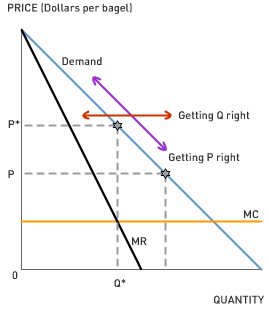
    Levitt shows that Paul gets quantities right (for both bagels and donuts, there are very few stock-outs or left-overs), but he often gets prices wrong. Paul systematically prices donuts and bagels too low. Indeed . . . Paul could actually increase total revenue by increasing his prices. Hence, his prices are at a point like P in the figure. At point P, marginal revenue is negative (below the x-axis); so increasing price and reducing sales will raise revenue.

    The question is whether Paul — the savvy economist — really sets his prices “too low.” I suspect not. Paul doesn’t need the money. Knowing Paul, he’s making himself happy by more-or-less correctly judging the number of bagels and doughnuts he can sell at prices that don’t cause him to lose money. That is, he wants to maximize the quantity of bagels and doughnuts enjoyed by his customers, as long as he’s making “enough” to warrant the effort he puts into his business. There’s more to income than money, and Paul’s behavior is a good case in point.

    The kind of behavior exhibited by Paul also is a good long-run business strategy. “Underpricing” helps to build loyalty. Consumers are less likely to switch to competing vendors and products if they have been pleased by a vendor’s or manufacturer’s long record of offering good value for the money.

    Related posts:
    The Rationality Fallacy
    The Social Welfare Function
    What Economics Isn’t
    Ten Commandments of Economics
    More Commandments of Economics

    This Day in Baseball History

    From MLB.com:

    May 2, 1939 > Lou Gehrig’s streak of 2,130 consecutive games comes to an end. An ailing Gehrig removes himself from the lineup, telling manager Joe McCarthy that he cannot play because of continuing weakness. Doctors will later diagnose Gehrig with ALS, a fatal disease that affects the muscles. The Iron Horse will never play again.
    Lou Gehrig’s career stats >

    The Illusion of Reality

    A self-description by the spinster, librarian narrator of Jincy Willett’s novel, Winner of the National Book Award:

    You escape, said Abe Marx, into your books. I didn’t have the wit then, quite, for the obvious riposte: I escape, when I feel the need, into what all you bullies insist is reality. I study birds, library patrons, local politicians. Sometimes I garden. Sometimes I watch the Sox. Sometimes I drink. I keep a neat house and I pay my taxes, all in the real world. But I don’t live there.

    She speaks for me.

    "Dangerous Dan" McCain

    My reference is to the title character of Robert Service’s poem, “The Shooting of Dan McGrew.” But John McCain is far more dangerous than any Klondike gunslinger, because McCain would use (and has used) the power of government to suppress speech in the name of “clean government.”

    Many bloggers have picked up on McCain’s latest outrageous utterance:

    He [Michael Graham] also mentioned my abridgement of First Amendment rights, i.e. talking about campaign finance reform….I know that money corrupts….I would rather have a clean government than one where quote First Amendment rights are being respected, that has become corrupt. If I had my choice, I’d rather have the clean government.

    But no blogger whom I have read has gone to the heart of “Dangerous Dan” McCain’s twisted agenda. When speech is suppressed in the name of “clean government,” the essential element of “clean government” — namely, competition for control — is removed.

    McCain and his ilk like to pretend that money “buys” politicians. Money may buy criminal acts — such as those committed by Duke Cunningham — but those acts are easilty dealt with as matters of criminality. In the main, money only “buys” politicians to the extent that it helps to elect those politicians whose views are already attuned to the views of their contributors.

    Incumbents already have been “bought” in the sense that their success has been abetted by like-minded supporters. The best way to keep incumbents “honest” is to ensure that they face strong challenges at election time. But the power of incumbency requires that challengers have access to more money than incumbents. McCain will have none of that because his real agenda is to make it difficult for challengers to raise enough money to defeat incumbents. It’s a power-grab, pure and simple.

    It should be obvious to anyone who thinks about it for more than a nanosecond that “Dangerous Dan” McCain — that arrogant hypocrite — is opposed to free speech and “clean government.” His twisted agenda is to suppress potential challenges to the power of incumbency.

    Disposing of a Few Idiocies

    Late Friday afternoon, fresh from a nap after a delightful lunch at a lakeside restaurant. I can muster only a few quick comments.

    Dale Carpenter, writing at The Volokh Conspiracy, asks “Why So Few Gay Marriages?” He fails to suggest the main reason: “Gayness” is mostly about sex, not about lifetime bonding centered mainly around children.

    Publius (with a little “p”), of legal fiction, chastises Americans for their obliviousness to history. His aim — which he disavows, of course — is to suggest that Americans are somehow responsible for Islamic terrorism because of their ignorance of the “villainy” of (some of) their European ancestors during the Crusades. According to publius, Americans’ obliviousness to history also blinds them to the fact that America’s efforts to “export democracy” have been failures, though he somehow fails to mention Germany and Japan. Nor does he acknowledge that our real aim in the Middle East isn’t so much to export democracy as it is to establish friendly regimes that are (at least) not oppressive.

    Publius goes on to say that “Americans just haven’t had to internalize defeat, loss, and humiliation in the same way that other people have.” But in the next paragraph he contradicts himself by acknowledging “two [sizeable] groups of people in America that do have a collective consciousness of resentment . . . white Southerners and blacks. Say what you will about both groups, they don’t forget.” I’m not sure whether little “p” objects to the defeat of the Confederacy or to the failure of the effort to remove all freed slaves to Liberia.

    Come the Millenium . . .

    . . . or Nirvana, or the Left’s day-dream . . . and the price of gasoline will be pegged by the government at $1.00 a gallon, everyone will have free access to a state-run healthcare system, and everyone (but the intelligentsia and commissars, of course) will be paid the same “living wage” regardless of differences in what they do or how well they do it. The result? Gas will be available only on the black market, there will be less healthcare (and what there is will be lousy), and the American standard of living will be reduced to a depth not reached during the Great Depression. But Leftists, naifs (that’s most Americans), and power-crazed politicians will be happy — because government is doing something!

    A "Living Constitution" Means Anything and Everything

    Keith Burgess-Jackson (AnalPhilosopher) points out that the

    editors of The New York Times, in their infinite wisdom, conclude that capital punishment violates the United States Constitution. See here. In this, they disagree with the framers of the Constitution, who wrote that “No person shall . . . be deprived of life, liberty, or property, without due process of law.” I go with the framers. You?

    Me? I’m with the Framers. But then, I don’t believe in the “living Constitution,” wherein one may find anything one wants to find, not only deep in the penumbras but also in open contradiction with the Framers’ plain words.

    True Federalism

    Alex Tabarrok of Marginal Revolution observes that

    [c]ompetitive federalism has many advantages. Citizens can move to communities that better reflect their preferences for public goods, they can vote with their feet, thereby penalizing poorly performing governments, and they can serve as a salutary example for others by trying out new ideas in governing.

    Yet, in 1789 the United States had 13 states and four million people. If the number of states had grown as fast as the number of people or if we in the United States had about the same amount of federalism as do the contemporary Swiss we would today have about 1000 states.

    I think we need more states. If 1000 sounds extreme why is 50 the magic number? And why is 50 the magic number when the population is 150 million as when it is 300 million?

    I agree that the ability to vote with one’s feet is essential to liberty. As I wrote here,

    Exit — the ability to flee a highly taxed and regulated State (that is, one of the United States) for a somewhat less taxed and regulated State — remains an option, and those who avail themselves of it are sending a message that is lost in the tumult and shouting of electoral politics. Despite the erosion of local and regional differences in governance — owing to the centralization of power in Washington and the general expansion of government power at all subordinate levels — there is net migration from the Northeast and Midwest toward the “sun belt” States of the South and West (excluding California), which generally have lower tax rates and less unionism than the Northeast and Midwest. (Summary statistics on internal migration are here, at Table H on page 14. An index of economic freedom, by State, is here.)

    It is therefore no coincidence that the mean population center of the U.S. has since 1960 moved smartly southwestward, from southern Illinois into south central Missouri. Incentives matter; that which enhances economic liberty also enhances personal liberty, for the two are indivisible. The urge for liberty drives people out of high-tax States and toward (relatively) low-tax States, as illustrated by this graphic from “Revolution on Wheels” (Barron’s Online, February 13, 2006):

    The lesson here is simple: As long as there is meaningful exit there can be a race to the top. Exit serves liberty because it enables each person to find that place whose values come closest to his or her preferred way of life. Places deemed among the most attractive will grow in numbers and prosper; places deemed less attractive will wither, economically if not in terms of population. Under the right conditions (to which I will come), the balance will tilt toward liberty, that is, toward a modus vivendi that seems, for most people, to offer happiness. That is the essence of federalism, as it was envisioned by the Framers.

    But how many States do we need? Ideally, a lot more than 1,000. In the same post I proposed the establishment of a

    zone of liberty [which] would be something like a “new city” — with a big difference. Uninhabited land would be acquired by a wealthy lover (or lovers) of liberty (call him or them the “developer”). The zone would be populated initially by immigrants, who would buy parcels of land from the developer, and who would be allowed to build the home or business of their choosing on the land that they buy. Sub-developers would be allowed to acquire large parcels, subdivide those parcels, and attach perpetual covenants to the use of the subdivided parcels — covenants that initial and subsequent buyers would knowingly accept. Absentee ownership would be prohibited.

    Infrastructure would be provided by competing vendors of telecommunications and transportation services. Rights-of-way would be created through negotiations between vendors and property owners. Any resident homeowner or businessperson could import or export any article from or to any place, including another country; there would be no import controls, duties, or tarrifs; the only restrictions on commerce would be those that are imposed by outside governments.

    A zone’s government would comprise an elected council, a police force, and a court (all paid for by assessments based on the last sale price of each property in the zone). The police force would be empowered to keep the peace among the residents of the zone, and to protect the residents from outsiders who come into the zone without permission from a resident and/or who breach the peace. Breaches of the peace would be defined by the development of a common law through the court. The elected council (whose members would serve single, four-year terms) would oversee the police force and court, and would impose the assessments necessary to defray the costs of government. The council would have no other powers, and it would be able to exercise its limited powers only by agreement among three-fourths of the members of the council. The members, who would not be salaried, would annually submit a proposed budget to the electorate, which would have to approve the budget by a three-fourths majority. The electorate would consist of every resident who is an owner or joint owner of a residence or business (not undeveloped land), and who has attained the age of 30.

    A zone of liberty would not be bound by federal, State, or local statutes, except that the federal government could impose a per-capita tax on residents of the zone that is sufficient to defray the zone’s per-capita share of the national budget for defense and foreign affairs. The actions of the zone’s government would be reviewable only by the U.S. Supreme Court, and then only following the passage of a bill of particulars by two-thirds of the number of U.S. Senators and Representatives, which must be signed by the President. (A zone could be abolished only with the approval of four-fifths of both houses of Congress and the President.)

    Absent such an experiment, I fear that organized minorities will continue to constrain liberty, mooting even the modest degree of inter-State migration that now prevails. Our only hope for liberty — albeit a slim one — would then rest in the hands of the Supreme Court.

    I am being realistic in my assessment of what it would take to attain something like liberty in the United States: either an upheaval of the Supreme Court or the creation of something like zones of liberty. Politics as usual will only take us further down the road to serfdom. Frankly, I see little chance of averting serfdom. All I can do is propose an alternative — unlikely as it is — and pray.

    How many persons would inhabit a zone of liberty?

    I would constrain the size and membership of each zone of liberty, creating more of them instead of allowing any one of them to grow beyond the size of a small village — perhaps not exceeding a population of 150.

    That’s 2 million zones of liberty (or States) for a population of 300 million. Hmmm . . .

    It’s the Spending Stupid

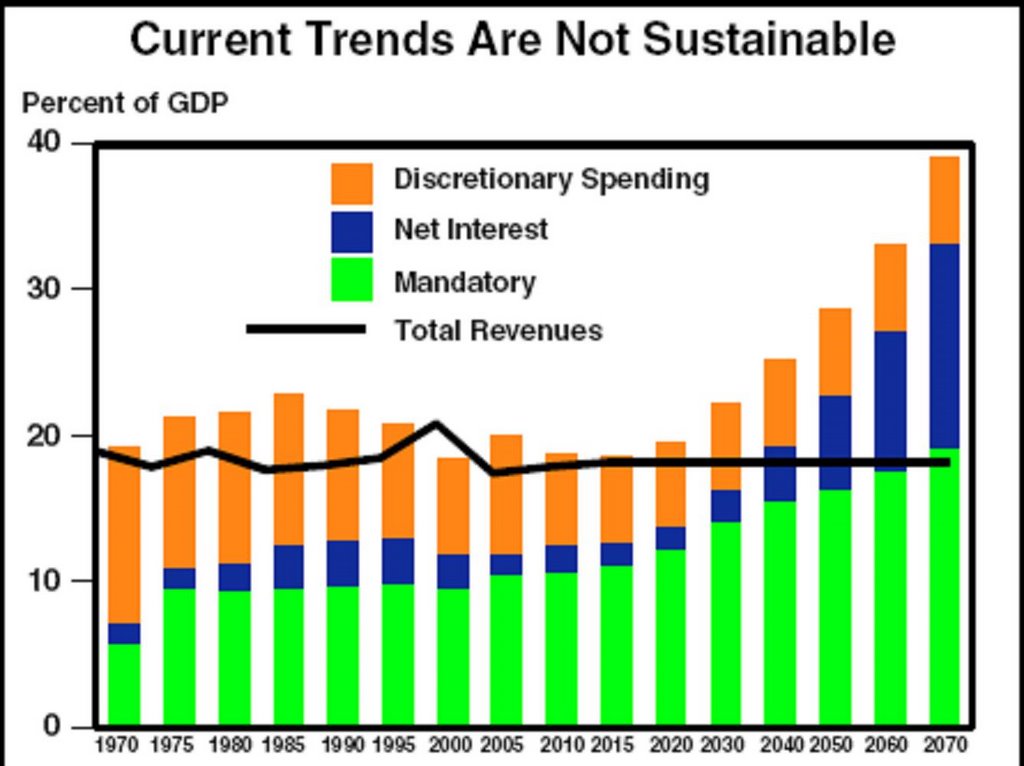
    . . . as I’ve explained many times, most recently here. The Skeptical Optimist has a rosy outlook because his focus is on near-term prospects for eliminating the deficit. But look at the following chart (and ignore the revenue line).

    I’m certainly not picking on The Skeptical Optimist, who has a rather sensible view of the deficit. But I am picking on “deficit hawks” who want to attack the deficit by raising taxes. All that does is lend an air of legitimacy to the government’s confiscation of resources through spending.