More about Crime and Punishment

I argue in “More Punishment Means Less Crime” that making federal sentencing guidelines advisory rather than mandatory, as the Supreme Court has done, will lead a resurgence of the violent-crime rate. Eugene Volokh cites a case in point:

Why People Are Skeptical of Judicial Discretion in Sentencing: Here’s the story:

Wednesday [Vermont trial court Judge Edward Cashman] sentenced child rapist Mark Hulett to 60 days in jail. Hulett admitted he raped a little girl countless times when she was between 7 and 10 years old.

Prosecutors said Hulett deserved at least 8 years in prison in part as punishment.

But Judge Cashman said the 60-day sentence guaranteed that Hulett would get into sex offender rehabilitation quickly or face a possible life sentence. He said he had no choice because the Corrections Department classified Hulett as a low risk offender meaning he can’t get treatment until he’s out of jail.

And more importantly the judge announced that after 25 years on the bench, he no longer believes in punishment. . . .

There’s a similar situation in Australia, Norway, Sweden, and France, where“Islamic men are raping Western women for ethnic reasons. We know this because the rapists have openly declared their sectarian motivations.” Why is this happening? Political correctness or, more accurately, reverse racism:

In Australia, when journalist Paul Sheehan reported honestly on the Sydney gang rapes, he was called a racist and accused of stirring up anti-Muslim hatred. And when he reported in his Sydney Morning Herald column that there was a high incidence of crime amongst Sydney’s Lebanese community, fellow journalist, David Marr sent him an e-mail stating, “That is a disgraceful column that reflects poorly on us all at the Herald.”

Keysar Trad, vice-president of the Australian Lebanese Muslim Association said the gang rapes were a “heinous” crime but complained it was “rather unfair” that the ethnicity of the rapists had been reported.

Journalist Miranda Devine reported during the same rape trials that all reference to ethnicity had been deleted from the victim impact statement because the prosecutors wanted to negotiate a plea bargain.

So when Judge Megan Latham declared, “There is no evidence before me of any racial element in the commission of these offences,” everyone believed her. And the court, the politicians and most of the press may as well have raped the girls again.

Retired Australian detective Tim Priest warned in 2004 that the Lebanese gangs, which emerged in Sydney in the 1990s – when the police were asleep – had morphed out of control. “The Lebanese groups,” he said, “ were ruthless, extremely violent, and they intimidated not only innocent witnesses, but even the police that attempted to arrest them.”

Priest describes how in 2001, in a Muslim dominated area of Sydney two policemen stopped a car containing three well-known Middle Eastern men to search for stolen property. As the police carried out their search they were physically threatened and the three men claimed they were going to track them down, kill them and then rape their girlfriends.

According to Priest, it didn’t end there. As the Sydney police called for backup the three men used their mobile phones to call their associates, and within minutes, 20 Middle Eastern men arrived on the scene. They punched and pushed the police and damaged state vehicles. The police retreated and the gang followed them to the police station where they intimidated staff, damaged property and held the police station hostage.

Eventually the gang left, the police licked their wounds, and not one of them took action against the Middle Eastern men. Priest claims, “In the minds of the local population, the police are cowards and the message was, ‘Lebanese [Muslim gangs] rule the streets.’”

In France, in the banlieues, where gang rape is now known simply as tournantes or ‘pass-around,’ victims know the police will not protect them. If they complain, Samir Bellil said, they know that they and their families will be threatened.

However, Muslim women in the French ghettos are finally fighting back against gang rape and police non-action. They have begun a movement called, “We’re neither whores nor doormats.” They are struggling against the intrinsic violence that plagues their neighbourhoods and the culture that condones it.

In most French prosecutions, the Muslim rapists state that they do not believe they have committed a crime. And in a frightening parallel with the gang rapists in Australia, they claim the victim herself is to blame and accuse her of being a “slut” or a “whore.”

According to The Guardian, during the recent French riots, a Saudi Prince with shares in News Corporation boasted to a conference in Dubai that he had phoned Rupert Murdoch and complained about Fox News describing the disturbances as “Muslim riots.” Within half an hour he said, it was changed to “civil riots.”

Swedish translator, Ali Dashti, stated that in Sweden when three men raped a 22-year-old woman recently, they said one word to her. “Whore.” Such stories, according to Dashti, are in the Swedish newspapers every week. And, the politically correct “take great care not to mention the ethnic background of the perpetrators.”

Sweden’s English newspaper The Local reported in July that Malmo police commander Bengt Lindström had been charged with inciting racial hatred. He sent e-mails from his home computer to two city officials. To the head of healthcare, he wrote: “You…treat old Swedes who have worked hard building up the fatherland like parasites and would rather give my taxes to criminals called Mohammed from Rosengärd.”

In Malmo, the third largest city in Sweden, the police have admitted, Dashti says, that they no longer control the city. “It is effectively ruled by violent gangs of Muslim immigrants.” Ambulance personnel are regularly attacked and spat upon and are now refusing to help until a police escort arrives. The police are too afraid to enter parts of the city without backup.

In early 2005, Norwegian newspapers reported that Oslo had recorded the highest ever number of rape cases in the previous twelve months. However, Fjordman explained, the official statistics contained no data regarding “how immigrants were grossly over represented in rape cases”, and the media remain so strangely silent.

Oslo Professor of Anthropology, Unni Wikan, said Norwegian women must take responsibility for the fact that Muslim men find their manner of dress provocative. And since these men believe women are responsible for rape, she stated, the women must adapt to the multicultural society around them.

The BBC pulled a documentary scheduled for screening in 2004, after police in Britain warned it could increase racial tension. “In these exceptional circumstances… Channel 4 as a responsible broadcaster has agreed to the police’s request…” The documentary was to show how Pakistani and other Muslim men sexually abused young, white English girls as young as 11.

The number of rapes committed by Muslim men against women in the last decade is so incredibly high that it cannot be viewed as anything other than culturally implicit behaviour. It is overtly reinforced and sanctioned by Islamic religious leaders who blame the victims and excuse the rapists….

In July 2005, Melbourne Sheik Mohammad Omran told Sixty Minutes that “…we believe we have more rights than you because we choose Australia to be our home and you didn’t. “

In the same interview visiting Sheik Khalid Yasin warned “There’s no such thing as a Muslim having a non-Muslim friend, so a non-Muslim could be your associate but they can’t be a friend. They’re not your friend because they don’t understand your religious principles and they cannot because they don’t understand your faith.”

Despite being told over and over by Islamic scholars, and witnessing massive influxes of Islamic crime, Western countries continue to believe in the reality of assimilation and moral relativism.

It can happen here. If fact, it has been happening here since the 1960s, when America’s media and courts began in earnest to avoid blaming blacks for criminal conduct. Mandatory federal sentencing guidelines were a necessary and fairly effective counter-measure to that reign of reverse racism. But the Supreme Court has neutralized that counter-measure.

Government’s sole justification is to fight the enemies of liberty, namely, criminals and terrorists. The Judge Cashmans of this world have sided with those enemies.

Related posts:
Does Capital Punishment Deter Homicide?
Libertarian Twaddle about the Death Penalty
Crime and Punishment
Abortion and Crime
Saving the Innocent?
Saving the Innocent?: Part II
More on Abortion and Crime
More Punishment Means Less Crime
More Punishment Means Less Crime: A Footnote
Clear Thinking about the Death Penalty
Let the Punishment Fit the Crime
Another Argument for the Death Penalty
Less Punishment Means More Crime
Crime, Explained

A New Whine from Prof. Bainbridge

Today, the prof picks up a theme that resounds on the loony right: War without a foreseeable end (i.e., the war on terror) means the limitless accretion of power in the hands of the presidency. Yeah, well, we had a Cold War thatfor almost 40 years had no foreseeable end, and the prof and his ilk remain at large and unstifled.

(The title of this post is a bad pun on the prof’s wine snobbery.)

Lew-nacy

Apropos “Neo-Nazi Conned?“: LewRockwell.com has a department called “The Peace Archive,” which features writings by many obscure loonies and such eminent ones as Pat Buchanan, Bobby (Klansman) Byrd, and Cindy Sheehan. Strange bedfellows, indeed, for a staunch anti-statist. Lew, your desperation is showing.

Crime and Punishment

I have twice updated “More Punishment Means Less Crime” (scroll down to the updates). The new material reinforces my conclusion that incarceration is the key to controlling violent crime. As I said at the end of the original post,

[i]ncarceration follows from prosecution, which follows from investigation. I therefore stand by my earlier conclusion that “incarceration and spending on the criminal justice system . . . . are the public-policy weapons of choice” when it comes to fighting crime.

The Paradox of Libertarianism

Chris Matthew Sciabarra’s article, “Libertarianism,” first appeared in the International Encyclopedia of Economic Sociology (2006, pp. 403-7). Sciabarra leads off with this:

Libertarianism is the political ideology of voluntarism, a commitment to voluntary action in a social context, where no individual or group of individuals can initiate the use of force against others.

Sciabarra’s rendition of libertarianism emphasizes the non-aggression principle. My version has a somewhat different emphasis and allows for a minimal state:

If you are doing no harm to anyone, no one should harm you physically, coerce you, defraud or deceive you, steal from you, or tell you how to live your life. “No one” includes government, except to the extent that government is empowered — by the people — to defend life, liberty, and property through the circumscribed use of police, courts, and armed forces.

The first sentence of my version is operationally equivalent to the quotation I pulled from Sciabarra’s entry. To put it more simply:

The core of libertarianism is liberty: briefly, the negative right to be left alone — in one’s person, pursuits, and property — as long as one leaves others alone.

The problem with all such formulations, however, is that they gloss over two important questions:

  1. What is harm and who defines it?
  2. How does one ensure that one is “left alone” in a world where there are predators and parasites who will not subscribe voluntarily to a pact of mutual restraint?

The paradox of libertarianism lies in the answers to those two questions, which I’ll answer in reverse order.

Here is how one ensure that one is “left alone”:

  1. All members of a group agree as to what specifically constitutes harm.
  2. All members of the group agree to honor the obligation to leave other members alone, as long as those other members do not commit acts that are recognized as harmful.
  3. By the same token, all members of the honor the obligation to defend a fellow member or members against predators (renegades within the group, or outsiders).

The “catch” is point 1, which requires an answer to the question “What is harm and who defines it?”

To be a member of the group and to merit its protection (through mutual restraint and mutual defense) requires acceptance of a common, specific definition of harm. Various members might prefer different definitions. (For example, some might view abortion as harmless; some might view it as the murder of a prospective member of the group; and others might view it as an act that will inevitably lead to harm because it invites, say, euthanasia.) But unless each member subscribes to the same, specific definition of harm there can be no basis for mutual restraint — or for mutual defense. Where some see harm — from other members of the group or from outsiders — others may see no harm.

In summary: Liberty rests on an agreed definition of harm, and on an accompanying agreement to act with mutual restraint and in mutual defense. Given the variety of human wants and preferences, the price of mutual restraint and mutual defense is necessarily some loss of liberty. That is, each person must accept, and abide by, a definition of harm that is not the definition by which he would abide were he able to do so. But, in return for mutual restraint and mutual defense, he must abide by that compromise definition.

That insight carries important implications for the “anything goes” or “do your own thing” school of pseudo-libertarianism. That school consists of those libertarians who believe that harm is in the mind of the doer, or who believe that they can define harm while standing on the outside of society looking in. Thus they proclaim abortion and same-sex “marriage” (among other things) to be harmless — just because they favor abortion and same-sex “marriage” or cannot see the harm in them.

But, as I have explained, that is not how liberty is defined. So the paradox of libertarianism is this: Libertarians cannot properly define it.

East Meets West

Mark Steyn writes:

Since the president unveiled the so-called Bush Doctrine–the plan to promote liberty throughout the Arab world–innumerable “progressives” have routinely asserted that there’s no evidence Muslims want liberty and, indeed, that Islam is incompatible with democracy. If that’s true, it’s a problem not for the Middle East today but for Europe the day after tomorrow. According to a poll taken in 2004, over 60% of British Muslims want to live under Shariah–in the United Kingdom. If a population “at odds with the modern world” is the fastest-breeding group on the planet–if there are more Muslim nations, more fundamentalist Muslims within those nations, more and more Muslims within non-Muslim nations, and more and more Muslims represented in more and more transnational institutions–how safe a bet is the survival of the “modern world”?

Perhaps safer than he thinks. Gerard Van der Leun reckons that a

second series of attacks on America at the level of 9/11 or greater will not bring out more B-52s. They are already out. A second series will bring out the one arm of America’s war machine that has rarely been asked about, written about, or even mentioned in passing since September, 2001; the ballistic missile submarines. . . .

Under the right circumstances, human beings are capable of anything. . . . Should Europe feel the threat of Islam within its borders too keenly it is not difficult to envision it returning to the up close and personal techniques of genocide it perfected in the last century. Europe is very, very good at police states, purges, death camps, massacres and Gulags. Although it may look to be weak and appeasing, Europe’s final solution skill set is never stored very far away.

Should the United States come to feel threatened in a similar way, its preferred technique (also perfected in the last century) is remote genocide. . . . I have no doubt that, if we feel for any reason threatened enough, we will indeed come to the day when the unthinkable becomes doable.

This is why I still deeply believe that the current effort in Iraq and the Middle East to counter and expunge Islamic terrorism and turn Islam from the road it is on towards one of reformation and assimilation is the best path that can be taken at this time. Indeed . . . this shoot-the-moon, Hail Mary of a foreign policy in Iraq is not just a policy to make America safer at home. It is the only thing that stands between Islam and its own destruction.

Sometime shortly after 9/11 in an online forum I frequented then, an exasperated idealist proclaimed that “After all, you can’t kill a billion Muslims.” Like so many others he spoke from somewhere outside History. History, especially the world’s most recent history, shows us all that, “Yes, if you really want to, you can.”

And that is the most terrible and terrorizing thought of the 21st century.

But less terrible and terrorizing than the alternative.

Thought for the Day

Having your overseas communications monitored by the use of an impersonal, computerized algorithm is no more harmful to life, liberty, and happiness than the requirement to use blackout curtains or ration coupons. (And I still have some of my ration coupons from World War II.)

The Real Con Job

Fringe Watch has posted “The Real Con Job: John Sharpe’s ‘Anti-War’ Series.” The subject of the post is the Neo-Conned series of anti-war books, published by John Sharpe (through his IHS Press/Light in the Darkness affiliate). As documented in the Fringe Watch posts, Sharpe has ties to anti-Semitic, anti-American extremist politics. It is disconcerting therefore, to find that some members of the anarcho-capitalist contingent at LewRockwell.com (“anti-state, anti-war, pro-market”) have contributed to and touted the Neo-Conned books (see here, here, and here). They have let their opposition to the present war blind them to the agenda that animates the Neo-Conned books. Here, with permission, is “The Real Con Job”:

The Real Con Job: John Sharpe’s “Anti-War” Series

On November 9, 2005, LewRockwell.com posted “ The Case Against This Monstrous War,” a glowing endorsement of two anti-war books: Neo-Conned and Neo-Conned Again!. They are put out by the IHS Press, under its Light in the Darkness imprint. As the review opines, IHS “has assembled one of the most impressive lineups of scholars and commentators. . . ever seen on any subject.” The bi-partisan authorship spans the entire political range from paleo-conservative Pat Buchanan to Marxist Noam Chomsky. Some contributors are entirely reputable. However, beneath the superficial respectability of IHS Press there lies a web of connections that conservatives should find disturbing.

The problem with the Neo-Conned series is more than impassioned rhetoric, it’s a matter of caveat emptor. Unsavory politics lurk beneath the surface. Consider that the founder, CEO, and editor of IHS Press is John Sharpe. The following points should send off alarm bells among his target conservative audience:

1) John Sharpe has a long record of sympathy with anti-American Arab regimes and tries to downplay the horror of 9/11 by blaming it on Israel and the US itself.

2) He promotes socialist/leftist economic theories, through the works of IHS Press’ Sheffield Hallam University Press series and the works of the eccentric British “guild socialist” Arthur Penty.

3) He disseminates anti-Semitic publications through a subsidiary called the Legion of St. Louis (LSL).

If it is thought that this last charge is an exaggeration, consider Mr. Sharpe’s argument for “sane” anti-Semitism:

Finally, let us not fear the epithet “anti-Semite” as it is used by the enemies of the Faith and of the West. . . . [W]e all then have the courage to respond with the words of Fr. Fahey: “In that sense, every sane thinker must be an anti-Semite” (“Judaism and the Vatican,” The Angelus, June 2003).

The LSL is an ostensibly Catholic organization which pitches to traditionalists. But a perusal of the Legion’s eclectic offering of books turns up such titles as The International Jew (admired by Adolf Hitler), the writings of British fascist A.K. Chesterton and an anti-Jewish screed by self-proclaimed “white separatist” Michael Hoffman.

To sum up, this exposé is not meant to discuss the merits of the Iraq War. Whatever one’s views, it is possible to be concerned about ideological radicals exploiting sensitive issues for their own benefit. What is the upshot? First, political radicals (tied to neo-Nazis) gain the credibility they have long coveted by collaboration with well-known and respected individuals. Second, dissenting conservatives, understandably scandalized by the insanity of mainstream culture, are sidetracked from their real work and are ethically compromised.

Authoritarianism and Adolescence on the Left

Dr. Helen writes today about the inverse authoritarian personality:

I have spent some interesting hours reading [in Roots of Radicalism: Jews, Christians, and the Left] about studies done with Jewish and Christian leftist radicals in the 1970’s and 80’s. Please bear the age of these studies in mind when I talk about some of the information I gleaned from the book. Yes, this is old stuff but I think in discussing some of the traits of radicals on the left, much of it still holds true. I do not believe these traits are necessarily pathological–but they are descriptive in helping to understand those who follow extreme left-leaning thought. . . .

The authors of the book, Stanley Rothman & S. Robert Lichter spend chapters discussing how the same conflicts that underlie the authoritarian can be turned inside out. “The traditional authoritarian deflects his hidden hostilities onto outsiders and outgroups. The inverse (my italics) authoritarian unleashes his anger directly against the powers that be while taking the side of the world’s ‘victims’ and ‘outcasts.'” The authors ask an important question about the inverse authoritarian: “Was it not possible that the ‘liberated generation’ was bound to potentially dangerous unconscious personality dynamics no less than its forebears?” . . .

Without going into too much detail, here are a few other things they found. Conservatives–particularly Jewish Conservatives–were found to be lowest on the need to feel powerful, followed by liberals but the need to feel powerful rose sharply among the New Left radical group–it was especially high in the Jewish radicals. Jewish conservatives, liberals, and radicals were all more affiliative (defined as a concern to establish, maintain and restore positive emotional relationships) than their non-Jewish counterparts.

What I carried away from the book is that there is no difference in the rigidity between fighting against outsiders or outgroups and fighting against the establishment—both are a form of rebellion that is based not on what is right, but on how one chooses to rebel. Basing politics and policy on how they fullfill our need for power, affiliation or hostility cannot be the best way of deciding what is right for our country.

Dr. Helen is a Ph.D. psychologist. I’m a mere observer of the human condition, which led me to write this some months ago:

Persons of the Left simply are simply unthinking, selfish adolescents who want what they want, regardless of the consequences for others. The Left’s stance on abortion should be viewed as just one more adolescent tantrum in a vast repertoire of tantrums.

Indeed.

More Punishment Means Less Crime

UPDATED 01/04/06
UPDATED 01/05/06

In Freakonomics, Steven Levitt rehashed an earlier paper he wrote with John Donohue, in which the two economists posit a strong relationship between the legalization of abortion in the early 1970s and the drop in the crime rate, which began around 1990. Here’s how The Washington Post summarizes what Freakonomics has to say about the relationship between abortion and crime:

. . . First, Freakonomics shows that although commonly cited factors such as improved policing tactics, more felons kept in prison and the declining popularity of crack account for some of the national reduction in crime that began in about the year 1990, none of these completes the explanation. (New York City and San Diego have enjoyed about the same percentage decrease in crime, for instance, though the former adopted new policing tactics and the latter did not.) What was the significance of the year 1990, Levitt asks? That was about 16 years after Roe v. Wade . Studies consistently show that a disproportionate number of crimes are committed by those raised in broken homes or who were unwanted as children. When abortion became legal nationally, Levitt theorizes, births of unwanted children declined; 16 years later crime began to decline, as around age 16 is the point at which many once-innocent boys start their descent into the criminal life. Leavitt’s [sic] clincher point is that the crime drop commenced approximately five years sooner in Alaska, California, Hawaii, New York and Washington state than it did in the nation as a whole. What do these states have in common? All legalized abortion about five years before Roe .

Levitt has defended his findings against some well-qualified critics, most notably Steve Sailer (see here, here, here, and here, for example) and economists Christopher L. Foote and Christopher F. Goetz. If you’re interested in the minutiae of the debate, go here, where Levitt also discusses the sideshow involving Bill Bennett. Bennett, as you recall, created a stir with this colloquy during the September 28, 2005, broadcast of Salem Radio Network’s Bill Bennett’’s Morning in America:

BENNETT: . . . one of the arguments in this book Freakonomics that they make is that the declining crime rate, you know, they deal with this hypothesis, that one of the reasons crime is down is that abortion is up. Well . . .—

CALLER: Well, I don’’t think that statistic is accurate.

BENNETT: Well, I don’’t think it is either, I don’’t think it is either, because first of all, there is just too much that you don’t know. But I do know that it’’s true that if you wanted to reduce crime, you could . . . —if that were your sole purpose, you could abort every black baby in this country, and your crime rate would go down. That would be an impossible, ridiculous, and morally reprehensible thing to do, but your crime rate would go down. So these far-out, these far-reaching, extensive extrapolations are, I think, tricky.

Rather than rehash all the debates about Levitt’s work and Bennett’s statement, I decided to take a fresh look at the numbers. I drew on the U.S. Census Bureau’s “Mini-Historical Statistics” to derive the following statistics for the United States (each descriptor links to the Excel spreadsheet from which I derived the relevant statistics):

Violent crimes per 100,000 persons
Percentage of population aged 15-24
Births and illegitimate births per 100,000 women aged 15-19
Blacks as a percentage of the population
Persons incarcerated per 100,000

I selected the 15-24 year age range because persons in that age bracket are most prone to the commission of violent crimes. Because the midpoint of that age bracket is approximately 19, I lagged the birth statistics by 19 years so that birth rates in a particular year are measured against crime statistics 19 years later (e.g., births in 1960 vs. crime in 1977, births in 1973 vs. crime in 1990). I used the overall rate of incarceration rather than a rate for violent offenders because locking up offenders of any kind must ensure that persons who would otherwise commit violent crimes are unable to do so.

Before plunging into a regression analysis, I indexed the series to 1960 (the first year in the violent-crime series) and plotted them (again, with a 19-year lag on the birth-rate series). Here are the plots:

The relationships suggest strongly that the legalization of abortion did not have a significant effect on the rate of violent crime in the U.S. The violent-crime rate rose almost steadily from 1960 until 1991, when it peaked. The lagged rate of illegitimate births for women aged 15-19 (probably the best available proxy for “unwanted” children) leveled off about when the crime rate peaked, but the illegitimacy rate then resumed its steady rise, even as the violent-crime rate dropped dramatically. It is therefore improbable (if not impossible) that abortion — as measured by the rate of illegitimate births — had anything to do with the drop in the crime rate. Using the total rate of births for women aged 15-19 as a proxy for “unwantedness” yields even more problematic results: the lagged rate peaked in 1976, fully 15 years before the crime rate peaked.

I nevertheless ran many regressions on the violent-crime rate and various combinations of the key variables. Only one regression yields credible results (high R-squared, standard error of estimate among the lowest, intuitively correct signs on all coefficients, and high t-statistics on all coefficients). That regression takes the following form:

Number of violent crimes per 100,000 persons =
– 3723
+ 37058 x number of Blacks as a decimal fraction of the population
– 0.568 x number of persons incarcerated per 100,000 of population

The t-statistics on the intercept and coefficients are -15.854, 17.047, and -5.042, respectively; the adjusted R-squared is 0.936; the standard error of the estimate is 47.0.

The mean value of the dependent variable is 483.1, with a range of 158.1 to 758.2. The corresponding values for proportion of blacks: 0.117, 0.105, 0.125; for incarceration rate: 202.4, 93, 476.

The years represented in the regression are 1960-99 (the last year of data on Blacks as a fraction of the population).

That equation is especially compelling because both explanatory variables are statistically signficant even though they are strongly correlated (R = 0.84). Given that, and the evidence of the plots above — in which the declining crime rate is accompanied by a rising incarceration rate — two things are evident: incarceration is the key to crime reduction, and abortion has no place in the discussion of crime. What happened was that the incarceration rate finally became high enough, around 1991, to offset the countervailing influences on crime.

Incarceration follows from prosecution, which follows from investigation. I therefore stand by my earlier conclusion that “incarceration and spending on the criminal justice system . . . . are the public-policy weapons of choice” when it comes to fighting crime.

UPDATE (01/04/06): None of my regressions (not even the best one) fully accounts for the sharp decline in the violent-crime rate after 1990. That is because I did not try to model the effects of concerted efforts, since the late 1980s, to put violent offenders behind bars and to keep them there longer. The missing variable, of course, is to be found in the effectiveness of federal sentencing guidelines, which were enacted in 1987 and declared constitutional by the U.S. Supreme Court in 1989. Liberal do-gooders and their allies on the bench nevertheless persuaded the Supreme Court last year (in a pair of related cases) to find the guidelines unconstitutional and, therefore, only advisory rather than mandatory.

Given the inevitability of more lenient sentencing in many jurisdictions, I predict that the violent-crime rate will resume its long-term ascent. That ascent will mirror the continuing destruction of civil society at the hands of liberals — and those libertarians who seem unable to grasp the notion that liberty must be defended, at home and abroad.

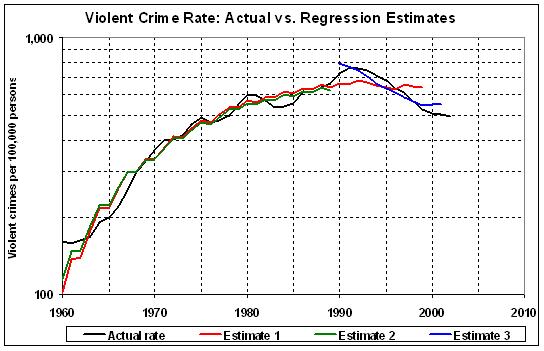
UPDATE (01/05/06): In light of the preceding update I ran separate regressions on the violent crime rate for two periods: 1960-89 and 1990-2001, 1990 being the first full year under the federal sentencing guidelines. The best regression for 1960-89 has the same two explanatory variables above. The best regression for 1990-2001 (the last year of my series on incarceration rate) has only one explanatory variable: number of persons incarcerated per 100,000 of population. The graph below gives plots of the following statistics and regression estimates:

  • actual rate of violent crimes (per 100,000 persons)
  • estimates for the original regression (estimate 1)
  • estimates for the separate regressions on 1960-89 (estimate 2) and 1990-2001 (estimate 3).

Estimate 3 further convinces me that more punishment means less crime, and that we are about to see a resurgence of violent crime because punishment has become less certain.

P.S., here are the numbers:

1. As in the original portion of the post.

2. Number of violent crimes per 100,000 persons =

– 3496
+ 34964 x number of Blacks as a decimal fraction of the population
– 0.528 x number of persons incarcerated per 100,000 of population

The t-statistics on the intercept and coefficients are -19.241, 20.544, and -2.982, respectively; the adjusted R-squared is 0.936; the standard error of the estimate is 47.0.

The mean value of the dependent variable is 419.8, with a range of 158.1 to 666.9. The corresponding values for proportion of blacks: 0.114, 0.105, 0.122; for incarceration rate: 139.6, 93, 276.

The years represented in the regression are 1960-89, as explained in this update.

3. Number of violent crimes per 100,000 persons =

1216 – 1.413 x number of persons incarcerated per 100,000 of population

The t-statistics on the intercept and coefficients are 15.976 and -7.595, respectively; the adjusted R-squared is 0.837; the standard error of the estimate is 40.4.

The mean value of the dependent variable is 645.0, with a range of 506.5 to 758.2. The corresponding values for incarceration rate: 404.5, 297, 476.

The years represented in the regression are 1990-2001, as explained in this update.

The “Black” variable drops out of #3 because it is almost constant during the relevant period. It is “working” in the background to produce a high crime rate, but the “incarceration” variable has a measurable countervailing effect on crime.

Related posts:
Does Capital Punishment Deter Homicide?
Libertarian Twaddle about the Death Penalty
Crime and Punishment
Abortion and Crime
Saving the Innocent?
Saving the Innocent?: Part II
More on Abortion and Crime
More About Crime and Punishment
More Punishment Means Less Crime: A Footnote
Clear Thinking about the Death Penalty
Let the Punishment Fit the Crime
Another Argument for the Death Penalty
Less Punishment Means More Crime
Crime, Explained

January 3, 2006 . . .

. . . in Austin: temperature 86 degrees, ceiling unlimited, visibility limited only by your elevation.

The haziness is caused what the locals call “cedar” pollen, which is really the pollen of the Ashe Juniper. The juniper grows profusely in central Texas and emits copious quantities of pollen in late December and early January. Persons who are especially allergic to the pollen are said to suffer “cedar fever.”

The body of water visible in the center of the photo is Lake Austin, which is one of several lakes that were created by damming the Colorado River (the one that rises in Texas and flows to the Gulf of Mexico). The undammed Colorado isn’t much more than a stream, by my standards, and Lake Austin is a glorified pond. Lake Austin, at its widest, is perhaps a quarter-mile wide, which is only about one-fourth the width of the St. Clair River, near which I grew up. The St. Clair flows from Lake Huron, which is about 200 miles long and 200 miles wide, at its widest point.

But . . . today’s high in eastern Michigan was only about 40 degrees . . . and it was cloudy . . . and rain is expected tomorrow, with rain and snow on Thursday, etc., etc., . . .

That’s why I’m here and not there.

Capitalism, Liberty, and Christianity

William Grimes, writing in The New York Times, reviews Rodney Stark’s The Victory of Reason: How Christianity Led to Freedom, Capitalism, and Western Success:

Mr. Stark, the author of “The Rise of Christianity” and “One True God: Historical Consequences of Monotheism,” is sick and tired of reading that religion impeded scientific progress and stunted human freedom. To those who say that capitalism and democracy developed only after secular-minded thinkers turned the light of reason on the obscurantism of the Dark Ages, he has a one-word answer: nonsense.

“The success of the West, including the rise of science, rested entirely on religious foundations, and the people who brought it about were devout Christians,” he argues in this provocative, exasperating and occasionally baffling exercise in revisionism. Capitalism, and the scientific revolution that powered it, did not emerge in spite of religion but because of it.

. . . Mr. Stark argues [that] . . . . [d]espite the prejudiced arguments of anticlerical Enlightenment thinkers, free inquiry and faith in human reason were intrinsic to Christian thought. Christianity, alone among the world’s religions, conceived of God as a supremely rational being who created a coherent world whose inner workings could be discovered through the application of reason and logic. Consequently, it was only in the West, rather than in Asia or the Middle East, that alchemy evolved into chemistry, astrology into astronomy.

Mr. Stark gets down to cases quickly. He rapidly administers a few bracing slaps to Max Weber’s theory that the Protestant ethic of self-denial and reinvestment propelled capitalism, pointing out that capitalism was in full flower in Italy centuries before the Reformation. . . .

The most persuasive chapters in “The Victory of Reason” describe the early stirrings of free-market enterprise and scientific experimentation on the monastic estates that spread throughout Western Europe after the ninth century. It was during the so-called Dark Ages that Christian monks, throwing off “the stultifying grip of Roman repression and mistaken Greek idealism,” developed innovations like the water wheel, horseshoes, fish farming, the three-field system of agriculture, eyeglasses and clocks. “All of these remarkable developments can be traced to the unique Christian conviction that progress was a God-given obligation, entailed in the gift of reason,” writes Mr. Stark, who has described himself in interviews, surprisingly, as not religious in any conventional sense.

The seeming contradiction between Stark’s lack of religiosity and his understanding of the nexus of Christianity, liberty, and capitalism is not at all surprising. Stark has the ability, so lacking in many of today’s “rational” thinkers (i.e., anti-religious bigots) to confront the facts. There is, first of all, the libertarianism of the last six of the Ten Commandments. As the Catholic Encyclopedia puts it:

The precepts [of the last six of the Commandments] are meant to protect man in his natural rights against the injustice of his fellows.

  • His life is the object of the Fifth;
  • the honour of his body as well as the source of life, of the Sixth;
  • his lawful possessions, of the Seventh;
  • his good name, of the Eighth;
  • And in order to make him still more secure in the enjoyment of his rights, it is declared an offense against God to desire to wrong him, in his family rights by the Ninth;
  • and in his property rights by the Tenth.

Also from the Catholic Encyclopedia, here is some wisdom about rights and justice:

. . . We sometimes say that the unemployed have a right to work, that the needy have a right to assistance, and it may be conceded that those phrases are quite correct, provided that such a right is understood as a claim in charity not as a claim in justice. For, at least if we confine our attention to natural law and ordinary circumstances, the assistance to which a man in need has a claim does not belong to him in justice before it is handed over to him, when it becomes his. His claim to it rests on the fact that he is a brother in distress, and his brotherhood constitutes his title to our pity, sympathy, and help. It may, of course, happen that positive law does something more than this for the poor and needy; it may be that the law of the land has given a legal right to the unemployed to have employment provided for them, or to the poor a legal right to relief; then, of course, the claim will be one of justice.

A claim in justice, or a right in the strict sense, is a moral and lawful faculty of doing, possessing, or exacting something. If it be a moral and lawful faculty of doing something for the benefit of others, it belongs to the class of rights of jurisdiction. Thus a father has the natural right to bring up and educate his son, not for his own, but for the son’s benefit. A lawful sovereign has the right to rule his subjects for the common good. The largest class of rights which justice requires that we should render to others are rights of ownership. Ownership is the moral faculty of using something subordinate to us for our own advantage. The owner of a house may dispose of it as he will. He may live in it, or let it, or leave it unoccupied, or pull it down, or sell it; he may make changes in it, and in general he may deal with it as he likes, because it is his. Because it is his, he has a right to all the uses and advantages which it possesses. It is his property, and as such its whole being should subserve his need and convenience. Because it belongs to him he must be preferred to all others as to the enjoyment of the uses to which it can be put. He has the right to exclude others from the enjoyment of its uses, it belongs with all the advantages which it can confer to him alone. Were anyone else to make use of the house against the reasonable wish of the owner, he would offend against justice, he would not be render- ing to the owner what belongs to him.

Finally, St. Pope Pius X (quoted by Father Stephen DeLallo) said this in his motu proprio Fin Dalla Prima of December 18, 1903:

IV. Of the goods of the earth man has not merely the use, like the brute creation, but he has also the right of permanent proprietorship—and not merely of those things which are consumed by use, but also of those which are not consumed by use. (Encyclical Rerum Novarum.)

V. The right of private property, the fruit of labor or industry, or of concession or donation by others, is an incontrovertible natural right; and everybody can dispose reasonably of such property as he thinks fit. (Encyclical Rerum Novarum.)

VI. To heal the breach between rich and poor, it is necessary to distinguish between justice and charity. There can be no claim for redress except when justice is violated. (Encyclical Rerum Novarum.) . . . .

XI. For the settlement of the social question much can be done by the capitalists and workers themselves, by means of institutions designed to provide timely aid for the needy and to bring together and unite mutually the two classes. Among these institutions are mutual aid societies, various kinds of private insurance societies, orphanages for the young, and, above all, associations among the different trades and professions. (Encyclical Rerum Novarum.)

Private property, voluntary exchange, and voluntary charity. These are concepts that our statist regime has long since subverted.

Rodney Stark’s thesis is entirely consistent with the teachings of the Church. As I wrote a few weeks ago,

One does not have to be a believer to understand the intimate connection between religion and liberty. . . . Strident atheists of Singer’s ilk like to blame religion for the world’s woes. But the worst abuses of humanity in the 20th century arose from the irreligious and anti-religious regimes of Hitler, Stalin, and Mao.

(Thanks to my son for pointing me to the second set of quotations from the Catholic Encyclopedia and to the piece by Fr. DeLallo.)

Related posts:

Judeo-Christian Values and Liberty (02/20/05)
Religion and Liberty (08/25/05)
Science, Evolution, Religion, and Liberty (08/31/05)

A Final Thought for 2005

I refuse to bow to the conventional libertarian-liberal wisdom that a vigorous defense of liberty should not include selective surveillance, indefinite detention of enemies, or aggressive interrogation of the same. Eternal vigilance is the price we must pay for life, liberty, and the pursuit of happiness.

My Favorite Posts of 2005

Academic Freedom and Freedom of Speech

A Different Perspective on the Ward Churchill Affair
Free Speech and Limited Government
What Is the Point of Academic Freedom?
How to Deal with Left-Wing Academic Blather
Here We Go Again
It’s Not Anti-Intellectualism, Stupid
The Case Against Campus Speech Codes
Treasonous Speech?

Affirmative Action and Race

Affirmative Action: Two Views from the Academy
Lamm (Soft of) Lays It on the Line
Affirmative Action, One More Time
A Contrarian View of Segregation
Much Food for Thought
A Law Professor to Admire
Guilty Until Proven Innocent
After the Bell Curve
A Footnote . . .
Schelling and Segregation

The Constitution: Original Meaning, Subversion, and Remedies

Can the Town Take Your Home?
Unlimited Government
The Constitution in Exile
The Legitimacy of the Constitution
The Wrong Case for Judicial Review
Raich and the Rule of Law
The Last Straw?
An Agenda for the Supreme Court
Judge Roberts and the Defense of America
What Is the Living Constitution?
Senator Specter Abuses the Constitution
Liberals and the Rule of Law
A Challenge to My Senators
The Supreme Court: Our Last, Best Hope for a Semblance of Liberty
The FEC and Bloggers: Stay Tuned
The Legality of Teaching Intelligent Design
The Legality of Teaching Intelligent Design: Part II
Tom DeLay and James Madison
The Case of the (Happily) Missing Supreme Court Nominee(s)
Kelo, Federalism, and Libertarianism
States’ Rights and Skunks
A Useful Precedent
Speaking of States’ Rights and Judge McConnell
“Equal Protection” and Homosexual Marriage
Law, Liberty, and Abortion
An Answer to Judicial Supremacy?
Oh, *That* Privacy Right
Don’t Just Take My Word for It
A New Constitution, Revised
The Original Meaning of the Ninth Amendment
Substantive Due Process, Liberty of Contract, and States’ “Police Power”
Privacy, Autonomy, and Responsibility
Amend the Constitution or Amend the Supreme Court?
The Solomon Amendment
Great Minds and the Constitution
The Constitution and Warrantless “Eavesdropping”
NSA “Eavesdropping”: The Last Word (from Me)

Economics: Principles and Issues

A Century of Progress?
Social Security Privatization and the Stock Market
Understanding Economic Growth
The Problem with Voluntary Personal Accounts
Oh, That Mythical Trust Fund!
The Real Meaning of the National Debt
Socialist Calculation and the Turing Test
Social Security: The Permanent Solution
The Population Mystery
The Bankruptcy Bill in Perspective
The Social Welfare Function
Funding the Welfare State
Apropos Bankruptcy Reform
A Mathematician’s Insight
Social Security Transition Costs, in a Nutshell
Libertarian Paternalism
Traffic-Congestion Hysteria
The Economy Works, in Spite of Zany Economists
A Libertarian Paternalist’s Dream World
What Economics Isn’t
Talk Is Cheap
Giving Back to the Community
Computer Technology Will Replace Concrete
The Short Answer to Libertarian Paternalism
Second-Guessing, Paternalism, Parentalism, and Choice
Too “Right” for a Leftist
A Non-Paradox for Libertarians
Another Thought about Libertarian Paternalism
Judge Roberts and Women
Katrina’s Aftermath: Who’s to Blame?
“The Private Sector Isn’t Perfect”
A Modest Proposal for Disaster Preparedness
No Mention of Opportunity Costs
Whose Incompetence Do You Trust?
Enough of Amateur Critics
Debt Hysteria, Revisited
Why Government Spending Is Inherently Inflationary
Thoughts That Liberals Should Be Thinking
More Thoughts That Liberals Should Be Thinking
The Economics of Corporate Fitness Programs
Understanding Outsourcing
Much Ado about Donning
Joe Stiglitz, Ig-Nobelist
How to End the Postal Monopoly
Red vs. Blue Charity
Taxes, Charitable Giving, and Republicanism
Where’s the Outrage?
A Simple Fallacy
Ten Commandments of Economics
Professor Buchanan Makes a Slight Mistake
A Little Putdown of Politically Correct Shopping
More Commandments of Economics
Three Truths for Central Planners
Bits of Economic Wisdom
Productivity Growth and Tax Cuts
Zero-Sum Thinking

Humor, Satire, and Wry Commentary

Who Looks Like a Republican?
PC Madness
Why Not Marry Your Pet?
The Seven Faces of Blogging
DWI
An Insensitive Proposal, or Two

Infamous Thinkers: Cass Sunstein and Others of His Ilk

Killing Free Speech in Order to Save It
Slippery Sunstein
I Dare Call It Treason
Brian Leiter Is an Idiot
Nicholas Kristof Is an Idiot
Through the Looking Glass with Leiter
The Illogical Left, via Leiter
An Open Letter to Michael Moore
Like a Fish in Water
Joe Stiglitz, Ig-Nobelist
Peter Singer’s Agenda

Justice

Crime and Punishment
Abortion and Crime
Alter’s Ego
Saving the Innocent?
Saving the Innocent?: Part II
Guilty Until Proven Innocent
Further Erosion of the Employment Relationship
A Useful Precedent
Oh, *That* Privacy Right
More on Abortion and Crime

Libertarianism and Other Political Philosophies

Judeo-Christian Values and Liberty
Treasonous Blogging?
More about the Origin of Rights
Liberty, Democrarcy, and Voting Rights
Absolutism
More about Democracy and Liberty
Yet Another Look at Democracy
Redefining Altruism
A Footnote to My Theory of Rights
Where Conservatism and (Sensible) Libertarianism Come Together
Getting Neolibertarianism Wrong
Fundamentalist Libertarians, Anarcho-Capitalists, and Self-Defense
Conservatism, Libertarianism, and Public Morality
Another Thought about Anarchy
Where Do You Draw the Line?
The State, a Creature of Love or Fear?
Anarcho-Capitalism vs. the State
Rights and the State
Free Markets, Free People, and Utter Disgust with Government
The Essential Case for Consequentialist Libertarianism
The Principle of Actionable Harm
Three Axioms
Case Dismissed
Moral Issues
A Paradox for Libertarians
Conservatism, Libertarianism, Socialism, and Democracy
The Consequences and Causes of Abstinence
Shall We All Hang Separately?
Foxhole Rats
A Non-Paradox for Libertarians
Another Thought about Libertarian Paternalism
Judge Roberts and Women
Foxhole Rats, Redux
What Is the Living Constitution?
Religion and Liberty
A Values-Free Government?
Science, Evolution, Religion, and Liberty
Katrina’s Aftermath: Who’s to Blame?
“The Private Sector Isn’t Perfect”
Common Ground for Conservatives and Libertarians?
Know Thine Enemy
Whose Incompetence Do You Trust?
Enough of Amateur Critics
Enough of Altruism
The Supreme Court: Our Last, Best Hope for a Semblance of Liberty
Thoughts That Liberals Should Be Thinking
More Thoughts That Liberals Should Be Thinking
Liberty or Self-Indulgence?
Barking Up the Wrong Libertarian
Kelo, Federalism, and Libertarianism
States’ Rights and Skunks
The Corporation and The State
Killing Conservatism in Order to Save It
Speaking of States’ Rights and Judge McConnell
Conservatism and Capitalism
Some Thoughts about Liberty
Libertarianism and Preemptive War: Part II
A False Dichotomy
The Media’s Measurable Bias
Anarchy: An Empty Concept
The Pathology of Academic Leftism
Ethics and the Socialist Agenda

Movies, Music, and Musicians

My Views on Classical Music, Vindicated
But It’s Not Music
On Seeing Dumbo Again
A Hollywood Circle
A Quick Note about Music
Movies
Like a Fish in Water
Rich October Skies
Christmas Movies

Nostalgia

As Time Goes By
Thoughts of Winter
Baseball Nostalgia
On a Lighter Note . . . (old comic strips)
The Next Winner of the World Series?
Ghosts of Thanksgiving Past

Politics in Practice

Great Minds Agree, More or Less
Base Closure: A Model for Entitlement Reform?
Rich Voter, Poor Voter, and Academic Liberalism
Tolerance and Poverty
The Threat of Anti-Theocracy
Illusory Progress

Class in America
An Alternative to Death and Taxes
Three More Cheers for the Great Political Divide
Judge Roberts and Women
Katrina’s Aftermath: Who’s to Blame?
Will Congress Buy It?
A Challenge to My U.S. Representative
A Challenge to My Senators
A Concession, of Sorts
The FEC and Bloggers: Stay Tuned
The UN and the Internet
Torture and Morality
A Little Putdown of Politically Correct Shopping
A 32-Year Error
The Media’s Measurable Bias

Presidents and the Presidency

Lincoln, the Poet President
Ages of Presidents

Science, Pseudo-Science, and Economics as Science

Going Too Far with the First Amendment
Atheism, Religion, and Science
The Limits of Science
Three Perspectives on Life: A Parable
Beware of Irrational Atheism
The Hockey Stick Is Broken
Talk about Brainwaves!
The Creation Model
The Thing about Science
Religion and Personal Responsibility
Free Will: A Proof by Example?
Science in Politics, Politics in Science
Baseball and the Constants of the Universe
A Theory of Everything, Occam’s Razor, and Baseball
Global Warming and Life
Evolution and Religion
Speaking of Religion…
Words of Caution for Scientific Dogmatists
Science, Evolution, Religion, and Liberty
Hurricanes and Global Warming
The Legality of Teaching Intelligent Design
Global Warming and the Liberal Agenda
Schelling and Segregation
What’s Wrong with Game Theory
Science, Logic, and God
Ockham’s Razor in the Age of Statistics
The Pathology of Academic Leftism

Self-Ownership (abortion, euthanasia, marriage, and other aspects of the human condition)

The Marriage Contract
Feminist Balderdash
Taking Exception
Protecting Your Civil Liberties
Libertarianism, Marriage, and the True Meaning of Family Values
The Consequences of Roe v. Wade
The Old Eugenics in a New Guise
The Left, Abortion, and Adolescence
Moral Luck
Consider the Children
Same-Sex Marriage
“Equal Protection” and Homosexual Marriage
Law, Liberty, and Abortion
Equal Time: The Sequel
Marriage and Children
Don’t Just Take My Word for It
Oh, *That* Slippery Slope
Metaphor du Jour
Abortion and the Slippery Slope
More on Abortion and Crime
The Cynics Debate While Babies Die
Privacy, Autonomy, and Responsibility
Peter Singer’s Agenda

War, Self-Defense, and Civil Liberties

Getting It Almost Right about Iraq
Philosophical Obtuseness
But Wouldn’t Warlords Take Over?
Sorting Out the Libertarian Hawks and Doves
Now, Let’s Talk About Something Else
Shall We All Hang Separately?
Foxhole Rats
Foxhole Rats, Redux
Know Thine Enemy
September 11: A Remembrance
September 11: A Postscript for “Peace Lovers”
The UN and the Internet
The Faces of Appeasement
Libertarianism and Preemptive War: Part II
Torture and Morality
Give Me Liberty or Give Me Non-Aggression?
We Have Met the Enemy . . .
Prof. Bainbridge Flunks
My View of Warlordism, Seconded
Whose Liberties Are We Fighting For?
Prof. Bainbridge and the War on Terror
The Constitution and Warrantless “Eavesdropping”
NSA “Eavesdropping”: The Last Word (from Me)

Remedial Vocabulary Training

David Bernstein, writing at TCS Daily a few years ago, recounted tales from the department of politically correct speech. This one struck close to home:

One especially merit-less [hostile work environment] claim that led to a six-figure verdict involved Allen Fruge, a white Department of Energy employee based in Texas. Fruge unwittingly spawned a harassment suit when he followed up a southeast Texas training session with a bit of self-deprecating humor. He sent several of his colleagues who had attended the session with him gag certificates anointing each of them as an honorary Coon Ass — usually spelled coonass — a mildly derogatory slang term for a Cajun. The certificate stated that [y]ou are to sing, dance, and tell jokes and eat boudin, cracklins, gumbo, crawfish etouffe and just about anything else. The joke stemmed from the fact that southeast Texas, the training session location, has a large Cajun population, including Fruge himself.

An African American recipient of the certificate, Sherry Reid, chief of the Nuclear and Fossil Branch of the DOE in Washington, D.C., apparently missed the joke and complained to her supervisors that Fruge had called her a coon. Fruge sent Reid a formal (and humble) letter of apology for the inadvertent offense, and explained what Coon Ass actually meant. Reid nevertheless remained convinced that Coon Ass was a racial pejorative, and demanded that Fruge be fired. DOE supervisors declined to fire Fruge, but they did send him to diversity training. They also reminded Reid that the certificate had been meant as a joke, that Fruge had meant no offense, that Coon Ass was slang for Cajun, and that Fruge sent the certificates to people of various races and ethnicities, so he clearly was not targeting African Americans. Reid nevertheless sued the DOE, claiming that she had been subjected to a racial epithet that had created a hostile environment, a situation made worse by the DOEs failure to fire Fruge.

Reid’s case was seemingly frivolous. The linguistics expert her attorney hired was unable to present evidence that Coon Ass meant anything but Cajun, or that the phrase had racist origins, and Reid presented no evidence that Fruge had any discriminatory intent when he sent the certificate to her. Moreover, even if Coon Ass had been a racial epithet, a single instance of being given a joke certificate, even one containing a racial epithet, by a non-supervisory colleague who works 1,200 miles away does not seem to remotely satisfy the legal requirement that harassment must be severe and pervasive for it to create hostile environment liability. Nevertheless, a federal district court allowed the case to go to trial, and the jury awarded Reid $120,000, plus another $100,000 in attorneys fees. The DOE settled the case before its appeal could be heard for a sum very close to the jury award.

In a meeting with a group of employees, in which I discussed our company’s budget, I used the word “niggardly” (meaning stingy or penny-pinching). The next day a fellow VP informed me that some of the black employees of her division had been offended by my use of the word “niggardly.” My reaction was to suggest that she give her employees remedial training in English vocabulary. That should have been the verdict in the Reid case.

Zero-Sum Thinking

The Skeptical Optimist seems to like this passage from Jane Jacobs’s The Economy of Cities:

The primary economic conflict, I think, is between people whose interests are with already well-established economic activities, and those whose interests are with the emergence of new economic activities. This is a conflict that can never be put to rest except by economic stagnation… The only possible way to keep open the economic opportunities for new activities is for a “third force” to protect their weak and still incipient interests. Only governments can play this economic role.

But, as I found in a post by Arnold Kling, there is more to that paragraph:

And sometimes, for pitifully brief interludes, they do. But because development subverts the status quo, the status quo soon subverts governments. When development has proceeded for a bit, and has cast up strong new activities, governments come to derive their power from those already well-established interest, and not from still incipient organizations, activities and interests.

The lesson is simple: What government can “give,” government can take away.

More fundamentally, the first quotation above betrays a zero-sum view of economics. There is no real “economic conflict” unless economic decisions are taken to the political arena. It is a grave mistake to say (or believe) that the “only possible way to keep open the economic opportunities for new activities is for a ‘third force’ to protect their weak and still incipient interests. Only governments can play this economic role.” There is — or can be, in the absence of government interference — ample support for “new activities” and new entrants to the labor force. That support comes from entrepreneurs who bootstrap themselves, and from capitalists whose investments underwrite new technology and job creation. Government interference — through redistribution, regulation, and research funding — hampers the undertaking of “new activities” and elevates political judgments above consumers’ actual wants and preferences.

Productivity Growth and Tax Cuts

Arnold Kling, in an article about productivity growth at TCS Daily, notes the burst of productivity growth since 2000, but . . .

What does this outstanding productivity performance say about economic policy under President Bush? Nothing. Let me repeat. Nothing. There is no political point-scoring to be made out of the news on productivity.

First of all, it is important to understand that, for the most part, productivity growth is the economy’s gift to policymakers, not the other way around. It would be foolish to attribute to tax cuts that which ought to be attributed to Moore’s Law.

Second, even when economic policy affects productivity growth, the effect comes with a long lag. We do not know how much of today’s productivity growth reflects Clinton-era policies or Reagan-era policies or even the deregulation that began under President Carter.

Finally, one should not necessarily use these productivity figures to brag about anyone’s economic policy. One could argue that our productivity growth really ought to be higher. In a column I wrote called Rationally Exuberant, I pointed out that computers are an ever larger-share of the economy. Suppose that productivity growth in the traditional economy is 1 percent per year and that productivity growth in computers is 50 percent per year. In that case, an economy that is 6 percent computers and 94 percent everything else should grow at a rate of 3.94 percent per year. If so, then perhaps from a policy perspective the question we ought to be asking is, “What are we doing wrong?”

All very sensible, but I think that Kling may be too quick to disassociate productivity growth and tax cuts. Drawing on BLS data, I constructed the following graph:


Note: Derived from annual data for nonfarm business productivity, 1948-2005, which are available via this link. The productivity gain for 2005 is based on the average for the first three quarters.

I take the gain for 1948-51 to be related to retooling after World War II. But productivity surges since then seem to have had something to do with cuts in federal income-tax rates:

  • The productivity surge that peaked around 1965 followed quickly from the reduction of the top marginal rate from 91% in 1963 (where it had been since 1954), to 77% in 1964 and 70% in 1965. (Those cuts were proposed by President Kennedy in 1963.)
  • The rebound in the 1980s followed the cut in the top rate from 70% to 50% in 1982. (The almost-certain prospect of Reagan’s election in 1980 surely led many investors to anticipate tax-rate cuts even before Congress had approved them.)
  • The end-of-century surge that began around 1996 may have been given a boost by the anticipation and realization of Bush’s tax cuts.

To take the longer view:

  • During the long decline in the rate of productivity growth from the early 1950s to the early 1980s, the top marginal tax rate dropped by only 24 percent (from 91% to 70%). The reduction in the top income-tax rate wasn’t enough to offset the growing regulatory burden and the prospect of permanently high inflation.
  • That changed, however, with the Republican resurgence that began with Reagan’s election in 1980. There has since been a 50-percent reduction in the top marginal tax rate (from 70% to 35%), which neatly dovetails with the rebound in productivity since the early 1980s.

A cut in the top marginal tax rate leaves more money in the hands of those who are most likely to invest in productivity-enhancing technology, either directly or by acquiring equity in new and established companies. So, I would give tax-rate cuts at least a share of the credit for productivity growth. Specifically, the resurgence of tax-cutting Republicanism has given investors renewed confidence that their investments will pay off. That boost survived Bush Senior’s modest tax hike and Clinton’s somewhat less modest one. Had Bush Junior not been elected in 2000, however, I believe that the productivity surge would have been curtailed, and that we would now be in the grip of stagflation.

Ethics and the Socialist Agenda

UPDATE BELOW, 12/29/05

From a story in the L.A. Times (get an ID and password from bugmenot.com):

“This letter is for yourself alone,” [reads a letter written by Upton Sinclair to his attorney on Sept. 29, 1929]. “Stick it away in your safe, and some time in the far distant future the world may know the real truth about the matter. I am here trying to make plain my own part in the story.”

The story was “Boston,” Sinclair’s 1920s novelized condemnation of the trial and execution of Nicola Sacco and Bartolomeo Vanzetti, Italian immigrants accused of killing two men in the robbery of a Massachusetts shoe factory.

Prosecutors characterized the anarchists as ruthless killers who had used the money to bankroll antigovernment bombings and deserved to die. Sinclair thought the pair were innocent and being railroaded because of their political views.

Soon Sinclair would learn something that filled him with doubt. During his research for “Boston,” Sinclair met with Fred Moore, the men’s attorney, in a Denver motel room. Moore “sent me into a panic,” Sinclair wrote in the typed letter that Hegness found at the auction a decade ago.

“Alone in a hotel room with Fred, I begged him to tell me the full truth,” Sinclair wrote. ” … He then told me that the men were guilty, and he told me in every detail how he had framed a set of alibis for them.” . . .

Upton Beall Sinclair was a giant of the nation’s Progressive Era, a crusading writer and socialist who championed the downtrodden and persecuted. President Theodore Roosevelt, who pushed through the nation’s first food-purity laws in response to “The Jungle,” coined the name for Sinclair’s craft: muckraker. . . .

“I faced the most difficult ethical problem of my life at that point,” [Sinclair] wrote to his attorney. “I had come to Boston with the announcement that I was going to write the truth about the case.”

Other letters tucked away in the Indiana archive illuminate why one of America’s most strident truth tellers kept his reservations to himself. . . .

He also worried that revealing what he had been told would cost him readers. “It is much better copy as a naïve defense of Sacco and Vanzetti because this is what all my foreign readers expect, and they are 90% of my public,” he wrote to Minor.

It surpriseth me not. Sinclair was a role model for today’s Left-leaning media. What other lies did Sinclair tell in order to advance the “progressive” (i.e., socialist) cause?

UPDATE: This is from a post by Eugene Volokh at The Volokh Conspiracy:

The ACLU’s founding director and likely most influential official, Roger Baldwin, had long been an admitted supporter of communism as an economic system, and on balance an apologist for the Soviet Union. Though he criticized the Soviets at times, he had also praised the USSR as on balance a haven for liberty. His true break with the Soviets (which ultimately brought him around to pretty vociferous anti-Communism) came not with Stalin’s ascent, not with the Ukrainian famine, not with the Terror and the show trials — he defended the Soviets even after that — but only in 1939, with the Molotov-Ribbentrop pact.

On top of that, Baldwin was on the record as having said that his commitment to civil liberties for supposed reactionaries was sheerly instrumental, just a tool for advancing the cause of communism. His struggle for free speech, he said, was just incidental to the class struggle, a useful tactic for furthering communist goals. When the working class took over, the resulting regime should be supported by any means necessary, including dictatorship. Dictatorship and suppression of civil liberties would be necessary to get to a socialist society, so such suppression is justified. That was the position of the founding director of the ACLU.

NSA "Eavesdropping": The Last Word (from Me)

I’ll begin with an op-ed by David B. Rivkin and Lee A. Casey, from yesterday’s NYT:

SHORTLY after the Sept. 11 attacks, President Bush ordered surveillance of international telephone communications by suspected members of Al Qaeda overseas, even if such calls also involved individuals within the United States. This program was adopted by direct presidential order and was subject to review every 45 days. Judicial warrants for this surveillance were neither sought nor obtained, although key members of Congress were evidently informed. The program’s existence has now become public, and howls of outrage have ensued. But in fact, the only thing outrageous about this policy is the outrage itself.

The president has the constitutional authority to acquire foreign intelligence without a warrant or any other type of judicial blessing. The courts have acknowledged this authority, and numerous administrations, both Republican and Democrat, have espoused the same view. The purpose here is not to detect crime, or to build criminal prosecutions – areas where the Fourth Amendment’s warrant requirements are applicable – but to identify and prevent armed attacks on American interests at home and abroad. The attempt, by Democrats and Republicans alike, to dismantle the president’s core constitutional power in wartime is wrongheaded and should be vigorously resisted by the administration.

After all, even the administration’s sternest critics do not deny the compelling need to collect intelligence about Al Qaeda’s plans so we can thwart future attacks. So instead of challenging the program on policy grounds, most have focused on its legal propriety, specifically Mr. Bush’s decision not to follow the framework established by the 1978 Foreign Intelligence Surveillance Act.

In an effort to control counterintelligence activities in the United States during the cold war, the surveillance act established a special court, known as the FISA court, with authority to issue wiretapping warrants. Instead of having to show that it has “probable cause” to believe criminal activity is taking place (which is required to obtain a warrant in an ordinary investigation), the government can get a warrant from the FISA court when there is probable cause to believe the target of surveillance is a foreign power or its agent.

Although the administration could have sought such warrants, it chose not to for good reasons. The procedures under the surveillance act are streamlined, but nevertheless involve a number of bureaucratic steps. Furthermore, the FISA court is not a rubber stamp and may well decline to issue warrants even when wartime necessity compels surveillance. More to the point, the surveillance act was designed for the intricate “spy versus spy” world of the cold war, where move and countermove could be counted in days and hours, rather than minutes and seconds. It was not drafted to deal with the collection of intelligence involving the enemy’s military operations in wartime, when information must be put to immediate use.

Indeed, it is highly doubtful whether individuals involved in a conflict have any “reasonable expectation of privacy” in their communications, which is the touchstone of protection under both the Fourth Amendment and the surveillance act itself – anymore than a tank commander has a reasonable expectation of privacy in his communications with his commanders on the battlefield. The same goes for noncombatants swept up in the hostilities.

Even if Congress had intended to restrict the president’s ability to obtain intelligence in such circumstances, it could not have constitutionally done so. The Constitution designates the president as commander in chief, and Congress can no more direct his exercise of that authority than he can direct Congress in the execution of its constitutional duties. As the FISA court itself noted in 2002, the president has “inherent constitutional authority to conduct warrantless foreign intelligence surveillance.”

In this instance, in addition to relying on his own inherent constitutional authority, the president can also draw upon the specific Congressional authorization “to use all necessary and appropriate force” against those responsible for the Sept. 11 attacks “in order to prevent any future attacks of international terrorism against the United States.” These words are sufficiently broad to encompass the gathering of intelligence about the enemy, its movements, its abilities and its plans, a core part of the use of force against Al Qaeda and its allies. The authorization does not say that the president can order the use of artillery, or air strikes, yet no one is arguing that therefore Mr. Bush is barred from doing so.

The fact that the statutory language does not specifically mention intelligence collection, or that this matter was not raised by the White House in negotiations with Congress, or even that the administration had sought even broader language, all points recently raised by former Senator Tom Daschle, is irrelevant.

Overall, this surveillance program is fully within the president’s legal authority, is limited in scope (involving communications to or from overseas related to the war against Al Qaeda), and is subject to stringent presidential review. The contretemps its revelation has caused reveals much more about the chattering classes’ fundamental antipathy to strong government in general, and strong executive power in particular, than it does about presidential overreaching.

The Constitution’s framers did not vest absolute power in any branch of the federal government, including the courts, but they did create a strong executive and equipped the office with sufficient authority to act energetically to defend the national interest in wartime. That is what President Bush has done, and nothing more.

David B. Rivkin and Lee A. Casey are lawyers who served in the Justice Department in the Reagan and George H. W. Bush administrations.

Now, to the Executive Vesting Clause of Article II of the Constitution:

The executive Power shall be vested in a President of the United States of America.

That short sentence carries a lot of weight. Here’s what Sai Prakash has to say about it in The Heritage Guide to the Constitution (pp. 179-82):

The [Executive Vesting Clause] . . . accords the President those foreign-affairs authorities not otherwise granted to Congress or shared with the Senate. . . .

The Articles of Confederation lacked an independent chief executive. Instead, the Continental Congress exercised the executive power, appointing and dominating the secretaries of the executive departments. Unfortunately, law execution under the direction of a distracted, plural executive was neighter vigorous nor swift. Congress likewise proved a poor steward of foreign affairs, with American diplomats complaining that Congress could not act with the requisite speed or secrecy. . . .

Resolving to avoid the problems plaguing state and national executives, the Constitution’s makers created an energetic, responsible, and unified executive. . . . The Anti-Federalists well understood the Framers’ design and criticized the unitary executive [but they lost the argument: ED] . . . .

. . . [T]he delegates [to the Constitutional Convention] spoke of the President’s principal foreign-affairs role, oftentimes referring to the Senate’s role in treaty-making as a limited exception to the grant of foreign-affairs authority to the President. . . .

. . . [T]raditional rules of statutory interpretation require us to take seriously the differences in phrasing across the three vesting clauses. Artilce I, Section 1 (“All legislative Powers herein granted shall be vested in a Congress of the United States. . . .”) makes clear that it vests no authorities separate from those enumerated in the rest of Article I. In contrast, Article III, Section 1 (“The judicial Power of the United States, shall be vested in one supreme Court, and in such inferior Courts as the Congress may . . . establish.”) clearly vests the federal courts with judicial authority. The Executive Vesting Clause reads like its Article III counterpart, in sharp contrast to the Article I introductory clause. . . .

In a case touching upon foreign affairs, the judiciary has recently reaffired that the executive power grants foreign-affairs authority to the President. See American Insurance Ass’n v. Garamendi (2003). This marks a departure from prior case law, which had grounded the executive’s foreign-affairs powers not in any constitutional text, but in necessity and sovereignty. See United States v. Curtiss-Wright Export Corp. (1936).

John Yoo and James C. Ho, writing in the same volume about the president’s role as commander in chief (pp. 195-8), have this to say:

. . .[S]ome originalist scholars have concluded that Congress’s war power is limited to its control over funding and its power to impeach executive officers. They contend that the President is constitutionally empowered to engage in hostilities with whatever resources Congress has made available to the executive. . . .

In summary, the argument for executive initiative rests on the background understanding that the vesting of “executive Power” and the “Commander in Chief” designation together constitute a substantive grant of authority to the President to conduct military operations.

It is clear that it is fully within the president’s constitutional authority to order electronic surveillance of communications between persons in the U.S. and persons overseas. It is especially that such surveillance is legitimate because of its war-related purpose. The interception of communications by U.S. citizens is merely incidental to that purpose.

The Framers intended the executive to be a passive enforcer of laws passed by Congress that bear on domestic affairs (and those laws were to be strictly limited in scope). At the same time, the Framers intended the executive to defend Americans actively against enemies foreign and domestic. Those who cavil at such things as the NSA’s surveillance of international communications would have it the other way around: They prefer a domestic dictator of social and economic outcomes (as in FDR and LBJ) who is, at the same time, content to leave America exposed to its enemies. Neither FDR nor LBJ were content to leave America exposed to its enemies, but their Democrat Party is not today’s Democrat Party.

Related post: The Constitution and Warrantless “Eavesdropping” (with many links therein)

Where You Stand Depends on Where You Sit

The American Left might have a different attitude toward preemptive defense, surveillance, aggressive interrogation, “secret” prisons, and the Patriot Act if it took the threat seriously. That’s the point I take from a post by David Bernstein at The Volokh Conspiracy:

. . . I predict that Israel will strike Iran within the next few months, with the goal of disrupting or terminating Iran’s nuclear program. . . . I just returned from Israel, and I found a remarkable consensus in favor of doing whatever is necessary to stop Iran (a consensus no doubt solidified by Iranian threats to annihilate Israel, and recent vicious anti-Semitism emanating from the highest rank of the Iranian government). One leftist member of my wife’s family told me that the IDF will do whatever is necessary. When I expressed concern that Iran will retaliate through Hizbullah, he replied that the Lebanese government will stop any large-scale retaliation, or the ramifications will be disastrous in and for Beirut. Other leftists of my acquaintance were equally inclined to support vigorous action against Iran, and equally confident of the government’s ability to manage the situation. Given that the anti-Iranian consensus is so solid even on the Left, I would be very surprised if the Israeli government fails to follow through on its promise to prevent Iran from acquiring atomic weapons–assuming, of course, that Iran isn’t stopped by other international forces.

The American Left of today resembles the Left of the 1930s. In spite of 9/11 and the bombings in Madrid and London, the Left still refuses to acknowledge the threat to America and America’s well-being. Peace in our time will come simply by wishing for it.