Science, Logic, and God

Science rests on induction and deduction:

  • Induction is “the process of deriving general principles from particular facts or instances.” That is how scientific theories are developed, in principle. That is, a scientist begins with observations and devises a theory from them. Or a scientist may begin with an existing theory, note that new observations do not comport with the theory, and devise a new theory to fit all the observations, old and new.
  • Deduction is “the process of reasoning in which a conclusion follows necessarily from the stated premises; inference by reasoning from the general to the specific.” That is how scientific theories are tested, in principle. That is, a theory (a “stated premise”) should lead to certain conclusions (“observations”). If it does not, the theory is falsified. If it does, the theory lives for another day.

Scientists, being human, tend to forget the limits of their craft and venture where they are unqualified to venture as scientists. Many of them, for example, like to flaunt their scientific credentials while taking public positions about wars and global warming, as if their scientific credentials gave them special knowledge about such subjects. (War is a political issue. Global warming is an issue about which precious few scientists know very much, but that doesn’t stop those who know next to nothing about it from signing manifestos about it.)

One realm into which scientists often venture, with equally invalid effect, is the realm of theology. It seems that scientists can’t resist atheism, which is an utterly unscientific stance because it assumes an empirically untestable fact, namely, that there is no God.

At least one scientist has tried to work around the empirical obstacle to atheism by trying to prove with logic that there cannot be an omniscient God. After all, he probably said to himself, if God isn’t omniscient, then He’s not much to reckon with. Now, I have no problem with agnosticism (being an agnostic myself), which is perfectly defensible from a scientific viewpoint, but I do have a problem with scientists who try to sneak unscientific atheism into their science, so I must expose the error of this particular scientist’s ways.

John D. Barrow, an English astronomer, wrote a book called Impossibility: The Limits of Science and the Science of Limits (1997), which I recently began to reread. I encountered this on page 13:

We [pompous ass: ED] began this section by introducing the familiar idea of a god who is ominiscient: someone who knows everything. Ths possibility does not immediately ring alarm bells in our brains; it is plausible that such a being could exist. [Note that he says “plausible” and not “possible”: ED] Yet, when it is probed more closely one can show that omniscience of this sort creates a logical paradox and must, by the standards of human reason, therefore be judged impossible or be qualified in some way. To see this consider this test statement:

THIS STATEMENT IS NOT KNOWN TO BE TRUE BY ANYONE.

Now consider the plight of our hypothetical Omniscient Being (‘Big O’). Suppose first that this statement is true and Big O does not know it. Then Big O would not be omniscient. So, instead, suppose our statement is false. This means that someone must know the statement to be true; hence it must be true. So regardless of whether we assume at the outset that this statement is true or false, we are forced to conclude that it must be true! And therefore, since the statement is true, nobody (including Big O) can know that it is true. This shows that there must always be true statements that no being can know to be true. Hence thaer cannot be and Omniscient Being who knows all truths.

If that’s too convoluted for you, here’s a more straightforward version:

1. Statement X — which is either true or false — asserts that no one knows it (the statement) to be true. In plainer words than those used by Barrow:

X: NO ONE KNOWS THAT THIS STATEMENT IS TRUE.

2. If X is true (that is, if no one knows that X is true), and an omniscient God knows that X is true, then the omniscient God cannot be omniscient because the true statement is that no one knows of its truth. If no one knows of its truth, there cannot be an omniscient God.

3. If, however, X is false, then someone knows that X is true. And if X is true, no one knows that it is true. And if no one knows that it is true, there cannot be an omniscient God.

This is all verbal sleight of hand. Here’s the trick:

1. Barrow’s statement is really a variant of the Epimenides paradox: Epimenides was a Cretan who made one immortal statement: “All Cretans are liars.” Accepting, for the sake of argument, that Epimenides was a Cretan and that all Cretans are liars (all of the time), one reaches two contradictory conclusions:

a. If Epimenides was lying, as he must have been as a Cretan, then all Cretans are not liars.

b. But if all Cretans are not liars, then Epimenides was telling the truth, which is that all Cretans are liars.

2. One problem with the Epimenides paradox, as with Barrow’s statement, is its self-referentiality. This can be shown by restating it properly:

EPIMENIDES SAYS THAT ALL CRETANS ARE LIARS (ALL OF THE TIME).

EPIMENIDES IS A CRETAN.

THEREFORE, . . .

Therefore, nothing. Epimenides, as a Cretan, could not assert a possibly truthful statemtent about Cretans (“All Cretans are liars”) because he called himself a liar to begin with. Barrow’s statement is more obviously self-referential:

BARROW SAYS THAT THERE IS A STATEMENT “X” THAT IS NOT KNOWN BY ANYONE TO BE TRUE.

STATEMENT “X” IS “THAT THERE IS A STATEMENT THAT IS NOT KNOWN BY ANYONE TO BE TRUE.

THEREFORE, . . .

Therefore, according to Barrow, there is a statement X that says that it (statement X) is not known by anyone to be true. That’s all Barrow has “proved.”

2. Barrow’s statement suffers from more than self-referentiality. It is nonsense. It asserts that “this statement is not known to be true,” without specifying what it is about the statement that is not known to be true. A statement that purports to be either true or false has no meaning if it does not assert something that can be adjudged true or false.

3. But Barrow’s statement is worse than nonsense because it also asserts an unprovable fact, namely, that “this statement is not known to be true by anyone.” One can never know if a particular thing is not known by anyone.

Consider this equivalent piece of nonsense:

BARROW SAYS THAT THERE IS A STATEMENT X THAT IS NOT KNOWN BY ANYONE TO BE TRUE.

STATEMENT X IS JABBERWOCKY.

THEREFORE, THERE IS A STATEMENT X THAT IS JABBERWOCKY, AND WHICH BARROW SAYS IS NOT KNOWN BY ANYONE TO BE TRUE, ALTHOUGH SAYING THAT A STATEMENT IS JABBERWOCKY IS NONSENSE AND NOT A MATTER OF TRUTH OR FALSITY. AND SAYING THAT A STATEMENT IS NOT KNOWN BY ANYONE TO BE TRUE IS AN UNPROVABLE ASSERTION.

Barrow’s statement, in sum, is a piece of nonsense, deployed in an attempt to proved the unprovable (the non-existence of an omniscient God) through flawed (self-referential) logic, which hinges on an unprovable premise (“this statement is not known to be true by anyone”).

Barrow, in his anxiety to disprove the existence of an omniscient God, chose to doff his scientist’s hat and put on his atheist’s hat. As a scientist, Barrow should have known better than to try to prove the unprovable — or I should say, to disprove the undisprovable: the existence of an omniscient God.

Don’t Just Take My Word for It

For what? For the wrongness of Roe v. Wade. Of course, many legal scholars have been saying the same thing for years. It just happens that I came to see the wrongness of Roe v. Wade on my own, not by cribbing from what those scholars have said. But vindication is always sweet, and I must share the experience. I just came across a piece at FindLaw by Edward Lazarus, who is “pro-choice” and who clerked for the late Justice Blackmun (who opined for the Court in Roe). Among other things, Lazarus has this to say:

What, exactly, is the problem with Roe? The problem, I believe, is that it has little connection to the Constitutional right it purportedly interpreted. A constitutional right to privacy broad enough to include abortion has no meaningful foundation in constitutional text, history, or precedent – at least, it does not if those sources are fairly described and reasonably faithfully followed.

My argument, precisely.

There are other prominent legal scholars — pro- and anti-abortion — who agree that Roe v. Wade was decided wrongly, though sometimes for other reasons. For a roundup of such views, see this.

Wait . . . there’s more. I wrote here that

Roe v. Wade is nothing more than an illogical, ill-founded, politically expedient position staked out by seven justices who were caught in the tide of “personal liberation.” That tide, which rose in the 1960s and has yet to fully recede, is powered by the perverse belief that liberty is to be found in license.

William Saletan, writing at Legal Affairs, in a review of Linda Greenhouse’s Becoming Justice Blackmun, says this:

Was [Blackmun] a feminist crusader? Or was he, as his files suggest, more of an old-fashioned conservative? At his retirement ceremony two decades after Roe, Blackmun portrayed the case as a pioneering advance in a difficult climate, “a step that had to be taken as we go down the road toward the full emancipation of women.”

Enough said.

Understanding Outsourcing

What U.S. consumers should (and do) care about is getting the most for their money. If more of their dollars happen to flow across international borders as American companies strive for efficiency, so what? If American companies “send jobs” to Juan in Nuevo Laredo, Mexico, and Pierre in St. Stephen, New Brunswick, Juan and Pierre wil use the extra dollars they earn to buy things of good value to them that are made in the U.S., things that they couldn’t afford before. That’s called job creation.

In sum, Juan and Pierre outsource to us because we outsource to them, just as you outsource auto repair to your local mechanic and he outsources, say, computer programming to you. And if Juan and Pierre don’t spend all of their dollars on consumer goods, they put some of their dollars (directly or indirectly) into U.S. stocks and bonds, which helps to finance economic growth in the U.S.

Outsourcing, which is really the same thing as international trade, creates jobs, creates wealth, and raises real incomes — for all. Economics is a positive-sum “game.”

If you’re not convinced, think of it this way: If product X is a good value, does it matter to you whether it was made in Poughkeepsie or Burbank? Well, then, there’s nothing wrong with Laredo, Texas, or Calais, Maine, is there?

Now imagine that the Rio Grande River shifts course and, poof, Nuevo Laredo, Mexico, becomes Nuevo Laredo, Texas. Or suppose that the Saint Croix River between Maine and New Brunswick shifts course and the former St. Stephen, New Brunswick, becomes St. Stephen, Maine. Juan and Pierre are now Americans. Feel better?

What’s in a border? A border is something to be defended against an enemy. But do you want a border to stand between you and lower prices, more jobs, and economic growth? I thought not.

Oh, *That* Privacy Right

I have written here and here, for example, about the “right to privacy” conjured in Roe v. Wade and its precedents. Of course, judge-made rights can be overturned as quickly as judges want to overturn them. Tom Smith of The Right Coast explains:

Skeptics about Roe v. Wade have long railed about the invention of a right of sexual privacy by the US Supreme Court in that controversial case. Where was that controversial right supposed to come from? Sex, let alone abortion, is mentioned nowhere in the Constitution. Yet find such a right the Court did. Legal scholars wondered, as well they might, where such a right, once invented, would find its limit. Does the right of sexual privacy imply a right to gay marriage? To any form of sexual conduct, no matter how alarming?

Now, in a bold decision positively reeking of integrity, Judge Stephen Reinhardt has laid down the law, finally proclaiming that this murky right goes so far, but no further. Strict constructionists everywhere may breathe a sigh of relief. How ironic, and indeed inspirational, it is that this paradoxical opinion comes from a judge some brand as among the most liberal and activist on the ever amusing Ninth Circuit.

The case arose when irate parents objected to the Palmdale School District’s giving their children, including first graders, a questionaire including sexually explicit questions, along the lines of whether the children played with their “private parts”, had sexual feelings, and so on. Parents asserted a constitutional right not to have the school introduce young children, many of whom do not yet know where babies come from, to concepts such as masturbation, sexual abuse, and sex generally. However foolish the notion may be that parents should want to shield first graders from intrusive sexual investigation, one can understand how, in a world of expansive conceptions of sexual privacy, they could have imagined they had such a ridiculous privilege. But no more. They have been educated, as harshly as their children, by the Ninth Circuit. . . .

This is really an important lesson for everyone interested in constitutional law. We frequently jump to the conclusion that words like “privacy” mean what they mean in ordinary contexts. But this is not so. “Privacy” does not mean such things as a family exercising control over whether state employees ask their six year olds about their private parts and whether they ever touch them. (After all, what possible motive could a teacher have for posing such a question, other than a benign one? What possible dangers could such questions pose?) It means something much more complicated than that. Thus, the right to privacy includes the right to choose to terminate the life-like process of an otherwise about-to-be-born non-person person-like post-fetal entity, but not to control the early education of such entity in its early stages of personhood, once that small person or near-person has been put into the hands of the state educational system. That is, to strip the point of its many deeply intriguing nuances, you may kill the thing, but not control its education; the former is privacy, the latter is not.

The lesson is this: Judges will find rights where it’s convenient to find rights and they will repudiate rights where such rights might get in the way of the outcomes they want to achieve.

If only Judge Reinhardt’s “principled” view of privacy had been understood by the U.S. Supreme Court in 1965 (Griswold v. Connecticut) and 1973 (Roe v. Wade).

Piracy and Global Warming

Yes, that’s right. Piracy (the decline thereof) is the cause of global warming:

I knew it! Thanks to Glen Whitman of Agoraphilia for the pointer.

Marriage and Children

Apropos the preceding post, I offer the following charts:

Source: The Future of Children, a Princeton-Brookings project; journal, Marriage and Child Wellbeing; article, “American Marriage in the Early Twenty-First Century,” figures 1 and 2.

Equal Time: The Sequel

REVISED, 11/05 @ 5:07 PM (CT)

I recently linked to a series of posts at The Volokh Conspiracy in which guest blogger Dale Carpenter lays out his case for same-sex marriage (SSM). I said that when Carpenter had finished posting I would try to summarize his conclusion and compare it with that of Maggie Gallagher, who had earlier guest-blogged at Volokh about her case against same-sex marriage.

Carpenter has made my job easy. In his final post, he wrote this:

Analogies can obfuscate, but in their own way they can distill a matter to its essence. In her last post two weeks ago, Maggie described the issue of gay marriage by use of a vivid analogy that I will never get out of my mind:

Imagine you stand in the middle of vast, hostile desert. A camel is your only means of transversing it, your lifeline to the future. The camel is burdened– stumbling, loaded down, tired; enfeebled– the conditions of the modern life are clearly not favorable to it. But still it’s your only hope, because to get across that desert you need a camel.

Now, chop off its legs and order it to carry you to safety.

That’s what SSM looks like, to me.

That’s one way to see it. Here’s another:

Imagine you stand with your loved one and child in the middle of a vast, hostile desert. You are burdened – stumbling, loaded down, tired. These are the conditions of modern life for you and they are not favorable, but you’ve been trying to make it. To get across that desert you need a camel.

Along comes a caravan with a hundred camels, three of them with no riders, more than enough for you and your family. You plead to use them, agreeing to pay your way and live by their rules for the journey.

But they say, “No, it might disturb the camels we’re riding on.”

That’s what the denial of marriage to gay families looks like, to me.

Both analogies fail, though Gallagher’s comes closest to the mark. Here’s the right way to look at SSM vs. traditional, heterosexual marriage:

Imagine a society that depends on the camel (the family, in this analogy) for transportation across a dangerous desert and into an oasis of civility. A camel that is operated by a man and a woman — joined contractually to do their best to steer the camel from danger — is most likely to arrive at its destination safely because the man and woman have complementary skills, and because they (and their offspring, to break the analogy for a moment) are bonded in an irreplicable biological symbiosis. A camel that is operated by either a man or a woman alone is next most likely to arrive at its destination safely because a sole operator, knowing that he or she lacks certain skills, is at least likely to try to compensate for that lack. A camel that is operated by two persons of the same sex is least likely to arrive at its destination safely because: (1) the operators’ bonding can never be as complete as that of a man-woman team and (2) the operators deliberately choose to omit half the skills required for the job.

Those differences might have only a marginal effect on the overall success of camel-driving operations if the state were not involved in licensing and supporting camel drivers. But the state is involved in licensing and supporting camel drivers, and it has done poorly by the camel in the process. The state began many years ago to encourage solo camel driving by enabling man-woman teams to break their contracts at will instead of trying to work out their differences. (The lesson: When the state sends signals about private arrangements, private arrangements tend to align themselves with the signals being sent by the state.) The state later began to encourage yet more solo camel driving by subsidizing women for driving solo (for raising children out of wedlock, that is) and fostering the dereliction of camel-driving duty in the name of “equality” (as if camel driving were a lesser occupation than, say, camel trading). Now the state is beginning to encourage the formation of man-man and woman-woman camel-driving teams. Given the state’s record in such matters, the predictable outcomes of that development are these:

  • An increasing proportion of camels will be driven by same-sex teams, thus decreasing the likelihood that camels will arrive safely at the oasis of civility.
  • A decreasing proportion of men and women will feel the need to form opposite-sex camel-driving teams, as they see that the state (having usurped society’s role in legitimating and supporting camel driving teams) values such teams less and less, thus even further decreasing the likelihood that camels will arrive safely at the oasis of civility.

The problem isn’t the number of marriages, as Dale Carpenter would have it, it’s how many marriages are traditional, heterosexual unions. Given the signals being sent by the state, the rate of formation of traditional, heterosexual marriages will continue to decline. (According to the Census Bureau, the percentage of adult males who are married dropped steadily from 71.1 percent in the 1960 census to 58.6 percent in the 2000 census; for females, the percentage dropped from 67.4 to 54.6. About half of each drop is explained by a rise in the percentage of adults who never marry, the other half by a rise in the percentage of divorced adults. Those statistics are what one should expect when the state signals — as it began to do increasingly after 1960 — that traditional marriage is no special thing by making it easier for couples to divorce, by subsidizing single mothers, and by encouraging women to work outside the home.)

All types of marriage are not created equal. Although it’s true that traditional, heterosexual unions have their problems, those problems have been made worse than ever by the intercession of the state. Nevertheless, the state — in its usual perverse wisdom — seems about to create new problems for society by legitimating same-sex marriage. And that will harm traditional, heterosexual marriage by signaling anew its diminishing importance in the scheme of things. Society will suffer. Mark my words.

Related posts:

A Century of Progress? (01/30/05)
The Marriage Contract (02/16/05)
Feminist Balderdash (02/19/05)
Libertarianism, Marriage, and the True Meaning of Family Values (04/06/05)
Consider the Children (10/07/05)
Same-Sex Marriage (10/20/05)
“Equal Protection” and Homosexual Marriage (10/30/05)

Twenty-Five Years Ago Today . . .

. . . the voters of 44 States elected the electors who elected Ronald Reagan to the presidency. I was already a libertarian by then (albeit an instinctive rather than reflective one), and I certainly preferred Reagan to Carter, against whom I had voted in 1976. But by 1980 I was so disenchanted by electoral politics — because of Carter’s win in 1976 — that I didn’t bother to vote.

The more I learn about Reagan and his well-thought-out brand of almost-libertarian Republicanism, the more I wish for two things:

  • that I had voted for him, just for the satisfaction of having done so.
  • that his domestic agenda had not been thwarted by congressional opposition. (Strong Democrat control of the House more than offset the slim majority Republicans enjoyed in the Senate for the first six years of Reagan’s presidency.)

If only . . . the saddest words man can pen.

A Memo to France

According to your very own AFP (ah-eff-pay) the riots you have been enduring began on October 27

when two teenagers were electrocuted in a tough, low-income suburb north of Paris as they hid in an electrical sub-station to flee a police identity check.

The riots have spread each night, eventually surrounding Paris then, overnight Thursday, flaring also in Marseille, Dijon and in Normandy — and even in central parts of the capital itself.

Overwhelmed police have found themselves powerless to stop the conflagration, which has seen over 1,000 vehicles torched and more than 200 people arrested amid fears that the country’s racial and social divisions were fuelling the violence, the worst seen since a 1968 student revolt.

As the violence has progressed, it has taken on an increasingly dangerous tone, with widespread fire-bombings, occasional shots fired at riot squads — and prosecutors revealing that a handicapped woman was deliberately set on fire.

And why is it that if your police are overwhelmed you have not called in your army to secure the riot-torn area, block by block and building by building, taking prisoners along the way? Or would that be politically incorrect, given that “those responsible are groups of young Muslim men” who seem to have found it unacceptable that two of their own should be foolish enough to electrocute themselves in an effort to evade lawful authority?

We are indeed fortunate that France chose not to “support” the war in Iraq. Merci beaucoup.

Not a Good Proponent of Same-Sex Marriage

Texans will vote next Tuesday on an proposed amendment to the State’s constitution that would define marriage as the union of one man and one woman. Texas State Representative Warren Chisum, writing in today’s Austin American-Statesman, argues (among other things) that

[i]n marriage, the complementary differences between man and woman are fulfilled. This unique union produces our children and provides the best conditions for a family to flourish.

Same-sex “marriage” is a social experiment — the results of which will not be known after only a year or two. It will take at least one generation to see the effect on society. We don’t have any assurance of a beneficial outcome because there has never been a civilization that openly embraced same-sex unions as a valid lifestyle and lasted long enough to report on the societal impact of the next generation.

There are, however, some negative effects of which we are already aware. Holland, the first country to legalize same-sex marriage, just validated the first three-person civil union. The “groom” said, “We consider this to be just an ordinary marriage.” How long will it be before group marriage becomes acceptable?

Mr. Chisum’s entire op-ed piece is similarly restrained and civil. It is anything but hateful or disrespectful toward homosexuals or, for that matter, opponents of the proposed amendment. It is thus unfortunate that the Statesman chose to run a companion piece by one Turk Pipkin, a piece that fails to address Chisum’s arguments and opts for ad hominem conservative-bashing; for example:

So let’s be straightforward — but not straight — I’m a white guy, the only kind of person your legislation has historically supported. Love you? Why, you’re my hero, for you have the courage to stand up and express your deepest thoughts, even when your words go against everything our beautiful country stands for. . . .

Yes, Warren, I’m confessing that I love you and your courage to do the wrong thing. Let’s face it, it takes guts to hire two men under indictment for money laundering and unlawful acceptance of corporate contributions — my other man-crushes, John Colyandro and Jim Ellis — as consultants for your support group, the Texas Marriage Alliance. . . .

I mean, who cares about indictments, trials and the possibilities of long sentences in the slammer when we have marital institutions to bash.

That’s the level of discourse on the Left these days. Come to think of it, hasn’t it always been thus?

An Answer to Judicial Supremacy?

LAST REVISED 9:15 AM 11/05/05 (with yet more improvements to my proposed “nullification” amendment and a statement of its advantages)

I have in the past rejected nullification as the answer to the problem of judicial supremacy, which is that judicial supremacy leaves it to the Supreme Court to interpret the Constitution. Now, thanks to a great find by Lydia McGrew of Right Reason, I may be able to convince myself that there is a way to make nullification work. Her find is James Madison’s “Report of 1800” on the Virginia Resolutions of 1798, which includes this (as quoted by McGrew):

However true, therefore, it may be, that the judicial department is, in all questions submitted to it by the forms of the Constitution, to decide in the last resort, this resort must necessarily be deemed the last in relation to the authorities of the other departments of the government; not in relation to the rights of the parties to the constitutional compact, from which the judicial, as well as the other departments, hold their delegated trusts. On any other hypothesis, the delegation of judicial power would annul the authority delegating it; and the concurrence of this department with the others in usurped powers, might subvert forever, and beyond the possible reach of any rightful remedy, the very Constitution which all were instituted to preserve.

McGrew goes on to say that

I do realize that Madison came out against state-by-state nullification of federal laws. . . . But here he certainly seems to be defending a very strong form of states’ rights, even to the point of the states’ having the right to decide in some effective fashion when a federal law is an unconstitutional usurpation, to act to “arrest the progress of the evil.” Perhaps what Madison envisages is that the states together should decide (when a majority of states agree?) that a federal law is such a usurpation and that only then would it be nullified. But even this more cautious sort of state sovereignty (that is, more cautious than an assertion of a lone state’s right to nullify a federal law) would be a far cry from anything we have now.

A lone State, or a few States acting separately, might well nullify perfectly constitutional laws. It is unlikely that a majority of States acting in concert would do so. Now the question is whether there is a way in which States could constitutionally procure such an act of nullification. The answer is “yes”:

Article. V.

The Congress, whenever two thirds of both Houses shall deem it necessary, shall propose Amendments to this Constitution, or, on the Application of the Legislatures of two thirds of the several States, shall call a Convention for proposing Amendments, which, in either Case, shall be valid to all Intents and Purposes, as Part of this Constitution, when ratified by the Legislatures of three fourths of the several States, or by Conventions in three fourths thereof, as the one or the other Mode of Ratification may be proposed by the Congress. . . .

It seems to me that a proposed amendment on nullification might have a chance, were it to appeal to Madison’s wisdom and read something like this:

1. Delegations of the States shall convene every four years for the purpose of considering revisions to and revocations of acts of Congress and/or holdings of the Supreme Court of the United States. Such conventions (hereinafter “convention of the States”) may revise and/or revoke any act or acts and/or any holding or holdings, in the sole discretion of a majority of State delegations present and voting.

2. The first convention of the States shall be held in the first-odd numbered year following the ratification of this amendment. Each convention of the States shall assemble on the 5th day of July, or the first business day following, and shall stay in session for as long as there is a quorum of at least one delegate from each of 51 States when a convention is in general session, and until a convention is dissolved by a majority vote of the delegations present and attending, but not later than December 31 of the same year.

3. The first convention of the States shall be held in a place in Kansas to be determined by the most numerous house of the legislature thereof. The manner of determining the site of subsequent conventions of the States shall be determined at the first. The expenses of each convention of the States shall be defrayed by the States. Each State shall be responsible for the expenses of its delegation to each convention, and all of the attending States shall share equally in the cost of providing facilities and support for each convention.

4. The most numerous house of the legislature of each State shall select that State’s delegation for each convention of the States. Each State’s delegation shall vote as a unit on all matters coming before a convention, as directed by the most numerous house of that State’s legislature. The officers of each convention shall be elected by a majority of the delegations appointed and attending, which delegations may also by majority vote appoint committees and establish procedures for setting the rules of the convention.

5. A majority of the delegations present and voting shall be sufficient to revise and/or revoke a specific act (or acts) of Congress or a specific holding (or holdings) of the Supreme Court of the United States, provided that:

  • the instrument of revision and/or revocation shall specifically identify the act (or acts) of Congress and/or the holding (or holdings) of the Supreme Court of the United States that are being revised and/or revoked, and then shall specifically revise and/or revoke such act, acts, holding, and/or holdings, and
  • no revision or revocation may have the effect of increasing the expenditures of the Government of the United States or of any State.

6. The revision and/or revocation of an act (or acts) of Congress and/or a holding (or holdings) of the Supreme Court of the United States shall be effective upon the publication of same by the presiding officer of the convention, whereupon the Government of the United States and all other governmental units in the United States which may be affected by any such revised and/or revoked act, acts, holding, and/or holdings shall be duty-bound to honor such revisions and/or revocations as the supreme law of the land.

7. A revised or revoked act of Congress or holding of the Supreme Court of the United States may not be further revised and/or reinstated by Congress, the Supreme Court of the United States, or convention of the States until at least eight years have passed since the publication of the last amendment or revocation of the same act or holding. This prohibition applies to any new or amended act or holding that would effectively revise or reinstate any act(s) or holding(s) originally revised or revoked by a convention of the States.

8. No branch of the Government of the United States may directly or indirectly, or overtly or covertly, attempt by any manner of means to influence the assembly of, proceedings of, or decisions of any convention of the States. No State which chooses not to send a delegation to a particular convention may directly or indirectly, or overtly or covertly, attempt by any manner of means to influence the proceedings of or decisions of said convention.

9. No branch of the Government of the United States nor any State or jurisdiction thereof shall presume to certify or challenge, by any manner of means, the decisions of any convention of the States.

10. Each convention of the States shall appoint legal counsel with authority to act in perpetuity for the convention by which said counsel was appointed. Legal counsel may and shall bring suit against the Government of the United States, any State, or the succeeding convention of the States if said entity, in counsel’s opinion, shall have violated any provision of sections 6 through 9 of this amendment. Actions against the courts of the United States, including the Supreme Court thereof, shall be tried promptly in the Senate of the United States, and disposed of by a majority of the number of Senators then holding office. All other actions shall be heard and resolved promptly by the Supreme Court of the United States

The “nullification convention” — as I like to think of it — has the advantage of imposing an independent check on the actions of Congress and the Supreme Court. Those bodies, knowing that many or their acts and decisions might be revised or revoked every four years, would be more careful to follow the Constitution in the first place.

What we have now in the present system of “checks and balances” is one-party control of Congress, which has been the case far more often than not. Things are even worse when the party in control of Congress is the president’s party, which seems to diminish if not extinguish a president’s enthusiasm for the veto.

As for the Supreme Court, well, its course is unpredictable because one never knows how the political land will lie when vacancies occur, whether justices serve fixed terms or for life. But one thing is certain about the Court: its power is unchecked. That must end.

Related posts:

When Must the Executive Enforce the Law? (08/20/04)
More on the Debate about Judicial Supremacy (08/24/04)
Another Look at Judicial Supremacy (09/07/04)
Judicial Interpretation (09/16/04)
Delicious Thoughts about Federalism (11/23/04)
Is Nullification the Answer to Judicial Supremacy? (11/24/04)
The Alternative to Nullification (11/27/04)
No Way Out? (12/05/04)
The Wrong Case for Judicial Review (06/03/05)
States’ Rights and Skunks (10/20/05)

Time Lost

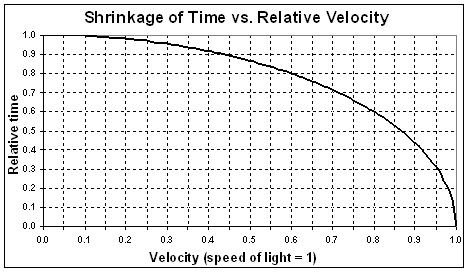
Have you ever felt that time was standing still. Well it was, if you were traveling at the speed of light. Otherwise, time simply slows down if you’re moving quickly away from a point of reference. By how much does time slow? It depends on how fast you’re going. The following chart depicts the relationship.

So, if you’re traveling “with” me through space (that is your velocity relative to mine is zero) your clock will advance at the same rate as (1 x) the rate at which my clock advances. If you’re moving steadily away from me at, say, one-half (0.5 x) the speed of light, your clock will advance at about 0.87 times the rate at which my clock advances. That is, when I look at my clock and see that an hour has passed since I last checked it, only about 52 minutes will have elapsed on your clock.

Just to put that in perspective, suppose you’re traveling at the rather brisk pace of 2,000 miles an hour (about 3 x the speed of sound). That’s about 3 millionths of the speed of light, at which rate your clock will advance at about 0.999999999996 times the rate of my clock. Hard to tell the difference, isn’t it?

That’s special relativity for you.

Ages of Presidents

UPDATED (03/25/08)

The subtitle of this post might be: Things you never needed to know about the presidents of the United States. To enlarge a graph, right-click on it and select “open in a new tab.”

The following graph highlights gaps between presidential birth years.


The longest gap is the most recent. Carter and G.H.W. Bush were born in 1924; Clinton and G.W. Bush were born in 1946. That’s a gap of 22 years — an entire generation (mine) deprived of a presidency. No fair! What’s worse, my generation is unlikely ever to have a president because by 2008 the youngest member will be 63 — not an impossible age for election to the presidency, but an unlikely age. Perhaps our last (best?) hope is Rudolph Giuliani, who was born in 1944. UPDATE (11/05/05): I suppressed the name of John McCain (born 1936) because I associate him first, last, and always with McCain-Feingold, that unconstitutional piece of incumbent-protecting legislation. McCain, who will be 72 in 2008 may well run for president again, but perhaps by then his age will be held against him. One can only hope. UPDATE (03/25/08): Well, McCain may be the next president. Whether he faces Barack Obama or Hillary Clinton in November matters not to me; he will be the lesser of two evils, in either event.

The next graph highlights trends (such as they are) in the age at which presidents have died (or to which they have survived if still living), the age at which they were elected or succeeded to the presidency, and the number of years by which they survived (or have thus far survived) election or succession. (I have omitted assassinated presidents from the data for age of death and number of years surviving, thus the gaps in the first and third series.)


It seems to me that the early presidents were generally “healthy and wise” (and wealthy, by the standards of their time). That is, they were of superior genetic stock, relative to the average person. Their successors have tended to be of less-superior stock, and it shows in the downward trends after 1836.

The general rise in life expectancies since 1900 masks the relative inferiority of twentieth century presidents. The rising age of accession to the presidency after 1932 and the rise in years of survivorship after 1924 (both with wide variations around the trend) should not be taken to indicate that presidents of the twentieth century are on a par, genetically, with the early presidents. They are not.

Plus Ca Change

IT is one of the most melancholy reflections of the present day, that while wealth and capital have been rapidly increasing, while science and art have been working the most surprising miracles in aid of the human family, and while morality, intelligence, and civilization have been rapidly extending on all hands;—that at this time, the great material interests of the higher and middle classes, and the physical condition of the labouring and industrial classes, are more and more marked by characters of uncertainty and insecurity.

What hasn’t changed, of course, is the tendency of the press to see problems where others see progress.

(Thanks to Pejman at A Chequer-Board of Nights and Days for the pointer.)

Equal Time

LINKS ADDED, AS NOTED BELOW — SERIES COMPLETE, MY COMMENTARY TO FOLLOW

Last week I reported about a series of posts by Maggie Gallagher, guest-blogging at The Volokh Conspiracy, in which Gallagher laid out a case against legalizing same-sex marriage. Volokh is now hosting Dale Carpenter, who will make a “traditionalist” case for legalizing same-sex marriage. I’ll add links to Carpenter’s posts as they appear. When he’s done I’ll try to summarize his conclusion, and compare it with Gallagher’s.

Posts to date:

Dale Carpenter on Same-Sex Marriage (intro by Eugene Volokh)
The Traditionalist Case for Gay Marriage — The Week Ahead
The Traditionalist Case — The Numbers
The Traditionalist Case — Individualistic Benefits to Gay Couples and Individuals
Response to Commentators — Day 1 (ADDED 11/01 @ 10:23 AM)
The Traditionalist Case — Individualistic Benefits to Children (ADDED 11/01 @ 10:58 AM)
People Unclear on the Concept (comment about comments by Eugene Volokh) (ADDED 11/01 @ 3:45 PM)
The Traditionalist Case – Communitarian Benefits (ADDED 11/01 @ 3:45 PM)
The Traditionalist Case – The Magnitude of the Benefits (ADDED 11/02 @ 12:18 PM)
Response to commentators – Day 2 (ADDED 11/02 @ 12:18 PM)
The Traditionalist Case — The Definitional Argument Against Gay Marriage (ADDED 11/02 @ 12:18 PM)
The Traditionalist Case – The Contagious-Promiscuity Argument (ADDED 11/02 @ 5:55 PM)
The Traditionalist Case – The Polygamy Slippery-Slope Argument (ADDED 11/02 @ 8:25 PM)
Response to commentators — Day 3 (ADDED 11/03 @ 4:15 PM)
The Traditionalist Case – The Procreation Argument (Standard Version) (ADDED 11/03 @ 4:15 PM)
More from Cathy Young on Same-Sex Marriage (an interjection by Eugene Volokh) (link to source ADDED 11/03 @ 4:15 PM)
The Traditionalist Case – The Procreation Argument (Gallagher Version) (ADDED 11/03 @ 8:52 PM)
Response to commentators – Day 4 (ADDED 11/04 @ 10:25 AM)
The Traditionalist Case – What Would Burke Do? (ADDED 11/04 @ 10:25 AM)
The Traditionalist Case – Getting From Here to There (ADDED 11/04 @ 10:35 PM)
The Traditionalist Case – Last Thoughts (ADDED 11/04 @ 10:35 PM)

Law, Liberty, and Abortion

This an abridgement of a post at Liberty Corner II. It is complete but for long quotations from Supreme Court opinions.

There are compelling legal and libertarian arguments against abortion. The essence of the legal argument is this: Roe v. Wade was decided wrongly. But that argument will not convince reflexive libertarian defenders of abortion. For them, I have a separate, four-fold argument against abortion: Life cannot be treated as property; the appeal to “viability is circular; privacy cannot be an absolute right; and the appeal to “safety” opens the door to the legalization of any form of murder. I conclude by explaining how the legalization of abortion plays into the hands of the state by creating a precedent for the taking of innocent life wherever the state finds it convenient to do so.

The Wrongness of Roe v. Wade

Abortion was considered murder long before States began to legislate against it in the 19th century. The long-standing condemnation of abortion — even before quickening — is treated thoroughly in Marvin Olasky’s Abortion Rites: A Social History of Abortion in America. Olasky corrects the slanted version of American history upon which the U.S. Supreme Court relied in Roe v. Wade.

Because abortion was not a right at the time of the adoption of the Ninth Amendment, there is no unenumerated right to abortion in the Constitution. The majority in Roe v. Wade (1973) instead seized upon and broadened a previously manufactured “privacy right” in order to legalize abortion. . . .

[excerpts of the majority opinion in Roe v. Wade]

In effect, the Roe v. Wade majority acknowledged that abortion is not even an unenumerated right. It then manufactured from specified procedural rights enumerated in the Bill of Rights — rights which are totally unrelated to abortion — and from strained precedents involving “penumbras” and “emanations,” a general right to privacy in order to find a “privacy” right to abortion. I have dissected a key precedent, Griswold v. Connecticut (1965), in the “Liberty” section of this post. It bears repeating that in drafting the Ninth Amendment Madison had in mind no particular unenumerated rights:

It is clear from its text and from Madison’s statement [upon presenting the Bill of Rights to the House of Representatives] that the [Ninth] Amendment states but a rule of construction, making clear that a Bill of Rights might not by implication be taken to increase the powers of the national government in areas not enumerated, and that it does not contain within itself any guarantee of a right or a proscription of an infringement.

It is therefore unsurprising that the majority in Roe v. Wade could not decide whether the general privacy right is located in the Ninth Amendment or the Fourteenth Amendment. Neither amendment, of course, is the locus of a general privacy right because none is conferred by the Constitution, nor could the Constitution ever confer such a right, for it would interfere with such truly compelling state interests as the pursuit of justice. The majority simply chose to ignore that unspeakable consequence by conjuring a general right to privacy for the limited purpose of ratifying abortion.

The spuriousness of the majority’s conclusion is evident in its flinching from the logical end of its reasoning: abortion anywhere at anytime. Instead, the majority delivered this:

The privacy right involved, therefore, cannot be said to be absolute. . . . We, therefore, conclude that the right of personal privacy includes the abortion decision, but that this right is not unqualified and must be considered against important state interests in regulation.

That is, the majority simply drew an arbitrary line between life and death — but in the wrong place. It is as if the majority understood, but wished not to acknowledged, the full implications of a general right to privacy. Such a general right could be deployed by unprincipled judges to decriminalize a variety of heinous acts.

Underlying the majority’s sophistry was its typically “liberal” reluctance to place responsibility where it belongs, in the hands of those persons who (in almost all cases) conceive through engaging voluntarily in an act, the potential consequences of which are well known. Thus we read:

Maternity, or additional offspring, may force upon the woman a distressful life and future. . . . All these are factors the woman and her responsible physician necessarily will consider in consultation.

All these are factors which “the woman,” barring rape, would have known before conception. . . .

[Justice White’s dissent, followed by excerpts of Justice Rehnquist’s concurring dissent]


Roe v. Wade
is nothing more than an illogical, ill-founded, politically expedient position staked out by seven justices who were caught in the tide of “personal liberation.” That tide, which rose in the 1960s and has yet to fully recede, is powered by the perverse belief that liberty is to be found in license.

The Supreme Court’s subsequent decision in Casey (1992) is a step in the right direction. As blogger Patterico explains, Casey

1) upheld the central holding of Roe on stare decisis grounds; 2) stripped the abortion right of its status as a ““fundamental right”” under the Constitution; and 3) replaced Roe‘s trimester framework with a rule tied to viability.

The next step, or steps, should be to undo Roe v. Wade completely and then turn it around. The States have no basis for allowing abortion (except where a mother’s physical health or life are endangered) because to do so deprives the fetus (a person) of due process of law and equal protection under the law, in violation of the Fifth and Fourteenth Amendments.

Abortion is Anti-Libertarian

The demonstrable fact of Roe v. Wade‘s wrongness will not dissuade those libertarians who defend abortion as a extra-legal right. Unsophisticated, self-styled libertarian defenders of abortion hold an “anything goes” view of liberty that is in fact antithetical to liberty. They may call themselves libertarians, but they might as well be anti-war protesters who block traffic or “greens” who burn down ski lodges.

Liberty requires each of us to pursue happiness without causing harm to others, except in self-defense. Those libertarian defenders of abortion who bother to give the issue a bit of thought try to build a case for abortion around self-defense, arguing that a woman who aborts is defending herself, and that no one should question her act of self-defense.

The self-defense argument — which is sometimes billed as a property rights argument for — goes like this: A fetus is an “uninvited guest” in or “invader” of its mother’s body, which is the mother’s property. The mother may therefore do with the fetus as she will.

But a fetus is neither an uninvited guest nor an invader. Rather, it is a life, and that life — by biological necessity — is its mother’s responsibility:

  • Conception, in almost all cases, is the result of a consensual act of sexual intercourse. (Rape, which accounts for a relatively small number of applications for abortion, is an exception. But it’s an exception that shouldn’t dictate what happens in the majority of pregnancies. If the state insists that rape victims give birth (as it ought to because of the state’s obligation to protect life), the state then takes responsibility for the adoption of those babies who may be unwanted by their mothers.)
  • Conception is a known consequence of the act of sexual intercourse. And it has been shown that when abortion becomes less readily available (e.g., more expensive),

    [t]his induces teenage girls to avoid risky sex, which will likely have the effect of lowering pregnancy rates, abortion rates, and birth rates among this group of individuals. . . . Behavior is not static, and claims based on the assumption of static behavior are flawed. [That is, “they” will not “just get pregnant, anyway”: ED]

  • It has been shown, as well, that

    [l]aws requiring minors to seek parental consent or to notify a parent prior to obtaining an abortion raise the cost of risky sex for teenagers. . . . [O]ur results indicate that the enactment of parental involvement laws significantly reduces risky sexual activity among teenage girls. [So much for “back alley abortions”: ED]

  • Life indisputably begins at conception:

    Surely the child is alive then [at the tying of the umbilical cord]. It cannot be the mere act of tying the cord that produced life. Then when did life begin? With respiration? That is only one added function. There was circulation previously, and the power of nervous action and motion. Why is not a fetus alive when it is diving and plunging in its mother’s womb? Simply because its lungs are not inflated? Out on such nonsense! One might as well say that a child born blind was not alive because it did not use its eyes. It is on the record, I believe that children have been born by the Caesarean section, after the death of the mother. If there was no vitality in the fetus previous to respiration, then why was it not dead, like the mother? There can be no doubt of it, there was vitality or life. Then if we acknowledge that the fetus had life, how can we say at what period of gestation that life commences? The period of quickening varies, and I do not see why a fetus is not quite as much alive just before it moves as just after. . . . [From O.C. Turner, “Criminal Abortion,” Boston Medical and Surgical Journal, Vol. 5 (April 21, 1870), pp. 299-300. Quoted by Marvin N. Olasky in Abortion Rites: A Social History of Abortion in America, Regnery Publishing, Inc., Washington, D.C. (1995), pp. 121-122.]

  • A person who conceives therefore has incurred an implicit obligation to care for the life that flows from her consensual act.
  • Given that the existence of a fetus cannot cause harm to anyone but its mother, the only valid route for terminating the life of a fetus would be a legal proceeding that culminates in a judicial determination that the continuation of the life of the fetus would cause grave physical harm or death to the mother.

A fetus, in sum, cannot be treated as “property,” to be disposed of willy-nilly. A libertarian who argues otherwise can do so only by regarding the fetus a sub-human implantation for with the mother bears no responsibility. Such a libertarian might as well argue for a right to keep slaves or a right to dispose of dependent children and parents through involuntary euthanasia.

When that realization strikes home, the next step may be an appeal to the viability of the fetus. The argument that a fetus is “inviable” — and therefore somehow undeserving of life — until it reaches a certain stage of development is a circular argument designed to favor abortion. A fetus (except in the case of a natural miscarriage) is viable from the moment of conception until birth as long as it is not aborted. It is abortion that makes a fetus inviable. Abortion therefore cannot be excused on the basis of presumed inviability.

Drawing an arbitrary line, say, three months after conception does not change the fact that a life is a life. And if that arbitrary line can be drawn, why not draw it at birth or just after birth or at any time during a child’s life? Remember, we are arguing here about libertarian principles, not legal niceties. If a child is a mother’s “property” — or if a mother always has a right to “defend” herself from an “unwanted guest” (in her womb or in her home) — why stop at abortion in the first trimester? (Actually, the law hasn’t stopped it there, which is a point that I’ll come to when I discuss the slippery slope down which we’re headed.)

Where, then, lies a valid libertarian defense of abortion? In privacy? Not at all. Privacy, to the extent that it exists as right, cannot be a general right, as I have argued above. If privacy were a general right, a murderer could claim immunity from prosecution as long as he commits murder in his own home, or better yet (for the murderer), as long as he murders his own children in his own home.

A “practical” libertarian might argue that legalizing abortion makes it “safer” (less dangerous to the mother), presumably because legalization ensures a greater supply of abortionists who can do the job without endangering the mother’s life, and at a lower price than a safe abortion would command without legalization. I’m willing to grant all of that, but I must observe that the same case can be made for legalizing murder. That is, a person with murderous intent could more readily afford to hire a professional who to do the job successfully and, at the same time, avoid putting himself at risk by trying to do the job himself. “Safety” is a rationalization for abortion that blinks at the nature of the act.

I am unable to avoid the conclusion that abortion is an anti-libertarian act of unjustified aggression against an innocent human being, an act that is undertaken for convenience and almost never for the sake of defending a mother’s life. Murder, too, is an act of convenience that is seldom justified by self-defense. Abortion, therefore, cannot be validated by mistaken appeals to self-defense, privacy, viability, and safety. Nor can abortion be validated (except legalistically) by a series of wrongly decided Supreme Court cases.

The Slippery Slope

If libertarians are to be faithful to libertarian principles, they must oppose the law even when — especially when — it puts convenience above principle. As I wrote here (modified language in brackets):

You may like the outcomes in Griswold v. Connecticut, Roe v. Wade, and Lawrence v. Texas because [you just like them or because they comport with your half-baked notion of liberty]. But it should bother you that the Supreme Court can so blithely turn the law on its head to enact its own beliefs, on the pretext of finding rights in “penumbras, formed by emanations” of the Constitution. A Court that can do such things is a Court that can just as easily interpret the law so as to restrict liberty, all in the name of meeting a pressing social need — as it has in done in many instances. . . .

It all reminds me of this exchange from Act I, Scene 6, of Robert Bolt’s play about Sir Thomas More, A Man for All Seasons:

Roper: So now you’d give the Devil benefit of law.

More: Yes. What would you do? Cut a great road through the law to get after the Devil?

Roper: I’d cut down every law in England to do that.

More: Oh? And when the last law was down–and the Devil turned round on you–where would you hide? Yes, I’d give the Devil benefit of law, for my own safety’s sake.

Libertarians who applaud the outcomes of such cases as Griswold v. Connecticut and Roe v. Wade because those outcomes seem to advance personal liberty are consorting with the Devil of statism. Every time the state fails to defend innocent life it acquire a new precedent for the taking of innocent life.

Thus we come to the slippery slope. As I wrote here:

[T]hink about the “progressive” impulses that underlie abortion (especially selective abortion), involuntary euthanasia, and forced mental screening — all of them steps down a slippery slope toward state control of human destiny.

In a later post I said that “the state is condoning and encouraging a resurgence of Hitlerian eugenics.” If you think I exaggerate, consider this:

In an article titled, “The Abortion Debate No One Wants to Have,” a former Washington Post reporter speaks of her Down Syndrome daughter and the conflicts such children provoke among enlightened pro-abortion professionals. She concludes:

And here’s one more piece of un-discussable baggage: This question is a small but nonetheless significant part of what’s driving the abortion discussion in this country. I have to think that there are many pro-choicers who, while paying obeisance to the rights of people with disabilities, want at the same time to preserve their right to ensure that no one with disabilities will be born into their own families. The abortion debate is not just about a woman’s right to choose whether to have a baby; it’s also about a woman’s right to choose which baby she wants to have.

Amy Welborn makes this apposite comment:

. . . This is not about “having” or “not having” babies with disabilities – the common way of discussing such things, when they are discussed at all. It is about “killing” or “not killing” babies with disabilities. Period.

And Wilfred McClay at Mere Comments provides us with a perspective rarely included in the debate.

I myself recall having a conversation with a Down’s syndrome adult who noted the disparity between Senator Edward M. Kennedy’s well-publicized support for the Special Olympics, and his equally well-known insistence that no woman should have to bear the indignity of a “defective” or unwanted child. “I may be slow,” this man observed, “but I am not stupid. Does he think that people like me can’t understand what he really thinks of us? That we are not really wanted? That it would be a better world if we didn’t exist?”

. . . This from a speech by the late Malcolm Muggeridge, given at the University of San Francisco in 1978:

. . . I know, that as sure as I can possibly persuade you to believe: governments will find it impossible to resist the temptation . . . to deliver themselves from this burden of looking after the sick and the handicapped by the simple expedient of killing them off. Now this, in fact, is what the Nazis did . . . not always through slaughter camps, but by a perfectly coherent decree with perfectly clear conditions. In fact, delay in creating public pressure for euthanasia has been due to the fact that it was one of the war crimes cited at Nuremberg. So for the Guinness Book of Records you can submit this: That it takes just about 30 years in our humane society to transform a war crime into an act of compassion. That is exactly what happened.

Not only can it happen in America, it is happening in America. Thus convenience does make killers of us all — or all of us who condone abortion and therefore encourage its accompanying eugenic evils.

CLICK HERE FOR THE FULL POST, WHICH INCLUDES RELEVANT PORTIONS OF SUPREME COURT OPINIONS.

Related posts:
I’ve Changed My Mind (08/15/04)
Next Stop, Legal Genocide? (09/05/04)
Here’s Something All Libertarians Can Agree On
(09/10/04)
It Can Happen Here: Eugenics, Abortion, Euthanasia, and Mental Screening (09/11/04)
Creeping Euthanasia (09/21/04)
PETA, NARAL, and Roe v. Wade (11/17/04)
Flooding the Moral Low Ground (11/19/04)
The Beginning of the End? (11/21/04)
Peter Singer’s Fallacy (11/26/04)
Taking Exception (03/01/05)
Protecting Your Civil Liberties
(03/22/05)
Where Conservatism and (Sensible) Libertarianism Come Together (04/14/05)
Conservatism, Libertarianism, and Public Morality (04/25/25)
The Threat of the Anti-Theocracy (05/03/05)
The Consequences of Roe v. Wade (06/08/05)
The Old Eugenics in a New Guise (07/14/05)
The Left, Abortion, and Adolescence (07/21/05)

Law, Liberty, and Abortion

There are compelling legal and libertarian arguments against abortion. The essence of the legal argument is this: Roe v. Wade was decided wrongly. But that argument will not convince reflexive libertarian defenders of abortion. For them, I have a separate, four-fold argument against abortion: Life cannot be treated as property; the appeal to “viability” is circular; privacy cannot be an absolute right; and the appeal to “safety” opens the door to the legalization of any form of murder. I conclude by explaining how the legalization of abortion plays into the hands of the state by creating a precedent for the taking of innocent life wherever the state finds it convenient to do so.

The Wrongness of Roe v. Wade

Abortion was considered murder long before States began to legislate against it in the 19th century. The long-standing condemnation of abortion — even before quickening — is treated thoroughly in Marvin Olasky’s Abortion Rites: A Social History of Abortion in America. Olasky corrects the slanted version of American history upon which the U.S. Supreme Court relied in Roe v. Wade.

Because abortion was not a right at the time of the adoption of the Ninth Amendment, there is no unenumerated right to abortion in the Constitution. The majority in Roe v. Wade (1973) instead seized upon and broadened a previously manufactured “privacy right” in order to legalize abortion:

VIII

The Constitution does not explicitly mention any right of privacy. In a line of decisions, however, going back perhaps as far as Union Pacific R. Co. v. Botsford, 141 U.S. 250, 251 (1891), the Court has recognized that a right of personal privacy, or a guarantee of certain areas or zones of privacy, does exist under the Constitution. In varying contexts, the Court or individual Justices have, indeed, found at least the roots of that right in the First Amendment, Stanley v. Georgia, 394 U.S. 557, 564 (1969); in the Fourth and Fifth Amendments, Terry v. Ohio, 392 U.S. 1, 8 -9 (1968), Katz v. United States, 389 U.S. 347, 350 (1967), Boyd v. United States, 116 U.S. 616 (1886), see Olmstead v. United States, 277 U.S. 438, 478 (1928) (Brandeis, J., dissenting); in the penumbras of the Bill of Rights, Griswold v. Connecticut, 381 U.S., at 484 -485; in the Ninth Amendment, id., at 486 (Goldberg, J., concurring); or in the concept of liberty guaranteed by the first section of the Fourteenth Amendment, see Meyer v. Nebraska, 262 U.S. 390, 399 (1923). These decisions make it clear that only personal rights that can be deemed “fundamental” or “implicit in the concept of ordered liberty,” Palko v. Connecticut, 302 U.S. 319, 325 (1937), are included in this guarantee of personal privacy. They also make it clear that the right has some extension to activities relating to marriage, Loving v. Virginia, 388 U.S. 1, 12 (1967); procreation, Skinner v. Oklahoma, 316 U.S. 535, 541 -542 (1942); contraception, Eisenstadt v. Baird, 405 U.S., at 453 -454; id., at 460, 463-465 [410 U.S. 113, 153] (WHITE, J., concurring in result); family relationships, Prince v. Massachusetts, 321 U.S. 158, 166 (1944); and child rearing and education, Pierce v. Society of Sisters, 268 U.S. 510, 535 (1925), Meyer v. Nebraska, supra.

This right of privacy, whether it be founded in the Fourteenth Amendment’s concept of personal liberty and restrictions upon state action, as we feel it is, or, as the District Court determined, in the Ninth Amendment’s reservation of rights to the people, is broad enough to encompass a woman’s decision whether or not to terminate her pregnancy. The detriment that the State would impose upon the pregnant woman by denying this choice altogether is apparent. Specific and direct harm medically diagnosable even in early pregnancy may be involved. Maternity, or additional offspring, may force upon the woman a distressful life and future. Psychological harm may be imminent. Mental and physical health may be taxed by child care. There is also the distress, for all concerned, associated with the unwanted child, and there is the problem of bringing a child into a family already unable, psychologically and otherwise, to care for it. In other cases, as in this one, the additional difficulties and continuing stigma of unwed motherhood may be involved. All these are factors the woman and her responsible physician necessarily will consider in consultation.

On the basis of elements such as these, appellant and some amici argue that the woman’s right is absolute and that she is entitled to terminate her pregnancy at whatever time, in whatever way, and for whatever reason she alone chooses. With this we do not agree. Appellant’s arguments that Texas either has no valid interest at all in regulating the abortion decision, or no interest strong enough to support any limitation upon the woman’s sole determination, are unpersuasive. The [410 U.S. 113, 154] Court’s decisions recognizing a right of privacy also acknowledge that some state regulation in areas protected by that right is appropriate. As noted above, a State may properly assert important interests in safeguarding health, in maintaining medical standards, and in protecting potential life. At some point in pregnancy, these respective interests become sufficiently compelling to sustain regulation of the factors that govern the abortion decision. The privacy right involved, therefore, cannot be said to be absolute. In fact, it is not clear to us that the claim asserted by some amici that one has an unlimited right to do with one’s body as one pleases bears a close relationship to the right of privacy previously articulated in the Court’s decisions. The Court has refused to recognize an unlimited right of this kind in the past. Jacobson v. Massachusetts, 197 U.S. 11 (1905) (vaccination); Buck v. Bell, 274 U.S. 200 (1927) (sterilization).

We, therefore, conclude that the right of personal privacy includes the abortion decision, but that this right is not unqualified and must be considered against important state interests in regulation.

In effect, the Roe v. Wade majority acknowledged that abortion is not even an unenumerated right. It then manufactured from specified procedural rights enumerated in the Bill of Rights — rights which are totally unrelated to abortion — and from strained precedents involving “penumbras” and “emanations,” a general right to privacy in order to find a “privacy” right to abortion. I have dissected a key precedent, Griswold v. Connecticut (1965), in the “Liberty” section of this post. It bears repeating that in drafting the Ninth Amendment Madison had in mind no particular unenumerated rights:

It is clear from its text and from Madison’s statement [upon presenting the Bill of Rights to the House of Representatives] that the [Ninth] Amendment states but a rule of construction, making clear that a Bill of Rights might not by implication be taken to increase the powers of the national government in areas not enumerated, and that it does not contain within itself any guarantee of a right or a proscription of an infringement.

It is therefore unsurprising that the majority in Roe v. Wade could not decide whether the general privacy right is located in the Ninth Amendment or the Fourteenth Amendment. Neither amendment, of course, is the locus of a general privacy right because none is conferred by the Constitution, nor could the Constitution ever confer such a right, for it would interfere with such truly compelling state interests as the pursuit of justice. The majority simply chose to ignore that unspeakable consequence by conjuring a general right to privacy for the limited purpose of ratifying abortion.

The spuriousness of the majority’s conclusion is evident in its flinching from the logical end of its reasoning: abortion anywhere at anytime. Instead, the majority delivered this:

The privacy right involved, therefore, cannot be said to be absolute. . . . We, therefore, conclude that the right of personal privacy includes the abortion decision, but that this right is not unqualified and must be considered against important state interests in regulation.

That is, the majority simply drew an arbitrary line between life and death — but in the wrong place. It is as if the majority understood, but wished not to acknowledged, the full implications of a general right to privacy. Such a general right could be deployed by unprincipled judges to decriminalize a variety of heinous acts.

Underlying the majority’s sophistry was its typically “liberal” reluctance to place responsibility where it belongs, in the hands of those persons who (in almost all cases) conceive through engaging voluntarily in an act, the potential consequences of which are well known. Thus we read:

Maternity, or additional offspring, may force upon the woman a distressful life and future. . . . All these are factors the woman and her responsible physician necessarily will consider in consultation.

All these are factors which “the woman,” barring rape, would have known before conception.

Justice White’s dissent says it all:

At the heart of the controversy in these cases are those recurring pregnancies that pose no danger whatsoever to the life or health of the mother but are, nevertheless, unwanted for any one or more of a variety of reasons — convenience, family planning, economics, dislike of children, the embarrassment of illegitimacy, etc. The common claim before us is that, for any one of such reasons, or for no reason at all, and without asserting or claiming any threat to life or health, any woman is entitled to an abortion at her request if she is able to find a medical advisor willing to undertake the procedure.

The Court, for the most part, sustains this position: during the period prior to the time the fetus becomes viable, the Constitution of the United States values the convenience, whim, or caprice of the putative mother more than the life or potential life of the fetus; the Constitution, therefore, guarantees the right to an abortion as against any state law or policy seeking to protect the fetus from an abortion not prompted by more compelling reasons of the mother.

With all due respect, I dissent. I find nothing in the language or history of the Constitution to support the Court’s judgment. The Court simply fashions and announces a new constitutional right for pregnant mothers [410 U.S. 222] and, with scarcely any reason or authority for its action, invests that right with sufficient substance to override most existing state abortion statutes. The upshot is that the people and the legislatures of the 50 States are constitutionally dissentitled to weigh the relative importance of the continued existence and development of the fetus, on the one hand, against a spectrum of possible impacts on the mother, on the other hand. As an exercise of raw judicial power, the Court perhaps has authority to do what it does today; but, in my view, its judgment is an improvident and extravagant exercise of the power of judicial review that the Constitution extends to this Court.

The Court apparently values the convenience of the pregnant mother more than the continued existence and development of the life or potential life that she carries. Whether or not I might agree with that marshaling of values, I can in no event join the Court’s judgment because I find no constitutional warrant for imposing such an order of priorities on the people and legislatures of the States. In a sensitive area such as this, involving as it does issues over which reasonable men may easily and heatedly differ, I cannot accept the Court’s exercise of its clear power of choice by interposing a constitutional barrier to state efforts to protect human life and by investing mothers and doctors with the constitutionally protected right to exterminate it. This issue, for the most part, should be left with the people and to the political processes the people have devised to govern their affairs.

It is my view, therefore, that the Texas statute is not constitutionally infirm because it denies abortions to those who seek to serve only their convenience, rather than to protect their life or health. Nor is this plaintiff, who claims no threat to her mental or physical health, entitled to assert the possible rights of those women [410 U.S. 223] whose pregnancy assertedly implicates their health. This, together with United States v. Vuitch, 402 U.S. 62 (1971), dictates reversal of the judgment of the District Court.

Likewise, because Georgia may constitutionally forbid abortions to putative mothers who, like the plaintiff in this case, do not fall within the reach of § 26-1202(a) of its criminal code, I have no occasion, and the District Court had none, to consider the constitutionality of the procedural requirements of the Georgia statute as applied to those pregnancies posing substantial hazards to either life or health. I would reverse the judgment of the District Court in the Georgia case.

And here is a portion of Justice Rehnquist’s concurring dissent, in which he focuses on “privacy” and the applicability of the Fourteenth Amendment:

I have difficulty in concluding, as the Court does, that the right of “privacy” is involved in this case. Texas, by the statute here challenged, bars the performance of a medical abortion by a licensed physician on a plaintiff such as Roe. A transaction resulting in an operation such as this is not “private” in the ordinary usage of that word. Nor is the “privacy” that the Court finds here even a distant relative of the freedom from searches and seizures protected by the Fourth Amendment to the Constitution, which the Court has referred to as embodying a right to privacy. Katz v. United States, 389 U.S. 347 (1967). . . .. . . The decision here to break pregnancy into three distinct terms and to outline the permissible restrictions the State may impose in each one, for example, partakes more of judicial legislation than it does of a determination of the intent of the drafters of the Fourteenth Amendment.

The fact that a majority of the States reflecting, after all, the majority sentiment in those States, have had restrictions on abortions for at least a century is a strong indication, it seems to me, that the asserted right to an abortion is not “so rooted in the traditions and conscience of our people as to be ranked as fundamental,” Snyder v. Massachusetts, 291 U.S. 97, 105 (1934). Even today, when society’s views on abortion are changing, the very existence of the debate is evidence that the “right” to an abortion is not so universally accepted as the appellant would have us believe.

To reach its result, the Court necessarily has had to find within the scope of the Fourteenth Amendment a right that was apparently completely unknown to the drafters of the Amendment. . . .

There apparently was no question concerning the validity of this provision or of any of the other state statutes when the Fourteenth Amendment was adopted. The only conclusion possible from this history is that the drafters did not intend to have the Fourteenth Amendment withdraw from the States the power to legislate with respect to this matter.

Roe v. Wade is nothing more than an illogical, ill-founded, politically expedient position staked out by seven justices who were caught in the tide of “personal liberation.” That tide, which rose in the 1960s and has yet to fully recede, is powered by the perverse belief that liberty is to be found in license.

The Supreme Court’s subsequent decision in Casey (1992) is a step in the right direction. As blogger Patterico explains, Casey

1) upheld the central holding of Roe on stare decisis grounds; 2) stripped the abortion right of its status as a ““fundamental right”” under the Constitution; and 3) replaced Roe‘s trimester framework with a rule tied to viability.

The next step, or steps, should be to undo Roe v. Wade completely and then turn it around. The States have no basis for allowing abortion (except where a mother’s physical health or life are endangered) because to do so deprives the fetus (a person) of due process of law and equal protection under the law, in violation of the Fifth and Fourteenth Amendments.

Abortion is Anti-Libertarian

The demonstrable fact of Roe v. Wade‘s wrongness will not dissuade those libertarians who defend abortion as a extra-legal right. Unsophisticated, self-styled libertarian defenders of abortion hold an “anything goes” view of liberty that is in fact antithetical to liberty. They may call themselves libertarians, but they might as well be anti-war protesters who block traffic or “greens” who burn down ski lodges.

Liberty requires each of us to pursue happiness without causing harm to others, except in self-defense. Those libertarian defenders of abortion who bother to give the issue a bit of thought try to build a case for abortion around self-defense, arguing that a woman who aborts is defending herself, and that no one should question her act of self-defense.

The self-defense argument — which is sometimes billed as a property rights argument for — goes like this: A fetus is an “uninvited guest” in or “invader” of its mother’s body, which is the mother’s property. The mother may therefore do with the fetus as she will.

But a fetus is neither an uninvited guest nor an invader. Rather, it is a life, and that life — by biological necessity — is its mother’s responsibility:

  • Conception, in almost all cases, is the result of a consensual act of sexual intercourse. (Rape, which accounts for a relatively small number of applications for abortion, is an exception. But it’s an exception that shouldn’t dictate what happens in the majority of pregnancies. If the state insists that rape victims give birth (as it ought to because of the state’s obligation to protect life), the state then takes responsibility for the adoption of those babies who may be unwanted by their mothers.)
  • Conception is a known consequence of the act of sexual intercourse. And it has been shown that when abortion becomes less readily available (e.g., more expensive),

    [t]his induces teenage girls to avoid risky sex, which will likely have the effect of lowering pregnancy rates, abortion rates, and birth rates among this group of individuals. . . . Behavior is not static, and claims based on the assumption of static behavior are flawed. [That is, “they” will not “just get pregnant, anyway”: ED]


  • It has been shown, as well, that

    [l]aws requiring minors to seek parental consent or to notify a parent prior to obtaining an abortion raise the cost of risky sex for teenagers. . . . [O]ur results indicate that the enactment of parental involvement laws significantly reduces risky sexual activity among teenage girls. [So much for “back alley abortions”: ED]


  • Life indisputably begins at conception:

    Surely the child is alive then [at the tying of the umbilical cord]. It cannot be the mere act of tying the cord that produced life. Then when did life begin? With respiration? That is only one added function. There was circulation previously, and the power of nervous action and motion. Why is not a fetus alive when it is diving and plunging in its mother’s womb? Simply because its lungs are not inflated? Out on such nonsense! One might as well say that a child born blind was not alive because it did not use its eyes. It is on the record, I believe that children have been born by the Caesarean section, after the death of the mother. If there was no vitality in the fetus previous to respiration, then why was it not dead, like the mother? There can be no doubt of it, there was vitality or life. Then if we acknowledge that the fetus had life, how can we say at what period of gestation that life commences? The period of quickening varies, and I do not see why a fetus is not quite as much alive just before it moves as just after. . . . [From O.C. Turner, “Criminal Abortion,” Boston Medical and Surgical Journal, Vol. 5 (April 21, 1870), pp. 299-300. Quoted by Marvin N. Olasky in Abortion Rites: A Social History of Abortion in America, Regnery Publishing, Inc., Washington, D.C. (1995), pp. 121-122.]

  • A person who conceives therefore has incurred an implicit obligation to care for the life that flows from her consensual act.
  • Given that the existence of a fetus cannot cause harm to anyone but its mother, the only valid route for terminating the life of a fetus would be a legal proceeding that culminates in a judicial determination that the continuation of the life of the fetus would cause grave physical harm or death to the mother.

A fetus, in sum, cannot be treated as “property,” to be disposed of willy-nilly. A libertarian who argues otherwise can do so only by regarding the fetus a sub-human implantation for with the mother bears no responsibility. Such a libertarian might as well argue for a right to keep slaves or a right to dispose of dependent children and parents through involuntary euthanasia.

When that realization strikes home, the next step may be an appeal to the viability of the fetus. The argument that a fetus is “inviable” — and therefore somehow undeserving of life — until it reaches a certain stage of development is a circular argument designed to favor abortion. A fetus (except in the case of a natural miscarriage) is viable from the moment of conception until birth as long as it is not aborted. It is abortion that makes a fetus inviable. Abortion therefore cannot be excused on the basis of presumed inviability.

Drawing an arbitrary line, say, three months after conception does not change the fact that a life is a life. And if that arbitrary line can be drawn, why not draw it at birth or just after birth or at any time during a child’s life? Remember, we are arguing here about libertarian principles, not legal niceties. If a child is a mother’s “property” — or if a mother always has a right to “defend” herself from an “unwanted guest” (in her womb or in her home) — why stop at abortion in the first trimester? (Actually, the law hasn’t stopped it there, which is a point that I’ll come to when I discuss the slippery slope down which we’re headed.)

Where, then, lies a valid libertarian defense of abortion? In privacy? Not at all. Privacy, to the extent that it exists as right, cannot be a general right, as I have argued above. If privacy were a general right, a murderer could claim immunity from prosecution as long as he commits murder in his own home, or better yet (for the murderer), as long as he murders his own children in his own home.

A “practical” libertarian might argue that legalizing abortion makes it “safer” (less dangerous to the mother), presumably because legalization ensures a greater supply of abortionists who can do the job without endangering the mother’s life, and at a lower price than a safe abortion would command without legalization. I’m willing to grant all of that, but I must observe that the same case can be made for legalizing murder. That is, a person with murderous intent could more readily afford to hire a professional who to do the job successfully and, at the same time, avoid putting himself at risk by trying to do the job himself. “Safety” is a rationalization for abortion that blinks at the nature of the act.

I am unable to avoid the conclusion that abortion is an anti-libertarian act of unjustified aggression against an innocent human being, an act that is undertaken for convenience and almost never for the sake of defending a mother’s life. Murder, too, is an act of convenience that is seldom justified by self-defense. Abortion, therefore, cannot be validated by mistaken appeals to self-defense, privacy, viability, and safety. Nor can abortion be validated (except legalistically) by a series of wrongly decided Supreme Court cases.

The Slippery Slope

If libertarians are to be faithful to libertarian principles, they must oppose the law even when — especially when — it puts convenience above principle. As I wrote here (modified language in brackets):

You may like the outcomes in Griswold v. Connecticut, Roe v. Wade, and Lawrence v. Texas because [you just like them or because they comport with your half-baked notion of liberty]. But it should bother you that the Supreme Court can so blithely turn the law on its head to enact its own beliefs, on the pretext of finding rights in “penumbras, formed by emanations” of the Constitution. A Court that can do such things is a Court that can just as easily interpret the law so as to restrict liberty, all in the name of meeting a pressing social need — as it has in done in many instances. . . .

It all reminds me of this exchange from Act I, Scene 6, of Robert Bolt’s play about Sir Thomas More, A Man for All Seasons:

Roper: So now you’d give the Devil benefit of law.

More: Yes. What would you do? Cut a great road through the law to get after the Devil?

Roper: I’d cut down every law in England to do that.

More: Oh? And when the last law was down–and the Devil turned round on you–where would you hide? Yes, I’d give the Devil benefit of law, for my own safety’s sake.

Libertarians who applaud the outcomes of such cases as Griswold v. Connecticut and Roe v. Wade because those outcomes seem to advance personal liberty are consorting with the Devil of statism. Every time the state fails to defend innocent life it acquire a new precedent for the taking of innocent life.

Thus we come to the slippery slope. As I wrote here:

[T]hink about the “progressive” impulses that underlie abortion (especially selective abortion), involuntary euthanasia, and forced mental screening — all of them steps down a slippery slope toward state control of human destiny.

In a later post I said that “the state is condoning and encouraging a resurgence of Hitlerian eugenics.” If you think I exaggerate, consider this:

In an article titled, “The Abortion Debate No One Wants to Have,” a former Washington Post reporter speaks of her Down Syndrome daughter and the conflicts such children provoke among enlightened pro-abortion professionals. She concludes:

And here’s one more piece of un-discussable baggage: This question is a small but nonetheless significant part of what’s driving the abortion discussion in this country. I have to think that there are many pro-choicers who, while paying obeisance to the rights of people with disabilities, want at the same time to preserve their right to ensure that no one with disabilities will be born into their own families. The abortion debate is not just about a woman’s right to choose whether to have a baby; it’s also about a woman’s right to choose which baby she wants to have.

Amy Welborn makes this apposite comment:

. . . This is not about “having” or “not having” babies with disabilities – the common way of discussing such things, when they are discussed at all. It is about “killing” or “not killing” babies with disabilities. Period.

And Wilfred McClay at Mere Comments provides us with a perspective rarely included in the debate.

I myself recall having a conversation with a Down’s syndrome adult who noted the disparity between Senator Edward M. Kennedy’s well-publicized support for the Special Olympics, and his equally well-known insistence that no woman should have to bear the indignity of a “defective” or unwanted child. “I may be slow,” this man observed, “but I am not stupid. Does he think that people like me can’t understand what he really thinks of us? That we are not really wanted? That it would be a better world if we didn’t exist?”

. . . This from a speech by the late Malcolm Muggeridge, given at the University of San Francisco in 1978:

. . . I know, that as sure as I can possibly persuade you to believe: governments will find it impossible to resist the temptation . . . to deliver themselves from this burden of looking after the sick and the handicapped by the simple expedient of killing them off. Now this, in fact, is what the Nazis did . . . not always through slaughter camps, but by a perfectly coherent decree with perfectly clear conditions. In fact, delay in creating public pressure for euthanasia has been due to the fact that it was one of the war crimes cited at Nuremberg. So for the Guinness Book of Records you can submit this: That it takes just about 30 years in our humane society to transform a war crime into an act of compassion. That is exactly what happened.

Not only can it happen in America, it is happening in America. Thus convenience does make killers of us all — or all of us who condone abortion and therefore encourage its accompanying eugenic evils.

Related posts:
I’ve Changed My Mind (08/15/04)
Next Stop, Legal Genocide? (09/05/04)
Here’s Something All Libertarians Can Agree On
(09/10/04)
It Can Happen Here: Eugenics, Abortion, Euthanasia, and Mental Screening (09/11/04)
Creeping Euthanasia (09/21/04)
PETA, NARAL, and Roe v. Wade (11/17/04)
Flooding the Moral Low Ground (11/19/04)
The Beginning of the End? (11/21/04)
Peter Singer’s Fallacy (11/26/04)
Taking Exception (03/01/05)
Protecting Your Civil Liberties
(03/22/05)
Where Conservatism and (Sensible) Libertarianism Come Together (04/14/05)
Conservatism, Libertarianism, and Public Morality (04/25/25)
The Threat of the Anti-Theocracy (05/03/05)
The Consequences of Roe v. Wade (06/08/05)
The Old Eugenics in a New Guise (07/14/05)
The Left, Abortion, and Adolescence (07/21/05)

Right Again?

President Bush has nominated Judge Samuel Alito to the Supreme Court. I wrote this on October 27:

  • But Bush had to seem to want to replace O’Connor with another woman.
  • Bush therefore chose Miers, whose nomination he knew would be fiercely opposed on the right.
  • Given Miers’s position as White House counsel, her name could be withdrawn as a matter of principle (defense of the separation of powers).
  • Bush’s withdrawal of the Miers nomination would not only please the right but also not be seen as a bow to the left.

The nominee isn’t McConnell, but he’s just as good as far as I can tell. The choice of Alito certainly isn’t a bow to the left. As Max Goss says at Right Reason, ” NPR has been throwing around terms like ‘wacko’ and ‘radical’ all morning. Must be a good guy.” Hear, hear!

"Equal Protection" and Homosexual Marriage

REVISED AT 2: 49 PM (CT) 10/30/05

The “equal protection” clause of the Fourteenth Amendment is getting quite a workout these days. In some jurisdictions, “equal protection” gives a homosexual person the same access to his or her “partner’s” company’s health-insurance plan as a spouse in a traditional marriage. In other jurisdictions, “equal protection” leads to the recognition of homosexual “marriage” on the same basis as traditional marriage. And on and on.

None of this would be happening if the “equal protection” clause hadn’t long ago been turned upside down by loose constructionists. What “equal protection” really means is this:

Any law that is otherwise constitutional is a valid law, which must be applied equally to all persons.

As long as that law is applied equally to all persons, it is irrelevant if the application of the law happens to lead to unequal outcomes for various identifiable groups of persons. Instead, “equal protection” now means that everyone is entitled to the same outcome — the law be damned.

Consider, for example, an employer who is foolish enough to screen job applicants by administering tests that might, even by inference, measure intelligence. Why? Because such tests would expose the employer to a charge of racial discrimination, under the Civil Rights Act of 1964, under which it has become illegal for employers to make hiring decisions if the effect of those decisions (not the intent, but the effect) seems discriminatory.

The perverse logic of the current interpretation of the “equal protection” clause may be further illustrated by a (not so far-fetched) hypothetical. Many crimes carry a stiffer penalty if a perpetrator possesses a firearm in the commission of a crime. The current, perverted interpretation of the “equal protection” clause would eliminate the additional penalty for carrying a firearm on the ground that all criminals ought to be treated the same. Taken to the extreme, the current, perverted interpretation of the “equal protection” clause would de-criminalize crime on the ground that criminal statutes do not afford criminals “equal protection” of the law; that is, criminals go to jail while others go free. The logic of the current, perverted interpretation of the “equal protection” clause boils down to this: Legislatures may not attempt to legislate for the preservation and protection of a civil society (e.g., heterosexual marriage is good for society, potentially violent criminals are bad for society) if legislation somehow fails to treat all persons equally, even persons who are not the intended beneficiaries or targets of legislation.

Marriage, as an institution that comes under the jurisdiction of the States, should be governed by the laws of the States. A State court that decrees, without benefit of legislation, that marriage is available to homosexuals has made new law by applying the perverted meaning of the “equal protection” clause. A proper application of the “equal protection” clause by a State court would go something like this:

The legislature of this State, acting in accordance with the constitution of this State, has determined that marriage consists of a legal, binding, union between a man and a woman. Therefore, this court cannot institute homosexual marriage because to do so would dilute the benefits pertaining to marriage under the laws of this State, by requiring the State to transfer scarce resources to the support of homosexual unions, in violation of “due process” and “equal protection” clauses of the Fourteenth Amendment to the Constitution of the United States. All who come under the purview of a constitutional law are entitled to the protection of that law. All who do not may petition the legislature for a more encompassing law.

And so, even though marriage is a State-controlled institution, it would be within the purview of the U.S. Supreme Court to overrule a State supreme court’s creation of a right to homosexual marriage without legislative authority. Why? Because the issue involved — “equal protection” — arises from an application of the U.S. Constitution.

Related posts:

A Century of Progress?
(01/30/05)
Libertarianism, Marriage, and the True Meaning of Family Values (04/06/05)
States’ Rights and Skunks (10/20/05)
Same-Sex Marriage (10/20/05)
Speaking of States’ Rights and Judge McConnell (10/27/05)

The Left’s Double Standard on Harriet Miers

John Podesta, formerly a chief of staff to Bill Clinton and now a member of the Left’s traveling pack of attack dogs (same thing), writes at Think Progress:

Harriet Miers’ nomination fell victim to a right-wing double standard.

In his confirmation hearing, John Roberts affirmed the right to privacy, agreed with the conclusion of Griswold, and told the Judiciary Committee that he considered Roe v. Wade ““settled as a precedent.””

There is much in Harriet Miers’’ record to suggest she fell to the right of Roberts’ on the question of abortion rights. She does not consider Griswold settled law and had a record of supporting anti-choice causes.

John Roberts was enthusiastically embraced by right-wing conservatives eager to overturn Roe v. Wade. Harriet Miers was vilified by the exact same people.

Harriet Miers’’ nomination has always been controversial, but it was not until comments from a 1993 speech surfaced where she said she believed in ““self-determination” that Miers was presumably forced to withdraw.

It is clear that, absent an unambiguous pledge to overturn Roe, the right holds women nominees to a different standard. They do it because they fear a woman justice will feel empathy towards other women making the agonizing choice of whether to have an abortion. They fear that a woman justice would not be willing to use criminal sanctions to regulate other women’s decisions.

No nominee should be subject to a litmus test, especially one that discriminates based on gender.

Podesta’s hypocrisy knows no bounds. Imagine the impossible: Podesta on the talk-show circuit defending Harriet Miers’s nomination because of her seemingly inconsistent views about abortion and her disdain for Griswold v. Connecticut.

The double standard on display is that of the Left, which prefers the litmus test of “diversity” to the litmus test of competence. Most conservatives who were outraged about Miers were outraged long before Miers’s ramblings about “self determination” came to light. And they were outraged because of Miers’s evident faults: little or no relevant legal experience, a muddled mind. In sum, conservatives put quality above diversity.

Such a concept would never cross the mind of a John Podesta, whose lack of interest in Miers’s judicial qualifications is exceeded only by his cynical delight in conservative-bashing.

(Thanks to SCOTUSblog for the pointer.)