
I noticed that as I was scouring the Internet Movie Database for movies to add to my Blockbuster.com queue I eschewed films starring Kirk Douglas, Glenn Ford, Burt Lancaster, and Robert Mitchum. Perhaps it’s because I tend to dislike the melodramatic, unrealistic movies of the late 1940s and 1950s, which was when Douglas, Ford, Lancaster, and Mitchum became stars. But even their later films don’t appeal to me. I’ll have to give it some more thought. Stay tuned for a P.S.
Author: Loquitur Veritatem
See https://politicsandprosperity.com/about/.
Second-Guessing, Paternalism, Parentalism, and Choice
You make the best decision you can, at the time you make it, in light of your preferences and knowledge at that time. Then someone (sometimes yourself) comes along to tell you that you would would have made a “more rational” decision if only you had had different knowledge or different preferences at the time you made the decision.
Persons with a compulsion to second-guess the decisions of others are paternalists; they want to use the power of the state to force others to make “rational” (i.e., different) decisions. Persons with a compulsion to second-guess themselves are parentalists; they want the state to make “rational” decisions for them. Paternalism and parentalism have the same effect: loss of liberty.
Glen Whitman explains:
Julian [Sanchez has] written up an excellent piece on “parentalism” – the desire of some people to have their own freedom restricted for their own good. He cites a forthcoming Cato Policy Analysis by yours truly on the subject of “internalities,” a term of art for within-person externalities that people impose on themselves. In so doing, he helpfully saves me the trouble of having to summarize my own argument:
There are plenty of practical problems with the parentalist impulse. As economist Glen Whitman notes in a forthcoming Cato Institute paper, we cannot assume we always help people by giving preference to their “long term” over their “short term” interests. Imagine an aging man in ill-health lamenting his sybaritic youth. We are tempted to say that his younger self, seeing the pleasures immediately available to him and giving short shrift to their long term consequences, exhibited a foolish bias toward the present. But surely it’s also possible that his older self, faced with the proximate pains and inconveniences of poor health, discounts the pleasures past he’d have forsaken had he been more health-conscious. If we’re prone to the first form of cognitive bias, why not the second?
Whitman also argues that, just as simple Pigovian taxes on pollution may be less efficient than allowing market negotiation to determine how much pollution will be produced in what location, sin taxes, smoking bans, and other parentalist attempts to spare our future selves the costs of our present choices may displace a rich variety of mechanisms for self-restraint that would match the rich variety of risk profiles and time-discount rates we find among members of a pluralistic society. And as the young man interviewed by the Village Voice demonstrated, we can be ingenious at outwitting imposed restraints—even those we welcome in principle. We may find ourselves running up bigger credit card bills to buy more sin-taxed Twinkies and cigarettes, or traveling inconvenient distances to find a smoke friendly bar.
So what’s the difference between parentalism and paternalism? Paternalism involves other people favoring restrictions for a person’s own good, whereas parentalism involves people favoring restrictions on themselves. While this distinction is clear in principle, in practice the latter quickly shades into the former. True paternalists will seize upon the (possibly idle) statements of parentalists to justify their favored policies. Indeed, the whole thrust of the “new paternalism” is that restrictions on personal liberty will help people to better achieve their own preferences, not externally imposed preferences. As I put it in my article, “[T]he old paternalism said, ‘We know what’s best for you, and we’ll make you do it.’ The new paternalism says, ‘You know what’s best for you, and we’ll make you do it.’” The problem is that the policymakers, who cannot possibly know the “true” preferences of all those affected by their policies, ultimately have to impose an external set of preferences via their regulatory choices.
Giving the state the power to make your choices for you is like handing the remote control to a stranger who can force you to sit and watch the TV programs he chooses.
Related posts:
The Rationality Fallacy (08/16/04)
Socialist Calculation and the Turing Test (02/13/05)
Libertarian Paternalism (04/24/05)
Movies
UPDATED 07/15/05
I have been building my queue at Blockbuster.com by searching the Internet Movie Database. In the process of searching, I’ve updated the lists of movies I keep there.
Here are my IMDb power-search criteria:
- English language (I’m finding subtitles hard to read)
- Made between 1910 and the present
- Minimum of 100 voters (persons rating a movie)
- Exclude all movies in all of my IMDb categories (see below)
- Rated between 7 and 10 (where 10 is the highest rating) by persons aged 45 or older
And here are my IMDb categories and the numbers of movies currently in each one:
Blockbuster Queue — This category comprises the 158 titles on their way to me or in my queue at Blocbuster.com.
Must See — There are 65 movies I’d like to see that aren’t yet available (a few new movies, but mostly titles from the 1930s to 1960s).
Don’t See — This category (currently 941 titles) comprises movies I’m not interested in, or that I have rented and rejected, even though they meet my IMDb power-search criteria.
Seen — These are the 1,883 titles (good, bad, and indifferent) that I can remember having seen* in almost 60 years of movie-watching. Most of the titles are feature films, but the list does include about 80 notable TV miniseries, such as Bramwell; The Forsyte Saga (original and remake); The Sopranos; and Upstairs, Downstairs.
Related post: A Week in the Making…Now Showing on Your Computer Screen…”The 325 Greatest Movies of All Time”…
__________
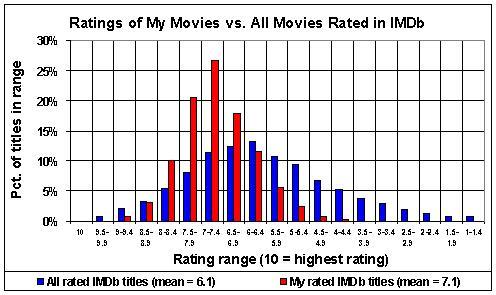
* IMDb has ratings for 1,851 of the 1,883 titles on my “Seen” list. The average rating for my titles is 7.1 (out of 10) as of 11 p.m. CT on 07/14/05. The average rating for the 105,886 IMDb titles with ratings (as of the same time and date) is 6.1. Pickiness pays off:
A Law Professor to Admire
I balance my dismissal of UT lawprof Brian Leiter by endorsing his senior colleague, Lino Graglia. In an interview with Columbia Law School Report on the occasion of the 50th anniversary of the Supreme Court’s decision in Brown v. Board of Education, Graglia had much to say, including this:
The overwhelming negative effect of Brown is that it changed the view of many people – certainly of most professors of constitutional law and, most important, of the justices themselves – as to the proper role of the Supreme Court in our system of government. If the court (as was believed) could do so great and good a thing as end racial segregation, what other great and good things could it not do? Did not Brown demonstrate that decision-making by judges on issues of basic social policy is superior to decision-making by elected representatives? The result has been a perversion of the system of government created by the Contitution, the basic principles of which are self-government through elected representatives, decentralized power (federalism), and separation of powers. At least in part as a result of Brown, we have arrived at the antithesis of this system: government by majority vote of a committee of nine unelected, life-tenured lawyers making the most basic policy decisions for the nation as a whole from Washington, D.C. The acclaim the court received as a result of Brown emboldened it to go on to such further decisions as Roe v. Wade, purporting to find that the Constitution, incredibly enough, guarantees rights of abortion, thereby converting an issue that was being peacefully settled on a state-by-state basis into an intractable national controversy.
On the race issue itself, the eventual success of Brown as a result of the 1964 Civil Rights Act emboldened the court to move from Brown’s prohibition of segregation – prohibiting the assignment of students to separate schools by race – to a vastly more ambitious and questionable requirement of integration – requiring the assignment of students to schools by race, now to increase racial mixing. Compulsory school racial integration, given residential racial concentrations, could only be attempted by ordering cross-district busing, but the justices now felt powerful enough to think that they could order even that. The result has been not to lessen but to increase school racial separation – as middle-class parents, black as well as white, fled school systems subject to busing orders – and the expenditure of billions of dollars and devastation of public school systems across the nation with no educational or other benefit….
Segregation should have been ended by Congress, as it in fact eventually was, and it is most unfortunate, as shown above, that the issue was purportedly decided instead by the court. The court’s supposed reliance on the totally discredited so-called sociological evidence in Brown illustrates only that constitutional law need have no relation to truth or reality….
It is misleading to state that “public schools in America remain segregated,” even after adding “though not officially by law,” seeming to suggest some inconsistency with Brown when in fact it is compulsory integration that violates Brown’s prohibition of all official race discrimination. For social, economic, and perhaps other reasons, areas of residential racial concentration are the norm, and neighborhood schools (which have many advantages) necessarily reflect residential patterns. This does not make the schools “segregated” any more than the neighborhoods are “segregated.” The pursuit of school “racial balance” is not only largely futile or counterproductive, but essentially pointless. The problem to be faced in regard to black education is the astounding fact that the average black 12th grader performs at about the level of the average white or Asian eighth grader in reading and math, and blacks from high income homes score below whites and Asians from low income homes. Some schools with the highest per pupil expenditures, as in Washington, D.C., and New York City, have the lowest levels of pupil performance. The pursuit of school “racial balance” – the dispersal of black students among whites and Asians (but not among Hispanics who have similar, though lesser educational difficulties) – will do nothing to change these facts. It will serve only to divert attention from possibly effective efforts and keep racial activists in business.
Graglia for Chief Justice. (If only he weren’t “too old” and “politically incorrect.”)
The Essential Case for Consequentialist Libertarianism
Steven Horowitz, a guest gadfly at Agoraphilia, succinctly makes the case:
It may be that utilitarians don’t believe in natural rights, but one can be a utilitarian, in the broadest sense, and still argue that a particular set/bundle of rights will lead to the greatest good, or put better, will have consequences that (virtually) all will think are good. Or put somewhat differently, it may be that a system in which individuals have very strong rights is a system that generates the best consequences (i.e., is best from a utilitarian point of view).
For an elaboration of this point, see my series on “Practical Libertarianism.” Start with Part VIII. Practical Libertarianism — A Summary. The core of my argument for consequentialism is detailed in these parts:
III. The Origin and Essence of Rights
Addendum to Part V: The Destruction of Income and Wealth by the State
The Last of Leiter
I’ve posted thrice about Brian Leiter (a.k.a. B. Leiter or the blighter): here, here, and here. Also weighing in are Steve Burton at Right Reason and Armed Liberal at Windsofchange.net. Burton’s take on Leiter is especially devastating.
I’ve come to the view that the blighter is merely a stupid, shrill version of Cass Sunstein. Given that, Leiter’s no longer worth my time. I’ll spend my ammo on bigger game. Bye-bye, Brian.
Aid for Africa: Wishful Thinking vs. the Facts of Life
Wishful thinking (from Sarah Vowell, writing in The New York Times):
That fact, that every three seconds an African human being dies from hunger or AIDS or, honestly, mosquito bites in this day and age, is literally the dumbest thing I’ve ever heard…That every-three-seconds statistic is so moronic, and having the richest countries in the world do something about it is such a total no-brainer….
The facts of life (from a Spiegel interview of Kenyan economics expert James Shikwati):
SPIEGEL: Mr. Shikwati, the G8 summit at Gleneagles is about to beef up the development aid for Africa…
Shikwati: … for God’s sake, please just stop.
SPIEGEL: Stop? The industrialized nations of the West want to eliminate hunger and poverty.
Shikwati: Such intentions have been damaging our continent for the past 40 years. If the industrial nations really want to help the Africans, they should finally terminate this awful aid. The countries that have collected the most development aid are also the ones that are in the worst shape. Despite the billions that have poured in to Africa, the continent remains poor.
SPIEGEL: Do you have an explanation for this paradox?
Shikwati: Huge bureaucracies are financed (with the aid money), corruption and complacency are promoted, Africans are taught to be beggars and not to be independent. In addition, development aid weakens the local markets everywhere and dampens the spirit of entrepreneurship that we so desperately need. As absurd as it may sound: Development aid is one of the reasons for Africa’s problems. If the West were to cancel these payments, normal Africans wouldn’t even notice. Only the functionaries would be hard hit. Which is why they maintain that the world would stop turning without this development aid.
SPIEGEL: Even in a country like Kenya, people are starving to death each year. Someone has got to help them.
Shikwati: But it has to be the Kenyans themselves who help these people. When there’s a drought in a region of Kenya, our corrupt politicians reflexively cry out for more help. This call then reaches the United Nations World Food Program — which is a massive agency of apparatchiks who are in the absurd situation of, on the one hand, being dedicated to the fight against hunger while, on the other hand, being faced with unemployment were hunger actually eliminated. It’s only natural that they willingly accept the plea for more help. And it’s not uncommon that they demand a little more money than the respective African government originally requested. They then forward that request to their headquarters, and before long, several thousands tons of corn are shipped to Africa …
and at some point, this corn ends up in the harbor of Mombasa. A portion of the corn often goes directly into the hands of unsrupulous politicians who then pass it on to their own tribe to boost their next election campaign. Another portion of the shipment ends up on the black market where the corn is dumped at extremely low prices. Local farmers may as well put down their hoes right away; no one can compete with the UN’s World Food Program. And because the farmers go under in the face of this pressure, Kenya would have no reserves to draw on if there actually were a famine next year. It’s a simple but fatal cycle.
SPIEGEL: If the World Food Program didn’t do anything, the people would starve.
Shikwati: I don’t think so. In such a case, the Kenyans, for a change, would be forced to initiate trade relations with Uganda or Tanzania, and buy their food there. This type of trade is vital for Africa. It would force us to improve our own infrastructure, while making national borders — drawn by the Europeans by the way — more permeable. It would also force us to establish laws favoring market economy.
SPIEGEL: Would Africa actually be able to solve these problems on its own?
Shikwati: Of course. Hunger should not be a problem in most of the countries south of the Sahara. In addition, there are vast natural resources: oil, gold, diamonds. Africa is always only portrayed as a continent of suffering, but most figures are vastly exaggerated. In the industrial nations, there’s a sense that Africa would go under without development aid. But believe me, Africa existed before you Europeans came along. And we didn’t do all that poorly either.
SPIEGEL: But AIDS didn’t exist at that time.
Shikwati: If one were to believe all the horrorifying reports, then all Kenyans should actually be dead by now. But now, tests are being carried out everywhere, and it turns out that the figures were vastly exaggerated. It’s not three million Kenyans that are infected. All of the sudden, it’s only about one million. Malaria is just as much of a problem, but people rarely talk about that.
SPIEGEL: And why’s that?
Shikwati: AIDS is big business, maybe Africa’s biggest business. There’s nothing else that can generate as much aid money as shocking figures on AIDS. AIDS is a political disease here, and we should be very skeptical.
SPIEGEL: The Americans and Europeans have frozen funds previously pledged to Kenya. The country is too corrupt, they say.
Shikwati: I am afraid, though, that the money will still be transfered before long. After all, it has to go somewhere. Unfortunately, the Europeans’ devastating urge to do good can no longer be countered with reason. It makes no sense whatsoever that directly after the new Kenyan government was elected — a leadership change that ended the dictatorship of Daniel arap Mois — the faucets were suddenly opened and streams of money poured into the country.
SPIEGEL: Such aid is usually earmarked for a specific objective, though.
Shikwati: That doesn’t change anything. Millions of dollars earmarked for the fight against AIDS are still stashed away in Kenyan bank accounts and have not been spent. Our politicians were overwhelmed with money, and they try to siphon off as much as possible. The late tyrant of the Central African Republic, Jean Bedel Bokassa, cynically summed it up by saying: “The French government pays for everything in our country. We ask the French for money. We get it, and then we waste it.”…
SPIEGEL: The German government takes pride in precisely monitoring the recipients of its funds.
Shikwati: And what’s the result? A disaster. The German government threw money right at Rwanda’s president Paul Kagame. This is a man who has the deaths of a million people on his conscience — people that his army killed in the neighboring country of Congo.
SPIEGEL: What are the Germans supposed to do?
Shikwati: If they really want to fight poverty, they should completely halt development aid and give Africa the opportunity to ensure its own survival. Currently, Africa is like a child that immediately cries for its babysitter when something goes wrong. Africa should stand on its own two feet.
Interview conducted by Thilo Thielke
Translated from the German by Patrick Kessler
Unusually Bad Advice
Don Boudreaux of Cafe Hayek writes:
I content myself here merely to point out that if a government has any legitimate functions, surely the most central of these is to protect its people from violence inflicted by foreign invaders. If Uncle Sam’s current foreign policies promote such invasions of terrorists (as Pape’s evidence suggests), then Uncle Sam’s first duty – if it truly puts the welfare of Americans first – is to have its garrisons and guns scram from the middle east ASAP.
Our garrisons and guns in the Middle East are there not only to fight organized terrorism (not an oxymoron) but also to guard our access to oil. Our withdrawal would enable bin Laden and his ilk to disrupt the production and shipment of oil at will. Our withdrawal would also send the message that we’re unwilling to defend our vital interests, which would only embolden bin Laden and his ilk. In sum, withdrawal would undermine the economic and physical security of Americans.
Boudreaux, who usually thinks clearly, seems to have let his anti-statism cloud his judgment on a matter of fundamental importance to Americans. Cafe Hayek is reliable on economic issues, but not otherwise.
The only way to defend against terrorism is to fight it, wherever we find it.
A Theory of Everything, Occam’s Razor, and Baseball
is a theory of theoretical physics and mathematics that fully explains and links together all known physical phenomena (i.e. “everything”). Initially the term was used with an ironical connotation, to refer to various overgeneralized theories….Over time, the term stuck in popularizations of quantum physics to describe a theory that would unify the theories of the four fundamental interactions of nature.
There have been numerous theories of everything proposed by theoretical physicists over the last century, but as yet none has been able to stand up to experimental scrutiny or there is tremendous difficulty in getting the theories to produce even experimentally testable results. The primary problem in producing a TOE is that quantum mechanics and general relativity have radically different descriptions of the universe….
There is…a philosophical debate within the physics community as to whether or not a “theory of everything” should be seen as the fundamental law of the universe. One view is the hard reductionist view that the TOE is the fundamental law of the universe and that all other theories of the universe are a consequence of the TOE. Another view is that there are laws which Steven Weinberg calls free floating laws which govern the behavior of complex systems, and while these laws are related to the theory of everything, they cannot be seen as less fundamental than the TOE. Some argue that this explanation would violate Occam’s Razor if a completely valid TOE were formulated.
Occam’s Razor notwithstanding, I’m in favor of “free floating laws” which, taken together, are the theory of everything, but which otherwise seem to operate independently. Baseball serves as a metaphor:
- There are rules for determining the “quantum events” of a game (e.g., balls, strikes, walks, strikeouts, errors, hits, runs, and outs).
- The quantum events of each team’s innings determine the outcome of each game, which is another quantum event (a team either wins or loses a game).
- Another set of rules determines how wins and losses determine the standing of each team relative to the other teams in its division.
- Yet another set of rules determines how a team’s position in its division affects its advancement to post-season play.
- A final set of rules determines the outcome of post-season play, in which individual games are decided by the quantum events of the first and second bullets.
Distinct sets of rules determine microcosmic outcomes (e.g, individual events in a game) and macrocosmic outcomes (e.g., the winner of the World Series). But those distinct sets of rules are connected systematically. Perhaps physicists should try to understand the connectedness of the various laws of physics instead of seeking a single law that explains all physical phenomena.
The Illogical Left, via Leiter
UPDATED BELOW
B. Leiter (blighter) commends a post by one P.Z. Myers, in which Myers says:
But if I…agree that there is a statistical difference in the distribution of the sexes in various occupations which is in some way driven by gender, I would say that it is 100% the product of society and culture, and that it is 100% the product of biological evolution.
[Todd Zywicki of The Volokh Conspiracy is] making the old, tired nature/nurture distinction, and it drives me nuts. It’s a false dichotomy that is perpetuated by an antiquated misconception about how development and biology works. Genes don’t work alone, they always interact with their environment, and the outcome of developmental processes is always contingent upon both genetic and non-genetic factors.
So much for the intellectual superiority of blighter and his ilk. Genes don’t work alone, but nature must precede nurture in any explanation of aptitude. Consider this, for example. I learned to love the game of baseball at an early age (nurture). My love of the game fostered in me a desire to become a major league baseball player (a leaning born of nurture). I could never become a major league baseball player because of my eyesight, which even when corrected is about 20-40 (nature).
In sum: Nature trumps nuture when it comes to having the requisite ability to excel in any occupation that requires a modicum of skill, whether it be playing major league baseball or doing physics.
Glibness and intellectual superiority are not the same thing, as blighter proves whenever he opines or approvingly cites a like-minded Leftist.
UPDATE: Todd Zywicki defends himself rather nicely in the third update to his original post; for example:
In response to PZ Myer’s assertion that evolutionary psychology is “poorly done hokum” and that there is “vigorous disagreement” about the entire field of evolutionary psychology I requested (quite reasonably, I thought) that Myers supply some specific examples of scientific disagreement over many of the core principles of evolutionary psychology, such as Hamilton’s theory of kin selection. He has responded to this request for specifics that would support his claim that the entire field “poorly done hokum”:
That semi-random list of principles is not the same as EP. It’s like saying that because Michael Behe understands and agrees that natural selection has occurred, Intelligent Design is therefore the same as accepted neo-Darwinian theory. Picking a few points of concordance while ignoring the points of divergence between two ideas to imply a unity of support that is not there is, well, dishonest.
Nah, I’m plainspoken. He’s lying. There is substantial disagreement in the biological community on evolutionary psychology, and to imply that this question has been settled in his favor is either gross ignorance on his part or simple fraud. Of course there is currently an ongoing battle over EP; check out the last link in my article.
I’m actually being kind by conceding that there is a legitimate debate on the subject. I know very few scientists who don’t think Pinker is full of shit.
Ah, so now I understand–no need to respond to my request for analysis, because, well, “Pinker is full of shit.” Why attack Pinker out of the blue when I never even mentioned him, rather than addressing the specifics I raised? Is it that Pinker is the only evolutionary psychologist with whom Myers is familiar? Then, falling back (again) on the good old reliable argument from authority, he also links to an interview with philosopher David J. Buller, a critic of evolutionary psychology, who raises doubts about some aspects of the evolutionary psychology research program. Apparently citing an interview with this particular philosopher where he critiques some aspects of the evolutionary psychology research program sufficies to demonstrate that the entire field is “hokum” and that the entire field is open to question (it is not clear whether Buller is one of the scientists, actually he’s a philosopher so he may not be included, who think that “Pinker is full of shit”–if so, that must be in his book because I couldn’t find that particular quote in the interview he links).
If anything, it seems like the argument Myers is making is much closer to the ID argument that he critiques, than the argument I was making. As I understand the ID argument, it picks up on small holes in the theory of evolution or questions around the edges of the theory, and then proceeds to infer that the entire theory is open to question. Similarly, I have enumerated a long list of core (not semi-random at all) evolutionary psychology ideas on which there seems to be a substantial degree of agreement. Indeed, from what I can tell, he does not disagree with my assessment that there is widespread agreement on these concepts, he simply dismisses this agreement as irrelevant under his particular definition of evolutionary psychology. His response, as I understand it, is that this scientific agreement on these many core principles of evolutionary psychology is irrelevant because there are some unsettled questions around the edges of the research program, and so that therefore the whole research program itself is questionable and that there is controversy about the entire field. This seems much more similar to the arguments that I have read by ID theorists critiquing Darwinian theory, rather than the arguments that I was making. For the record, I don’t know whether adherents to intelligent design theory also think that Pinker (or Darwin, for that matter) “is full of shit.”
And so on.
Blighter and his Leftist friends are so unsure of their grasp of truth — or so afraid of the truth — that they simply stoop to scurrilous prose. Dismissiveness is the last refuge of an ignoramus (one of blighter’s favorite terms for those who challenge his pointy-headed blatherings).
P.S. I’m purposely being scurrilous here and in my other posts about blighter because he endorses abusive and offensive blogging. If he says it’s all right, it must be — he knows all.
Alter’s Ego
Jonathan Alter of Newsweek disgorges a few hundred self-serving words in “You Shield Us, We’ll Shield You.” Here’s the core of Alter’s argument for a federal shield law:
The Supreme Court refused [last week] to rule in the Valerie Plame case, leaving a federal judge free to jail innocent reporters. When Norman Pearlstine, editor in chief of Time Inc., agreed to turn over Time magazine reporter Matt Cooper’s sources to the prosecutor, the chilling message to any other anonymous sources thinking of telling their stories to Time Inc. publications was clear: don’t. Your identity cannot be protected. Reporters will now have to tell their confidential sources two things: (1) I’ll go to jail to protect you; and (2) I’ll never turn over my notes to my corporate bosses. That’s not going to be very comforting to whistle-blowers (see Time’s “Persons of the Year,” 2002) who put their jobs on the line when they talk to the press.
Innocent or not, Matt Cooper and the other jailed reporter (Judith Miller of The New York Times) have refused to give crucial testimony in a criminal case. What puts them above the law?
Alter studiedly ignores the fact that the two reporters were asked to reveal sources in the Plame case because Plame’s outing as a CIA agent, if done knowingly, was a crime. I certainly hope that the Supreme Court’s refusal to consider the reporters’ appeal in the Plame case will have a chilling effect on illegal disclosures.
Alter’s holier-than-thou defense of the press’s right to consort with criminals knows no logic:
[C]onsider that Judith Miller of The New York Times (who, unlike Cooper, is fully backed by her corporate boss) will likely go to jail soon over a story she never wrote. She simply talked to someone in the government, then did nothing.
Miller didn’t simply “talk to someone in the government.” She talked to someone who may have committed a crime by telling Miller something that neither Miller nor any other nor any other reporter had a right to know. The fact that Miller didn’t write a story based on the information she received is beside the point. Miller, and all other reporters in the case, should be compelled to cooperate in the pursuit of justice. But Alter doesn’t think so, because he’s a reporter. Well, he thinks of himself as one.
Alter’s scare-mongering aside, the Supreme Court’s refusal to hear Miller and Cooper’s appeal is unlikely to have a chilling effect on legal disclosures. For one thing, Congress has absolute power to investigate matters of its choosing and to subpoena relevant witnesses. For another thing, most whistle-blowing is born of an irrepresible desire to settle scores, which works just as much against the powers-that-be as in their favor. The Supreme Court’s action in the Plame case upholds the rule of law without harming the public’s so-called right to know.
Through the Looking Glass with Leiter
`When I use a word,’ Humpty Dumpty said, in rather a scornful tone, `it means just what I choose it to mean — neither more nor less.’
Lewis Carroll in Through the Looking Glass, Chapter VI, Humpty Dumpty*
Reminds me of B. Leiter (blighter), who uses his command of philosophical argot to call easy questions “hard” and hard questions “easy”:
Start with some examples of hard questions, the kinds of questions I largely avoid on the blog (though some of them are the subject of my scholarly work):
Does the now orthodox thesis of the token-identity of the mental and the physical (the supervenience of the mental on the physical) have the unintended consequence that the mental is epiphenomenal? (Relatedly: is there really an intelligible kind of metaphysical relationship between properties [i.e., supervenience] that is intermediate between property-dualism and type-identity?)
Is there any reason to think that putative moral facts will figure in the best causal explanation of any aspect of our experience?
What exactly is Nietzsche’s doctrine of the will to power, and what role is it playing in the argument of the Genealogy?
Do authoritative reasons in Raz’s sense really have to be exclusionary reasons, or will it suffice if they simply have more “weight” than other kinds of reasons?
What reasons, if any, does (or can) Quine give for his naturalism, and are they sound?
Is it an obstacle to descriptive jurisprudence that the concepts central to law are (as I have called them) hermeneutic concepts, i.e., concepts whose extension is supposed to be fixed by the role they play in how people understand themselves and their social world?
What is Foucault’s view of the cognitive and epistemic status of the claims of the human sciences?…
By contrast, here are some easy questions:
Was the U.S. justified in invading Iraq?
Are Bush’s economic policies in the interests of most people?
Is Darwin’s theory of evolution by natural selection a well-confirmed scientific theory?
Is there a social security “crisis”?
Leiter goes on, in his usual egotistical manner, to assume that he has a monopoly on the answers to the “easy” questions (presumably “no,” “no,” “yes,” and “no,” respectively), which entitles him to dismiss those who have different answers:
These questions, and many others, are easily addressed in the blogosphere, since there is no serious–or at least no honest or intelligent–dispute about the epistemic merits of the possible answers. Where I get into “trouble,” of course, is with those who can’t tell the difference between the two kinds of questions, the ones who think that the dialectical care, caution, and intellectual humility required for the genuinely “hard” questions ought to apply to the easy questions as well. These folks are a bit miffed when I dismiss their positions out of hand. But that is what their positions usually deserve.
Part of intellectual maturity is being able to tell the difference between questions where humility is required and questions which are not worth one’s time. The so-called “blogosphere,” like the public culture in general, is not a rich repository of intellectual maturity, needless to say. And, unsurprisingly, intellectual lightweights with trite opinions, and limited analytical skills, take offense when I make it all too clear what the answers to the easy questions are. Many of these folks are no doubt honest, well-intentioned, decent people, who have been led down unhappy paths by circumstances or indoctrination. It is an important question, far beyond my ken, what can be done to set them straight. But it is not the aim of this blog to do so.
Leiter’s “hard” questions are nothing more than the kind of intellectual pornography that stimulates professional academics and pseudo-intellectuals to engage in endless, meaningless bouts of mutual, mental masturbation.
Leiter’s first two “easy” questions are in fact hard questions with indeterminate, political answers and real consequences for real people (as opposed to academics). Leiter’s third “easy” question is in fact a hard scientific question which cannot be answered “yes” or “no” because it pertains to a falsifiable hypothesis. Leiter’s fourth “easy” question is easy only because of the way Leiter has framed it. The real question (what to do about Social Security) is as hard as his first two “easy” questions.
Leiter would object that I am not using “hard” and easy” as he intends them. But I am using “hard” and “easy” as they are commonly understood; Leiter is not. He has no monopoly on the terms of public discourse, just as he has no monopoly on the answers to truly hard questions, his delusions of intellectual superiority to the contrary.
__________
* Who must look like this:

Source: B. Leiter’s homepage.
A Quick Note about Music
Here’s a scholarly take on “modern” music, by Miles Hoffman, violist and artistic director of the American Chamber Players, and music commentator for NPR’s Morning Edition. It squares with my amateur musings, which are here, here, here, and here. Some excerpts of Hoffman’s long and insightful essay:
The primary proposition in defense of avant-garde music of the relentlessly dissonant and persistently unpopular variety has always been that, through exposure and familiarity, we often come to appreciate, and even love, things that initially confuse or displease us. Here what we might call “the Beethoven Myth” comes into play. “Beethoven was misunderstood in his time,” the argument goes, “but now the whole world recognizes his genius. I am misunderstood in my time, therefore I am like Beethoven.” This reasoning, unfortunately, has been the refuge of countless second- and third-rate talents. Beethoven ate fish, too. If you eat fish, are you like Beethoven? But there’s a much graver flaw in the argument: Beethoven was not misunderstood in his time. Beethoven was without doubt the most famous composer in the world in his time, and the most admired. And if there were those who didn’t “get” his late string quartets, for example, there were plenty of others who did, and who rapidly accepted the quartets as masterpieces….
Have I exaggerated the intensity of the distaste that so much modernist music has aroused? No, sad to say, not if we keep certain factors in mind. One is the strength of the needs, the intensity of the desires, that we fulfill with music. Our expectations of music—expectations of the type nurtured, reinforced, and satisfied for generation upon generation—are enormous, and enormously important to us, and when those expectations are disappointed, we take it very badly indeed….
Inevitably, however, we return to the fact that there’s something basic to human nature in the perception of “pleasing sounds,” and in the strength of the tonal structures that begin and end with those sounds. Blue has remained blue to us over the centuries, and yellow yellow, and salt has never started tasting like sugar. With or without physics, consonances are consonances because to most people they sound good, and we abandon them at great risk. History will say—history says now—that the 12-tone movement was ultimately a dead end, and that the long modernist movement that followed it was a failure. Deeply flawed at their musical and philosophical roots, unloving and oblivious to human limits and human needs, these movements left us with far too many works that are at best unloved, at worst detested. They led modern classical music to crisis, confusion, and, in many quarters, despair, to a sense that we’ve wasted decades, and to a conviction that our only hope for whatever lies ahead starts with first making sure we abandon the path we’ve been on.
From a distance of centuries, knowledgeable observers can usually discern when specific cultural developments within societies or civilizations reached their peaks. The experts may argue over precise dates and details, but the existence of the peaks themselves is rarely in question. In the case of Western music, we don’t have to wait centuries for a verdict. We can say with confidence that the system of tonal harmony that flowered from the 1600s to the mid-1900s represents the broad summit of human accomplishment, and that our subsequent attempts to find successors or substitutes for that system are efforts—more or less noble—along a downhill slope. [But the joy of “serious” music began to diminish around 1900, when many leading composers (e.g., Mahler and R. Strauss, following the lead of Wagner and Bruckner), began to deploy tonality in pretentious, ponderous, and dreary works: ED.]
What lies ahead? Nobody can say, of course. But with the peak behind us, there’s no clear cause for optimism—no rational cause, anyway, to believe that another Beethoven (or Berlioz or Brahms…) is on the way. And even if he were on the way, in what musical language would he write when he got here? The present is totally free but totally uncertain, the immediate past offers little, and the more distant past is . . . past. And yet, irrational creatures that we are, we keeping hoping for the best, and it’s right that we do. We owe it to Music. The good news is that there are many composers today who, despite the uncertain footing, are striving valiantly, and successfully, to write works that are worthy of our admiration and affection. They write in a variety of styles, but the ones who are most successful are those who are finding ways—often by assimilating ethnic idioms and national popular traditions—to invest their music with both rhythmic vitality and lyricism. They’re finding ways to reconnect music to its eternal roots in dance and song.
Rhythmic vitality and lyricism. That’s what it takes, and that’s what’s been missing from most “serious” music for the past 100 years or so.
An Agenda for the Supreme Court
I argued in Part VII of “Practical Libertarianism for Americans” that the practical way to redeem the promise of liberty is through a renaissance (or nascence) of pro-libertarian federalism — under the guidance of Republican appointees to the U.S. Supreme Court. In light of the Court’s anti-libertarian majorities in Gonzales v. Raich and Kelo v. City of New London (my commentary here, here, and here), it would take many years — if not decades — to see the Court safely into the hands of a pro-libertarian, federalist majority. I now almost despair of the possibility of such a sea change in the Court’s composition. But with candidates like Janice Rogers Brown in the wings, hope is not dead.
Therefore, I will from time to time offer my agenda for a more libertarian Court. It is an admittedly ambitious agenda that would advance liberty, which must be understood as the negative right to be left alone — in one’s person, pursuits, and property — as long as one leaves others alone. Liberty, in that sense, encompasses what the Founders intended by “life, liberty, and the pursuit of happiness” in the Declaration of Independence. In sum, the liberty right is a triune concept, with life as its basis and the pursuit of happiness (personal satisfaction or self-interest) as its end.
I begin with life, without which liberty is a nullity.
Defend Life
The Court should do three things under this heading: reverse the majority in Roe v. Wade, ensure that a person cannot — unlike Terri Schiavo — be euthanized at the whim of an interested party, and put a stop to forced mental screening. Abortion (especially selective abortion), involuntary euthanasia, and forced mental screening are steps down a slippery slope toward complete state control of human destiny.
Eugenics was considered “progressive” a century ago, and it is considered “progressive” today. After all, the state controls our economic and social destiny, why shouldn’t it control our biological destiny as well? It’s all for the best, isn’t it? Ah, the banality of evil.
Defend American Sovereignty
In another post I stipulated the following:
1. “Life, liberty, and the pursuit of happiness” summarizes the American ideal.
2. America’s sovereignty provides a shield behind which Americans may pursue the American ideal.
3. Americans’ ability to pursue the American ideal therefore depends on the successful defense of American interests and America’s sovereignty.
4. Americans, acting through the state, should defend American interests and America’s sovereignty.
The sovereignty of the United States is a shield for the benefits afforded Americans by the U.S. Constitution, most notably the enjoyment of civil liberties, the blessings of more-or-less free markets and free trade, and the protections of a common defense. To cede sovereignty is to risk the loss of those benefits. That is why we must always be cautious in our commitments to international organizations and laws.
We can and should work to make the U.S. more benign, that is, more libertarian. But if we didn’t have our somewhat benign state to protect us it’s quite likely that we’d live under one that’s entirely evil. Remember Hitler and Stalin? Those bad guys were really bad — and there are plenty more where they came from. Just look around you at the world we live in.
The warmaking power of the United States government is essential to the preservation of America’s sovereignty and Americans’ liberty. Yet the present Court has cavalierly undermined that warmaking power in its handling of the cases of detainees captured by American armed forces operating lawfully in Afghanistan and Iraq. (See this post and follow the links.) A future Court would do well to heed Justice Felix Frankfurter, who in the case of Korematsu v. United States (1944) said this:
The provisions of the Constitution which confer on the Congress and the President powers to enable this country to wage war are as much part of the Constitution as provisions looking to a nation at peace. And we have had recent occasion to quote approvingly the statement of former Chief Justice Hughes that the war power of the Government is ‘the power to wage war successfully.’… Therefore, the validity of action under the war power must be judged wholly in the context of war. That action is not to be stigmatized as lawless because like action in times of peace would be lawless. To talk about a military order that expresses an allowable judgment of war needs by those entrusted with the duty of conducting war as ‘an unconstitutional order’ is to suffuse a part of the Constitution with an atmosphere of unconstitutionality. The respective spheres of action of military authorities and of judges are of course very different. But within their sphere, military authorities are no more outside the bounds of obedience to the Constitution than are judges within theirs. ‘The war power of the United States, like its other powers … is subject to applicable constitutional limitations’,….To recognize that military orders are ‘reasonably expedient military precautions’ in time of war and yet to deny them constitutional legitimacy makes of the Constitution an instrument for dialectic subtleties not reasonably to be attributed to the hard-headed Framers, of whom a majority had had actual participation in war.
Amen.
Restore Economic Liberty
The Supreme Court has long since given the States and the central government almost unlimited authority to dictate economic activity. In the wake of Raich and Kelo there is ample commentary about the Court’s abuse of the Commerce Clause and the Takings Clause. So, I will turn here to other aspects of economic liberty that future Courts should restore.
I begin with the loss of freedom of contract. The Court upheld that freedom in Bronson v. Kinzie (1843). According to The Oxford Guide to United States Supreme Court Decisions (Oxford University Press, 1999, p. 33),
Chief Justice Roger B. Taney held that [a] legislative attempt to modify the terms of [an] existing mortgage was an unconstitutional impairment of the obligation of contract. Taney agreed that a state could alter the remedies available to enforce past as well as future contracts. He nonetheless emphasized that such changes could not materially impair the rights of creditors. In broad language Taney extolled the virtue of the Contract Clause: “It was undoubtedly adopted as part of the Constitution for a great and useful purpose. It was to maintain the integrity of contracts, and to secure their faithful execution throughout this Union.”
The Oxford Guide continues :
The Court long adhered to the Bronson rule, invalidating state laws that interfered with contractual rights in the guise of regulating remedies. The decision was effectively superseded, however, by Home Building and Loan Association v. Blaisdell (1934), in which the justices ruled that contracts were subject to the reasonable exercise of state police power.
Just what is “reasonable exercise of state police power”? In Home Building and Loan Association, according to Chief Justice Hughes, writing for the Court, it is this:
We come back, then, directly, to the question of impairment. As to that, the conclusion reached by the court here seems to be that the relief [from mortgage foreclosures] afforded by the [Minnesota] statute does not contravene the constitutional provision because it is of a character appropriate to the emergency and allowed upon what are said to be reasonable conditions.
That is, the Court simply decided to uphold a Minnesota statute that altered the terms of a contract because it wanted to do so, not because it had constitutional authority for doing so. The Constitution doesn’t forbid States to impair contracts except in emergencies or to exercise their “policing power”; the Constitution flatly forbids States to impair contracts. A libertarian Court would begin to restore freedom of contract by reversing Home Building and Loan Association v. Blaisdell.
It would take more than that, however, to restore freedom of contract in employment relationships, which long ago gave away to mandatory unionism, the minimum wage, and various other impediments to employment-at-will. A libertarian Court would do the right thing by throwing out the Wagner Act and its various offshoots, including the minimum wage, then turn its sights on affirmative action.
As for States’ so-called policing power, an article at FindLaw tells this tale:
[I]deas embodying the social compact and natural rights, which had been espoused by Justice Bradley in his dissent in the Slaughter-House Cases, 43 had been transformed tentatively into constitutionally enforceable limitations upon government. 44 The consequence was that the States in exercising their police powers could foster only those purposes of health, morals, and safety which the Court had enumerated, and could employ only such means as would not unreasonably interfere with the fundamentally natural rights of liberty and property, which Justice Bradley had equated with freedom to pursue a lawful calling and to make contracts for that purpose. 45
So having narrowed the scope of the state’s police power in deference to the natural rights of liberty and property, the Court next proceeded to read into the concepts currently accepted theories of laissez faire economics, reinforced by the doctrine of Social Darwinism as elaborated by Herbert Spencer, to the end that ”liberty,” in particular, became synonymous with governmental hands-off in the field of private economic relations. In Budd v. New York, 46 Justice Brewer in dictum declared: ”The paternal theory of government is to me odious. The utmost possible liberty to the individual, and the fullest possible protection to him and his property, is both the limitation and duty of government.” …
To the State was transferred the task of demonstrating that a statute interfering with the natural right of liberty or property was in fact ”authorized” by the Constitution, and not merely that the latter did not expressly prohibit enactment of the same.
In 1934 the Court in Nebbia v. New York 52 discarded this approach to economic legislation, and has not since returned to it. The modern approach was evidenced in a 1955 decision reversing a lower court’s judgment invalidating a state statutory scheme regulating the sale of eyeglasses to the advantage of ophthalmologists and optometrists in private professional practice and adversely to opticians and to those employed by or using space in business establishments.
Nebbia has got to go. The reversal of Nebbia, accompanied by the reversal of Kelo, would prevent much of the economic harm that is done by State and local governments.
Also under this head, there is the anti-trust movement. It waxes and wanes, but when it waxes it does great harm to invention, innovation, and entrepreneurship — the engines of economic progress. The prospect of earning inordinate profits entices inventors, innovators, and entrepreneurs to take financial risks in an effort to develop and market goods and services that enrich lives. The realization of large profits encourages competition — direct competition by offerors of equivalent goods and services, and indirect competition by offerors of substitutes. A libertarian Court would agree with my analysis and vitiate the Sherman Antitrust Act and the Clayton Antitrust Act as invalid extensions of federal power.
Finally — for now — a truly bold and principled Court would enforce the Constitution’s express limitation of Congress’s power in Article I, Section 8, by striking down or reining in the regulatory-welfare state, which is embodied in such institutions as the Social Security Administration, Federal Trade Commission, Federal Communications Commission, and Food and Drug Administration, to name but a few. (For much more, read this, this, this, this, this, this, this, this, this, this, this, this, and this, and follow the links and sources cited therein.)
To be continued.
Practical Libertarianism — A Summary
I have posted “Practical Libertarianism — A Summary” at Liberty Corner II. That post completes and summarizes the series of essays entitled “Practical Libertarianism for Americans.” Supporting details and links to additional sources can be found in the preceding posts of the series.
Some of my favorite bits:
My focus is on American libertarianism because the Constitution of the United States of America holds the promise of liberty. Building on that promise, Americans can strive to perfect liberty in the United States. But the rest of the world isn’t bound by our Constitution, and it is foolish to think that the rest of the world prizes America’s liberty. America’s sovereignty and strength is the shield of America’s liberty, imperfect as it may be.
What is libertarianism, and why should you embrace it? Here is a formal definition of libertarianism…:
Libertarianism is a political philosophy which advocates individual rights and a limited government. Libertarians believe that individuals should be free to do anything they want, so long as they do not infringe upon what they believe to be the equal rights of others. In this respect they agree with many other modern political ideologies. The difference arises from the definition of “rights”. For libertarians, there are no “positive rights” (such as to food, shelter, or health care), only “negative rights” (such as to not be assaulted, abused or robbed). Libertarians further believe that the only legitimate use of force, whether public or private, is to protect these rights.
Here’s my rendition:
If you are doing no harm to anyone, no one should harm you physically, coerce you, defraud or deceive you, steal from you, or tell you how to live your life. “No one” includes government, except to the extent that government is empowered — by the people — to defend life, liberty, and property through the circumscribed use of police, courts, and armed forces….
Fundamentalist libertarians argue that the only right is liberty, and that it is a natural right with which human beings are endowed a priori. In one rendition, liberty is immanent — something that simply is in human nature, perhaps as a gift from God. In another rendition, humans are endowed with liberty as a logical necessity, because humans own themselves.
But appeals to immanence and self-ownership are no more meaningful than appeals to faith. Such appeals fail because they take liberty as a first principle. Liberty, which is a condition of existence, cannot be a first principle, it can only serve the first principle of existence, which is self-interest….
Rights — though they can exist without the sanction of government and the protection of a state — are political. That is, although rights may arise from human nature, they have no essence until they are recognized through interpersonal bargaining (politics), in the service of self-interest. It is bargaining that determines whether we recognize only the negative right of liberty, or the positive right of privilege as well. The preference of human beings — revealed over eons of coexistence — is to recognize both liberty (usually constrained to some degree) and privilege (which necessitates constraints on liberty).
The problem for libertarians, therefore, is to convince the body politic of two complementary truths: Self-interest dictates that liberty should be the paramount right. The recognition of privilege as a co-equal right undermines the benefits that flow from liberty….
The logical incompatibility of liberty and privilege doesn’t keep most people from wanting both. People want to be left alone, but it seems that almost everyone also yearns for some version of the welfare-regulatory state. People seem to believe that government does things that are more valuable than the freedom of action they forego because government does things. Most Americans simply don’t understand the true costs and illusory benefits of the welfare-regulatory state.
Absent the welfare-regulatory state, most of the poor would be rich, by today’s standards. And those who remain relatively poor or otherwise incapable of meeting their own needs — because of age, infirmity, and so on — would reap voluntary charity from their affluent compatriots….
[T]he bottom line:
- Real GDP (in year 2000 dollars) was about $10.7 trillion in 2004.
- If government had grown no more meddlesome after 1906, real GDP might have been $18.7 trillion (from the chart entitled “Real GDP: 1870-1906, 1907-2004”).
- That is, real GDP per American would have been about $63,000 (in year 2000 dollars) instead of $36,000.
- That’s a deadweight loss to the average American of more than 40 percent of the income he or she might have enjoyed, absent the regulatory-welfare state.
- That loss is in addition to the 40-50 percent of current output which government drains from the productive sectors of the economy.
- Moreover, the stocks of corporations in the S&P 500 are currently undervalued by one-third because of the depradations of the regulatory-welfare state, which have lowered investors’ expectations for future earnings. (The effect of those lowered expectations is shown in the chart entitled “Real S&P Index vs. Real GDP.”) And that’s only the portion of wealth that’s represented in the S&P 500. Think of all the other forms in which wealth is stored: stocks not included in the S&P 500, corporate bonds, mortgages, home equity, and so on.
That is the measurable price of privilege — of ceding liberty piecemeal in the mistaken belief that one more government program, a bit more income redistribution, or yet another regulation will do little harm to the general welfare, and might even increase it….
When people are deprived of incentives through taxation, regulation, and welfare, they are less able and willing to strive for themselves. And it is self-striving that leads people to do things that are valued by others. Regulation and welfare (the “free lunch”) impose costs (bureaucratic overhead), where there otherwise would be no costs, and distort the free-market signals that tell people how they can do better for themselves by doing better for others….
If liberty is so bounteous, why don’t we enjoy it in full? Why are our lives so heavily regulated and legislated by so many federal, State, and local agencies at such a high cost? What happened to the promise of liberty given in the Declaration of Independence and Constitution? The answers to those questions are bound up in human nature and the nature of governance in a democracy….
It is easy to endorse liberty in principle and yet be its enemy in practice. Our need for control and our baser instincts lead many of us to become politicians and cause most of us to succumb to political rhetoric. Most of us simply lack the requisite temperament, or vision, for libertarianism.
Thomas Sowell, in A Conflict of Visions: Ideological Origins of Political Struggles, posits two opposing visions: the unconstrained vision (I would call it the idealistic vision) and the constrained vision (which I would call the realistic vision)….
In sum, it’s all about trust and its opposite: control. You can trust others to do the right thing because it’s to their benefit to do so, as it is in free markets and free societies. Or you can control others, economically and socially, through a morass of statutes, regulations, and judge-made law.
Trust doesn’t mean an absence of rules, but the rules have only to be minimal, socially evolved rules of acceptable conduct, such as the Golden Rule or the last six of the Ten Commandments. The clearer and more intuitive the rules, the more likely they are to be enforced by self-interest, by fear of social opprobrium, and by pride in reputation — with swift, sure, and hard justice as a backup.
But none of that goes down well with those who think that the road to happiness must be paved with hard-and-fast rules for everything and everyone. Otherwise, how would people know what to do?
The demand for control is fed by economic illiteracy, the prevalent failure to grasp such simple principles as these:
- Incentives matter. Taxation, redistribution, and regulation result in the reduction and misdirection of economic activity and social trust.
- There’s no free lunch. Government can’t provide something for nothing. It never could, it never will. Every governmental action has an opportunity cost: that which the private sector could do with the same resources. There’s no such thing as “federal money” or “government money”; there’s only “our money.”
- Government doesn’t add value. At best it protects what we value, by defending us at home and abroad.
- The economy isn’t a zero-sum game. Bill Gates is immensely wealthy because he has created things that are of value to others. When Indian computer geeks man call centers for lower salaries than those of American computer geeks, it makes both Indians and Americans better off.
- There’s no such thing as “market failure.” Rather, there is only failure of the market to provide what some people think it should provide. Even defense and justice (both classic examples of a “public good“) could be provided by the market, as anarcho-capitalists aver, but minarchists (as I am) fear the consequences (warlord rivalry) and reluctantly trust in the state for those essential underpinnings of a free society.
Most people simply don’t understand the consequences of the rules that they so fervently seek to impose on others. They have little idea of the measurable costs of intervention — the 40-to-50 percent of GDP that goes into government programs, for instance — and they have no idea of the hidden costs of that intervention — the additionale of an additonal 40 percent of income and untold amounts of wealth. They simply cannot comprehend the indivisibility of economic and social liberty (though the Supreme Court’s recent decisions in Raich and Kelo may open some eyes).
Control-seeking politicians — most of whom also suffer from economic illiteracy — are able to draw power from the masses by appealing to the insecurity and economic illiteracy of the masses. Once having drawn that power, they seek always to aggrandize it. What happens, then, is a ratcheting of government power, in response to never-ending demands for government to “do something” — because government’s previous efforts to “do something” have inevitably failed to achieve nirvana.
Thus we have been following a piecemeal route to serfdom — adding link to link and chain to chain — in spite of the Framers’ best intentions and careful drafting. Why? Because the governed — or dominant coalitions of them — have donned willingly the chains that they have implored their governors to forge. Their bondage is voluntary, though certainly not informed. But their bondage is everyone’s bondage….
Unchecked democracy undermines liberty and its blessings. Unchecked democracy imposes on everyone the mistakes and mistaken beliefs of the controlling faction. It defeats learning. It undoes the social fabric that underlies civility. It defeats the sublime rationality of free markets, which enable independent individuals to benefit each other through the pursuit of self-interest. As “anonymous” says, with brutal accuracy, “Democracy is two wolves and a lamb voting on lunch.”…
[A] not-so-funny thing has happened on the way to the state of liberty foreseen by Madison and the other Framers: Human nature has overcame constitutional obstacles. The governed and their governors have conspired to undermine the Constitution’s checks and balances. People, given their mistrustful and ignorant nature, have turned to government for “solutions” to their “problems.” Government, in its turn, has seized whatever power is necessary to go through the motions of providing “solutions.” For rare is the legislator who doesn’t want to legislate, the executive who doesn’t want to act, and the judge who doesn’t want to exercise his judgment by interpreting the law rather than simply apply it….
[T]he “checks and balances” in the Constitution are there to limit the federal government’s ability to act, even within its sphere of authority. In the legislative branch neither the House of Representatives nor the Senate can pass a law unilaterally. In his sole constitutional role — as head of the executive branch — the President of the United States must sign acts of Congress before they become law, and may veto acts of Congress — which may, in turn, override his vetoes. From its position atop the judicial branch, the Supreme Court is supposed to decide cases “arising under” (within the scope of) the Constitution, not to change the Constitution without benefit of convention or amendment.
The Constitution itself defines the sphere of authority of the federal government and balances that authority against the authority of the States and the rights of citizens. Although the Constitution specifies certain powers of the federal executive and judiciary (e.g., commanding the armed forces and judging cases arising under the Constitution), federal power rests squarely and solely upon the legislative authority of Congress, as defined in Article I, Sections 8, 9, and 10. The intentionally limited scope of federal authority is underscored by Amendments IX and X.
In spite of all that, we now have myriad statutes, regulations, and court rulings through which the federal government — acting at the people’s behest and in their name — has arrogated unconstitutional power to itself (and sometimes to the States). And the people suffer….At this moment in history, federalism seems the most promising option because the Left is now beginning to understand that the power of the federal government may be used not only to advance its agenda but also to thwart that agenda. Leftists, like conservatives and pragmatic libertarians, may be willing to settle for a “good” solution rather than hold out for the “best” of all possible worlds. But, as I will explain, the way to federalism isn’t through a collaboration between Left and Right….
In summary, the Left’s vision of federalism is to devolve the central government’s acquired anti-libertarian powers to somewhat less remote commissars at the State and local level. The Left simply isn’t to be trusted as a partner in the shaping of a new federalism. A pro-libertarian federalism would not only limit the power of the central government but would also limit the power of State and local governments to advance the Left’s anti-libertarian agenda.
The only way to advance pro-libertarian federalism is to ensure that the Left neither controls the central government nor has little influence over its policies. This is especially true of the U.S. Supreme Court. For the surest way to return to a form of federalism that, in the main, advances liberty and prosperity is through Court rulings of the kind so feared by publius and his ilk: “the overruling of the post-New Deal regulatory state.”
Something resembling pro-libertarian federalism will come about only if a Republican president, aided by a strongly Republican Senate, is able to stock the courts with judges who are committed to the restraint of government power — at all levels of government. (Janice Rogers Brown is that kind of judge.)
Certainly not all decisions by all Republican appointees to the bench will satisfy all libertarians, many of whom seem to focus on narrowly tailored “rights,” such as abortion and gay marriage. But by siding with the Left on such issues, libertarians effectively abjure more basic rights — rights that broadly affect the ability of most Americans to pursue happiness — such as freedom of speech, freedom of association, and freedom of contract.
In the real world there are real choices. The real choice for libertarians is between what seems “best” for a few and what is actually “better” for the many. I choose the latter, without hesitation.
Pro-libertarian federalism is the best practical way to redeem the promise of liberty. The surest route to pro-libertarian federalism, it seems to me, can be found through the Republican Party. The GOP may not be reliably anti-statist, but it is less statist than the Left. And it is more likely to defend our basic rights — in the courts, in the streets, and in foreign fields.
What’s With the Name Calling?
The titles of two recent entries, “Nicholas Kristof Is an Idiot” and “Brian Leiter Is an Idiot,” might have you wondering if this blog has suddenly become one of those hate-filled, shout-at-everything rantfests that one encounters on the Left and Right fringes of the blogosphere. No, it’s just that two supremely anti-libertarian decisions by the U.S. Supreme Court (Raich and Kelo), coming back to back, are tantamount to a declaration of war on liberty. And as I said here,
“I’m mad as hell, and I’m not going to take it anymore.” Well, I won’t take it quietly.
For starters, I’m going to spend more time firing back at the enemies of liberty as they pop up on my radar screen. I will focus on American enemies of liberty — like Kristof and Leiter — because they are parasites who would destroy the host on which they feed: the very liberty that enables them to spew their half-baked, anti-libertarian ideologies, at great personal profit. As I said, they are idiots.
Nicholas Kristof Is an Idiot
Nicholas D. Kristof, a Lefty columnist for The New York Times, today succumbs to budget-deficit hysteria. Here’s a sample:
[T]hree-fourths of our new debt is now being purchased by foreigners, with China the biggest buyer of all. That gives China leverage over us, and it undermines our national security.
Let’s see here: We have China’s money; the Chinese would like to get it back from us, with interest. Who has leverage over whom?
I wonder what Kristof would have to say about government debt if Clinton were still in the White House and the debt had been incurred to buy out America’s health-care system and give flying lessons to members of al Qaeda?
Kristof, like most debt-hysterics (or pseudo-hysterics) misunderstands the true significance of the central government’s debt. I summarized it here:
The debt really is a measure of the extent to which spending by the U.S. government has exceeded taxes collected by the U.S. government since 1789. In other words, the damage has already been done: first, by government spending, which on balance diverts resources from productive uses; second, by the inflationary effects of government spending, which deficits merely aggravate.
…and explained it more fully here:
Government spending, however it is financed, is a way of commandeering resources that otherwise would flow to private consumption and investment (i.e., capital formation). To the extent that government activities fail to pay their own way by yielding goods and services of equivalent value — and they don’t (a) — the resources used by government are simply wasted — thrown down a rat hole (b).
Government nevertheless goes through the charade of taxing and borrowing to finance its activities, instead of simply sending goon squads to impress those resources into government service. Thus the total amount of money in circulation remains more or less unaffected by government spending, while the total output of real goods and services (including capital assets) is reduced as government commandeers resources. The result, of course, is inflationary (c).
In particular, the injection of government bonds into financial markets, with the help of the Federal Reserve’s authority to create money, means that the total nominal value of financial assets is at least the same as it would have been in the absence of government borrowing, and probably higher (d). At the same time, government spending reduces the output of real assets, thus diluting the value of financial assets. Financial assets are fungible, so the holder of a government bond has the same claim on real assets as the holder of, say, a share of Berkshire Hathaway stock.
Think of it this way: Every time the government issues a new bond because it’s spending more money, your real share of stock in America’s economy becomes worth less, even if the nominal price of the stock rises. Depressing, isn’t it?
__________
a. An official estimate of the annual benefits flowing from federal regulations places the value of those benefits at less than $200 billion. But the annual cost of those regulations — including the hidden costs not included in the government estimate — is approaching or has exceeded $1 trillion, as discussed here, here, here, and here. But that’s just the tip of the iceberg that rammed into the American economy about 100 years ago, as I [have shown] in Part V [and the addendum to Part V] of “Practical Libertarianism for Americans.”b. I exclude most expenditures on defense and justice from that indictment.
c. That is, government spending causes prices to be higher than they otherwise would be because total spending remains about the same as it would have been, whereas real output is reduced. Whether or not those nominal prices rise (the usual meaning of inflation) depends on the rate at which government spending grows relative to the growth of output of real consumer goods, services, and assets.
d. The total nominal value of financial assets is approximately unaffected by government borrowing, if you accept the crowding-out theory. The total nominal value of financial assets rises with government borrowing if you don’t, if you don’t accept the crowding-out theory. I don’t.
A Familiar Story
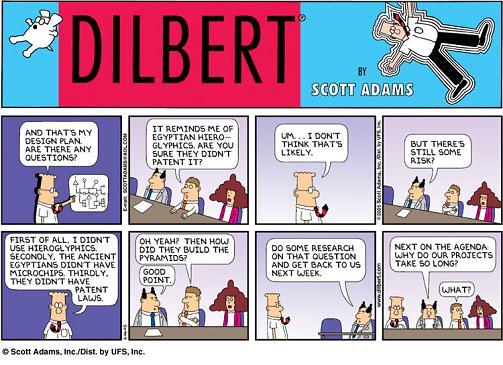
Today’s Dilbert reminds me of my (former) pointy-haired boss, the analytic paralytic:
Brian Leiter Is an Idiot
Brian Leiter,* a lawprof at the University of Texas, writes:
Why is it even remotely relevant what [the] words [of the Constitution] meant when the Constitution was adopted? The right has been pushing this non-sequitur for a couple of decades now, but they still have no answers to the simplest questions about the legal or moral relevance of the “original meaning” or “original intent” of Constitutional provisions. Those who produced the “original” meanings have no claim of democratically sanctioned authority over us.
Hmmm… I recently came upon similar words, in Lysander Spooner’s 1870 essay, “The Constitution of No Authority.” Spooner’s anarchistic thesis is that the Constitution never was and never will be binding because it isn’t a voluntary contract entered into by those presumed to be bound by it. That is, by Spooner’s reckoning, the Constitution was simply imposed on us by Madison and his cronies.
What Leiter the Lefty and Spooner the Anarchist fail to grasp is that the binding nature of the Constitution’s original meaning is implicit in the fact that it can be amended. The Framers’ willingness to submit their work to emendations proves that the Constitution, as it was then understood, was meant to be binding in perpetuity, unless and until those who came later chose to amend it in order to change its meaning. Acceptance is implied consent.
Leiter presumably objects to the notion of implied consent (if it has crossed his mind) because the process of amending the Constitution relies on supermajorities. That’s “undemocratic,” don’t you know? I wonder how Leiter would feel if a mere majority of the Texas legislature were to strip him of his cushy professorship? That would be democratic, after all.
I’m sure that with his professorship at stake Leiter would prove himself a hypocrite about democracy, just as he has proved himself a hypocrite about the concept of original meaning, which he accepts when it suits him:
Suppose the legislature prohibits the killing of “fish”” within 100 miles of the coast, intending quite clearly (as the legislative history reveals) to protect whales, but not realizing that “fish” is a natural kind term that does not include whales within its extension. The new theory of reference tells us that the statute protects sea bass but not whales, yet surely a court that interpreted the statute as also protecting whales would not be making a mistake. Indeed, one might think the reverse is true: for a court not to protect whales would be to contravene the will of the legislature, and thus, indirectly, the will of the people.
Actually, it’s all about original meaning, isn’t it? But Leiter’s views about original meaning seem to depend very much on whose whale is being harpooned.
__________
* Our hero:
"American Exceptionalism," from the Left
Howard Zinn, ranting from the Left, assembles a hodge-podge of non-sequiturs, false premises, and excluded middles in his attack on American exceptionalism (“The Power and the Glory,” Boston Review). Or is it an attack on American self-defense, religion, and G.W. Bush? It’s all of the above, premised on the notion that because America isn’t perfect it must be evil and resisted by the rest of the world. Same to you, Howard.
 Politics and Prosperity