The Short Answer to Libertarian Paternalism

Here’s the fatal flaw in “libertarian paternalism” and all other forms of statism:

If we are systematically flawed in our efforts to see what is good for ourselves, how much worse must we be at seeing what is good for others, about whom we can know far less and with whose interests we can have at best partial empathy!

— Nick Weininger, writing at Catallarchy

Free Markets, Free People, and Utter Disgust with Government

The societal value of a good or service — its value to persons other than its producer — is neither intrinsic nor determined by, say, the amount of labor that goes into its production. The societal value of a good or service can be determined only when a free market establishes a price for that good or service. This simple assertion, which I will prove below, explains why government intervention in the economy — through spending, redistribution, and regulation — causes the economy to underperform and creates general harm, as I have shown here, for instance.

Consider this: I may labor skillfully for days on end to carve a miniature portrait of John Stuart Mill on the shell of a walnut, but if no one wants to buy that portrait, it has no value to others. Does it still have a value? Well, if I decide — before setting out on my quixotic carving task — that I would want the carving for myself, whether or not anyone will buy it, then I am ascribing a personal value to the work. My personal value is the market value of the labor I forbore to sell to a willing buyer so that I could carve the likeness of John Stuart Mill. But that value is my value, not a societal value, which is zero because I cannot turn around and sell the carving for the value of the labor that I forbore to sell to a willing buyer.

Some will say “So what?” If I derive value from a carving I can’t sell, at least I have something of value to show for my labor. Here’s “what”: Suppose I do nothing with my time but make carvings that no one will buy. Suppose, further, that a powerful clique of persons wants to encourage me in my artistic endeavors and therefore forces others to buy my carvings at a price and frequency that enables me to feed, clothe, and shelter myself. If you are one of the persons who is forced to buy one of my carvings, you receive nothing of value for yourself, but — thanks to the powerful clique — I deprive you of some portion of the food, clothing, or shelter you might have been able to buy from income you earned from willing buyers of your product or service.

The same powerful clique might as well force you and others to give me money in exchange for nothing. It would amount to the same thing, inasmuch as no one places any value on my walnut carvings. If it happens that your neighbor comes to acquire a taste for walnut carvings, he may be happy with the exchange. But that does you no good; cost-benefit analysis to the contrary, you neighbor’s happiness and yours are incommensurable. If your neighbor wants walnut carvings, let him buy his own; if he wants to give money to indigent walnut carvers, let him give his own. Why should you help subsidize his acquired taste for walnut carvings?

The powerful clique of my metaphor stands for government, of course. The powerful clique’s decisions are analogous to government spending, redistribution, and regulation, which:

  • Deprive you of a portion of your earnings in order to subsidize the production of government services that you may not want.
  • Force you to donate some of your earnings to persons who produce nothing for the money they receive.
  • Effectively dictate the kinds of goods and services that may or may not be produced. (It is but a small further step to dictate how goods and services must be produced.)

Free markets, by contrast, call forth only those goods and services that are of value to you. Unless you are a net beneficiary of government intervention — and relatively few of us are — the powerful clique that is government invariably makes you worse off through spending, redistribution, and regulation.

But, you may ask, what about providing for the aged, the poor, the handicapped, and the elderly; what about protecting the environment, ensuring the safety of drugs, assuring that medical doctors are properly trained, providing for the common defense, and all the other functions that have been assigned to government?

The short answer is this: Read this blog, starting with this, this, this, this, this, this, this, this, this, this, this, this, and this, and following the links and sources cited therein.

The slightly longer answer is this: There is almost nothing government can do for you that you can’t do for yourself, or that you can’t buy in a truly free market, including environmental protection (to name but one supposedly indispensable function of government). With government out of the way we would be so much more prosperous that there would be few needy persons and ample private charity for those who cannot fend for themselves. Asking government to “solve problems” is somewhat like gambling at a casino; the odds are against you because the house takes its cut. But it’s worse than that, because government cannot know what you know about what you want and how to produce what others want. As I wrote here,

think of yourself as a business. You are good at producing certain things — as a family member, friend, co-worker, employee, or employer — and you know how to go about producing those things. What you don’t know, you can learn through education, experience, and the voluntary counsel of family, friends, co-workers, and employers. But you are unique — no one but you knows your economic and social preferences. If you are left to your own devices you will make the best decisions about how to run the “business” of getting on with your life. When everyone is similarly empowered, a not-so-miraculous thing happens: As each person gets on with the “business” of his or her own of life, each person tends to make choices that others find congenial. As you reward others with what you produce for them, economically and socially, they reward you in return. If they reward you insufficiently, you can give your “business” to those who will reward you more handsomely. But when government meddles in your affairs — except to protect you from actual harm — it damages the network of voluntary associations upon which you depend in order to run your “business” most beneficially to yourself and others. The state can protect your ability to run the “business” of your life, but once you let it tell you how to run your life, you compromise your ability to make choices that are right for you.

The government that forbids you to raise cannabis for your own use and that can seize your property at will is the same government that’s here to “help” you “solve” your problems. It’s “help” like that which makes us less free and less prosperous, day by day.

As the character Howard Beale said in Network, “I’m mad as hell, and I’m not going to take it anymore.” Well, I won’t take it quietly. In fact, I am close to changing my mind about defense, which I have long argued is a legitimate function of government. Look what happens: We create a government for self-defense and the next thing we know it’s telling us how to run our lives. Enough is more than enough. We are careening down the slippery slope toward serfdom.

The Last Straw?

UPDATED BELOW

This decision, in Kelo v. City of New London, coming on top of the decision in Raich, drives me to the edge of despair:

Supreme Court Rules Cities May Seize Homes

WASHINGTON – A divided Supreme Court ruled Thursday that local governments may seize people’s homes and businesses against their will for private development in a decision anxiously awaited in communities where economic growth often is at war with individual property rights.

The 5-4 ruling — assailed by dissenting Justice Sandra Day O’Connor as handing “disproportionate influence and power” to the well-heeled in America — was a defeat for Connecticut residents whose homes are slated for destruction to make room for an office complex. They had argued that cities have no right to take their land except for projects with a clear public use, such as roads or schools, or to revitalize blighted areas.

As a result, cities now have wide power to bulldoze residences for projects such as shopping malls and hotel complexes in order to generate tax revenue.

The state is in the saddle and its steed is trampling liberty with abandon.

UPDATE: Some would blame today’s market drop on the price of crude:

Stocks slump after oil taps $60
Dow posts biggest one-day drop in more than 2 months

But a look at the intraday chart suggests that the selloff began just after the news of the Court’s decision in Kelo. It’s bad for people and bad for business (which also makes it bad for people).

State and local governments now have the power to shut down any business on any pretext that can be labelled a “public purpose.” The regulatory hazards of doing business have just been magnified and the trajectory of economic growth has been pushed downward, again, in yet another blow to liberty. It began, in earnest, about 100 years ago. And there’s no letup in sight.

Sweet Reason from the Left

Reactions to an appearance by George Neumayr, executive editor of The American Spectator on PBS’s NewsHour With Jim Lehrer, in a segment entitled “Public Broadcasting Under Fire“:

Your whole organization is a sorry pile of manure in the first place but that crap that Neumayr was spreading on tonight’s “NewsHour” was an embarrassment even for a sorry bunch like you.

Christ on a Ritz, could that sorry bastard possibly be the best you could offer to state your warped and perverted view of PBS….

You have overstepped the bounds of free speech this time….

Dick Cheney’s use of F— has liberated me from restraining my vitriol in these circumstances, about the only thing that lying, war/death-profiteering canker’s ever done for the rest of us….

I’m not happy with PBS as I think it lets you people off too lightly when it should expose you as the elitist parasitic vermin you are. But I’m an adult and realize that PBS doesn’t belong to me….

Please tell [Mr. Neumayr] that he needs to have his chin tucked. It’s fat and hangs over his collar. He could also benefit from bigger lips. His oral cavity looks more like a hole than a mouth….

You sicken me….

You should discourage Mr. Neumayr from seeking the camera — he just comes across as the typical twitchy repressed gay Catholic weirdo. Basically, he’s a repulsive pile of pixels on our digital screens. The fact that the cartoon didn’t show the Klan lynching the queer mommies clearly has his goat — and judging by some of the confessions on talk shows recently, conservatives are likely to be jealous of their farm animals….

Just saw your smug little face on PBS — stick it in your [bleep]….

Doesn’t Mr. Neumayr realize the only good conservative is a dead conservative?…

The tolerant, loving Left has spoken.

Baseball and the Constants of the Universe

Consider this:

Some things never change. Physicists call them the constants of nature. Such quantities as the velocity of light, c, Newton’s constant of gravitation, G, and the mass of the electron, me, are assumed to be the same at all places and times in the universe. They form the scaffolding around which the theories of physics are erected, and they define the fabric of our universe. Physics has progressed by making ever more accurate measurements of their values.

And yet, remarkably, no one has ever successfully predicted or explained any of the constants. Physicists have no idea why they take the special numerical values that they do. In SI units, c is 299,792,458; G is 6.673 X 10⁻¹¹; and me is 9.10938188 X 10⁻³¹–numbers that follow no discernible pattern. The only thread running through the values is that if many of them were even slightly different, complex atomic structures such as living beings would not be possible. The desire to explain the constants has been one of the driving forces behind efforts to develop a complete unified description of nature, or “theory of everything.” Physicists have hoped that such a theory would show that each of the constants of nature could have only one logically possible value. It would reveal an underlying order to the seeming arbitrariness of nature.

In recent years, however, the status of the constants has grown more muddled, not less. Researchers have found that the best candidate for a theory of everything, the variant of string theory called M-theory, is self-consistent only if the universe has more than four dimensions of space and time–as many as seven more. One implication is that the constants we observe may not, in fact, be the truly fundamental ones. Those live in the full higher-dimensional space, and we see only their three-dimensional “shadows.”

Meanwhile physicists have also come to appreciate that the values of many of the constants may be the result of mere happenstance, acquired during random events and elementary particle processes early in the history of the universe.

I like the happenstance theory. Suppose a fledgling baseball fan knows only one fact about major league baseball, namely, the lifetime batting average of Ty Cobb, which is .367. That average is not a “law of nature” but, rather, the byproduct of Cobb’s 11,429 official at-bats in regular-season play (which excludes the times he was walked or hit by a pitch). Cobb happened to collect 4,191 base hits in those 11,429 official at-bats; thus his lifetime average of .367. If Cobb had retired a few years earlier, his lifetime batting average would have been higher; a few years later, it would have been lower. Then there are the thousands of other “unobserved” persons who played major league baseball and compiled batting averages lower than Ty Cobb’s.

Scientific knowledge, in some respects, is as superficial as the knowledge of the fledgling baseball fan. The “constants” of nature have been found to take certain values. But until scientists understand “why” the constants take the values that they do — just as we know “why” Ty Cobb batted .367 over his career — scientists will have only superficial and partial knowledge of our universe.

Isaac Newton (1642-1727) said near the end of his life,

I do not know what I may appear to the world; but to myself I seem to have been only like a boy playing on the seashore, and diverting myself in now and then finding a smoother pebble or a prettier shell than ordinary, while the great ocean of truth lay all un-discovered before me.

Almost 300 hundred years have passed since Newton wrote those words. Yet, any living scientist who is worthy of being called a scientist would take them for his own.

An Alternative to Death and Taxes?

The tragic death of Jeffrey Yu-Chang Kao in Houston, Tex., on November 5, 2003, at the hands of a Houston Metro bus driver, could lead to the removal of a layer of immunity from local governments in Texas. That’s good news for the victims of negligent government employees and bad news for the taxpayers of Texas. A better alternative, for everyone, would be to privatize public transit, as well as other pseudo-governmental functions.

Because Houston Metro is operated by the Transit Authority of Harris County, Texas, claims against it are capped under the Texas Tort Claims Act. Judicial interpretation of the act (scroll to I.B.7) has resulted in a $100,000 cap on the damages payable in a death caused by the actions of an employee of the State or one of its political subdivisions. Metro, as an arm of Harris County, is sheltered by the cap. If it weren’t it might by now be out of business, given its track record.

Jeffrey Kao’s widow, Loan-Anh Tran Kao, has since November 2004 publicized the case through a statement at a website, which links to an on-line petition addressed to the Texas State Legislature. Ms. Kao closes her statement by saying:

After Jeff’s accident, for the first time in my life, I felt powerless. I wanted to empower myself. I did not know where to start. I had been told time and time again that any efforts to force METRO to be held accountable for its actions would be futile and that the prudent action was to accept the $100,000 liability limit. However, I refused to believe that an entity set up to serve the public and funded by the public is not and cannot be held accountable to the public. Thus, I am doing the only thing I know to do right now and that is to work to change a law that makes METRO value a person’s life at only $100,000. This limit was established in 1973, was not indexed for inflation or cost of living and has not been changed since 1973. It is time for a change.

In the petition she adds:

I cannot undo the damage that has been inflicted upon my family. I can, however, with your help, make sure that, to the extent humanly possible, no one else will have to lose a love one. Metro must be held accountable for not putting safety first. Metro should not be protected by a $100,000 liability cap when it does not put safety first.

The $100,000 cap would be $330,000 if inflated to keep pace with the rise in the CPI since 1973. That’s not much money for a life. Removal of the cap makes more sense, from a claimant’s point of view. And that’s exactly what a Texas legislator has proposed.

On March 16, 2005, State Rep. Corbin Van Arsdale (R-Houston), placed before the Texas House of Representatives a bill (H.B. No. 2588) that would, among other things, remove the cap on the damages for which a political subdivision of the State of Texas may be liable:

(b) Notwithstanding any other law, sovereign immunity of a political subdivision described by Sections 101.001(3)(B) and (C) to suit and from liability is waived, and the political subdivision is liable to a claimant to the same extent as a private person according to Texas law.

The bill is still in committee, and the Texas Legislature has adjourned until 2007. (Gov. Rick Perry has called a special session, but that session will focus on public-school finance.) Perhaps the Legislature will take up the bill two years from now. If it does, my heart wants the bill to become law, for the sake of Ms. Kao and other victims of negligence by public employees. My mind tells me that the removal of the cap would harm the taxpayers of Texas, with little effect on the behavior of public employees. My libertarianism tells me that there must be a way to save lives and taxpayers’ money.

I’m entirely in sympathy with anyone who has suffered at the hands of a negligent person or entity — especially a government entity that is able to evade the consequences of its negligence by hiding behind its shield of sovereign immunity. After all, the true sovereign in the United States is — or is supposed to be — the people, not government. That’s the best argument for removing the shield of sovereign immunity from all political subdivisions of the State of Texas, not to mention all political entities in the United States. But…

Tort lawyers and irresponsible juries are (unwittingly) working hand-in-glove with tax-spend-and-regulate governments (federal, State, and local) to drive the American economy to its knees. Taking the lid off tort claims may seem just when viewed in the context of a particular case, but it could have dire long-term consequences for the taxpayers of Texas, and other States.

Why should we expect government employees to be any less negligent just because a change in the law uncaps tort claims against government entities? If criminal prosecutions won’t deter negligence, nothing will. Government employees can and will continue to act irresponsibly because their bosses — unlike the owners of private businesses — have no bottom-line incentive to enforce responsible behavior. After all, who will end up paying the claims allowed by a change in the law? Not government employees or their bosses. No sir, tort lawyers will go where the money is: in the pockets of taxpayers.

The real, long-term solution to the twin problems of negligence and liability is to get government out of the transit business — and all the other businesses that it’s in, namely, providing roads, schools, recreation, health care, social services, etc. Government, at all levels, should focus on its few legitimate lines of work, principally, defense and criminal justice.

But let’s start with the transit business. If transit systems were truly private — neither operated by a government entity nor in an agency relationship with a government entity — there’d be no cap on claims and the cost of claims would be passed on to users of the system, not to taxpayers (as taxpayers). The right course of action for the Texas legislature isn’t to remove the cap on liability claims but to remove the counties and cities of Texas from the transit business.

It says on Houston Metro’s own website that the “Texas State Legislature authorized the creation of local transit authorities in 1973.” Well, that was back in the bad old days when “socially responsible” Democrats controlled the Texas legislature. It seems to me that the current, Republican-controlled legislature should do the Republican thing and order the privatization of local transit systems in Texas.

That would accomplish three things at a stroke:

1. There’d be no cap on damages caused by negligent government employees.

2. There’d be a compelling (profit) incentive to ensure the safe operation of transit vehicles. For example, in 2004 the U.S. Postal Service’s motor-vehicle accident rate was 10.4 per million miles (see p. 12), whereas UPS’s rate was less than one accident per million miles.

3. The users of transit systems would pay for those systems — not the general public. (The users might cry “unfair” because of the existence of “free” public roads, but that’s changing in Texas.)

Houston Metro’s total operating expense in fiscal year 2003 was $395.6 million (including depreciation and amortization). Fares covered only $47.3 million (12 percent) of that total. The deficit was covered by sales taxes collected by the city and county on behalf of the transit authority. In other words, many taxpayers who don’t ride Metro subsidize those who do. And taxpayers who do ride Metro are simply subsidizing themselves. There’s no such thing as a free ride.

That’s not to say private entities couldn’t be lured into the business, if they were allowed to raise fares and eliminate unprofitable routes. A Houstonite who absolutely can’t bear the thought of paying for his own commute can always move to Los Angeles, a.k.a. Houston-on-the-Pacific.

So here’s my suggestion for the Texas State Legislature:

1. Remove the liability cap, as proposed by Rep. Van Arsdale.

2. Rescind the statutory authority for public transit systems and set a date certain for privatization.

3. Require municipalities to contract-out their transit systems during the transition period. That transition period would enable contractors to test the market to determine the most profitable combination of routes, schedules, and fares. The transition period also would give transit riders and entrepreneurs time to test and implement alternatives, such as carpooling, commercial van services, etc.

4. Municipalities would be required to contract-out to several operators, whose territories would overlap in high-density areas, to encourage competition.

5. The operators would acquire public-transit facilities and equipment through long-term lease-purchase arrangements at favorable terms. (After all, an asset that produces negative earnings is worthless to its owner — taxpayers, in this case.)

The privatization of transit systems in Texas might start a trend toward the privatization of other government-run businesses that aren’t properly the business of government.

If it did nothing else, privatization would reduce incidents of lethal negligence and keep tort lawyers out of taxpayers’ pockets.

This post is also available at Blogger News Network.

Baseball Nostalgia

UPDATED 06/20/05, 12:46 PM

Baseball is a nostalgic sport because of the individuality of major league parks, especially those that were built in the late 1800s and early 1900s. (Some, like Ebbets Field, the Polo Grounds, Fenway Park, and Wrigley Field, are memorable in their uniqueness.) Thus one remembers not only the players but also where they played. The play and the playing field are inextricably bound in the game of baseball.

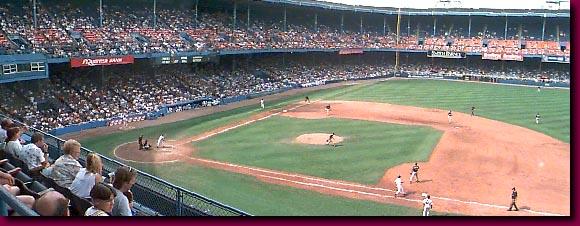
I was a Detroit Tigers fan for a long time, thanks to my maternal grandmother, who introduced me to baseball in the 1940s. Whenever I visited her (see here), the evening’s entertainment would either be a Tigers’ game on the radio or a film at the local movie house (as we called motion picture theatres in Michigan). The Detroit Tigers of my memory are bound up with Briggs Stadium (1912-1999), originally Navin Field and later Tiger Stadium. Here’s the view from the stands on the first-base side, looking toward the third-base side:

Note the proximity of the stands to fair territory. Note also the position of the upper deck, which is directly above the lower deck, rather than set back as in modern stadiums. The best way to watch a ball game at Briggs Stadium was to sit in the upper deck somewhere between first base and third base, which — as you can see — afforded a bird’s eye view of the action.

Until 1987 (the last year in which Detroit won a division championship), the Tigers often fielded contending teams but seldom won a league championship or World Series. From childhood to early adulthood I had to live on past glories: pennants in 1907-9, 1934-5, 1940, 1945; World Series wins in 1935 and 1945. That was it until the Tigers led the league and won the World Series in 1968 and again in 1984, by which time I had lost my deep attachment to baseball and the Tigers.

One reason for my alienation from the team and the game is the rise of modern ballparks that are tricked up to look “old” but aren’t built so that the upper deck sits directly over the lower deck. Upper-deck seats in the Tigers’ present home at Comerica Park — like upper-deck seats in other modern ballparks — should come equipped with binoculars:

The hallmark of the Tigers for many decades was offensive prowess. The Tigers put on a good show, even when they weren’t winning pennants. In the 55 seasons from 1907 through 1961, for example, Detroit batters led the league in batting average 21 times:


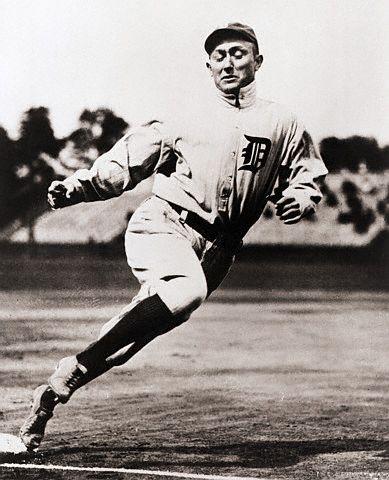
Ty Cobb: batting champion 1907-1913, 1915, 1917-19; .367 lifetime batting average; 22 seasons with Detroit (Cobb is shown here early in his career, which spanned 1905-28.)


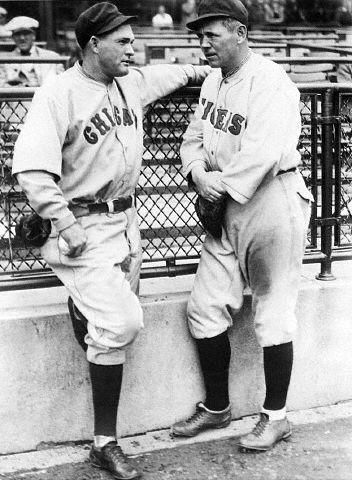
Harry Heilmann (right): 1921, 1923, 1925, 1927; .342 lifetime; 15 seasons with Detroit (Heilmann is seen here with Rogers Hornsby in 1929.)


Heinie Manush* (left): 1926; .330; 5 (This is Manush as a Washington Senator in 1933, with teammates Fred Schulte and Goose Goslin.)


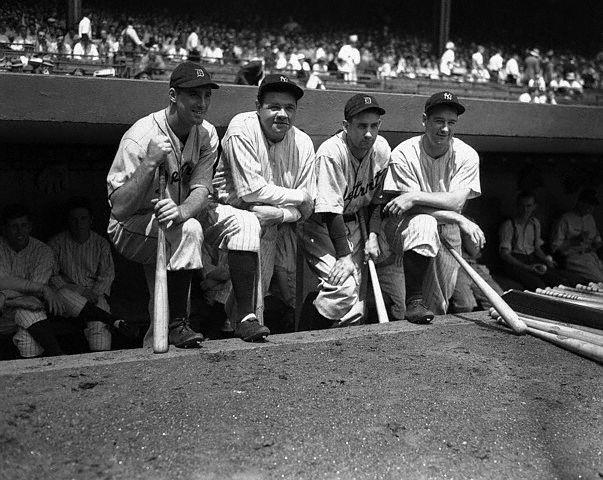
Charlie Gehringer (third from left): 1937; .320; 19 (In this 1934 photo Gehringer is flanked by Hank Greenberg, Babe Ruth, and Lou Gehrig.)


George Kell: 1949; .306; 5 (This photo is from 1949.)


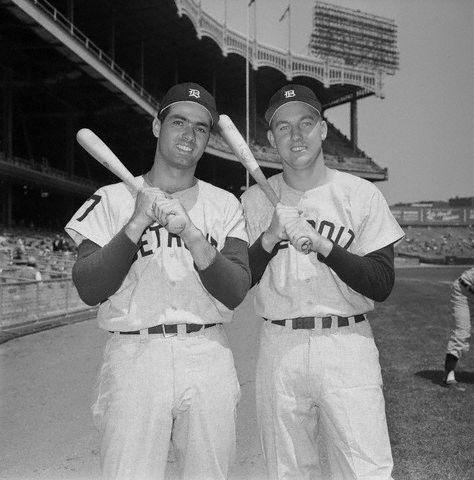
Al Kaline (right): 1955; .297; 22 (Kaline poses with teammate Rocky Colavito in 1960.)


Harvey Kuenn: 1959; .303; 8 (This photo is from 1953, Kuenn’s first full season with Detroit.)


Norm Cash (third from left): 1961; .271; 15 (In this 1961 photo Cash is seen with Roger Maris, Colavito, and Mickey Mantle.)

Hall of Famers whose primary team was Detroit:


“Wahoo” Sam Crawford (major leagues, 1899-1917; Detroit, 1903-17)

Ty Cobb (pictured above) (1905-28; 1905-26)

Harry Heilmann (pictured above) (1914, 1916-29, 1930-31; 1914, 1916-29)

Charlie Gehringer
(pictured above) (1924-42)

Hank Greenberg (pictured above) (1930, 1933-41, 1945-47; 1930, 1933-41, 1945-46)


“Prince Hal” Newhouser (1939-55; 1939-54)

George Kell (pictured above) (1943-57; 1946-52)

Al Kaline (pictured above) (1953-74; 1953-74)

That’s a continuous line of Hall of Famers from 1903 through 1974. Then the string ran out, and Detroit won only one more league championship and World Series.

The Tigers may rise again, but probably not until they can find and keep a perennial contender for the batting championship — if not a Cobb, then a Heilmann, Gehringer, or Kaline. Those were the days. A great ballpark and great hitters. Perhaps gone forever, along with Briggs Stadium and lifetime contracts.

__________
* Henry Emmet (Heinie) Manush: born Tuscumbia, Alabama, 1901; died Sarasota, Florida, 1971; played in the major leagues 1923-39; elected to the Hall of Fame, 1954. Immortalized on film in Obliging Young Lady (1942) when Edmond O’Brien, in the role of Red Reddy, walks down the aisle of a passenger train and begins to say “Heinie Manush” in time with the “clickety clack” of the train wheels. Soon, all the passengers are saying “Heinie Manush” in unison. I saw the film on TV about 40 years after its release. I may have been the only person watching who got the joke.

A Hollywood Circle

Note: The images shown below aren’t from the films mentioned in the text.


William Powell (1892-1984) played Moriarty in his film debut, the 1922 version of Sherlock Holmes, which starred


John Barrymore (1882-1942) as the legendary sleuth. Barrymore appeared as Mercutio in the 1936 version of Romeo and Juliet, in which


Norma Shearer (1902-83) played Juliet. Shearer starred as Mary Haines in 1939’s The Women, as did


Joan Crawford (1904-77), in the role of Crystal Allen. Crawford and


Bette Davis (1908-89) co-starred in Whatever Happened to Baby Jane? (1962), playing Blanche Hudson and Baby Jane Hudson, respectively. Davis played Libby Strong to the Sarah Webber of


Lillian Gish (1893-1993) in 1987’s The Whales of August. To complete the circle: Gish had the title role in Romala (1924), playing opposite William Powell as Tito.

From William Powell to William Powell, in six steps.

"Sorry" Is Right

Excerpts of Megan O’Connor’s column about “the latest chatter in cyberspace,” from today’s edition of Slate .

First excerpt:

Bloggers discuss the Senate’s apology for not passing an anti-lynching law; they also tackle a proposed increase in the retirement age and a new study on virginity pledges.

So, so sorry: The Senate issued a formal apology for its decades-long failure to enact an anti-lynching law, but the fact that only 80 of the 100 senators co-sponsored the bill irked some.

Bloggers focus on the missing 20: Responding to a list of “pro-lynching senators” posted by the liberal Atrios, commenter Samurai Sam writes, “I don’t know whether to laugh or cry at this. It just makes me choke to think we’ve made so little progress in race relations in the past 40 years. Or, more correctly, that the North and both coasts have made the progress and the South and some of the Midwest have not.” …

Listen up, Lefties. Lynching isn’t a federal matter, per se. The Senate has nothing to apologize for because the Senate should never have considered an anti-lynching bill in the first place. Lynching is murder. The only time murder should be a federal offense is when it’s committed in the District of Columbia or on federal property that doesn’t lie within the boundaries of a State. If a State isn’t granting its citizens equal protection of its laws, that’s a violation of the U.S. Constitution which should be dealt with case by case. Just as the U.S. Supreme Court should be striking down anti-business State regulations, as it did before the New Deal.

Second excerpt:

Not-so-golden years: Republican senators are considering a bill that would raise the Social Security retirement age to 69 over the next two decades. The proposal was presented last week as part of a plan to ensure “greater financial solvency” to Social Security.

Supporters think it’s just plain good sense: “Raising the eligibility age for Social Security really should be part of any commonsense solution,” argues The Yellow Line‘s Alan Stewart Carl, a “former democrat and a former republican.” He writes, “In 1940, the average life expectancy was 64 years while right now it’s around 77… If we’re living longer, shouldn’t we be able to work longer?” Commenter Jonathan Cortis agrees: “With a combination of raising the retirement age and raising the cap on social security wages, we may just be able to bring SS back to the PAYGO system FDR envisioned.”

Opponents use the chance to complain about President Bush and Republicans: “What people need to understand is that there is no Social Security ‘shortfall’ at all until 2042,” says The Land of Ding‘s Andrew Dingfelder, a new blogger. ” … The problem is that Bush is spending money like a drunken sailor and giving tax cuts to his wealthy benefactors at the same time.” Other bloggers complain about New York Times‘ columnist John Tierney’s suggestion that Americans spend too much time in retirement: At the liberal Delusions of Grandeur, Emeryroolz writes, “Tierney seems to think it’s INSANE to not want to work until you drop dead? Spoken like a guy who’s never done an honest day’s work in his life.”…

Actually, Tierney said this:

With the help of groups like AARP, the elderly have learned to fight for the right to retire earlier and get bigger benefits than the previous generation – all financed by making succeeding generations pay higher taxes than they ever did themselves.

The result is a system that burdens the young and creates perverse incentives for people to retire when they’re still middle-aged. Once you’ve worked 35 years, more work often yields only a tiny increase in your benefits (sometimes none at all), but you still have to keep paying the onerous Social Security tax, which has more than doubled over the last half century.

If the elderly were willing to work longer, there would be lower taxes on everyone and fewer struggling young families. There would be more national wealth and tax revenue available to help the needy, including people no longer able to work as well as the many elderly below the poverty line because they get so little Social Security.

Getting that kind of system seems politically hopeless at the moment here, but it already exists in Chile. Its pension system has a stronger safety net for the older poor than America’s (relative to each country’s wages) and more incentives for people to work, because Chileans’ contributions go directly into their own private accounts instead of a common pool like Social Security.

But Lefties don’t want to discuss facts and logic. They just want to smear everyone who disagrees with their illogical positions. They want to believe that, under the present Social Security system, manna for the elderly falls from heaven, when it’s actually extracted from the pockets of workers. When it comes to Social Security, Lefties are knee-jerk idiots. And that’s not a smear, that’s an obvious fact.

Third excerpt:

Virginity pledges: Contradicting earlier findings, the Heritage Foundation has published a study concluding that young people who took virginity pledges contracted fewer STDs, were more likely to abstain from sex; and were less likely to become prostitutes. The Times reports that other experts find the results “provocative, but … flawed.”

Bloggers criticize the Heritage Foundation’s motives and ideology. “It’s not surprising that an organization dedicated to pursuing an ideological agenda might abandon good science in the name of politics,” writes Publius of The Third Estate. Journalist Doug Ireland condemns the Times for failing to point out the ideology of the “oh-so-conservative” foundation. “By giving such play and credence today to this mendacious and unscientific Heritage study,” he writes, “the Times is encouraging the myth that abstinence-only sex ed and virginity pledges help stop the spread of AIDS and STDs—when, in fact, the reverse is true. Shameful.” Matthew Yglesias, writing at the American Prospect blog, TAPPED, further criticizes the Times, saying, “The only newsworthy information in the story is that the Bush Department of Health and Human Services has decided for some reason to start contracting out research on controversial questions to an ideological think tank that is non-partisan in name only, rather than to proper independent analysts.”

Harvard’s “independent,” left-wing department of sociology, for instance?

Anyway, I do not doubt that “young people who took virginity pledges contracted fewer STDs, were more likely to abstain from sex; and were less likely to become prostitutes.” Young people who take such pledges are more likely, in the first place, to abstain from sex, etc. Correlation isn’t causation. That’s all that need be said.

But Lefties get exercised about such matters because they don’t want to admit the simple fact that abstinence is the best insurance against contracting a sexually transmitted disease. The “anything goes” cult — of which the Left has long been the leading proponent — is responsible for the decline of moral standards and for the rise of STDs. Now, there’s causation for you.

Computer Technology Will Replace Concrete

Glenn Reynolds, writing at Tech Central Station, observes that

the growth of cheap computing power has…undercut the importance of big organizations in many, many areas. That cheap computing power is now being coupled with cheap manufacturing — including, increasingly, what Neal Gershenfeld calls “personal fabrication,” in his book, Fab: The Coming Revolution on Your Desktop – From Personal Computers to Personal Fabrication….

For activities that, ultimately, are about processing information, the computer revolution itself has drastically reduced the minimum efficient scale. A laptop, a cheap videocamera, and the free iMovie or Windows Movie Maker software (plus an Internet connection) will let one person do things that the Big Three television networks could only dream of in [John Kenneth] Galbraith’s day, at a tiny fraction of the cost. The same laptop with a soundcard, a couple of microphones, and software like Acid, Cubase, or Audition can replace an expensive recording studio. Change the software and it can replace an office full of Galbraith-era accountants with calculators, pencils and paper, or even with access to big 1960s mainframe computers….It’s not just that fewer people can do the same work, it’s that they don’t need a big company to provide the infrastructure to do the work, and, in fact, they may be far more efficient without the big company and all the inefficiencies and stumbling blocks that its bureaucracy and “technostructure” tend to produce.

Those inefficiencies were present in Galbraith’s day, too, of course. People have been making jokes about office politics and bureaucratic idiocies since long before Dilbert. But in the old days, you had to put up with those problems because you needed the big organization to do the job. Now, increasingly, you don’t. Goliath’s clumsiness used to be made up for by the fact that he was strong. But now the Davids are muscling up without bulking up. So why be a Goliath?

That is the question that many people are asking themselves, and as technology moves toward smaller, faster, and cheaper approaches in man, many areas we’re likely to see an army of Davids taking the place of those slow, shuffling Goliaths. This won’t be the end of big enterprises, or big bureaucracies (especially, alas, the latter) but it will represent a dramatic reversal of recent history, toward more cottage industry, more small enterprises and ventures, and more empowerment for individuals willing to take advantage of the tools that become available. In some ways, the future may look more like the distant past than the recent past. It’s not surprising that it may also seem to operate on a more human scale.

The trend toward the decentralization of work will be hastened by traffic congestion. People put up with it only to the extent that the jobs they struggle to arrive at and return home from are worth the time, expense, and aggravation. Those who worry about the seemingly endless spiral of road-building and traffic congestion should worry less and have faith in the power of technology and markets. As I wrote here,

[i]nstead of paving America — at vast expense — we should simply let the market solve the problem. When commuters have truly had enough they will turn to alternatives that will arise to meet the demand. Those alternatives — if government will stay out of the way — will be offered by private transportation companies, automobile manufacturers, employers (who may finally get serious about telecommuting, for example), and workers (some of whom will opt for simpler lives or forms of employment that don’t require commuting).

Perspectives on Iraq

Defeatism from isolationist libertarians:

Selective quotations: US Officers See No Military Solution In Iraq.

Gloom and doom about military recruiting: You and What Army?.

The not altogether gloomy facts about military recruiting: Army misses recruiting goal again.

How to help the Iraqis win their own war: Training the Iraqi Army

Someone who understands the real problem: Recruitment Improvement, in which the author says:

I read that the Army and the Marines are not meeting their enlistment quotas and I have two thoughts about this problem:

One, pay them a lot more. Not just a little more, but a lot more. Much, much more. They are indispensable. Let’s treat them that way. If we have to raise taxes to do it, let’s do it. These guys deserve a great life style if they offer up their lives for us.

Second, why would anyone join the Army if he reads the newspapers and watches TV? The mainstream media show the military doing three things: being criminals, abusing captives, killing civilians, torturing the innocent — that’s one way. Then they show the Army being stupid, making mistakes that get people killed. That’s the second way. Then they show the military getting killed.

Who would want to join a military that’s criminal, stupid, and a deathtrap?

But what if the media showed the military building schools, saving little children’s lives, feeding families, getting sick people medical care? What if the media showed smiling, grateful Iraqis thanking the Army and the Marines? What if the media showed the military winning battles and capturing and killing terrorists?

But this is the more true picture of the military and it rarely gets showed.

Again, why wouldn’t the Army and Marines have trouble attracting recruits if the media is endlessly saying you have to be a fool to enlist?

Well, I guess it never ends, does it?

The American media are still fighting the anti-Vietnam War. I guess it never ends.

But there’s this: Good news from Iraq, part 29. And there’s a lot of it. Where there’s a will, there’s a way. That used to be the American spirit. It still is, where it matters, which is in the White House (from Staying in Iraq):

It’s too bad this job has turned out to be tougher than expected. But “bad” isn’t “calamitous” — the condition into which everything would fall were we to say to democratic, liberty-seeking Iraq: Over to you; call us if you need anything, like advice on franchising pizza delivery service.

The president knows the consequences of copping out. We may count on him both to recognize and live up to his understanding, which is that as awful as Iraq might be, more awful still would be a stampede now for the exits. No sensible government allows itself to be governed in turn by pollsters.

Let us hope that sensible government is here to stay for a while.

Today in History

Today is Flag Day, which commemorates the adoption by the Continental Congress of the stars and stripes for the flag of the United States on June 14, 1777.

Today is the 121st anniversary of the birth of tenor John McCormack, arguably Ireland’s greatest gift to the world of music. (Listen to this recording from 1910.)

And most importantly to me, today would have been my father’s 88th birthday. I still miss you, Pop.

Rights and the State

For reasons detailed here, I deny that rights are innate to humans. Rights may arise from urges that are innate to humans, but a person possesses rights only to the extent that those rights are enforced or enforceable through self-defense, common consent, or state power.

Moreover, not all rights comport with liberty, which is the right to be left alone in return for leaving others alone. For liberty conflicts with the contrary desire to control others. That desire arises from instincts that are just as deeply seated in humans as the yearning for liberty — aggressiveness, avarice, envy, fear, mistrust, and sloth, for example.

Absent coercion, the conflicting desires for liberty and for control are reconciled through political bargaining. The term “political bargaining” does not connote the creation of a state or the use of state power to strike a balance between liberty and control. For politics is “the process and method of decision-making for groups of human beings [which is] observed in all human group interactions.” Each party to a political bargain acquires certain rights, that is, claims on the other parties to the bargain, which the other parties acknowledge and for which they receive reciprocal claims of one kind or another.

Political bargaining becomes more complex as a group’s numbers grow. Factions arise, with each faction preferring a package of rights that differs from the packages preferred by other factions. If the resulting centrifugal force is not great enough to cause the group to splinter, a shifting coalition of factions will dominate the group’s decision process. And from that shifting coalition will emerge a shifting package of rights.

As long as the then-dominant coalition operates through persuasion and without resort to force or the threat of force — and as long as no member of the group is compelled to remain in the group — the resulting package of rights is consensual. Each member of the group, by remaining a member of the group, effectively agrees to accept certain rights (e.g., mutual defense) as compensation for the loss or diminution of other rights (e.g., a reduction of personal autonomy because of the demands of mutual defense).

At some point, however, a state arises,

  • as the outcome of a struggle between competing coalitions, in which the coalitions resort to force to settle their differences,
  • as an antidote to violent anarchy, or
  • because the then-dominant coalition seeks to perpetuate its particular conception of rights.

Rights then lose their consensual basis; instead, they are determined by the coalition that controls the state’s decision process, which is backed by superior force. That coalition — not the community as a whole — decides the package of rights and the distribution of the cost of securing those rights. Members of the group may opt out only by leaving the geographic territory controlled by the state, that is, by leaving their homes, their jobs, and their friends and relatives.

The state may lack sufficient power to force all of its subjects to adhere to its dictates, but the state’s ability to discipline blatant violations of official norms keeps most of its subjects in line. Some small groups (e.g., polygamous communes) may form for the purpose of evading state control and adopting group-specific packages of rights to which their members give common consent. But the state, in an effort to deter such rebelliousness and to maintain its dominance, seeks to suppress or destroy such groups whenever they gain notoriety.

The state could create and enforce a package of rights that is biased toward liberty — if the proper coalition controls the state’s decision process. That is what happened in the American experience, for a time. But that time has passed, as the package of rights envisioned by the Founders and enshrined by the Framers has been discarded by power-seeking politicians who have pandered to avarice, envy, fear, mistrust, and sloth.

Would we be better off with anarchy? Only as long as it is non-violent and fosters consensual decision-making. But, given human nature, anarchy leads to violence and violence leads to the creation of a state.

The choice then, is not between anarchy and the state, but between a minimal state that is disposed toward liberty and a state that is more or less disposed toward control. History and current events suggest that a repetition of the American experience would be nothing more than temporary good luck.

"Giving Back to the Community"…

…rankles every time I read or hear it. Generally, a person whose income isn’t derived from tax dollars already has “given back” by providing goods and services that are valued by the persons who receive and pay for those goods and services.

It’s another story if a person works for a tax-supported institution, as did I for 30 years…

In the latter years of my employment at a defense think-tank, our CEO established a “community service” program so that we well-paid, mostly white, professionals could “give back to the community.” The “community” to which we gave “service” was not well-paid, mostly white, or professional, of course.

I am confident that the targets of our beneficence paid only a minuscule fraction of the taxes that funded our nicely appointed offices, high salaries, and generous benefits. “Giving back” to the “community” that actually supported us would have involved mowing lawns, tutoring, and babysitting for mostly white, middle- and upper-income Americans in other parts of the D.C. area than the one selected by our CEO as the “community” to which we would “give back.”

If the services we provided in exchange for our splendid offices, salaries, and benefits had been worth what taxpayers were paying for them, there would have been no need for us to “give back” to any community. Taxpayers would have received their money’s worth, and that would have been that.

Our CEO either felt guilty about his huge office, high salary, and princely benefits or he thought that our think-tank wasn’t giving taxpayers fair value for their money. As he would have been the last person in the United States to admit that we weren’t delivering fair value, I can only conclude that his yearning to “give back” to the community arose from feelings of guilt, which he projected onto his employees. For, even as he was pressing us to “give back,” he constantly sought to justify the spending of more tax dollars on better accommodations and higher compensation for himself and the rest of us.

Feelings of guilt aren’t confined to those who feed at the public trough, of course. CEOs and senior executives of large corporations have a good thing going for themselves — which they owe to their chummy relations with boards of directors — and they know it. Thus the impetus for private-sector “giving back.”

In summary, “giving back to the community” is either an unnecessary act — because “the community” already has received fair value for its money — or it is emblematic of guilt. In the first instance, “giving back” is really an act of charity. In the second instance, “giving back” is really a false act of contrition and an inadequate, misdirected form of compensation for executive avarice.

"Thinking" vs. "Feeling"

Arnold Kling, in n a recent Tech Central Station column, posits a correlation between libertarianism and the “thinking” aspect of personality:

In my experience, libertarians and collectivists often talk past one another. Libertarians believe that collectivists are not thinking, while collectivists believe that libertarians are not feeling.

There’s a lot to that. But a post by Alex Tabarrok at Marginal Revolution reminds me of my “feeling” side:

Here is a new interview with Milton Friedman. I liked this from the introduction:

San Francisco seems an unlikely home for the man who in 1962 first proposed the privatization of Social Security.

Asked why he dwells in liberalism’s den, Milton Friedman, 92, the Nobel laureate economist and father of modern conservatism, didn’t skip a beat.

“Not much competition here,” he quipped.

How does that remind me of my “feeling” side? Friedman’s quip is obviously just that, a quip. Friedman probably could live anywhere he wants to live. Why San Francisco, then? Why not? It has more than Lefties; it has “culture” — universities, museums, and the arts (of all kinds).

In fact, one tends to find “culture” where one finds a lot of Lefties. Moreover, many Lefties are actually nice people, as long as they can avoid talking about George W. Bush, a topic that seems to bring out the worst in their natures.

So, when I want to be a “feeling” person I hang out with Lefties and engage in pursuits that are more typical of Lefties than Righties. To tell the truth, with a few exceptions I avoid the company of Righties because I don’t share their tastes in music (the Nashville sound), sports (NASCAR), and media personalities (Limbaugh, O’Reilly, and Hannity), among other things.

Well, that’s enough “feeling” for today.

The Consequences of Roe v. Wade

From a post at Right Reason by Francis Beckwith (paragraph break and emphasis added by me):

A 1997 article in The New Republic, a magazine whose editorial position is generally supportive of abortion-choice, cites the work of Ruth Padawer, a staff writer for the local Bergen County, New Jersey, newspaper, The Record: “she called local clinics, asked how many [partial-birth abortions] they performed, did some math and wrote up her conclusions: `Interviews with physicians who use the method reveal that in New Jersey alone, at least 1,500 partial-birth abortions are performed each year, three times the supposed national rate. Moreover, doctors say only a minuscule amount are for medical reasons.'” (William Powers, “Partial Truths,” The New Republic [March 24, 1997]: 19)

Dr. Hakell’s practice and Ms. Padawer’s story were confirmed by a stunning confession by Ron Fitzsimmons, then-executive director of the National Coalition of Abortion Providers. Since 1995, when the debate over partial-birth abortion began, Fitzsimmons and his abortion-choice colleagues had claimed that partial-birth abortion was extremely rare (about 450 per year) and performed only in late-term pregnancy for serious reasons such as severe fetal deformity and to save the life of the mother. In 1997, Fitzsimmons, on an episode of ABC News’ “Nightline” admitted, in an answer to Ted Koppel’s question, “[W]hat were you lying through you teeth about?,”: “When I said that the procedures were performed only in about 450 cases and only in those severe circumstances. That was not accurate. But we have no apologies for this procedure.” (Ibid) According to The New Republic’s account, “Fitzsimmons tried, several times, to tell Koppel that, in fact, 3,000 to 5,000 partial-birth abortions were performed every year on fetuses twenty weeks or older; and, of course, only 500 to 750 were performed for reasons of maternal health in the third trimester.” (Ibid) Fitzsimmons told the New York Times that “in the vast majority of cases, the procedure is performed on a healthy mother with a healthy fetus that is 20 weeks or more along” and is “performed far more often than his colleagues have acknowledged.” (David Stout, “An Abortion Rights Advocate Says He Lied About Procedure,” New York Times [February 26, 1997]: A11)

A perfect illustration of the slippery slope down which Roe v. Wade has led us. For more about the dangers of state-sponsored eugenics, read this and follow the links.

Raich and the Rule of Law

Outrage abounds in liberal and libertarian circles as the U.S. Supreme Court decides Gozales v. Raich thusly:

California’s Compassionate Use Act authorizes limited marijuana use for medicinal purposes. Respondents Raich and Monson are California residents who both use doctor-recommended marijuana for serious medical conditions. After federal Drug Enforcement Administration (DEA) agents seized and destroyed all six of Monson’s cannabis plants, respondents brought this action seeking injunctive and declaratory relief prohibiting the enforcement of the federal Controlled Substances Act (CSA) to the extent it prevents them from possessing, obtaining, or manufacturing cannabis for their personal medical use. Respondents claim that enforcing the CSA against them would violate the Commerce Clause and other constitutional provisions. The District Court denied respondents’ motion for a preliminary injunction, but the Ninth Circuit reversed, finding that they had demonstrated a strong likelihood of success on the claim that the CSA is an unconstitutional exercise of Congress’ Commerce Clause authority as applied to the intrastate, noncommercial cultivation and possession of cannabis for personal medical purposes as recommended by a patient’s physician pursuant to valid California state law. The court relied heavily on United States v. Lopez, 514 U. S. 549, and United States v. Morrison, 529 U. S. 598, to hold that this separate class of purely local activities was beyond the reach of federal power.

Held: Congress’ Commerce Clause authority includes the power to prohibit the local cultivation and use of marijuana in compliance with California law….

Congress’ power to regulate purely local activities that are part of an economic “class of activities” that have a substantial effect on interstate commerce is firmly established. See, e.g., Perez v. United States, 402 U. S. 146, 151. If Congress decides that the ” ‘total incidence’ ” of a practice poses a threat to a national market, it may regulate the entire class….Of particular relevance here is Wickard v. Filburn, 317 U. S. 111, 127-128, where, in rejecting the appellee farmer’s contention that Congress’ admitted power to regulate the production of wheat for commerce did not authorize federal regulation of wheat production intended wholly for the appellee’s own consumption, the Court established that Congress can regulate purely intrastate activity that is not itself “commercial,” i.e., not produced for sale, if it concludes that failure to regulate that class of activity would undercut the regulation of the interstate market in that commodity….

[I]n both Lopez and Morrison, the parties asserted that a particular statute or provision fell outside Congress’ commerce power in its entirety. This distinction is pivotal for the Court has often reiterated that “[w]here the class of activities is regulated and that class is within the reach of federal power, the courts have no power ‘to excise, as trivial, individual instances’ of the class.” Perez, 402 U. S., at 154. Moreover, the Court emphasized that the laws at issue in Lopez and Morrison had nothing to do with “commerce” or any sort of economic enterprise. See Lopez, 514 U. S., at 561; Morrison, 529 U. S., at 610. In contrast, the CSA regulates quintessentially economic activities: the production, distribution, and consumption of commodities for which there is an established, and lucrative, interstate market. Prohibiting the intrastate possession or manufacture of an article of commerce is a rational means of regulating commerce in that product. The Ninth Circuit cast doubt on the CSA’s constitutionality by isolating a distinct class of activities that it held to be beyond the reach of federal power: the intrastate, noncommercial cultivation, possession, and use of marijuana for personal medical purposes on the advice of a physician and in accordance with state law. However, Congress clearly acted rationally in determining that this subdivided class of activities is an essential part of the larger regulatory scheme. The case comes down to the claim that a locally cultivated product that is used domestically rather than sold on the open market is not subject to federal regulation. Given the CSA’s findings and the undisputed magnitude of the commercial market for marijuana, Wickard and its progeny foreclose that claim….

Justice Thomas, in a strong dissent, gives the majority a lesson in constitutional law:

Respondents Diane Monson and Angel Raich use marijuana that has never been bought or sold, that has never crossed state lines, and that has had no demonstrable effect on the national market for marijuana. If Congress can regulate this under the Commerce Clause, then it can regulate virtually anything–and the Federal Government is no longer one of limited and enumerated powers….

As I explained at length in United States v. Lopez, 514 U. S. 549 (1995), the Commerce Clause empowers Congress to regulate the buying and selling of goods and services trafficked across state lines…. The Clause’s text, structure, and history all indicate that, at the time of the founding, the term ” ‘commerce’ consisted of selling, buying, and bartering, as well as transporting for these purposes.”Commerce, or trade, stood in contrast to productive activities like manufacturing and agriculture….Throughout founding-era dictionaries, Madison’s notes from the Constitutional Convention, The Federalist Papers, and the ratification debates, the term “commerce” is consistently used to mean trade or exchange–not all economic or gainful activity that has some attenuated connection to trade or exchange….The term “commerce” commonly meant trade or exchange (and shipping for these purposes) not simply to those involved in the drafting and ratification processes, but also to the general public….

Even the majority does not argue that respondents’ conduct is itself “Commerce among the several States.”…Monson and Raich neither buy nor sell the marijuana that they consume. They cultivate their cannabis entirely in the State of California–it never crosses state lines, much less as part of a commercial transaction. Certainly no evidence from the founding suggests that “commerce” included the mere possession of a good or some purely personal activity that did not involve trade or exchange for value. In the early days of the Republic, it would have been unthinkable that Congress could prohibit the local cultivation, possession, and consumption of marijuana.

On this traditional understanding of “commerce,” the Controlled Substances Act (CSA)…regulates a great deal of marijuana trafficking that is interstate and commercial in character. The CSA does not, however, criminalize only the interstate buying and selling of marijuana. Instead, it bans the entire market–intrastate or interstate, noncommercial or commercial–for marijuana. Respondents are correct that the CSA exceeds Congress’ commerce power as applied to their conduct, which is purely intrastate and noncommercial.

More difficult, however, is whether the CSA is a valid exercise of Congress’ power to enact laws that are “necessary and proper for carrying into Execution” its power to regulate interstate commerce….

In McCulloch v. Maryland,…this Court, speaking through Chief Justice Marshall, set forth a test for determining when an Act of Congress is permissible under the Necessary and Proper Clause:

“Let the end be legitimate, let it be within the scope of the constitution, and all means which are appropriate, which are plainly adapted to that end, which are not prohibited, but consist with the letter and spirit of the constitution, are constitutional.”

The Commerce Clause was meant to prevent the States from restricting or distorting the terms of trade across their borders. The Commerce Clause was not meant to give the central government the power to dictate what goods may be manufactured, how those goods should be made, or how businesses must be operated. Yet, in a long string of decisions leading up to Raich, the Supreme Court had granted those sweeping powers to the central government.*

Now, with its decision in Raich, the Supreme Court has handed the central government the power to regulate anything it wants to regulate — period. Congress can drop the pretense that it is regulating interstate commerce and simply tell us how to live our lives. As Justice Thomas puts it in his dissent, “the Federal Government may now regulate quilting bees, clothes drives, and potluck suppers throughout the 50 States.” Justice Thomas continues:

This makes a mockery of Madison’s assurance to the people of New York that the “powers delegated” to the Federal Government are “few and defined,” while those of the States are “numerous and indefinite.” The Federalist No. 45, at 313 (J. Madison).

A mockery wrapped in a travesty inside a tragedy.
__________
* For an analysis of Raich and its precedents, see this post by Lawrence Solum (Legal Theory Blog). Solum concludes by saying this:

It looks like Raich is a landmark decision that signals the end of the New Federalism [of Lopez and Morrison] as a significant limit on the powers of Congress.

Tragic, but true.

Much Food for Thought

Tyler Cowen of Marginal Revolution points to a paper by Harvard economist Roland G. Fryer Jr. and graduate student Paul Torelli, “An Empirical Analysis of ‘Acting White’.” The Washington Post‘s Richard Morin summarizes:

As commonly understood, acting white is a pejorative term used to describe black students who engage in behaviors viewed as characteristic of whites, such as making good grades, reading books or having an interest in the fine arts.

The phenomenon is one reason some social thinkers give to help explain at least a portion of the persistent black-white achievement gap in school and in later life. Popularity-conscious young blacks, afraid of being seen as acting white, steer clear of behaviors that could pay dividends in the future, including doing well in school, Fryer said. At the same time, the desire to be popular pushes many whites to excel in the classroom, enhancing their future prospects….

Among white teens, Fryer and Torelli found that better grades equaled greater popularity, with straight-A students having far more same-race friends than those who were B students, who in turn had more friends than C or D students. But among blacks and especially Hispanics who attend public schools with a mix of racial and ethnic groups, that pattern was reversed: The best and brightest academically were significantly less popular than classmates of their race or ethnic group with lower grade point averages [emphasis mine: ED].

“For blacks, higher achievement is associated with modestly higher popularity until a grade point average of 3.5 [a B+ average], then the slope turns negative,” Fryer and Torelli wrote in a new working paper published by the National Bureau of Economic Research. A black student who’s gotten all A’s has, on average, 1.5 fewer same-race friends than a straight-A white student. Among Hispanics, there is little change in popularity until a student’s average rises above a C+, at which point it plummets. A Hispanic student with all A’s is the least popular of all Hispanic students, and has three fewer friends than a typical white student with a 4.0 grade point average….

They also found that more blacks “acted white” [i.e., denigrated scholarly achievement: ED] in schools where less than 20 percent of the students were African American, while hardly any did in predominantly black schools or in private schools. “These findings suggest the achievement gap is not about cultural dysfunctionality,” Fryer said, and that contrary to conventional wisdom, the phenomenon may be more prevalent among blacks living in the more affluent suburbs than among those living in the inner city. (There were no majority-Hispanic schools in the study.)

Why is “acting white” absent in mostly black schools?

That’s easy, said Fryer, who is African American. He recalled his own experience growing up and attending predominantly black schools in Daytona Beach, Fla., and Dallas. “We didn’t act white — we didn’t know what that was,” he said, stressing that he prefers data to anecdote. “There were no white kids around.”

Now we turn to Randall Parker, writing at FuturePundit, who links to and discussesNatural History of Ashkenazi Intelligence,” by three researchers at the University of Utah, anthropologist Henry Harpending, Gregory Cochran (a Ph.D. physicist turned genetic theorist), and Jason Hardy. Parker’s take:

Ashkenazi Jews pose two mysteries for biological science. First, why do they have so many genetic diseases that fall into just a few categories of metabolic function….The second mystery is why are Jews so smart?…

Nicholas Wade of the New York Times has written one of the two news stories about [the University of Utah paper] to date. The proposed hypothesis holds that Jews developed their genetic diseases as a side effect of strong selective pressures for higher intelligence during the Middle Ages as they were forced to work mainly in occupations that required greater cognitive ability.

A team of scientists at the University of Utah has proposed that the unusual pattern of genetic diseases seen among Jews of central or northern European origin, or Ashkenazim, is the result of natural selection for enhanced intellectual ability.

The selective force was the restriction of Ashkenazim in medieval Europe to occupations that required more than usual mental agility, the researchers say in a paper that has been accepted by the Journal of Biosocial Science, published by Cambridge University Press in England.

The Economist has the other article about this research paper. The distribution of the Jewish genetic diseases is clustered too much into a few areas of genetic functionality This concentration of mutations argues for selective pressures as the logical expanation for rate of occurrence of these mutations in Ashkenazi Jews.

What can, however, be shown from the historical records is that European Jews at the top of their professions in the Middle Ages raised more children to adulthood than those at the bottom. Of course, that was true of successful gentiles as well. But in the Middle Ages, success in Christian society tended to be violently aristocratic (warfare and land), rather than peacefully meritocratic (banking and trade).

Put these two things together—a correlation of intelligence and success, and a correlation of success and fecundity—and you have circumstances that favour the spread of genes that enhance intelligence. The questions are, do such genes exist, and what are they if they do? Dr Cochran thinks they do exist, and that they are exactly the genes that cause the inherited diseases which afflict Ashkenazi society.

Cochran, Harpending, and Hardy claim higher intelligence increased reproductive fitness for Jews in medieval Europe who were legally prevented from performing in occupations that had lower need for intelligence. Simultaneously Jews were allowed to work in more cognitively demanding occupations involving money handling even as the Catholic Church banned Christians from many of those same occupations….

If this hypothesis is correct (and I believe it is) then it is problematic for efforts to raise human intelligence. How many of the intelligence raising genetic variants bring undesirable side effects? Some scientists speculate that assortive mating of high IQ people is contributing to a rising incidence of autism and Asperger’s Syndrome. As smart people become more likely to breed with other smart people the odds increase that pairs of autosomal recessives or other problematic combinations of intelligence boosting genes will given to offspring….

Step back and look at Jewish and European history from the context of this hypothesis. A few things come to mind. First off, Middle Ages bans on Christian money lending created an environmental niche in which high IQ was selected for in Jews. This led to a few important historical consequences. First off, it led to financial and reproductive success of urban Jews and hence resentment against them by both elites and masses in Europe. This resentment of course led to pogroms and Hitler’s “Final Solution”. There’s an old Japanese saying that comes to mind: “The nail that sticks up gets hammered down”. Well, smart Jews stood out and the response of jealousy and resentment against the more successful “other” is a recurring theme in human history….

The bottom line:

  • The second paper adds to the body of evidence that intelligence is strongly determined by genetic inheritance and, therefore, highly correlated with race.
  • Both papers underscore the destructive potential of envy. The less able — who too often seek the social, economic, and even corporal abasement of the more able — do so at their own expense. For it is the accomplishments of the more able that, by and large, fuel economic growth. And economic growth benefits the less able as well as the more able.

Trade Deficit Hysteria, Redux

Many bloggers have been pointing to Walter Williams’s fine dissection of trade deficit hysteria. I said it, in many fewer words, back on May 14, 2004:

Trade deficit hysteria is a psychological illness closely related to budget deficit hysteria (see Wednesday, April 21, 2004). Why do people (e.g., CNN’s Lou Dobbs) get all excited when the value of U.S. imports exceeds the value of U.S. exports? They think we’re shipping “our” money overseas.

Wrong. When the value of U.S. imports exceeds the value of U.S. exports, it means that we’re able to buy more things than we could in the absence of foreign trade.

But where does “our” money (the deficit) go? Well, our deficit is a surplus to foreigners. Guess what they do with their surplus. They invest it in U.S. Treasury bonds, the U.S. stock market, and U.S. real estate. That’s more good news for Americans.

So, if you’re suffering from trade deficit hysteria, calm down and quit watching CNN.

The Wrong Case for Judicial Review

I have defended judicial review, albeit reluctantly, on several occasions.* But I have never defended judicial review as a way to make law, which is the ground on which Erwin Chemerinsky stands in the current debate at the Legal Affairs Debate Club: Should We Get Rid of Judicial Review? For example, in one posting Chemerinsky responds to his opponent, Mark Tushnet, as follows:

I do have substantive value preferences. These include that the Supreme Court was right in ordering desegregation and striking down Jim Crow laws, in protecting reproductive privacy including abortion rights, in finding a right to privacy for consenting adults in their bedroom.

The catch is that the Supreme Court’s decisions ordering desegregation (Brown v. Board of Education), legalizing abortion (Roe v. Wade), and finding various zones of privacy (e.g., a right to buy contraceptives in Griswold v. Connecticut; a right to commit homosexual acts in Lawrence v. Texas) were based on extra-legal, sociological flim-flam and tortured readings of the Constitution. Why? Because the majority in each case wanted to make law, not apply the Constitution.

You may like the outcomes in Brown v. Board of Education, Roe v. Wade, Griswold v. Connecticut, and Lawrence v. Texas. But it should bother you that the Supreme Court can so blithely turn the law on its head to enact its own beliefs, on the pretext of finding rights in “penumbras, formed by emanations” of the Constitution. It all reminds me of this exchange from Act I, Scene 6, of Robert Bolt’s play about Sir Thomas More, A Man for All Seasons:

Roper: So now you’d give the Devil benefit of law.

More: Yes. What would you do? Cut a great road through the law to get after the Devil?

Roper: I’d cut down every law in England to do that.

More: Oh? And when the last law was down–and the Devil turned round on you–where would you hide? Yes, I’d give the Devil benefit of law, for my own safety’s sake.

Chemerinsky’s defense of judicial review is opportunistic. He wants a Court that will make his kind of law, not a court that will apply the meaning of the Constitution to the law. We need judicial review to hold legislatures and executives in check, but it must be judicial review that is grounded in the meaning of the Constitution. As I argued here:

Something resembling [liberty] will come about only if a Republican president, aided by a strongly Republican Senate, is able to stock the courts with judges who are committed to the restraint of government power — at all levels of government. (Janice Rogers Brown is that kind of judge.)

Certainly not all decisions by all Republican appointees to the bench will satisfy all libertarians, many of whom seem to focus on narrowly tailored “rights,” such as abortion and gay marriage (both of which are in fact threats to liberty, as I argue here and here). But by siding with the Left on such issues, libertarians effectively abjure more basic rights — rights that broadly affect the ability of most Americans to pursue happiness — such as freedom of speech, freedom of association, and freedom of contract.

In the real world there are real choices. The real choice for libertarians is between what seems “best” for a few and what is actually “better” for the many. I choose the latter, without hesitation.

__________
* Links to my previous posts about judicial review:

When Must the Executive Enforce the Law?

More on the Debate about Judicial Supremacy

Another Look at Judicial Supremacy

Judicial Interpretation

Is Nullification the Answer to Judicial Supremacy?

The Alternative to Nullification

No Way Out?