Welcome to the Land of Oz

And I don’t mean Australia. I’ve been living in the Land of Oz, and I didn’t know it. But I do now, thanks to outfits like WING TV. For example, here’s the way the world works, according to Victor Thorn’s “The Real Dark Overlords“:

George Bush is an empty suit Manchurian creation of nepotistic fate who serves as a lightning-rod diversion to distract people’s attention away from the actual hidden evil daemon that are manipulating our planet through wars, finance, false religion, and a reconditioning of our mental faculties….

…George Bush is not enemies with Osama bin Laden, Saddam Hussein, or even Al Gore and John Kerry. It’s all a con-job because these individuals are all on the same team, and they’re all serving the same masters in one capacity or another. And what is their ultimate goal as they sell their souls? Answer: to preserve the controlling elite’s status quo, and subsequently their positions of subservient power within it.

George Bush is merely a puppet; a figurehead; and an implementer….if YOU were running the world, would you let George W. Bush be the CEO? Hell, the Bushes don’t even trust him enough to run their own family business! So, in this sense, he’s nothing more than a dangling carrot that is used as either a figure of adoration for the kool-aid conservatives, or a symbol of disdain for the lockstep liberals….Yet for some inexplicable reason, many people who should know better still allow themselves to be bamboozled by this illusory left/right paradigm….

Please, remember: George Bush, Bill & Hillary Clinton, Ronald Reagan, and John Kerry are not (and were not) the ultimate idols and demons. They’re simply conduit/actors on the public stage who are advancing the goals of those behind the veil…. “What is essential is invisible to the eye.” In other words, the true fiends that are destroying our world and feeding off their hosts (that means us – everyday people) like parasitical vampires are far-removed from the glare of public exposure….

The key to remember is this: George Bush and his ilk are merely SYMPTOMS of evil; not the true CAUSE. If we really want the truth, we have to insist on looking further than what is standing right before us.

Yup. That’s why WING TV is presenting “9/11 on Trial” this very day:

“9-11 on Trial”…will examine the government’s explanation of events following the terror attacks of September 11, 2001. Specifically, the focal point of these proceedings will be: did burning jet fuel cause the collapse of each World Trade Center tower? A subsequent trial in mid-to-late 2005 will take into consideration whether Flight 77 – a Boeing 757 – struck the Pentagon.

To prosecute this case, we are going to rely solely on verifiable scientific data of the highest order (as opposed to the obvious pitfalls associated with “theory”). In this sense, our focus will be exclusively directed at the CAUSE of the towers’ collapse, and not any peripheral SYMPTOMS.

We are engaging in this project for two primary reasons: (a) to counteract a “black hole” of sorts that has engulfed previous and/or current 9-11 lawsuits, all of which seem to be squashed, in limbo, or severely compromised; and (b) to show that this case can be proven in a court of law relying solely on verifiable scientific facts, physics, and the laws of nature.

At this point we have amassed mountains of data, but if anyone would like to submit material which fits the above-mentioned criteria, their contributions are most certainly welcome.

“9-11 on Trial” promises to be an historic event, for we will prove beyond a shadow of a doubt – in a courtroom setting for all the world to see – that the government’s explanation of events were nothing more than bold-faced lies.

Popular Mechanics disposes of crap like “9-11 on Trial” in “9/11: Debunking the Myths“:

FROM THE MOMENT the first airplane crashed into the World Trade Center on the morning of September 11, 2001, the world has asked one simple and compelling question: How could it happen?

Three and a half years later, not everyone is convinced we know the truth. Go to Google.com, type in the search phrase “World Trade Center conspiracy” and you’ll get links to an estimated 628,000 Web sites. More than 3000 books on 9/11 have been published; many of them reject the official consensus that hijackers associated with Osama bin Laden and Al Qaeda flew passenger planes into U.S. landmarks.

Healthy skepticism, it seems, has curdled into paranoia. Wild conspiracy tales are peddled daily on the Internet, talk radio and in other media. Blurry photos, quotes taken out of context and sketchy eyewitness accounts have inspired a slew of elaborate theories: The Pentagon was struck by a missile; the World Trade Center was razed by demolition-style bombs; Flight 93 was shot down by a mysterious white jet. As outlandish as these claims may sound, they are increasingly accepted abroad and among extremists here in the United States.

To investigate 16 of the most prevalent claims made by conspiracy theorists, POPULAR MECHANICS assembled a team of nine researchers and reporters who, together with PM editors, consulted more than 70 professionals in fields that form the core content of this magazine, including aviation, engineering and the military.

In the end, we were able to debunk each of these assertions with hard evidence and a healthy dose of common sense. We learned that a few theories are based on something as innocent as a reporting error on that chaotic day. Others are the byproducts of cynical imaginations that aim to inject suspicion and animosity into public debate. Only by confronting such poisonous claims with irrefutable facts can we understand what really happened on a day that is forever seared into world history.–THE EDITORS

Letsroll911.org, another conspiracy-mongering outfit,tries to debunk the debunking by using impeachable witnesses, fuzzy images (into which one can see anything one wishes to see), and such impeccable logic as this:

Did you know that: Popular Mechanics is owned by Hearst Publications, and that the term “Yellow Journalism” came from shoddy reporting from Hearst Newspapers, most notoriously Hearst’s promotion of the false claim that Spain had blown up the USS Maine in Havana harbor which was the pretext for the Spanish-American war…?

In other words, your grandfather was a horsethief, so you must be a wife-beater.

As PM‘s Jim Meigs notes:

“Everyone is entitled to his own opinion,” the great Sen. Daniel Patrick Moynihan of New York was fond of saying. “He is not entitled to his own facts.”…

These 9/11 conspiracy theories, long popular abroad, are gradually–though more quietly–seeping into mainstream America. Allegations of U.S. complicity in the attacks have become standard fare on talk radio and among activists on both the extreme left and the extreme right of the political spectrum.

Which brings me to the Republic Broadcasting Network, another purveyor of non-stop conspiracy theorizing, which offers tidbits like these:

What Was Dick Cheney Doing on the Morning of September 11, 2001?

Arnold Exposed/Save the Constitution

The Bush Doctrine is Israel’s Doctrine

It’s obvious to me, now, that the “controlling elite” that stands “behind the veil” is a capitalist, neo-Nazi, Zionist cabal. And all these years I thought it was only Frank Morgan.
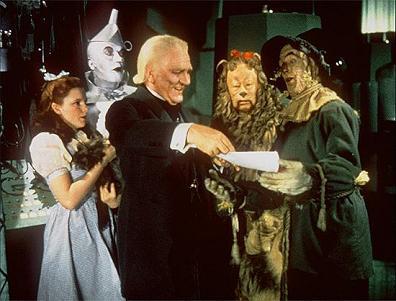

Dorothy (Judy Garland), the Tin Woodman (Jack Haley), the Cowardly Lion (Bert Lahr) and the Scarecrow (Ray Bolger) with the Wizard (Frank Morgan) in “The Wizard of Oz,” distributed by Warner Bros.

More about the Origin of Rights

Jon Henke of Q&O writes about the origin of rights:

Dean Esmay touches on something very important—something central to the evolution of my political philosophy past rigid Libertarian doctrine…

“You only have any rights because the rest of us pretty much agree that you have them.”

America was founded on an idea known as “natural rights,” at least as part of our founding myth. In truth not all the Founders believed in the concept, but most went along with the general idea. This concept of “natural rights” is helpful as a frame of reference, but really, it’s nothing but an intellectual tool. It’s a good way of getting people into the spirit of protecting each others’ rights, but ultimatey it’s nothing but sentiment.

As a matter of faith some may cleave to the notion that their rights come “ultimately” from God or some other higher source, or perhaps from an elaborately worked out system of rationalization. But as a matter of pragmatism that is all superfluous; unless you believe that your Creator is going to take a direct hand in everyday affairs for you, you are utterly dependent upon our fellow men to protect your rights. To get your fellow men to do that, you’re going to have to get most of them to agree on what your rights are or, failing that, get them to agree that the system of government which protects those rights should be obeyed—which is six of the one and half a dozen of the other.

Go on, try to get around it. Quote the Magna Carta at me; I don’t care. Quote Ayn Rand for me; I still don’t care. Quote Karl Marx or Rousseau for me; then I definitely don’t care. Indeed, take any political philosopher who has written at length about any of these issues, and consider: it only takes enough of us who say, “that’s a crock!” to expose any such intellectual edifices as castles made of sand.

Your rights do not exist unless your fellow men agree that they exist. You and I will live with that. Regardless of how we feel about it, it is empirical reality.

“Your rights do not exist unless your fellow men agree that they exist. … it is empirical reality”. Like Dean, I still await verifiable, physical proof of the existence of “rights”. If they are natural, surely there should be evidence, no?

There is not. Rights, as Max Borders wrote, “are not some Cartesian substance that animates the body in the manner of a soul. Rights are a human construct, just like money. The more we believe in them, the better they work“. And yet, objectivists—who are generally dismissive of unsupported claims of the supernatural—are perfectly willing to buy into the idea that the human race is exempt from the “survival of the fittest” – that we are somehow bound by other laws of nature….

A political philosophy should have ideals…but it should also be grounded in reality, else it is not really philosophy at all, merely wishful thinking. There are still many valid rationales for libertarianism, though, and they provide the basis of a more fundamentally healthy political philosophy.

In an update, Henke dismisses a reader’s argument for consequentialism as a proof of “natural rights”:

[H]is evidence comes down to “an irrefutable correlation” between the recognition of rights and successful outcomes, which indicates that “liberty is in everyone’s interest”.

And, in that, I absolutely agree with him. But that doesn’t prove the natural existence of a thing called “rights”, anymore than the productive cooperation that occurs between bees proves that insects have rights.

Precisely. As I have written:

I would like to be able to say, with fundamentalist [natural rights] libertarians, that liberty is an innate human right — and the only innate right. But that would be nothing more than an assertion, however cleverly I might clothe it in the language of philosophy.

I would like to be able to say that liberty is a paramount human instinct, honed through eons of human existence and experience. But we are surrounded by too much evidence to the contrary, both in recorded and natural history. The social and intellectual evolution of humankind has led us to a mixed bag of rights, acquired politically through cooperation and conflict resolution, often predating the creation of governments and the empowerment of states. The notion that we ought to enjoy the negative right of liberty is there among our instincts, of course, but it is at war with the positive right of privilege — the notion that we are “owed something” beyond what we earn (through voluntary exchange) for the use of our land, labor, or capital. Liberty is also at war with our instincts for control, aggression, and instant gratification.

I do not mean that the social and intellectual evolution of humankind is right — merely that it is what it is. Libertarians must accept this and learn to work with the grain of humanity, rather than against it….

There can be much profit in demonstrating, logically and factually, how illiberal laws and government actions make people worse off — often the same people who are supposed to benefit from those laws — and in offering superior alternatives. In other words, consequentialist libertarianism can make real gains for liberty by appealing successfully to self-interest.

The superior consequences of liberty argue for its acceptance, not for its inevitability. If the state of liberty were inevitable simply because of its demonstrable superiority, we would never have had to fight any wars to acquire and preserve it, nor would America have traveled as far down the road to serfdom as it has in the past 70 years.

Eternal vigilance is the price of liberty.

Treasonous Blogging?

Tom W. Bell of Agoraphilia posts about and links to an article he has submitted to several law reviews. The title is of the article is “Treason, Technology, and Freedom of Expression.” Here are some excerpts of the abstract and concluding section:

The power to punish treason against the U.S. conflicts with the First Amendment freedoms of speech and of the press. Far from a question of mere theory, that conflict threatens to chill public dissent to the War on Terrorism….After World War II, the United States won several prosecutions against citizens who had engaged in propaganda on behalf of the Axis powers. Today, critics of the War on Terrorism likewise face accusations of treason. Under the law of treasonous expression developed following World War II, those accusations could credibly support prosecutions. Any such prosecutions could win convictions, moreover, unless courts narrow the law of treasonous expression to satisfy the First Amendment….

In terms of abstract doctrine, the law of treason condemns anyone who owes allegiance to the U.S., who adheres to U.S. enemies, and who gives them aid and comfort by an overt act to which two witnesses testify. As courts have applied that doctrine, however, it threatens any citizen or resident of the U.S. who publicly expresses disloyal sentiments. The Internet has made it cheap, easy, and dangerous to publish such sentiments….Even if no prosecutions for treason arise, the alarmingly broad yet ill-defined reach of the law of treason threatens to unconstitutionally chill innocent dissent….

As courts have interpreted it, the law of treason allows for the punishment of an indeterminate but wide range of disloyal public expressions that help enemies of the U.S. That interpretation both subverts the original meaning of the constitution’s treason clause and violates the strict scrutiny test applied to content-based restrictions on expression. To save the law from unconstitutionality, courts should in cases of treasonous expression interpret the “adhering to [U.S.] enemies” element of treason as nothing broader than “being employed by enemies of the U.S.” Perhaps courts should demand a still less restrictive variation on the law of treason. Perhaps they should do away with the law of treasonous expression altogether. At the least, though, they should limit liability for treasonous expression to defendants employed by enemies of the U.S. Anything broader than that would, by wounding our First Amendment rights, do far more to harm the U.S. than disloyal expressions would.

I disagree with the compromise position Bell offers in the final sentence. If it’s treason, it’s treason. An unpaid traitor can do just as much harm to the nation as can a paid traitor.

It would be better to do away with the law of treasonous expression altogether than to draw an arbitrary line between paid and unpaid traitors. If a person’s treachery goes no further than expressions of hatred for America or sympathy with America’s enemies, let that person suffer the consequences in the forum of public opinion.

We bloggers are already facing enough trouble, given the strong possibility that our freedom of expression may be throttled by the strict application of the McCain-Feingold Act. The last thing that we (bloggers) need is an inquisition into our views about the War on Terrorism.

I do detest the extremists of the left and right who portray America as the villain of the piece. But I defend their right to do so — as long as they aren’t doing it on my dime.

Here We Go Again

Back on September 18, in “Time to Regulate the Blogosphere?,” I wrote that the thought of regulating the blogosphere

must have crossed the minds of some highly placed Democrat sympathizers in the “mainstream” media when the blogosphere started shredding the threadbare remnants of Dan Rather’s reputation for honest reporting. But the blogosphere is protected by the First Amendment, isn’t it?

There’s stark evidence that the blogosphere can be regulated, if the feds want to do it. Look at the airwaves, which the feds seized long ago, and which the feds censor by intimidation. Look at the ever-tightening federal control of political speech, which has brought us to McCain-Feingold. It’s all in the name of protecting us, of course.

I followed that with a post on October 13, in which I quoted from an AP story (link no longer works):

FEC May Regulate Web Political Activity

Oct 13, 7:55 AM (ET)

By SHARON THEIMER

WASHINGTON (AP) – With political fund raising, campaign advertising and organizing taking place in full swing over the Internet, it may just be a matter of time before the Federal Election Commission joins the action. Well, that time may be now.

A recent federal court ruling says the FEC must extend some of the nation’s new campaign finance and spending limits to political activity on the Internet.

Long reluctant to step into online political activity, the agency is considering whether to appeal.

But vice chairwoman Ellen Weintraub said the Internet may prove to be an unavoidable area for the six-member commission, regardless of what happens with the ruling.

“I don’t think anybody here wants to impede the free flow of information over the Internet,” Weintraub said. “The question then is, where do you draw the line?”…

LGF (via Freespace) now points to this (from CNET News.com):

The coming crackdown on blogging

March 3, 2005, 4:00 AM PT
By Declan McCullagh
Staff Writer, CNET News.com

Bradley Smith says that the freewheeling days of political blogging and online punditry are over.

In just a few months, he warns, bloggers and news organizations could risk the wrath of the federal government if they improperly link to a campaign’s Web site. Even forwarding a political candidate’s press release to a mailing list, depending on the details, could be punished by fines.

Smith should know. He’s one of the six commissioners at the Federal Election Commission, which is beginning the perilous process of extending a controversial 2002 campaign finance law to the Internet.

In 2002, the FEC exempted the Internet by a 4-2 vote, but U.S. District Judge Colleen Kollar-Kotelly last fall overturned that decision. “The commission’s exclusion of Internet communications from the coordinated communications regulation severely undermines” the campaign finance law’s purposes, Kollar-Kotelly wrote.

Smith and the other two Republican commissioners wanted to appeal the Internet-related sections. But because they couldn’t get the three Democrats to go along with them, what Smith describes as a “bizarre” regulatory process now is under way.

CNET News.com spoke with Smith about the Bipartisan Campaign Reform Act of 2002, better known as the McCain-Feingold law, and its forthcoming extrusion onto the Internet.

Q: What rules will apply to the Internet that did not before?
A: …Do we give bloggers the press exemption? If we don’t give bloggers the press exemption, we have the question of, do we extend this to online-only journals like CNET?

How can the government place a value on a blog that praises some politician?
…The FEC did an advisory opinion in the late 1990s (in the Leo Smith case) that I don’t think we’d hold to today, saying that if you owned a computer, you’d have to calculate what percentage of the computer cost and electricity went to political advocacy.

It seems absurd, but that’s what the commission did. And that’s the direction Judge Kollar-Kotelly would have us move in….

How about a hyperlink? Is it worth a penny, or a dollar, to a campaign?
I don’t know. But I’ll tell you this. One thing the commission has argued over, debated, wrestled with, is how to value assistance to a campaign….

Then what’s the real impact of the judge’s decision?
The judge’s decision is in no way limited to ads. She says that any coordinated activity over the Internet would need to be regulated, as a minimum….

(Editor’s note: federal law limits the press exemption to a “broadcasting station, newspaper, magazine or other periodical publication.” )

How do you see this playing out?
There’s sensitivity in the commission on this. But remember the commission’s decision to exempt the Internet only passed by a 4-2 vote.

This time, we couldn’t muster enough votes to appeal the judge’s decision. We appealed parts of her decision, but there were only three votes to appeal the Internet part (and we needed four). There seem to be at least three commissioners who like this.

Then this is a partisan issue?
Yes, it is at this time. But I always point out that partisan splits tend to reflect ideology rather than party. I don’t think the Democratic commissioners are sitting around saying that the Internet is working to the advantage of the Republicans.

One of the reasons it’s a good time to (fix this) now is you don’t know who’s benefiting. Both the Democrats and Republicans used the Internet very effectively in the last campaign.

What would you like to see happen?
I’d like someone to say that unpaid activity over the Internet is not an expenditure or contribution, or at least activity done by regular Internet journals, to cover sites like CNET, Slate and Salon. Otherwise, it’s very likely that the Internet is going to be regulated, and the FEC and Congress will be inundated with e-mails saying, “How dare you do this!”

What happens next?
It’s going to be a battle, and if nobody in Congress is willing to stand up and say, “Keep your hands off of this, and we’ll change the statute to make it clear,” then I think grassroots Internet activity is in danger….

Senators McCain and Feingold have argued that we have to regulate the Internet, that we have to regulate e-mail. They sued us in court over this and they won.

If Congress doesn’t change the law, what kind of activities will the FEC have to target?
We’re talking about any decision by an individual to put a link (to a political candidate) on their home page, set up a blog, send out mass e-mails, any kind of activity that can be done on the Internet….

Why wouldn’t the news exemption cover bloggers and online media?
Because the statute refers to periodicals or broadcast, and it’s not clear the Internet is either of those. Second, because there’s no standard for being a blogger, anyone can claim to be one, and we’re back to the deregulated Internet that the judge objected to. Also I think some of my colleagues on the commission would be uncomfortable with that kind of blanket exemption….

Imagine that: unregulated political speech. What a concept. Perhaps we need a constitutional amendment to protect it. We could even call it the First Amendment, because of its importance.

God damn McCain, Feingold, Congress, the President, and the U.S. Supreme Court! (Oops, am I allowed to say that?)

Favorite Posts: Academic Freedom and Freedom of Speech

The Population Mystery

If a species that cannot provide for itself must decline, what does the following chart say about the ability of humans to provide for themselves?


Estimates for -400 through 1800 are from U.S. Census Bureau, “Historical Estimates of World Population“; estimate for 2000 is from U.S. Census Bureau, “Total Midyear Population for the World: 1950-2050.” Year 1 is plotted as Year 0 for ease of illustration. “Upper” estimates are used for -400 through 1800 (where given) because those estimates are taken from a series that extends from -10000 through 1950, and the upper estimate for 1950 in that series agrees with the estimate for 1950 in the series for 1950-2050.

Kill the Innocent, Save the Guilty

News headlines:

U.S. Supreme Court declines to hear Terry Schiavo Case

5-4 Supreme Court abolishes juvenile executions

Taking Exception

Aaron Margolis, a co-blogger at the late, unlamented Blogger News Network, once wrote:

The operative question in this case: should Michael Schiavo’s rights as a husband be reduced or eliminated because his wife’s parents do not agree with his legal right to make medical decisions on her behalf? The point of view of some conservatives on this issue is, I believe, incorrectly predicated. While we may argue Terri Schiavo’s right to live or die ad infinitum, the broader issue is being ignored; it is not our choice….

This is not a pro-life related issue; Terri Schiavo is not an unborn child. Therefore, this aspect should not be brought into the picture. The fundamental issue should be about who has the ultimate right to make a decision, medical or otherwise, of this nature….

Conservatives fight hard to preserve not only the sanctity of marriage, but the idea of individual responsibility and independence of action. However, it would appear that as concerns this matter, some of our number have forgotten these basic tenets. Where may this lead us, and what should conservatives being saying or doing, ultimately? As with our defense of the sacrosanct right of free speech, while we may not agree with Michael Schiavo, we should be willing to support his right to act in accordance with his rights and obligations.

But the Schiavo case is about life, not about marriage. As I have written, “think about the ‘progressive’ impulses that underlie abortion (especially selective abortion), involuntary euthanasia, and forced mental screening — all of them steps down a slippery slope toward state control of human destiny.” (See here, also.) If Michael Schiavo succeeds in his court-aided quest to end his wife’s life, the slope will become noticeably slicker.

I’m an ardent libertarian who’s a staunch conservative when it comes to protecting the lives of the innocent. Without life, there is no liberty, no pursuit of happiness.

How to Deal with Left-Wing Academic Blather

David French, over at FIRE’s The Torch, writes about a speech by Newt Gingrich (my comments bolded in brackets):

Gingrich asks, “What obligation does society have to fund its own sickness?” This is a good question—but it is constitutionally dangerous. One of the most common statements we hear at FIRE (in the context of both public and private schools—since almost every college and university in the United States receives significant government funding) is: “Sure, they have their right to free speech, but why do I have to fund it?” [Good question. It’s your tax dollars at work.]

In essence, what Gingrich (and others) wants is to attach viewpoint-related strings to public funds. We will “fund” speech, but only the speech we like. In the public university context, I can think of few ideas more catastrophic to free speech and open debate than the notion that the funding entity controls the political discourse of a university community. [But the funding entity can and should control a university’s academic emphasis.] Do we really want state legislators injecting themselves into tenure disputes? Deciding which English teachers deserve their salaries? The obligation of the funding entity should be viewpoint neutrality, not ideological conformity. [So, we leave ideological conformity in the hands of the left-wingers who dominate university faculties?]

Within the university setting, think of the state as funding not a point of view but a marketplace of ideas. [Balderdash! See previous comment.] The goal is to advance knowledge and freedom through public institutions that foster and support the free exchange of ideas. [The kind of blather espoused by academic left-wingers isn’t remotely related to knowledge.] The existence of a Ward Churchill is no more evidence that the marketplace is broken than the existence of the Edsel (or, even worse, the AMC Pacer) was evidence of fundamental problems in the American car market. [But the Edsel and Pacer were evidence of fundamental problems in the American car market, which have been cured to some extent by competition from Japanese makes.] Even in a perfectly functioning marketplace, Ward Churchills would exist, teach (sometimes to packed houses), and maybe even get tenure. [In a perfectly functioning academic marketplace there would be conservative and libertarian counterparts to Ward Churchill, who would also be heard.]

The real problem in our public universities is not that “bad ideas” are funded but that the marketplace of ideas itself has broken down. [As I was saying.] Through speech codes, mandatory diversity training, viewpoint discrimination in hiring and other mechanisms that violate basic constitutional protections, universities have closed the free marketplace and are often simply vendors for the prevailing political orthodoxy. If Newt wants to create positive change at our universities, he should be talking about opening them up to more ideas, not adding yet another “forbidden topic” to the long list that currently exists. [Agreed. But how does one open them to more (non-left-wing) ideas?]

How have we improved our universities if we add just one more “ism” to the long list of banned thoughts and words? Campuses have already banned subjectively defined expressions of racism, sexism, homophobia, and so on. Do we solve anything by including “anti-Americanism”? If the state and federal government have any role in this dispute, it is to take steps to restore the free marketplace, not to add further restrictions. [Perhaps restoring the free marketplace at universities requires the application of something like an intellectual anti-trust act, to break up the left’s stranglehold on most universities.]

Actually, although Ward Churchill and his ilk are despicable human beings, I don’t care what they say as much as I care that they represent what seems to pass for “thought” in large segments of the academic community. Clearly, universities are failing in their responsibility to uphold academic standards. Left-wing blather isn’t knowledge, it’s prejudice and hate and adolescent rebellion, all wrapped up in a slimy package of academic pretentiousness.

The larger marketplace of ideas counteracts much of what comes out of universities — in particular the idiocy that emanates from the so-called liberal arts and social sciences. But that’s no reason to continue wasting taxpayers’ money on ethnic studies, gender studies, and other such claptrap. State legislatures can and should tell State-funded universities to spend less on liberal arts and social sciences and spend more on the teaching of real knowledge: math, physics, chemistry, engineering, and the like. That strikes me as a reasonable and defensible stance.

It isn’t necessary for State legislatures to attack particular individuals who profess left-wing blather. All the legislatures have to do is insist that State-funded schools spend taxpayers’ money wisely, by focusing on those disciplines that advance the sum of human knowledge. Isn’t that what universities are supposed to do?

Favorite Posts: Academic Freedom and Freedom of Speech

Free Riders to the North

From the Associated Press:

Canada Opts Out of U.S. Defense Shield

TORONTO – Prime Minister Paul Martin said Thursday that Canada would opt out of the contentious U.S. missile defense program, a move that will further strain brittle relations between the neighbors but please Canadians who fear it could lead to an international arms race.

Martin, ending nearly two years of debate over whether Canada should participate in the development or operation of the multibillion-dollar program, said Ottawa would remain a close ally of Washington in the fight against global terrorism and continental security.

It’s the old “arms race” bugaboo. In other words, when we stop arming the bad guys will stop, too. Ha! As Reagan proved in the 1980s, when we continue to arm, the bad guys are (a) outmatched, (b) give up because they can’t afford to keep up with us, or both.

Actually, Martin’s decision smacks of an excuse to free-ride at the expense of American taxpayers. Martin and his advisers know full well that our defense shield must provide at least partial protection for Canada — especially for the most densely populated parts of Canada, which lie along or near the border with the U.S.

As for the rest of it, I’m not impressed by Canada’s politically correct stance on terrorism. Nor am I aware of any significant Canadian contributions to continental security.

The Canadian anthem is a parody of the political views now dominant in the land of my forbears.* Read it and weep:

O Canada!
Our home and native land!
True patriot love in all thy sons command.

With glowing hearts we see thee rise,
The True North strong and free!

From far and wide,
O Canada, we stand on guard for thee.

God keep our land glorious and free!
O Canada, we stand on guard for thee.

O Canada, we stand on guard for thee.

__________
* With the notable exception of the Red Ensign Bloggers:

Abraca-Pocus!
Absinthe & Cookies
All AgitProp, all the Time…
Angry in the Great White North
Anthroblogogy
Argghhh!
Babbling Brooks
bluetory.ca
bound by gravity
BumfOnline

canadiancomment
Candepundit
ChrisCam
doxology
dustmybroom
ESR | Musings…
Gen X at 40
Hammer into Anvil
Hypothesis.ca
John The Mad

Just Between Us Girls
Minority of One
Musing
Musings of a Canadian Slacker
myrick
Nathan’s Updates from Seoul
North Western Winds
OCCAM’S CARBUNCLE
Quotulatiousness
Raging Kraut

Ravishing Light
Rempelia Prime
Rightjab
SHINY HAPPY GULAG
Skeet Skeet Skeet
Stephen Taylor
Striving Against Opposition
Taylor & Company
The Freeway To Serfdom
The Green Baron

The Last Amazon
The London Fog
The Meatriarchy
The Monger
The Phantom Observer
The Tiger in Winter
tipperography
Trudeaupia
West Coast Chaos

The Stupid Party

Orin Judd, writing at Tech Central Station, observes of the Democrat Party’s suicidal behavior:

[W]e should be reluctant to label a whole political party “stupid.” But the only other description that seems to fit this behavior pattern is insanity: doing the same thing repeatedly and expecting a different result. So, take your pick, stupidity or insanity?

And the right answer is: stupidity. As I have shown, the right is smarter than the left.

See, People Can Think for Themselves

Craig William Perry and Harvey S. Rosen (both of Princeton) have published a paper that goes by this provocative title: “The Self-Employed are Less Likely to Have Health Insurance Than Wage Earners. So What?” Here’s the abstract:

There is considerable public policy concern over the relatively low rates of health insurance coverage among the self-employed in the United States. Presumably, the reason for the concern is that their low rates of insurance lead to worse health outcomes. We use data from the Medical Expenditure Panel Survey conducted in 1996 to analyze how the self-employed and wage-earners differ with respect to insurance coverage and health status. Using a variety of ways to measure health status, we find that the relative lack of health insurance among the self-employed does not affect their health. For virtually every subjective and objective measure of health status, the self-employed and wage earners are statistically indistinguishable from each other. Further, we present some evidence that this phenomenon is not due to the fact that individuals who select into self-employment are healthier than wage-earners, ceteris paribus. Thus, the public policy concern with the relative lack of health insurance among the self-employed may be somewhat misplaced.

In other words, the self-employed tend to make an informed calculation about the risks to their health and don’t waste money on unneeded health-insurance coverage. No doubt many persons who work for others make the same rational calculation.

But if the health-care hysterics on the left had their way, the U.S. government would force health insurance down the throats of everyone, driving up health-care costs and premiums. But it would be “free” because we (as taxpayers) would share the burden. Right.

(Thanks to Alex Tabarrok at Marginal Revolution for the pointer to the abstract.)

The Creation Model

In a post at The Panda’s Thumb, Timothy Sandefur says this:

[T]he reason many people complain about evolution education is because they believe that it is a kind of “religion” which is receiving preferable treatment over their own religions.There are three problems, however, with this argument. First, evolution, being science, differs from religion in that it is a testable, confirmable theory, which can be compared with observed results. The “creation model”—that is, a miracle story—is usually stated in an untestable way, and when it has been stated in a testable way (e.g., that the world was created in 4004 B.C.) such “models” have failed the tests.

Not so fast. Here’s some of what Wikipedia has to say in today’s featured article about the “Big Bang“:

The term “Big Bang” is used both in a narrow sense to refer to a point in time when the observed expansion of the universe (Hubble’s law) began, and in a more general sense to refer to the prevailing cosmological paradigm explaining the origin and evolution of the universe….

According to current physical models, 13.7 billion (13.7 × 10⁹) years ago the universe was in the form of a gravitational singularity, time and distance measurements were meaningless, and temperatures and pressures were infinite. As there are no models for systems with these characteristics, and in particular, no theory of quantum gravity, this period of the history of the universe remains an unsolved problem in physics.

In 1927, the Belgian priest Georges Lemaître was the first to propose that the universe began with the “explosion” of a “primeval atom“….

A number of Christian apologists, and the Roman Catholic Church in particular, have accepted the Big Bang as a description of the origin of the universe, interpreting it to allow for a philosophical first cause.

The “creation model” posited by Sandefur isn’t the only “creation model” put forth by religionists. Father Lemaître offered a testable model, one that seems to be holding up as fact and which is accepted by many religionists. And Father Lemaître wasn’t simply trying to evade the consequences of scientific thought:

He based his theory, published between 1927 and 1933, on the work of Einstein, among others. Einstein, however, believed in a steady-state model of the universe. Lemaître took cosmic rays to be the remnants of the event, although it is now known that they originate within the local galaxy. He estimated the age of the universe to be between 10 and 20 billion years ago, which agrees with modern opinion.

Einstein posited (and later renounced) a cosmological constant so that his equations for general relativity would yield a steady-state universe rather than a collapsing one. It now seems that there is a cosmological constant, but not of the kind envisioned by Einstein: The universe is expanding at an accelerating rate because of something called “dark energy,” the origins of which are unknown.

And it took a Belgian priest to point the scientific world in the right direction.

Sandefur is too anxious to paint all religionists as know-nothings. He should relent if he wants his ideas to resonate beyond the circle of ardent atheists, whose grasp of scientific rigor is tenuous, as I’ve explained here, here, and here.

Unlimited Government?

Well, that’s what J. Peter Byrne seems to advocate in his online debate with Richard Epstein about Kelo v. New London (discussed in an earlier post):

[In the city of New London’s taking,] I see self-government, which while never pure, gives most of us a voice and is capable of innovation….I think that the democratic process provides the best and most legitimate accountability, especially if it is amenable to reform from above, as municipal decision making is by state statutes. The abuses in eminent domain can be addressed through statutes improving procedures and changing the measure of compensation.

Not incidentally, I think New London’s plan here is quite reasonable, so far as I understand it. They are redeveloping some 90 acres, strategically located between a new Pfizer research facility—the largest private investment in New London in many years—and the water; they are constructing a new park and providing substantial infrastructure and environmental remediation in their best shot to encourage private development of offices, hotels, and residences. The plaintiffs’ property lies in the middle of the 90 acres and in a flood plain. The elevation of the land needs to be raised for development and that cannot be done with functioning inholdings. This is not warehousing, but a sensible, long term development plan, which the people of New London have knowingly approved and financed.

In other words, government can do anything it wants to do, as long as it is done in the name of “social progress” or “economic development” — and as long as it pretends to draw its legitimacy from the “people.” By Byrne’s rule, government is entitled to tell us where to work, where to live, how many children to have, and on and on. If government is so “smart,” why don’t we just let it run all of our businesses and lives? We could then stop pretending that we live in something approximating liberty.

It all reminds me very much of Hitler’s abuse of German law to advance his repugnant agenda. Just go through the motions and what do you get? Absolute power of the kind that makes mincemeat of schnooks like Byrne.

Great Minds Agree, More or Less

UPDATED, BELOW:

Randy Barnett, writing at The Volokh Conspiracy, says:

In hindsight, I think that the creation of the Libertarian Party has been very detrimental to the political influence of libertarians. Some voters (not many lately) and, more importantly, those libertarians who are interested in engaging in political activism (which does not include me) have been drained from both political parties, rendering both parties less libertarian at the margin….

While some libertarian political activists are certainly Republicans and Democrats, the existence of the Libertarian Party ensures that there are fewer activists and fewer voters in each major party coalition than would otherwise exist. Therefore, each party’s coalition becomes less libertarian. I do not mean to exaggerate the extent of this effect. But even a handful of political activists in local and state party organizations can make a big difference. Whatever one thinks of the initial creation of the Libertarian Party, its continued existence seems to be a mistake for libertarians.

Here’s my take (from October 26, 2004):

Max Borders, writing at Jujitsui Generis, says:

A viable Libertarian Party is going to have to change its ways: 1) its platform, i.e. to moderate its views; 2) it’s [sic] image, i.e. of geeks and pot-smokers; and 3) maybe even its name and brand, i.e. a name and brand sullied by 1 and 2.

Here’s a better plan. Don’t run LP candidates for office — especially not for the presidency. Throw the LP’s support to candidates who — on balance — come closest to espousing libertarian positions. Third parties — no matter how they’re packaged — just don’t have staying power, given the American electoral system. The LP’s only hope of making progress toward libertarian ideals is to “sell” its influence to the highest bidder.

My approach would keep the LP intact, as an ideological center of gravity for politically active libertarians, who would determine which major-party candidates and causes are worthy of endorsement and active support. It seems to me that such a scheme would give libertarian ideas greater visibility and leverage than the alternative posed by Barnett.

Given a say in the matter, I would argue that the LP ought to lean toward Republican candidates and causes, for reasons I have discussed in earlier posts (here, here, and here):

[L]ibertarians and conservatives generally see eye-to-eye on so-called social programs, affirmative action, Social Security reform, school vouchers, campaign-finance laws, political correctness, and regulation. Libertarians will never see eye-to-eye with conservatives on all issues, but it seems to me that they see eye to eye on enough issues to make a political alliance worthwhile.

If libertarians were pragmatic they would adopt this view: An alliance with conservatives is, on balance, more congenial than an alliance with liberals because conservatives are closer to being “right” on more issues, and their theocratic leanings are unlikely to prevail (the social norms of the 1940s and 1950s are gone forever). If libertarians were to approach conservatives en bloc, libertarians might be able to help conservatives advance the causes on which there is agreement. If libertarians were to approach conservatives en bloc, libertarians might be able to trade their support (and the threat of withdrawing it) for influence in the councils of government. Libertarians could use that influence to push conservatives in the right direction on issues where they now differ with conservatives.

Many libertarians will reject such a strategy, but they would be wrong to do so. We will never attain a libertarian nirvana — whatever that is — but we can advance some libertarian causes. We shouldn’t let the “best” be the enemy of the “good.”

* * *

Getting the left (i.e., Democrats) to buy into economic liberty may prove to be just as hard as getting Republicans to buy into gay marriage, abortion, and decriminalization of drugs. Bill Clinton alienated much of his party by supporting welfare reform and NAFTA. He also raised taxes (against Republican opposition), tried to nationalize medicine by the back door after his 1993 plan failed (thanks to Republicans), and seldom saw a regulation he didn’t like (whereas the Bush administration has slowed the pace of regulation considerably).

Are Democrats likely to offer us another “Clinton” (but not Hillary) anytime soon? Perhaps the results of the 2004 election will cause them to do so. But that prospect doesn’t do much to brighten my day. Social freedom has advanced markedly in my lifetime, in spite of rearguard efforts by government to legislate “morality.” Government control of economic affairs through taxation and regulation has advanced just as markedly, especially under Democrats.

In sum, libertarians may be repulsed by the moralists who have taken over the Republican Party, but that moralizing, I think, is a lesser threat to liberty than regulation and taxation. For that reason — and because Republicans are more likely than Democrats to defend my life — I’m not ready to give up on the GOP.

* * *

I view a stable society as a necessary condition of liberation. Stability helps to ensure that we keep the liberation we’ve gained as individuals, without sacrificing other values, such as the prosperity we enjoy because of somewhat free markets and the security we enjoy because we remain resolute about fighting criminals and terrorists.

Of course, there is such a thing as too much stability. For example, a society that frowns on actions that do no harm to others (e.g., a white person’s trading with or marrying a black person) and then uses the government to bar and penalize such actions is not conducive to liberty.

But efforts to secure personal liberation can be destabilizing, and even damaging to “liberated” groups, when “liberation” proceeds too swiftly or seems to come at the expense of other groups (e.g., the use of affirmative action to discriminate in favor of blacks, the insistence that marriage between man and woman is “nothing special” compared with homosexual marriage). For, as I said here, “[t]he instincts ingrained in a long-ago state of nature may be far more powerful than libertarian rationality.”

Where does that leave libertarians? Well, it leaves this libertarian rather more sympathetic to conservatives, who are more reliable than leftists about defending life and economic liberty….

When I say “defend my life,” I mean on city streets as well as overseas.

…I think libertarians have a lot to lose by throwing in with leftists. And they probably have nothing to gain that won’t be gained anyway, as society proceeds — in its glacial way — to liberate individuals from the bonds of repressive laws.

Why should libertarians make a Faustian bargain with the left to achieve personal liberation — which, with persistence, will come in due time — when the price of that bargain is further economic enslavement and greater insecurity?

UPDATE:

For corroboration, I turn to Philip Klein’s “Rifts and the Right” at Tech Central Station:

Whether libertarians like it or not, cultural issues most likely did more to reelect President Bush than enthusiasm for Social Security reform.

This does not mean that libertarians who want to influence conservative thought should throw their hands up in despair. A debate that has echoed in conservative and libertarian enclaves on the Internet over the past few days has focused on the rift between the two groups, but there is a common ground to be had. To achieve this common ground, libertarians must acknowledge that values are important and conservatives must push to remove government from the values debate.


Libertarians should realize that it is not, by definition, a contradiction of limited government principles to suggest that the erosion of traditional values has had adverse effects on American society. In fact, the existence of a culture that fosters shared values is essential to a free society….


The problem with social conservatives lies not in their ultimate goal of strengthening families or in their belief that religion has an important role to play in society, but in their means of getting what they want. If conservatives believe in small government, they can’t make an exception on social issues.


Almost every major “values” issue originates from the government being overly involved in areas it shouldn’t be in. The debate over stem-cell research is spurred by government involvement in medical research. School prayer is controversial because parents are denied control over their education dollars….


Libertarians and conservatives share a common interest in getting the government out of people’s lives while preserving the values on which this country was founded.

As I wrote in Part IV of “Practical Libertarianism for Americans“:

Forbearance from meddling in the socio-economic order implies laissez-faire, except to prevent or remedy an actual harm….As Hayek pointed out, liberty requires a degree of stability in society; otherwise, how can you decide, with any degree of confidence, what sort of life and livelihood to pursue? Of course, there can be such a thing as too much stability (as Hayek also argued), as well as too much instability. Thus it is equally damaging to liberty to use the law to bar interracial marriage, to foster affirmative action as it is practiced in the United States, to prohibit smoking on private property, or to regulate economic activity on the basis of environmental hysteria rather than sound science.

To paraphrase what I wrote here, you may want government to meddle in certain private matters because that meddling seems to advance liberty. But it should bother you that government can just as easily restrict liberty, all in the name of meeting a pressing social or economic need. Government has taken liberty down a slippery slope, and every instance of meddling — always for a “good” cause — creates a precedent for another step down the slope. It all reminds me of this exchange from Act I, Scene 6, of Robert Bolt’s play about Sir Thomas More, A Man for All Seasons:

Roper: So now you’d give the Devil benefit of law.

More: Yes. What would you do? Cut a great road through the law to get after the Devil?

Roper: I’d cut down every law in England to do that.

More: Oh? And when the last law was down–and the Devil turned round on you–where would you hide? Yes, I’d give the Devil benefit of law, for my own safety’s sake.

Support Homeschooling

WriteWingNut, a homeschooler and co-blogger at Blogger News Network, writes about “Homeschooling and Socialization.” There’s much to be said in favor of homeschooling as an antidote to public education. But teachers’ unions and their allies (notably the Democrat Party) have a lot of political clout, which they wield almost ceaselessly in an effort to undermine homeschooling.

Just take a look at the website of the Home School Legal Defense Association (HSLDA), for a taste of the legal hurdles that homeschoolers face or are threatened with. Here’s what HSLDA is and does:

Home School Legal Defense Association is a nonprofit advocacy organization established to defend and advance the constitutional right of parents to direct the education of their children and to protect family freedoms. Through annual memberships, HSLDA is tens of thousands of families united in service together, providing a strong voice when and where needed.

HSLDA advocates on the legal front by fully representing member families at every stage of proceedings. Each year, thousands of member families receive legal consultation by letter and phone, hundreds more are represented through negotiations with local officials, and dozens are represented in court proceedings. HSLDA also takes the offensive, filing actions to protect members against government intrusion and to establish legal precedent. On occasion, HSLDA will handle precedent-setting cases for nonmembers, as well.

HSLDA advocates on Capitol Hill by tracking federal legislation that affects homeschooling and parental rights. HSLDA works to defeat or amend harmful bills, but also works proactively, introducing legislation to protect and preserve family freedoms.

HSLDA advocates in state legislatures, at the invitation of state homeschool organizations, by assisting individual states in drafting language to improve their homeschool legal environment and to fight harmful legislation.

HSLDA advocates in the media by presenting articulate and knowledgeable spokesmen to the press on the subject of homeschooling. HSLDA staff members are regularly called upon for radio, television, and print interviews, and their writings are frequently published in newspapers and magazines across the country. HSLDA’s own bimonthly magazine, The Home School Court Report, provides news and commentary on a host of current issues affecting homeschoolers. And its two-minute daily radio broadcast, Home School Heartbeat, can be heard on nearly 500 radio stations.

HSLDA advocates for the movement by commissioning and presenting quality research on the progress of homeschooling. Whether it’s in print, from the podium, or on the air, HSLDA provides insightful vision and leadership for the cause of homeschooling.

You can support HSLDA’s worthy efforts by shopping online through its Clicks for Homeschooling page:

Did you know that you can support homeschooling just by using the links on this page or special QuickLinks set from this page to get to your favorite online retailers? That’s right, the online retailers on this page will give a portion of your online purchase amount back to HSLDA for the work of the Home School Foundation. So next time you want to shop online, please come to this page first or use one of our QuickLinks to get to the online retailer. It’s easy and you will be helping the Home School Foundation support homeschooling through its Special Needs Children’s Fund, Widows Curriculum Scholarship Fund, and its other funds.

The list of participating retailers includes many familiar names (e.g., Amazon.com, Circuit City, Home Depot, Toysrus.com, and Wal-Mart.com). From now on, I’m going first to the Clicks for Homeschooling page before I shop online.

(Thanks to my daughter-in-law for the tip about HSLDA.)

Can Your Town Take Your Home?

It’s a debate about eminent domain at Legal Affairs Debate Club:

This week, the Supreme Court hears the case of Susette Kelo and her neighbors in the Fort Trumbull neighborhood of New London, Conn. [Kelo v. New London]. The city intends to evict these residents and develop their waterfront neighborhood claiming that doing so will enhance the city’s tax-base.

The Fifth Amendment describes the power of eminent domain as a taking for public use with fair compensation. Kelo and her neighbors argue that expropriation of their property for a redevelopment project cannot be a “public use” if private developers eventually will possess the land.

Is New London taking the principle of eminent domain too far?

The debaters are Richard A. Epstein, James Parker Hall Distinguished Service Professor of Law at the University of Chicago, and J. Peter Byrne, Professor of Law at Georgetown University. Round 1 is over and it’s already a TKO, in favor of Epstein. But Byrne is so groggy that he doesn’t know that the fight is over.

Talk about being mentally flabby, here’s Byrne’s final punch of round 1:

Judgments about the wisdom of the project should be left to the people of Connecticut and New London, where the constitution places it.

The Constitution, quite obviously, places the judgment in the hands of the U.S. Supreme Court. Whether the Court will do the right thing and find for Kelo is another matter. If Byrne is to be believed (a dubious proposition), U.S. Supreme Court precedent is on the side of New London. Fortunately, perhaps, there’s more recent and directly applicable precedent in the reversal of Poletown.

What Is the Point of Academic Freedom?

Just read:

Marketplace of Fear

New Proof That Man Has Created Global Warming

How Global Warming Research Is Creating a Climate of Fear

Ego, Testosterone, and the Academy: Why the Controversy Over Larry Summers Is Important

And that’s only the teeny-tiny pointy tip of the iceberg — as you know well, unless your only source of news is Dan Rather.

Academic freedom isn’t an end unto itself, it’s a means to an end, which is to debate the truth. Where there is no debate, the truth (or something approaching it) is unlikely to emerge, to the detriment of education, in particular, and human progress, in general. As I wrote here (apropos Ward Churchill’s aborted appearance at Hamilton College): Educators are paid not only to educate but also to educate well. Maybe it’s time for political-point-of-view quotas for professorships.

Favorite Posts: Academic Freedom and Freedom of Speech

Dancing with Chirac

UPDATED, BELOW

James Lewis at The American Thinker doesn’t think much of our apparent flirtation with Jacques Chirac and his band of continental cronies:

Even while Condi Rice was in Europe, the EU was planning to lift its arms embargo against China. Jacques Chirac flew to Beijing to sell stealth aircraft to China a few months ago, knowing that the Red Army has some 600 short-range missiles aimed at Taiwan. Against those bombers, the Taiwanese may be helpless. In the last Taiwan crisis the US had to interpose naval ships in the Straits, placing our ships in mortal danger to keep the peace. High-tech European arms could easily destabilize that fragile balance. This is a classic old Great Power gambit, to arm the enemy of your enemy. It is how the Kaiser knocked out Russia in 1917. Now the US military is forced [to] plan for a two-front war, one in Iraq, the other in the Pacific. Merci beaucoup, our European friends.

So while the American media go all moist and fuzzy about Europe’s willingness to forgive our sins, I would just ask one question: What European allies?

I don’t think Bush has any illusions about the intentions of Chirac and Schroeder. The “opening to Europe” strikes me as a ploy to quell, if not dispel, the fashionable, uninformed (or malicious) grumbling about “unilateralism.” When Bush shows you his left, look out for the hard jab with the right, followed by a left hook. In this case, I expect to see something like this: “I tried to make nice to Europe, but they’re just bent on opposing our interests,” followed by unilateral military action as necessary against Korea, Iran, or Syria.

Don’t misunderestimate Mr. Bush.

UPDATE:

Mark Steyn is on my frequency:

[T]he administration is changing the tone [vis-à-vis Europe] precisely because it understands there can be no substance. And, if there’s no substance that can be changed, what’s to quarrel about? International relations are like ex-girlfriends: if you’re still deluding yourself you can get her back, every encounter will perforce be fraught and turbulent; once you realise that’s never gonna happen, you can meet for a quick decaf latte every six – make that 10 – months and do the whole hey-isn’t-it-terrific-the-way-we’re-able-to-be-such-great-friends routine because you couldn’t care less. You can even make a few pleasant noises about her new romance (the so-called European Constitution) secure in the knowledge he’s a total loser.

Irrelevance, thy name is Old Europe.

Social Security: The Permanent Solution

Many, many posts ago I promised to unveil my plan for fixing Social Security. I have duly kept up with the continuing debate about Social Security “privatization,” which is hardly what the President’s plan envisions. (There’s a selected bibliography at the bottom of this post.) Having weighed it all, I am reinforced in my belief that the only way out of the Social Security “mess” is to phase out Social Security.

Why? As a bleeding-heart libertarian who wants the best for others as well as for himself, and who understands that economics is a positive-sum game, I say this: The best way to incentivize people to work hard, to acquire new and higher-paying skills, and to stay sober is to allow them take responsibility for their old age. Put them on notice (reasonable notice, of course) that they are responsible for themselves; unless they can count on family, friends, or private charity to see themselves through old age, they should consume less, save more, and invest wisely.

What’s the worst that can happen? Some form of public assistance would be demanded for the truly needy (and for their fellow travelers, the lazy and the imprudent), and by those who simply bleed envy or pity at the thought of “excessive” income inequality. But the accompanying tax burden would be much smaller than the burden that now hangs over future taxpayers if we try to redeem anything resembling the “promises” implicit in the present Social Security scheme. Moreover, the demise of Social Security would give added impetus to the coming economic boom (see here and here), as the higher rate of personal saving necessitated by the phase-out of Social Security would finance additional investments in productivity-enhancing growth. Lower taxes and a more robust economy would also foster a resurgence of private charity, in aid of the truly needy (if not the lazy and imprudent).

Here’s my plan:

1. Abolish Social Security payroll taxes as of a date certain (Abolition Day).

2. Pay normal benefits (those implicitly promised under the present system) to persons who are then collecting Social Security and to all other qualifying persons who have then reached the age of 62.

3. Persons who are 55 to 61 years old would receive normal benefits, pro-rated according to their contributions as of Abolition Day.

4. The retirement age for full benefits would be raised for all persons who are younger than 55 as of Abolition Day. The full retirement age is now scheduled to rise to 67 in 2027; it should rise to 73 by, say, 2020. Moreover, partial benefits would no longer be available to persons between the age of 62 and full-retirement age.

4. Persons who are 45 to 54 years old also would receive pro-rata benefits based on their contributions as of Abolition Day. But their initial benefits would be reduced on a sliding scale, so that the benefits of those persons who are 45 as of Abolition Day would be linked entirely to the CPI rather than the wage index.

5. Persons who are younger than 45 would receive a lump-sum repayment of their contributions (plus accrued interest) at full retirement age, in lieu of future benefits. That payment would automatically go to a surviving spouse or next-of-kin if the recipient dies intestate. Otherwise, the recipient could bequeath, transfer, or sell his interest in the payment at any time before it comes due.

6. The residual obligations outlined in points 2-5 would be funded by a payroll tax, which would diminish as those obligations are paid off.

Repeat, with appropriate variations, for Medicare and Medicaid.

SELECTED BIBLIOGRAPHY

The Official State of Social Security
2004 OASDI Trustees Report: Contents
2004 OASDI Trustees Report: Conclusion
The looming deficit problem: Table VI.F8.–Operations of the Combined OASI and DI Trust Funds, in Constant 2004 Dollars, Calendar Years 2004-80
The underlying causes: Shrinking worker-retiree ratio, increasing longevity, and wage indexing

Some Alternative Solutions to the Problem
General Accounting Office
Brookings Institution
Cato Institute
Laurence J. Kotlikoff

Analytical Perspectives of Other Bloggers
Arnold Kling: Fighting Murphy (also known as “A Social Security Policy Primer”)
Alex Tabarrok: The Microeconomics of Social Security Privatization
Tyler Cowen: Should We Privatize Social Security?
Arnold Kling: The Cost of Privatization
Will Wilkinson: How Much Does SS Screw You?
Alex Tabarrok: Prescott on Social Security Reform
Tyler Cowen: Social Security and Our Future
Tyler Cowen: Freezing Social Security Benefits
For much more, browse this list of articles by Arnold Kling, many of which are about Social Security.

My Posts on Social Security and Related Issues
Social Security Is Unconstitutional
Why It Makes Sense to Privatize Social Security
P.S. on Privatizing Social Security
Fear of the Free Market — Part III
Social Injustice
Let’s Just Say He’s a Bit Evasive
A Good Reason to Favor the “Ownership Society”
That Mythical, Magical Social Security Trust Fund
The Real Social Security Issue
Social Security — Myth and Reality
Nonsense and Sense about Social Security
More about Social Security
Social Security Privatization and the Stock Market
Oh, That Mythical Trust Fund!
Understanding Economic Growth
The Problem with Voluntary Personal Accounts

Judeo-Christian Values and Liberty

Dennis Prager’s first column of 2005 inaugurates “a periodic series of columns devoted to explaining and making the case for what are called Judeo-Christian values.” Prager contends that

The collapse of Christianity in Europe led to the horrors of Nazism and Communism. And to the moral confusions of the present — such as the moral equation of the free United States with the totalitarian Soviet Union, or of life-loving Israel with its death-loving enemies.

In fact, it was a secular Jew, the great German Jewish poet Heinrich Heine, who understood that despite its anti-Semitism and other moral failings, Christianity in Europe prevented the wholesale slaughter of human beings that became routine with Christianity’s demise. In 1834, 99 years before Hitler and the Nazis rose to power, Heine warned:

A drama will be enacted in Germany compared to which the French Revolution will seem harmless and carefree. Christianity restrained the martial ardor for a time but it did not destroy it; once the restraining talisman [the cross] is shattered, savagery will rise again. . . .

What is needed today is a rationally and morally persuasive case for embracing the values that come from the Bible. This case must be more compelling than the one made for anti-biblical values that is presented throughout the Western world’s secular educational institutions and media (news media, film and television).

One need not be a believer to embrace the values espoused in the Bible, in particular, the last six of the Ten Commandments (from the Douay-Rheims Bible Online, Exodus 20, verses 13-17):

13 Thou shalt not kill. 14 Thou shalt not commit adultery. 15 Thou shalt not steal. 16 Thou shalt not bear false witness against thy neighbour. 17 Thou shalt not covet thy neighbour’s house: neither shalt thou desire his wife, nor his servant, nor his handmaid, nor his ox, nor his ass, nor any thing that is his.

As the Catholic Encyclopedia puts it:

The precepts [of the last six of the Commandments] are meant to protect man in his natural rights against the injustice of his fellows.

  • His life is the object of the Fifth;
  • the honour of his body as well as the source of life, of the Sixth;
  • his lawful possessions, of the Seventh;
  • his good name, of the Eighth;
  • And in order to make him still more secure in the enjoyment of his rights, it is declared an offense against God to desire to wrong him, in his family rights by the Ninth;
  • and in his property rights by the Tenth.

That’s a good summary of the precepts of libertarianism.

Related posts:
Atheism, Religion, and Science
The Limits of Science
Three Perspectives on Life: A Parable
Beware of Irrational Atheism

(Thanks to Mike Rappaport at The Right Coast for the pointer to Prager’s column.)