Same Old Story, Same Old Song and Dance

I’ve read the same line so many times that I can’t stand it any more. The line, spouted this time by scientist Richard Dawkins, goes like this:

Much of what people do is done in the name of God. Irishmen blow each other up in his name. Arabs blow themselves up in his name….

Thus Dawkins begins an essay entitled “The Improbability of God.” Now, it’s obvious from the title and the opening sentences of the essay where Dawkins is going, but there is no logical connection between the vile acts purportedly committed in God’s name and the existence of God. Sectarian violence of the kind seen in Ireland and the Middle East violates the tenets of Catholicism, Protestantism, Judaism, and most forms of Islam — not to mention Hinduism, Buddhism, and other Eastern religions.

Why single out a belief in God as a cause of violence? What about the “religion of the state” or the “cult of personality” as practiced under Hitler, Stalin, Mussolini, Mao, and Saddam Hussein, among many others of their ilk?

Violence comes from humans. God — or more precisely, religion — is but one excuse for violence. There are many other excuses. The existence of violence neither proves nor disproves the existence of God. Dawkins’s opening is a cheap rhetorical trick, designed to cater to emotion rather than reason. Not very scientific, eh Professor Dawkins?

A Crime Is a Crime

Would the murder of Matthew Shepard be any less reprehensible if it hadn’t been motivated by hatred of homosexuals? We hear from Virginia Heffernan of The New York Times:

…Elizabeth Vargas goes for broke tonight on an intellectually brave episode of “20/20” on ABC.

Ms. Vargas,…who replaced Barbara Walters as co-host of the show in September, has wasted no time before taking on a risky story: the 1998 murder of Matthew Shepard. But what’s incendiary about tonight’s program is not its topic but its argument. “20/20” takes the position that the description of this murder as an anti-gay hate crime is entirely wrong. After six years of sentimental theater, documentaries and television movies that have bolstered the hate-crime view, tonight’s program is no less than iconoclastic.

In October 1998, Mr. Shepard, a 21-year-old student at the University of Wyoming in Laramie, was found tied to a fence on the outskirts of town. He’d been pistol-whipped and left shoeless in near-freezing temperatures; he was almost dead. Friends who heard about his beating instantly began to tell reporters that he was gay and that his attack might have been an instance of gay-bashing.

Two men, Aaron McKinney and Russell Henderson, were arrested. Mr. McKinney’s girlfriend told the press that he had lashed out when Mr. Shepard came onto him. As people across the country held candlelight vigils, this became the dominant refrain: Mr. Shepard was attacked because he was gay.

Then Mr. Shepard died. His funeral was picketed by chilling figures whose placards said he deserved it. Also in attendance were antiviolence activists, who wore white angel get-ups.

As Ms. Vargas says, the crime’s stakes then came through plainly: tolerance versus hate, good versus evil. The parable drawn from the crime was supplemented with beauty shots of Mr. Shepard that made him look like a frail James Dean, and arraignment photos of Mr. McKinney and Mr. Henderson that made them look like tight-lipped white power people.

The men, however, did not have ideologies. They were full-time roofers with steady girlfriends. But Mr. McKinney was also a speed freak….According to a drug buddy interviewed by Ms. Vargas, Mr. McKinney had been on a weeklong no-sleeping bender before he murdered Mr. Shepard. Mr. Henderson says on camera that he was so worried about Mr. McKinney’s drug-induced volatility that night that he hoped to keep him drinking in a local bar until he calmed down.

Newly armed with a large-frame revolver…Mr. McKinney was hoping to commit a robbery. He was full of scattershot rage. When Mr. Shepard, who was also at the bar, asked him for a ride home, he agreed, planning to steal his wallet for drug money. Mr. Henderson went along on the drive, and after Mr. McKinney beat Mr. Shepard senseless with the gun, he tied him to a fence in a remote field. The two men then took off for town, where Mr. McKinney attacked another guy he came across, cracking the man’s skull.

Mr. Henderson eventually pleaded guilty to murder and kidnapping, while Mr. McKinney was convicted of felony murder, aggravated robbery and kidnapping. Both men are serving double life sentences. Mr. McKinney has waived his right to appeal; Mr. Henderson hopes to file a federal appeal, claiming he was never fully advised of his rights.

Mr. McKinney now says that he and his defense team cooked up a gay-panic defense – the one that said he responded violently when hit on by a man – though it wasn’t true. Mr. McKinney’s girlfriend, the early proponent of the gay-panic story, has also recanted….

…In defending himself from charges of homophobia Mr. McKinney says, noxiously, “I have gay friends,” which gives the documentary a chance for a bravura transition.

“One of McKinney’s gay friends may have been Matthew Shepard,” Ms. Vargas says in voice-over.

What? They knew each other?

Mr. McKinney denies it to Ms. Vargas, but “20/20” then produces several interviews with people who had seen the men together. And then a bomb is dropped.

Mr. O’Connor [a character who knew Shepard and McKinney], volunteers that Mr. McKinney didn’t hate gays because “I know of an instance where he had a three-way – two guys and one girl at a party, an all-nighter.” After confirming that Mr. McKinney had had sex with the man of the trio, Ms. Vargas asks Mr. O’Connor how he knows about such an intimate experience.

“Because he did it with me,” the limo driver says.

Now what does this prove? That Mr. McKinney was bisexual, as his girlfriend goes on to confirm? (Mr. McKinney denies that he has ever had sex with a man.) Does that mean he wasn’t homophobic? And as for the news about Mr. Shepard – so what if he did meth or had H.I.V.?

Mr. Shepard’s parents, Dennis and Judy, are interviewed here about their son’s character; they have since taken the position that the documentary is filled with errors.

None of this, as Ms. Vargas points out, changes the horror of the murder, or the inspiration and awareness that people gained from the widespread parable version of the event. But getting the truth – in ABC’s revisionist investigation, which seeks to overturn the powerful and canonical version of the facts and meaning of this crime – is worthwhile, as it thickens the description and adds to the mystery of what happened that night in Laramie.

The doubts about McKinney’s motivation and the final, gratuitous, paragraph notwithstanding, it is evident that Matthew Shepard’s murder — like the school shootings at Columbine and elsewhere — was used cynically by advocates of an agenda. That agenda was gay rights in the Shepard case, whereas it was gun control in the school-shooting cases.

The tone of the Times story suggests that McKinney’s crime would have been less heinous if Shepard hadn’t been killed because of his homosexuality. Why? Why should it more wrong to kill a homosexual because he’s a homosexual than to kill a homosexual because he has some money? The law should judge the crime, and not presume to judge the perpetrator’s state of mind. (And, yes, I take the same view of the insanity defense.)

(Thanks to Instapundit.com and Althouse for pointing me to the NYT piece.)

I Can’t Help Myself, So Sue You

First it was cigarette smoking, then it was smoking guns, now it’s a smoking credit card. The user blames the provider for being unable to control herself:

It’s not my fault. I’m mentally ill. That’s the argument a woman is using to sue American Express for two (M) million dollars after she ran up nearly one (M) million dollar in charges and couldn’t pay the bill.

Prosecutors say the woman – 40-year-old Antoinette Millard – posed as a Saudi princess to steal hundreds of thousands of dollars worth of merchandise. She is now suing America Express saying she was mentally incompetent when she opened her account and the company should have known it….

But she would have sued American Express for invasion of privacy had the company tried to discern her mental state.

Peter Singer’s Fallacy

Peter Singer — the Ira W. DeCamp Professor of Bioethics at the University Center for Human Values of Princeton University, a proponent of animal rights, and a bête noire of the right — says this about his ethical position:

…I approach each issue by seeking the solution that has the best consequences for all affected. By ‘best consequences’, I understand that which satisfies the most preferences, weighted in accordance with the strength of the preferences. Thus my ethical position is a form of preference-utilitarianism….

Which his source defines as a

[m]oral theory according to which the good consists in the satisfaction of people’s preferences, and the rightness of an action depends directly or indirectly on its being productive of such satisfaction. Like other kinds of consequentialism, the theory has satisficing and maximising variants. The latter are the more common ones: the more people get what they want, the better. Syn. preference consequentialism

And “consequentialism” encompasses such concepts as these:

…On the “total view”, an increase of the total number of people is an improvement (other things being equal), as long as the additional individuals have a positive welfare or happiness score, however marginal. On the “average view”, the important thing is to seek to increase average pleasure, happiness, welfare, or the like. A situation in which there are a larger number of people would not be better (other things being equal) if the average welfare remained the same.”

That is to say, Singer sets himself up as an omniscient arbiter and weigher of the preferences of billions of individual humans (and other animals), in the belief that he has a formula for determining “the greatest good of the greatest number.” That is a bankrupt formula, as I have written:

…It’s patently absurd to think of measuring individual degrees of happiness, let alone summing those measurements. Suppose the government takes from A (making him miserable) and gives to B (making him joyous). Does B’s joyousness cancel A’s misery? Only if you’re B or a politician who has earned B’s support by joining in the raid on A’s bank account.

Something like “the greatest good for the greatest number” can come about only in a representative democracy, where political bargaining about legitimate government functions leads to a compromise that’s satisfactory to most members of the body politic. An example would be an agreement to have a defense budget of a certain size and to authorize (or not) the use of the armed forces for a particular defensive objective….

Peter Singer joins Cass Sunstein on my list of “respectable” thinkers who seductively espouse serfdom in the name of freedom. (For my take on Sunstein, go here, here, here, here , here, and here.)

Property Rights with a Vengeance

From The New York Times:

Property Rights Law May Alter Oregon Landscape

By FELICITY BARRINGER

Published: November 26, 2004

PORTLAND, Ore., Nov. 20 – Over the past three decades, Oregon has earned a reputation for having the most restrictive land-use rules in the nation. Housing was grouped in and near the cities, while vast parcels of farmland and forests were untouched by so much as a suburban cul-de-sac.

Environmentalists and advocates for “smart growth” cheered the ever-growing list of rules as visionary, while some landowners, timber companies and political allies cried foul.

But in a matter of days, the landowners will get a chance to turn the tables. Under a ballot measure approved on Nov. 2, property owners who can prove that environmental or zoning rules have hurt their investments can force the government to compensate them for the losses – or get an exemption from the rules.

Supporters of the measure, which passed 60 percent to 40 percent, call it a landmark in a 30-year battle over property rights….

Whatever the benefits of Oregon’s land-use rules, Mr. Day added, “the people paying the cost are property owners.”…

Both sides expect the measure to survive judicial scrutiny, and the state and local governments are to start fielding claims on Dec. 2. If claims are found to be valid and the government will not or cannot pay, it must instead waive any restrictions that went into force after the owners – or their parents or grandparents – acquired the land….

Liberty and property rights: inextricable values.

Bah, Humbug!

Since I attained adolescence I have dreaded the obligatory gatherings that occasion American’s two “family” holidays: Thanksgiving and Christmas. Political conventions, protest marches, and Thanksgiving Day parades excepted, never have so many gone to such great trouble and expense to bore or irritate so many others as at the great, temporary migrations that mark Thanksgiving and Christmas.

Families are inherently dysfunctional because, unlike friendships and employment relationships, they aren’t voluntary associations. I do not understand why a group of individuals who happen to share some genes should feel compelled to foregather once or twice a year. Those who want to give thanks should give thanks; those who want to observe the birth of Christ should observe it. But what does any of that have to do with frogmarching me to the groaning board because, by blood or marriage, I happen to belong to some familial constellation of incompatible personalities?

Many of us go away to college to escape the banality of family life. Why do so many of those same escapees seek to resurrect that banality once or twice a year? Is it an attempt to assuage the guilt of not liking one’s family as much as one’s friends? Or is it just a “female thing”?

My mother, who lives alone at the age of 89, is bereft when she spends a holiday without a visit from a child or grandchild. When I am 89, I will be bereft if I am besieged by children or grandchildren who feel duty-bound to join me in observing a “family” holiday. I love them all, but I want to see them only if they want to see me, and then only when it’s warm and sunny and we can go to parks and take long walks and enjoy cool drinks on a shady porch.

No lengthy, distracting preparations; no football games on TV; no dancing politely around taboo subjects; no retelling of tales that were stale two decades ago; no laborious cleanup; no company — that’s my idea of Thanksgiving and Christmas.

Knee-Jerk Anti-Religionism

UPDATED 11/26/04

This one’s getting a lot of play, but I have to add my dime’s worth:

Declaration of Independence Banned at Calif School

Wed Nov 24, 2004 04:12 PM ET

By Dan Whitcomb

LOS ANGELES (Reuters) – A California teacher has been barred by his school from giving students documents from American history that refer to God — including the Declaration of Independence.

Steven Williams, a fifth-grade teacher at Stevens Creek School in the San Francisco Bay area suburb of Cupertino, sued for discrimination on Monday, claiming he had been singled out for censorship by principal Patricia Vidmar because he is a Christian.

“It’s a fact of American history that our founders were religious men, and to hide this fact from young fifth-graders in the name of political correctness is outrageous and shameful,” said Williams’ attorney, Terry Thompson.

“Williams wants to teach his students the true history of our country,” he said. “There is nothing in the Establishment Clause (of the U.S. Constitution) that prohibits a teacher from showing students the Declaration of Independence.”…

Williams asserts in the lawsuit that since May he has been required to submit all of his lesson plans and supplemental handouts to Vidmar for approval, and that the principal will not permit him to use any that contain references to God or Christianity.

Among the materials she has rejected, according to Williams, are excerpts from the Declaration of Independence, George Washington’s journal, John Adams’ diary, Samuel Adams’ “The Rights of the Colonists” and William Penn’s “The Frame of Government of Pennsylvania.”

“He hands out a lot of material and perhaps 5 to 10 percent refers to God and Christianity because that’s what the founders wrote,” said Thompson, a lawyer for the Alliance Defense Fund, which advocates for religious freedom. “The principal seems to be systematically censoring material that refers to Christianity and it is pure discrimination.”…

Is Vidmar trying, Soviet-style, to write Christianity out of American history? Perhaps. More likely she has an axe to grind with Williams or a twisted view of the meaning of separation of church and state. Whatever her motivation, Vidmar is a living advertisement for the corrupt state of public “education”.

P.S. I am not a religious person. I am simply appalled by the know-nothings who find religion so threatening that they strive to expunge it from history and daily life.

UPDATE:

Now comes this, from Fox News:

Young students across the state read stories about the Pilgrims and Native Americans, simulate Mayflower voyages, hold mock feasts and learn about the famous meal that temporarily allied two very different groups.

But what teachers don’t mention when they describe the feast is that the Pilgrims not only thanked the Native Americans for their peaceful three-day indulgence, but repeatedly thanked God.

“We teach about Thanksgiving from a purely historical perspective, not from a religious perspective,” said Charles Ridgell, St. Mary’s County Public Schools curriculum and instruction director….

How is it a “historical perspective” to teach about Thanksgiving without reference to God? What are these people afraid of, that they’ll offend someone by referring to God, or that they’ll instantaneously convert non-believers to believers by mentioning God? This urge to deny a simple historical fact suggests downright animosity to religion (or at least to the form of religion practiced by the Pilgrims). That hardly seems consistent with leftism’s vaunted tolerance for differing views. (Oh, I forgot, in the lexicon of the left, differing views can only be non-Judeo-Christian and non-Western.)

Jill the Ripper?

I’ve never been a “Ripper” fanatic. The case of Jack the Ripper is just another insoluble historical who-done-it as far as I’m concerned — on a par with the Princes in the Tower and the assassination of JFK. But I found it fascinating to learn that several somehat-prominent figures have been suspected of the Whitechapel Murders. Here, from Casebook, is a gallery of suspects:

I had heard about the candidacy of Prince Albert Victor (a grandson of Queen Victoria and a great-great uncle of the present Queen Elizabeth), and about the Royal conspiracy. Patricia Cornwell has touted actor-artist Walter Sickert as the Ripper in her book, Portrait of a Killer: Jack the Ripper – Case Closed. But Lewis Carroll, James Kenneth Stephen, and Francis Thompson — writers of more or less renown — are news to me.

My money’s on Mary Pearcey (Jill the Ripper). Follow the links and draw your own conclusions.

(Thanks to Oxblog for the pointer to Casebook.)

Is Nullification the Answer to Judicial Supremacy?

I have written often — and reluctantly — that the words and logic of the Constitution give the judicial branch the last word in the making of law. (See here, here, here, and here.) But, thanks to a post by William Watkins at Southern Appeal, I found a blurb for The Politically Incorrect Guide to American History, by Thomas E. Woods Jr., which includes this passage:

[The book’s] treatment of the early republic recalls parts of American history that have vanished into the memory hole, including the crucially important Virginia and Kentucky Resolutions of 1798 and Thomas Jefferson’s belief that only state nullification of unconstitutional federal legislation, rather than “checks and balances” among the branches of the federal government itself, had a chance of keeping the federal government in check.

Here, from Houghton Mifflin’s “The Reader’s Companion to American History,” is a bit more about the Resolutions:

The Virginia and Kentucky Resolutions of 1798 and 1799 raised the question of states rights’ and nullification. They were drafted in response to the passage of the Alien and Sedition Acts of 1798 but were concerned with a larger and more deep-rooted problem. How was power to be divided between the federal government and the states, and who was to settle disputes between the two?

The first Kentucky Resolution, passed by the state legislature on November 16, 1798, stated that when the federal government exercised power not specifically delegated to it by the Constitution, each state could judge the validity of that action for itself. The Virginia Resolution of December 24, 1798, claimed that the states “have the right and are in duty bound to interpose for arresting the progress of the evil.” Several northern states objected that the judiciary, not the states, should be the arbiter of constitutionality. The Kentucky legislature passed a second Resolution on November 22, 1799, arguing that a single state had the power to nullify a federal action it deemed unconstitutional.

Unknown to contemporaries, the Virginia and Kentucky Resolutions were drafted, respectively, by James Madison and Thomas Jefferson. The doctrines they enunciated were later cited by southern slaveholders in support of their right to secede from the Union. Yet it would be a mistake to conclude that either Jefferson or Madison truly wanted to dismantle the Union. The Resolutions are best understood in the context of the fierce political battles between Federalists and Jeffersonians in the 1790s and the prevailing theory of divided sovereignty. When John C. Calhoun evoked the Resolutions in the 1820s to support his own doctrine of nullification, he was solidly opposed by James Madison.

Nevertheless, considering the authorship of the Resolutions, there may be something to the concept of nullification as a response to blatantly unconstitutional lawmaking, whether it arises from unchecked congressional overstepping of its enumerated powers or judicial fiat. Consider these passages from Madison’s Virginia Resolution:

RESOLVED, That the General Assembly of Virginia, doth unequivocably express a firm resolution to maintain and defend the Constitution of the United States, and the Constitution of this State, against every aggression either foreign or domestic, and that they will support the government of the United States in all measures warranted by the former.

That this assembly most solemnly declares a warm attachment to the Union of the States, to maintain which it pledges all its powers; and that for this end, it is their duty to watch over and oppose every infraction of those principles which constitute the only basis of that Union, because a faithful observance of them, can alone secure it’s existence and the public happiness.

That this Assembly doth explicitly and peremptorily declare, that it views the powers of the federal government, as resulting from the compact, to which the states are parties; as limited by the plain sense and intention of the instrument constituting the compact; as no further valid that they are authorized by the grants enumerated in that compact; and that in case of a deliberate, palpable, and dangerous exercise of other powers, not granted by the said compact, the states who are parties thereto, have the right, and are in duty bound, to interpose for arresting the progress of the evil, and for maintaining within their respective limits, the authorities, rights and liberties appertaining to them.

That the General Assembly doth also express its deep regret, that a spirit has in sundry instances, been manifested by the federal government, to enlarge its powers by forced constructions of the constitutional charter which defines them….

That the good people of this commonwealth, having ever felt, and continuing to feel, the most sincere affection for their brethren of the other states; the truest anxiety for establishing and perpetuating the union of all; and the most scrupulous fidelity to that constitution, which is the pledge of mutual friendship, and the instrument of mutual happiness; the General Assembly doth solemnly appeal to the like dispositions of the other states, in confidence that they will concur with this commonwealth in declaring, as it does hereby declare, that the acts aforesaid, are unconstitutional; and that the necessary and proper measures will be taken by each, for co-operating with this state, in maintaining the Authorities, Rights, and Liberties, referred to the States respectively, or to the people….

And these passages from Jefferson’s second Kentucky Resolution:

THE representatives of the good people of this commonwealth in general assembly convened, having maturely considered the answers of sundry states in the Union, to their resolutions passed at the last session, respecting certain unconstitutional laws of Congress, commonly called the alien and sedition laws, would be faithless indeed to themselves, and to those they represent, were they silently to acquiesce in principles and doctrines attempted to be maintained in all those answers, that of Virginia only excepted….

RESOLVED, That this commonwealth considers the federal union, upon the terms and for the purposes specified in the late compact, as conducive to the liberty and happiness of the several states: That it does now unequivocally declare its attachment to the Union, and to that compact, agreeable to its obvious and real intention, and will be among the last to seek its dissolution: That if those who administer the general government be permitted to transgress the limits fixed by that compact, by a total disregard to the special delegations of power therein contained, annihilation of the state governments, and the erection upon their ruins, of a general consolidated government, will be the inevitable consequence: That the principle and construction contended for by sundry of the state legislatures, that the general government is the exclusive judge of the extent of the powers delegated to it, stop nothing short of despotism; since the discretion of those who administer the government, and not the constitution, would be the measure of their powers: That the several states who formed that instrument, being sovereign and independent, have the unquestionable right to judge of its infraction; and that a nullification, by those sovereignties, of all unauthorized acts done under colour of that instrument, is the rightful remedy:…That although this commonwealth as a party to the federal compact; will bow to the laws of the Union, yet it does at the same time declare, that it will not now, nor ever hereafter, cease to oppose in a constitutional manner, every attempt from what quarter soever offered, to violate that compact….

“That the several states who formed [the Constitution], being sovereign and independent, have the unquestionable right to judge of its infraction; and that a nullification, by those sovereignties, of all unauthorized acts done under colour of that instrument, is the rightful remedy.” I love it.

More to come.

Delicious Thoughts about Federalism

A recent post by publius at Legal Fiction (a regressive blog) includes these tidbits (with my comments in brackets):

…From the New Deal on, the courts allowed the legislature to have the final say-so on whether a given law was related to interstate commerce. Maybe the legislature was right, maybe it was wrong – but it was the final arbiter. In the 1990s, the Rehnquist Court (for the first time in over half a century) [unthinkable!] found that a congressionally enacted law did not relate to interstate commerce and was therefore unconstitutional. [Imagine that!] The Court ruled that the law was outside the Article I enumerated powers in a case called Lopez and later in a case called Morrison….

But here’s what was really going on. Lopez and Morrison were less about enumerated powers and more about increasing the power of the judiciary…. [Actually it was about exercising the judiciary’s constitutional power. See below.]

So here’s what’s coming – and this will be the “first front” against the New Deal’s legislatively-enacted regulatory state. [That’s an almost-accurate description, but don’t forget the judiciary’s acquiescence.] If Republicans keep appointing judges, the number of laws found to be outside of the commerce power and Article I will grow. [One hopes.] In the beginning, they will be politically appealing decisions such as striking down federal laws banning medicinal marijuana. [You wish!] But with the principle firmly established, the courts will move on to bigger game. Though I doubt any of them will have the guts [a Republicans-are-racist slur] to declare the Civil Rights Act unconstitutional (it was enacted under the commerce power), they could very well strike down the entire environmental regulatory regime. Jeffrey Rosen (via Kevin Drum) recently wrote an excellent article that outlined just how much the administrative state could be threatened.

In short, the greatest danger from a Bush Court is not the overruling of Roe v. Wade but the overruling of the post-New Deal regulatory state.

That’s 100% correct. Rosen also makes the astute observation that, just like in the political sphere, conservatives scream about social issues like abortion to distract Americans from the economic consequences of approving Republican judges. But Rosen misses an essential point. Things like the EPA and the Endangered Species Act and anti-discrimination laws and workplace protections were all legislatively approved by democratic majorities. [So what, if they aren’t constitutional.] Conservatives cannot get a political majority to overturn the Clean Air Act, so they’re systematically stocking the judiciary with judges who will. It’s exactly what Bork was talking about, except that the judges are thwarting the political process in the economic and regulatory arena as opposed to the social arena. You can see how it works – Lopez and Morrison shift the power to the judiciary to be the final arbiters. [No, the Constitution does that.] Once that principle is established, GOP judges will start using that power to strike down the regulatory state. [Right on!]

So that’s the first front of the battle-to-come. The second front is a revival of Lochner. This is less likely, but as I explained earlier this week, Lochner revivals are stirring. For non-lawyers, just remember what I said yesterday. The Constitution is an obstacle course of sorts. If a law gets through the Article I obstacles, it must then not violate any other part of the Constitution. What a new Lochner would do would be to establish a new obstacle in the form of a “right to economic freedom” that could not be unreasonably infringed upon.

Here’s how this would work. Currently, if you argue that a given law violates your economic freedom (or economic due process rights or equal protection rights), it is reviewed under a “rational basis” test. That’s legalese for “anything goes.” The big point here is that, since the New Deal, courts have decided that the legislature (and not judges) should have the final say-so on the wisdom of an economic law or regulation. [As if the New Deal supplanted the Constitution.]

A new Lochner (or even a new watered-down version of Lochner) would increase the “scrutiny” applied to economic regulations. [Actually, Lochner is bad law; the same result can and should be achieved through the contracts clause, as explained here.] More regulations would be struck down on the grounds that they infringe upon people’s economic freedoms. [True.] But the big point, once again, is that such a move would shift power from the legislature to the judiciary. Judges, and not legislatures, would be the final arbiter of what economic laws are acceptable…. [True, and proper, according to the Constitution.]

If this happened, judges would be thwarting the [unconstitutional] will of the democratic majorities in order to enact their own minority political preferences [actually, their preference for constitutional laws].

If this is all too confusing, here’s the big point. Much of the conservative judiciary has adopted a judicial philosophy that is strikingly anti-democratic [read, anti-socialist and pro-constitutional] in the economic sphere. This philosophy – if enacted – would shift the power to judge economic regulations from the legislature to the judiciary….[What a novel concept: The power to judge would reside in the judiciary. And it would be the power to judge the legislation that authorizes regulations, as well as the conformity of regulations to legislation.]

Now, publius is clearly antagonistic to the idea of judicial supremacy — even though, within the confines of the three branches of the federal government, the judiciary is necessarily supreme. (See here, here, here, and here.) Moreover, publius is clearly antagonistic to the idea that the power of Congress should be confined to the powers enumerated in the Constitution — even though that is plainly what the Framers intended. (See here, here, here, here, and here, for example.)

Given publius‘s leanings I am especially heartened by his or her forebodings as to the demise of the regulatory state. If a conservative or libertarian were predicting that demise, I would say that he or she was smoking a controlled substance (though it wouldn’t bother me). But publius‘s prediction fills me with hope because it comes from the keyboard of someone who clearly begrudges it.

Rather Faint Praise

CBS News, in announcing Dan Rather’s retirement as anchor of CBS Evening News (effective next March), says:

…The triumvirate of Rather, Brokaw and ABC’s Peter Jennings has ruled network news for more than two decades. Rather dominated ratings after taking over for Cronkite during the 1980s, but he was eclipsed first by Jennings and then by Brokaw. His evening news broadcast generally runs a distant third in the ratings each week….

And it only got worse after “Memogate.” That’s the real message here: CBS pushed Rather out the door in order to rehabilitate Evening News and recapture market share (i.e., advertising dollars).

(Thanks to Captain Ed for the pointer to the CBS press release.)

Calling a Thing What It Is

Thomas Lifson of The American Thinker proposes “regressive” as the proper name for the political tendency known as “liberal” or “progressive”.

I concur, with the proviso that we call the party to which most regressives belong by its right name: the Eeyore Party.

The Greatest Good of the Greatest Number?

I don’t know what that means, but it can’t refer to something like a quotient of national (or global) happiness. It’s patently absurd to think of measuring individual degrees of happiness, let alone summing those measurements. Suppose the government takes from A (making him miserable) and gives to B (making him joyous). Does B’s joyousness cancel A’s misery? Only if you’re B or a politician who has earned B’s support by joining in the raid on A’s bank account.

Something like “the greatest good for the greatest number” can come about only in a representative democracy, where political bargaining about legitimate government functions leads to a compromise that’s satisfactory to most members of the body politic. An example would be an agreement to have a defense budget of a certain size and to authorize (or not) the use of the armed forces for a particular defensive objective.

But representative democracy has adopted modern liberalism’s conception of the greatest good for the greatest number, which is to tell us how we should live our lives — for our own good, of course. It’s busy-body government. It may yield the greatest psychic good to those who make the rules, but it yields untold economic harm to almost everyone, including those who make the rules. (See the preceding post.)

The True Cost of Government: An Addendum

Five months ago, in “The True Cost of Government,” I wrote this:

Americans are far less prosperous than they could be, for three reasons:

• Government uses resources that would otherwise be used productively in the private sector (19 percent of GDP in 2003).

• Government discourages work and innovation by taxing income at progressive rates and by transferring income from the productive to the non-productive (12 percent of GDP for recipients of Social Security, Medicare, Medicaid, etc., in 2003).

• Government regulation stifles innovation and raises the cost of producing goods and services (a net loss of 16 percent of GDP in 2003)….

I noted that

the regulatory state began to encroach on American industry with the passage of the Food and Drug Act and the vindictive application of the Sherman Antitrust Act, beginning with Standard Oil (the Microsoft of its day). There followed the ratification of Amendment XVI (enabling the federal government to tax incomes); World War I (a high-taxing, big-spending operation); a respite (the boom of the 1920s, which was owed to the Harding-Coolidge laissez-faire policy toward the economy); and the Great Depression and World War II (truly tragic events that imbued in the nation a false belief in the efficacy of the big-spending, high-taxing, regulating, welfare state).

The Great Depression also spawned the myth that good times (namely the Roaring ’20s) must be followed by bad times, as if good times are an indulgence for which penance must be paid. Thus the Depression often is styled as a “hangover” that resulted from the “partying” of the ’20s, as if laissez-faire — and not wrong-headed government policies — had caused and deepened the Depression.

I should have noted, also, the debilitating effect of labor unionism, which received the imprimatur of the federal government in the 1930s. An article by Thomas E. Woods includes this estimate of the economic effects of unionism:

The ways in which labor unionism impoverishes society are legion, from the distortions in the labor market…to union work rules that discourage efficiency and innovation. The damage that unions have inflicted on the economy in recent American history is actually far greater than anyone might guess. In a study published jointly in late 2002 by the National Legal and Policy Center and the John M. Olin Institute for Employment Practice and Policy, economists Richard Vedder and Lowell Gallaway of Ohio University calculated that labor unions have cost the American economy a whopping $50 trillion over the past 50 years alone.

That is not a misprint. “The deadweight economic losses are not one-shot impacts on the economy,” the study explains. “What our simulations reveal is the powerful effect of the compounding over more than half a century of what appears at first to be small annual effects.” Not surprisingly, the study did find that unionized labor earned wages 15 percent higher than those of their nonunion counterparts, but it also found that wages in general suffered dramatically as a result of an economy that is 30 to 40 percent smaller than it would have been in the absence of labor unionism….

Woods’s article lays out the argument against unionism at length. I highly recommend it.

Nicely Observed

DJ Drummond at PoliPundit.com says:

…Pick any Left-leaning blog, and what you’ll find is a strict two-level code; Liberals must be praised, and Conservatives damned. While some Right-leaning blogs are also guilty of this, in the main Conservatives prefer to use facts, and are respectful of dissent, even when it is unreasonable….

That jibes with my experience. In the months before the election I regularly visited several of the most popular left-wing blogs (e.g., Eschaton and Daily Kos). They were filled with vile, foul-mouthed expressions of hatred for GWB. Their supporting “facts” — when they pretended to have any — were on a par with Dan Rather’s forgeries.

Yes, conservative and libertarian blogs carried (and still carry) a lot of sniping at the Left (not to mention some righteous gloating). But conservative and libertarian blogs do rely mainly on facts and logic to make their points. Moreover, conservative and libertarian blogs — quite in keeping with the generally forward-looking and optimistic nature of today’s conservatives and libertarians — have moved on to new subjects, while the Left remains mired in its hatred of Bush and those who elected him.

Escalating the Netwar

Douglas Hanson, in “Netwar: The first battles” at The American Thinker, lays down some heavy fire on the Left and the press:

…A recent unclassified study by the Army’s Intelligence and Security Command predicted, in a conceptual sense, what we have witnessed in the information war during the [recent] political campaign. In concert with the guerilla war in Iraq against Coalition forces, the leadership of global Islamofascism has executed a well thought-out IW campaign, since they realize that the armed forces of Western civilization cannot be defeated on the battlefield….

Al Qaeda (AQ) understands well the concepts of information warfare (IW). They not only want to achieve information dominance, but also understand that Psychological Operations (PSYOPs) are a critical part of IW, so that they can influence the target population’s emotions and objective reasoning. But IW is normally waged within the confines of the theater of war and consists of targeting the enemy’s command and control apparatus and attempting to influence his soldiers involved in the fight. The new IW is different.

If AQ wants to target a civilian population beyond its normal area of influence, that is, outside of the Middle East and Central Asia, it must establish its own network of groups who share in AQ’s goals and objectives, and capitalize on the efforts of independent actors whose own goals and activities also unwittingly serve AQ’s ends. Simply put, AQ understands and practices Netwar, which according to the Army Intelligence and Security Command study is,

Information-related conflict at a grand level between nations or societies. It means trying to disrupt or damage what a target population knows or thinks it knows about itself and the world around it. A Netwar may focus on public or elite opinion, or both [emphasis mine]. It may involve diplomacy, propaganda and psychological campaigns, political and cultural subversion, deception of or interference with local media, infiltration of computer networks and databases, and efforts to promote dissident or opposition movements across computer networks.

The Netwar battlefield is not confined to the internet, it involves using the entire array of communication and information infrastructure of “open societies” to achieve victory over the US and the Coalition. Misdirection is a key tactic. Understand that the Islamofascists have, in fact, chosen Iraq as the key physical battlefield for the global jihad. This is why they have staked their Netwar campaign on operations to portray Operation Iraqi Freedom as a “distraction” from the War on Terror. We are hurting them badly, and they want the American left, the EU, the UN, and other actors of the so-called international community to make it stop….

…An average of polling data just before the election was showing a Bush victory, and the new video of Osama Bin Laden, promising peace and prosperity to Blue states and death and destruction to Red states, certainly didn’t help matters for the Democrats. If one listened closely to some of bin Laden’s words, a reasonable person might ask if he were parroting the talking points of the DNC. Clearly, this was bin Laden’s last ditch attempt at PSYOPs on the American electorate. Most Americans thankfully took it as a challenge, and concluded that we were not going to be dissuaded from our decision by threats. John Kerry, after thinking about it for more than a week following his defeat, blamed the bin Laden tape for his loss….

This last year has witnessed just the beginning of intense fights in the ongoing Netwar. After all, it’s the only hope for the terrorists’ cause. The outcome of our Armed Forces conventional battles against Islamofascism will never be in doubt, but the Netwar battles in the ether are just as critical in fighting the War on Terror….

Strong stuff. Stronger stuff omitted. Hanson goes over the top in practically accusing the Left and the press of complicity with the enemy. But there’s certainly nothing wrong with pointing out that the Left and the press, at times, advance the enemy’s cause. Free speech works in both directions.

Let ‘Em Secede

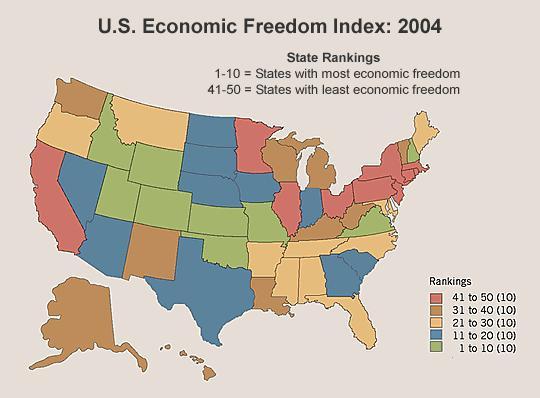
Pejman Yousefzadeh, writing at Tech Central Station, has a roundup of post-election reaction from the Left. I especially like the idea of Blue-State secession (though its proponents should check out Texas v. White). The secessionists would like to join their ideologically compatible neighbour to the north, with this result (my editing):

P.S. Note the correlation between “Freeland” and States with the best scores on the index of economic freedom (green, blue, and tan in the chart below):

(Thanks to Let’s Try Freedom for the pointer to the index.)

The Next Chief Justice?

I’ve long favored Thomas, but the Dems have signaled a preference for Scalia. In other words, if Bush were to nominate Thomas, stand by for a bruising confirmation hearing and a filibuster.

The Institute for Justice (a libertarian public-interest law firm) has a somewhat dated, but probably still accurate, assessment of the Justices’ records on individual liberties. Here’s the bottom line:


Those ratings reflect IJ’s assessment of the Justices’ stance on IJ amicus cases and other major cases, in these categories: free speech and association, limiting federal power, property rights, race neutrality, and school choice. The main difference between Thomas and Scalia seems to lie in the realm of property rights, where both Scalia and Thomas are strong on takings but Scalia is soft on forfeiture. Kennedy places ahead of Scalia for the same reason.

Scalia would be a good second choice to Thomas. Kennedy is too much the compromiser on other issues.

The Face of "Academc Freedom"


Prof. Hamid Dabashi of Columbia University.

Remember the name and face. Here’s why (from the New York Daily News):

In the world of Hamid Dabashi, supporters of Israel are “warmongers” and “Gestapo apparatchiks.”

The Jewish homeland is “nothing more than a military base for the rising predatory empire of the United States.”

It’s a capital of “thuggery” – a “ghastly state of racism and apartheid” – and it “must be dismantled.”

A voice from America’s crackpot fringe? Actually, Dabashi is a tenured professor and department chairman at Columbia University. And his views have resonated and been echoed in other areas of the university.

Columbia is at risk of becoming a poison Ivy, some critics claim, and tensions are high.

In classrooms, teach-ins, interviews and published works, dozens of academics are said to be promoting an I-hate-Israel agenda, embracing the ugliest of Arab propaganda, and teaching that Zionism is the root of all evil in the Mideast.

In three weeks of interviews, numerous students told the Daily News they face harassment, threats and ridicule merely for defending the right of Israel to survive.

And the university itself is holding investigations into the alleged intimidation.

Dabashi has achieved academic stardom: professor of Iranian studies; chairman of the Middle East and Asian languages and cultures department; past head of a panel that administers Columbia’s core curriculum.

The 53-year-old, Iranian-born scholar has said CNN should be held accountable for “war crimes” for one-sided coverage of Sept. 11, 2001. He doubts the existence of Al Qaeda and questions the role of Osama Bin Laden in the attacks.

Though Dabashi and his fellow travelers on the loony Left aren’t necessarily a majority in academia, they’re not far from its mainstream. Consider this report from The New York Times:

…[A] national survey of more than 1,000 academics, shows that Democratic professors outnumber Republicans by at least seven to one in the humanities and social sciences. That ratio is more than twice as lopsided as it was three decades ago, and it seems quite likely to keep increasing, because the younger faculty members are more consistently Democratic than the ones nearing retirement, said Daniel Klein, an associate professor of economics at Santa Clara University and a co-author of the study.

In a separate study of voter registration records, Professor Klein found a nine-to-one ratio of Democrats to Republicans on the faculties of Berkeley and Stanford. That study, which included professors from the hard sciences, engineering and professional schools as well as the humanities and social sciences, also found the ratio especially lopsided among the younger professors of assistant or associate rank: 183 Democrats versus 6 Republicans…

No surprises there.

(Thanks to Instapundit for the tip about Dabashi, and to Marginal Revolution for the pointer to the Times story.)

Today’s Entertainment Trivia

You may have heard of Efrem Zimbalist Jr. (1917 – ), who starred in two successful TV series: 77 Sunset Strip (1958-64) and The FBI (1965-74). Did you know that he is the son of concert violinist Efrem Zimbalist Sr. (1889-1985) and opera singer Alma Gluck (1884-1938). Here’s Gluck:

And here are links to RealAudio tracks of two of Gluck’s recordings:

Charpentier, Louise, “Depuis le jour” (Rec: 23 January 1913)

Rimsky-Korsakov, The Tsar’s Bride, “Liuba’s Air ” (Rec: 31 December 1913)