Intellectuals, Academia, and the "Common" Person

Terry Eagleton, writing at New Statesman, reviews Where Have All the Intellectuals Gone? by Frank Furedi. Eagleton’s review is rife with trenchant observations. Here’s a sampling:

…We inherit the idea of the intellectual from the 18th-century Enlightenment, which valued truth, universality and objectivity – all highly suspect notions in a postmodern age. As Furedi points out, these ideas used to be savaged by the political right, as they undercut appeals to prejudice, hierarchy and custom. Nowadays, in a choice historical irony, they are under assault from the cultural left.

In the age of Sontag, Said, Williams and Chomsky, whole sectors of the left behave as though these men and women were no longer possible. Soon, no doubt, they will take to imitating the nervous tic by which the right ritually inserts the expression “so-called” before the word “intellectual”. Right-wingers do this because they imagine that “intellectual” means “frightfully clever”, a compliment they are naturally reluctant to pay to their opponents. In fact, there are dim-witted intellectuals just as there are incompetent chefs. The word “intellectual” is a job description, not a commendation….

[A] snap definition of an intellectual would be “more or less the opposite of an academic”….Literary academics are more likely than insurance brokers to be left-wingers….

University academics are discouraged from fostering adversarial debate, in case it should hurt someone’s feelings….In what one American sociologist has termed the McDonaldisation of the universities, students are redefined as consumers of services rather than junior partners in a public service….

[T]he politics of inclusion…in [Furedi’s] view belittles the capacities of the very people it purports to serve. It implies in its pessimistic way that excellence and popular participation are bound to be opposites….[H]e rejects cultural pessimism, decries the idea of a golden age, and applauds the advances that contemporary culture has made. It is just that he objects to slighting people’s potential for self-transformation under cover of flattering their current identities.

Here’s What a Real Nazi Does

For the benefit of those who glibly call Bush a Nazi, here’s what a real Nazi does:

Hitler Signs an Order Authorizing Involuntary Euthanasia in Germany, October 1939

Germany had been the site of an increasing number of measures taken in the name of “racial purity” since the Nazis assumed power in 1933, including forced sterilization of those with physical and/or mental handicaps, and the murder of infants with similar handicaps (in both cases, the primary targets were not Jews, but so-called “Aryans,” or non-Jewish Germans). Now in 1939, under the cover of war, the program was to be expanded to include murdering handicapped adults. Since Hitler would issue no law legalizing such forced “euthanasia,” and since physicians would hesitate or refuse to take part in the killing unless they had written protection from later prosecution, Hitler was persuaded to sign this document on his personal stationery (German-language version also available) instructing his assistants Philipp Bouhler and Dr. Karl Brandt to initiate the program. The document was signed in October 1939, but backdated to 1 September, the date of the beginning of World War II. For further information, see Henry Friedlander, The Origins of Nazi Genocide: From Euthanasia to the Final Solution. (Chapel Hill, N.C.: University of North Carolina Press, 1995), p. 67.

ADOLF HITLER

Berlin, 1 September 1939

Reichsleiter Bouhler and
Dr. med. Brandt

are instructed to broaden the powers of physicians designated by name, who will decide whether those who have – as far as can be humanly determined – incurable illnesses can, after the most careful evaluation, be granted a mercy death.

/signed/ Adolf Hitler

That’s Nazism for you.

(Thanks to my son for the link.)

As I Was Saying….

UPDATED BELOW

three days ago:

…[A] good sign that Rather’s story has absolutely no credibility — except as a rallying point for rabid Bush-haters — is Howard Kurtz’s column in today’s WaPo. Two paragraphs of professional courtesy toward Rather precede 20 paragraphs that mostly damn Rather’s story with straightforward observations about the flimsiness of it….

Kurtz’s objectivity about the matter signals other serious journalists that they can dump on old Dan, at will.

Well, there’s been plenty of dumping on Dan by the mainstream media since then, but this article in today’s WaPo is a sledge-hammer blow to the gut:

Expert Cited by CBS Says He Didn’t Authenticate Papers

By Michael Dobbs and Howard Kurtz

Washington Post Staff Writers

Tuesday, September 14, 2004; Page A08

The lead expert retained by CBS News to examine disputed memos from President Bush’s former squadron commander in the National Guard said yesterday that he examined only the late officer’s signature and made no attempt to authenticate the documents themselves.

“There’s no way that I, as a document expert, can authenticate them,” Marcel Matley said in a telephone interview from San Francisco. The main reason, he said, is that they are “copies” that are “far removed” from the originals.

Matley’s comments came amid growing evidence challenging the authenticity of the documents aired Wednesday on CBS’s “60 Minutes.”…

And it goes on from there to detail a lot of what the blogosphere has been saying for days — without crediting the leaders of the blogospheric charge.

The last paragraph of the story says a lot about the Post:

Prominent conservatives such as Rush Limbaugh are insisting the documents are forged. New York Times columnist William Safire said yesterday that CBS should agree to an independent investigation. Brent Bozell, president of the Media Research Center, called on the network to apologize, saying: “The CBS story is a hoax and a fraud, and a cheap and sloppy one at that. It boggles the mind that Dan Rather and CBS continue to defend it.”

It’s obvious from the rest of the article that the Post endorses Limbaugh, Safire, and Bozell in this matter, so it gives them the last word. It is a “news” story, after all.

UPDATE:

From ABC News:

BUSH IN THE NATIONAL GUARD

ABC’s Brian Ross interviewed the two experts who CBS hired to validate the National Guard documents and reports they ignored concerns they raised prior to the CBS News broadcast. “I did not feel that they wanted to investigate it very deeply,” Emily Will told Ross. “I did not authenticate anything and I don’t want it to be misunderstood that I did,” Linda James told Ross. Ross reports 2 experts told ABC News today that even the most advanced typewriter available in 1972 could not have produced the documents. Ross also reported that Lt. Col. Jerry Killian’s secretary says she believes the documents are fake but that they express thoughts Killian believed….

Well, Lt. Col. Killian’s secretary believes the documents are fake because she knows she knows she didn’t type them. As for Lt. Col. Killian’s “thoughts”…well fact and fancy are two different things, except at CBS News.

(Thanks to Captain Ed for the pointer.)

Why Sovereignty?

The Chronicle carries an article by Carlin Romano with this provocative title: “Violating ‘Sovereignty’: Questioning a Concept’s Long Reign.” It begins badly:

Everywhere the S-word wreaks havoc. Iraqi terrorists kill hundreds of Americans and Iraqis to protest infringement of sovereignty by the Great Satan.

Those terrorists (at least he got that part right) aren’t protesting the infringement of Iraqi sovereignty by the U.S., they’re trying to make life miserable for non-Saddamites and also to fuel antiwar feelings in the U.S. It gets worse:

As an explosive real-world political idea, sovereignty propels international armies and costs untold lives.

Sovereignty doesn’t propel armies; avarice and power-madness and self-defense do those things. Romano sort of gets on the right track with this reference to some writings by the late Alan Cranston:

[S]overeignty as a defense against outside intervention to stop extraordinarily unacceptable behavior by a government against its people is always, in Cranston’s view, heinous and unjustified. International covenants on genocide and human rights similarly demonstrate the world community’s declining appetite for claims of such absolute state sovereignty.

But notice how he subtly changes the subject from sovereignty to “claims of absolute state sovereignty.” Hell, we’ve know the value of such claims at least since American troops invaded Sicily and France, then rolled into Germany to end the war in Europe.

Romano alludes to the value of sovereignty when he says:

Not every political scientist, it should be noted, opposes sovereignty’s influence in public policy. In The Case for Sovereignty (AEI Press), a recent study, Cornell government professor Jeremy Rabkin contends that a “post-sovereign” world would encourage terrorism, erode national loyalties, and spur even greater international conflict.

But Romano doesn’t pursue the thought. So I will.

The sovereignty of the United States is inseparable from the benefits afforded Americans by the U.S. Constitution, most notably the enjoyment of civil liberties, the blessings of more-or-less free markets and free trade, and the protections of a common defense. To cede sovereignty is to risk the loss of those benefits. That is why we must always be cautious in our commitments to international organizations and laws.

American sovereignty is a golden shield. Mindless internationalism is a corrosive acid that eats away at the shield.

Paul Krugman, an Inspiration to Us All

Paul Krugman, NYT columnist and alleged economist, keeps trying to practice political punditry. Well, he needs a lot more practice. Here are some bits (in italics) from today’s column, interspersed with my comments:

Yet many voters still believe that Mr. Bush is doing a good job protecting America.

Well, so far, he is. I guess that fact is too obvious for Krugman to grasp.

…Dick Cheney is saying vote Bush or die….

Actually, Cheney said something to this effect: You’re more likely to die if Kerry is elected. It wasn’t a threat, it was a prediction. And not a bad one.

Can Mr. Kerry, who voted to authorize the Iraq war, criticize it? Yes, by pointing out that he voted only to give Mr. Bush a big stick.

Oh, was there an asterisk attached to Kerry’s vote? I didn’t see it in the Congressional Record.

Mr. Kerry can argue that he wouldn’t have overruled the commanders who had wanted to keep the pressure on Al Qaeda, or dismissed warnings from former Gen. Eric Shinseki, then the Army’s chief of staff, that peacekeeping would require a large force. He wouldn’t have ignored General Conway’s warnings about the dangers of storming into Falluja, or overruled his protests about calling off that assault halfway through.

He could argue those things, but he would be seen as nothing better than a Monday-morning quarterback. In any event, Krugman is studiously ignoring economic principles and bureaucratic facts of life: He doesn’t address the opportunity costs associated with the actions he implicitly endorses, nor does he acknowledge the very likely fact that Bush (and Rumsfeld) acted on military and diplomatic advice in taking their decisions.

And why is Krugman doing offering advice about how to win a war he didn’t want in the first place? What does he know about it, anyway? When I want to fight a war, I ask a general for advice. When I want to solve a problem in economics, I ask a real economist for advice. Where does that leave Krugman? Well, when I want to write a snarky post, I read Krugman for source material.

More Wisdom from Lileks

James Lileks has an inexhaustible supply of wisdom. His latest pearl invokes Pat Tillman, the NFL football player whose patriotism led him to the army and to Afghanistan, where he was killed in action:

[T]hose who think we’re living in some incipient Fascist state should note the absence of Tillmanism in the culture today – no songs in his name, no movies played on 2000 screens at the state’s request, no statues, no grade-school drills where the kids are taught to recite his Exploits, no posters of the Fallen Hero in the bus shelters, no mentions in every other speech. Hitler would have gone to town with Pat Tillman. And renamed it Tillmansberg.

Rather’s Last Stand — Shot to Pieces

Holy cow, look at all those bloggers!

Dan Rather, surrounded by the facts, still refuses to surrender to them. CBS News (presumably with Rather’s blessing) has posted this story on its site:

Questions Linger Over Bush Memos

NEW YORK, Sept. 13, 2004

(CBS/AP) Amid challenges from other news organizations and partisans [i.e., bloggers: ED], CBS News continued to defend itself over criticism stemming from documents it obtained that questioned President Bush’s service in the Air National Guard.

On “The CBS Evening News” Monday night, Dan Rather said his original report on “60 Minutes” used several different techniques to make sure the memos were genuine, including talking to handwriting and document analysts and other experts who strongly insist that the documents could have been created in the 1970s – as opposed to a word-processing software program, as some have charged.

“Everything that’s in those documents, that people are saying can’t be done, as you said, 32 years ago, is just totally false. Not true. Proportional spacing was available. Superscripts were available as a custom feature. Proportional spacing between lines was available. You can order that any way you’d like,” said document expert Bill Glennon.

Richard Katz, a software designer, found some other indications in the documents. He noted that the letter “L” is used in those documents, instead of the numeral “one.” That would be difficult to reproduce on a computer today….

I won’t go any further, because the blogosphere has put it to rest — in spades. I just want to comment on the third and fourth paragraphs.

Document “expert” Bill Glennon is certainly right that proportional letter spacing, superscripts, and proportional line spacing were available 32 years ago. But that ducks the fact that Microsoft Word and the version of Times New Roman used by Microsoft Word weren’t available 32 years ago. I think it’s been shown conclusively that the so-called documents can be replicated exactly — and only — using Microsoft Word and its Times New Roman font.

Now, what about the numeral “one” that looks like a lower-case “L”? Guess what? The numeral “one” in Microsoft Word’s Times New Roman resembles a lower-case “L”. In fact, it looks exactly like the numeral “one” as it appears at the top of the forgery at this link. Moreover, the lower-case “L”s sprinkled through the text of the forgery look exactly like the lower-case “L”s in Microsoft Word’s Times New Roman. You can check this at home and send me an e-mail if you disagree.

What’s next, Dan? I think it’s time for you to say that you were brainwashed when you served in Korea. But you can’t can you, because you didn’t serve in Korea. Hmmm…I though you said somewhere that you did. Am I making up stuff about you? Why not? You make up stuff all the time.

A Story That Makes Me See Red (Ink)

From AP via Yahoo! News:

US Airways Gets OK to Use Taxpayer Funds

By MATTHEW BARAKAT, AP Business Writer

ALEXANDRIA, Va. – A bankruptcy judge gave US Airways Group Inc. permission Monday to tap a government loan to fund daily operations — a move expected to allow the airline to continue its normal flight schedule while it searches for additional financing….

The headline has it right. A “loan fund” is funded by taxpayers. I guess airlines have become as indispensible as farms. Why can’t we just let them disappear gracefully instead of prolonging their death throes? Too little faith in the power of America’s economic engine; too much clout in Washington.

Message to Democrats: Get Over It

Democrats keep saying things like this: “Republicans are nasty.” “Republicans don’t fight fair.” Well, there’s plenty of that going around in all political camps. The real problem with Democrats is that they think they’re still supposed to be in the White House and in charge of Congress.

Well, the fact is that we’re in a Republican era that began as long ago as 1968, when Nixon beat Humphrey, even though Wallace took a lot of votes that probably would have gone to Nixon. (Don’t start on that racist crap, again, there’s a lot more to the South than race — and always has been.) Republicans have held the White House ever since, except for Carter’s term, which he owed to Nixon’s disgrace, and Clinton’s two terms, which he owed to Perot’s candidacy. Moreover, Republicans began to claw their way back into congressional power in the 1980s, when they held the Senate for several years. They regained full control of Congress in the election of 1994 — ten whole years ago.

So, it seems that Democrats are suffering from a bizarre form of near-term memory loss. They remember 1933-1969, when they held the White House for all but Ike’s two terms. (And what kind of Republican was Ike, anyway?) They mistakenly thought their White House hegemony had been restored with Clinton’s ascendancy, but Clinton was really an accidental president. Democrats vividly remember having controlled both houses of Congress for most of the 62 years from 1933 to 1995, and they keep deluding themselves that they will retake Congress in the “next” election.

Now Democrats are clinging to their old memories and crying “nasty” and “unfair” whenever they lose to Republicans. It’s childish behavior. Get over it!

How to Fight Crime

According to an article in today’s NYTimes.com, “Most Crimes of Violence and Property Hover at 30-Year Lows.” Three important things happened after 1995 — the year in which the rate of violent crime began to drop markedly. First, the incarceration rate continued to rise: Persistence pays off. Second, the percentage of the population that is male and 20-24 years old continued to drop, in keeping with the general aging of the population. (Age usually brings with it a greater degree of maturity, stability, and aversion to committing criminal acts.) At the same time, spending on criminal justice functions (police, corrections, and courts) continued to rise, especially spending on police.

I’m sure there are other causal factors, but those are probably the big ones. The first and third of those factors — incarceration and spending on the criminal justice system — go hand in hand. And they are the public-policy weapons of choice in a society that values individual responsibility.

The Politics of Gun Control in Action

Reuters — yes, Reuters — tells us:

More Smoke Than Fire as U.S. Assault Gun Ban Ends
By Michael Conlon

CHICAGO (Reuters) – A 10-year-old ban on assault weapons expired across the United States on Monday with a political firefight but no apparent rush to rearm by gun fanciers….[Fancy that! I’ll bet he thought every “gun fancier” would buy a dozen semi-automatic rifles and start shooting people from tall buildings.]

In Tennessee, at Nashville’s Gun City USA, firearms instructor Robert Schlafly said there had been no upsurge in orders or interest, adding it may be too early to tell what will happen.

In the long run, he predicted the end of the ban will drive down prices since new inventories will appear on the market.

“To me the ban was just a way for (former President Bill) Clinton to get more votes,” Schlafly said. “It’s all politics. It didn’t hurt the firearms industry but people were mad.”…[Darn tootin’. They thought there was a Second Amendment lying around here somewhere.]

In Washington, Democratic presidential challenger John Kerry accused President Bush of choosing “powerful and well-connected friends” [like the average citizen?] over police officers and families by secretly backing the gun lobby in its opposition to a renewal of the law.

Now, he said, “when a killer walks into a gun shop, when a terrorist goes to a gun show somewhere in America, when they want to purchase an AK-47 [still illegal, try again: ED] or some other military assault weapon, they’re going to hear one word: ‘sure.”‘ [And when a homeowner who wants to defend himself from criminals and terrorists goes to a gun show or gun store somewhere in America, he’s going to hear one word: “Sold.”]

Bush spokesman Scott McClellan called Kerry’s remarks “another false attack” and said the best way to stop gun violence is to vigorously prosecute gun crime. [How true! A law has yet to deter a weapon.]

A Bit of Sense and a Lot of Nonsense from Austin

Here’s economist James K. Galbraith — who professes at The University of Texas at Austin — writing in today’s Austin American-Statesman about his profession:

…Economics suffers today from high formalism, rigid orthodoxy and tribal exclusiveness in professional journals; real-world scholarship is not prized and not easily published. But fortunately, with the Internet the costs of publication are falling. New journals are springing up that can peer-review effectively at low cost, and this will one day cause the breakdown of our ossified system.

In a world of virtual journals and electronic working papers, scholarly engagement has a better chance. Let’s hope that quality will still be distinguishable from junk…

Oops — can’t trust the uninitiated to sort it out for themselves, can we? Well economists can’t agree about much, so why does it matter what the uninitiated make of what economists write? Back to Galbraith:

Finally, for the engaged scholar, there is always the tricky issue of the role of values and politics. Some scholarship is intrinsically apolitical, but social scholarship can’t be. The policies I support grow from my ethical and political beliefs, to which my expertise (such as it is) merely adds an element of engineering.

In other words, he doesn’t know how to separate scholarship from values. Hmmm…

And yet, of course, a professor is not a missionary. A profound obligation is to respect the ideas and views of students who come in with different values.

My approach to that is to declare my own politics frankly — I’m a liberal Keynesian Democrat, in case you didn’t know.

Why is it necessary to declare one’s politics frankly, in the classroom, and how is doing it consistent with what he says next?

But I try to preserve my classroom as a space for respectful discourse with all points of view.

And, sometimes, you pull it off.

Some years ago, a student wrote these words on my confidential end-of-semester evaluation: “It pains me to say this, but you are the best professor I’ve had here — even though you are a communist.”…

Yeah, sometimes his non-liberal, non-Keynesian, non-Democrat students aren’t cowed by his frankly declared politics. How often? Once? At least that student saw him for what he is. (No, I’m not calling Galbraith names. He’s a liberal, so he mustn’t mind being called a communist; he’s open-minded.)

Now for Galbraith’s op-ed page companion, the re-doubtable Molly Ivins — an Austin-based, syndicated columnist (as the American-Statesman likes to remind us) — whose “good old gal” shtick has become more of a shrill whine. Molly is inveighing against the “old boy” network of rich Texans that undoubtedly arranged for GWB to do his Vietnam time in the Texas Air National Guard. Here’s the (unintentionally) funny part:

Listen, my children, and you shall hear: There was then no nasty partisan politics in Texas except inside the Democratic Party. The Republicans were upper-class establishment types, and the tradition of Texas Republicans and Texas Democrats working and playing well together continued, actually, until the Republicans took over, when it ended with a bang.

What Ivins is trying to imply is that a bunch of rich Republicans invaded Texas, took it over, and started playing nasty. What happened, of course, was that a lot of Texas Democrats got sick and tired of the national party’s positions on issues (abortion, defense, welfare, government in general) and became Republicans. And so it went — in Texas as across most of the South. Then, new voters followed mostly in their parents’ footsteps and allied with the Republican Party. Their numbers have been reinforced by a steady in-migration of disenfranchised Republicans and Reagan Democrats who have fled the “liberal” North for the warmth and more companionable politics of the South. An invasion? No, just a good, old-fashioned combination of political conversion and American mobility. The upshot of which has been to make Texas a solidly Republican State.

Ivins, of course, is sick — just sick — because all those converts and new Texas voters have lined up with the “upper-class establishment types” instead of flocking to her Willie Nelson worldview. And when the Republican majority insists on acting like a majority, that’s “playing nasty” in Ivins’s view. Talk about sore losers.

Catastrophe Theory at Work

Mike Rappaport at The Right Coast calls it “Rathergate as Agincourt,” but his description of recent events offers a good illustration of catastrophe theory:

…Had the blogosphere not kept the Swiftboat case alive, it is not clear CBS would have been desparate [sic] enough to go with these fraudulent documents. Thus, the CBS story may be the result of main stream media’s frustration at not controlling the news previously….

Think of the Titanic. Think of the blogosphere as the iceberg that the Titanic’s captain refused to heed in his headlong rush to cross the Atlantic in record time.

Me, Too

Arnold Kling of EconLog, quoting from his forthcoming book, says this about the incomprehensibility of what most economists write:

I believe that some of the fault lies with the top graduate schools in economics, such as the Massachusetts Institute of Technology, where I obtained my Ph.D. The focus on mathematical training in these programs is so intense that they tend to produce a sort of idiot-savant, competent only to publish in academic journals. It pains me to see economists for whom expounding economic principles and speaking in plain English are mutually exclusive activities.

Precisely. I began Ph.D. work in economics at M.I.T. in the early ’60s. I quit, fairly promptly, because I found the program depressingly, deadeningly sterile. I’m sure it only got worse.

Conservative Criticism of the War on Terror

A piece at The American Thinker by Rachel Neuwirth asserts that “The U.S. is not really fighting terrorism.” Actually, it’s not as stark as the title suggests. Here’s the lead sentence: “Claims that America is engaged in a total war against terrorism are greatly exaggerated.”

I’m not sure who’s claiming a total war. We are undoubtedly doing a lot on a lot of fronts, not all of them visible even to the media (thank goodness). The question is whether we should be doing more if we could, absent political and resource constraints.

From that perspective, Neuwirth’s essay is a good checklist of the things we should do (or abet) when it’s politically and economically feasible to do them; for example: take out Arafat and dismantle the PLO, come down hard on the Saudis and Egypt, and seek a U.N. declaration against Islamic terrorism. The value of seeking a U.N. declaration on anything escapes me, but it’s related to Neuwirth’s recitation of two key failures that we could remedy easily, at relatively little cost:

…First, we have not properly defined what we stand for. The Islamic enemy cites examples of Western decadence as justification for their ‘holy war.’ Simply saying that we stand for “freedom” and “free enterprise” has limited value because for many religious Muslims those terms may seem foreign. It suggests that we are simply imposing our system upon them by force….

Surely the U.S. information agencies can do a better job of communicating the alternative that America’s principles of freedom, openness, the rule of law, respect for human rights, equality, and tolerance present to the peoples of the Islamic world, and their manifest superiority to the hate, intolerance, lawlessness and cruelty of the Islamist fanatics.

And second, we have failed to cultivate the truly moderate and responsible Islamic clerics and intellectuals. Those Muslims understand very well the sickness that prevails in so many Islamic societies and how the extremists have twisted the Quran to breed terrorists. It is their voices that need to be heard, boldly challenging the extremists on a religious basis, point for point, to demonstrate to the Islamic masses just how they have been hoodwinked and led down the path to destruction. They must show the way out of this dead end and back towards an enlightened form of Islam. Such actually existed for a time centuries ago, before this current extremism, when there was true creativity and a lively interchange of ideas across different cultures. Once Muslims hear from devout and learned men and women of their own faith that human rights, the rule of law, and respect for other religions and cultures are not incompatible with their Islamic heritage, most will eventually reject the teaching of the extremist hatemongers among them. Why not use our information forums and financial resources to help the courageous and lonely Muslim moderates to get their enlightened message to their own people?

Why not, indeed? Neuwirth keeps going:

However, our own leaders act as if they are unaware of this battle of ideas, and instead allow the extremists to have access to the highest levels of our government. Grover Norquist is a conservative activist who used to be involved in economic issues, but recently has been using his influence to help Muslims with radical and even pro-terrorist ties to gain access to high Administration officials. This in turn has allowed the Council on American Islamic Relations (C.A.I.R.) to help place Islamists among those selecting clerics for Muslim inmates in our prisons, selecting clerics for Muslim soldiers in our military and to demand all manner of rights and concessions for Muslims in America while playing the role of victims of discrimination.

I’ve read about this elsewhere. It makes no sense to me. Perhaps a second-term Bush can get himself out of such entanglements. Similarly, perhaps a second-term Bush can more overtly ally with Israel. As Neuwirth says:

…We have betrayed and weakened our loyal ally, Israel, while pandering to Israel’s Arab enemies. And what benefit has it bought us? Except for Israel, how many countries in the world can we count as true and staunch allies? When Tony Blair leaves power, Britain may become like Germany. The same is true for allies such as Italy and Australia, where the current political leadership faces strong public opposition to support of the war in Iraq. We betrayed our principles to pander to the nations and yet we are still hatred and distrusted in much of the world. Playing a double game on terrorism has not bought us friends. Perhaps it is time for us to try some moral consistency….

Neuwirth deserves the last word:

America should at least declare moral clarity even if we cannot actually undertake the impossible task of being the world’s policeman. We, as a superpower, are even more free than other nations to at least speak the truth without having to fear reprisals from powers stronger than ourselves. Unfortunately we have consistently failed to even speak the moral truth, and so we are seriously compromised in our self-declared war on terror.

Hide the Children

Too good not to post:

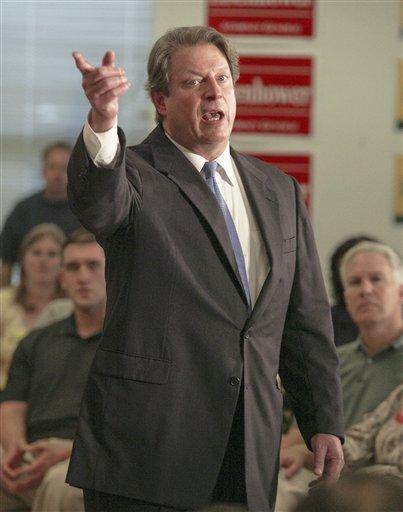
No, it’s not John Goodman in his “West Wing” role as Glenallen Walken, the wild-eyed “cowboy” Republican Speaker of the House who became acting president (and made a right good job of it):

Left, Right, What’s the Difference?

Michael Rosen at Tech Central Station writes about Pat Buchanan’s mellowing in “Right From the Beginning, Left at the End”:

Buchanan, variously described as an arch-conservative, a paleoconservative, and a populist conservative, has throughout his career shirked the orthodoxies of the Republican party and the prevailing norms of conservatism. In his magazine, The American Conservative, and in his latest book, Where the Right Went Wrong: How Neoconservatives Subverted the Reagan Revolution and Hijacked the Bush Presidency…Buchanan presents his case for an “authentic” conservatism that has been infected by radical, Johnny-come-lately variants. Yet many of Buchanan’s positions, most recently on the War on Terror, have placed him and his supporters in ideological company with the left.

Buchanan has moved slowly but steadily out of the Republican mainstream….[I]n 2000, Buchanan broke with the Republican Party, seemingly for good, and assailed Bush from the right under the confines of the Reform Party.

Buchanan’s policies, too, have strayed from popular conservative dogma. To begin with, much ink has been spilled about the alliance between the far left and the far right with regard to immigration and free trade….In a recent interview with Buchanan, Ralph Nader, the country’s best-known leftist politician, made a bid for the “disenfranchised Right” by referring to NAFTA and the World Trade Organization as “sovereignty-shredding” institutions.

Yet it is the Buchananite right’s recent criticisms of the Iraq War, of the Bush administration, and of the fight against global terror as a whole that have captured the most attention and that reflect a closer intellectual propinquity with the left than previously thought….

[T]he Buchanan approach to Israel is of a piece with his general tilt toward the ideas of the left-wing. Much has been written about Buchanan’s views on Israel and its supporters in the U.S. Yet it should be pointed out that he is better depicted not as an opponent of Israel’s right to exist but as a supporter of the Israeli left. Just as parties of a leftist tilt in Israel believe that the Jewish state must make deep-seated compromises to achieve peace with the Arab world, so has Buchanan castigated successive right-of-center Israeli leaders and their American “amen corner” for their “intransigence.”…

Ronald Reagan, the leader to whom Buchanan pays fealty in his latest book and a Democrat in his acting days, famously said that he didn’t leave the Democratic Party, the party left him. Yet one gets the sense, in Buchanan’s case, that it is he who has abandoned Republican ideology and principles, not the other way around. In comparing Iraqi militants to American revolutionaries, Buchanan is adopting at least the rhetoric of the left. After all, in the breathless words of Bill Maher, “that’s something Michael Moore might say.”

All of which says a lot about the similarities of hard-line leftists and rightists: Both camps are intellectually obtuse — and statists under the skin. To say that Stalin was a leftist and Hitler was a rightist is a supreme mistake: Both were vicious statists who happened to be competitors for power.

The Wrong Path to School Choice

Adam B. Schaeffer offers some advice for “Changing School Choice Strategy” at Tech Central Station:

The legal, regulatory, and political bunkers manned by soldiers from the Democratic coalition make school choice a slow and difficult battle. What little ground reformers gain is constantly under threat of being lost. The school choice movement should step around these obstacles by concentrating their efforts on a drive, in each state with an income tax, for Universal Tuition Tax Credits (UTTCs) that allow all parents a true choice in education.

The idea has several problems:

1. Not every State has an income tax.

2. Even in States with an income tax, the size of the tax credit wouldn’t offset the cost of private schooling for parents whose income tax bill is already low because their incomes are relatively low, they can claim a large number of exemptions, or they have large itemized deductions.

3. States can reclaim lost income-tax revenues by raising marginal rates and/or increasing sales taxes.

I say, keep up the good fight for universal recognition of school vouchers. If Bush is re-elected the fight should become easier.

Why the Minimum Wage Hurts People

Alex Tabarrok at Marginal Revolution has it figured out:

When I discuss minimum wages in class I tell my students that one of the best ways to get a high-paying job is to get a low-paying job and work your way up. The minimum wage can put the least employable out of work and have permanent negative effects when training and work skills not acquired in youth are difficult to accumulate later on….

The bottom line? If you don’t work at McDonald’s when you are a teenager, don’t expect to manage a McDonald’s when you are middle-aged.

Read the whole thing. It includes useful links, including a link to a recent study to corroborates Tabarrok’s thesis.

A Lefty Offers Advice about Dealing with Terrorism

Jessica Wilson, guest-blogging at The Leiter Reports, instructs us on how to respond to terrorist acts:

I am not a wise person, though I aspire to be. But I know how a wise person responds to aggression. When a wise person faces aggression, they do not immediately and blindly strike back, thus potentially initiating a cycle of endless violence and retribution. Rather, they consider why they have been struck. Have they, perhaps, done something to offend the aggressor? If so, muses the wise person, perhaps they might avoid future aggression by removing the source of the offense.

She isn’t a wise person — that’s for sure. But, at the risk of being offensive, I will recast the rest of her paragraph in terms that she might understand:

I know how a wise woman responds to attempted rape. When a wise woman faces attempted rape, she does not immediately and blindly pull out her pistol and shoot the would-be rapist. Rather, she considers why she is the target of a would-be rapist. Has she, perhaps, done something to offend the aggressor? If so, muses the wise person, perhaps she might avoid future rape attempts by locking herself in her house and leaving the streets to rapists.

That’s the wisdom of the left. The rest of Wilson’s post is just as fatuous, but I’m not going to waste any more time on her musings.