Race and Reason: The Victims of Affirmative Action

Race and Reason: The Derbyshire Debacle” was this blog’s first serious venture into the sociology and politics of race in America. This second venture addresses the ways in which the state usurps the liberty and property of white Americans for the benefit of black ones.

It all adds up to gross injustice: placing the blame on the blameless. As I say in “Luck-Egalitarianism and Moral Luck“:

  • There is a “right” set of life outcomes …, which luck-egalitarians are qualified to choose and evaluate because of their [self-assessed] superior moral character.
  • Therefore, it is wrong if some persons are worse off than others in terms of the “right” set of outcomes….
  • Those who are better off (by the selective standards of the luck-egalitarian) owe aid to those who are worse off, even if those who are better off did nothing that made others worse off. The better-off simply do not deserve all that they have because, surely, they must owe much of it to luck.

Thus blameless Americans have been burdened with equal employment opportunity (EEO), about which more below; minority lending preferences, which contributed to the Great Recession by encouraging mortgage loans to low-income borrowers; public-accommodations laws, a.k.a. theft of property rights and denial of freedom of association; the expansion of the welfare state, which led to welfare dependency, broken families, and crime; and the prosecution and persecution of politically incorrect views as “hate crimes” and “inappropriate” expressions of thought.

Of those burdens, I am most familiar with EEO (a.k.a. affirmative action) because I had to contend with its enforcement and consequences in my job as the chief financial and administrative officer of a private, federally funded, research organization. What EEO (affirmative action) means in practice is this: If a member of a “protected” (i.e., favored) identity-group seems to have something like the minimum qualifications for a job, and if that person’s work record and interviews aren’t off-putting, the identity-group person is likely to be hired or promoted ahead of equally or better-qualified whites. Why?

  • Pressure from government EEO offices, which focus on percentages of identity groups hired and promoted, not on the qualifications of applicants for hiring and promotion.
  • The ability of those EEO offices to put government agencies and private employers through the pain and expense of extensive audits, backed by the threat of adverse reports to higher ups (in the case of government agencies) and fines and the loss of contracts (in the case of private employers).
  • The ever-present threat of complaints to the EEOC (or its local counterpart) by rejected identity-group candidates for hiring and promotion. Those complaints can then be followed by costly litigation, settlements, and court judgments.
  • Boards of directors and senior managers who (a) fear the adverse publicity that can accompany employment-related litigation and (b) push for special treatment of identity groups because they think it’s “the right thing to do.”
  • Managers down the line who practice reverse discrimination against better-qualified but “unprotected” identity groups, to keep EEO offices and upper management happy.

(UPDATE 08/14/12: See Roger Clegg’s “Big Business Weighs In, Unconvincingly, in Fisher v. Texas” for more in the vein of the last two points.)

Blacks constitute the identity group most likely to seek “protection” under the rubric of  EEO.  On balance, the (effectively) forced hiring of under-qualified blacks causes significant economic damage — as well as resentment of and condescension toward blacks as “affirmative action hires.”

Universities long ago began to use the term “diversity” in place of “affirmative action.” This euphemistic shift was meant to reduce resentment and condescension toward under-qualified blacks who were (and are) admitted in place of better-qualified whites, and to deflect legal challenges of reverse discrimination by disguising it as an element of a policy of “mixing” for the betterment of social solidarity — or some such bullshit. Many businesses — especially large corporations — have adopted “diversity” as a corporate “value” because doing so reflects the “social responsibility” of boards and top executives.

Reverse discrimination in favor of blacks has victimized millions of Americans, in at least three ways:

  • The aforementioned combination of resentment and condescension has undoubtedly impeded the advance of racial harmony.
  • Many whites have suffered the loss of opportunities and income in the workplace — opportunities and income that would have been theirs if blacks were held to the same standards as whites with respect to hiring and promotion.
  • Many blacks have suffered, in the not-so-long run, because reverse discrimination has set them up for failure.

Victim 1: Social Comity

Reverse discrimination may have fostered harmony — in isolated instances. But, on balance, the country (as represented by the racial composition of public schools) has become more polarized along racial lines than it was in the 1960s and 1970s. Some critics of this phenomenon — which is called resegregation — blame court rulings that have undone much of the forced mixing that ensued from Brown v. Board of Education. But those rulings have only enabled many whites to avoid the mixing that they did not want in the first place. Further, resegregation owes much to “white flight” from old cities to suburbs and then to exurbs. Crime and culture are real and valid reasons for an aversion to mixing — reasons that cosseted politicians, academicians, and corporate executives cannot bring themselves to recognize or avow. America will never be a land of sweet racial harmony — nor will any other country — but more whites would willingly accept blacks as neighbors and classmates, were it not for the resentment and condescension caused by affirmative action.

Victim 2: Low-Income Whites

It is hard to come by good estimates of the cost to whites of pro-black discrimination in the workplace. The best one that I have found is here, where the author says this:

In 1997, because of affirmative action, about $192 billion in income [2.3 percent of GDP] was transferred from whites to preferred minorities. If we perform precisely the same calculation for blacks and Hispanics, we can break down the $192 billion into the amounts gained by each group. We find that $144.3 billion [1.7 percent of GDP] was transferred to blacks and $47.5 billion to Hispanics. Dividing these gains by the respective numbers of black and Hispanic workers, we can compute their average annual income enhancement. In 1997, on average a black was subsidized to the tune of about $9,400; a Hispanic gained an average of about $3,900. The cost of these subsidies was spread over 98,782,000 white workers who suffered an average loss of about $1,900 to pay the bill.

The cascade effect. The net displacement of whites by minorities is not uniformly spread across the quintiles. When high-earning whites are displaced down the employment ladder, they displace other whites downward by exerting pressure on the rung below. The effect is like a cascade. At the bottom there is no rung left. Low IQ whites, who in an affirmative action-free marketplace would be competitive in the $10,000 to $20,000 bracket, now pile up in the lowest-income quintile. Although affirmative action affects every white, the largest number affected are the least intelligent and competitive….

In sum, low-income whites — who are thought to be strongly anti-black, as a group — have a valid economic reason for their resentment of blacks. Although blacks, on the whole, are not to blame for affirmative action, they are its beneficiaries and they vote in disproportionate numbers for politicians who favor affirmative action and the other programs that are listed in the third paragraph of this post. The attachment of blacks to the tit of the state has not escaped the attention of whites, and a large fraction of them — the political left-academic complex aside — see that attachment as a moral failing.

Victim 3: Aspiring Blacks

Now to the issue of pro-black discrimination in the academy, which is the crux of Fisher v. University of Texas, a case that will be heard later this year by the U.S. Supreme Court. There is much to say about the harm done to whites and Asians in the name of “diversity,” but it has been said often and sometimes to good effect (e.g., Gratz v. Bollinger). The damage done to blacks has received far less attention, and Rick Sander, the main expositor of that harm, is one of a small number of academicians who has had the courage to call attention to it.

I first wrote about Sander seven years ago:

[N]ow comes Richard Sander…. a professor of law at UCLA who has published “A Systematic Analysis of Affirmative Action in American Law Schools[.]” [Samder] is without a doubt a liberal of the modern persuasion and a proponent of diversity. He is nevertheless critical of affirmative action as it is practiced at law schools. Here’s the gist of his analysis, as reported at FindLaw:

The Heavy Weight Placed on Race in Admissions in Virtually All Schools – the Cascade Effect
Professor Sander lays the foundation for his critique by describing the kind of race-based affirmative action that law schools use today. Under the Bakke and Grutter Supreme Court precedents, public (as well as private) law schools are prohibited from making use of quotas, two-track admissions schemes, or fixed points added to the numerical indices of minorities….

Professor Sander argues that, in fact, the Michigan law school program, despite its seeming flexibility and inscrutability, employs race in just as ambitious (critics would say aggressive) a way as did the Michigan undergraduate plan [which the U.S. Supreme Court found unconstitutional in Gratz]….

Moreover, and more important, Sander argues, the way race is used at the Michigan law school is the same way race is used in many if not most law school affirmative action programs. Indeed, Sander says that he has “been unable to find a single law school in the United States whose admissions operate the way Justice O’Connor describes in Grutter” – that is, where race is used as a flexible plus factor that does not effectively dominate over all other diversity criteria. The system of aggressive racial preferences is not, Sander says, confined to the “elite” law schools. Rather, “it is a characteristic of legal education as a whole.”

According to Sander, law school affirmative action across law schools is characterized by a “cascade” effect. As the elite schools “snap up” the blacks who otherwise would have been admitted to and have attended the next tier of schools, that next tier of schools snaps up the blacks who would have otherwise attended the tier below. And so forth.

The Mismatch Effect

This systematic cascade phenomenon is important, because when race is being used so weightily in schools all the way down the ladder, the result is that the African Americans who are admitted to each school under an affirmative action program are significantly less numerically qualified than are their white competitor students at that school, who were admitted outside the affirmative action plan. Sander calls this phenomenon the “mismatch” effect – black beneficiaries of affirmative action are “mismatched” at schools whose non-affirmative action students possess better credentials and skills.

Because of the pronounced mismatch effect that extends down the law school hierarchy, blacks tend to suffer poor grades in law school. According to the data Sander adduces, the median black law student’s GPA at the end of the first year of law school places him at the 7th or 8th percentile of his class. Put another way, more than 50% of black law students are in the bottom one-tenth of their law school class (in terms of grades) at the end of the first year.

The Long-Term Costs of the Mismatch Effect – Bar Passage and Job Placement

This poor academic performance in law school, in turn, creates two distinct costs for African Americans. First, Sander argues, the poor grades lead to a very poor bar passage rate. As he points out, “only 45% of black law students in the 1991 cohort completed law school and passed the bar on their first attempt.” That number is far worse than the comparable number for whites.

Sander goes on to argue that many of these blacks with poor grades would have had better grades – and have ended up with a higher chance of passing the bar – if they had been at law schools more commensurate with their academic skills. Sander’s data suggests to him that black students at any law school who have the same law school grades as white students at that school pass the bar in the same percentages. In other words, blacks with good law school grades don’t fail the bar any more than whites with the same grades.

The problem, Sander suggests, is that law schools have “mismatched” blacks in schools where they are unlikely to get good grades. By placing black students in environments where their grades will be higher – less competitive law schools — the system could improve their overall bar pass rate….

From all this, Sander argues that if race-based law school affirmative action were eliminated or reduced, the black bar passage rate would actually go up. According to his calculations, in the absence of preferential admissions, this rate would rise to 74% from the 45% he observed….

If affirmative action were eliminated, most black law students wouldn’t be ousted from law school entirely – they would simply attend law schools that “match” their numerical credentials more tightly. In other words, elimination of affirmative action would simply eliminate the mismatch effect – blacks would simply be attending less competitive and less prestigious schools than they are currently attending. And of those blacks who would be displaced from the bottom of the legal academic system altogether (i.e., those who need affirmative action simply to get into the least competitive schools), many of them today do not end up passing the bar and entering the legal profession in any event….

Sander says that blacks at better schools, but with poor grades, get worse jobs than they would if they were at lesser schools and had better grades. In other words, Sander argues, at all but the most elite schools, grades matter more than the school from which one graduates for black law job applicants. The upside of attending a better school is more than outweighed – in terms of employment options – by the downside of getting weak grades at that school, compared to the better grades that could have been obtained at a less competitive school….

So whether one focuses on passing the bar, or getting a good job, Sander says, there is a case that race-based affirmative action hurts, rather than helps, black law students.

Two years later, I added this:

Gail Heriot of The Right Coast, who is a professor at the University of San Diego School of Law and a commissioner of the U.S. Commission on Civil Rights, pens an update:

No one claims Sander’s findings are the last word on the subject. Although so far his work has held up to scrutiny as least as well as the work of his critics, all fair-minded scholars agree that more research is necessary before the “mismatch thesis” can be definitively accepted or rejected.

Unfortunately, fair-minded scholars are hard to come by when the issue is affirmative action. Some of the same people who argue Sander’s data are inconclusive are now actively trying to prevent him from conducting follow-up research that might yield definitive answers. If racial preferences really are causing more harm than good, these thinly-disguised political operatives don’t want anyone to know.

Take William Kidder, a University of California staff member and co-author of a frequently-cited attack of Sander’s study. When Sander and his ideologically-diverse co-investigators sought bar passage data from the State Bar of California, Kidder passionately argued that access should be denied, because disclosure “risks stigmatizing African American attorneys.” At the same time, the Society of American Law Teachers, which leans so heavily to the left it risks falling over sideways, subtly threatened future litigation against the State Bar. Coincidentally, one of Kidder’s co-authors, University of Michigan law professor David Chambers, is a former SALT president.

Sadly, the State Bar’s Committee of Bar Examiners caved under the pressure. The committee members didn’t formally explain their decision to deny Sander’s request for the non-personally-identifiable data, but the root cause is clear: Over the last forty years, many distinguished citizens–university presidents, judges, philanthropists, and other leaders–have built their reputations on their support for race-based admissions. Ordinary citizens have found secure jobs as part of the resulting diversity bureaucracy. If it’s not working, they too don’t want anyone to know.

The U.S. Commission on Civil Rights hopes that it can persuade the State Bar to reconsider. Its newly-released report on affirmative action in law schools specifically calls for state bar authorities to cooperate with qualified scholars studying the mismatch issue. Its recommendation is thus modest. It doesn’t claim that Sander is right or his critics wrong. It simply seeks to encourage and facilitate important research.

Its deeper purpose is to remind those who support and administer affirmative action polices of something that ought to be obvious: The good intentions of one’s predecessors do not give anyone a permanent moral free ride. Good faith requires a willingness to re-examine the consequences of one’s actions from time to time. Deliberate ignorance is not an option….

Sander doesn’t need to be proven 100% correct for his research to be devastating news for affirmative action supporters. Suppose the consequences of race-based admissions turn out to be simply a wash–neither increasing nor decreasing the number of minority attorneys. In that case, few people would think it worth the costs, not least among them the human cost that results from the failure of the supposed affirmative action beneficiaries to graduate and pass the bar. Under current practices, only 45% of blacks who enter law school pass the bar on their first attempt as opposed to over 78% of whites. Even after multiple tries, only 57% of blacks succeed. The rest are often saddled with student debt, routinely running as high as $160,000, not counting undergraduate debt. The real question therefore is how great an increase in the number of black attorneys is needed to justify this. If it is decreasing the number, it can hardly be defended.

Sander has returned to the fray, with more evidence about “mismatch” — this time about “scientific mismatch.” His three posts on the subject, at The Volokh Conspiracy,  merit extensive excerpting. In his first post, he writes:

As some readers will recall, a little more than seven years ago I published an analysis of law school affirmative action in the Stanford Law Review. The article was the first to present detailed data on the operation and effects of racial preferences in law schools (focusing on blacks)….

The article generated intense interest, debate, and criticism, though even most critics conceded that I had gotten the facts right. Several well-known empirical scholars in law schools published essays that purported to disprove the mismatch hypothesis. For awhile, many defenders of affirmative action seemed to assume that the article would inevitably provoke a crisis in legal academia, and while attempting to seize the moral high ground in the debate, they attracted even more publicity to the article.

After several months, however, it became clear there would be no widespread calls, among either law students or law faculty, for further inquiry and reform, and things died down. Those unhappy with the “mismatch” article – and that included the vast majority of law school and university administrators – decided the best strategy was to (a) ignore the issue and (b) use their best efforts to prevent the further release of data such as I had used in the original article. There was another, smaller burst of attention when I published a follow-up article  about affirmative action in law firms, and its similar tendency to boomerang on the intended beneficiaries; but otherwise, public debate about mismatch faded away.

It is about to come back.

Over the past few years, there has been a steadily growing stream of empirical research on affirmative action, much of it taking up the mismatch question.  Some social scientists, like Peter Arcidiacono at Duke University and Frederick Smyth at the University of Virginia, were interested in this subject and producing valuable research well before my Stanford article appeared.  Others, like Doug Williams at Sewanee University or Robert Zelnick at Boston University, were intrigued by some of the issues that arose out of the public mismatch debate and the questions raised in the debate.  Still others have been attracted by the “natural experiments” in affirmative action created by the bans on racial preferences adopted in half-a-dozen states.  I have worked closely with Jane Yakowitz (soon to join the law faculty at the University of Arizona) and public-spirited lawyers to pry loose data relevant for studying affirmative action.

Cumulatively, these scholars have produced a remarkable body of research (some of which can be found here) on the workings and effects of affirmative action. And the Supreme Court’s decision (by granting cert to Fisher v. University of Texas) to revisit the subject of racial admissions preferences in higher education will undoubtedly fuel interest in this work.

This is from Sander’s second post:

Some of the most significant recent work on affirmative action concerns a phenomenon called “science mismatch”. The idea behind science mismatch is very intuitive: if you are a high school senior interested in becoming, for example, a chemist, you may seriously harm your chances of success by attending a school where most of the other would-be chemists have stronger academic preparation than you do. Professors will tend to pitch their class at the median student, not you; and if you struggle or fall behind in the first semester of inorganic chemistry, you will be in even worse shape in the second semester, and in very serious trouble when you hit organic chemistry. You are likely to get bad grades and to either transfer out of chemistry or fail to graduate altogether….

Duke economists Peter Arcidiacono, Esteban Aucejo, and Ken Spenner last year completed a study that looked at a number of ways that differences in admissions standards at Duke affected academic outcomes. In one of many useful analyses they did, they found that 54% of black men at Duke who, as freshmen, had been interested in STEM fields or economics, had switched out of those fields before graduation; the comparative rate for white men was 8%. Importantly, they found that “these cross-race differences in switching patterns can be fully explained by differences in academic background.” In other words, preferences – not race – was the culprit.

In research conducted by FTC economist Marc Luppino and me, using data from the University of California, we have found important peer effects and mismatch effects that affect students of all races; our results show that one’s chances of completing a science degree fall sharply, at a given level of academic preparation, as one attends more and more elite schools within the UC system. At Berkeley, there is a seven-fold difference in STEM degree completion between students with high and low pre-college credentials.

As is always the case with affirmative action, ironies abound. Although young blacks are about one-seventh as likely as young whites to eventually earn a Ph.D. in STEM fields, academically strong blacks in high school are more likely than similar whites to aspire to science careers. And although a U.S. Civil Rights Commission report in 2010 documented the “science mismatch” phenomenon in some detail, President Obama’s new initiative to improve the nation’s production of scientists neither recognizes nor addresses mismatch….

Science mismatch is, of course, relevant to the general affirmative action debate in showing that preferences can boomerang on their intended beneficiaries. But it also has a special relevance to Fisher v. University of Texas. The university’s main announced purpose in reintroducing racial preferences in 2004 was to increase “classroom” diversity. The university contended that, even though over a fifth of its undergraduates were black or Hispanic, many classrooms had no underrepresented minorities. It sought to use direct (and very large) racial preferences to increase campus URM numbers and thus increase the number of URMs in classes that lacked them. But science mismatch shows that this strategy, too, can be self-defeating. The larger a university’s preferences, the more likely it is that preferenced students will have trouble competing in STEM fields and other majors that are demanding and grade sternly. These students will tend to drop out of the tough fields and congregate in comparatively less demanding ones. Large preferences, in other words, can increase racial segregation across majors and courses within a university, and thus hurt classroom diversity.

And this is from Sander’s third post:

[In the previous post] I discussed a body of research – all of it uncontroverted – that documents a serious flaw in affirmative action programs pursued by elite colleges. Students who receive large preferences and arrive on campus hoping to major in STEM fields (e.g., Science, Technology, Engineering and Math) tend to migrate out of those fields at very high rates, or, if they remain in those fields, often either fail to graduate or graduate with very low GPAs. There is thus a strong tension between receiving a large admissions preference to a more elite school, and one’s ability to pursue a STEM career.

Is it possible for contemporary American universities to engage constructively with this type of research? Recent events at Duke University suggest not.

The Duke study … (by economists Peter Arcidiacono and Esteban Aucejo, and by sociologist Ken Spenner, all of Duke) was motivated by an important question: do students who receive large admissions preferences “catch up” with their peers over their college years? This ties into an important premise of many preference programs – i.e., that the rich resources of an elite university will help to phase out prior preparation gaps between students of different races. Aggregate data at Duke suggested that the GPA gap across racial groups was, indeed, narrowing as college progressed, from over half-a-point black/white GPA gap in the first semester, to less than three-tenths of a point by the eighth semester.

Using data gathered by the university, Arcidiacono et al found that this narrowing was illusory. Courses taken by juniors and seniors were graded very leniently, and, more importantly, students who had bad grades in their freshmen year migrated in large numbers from STEM fields and economics to other majors, which generally had easier grading. When one adjusted for these effects, the relative achievement level of different groups was unchanged over the course of college. Thus, there was no silver lining to offset the science mismatch effect.

Importantly, the authors found that these patterns had nothing to do with race, but rather with a student’s level of academic preparation upon entry into Duke. White legacies admitted with large preferences showed the same patterns as blacks admitted with large preferences.

The paper offered no policy recommendations; like a large body of Arcidiacono’s earlier research on other social and educational issues, it simply presented intriguing results researched and analyzed in a conceptually clear and empirically careful way.

In mid-January 2012, the Chronicle of Higher Education ran a story on the article. Although the reporter, Peter Schmidt, was characteristically fair in summarizing the article’s findings, once the news reached Duke, the reaction was extreme. The Black Student Alliance denounced the research and staged a protest, suggesting that the research was actually an attack on black students and that data they had provided to the university had been misused. Seventeen black alumni wrote an open letter attacking the research as “misguided scholarship” whose results and methodology were “both flawed and incorrect”, though they provided no specifics. “We cannot sit idly by and allow this slander to be (mis)labeled as truth.” Duke faculty got into the act as well, sending angry, indignant emails to the authors and to the economics department.

The President of Duke, Richard Brodhead, finally weighed in on the controversy on March 22nd, at the Annual Meeting of University Faculty. He said he had decided to devote his talk to the issue of race in part because of the controversy generated by the study. He extolled the university’s progress in moving from exclusionary policies in the 1950s and before, to today having among the highest proportion of enrolled blacks of any elite university. He then went on:

“With respect to this January’s controversy I would say the following. I hope all members of this community recognize that it is not the proper function of the university to block expression from its faculty or enforce a correct view. Universities live through free and open debate; when someone thinks someone else has come to an erroneous conclusion, the remedy is to criticize it and offer a better account. On the other hand, I can see why students took offense at what was reported of a professor’s work. Generalizations about academic choices by racial category can renew the primal insult of the world we are trying to leave behind – the implication that persons can be known through a group identity that associates them with inferior powers. A further insult was that the paper had been included in an amicus brief submitted by opponents of affirmative action urging the Supreme Court to hear [Fisher v. University of Texas]….”

Brodhead’s remarks neatly stood reality on its head. The university’s policy of giving large preferences based on race had created a large academic preparation gap across racial lines (e.g., an average 150-point SAT gap, on the old 1600-point scale, between blacks and whites) and thus large differences in academic outcomes across racial lines; but careful research on the effect of academic preparation on these outcomes was offensive? Academic freedom was vital to the university’s life, but factually baseless slander against accurate research was understandable? And it was especially “insulting” to use such research in an amicus brief – i.e., a debate about public policy?

(As it happens, I know about the amicus brief mentioned by President Brodhead, because I coauthored the brief with Stuart Taylor. Both of us are, to be sure, critics of affirmative action, but neither of us are “opponents”, as I will discuss in a coming post. We cited Arcidiacono et al’s research in the brief pretty much in the same spirit that I discussed it in Friday’s post.)

Brodhead’s message was pretty clear: we won’t try to fire people who engage in honest research that identifies problems in affirmative action; but we will ostracize them, and thus strongly discourage such research. Other parts of the record suggest that Duke’s substantive response to the controversy will consist of providing additional funding to race-based student groups, and showing greater “sensitivity” to student complaints.

One might be tempted to put this behavior down to a particularly high level of intolerance at Duke or on Brodhead’s part (many Duke officials and faculty, including Brodhead, took political correctness to disgraceful lengths during the “lacrosse” scandal several years ago, when a number of white students were falsely accused of raping a black woman and Duke officials led the invidious attacks against them, even long after the prosecution had been discredited). But all of the facts of this latest episode at Duke, including Brodhead’s behavior, actually capture perfectly the dynamics of affirmative action discussions at all major universities.

Colleges and universities are committed to the mythology that diversity happens merely because they want it and put resources into it, and that all admitted students arrive with all the prerequisites necessary to flourish in any way they choose. Administrators work hard to conceal the actual differences in academic preparation that almost invariably accompany the aggressive use of preferences. Any research that documents the operation and effects of affirmative action therefore violates this “color-blind” mythology and accompanying norms; minority students are upset, correctly realizing that either the research is wrong or that administrators have misled them. In this scenario, administrators invariably resort to the same strategy: dismiss the research without actually lying about it; reassure the students that the researchers are misguided, but that the university can’t actually punish the researchers because of “academic freedom”. Note that in this dynamic, “academic freedom” becomes a device to protect the administration, not the faculty doing the research!…

But leftists — academic and other — cannot abide the truth when it refutes their prejudices. Affirmative action, as it turns out, is harmful to aspiring blacks, and so is the minimum wage, whose main beneficiaries are supposed to be young blacks. Most leftists will deny those facts because their leftist faith is more important to them than the well-being of those whose cause they claim to champion. They have no concern for the well-being of those whom they evidently despise — non-leftist whites, Asians, taxpayers, heterosexuals, legal immigrants, persons of religion, and the many other targets of left-academic scorn.

Related posts — leftists and academicians:
What Is the Point of Academic Freedom?
How to Deal with Left-Wing Academic Blather
It’s Not Anti-Intellectualism, Stupid
The Case Against Campus Speech Codes
Lefty Profs
Apropos Academic Freedom and Western Values
Why So Few Free-Market Economists?
Affirmative Action for Conservatives and Libertarians?
Academic Bias
Intellectuals and Capitalism
“Intellectuals and Society”: A Review
The Left’s Agenda
The Left and Its Delusions
The Spoiled Children of Capitalism
Politics, Sophistry, and the Academy
Subsidizing the Enemies of Liberty
Are You in the Bubble?

Related posts — race:
Diversity
Putting Hate Crimes in Perspective
The Cost of Affirmative Action
Why Not Just Use SAT Scores?
The Face of America
Is There Such a Thing as Legal Discrimination?
More on the Legality of Discrimination
Epstein’s Freedom
Epstein’s Freedom, Revisited
Race and Acceptance
Affirmative Action: A Modest Proposal
Race, Intelligence, and Affirmative Action
Affirmative Action: Two Views from the Academy
Lamm (Soft of) Lays It on the Line
Affirmative Action, One More Time
A Contrarian View of Segregation
Much Food for Thought
A Law Professor to Admire
Guilty Until Proven Innocent
After the Bell Curve
A Footnote . . .
Schelling and Segregation
Time on the Cross, Re-revisited
A Black Bigot Speaks
More Anti-Black Bigotry from the Left
Societal Suicide
A “Taste” for Segregation
Don’t Tar My Nationalism with the Racism Brush
Black Terrorists and “White Flight”
Timely Material
Affirmative Action: Two Views from the Academy, Revisited

It’s the Little Things That Count
A Footnote to a Footnote
Let Me Be Perfectly Clear…
Racism among the Deracinated
“The War”: A Second Reaction
The “Southern Strategy”
Conspicuous Consumption and Race
An Honest Woman Speaks Out
The End of Slavery in the United States
Luck-Egalitarianism and Moral Luck
Race and Reason: The Derbyshire Debacle
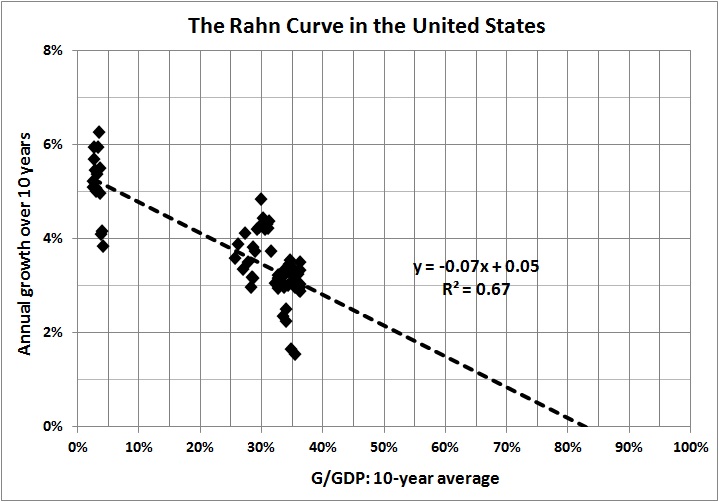
Economic Growth Since World War II

This post is now on a page of its own.

Bleeding Heart Libertarians = Left-Statists

A welcome to the readers of Jason Brennan’s “We Are Statists in Classical Liberal Clothing.” I have posted a response to Brennan (here). Thank you for visiting this blog.

I have been amused and somewhat bemused by the ongoing verbal war about bleeding-heart libertarians and bleeding-heart libertarianism (both BHL hereinafter). The main point of contention is the love of BHLs for “social justice.” The main  battlefields are the April 2012 issue of Cato Unbound* and most of the recent posts at Bleeding Heart Libertarians.

I have assayed BHL elsewhere. Here are relevant excerpts of my earlier assessment:

Matt Zwolinski asks [What Is Bleeding Heart Libertarianism?] in a post at Bleeding Heart Libertarians, and answers it by positing three types of bleeding-heart libertarian:

Contingent BHLs – This group has what might be described as standard right-libertarian views for standard right-libertarian reasons.  They believe that the state should more-or-less be constrained to the protection of negative liberty….  However, the fact that a libertarian state is good for the poor and vulnerable does not play an essential justificatory role for this group.  Libertarian institutions are justified independently and sufficiently on the basis of rights and/or consequences, and would still be justified even if they were not good for the poor and vulnerable….

Anarchist Left BHLs – …I sometimes have a bit of a hard time pinning this position down.  At times, it seems to be little more than right-anarchist-libertarianism combined with some distinctive empirical beliefs about the effects and characteristic functioning of markets and the state.  Morally, anarchist Left BHLs seem to have pretty standard libertarian views about self-ownership and the ownership of external property and, like Rothbard but unlike Nozick or Rand, conclude from these premises that all states are morally unjustifiable.  What sets them apart from right-Rothbardians seems mainly to be empirical beliefs about the extent to which contemporary capitalism is the product of and dependent on unjust government support, and about the extent to which the poor and working classes would be made especially better off in a stateless society….

Strong BHLs – Finally, there is my own preferred view…. The most important aspect of this view, and the aspect that distinguishes it from both the positions above,  is that it holds that libertarian institutions depend in part for their moral justification on the extent to which they serve the interests of the poor and vulnerable….

…Here is how Zwolinski explains [the strong BHL position], in an interview to which he links:

So to see if you kind of qualify as a bleeding heart libertarian in that strong sense, try a thought experiment. Suppose that all the critics of libertarianism were right about the empirical claims that they make: that markets are rife with failures, they tend to cause the rich to get richer and the poor to get poorer, that this leads to the exploitation of workers by capitalists. If all those claims were really true, and libertarians don’t believe that they are, but suppose they were. Would you then still be a hardcore libertarian? If the answer to that is no, then I think you might be a bleeding heart libertarian….

Note the circular reasoning: Libertarian institutions depend in part for their moral justification on the extent to which they serve the interests of the poor and vulnerable, but the libertarian institution of free markets “fails” because one result of free markets is that some persons make less than others, that is, they are necessarily “poor” by the usual, relative measure of “poorness” in the United States.

That most “poor” Americans are vastly better off than the abjectly impoverished denizens of much of Africa seems not to weigh on BHLs, who stand ready to exact “social justice” on behalf of their “poor” countrymen. That another libertarian institution — private charity (both organized and spontaneous) — can and does alleviate poverty (and other sufferings) seems to to missing from what is in fact a summary judgment against libertarianism. Libertarianism — advocacy of voluntary social and economic arrangements — is tainted, in the view of BHLs, if it does not also yield “social justice.”

The tension between liberty and “social justice” is the subject of the recently published  Free Market Fairness, written by John Tomasi. According to one review, Tomasi’s thesis is that the proverbial “we”

have been forced … to choose between social justice and economic freedom, often in reductive forms governed by moralistic absolutes. On one side is a frequently “bullying (and morally condescending)” left-liberalism; on the other an often “cold and heartless” libertarianism. It is widely thought, Mr. Tomasi says, that there can be “no common ground” between the two sides. The antagonists enter the fray believing that “when the dust settles, one side will win and the other will lose.”

Mr. Tomasi, a political theorist at Brown University, is unhappy with this stark choice. He confesses that he is attracted to the ideals of both camps. He also observes that much has changed since the 1970s. As we move into a postindustrial, Internet economy, it becomes increasingly clear that people of all income levels value the right to make economic choices. Yet most people also believe in something like social justice, supporting programs that adjust for inequalities.

With “Free Market Fairness,” Mr. Tomasi proposes an alternative to both points of view. He christens it “market democracy,” a mix of economic liberty and social justice that, in his view, supports a morally superior ideal than either the minimal state or welfare-state liberalism. Market democracy is not meant to be a mushy compromise or mere middle way, he says, but a “hybrid” that stands on its own merits.

Mr. Tomasi’s idea of a market democracy breaks with key ideas on both sides of the debate. First, he argues—against the socialist ethic of Rawls—that economic liberty is among the basic rights of individuals, as fundamental as the right to free speech. That is, we value economic liberty not merely for reasons of utility but for the ways in which it enables us to be the authors of our own lives. As Mr. Tomasi eloquently explains: “Restrictions of economic liberty, no matter how lofty the social goal, impose conformity on the life stories that free citizens might otherwise compose.”

Second, market democracy breaks with modern libertarian thinking by taking the claims of social justice seriously. Unlike Hayek, Mr. Tomasi does not believe that social justice is a mere will-o’-the-wisp. Nor does he believe that society is little more than the sum of private transactions. For Mr. Tomasi, society is “a public thing,” and thus all citizens should be able to affirm that its arrangements are fair. “A set of institutions is just,” he writes, reworking Rawls, “only if it works over time to improve the condition of the least well-off citizens.”

Market democracy recognizes that the question of social justice is a real one but without assuming that ordinary people don’t value economic liberty. Thus Mr. Tomasi believes that health care is a matter of social justice, but he prefers market-based approaches (with a safety net). “In seeking to benefit the least well off,” he says, “we must take care to do so in ways that respect the autonomy and dignity of those citizens.”

But he notes that economic liberty, as a triumphant principle, can lead to repellent results. To take a classic example, a person has no right to sell himself into slavery. Nor, Mr. Tomasi suggests, should the state sit idly by while sectors of society fall into grinding poverty and social dysfunction. The state has an obligation, he argues, to intrude upon laissez-faire arrangements so that “the exercise of responsible self-authorship” is possible.

It isn’t entirely clear how market democracy would function in the policy debates of the moment. Mr. Tomasi’s book is emphatically a work of political theory, not a blueprint for political action, much less a catalog of policy solutions. He does believe though that market democracy offers a way out of our either-or political debate, which at its extremes pits the Tea Party against the Occupy Wall Street movement. Market democracy would make the welfare of the very poor a top concern but would find little justice in mere wealth redistribution….

There is more specificity in Zwolinski and Tomasi’s lead essay for the April 2012 issue of Cato Unbound. Here are some relevant excerpts:

During the Progressive era, [Ludwig von] Mises complained that advocates of the New Liberalism [i.e., modern “liberals”] “arrogate to themselves the exclusive right to call their own program the program of welfare.” Mises regarded this as “a cheap logical trick.” The fact that classical liberals do not rely upon direct, state-based programs to distribute benefits does not mean that they are any less concerned for the poor.[15] Defending his preferred system of economic liberty, Mises wrote: “Any increase in total capital raises the income of capitalists and landowners absolutely and that of workers both absolutely and relatively. . . The interests of entrepreneurs can never diverge from those of consumers.”[16] If capitalism benefits the poor not just in real terms but also relatively to the wealthy, then capitalism is especially beneficial to the poor.

Mises’s critics (and some of his defenders) read Mises as whitewashing an uncompromising system of economic liberty with the idle hope that such a system maximizes productivity. On this reading, it is overall productivity that Mises cared about, and the distributional pattern that results is something about which Mises cared not one jot. However, notice what Mises did not say. He did not say: “The institutions of commercial society generate the greatest aggregate wealth and so, even though such institutions predictably deposit 20 percent of the population in a position of hereditary inferiority, this is A-OK.” Instead, Mises thought capitalist institutions justified, at least in part, because he believed a society-wide system of voluntary exchange will be materially beneficial for all citizens. Inequalities are justified, Mises seems to have argued, at least in part because they work to the material benefit of the least well off.

Indeed, Mises was explicit about the normative role he saw such claims playing within his defense of the free society. Thus: “In seeking to demonstrate the social function and necessity of private ownership of the means of production and of the concomitant inequality in the distribution of income and wealth, we are at the same time providing proof of the moral justification for private property and for the capitalist social order based upon it.”[17] The social function of inequalities—the benefits they provide to all, especially the poor—is an essential element in their moral justification.

It is no surprise, therefore, that when describing man’s role as a member of a (properly) liberal social order, Mises declared that each person “must adjust his conduct to the requirements of social cooperation and look upon his fellow men’s success as an indispensable condition of his own.”[18] Society, according to Mises, is a cooperative venture for mutual gain. In a good and just social order, people look upon the special talents of the fellow citizens not as weapons to be feared but as in some sense a common bounty. Economic competition is a morally praiseworthy form of social cooperation at least in part because it channels the talents of each towards the production of benefits for all….

[F]ree marketers should not be afraid to express a principled concern for the poor, or even to commit themselves to an ideal of social or distributive justice. First, in its philosophically most sophisticated formulations, such as that of left liberal paragon John Rawls, social justice concerns the material condition of the lowest paid workers—not that of idle surfers, coffeehouse Marxists, the unemployable, or even the temporarily unemployed. Second, social justice is not a property of the particular distributions that emerge in a society but of social and economic institutions viewed as integrated wholes. Thus a commitment to social justice in no way commits one to advocating liberty-limiting “corrections” of emergent distributions on an ongoing basis…. [A]s a consequence, a commitment to social justice does not require that one advocate “big state” welfare programs or anything even close. A set of institutions might well satisfy the requirements of social justice without including any state-based “redistributive” apparatus whatsoever.[24] After all, what are these requirements of social justice? According to Rawls, social justice allows for material inequalities, even extremely large and growing inequalities, provided only that the overall system works in a way that is beneficial to the lowest paid workers (that is, if the lowest paid workers in capitalist societies, over time, tend to earn more than the lowest paid workers in any noncapitalist alternative, then capitalist societies are better from the perspective of social justice)….

If that still leaves you puzzled about the relationship between “social justice” and libertarianism, perhaps this later entry by Zwolinski and Tomasi will make it clear:

…[S]ocial justice is a moral standard by which the institutions of a society can be evaluated on the basis of how well they serve the interests of the poor and least advantaged [whatever they might be]. This broad concept can be fleshed out in a number of different ways by different particular conceptions of social justice. And a full conception would say, among other things, what counts as “advantage” (Wealth? Primary goods? Utility?), what the scope of social justice is (The nation? Humankind? All sentient beings?), how this standard of moral evaluation fits alongside others (nobody – not even Rawls – believes that the fate of the poor is the only important criterion for judging the morality of a society’s institutions), and so on. Again, we have not attempted to articulate or defend such a conception here. But it is not as though bleeding heart libertarians have been silent on this issue. For several serious scholarly treatments, see John’s book here, or this essay by Jason Brennan and John Tomasi. And see also the numerous blog posts from Jason (here, here, and here), Kevin Vallier (here and here) and me (here, here, here and here).

Our historical thesis is not that earlier classical liberals endorsed any particular conception of social justice. Indeed, we do not even claim that they were explicitly and self-consciously committed to even the broad concept of social justice. But they did, over and over again, suggest that they saw the fate of the working poor as an important element in assessing the justice of liberal institutions….

One of Zwolinski and Tomasi’s blog partners, Jason Brennan, puts it this way:

…All theorists who advocate social justice believe something like this:

  • If under favorable conditions, an political-economic regime systematically causes many innocent people, through no fault of their own, to live in poverty, without much opportunity, and without much ability to enjoy their freedom, and if there is some alternative regime that, under those same conditions, would eliminate these problems, this provides a strong presumption in favor of that alternative regime.
  • If our basic institutions systematically fail to benefit innocent people, or systematically tend to harm them, then it is unreasonable to ask them to observe those institutions. For instance, if through no fault of my own, some property rights regime causes me to starve, and if this isn’t just a result of bad luck but is a systematic effect of that regime, then the rest of you can’t demand I play along with the regime.

In other words, if a regime of liberty has consequences that, in the view of a BHL (or a left-statist), cause “many innocent people, through no fault of their own, to live in poverty,” it is legitimate to curtail the liberties of some so that others might enjoy unearned benefits.

Kevin Vallier, another BHL, puts it this way:

…[S]ocial justice is justice with regard to the arrangement of a society’s basic structure. Let’s take the second term first. Rawls defines a society’s basic structure as follows:

By the basic structure I mean a society’s main political, social, and economic institutions, and how they fit together into one unified system of social cooperation from one generation to the next (PL, 11).

Rawls’s theory in Political Liberalism is meant to apply to modern constitutional democracy, such that the subject of social justice is the structure of the modern constitutional democratic state and the institutions it governs. For Rawls the basic structure is “the first subject of justice” (257). He states again that,

The basic structure is understood as they way in which the major social institutions fit together into one system, and how they assign fundamental rights and duties and shape the division of advantages that arises through social cooperation. Thus the political constitution, the legally recognized forms of property, and the organization of the economic, and the nature of the family, all belong to the basic structure (258).

So the basic structure is one great big social thing and serves as a subject of evaluation. A basic structure is socially unjust when it is not arranged in accord with principles that can be justified to each reasonable comprehensive doctrine (kind of like my discussion of public reason, but not the same)….

But modern constitutional democracy is not a voluntary social order. It is a statist order that is superimposed on and destructive of voluntary social institutions, not only free markets but also the other institutions of civil society: family, church, club, and so on. To suggest that the dictates of constitutional democracy somehow define “social justice” and legitimately override the workings of voluntary social institutions — free markets among them — is either naive or cynical.

I believe that it is cynical. The BHL proponents of “social justice” are intelligent and clever persons. They know what they are doing by wrapping their statist agenda in the banner of libertarianism. But their game is given away when one of their number dares, at last, to give operational meaning to “social justice.” I refer to the following utterances by another BHL, Jessica Flanagan:

I support a Universal Basic Income (UBI), and I think that other libertarians ought to as well….

When I say ‘social justice,’ I mean UBI. Below are several arguments for a basic income. I don’t endorse them all, but I’m including them all to show that there are many libertarian paths to this kind of ‘social justice’ conclusion.

First, I think that a UBI is morally required, given the wrong of a state-enforced property system….

Second, the UBI is relatively market friendly.… [W]e ought to support things like childcare and education vouchers, or a UBI for kids. Such a system would help citizens access the services they need without forcing them to sign up with a crappy state program.

Third, consider libertarian types like John Tomasi, Loren Lomasky, and Gerald Gaus, who argue that a UBI makes state power justifiable. Tomasi thinks that impartial institutional designers would first choose to protect important liberties (including economic liberties like contract and ownership) but then they would endorse redistributive policies to benefit society’s worst off within the limits of said liberties.

Fourth, a UBI can be compatible in principle with ‘hard libertarian’ property rights. Even if you were entitled to your property holdings, you are not entitled to coercive public enforcement of those holdings. Just because we have negative rights doesn’t mean that those rights merit full public accommodation. Once libertarians start demanding that their property is protected and their rights are publicly enforced, we can think of taxes as the public fee for that enforcement. If the public is the guardian of your wealth, who are you to tell your security guard how to spend his paycheck? This isn’t how states work, but it does point to a possible justification for redistribution.

Alternatively, some libertarians believe that a UBI is good because it will promote overall well being….

These arguments for the UBI also explain why libertarianism at its best is aligned with the political left. The world is really unjust in part because states coercively enforce laws that make people really badly off. On this we agree. Sufficiency is on the path to priority or equality, so for a while, BHL’s and leftists can walk the path from here to social justice together.

PS: Matt Zwolinski wrote a great essay on the topic of Classical Liberalism and The Basic Income (see SSRN for a PDF) 

Thus Flanagan exposes the truth about BHL: It is left-statist and anti-libertarian. It is nothing more than utilitarianism. That is to say, it is based on the presumptive, pseudo-omniscient belief that resources should be diverted from their owners to other persons, on the ground that those others “deserve” the diverted resources more than the owners of those resources. One among many justifications for this presumption is the pseudo-economic claim that money, for any individual, has diminishing marginal utility. Therefore, those from whom resources are taken suffer little if any loss of utility, whereas those (poorer persons) to whom resources are given gain much utility. This assumes a social-welfare function, which does not exist. It also assumes, wrongly, that the marginal utility of money diminishes as one accumulates more and more of it, which would come as a surprise to Warren Buffet, Bill Gates, oil sheiks, and almost everyone who would love to become wealthier (which is most persons). It makes you wonder why millions of Americans buy lottery tickets every week, if not every day. (For more about utilitarianism and social welfare, see this, this, this, this, and this).

Flanagan, like many other BHLs (and most leftists) evidently believes that the owners of large claims on resources (e.g., “the 1%”) are undeserving of their claims because the “system” is rigged so that “the 1%” (and such-like) become rich and powerful at the expense of the poor and vulnerable. This is patent nonsense because it assumes that there is a possible “perfect” system that is not, in some way, rigged to benefit one set of elites or another.

The relevant questions, which go unanswered by BHLs (and leftists), are these:

  • Whether the current system of regulated capitalism, when enables some classes of individuals to piggy-back on others, is worse than the attainable alternatives (if there are any).
  • The extent to which those at the top actually cause deep poverty among those at the bottom.

I submit that because of the legal complexities of regulated capitalism it is impossible to know the extent to which those who benefit from the current system actually deprive others of the “just desserts.” Among the complexities are the many programs that work in favor of the “working poor” — and a vast cohort of sloths. Further, any regime — from libertarian to state-socialist — will generate a “1%.” And it is hard to say that the composition of America’s “1%” would not (for the most part) be the same under a regime of pure, anarchistic libertarianism or ironclad state-socialism. Ability, intelligence, guile, ambition, and ruthlessness rise to the top.

Flanagan’s point about the state’s right to spend its “paycheck” as it pleases is a bogus one. Those libertarians who accept the necessity of the state do so with the proviso that the state’s sole function is to protect property rights and negative rights. The state may spend its “paycheck” only for the purpose of protecting those rights — not for the purpose of spending the “paycheck” as it pleases. A state that goes beyond its remit to perform illegitimate functions does not collect a “paycheck” for its services. It steals.

As for UBI, it arrived on the scene a long time ago, in the form of Social Security, Medicare, Medicaid, EITC, SNAP, AFDC, subsidized housing, subsidized mortgage loans, affirmative action, etc., etc., etc. It is pure naivete to suggest UBI as a politically feasible alternative to those programs, each of which has entrenched constituencies and powerful defenders. UBI would be an addition to the list, not a substitute for it.

Some final words for BHLs: If you know of persons who are poor and vulnerable, help them yourself. Give them your time and effort, give them money, or give money to a charity that actually does something to help. But do not presume to be my conscience, and take your hand out of my pocket.

Related reading:
The Top 0.1 Percent
Bleeding-Heart Libertarianism and “Social Justice”
Bleeding Heart Libertarianism, Utilitarianism, and Statism

Related posts:
On Liberty
Greed, Cosmic Justice, and Social Welfare
Positive Rights and Cosmic Justice
Fascism with a “Friendly” Face
Democracy and Liberty
The Interest-Group Paradox
Parsing Political Philosophy
Is Statism Inevitable?
Inventing “Liberalism”
What Is Conservatism?
Utilitarianism, “Liberalism,” and Omniscience
Utilitarianism vs. Liberty
Fascism and the Future of America
The Indivisibility of Economic and Social Liberty
Beware of Libertarian Paternalists
Law and Liberty
Negative Rights
Negative Rights, Social Norms, and the Constitution
Rights, Liberty, the Golden Rule, and the Legitimate State
The Near-Victory of Communism
Tocqueville’s Prescience
The Mind of a Paternalist
Accountants of the Soul
Rawls Meets Bentham
Is Liberty Possible?
The Left
Line-Drawing and Liberty
The Divine Right of the Majority
Our Enemy, the State
Pseudo-Libertarian Sophistry vs. True Libertarianism
Positivism, “Natural Rights,” and Libertarianism
What Are “Natural Rights”?
The Golden Rule and the State
Libertarian Conservative or Conservative Libertarian?
Liberty, Equality, Fraternity: Part I
Bounded Liberty: A Thought Experiment
Evolution, Human Nature, and “Natural Rights”
More Pseudo-Libertarianism
More about Conservative Governance
The Meaning of Liberty
Positive Liberty vs. Liberty
On Self-Ownership and Desert
Understanding Hayek
The Golden Rule as Beneficial Learning
Facets of Liberty
Burkean Libertarianism
Rights: Source, Applicability, How Held
What Is Libertarianism?
Nature Is Unfair
True Libertarianism, One More Time
Human Nature, Liberty, and Rationalism
Utilitarianism and Psychopathy
“Occupy Wall Street” and Religion
A Declaration and Defense of My Prejudices about Governance
The Libertarian-Conservative Fusion Is Alive and Well
Libertarianism and Morality
Libertarianism and Morality: A Footnote
Merit Goods, Positive Rights, and Cosmic Justice
More about Merit Goods
What Is Bleeding-Heart Libertarianism?
The Morality of Occupying Private Property
In Defense of the 1%
Liberty, Negative Rights, and Bleeding Hearts
Conservatives vs. “Liberals”
Why Conservatism Works
The Pool of Liberty and “Me” Libertarianism

__________
* Here is a summary of the contributions to the April 2012 issue:

Lead Essay

  • A Bleeding Heart History of Libertarianism by Matt Zwolinski and John TomasiMatt Zwolinski and John Tomasi propose to refocus the libertarian movement. Although they agree that individual property rights are important, they propose to return libertarianism to its nineteenth-century intellectual roots. They argue that the classical liberals valued property rights for different reasons, perhaps, than we in the movement value them now: Property rights were intended to protect the least well-off workers in society. A “neoclassical liberal” would not advocate a welfare state, but would certainly value social justice; his means of attaining it would be through the institutions of property and contract.

Response Essays

  • In Praise of Bleeding Heart Absolutism by Roderick T. LongRoderick T. Long criticizes the sharp distinctions drawn by Zwolinski and Tomasi between nineteenth-century classical liberals and the “Unholy Trinity” of Mises, Rand, and Rothbard. He suggests many areas in which the earlier thinkers were not as Zwolinski and Tomasi characterize them, as well as several where Mises, Rand, and Rothbard don’t conform either. Long stresses the importance of class analysis in the thought of nineteenth-century classical liberals and points to its resurrection as a key aspect of Rothbard’s thought in particular. This, he suggests, points the way toward a “bleeding-heart absolutism” – an ideology critical of every form of state power, yet also prioritizing the moral claims of the poorest in society.
  • Natural Rights + ? by David D. FriedmanDavid Friedman argues that the pre-twentieth century classical liberals were motivated not by a concern for the poor per se, but by utilitarian reasoning. The “working poor” were a large majority of society in their time, and authors like Adam Smith must be read in their historical context. Doing so reveals Smith to be a progenitor of Jeremy Bentham, not John Rawls. Utilitarianism brings problems of its own, of course, but it should not be confused with social justice.
  • Let’s Reject the Purity Test by Alexander McCobinAlexander McCobin argues that libertarians often engage in unproductive debates about who or what is “more” libertarian. One thing lost in these debates is that, across the wide sweep of intellectual history, significant libertarian figures have usually felt free to draw from a wide array of justifications and policy approaches. Each was a product of a particular historical era, and there is no reason to find fault with any of them simply on that account. To advance liberty, we should think and write about libertarian principles in terms that unbiased observers will find persuasive today.

The Conversation

Reclaiming Liberty throughout the Land

Proclaim LIBERTY throughout all the Land unto
all the Inhabitants thereof Lev. XXV X

Inscription on the Liberty Bell

The evident repudiation of “austerity” by the unwashed masses and “intellectuals” of France and Greece has set the stage for the final decline and fall of Europe. Socialism is the enemy of robust economic activity, and it seems that most Europeans favor the opiate of socialism over economic reality. Europe is therefore doomed to low (perhaps negative) economic growth and its concomitant, social unrest. The end will come with the arrival of men and women on white horses, promising an unattainable Nirvana and delivering enslavement to the dictates of the state. The tragedies of the Third Reich and the USSR will be replayed in somewhat less brutal fashion.

Given the trend of American history since the early 1900s, there is great danger that Americans will follow Europeans into abject submission to the state. If the trend is not reversed, and soon, Thomas Sowell will have been right to say that “the day may yet come when the only thing that can save this country is a military coup.”

Sowell remains at large, which leads me to believe that I might, with impunity, embellish on Sowell’s observation.

I take Sowell to mean something like this: Thanks to the coercive and propagandistic efforts of government officials, bureaucrats, journalists, educators, and intelligentsia (the vast, left-wing portion thereof) — and thanks to the venality, gullibility, and ignorance of voters — America is now so far from being a civil society based on limited government and personal responsibility that it cannot again become one through the electoral process. In short, the Constitution has been subverted.

Sowell is correct in his diagnosis of the state of the nation. And he may be right to suggest that limited government, and with it civil society, can be restored only by extra-constitutional means. A hypothetical alternative to that hypothetical option is outright rebellion.

As long as I am speaking hypothetically, let me speak of a third option: an underground society. An underground society would comprise persons and enterprises whose personal and business transactions are founded on mutual trust and respect, who rely on consensus to establish and enforce codes of behavior, and whose affairs have been arranged so as to escape the notice of established governments (except perhaps the notice of a sympathetic local authority). (For more, see this and this.)

My assessment of the three options:

  • Underground society. No underground society can become large enough to perform the functions of an aboveground society before it is targeted for suppression by established governments. An underground society is more likely to attract unarmed flower children/academics or armed loudmouths — all easily detected and suppressed — than it is to attract persons possessing sufficient wealth and guile to bankroll extensive underground enterprises. Such persons, on balance, will favor the existing order because uncertainty and disorder are threats to their wealth. But all it takes is a (relative) handful of good (and wealthy) liberty-lovers.
  • Coup. Military personnel (careerists, in particular) are disciplined, have direct access to the tools of power, and many of them are trained in clandestine operations. Therefore, a cadre of properly motivated careerists might possess the wherewithal necessary to seize power from a corrupt regime. But a plot to undertake a coup is easily betrayed. And a coup, if successful, might deliver us from a relatively benign despotism into a decidedly malign despotism. Though, on that point, I am willing to take my chances, given the political trajectory of the nation.
  • Revolution. We are a long way from the conditions of the 1770s, when it was possible for a relatively small portion of the populace — albeit an able, courageous, and determined one — to rebel overtly and successfully against the ruling regime. It was only 90 years later that a much larger portion of the populace — equally able, courageous, and determined (though fighting for the wrong cause) — failed to defeat the ruling regime. Another 150 years on, we find a ruling regime with too many adherents and too much power to be overturned by overt rebellion.

Those Americans with a grasp of the reality that looms face two realistic (if uncertain) routes toward liberty. One route is to continue fighting the war of ideas. That war is being fought by libertarian think-tanks, a relative handful of politicians and “public intellectuals,” and a pitifully small portion of the populace (consisting mostly of bloggers, it seems). The odds of success are low, but not zero. In any event, there can be no change for the better if no one is fighting (intellectually and politically) for that change.

The other realistic route — the one taken by those of our ancestors who came to America for its promise of liberty — is emigration. That may be a route toward greater liberty for those who are willing and able to make the necessary financial and psychological sacrifices to venture it. The question, then, is where to go. The most promising and plausible answers given by the Fraser Institute and Heritage Foundation are Australia, New Zealand, and Switzerland — none of which, I daresay, has the degree of liberty that once prevailed in the United States.

So — being too old for emigration and skeptical of its benefits — I have rededicated myself to the war of ideas. But if the war of ideas cannot be won, I favor an underground society, a military coup, or a revolution (in that order).

See also “The Constitution: Myths and Realities“.

Combinatorial Play

What is it? It’s the term applied by Einstein to the creative combination of (seemingly) unconnected theories to develop new, more general theories.  Combinatorial play often works subconsciously, while a person is asleep or engaged in a “mindless” diversion. The possibility of arriving at a solution to a problem by shelving it — even overnight — underlies the counsel to “sleep on it.”

Combinatorial play occurs in the absence of artificial deadlines, which hamper truly creative thinking. Such thinking occurs when a person with deep knowledge of a practical, professional, or scientific subject acquires a new insight about the subject by thinking in new ways (often subconsciously) about his knowledge — by making new connections from “old facts,” so to speak.

Related reading:
Thought for thinkers:’Follow your gut,’ study advises on big decisions
Let Subconscious Handle Complex Decision Making?

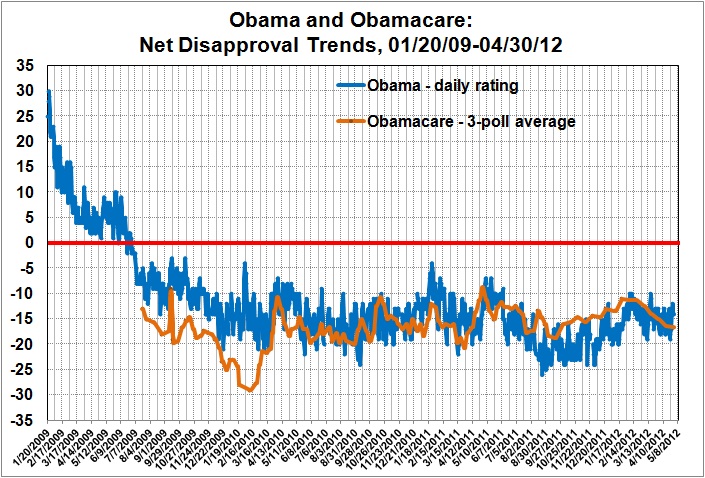
Obama and Obamacare: Twin Disasters

A picture worth 2,000 words:


Sources: Rasmussen Reports, Obama Approval Index History and Health Care Law.

I could have added graphs about the unemployment rate  (2 percentage points above the peak reached during GWB’s administration), the employment/population ratio (5 percentage points below the GWB peak), and the federal debt (which has grown almost 50 percent in the 3 years and 3 months of Obama’s presidency, as against a 25-percent rise in the first 3 years and 3 months of GWB’s presidency) — but why rub it in?

A Man for No Seasons

A Man for All Seasons, originally a play by Robert Bolt and later an acclaimed film, is about Sir Thomas More (or Saint Thomas More, if you prefer),

the 16th-century Chancellor of England, who refused to endorse King Henry VIII‘s wish to divorce his ageing wife Catherine of Aragon, who could not bear him a son, so that he could marry Anne Boleyn, the sister of his former mistress.

Thomas More

opposed Henry [VIII]’s separation from the Catholic Church [because it forbade divorce] and refused to accept the King as Supreme Head of the Church of England…. In 1535, [More] was tried for treason, convicted on perjured testimony and beheaded.

The title of the play

reflects … Bolt’s portrayal of More as the ultimate man of conscience. As one who remains true to himself and his beliefs under all circumstances and at all times, despite external pressure or influence, More represents “a man for all seasons”.

More’s constancy to principle stands in high relief against the amorality and immorality of normal political practices, past and present. These range from opportunism, flip-flopping, and log-rolling to deceit and lying to theft (disguised as “compassion”) and back-stabbing (both figurative and literal).

More’s constancy to principle also stands in high relief against the practice of tailoring one’s principles to fit the data at hand — or the data that one selects to justify one’s prejudices. I have found economists to be especially prone to such tailoring. For example, too many economists justify free markets on utilitarian grounds, that is, because free markets produce more (i.e., are more efficient) than regulated markets. This happens to be true, but free markets can and should be justified mainly because they are free, that is, because they allow individuals to pursue otherwise lawful aims through voluntary, mutually beneficial exchanges of products and services. Liberty is a principle, a deep value; economic efficiency is merely a byproduct of adherence to that value.

Economists are by no means the only practitioners of utilitarianism. It is rampant in the ranks of public intellectuals, and is exemplified in “Empiricism in politics: On opinions beyond the reach of data,” a piece by Will Wilkinson (hereinafter WW), which begins with this:

DAVID FRUM quotes the following passage of Charles Murray’s new book, “Coming Apart: The State of White America, 1960 – 2010”, in the midst of a long, scathing review (about which I here enter no opinion):

Data can bear on policy issues, but many of our opinions about policy are grounded on premises about the nature of human life and human society that are beyond the reach of data. Try to think of any new data that would change your position on abortion, the death penalty, legalization of marijuana, same-sex marriage or the inheritance tax. If you cannot, you are not necessarily being unreasonable.

I found this exceedingly odd. I can easily imagine what evidence would cause me to change my position on any of these issues. How about you? It’s a fun exercise, let’s try.

I will address, in turn, WW’s views on abortion, the death penalty, legalization of marijuana, same-sex marriage, and the inheritance tax.

Abortion. This is far and away the hardest one. I favour legal abortion…. I would seriously weigh this moral benefit ]a “culture of life”, which pays off in terms of greater general humanity and diminished cruelty] against the moral cost of reducing women’s control over their bodies….

Clearly, WW is a man in search of a principle upon which to hang his preference to allow persons “control over their bodies.” This– as a principle — would justify many immoral acts. For if one’s use of one’s body is not to be interfered with, on what basis could WW condemn murder, for example? And yet he does condemn it, implicitly, when he quibbles about the death penalty as a punishment for murder.

WW (I strongly suspect) might respond that he is talking only about control over what one does to oneself, as in the use of marijuana (to which I will come). But WW is unconvincing with respect to abortion. He is willing to recognize “robust moral rights” for children at birth because that is “the convention.” But before the U.S. Supreme Court overturned long-standing State laws rooted in moral tradition, it was the convention (in most States) to recognize robust moral rights for children at conception. (By contrast, the convention of slavery, which was recognized and fostered by several States, stood on flimsy moral ground.)

The lack of a firm principle (e.g., abortion is murder) leads WW into sophistry and hair-splitting. These abound in the elided portions of the preceding quotation:

…I don’t think embryos or fetuses are persons, and I don’t think it’s wrong to kill them. I also don’t think infants are persons, but I do think laws that prohibit infanticide are wise. Birth is a metaphysically arbitrary line, but it’s a supremely salient socio-psychological one. A general abhorrence of the taking of human life is something any healthy culture will inculcate in its members. It’s easier to cultivate the appropriate moral sentiments within a society that has adopted the convention of conferring robust moral rights on infants upon birth than it would be in a society that had adopted the convention of conferring the same rights on children only after they’ve reached some significant developmental milestone, such as the onset of intelligible speech. The latter society, I suspect, would tend to be more generally cruel and less humane. This is just an empirical hunch, though I feel fairly confident about it. But I could be wrong. And I could be wrong in the other direction as well. If it were shown that societies which ban abortion, or which ban abortion beyond a certain point, exceed societies which don’t ban abortion in cultivating a “culture of life”, which pays off in terms of greater general humanity and diminished cruelty, I would seriously weigh this moral benefit against the moral cost of reducing women’s control over their bodies. Also, if it were shown that abortion tended to damage women’s mental and physical health more than forcing women to carry unwanted pregnancies to term, I would tend to look more favourably on restrictions on abortion, especially for minors.

Fetuses may not be persons, in WW’s view, but fetuses are human life. WW’s defense of abortion amounts to a defense of taking blameless, defenseless humans. He cannot bring himself to admit that, so he adopts the language of Roe v. Wade (a fetus is not “a person within the meaning of the Fourteenth Amendment”). But, as WW acknowledges, there is no specific point at which a human being becomes a “person.” The fetus-person distinction is an entirely arbitrary one, concocted for the purpose of justifying abortion.

If WW is willing to accept birth as the point at which the taking of innocent life becomes unacceptable, why not seven or eight months into a pregnancy, when the chances of survival outside the womb are high, especially given the life-sustaining technologies that are now available? And if a fetus is “viable” at seven or eight months, it is “viable” at earlier stages of development, as long its life is not ended artificially. The “logic” of abortion based on “viability” is circular because a fetus is (almost always) “viable” unless it is aborted.

And why is it not even “easier to cultivate the appropriate moral sentiments within a society that has adopted the convention of conferring robust moral rights on infants” upon conception? Such a society, I believe, would tend to be less cruel and more humane than the one that allows abortion at every stage of fetal development.

WW’s next suggestion is fatuous in the extreme. It need not be shown that societies which ban abortion, or which ban abortion beyond a certain point, exceed societies which do not ban abortion in cultivating a “culture of life.” Societies that ban abortion, ceteris paribus, have a culture of life, by definition. By the same token, societies that encourage or acquiesce in atrocities against humanity on a par with abortion (e.g., the Third Reich) have a culture of death. One very good reason for resisting the practice of abortion is to avert the next steps down the slippery slope toward that culture.

Looking unfavorably upon abortion if it tended to damage women’s mental and physical health is putting a possible side effect of abortion above its abhorrent moral status. But that should come as no surprise because, on this issue, WW clearly betrays a lack of moral sense.

This brings me to WW’s next moral test:

Death penalty. This is a lot easier. I oppose the death penalty. But if the death penalty were shown to be (1) a very effective deterrent of murder and violent crime, (2) non-prejudicially applied, and (3) very rarely applied to the innocent, I would support it in especially heinous cases of murder.

This is a lot easier for me, too. You are either for the death penalty as a matter of justice (taking its deterrent value as a bonus), or you are against it because, say, you cannot condone the taking of life by the state. WW, as an advocate of abortion, cannot take the latter position, so he dances around the death penalty — treating it entirely as an exercise in utilitarian calculation. In reality, he takes no position at all because he uses wiggle-words like “very effective,” “non-prejudicially,” “very rarely,” and “especially heinous.”

Thirdly:

Legalisation of marijuana. I support legal weed! If it were shown that marijuana is super-addictive, impossible to use responsibly, and that its users predictably harm others and/or egregiously harm themselves, I’d support something in the neighbourhood of status quo prohibition.

I have a strong suspicion that only a small fraction of the users of marijuana are detected and prosecuted for their use. That is to say, I view legalization as a bogus issue. But the purported harmlessness of marijuana allows libertarians to replay the pro-abortion theme: control over one’s body. However, WW (unlike most libertarians who write about drug use) seems willing to concede that the use of marijuana ought to be made illegal if it would “egregiously harm” the user. This suggests that control over one’s body is not sacrosanct.

But what is the deeper principle that determines where and when one has control over one’s body? I find no clue in WW’s article. There is no “moral there” there. Being pro-abortion, anti-death penalty, pro-marijuana, and pro-same-sex marriage are attitudes, the possession of which marks one as “liberal” and “open-minded.” But bottomless.

And so on:

Same-sex marriage. I’m so pro, I almost wish I were gay so I could have one. If compelling evidence were unearthed that showed that widespread same-sex marriage really would precipitate the unraveling of the traditional family and subsequently the stability of society and the ruin of us all, I suppose I’d settle for the right of same-sex couples to shack up.

“Compelling evidence” about the effects of same-sex “marriage” on society can be had only by the widespread legalization of same-sex “marriage” over a long period, by which time it would be impossible to undo the damage caused by same-sex “marriage.” Would it not be better to exercise one’s moral judgment about the effects of state action before that action is taken?

In the case of same-sex “marriage” the judgment goes like this: Marriage, as the union of a man and a woman, is a social-religious convention, which (until modern times) had a legitimacy and standing that did not depend on state action. State involvement in marriage — as in other social arrangements — undermines its significance as a deep and socially beneficial commitment. The undermining process began in earnest with state action that eased divorce. Widespread governmental recognition of same-sex “marriage” would accelerate the undermining process. The state would effectively convert marriage from a social-religious commitment to a licensed arrangement devoid of social-religious meaning. This would reinforce the trend toward cohabitation, with all that it implies: convenience rather than commitment, greater ease of breakup, temporary couplings where one partner (usually the man) has no stake in the proper upbringing of  the other partner’s children, psychologically and (all-too-often) physically damaged children who are more prone than their “traditional” counterparts to economically unproductive and socially destructive behaviors.

Why not think things through instead making a show of demanding “evidence” that can be obtained only when it is too late to do any good? Well, the answer to that question is obvious: WW wants same-sex “marriage” — the evidence be damned.

Finally:

Inheritance tax. I don’t have an especially strong opinion about this, other than that the “death tax” tends not to be very efficient and that large bequests aren’t an especially important source of inequality or the reproduction of class. So, I guess I’d need to learn that inheritance taxes don’t create a lot of wasteful, evasive resource shuffling, and do significantly contribute to class mobility if I were to develop a more favourable opinion of them.

That is about as clueless as it gets. Where is the right to do with one’s property as one likes, as long as the doing is not harmful to others? What a strange oversight by WW,  given his commitment to the control of one’s own body. If a person cannot control the legitimate produce of his bodily labors, he lacks effective control of his body.

If consequences were all, as they seem to be for WW, the ability to leave an inheritance is an incentive to do productive things, either directly or by making loans and investments that enable others to do productive things. For what earthly reason would anyone want to blunt or cancel that incentive? Out of a sense of “fairness”? What gives the likes of WW and Barack Obama the ability to reach into the minds and souls of millions of Americans and judge their relative worthiness to make and receive bequests? The inheritance tax is an exercise in social engineering that any self-respecting libertarian ought to reject categorically, not provisionally, as WW does.

WW often posts sensible things at his various outlets. But “Empiricism in politics” is a sign that WW should take a break from punditry, as he has said he might. On the basis of “Empiricism,” I would characterize WW as a man who knows the price of everything and the value of nothing. He pays lip-service — but nothing more — to the value of social traditions. He stands ready to jettison them at the drop of a statistic. As I have said, he is far from the sole possessor of that trait. I single him out here because “Empiricism” is an exemplar of utilitarian amorality.

*   *   *

Related reading: Jay W. Richards, “Should Libertarians Be Conservatives?: The Tough Cases of Abortion and Marriage

Related posts (with many more linked therein):
Libertarian Twaddle about the Death Penalty
Law, Liberty, and Abortion
Clear Thinking about the Death Penalty
Another Argument for the Death Penalty
Crime, Explained
A Wrong-Headed Take on Abortion
“Family Values,” Liberty, and the State
Is There Such a Thing as Society
Greed, Cosmic Justice, and Social Welfare
Enough of “Social Welfare”
The Case of the Purblind Economist
Pseudo-Libertarian Sophistry vs. True Libertarianism
Positivism, “Natural Rights,” and Libertarianism
The Golden Rule and the State
Libertarian Conservative or Conservative Libertarian?
Bounded Liberty: A Thought Experiment
Evolution, Human Nature, and “Natural Rights”
More Pseudo-Libertarianism
More about Conservative Governance
The Meaning of Liberty
Substantive Due Process and the Limits of Privacy
Positive Liberty vs. Liberty
On Self-Ownership and Desert
In Defense of Marriage
What Is Justice?
Myopic Moaning about the War on Drugs
Creative Destruction, Reification, and Social Welfare
Burkean Libertarianism
Crimes against Humanity
Abortion and Logic
What Is Libertarianism?
True Libertarianism, One More Time
Human Nature, Liberty, and Rationalism
Utilitarianism and Psychopathy
The Myth That Same-Sex “Marriage” Causes No Harm
The Libertarian-Conservative Fusion Is Alive and Well
Cato, the Kochs, and a Fluke
Why Conservatism Works
Abortion, Doublethink, and Left-Wing Blather

Higher Taxes, Higher Government Spending, Slower Economic Growth

J.D. Foster and Curtis Dubay, writing at The Foundry (“Of Course Higher Taxes Slow Growth — A Response to Diamond and Saez“), make mincemeat of Peter Diamond and Emmanuel Saez’s arguments for higher taxes on “the rich.” Implicit in Foster and Dubay’s takedown of Diamond and Saez is the demonstrably strong (and negative relationship) between government spending and economic growth.

Spending is funded by taxes, after all. And even when spending is funded by borrowing it amounts to a tax on the productive sectors of the economy. How is that? When government sell bonds to the public it redirects money from productive uses in the private sector to unproductive and counter-productive uses in the so-called public sector (i.e., government). The thievery is no less destructive — but more apparent — when the Fed creates money out of thin air to finance government spending.

So, the focus should be on spending, for which taxation is a proxy. The effect of government spending on economic growth is nothing less than disastrous. I have treated the subject at length in “Estimating the Rahn Curve: Or, How Government Inhibits Economic Growth.” Here is another version of the final graph in that post:

The bottom line is that for every 10 percentage points by which government spending rises, the rate of growth declines by 0.7 percentage points. If you think that 0.7 percent is negligible, try compounding it over a lifespan of 80 years. In that time, a sustained 10 percent rise in government spending will reduce the average person’s real income by more than 40 percent.

That, my friends, is soak-the-rich Obamanomics at work. Apologists for Obamanomics, like Diamond and Saez, should be ashamed of themselves for abetting economically destructive demagoguery.

Related posts:
The Causes of Economic Growth
A Short Course in Economics
Addendum to a Short Course in Economics
Enough of “Social Welfare”
The Case of the Purblind Economist
Economic Growth since WWII
The Price of Government
Does the Minimum Wage Increase Unemployment?
The Price of Government Redux
The Mega-Depression
The Real Burden of Government
Toward a Risk-Free Economy
The Rahn Curve at Work
The Illusion of Prosperity and Stability
Society and the State
The “Forthcoming Financial Collapse”
Estimating the Rahn Curve: Or, How Government Inhibits Economic Growth
The Deficit Commission’s Deficit of Understanding
Undermining the Free Society
The Bowles-Simpson Report
The Bowles-Simpson Band-Aid
Build It and They Will Pay
Government vs. Community
The Stagnation Thesis
Government Failure: An Example
Taxing the Rich
More about Taxing the Rich
Voluntary Taxation
Money, Credit, and Economic Fluctuations
A Keynesian Fantasy Land
“Tax Expenditures” Are Not Expenditures
The Keynesian Fallacy and Regime Uncertainty
Why the “Stimulus” Failed to Stimulate
The “Jobs Speech” That Obama Should Have Given
Regime Uncertainty and the Great Recession
The Real Multiplier
Vulgar Keynesianism and Capitalism
Why Are Interest Rates So Low?
Don’t Just Stand There, “Do Something”
Economic Growth Since World War II
The Commandeered Economy
We Owe It to Ourselves
In Defense of the 1%
The Real Multiplier (II)

More about Luck and Baseball

In “Luck and Baseball, One More Time,” I make the point that

it takes a lot more than luck to succeed at almost anything, from winning high office to making millions of dollars to painting a masterpiece to building a house to cutting hair properly. To denigrate the rich and famous by calling them lucky is to denigrate every person who strives, with some success, to overmaster whatever bad luck happens to come his way.

The backdrop for that claim is some statistical evidence from the history of major-league baseball:

In the 111-year history of the American League, 60 different players have led the league in batting. Those 60 players have recorded a total of 367 top-10 finishes in American League batting races over the years — an average of 6 top-10 finishes for each of the players. It is not surprising, therefore, that most of the 60 players also compiled excellent career batting averages. Specifically, through 2010, 57 of the 60 had made at least 5,000 plate appearance in the American League, and 43 of the 57 are among the top 120 hitters (for average) — out of the thousands of players with at least 5,000 plate appearances in the American League. Were those 43 players merely “lucky”? It takes a lot more than luck to hit so well, so consistently, and for so many years.

Here is more evidence to the same effect. Two days ago, a young pitcher for the Chicago White Sox named Philip Humber threw a perfect game against the Seattle Mariners. Humber’s was the 19th perfect game since 1893, when the distance from the pitcher’s plate (rubber) to the back point of home plate (where the foul lines intersect) was increased to 60 feet, 6 inches. The 19 perfect games were pitched by 19 different men. And the total number of major league games played from 1893 through today numbers well above 300,000, which means that the potential number of perfect games (if thrown by both teams’ pitchers) is well above 600,000.

Aha, you might say, a perfect game is a matter of luck. Well, it may be partly a matter of luck, but baseball (despite some elements of randomness) is a game of skill, applied intentionally. A perfect game, like many other aspects of baseball, is the residue of the applied skills of pitchers and fielders, just as (the prevalent) imperfect game is the residue of the applied skills of batters and base runners.

The element of skill involved in pitching a perfect game is evidenced by the fact that most of the players who have pitched perfect games are the holders of above-average to exceptional pitching records:

Career Record*
Year of perfect game Pitcher Seasons played Wins Losses W-L % ERA+** Hall of Fame?***
1904 Cy Young 1890-1911 511 316 .618 138 Yes
1908 Addie Joss 1902-1910 160 97 .623 142 Yes
1922 Charlie Robertson 1919-1928 49 80 .380 90 No
1956 Don Larsen 1953-1967 81 91 .471 99 No
1964 Jim Bunning 1955-1971 224 184 .549 114 Yes
1965 Sandy Koufax 1955-1966 165 87 .655 131 Yes
1968 Catfish Hunter 1965-1979 224 166 .574 105 Yes
1981 Len Barker 1976-1987 74 76 .493 94 No
1984 Mike Witt 1981-1993 117 116 .502 105 No
1988 Tom Browning 1984-1995 123 90 .577 98 No
1991 Dennis Martinez 1976-1998 245 193 .559 106 No
1994 Kenny Rogers 1989-2008 219 156 .584 108 Not yet eligible
1998 David Wells 1987-2007 239 157 .604 108 Not yet eligible
1999 David Cone 1986-2003 194 126 .606 121 No
2004 Randy Johnson 1988-2009 303 166 .646 136 Not yet eligible
2009 Mark Buehrle 2000- 162 121 .572 120 Active player
2010 Dallas Braden 2007- 26 36 .419 102 Active player
2010 Roy Halladay 1998- 191 93 .673 139 Active player
2012 Philip Humber 2006- 12 10 .545 110 Active player
Combined W-L 3319 2361 .584
* Through April 22, 2012.
** Earned run average adjusted for ballpark and the league’s mean ERA in each season. An ERA+ of 100 is therefore an average performance over a career; ERA+ >100 is above average; ERA+ <100 is below average. (Details here: http://en.wikipedia.org/wiki/ERA%2B.)
*** Membership in the Hall of Fame is noted for the sake of completeness, though it is not conclusive proof of greatness. (See: http://libertycorner.blogspot.com/2006/10/anti-hall-of-fame-and-baseball.html; http://libertycorner.blogspot.com/2007/12/hall-of-famers.html.)

The point of this excursion into baseball is stated in an old post of mine:

A bit of unpredictability (or “luck”) here and there does not make for a random universe, random lives, or random markets. If a bit of unpredictability here and there dominated our actions, we wouldn’t be here to talk about randomness….

Human beings are not “designed” for randomness. Human endeavors can yield unpredictable results, but those results do not arise from random processes, they derive from skill or the lack therof, knowledge or the lack thereof … , and conflicting objectives…

In baseball, as in life, “luck” is mainly an excuse and rarely an explanation….

Related posts:
Fooled by Non-Randomness
Randomness Is Over-Rated
Luck-Egalitarianism and Moral Luck
Luck and Baseball, One More Time

Mysteries: Sacred and Profane

A philosopher named Jamie Whyte, about whom I have written before (“Invoking Hitler“), is the author of Bad Thoughts – A Guide to Clear Thinking. According to the publisher, it is a

book for people who like argument. Witty, contentious, and passionate, it exposes the methods with which we avoid reasoned debate…. His writing is both laugh-out-loud funny and a serious comment on the ways in which people with power and influence avoid truth in steering public opinion.

Bad Thoughts is witty — though “laugh-out-loud funny” is a stretch — and, for the most part, correct in its criticisms of the kinds of sloppy logic that are found routinely in politics, journalism, blogdom, and everyday conversation.

But Whyte is not infallible, as I point out in “Invoking Hitler.”  This post focuses on another of Whyte’s miscues, which is found under “Mystery” (pp. 23-26). Here are some relevant samples:

…Consider … the orthodox Christian doctrine of the Unity of the Holy Trinity. The Father, the Son and the Holy Ghost are three distinct entities — as suggested by ‘Trinity’. Yet each is God, a sinle entity — as suggested by ‘Unity’. The doctrine is not that each is part of God, in the way that the FM tuner is part of your three-in-one home stereo. Each is wholly God.

And there’s the problem. It takes only the most basic arithmetic to see that three things cannot be one thing. The doctrine of the Unity of the Trinity is inconsistent with the fact that three does not equal one.

Whyte goes on and on, but the quoted material is the essence of his “case” that the Blessed Trinity (Catholic usage) is impossible because it defies mathematical logic. What is worse, to Whyte, is the fact that this bit of illogic is “explained away” (as he would put it) by calling it a “mystery.”

I am surprised that a philosopher cannot accept the idea of “mystery.” Anyone who thinks for more than a few minutes about the nature of the universe, as Whyte must have done, concludes that its essence is beyond human comprehension. And, yet, the universe exists. The universe — a real thing — is, at bottom, a mystery. Somehow, the mysteriousness of the universe does not negate its existence.

And there are scientific mysteries piled on that mysteriousness. Two of those mysteries have a common feature: They posit the simultaneous existence of one thing in more than one form — not unlike the Blessed Trinity:

Wave–particle duality postulates that all particles exhibit both wave and particle properties. A central concept of quantum mechanics, this duality addresses the inability of classical concepts like “particle” and “wave” to fully describe the behavior of quantum-scale objects.

*   *   *

The many-worlds interpretation is an interpretation of quantum mechanics that asserts the objective reality of the universal wavefunction, but denies the actuality of wavefunction collapse. Many-worlds implies that all possible alternative histories and futures are real, each representing an actual “world” (or “universe”).

As Shakespeare puts it (Hamlet, Act I, Scene V), “There are more things in heaven and earth, Horatio, than are dreamt of in your philosophy.” Or in your physics.

If Whyte wants to disprove the Blessed Trinity, he must first try to disprove the existence of God — a fool’s errand that I have addressed in other posts; for example:

A Digression about Probability and Existence
More about Probability and Existence
Existence and Creation
Probability, Existence, and Creation
The Atheism of the Gaps
Not-So-Random Thoughts (II)” (see the first section, “Atheism,” which inter alia addresses Lawrence M. Krauss’s A Universe from Nothing, which is summarized in this article by Krauss)

The Pool of Liberty and “Me” Libertarianism

Ted Levy makes some excellent points in “Is the Pool of Liberty Drying Up?“:

…[A] few years ago [David Boaz, executive vice president of Cato Institute] made a well received but, I think, incomplete analysis of liberty….

Boaz’s thoughts were well articulated in a 2010 piece, found here on Reason.com: Up From Slavery: There’s No Such Thing As A Golden Age of Lost Liberty.

… Boaz notes Cato pamphlets used to include as the Institute’s raison d’être, “Since [the American] revolution, civil and economic liberties have been eroded.” And then, Boaz notes, a visiting Clarence Thomas, prior to his ascension to the Supreme Court, pointed out black people didn’t look at matters quite that way.

And not only black people, of course, though the awfulness of slavery is hard to trump. But the political liberties, or lack thereof, of Jews, gays, and women were also not proud applications of individual liberty in America’s past.

Then there’s Brink Lindsey’s argument, quoted by Boaz, from Lindsey’s The Age of Abundance (2007): Looking at liberty’s gains in the last half-century, Lindsey writes: “Compare conditions now to how they were at the outset of the 1960s. Official governmental discrimination against blacks no longer exists. Censorship has beaten a wholesale retreat. The rights of the accused enjoy much better protection. Abortion, birth control, interracial marriage, and gay sex are legal. Divorce laws have been liberalized and rape laws strengthened. Pervasive price and entry controls in the transportation, energy, communications, and financial sectors are gone. Top income tax rates have been slashed. The pretensions of macroeconomic fine-tuning have been abandoned. Barriers to international trade are much lower. Unionization of the private sector work force has collapsed. …cultural expression, personal lifestyle choices, entrepreneurship, and the play of market forces all now enjoy much wider freedom of maneuver.”

Lindsey’s is a hopeful message, and makes points similar to those made by Nick Gillespie and Matt Welch in their 2011 book The Declaration of Independents. Gillespie and Welch note that in all areas of life not touched by the mailed fist of government, things have improved dramatically in much less than a century. Save for the areas government controls–our educational system, our health care, our retirement plans–things are quite rosy.

But of course our educational system, health care, and retirement needs are not de minimis aspects of our lives…. The financial sector has undergone massive re-regulation since Lindsey wrote, and there is a resurgence of opposition to both international free trade and simple rules to limit the political power of public-sector unions. Finally, “the pretensions of macroeconomic fine tuning” have hardly, in the days of Obama, been “abandoned,” and Gingrich, Santorum, and Romney disagree only with Obama’s choices, not the principle of fine-tuning the economy from Washington.

…Things are better for blacks, for women, for a diverse and important subset of Americans. But this captures only part of the dynamic. We now, all of us, have our rights recognized equally. And we now, all of us, equally, have less rights than some of us did before. Is this a gain from a libertarian perspective?

Liberty is like the water in a swimming pool. You can dive in, and be surrounded by freedom. In the past, the pool was large and deep. Those who could dive in were engulfed in liberty. It was everywhere. There was so much liberty you could drown in it if you were not careful, but people exposed to liberty were buoyant, and liberty lifted you.

And entry into the pool, for many, was their birthright. It could not be taken away. The lifeguard at the pool was like a night watchman, seldom needed, helpful in emergencies.

Sadly, though, and wrongly, the pool was restricted. No blacks allowed, with only token exceptions. No Jews. No gays. No women. Property owners preferred. Yet despite all this, the pool and the opportunity to dive into it attracted millions from all over the world.

Over time, two things happened, one good, one bad. Rules were changed to allow more people to enter the pool. Over time first blacks, then Asians, Jews, women–now, though not yet fully, even gays–have been allowed to join the club and enter the pool. Sadly, at the same time, the pool has been shrinking. Once the pool was gigantic in size. As James Wilson might have said, “Measure the size of the pool? I am sure, sirs, that no gentleman in the late Convention would have attempted such a thing.”…

Blacks can now enter the pool. Women can now get their toes wet. Gays are now free to wear the most outrageous swimsuits poolside. But no one–white or black; gay or straight; male or female; young or old–NO ONE can now do high dives into the deep end. It is too shallow. It would be dangerous. It is prohibited for our own safety. The waters of liberty now engulf no one, equally….

We do, clearly, today have more liberty in the sense it is available to more people. More people are allowed into the pool. But it is hard to appreciate how much the pool has shrunk. The shrinkage takes place over time, and on any given day the shrinkage may be difficult to notice….

When we watch a race where some runners are shackled, we recognize it as unfair. We see the liberty of the shackled runners restricted if they are weighted down by the force of law. When we call out for greater equality, should we be satisfied if the laws are changed so as to shackle all runners equally, or should we remain unsatisfied until shackles are removed, and no one is weighted down?

On the March 8th episode of his eponymous Fox Business Network (FBN) show, John Stossel provided the second in a series on the huge expansion of laws under which we suffer in America, “Is Everything Illegal in America Today?” He noted in the last year alone the Federal government has generated 160,000 pages of NEW laws and regulations, restrictions on freedom, excuses to imprison citizens. These are not further descriptions and elaborations of rape and murder, robbery and home invasion. Stossel tells of the man who was imprisoned for SIX YEARS because he sold seafood in the wrong containers, lobsters that, while not mislabeled to consumers, were nonetheless smaller than the legal salable size. Opening a lemonade stand in your front yard requires, in NYC, preliminary attendance at a 15 hour Food Protection class, and filling out many legal forms….

We are now, in the words of Proudhon, watched, inspected, spied upon, directed, law-driven, numbered, regulated, enrolled, indoctrinated, preached at, controlled, checked, estimated, valued, censured, commanded. We are all in the pool now. And our feet are all equally barely wet. And while there was no Golden Age of Liberty, Americans today seem oblivious to a real and tragic loss, seem unaware they can no longer immerse themselves in liberty, can no longer swim unimpeded. Can no longer be everywhere surrounded by freedom.

Contrast Levy’s analysis with that of Jim Peron, writing in “The Disaster of Me Libertarianism.” Peron begins by repeating some “critiques of libertarianism”:

Libertarians are just conservatives who like drugs!

Libertarians are only concerned about themselves!

Libertarians don’t care what happens to other people?

Libertarians are selfish!

He then piles on:

I just spent a couple days at a libertarian conference. It was an experience that I find increasingly dismaying and disappointing because there has been a clear rightward shift in the libertarian movement….

But, what is interesting is listening to libertarians dismiss issues that are important to people who aren’t like them. Let us be truthful: the typical libertarian, and certainly the typical attendee at this conference, is a middle-aged, white, straight male. And, they seem utterly incapable of seeing freedom through the eyes of anyone who isn’t the same.

Mention equal marriage rights for gay people and they simply dismiss it as unimportant. If they aren’t actively opposed—and some were—they see it as inconsequential. If you talk about guns they often are interested since so many of them own firearms. If you talk about pornography they are interested. But when it comes to the barriers to immigration they don’t give a damn since they aren’t immigrants. They hate tax laws, but then they pay taxes. [Ed. note: The last is a fatuous observation. Of course they pay taxes, given the alternative of imprisonment and/or hefty fines.]

They really are libertarians who only see liberty as an issue as it applies to white, middle-aged, straight men (WMASM).

David Boaz wrote about the same thing by implication….

The piece by Boaz is the one mentioned by Levy. But Peron, unlike Levy, seems unaware that the pool of liberty is drying up, so focused is Peron on those “libertarians” who (according to him) do not share his (verbal) compassion for all creatures great and small. He recites some examples of un-libertarian attitudes, and summarizes them in this way:

All of this is what I call “me” libertarianism. That is the tendency of individual libertarians to interpret political trends only through their own experiences, without caring what the broader reality happens to be.

What is that “broader reality”?

We have millions of our fellow citizens who are freer today than they would have been had they lived in the golden age of liberty—whenever you think that might be. We have to be aware of their concerns as well. “Me” libertarianism references liberty only as it effects [sic] the speaker, without consideration of the freedom of others. It does send the message that libertarianism is selfish and about protecting privilege for white males only.

Others, who were not so privileged in the past, have trouble seeing how liberty will help them because so many advocates of liberty simply don’t care about how others are oppressed today. These libertarians do care about the issues that impact their own lives, but everyone else is inconsequential. Is it any wonder that so many African-Americans don’t see libertarians as interested in them? Is it really a surprise that libertarian meetings are so overwhelmingly male? Why is anyone surprised when the LBGT community ignores libertarianism, after libertarians have spent decades ignoring them?

The “libertarians” to whom Peron refers bear no resemblance to the libertarians who dominate the blogosphere. The latter are — almost to a white, middle-aged, straight man — very much pro-black, pro-illegal immigration, pro-LBGT (especially pro-homosexual “marriage”), pro “choice,” and so on.

But that contradiction is not the most serious flaw in Peron’s rant. This is:

[W]e should … fight for issues like marriage equality, the rights of immigrants, and reproductive rights for women…. We need to listen to people who are not like us.

In other words, Peron believes that liberty can be attained by destroying marriage (the bulwark of civil society); allowing illegal immigrants to pick the pockets of working Americans and vote for Democrats (world-class pickpockets themselves); and enabling state-sponsored murder, which encourages other eugenic practices.

Peron seems not to have noticed that the gains made by blacks, by women (in the workplace), by immigrants, and by homosexuals often have been proximate causes of the shrinkage of the pool of liberty. Those gains have been made by mainly through the agency of the state, by such techniques as restricting freedom of speech, punishing “incorrect” thoughts, redistributing income,, denying property rights, suppressing freedom of conscience, forbidding freedom of association, and granting admissions, jobs, and promotions to favored groups. (I must note that Levy slides by these specifics when he gives his reasons for the shrinkage of the pool of liberty.)

Finally, Peron wants us to believe that “freedom is indivisible.” Actually, it is divisible, as a mere glance at the outside world would tell hm. Some enjoy a lot of freedom; others enjoy less, very little, or none. But it is not libertarian to take freedom away from those who enjoy it, for the sake of “liberating” others — especially when those acts of “liberation” cause the pool of liberty to shrink.

I am all for the expansion of freedom, but not if it comes at the expense of my freedom. If that is “me” libertarianism, so be it.

Related posts:
Greed, Cosmic Justice, and Social Welfare
Positive Rights and Cosmic Justice
The Interest-Group Paradox
Parsing Political Philosophy
Is Statism Inevitable?
Inventing “Liberalism”
Law and Liberty
Rights, Liberty, the Golden Rule, and the Legitimate State
An Encounter with a Marxist
Pseudo-Libertarian Sophistry vs. True Libertarianism
Positivism, “Natural Rights,” and Libertarianism
Our Enemy, the State
The Golden Rule and the State
A Not-So-Fine Whine
Social Justice
Evolution, Human Nature, and “Natural Rights”
More Pseudo-Libertarianism
More about Conservative Governance
The Meaning of Liberty
Positive Liberty vs. Liberty
More Social Justice
Facets of Liberty
Burkean Libertarianism
Rights: Source, Applicability, How Held
What Is Libertarianism?
Nature Is Unfair
True Libertarianism, One More Time
Human Nature, Liberty, and Rationalism
A Declaration and Defense of My Prejudices about Governance
The Libertarian-Conservative Fusion Is Alive and Well
Libertarianism and Morality
Libertarianism and Morality: A Footnote
Merit Goods, Positive Rights, and Cosmic Justice
More about Merit Goods
What Is Bleeding-Heart Libertarianism?
Prohibition, Abortion, and “Progressivism”
Liberty, Negative Rights, and Bleeding Hearts
Conservatives vs. “Liberals”
Why Conservatism Works

Constitutional Confusion

Will Wilkinson’s “The individual mandate: A taxing distinction” is rife with confusion about the Constitution:

…Suppose I sell a novel to a publisher. If the publisher cuts a check to my agent, and my agent cuts a check to me, did I really not do business with the publisher? Of course I did. The middle man is irrelevant to whether or not business has been done between the publisher and I. Likewise, if I cut a check to the government and the government cuts a check to Raytheon, I did business with Raytheon.

…If forcing me to hand a dollar to Raytheon and taking a dollar by force and handing it Raytheon are two materially equivalent ways of making me do business with Raytheon, and they are, then the undisputed power of Congress to tax and spend was a power to force me to do business with private companies all along.

One principled libertarian line on this question is that government has the power to tax only for the purpose of spending on the provision of those public goods, such as the common defence, which voluntary exchange on the free market cannot be relied on to provide…. A ruling to the effect that government may not force citizens to do business with private entities could be useful to a libertarian legal activist precisely because there really is no sound distinction between mediated and unmediated transactions….

The “libertarian line,” principled or not, is irrelevant to the meaning of the Constitution, which is not a libertarian document but a political one. The issue at hand — the constitutionality of the individual mandate — cannot be resolved by invoking libertarian principles; it must be resolved by invoking constitutional principles.

The Constitution gives the federal government the power to raise and employ armed forces in the defense of the nation. The taxing power is used legitimately (in constitutional terms) when it enables the exercise of that power. When Wilkinson is taxed to help defray the cost of national defense, he is not being forced to do business with Raytheon. He is being forced (legitimately, under the Constitution) to support the national defense, which happens to involve purchases from Raytheon (among many things).

One need not get into the messy business of defining public goods to find fault with the individual mandate, as a constitutional matter.  The mandate is constitutionally wrong because there is no constitutional writ for such a thing. Obamacare, of which the mandate is an integral element, is nothing less than an attempt on the part of the federal government to commandeer and direct all economic activity that is conceivably related to a fictional entity called the “market for health care.” The mandate is an attempt to further that scheme by forcing individuals to engage in commerce — a power that can be read into the Constitution only by those who would prefer to have a federal government of unlimited power.

Finally, it is hogwash to say that “there really is no sound distinction between mediated and unmediated transactions.” I am not “doing business with Raytheon” because some of my tax dollars go to Raytheon. I am doing business with the federal government as a (constitutionally legitimate) provider of national defense. But if the federal government forces me to buy health insurance (or pay a hefty penalty), I am doing business with an insurance company, not with the federal government.

Related posts:
Unintended Irony from a Few Framers
Freedom of Contract and the Rise of Judicial Tyranny
Social Security Is Unconstitutional
The Constitution in Exile
What Is the Living Constitution?
Blame It on the Commerce Clause
The Slippery Slope of Constitutional Revisionism
The Real Constitution and Civil Disobedience
The Constitution: Original Meaning, Corruption, and Restoration
The Unconstitutionality of the Individual Mandate
Does the Power to Tax Give Congress Unlimited Power?
Does Congress Have the Power to Regulate Inactivity?
Obamacare: Neither Necessary Nor Proper

Too Much Protection for the President?

How much protection does the president need? The current scandal surrounding the Secret Service raises this question: Does the president really need so many protectors that large numbers of them have the luxury of arranging and attending parties with prostitutes?

To answer the question, I adopt the case-study method: Lincoln, Garfield, and McKinley could have used more SS protection than the none or little available to them. In every case, the VP who succeeded was a worse president than the man he succeeded. (No fan of TR am I.)

JFK had a lot of SS protection, but not as much as presidents of latter years. JFK’s death led not only to the elevation of (ugh!) LBJ but also helped LBJ ram through the Great Society legislation that has had dire consequences for the country.

My conclusion: I should be in charge of deciding the level of SS protection afforded a president, given his policies, the identity of his VP, and the likely effect of the president’s demise on the next president’s ability to “get things done.” Sympathy passage of Obama-Biden policies, followed by the election of Biden would be a bad thing.

Therefore, I would protect Obama as if he were the holiest of holies, so that he can be defeated in November.

Race and Reason: The Derbyshire Debacle

Race is one of the several badges of identity that have been recognized by leftists in their generally successful quest to obtain unmerited privileges for the bearers of those badges. Leftists will have no truck with freedom of association, property rights, or actual merit. No, their clientele must be given special dispensations, even if doing so means that others are penalized for the “sin” of not being on the left’s list of preferred identity groups.

This post is about a particular identity group: blacks. Specifically, it is about the specter that haunts every discussion of blacks: racism.

Since I began blogging at Politics & Prosperity in February 2009, I have not written much about the “race issue.” (My post about the Trayvon Martin case was about Obama’s race-baiting, not about race per se.) It is time to end this blog’s avoidance of the race issue, especially in light of Fisher v. University of Texas, a case that will be heard later this year by the U.S. Supreme Court.

It is not that I expect to influence the outcome of Fisher v. UT. Nor do I expect to influence the views of the smug, self-deluding, racist leftists who dominate UT and the political life of Austin. But as a taxpayer, I am an unwilling supporter of the racist admission policy of the University of Texas. Therefore, I can no longer stifle my disdain for that policy. If nothing else, perhaps fate (and Google) will send an errant leftist in this direction, so that he or she may be offended by what I have to say.

I wrote a lot about the race issue and its evil spawn, affirmative action, at my old blog, which I maintained from 2004 to 2008. I am not sure why I stopped writing about race when I created Politics & Prosperity soon after the inauguration of Barack Obama. Perhaps, subconsciously, I did not want my criticisms of Obama’s leftist predilections and policies to be tainted by the suggestion that I disdain him for his racial identity (which is black, despite his mixed parentage). In fact, Obama’s policies are loathsome on their own merits. The man is nothing more than a tan version of Bill Clinton, Jimmy Carter, LBJ, and FDR — all of whom I disrespect deeply. My loathing for leftists is color-blind.

Anyway, here is Politics & Prosperity‘s initial foray into the issue of race, or — more precisely — racism.

*   *   *

I do not mean by racism the view that there are races and that they differ by virtue of genetic and cultural heredity. That proposition, despite much evidence in its favor, is widely thought to be a racist one. But it is not.

Racism is undiscriminating distrust, suspicion, scorn, or hatred directed toward a racial group and its members, just because the racial group is identifiably different than the racial group with which the distrustful, suspicious, scornful, or hate-filled person — the racist — identifies. Racism knows no bounds; it is found in blacks, whites, Asians, aboriginals of all kinds, and in sub-groups of each.

Racism is an extreme form of in-group allegiance, that is, identification of oneself with a group because that identification satisfies prudential and/or emotional needs. A desire for mutual defense is a valid prudential need. Who better to turn to for defense against predators than one’s kin, neighbors, community, and network of communities linked by a common heritage? Predators may be found in each of those groups, but such groups (unless controlled by predators) can be counted on to resist predation, both internal and from without. Nor is defense against predators the only prudential need that can be satisfied by in-group allegiance; there is also, for example, mutual aid in times of natural disaster.

In-group allegiance, when rewarded by such benefits as mutual defense and mutual aid, can satisfy an emotional need for belonging, which sometimes manifests itself as patriotism. But patriotism, like racial identity, has negative consequences when it blinds its adherents to the virtues of individuals outside the in-group. The result is self-defeating insularity, which finds expression in policies that are harmful to many members of the in-group (e.g., protectionism, bans on social and economic fraternization with blacks). Racism, in other words, is a virulent kind of in-group allegiance that satisfies an emotional need while causing harm — even to its practitioners. It is akin to (though far more serious than) the kind of hooliganism that results from cultish attachments to sports teams, as in the case of European football.

Thus blinded to the virtues of individuals outside his in-group, a racist condemn all members of a despised out-group. A racist may praise the accomplishments of some members of a despised group (athletes are particular favorites), while attributing those accomplishments to racial traits or otherwise belittling the individuals whose accomplishments are noteworthy. A racist may justify his racism by citing evidence of racial differences (e.g., the lower average intelligence of blacks, compared to whites). But the racism (usually) precedes the evidence, which a racist will cite in support of his racism.

It is not racist to recognize the fact of inter-racial differences, on average, as long as one evaluates and treats individuals as individuals and recognizes that group averages do not obliterate individual differences.

It is not racist to recognize the risks of venturing into the “territory” of a racial group other than one’s own. But that recognition is racist if it is not matched by equal caution about venturing into the “territory” of certain sub-cultures of one’s own racial group. Specifically, a middle-class white person foolishly ventures into an area known as a redoubt for black gangbangers. But the same middle-class white wears racial blinders if he insouciantly ventures into Deliverance country.

Having said all of that, I admit the difficulty of telling racism apart from realism.

An excellent case in point is John Derbyshire‘s column of April 5, “The Talk: Nonblack Version,” which appeared in Taki’s Magazine. Derbyshire, for the sins of realism and candor, was immediately fired from his long-standing gig as a columnist for National Review, a creature of William F. Buckley Jr. which proclaims itself “America’s most widely read and influential magazine and website for Republican/conservative news, commentary and opinion.” Derbyshire’s offense, according to Rich Lowry, editor of NR, was to

lurch[] from the politically incorrect to the nasty and indefensible. We never would have published [“The Talk: Nonblack Version”], but the main reason that people noticed it is that it is by a National Review writer. Derb is effectively using our name to get more oxygen for views with which we’d never associate ourselves otherwise. So there has to be a parting of the ways. Derb has long danced around the line on these issues, but this column is so outlandish it constitutes a kind of letter of resignation.

(Three days after firing Derbyshire, NR fired another columnist, Robert Weissberg, for participating “in an American Renaissance conference where he delivered a noxious talk about the future of white nationalism.” I may address that case in a future post.)

Was Derbyshire’s piece “nasty and indefensible,” or simply too realistic for NR, which — as a conservative outlet — is always a prime candidate for the “racist” label that leftists like to stick on their opponents. (I often, and quite properly, refer to leftists as racists because they condescend to blacks and pursue policies that favor blacks simply for being black.)

Here are excerpts of Derbyshire’s article:

There is much talk about “the talk.”

“Sean O’Reilly was 16 when his mother gave him the talk that most black parents give their teenage sons,” Denisa R. Superville of the Hackensack (NJ) Record tells us. Meanwhile, down in Atlanta: “Her sons were 12 and 8 when Marlyn Tillman realized it was time for her to have the talk,” Gracie Bonds Staples writes in the Fort Worth Star-Telegram.

Leonard Greene talks about the talk in the New York Post. Someone bylined as KJ Dell’Antonia talks about the talk in The New York Times. Darryl Owens talks about the talk in the Orlando Sentinel.

Yes, talk about the talk is all over.

There is a talk that nonblack Americans have with their kids, too. My own kids, now 19 and 16, have had it in bits and pieces as subtopics have arisen. If I were to assemble it into a single talk, it would look something like the following.

* * * * * * * * * * * * *

(1) Among your fellow citizens are forty million who identify as black, and whom I shall refer to as black….

(2) American blacks are descended from West African populations, with some white and aboriginal-American admixture….

(3) Your own ancestry is mixed north-European and northeast-Asian, but blacks will take you to be white.

(4) The default principle in everyday personal encounters is, that as a fellow citizen, with the same rights and obligations as yourself, any individual black is entitled to the same courtesies you would extend to a nonblack citizen….

(5) As with any population of such a size, there is great variation among blacks in every human trait (except, obviously, the trait of identifying oneself as black)….

(6) As you go through life, however, you will experience an ever larger number of encounters with black Americans. Assuming your encounters are random—for example, not restricted only to black convicted murderers or to black investment bankers—the Law of Large Numbers will inevitably kick in. You will observe that the means—the averages—of many traits are very different for black and white Americans, as has been confirmed by methodical inquiries in the human sciences.

(7) Of most importance to your personal safety are the very different means for antisocial behavior, which you will see reflected in, for instance, school disciplinary measures, political corruption, and criminal convictions.

(8) These differences are magnified by the hostility many blacks feel toward whites. Thus, while black-on-black behavior is more antisocial in the average than is white-on-white behavior, average black-on-white behavior is a degree more antisocial yet.

(9) A small cohort of blacks—in my experience, around five percent—is ferociously hostile to whites and will go to great lengths to inconvenience or harm us. A much larger cohort of blacks—around half—will go along passively if the five percent take leadership in some event….

(10) Thus, while always attentive to the particular qualities of individuals, on the many occasions where you have nothing to guide you but knowledge of those mean differences, use statistical common sense:

(10a) Avoid concentrations of blacks not all known to you personally.

(10b) Stay out of heavily black neighborhoods.

(10c) If planning a trip to a beach or amusement park at some date, find out whether it is likely to be swamped with blacks on that date (neglect of that one got me the closest I have ever gotten to death by gunshot).

(10d) Do not attend events likely to draw a lot of blacks.

(10e) If you are at some public event at which the number of blacks suddenly swells, leave as quickly as possible.

(10f) Do not settle in a district or municipality run by black politicians.

(10g) Before voting for a black politician, scrutinize his/her character much more carefully than you would a white.

(10h) Do not act the Good Samaritan to blacks in apparent distress, e.g., on the highway.

(10i) If accosted by a strange black in the street, smile and say something polite but keep moving.

(11) The mean intelligence of blacks is much lower than for whites….

(12) There is a magnifying effect here, too, caused by affirmative action. In a pure meritocracy there would be very low proportions of blacks in cognitively demanding jobs. Because of affirmative action, the proportions are higher. In government work, they are very high. Thus, in those encounters with strangers that involve cognitive engagement, ceteris paribus the black stranger will be less intelligent than the white. In such encounters, therefore—for example, at a government office—you will, on average, be dealt with more competently by a white than by a black. If that hostility-based magnifying effect (paragraph 8) is also in play, you will be dealt with more politely, too. “The DMV lady“ is a statistical truth, not a myth.

(13) In that pool of forty million, there are nonetheless many intelligent and well-socialized blacks [ISWBs]…. You should consciously seek opportunities to make friends with IWSBs. In addition to the ordinary pleasures of friendship, you will gain an amulet against potentially career-destroying accusations of prejudice.

(14) Be aware, however, that there is an issue of supply and demand here….

(15) Unfortunately the demand is greater than the supply, so IWSBs are something of a luxury good, like antique furniture or corporate jets: boasted of by upper-class whites and wealthy organizations, coveted by the less prosperous. To be an IWSB in present-day US society is a height of felicity rarely before attained by any group of human beings in history. Try to curb your envy: it will be taken as prejudice (see paragraph 13).

* * * * * * * * * * * * *

You don’t have to follow my version of the talk point for point; but if you are white or Asian and have kids, you owe it to them to give them some version of the talk. It will save them a lot of time and trouble spent figuring things out for themselves. It may save their lives.

Derbyshire’s “talk” (hereafter DT) should be judged on two criteria: appropriateness and accuracy. If it is accurate, it is appropriate. Parents have a duty to educate their children in the facts of life, sexual and otherwise. To neglect that duty is to leave them open to harms that they are better able to avoid with foreknowledge and forewarning. DT (if accurate) can be called inappropriate only by persons who put political correctness above the well-being of children. To take a non-racial example, parents who fail to teach their children of the health risks of male homosexuality, and who condone homosexual experimentation by male adolescents because “there’s nothing wrong with that,” are endangering the lives of those adolescents through their politically correct passivity.

Is DT accurate? Derbyshire assiduously documents almost all of his points, in the links reproduced above and in others that are in elided passages. One weak point is (9), where Derbyshire lapses into generalizations about the percentage of blacks who are openly hostile to whites (about five percent) and the fraction of blacks (about half) who will follow the lead of hostile blacks. But these lapses do not negate the advice that follows. It is incontrovertible that some blacks have and will harm whites, and it is a staple of human nature that the “masses” (of any color) will flee from, ignore, or acquiesce in acts of savagery. (The heroism of some passengers on United 93 is nothing compared with, say, the silent acceptance of the Holocaust by masses of Germans — to offer but one case in point.) But Derbyshire’s guesses about proportions do not vitiate the points that follow: (10a)-(10i).

I find (14) and (15) to be strained, but generally accurate. However, no one is in a position to assert, as Derbyshire does in (15), that

[t]o be an IWSB in present-day US society is a height of felicity rarely before attained by any group of human beings in history.

This is pure hyperbole. Neither Derbyshire nor any other observer is in a position to judge the “felicity” of IWSBs, individually or as a group. (Group felicity is an empty construct, in any case, because one cannot sum individual states of well-being to attain a collective measure of well-being.) The assertion is also condescending, and thus suggestive of a racist attitude toward blacks.

My few objections aside, DT is accurate (on the whole) and therefore appropriate. The powers-that-be at NR are guilty of bowing to the false gods of political correctness.

I do not mean to say that Derbyshire is not a racist. He may well be one. But a racist, like a stopped clock, can sometimes be right about racial issues, just as a poor marksman can sometimes hit a bulls-eye if he expends a lot of ammunition.

This brings me to Derbyshire’s next column at Taki’s Magazine, “Talking Back,” which addresses some of the blogospheric commentary about DT. Near the end of “Talking Back,” Derbyshire offers the following:

Lefty commenters waxed large on my piece as promoting eugenics, arguing for genetic inferiority, and so on.

Now, I do have opinions about eugenics. I support, for example, the eugenic requirements in the marriage laws of my state (see under “Familial Restrictions” here)

Similarly, I have opinions about the notion of genetic success (as I prefer to frame the issue). In the long biological view, the only criterion is survival… [T]he premise of the movie Idiocracy is that coarse, dumb people will inherit the Earth by out-breeding refined, smart people. If that happens (and I wouldn’t be surprised) then from a biological perspective, which is actually my own perspective as a stone-cold empiricist, the coarse, dumb people will have proven “superior” to the refined, smart ones. Personally I prefer the latter type, but Ma Nature doesn’t care what I prefer.

Sure, I have opinions; sure, I’m willing to discuss these topics. There was nothing of them in my piece, though. I just stated facts, based on statistics gathered over decades, by both private and government agencies, accumulated and checked beyond the range of dispute. Those facts might have any of several causes, with corresponding remedies. They might be “cultural”: Perhaps a nationwide ban on rap music and malt liquor might change them. They might be biomedical, fixable by some not-yet-discovered pharmacological wonder we could put in the water supply such as fluoride. They might be manipulated by extraterrestrial powers lurking in the fogs of Jupiter, beaming malign rays at us. I didn’t speculate. I framed no hypotheses. Just the facts….

Were there any reasoned non-hostile critiques I thought were good?

Even there, I only looked at three or four, at the urging of friends. Of those, the best was Noah Millman‘s. It deserves a formal, collegial rebuttal, but I’m so far behind with absolutely everything, I daren’t think about it. I haven’t done my damn TAXES yet. Sorry, Noah. In any case, most of the points I’d make are already there in the comment thread to Noah’s piece.

It is going somewhat too far to say that DT recites “just the facts.” But it is heavily fact-based and accurate in its thrust. It is a big improvement on touchy-feely political correctness, which substitutes hopes for facts.

What about Millman’s column, “A Quick Word on the Derb,” at The American Conservative? For one thing, Millman says that Derbyshire’s injunctions (10a)-(10i) are

bad advice. To be a good application of statistical common sense, it’s not enough to know that, for example, crime rates (on average) are higher in majority-black neighborhoods. You’d need to know that the disparity was large enough, and the variance around the average small enough, so that following such a rule would actually be a decent heuristic; not to mention that there were no more finely-grained heuristics available and that the cost of applying such a sweeping heuristic in terms of the loss of experience of life and its manifold pleasures was not prohibitive.

Because here’s the thing. Granting that nobody has an obligation to be politically correct in their behavior, and granting (for the sake of argument) all of Derbyshire’s premises, what he’s still saying is that the risks are so great that it’s better simply to wall oneself off from African-Americans to the greatest degree possible. But he hasn’t actually measured the risks in absolute terms, only in relative terms: would this action reduce risk; if yes, then follow it. I wonder: does he take a similar attitude toward other risks? Toward, to take a few examples, eating raw food, bicycling without a helmet, traveling alone to a foreign country, or writing whatever one wishes for a publication like Taki’s Magazine?…

The “race realists” like to say that they are the ones who are curious about the world, and the “politically correct” types are the ones who prefer to ignore ugly reality. But the advice Derbyshire gives to his children encourages them not to be too curious about the world around them, for fear of getting hurt. And, as a general rule, that’s terrible advice for kids – and not the advice that Derbyshire has followed in his own life.

Twaddle. Derbyshire’s advice is cautionary — it is of a kind with warning one’s children about the dangers of street-racing and para-sailing. They may do such things anyway, but they may do so after taking duly precautionary measures.

Moreover, Millman’s proffered alternative is fatuous:

To be a good application of statistical common sense, it’s not enough to know that, for example, crime rates (on average) are higher in majority-black neighborhoods. You’d need to know that the disparity was large enough, and the variance around the average small enough, so that following such a rule would actually be a decent heuristic; not to mention that there were no more finely-grained heuristics available and that the cost of applying such a sweeping heuristic in terms of the loss of experience of life and its manifold pleasures was not prohibitive.

And where does one obtain these fine-grained statistics and heuristics? And on short notice? And what is the “loss of experience of life” next to the very real possibility of a dire outcome, including loss of life itself?

Millman goes on:

The “race realists” like to say that they are the ones who are curious about the world, and the “politically correct” types are the ones who prefer to ignore ugly reality. But the advice Derbyshire gives to his children encourages them not to be too curious about the world around them, for fear of getting hurt. And, as a general rule, that’s terrible advice for kids – and not the advice that Derbyshire has followed in his own life.

I have no idea about “the advice that Derbyshire has followed in his own life,” nor do I know how Millman knows what that might be. But it is evident that Derbyshire has not been killed by a black thug or black mob. Further, I cannot imagine that Derbyshire’s advice stifles his children’s curiosity, though it may help to channel that curiosity away from situations and events that are best avoided by any sensible person. There is plenty to be curious about in this world; most of it is far more interesting than wandering into strange neighborhoods and mingling in crowds of strangers.

Later:

Which brings us to the supposed point of the column. That point, I take it, is to argue that just as African-American parents have to brief their sons on how to keep themselves from ending up like Trayvon Martin, white parents have to brief their sons on how to keep themselves safe from personal violence at the hands of African-Americans. But there’s a profound lack of parallelism between the two conversations. “The Talk” is about how you are perceived by others, and how to comport yourself so as to counteract that perception. Derbyshire’s talk is about how you should perceive others. There’s no analogy. They have nothing to do with each other.

The “talks” have everything to do with each other: They are about how to avoid harm.

In sum, I am unpersuaded by Millman’s commentary. Derbyshire’s children — and other non-black children — should follow Derbyshire’s advice, just as black children should heed “the talk.”

Whether Derbyshire is a racist or a realist matters not. On the whole, he is right.

*   *   *

I will address affirmative action and other policy fiascoes in future posts.

The Candle Problem: Balderdash Masquerading as Science

For a complete treatment of the Candle Problem and several other cases of balderdash masquerading as science, go here.

In summary:

The Candle Problem is an interesting experiment, and probably valid with respect to the performance of specific tasks against tight deadlines. I think the results apply whether the stakes are money or any other kind of prize. The experiment illustrates the “choke” factor, and nothing more profound than that.

I question whether the experiment applies to the usual kind of incentive (e.g., a commissions or bonus), where the “incentee” has ample time (months, years) for reflection and research that will enable him to improve his performance and attain a bigger commission or bonus (which usually isn’t an all-or-nothing arrangement).

There’s also the dissimilarity of the Candle Problem — which involves more-or-less randomly chosen subjects, working against an artificial deadline — and actual creative thinking — usually involving persons who are experts (even if the expertise is as mundane as ditch-digging), working against looser deadlines or none at all.

Abortion, Doublethink, and Left-Wing Blather

I recently had the frustrating experience of reading and responding to the blatherings of a young woman who attends what used to be called a liberal-arts college, but should now be called a left-wing indoctrination and reinforcement center. I can only liken the experience to that of attempting conversation with a parrot.

The nexus of our interchange was the subject of abortion. All I need say about the young woman’s stand on the issue is that she is a scion of a “progressive” family* in a “liberal” bastion of this beleaguered republic. Having swallowed whole the leftist cant of her parents and peers, she was only able to regurgitate it. She is a living, breathing advertisement for the wisdom of forbidding a college education to anyone who has not yet worked in the real world of profit and loss.

The discussion began with the posting by my daughter-in-law of this image:

My daughter-in-law accompanied the image with this comment:

Just imagine the hoopla that would surround such a discovery if it were made on Mars. If it’s a discovery made in the womb of the next-door-neighbor, for some strange reason, it doesn’t count as life.

The young woman chimed in with this:

I think at least, the real problem is when this cell (arguably living or not) becomes more important than the life and well-being of the woman it’s inside of. If this were found on another planet it would not probably exist in another being–whereas on earth, there are so many other factors to consider. Just my two cents. I do agree at least this is a thought-provoking way to present this.

To which I responded:

There is no “not” about it, the cell is living. It is, moreover, a living human being in the earliest stage of its existence. It is “viable” even then, as long as it is not aborted. “More important than the life and well-being of the woman” means what? I do not believe that “life and well-being” is a major reason for abortion. The major reason, overwhelmingly, is convenience. The brutality of abortion cannot be justified by the small number of cases in which a woman’s life and health might actually be at risk.

There followed an exchange between the young woman and my daughter-in-law, with a few pertinent contributions from another party. Near the end of the exchange, the young woman admitted her imperviousness to facts and logic:

I personally feel that it is perpetuating violence to deny women full reproductive freedoms. In that case, I also feel we do indeed have different priorities/viewpoints and this probably isn’t a very productive discussion for either of us.

My daughter-in-law’s reply:

I should like to observe that if a woman is killed while she’s still gestating in the womb, she will never have the chance to be denied reproductive freedoms. Or put another way, women must be born to enjoy reproductive freedom. It is an irony that if reproductive freedom means abortion, then women will be denying other women their rights.

The young woman’s feeble rejoinder:

Reproductive freedom is not about abortion…it’s having the freedom to do what you want with your reproductive capacities.

My daughter-in-law’s knockout punch:

While it is true that abortion is not the only thing a woman can do with her reproductive capacities, it’s still part of what is called “reproductive freedom.” Simply being one option among many others does not exclude it from that classification. So it remains that women who choose abortion do, in fact, deny other women their reproductive rights as well as their very lives.

And that was the end of that exchange. I was drafting some comments about the young woman’s inane observations, but forbore when I saw that she had been routed and had withdrawn from the fray.

What follows are various of the young woman’s assertions (in italics), followed by the responses (in bold) that I had drafted:

And you [referring to my daughter-in-law] are correct, when a class of humanity is declared disposable [i.e., children in the womb], then no class is safe. I would argue however, in the United States, many kinds of people are already considered disposable: people of color, the less abled (mentally or physically), the elderly, the homeless, low-income, gender-queer and sexually-queer, etc. And are seen as disposable populations considering the high rate of incarceration of people of color, the refusal/ignorance of natives’ rights, the unequal access to education, the unequal access to reproductive health, the high rate of nursing homes, mental institutions, etc.

Another good example of inverted logic, where you attempt to justify abortion by asserting that “many kinds of people are already considered disposable.” So, if there are some disposable persons it is all right to add to the list? It is trite but true to say that two wrongs don’t make a right. As the author of Being Logical puts it, “What two wrongs make, in fact, is two wrongs.”

“People of color, the less abled (mentally or physically), the elderly, the homeless, low-income, gender-queer and sexually-queer, etc.” have nothing to do with the morality of abortion. By introducing them, you are changing the subject from abortion, not addressing it.

*   *   *

I personally feel that it is perpetuating violence to deny women full reproductive freedoms.

“It is perpetuating violence to deny women full reproductive freedoms” is another way of saying that to ban violence against a fetus is, somehow, an act of violence. George Orwell would have called this Doublethink.

*   *   *

[T]his probably isn’t a very productive discussion for either of us.

If you find yourself in a discussion that “isn’t very productive,” you should ask yourself why that is so. Is it because your interlocutor is being illogical or ignoring facts, or is it because you find yourself unable to respond logically and factually to your interlocutor? Until you are able to carry on a discussion without committing logical errors and resorting to left-wing clichés, you are well advised to share your opinions with like-minded persons.

My objections to abortion are moral and prudential. I cannot condone a brutal, life-taking practice for which the main justification is convenience. (See, for example, tables 2 through 5 of “Reasons U.S. Women Have Abortions: Qualitative and Quantitative Perspectives,” a publication of the Guttmacher Institute, a pro-abortion organization.) Prudentially, I do not want to live in a country where blameless life can be taken easily, with the encouragement of the state or at the state’s insistence. Abortion is a step down a slippery slope.

The history of abortion since Roe v. Wade is a case in point: First, it was abortion in the first trimester. Then it became abortion at any time during a pregnancy, up to and including murder at birth. (Let us not dress it up in fancy language.) There have been serious (academic) proposals to allow post-natal abortion (i.e., infanticide). The next step, which has been taken in some “civilized” countries (not to mention the Third Reich and Soviet Russia) is involuntary euthanasia to “rid the populace” of those deemed unfit.

Ah, but who does the “deeming”? That is always the question. Given the rate at which power is being centralized in this country, it is not unthinkable that decisions about life and death will be placed in the hands of faceless bureaucrats, accountable only to their masters in high places. And those bureaucrats will not care about a person’s politics when they render their decisions, for they will be drunk on the power that is vested in them.

If anyone thinks it cannot happen here, think again. No nation or class of people is immune from the disease of power-lust. The only way to prevent it from spreading and becoming ever more malevolent is to resist it at every turn.

__________
* The young woman’s parents are “yellow dog” Democrats, and decidedly well to the left of center. For example: The young woman’s father is the “friend” I addressed in “Taxing the Rich” and “More about Taxing the Rich“; the facts I adduced in those posts had absolutely no effect on his view that the rich do not deserve their riches, and that taxing them heavily would not in fact harm the economy and therefore harm the “poor” with whom he claims solidarity. The young woman’s mother reluctantly agreed to move to the more affluent, northwestern part of Austin, so that the young woman could attend better schools; the mother was loath to associate with what she called “northwest Nazis” — a Nazi (in her perverted view) being a person who had the gall to resist and resent the dictatorial, money-wasting, redistributionist policies of Austin’s solidly Democrat ruling class.

Related posts:
Law, Liberty, and Abortion
Substantive Due Process and the Limits of Privacy
Crimes against Humanity
Abortion and Logic

Free Will, Crime, and Punishment

Humans often are confronted with situations that they could not and did not foresee in detail, even if those situations were anticipated in outline. Consider aerial combat (dogfighting), before the age of air-to-air missiles.

The enemy pilot (Red) comes “out of the sun,” as he is trained to do, and as the friendly pilot (Blue) is trained to anticipate. Blue, upon seeing his adversary, must decide in an instant how to evade Red — if it is not too late to do so. Assume that Blue survives the crucial early moments of his encounter with Red. Blue’s decision about what to do next (probably) will accord with his training; that is, he will choose one of the maneuvers that he was trained in, though he may not execute it in “textbook” style. But the maneuver that he chooses, and how he specifically executes it, will depend on his (very rapid) assessment of the environment (e.g., the enemy’s rate and angle of closure, altitude, presence of clouds, topography), the condition of his aircraft and its armament (e.g., maneuverability, climb rate, ability to withstand the stress of a violent maneuver, accuracy of the machine gun, number of rounds in the magazine, amount of fuel in the tank), and his own confidence in his ability to do what he “should” do, given his necessarily imperfect assessment of the situation, his options, and his ability to exercise each of them.

The key word in all of that is “judgment.” Regardless of Blue’s genetic and behaviorial inheritance, he is in a life-or-death situation, and his goal — unless he is suicidal — is to get out of it alive. More than that, he wants to elude Red’s initial onslaught so that he can kill Red. Blue therefore assesses his options with those goals in mind, overriding whatever “instincts” might lead him to panic or choose an inappropriate option, given the specific circumstances of his encounter with Red.

Similarly, but less dramatically, humans (in the Western world, at least) make judgments about how they should act so that they can  have enough money to buy a house, be healthy, maintain a stable and happy family life, retire comfortably, and so on.  The judgments — and the behavior that follows from them — may not “come naturally”: saving instead of squandering, drinking moderately instead of heavily, remaining faithful to one’s spouse, and so on.

Thus I have no doubt that I — and most humans — can (and do) act deliberately in ways that are not strictly determined by genetic inheritance, behavioral conditioning, the moon’s cycle, the position of the stars, or any such influence. (It does seem to me that determinism has a lot in common with astrology.) Determinists bear the burden of proving that freely chosen, purposive behavior is an illusion.

Some determinists hew to their faith because it allows them to view criminals as automata who are not responsible for their actions and, therefore, undeserving of punishment. Illogically, these criminal-coddling determinists usually favor “rehabilitation” over punishment. That position is illogical because:

  • If there is free will, punishment can deter wrong-doing and keep wrong-doers out of circulation (for a while, at least). Rehabilitation will work only in those unusual cases where criminals are able to transform themselves, so that their judgments no longer have anti-social consequences.
  • If free will is lacking (either generally or for persons with certain disorders of the brain), rehabilitation is impossible because criminals are “destined” to commit anti-social acts. But punishment (incarceration or execution) will keep them from committing such acts (temporarily or permanently).

Related reading: “Is Free Will an Illusion?” (a virtual colloquium at The Chronicle of Higher Education)

Related posts:
Does Capital Punishment Deter Homicide?
Libertarian Twaddle about the Death Penalty
Crime and Punishment
Abortion and Crime
Saving the Innocent?
Saving the Innocent?: Part II
More on Abortion and Crime
More Punishment Means Less Crime
More About Crime and Punishment
More Punishment Means Less Crime: A Footnote
Clear Thinking about the Death Penalty
Let the Punishment Fit the Crime
Another Argument for the Death Penalty
Less Punishment Means More Crime
Crime, Explained
Abortion and Crime (from a different angle than the earlier post of the same name)
Lock ‘Em Up
Legislating Morality
Legislating Morality (II)

Not-So-Random Thoughts (II)

Links to the other posts in this occasional series may be found at “Favorite Posts,” just below the list of topics.

Atheism

Philip Kitcher reviews Alex Rosenberg’s The Atheist’s Guide to Reality:

The evangelical scientism of “The Atheist’s Guide” rests on three principal ideas. The facts of microphysics determine everything under the sun (beyond it, too); Darwinian natural selection explains human behavior; and brilliant work in the still-young brain sciences shows us as we really are. Physics, in other words, is “the whole truth about reality”; we should achieve “a thoroughly Darwinian understanding of humans”; and neuroscience makes the abandonment of illusions “inescapable.” Morality, purpose and the quaint conceit of an enduring self all have to go.

The conclusions are premature. Although microphysics can help illuminate the chemical bond and the periodic table, very little physics and chemistry can actually be done with its fundamental concepts and methods, and using it to explain life, human behavior or human society is a greater challenge still. Many informed scholars doubt the possibility, even in principle, of understanding, say, economic transactions as complex interactions of subatomic particles. Rosenberg’s cheerful Darwinizing is no more convincing than his imperialist physics, and his tales about the evolutionary origins of everything from our penchant for narratives to our supposed dispositions to be nice to one another are throwbacks to the sociobiology of an earlier era, unfettered by methodological cautions that students of human evolution have learned: much of Rosenberg’s book is evolutionary psychology on stilts. Similarly, the neuroscientific discussions serenely extrapolate from what has been carefully demonstrated for the sea slug to conclusions about Homo sapiens.

And David Albert gets rough with Lawrence M. Krauss’s A Universe from Nothing:

Look at how Richard Dawkins sums it up in his afterword: “Even the last remaining trump card of the theologian, ‘Why is there something rather than nothing?,’ shrivels up before your eyes as you read these pages. If ‘On the Origin of Species’ was biology’s deadliest blow to super­naturalism, we may come to see ‘A Universe From Nothing’ as the equivalent from cosmology. The title means exactly what it says. And what it says is ­devastating.”

Well, let’s see. There are lots of different sorts of conversations one might want to have about a claim like that: conversations, say, about what it is to explain something, and about what it is to be a law of nature, and about what it is to be a physical thing. But since the space I have is limited, let me put those niceties aside and try to be quick, and crude, and concrete.

Where, for starters, are the laws of quantum mechanics themselves supposed to have come from?…

Never mind. Forget where the laws came from. Have a look instead at what they say. It happens that ever since the scientific revolution of the 17th century, what physics has given us in the way of candidates for the fundamental laws of nature have as a general rule simply taken it for granted that there is, at the bottom of everything, some basic, elementary, eternally persisting, concrete, physical stuff….

The fundamental laws of nature generally take the form of rules concerning which arrangements of that stuff are physically possible and which aren’t, or rules connecting the arrangements of that elementary stuff at later times to its arrangement at earlier times, or something like that. But the laws have no bearing whatsoever on questions of where the elementary stuff came from, or of why the world should have consisted of the particular elementary stuff it does, as opposed to something else, or to nothing at all.

The fundamental physical laws that Krauss is talking about in “A Universe From Nothing” — the laws of relativistic quantum field theories — are no exception to this. The particular, eternally persisting, elementary physical stuff of the world, according to the standard presentations of relativistic quantum field theories, consists (unsurprisingly) of relativistic quantum fields. And the fundamental laws of this theory take the form of rules concerning which arrangements of those fields are physically possible and which aren’t, and rules connecting the arrangements of those fields at later times to their arrangements at earlier times, and so on — and they have nothing whatsoever to say on the subject of where those fields came from, or of why the world should have consisted of the particular kinds of fields it does, or of why it should have consisted of fields at all, or of why there should have been a world in the first place. Period. Case closed. End of story….

[Krauss] has an argument — or thinks he does — that the laws of relativistic quantum field theories entail that vacuum states are unstable. And that, in a nutshell, is the account he proposes of why there should be something rather than nothing.

But that’s just not right. Relativistic-quantum-field-theoretical vacuum states — no less than giraffes or refrigerators or solar systems — are particular arrangements of elementary physical stuff…. And the fact that particles can pop in and out of existence, over time, as those fields rearrange themselves, is not a whit more mysterious than the fact that fists can pop in and out of existence, over time, as my fingers rearrange themselves. And none of these poppings — if you look at them aright — amount to anything even remotely in the neighborhood of a creation from nothing.

None of this is news to me. This is from my post, “The Atheism of the Gaps“:

The gaps in scientific knowledge do not prove the existence of God, but they surely are not proof against God. To assert that there is no God because X, Y, and Z are known about the universe says nothing about the creation of the universe or the source of the “laws” that seem to govern much of its behavior.

(See also the many posts linked at the bottom of “The Atheism of the Gaps.”)

Caplan’s Perverse Rationalism

Regular readers of this blog will know that I have little use for the psuedo-libertarian blatherings of Bryan Caplan, one of the bloggers at EconLog. (See also this and this.) Caplan, in a recent post, tries to distinguish between “pseudo output” and “real output”:

1. Some “output” is actually destructive.  At minimum, the national “defense” of the bad countries you think justifies the national defense of all the other countries.

2. Some “output” is wasted.  At minimum, the marginal health spending that fails to improve health.

3. Some “output” doesn’t really do what consumers think it does.  At minimum, astrology.

Note: None of these flaws have any definitional libertarian component.  Even if there’s no good reason for tax-supported roads, existing government roads really are quite useful.  Still, coercive support is often a credible symptom of pseudo-output: If the product is really so great, why won’t people spend their own money on it?

Once you start passing output through these filters, the world seems full of pseudo-output.  Lots of military, health, and education spending don’t pass muster.  Neither does a lot of finance.  Or legal services. In fact, it’s arguably easier to name the main categories of “output” that aren’t fake.  Goods with clear physical properties quickly come to mind:

  • Food.  People may be mistaken about food’s nutritional properties.  But they’re not mistaken about its basic life-preserving and hunger-assuaging power – or how much they enjoy the process of eating it.
  • Structures.  People may overlook a structure’s invisible dangers, like radon.  But they’re not mistaken about its comfort-enhancing power – or how aesthetically pleasing it is.
  • Transportation.  People may neglect a transport’s emissions.  But they’re not mistaken about how quickly and comfortably it gets them from point A to point B.

Lest this seem horribly unsubjectivist, another big category of bona fide output is:

  • Entertainment.  People may be misled by entertainment that falsely purports to be factual.  But they’re not mistaken about how entertained they are.

Caplan is on to something when he says that “coerc[ed] support is often a credible symptom of pseudo-output,” but he gives away the game when he allows entertainment but dismisses astrology. In other words, if Caplan isn’t “entertained” (i.e., made to feel good) by something, it’s of no value to anyone. He is a pacifist, so he dismisses the value of defense. He (rightly) concludes that the subsidization of health care means that a lot of money is spent (at the margin) to little effect, but the real problem is not health care — it is subsidization.

Once again, I find Caplan to be a muddled thinker. Perhaps, like his colleague Robin Hanson, he is merely being provocative for the pleasure of it. Neither muddle-headedness nor provocation-for-its-own-sake is an admirable trait.

The Sociopaths Who Govern Us

I prefer “psychopath” to “sociopath,” but the words are interchangeable; thus:

(Psychiatry) a person afflicted with a personality disorder characterized by a tendency to commit antisocial and sometimes violent acts and a failure to feel guilt for such acts Also called sociopath

In “Utilitarianism and Psychopathy,” I observe that the psychopathy of law-makers is revealed “in their raw urge to control the lives of others.” I am not alone in that view.

Steve McCann writes:

This past Sunday, the Washington Post ran a lengthy front-page article on Obama’s machinations during the debt ceiling debate last summer.  Rush Limbaugh spent a considerable amount of his on-air time Monday discussing one of the highlights of the piece: Barack Obama deliberately lied to the American people concerning the intransigence of the Republicans in the House of Representatives.  The fact that a pillar of the sycophantic mainstream media would publish a story claiming that their hero lied is amazing….

What I say about Barack Obama I do not do lightly, but I say it anyway because I fear greatly for this country and can — not only from personal experience, but also in my dealing with others — recognize those failings in a person whose only interests are himself and his inbred radical ideology, which as its lynchpin desires to transform the country into a far more intrusive state by any means possible….

… Obama is extremely adept at exploiting the celebrity culture that has overwhelmed this society, as well as the erosion of the education system that has created a generation or more of citizens unaware of their history, culture, and the historical ethical standards based on Judeo-Christian teaching….

The reality is that to Barack Obama lying, aka “spin,” is normal behavior. There is not a speech or an off-the cuff comment since he entered the national stage that does not contain some falsehood or obfuscation. A speech on energy made last week and repeated on March 22 is reflective of this mindset. He is now attempting to portray himself as being in favor of drilling in order to increase oil production and approving pipeline construction, which stands in stark contrast to his stated and long-term position on energy and reiterated as recently as three weeks ago. This is a transparent and obvious ploy to once again fool the American people by essentially lying to them….

[T]here has been five years of outright lies and narcissism that have been largely ignored by the media, including some in the conservative press and political class who are loath to call Mr. Obama what he is, in the bluntest of terms, a liar and a fraud. That he relies on his skin color to intimidate, either outright or by insinuation, those who oppose his radical agenda only adds to his audacity. It is apparent that he has gotten away with his character flaws his entire life, aided and abetted by the sycophants around him; thus, he is who he is and cannot change.

Obama: Sociopath-in-Chief.

Poetic Justice

Newspaper Ad Revenues Fall to 60-Yr. Low in 2011

“Nuff said.

Why (Libertarian) Conservatism Works

Liberalism,” overt statism, and pseudo-libertarianism are contrivances, based (respectively) on state-imposed “rationality” (often nothing more than whims wrapped in pseudo-intellectual language); unapologetic brute force; and an unrealistic, anti-social view of humans as arms-length negotiators. “Liberalism” and overt statism impose the preferences of powerful elites and individuals on everyone, regardless of the effects of those impositions on the well-being of everyone. That the impositions are advertised as beneficial does not make them so; such claims are delusional and self-serving. Pseudo-libertarianism can be dismissed as nothing more than a pipe-dream; “liberalism” and overt statism are the true enemies of liberty and prosperity.

True libertarianism (libertarian conservatism) rests on six principles:

  1. Belief that political problems, at bottom, are religious and moral problems.
  2. Affection for the proliferating variety and mystery of traditional life, as distinguished from the narrowing uniformity and egalitarian and utilitarian aims of most radical systems.
  3. Conviction that civilized society requires order.
  4. Persuasion that property and freedom are inseparably connected, and that economic leveling is not economic progress.
  5. Faith in traditional mores and distrust of “sophisters and calculators.” Tradition and sound prejudice provide checks upon man’s anarchic impulse.
  6. Recognition that change and reform are not identical.

These principles, taken together, set libertarian conservatism apart from “liberalism,” overt statism, and pseudo-libertarianism. Unlike those “systems,” libertarian conservatism relies on evolved social norms to regulate interpersonal relations and to channel them in mutually beneficial directions. That is to say, libertarian consevatism “works” because it is consistent with human needs and human nature; it incorporates the lessons of experience into everyday rules of conduct.

Related reading:
The 20th  Anniversary of Hayek’s Death,” by Mike Rappaport
Why I Am Not a Libertarian,” by Nathan Schlueter

Related posts:
On Liberty
Greed, Cosmic Justice, and Social Welfare
Positive Rights and Cosmic Justice
The Interest-Group Paradox
Parsing Political Philosophy
Is Statism Inevitable?
Inventing “Liberalism”
Utilitarianism, “Liberalism,” and Omniscience
Utilitarianism vs. Liberty
Law and Liberty
Negative Rights
Negative Rights, Social Norms, and the Constitution
Rights, Liberty, the Golden Rule, and the Legitimate State
The Near-Victory of Communism
Tocqueville’s Prescience
The Mind of a Paternalist
Accountants of the Soul
Rawls Meets Bentham
Is Liberty Possible?
Our Enemy, the State
Pseudo-Libertarian Sophistry vs. True Libertarianism
Bounded Liberty: A Thought Experiment
The Meaning of Liberty
Positive Liberty vs. Liberty
Corporations, Unions, and the State
Rethinking the Constitution: “Freedom of Speech, and of the Press”
What Is Libertarianism?
Nature Is Unfair
True Libertarianism, One More Time
Human Nature, Liberty, and Rationalism
Utilitarianism and Psychopathy
A Declaration and Defense of My Prejudices about Governance
Merit Goods, Positive Rights, and Cosmic Justice
More about Merit Goods
Don’t Just Stand There, “Do Something”
What Is Bleeding-Heart Libertarianism?
Liberty, Negative Rights, and Bleeding Hearts
Legislating Morality
Legislating Morality (II)

So, Who Made You Laugh?

This is a quiz. What do the following persons have in common? (List updated 03/25/12, thanks to unlocked memories and associations flowing from them.)

*   *   *

Ed Wynn (born Isaiah Edwin Leopold, 1886–1966)

The Marx Brothers*:

Harpo Marx (born Adolph Marx, 1888–1964)

Chico Marx (born Leonard Marx, 1887–1961)

Groucho Marx (born Julius Marx, 1890–1977)

Zeppo Marx (born Herbert Marx, 1901–79)

*There was also Gummo Marx (born Milton Marx, 1893–1977), who retired from the act before his brothers made their first film.

Fanny Brice (born Fania Borach, 1891–1951)

Eddie Cantor (born Israel Iskowitz, 1892–1964)

The Three Stooges (not all at the same time):

Shemp Howard (born Samuel Horwitz, 1895–1955)

Moe Howard (born Moses Horwitz, 1897–1975)

Larry Fine (born Louis Feinberg, 1902–75)

Curly Howard (born Jerome Horwitz, 1903–52)

Joe Besser (1907–88)

Jack Benny (born Benjamin Kubelsky, 1894–1974)

George Burns (born Nathan Birnbaum, 1896–1996)

George Jessel (1898-1981)

Gertrude Berg (born Tilly Edelstein, 1899–1966)

Ritz Brothers (Al, Jimmy, and Harry Joachim, 1901–65, 1904–85, 1907–86)

Joe E. Lewis (born Joseph Klewan, 1902-1971)

Morey Amsterdam (born Moritz Amsterdam, 1908-1996)

Milton Berle (born Milton Berlinger, 1908–2002)

Mel Blanc (1908–89)

John Banner (born Johann Banner, 1910–73)

Jack E. Leonard (born Leonard Lebitsky, 1910-1963)

Sam Levenson (1911-80)

Phil Silvers (born Philip Silver, 1911–85)

Danny Kaye (born David Daniel Kaminsky, 1913–87)

Jan Murray (born Murray Janofsky, 1916–2006)

Joey Bishop (born Joseph Abraham Gottlieb, 1918-2007)

Red Buttons (born Aaron Chwatt, 1919–2006)

Werner Klemperer (1920–2000)

Walter Matthau (1920–2000)

Tony Randall (born Arthur Leonard Rosenberg, 1920–2004)

Rodney Dangerfield (born Jacob Cohen, 1921–2004)

Judy Holliday (born Judith Tuvim, 1921–65)

Abe Vigoda (born 1921)

Sid Caesar (born Isaac Sidney Caesar, 1922)

Jack Klugman (born 1922)

Carl Reiner (born 1922)

Jack Carter (born Jack Chakrin, 1923)

Buddy Hackett (born Leonard Hacker, 1924–2003)

Peter Sellers (1925-1980)

Shelley (Sheldon) Berman (born 1926)

Jerry Lewis (born Joseph Levitch, 1926)

Don Rickles (born 1926)

Tom Bosley (1927–2010)

Alan King (born Irwin Alan Kniberg, 1927-2004)

Harvey Korman (1927–2008)

Mort Sahl (born 1927)

Jerry Stiller (born 1927)

Ed Asner (born 1929)

Hal Linden (born Harold Lipshitz, 1931)

Jackie Mason (born Yacov Moshe Maza, 1931)

Joan Rivers (born Joan Alexandra Molinsky Sanger Rosenberg, 1933)

Alan Arkin (born 1934)

George Segal (born 1934)

Woody Allen (born Allan Stewart Konigsberg, 1935)

Steve Landesberg (1936-2010)

Linda Lavin (born 1937)

Suzanne Pleshette (1937–2008)

Elliott Gould (born Elliot Goldstein, 1938)

Goldie Hawn (born 1945)

Gabe Kaplan (born 1945)

Henry Winkler (born 1945)

Gilda Radner (1946–89)

Rob Reiner (born 1947)

Billy Crystal (born 1947)

Albert Brooks (born Albert Lawrence Einstein, 1947)

Andy Kaufman (1949–84)

(Primary sources: My memory and this page at Wikipedia.)

*   *   *

I’m sure that you didn’t read too far down the list before breaking the code: The list comprises persons of Jewish lineage who are (were) in show business and who crack(ed) jokes and/or act(ed) in comedic roles (some of the time, at least). What you probably won’t have surmised is that I had the pleasure of seeing or hearing every one of them (except Gummo Marx) perform — on radio, on TV, or in the movies.

If you don’t recognize a name — and younger readers won’t recognize many of them — follow the links to discover the wonderfully rich contributions of Jews to the state of laughter in America.

What, you were expecting me to list Mel Brooks (born Melvin Kaminsky, 1926) and his regulars? Sorry, but to me his stuff is dreck. And poor old Bert Lahr (born Irving Lahrheim, 1895-1967) I didn’t get.

What about Jerry Seinfeld and most of the cast of his eponymous sitcom, or some members of the cast of Friends? Sorry, bube, but them I never watched. They’re too young or I’m too old — take your pick.

*   *   *

Recommended reading:
Yiddish Words Used in English
Yiddish Dictionary Online