Will Obama Campaign Set Back Race Relations?

Guest commentary by Postmodern Conservative.

So many commentators have remarked on the surprising racial component of Hillary’s campaign against Obama, it’s hard to add to the pile. But one snippet I picked up yesterday from The American Spectator was indicative. It quoted an aging Democrat harridan screaming:

“And the Democrats are throwing the election away! For what? An inadequate black male who would not have been running had it not been a white woman that was running for president!”

It is this sort of racial motivation (which Liberty Corner commented on previously) that has caused discomfort for Democrats and no doubt played into Obama’s hands. To sum up, here are some things worth pondering:

1. As many have noted, an Obama nomination will push many fence-sitters over to McCain. It’s the “racial crossover vote.” But as I pointed out, these people are superficial, cultural reactionaries, not true conservatives and in most cases definitely not social (i.e., moral) conservatives.

2. Unfortunately even some Republicans share this racial prejudice. However, amongst both crossovers and Republicans a certain subtlety should be thrown in: often times what is hastily perceived as anti-black prejudice is really just an annoyance with a certain type of black culture and black politics—whining victimization theory and leftist welfare state politics that contains, one might add, a degree of black racist assumptions, whether conscious or not. (In my own place of work it is notable that when blacks speak of “diversity” what they often mean is a pro-black emphasis, blatantly ignoring Asians, Latinos, etc.)

3. Despite his ambiguous March 18 speech on race, with some sensible statements thrown in, Obama failed to divest himself completely of the biased liberal race agenda.

4. In the short term a liberal black candidacy will favor McCain, possibly winning him an election that previously seemed out of reach due to the controversies surrounding the Bush administration. Note my emphasis, because a black conservative candidate would presumably pick up many black votes as well as most white conservative votes.

5. In the long term, because of the clannish attitude of the majority of blacks (see previous comments) the election could become as racially divisive as the Rodney King and O.J. Simpson trials of the 1990s. They will assume, as they have been indoctrinated to do for generations, that a vote for McCain is a vote against them. This has already happened in the case of Hillary’s shameless opportunism in playing the race card for her own benefit.

6. One regrets that the views of outstanding black Americans like Thomas Sowell, Judge Clarence Thomas and J.C. Watts are not nearly as popularized as those of Oprah, Al Sharpton or, for that matter, Barack Obama. One wishes that liberals of whatever color could heed the words of actor Morgan Freeman who (though no Republican) has said: “I don’t want a black history month. Black history is American history” and “Stop talking about race and racism will end.” Now as it turns out, Freeman has endorsed Obama, but at least, as he was keen to point out, it wasn’t for racial reasons.

7. One last thought: a positive development could come out of this if enough minorities like Asians and Latinos were to clearly favor McCain, then what at first sight seems a rehash of ideologically driven black favoritism might finally give way to a more sensible (in fact equitable) view on race relations.

Harassment

Guest post by Postmodern Conservative.

Today I had to take an online employee harassment seminar which, to some, might seem a form of harassment itself. Joking aside, much of it was common sense. The things that had to do with sexual harassment are questions of basic morality. My workplace is very conservative in that regard, partly because of the nature of the industry—a professional services firm—and partly because (I am guessing) the more traditional region I live in (the South).

Likeminded individuals will say that not only are unsolicited sexual actions disagreeable, but so are “welcome” ones. The same goes for dirty jokes, etc. A couple of years ago my supervisor, an aging frat boy, tried to show me an online striptease game. I passed on it saying, “No thanks, I’ve already got one naked woman in my life,” since I’m a married man.

No doubt modern sensitivities about this sort of thing are probably an improvement on the culture of twenty or thirty years ago. But with the good comes the bad, especially in our ideologically-driven workplace. One example was given in the slideshow of a man dating another man and how co-workers expressed their dislike… not persecution, mind you, but just quiet disapproval. But even that’s frowned upon. This goes to show that with many HR issues, it is an agenda that is being promoted that demands not just “tolerance” but acceptance. Fortunately, the very mentality that makes our firm conservative on male-female relationships have also keep this sort of thought-policing at bay…. at least for the moment.

Finally, I just had to laugh when I read in the online quiz that a party given to a 40-year-old, which joked about someone being “over the hill” and “ready for retirement,” might be considered age discrimination…. at least for someone with no sense of humor. I’m now 41 and I honestly never thought of myself as belonging to a protected category. Too bad!

The Problem of Political Tribalism

Guest post by Postmodern Conservative.

Barrack Obama’s appeal to 90% of black American voters is an example of “political tribalism.” By this I don’t mean a slur on African ethnicity or any ethnicity in particular. The fact is that all sorts of people and races indulge in this sort of identitarian or group mentality. The Croats and Serbs of former Yugoslavia are an apt example. But whatever its manifestation, it is a problem that must be consistently combated. Any sort of balkanized politics is opposed to basic principles of western civic tradition, republican stability, and the rule of law.

For example, we saw political tribalism in the early ’60s in the way American Catholics, otherwise as a very conservative bunch, backed John F. Kennedy and later his brother Ted. Whole segments of the Church, bishops and priests included, bought into a political machine because they mistook a surface “identity” with their religious or cultural background (for example, working class Boston Irish) for real principles. In the end, the principles were lost and only the smarmy Kennedy mafia machinery remained. The modern faithlessness of Boston Catholics is now legendary. And while blacks have long had a reputation for religiosity and love of family, one can safely say that this has been totally imploded thanks to a similar sell out of morality for ideology. Both blacks and Catholics got sidetracked by what Lenin perhaps aptly called the “trade union” mentality in politics.

A rightist version of tribalism is evinced by John Derbyshire, a columnist for National Review, who has engendered controversy for his racialist views. Although married to an Asian women, he has made clear his dislike for blacks and likes cavorting with high-brow bigots like Jared Taylor. He admits he is a “racist,” albeit “a mild and tolerant one.” He is an ex-Christian turned New Ager who enjoys bashing proponents of Intelligent Design. He also is pro-choice and supports euthanasia. And I have run into a lot of right-wingers like Derbyshire who are hard-core on all the wrong issues, or on issues that are secondary to the more important social and ethical concerns of conservatism. In previous posts I’ve noted the problem of paleo-tribalists like Joseph Sobran and Samuel Francis.

What is particularly devious about modern tribal politics, whether of the class, ideological or ethnic variety, is that unlike the old barbarian clannishness, it makes a sham appeal to universal morality in denouncing oppression or discrimination. And many of those claims may in fact be true. But it then goes on to apply a totally subjective remedy which is no more than an expression of envy or hatred. It undermines any sense of equitable justice. It keeps the wheels of vengeance turning, and reduces human polity to a series of never-ending vendettas. This may be the way of savages (of the cultural or ideological variety) but it is totally out of keeping with our Greco-Roman notions of law and our Judeo-Christian moral heritage.

As Benjamin Franklin, himself an agnostic, once admitted: “If men are so wicked with religion, what would they be if without it.” The point is that if political ethics are not based on something transcendent then they have become just another form of vice.

An Honest Woman Speaks Out

The “My Turn” feature in the April 14 issue of Newsweek offers “I Am Not the Enemy,” by Felicia J. Nu’Man. She writes so compellingly and wisely that I am tempted to reproduce her every word. But I won’t. Here’s a sample:

I battle crime every day, and I defend myself every day, too. I’m a [__] prosecutor in Louisville, Ky. I have presented cases before juries, but from my first day on the job I have felt that I have been on trial in the court of public opinion. Even my maternal grandmother once asked if I was a Republican (I’m not), while others just asked the ultimate question: how can you put our [__] men in jail?

Depending on my mood, the answer can be a three-part speech on the decay of moral values, educational-attainment levels and teenage motherhood. Other times I simply tell them the defendants put themselves in the penitentiary and I facilitated their exodus from the community. Or better yet, my favorite answer: I didn’t put the crack in their pocket and a gun in the other….

My job is not that of a social worker or a social scientist. I was hired to enforce the laws as drafted. I have a duty to the citizens of the Commonwealth of Kentucky, including all the [__] victims of the drug culture. These victims are not just the dead rival drug dealers but the addicted mothers who neglect their children, the neglected children themselves and the overburdened extended families who care for these addicts and their children.

…Race does not enter the equation for me. My question to these [__] people who believe me to be a traitor is, when will you connect the dots? Please realize, the police and the prosecutors are not the problem; it is the criminals in these depressed neighborhoods who are.

…Of course, [__] people are treated unfairly. Of course, the inner cities have a decaying infrastructure. But there is absolutely no reason to break a reasonable, appropriate law. None. The alternative is chaos.

If you hadn’t guessed, my underscoring replaces the word “black.” And Nu’Man is a brave and wise woman who happens to be black:

James Chance / Rapport for Newsweek

Political Correctness (II)

Ed Brayton, a member of the politically correct “libertarian” Left, takes exception to John Ray’s characterization of Barack Obama as a fascist. Here is part of Ray’s response to Brayton:

He presents a set of fairly reasonable excerpts from my various notes about the similarities between Obama and the Fascists of the 1930s. I am glad that he has exposed my contentions to his Leftist audience. Some intelligent Clintonista (if there is one) might note them and use them! I am pretty sure no Clintonistas read this blog!

Brayton thinks it is self-evident that my comparison is absurd — and he would not be alone in that: Fascists are nasty and evil and Obama is nice. Sadly, the Leftist control of the education system has almost completely blanked out how Hitler was seen in his time. I guess it is hard for a survivor of a modern education to accept but Hitler too was seen as “nice” in his day — as a caring father figure for all Germans in fact. He was even seen as devoted to peace! I include some documentation of that in my monograph on Hitler.

And Obama and the Fascists have lots of policy in common too — government control of just about everything, in fact. And I pointed out recently on my Obama blog that Obama is not at all averse to military adventures abroad.

And the public adulation Obama receives is eerily reminiscent of how Hitler was received by vast numbers of Germans. But you have to know history to realize that.

This strikes me as right about Obama and right about the “libertarian” Left, which — like the unvarnished Left — seeks to paint Obama’s critics as racist.

I must add that Ray is too easy on Brayton, who — in addition to being an anti-libertarian Leftist — is a fanatical anti-religionist. He and his ilk at The Panda’s Thumb subscribe to the idea that the government (especially judges) should be in the business of deciding what science is, and isn’t. As I say here,

Think of the fine mess we’d be in if the courts were to rule against the teaching of intelligent design not because it amounts to an establishment of religion but because it’s unscientific. That would open the door to all sorts of judicial mischief. The precedent could — and would — be pulled out of context and used in limitless ways to justify government interference in matters where government has no right to interfere.

It’s bad enough that government is in the business of funding science — though I can accept such funding wheere it actually aids our defense effort. But, aside from that, government has no business deciding for the rest of us what’s scientific or unscientific. When it gets into that business, you had better be ready for a rerun of the genetic policies of the Third Reich.

Liberty, to Brayton and his friends on the “libertarian” Left, is the “right” to believe as they do.

Lochner, Where Are You When We Need You?

SCOTUSBLOG reports:

Supreme Court Justice Anthony M. Kennedy refused on Thursday afternoon to forbid the city and county of San Francisco to continue enforcing a local ordinance that sets minimum levels of spending by employers for their workers’ health care.

Back when the U.S. Supreme Court upheld the Constitution, the City of San Francisco would have thought long and hard before interfering in employment relationships. (See Lochner v. New York.) But that was before the New Deal Court began to find constitutionality in government-imposed conditions of employment, from mandatory unionization to Social Security to affirmative action.

Well, if the Circuit Court and the U.S. Supreme Court uphold San Francisco in this case, that “fair” city will be waving bye-bye to a lot of companies and a lot of jobs.

Related posts:
The Cost of Affirmative Action” (01 Jun 2004)
A Very Politically Incorrect Labor Day Post” (06 Sep 2004)
Freedom of Contract and the Rise of Judicial Tyranny” (07 Sep 2004)
Social Security Is Unconstitutional” (31 Oct 2004)
Race, Intelligence, and Affirmative Action” (05 Dec 2004)
An Agenda for the Supreme Court” (29 Jun 2005)
Substantive Due Process, Liberty of Contract, and States’ ‘Police Power’” (28 Nov 2005)
Positive Rights and Cosmic Justice: Part IV” (06 Aug 2007)

The Misunderstood Race Issue

Guest post:

Though the Democrats have tried to put a lid on the race issue in their campaign, it will work itself out again before too long. Obama may have better people skills. He doesn’t have that look of perpetual dyspepsia that Clinton evinces, which is a symptom of her ill-concealed arrogance. But Obama is black after all, and if you think that doesn’t matter to liberal Democrats then you’ve misunderstood the race issue. In fact, it’s been misunderstood for decades.

First lesson: Racialism is not ipso facto synonymous with conservatism. It is not based on principle but on irrational prejudice. If any group is really trying to look beyond the divisive race issue it is conservatives, particularly social conservatives. On the other hand, I’ve met many liberals who were bigots. As it turns out, most of their bigotry is directed at blacks, for unique reasons that seem to have to do with culture and history (see Sowell for more information). As such, Jews as well as other whites can hold prejudiced views against blacks. This point also belies long-standing stereotypes about Jews, race and anti-Semitism.

Second lesson: The mainstream has traditionally equated anti-Jewishness with racialism, yet there are plenty of people, including non-whites, who are anti-Jewish without harboring any other racial views. Hatred of Jews is motivated more by conspiratorial views of society than biological theories, hence the recurring tendency of the Left to indulge in anti-Semitism. By that same token there is a brand of white ethnocentrism which is inclusive towards Jews (e.g., Jared Taylor’s American Renaissance movement). Finally, a serious belief in equality means that blacks, possessing human nature like everyone else, are just as liable to bigotry as whites (see a good commentary on this point from a theologically conservative perspective).

Third lesson: As Liberty Corner has pointed out in the past, left-liberal views on race manifest themselves in the form of socialist paternalism. Maybe it should be called “compassionate racism.” According to this, what are seen as disruptive tendencies on the part of many blacks are deemed inevitable (which they are not) and must be pandered to (which they should not) for to sake of statist welfare policies. This is because what motivates liberal elitists is not concern for blacks, any more than Marxist leaders are concerned for the “plight of the worker.” It’s about the manipulation of people for the sake of political power. So if there is any difference between racists on the left and on the right, it is that the former are sanctimonious hypocrites who preach equality while covertly segregating themselves economically and socially from blacks.

Fourth lesson: But what about racism on the “right”? Does my model still hold? I maintain that it does. Again, racial bigotry is an irrational response to physical or social differences in other people. Ideologically it stems from the nationalism and materialism of the 19th century; views anathema to a traditional Christian outlook. This fact explains how someone like Karl Marx shared the same bigoted racial views as his ultra-nationalist contemporaries. I’ve found that right-wingers who back populist/nativist political movements are often social libertines. They may be against big government, gun-control, immigration, etc. but are to the left on issues like abortion, euthanasia, traditional marriage, and public morality. Their thinking is emotive rather than principled. This may explain why Hitler’s political appeal in 1930s Germany cut across traditional political boundaries, since he catered to the short-sighted, hedonistic sentiments of both socialists and radical nationalists.

In conclusion, it is clear that the race issue in politics has been long misunderstood… perhaps deliberately so.

The "Southern Strategy": A Postscript

I conclude “The ‘Southern Strategy’” by saying that

it is plain that the South’s attachment to the GOP since 1964, whatever its racial content, is much weaker than was the South’s attachment to the Democrat Party until 1948, when there was no question that that attachment had a strong (perhaps dominant) racial component.

[Paul] Krugman’s condemnation [in The Conscience of a Liberal] of racial politics in a major political party [the GOP] comes 60 years too late, and it’s aimed at the wrong party.

Case closed.

Bruce Bartlett decisively slams the door on Krugman’s case in “Whitewash: The racist history the Democratic Party wants you to forget“; for example:

[I]f a single mention of states’ rights 27 years ago [by Ronald Reagan] is sufficient to damn the Republican Party for racism ever afterwards, what about the 200-year record of prominent Democrats who didn’t bother with code words? They were openly and explicitly for slavery before the Civil War, supported lynching and “Jim Crow” laws after the war, and regularly defended segregation and white supremacy throughout most of the 20th century.

Bartlett then gives many examples of racist statements by prominent Democrats, beginning with Thomas Jefferson (1787) and ending with Joseph Biden (2007), with several stops in between at the Democrats’ platform and the pronouncements of prominent Democrats, including FDR, Hugo Black, Robert Byrd, Lyndon Johnson, Jimmy Carter, and Chris Dodd.

As I say in my earlier post,

Krugman’s real complaint… is that Republicans have been winning elections far too often to suit him. His case of Republican Derangement Syndrome is so severe that he can only pin the GOP’s success on racism. I will refrain from references to Freud and Pinocchio and note only that Krugman’s anti-GOP bias seems to have grown as his grasp of economics has shrunk.

Amen.

Paleocons and the Legacy of Samuel Francis

My thanks to Liberty Corner for allowing me to guest-post.

I voted for Pat Buchanan in 2000, and so long as paleoconservatism spent its time critiquing mainstream conservatism for its compromises, it had my sympathy. But old-rightists have increasingly called for political separatism which seems helpful only to the polarizing forces of extremism. In such cases, the left will always benefit more than the “right.” Perhaps no better illustration of this was the encomiums lavished on the late Samuel Francis, exponent of American ethno-nationalism.

The sad thing was that commentators offered glowing praise of Francis’s journalism while overlooking some major intellectual blemishes. Others were less restrained, as for example the anti-immigration group VDARE which opined that: “With the end of the Cold War, [Francis] emerged as a type of white nationalist, defending the interests of the community upon which the historic United States was, as a matter of fact, built….”

Francis first got into hot water for his Washington Times column from July 27, 1995 in which he berated the opportunism of various religious groups—in this case the Southern Baptists—for their “apologies for slavery.” Most conservatives would agree that this was shameless political posturing. But Francis went further.

If the sin is hatred or exploitation, they may be on solid ground, but neither “slavery” nor “racism” as an institution is a sin…. Not until the Enlightenment of the 18th century did a bastardized version of Christian ethics condemn slavery. Today we know that version under the label of “liberalism,” or its more extreme cousin, communism.

Whatever his other talents, Francis’ dearth of historical and theological expertise is staggering. It’s true (though not a popular view) that there are worse things than slavery—abortion or mass murder for instance. Bur it’s simply wrong to imply that only some sort of later-day, liberalized Christianity condemned slavery. In 1462, Pope Pius II called slavery a “great crime” and Catholic leaders opposed the revival of a practice which had been so successfully stamped out in the Middle Ages.

In a parting gesture (November 26, 2004), Francis condemned an ad on ABC’s Monday Night Football which featured a risqué situation between a football player and a woman as an “act of moral subversion.” What really rankled him, however, was the fact that the football player was black and the woman was white. His conclusion was that “interracial” sex (rather than mere promiscuity) is the “major weapon of cultural destruction.” But Francis was, after all, an admirer of Nietzsche and an editor of the racial-eugenicist Occidental Quarterly. In conclusion, whatever good Francis might have done was certainly annulled by an atavistic, fringe theorizing that has no relevance to the classic conservative outlook. At any rate, Mr. Francis’s legacy is apt to be a divisive one, if short-lived.

The "Southern Strategy"

Paul Krugman claims that

the political successes of the G.O.P. since it was taken over by movement conservatives, …had very little to do with public opposition to taxes, moral values, perceived strength on national security, or any of the other explanations usually offered. To an almost embarrassing extent, they all come down to just five words: southern whites starting voting Republican.

Barry Goldwater, the Republican Party’s “loss leader” in 1964 wasn’t a “movement conservative”? Anyway, Krugman’s charge is answered here (by Matt Yglesias), here (by Edward Glaeser), and here and here (by Ross Douthat). Among many telling points Douthat makes in the last-linked item is this one:

Southern whites were, and are, natural conservatives who happened to find themselves in the more liberal of the two parties; once Democrats associated themselves with the civil-rights movement, there wasn’t anywhere else for white Mississippians and Alabamans to go except the GOP.

There’s much more — in all of the linked items — and all of it is compelling (and not forgiving of GOP race-baiting, to the extent that it occurred).

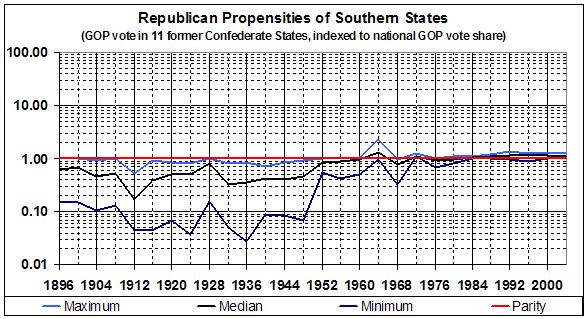
My purpose here isn’t to rehash Yglesias, Glaeser, and Douthat, but to tell the tale of the numbers. Specifically, I look at the share of popular votes garnered by GOP presidential candidates in the 11 States of the former Confederacy, in relation to the GOP candidates’ shares of the national popular vote. For example, the GOP candidate in 1944 (Thomas E. Dewey) garnered 17 percent of the popular vote in Texas; Dewey’s nationwide popular-vote share in that election was 46 percent. The index for the Texas vote for 1944 is therefore 0.37 (17 percent divided by 46 percent).

Here are the maximum, minimum, and median values for the 11 States, from the election of 1896 through the election of 2004:

As Reconstruction ended in the South, Democrats gradually reasserted political control and began to suppress the black vote, which had been heavily Republican. The suppression of the black vote was, by 1904, as complete as it would be, and the median value of 0.46 reflects that. (The dip in 1912 reflects the siphoning of GOP votes by Teddy Roosevelt’s potent third-party candidacy, which relegated the GOP to an ignominious third place in the popular and electoral vote counts.)

The median value remained at or below 50 percent through 1948, with the exception of 1928, when the Democrat candidate was Al Smith, a Roman Catholic. (The pro-GOP spike in 1928 suggests that about half of the South’s Democrats defected because of Smith’s Catholicism.) The noticeable dip from 1932 through 1944 points to the vein of Southern populism that was exploited by Democrats’ anti-capitalist rhetoric. (See, for example, this post about FDR and this Wikipedia entry about Louisiana’s Huey Long.)

Southern voters began to abandon the Democrat Party in 1948, when Strom Thurmond ran under the banner of the “Dixiecrat” Party. That party (formally, the States’ Rights Democratic Party) arose in response to the national party’s adoption of an anti-segregation plank at its convention. Thurmond was on the ballot in 17 States, but most of his support came from the 11 former Confederate States. He garnered only 2.4 percent of the popular vote, nationwide, but carried four Southern States — Louisiana, Mississippi, Alabama, and South Carolina. Thurmond’s victories there, and his good showing in several other Southern States, came at the expense of the Democrat Party’s nominee, Harry Truman, and do not show up as a gain for the GOP in 1948.

Having nowhere else to turn in 1952, many Southern Democrats defected to the GOP, and continued to do so in 1960, when the Democrat Party chose John F. Kennedy (a Catholic in name) as its presidential candidate.

Before you conclude that the GOP is strong in today’s South because of the events of 1948 and 1960, consider these points:

1.What Krugman conveniently ignores in his anti-Republican screed is the South’s long embrace of the Democrat Party, for blatantly racial reasons. Democrats Woodrow Wilson and FDR — who held the presidency for 20 of the first 45 years of the twentieth century — enjoyed strong support in the South and were, therefore, segregationist in their policies. Southern Democrats disproportionately voted for FDR and his New Deal, about which Krugman’s only complaint could be that it wasn’t socialistic (or fascistic) enough.

2. The South’s defection to the GOP peaked in 1964, the year of Barry Goldwater’s inglorious defeat — another “lost cause” for the South. Goldwater, who was anything but a segregationist, simply had strong views about the proper role of the federal government in relation to the States, namely, that it should butt out of the affairs of individuals and businesses. Such views were then more widely embraced in the South than in the North, and had as much to do with the South’s Jeffersonian tradition as with racial segregation.

3. The GOP’s grip on the South has, if anything, weakened since 1964. Whatever Richard Nixon and Ronald Reagan might have done to woo Southern voters did not cause those voters to flock to the Republican Party. Barry Goldwater’s conservatism caused that.

4. What about the sharp drop in Southern support for the GOP in 1968? That drop coincides with George Wallace‘s segregationist, third-party candidacy in 1968. Krugman would say: “Aha! That defection, and the GOP’s recovery from it in 1972 (when Wallace was out of the picture), demonstrates that the GOP depends (or depended) heavily on the Southern racist vote.” Not so fast, Paul: Southern Democrats defected to George Wallace in 1968 at the same rate as Southern Republicans.

5. Why was it legitimate for a super-majority of white Southerners to support the New Deal out of desperation, but illegitimate for many of them (and their children) to turn, years later, to a party more in tune with their conservative inclinations? The South merely has become the North in reverse: strongly Republican (as the North is strongly Democrat) for reasons of ideology, not of race. On that point, here is a harder-to-read but more accurate depiction of the South’s attachment (or lack thereof) to the Republican Party:

In sum, it is plain that the South’s attachment to the GOP since 1964, whatever its racial content, is much weaker than was the South’s attachment to the Democrat Party until 1948, when there was no question that that attachment had a strong (perhaps dominant) racial component.

Krugman’s condemnation of racial politics in a major political party comes 60 years too late, and it’s aimed at the wrong party.

Case closed.

* * *
Krugman’s real complaint, of course, is that Republicans have been winning elections far too often to suit him. His case of Republican Derangement Syndrome is so severe that he can only pin the GOP’s success on racism. I will refrain from references to Freud and Pinocchio and note only that Krugman’s anti-GOP bias seems to have grown as his grasp of economics has shrunk:

Krugman and DeLong: A Prevaricating Pair
Professor Krugman Flunks Economics
Paul Krugman, an Inspiration to Us All
Social Security: Myth and Reality
The Last(?) Word about Income Inequality
Krugman and Monopoly
Rich Voter, Poor Voter: Revisited
Setting the Record Straight about Paul Krugman’s “Who Was Milton Friedman?”
Krugman vs. Krugman


"The War": A Second Reaction

I have now watched the first three episodes of Ken Burns’s The War. The second episode reinforced my reaction to the first episode:

War is not glorified (nor should it be), but Burns makes a strong case that war can be necessary — contrary to the anti-war mantra that substitutes for thought on the Left.

The War illustrates that, however necessary a war, victory may be attainable only at a very high price. (That illustration is especially valuable for the generations whose only war was the seemingly quick-and-easy Gulf War of 1990-91.) The War also makes the case, graphically, that there can be no alternative but to pay that very high price when one is faced with brutal, fanatical enemies.

The third episode further supports that view. But the third episode also spends a lot of time on issues with racial dimensions; specifically:

  • “the forced removal and internment of approximately 120,000 Japanese and Japanese Americans (62 percent of whom were United States citizens) from the West Coast of the United States during World War II.” (Wikipedia)
  • government-enforced racial segregation in the armed forces (and, sometimes, among workers in defense plants), against a backdrop of racial tension.

The internment of Japanese and Japanese Americans remains controversial. I have no doubt that racial hatred (inflamed by the attack on Pearl Harbor) enabled the decision to remove Japanese nationals and persons of Japanese origin and descent from the West Coast. But The War neglects to mention the military considerations that justified the action. (See these three posts, for example.) The War, in other words, engages in the kind of second-guessing eschewed by the U.S. Supreme Court when it opined in the case of Korematsu v. United States (1944). Justice Black, writing for the 6-3 majority:

To cast this case into outlines of racial prejudice, without reference to the real military dangers which were presented, merely confuses the issue. Korematsu was not excluded from the Military Area because of hostility to him or his race. He was excluded because we are at war with the Japanese Empire, because the properly constituted military authorities feared an invasion of our West Coast and felt constrained to take proper security measures, because they decided that the military urgency of the situation demanded that all citizens of Japanese ancestry be segregated from the West Coast temporarily, and finally, because Congress, reposing its confidence in this time of war in our military leaders — as inevitably it must — determined that they should have the power to do just this. There was evidence of disloyalty on the part of some, the military authorities considered that the need for action was great, and time was short. We cannot — by availing ourselves of the calm perspective of hindsight — now say that at that time these actions were unjustified.

It is right to give time to the internment; it was a significant (and temporary) event arising out of our prosecution of the war. But it is wrong to give a one-sided presentation of that event.

The segregation of blacks — and black-white conflict — on the other hand, were nothing new in America. Racial segregation had been (and would remain, for some years), a government policy. Would it have been too much to expect a government that was battling ferocious enemies abroad to take time out to desegregate the armed forces, desegregate civilian life, and deal with the resulting racial conflict (of which there was already enough)? The short answer is “yes.” That is not to excuse government-sponsored and government-enforced segregation. It is simply to call, once again, for perspective and balance, which The War does not offer. A viewer lacking historical perspective (and there are many out there) might well conclude that segregation and racial tension arose from the war effort.

The War redeems itself, to some extent, by giving expression (perhaps too subtly) to these truths: However imperfect the United States of 1941-45, it was far more perfect than its militaristic, inhumane enemies. Americans of Japanese and African descent could hope for (and would realize) a better future here; they could have had no such hope for a world dominated by Japan and Germany.

And Your Point Is?

Jim Harper (Cato-at-Liberty) says:

The story [this story: LC] says that unlicensed driving dropped by a third when New Mexico de-linked driver licensing and immigration status. Actually, unlicensed driving dropped by two thirds, from 33% to 11%, lower than the national average.

Which means that a lot of illegal aliens are driving legally in New Mexico. Is that supposed to be a good thing?

Friday’s Best Reading

Links and excerpts:

The Laffer Curve Straw Man,” by Daniel Mitchell (Cato-at-Liberty)

The real issue is whether certain changes in tax policy will have some impact on economic activity. If an increase (decrease) in tax rates changes behavior and causes a reduction (increase) in taxable income, then revenues will not rise (fall) as much as “static” revenue-estimating models would predict. This is hardly a radical concept, and evidence of Laffer-Curve effects is very well established in the academic literature.

Sociologists Discover Religion,” by Heyecan Veziorglu (campusreportonline.net)

Associate Professor Dr. Jeffrey Ulmer from Pennsylvania State University examines the degree to which religiosity increases self-control. He points out that religious observance builds self-control and substance use is lower in stronger moral communities.

Eminent Scientist Censored for Truth-Telling [about genes and IQ],” by John J. Ray (Tongue Tied 3)

…There is no inconsistency in saying that blacks as a whole are less intelligent while also acknowledging that some individual blacks are very intelligent. What is true of most need not be true of all.

Scientists have spent decades looking for holes in the evidence [Dr. James] Watson [of DNA fame] was referring to but all the proposed “holes” have been shown not to be so. There is NO argument against his conclusions that has not been meticulously examined by skeptics already. And all objections have been shown not to hold up. There is an introduction to the studies concerned here.

Some commentators have mentioned that old Marxist propagandist, Stephen Jay Gould, as refuting what Watson said. Here is just one comment pointing out what a klutz Gould was. And for an exhaustive scientific refutation of Gould by an expert in the field, see here. [Highly recommended: LC.] Gould’s distortions of the facts really are quite breathtaking.

Hanson Joins Cult,” by Robin Hanson (Overcoming Bias)

Rumors of a weird cult of “Straussians” obsessed with hidden meanings in classic texts have long amused me. Imagine my jaw-dropping surprise then to read an articulate and persuasive Straussian paper by Arthur Melzer in the November Journal of Politics:

Leo Strauss…argued that, prior to the rise of liberal regimes and freedom of thought in the nineteenth century, almost all great thinkers wrote esoterically: they placed their most important reflections “between the lines” of their writings, hidden behind a veneer of conventional pieties. They did so for one or more of the following reasons: to defend themselves from persecution, to protect society from harm, to promote some positive political scheme, and to increase the effectiveness of their philosophical pedagogy….

Melzer convinced me with data:

By now we have seen a good number of explicit statements by past thinkers acknowledging and praising the use of esoteric writing for pedagogical purposes. What is perhaps even more striking in this context is that I have been unable to find any statements, prior to the nineteenth century, criticizing esotericism for the aforementioned problem, or indeed for any other.

This great transition is my best bet for the essential change underlying the industrial revolution:

In The Flight from Ambiguity, the distinguished sociologist Donald Levine writes: “The movement against ambiguity led by Western intellectuals since the seventeenth century figures as a unique development in world history. There is nothing like it in any premodern culture known to me”. This remarkable transformation of our intellectual culture was produced by a variety of factors, but most obviously by the rise of the modern scientific paradigm of knowledge which encouraged the view that, in all fields, intellectual progress required the wholesale reform of language and discourse, replacing ordinary parlance with an artificial, technical, univocal mode of communication

Modern growth began when enough intellectuals gained status not from ambiguity but from clarity, forming a network of specialists exchanging clear concise summaries of new insights.

Racism among the Deracinated

John Ray points to a story at Telegraph.co.uk:

Student’s ‘English bash’ deemed racist

A student at a university that prides itself on being among the most multicultural in Britain has been branded “racist” after distributing invitations to an “English party”.

Rugby captain Timothy McLellan has been forced to apologise after pinning up posters around the campus promising the event would have “no bongos, shisha pipes or Arabic music”.

The 20-year-old law student had intended the flyer to be a joke poking fun at parties held at the School of Oriental and African Studies in London, which typically have an ethnic theme.

McLellan apologized, of course, saying (in part):

The choice of the word ‘English’, which I now regret, was not intended to mean that it was a party for white English students but was rather intended to express that the party’s vibe reflected England’s mainstream culture, which in itself is not racially exclusive.

Well, mainstream English culture may or may not be “racially exclusive,” but it is (as McLellan clearly implies) substantially different than the cultures celebrated at the School of Oriental and African Studies.

The incident reminds me of one that I witnessed 25 years ago, when I was, for a while, taking a bus to work. The regular bus driver was a white gentleman of Southern extraction. Most of the passengers were Asians and West Indian blacks who attended a community college located near a stop toward the end of the bus route. My stop was the last one on the route.

It was usual for everyone on the bus but me to disgorge at the stop located near the community college. One day, after the students has swarmed from the bus, the driver turned to me and said “I think I’ll go to Germany, where I can see some Americans.” (This was, of course, before the Muslim invasion of Western Europe.)

I understand what the bus driver felt, just as I sympathize with Timothy McLellan. There is — or was — a mainstream American culture,* just as there is — or was — a mainstream English culture. It is now de rigeur to deride those cultures and to say that their proponents and practitioners are insensitive racists. What does that make the proponents and practitioners of sub-cultures and imported cultures, especially those whose aim is the overthrow of the mainstream culture?

Mainstream Americans and Englishmen, arise. Shake off your apologetic airs. Assert your cultural pride. Illegitimi non carborundum.
_________
* The American mainstream was: upper lower-class (i.e., non-redneck) to upper middle-class; against welfare (charity was for the helpless and hopeless, and it began at home); for punishment (as opposed to excuses about poverty, etc.); overtly religious or respectful of religion (and, in either case, generally respectful of the last six of the Ten Commandments); personally responsible (stuff happens, and it’s rarely someone else’s fault); polite and helpful to strangers; patriotic (the U.S. was better than other countries and not beholden to international organizations, wars were to be fought to victory); and anti-socialist (being anti-communist was a given). Racist views, to the extent they were held, were expressed only to people one knew well (and who were of a like mind); such views were not acted upon violently or even impolitely. The “f” word and similar expletives were closeted, as well. Homosexuality and “shacking up” were disgraceful novelties, not “lifestyles” to be venerated.

Mainstream Americans might have been white or black, Christian or Jewish, rural or urban, college-educated or not, but the mainstream was wide. I knew mainstreamers well. They were to be found on main street, in side streets, and even in universities — often among the faculty. They abounded in public education, where they taught mainstream values.

The mainstream began to dry up when universities began to spew forth “educators” whose beliefs run contrary to those recited above (i.e., for welfare, against punishment, etc., etc., etc.). Those “educators” have long since done the bidding of anti-mainstream élites, in and out of academia. Thus the mainstream is now a relative trickle in an arid valley of Leftist sentiments, which have become so commonplace that they are parroted even by persons who do not consider themselves Leftists.

A Century of Regress

If this is true, so is this.

Let Me Be Perfectly Clear…

…about “black redneck culture,” which I have addressed in earlier posts (e.g., here and here). It is a possible explanation for the persistent black-white achievement gap. (There is also IQ.) But blacks certainly do not dominate the boisterous, live-for-today, take-what-you-can-from-the-man, in-your-face, quick-to-take-offense, often-violent “lifestyle” that is summarized in the term “black redneck culture.” White redneck culture is all too prevalent.

White redneck culture is not, as depicted in the following passage, restricted to the rural poor:

Rednecks typically are more libertine, especially in their personal lives, than other country brethren who tend towards social conservatism. In contrast to country people, stereotypical rednecks tend not to attend church, or do so infrequently. They also tend to use alcohol and gamble more than their church-going neighbors.

Redneck culture is no longer dominated by “rural poor to working-class people of rural extraction.” It is alive and flourishing among whites of all socio-economic classes and in all locales: from small towns to large metropolitan areas.

The prevalence of redneck culture — black, white, and tan — is evident in popular culture. Look at what’s offered and imbibed avidly via TV (both network and cable), movie theaters, CDs and DVDs, video games (or whatever they’re called now), shopping malls, and professional sporting events (most notably basketball). Noise, violence, vulgarity, profanity, and prurience prevail, usually all at the same time.

Redneck culture has these essential — and socially destructive — characteristics: disregard for other persons and their property, indolence, a sense of entitlement (as if in compensation for the effects of indolence), a ready acceptance of myths and prejudices in place of facts and reason, a sneering attitude toward education and hard work, and (thus) a tendency to “live for today and let tomorrow take care of itself.”

Liberty, which depends upon mutual restraint, cannot survive in a redneck milieu: a culture of moral anarchy which invites totalitarianism. The spread of redneck culture further encourages the emergence of totalitarianism because rednecks (of whatever race, class, and clime) are seduced easily by “bread and circuses” — and perhaps by the promise of “freehealth care.

(I am indebted to my son for a crystallizing conversation on this topic.)

A Footnote to a Footnote

In “A Footnote…” I say this about black Americans’ persistent achievement deficit:

If East Asians and Azhkenazic Jews could rise to the top of the IQ charts, as they have, why can’t blacks rise too? [Thomas] Sowell would answer [e.g., here] that they could rise, if only they would break the bonds of the “black redneck” culture, which hinders so many of them. The law cannot break those bonds, for, as Sowell argues, the law only reinforces those bonds by making blacks dependent on the affirmative action, welfare programs, and other “white liberal” contrivances.

Whether blacks can break the bond of “black redneck” culture, is a good question. (Though, even if they could, it might not improve* their relative economic standing, on the whole.) Kerwin Kofi Charles, Erik Hurst, and Nikolai Roussanov, writing in an NBER working paper (“Conspicuous Consumption and Race“), say:

A large body of anecdotal evidence suggests that Blacks devote a larger share of their overall expenditure to consumption items that are readily visible to outside observers than do Whites. Automobiles, clothing, and jewelry are examples of these forms of “visible” consumption. There has to date, however, been little formal analysis by economists of the degree to which these racial differences in consumption patterns actually exist in the data, what accounts for them if they do, and what the consequences of any such differential expenditure might be. We address these questions in this paper.

The first part of our paper documents differences by race in expenditures devoted to visible consumption items. Using data from the Consumer Expenditure Survey (CEX) from the period of 1986-2002 [sample here: LC], we show that although, unconditionally, racial minorities and Whites spend approximately the same fraction of their resources on visible consumption, Blacks and Hispanics spend about thirty percent more on visible goods, after accounting for differences in permanent income. These expenditure differences are found within all sub-groups, except older households.

We find that these racial gaps have been relatively constant over the past seventeen years. And, we show that spending on housing or differential treatment in the housing market cannot explain these patterns. Finally, the gaps are economically large: the absolute level annual dollar differential for visible consumption is on the order of $2300, which is a non-trivial quantity given Black and Hispanic average income.

Because household spending must satisfy an inter-temporal budget constraint, spending devoted to visible consumption must be diverted from some alternative use. Reduced spending on specific types of current consumption on the one hand and lower savings (future consumption) on the other are the two possibilities. We show that the higher visible spending of racial minorities seems to come out of both future consumption and all other categories of current consumption: Blacks consume less than Whites in essentially every other expenditure category (aside from housing) to maintain higher visible consumption….

Strikingly, we find that, consistent with the status argument, there is a strong negative association between visible spending and the mean income of one’s reference group within all races….

We then turn to the obvious next step: Do differences in…income explain the racial expenditure gaps that are our main focus? In a series of regressions, we show that accounting for [relative income] explains most of the racial gap in visible spending…

Controlling for the mean income of one’s reference group at the state/race level dramatically reduces the measured difference in wealth holdings between similar Blacks and Whites. Specifically, roughly 60% of the unexplained racial gap in wealth holdings after controlling for permanent income and demographics is accounted for by average differences in reference group income…[I]t does appear that the mechanism that leads Blacks to consume more conspicuous
goods than their White counter parts could also explain some of the well documented Black-
White wealth gap.

So, the propensity for visible (exhibitionist) consumption varies inversely with socio-economic status. But, socio-economic status explains only 60 percent of the black-white wealth gap. That leaves a lot of room for the influence of “black redneck” culture. My question stands: Can blacks (on the whole) break the bonds of “black redneck” culture?
__________
* This is a subtle reference to inherent racial differences in IQ, which I examine at length in the linked post. Following the lead of Arnold Kling, I hereby abandon subtlety.

I further direct you to this post by John Ray.

Liberal Condescension…

…by Hillary Clinton. Nailed by Walter Williams.

It’s the Little Things That Count

From World Science:

A re­nowned sci­ent­ist has backed off a find­ing that he, joined by oth­ers, long touted as ev­i­dence for what they called a prov­en fact: that ra­cial dif­fer­ences among peo­ple are im­ag­i­nary.

That idea—en­trenched to­day in ac­a­dem­ia, and of­ten used to cast­i­gate schol­ars who study race—has drawn much of its sci­en­tif­ic back­ing from a find­ing that all peo­ple are 99.9 per­cent ge­net­ic­ally alike.

But ge­net­icist Craig Ven­ter, head of a re­search team that re­ported that fig­ure in 2001, backed off it in an an­nounce­ment this week. He said hu­man varia­t­ion now turns out to be over sev­en times great­er than was thought, though he’s not chang­ing his po­si­tion on race.

Some oth­er sci­ent­ists have dis­put­ed the ear­li­er fi­gure for years as un­der­est­i­mat­ing hu­man va­ri­ation. Ven­ter, in­stead, has cit­ed the num­ber as key ev­i­dence that race is im­ag­i­nary. He once de­clared that “no se­ri­ous schol­ar” doubts that, though again, some re­cent stud­ies have con­tra­dicted it.

Whether people are 99.9 percent alike, 99 percent alike, or 9 percent alike isn’t (or shouldn’t be) the question. The question is: What are the systematic differences between groups of people, and how do those differences reveal themselves in such things as intelligence, physical skills, and culture?

Suppose that I (a white male of French-English-Scots-Irish-German descent) possess a genome that is, in 99.995 percent of its particulars, the same as that of, say, Frankie Frisch (a Hall of Famer who was, in his prime, about my height and weight). Why couldn’t I have become a Hall of Famer like Frisch? I had good upper body strength, could run fast, had good hand-eye coordination, could throw far and accurately, etc. I have loved baseball since I was about six years old, and — as an adolescent — played PONY Baseball to the best of my ability.

But my ballplaying ability was (and is) limited by an eye condition that keeps me from focusing well enough to hit a baseball, unless it is thrown rather slowly by the standards of professional baseball. The condition also hinders my ability to track a fly ball. (I am hopeless when it comes to tracking a golf shot of mine that travels more than about 150 yards.) Eyeglasses help, but not enough. Contact lenses are out of the question, given the nature of my condition.

So, perhaps one gene out of the 20,000-25,000 in my genome kept me from becoming a professional ballplayer — possibly even a Hall of Famer. What’s one gene? Well, if I possess 20,000 genes, then I probably have 99.995 percent of the genes required to a good-to-great ballplayer. But what counts, in this case, is that other 0.005 percent.

Related post: Positive Rights and Cosmic Justice: Part IV

Right On!

Linking Immigration and Poverty,” by Robert J. Samuelson, supports this and this.