Baseball Managers: A Recyclable Commodity?

It’s a commonplace that major league managers are fired by one team only to be hired by another. The managerial history of the current crop of managers is given below. Here’s an overview:

  • 12 of the 30 managers have managed only 1 team
  • 9 have managed 2 different teams
  • 6 have managed 3 different teams
  • 3 have managed 4 different teams.

A closer look:

  • 40 percent (12) of the present managers have managed only 1 team
  • the other 60 percent (18) have managed an average of 2-2/3 different teams (a total of 48 managing stints)
  • 8 of those 48 managing stints have spanned 10 or more seasons; 17 stints have spanned 5 or more seasons
  • the 18 team-switching managers have switched 30 times (1-2/3 times per manager)
  • the average gap between stints has been 3 seasons
  • 40 percent (12) of the switches were immediate (during a season or in consecutive seasons)
  • the immediate switches involved 50 percent (9) of the managers who have managed 2 or more teams.

Are major-league managers a recyclable commodity? I report, you decide.
__________

The managers and their teams and seasons (including partial seasons):

Felipe Alou

Montreal Expos, 1992-2001
San Francisco Giants, 2003-

Dusty Baker

San Francisco Giants, 1993-2002
Chicago Cubs, 2003-

Buddy Bell

Detroit Tigers, 1996-1998
Colorado Rockies, 2000-2002
Kansas City Royals, 2005-

Bruce Bochy

San Diego Padres, 1995-

Bobby Cox

Atlanta Braves, 1978-1981
Toronto Blue Jays, 1982-1985
Atlanta Braves, 1990-

Terry Francona

Philadelphia Phillies, 1997-2000
Boston Red Sox, 2004-

Ron Gardenhire

Minnesota Twins, 2002-

Phil Garner

Milwaukee Brewers, 1992-1999
Detroit Tigers, 2000-2002
Houston Astros, 2004-

Joe Gerardi

Florida Marlins, 2006-

John Gibbons

Toronto Blue Jays, 2004-

Ozzie Guillen

Chicago White Sox, 2004-

Mike Hargrove

Cleveland Indians, 1991-1999
Baltimore Orioles, 2000-2003
Seattle Mariners, 2005-

Clint Hurdle

Colorado Rockies, 2002-

Tony LaRussa

Chicago White Sox, 1979-1985
Oakland Athletics, 1985-1995
St. Louis Cardinals, 1996-

Jim Leyland

Pittsburgh Pirates, 1986-1996
Florida Marlins, 1997-1998
Colorado Rockies, 1999
Detroit Tigers, 2006-

Grady Little

Boston Red Sox, 2002-2003
Los Angeles Dodgers, 2006-

Ken Macha

Oakland Athletics, 2003-

Joe Maddon

California/Anaheim Angels, 1996, 1999
Tampa Bay Devil Rays, 2006-

Charlie Manuel

Cleveland Indians, 2000-2002
Philadelphia Phillies, 2005-

Bob Melvin

Seattle Mariners, 2003-2004
Arizona Diamondbacks, 2005-

Jerry Narron

Texas Rangers, 2000-2001
Cincinnati Reds, 2005-

Sam Perlozzo

Baltimore Orioles, 2005-

Willie Randolph

New York Mets, 2005-

Frank Robinson

Cleveland Indians, 1995-1997
San Francisco Giants, 1981-1984
Baltimore Orioles, 1988-1991
Montreal Expos/Washington Nationals, 2002-

Mike Scioscia

Anaheim/Los Angeles Angels, 2000-

Buck Showalter

New York Yankees, 1992-1995
Arizona Diamondbacks, 1998-2000
Texas Rangers, 2003-

Joe Torre

New York Mets, 1977-1981
Atlanta Braves, 1982-1984
St. Louis Cardinals, 1990-1995
New York Yankees, 1996-

Jim Tracy

Los Angeles Dodgers, 2001-2005
Pittsburgh Pirates, 2006-

Eric Wedge

Cleveland Indians, 2003-

Ned Yost

Milwaukee Brewers, 2003-
The Impossibility of a Perfect Game

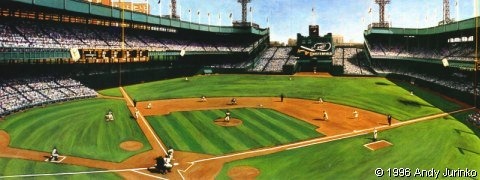
A “perfect game” in baseball is said to be one in which no batter for one of the teams reaches base safely in the course of nine innings (or more), all of which are pitched by the same pitcher for the other team. A “perfect game,” in other words, is perfect only from the standpoint of one team — the team that does not allow an opposing batter to reach base safely. The pitcher for that team is credited with pitching a “perfect game,” even though the attainment of “perfection” depends as much on the other players on the field as it does on the pitcher.

In sum, the traditional “perfect game” is a mark of defensive success and offensive failure. That strikes me as a wrong-headed way of defining perfection in a sport where the object is to win by outscoring the other side. A perfect offensive game — from the standpoint of one team — would be one in which none of its batters is ever retired. And a doubly perfect offensive game — from the standpoint of both teams — would be one in which no batter from either side is ever retired.

But neither a perfect offensive game nor a doubly perfect offensive game is possible — given the present rules of baseball — because the teams would never complete the first inning. A perfect offensive game might go into the bottom of the first inning, but it could never go beyond that; that is, if the team that bats in the top of the first inning (the visiting team) is retired, the team that bats in the bottom of the first inning (the home team) would never be retired. A doubly perfect offensive game would never reach the bottom of the first inning because the visiting team would never be retired.

A perfect or doubly perfect offensive game is therefore impossible because, under the present rules of baseball, a game isnt’ “a game” unless it lasts at least five innings (four and one-half if the home team is leading after the top of the fifth inning). Or, to put it another way, a perfect or doubly perfect offensive game is a pardoxical concept:

  • Such a game requires that at least one side is never retired.
  • If one side is never retired, the game cannot be completed.
  • If the game is not completed it cannot be counted as a perfect game.

Who’s on first?

Baseball Expansion

In a recent post I outlined a scheme for realigning major league baseball. The scheme includes an expansion of the number of major league teams by 2 from the present number of 30. “Aaagh,” yell the knee-jerk purists (as opposed to the thoughtful purists, like me), “expansion dilutes the quality of the game.”

That’s true only in the sense that the quality of the game wouldn’t be what it could be in the absence of expansion. But expansion doesn’t dilute the quality of the game if expansion keeps pace with population growth. (I take population as a reasonable index of the number of persons who are able to play baseball at a given level of skill, given that 32 teams would require only 800 players, out of a population of 300,000,000 — and growing.)

The population of the United States in 2006 is about twice the population of the United States in 1950. There were 16 major league teams in 1950. Twice 16 is 32. Q.E.D.

Home Run Kings

There are many ways to compare performances in baseball. The most common way to compare home-run hitters is by the number of home runs compiled in a career or in a season. With Barry Bonds in (perhaps futile) pursuit of Hank Aaron’s career home-run record, there is renewed attention to question of the “greatest” home-run hitter of all time. Here’s the usual list of the top-10 home run hitters, through the 2005 season, with relevant embellishments:

1. Most Regular-Season Home Runs, Career

Player

Years

Times led league in HR

Total HR

Total AB

HR per AB

Hank Aaron

1954-1976

4

755

12,364

0.061

Babe Ruth

1914-1935

12

714

8,398

0.085

Barry Bonds

1986-2005

2

708

9,140

0.077

Willie Mays

1951-1973

4

660

10,881

0.061

Sammy Sosa

1989-2005

2

588

8,401

0.070

Frank Robinson

1956-1976

1

586

10,006

0.059

Mark McGwire

1986-2001

4

583

6,187

0.094

Harmon Killebrew

1954-1975

6

573

8,147

0.070

Rafael Palmeiro

1986-2005

0

569

10,472

0.054

Reggie Jackson

1967-1987

4

563

9,864

0.057

The right column of Table 1 (home runs per at-bat) gives away one of the shortcomings of looking at total home runs; namely, that statistic recognizes longevity as much as it does prowess. Let’s look, instead, at career leaders ranked by home runs per at-bat, first including active players under the age of 40 (Table 2) and then excluding them (Table 3):

2. Most Regular-Season Home Runs per At-Bat, Career*

Player

Years

Times led league in HR

Total HR

Total AB

HR per AB

Mark McGwire

1986-2001

4

583

6,187

0.094

Babe Ruth

1914-1935

12

714

8,398

0.085

Barry Bonds

1986-2005

2

708

9,140

0.077

Jim Thome

1991-2005

1

430

5,919

0.073

Manny Ramirez

1993-2005

1

435

6,126

0.071

Ralph Kiner

1946-1955

7

369

5,205

0.071

Harmon Killebrew

1954-1975

6

573

8,147

0.070

Sammy Sosa

1989-2005

2

588

8,401

0.070

Alex Rodriguez

1994-2005

4

429

6,195

0.069

Ken Griffey Jr.

1989-2005

4

536

7,870

0.068

* Includes active players with a minimum of 3,000 plate appearances.

3. Most Regular-Season Home Runs per At-Bat, Career*

Player

Years

Times led league in HR

Total HR

Total AB

HR per AB

Mark McGwire

1986-2001

4

583

6,187

0.094

Babe Ruth

1914-1935

12

714

8,398

0.085

Barry Bonds

1986-2005

2

708

9,140

0.077

Ralph Kiner

1946-1955

7

369

5,205

0.071

Harmon Killebrew

1954-1975

6

573

8,147

0.070

Sammy Sosa

1989-2005

2

588

8,401

0.070

Ted Williams

1939-1960

4

521

7,706

0.068

Dave Kingman

1971-1986

2

442

6,677

0.066

Mickey Mantle

1951-1968

4

536

8,102

0.066

Jimmie Foxx

1925-1945

4

534

8,134

0.066

* Includes only those active players who are 40 years of age or older.

Tables 2 and 3 give a better indication of prowess than Table 1, but they do not take into account how the game of baseball has changed with time. A way to do that is to see how often a player excelled at hitting home runs, relative to his peers:

4. Most Seasons Leading League in Home Runs*

Player

Years

Times led league in HR

Total HR

Total AB

HR per AB

Babe Ruth

1914-1935

12

714

8,398

0.085

Mike Schmidt

1972-1989

8

548

8,352

0.066

Ralph Kiner

1946-1955

7

369

5,205

0.071

Harmon Killebrew

1954-1975

6

573

8,147

0.070

Mel Ott

1926-1947

6

511

9,456

0.054

Mark McGwire

1986-2001

4

583

6,187

0.094

Alex Rodriguez

1994-2005

4

429

6,195

0.069

Ted Williams

1939-1960

4

521

7,706

0.068

Ken Griffey Jr.

1989-2005

4

536

7,870

0.068

Mickey Mantle

1951-1968

4

536

8,102

0.066

Jimmie Foxx

1925-1945

4

534

8,134

0.066

Hank Greenberg

1930-1947

4

331

5,193

0.064

Willie Mays

1951-1973

4

660

10,881

0.061

Hank Aaron

1954-1976

4

755

12,364

0.061

Reggie Jackson

1967-1987

4

563

9,864

0.057

Johnny Mize

1936-1953

4

359

6,443

0.056

Hack Wilson

1923-1934

4

244

4,760

0.051

Chuck Klein

1928-1944

4

300

6,486

0.046

Cy Williams

1912-1930

4

251

6,780

0.037

* Excludes players who compiled most of their at-bats before 1920.

The criterion used in Table 4 still falls short because it doesn’t take into account home-run frequency, which — as I suggest above — is a better indicator of prowess. Thus this comparison:

5. Most Seasons Leading League in Home Runs per At-Bat*

Player

Seasons

Times led league in HR/AB

Total HR

Total AB

HR/AB

Babe Ruth

1914-1935

13

714

8,398

0.085

Mel Ott

1926-1947

10

511

9,456

0.054

Mark McGwire**

1986-2001

8

583

6,187

0.094

Barry Bonds

1986-2005

8

708

9,140

0.077

Ralph Kiner

1946-1955

7

369

5,205

0.071

Harmon Killebrew

1954-1975

6

573

8,147

0.070

Ted Williams

1939-1960

6

521

7,706

0.068

Mike Schmidt

1972-1989

6

548

8,352

0.066

Willie McCovey

1959-1980

5

521

8,197

0.064

Cy Williams

1912-1930

5

251

6,780

0.037

Manny Ramirez

1993-2005

4

435

6,126

0.071

Jimmie Foxx

1925-1945

4

534

8,134

0.066

Willie Mays

1951-1973

4

660

10,881

0.061

* Excludes players who compiled most of their at-bats before 1920.

** McGwire switched leagues during the 1997 season. His totals for the entire season gave him a better HR/AB record than the official leader in either league. I have therefore credited McGwire with leading in HR/AB 8 times, as against his official record of leading 7 times.

There we have it, dominance against one’s peers by a purer measure of prowess: home runs per at-bat in a season. Even purer measures are possible. As a Sabermetrician would tell you, seasonal performance should be adjusted for the characteristics of the ballparks a player played in, for the quality of the teams he played on (relative to the opposition), the equipment, the rules (e.g., height of the pitching mound), and so on.

Such adjustments might, for example, knock Mel Ott from his second-place perch because Ott (a left-handed batter) played his entire career (about one-half of his games) at the Polo Grounds, with its short foul lines (only 258 feet down the right-field line) and cavernous center field:

But Ott had to pull the ball sharply to take advantage of the peculiar geometry of the Polo Grounds, which meant that he had to adopt and perfect a peculiar batting style (a matter of skill). Because of that style, pitchers could more easily avoid throwing him pitches that he could pull, and fielders could more readily position themselves to defend the outfield gaps. In spite of that, Ott compiled a lifetime batting average of .304 while leading his league in HR/AB 10 times! Ott stays on the list, as do the other odd-balls:

  • Barry Bonds and Mark McGwire, with their weight-training and performance-enhancing substances.
  • Cy Williams, a left-handed batter who compiled a lot of his home runs in the friendly confines of Baker’s Bowl, with its “short porch” in right field — only 280 feet down the line, and not much more than that into right-center:

But Willams wasn’t a fluke. He led his league in AB/HR five times in a 12-season span (1916-1927), and batted .292 over the course of his career, almost half of which was in the “dead ball” era.

It’s impossible, really, to compare players who were not contemporaries. That’s why I like Table 5. It affords the best picture of home-run prowess across time. Ruth still stands at the top of the list; the long-forgotten Mel Ott and Cy Williams are restored to the prominence they enjoyed when they played; and Ralph Kiner, Harmon Killebrew, Ted Williams, Mike Schmidt, and Willie McCovey re-gain their proper places of pre-eminence, unshadowed by players who racked up home runs through sheer longevity. Should McGwire and Bonds really be listed among the greats? Certainly they were the greats of their era, however they got there. That’s all I have to say about that — for now.

And so, with the help of Table 5, we can trace the succession of pre-eminent home-run hitters who played most or all of their careers in the “lively ball” era:

  • American League — Babe Ruth (13 times in the span from 1918 through 1931), Jimmie Foxx (4 times during 1932-1939), Ted Williams (6, 1941-1957), Harmon Killebrew (6, 1959-1970), Mark McGwire (6, 1987-1997), and Manny Ramirez (4, 1999-2005). Those six players combined to lead the league in HR/AB in 39 of the 88 seasons from 1918 through 2005.

    Go back to hitters who played mostly in the “dead ball” era and you find Frank (Home Run Baker) and Harry Davis, who dominated the AL’s home run lists (such as they were). Davis was a 4-time leader in HR/AB, from 1904 through 1907; Baker, a 4-time leader in the span from 1911 through 1916. Throw in, from the “lively ball” era, Lou Gehrig (2 times), Hank Greenberg (3), Gus Zernial (3), Mickey Mantle (2), Norm Cash (2), Dick Allen (2), Gorman Thomas (2), Reggie Jackson (2), Ron Kittle (2), Jose Canseco (2), Ken Griffey (2), and Jim Thome (2). Now you have a list of 20 players who combined to lead the AL in 73 of the 102 seasons from 1904 through 2005. That’s a select group of fearsome sluggers.

  • National League — Cy Williams (5 times in the span of 1916 through 1927), Mel Ott (10 times, 1929-1944), Ralph Kiner (7, 1947-1952), Willie Mays (4, 1955-1965), Willie McCovey (5, 1963-1970), Mike Scmidt (6, 1974-1986), and Barry Bonds (8, 1992-2004). Those seven players combined to lead the league in HR/AB in 45 of 90 seasons from 1916 through 2005.

    Now add Gavvy Cravath, another name from the “dead ball” era. Cravath — Ruth’s predecessor as all-time leader in total home runs — led the NL in HR/AB 6 times during the seven seasons of 1912 through 1918. Throw in, from the “lively ball” era, Rogers Hornsby (2), Hack Wilson (2), Wally Berger (2), Eddie Matthews (3), Hank Aaron (3), Dave Kingman (3), George Foster (2), Darryl Strawberry (3), and Mark McGwire (2, his 70 and 65 HR seasons) and you have a mere 17 players who combined to lead the NL in 73 of the 94 seasons from 1912 through 2005. Another select group of dominating sluggers.

To see who filled the gaps, go here.

ACKNOWLEDGEMENTS: Players’ statistics from Baseball-Reference.com; ballpark stats and photos from Ballparks by Munsey and Suppes.

Baseball Realignment

If I were the “czar” of Major League Baseball (TM), I would add two teams and create four leagues of eight teams each. Gone would be the designations American League and National League, which have become less and less meaningful with free agency and the standardization of umpiring practices. The remaining distinction that makes a difference — the designated-hitter rule — has been blunted by interleague play, and it would be simple enough for a “czar” to say “make it so” across the board.

My criterion for realignment would be to cluster natural rivalries, which would be a boon to fans and, thus, to owners and players because of greater attendance and media coverage. Think of the New York Giants and Brooklyn Dodgers, subway rivals for decades. Think of the attendance at Yankees-Mets interleague games. Then consider the demands of Peter Angelos, owner of the American League Baltimore Orioles, for compensation because the National League Montreal Expos were relocated to Washington, D.C., a mere 30 miles or so from Baltimore. Having a Baltimore team and a Washington team in the same division wouldn’t be a threat to Baltimore’s attendance, it would be a boon.

Anyway, here’s how I’d realign MLB (current league assignments in parentheses):

Pacific League
Seattle Mariners (A)
Portland ? (new)
San Francisco Giants (N)
Oakland Athletics (A)
Los Angeles Dodgers (N)
Los Angeles Angels (A)
San Diego Padres (N)
Arizona Diamondbacks (N)

Central League
Colorado Rockies (N)
Kansas City Royals (A)
St. Louis Cardinals (N)
Minnesota Twins (A)
Milwaukee Brewers (N)
Chicago Cubs (N)
Chicago White Sox (A)
Detroit Tigers (A)

Northeastern League
Cincinnati Reds (N)
Cleveland Indians (A)
Toronto Blue Jays (A)
Pittsburgh Pirates (N)
Philadelphia Phillies (N)
Boston Red Sox (A)
New York Yankees (A)
New York Mets (N)

Southern League
Texas Rangers (A)
Houston Astros (N)
Baltimore Orioles (A)
Washington Nationals(N)
Charlotte ? (new)
Atlanta Braves (N)
Tampa Bay Devil Rays (A)
Florida Marlins (N)

Yeah, a few old (but not very intense) rivalries would be broken up (e.g., Tigers and Indians, Tigers and Blue Jays), but look at all the new pairings: Mariners and Portland, Giants and As, Angels and Dodgers, Angels and Padres, Royals and Cardinals, Reds and Indians, Indians and Pirates, Yankees and Mets, Rangers and Astros, Orioles and Nationals, Charlotte and the Braves, Devil Rays and Marlins.

A return to eight-team leagues would allow for a shorter regular season. In my ideal MLB, there would be no interleague play until the end of the season, so that each team would play every other team in its league 22 times during the regular season — 11 games at home and 11 games away — just like the good old days from 1901 through 1960. That would reduce the regular season from 162 games to 154 games.

The season would be further shortened by eliminating the (yawn) All-Star Game. So, the season could start in mid-April instead of early April, when so many games are rained-, snowed-, and frozen-out.

Post-season play? Simple:

  • The league champ with the best W-L record faces the league champ with the worst W-L record,* leaving the division champs with the second- and third-best records to face each other. Both series are best-of-seven.
  • In the first round, the team with the better regular-season record is the home team for the first three games and the last two games (as they are necessary).
  • The first-round winners meet in the World Series (best-of-seven, of course). The team with the better regular-season record is the home team for the first three games and the last two games (as they are necessary).

The two-round playoff (vice the present three-round format) would cut a week off the end of the season. Games could be postponed when the weather is truly foul, instead of forcing players and fans to endure cold, rainy nights.

Would postseason play determine the best team? Probably not, for the reasons spelled out here. But my scheme would eliminate the possibility that a World Series could be won by a weak division winner or wild-card team.
__________
* Throughout the playoffs, ties for best/better-worst/worse record are decided by coin tosses.

Ho-Hum

Barr-oid Bonds has tied Babe Ruth’s regular-season home run total of 714. Ruth, assisted only by his over-indulgence in food and drink, compiled his 714 home runs in 8,399 at-bats. In spite of steroids, it took Bonds 9,236 at-bats to hit 714 home runs. That’s about two seasons’ worth of additional at-bats to. Big deal.

P.S. (05/21/06): On September 30, 2004 (“Back to Baseball — Hyping the Heroes“), I wrote:

Remember when Hank Aaron broke Babe Ruth’s all-time home run record by hitting his 715th? Well, Ruth hit 714 in 8,399 official at-bats. By the time Aaron got to 714 home runs he already had more than 11,000 official at-bats.

Then there was Pete Rose eclipsing Ty Cobb’s all-time record for base hits. Rose surpassed Cobb’s record (4,191 hits) but it took him about 2,400 additional at-bats in which to do the trick. That’s why Rose’s lifetime batting average is only .303 to Cobb’s .367.

Aaron hit 41 more home runs than Ruth in about eight seasons’ worth of at-bats, and Rose “amassed” 65 more hits than Cobb in about four seasons’ worth of at-bats.

Triple ho-hum.

This Day in Baseball History

From MLB.com:

May 2, 1939 > Lou Gehrig’s streak of 2,130 consecutive games comes to an end. An ailing Gehrig removes himself from the lineup, telling manager Joe McCarthy that he cannot play because of continuing weakness. Doctors will later diagnose Gehrig with ALS, a fatal disease that affects the muscles. The Iron Horse will never play again.
Lou Gehrig’s career stats >

Mister Hockey

Wayne (The Great One) Gretzky holds the all-time goal-scoring record for major-league hockey:

  • 894 goals in 1,487 regular-season games in the National Hockey League (1979-80 season through 1998-99 season), for an average of 0.601 goals per game
  • Another 46 regular-season goals in the 80 games he played in the World Hockey Association (1977-78 and 1978-79 seasons)
  • A total of 940 goals in 1,567 games, or 0.600 goals per game.

The raw numbers suggest that Gretzky far surpassed Gordie (Mr. Hockey) Howe, who finished his much longer career with the following numbers:

  • 801 regular-season goals in 1,767 NHL games (“only” 0.453 per goals per game), in an NHL career that spanned the seasons from 1946-47 through 1970-71 and 1979-80
  • Another 143 goals and 349 games in the WHA, from 1973-74 through 1978-79
  • A total of 944 goals in 2,116 games, or 0.446 goals per game.

That makes Gretzky the greater goal scorer, eh? Not so fast. Comparing Gretzky’s raw numbers with those of Howe is like comparing Pete Rose’s total base hits (4,256) with Ty Cobb’s (4,191), without mentioning that Rose compiled his hits in far more at-bats (14,053) than Cobb (11,429). Thus Cobb’s lifetime average of .367 far surpasses Rose’s average of .303. Moreover, Cobb compiled his higher average in an era when batting averages were generally lower than they were in Rose’s era.

Similarly, Howe scored most of his goals in an era when the average team scored between 2.5 and 3 goals a game, whereas Gretzky scored most of his goals in an era when the average team scored between 3.5 and 4 goals a game. The right way to compare Gretzky and Howe’s goal-scoring prowess is to compare the number of goals they scored in each season to the average output of a team in that season. This following graph does just that.


Sources: Howe’s season-by-season statistics, here; Gretzky’s season-by-season statistics, here; NHL season-by-season team statistics, beginning here; WHA season-by-season team statistics, here.

Gretzky got off to a faster start than Howe, but Howe has the better record from age 24 onward. Gretzky played 20 NHL seasons, the first ending when he was 19 years old and the last ending when he was 38 years old. Over the comparable 20-season span, Howe scored 5 percent more adjusted goals than did Gretzky. Moreover:

  • Howe’s adjusted-goal total for his NHL career (26 seasons) exceeds Gretzky’s by 30 percent.*
  • Howe’s adjusted-goal total for his entire NHL-WHA career (32 seasons) exceeds Gretzky’s (21 seasons**) by 43 percent.

Gordie Howe is not only Mister Hockey, he is also Mister Goal Scorer. “No doot aboot it.”
____________
* This writer, whose method is more complex than mine, gives Howe a 21-percent advantage over Gretzky for their respective NHL careers.

** I have omitted from these calculations Gretzky’s 3 goals in 8 games at the end of the 1978-79 WHA season.

The Next Winner of the World Series?

UPDATED, 11/13/05, 11/14/05, AND 10/28/07
REVISED, 10/29/07

The Boston Red Sox won the World Series in 2004. That was the first WS win for a Red Sox team since 1918. The Chicago White Sox won the WS in 2005. That was the first WS win for a White Sox team since 1917. Who’s next? Who knows?

Now we know, the St. Louis Cardinals (2006) and the Red Sox, again (2007).

But to fuel offseason speculation, the following list ranks teams by the number of World Series that have been played since a team’s last WS win. The number after the “/” indicates a team’s longest drought (the consecutive number of WS played in which the team failed to win a WS). The year of a team’s last WS victory is shown parenthetically. The 16 pre-expansion teams are listed in bold; the 14 expansion teams, in italics. League designations are AL (American League), NL (National League).

98/98 – Chicago Cubs (1908) NL
58/58 – Cleveland Indians (1948) AL
52/52 – San Francisco Giants (1954) (New York Giants through 1957; San Francisco Giants, 1958-) NL
46/46 – Texas Rangers (1961 expansion team without WS victory; Washington Senators, 1961-71; Texas Rangers, 1972-) AL
45/45 – Houston Astros (1962 expansion team without WS victory) NL
38/38 – Milwaukee Brewers (1969 expansion team without WS victory; Seattle Pilots, 1969; Milwaukee Brewers, 1970-97) AL /(Milwaukee Brewers, 1998-) NL
38/38 – San Diego Padres (1969 expansion team without WS victory) NL
38/38 – Washington Senators (1969 expansion team without WS victory; Montreal Expos, 1969-2004; Washington Nationals, 2005-) NL
30/30 – Seattle Mariners (1977 expansion team without WS victory) AL
27/51 – Pittsburgh Pirates (1979) NL
26/76 – Philadelphia Phillies (1980) NL
23/40 – Baltimore Orioles (1983) (Milwaukee Brewers, 1901; St. Louis Browns, 1902-53: Baltimore Orioles, 1954-) AL
22/31 – Detroit Tigers (1984) AL
21/19 – Kansas City Royals (1977 expansion team, WS victory in 1985) AL
20/18 – New York Mets (1986) (1962 expansion team, last WS victory in 1986) AL
18/51 – Los Angeles Dodgers (1988) (Brooklyn Dodgers through 1957; Los Angeles Dodgers, 1958-) NL
17/41 – Oakland Athletics (1989) (Philadelphia A’s, 1901-54; Kansas City A’s, 1955-67; Oakland A’s 1968-) AL
16/34 – Cincinnati Reds (1990) NL
15/62 – Minnesota Twins (1991) (Washington Senators, 1901-60; Minnesota Twins, 1961-) AL
14/14 – Colorado Rockies (1993 expansion team without WS victory) NL
13/16 – Toronto Blue Jays (1977 expansion team, last WS victory in 1993) AL
12/42 – Atlanta Braves (1995) (Boston Braves through 1952; Milwaukee Braves, 1953-65; Atlanta Braves, 1966-) NL
10/10 – Tampa Bay Devil Rays (1998 expansion team without WS victory) AL
07/19 – New York Yankees (2000) (Baltimore Orioles, 1901-2; New York Highlanders/Yankees, 1903-) AL
06/06 – Arizona Diamondbacks (1998 expansion team, WS victory in 2001) NL
05/40 – Los Angeles Angels (2002) (1961 expansion team, WS victory in 2002) (known variously as Los Angeles Angels, California Angels, Anaheim Angels, and now Los Angeles Angels of Anaheim) AL
04/05 – Florida Marlins (2003) (1993 expansion team, last WS victory in 2003) AL
02/86 – Chicago White Sox (2005) AL
01/23 – St. Louis Cardinals (2006) NL
00/84 – Boston Red Sox (2007) AL

Notes and comments:

1. The Cubs are closing in on the century mark. Will 2006 be the “Year of the Cubs”? (No.) How about a World Series between the Cubs and Indians? The Cubs probably would lose it.

2. Nineteen different teams won the 28 World Series that were played from 1979 through 2007. Here’s the breakdown: Yankees, 4 wins; Cardinals, 2 wins; Red Sox, 2 wins; Marlins, 2; Blue Jays, 2; Twins, 2; Dodgers, 2; and 1 each for the White Sox, Angels, Diamondbacks, Braves, Reds, Athletics, Mets, Royals, Tigers, Orioles, Phillies, and Pirates. That’s a far cry from the 28 World Series played from, say, 1934 through 1959, which were won by only 8 different teams: Yankees, 14 wins; Cardinals, 4; Dodgers, 2; Tigers, 2; and 1 each for the Braves, Giants, Indians, and Reds.

3. And how about those Yankees? Of the 18 World Series played from 1936 through 1953, the Yankees played in 13 and won 12. The Yankees played in 22 of the 29 World Series from 1936 through 1964, winning 16 times. Of the 44 World Series played from 1921 through 1964, the Yankees played in 29 and won 20. Since 1964 — after expansion began and not too long before the era of free agency for players — the Yankees have appeared in 10 of 40 World Series, and have won 6 times. That’s the best record of any team for 1965-2005, but it’s a far cry from the Yankees’ glory days of 1921-64. Expansion and free agency do seem to have made a difference in the competitiveness of baseball (a statement corroborated by a post I wrote two years later).

4. Washington is now on its third franchise. The original Senators played in D.C. from 1901 through 1960, then became the Minnesota Twins. The expansion Senators lasted only from 1961 through 1971, when they became the Texas Rangers. The present Senators (oops, Nationals) were the Montreal Expos from 1969 through 2004. My money on another flop (see, also, this later post). After the novelty of major-league baseball wears off, residents of D.C. and environs will pay only to see a consistent winner, if then.

A Theory of Everything, Occam’s Razor, and Baseball

A theory of everything

is a theory of theoretical physics and mathematics that fully explains and links together all known physical phenomena (i.e. “everything”). Initially the term was used with an ironical connotation, to refer to various overgeneralized theories….Over time, the term stuck in popularizations of quantum physics to describe a theory that would unify the theories of the four fundamental interactions of nature.

There have been numerous theories of everything proposed by theoretical physicists over the last century, but as yet none has been able to stand up to experimental scrutiny or there is tremendous difficulty in getting the theories to produce even experimentally testable results. The primary problem in producing a TOE is that quantum mechanics and general relativity have radically different descriptions of the universe….

There is…a philosophical debate within the physics community as to whether or not a “theory of everything” should be seen as the fundamental law of the universe. One view is the hard reductionist view that the TOE is the fundamental law of the universe and that all other theories of the universe are a consequence of the TOE. Another view is that there are laws which Steven Weinberg calls free floating laws which govern the behavior of complex systems, and while these laws are related to the theory of everything, they cannot be seen as less fundamental than the TOE. Some argue that this explanation would violate Occam’s Razor if a completely valid TOE were formulated.

Occam’s Razor notwithstanding, I’m in favor of “free floating laws” which, taken together, are the theory of everything, but which otherwise seem to operate independently. Baseball serves as a metaphor:

  • There are rules for determining the “quantum events” of a game (e.g., balls, strikes, walks, strikeouts, errors, hits, runs, and outs).
  • The quantum events of each team’s innings determine the outcome of each game, which is another quantum event (a team either wins or loses a game).
  • Another set of rules determines how wins and losses determine the standing of each team relative to the other teams in its division.
  • Yet another set of rules determines how a team’s position in its division affects its advancement to post-season play.
  • A final set of rules determines the outcome of post-season play, in which individual games are decided by the quantum events of the first and second bullets.

Distinct sets of rules determine microcosmic outcomes (e.g, individual events in a game) and macrocosmic outcomes (e.g., the winner of the World Series). But those distinct sets of rules are connected systematically. Perhaps physicists should try to understand the connectedness of the various laws of physics instead of seeking a single law that explains all physical phenomena.

Baseball and the Constants of the Universe

Consider this:

Some things never change. Physicists call them the constants of nature. Such quantities as the velocity of light, c, Newton’s constant of gravitation, G, and the mass of the electron, me, are assumed to be the same at all places and times in the universe. They form the scaffolding around which the theories of physics are erected, and they define the fabric of our universe. Physics has progressed by making ever more accurate measurements of their values.

And yet, remarkably, no one has ever successfully predicted or explained any of the constants. Physicists have no idea why they take the special numerical values that they do. In SI units, c is 299,792,458; G is 6.673 X 10⁻¹¹; and me is 9.10938188 X 10⁻³¹–numbers that follow no discernible pattern. The only thread running through the values is that if many of them were even slightly different, complex atomic structures such as living beings would not be possible. The desire to explain the constants has been one of the driving forces behind efforts to develop a complete unified description of nature, or “theory of everything.” Physicists have hoped that such a theory would show that each of the constants of nature could have only one logically possible value. It would reveal an underlying order to the seeming arbitrariness of nature.

In recent years, however, the status of the constants has grown more muddled, not less. Researchers have found that the best candidate for a theory of everything, the variant of string theory called M-theory, is self-consistent only if the universe has more than four dimensions of space and time–as many as seven more. One implication is that the constants we observe may not, in fact, be the truly fundamental ones. Those live in the full higher-dimensional space, and we see only their three-dimensional “shadows.”

Meanwhile physicists have also come to appreciate that the values of many of the constants may be the result of mere happenstance, acquired during random events and elementary particle processes early in the history of the universe.

I like the happenstance theory. Suppose a fledgling baseball fan knows only one fact about major league baseball, namely, the lifetime batting average of Ty Cobb, which is .367. That average is not a “law of nature” but, rather, the byproduct of Cobb’s 11,429 official at-bats in regular-season play (which excludes the times he was walked or hit by a pitch). Cobb happened to collect 4,191 base hits in those 11,429 official at-bats; thus his lifetime average of .367. If Cobb had retired a few years earlier, his lifetime batting average would have been higher; a few years later, it would have been lower. Then there are the thousands of other “unobserved” persons who played major league baseball and compiled batting averages lower than Ty Cobb’s.

Scientific knowledge, in some respects, is as superficial as the knowledge of the fledgling baseball fan. The “constants” of nature have been found to take certain values. But until scientists understand “why” the constants take the values that they do — just as we know “why” Ty Cobb batted .367 over his career — scientists will have only superficial and partial knowledge of our universe.

Isaac Newton (1642-1727) said near the end of his life,

I do not know what I may appear to the world; but to myself I seem to have been only like a boy playing on the seashore, and diverting myself in now and then finding a smoother pebble or a prettier shell than ordinary, while the great ocean of truth lay all un-discovered before me.

Almost 300 hundred years have passed since Newton wrote those words. Yet, any living scientist who is worthy of being called a scientist would take them for his own.

Baseball Nostalgia

UPDATED 06/20/05, 12:46 PM

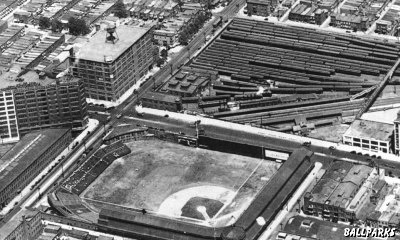
Baseball is a nostalgic sport because of the individuality of major league parks, especially those that were built in the late 1800s and early 1900s. (Some, like Ebbets Field, the Polo Grounds, Fenway Park, and Wrigley Field, are memorable in their uniqueness.) Thus one remembers not only the players but also where they played. The play and the playing field are inextricably bound in the game of baseball.

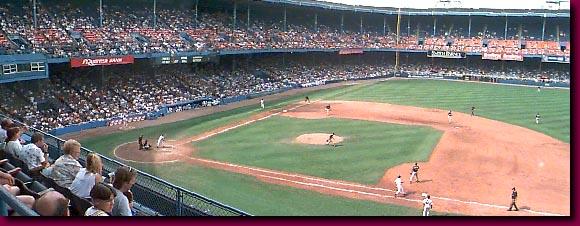
I was a Detroit Tigers fan for a long time, thanks to my maternal grandmother, who introduced me to baseball in the 1940s. Whenever I visited her (see here), the evening’s entertainment would either be a Tigers’ game on the radio or a film at the local movie house (as we called motion picture theatres in Michigan). The Detroit Tigers of my memory are bound up with Briggs Stadium (1912-1999), originally Navin Field and later Tiger Stadium. Here’s the view from the stands on the first-base side, looking toward the third-base side:

Note the proximity of the stands to fair territory. Note also the position of the upper deck, which is directly above the lower deck, rather than set back as in modern stadiums. The best way to watch a ball game at Briggs Stadium was to sit in the upper deck somewhere between first base and third base, which — as you can see — afforded a bird’s eye view of the action.

Until 1987 (the last year in which Detroit won a division championship), the Tigers often fielded contending teams but seldom won a league championship or World Series. From childhood to early adulthood I had to live on past glories: pennants in 1907-9, 1934-5, 1940, 1945; World Series wins in 1935 and 1945. That was it until the Tigers led the league and won the World Series in 1968 and again in 1984, by which time I had lost my deep attachment to baseball and the Tigers.

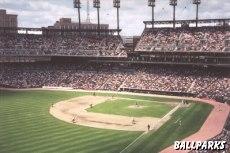
One reason for my alienation from the team and the game is the rise of modern ballparks that are tricked up to look “old” but aren’t built so that the upper deck sits directly over the lower deck. Upper-deck seats in the Tigers’ present home at Comerica Park — like upper-deck seats in other modern ballparks — should come equipped with binoculars:

The hallmark of the Tigers for many decades was offensive prowess. The Tigers put on a good show, even when they weren’t winning pennants. In the 55 seasons from 1907 through 1961, for example, Detroit batters led the league in batting average 21 times:


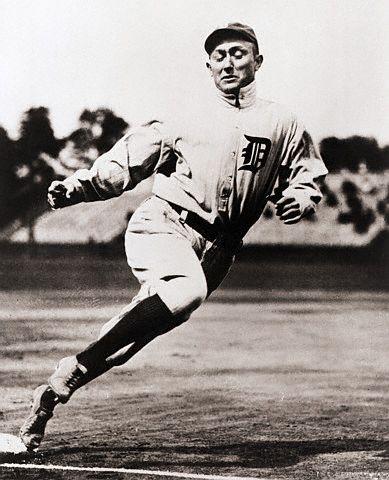
Ty Cobb: batting champion 1907-1913, 1915, 1917-19; .367 lifetime batting average; 22 seasons with Detroit (Cobb is shown here early in his career, which spanned 1905-28.)


Harry Heilmann (right): 1921, 1923, 1925, 1927; .342 lifetime; 15 seasons with Detroit (Heilmann is seen here with Rogers Hornsby in 1929.)


Heinie Manush* (left): 1926; .330; 5 (This is Manush as a Washington Senator in 1933, with teammates Fred Schulte and Goose Goslin.)


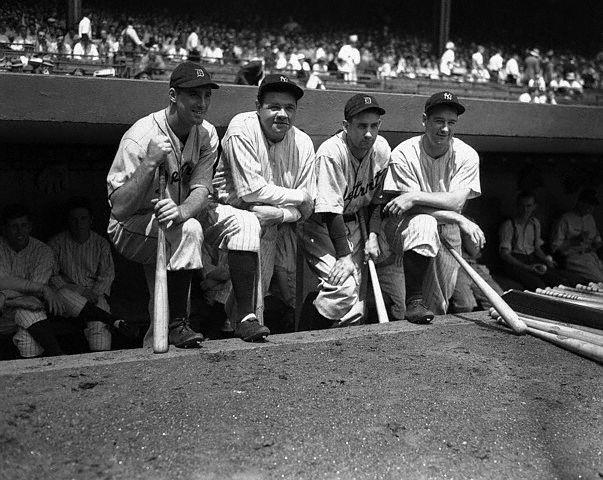
Charlie Gehringer (third from left): 1937; .320; 19 (In this 1934 photo Gehringer is flanked by Hank Greenberg, Babe Ruth, and Lou Gehrig.)


George Kell: 1949; .306; 5 (This photo is from 1949.)


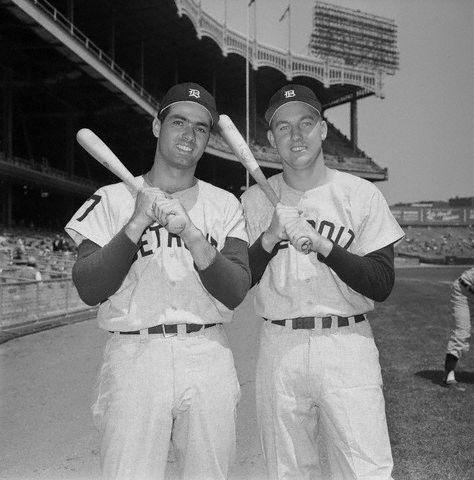
Al Kaline (right): 1955; .297; 22 (Kaline poses with teammate Rocky Colavito in 1960.)


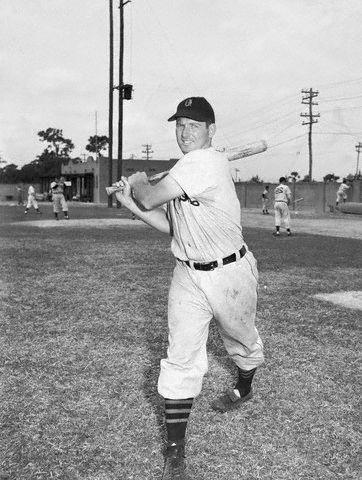
Harvey Kuenn: 1959; .303; 8 (This photo is from 1953, Kuenn’s first full season with Detroit.)


Norm Cash (third from left): 1961; .271; 15 (In this 1961 photo Cash is seen with Roger Maris, Colavito, and Mickey Mantle.)

Hall of Famers whose primary team was Detroit:


“Wahoo” Sam Crawford (major leagues, 1899-1917; Detroit, 1903-17)

Ty Cobb (pictured above) (1905-28; 1905-26)

Harry Heilmann (pictured above) (1914, 1916-29, 1930-31; 1914, 1916-29)

Charlie Gehringer
(pictured above) (1924-42)

Hank Greenberg (pictured above) (1930, 1933-41, 1945-47; 1930, 1933-41, 1945-46)


“Prince Hal” Newhouser (1939-55; 1939-54)

George Kell (pictured above) (1943-57; 1946-52)

Al Kaline (pictured above) (1953-74; 1953-74)

That’s a continuous line of Hall of Famers from 1903 through 1974. Then the string ran out, and Detroit won only one more league championship and World Series.

The Tigers may rise again, but probably not until they can find and keep a perennial contender for the batting championship — if not a Cobb, then a Heilmann, Gehringer, or Kaline. Those were the days. A great ballpark and great hitters. Perhaps gone forever, along with Briggs Stadium and lifetime contracts.

__________
* Henry Emmet (Heinie) Manush: born Tuscumbia, Alabama, 1901; died Sarasota, Florida, 1971; played in the major leagues 1923-39; elected to the Hall of Fame, 1954. Immortalized on film in Obliging Young Lady (1942) when Edmond O’Brien, in the role of Red Reddy, walks down the aisle of a passenger train and begins to say “Heinie Manush” in time with the “clickety clack” of the train wheels. Soon, all the passengers are saying “Heinie Manush” in unison. I saw the film on TV about 40 years after its release. I may have been the only person watching who got the joke.

Curses on the Red Sox

The Boston Red Sox broke the Curse of Bill Buckner by beating the New York Yankees to advance to the World Series. Now, the Red Sox have broken the Curse of the Bambino by beating the St. Louis Cardinals to win the Series.

How long before the Sox win another Series? As a Yankees fan, I curse the Sox to another 86-year wait.

Get ’em next year, Yanks.

Quantum Baseball

If you think that you can jinx your favorite team by watching its games on TV, Dennis Overbye agrees with you, in “This Season, Heisenberg Wears a Red Sox Rally Cap.”

The End of a Curse

The Red Sox have done something no other baseball team has ever done. By beating the Yankees last night, the Red Sox erased a 3-0 deficit to win a post-season series. More importantly for the Sox, by advancing to the World Series for the first time since 1986 they have broken the Curse of Bill Buckner.

Now, can the Sox win the Series and break the Curse of the Bambino? Stay tuned to your TV — but do it with the sound muted. The annoying Tim McCarver and the inane Al Leiter make for unbearable listening.

P.S. I’m a Yankees fan, but that comes second to being a baseball fan. I rejoice in the Red Sox’ display of skill and tenacity. Their unprecedented rally to win the American League Championship Series of 2004 ranks among the few greatest baseball “miracles” of all time.

A New Curse for the Red Sox

UPDATED, BELOW

All baseball fans and many non-fans know that the Boston Red Sox have failed to win a World Series since 1918, having appeared vainly in the Series of 1946, 1967, 1975, and 1986. That failure has been attributed to the Curse of the Bambino — Bambino being a nickname for Babe Ruth. Ruth played for Boston from 1914-19, first as an excellent pitcher and then as a slugging outfielder. The Sox won three American League pennants during Ruth’s tenure (in 1915, 1916, and 1918), and each time went on to win the World Series. But Ruth was traded to the Yankees after the 1919 season. The rest is history: post-season futility for the Red Sox and dominance for the Yankees — a mediocre team until Ruth’s arrival.

To make matters worse for Red Sox fans, a new curse has descended on the franchise. I trace the new curse to pivotal play in the 1986 Series. Here’s what happened, according to the New York Mets:

In Game Six of the World Series, the Mets complete a miracle, two-out comeback from 2 runs down in the bottom of the 10th, when Mookie Wilson dribbles a ground ball through Boston first baseman Bill Buckner‘s legs to score Ray Knight for a 6-5 victory.

The Mets then went on to win the win the seventh game, and the World Series. Now look at the Red Sox post-season record since 1986:

1988 AL Championship Series Oakland Athletics Lost 0-4

1990 AL Championship Series Oakland Athletics Lost 0-4

1995 AL Division Series Cleveland Indians Lost 0-3

1998 AL Division Series Cleveland Indians Lost 1-3

1999 AL Division Series Cleveland Indians Won 3-2
1999 AL Championship Series New York Yankees Lost 1-4

2003 AL Division Series Oakland Athletics Won 3-2
2003 AL Championship Series New York Yankees Lost 3-4

The sharp-eyed reader will have noted that the Red Sox have failed to advance to the World Series since the year of Buckner’s boot. That’s because the Red Sox are now suffering the Curse of Bill Buckner. Not only can’t the Red Sox win a World Series, they can’t even get into the World Series.

Will the Sox break the spell this year? At this point — with the Yankees leading the American League Championship Series 3 games to 1 — it would take something of a miracle. I expect the Curse of Bill Buckner to prevail.

HERE, I BEGIN TO EAT CROW (10/29/07)

The Red Sox performed the miracle and won the ALCS in 2004. They went on to win that year’s World Series, and encored in 2007.

The Yankees, in the three postseasons since 2004, have failed to advance beyond the first round of playoffs. And this year (2007) the Yankees failed to win the AL Eastern Division title for the first time since 1997.

It has now been seven years since the Yankees won a World Series (in 2000, over the New York Mets). Had the Yankees not folded in the 2004 ALCS, the story might be an entirely different one.

It is evident that the Yankees now suffer under a curse, which I hereby name “The Curse of 2004.”

"Red Sox Fear"?

Susan Estrich, in a pre-emptive complaint about “disenfranchisement”, says,

Red Sox fear animates the Kerry campaign, and Democratic activists across the country.

What’s that all about? Is she off her meds? Is she hallucinating?

“Red Sox fear” — what a great slogan. I can see the T-shirts.

The only thing the Red Sox have to fear is themselves.

More Baseball Facts and Opinions

The Houston Astros have advanced to the second round of post-season play by beating the Atlanta Braves. The Astros — an expansion franchise dating from 1962 — will face the St. Louis Cardinals. The Cards are an old-line franchise, as are the N.Y. Yankees and Boston Red Sox — who will face each other in the American League Championship Series.

Since 1995, with the inauguration of two rounds of playoffs before the World Series, at least one of the first-round teams has represented an expansion franchise. And at least one expansion team has advanced to the second round in every year since 1996. In fact, the last three World Series have been won by expansion teams: the Florida Marlins in 2003, the Anaheim Angels in 2002, and the Arizona Diamondbacks in 2001.

What’s worse — for a “purist” like me — is the fact that expansion teams have won nine of the 34 World Series since the advent of pre-World Series playoffs in 1969. The quality of the game would be much higher today if there were still only 16 teams (the number from 1901 through 1960). Then we wouldn’t have to put up with fluke World Series victories by such teams as the wild-card Florida Marlins (1997, 2003) and the New York Mets (1969, 1986) — a team whose fans are easily the most obnoxious of all in baseball.

There should be eight teams in each league, and regular season play should determine the championship of each league. The league champions should meet head-to-head in the World Series. And may the better team win.

Hey, it worked for more than 60 years, and it wasn’t broke. Why did they have to go and “fix” it?

One Baseball Tradition Ends, Another Continues

A few days ago I posted about the fact that all the teams then leading major league baseball’s six divisions were pre-expansion (pre-1961) franchises. So much for that piece of trivia. The Anaheim Angels, one of the first two expansion franchises (est. 1961) caught up with the Oakland Athletics (descended from the Philadelphia Athletics, est. 1901) and went on to win the American League West title by beating the A’s today.

For those few of you who might be interested: The other 1961 expansion team was the Washington Senators, a team that replaced the original American League Senators (1901-60), which moved to Minnesota for the 1961 season and has been there since, as the Twins. The expansion Senators lasted only 11 seasons (1961-71) and moved to Texas, as the Rangers. You may know all that, but did you know that there were two Washington Senators teams in the National League (1886-9 and 1892-9)? Which means that Washington is about to get its fifth baseball franchise.

How many chances do you get to show that you can support a baseball team? If your name is Washington, it seems that you get as many chances as you want.

Back to Baseball — Hyping the Heros

The big news of the moment: Ichiro is within one hit of George Sisler’s all-time, single-season record. Ichiro has 256 hits this season; Sisler had 257 in 1920. The difference is that Ichiro is batting .371, whereas Sisler batted .407 when he made his record. And he did it in 154 games, not the 159-plus it will take Ichiro to make the same number.

Remember when Hank Aaron broke Babe Ruth’s all-time home run record by hitting his 715th? Well, Ruth hit 714 in 8,399 official at-bats. By the time Aaron got to 714 home runs he already had more than 11,000 official at-bats.

Then there was Pete Rose eclipsing Ty Cobb’s all-time record for base hits. Rose surpassed Cobb’s record (4,191 hits) but it took him about 2,400 additional at-bats in which to do the trick. That’s why Rose’s lifetime batting average is only .303 to Cobb’s .367.

Wake me up when someone is about to break a real record, like Ty Cobb’s lifetime batting average. It’ll never happen. I’d better set my alarm clock.