Speaking of the New Washington Baseball Team…

…as I have been in recent posts, “Best of the Web Today” at OpinionJournal.com notes the latest D.C. mania — naming the new team:

…WTOP radio is inviting listeners to suggest a new name for the Washington team. Among the “most popular” suggestions are Senators, Nationals and Monuments; the “most interesting” include Gridlocks, Filibusters and Ex-Expos.

We got to thinking: There’s been a trend recently toward the use of abstract singular nouns as team names: Utah Jazz, Orlando Magic, Colorado Avalanche. This has mostly been a basketball and hockey phenomenon, though baseball does have the Tampa Bay Devilry. Why not click through to this link and cast your vote for calling the team the Washington Kerfuffle?

Not me. I’ll vote for the Washington Spend-and-Tax, and nothing less.

Subsidizing Multi-millionaires

I recently expressed some realism about the return of major league baseball to D.C.:

…To succeed financially, the new Washington team must draw well from the Maryland and Virginia suburbs. Attendance will be high for a few years, because the closeness of major-league baseball will be a novelty to fans who’ve had to trek to Baltimore to see the increasingly hapless Orioles. But suburbanites’ allegiance to the new Washington team won’t survive more than a few losing seasons — and more than a few seem likely, given the Expos’ track record. As the crowds wane, suburbanites will become increasingly reluctant to journey into the city. And, so, the taxpayers of D.C. (and perhaps the taxpayers of the nation) are likely to be stuck with an expensive memento of false civic pride.

Now, here’s Michelle Malkin:

THE MOTHER OF ALL STADIUM BOONDOGGLES

By Michelle Malkin · September 30, 2004 11:10 AM

The media cheerleading here in the D.C. area over the Expos deal is nauseating. I have nothing against baseball. I have everything against taxpayer-funded sports statism. (A commendable exception to the media slavering over this government rip-off is the Washington Times, whose scathing editorial today is dead-on.)….

And what did the WashTimes have to say? Among other things, this:

…To finance the $440 million project, the District would issue 30-year bonds. Annual debt-service costs would total more than $40 million. Those annual costs would be financed by $21 million to $24 million from a gross-receipts tax imposed on businesses with more than $3 million in annual revenues; $11 million to $14 million from taxes on tickets and stadium concessions; and $5.5 million in rent payments from the ballclub.

The team’s owners will receive all the income from ballpark naming rights, which can be quite substantial. The Redskins, whose stadium was privately financed, will receive more than $200 million over 27 years from Federal Express. It is outrageous for taxpayers to be on the hook for hundreds of millions of dollars over the next 30 years while the taxpayer-subsidized owners pocket perhaps hundreds of millions more for the naming rights of a ballpark they received as a gift. Should such a travesty come to pass, it would be the real legacy of Mayor Williams.

And just wait until fans start staying away in droves and the team’s owners lobby for better terms. Won’t the taxpayers of D.C. be happy then?

Baseball in the Nation’s Capital

The original Senators stuck it out from 1901 through 1960. (Washington: first in war, first in peace, last in the American League.) That team moved to Minnesota, where there was a long tradition of high-grade minor league baseball to sustain it. A pennant in 1965 also helped get the team off to a good start with local fans.

The expansion Senators started up in 1961 and lasted through the 1971 season. That team moved to Arlington, Texas, smack in the middle of the hugely populated Dallas-Fort Worth metropolitan area. The size of the fan base helped to sustain the Rangers until the team finally got into post-season play in 1996.

Now the failed Montreal Expos seem to be headed to D.C. The transplanted Expos will spend a few years in old D.C. Stadium, due east of the Capitol building (but far from the gentrified precincts of Capitol Hill). The team will then move to a new park on the Anacostia River in southeast D.C.

To succeed financially, the new Washington team must draw well from the Maryland and Virginia suburbs. Attendance will be high for a few years, because the closeness of major-league baseball will be a novelty to fans who’ve had to trek to Baltimore to see the increasingly hapless Orioles. But suburbanites’ allegiance to the new Washington team won’t survive more than a few losing seasons — and more than a few seem likely, given the Expos’ track record. As the crowds wane, suburbanites will become increasingly reluctant to journey into the city. And, so, the taxpayers of D.C. (and perhaps the taxpayers of the nation) are likely to be stuck with an expensive memento of false civic pride.

P.S. Baltimore Orioles owner Peter Angelos has to be bought off. He doesn’t want a National League team 40 miles from his American League team. Mmmm…remember when Boston, Chicago, New York, Philadelphia, and St. Louis had a team in each league? In fact, New York had two National League teams — one in Manhattan (the Giants) and one in Brooklyn (the Dodgers). Not only that, but for many years the teams in Philadelphia and St. Louis shared stadiums.

Time Out for Baseball

I first paid attention to a radio broadcast of a major league baseball game in about 1947. My grandmother, who was a die-hard fan of the Detroit Tigers, would tune in the Tigers’ games when she could pick up the signal of WXYZ, a Detroit station about 150 miles distant from her small lakeside village atop Michigan’s “thumb”. (If you didn’t know that Michigan has a thumb, look at a map.)

Anyway, at that time Detroit’s play-by-play announcer and baseball analyst, rolled into one, was Harry Heilmann — not a household name these days, but a former Detroit great who was a four-time American League batting champ in the 1920s. The Tigers, by default, became the team I rooted for until I switched my allegiance to the (gasp!) New York Yankees about 30 years later. (That’s another story.)

I’m reciting this bit of personal trivia just to let you know how long I’ve been a baseball fan. Because…when I opened the sports section of today’s paper to the baseball standings, I was struck by this fact: Each of the teams that now lead baseball’s six divisions (three in the American League, three in the National League) represents a franchise that was established before major league baseball began to expand after the 1960 season. From 1901 through 1960, there were 16 major league baseball teams (that number has since grown to 30). In fact, from 1903 through 1952 those 16 teams stayed put. And they stayed put in relatively few cities: Boston (one American League team, one National League team), New York (one AL team, two NL teams, including Brooklyn), Philadelphia (one AL, one NL), Pittsburgh (one NL), Washington (one AL), Cleveland (one AL), Cincinnati (one NL), Detroit (one AL), Chicago (one AL, one NL), and St. Louis (one AL, one NL).

Now, the six division-leading teams are:

AMERICAN LEAGUE
New York Yankees (what a surprise!), representing a franchise that has been in New York City since 1903. (The New York franchise replaced an original American League team known as the…Baltimore Orioles.)

Minnesota Twins, formerly the Washington Senators (1901-60).

Oakland Athletics, formerly the Philadelphia Athletics (1901-54) and the Kansas City Athletics (1955-68).

NATIONAL LEAGUE
Atlanta Braves, formerly the Boston Braves (1876-1952) and the Milwaukee Braves (1953-65).

St. Louis Cardinals, in business since 1892.

Los Angeles Dodgers, formerly (of course) the Brooklyn Dodgers (1890-1957). And here’s where the Dodgers played, from 1913 through 1957 — famed Ebbets Field:

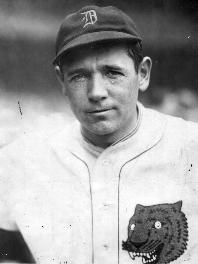
Oh, and here’s Harry Heilmann, in his playing days:

The Curse of the Bambino

George Vecsey, a sports writer for The New York Times and the originator of the legend known as the “Curse of the Bambino,” distances himself from some of the unsavoriness that surrounds the legend. (You can read his story here.) But he can’t distance himself from the underlying facts: Since the owner of the Boston Red Sox traded Babe Ruth to the New York Yankees after the 1919 season, the Red Sox have failed to win a World Series. If that’s not a curse, I don’t know what is.

For Baseball Fans

Here’s a site that’s easier to navigate than MLB.com and quite comprehensive: Baseball-Reference.com.