"Global Warming," Close to Home (II)

UPDATED (02/17/08)

I wrote here about the temperature records at the weather station nearest my home. (The station is about two miles from my home — as the crow flies.) The average temperature for 2007 has just been posted, leading me to make some further observations:

  • It remains the case (as I reported before) that half of the eighteen warmest years on record (years with an average temperature more than one standard deviation above the mean for 1854-2007) occurred before 1980.
  • Every year from 2000 through 2007 (but one) has been cooler than the two very hot years of 1998-99. Moreover, the trend is downward.
  • The cumulative, five-year-average temperature peaked in 2002. That peak was only 0.54 degree higher than the previous peak, which occurred in 1935.

In the interval from 1935 to 2002, my city’s population grew ten-fold; twenty-fold when you include the city’s sprawling suburbs, of which there were none in 1935. What was in 1935 a mid-sized city had become by 2002 a top-40 metropolitan area and, thus, an urban heat island.

UPDATE: See this teaser about the UHI effect in Phoenix.

You Know…

…that the debate about global warming has become more balanced when a website affiliated with CNN picks up a story from IBD. Here’s some of it:

Climate Change: Skepticism about man-induced global warming has reached the science pages of the newspaper of record. This suggests the debate not only isn’t over, but that it’s also finally newsworthy….

In his first [NYT] column of the new year, [John] Tierney writes that the deniers of truth are in fact Nobel Laureate Al Gore and those who ignore both scientific evidence and the historical record in their prophecies of doom. 2008, says Tierney, will be no exception….

A case in point cited by Tierney was when Arctic sea ice last year hit the lowest level ever recorded by satellites. It was hardly a blip in Earth’s geological history, but Tierney noted how “it was big news and heralded as a sign that the whole planet was warming.”

Less dramatic and newsworthy was the announcement that the same satellites also recorded that the Antarctic sea ice had reached the highest level ever….

In the same week Gore received his Nobel Peace Prize, the respected scientific journal Nature published a paper you probably didn’t hear much about. It concluded that global warming had a minimal effect on hurricanes….

As for temperature, Tierney reports how British meteorologists made headlines predicting that the buildup of greenhouse gases would make 2007 the hottest year on record. After 2007 was actually lower than any year since 2001, the BBC still proclaimed: “2007 Data Confirms Warming Trend.”…

But for greenies, it doesn’t matter what the weather actually is or what the data actually show. It’s all caused by global warming. As Canadian Greenpeace rep Steven Guilbeault explained in 2005: “Global warming can mean colder; it can mean drier; it can mean wetter; that’s what we’re dealing with.” Oh.

We hope Tierney’s piece signals the beginning of a fair and balanced debate on the Earth’s climate and man’s impact on it in the mainstream media, including all the inconvenient truths that are fit to print.

Posts at Liberty Corner:
“‘Warmism’: The Myth of Anthropogenic Global Warming” (23 Aug 2007)
Re: Climate ‘Science’” (19 Sep 2007)
More Evidence against Anthropogenic Global Warming” (25 Sep 2007)
Yet More Evidence against Anthropogenic Global Warming” (04 Oct 2007)
Global Warming, Close to Home” (22 Dec 2007)

Plus, many more in this category.

"Global Warming," Close to Home

Arnold Kling writes:

My view of climate change is that we have about three data points–an increase in temperatures from 1900-1940, and slight decrease from 1940-1970, and a recent increase. There are a lot of variables that could affect climate, and I wonder how we can be confident about our understanding of the process, given that we have only those three data points to work with.

The weather station nearest my home has been recording temperatures since 1854. The average annual data reported for that station are consistent with Kling’s statement: a warming trend from 1854 through 1933, a cooling trend from 1934 through 1979, and a warming trend from 1980 through 2007. Like Kling, I wonder how that pattern supports the theory that “global warming” is caused mainly by the rise in atmospheric CO2, a rise that could not have been reversed for 30-40 years if caused by human activity.

There are, in any event, many more relevant observations than those gleaned by weather stations. And those observations (from geological deposits and ice cores) cover much longer spans than 150 years. (See this post, for example.) What it all adds up to is this:

  • The current warm period is neither exceptionally warm nor caused by human activity.
  • We are in a phase of a climatic cycle that is determined mainly by solar activity and the position of our solar system within the Milky Way.
  • That phase probably will end relatively soon (a matter of years or decades, not centuries or millenia).
  • All we see when we look at (flawed and inconsistently recorded) temperature data from the past 100-150 years is the tail end of the phase through which we are passing.

By the way, the highest average monthly temperatures recorded by my local weather station are as follows (in degrees Fahrenheit):

January, 59.6 (1923)
February, 62.3 (1999)
March, 68.4 (1907)
April, 75.9 (1967)
May, 80.6 (1996)
June, 86.4 (1998)
July, 89.1 (1860)
August, 88.3 (1999)
September, 84.2 (1911)
October, 77.0 (1931)
November, 68.2 (1927)
December, 65.5 (1889)

Note the lack of record highs after 1999.

Also, half of the eighteen warmest years on record (years with an average temperature more than one standard deviation above the mean for 1854-2007) occurred before 1980.

Related reading, from around the web:
The Courage to Do Nothing” (14 Dec 2007)
Has Global Warming Stopped?” (19 Dec 2007)
U.S. Senate Report: Over 400 Prominent Scientists Disputed Man-Made Global-Warming Claims in 2007” (20 Dec 2007)
Good News! Earth Not Flat” (21 Dec 2007)

Posts at Liberty Corner:
“‘Warmism’: The Myth of Anthropogenic Global Warming” (23 Aug 2007)
Re: Climate ‘Science’” (19 Sep 2007)
More Evidence against Anthropogenic Global Warming” (25 Sep 2007)
Yet More Evidence against Anthropogenic Global Warming” (04 Oct 2007)

Plus, many more in this category.

Anthropogenic Global Warming Is Dead, Just Not Buried Yet

From around the web:

The Courage to Do Nothing” (14 Dec 2007)
Has Global Warming Stopped?” (19 Dec 2007)
U.S. Senate Report: Over 400 Prominent Scientists Disputed Man-Made Global-Warming Claims in 2007” (20 Dec 2007)
Good News! Earth Not Flat” (21 Dec 2007)

Related posts at Liberty Corner:

“‘Warmism’: The Myth of Anthropogenic Global Warming” (23 Aug 2007)
Re: Climate ‘Science’” (19 Sep 2007)
More Evidence against Anthropogenic Global Warming” (25 Sep 2007)
Yet More Evidence against Anthropogenic Global Warming” (04 Oct 2007)

Plus, many more in this category.

Yet More Evidence against Anthropogenic Global Warming

Here and here. The first item is interesting mainly for what it reveals about global-warming zealots. The second article offers strong, scientific evidence of the key role of cosmic radiation, which is influence by solar activity and the galactic position of the solar system.

See, also, this and this.

P.S. There’s a related piece, here, on the high cost of minimal reductions in CO2 emissions.

P.P.S. My son adds this quotation, from Evelyn Waugh’s Love Among the Ruins:

Despite their promises at the last Election, the politicians had not
yet changed the climate.

More Evidence Against Anthropogenic Global Warming

Add “Scientists Counter AP Article Promoting Computer Model Climate Fears” and “Questioning 20th Century Warmth” to what I say in “Warmism: The Myth of Anthropogenic Global Warming.” The second item is especially damaging to warmist hysteria.

P.S. See also “A Whole New World: Climate Change Debate Could Be Changing,” here.

Re: Climate "Science"

There’s this (via John Ray):

The authors compared, for the overlapping time frame 1962-2000, “the estimate of the northern hemisphere mid-latitude winter atmospheric variability within the available 20th century simulations of 19 global climate models included in the Intergovernmental Panel on Climate Change [IPCC] 4th Assessment Report” with “the NCEP-NCAR and ECMWF reanalyses,” i.e., compilations of real-world observations produced by the National Center for Environmental Prediction (NCEP), in collaboration with the National Center for Atmospheric Research (NCAR), and by the European Center for Mid-Range Weather Forecast (ECMWF)….

Quoting…the scientists who performed the model tests, “this study suggests caveats with respect to the ability of most of the presently available climate models in representing the statistical properties of the global scale atmospheric dynamics of the present [our italics] climate and, a fortiori [“all the more,” as per Webster’s Dictionary], in the perspective of modeling [future] climate change.” Indeed, it gives one pause to question most everything the models might suggest about the future.

And this:

It is difficult to understand how scientific forecasting could be conducted without reference to the research literature on how to make forecasts. One would expect to see empirical justification for the forecasting methods that were used. To provide forecasts of climate change that are useful for policy-making, one would need to prepare forecasts of (1) temperature changes, (2) the effects of any temperature changes, and (3) the effects of feasible proposed policy changes. To justify policy changes based on climate change, policy makers need scientific forecasts for all three forecasting problems and they need those forecasts to show net benefits flowing from proposed policies. If governments implement policy changes without such justification, they are likely to cause harm to many people….

Based on our literature searches, those forecasting long-term climate change have no apparent knowledge of evidence-based forecasting methods….

P.S. See also this post at World Climate Report.

Related post: “Warmism”: The Myth of Anthropogenic Global Warming

"Warmism": The Myth of Anthropogenic Global Warming

“Warmism” is the belief that the warming trend which began in the latter half of the twentieth century (a.k.a. “global warming”) is mainly an artifact of human activity. Warmism is a “religious” and political cause; it is not based on “scientific consensus.” (Science and consensus are antithetical, anyway.) I will not venture to summarize here the mountain of evidence against warmism. (Links to some of the evidence are here, in the section headed Climate Change.) I will focus, instead, on

  • “smoking gun” evidence against warmism
  • alternative and compelling explanations of the warming phase that we have been through, but which may be about to end.

(Some of the graphs that support my argument may be hard to read. To enlarge a graph, just right-click on it and select “open link in a new tab.”)

I begin with Steve McIntyre’s post about the “spaghetti graph,” which purports to show various estimates of changes in the temperature of the Northern Hemisphere since about 900 A.D. In fact, only three of the twelve series plotted in the “spaghetti graph” go back as far a 900 A.D.. And only one of those — the Moberg series — goes back as far as 1 A.D. Here, I splice NASA’s estimates of Northern Hemisphere temperatures to the Moberg series and compare the result to the world’s population (a proxy for “human activity”):
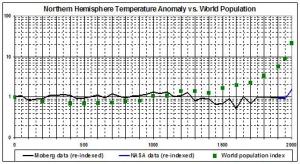
Notes and sources: The values on the x-axis are years A.D. The temperature anomalies (variations in degrees C from the mean for a base period) are plotted in 50-year intervals, except that the first year in the Moberg series (linked above) is 1 A.D. I re-indexed the Moberg series to give it a value of 1 in 1 A.D. (The underlying index is based on the mean value for 1961-90.) I re-indexed NASA’s estimates of temperatures in the Northern Hemisphere for 1900, 1950, and 2000 to make the value for 1900 coincide with the value of the re-indexed Moberg series in that year. I indexed population estimates to a value of 1 in year 1 A.D. Population estimates for selected years from 10000 B.C. through 1950 A.D. are taken from “Historical Estimates of World Population” (U.S. Census Bureau). I averaged the “summary” values from that source to obtain estimates for the years plotted from 1 A.D. through 1900 A.D. I took population estimates for 1950 and 2000 from “Total Midyear Population of the World: 1950-2050” (U.S. Census Bureau).

Oops! First, temperatures rise while population falls; next, population rises while temperatures fall; finally, late in the twentieth century, temperatures rise while population rises. Well, perhaps it takes a while (centuries?) for human activity to affect Earth’s temperature. Perhaps, for a long time, there were simply “too few” humans and too little of the “wrong kinds” of human activities. That is the story that “warmists” would like us to believe, though they concocted that story only after seizing upon the apparent relationship between human activity (i.e., the satisfaction of wants through economic endeavor) and the warming trend of the late twentieth century. Let us turn to that relationship.

Taking population as a proxy for the kind of human activity that generates carbon dioxide emissions — the chief culprit in the “greenhouse” theory of global warming — one would expect temperatures to rise with population. And so, it seems, they have — in the recent past:
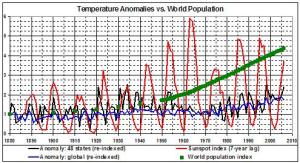
Notes and sources: Again, the x-axis represents years A.D. I re-indexed NASA’s estimates of U.S. and global temperature anomalies (base period 1951-80) to equal 1 in 1880 A.D. (I used the global series that represents only meteorological stations, though I suspect its validity, given the disparity in the U.S. and global trends. That disparity cannot be explained simply by the fact that the U.S. represents only two percent of Earth’s surface, as Steve McIntyre points out in these three postsUPDATES: plus this more recent one, and this and this one.) I drew estimates of sunspot activity from this NOAA source, and indexed them so that the value for 1880 equals 1. The sources for population estimates are as above, except that I estimated the value for 1880 by interpolation from the values for 1850 and 1900. I then indexed the population series so that the value for 1880 equals 1. Population is a proxy for carbon-dioxide emissions, though there hasn’t been a one-to-one relationship between population and emissions of carbon dioxide since 1980 (at least), according to the National Energy Administration’s “World Energy Use and Carbon Dioxide Emissions: 1980-2001.” (See the figure on page 13 and related text.) It seems that population has been growing faster than carbon dioxide emissions: 1.6 percent a year as against 1.2 percent a year.

Oops, again! It seems that temperatures not only have risen with population since the 1960s or 1970s, but also have risen with solar activity. Solar activity (inversely) affects the level of cosmic radiation reaching Earth; cosmic radiation, in turn, (directly) affects cloud formation; and cloud formation, in turn, (inversely) affects temperatures. (See this for an explanation.) In sum, more solar activity means higher temperatures, but it takes about seven years for changes in solar activity to be reflected in temperature changes. (See this.)

It should be quite evident by now that the warming trend of the past thirty-odd years merely coincides with the rise in human activity (as measured by population) but is not explained by the “greenhouse” effect that supposedly arises from human activity. (The “greenhouse” effect is in fact a physically impossible phenomenon, according to this source). There are alternative and compelling alternative explanations for the warming trend, including the influence of solar activity summarized above, as well as alternative (and far less alarming) estimates of the likely rise in temperatures over the next several decades. (Again, for more on such matters, go to the Climate Change section of this page).

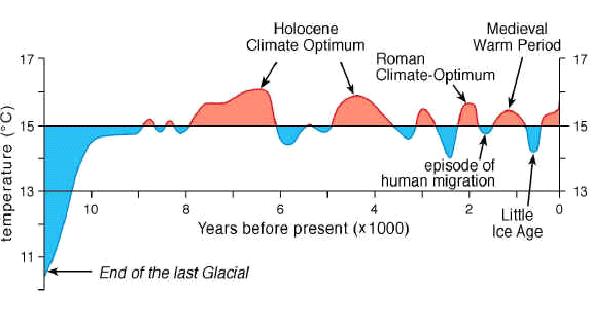
The nail in the coffin of warmism — as far as I am concerned — is the fact that the present warm period is a mere blip on Earth’s temperature chart. Consider, for example, the following reconstruction of temperatures in the Northern Hemisphere for the past 11,000 years (the red-blue curve):

Source: “Climate Patterns in Northern Finnoscandia during the Last Millenium” (figure 6).

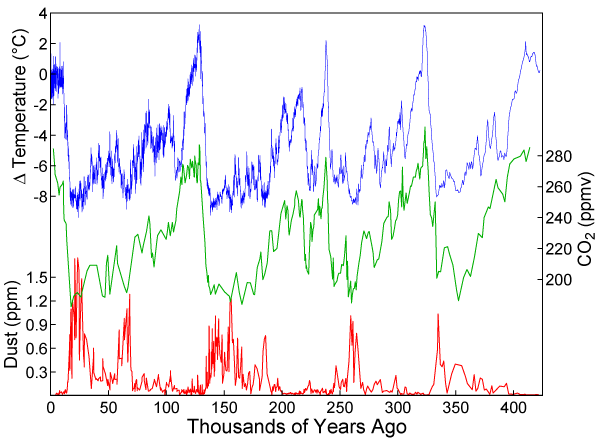
Two articles on paleoclimatology at Wikipedia accurately reflect what I have read elsewhere about long-run climate change. It takes only two figures to put things in perspective. First, a reconstruction of ice-core temperatures (blue line) at Vostok, Antarctica (the present is at the left):
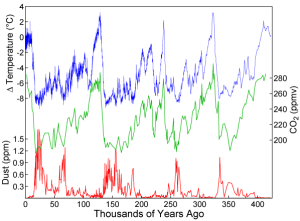
Source: This figure from “Paleoclimatology” at Wikipedia.

The next chart shows that the current cyclical era began about 500,000 years ago. (The present is at the right in this graph.) The expansion of the time scale from 10,000 years ago to the present puts the present warm spell in perspective. It is not extraordinarily warm, by any standard. It is, rather, only a small segment of a the “spike” that typically signals the end (or beginning) of a 120,000-year cycle. The present spike has thus far lasted about 10,000 years, a mere blink of the eye in geological time. It does not look like a spike in the graph because of the expansion of the time scale for the period from 10,000 years ago to the present.
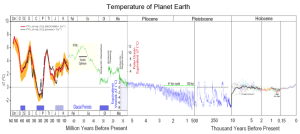
Source: This figure from “Geologic Temperature Record” at Wikipedia.

Two complementary theories explain climate change. First, there are

Milankovitch cycles…the collective effect of changes in the Earth‘s movements upon its climate, named after Serbian civil engineer and mathematician Milutin Milanković. The eccentricity, axial tilt, and precession of the Earth’s orbit vary in several patterns, resulting in 100,000 year ice age cycles of the Quaternary glaciation over the last few million years. The Earth’s axis completes one full cycle of precession approximately every 26,000 years. At the same time, the elliptical orbit rotates, more slowly, leading to a 21,000 year cycle between the seasons and the orbit. In addition, the angle between Earth’s rotational axis and the normal to the plane of its orbit changes from 21.5 degrees to 24.5 degrees and back again on a 41,000 year cycle. Currently, this angle is 23.44 degrees.

Then, as outlined above, there is the varying influence of solar activity on cosmic radiation as the Solar System traverses the Milky Way. This is from an article (“The Real Deal?“) in the National Post:

Astrophysicist Nir Shariv, one of Israel’s top young scientists, describes the logic that led him — and most everyone else — to conclude that SUVs, coal plants and other things man-made cause global warming.

Step One Scientists for decades have postulated that increases in carbon dioxide and other gases could lead to a greenhouse effect.

Step Two As if on cue, the temperature rose over the course of the 20th century while greenhouse gases proliferated due to human activities.

Step Three No other mechanism explains the warming. Without another candidate, greenhouses gases necessarily became the cause.

Dr. Shariv, a prolific researcher who has made a name for himself assessing the movements of two-billion-year-old meteorites, no longer accepts this logic, or subscribes to these views. He has recanted: “Like many others, I was personally sure that CO2 is the bad culprit in the story of global warming. But after carefully digging into the evidence, I realized that things are far more complicated than the story sold to us by many climate scientists or the stories regurgitated by the media.

“In fact, there is much more than meets the eye.”

Dr. Shariv’s digging led him to the surprising discovery that there is no concrete evidence — only speculation — that man-made greenhouse gases cause global warming. Even research from the Intergovernmental Panel on Climate Change– the United Nations agency that heads the worldwide effort to combat global warming — is bereft of anything here inspiring confidence. In fact, according to the IPCC’s own findings, man’s role is so uncertain that there is a strong possibility that we have been cooling, not warming, the Earth. Unfortunately, our tools are too crude to reveal what man’s effect has been in the past, let alone predict how much warming or cooling we might cause in the future.

All we have on which to pin the blame on greenhouse gases, says Dr. Shaviv, is “incriminating circumstantial evidence,” which explains why climate scientists speak in terms of finding “evidence of fingerprints.” Circumstantial evidence might be a fine basis on which to justify reducing greenhouse gases, he adds, “without other ‘suspects.’ ” However, Dr. Shaviv not only believes there are credible “other suspects,” he believes that at least one provides a superior explanation for the 20th century’s warming.

“Solar activity can explain a large part of the 20th-century global warming,” he states, particularly because of the evidence that has been accumulating over the past decade of the strong relationship that cosmic- ray flux has on our atmosphere. So much evidence has by now been amassed, in fact, that “it is unlikely that [the solar climate link] does not exist.”

The sun’s strong role indicates that greenhouse gases can’t have much of an influence on the climate — that C02 et al. don’t dominate through some kind of leveraging effect that makes them especially potent drivers of climate change. The upshot of the Earth not being unduly sensitive to greenhouse gases is that neither increases nor cutbacks in future C02 emissions will matter much in terms of the climate.

Even doubling the amount of CO2 by 2100, for example, “will not dramatically increase the global temperature,” Dr. Shaviv states. Put another way: “Even if we halved the CO2 output, and the CO2 increase by 2100 would be, say, a 50% increase relative to today instead of a doubled amount, the expected reduction in the rise of global temperature would be less than 0.5C. This is not significant.”

The evidence from astrophysicists and cosmologists in laboratories around the world, on the other hand, could well be significant. In his study of meteorites, published in the prestigious journal, Physical Review Letters, Dr. Shaviv found that the meteorites that Earth collected during its passage through the arms of the Milky Way sustained up to 10% more cosmic ray damage than others. That kind of cosmic ray variation, Dr. Shaviv believes, could alter global temperatures by as much as 15% –sufficient to turn the ice ages on or off and evidence of the extent to which cosmic forces influence Earth’s climate.

In another study, directly relevant to today’s climate controversy, Dr. Shaviv reconstructed the temperature on Earth over the past 550 million years to find that cosmic ray flux variations explain more than two-thirds of Earth’s temperature variance, making it the most dominant climate driver over geological time scales. The study also found that an upper limit can be placed on the relative role of CO2 as a climate driver, meaning that a large fraction of the global warming witnessed over the past century could not be due to CO2 — instead it is attributable to the increased solar activity.

Finally, there is this compelling evidence against warmism (from “Look to Mars for the Truth on Global Warming,” also in the National Post):

“One explanation could be that Mars is just coming out of an ice age,” NASA scientist William Feldman speculated after the agency’s Mars Odyssey completed its first Martian year of data collection. “In some low-latitude areas, the ice has already dissipated.” With each passing year more and more evidence arises of the dramatic changes occurring on the only planet on the solar system, apart from Earth, to give up its climate secrets.

NASA’s findings in space come as no surprise to Dr. Habibullo Abdussamatov at Saint Petersburg’s Pulkovo Astronomical Observatory. Pulkovo — at the pinnacle of Russia’s space-oriented scientific establishment — is one of the world’s best equipped observatories and has been since its founding in 1839. Heading Pulkovo’s space research laboratory is Dr. Abdussamatov, one of the world’s chief critics of the theory that man-made carbon dioxide emissions create a greenhouse effect, leading to global warming.

“Mars has global warming, but without a greenhouse and without the participation of Martians,” he told me. “These parallel global warmings — observed simultaneously on Mars and on Earth — can only be a straightline consequence of the effect of the one same factor: a long-time change in solar irradiance.”

The sun’s increased irradiance over the last century, not C02 emissions, is responsible for the global warming we’re seeing, says the celebrated scientist, and this solar irradiance also explains the great volume of C02 emissions.

“It is no secret that increased solar irradiance warms Earth’s oceans, which then triggers the emission of large amounts of carbon dioxide into the atmosphere. So the common view that man’s industrial activity is a deciding factor in global warming has emerged from a misinterpretation of cause and effect relations.”

Dr. Abdussamatov goes further, debunking the very notion of a greenhouse effect. “Ascribing ‘greenhouse’ effect properties to the Earth’s atmosphere is not scientifically substantiated,” he maintains. “Heated greenhouse gases, which become lighter as a result of expansion, ascend to the atmosphere only to give the absorbed heat away.”

The real news from Saint Petersburg — demonstrated by cooling that is occurring on the upper layers of the world’s oceans — is that Earth has hit its temperature ceiling. Solar irradiance has begun to fall, ushering in a protracted cooling period beginning in 2012 to 2015. The depth of the decline in solar irradiance reaching Earth will occur around 2040, and “will inevitably lead to a deep freeze around 2055-60” lasting some 50 years, after which temperatures will go up again.

To paraphrase Shakespeare: The warming, dear reader, is not in ourselves, but in our stars.

Related posts:
Re: Climate “Science”
More Evidence against Anthropogenic Global Warming
Yet More Evidence against Anthropogenic Global Warming
Anthropogenic Global Warming Is Dead, Just Not Buried Yet

Related reading:
A 2000-Year Temperature Reconstruction Based on Non-Treering Hypotheses (in which the Medieval Warm Period looms much larger than the current warm spell and the irrelevance of tree-ring data is explained)
Aliens Cause Global Warming and other speeches by Michael Crichton
Are Carbon Emissions the Cause of Global Warming ? (No. Moreover, global warming has reversed.)
Climate Audit (a blog by Steve McIntyre of the M&M project — see below — and a comprehensive resource for those interested about the science of global warming, as opposed to the religion of it)
Climate Change Chaos (two posts about alternative explanations of “global warming”)
Climate Change 2007: Climate Change Impacts, Adaptation, and Vulnerabilities (IPCC’s latest contribution to the scare about global warming)
Climate Patterns in Northern Fennoscandia during the Last Millenium (the present episode as a blip in Finnish temperature patterns dating back 7,640 years)
Climate Warming Is Naturally Caused and Shows No Human Influence
Clouding the Issue (the effect of the “Asian Brown Cloud” on “global warming”)
Cool Heads Required (Spiked! survey article about climate change)
A Consensus about Consensus
Consensus, What Consensus? Among Climate Scientists the Debate Is Not Over
Cosmoclimatology: A New Theory Emerges (Henrik Svensmark‘s theory of climate change as being caused mainly by the level of cosmic radiation reaching Earth; supported by this article; criticized in Lockwood and Frohlich’s paper, which is debunked here in a cached article that I have downloaded in case it disappears)
Datasets & Images (main page for NASA temperature data: U.S., northern hemisphere, various latitude bands, an global)
Falsification of the Atmospheric CO2 Greenhouse Effects within the Frame of Physics (in which two scientists explain that the so-called greenhouse effect violates the laws of physics)
Greenie Watch (a blog by John Ray in which he reprints articles debunking “warmism” and other enviro-nut causes)
Global Warming’s Silver Lining
Heat Capacity, Time Constant, and Sensitivity of Earth’s Climate System (a downward re-estimate of the likely change in Earth’s temperature, summarized here by John Ray)
Heretical Thoughts about Science and Society (an essay by noted physicist Freeman Dyson, in which he factually and logically dissects global-warming alarmism)
The Iris Opens Again? (a post about research into the cyclical relationship between clouds, warming, and cooling)
Let’s Be Honest about the Real Consensus
Let’s Look on the Sunny Side (Timesonline article about the sun and global warming)
M&M Project Page (summaries of and links to scientific analyses that refute the “hockey stick” paradigm upon which the global-warming scare rests)
New Peer-Reviewed Scientific Studies Chill Global Warming Fears (annotated bibliography, released by the ranking minority member of the U.S. Senate Committee on Environment and Public Works)
Peter Huber And Mark Mills On Our Energy Future
The Real Deal? (introductory article about cosmoclimatology, with links to 10 other articles on various aspects of “warmism”)
A Report from the Global Warming Battlefield
Scientific Forecasts vs. Forecasts by Scientists (documentation of the fact that the climate models that support “warmism” based on opinion, not evidence)
Tellus More about Hurricanes (a post at World Climate Report about three journal articles on the relationship between “global warming” and hurricanes)
Trouble in Climate-Model Paradise (how climate models used to project warming trends significantly underestimate precipitation)

Warming, Anyone?

From my “Resources” page, an updated section on climate change:

Aliens Cause Global Warming and other speeches by Michael Crichton
Climate Audit (a blog by Steve McIntyre of the M&M project — see below — and a comprehensive resource for those interested about the science of global warming, as opposed to the religion of it)
Climate Change Chaos (two posts about alternative explanations of “global warming”)
Climate Change 2007: Climate Change Impacts, Adaptation, and Vulnerabilities (IPCC’s latest contribution to the scare about global warming)
Climate Patterns in Northern Fennoscandia during the Last Millenium (the present episode as a blip in Finnish temperature patterns dating back 7,640 years)
Clouding the Issue (the effect of the “Asian Brown Cloud” on “global warming”)
Cool Heads Required (Spiked! survey article about climate change)
A Consensus about Consensus
Consensus, What Consensus? Among Climate Scientists the Debate Is Not Over
Cosmoclimatology: A New Theory Emerges (Henrik Svensmark‘s theory of climate change as being caused mainly by the level of cosmic radiation reaching Earth; supported by this article; criticized in Lockwood and Frohlich’s paper, which is debunked here in a cached article that I have downloaded in case it disappears)
Datasets & Images (main page for NASA temperature data: U.S., northern hemisphere, various latitude bands, an global)
Falsification of the Atmospheric CO2 Effects within the Frame of Physics (in which two scientists explain that the so-called greenhouse effect violates the laws of physics)
Greenie Watch (a blog by John Ray in which he reprints articles debunking “warmism” and other enviro-nut causes)
Global Warming’s Silver Lining
Heat Capacity, Time Constant, and Sensitivity of Earth’s Climate System (a downward re-estimate of the likely change in Earth’s temperature, summarized here by John Ray)
Heretical Thoughts about Science and Society (an essay by noted physicist Freeman Dyson, in which he factually and logically dissects global-warming alarmism)
The Iris Opens Again? (a post about research into the cyclical relationship between clouds, warming, and cooling)
Let’s Be Honest about the Real Consensus
Let’s Look on the Sunny Side (Timesonline article about the sun and global warming)
M&M Project Page (summaries of and links to scientific analyses that refute the “hockey stick” paradigm upon which the global-warming scare rests)
New Peer-Reviewed Scientific Studies Chill Global Warming Fears (annotated bibliography, released by the ranking minority member of the U.S. Senate Committee on Environment and Public Works)
Peter Huber And Mark Mills On Our Energy Future
A Report from the Global Warming Battlefield
Scientific Forecasts vs. Forecasts by Scientists (documentation of the fact that the climate models that support “warmism” based on opinion, not evidence)
Tellus More about Hurricanes (a post at World Climate Report about three journal articles on the relationship between “global warming” and hurricanes)
Trouble in Climate-Model Paradise (how climate models used to project warming trends significantly underestimate precipitation)

More from the Apocalyptic Left

This article in the current issue of Newsweek carries the subhed “If humans were evacuated, the Earth would flourish.” The final graph of the article puts the idea in perspective: “Too bad there’s no one there to see it.”

Actually, the central figure of the piece — one Alan Weisman — proposes more than evacuation. He’s trying to organize a voluntary human extinction movement. Weisman’s Leftist pedigree is quite evident in his affiliation with Homelands Productions.

Weisman is an extreme example of what I said here:

The emphasis on social restraints — to a Leftist… — means social engineering writ large. He wants a society that operates according to his strictures. But society refuses to cooperate, and so he conjures historically and scientifically invalid explanations for the behavior of man and nature. By doing so he is able to convince himself and his fellow travelers that the socialist vision is the correct one. He and his ilk cannot satisfy their power-lust in the real world, so they retaliate by imagining a theoretical world of doom. It is as if they walk around under a thought balloon which reads “Take that!”

Weisman isn’t content to foresee the apocalypse. He wants to rush toward it and embrace it.

The End of Global Warming

Here:

[W]e have been unable to find a scientific forecast to support the currently widespread belief in “global warming.”

More Quick Takes

World Climate Report reproduces this graphic:

Read the whole post. Then read this, and follow the links. See also this piece by Debra Saunders.

* * *

Donald Boudreaux explains, once again, why making healthcare a “right” will only make it more expensive and harder to come by.

* * *

Selwyn Duke’s “The Fascists among Us,” at The American Thinker, reminds me of my post, “Calling a Nazi a Nazi.” P.S. There’s also Thomas Sowell’s “Can we talk?” at Townhall.com.

* * *

Related to that, there’s wide support among Democrats — those “tolerant” people — for the “outing” of gay Republicans. (See this post at Patterico’s Pontifications.) It’s the old Leftist double standard: The only good gay is a Democrat gay; Bill Clinton couldn’t have been guilty of sexual harrassment because his “heart was in the right place”; the only “stolen” elections are those won by Republicans, even though Democrats are past masters at the art of stealing elections; etc., etc., etc.

* * *

Speaking of Democrats, read this post by Ed Lasky at The American Thinker, which opens thusly: “Jihadists admit they are killing for the the camera and for the Democrats.”

* * *

Tyler Cowen (Marginal Revolution) asks “Why hasn’t Mexico done better?” Perhaps because it’s not populated by immigrants from the British Isles and Northern Europe, and their descendants, whose political and economic leadership brought liberty and prosperity to the United States.

More Bad News for Global Warming Zealots

From World Climate Report:

[Standard climate] models predict an increase in global precipitation [associated with global warming], and none is observed. The models predict relatively large increases in precipitation in northern mid- to high latitudes and Antarctica in winter, and no increase in these areas is observed. The models do not predict much of an increase in temperature or precipitation in the tropical region of the Pacific and Indian Ocean, but that area shows the largest increase in precipitation anywhere in the world (offset by decreases in precipitation elsewhere).

Read the whole thing.

Meanwhile, at Cato-at-liberty, Jerry Taylor reports:

According to a new study from the Danish National Space Center, cosmic rays created by the explosions of distant stars play an important role in cloud formation in the earth’s lower atmosphere. Those clouds have a cooling effect on the planet. The sun’s magnetic field, however, interferes with this process to some degree, and that field has doubled for some reason in the 20th century.

According to the Space Center’s website:

The resulting reduction in cloudiness, especially of low-altitude clouds, may be a significant factor in the global warming Earth has undergone during the last century.

There’s a lot more in these Liberty Corner posts, which go back to July 16, 2004:

Climatology
Global Warming: Realities and Benefits
Words of Caution for the Cautious
Scientists in a Snit
Another Blow to Climatology?
Bad News for Politically Correct Science
Another Blow to Chicken-Little Science
Bad News for Enviro-nuts
The Hockey Stick Is Broken
Science in Politics, Politics in Science
Global Warming and Life
Words of Caution for Scientific Dogmatists
Hurricanes and Global Warming
Global Warming and the Liberal Agenda
Debunking “Scientific Objectivity”
Hurricanes and Glaciers
Remember the “Little Ice Age”?
Science’s Anti-Scientific Bent
A Possibly Useful Idiot
The Climate Debate: A Postscript
Today’s Climate Report
Consensus and Science Don’t Mix
Global Warming in Perspective
You Bet Your Life
What I Said about Climate Change . . .

What I Said about Climate Change . . .

. . . here. Read it, if you haven’t already, then go here (first two items).

You Bet Your Life

Most persons who are confronted by an armed mugger will accede to the mugger’s demands for wallet, jewelry, etc. The immediate prospect of being killed or injured generally outweighs the thought of resistance or flight, neither of which is likely to be effective and both of which might simply infuriate the mugger. The instintive logic at work in most persons goes like this: My odds of surviving this incident unharmed are much greater if I accede to the mugger’s demands than if I try to resist or flee. I value my life and limb more than the money and jewelry demanded by the mugger. Therefore, I will accede to the mugger’s demands.

Environmental alarmists react to the very mixed and uncertain evidence about climate change and its causes as if they were facing an armed mugger. Oh, they say (in effect), let’s give in to the “mugger” and forswear our wealth so that we might live to see a cooler, less turbulent day.

The difference, of course, is that the threat posed by the mugger is immediate and obvious. He’s right there in your face. That is not the case with climate change; we see the change (e.g., rising temperatures) but we are very far from certain about its causes, effects, and future course. (In addition to the item linked above, see this, this, and this, and follow the many links in the third item. See also John Ray’s Greenie Watch, which is replete with relevant material.)

Those who counsel environmental “action” in the face of such great uncertainty about the causes, effects, and future course of climate change are not being mugged, nor are they witnesses to a mugging. They are spectators to a scene that is visible to them through a translucent screen. They see something going on and they assume that it is a crime and that they can identify and shoot the criminal without harming the victim. In fact, there may be neither criminal nor victim. To assume that there is a crime and an identifiable criminal runs the risk of harming innocent persons (i.e., everyone) for the sake of nothing.

We are not facing the one-sided certainties of such screen “gems” as The Day After Tomorrow or An Inconvenient Truth. We are peering through a sceen darkly. The only muggers we face, in actuality, are the perpetrators of such propaganda as The Day After and Inconvenient — and those scientists who abet them, wittingly or not.

Do you want to bet your life (or livelihood) on the biased inferences of environmentalist muggers? I don’t. I want a lot more information about what is happening to the climate, why it is happening, whether the consequences for humans are good or ill, and what (if anything) humans can do about it if the consequences are ill.

Related link: Reality-Based Skepticism of Government Action to Reduce Global Warming, by Don Boudreaux of Cafe Hayek

Carnival of Links

I collect interesting links, group them by topic, and dump each related set of links into a draft post. Then, using the links as a starting point, I convert the draft to a full-blown post, as I have time.

I still have many interesting links in my collection that I probably won’t build into full-blown posts. Rather than hoard or discard those links, I present them here, organized by topic and with brief descriptions.

Liberty and the State

Mere Libertarianism: Blending Hayek and Rothbard: Agree or not with the author’s premises and conclusions, it’s an informative comparison of the two main schools of libertarianism.

Anarchism: Further Thoughts: An analysis of the varieties of anarchism and the faults of each.

Tax Rates Around the World: A brief post about the disincentivizing effects of high tax rates.

Paternalism and Psychology: A different look at the wrongness of “libertarian paternalism.”

Principles and Pragmatism: Why one libertarian blogger prefers idealism to pragmatism.

Lochner v. New York: A Centennial Perspective: (go to download link for full paper) The author of this long paper suggests that Lochner‘s much reviled “substantive due process” holding is in fact the basis for key Supreme Court decisons (e.g., Griswold v. Connecticut, Roe v. Wade, and Lawrence v. Texas).

Terrorism, War, and Related Matters

Apply the Golden Rule to Al Qaeda?: Why it makes no sense to apply Common Article 3 of the Geneva Conventions to terrorist detainees.

Captain Ed’s archive on Saddam’s Documents: A collection of posts about Saddam’s WMDs and terrorist ties.

The ACLU and Airport Security: How the ACLU is trying to depict behavior profiling as racial profiling.

Infinite Hatred: Considers and rejects the idea that it is futile to kill terrorists.

They, the People: An essay that parses the degrees of conflict and suggests that all-out war is the best way to change the hearts and minds of the enemy.

The Brink of Madness: A Familiar Place and The Mideast’s Munich: War with the Mullahs Is Coming: Two persuasive arguments that the West’s present mindset is like that which prevailed at the time of the Munich Agreement in 1938.

Sustaining Our Resolve: A sober but upbeat assessment of the prospects for the Middle East and the war on terror, by George P. Schultz.

Is the Bush Doctrine Dead?: An analysis by Norman Podhoretz.

Code Red: In which the writer tackles several anti-war and anti-anti-terror shibboleths.

Presidential Signing Statements

Bush’s Tactic of Refusing Laws Is Probed: An article about a panel of the American Bar Association’s so-called probe of Bush’s signing statements. (This WaPo article is anti-Bush, of course, but it sets the stage for the next two links.)

Enforcing the Constitution: A brief post defending signing statements.

The Problem with Presidential Signing Statements: A longer analysis of signing statements that also defends them.

Ideas

The Fifty Worst (and Best) Books of the Century: A distinguished panel of libertarian-conservatives compiles a list of the worst and best. The lists of worsts seems about right. The list of bests includes too many boring “classics.”

“Fake but Accurate?” Science: A scathing indictment of the “hockey stick” curve — which purports to show that global warming is only a recent phenomenon — its author, and its coterie of defenders.

The Problem of the Accuracy of Economic Data: An exposition of the spurious precision of economic statistics and analyses based on them.

Global Warming in Perspective

World Climate Report has a post about a pending case in which the U.S. Supreme Court will

review whether or not the federal government is currently required by law to limit emissions of carbon dioxide, the major human emission implicated in global warming. . . .

This case is a result of a pleading by several state Attorneys General, enviro groups, and assorted other hangers-on, arguing that carbon dioxide is a “pollutant,” and therefore must be regulated by the EPA.

The author (unidentified, but presumably the blog’s proprietor, Pat Michaels), zings global-warming hysteria with this:

Folks on my side of the issue, know that there’s not a suite of regulations and/or technology that can significantly alter the course of the earth’s temperature evolution for the life of anyone on this court, or, for that matter, for any of the next several appointees. By then, society will likely be producing or using energy in ways that are so different than today that this huge catfight will look like what it really is—a silly diversion, compared to some real-world problems, like nutsos with nuclear weapons, or people flying airplanes into skyscrapers for the love of a bevy of non-experienced women.

Because Michaels is a bona fide scientist who is on the faculty of environmental sciences at the University of Virginia, he offers convincing evidence to back up his position.

Sunday Grab Bag

These are some things I’ve bookmarked in the past month. The subjects are global warming, rooting for the other side, and “Crunchy Cons.”

Arnold Kling has had more to say about global warming:

Much, much more of the human activity that would cause global warming has occurred in the last 20 years than took place between 1900 and 1940. Also, much, much more of the greenhouse gas layer on earth consists of either water vapor or pre-industrial levels of carbon dioxide.

Thus, the link between human activity and global warming depends not on simple, obvious relationships in the data. It depends entirely on climate models of how these tiny (relative to the overall volume of greenhouse gases) human activities produce “feedback loops” on the rest. They are models of how much less than one percent of a phenomenon affects the entire phenomenon. They are much more faith-based than empirical.

It is possible that the models underestimate human-caused global warming. However, I believe that this is far less likely than that they over-estimate the human causal factor.

I believe that average temperatures have been rising. I have no reason to believe that they will stop rising. However, the most sensible position an empiricist can take is that human activity is not going to make much difference to global warming, one way or the other.

(An archive of related posts by Kling is here.)

Mike Rappaport wrote about the immorality of rooting for the other side:

[T]he more important point from [Michael Barone’s] article is how strong a case he makes for the moral impropriety of the Democrats’ behavior. Here is Barone’s description [redacted by LC]:

A substantial part of the Democratic Party, some of its politicians and many of its loudest supporters do not want America to succeed in Iraq. . . .

Successes are discounted, setbacks are trumpeted, the level of American casualties is treated as if it were comparable to those in Vietnam or World War II. Allegations of American misdeeds are repeated over and over; the work of reconstruction and aid of American military personnel and civilians is ignored.

In all this they have been aided and abetted by large elements of the press. . . .

. . . One or two instances of American misconduct are found equal in the balance to a consistent and premeditated campaign of barbarism.

. . . I am not saying that all critics of the war or the Bush Administration fall into this camp. There are many legitimate criticisms of the war. But such legitimate criticisms do not include rooting for the other side — including rooting that one does internally but does not admit to most other people.

There was plenty of this during the Cold War, which was reprehensible enough, but at least those people had convinced themselves that communism was not really bad. Few on the left believe that Islamo Facism is desirable.

There was plenty of rooting for the other side during the Vietnam War, as well. And look where it got us. An (initially) unnecessary war was (unnecessarily) lost, and thus America continued its downward spiral into defeatism, from which it has yet to recover fully.

Related to that, read this, by Austin Bay, about the publication by The New York Times and other papers of classified information about the war on terror. Bay concludes:

[S]ome headlines hurt – they damage our government’s Job One: national security. Perhaps the Times’ editors don’t believe we are engaged in a global counter-terror war against Islamo-fascism. We are. At one time there was hole in south Manhattan they could not ignore. . . . For America’s economic and media elites the war has been easy. . . . The US military has served with great distinction, despite major media attempts to “My Lai” Abu Ghraib and now Haditha. Moral compromise in war is inevitable; compromising legitimate intellgence operations is not. History may well conclude this is a war that didn’t need America’s media elites, and perhaps that suspicion curdles the gut of a couple of New York Times bigshots.

Jeffrey Tucker reviewed Rod Dreher’s book Crunchy Cons. Here are excerpts of Tucker’s review:

Dreher seems untroubled by serious issues of economics and politics. He has not put much thought into the political or the economic implications of what he writes. He is not the slightest bit curious about what his vision for his life and yours means for society at large. Though he imagines himself as a rebel against mass consumption, he seems completely unaware that he is purchasing his lifestyle choice just like everyone else, and that the market he loathes is precisely what makes his choice possible.

For those who haven’t read about this new approach to conservative living, here is a quick primer. Dreher follows in a long line of writers dating back to the Industrial Revolution — and a certain strain of post WW2 conservative writers — who loath consumer culture, believe that mass production for the masses is sheer corruption, that free trade is deracinating us all from praiseworthy national attachments, that machines destroy souls, and that capitalism is the enemy of faith because it fuels change and progress. Dreher reports with disgust that America has become one big shopping mall populated by people driven by spiritually barren materialist motives who buy buy buy goods and services of shoddy quality to feed their frenzied desire to live decadently while eschewing friends, community, family, and faith.

And make no mistake: it is the free market that is his target. He even says that “the place of the free market in society” is precisely where he departs with regular conservatives (who he wrongly assumes love the market).

We should go another way, says he. We should cook at home, turn off the television, have kids, educate them at home, buy organic veggies, eat free-range chickens, bike not drive, buy from small shops and never Wal-Mart, live in cottages rather than gated communities, buy old homes and fix them up, and you know the rest of the story. . . .

It never occurs to the author that his crunchy way of living is a consumable good — nay, a luxury good — made possible by the enormous prosperity that permit intellectuals like him to purport to live a high-minded and old-fashioned lifestyle without the problems that once came with pre-capitalist living. . . .

[W]hat we have here is a grab bag of weakly argued policies to support his particular lifestyle, which he is not content to live on his own but rather wants to see legislated as a national program. Never mind whether any of this stuff is consistent or what the consequences would be.

For more about “Crunchy Conservatism,” try these links, which I’ve been hoarding:

The “Crunchy Con” manifesto

A (defunct) blog by and about “Crunchy Cons”

Three posts at Right Reason (here, here, and here)

A review of Crunchy Cons at RedState

A three-part series at The Remedy (here, here, and here) about how “Crunchies seem to misunderstand the relation and distinction between politics and culture; they seem to misunderstand the true principles and ends of the American regime in which they live.”

Consensus and Science Don’t Mix

A needed reminder that science doesn’t advance through consensus but through bold, originial thought.

Free Market Environmentalism? Not This Time

Cato’s Jerry Taylor — a smart, no-nonsense fellow — comments about a current environmental lawsuit:

We don’t need no stinkin’ environmental regulations to save the earth — all we need are well functioning property rights for environmental resources and common law courts to protect that property against trespass. Pollution is simply a neighbor’s garbage dumped in your backyard without permission. If we simply recognize and enforce property rights for nature, the need for most environmental regulation goes away.

That’s the libertarian pitch anyway, and it goes by the moniker “Free Market Environmentalism,” or “FME” to its acolytes. FME was given a firm theoretical foundation by Ronald Coase, embellished and blessed by libertarian economist Murray Rothbard, given academic life by the Political Economy Research Center and the Foundation for Research on Economics and the Environment, popularized in Washington by the Competitive Enterprise Institute, and even pitched by yours truly to the Board of Trustees of the Natural Resources Defense Council about nine years ago.

Alas, there has never been much evidence to suggest that libertarians were making much headway with these arguments and I have come to believe that they have less promise than I had once imagined. But what do you know? FME is now all the rage amongst environmentalists who have discovered that suing polluters for tresspass is easier than passing satisfactory laws against the same.

Jerry nevertheless finds a glimmer of hope in the case at hand, in which

eight states, New York City and conservation groups pressed for reduced greenhouse gas emissions from the nation’s five largest electric utilities.

Jerry concludes with this:

Sure, one can argue that the plaintiffs don’t have proper standing, that there is really no nuisance here to begin with, that the tort system is so messed up that employing it in such cases is problematic, etc. But nonetheless, this is a growing trend and libertarians seem surprisingly ambivalent about it.

You said it, Jerry, the plaintiffs don’t have proper standing. The case has nothing to do with FME. It’s just another attempt to legislate through litigation, which has been tried in the case of tobacco (with success) and gun control (without success). FME is about private parties seeking redress under the common law. That’s not what’s happening here. Find a better example — if you can.