Today’s Climate Report

UPDATED BELOW

From The New York Times, via The American Thinker:

The first detailed analysis of an extraordinary climatic and biological record from the seabed near the North Pole shows that 55 million years ago the Arctic Ocean was much warmer than scientists imagined — a Floridian year-round average of 74 degrees.

The findings, published today in three papers in the journal Nature, fill in a blank spot in scientists’ understanding of climate history. And while they show that much remains to be learned about climate change, they suggest that scientists have greatly underestimated the power of heat-trapping gases to warm the Arctic.

Previous computer simulations, done without the benefit of seabed sampling, did not suggest an ancient Arctic that was nearly so warm, the authors said. So the simulations must have missed elements that lead to greater warming. . . .

The new analysis confirms that the Arctic Ocean warmed remarkably 55 million years ago, which is when many scientists say the extraordinary planetwide warm-up called the Paleocene Eocene Thermal Maximum must have been caused by an enormous outburst of heat-trapping, or greenhouse, gases like methane and carbon dioxide. But no one has found a clear cause for the gas discharge. . . .

The samples also chronicle the subsequent cooling, with many ups and downs, that the researchers say began about 45 million years ago and led to the cycles of ice ages and brief warm spells of the last several million years. . . .

The temperatures recorded in the samples, right through the peak of warming 55 million years ago, were consistently about 18 degrees higher than those projected by computer models trying to “backcast” what the Arctic was like at the time, according to one of the papers.

You should note these points:

  • There was no human activity 55 million years ago.
  • There seems to be no evidence that the warming 55 million years ago resulted from “greenhouse gases.” That explanation is obviously a leap of faith, made for the purpose of legitimating the “conventional wisdom” (or lack thereof) that human activity is an important cause of the current episode of warming.
  • Computer simulations have failed to estimate Arctic temperatures 55 million years ago. So much for computer simulations.
  • When things get hot they eventually cool down, and vice versa. Climate change is cyclical.

Recommended reading: World Climate Report

UPDATE (06/03/06): See also these posts by Arnold Kling and this article by Dave Kopel. The moral of their musings is that we cannot infer secular trends from data for a few years, decades, or centuries.

Related posts:
Climatology
Global Warming: Realities and Benefits
Words of Caution for the Cautious
Scientists in a Snit
Another Blow to Climatology?
Bad News for Politically Correct Science
Another Blow to Chicken-Little Science
Bad News for Enviro-nuts
The Hockey Stick Is Broken
Science in Politics, Politics in Science
Global Warming and Life
Words of Caution for Scientific Dogmatists
Hurricanes and Global Warming
Global Warming and the Liberal Agenda
Debunking “Scientific Objectivity”
Hurricanes and Glaciers
Remember the “Little Ice Age”?
Science’s Anti-Scientific Bent
A Possibly Useful Idiot
The Climate Debate: A Postscript

The Climate Debate: A Postscript

In my most recent posts about the climate debate (here and here), I forgot to note a suppressed article about greenhouse gases, which has been rescued from oblivion and republished here and here. Some excerpts:

According to Vladimir Shaidurov of the Russian Academy of Sciences, the apparent rise in average global temperature recorded by scientists over the last hundred years or so could be due to atmospheric changes that are not connected to human emissions of carbon dioxide from the burning of natural gas and oil. . . .

Shaidurov has used a detailed analysis of the mean temperature change by year for the last 140 years and explains that there was a slight decrease in temperature until the early twentieth century. This flies in the face of current global warming theories that blame a rise in temperature on rising carbon dioxide emissions since the start of the industrial revolution. Shaidurov, however, suggests that the rise, which began between 1906 and 1909, could have had a very different cause, which he believes was the massive Tunguska Event, which rocked a remote part of Siberia, northwest of Lake Baikal on the 30th June 1908. . . .

Global warming is thought to be caused by the “greenhouse effect”. Energy from the sun reaches the earth’s surface and warms it, without the greenhouse effect most of this energy is then lost as the heat radiates back into space. However, the presence of so-called greenhouse gases at high altitude absorb much of this energy and then radiate a proportion back towards the earth’s surface. Causing temperatures to rise. . . .

[T]he most potent greenhouse gas is water, explains Shaidurov and it is this compound on which his study focuses. According to Shaidurov, only small changes in the atmospheric levels of water, in the form of vapour and ice crystals can contribute to significant changes to the temperature of the earth’s surface, which far outweighs the effects of carbon dioxide and other gases released by human activities. Just a rise of 1% of water vapour could raise the global average temperature of Earth’s surface more then 4 degrees Celsius.

The role of water vapour in controlling our planet’s temperature was hinted at almost 150 years ago by Irish scientist John Tyndall. Tyndall, who also provided an explanation as to why the sky is blue, explained the problem: “The strongest radiant heat absorber, is the most important gas controlling Earth’s temperature. Without water vapour, he wrote, the Earth’s surface would be ‘held fast in the iron grip of frost’.” Thin clouds at high altitude allow sunlight to reach the earth’s surface, but reflect back radiated heat, acting as an insulating greenhouse layer.

Water vapour levels are even less within our control than CO levels. According to Andrew E. Dessler of the Texas A & M University writing in ‘The Science and Politics of Global Climate Change’, “Human activities do not control all greenhouse gases, however. The most powerful greenhouse gas in the atmosphere is water vapour, he says, “Human activities have little direct control over its atmospheric abundance, which is controlled instead by the worldwide balance between evaporation from the oceans and precipitation.”

As such, Shaidurov has concluded that only an enormous natural phenomenon, such as an asteroid or comet impact or airburst, could seriously disturb atmospheric water levels, destroying persistent so-called ‘silver’, or noctilucent, clouds composed of ice crystals in the high altitude mesosphere (50 to 85km). The Tunguska Event was just such an event, and coincides with the period of time during which global temperatures appear to have been rising the most steadily – the twentieth century. There are many hypothetical mechanisms of how this mesosphere catastrophe might have occurred, and future research is needed to provide a definitive answer.

Read the whole thing. Also read John Ray’s Greenie Watch, where Ray posts daily updates about unscientific “science” in the service of the Left’s anti-humane agenda.

Related posts:
Climatology
Global Warming: Realities and Benefits
Words of Caution for the Cautious
Scientists in a Snit
Another Blow to Climatology?
Bad News for Politically Correct Science
Another Blow to Chicken-Little Science
Bad News for Enviro-nuts
The Hockey Stick Is Broken
Science in Politics, Politics in Science
Global Warming and Life
Words of Caution for Scientific Dogmatists
Hurricanes and Global Warming
Global Warming and the Liberal Agenda
Debunking “Scientific Objectivity”
Hurricanes and Glaciers
Remember the Little Ice Age?
Science’s Anti-Scientific Bent
A Possibly Useful Idiot

Science’s Anti-Scientific Bent

Richard Lindzen, Alred P. Sloan Professor of Atmospheric Science at MIT, writes about “Climate of Fear” at OpinionJournal:

Everything from the heat wave in Paris to heavy snows in Buffalo has been blamed on people burning gasoline to fuel their cars, and coal and natural gas to heat, cool and electrify their homes. Yet how can a barely discernible, one-degree increase in the recorded global mean temperature since the late 19th century possibly gain public acceptance as the source of recent weather catastrophes? And how can it translate into unlikely claims about future catastrophes? . . .

Global temperature has risen about a degree since the late 19th century; levels of CO2 in the atmosphere have increased by about 30% over the same period; and CO2 should contribute to future warming. These claims are true. However, what the public fails to grasp is that the claims neither constitute support for alarm nor establish man’s responsibility for the small amount of warming that has occurred. In fact, those who make the most outlandish claims of alarm are actually demonstrating skepticism of the very science they say supports them. It isn’t just that the alarmists are trumpeting model results that we know must be wrong. It is that they are trumpeting catastrophes that couldn’t happen even if the models were right as justifying costly policies to try to prevent global warming. . . .

So how is it that we don’t have more scientists speaking up about this junk science? It’s my belief that many scientists have been cowed not merely by money but by fear. An example: Earlier this year, Texas Rep. Joe Barton issued letters to paleoclimatologist Michael Mann and some of his co-authors seeking the details behind a taxpayer-funded analysis that claimed the 1990s were likely the warmest decade and 1998 the warmest year in the last millennium. Mr. Barton’s concern was based on the fact that the IPCC [Intergovernmental Panel on Climate Change] had singled out Mr. Mann’s work as a means to encourage policy makers to take action. And they did so before his work could be replicated and tested–a task made difficult because Mr. Mann, a key IPCC author, had refused to release the details for analysis. The scientific community’s defense of Mr. Mann was, nonetheless, immediate and harsh. The president of the National Academy of Sciences–as well as the American Meteorological Society and the American Geophysical Union–formally protested, saying that Rep. Barton’s singling out of a scientist’s work smacked of intimidation.

All of which starkly contrasts to the silence of the scientific community when anti-alarmists were in the crosshairs of then-Sen. Al Gore. In 1992, he ran two congressional hearings during which he tried to bully dissenting scientists, including myself, into changing our views and supporting his climate alarmism. Nor did the scientific community complain when Mr. Gore, as vice president, tried to enlist Ted Koppel in a witch hunt to discredit anti-alarmist scientists–a request that Mr. Koppel deemed publicly inappropriate. And they were mum when subsequent articles and books by Ross Gelbspan libelously labeled scientists who differed with Mr. Gore as stooges of the fossil-fuel industry. . . .

Alarm rather than genuine scientific curiosity, it appears, is essential to maintaining funding. And only the most senior scientists today can stand up against this alarmist gale, and defy the iron triangle of climate scientists, advocates and policymakers.

The phrase “scientific objectivity” conjures an image of the super-human scientist — devoid of ambition and dedicated only to “the truth.” Such beings are few and very far between.

Scientific objectivity is an emergent phenomenon; it is not something that resides in a person or group of persons. Scientific objectivity happens when there is an open presentation of and debate about the validity and meaning of putative facts. Science — which is done by flawed, biased humans — yields useful results only if all voices are heard, most especially the voices of dissent.

When the scientific “community” circles its wagons around a particular thesis, it’s a pretty good indication that the thesis has flaws which the “community” wishes to hide from public view. That is the opposite of objectivity.

Sir Isaac Newton said “If I have seen further it is by standing on ye shoulders of Giants.” The scientific “community” today seems to be populated heavily by pygmies.

P.S. On that note, read this piece by John Stossel.

Related posts:
Climatology
Global Warming: Realities and Benefits Words of Caution for the Cautious
Scientists in a Snit
Another Blow to Climatology?
Bad News for Politically Correct Science
Another Blow to Chicken-Little Science
Bad News for Enviro-nuts
The Hockey Stick Is Broken
Science in Politics, Politics in Science
Global Warming and Life
Words of Caution for Scientific Dogmatists
Hurricanes and Global Warming
Global Warming and the Liberal Agenda
Debunking “Scientific Objectivity”
Hurricanes and Glaciers
Weather Wisdom
Remember the Little Ice Age?

Remember the "Little Ice Age"?

George Will does. As do I.

One Sunday morning in January or February of 1977, when I lived in western New York State, I drove to the news stand to pick up my Sunday Times. I had to drive my business van because my car wouldn’t start. (Odd, I thought.) I arrived at the stand around 8:00 a.m. The temperature sign on the bank across the street then read -16 degrees (Fahrneheit). The proprietor informed me that when he opened his shop at 6:00 a.m. the reading was -36 degrees.

That was the nadir of the coldest winter I can remember. The village reservoir froze in January and stayed frozen until March. (The fire department had to pump water from the Genessee River to the village’s water-treatment plant.) Water mains were freezing solid, even though they were 6 feet below the surface. Many homeowners had to keep their faucets open a trickle to ensure that their pipes didn’t freeze. And, for the reasons cited in Will’s article, many scientists — and many Americans — thought that a “little ice age” had arrived and would be with us for a while.

But science is often inconclusive and just as often slanted to serve a political agenda. (Also, see this.) That’s why I’m not ready to sacrifice economic growth and a good portion of humanity on the altar of global warming and other environmental fads.

The Alternative to Sprawl . . .

. . . is to cram everyone (in the whole world) into the Province of Alberta. It could be done. Dean Esmay explains.

Sprawl

A few days ago I left a comment on a post whose author bemoaned sprawl in the Atlanta area. I wrote:

How awful. Tasteless people want to live in the exurbs of Atlanta in houses that may be faux mansions but are probably good value, compared with the prices they’d pay for the same space and features in or near Atlanta. The developers have the county commissioners in their pockets, eh? How awful that owners of land are “allowed” to build houses on that land to meet the needs of consumers. If you and the crunchy cons don’t want to live amongst the “unwashed” don’t. I wouldn’t want to live amongst them either, but I don’t begrudge their their right to live where it suits them. I certainly don’t begrudge them the right to flee the big city, even if it’s for a McMansion. What’s your alternative? Force people to live cheek-to-jowl in the “friendly confines” of Atlanta — just so you drive through the countryside without being offended by their abysmal taste in architecture? Or perhaps you’d like to make birth control and abortion mandatory so the population stops growing. There’s lots of countryside out there. If you don’t like what you see in one spot, go to another spot. Better yet, buy some for yourself and set up covenants that will preserve it in its natural state, for your enjoyment and that of your heirs. Nothing wrong with that, either.

Today, at The Weekly Standard, I find a review by Vincent J. Cannato of Robert Bruegmann’s Sprawl: A Compact History. Toward the end of the review, Cannato says this:

While suburban sprawl might not be everyone’s cup of tea, (including mine) sprawl-like communities seem to afford a large number of people the kinds of lives they wish to lead. Sprawl critics have yet to convince large numbers of Americans that their solutions for engineering private choices about how and where to live and work will result in greater social benefits or happiness.

Sprawl is messy, chaotic, and sometimes annoying. In short, it is everything one expects from a free and democratic society. Leave the neat and clean societies for totalitarian regimes. Sprawl creates problems, just like every other social trend; but to damn it for its problems is akin to outlawing the sun for causing skin cancer.

Robert Bruegmann reminds us that much of the anti-sprawl crusade is a result of a rising level of prosperity, and the complexity of millions of individual decisions made on a daily basis by millions of citizens. Better to have to deal with long commutes and strained infrastructure than malaria, cholera, or declining life expectancy.

In terms of problems, I’d take sprawl any day.

Me, too.

Weather Wisdom

Earlier today I read this subjective (and incorrect) assertion at Wired News:

The scientific evidence is now overwhelming that unchecked growth in fossil fuel use throughout the next half-century will produce a global climate catastrophe.

I was thinking about writing a post that lists all the debunking of the “evidence” of which I am aware. But World Climate Report comes to the rescue with data:

For over a century, a national network of “weather nerds” (for lack of a better term) have monitored backyard weather stations where they kept track of daily maximum and minimum temperature and precipitation using standardized instruments and measurement techniques. Called the U.S. Cooperative Observer Network (co-op for short), these data, which were submitted monthly for many decades on paper logs, were often used to fill in gaps from the more comprehensive observations taken by trained weather service employees at far fewer locations. But the utility of the co-op records to climate analysis was limited by their cumbersome, paper format. However, recently the interest in climate change spurred the government to digitize these paper records, thus adding many new stations to the existing network. With the addition of the co-op data, the number of stations from roughly 1890 to 1947 doubled or tripled relative to the previous baseline.

These updated records shed new light on the behavior of U.S. extremes. . . . The data since 1950 shows a clear positive trend that seems to be getting more extreme later in the record, with the last few years showing the greatest extremes. This fits very nicely with common journalistic sentiments that our climate is obviously in never-been-to-before territory. But inclusion of the pre-1950 data paints quite a different picture. Not only did the frequency of extremes vary markedly in the early 20th century days of very low greenhouse gas levels, but the frequency of extreme events in the late 1890s was at least comparable to that in our current climate. . . . [S]tatistical tests demonstrat[e] that the most recent period (1983-2004) was not statistically different from the earliest period (1895-1916) for many combinations of event severity and return period, although a few were significantly different. The bottom line here? The assumption that U.S. rainfall is clearly getting more extreme because of global warming is hardly obvious based on the new and improved record. . . .

The heat wave record . . . is dominated by the huge spike during the 1930s “Dust Bowl” era. In fact, the recent period is hardly noticeable in the longer-term context, even though the number of heat waves has increased recently compared to the cool summers of the 1960s and 1970s. . . .

If more cold waves are harbingers of global warming, then the peaks that dominated that 1980s have completely disappeared. And if we should expect fewer cold outbreaks, then how does one account for all the cold air outbreaks 1980s when the atmosphere had plenty of greenhouse gases? The cold wave record shows some interesting long-term variability but no obvious trend. . . .

The post at World Climate Report is much longer and includes some excellent charts. Read the whole thing.

Related posts:

Climatology
Global Warming: Realities and Benefits
Words of Caution for the Cautious
Scientists in a Snit
Another Blow to Climatology?
Bad News for Politically Correct Science
Another Blow to Chicken-Little Science
Bad News for Enviro-nuts
The Hockey Stick Is Broken
Science in Politics, Politics in Science
Global Warming and Life
Words of Caution for Scientific Dogmatists
Hurricanes and Global Warming
Global Warming and the Liberal Agenda
Debunking “Scientific Objectivity”
Hurricanes and Glaciers

Hurricanes and Glaciers

Pat Michaels has a good piece at TCS Daily, which ends with this:

So what we have here are two stories making a lot of headlines — Greenland is melting and hurricanes are strengthening. Both things are true. And, again, looking at real data it is apparent that at this time they are both part of a natural cycle that has been going on for thousands of years.

And he has the numbers to back it up.

Related posts:

Climatology
Global Warming: Realities and Benefits
Words of Caution for the Cautious
Scientists in a Snit
Another Blow to Climatology?
Bad News for Politically Correct Science
Another Blow to Chicken-Little Science
Bad News for Enviro-nuts
The Hockey Stick Is Broken
Science in Politics, Politics in Science
Words of Caution for Scientific Dogmatists
Hurricanes and Global Warming
Global Warming and the Liberal Agenda
Debunking “Scientific Objectivity”

"Addicted to Oil"

Are Americans “addicted to oil” as President Bush — borrowing a line from environmental extremists — said in his State of the Union message last night? We are “addicted” to many things, for example breathing, eating, and sleeping — which are unavoidable aspects of living. So, let’s boil it down to an “addiction” to living.

President Bush presumably would not deny us the right to live, so he must want to deny us the right to live as well as we can. Of course, living as well as we can should not encompass cheating, lying, fraud, deception, theft, or murder. (I will resist the urge to pronounce here on politicians and the parasites upon whose votes they depend.) Assuming for the moment that Americans generally do not do such things in order to live, it seems that President Bush is telling us that there must be a limit on how well we should live. Moreover, that limit would seem to apply indiscriminately. The relatively poor person who relies on oil (or its derivative forms of energy) for transportation to work, enough light to read by, and enough fuel to cook with is just as “addicted” as the very rich person who relies on oil for jetting about the globe, projecting motion pictures on a home theater screen the size of Rhode Island, and eating food prepared and served by a small army of servants. (Oops, they’re not called “servants” anymore, are they?)

Thus government, in its wisdom, shall punish poor and rich alike for their “addiction” to living — or at least to living as well as they are able. How will it do that? By taxing us all for research into and development of alternative sources of energy. Isn’t it strange that government should have to do that when the “obscene profits” garnered by oil companies will surely call forth from the private sector the very same kinds of research and development?

Not only would private research and development be funded voluntarily, but it would more assuredly pay off. Private actors who have put their own money at risk do not make perfect decisions, but they make better decisions than politicians, lobbyists, and bureaucrats who get to play with taxpayers’ money. It’s not “real” money to politicians, lobbyists, and bureaucrats — but it’s real money to the rest of us.

And most of the rest of us are not very rich. We’re addicted to living, and trying to live as well as we can. President Bush’s program would punish our addiction and make it harder for us to live as well as we can.

Mr. Clinton’s Magic Economic Machine

UPDATED BELOW

AP reports on a speech made by the erstwhile president to an audience in Montreal:

With a “serious disciplined effort” to develop energy-saving technology, he said, “we could meet and surpass the Kyoto targets in a way that would strengthen and not weaken our economies.”

A free “serious disciplined effort” to develop energy-saving technology? Followed by the free replacement of existing technology?

Well, perhaps the effort could be powered by Clinton’s hot air, which is the only sign of warming — global or otherwise — in Montreal these days.

UPDATE: Follow the money. Always a good bet when it comes to the Clintons. Not that there’s anything wrong with money, but the things some people are willing to do for it . . .

(Hat tip to EconoPundit)

Warming Thoughts on a Cold Day

Today’s high temperature in Austin is 30 degrees below normal. So much for global warming. Nevertheless, if global warming is irreversible — which I doubt — it comes with a silver lining:

“From a purely evolutionary point of view, warm periods have been exceptionally good to us. Cold periods have been the troublesome ages,” [according to Benny Peiser, a social anthropologist at Liverpool John Moores University]. The possible positive side effects of global warming have researchers like Peiser ready for changes to come.

Earth’s temperature is expected to rise 1.4 to 5.8 degrees Celsius between 1990 and 2100, according to the Intergovernmental Panel on Climate Change, or IPCC. One area where this warming could aid society is in terms of health.

In Britain alone, scientists estimate between 20,000 and 40,000 deaths a year are related to cold winter weather. A report (.pdf) from the United Kingdom’s Faculty of Public Health found that the number of cold-weather deaths increase by approximately 8,000 for every 1 degree Celsius the temperature falls. Peiser estimates there will be only 2,000 more deaths a year due to an equal rise in temperature, because humans adapt better to hot climates and can rely on air conditioning.

“And Britain isn’t even that cold of place in the world respectively,” said Peiser. . . .

. . . While Peiser admits the price of global warming will differ for every region of the world, “the benefits outweigh the costs by far,” he said.

This could be especially true in regions of Russia where the harsh winters can kill hundreds in a single city. . . .

Fred Singer, president of the Science & Environmental Policy Project, a group that has consistently voiced doubts about the veracity of global warming projections, thinks the IPCC report (.pdf) [which sees an economic loss for developing countries and mixed consequences for developed nations] is wrong because “it deals with only part of the problem.”

Singer agrees with conclusions of The Impact of Climate Change. The book finds that a moderate warming will have a positive economic impact on the agriculture and forestry sectors. Since carbon dioxide is used by plants to capture and store energy, there may be a fertilizing effect as levels of the gas rise. This, combined with longer growing seasons, fewer frosts and more precipitation, among other factors, could benefit some economic sectors.

Bring on global warming. I could use some of it today.

Related posts:

Climatology (07/16/04)
Global Warming: Realities and Benefits (07/18/04)
Scientists in a Snit (08/14/04)
Another Blow to Climatology? (08/21/04)
Bad News for Politically Correct Science (10/18/04)
Another Blow to Chicken-Little Science (10/27/04)
Bad News for Enviro-Nuts (11/27/04)
The Hockey Stick Is Broken (01/31/05)
Science in Politics, Politics in Science (05/11/05)
Hurricanes and Global Warming (09/24/05)
Global Warming and the Liberal Agenda (10/12/05)

Piracy and Global Warming

Yes, that’s right. Piracy (the decline thereof) is the cause of global warming:

I knew it! Thanks to Glen Whitman of Agoraphilia for the pointer.

Global Warming and the Liberal Agenda

So Mars is getting warmer, without human activity. It’s more evidence that the apparent warming of Earth’s climate is due mainly to phenomena over which humans have no control.

The rush by many scientists and all hair-shirted liberals, anti-capitalists, and inveterate doomsayers to blame global warming on human activity arises from a predisposition to think of economic motives as “greedy” and “evil.” But it is the “greedy” and “evil” pursuit of profit and self-interest that lifts individuals out of poverty, leads to cures for disease, and generally makes life more livable.

In sum, the pursuit of profit and self-interest advances liberals’ proclaimed agenda. But liberals have been blinded to that fact by their own guilt, ignorance, and anti-capiltalist rhetoric. That many liberals are also hypocritical beneficiaries of the system they claim to despise should not go unmentioned, either.

Related posts:

Climatology (07/16/04)
Global Warming: Realities and Benefits (07/18/04)
Scientists in a Snit (08/14/04)
Another Blow to Climatology? (08/21/04)
Bad News for Politically Correct Science (10/18/04)
Another Blow to Chicken-Little Science (10/27/04)
Bad News for Enviro-Nuts (11/27/04)
The Hockey Stick Is Broken (01/31/05)
Science in Politics, Politics in Science (05/11/05)
Hurricanes and Global Warming (09/24/05)

Hurricanes and Global Warming

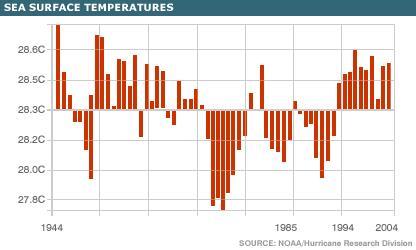
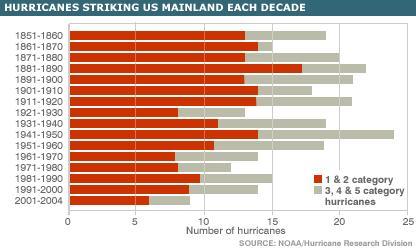
Two charts to reckon with, from BBC News online:

Words of Caution for Scientific Dogmatists

Remember the aether? Remember phlogiston? There may be more:

Einsten’s general relativity theory superseded Newton’s because Newton’s was less complete. It now seems that Einstein’s theory may need some work.

There may be something to Lamarck’s pre-Darwinian theory of evolution.

Global warming probably isn’t unique to our time.

I admire science, and scientists who practice science. But I don’t admire scientists who adhere to certain dogmas because they are predisposed to those dogmas, or because they neatly fit a preferred worldview.

Global Warming and Life

Philip Stott, an emeritus professor of biogeography in the University of London, has much to say about global warming and the G8 summit in “Global warming: Common sense prevails,” at spiked!:

Since the Rio Conference in 1992, the Greens and their camp-following Guardianistas have tried, with Cromwellian zeal, to employ the threat of ‘global warming’ to induce Protestant guilt in us all, to cap growth, to change lifestyles, to attack the car, industry and the Great Satan of America. Now it is surely time to face the facts: there isn’t a snowflake-in-hell’s chance of this altering real life. Indeed, it would be disastrous for the developing world, the other plank of the G8 agenda, if it did. Without increasing demand in the countries of the North, there is no way in which the poorer countries of the South will be able to grow out of their poverty. The attempt to cap growth through the environmental proxy of ‘global warming’ is a sleight of hand too far. Luckily, it appears that the general public has no intention of being conned.

But the failure of the Greens is not just with the public. While playing the climate-change card at the G8 Summit, the final Gleneagles’ declaration shows that the leaders of the developed world have no intention of sacrificing growth and economic success for an ascetic ‘global warming’ religion.

First, there is the clear recognition that global energy demand is expected to grow by 60 per cent over the next 25 years, especially in China and India, and that this will require the maintenance and development of ‘secure, reliable and affordable energy sources’ that are fundamental to economic stability and development, because ‘rising energy demand poses a challenge to energy security given increased reliance on global energy markets’. The declaration also correctly acknowledges that around two billion people lack modern energy services. As the document states: ‘We need to work with our partners to increase access to energy if we are to support the achievement of the goals agreed at the Millennium Summit in 2000….

[W]hat I wrote recently in a letter published in the Daily Telegraph (2) was more true than I had imagined: ‘In the UK, “global warming” is a faith. Here the “science” is legitimised by the myth. This is something that even our august Royal Society has failed to grasp. Too many of us believe we are making an independent scientific assessment, when, in reality, we have subsumed Hume-scepticism to the demands of faith.

‘With respect to the science of climate change, the most fundamental question remains: “Can humans manipulate climate predictably?” Or, more scientifically: “Will cutting carbon dioxide emissions at the margin produce a linear, predictable change in climate?” The answer is “No”. In so complex a coupled, non-linear, chaotic system as climate, not doing something at the margins is as unpredictable as doing something. This is the cautious science; the rest is dogma.’

Economic imperatives prevail over “scientific correctness.”

Related posts:

Hemibel Thinking (07/16/04)
Climatology (07/16/04)
Global Warming: Realities and Benefits (07/18/04)
Words of Caution for the Cautious (07/21/04)
Scientists in a Snit (08/14/04)
Another Blow to Climatology? (08/21/04)
Bad News for Politically Correct Science (10/18/04)
Another Blow to Chicken-Little Science (10/27/04)
Bad News for Enviro-nuts (11/27/04)
The Hockey Stick Is Broken (01/31/05)
The Thing about Science (03/24/05)
Science in Politics, Politics in Science (05/11/05)

Computer Technology Will Replace Concrete

Glenn Reynolds, writing at Tech Central Station, observes that

the growth of cheap computing power has…undercut the importance of big organizations in many, many areas. That cheap computing power is now being coupled with cheap manufacturing — including, increasingly, what Neal Gershenfeld calls “personal fabrication,” in his book, Fab: The Coming Revolution on Your Desktop – From Personal Computers to Personal Fabrication….

For activities that, ultimately, are about processing information, the computer revolution itself has drastically reduced the minimum efficient scale. A laptop, a cheap videocamera, and the free iMovie or Windows Movie Maker software (plus an Internet connection) will let one person do things that the Big Three television networks could only dream of in [John Kenneth] Galbraith’s day, at a tiny fraction of the cost. The same laptop with a soundcard, a couple of microphones, and software like Acid, Cubase, or Audition can replace an expensive recording studio. Change the software and it can replace an office full of Galbraith-era accountants with calculators, pencils and paper, or even with access to big 1960s mainframe computers….It’s not just that fewer people can do the same work, it’s that they don’t need a big company to provide the infrastructure to do the work, and, in fact, they may be far more efficient without the big company and all the inefficiencies and stumbling blocks that its bureaucracy and “technostructure” tend to produce.

Those inefficiencies were present in Galbraith’s day, too, of course. People have been making jokes about office politics and bureaucratic idiocies since long before Dilbert. But in the old days, you had to put up with those problems because you needed the big organization to do the job. Now, increasingly, you don’t. Goliath’s clumsiness used to be made up for by the fact that he was strong. But now the Davids are muscling up without bulking up. So why be a Goliath?

That is the question that many people are asking themselves, and as technology moves toward smaller, faster, and cheaper approaches in man, many areas we’re likely to see an army of Davids taking the place of those slow, shuffling Goliaths. This won’t be the end of big enterprises, or big bureaucracies (especially, alas, the latter) but it will represent a dramatic reversal of recent history, toward more cottage industry, more small enterprises and ventures, and more empowerment for individuals willing to take advantage of the tools that become available. In some ways, the future may look more like the distant past than the recent past. It’s not surprising that it may also seem to operate on a more human scale.

The trend toward the decentralization of work will be hastened by traffic congestion. People put up with it only to the extent that the jobs they struggle to arrive at and return home from are worth the time, expense, and aggravation. Those who worry about the seemingly endless spiral of road-building and traffic congestion should worry less and have faith in the power of technology and markets. As I wrote here,

[i]nstead of paving America — at vast expense — we should simply let the market solve the problem. When commuters have truly had enough they will turn to alternatives that will arise to meet the demand. Those alternatives — if government will stay out of the way — will be offered by private transportation companies, automobile manufacturers, employers (who may finally get serious about telecommuting, for example), and workers (some of whom will opt for simpler lives or forms of employment that don’t require commuting).

Science in Politics, Politics in Science

Here’s Will Saletan of Slate, writing about Intelligent Design (ID):

In September 1999, [John] Calvert founded the Intelligent Design Network to promote his mutant line of creationism. The next year, a political asteroid struck Kansas. Alarmed by the 1999 curriculum changes, voters went to the polls and wiped out the education board’s creationist majority. With the old species out of the way, the new one took over. In January 2001, as the newly constituted board reopened the curriculum standards, IDnet proposed revisions radically different from [those of the Creation Science Association for Mid-America (CSA)].

The board’s draft standards said, “The fossil record provides evidence of simple, bacteria-like life as far back as 3.8+ billion years ago.” CSA would have tried to remove that sentence. IDnet embraced it and proposed to add a prepositional phrase: “almost simultaneously with the postulated habitability of our earth.” This would underscore Calvert’s argument that life arose faster than randomness could account for. A few lines later, the board’s draft mentioned the fossil record, radioisotope dating, and plate tectonics. CSA would have fought all three references. IDnet affirmed them and asked only for a revision to limit their implications: “Certain aspects of the fossil record, the age of the earth based on radioisotope dating and plate tectonics are consistent with the Darwinian theory. However, this evidence is not inconsistent with the design hypothesis.”

Two years later, in a bioethics journal, Calvert and an IDnet colleague, biochemist William Harris, summarized the differences between Biblical creationism and ID. “Creation science seeks to validate a literal interpretation of creation as contained in the book of Genesis,” they explained. “An ID proponent recognizes that ID theory may be disproved by new evidence. ID is like a large tent under which many religious and nonreligious origins theories may find a home. ID proposes nothing more than that life and its diversity were the product of an intelligence with power to manipulate matter and energy.”

Last year, conservatives regained a narrow majority on the Kansas board. They’ve reopened the curriculum, but this time, CSA isn’t running the show. Calvert and Harris are. At last week’s hearings, Calvert presented 23 witnesses—– scientists, philosophers, and teachers — —to make the case for ID. A lawyer representing evolutionists asked the witnesses how old the earth was. Most affirmed the conventional geological estimate: 4.5 billion years. Only two stuck to the young-earth theory.

Essentially, ID proponents are gambling that they can concede evolutionist earth science without conceding evolutionist life science. But they can’t. They already acknowledge microevolution — —mutation and natural selection within a species. Once you accept conventional fossil dating and four billion years of life, the sequential kinship of species loses its implausibility. You can’t fall back on the Bible; you’ve already admitted it can’t always be taken literally. All you’re left with is an assortment of gaps in evolutionary theory — —how did DNA emerge, what happened between this and that fossil— — and the vague default assumption that an “intelligence” might fill in those gaps. Calvert and Harris call this assumption a big tent. But guess what happens to a tent without poles.

Perversely, evolutionists refuse to facilitate this collapse. They prefer to dismiss ID proponents as dead-end Neanderthals. They complain, legitimately, that Calvert and Harris are trying to expand the definition of science beyond “natural explanations.” But have you read the definition Calvert and Harris propose? It would define science as a continuous process of “observation, hypothesis testing, measurement, experimentation, logical argument and theory building to lead to more adequate explanations of natural phenomena.” Abstract creationism can’t qualify for such scrutiny. Substantive creationism can’t survive it. Or if it can, it should.

It’s too bad liberals and scientists don’t welcome this test. It’s too bad they go around sneering, as censors of science often have, that the new theory is too radical, offensive, or embarrassing to be taken seriously. It’s too bad they think good science consists of believing the right things. In the long view — —the evolutionary view— — good science consists of using evidence and experiment to find out whether what we thought was right is wrong. If they do that in Kansas, by whatever name, that’s all that matters.

The money quote: “It’s too bad [liberals and scientists] think good science consists of believing the right things.” Not all scientists think that way, but it’s obvious that many of them do. Politically correct science is dangerous science, for it can be used to “prove” that we ought to do things that are against our own best interest.

Consider this:

Our planet’s air has cleared up in the past decade or two, allowing more sunshine to reach the ground, say two studies in Science this week.

Reductions in industrial emissions in many countries, along with the use of particulate filters for car exhausts and smoke stacks, seem to have reduced the amount of dirt in the atmosphere and made the sky more transparent.

That sounds like very good news. But the researchers say that more solar energy arriving on the ground will also make the surface warmer, and this may add to the problems of global warming. More sunlight will also have knock-on effects on cloud cover, winds, rainfall and air temperature that are difficult to predict.

And this:

While researchers argue whether Earth is getting warmer and if humans are contributing, a heated debate over the global effect of sunlight boiled to the surface today.

And in this debate there is little data to go on.

A confusing array of new and recent studies reveals that scientists know very little about how much sunlight is absorbed by Earth versus how much the planet reflects, how all this alters temperatures, and why any of it changes from one decade to the next.

Determining Earth’s reflectance is crucial to understanding climate change, scientists agree.

And this:

Global warming has finally been explained: the Earth is getting hotter because the Sun is burning more brightly than at any time during the past 1,000 years, according to new research.

A study by Swiss and German scientists suggests that increasing radiation from the sun is responsible for recent global climate changes.

Dr Sami Solanki, the director of the renowned Max Planck Institute for Solar System Research in Gottingen, Germany, who led the research, said: “The Sun has been at its strongest over the past 60 years and may now be affecting global temperatures.

“The Sun is in a changed state. It is brighter than it was a few hundred years ago and this brightening started relatively recently – in the last 100 to 150 years.”…

Dr Bill Burrows, a climatologist and a member of the Royal Meteorological Society, welcomed Dr Solanki’s research. “While the established view remains that the sun cannot be responsible for all the climate changes we have seen in the past 50 years or so, this study is certainly significant,” he said.

“It shows that there is enough happening on the solar front to merit further research. Perhaps we are devoting too many resources to correcting human effects on the climate without being sure that we are the major contributor.”

And this:

Earth’s temperature is on the rise, researchers say, and environmental watchdogs are howling, hoping it’s not too late to avert negative effects that could range from melting icecaps to mass extinctions.

Some scientists, however, now think global warming is irreversible. In light of this sobering view, certain economists and scientists are searching for a silver lining. While the good news they find might not be global, some researchers believe the benefits of Earth’s warming will help compensate for the harmful consequences.

But global warming may in fact be a long-term cyclical phenomenon, and it may have little or nothing to do with human activity.

In spite of vast uncertainty about the causes and consequences of global warming, many scientists have joined the Luddites of the Left in their demand that we do something about global warming, namely, curtail economic activity and impoverish ourselves. Why? Because scientists are human, too. And many scientists, beneath a pretense to objectivity, are in fact Leftists who view global warming as a moral issue — it must be the consequence of our sinful embrace of capitalism and economic growth — and not as a series of unsettled scientific questions:

  • What actually causes global warming?
  • Is it permanent?
  • What might we be able to do about it, if anything?
  • Are its consequences, on balance, negative or positive — and for whom?

Why should we trust Left-wing scientists (or nonscientists) on the subject of evolution when we can’t trust them on the subject of climate?

Recommended Reading for Enviro-Nuts

Start with this: A Spiked! issue on Global warming.

Add this: A TCS piece about the scientic “consensus” on global warming.

And finish with this: The debunking of the “hockey stick” theory of global warming.

If that won’t cure your environmental hysteria, nothing will.

The Hockey Stick Is Broken

I wrote twice in October about the impending demise of the hockey-stick model of global warming. The hockey-stick model purports to show that temperatures on Earth have risen sharply in the past century, ostensibly because of human activity. That model is, of course, a favorite of Luddite leftists, many of whom are bandwagon scientists who give blind allegiance to the model.

The article that promises to drive a stake into the heart of the hockey-stick model is about to be published. The bottom line can be seen in this graph (available here):

“MBH98” (the light line) is the infamous hockey-stick depiction of Earth’s temperature trend. “Recalculated” (the dark line) is the correct depiction.

As I have written before — here, here, and here, for instance — there’s evidence that global warming has little to do with human activity and a lot to do with extraterrestrial events.

(Thanks to FuturePundit for the tip.)