A Nation of (Unconstitutional) Laws

I have long viewed the Constitution as a contract, which was entered into initially by the States, as authorized by the people of each State in a ratifying convention. At some point, probably long before the Civil War, the Constitution ceased to be a contract and became a law — or a conglomeration of laws, variously interpreted and enforced by the factions then in control of Congress, the executive branch, and the Supreme Court. The Civil War cemented the status of the Constitution as law by imposing it forcibly on dissenting parties: the members of the Confederate States of America.

The original contract was a compact among the States and the people thereof to form a central government of limited, enumerated powers. The main purposes of that government were to keep peace among the States, ensure a free flow of trade among the States, ensure uniformity in the rules of inter-State and international commerce, face the world with a single foreign policy and a national armed force, and ensure the even-handed application of the Constitution and of constitutional laws.

The central government is no longer the creature of a contract, bound by the terms of that contract. It has become the unaccountable arbiter of its own doings. Its laws — legislative enactments, executive orders, and judicial holdings — sometimes pay lip service to the Constitution. But the central government’s conduct is almost entirely unrelated to and unconstrained by the Constitution. Judicial holdings that affirm the original contract are notable because they are unusual.

What began as a grand bargain among equals has become a Faustian bargain.

Related posts:
Substantive Due Process, Liberty of Contract, and the States’ Police Power
Secession
A New, New Constitution
Secession Redux
A New Cold War or Secession?
The Real Constitution and Civil Disobedience
A Declaration of Independence
First Principles
Zones of Liberty
The State of the Union: 2010
The Shape of Things to Come
The Constitution: Original Meaning, Corruption, and Restoration
A Conversation with Uncle Sam

Another Entry in the Sunstein Saga

Alec Rawls, writing at his blog, Error Theory:

As Congress considers vastly expanding the power of copyright holders to shut down fair use of their intellectual property, this is a good time to remember the other activities that Obama’s “regulatory czar” Cass Sunstein wants to shut down using the tools of copyright protection. For a couple of years now, Sunstein has been advocating that the “notice and take down” model from copyright law should be used against rumors and conspiracy theories, “to achieve the optimal chilling effect.”

Why?

Sunstein seems most intent on suppressing is the accusation, leveled during the 2008 election campaign, that Barack Obama “pals around with terrorists.” (“Look Inside” page 3.) Sunstein fails to note that the “palling around with terrorists” language was introduced by the opposing vice presidential candidate, Governor Sarah Palin (who was implicating Obama’s relationship with domestic terrorist Bill Ayers). Instead Sunstein focuses his ire on “right wing websites” that make “hateful remarks about the alleged relationship between Barack Obama and the former radical Bill Ayers,” singling out Sean Hannity for making hay out of Obama’s “alleged associations” (pages 13-14).

What could possibly be more important than whether a candidate for president does indeed “pal around with terrorists”? Of all the subjects to declare off limits, this one is right up there with whether the anti-CO2 alarmists who are trying to unplug the modern world are telling the truth. And Sunstein’s own bias on the matter could hardly be more blatant. Bill Ayers is a “former” radical? Bill “I don’t regret setting bombs” Ayers? Bill “we didn’t do enough” Ayers?

For the facts of the Obama-Ayers relationship, Sunstein apparently accepts Obama’s campaign dismissal of Ayers as just “a guy who lives in my neighborhood.” In fact their relationship was long and deep. Obama’s political career was launched via a fundraiser in Bill Ayers’ living room; Obama was appointed the first chairman of the Ayers-founded Annenberg Challenge, almost certainly at Ayers’ request; Ayers and Obama served together on the board of the Woods Foundation, distributing money to radical left-wing causes; and it has now been reported by full-access White House biographer Christopher Andersen (and confirmed by Bill Ayers) that Ayers actually ghost wrote Obama’s first book Dreams from My Father.

Whenever free speech is attacked, the real purpose is to cover up the truth. Not that Sunstein himself knows the truth about anything. He just knows what he wants to suppress, which is exactly why government must never have this power.

As Rawls notes, Sunstein also wants to protect “warmists” from their critics, that is, to suppress science in the name of science:

In climate science, there is no avoiding “reference to the machinations of powerful people, who have also managed to conceal their role.” The Team has always been sloppy about concealing its machinations, but that doesn’t stop Sunstein from using climate skepticism as an exemplar of pernicious conspiracy theorizing, and his goal is perfectly obvious: he wants the state to take aggressive action that will make it easier for our powerful government funded scientists to conceal their machinations.

Rawls’s thesis is entirely unsurprising to me. This is from “Fascism with a Friendly Face,” a post I wrote almost three years ago:

Regarding the suppression of dissent, it is noteworthy that Obama’s has tagged Cass Sunstein (a Chicago crony) to head the Office of Information and Regulatory Affairs in the White House. (See this article for more about the likely direction of OIRA under Sunstein.) My biggest concern about Sunstein, who figures to be a strong influence on Obama, is his embrace of the oxymoronical thing known as “libertarian paternalism.” (For an exposition of its flaws, see this post and its predecessors, linked therein.)

“Libertarian paternalism” is nothing more than a dressed-up version of paternalism, in which the government is used to “nudge” people toward making the kinds of decisions that Sunstein and his ilk would make. That is to say, Sunstein (like too many other bright individuals) likes to believe that he knows what’s best for others. (That conceit is demolished in the posts mentioned at the end of the preceding paragraph and in these posts by an avowed utilitarian.)

“Libertarian paternalism” may seem innocuous, but there’s more to it than a bit of “nudging” (hah!) by the one-ton gorilla in the room (i.e., the federal government). Perhaps the most frightening item on Sunstein’s paternalistic agenda ties into Sen. Rockefeller’s proposal to give the president the power to shut down the internet — which amounts to the power to control the content of the internet. And make no mistake about it, Sunstein would like to control the content of the internet — for our own good, of course. I refer specifically to Sunstein’s “The Future of Free Speech,” in which he advances several policy proposals, including these:

4. . . . [T]he government might impose “must carry” rules on the most popular Websites, designed to ensure more exposure to substantive questions. Under such a program, viewers of especially popular sites would see an icon for sites that deal with substantive issues in a serious way. They would not be required to click on them. But it is reasonable to expect that many viewers would do so, if only to satisfy their curiosity. The result would be to create a kind of Internet sidewalk, promoting some of the purposes of the public forum doctrine. Ideally, those who create Websites might move in this direction on their own. If they do not, government should explore possibilities of imposing requirements of this kind, making sure that no program draws invidious lines in selecting the sites whose icons will be favoured. Perhaps a lottery system of some kind could be used to reduce this risk.

5. The government might impose “must carry” rules on highly partisan Websites, designed to ensure that viewers learn about sites containing opposing views. This policy would be designed to make it less likely for people to simply hear echoes of their own voices. Of course, many people would not click on the icons of sites whose views seem objectionable; but some people would, and in that sense the system would not operate so differently from general interest intermediaries and public forums. Here too the ideal situation would be voluntary action. But if this proves impossible, it is worth considering regulatory alternatives. [Emphasis added.]

A Left-libertarian defends Sunstein’s foray into thought control, concluding that

Sunstein once thought some profoundly dumb policies might be worth considering, but realized years ago he was wrong about that… The idea was a tentative, speculative suggestion he now condemns in pretty strong terms.

Alternatively, in the face of severe criticism of his immodest proposal, Sunstein merely went underground, to await an opportunity to revive his proposal. I somehow doubt that Sunstein, as a confirmed paternalist, truly abandoned it. The proposal certainly was not off-the-cuff, running to 11 longish web pages.  Now, judging by the bulleted list above, the time is right for a revival of Sunstein’s proposal. And there he is, heading the Office of Information and Regulatory Affairs. The powers of that office supposedly are constrained by the executive order that established it. But it is evident that the Obama adminstration isn’t bothered by legal niceties when it comes to the exercise of power. Only a few pen strokes stand between Obama and a new, sweeping executive order, the unconstitutionality of which would be of no import to our latter-day FDR.

Cass Sunstein is a dangerous man because he is intelligent, power-hungry, and overtly in favor of liberty, even as he fosters its demise.

*   *   *

Related posts:
Sunstein at the Volokh Conspiracy
More from Sunstein
Cass Sunstein’s Truly Dangerous Mind
An (Imaginary) Interview with Cass Sunstein
Libertarian Paternalism
Slippery Sunstein
A Libertarian Paternalist’s Dream World
The Short Answer to Libertarian Paternalism
Second-Guessing, Paternalism, Parentalism, and Choice
Another Thought about Libertarian Paternalism
Back-Door Paternalism
Another Voice Against the New Paternalism
Sunstein and Executive Power
The Feds and “Libertarian Paternalism”
A Further Note about “Libertarian” Paternalism
Apropos Paternalism
FDR and Fascism
Fascism
Are We All Fascists Now?
Fascism with a “Friendly” Face
Fascism and the Future of America
Discounting and Libertarian Paternalism
The Mind of a Paternalist

The Equal-Protection Scam and Same-Sex Marriage

Steven Horwitz, writing at Bleeding Heart Libertarians, opines that

In the world that exists, where the state is involved in marriage, I believe that….

Libertarianism requires  [federal recognition of same-sex marriage], as we often forget that the classical liberal tradition was built on two pillars: the rights of the individual against the state and equality before the law. The state may not discriminate. If it offers a benefit to some, it must offer it to all who are equally situated….

Suppose we had a Social Security system in which all residents of the US paid FICA but only white ones received the benefits. Would you argue that the libertarian position is to continue to deny people of color access to Social Security benefits on the grounds that giving the benefits to them would “extend federal power?” Would you continue to insist that the only libertarian position is to argue for the elimination of Social Security even though it continues to benefit only whites?

Double hogwash!

First, homosexuals are not “equally situated” with respect to heterosexuals. They want to call “marriage” something that cannot be marriage, as marriage has been understood for thousands of years: the union of a man and a woman in a lifelong commitment to each other. Homosexuals may choose to enter into private relationships that they call “marriage” — and no one can stop them — but those relationships are not manifestations of the time-honored social institution known as marriage.

Second, the analogy with Social Security is inapt. The recognition of marriage by the state is not a “benefit” in the same way as Social Security; that is, it is not a form of remuneration based on “contributions” to a (fictional) insurance pool. Social Security benefits are a quid pro quo; the recognition of marriage is a grant of status, in the same way that naturalization is a grant of status — the status of citizen. The state may make and change the qualifications for citizenship, because the power to do so is inherently a function of the state. But the state may not make and change the essential nature of marriage, which is a social phenomenon.

Where the state chooses to call a homosexual “marriage” a marriage, it simply indulges in legal fiction. But it is not harmless legal fiction — a crucial point that eludes “libertarians” like Horwitz; thus:

The recognition of homosexual “marriage” by the state — though innocuous to many, and an article of faith among most libertarians and liberals — is another step down the slippery slope of societal disintegration. The disintegration began in earnest in the 1930s, when Americans began to place their trust in chimerical, one-size-fits-all “solutions” offered by power-hungry, economically illiterate politicians and their “intellectual” enablers and apologists. In this instance, the state will recognize homosexual “marriage,” then bestow equal  benefits on homosexual “partners,”  and then require private entities (businesses, churches, etc.) to grant equal benefits to homosexual “partnerships.” Individuals and businesses who demur will be brought to heel through the use of affirmative action and hate-crime legislation to penalize those who dare to speak against homosexual “marriage,” the privileges that flow from it, and the economic damage wrought by those privileges.

It should be evident to anyone who has watched American politics that even-handedness is not a matter of observing constitutional limits on government’s reach, regardless of who asks for an exception; it is, rather, a matter of expanding the privileges bestowed by government so that no one is excluded. It follows that the recognition and punitive enforcement of same-sex “marriage” would be followed by the recognition and bestowal of benefits on other arrangements, including transient “partnerships” of convenience. And that surely will weaken heterosexual marriage, which is the axis around which the family revolves. The state will be saying, in effect, “Anything goes. Do your thing. The courts, the welfare system, and the taxpayer — above all — will pick up the pieces.” And so it will go….

Given the signals being sent by the state, the rate of formation of traditional, heterosexual marriages will continue to decline. (According to the Census Bureau, the percentage of adult males who are married dropped steadily from 71.1 percent in the 1960 census to 58.6 percent in the 2000 census; for females, the percentage dropped from 67.4 to 54.6. (The latest available figures, for 2009, show no significant change since 2000.) About half of each drop is explained by a rise in the percentage of adults who never marry, the other half by a rise in the percentage of divorced adults. Those statistics are what one should expect when the state signals — as it began to do increasingly after 1960 — that traditional marriage is no special thing by making it easier for couples to divorce, by subsidizing single mothers, and by encouraging women to work outside the home.

The well-known effects of such policies include higher rates of crime and lower levels of educational and economic achievement. (See this and this, for example.) Same-sex marriage would multiply these effects for the sake of mollifying a small minority of the populace.

A “libertarian” like Horwitz will assert that all such considerations are beside the point — as if the only point of liberty is “self-actualization” or similar clap-trap. I do wish that these self-styled “libertarians” would grow up and shut up.

Related posts:
Libertarianism, Marriage, and the True Meaning of Family Values
Same-Sex Marriage
“Equal Protection” and Homosexual Marriage
“Family Values,” Liberty, and the State
On Liberty
Civil Society and Homosexual “Marriage”
Perry v. Schwarzenegger, Due Process, and Equal Protection
Rationalism, Social Norms, and Same-Sex “Marriage”
Pseudo-Libertarian Sophistry vs. True Libertarianism
Libertarian Conservative or Conservative Libertarian?
Liberty, Equality, Fraternity: Part I
Bounded Liberty: A Thought Experiment
More Pseudo-Libertarianism
The Meaning of Liberty
Positive Liberty vs. Liberty
In Defense of Marriage
Burkean Libertarianism
Rights: Source, Applicability, How Held
What Is Libertarianism?
True Libertarianism, One More Time
Human Nature, Liberty, and Rationalism
The Myth That Same-Sex Marriage Causes No Harm
The Libertarian-Conservative Fusion Is Alive and Well
What Is Bleeding-Heart Libertarianism?

Lock ‘Em Up

Charles Murray writes:

Here is a graph that shows the violent crime rate per 100,000 population and the number of prisoners per 1,000 violent offenses from 1960–2010:

Source: Bureau of Justice Statistics, FBI Uniform Crime Reports. “Prisoners” refers to inmates of state and federal prisons and does not include persons in jail.

….

When crime gets safer, crime goes up very quickly as a response. In the late 1950s, the “prison only makes people into smarter criminals”  school became dominant in criminal justice circles. By the early 1960s, imprisonment rates were plummeting. For that matter, even the raw number of prisoners fell. One consequence was that every cohort of young people saw acquaintances start to get probation for offenses that would have sent them to prison or reform school in the 1950s. I still remember my shock as a 17-year-old in that era when a friend of mine who shoplifted several thousand dollars of clothes from the store where he worked got probation. Once he had been arrested, it had not occurred to me that he wouldn’t go to reform school.

Pushing that toothpaste back into the tube takes a lot longer. Kids who are amazed when a friend gets away with a serious crime aren’t amazed when, say, 19 percent of their friends arrested for a serious crime are incarcerated instead of 15 percent. Understandably, crime continued to rise after imprisonment rates started to rise after 1974. Even in 1990, after 15 years of rising imprisonment rates, the risk of going to prison if you committed a violent crime was still far lower than it had been in 1960.

Cumulatively, however, two things happen. First, more and more of the “dirty 7 percent” of offenders who commit about 50 percent of all crime end up in prison. They cannot commit crimes, except against other criminals. Second, the cumulative impact of much higher imprisonment rates does make an impression—the idea that crime doesn’t pay is no longer completely a joke. For violent crime, the tipping point occurred in 1992, when imprisonment rates were heading straight up. By the time that the imprisonment rate for violent crime reached its 1960 level in 1998, the downward trendline was well established.

So how much of the reduction in violent crime was produced by increased incarceration? This kind of analysis doesn’t tell us…. (“Keep locking ’em up,” The Enterprise Blog, December 29, 2011)

I assessed the effect of imprisonment on the crime rate in a post that is now more than four years old. The following material is excerpted from that post.

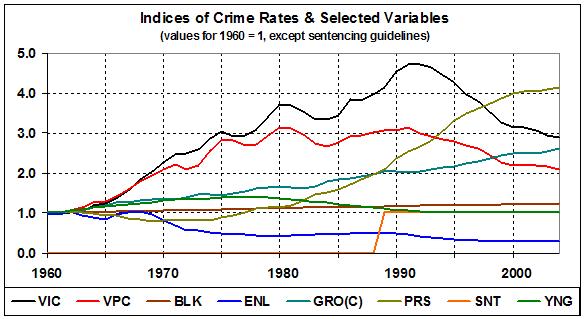
I … considered as explanatory variables the existence of mandatory federal sentencing guidelines (1989-2004), number of male enlisted personnel in the armed forces (in proportion to population), and year-over-year growth in real GDP per capita — in addition to the number of persons aged 15-24, number of prisoners, and number of blacks in proportion to total population, as before. (For sources, see the footnote to this post.) Here’s a graphical depiction of the crime rates and all of the variables I considered:


Key: VIC, violent crimes per 100,000 persons; VPC, violent+property+crimes per 100,000 persons; BLK, blacks as a proportion of population; ENL (active-duty, male, enlisted personnel as a proportion of population aged 15-24; GRO(C), growth of real GDP per capita as a proxy for year-to-year growth (GRO) used in the regression analysis; PRS, prisoners in federal and State penitentiaries as a proportion of population; SNT, mandatory sentencing guidelines in effect (0 = no, 1 = yes); YNG, persons aged 15-24 as a proportion of population.

A few comments about each of the explanatory variables: BLK, unfortunately, stands for a segment of the population that has more than its share of criminals — and victims. Having more men in the armed forces (ENL) should reduce, to some extent, the number of crime-prone men in the civilian population. (It would also help to alleviate our self-inflicted impotence, by putting more “boots on the ground” — and missiles in readiness.) I use the annual rate of real, per-capita economic growth (GRO) to capture the rate of employment — or unemployment — and the return on employment, namely, income. (The use of year-over-year growth vice cumulative growth avoids collinearity with the other variables.) PRS encompasses not only the effects of taking criminals off the streets, but the means by which that is done: (a) government spending on criminal justice and (b) juries’ and courts’ willingness to put criminals behind bars and keep them there for a good while. SNT ensures that convicted criminals are put away for a good while.

I focused on violent-plus-property crime (VPC) as the dependent variable, for two reasons. First, there is a lot more property crime than violent crime (VIC); that is, VPC is a truer measure of the degree to which crime affects Americans. Second, exploratory regression runs on VPC yielded more robust results than those on VIC.

Even at that, it is not easy to tease meaningful regressions from the data, given high correlations among several of the variables (e.g., mandatory sentencing guidelines and prison population, number of blacks and prison population, male enlistees and number of blacks). The set of six explanatory variables — taken one, two, three, four, five, and six at a time — can be used to construct 63 different equations. I estimated all 63, and rejected all of those that returned coefficients with counterintuitive signs (e.g., negative on BLK, positive on GRO).

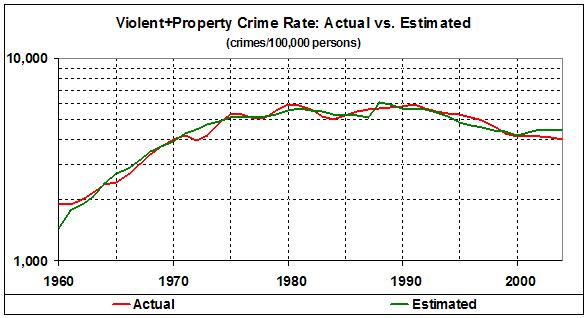
Of the 63 equations, I chose the one that has the greatest number of explanatory variables, where the sign on every explanatory variable is intuitively correct, and — given that — also has the greatest explanatory power (as measured by its R-squared):

VPC (violent+property crimes per 100,000 persons) =

-33174.6

+346837BLK (number of blacks as a decimal fraction of the population)

-3040.46GRO (previous year’s change in real GDP per capita, as a decimal fraction of the base)

-1474741PRS (the number of inmates in federal and State prisons in December of the previous year, as a decimal fraction of the previous year’s population)

The t-statistics on the intercept and coefficients are 19.017, 21.564, 1.210, and 17.253, respectively; the adjusted R-squared is 0.923; the standard error of the estimate/mean value of VPC = 0.076.

The minimum, maximum, and mean values of the dependent and explanatory variables:

VPC: 1887, 5950, 4773 (violent-plus-property crimes/100,000 persons)

BLK: 0.1052, 0.1300, 0.1183 (blacks/population)

GRO: -0.02866, 0.06263, 0.02248 (growth in real GDP per capita during year n-1/real GDP per capita in year n-2)

PRS: 0.0009363, 0.004842, 0.002243 (federal and State prisoners in December of year n-1/average population in year n-1)

Even though the coefficient on GRO isn’t strongly significant, it isn’t negligible, and the sign is right — as are the signs on BLK and PRS. The sign on the intercept is counterintuitive — the baseline rate of crime could not be negative. The negative sign indicates the omission of key variables. But forcing variables into a regression causes some of them to have counterintuitive signs when they are highly correlated with other, included variables.

In any event, the equation specified above does a good job of explaining variations in the crime rate:

I especially like the fact that the equation accounts for two policy-related variables: GRO and PRS:

1. Crime can be reduced if economic growth is encouraged by rolling back tax rates. Crime will rise if growth is inhibited by raising tax rates (even for the very rich).

2. Crime can be reduced by increasing the rate at which it is prosecuted successfully, and by ensuring that prisoners do not receive lenient sentences….

ENL and YNG, like SNT, are key determinants of the crime rate. Each of the three variables appears, with the right sign, in many of the 63 equations. So, I am certainly not ruling out ENL and YNG as important variables. To the contrary, they are important variables. But, just as with SNT, I can’t satisfactorily quantify their importance because of the limitations of regression analysis.

Crime, then, depends mainly on two uncontrollable variables (BLK and YNG), and four controllable ones: ENL, GRO, PRS, and SNT. The controllable variables are salutary means of reducing crime, and the record shows that they work….

*   *   *

Related posts:
Does Capital Punishment Deter Homicide?
Libertarian Twaddle about the Death Penalty
Crime and Punishment
Abortion and Crime
Saving the Innocent?
Saving the Innocent?: Part II
More on Abortion and Crime
More Punishment Means Less Crime
More About Crime and Punishment
More Punishment Means Less Crime: A Footnote
Clear Thinking about the Death Penalty
Let the Punishment Fit the Crime
Another Argument for the Death Penalty
Less Punishment Means More Crime
Crime, Explained
Abortion and Crime (from a different angle than the earlier post of the same name)

The Morality of Occupying Private Property

That is the subject of a post by Steve Horwitz at Bleeding Heart Libertarians. Horwitz writes:

So as the Occupy movement switches tactics to occupy foreclosed homes, I pose the following questions for my colleagues here at BHL and the commentariat:

1. Given that many of those homes are the property of the very same banks who were bailed out with their/our tax dollars, is there any reason to object to Occupiers simply reclaiming property that we could argue, with some strong moral force, actually belongs to “them/us” anyway?

2. And given the questionable legality of the foreclosure tactics banks have used, isn’t there a legitimate question of whether those homes really belong to the banks?…

…I don’t have a clear answer to either question myself, but I don’t think it’s clear and obvious that these attempts to occupy foreclosed houses are wrong on libertarian grounds.

Let us parse Horwitz’s questions:

1. The use of tax dollars to bail out (some) banks does not mean the “we” own the banks; it means that the banks owe “us” money.

Even accepting for the sake of argument the dubious claim that the foreclosed houses are “our” property, by what right does a small fraction of the populace — a fraction that probably pays far less than its “fair share” of taxes — occupy “our” property? If the foreclosed homes are “our” property, they should be sold and the proceeds returned to taxpayers in proportion to the taxes they pay. Occupiers have no particular right of occupation, and their occupation probably would diminish the value of the property they occupy, thus depriving taxpayers of what is rightly theirs.

The “logic” of question 1 leads to such spectacles as the occupations of public parks and streets,  which occupations deny large numbers of taxpayers the peaceful enjoyment of the facilities for which they paid.

2. If the homes really do not belong to the banks — a sweeping and unproved assertion — then they belong to the persons on whom the banks foreclosed and/or taxpayers in general (accepting for the sake argument the dubious claim that the foreclosed houses are “our” property). As explained above, occupiers have no claim on foreclosed homes. Accordingly, their occupation of foreclosed homes is an immoral breach of the property rights of the rightful owners.

*   *   *

Perhaps Horwitz is merely being provocative, but the fact that he doesn’t have a “clear answer” to either question indicates that his grasp of moral principles is weak. In that respect, he is in company with several of his co-bloggers at Bleeding Heart Libertarians.

Related posts:
A True Flat Tax
Utilitarianism and Psychopathy
“Occupy Wall Street” and Religion
The Spoiled Children of Capitalism
Libertarianism and Morality
Libertarianism and Morality: A Footnote
Merit Goods, Positive Rights, and Cosmic Justice
More about Merit Goods
What Is Bleeding-Heart Libertarianism?

Don’t Just Stand There, “Do Something”

“Activists” try my patience, and exhaust it. Their message — no matter the particulars of content or phrasing — boils down to this: Government should “do something” about “something.” This is a formula that has been invoked since the beginning of the Republic, though increasingly more often since the onset of the Progressive Era in the late 1800s. The exhortation betrays three beliefs, unconscious as they may be on the part of those who do the exhorting.

The first belief is that a particular phenomenon is so important — in the view of the exhorting person or group — that government should contrive to impose a particular outcome with respect to that phenomenon — regardless of the costs of that imposition, in treasure or liberty.

The second belief is a kind of prediction that proponents of government action usually cannot be bothered to test. This kind of prediction is known as the Nirvana fallacy: the logical error of comparing actual things with unrealistic, idealized alternatives. The actual things are the “somethings” about which government is supposed to “do something.” The unrealistic, idealized alternatives are the outcomes sought by the proponents of a particular course of government action. Thus legislation and regulation by mere mortals is taken as the functional equivalent of fiat lux.

This points to the third belief, which is that government — a mere creation of fallible, squabbling, power-lusting humans — is a kind of omniscient, single-minded, benevolent being that can overcome the forces of nature and human nature which gave rise, in the first place, to the “something” about which “something must be done.”

The evidence against these beliefs is so overwhelming that their persistence must be attributed to the psychological phenomenon summarized by Samuel Johnson as “the triumph of hope over experience.”

Proponents of government action will counter with the excuse that “something must be done” because of  “market failure,” which is the failure of markets to produce outcomes preferred by the proponents. And yet they overlook government failure, and often seek to rectify it by exhorting more government action, which leads to more government failure, and so on.

Here are some salient examples of government failure — and its correlate, misfeasance — that ought to (but will not) give pause to the “do something” crowd:

“Entitlements” (Social Security, Medicare, Medicaid, and their expansion through Obamacare) — These programs grew from an understandable (but ill-advised) urge to provide for the elderly who were seen as unable to provide for themselves. Through the predictable processes of constituency-mongering, the “social safety net” has acquired almost-inviolable status as a subsidy for millions of persons who could well provide for themselves. This dependency has discouraged thrift and, in the process, stripped away a key source of funds for investments in economic growth. The looming burden of taxation promises to cripple an already hobbled economy.

Welfare, the Minimum Wage, and Affirmative Action — Altogether, these programs have succeeded in breaking up black families, denying to many young blacks an opportunity to join the ranks of the economically productive (and to advance on their own merit), fomented crime, caused racial resentment, and positioned aspiring black students and professionals for failure.

The Great Depression and the Great Recession — These two devastating economic downturns, one of which became an excuse for the enactment of Social Security and the other of which still lingers, are quintessential examples of government failure. In the case of the Great Depression, the Federal Reserve’s monetary policies (first too loose, then too tight) caused a recession to deepen into a depression. That depression lingered for almost a decade (and ended largely because of a catastrophic war) because of interventionist, anti-business policies that began under Hoover and continued, with a vengeance, under Roosevelt. We owe the Great Recession to a combination of too-loose credit (the Fed again) and too-loose mortgage lending: a policy insisted upon by the Federal Reserve and influential members of Congress, and reinforced by their minions at Fannie and Freddie. “Wall Street” — as a willing maker of credit — deserves blame for the resulting financial meltdown and recession only in the way that a prostitute deserves blame for serving her clients.

Defense and Police Services  — These are public goods, but not for the reason advanced by believers in public goods, namely, that they would not be provided voluntarily because too many of their beneficiaries would try to take a “free ride” on paying customers, which would drive the prices of defense and police services too high to attract enough customers to pay for them. That is an unproved assertion, which runs counter to everyday experience (e.g., charitable giving and voluntarism) and ignores the very high stakes that could drive major corporations and very-high income earners to combine in a joint defense of their considerable interests in the U.S. and abroad — a defense that would unavoidably benefit free-riders. In this regard, it is noteworthy that in 2007 the combined pre-tax income of households in the top quintile was $2.5 trillion and pre-tax corporate profits came to $1.7 trillion. It is arguable that a consortium of taxpayers and corporations could underwrite the cost of defense and police forces (including courts, prosecutors, etc.), which in 2007 came to about $900 billion ($662 billion for defense and $230 billion for justice). In 2007, for example, taxpayers in the top 10 percent of adjusted gross incomes paid more than 70 percent of federal income taxes collected from filers of individual and joint returns. Who do you think pays the lion’s share of the costs of defense and police forces? The answer, of course, is high-income taxpayers, directly and through taxes on corporate income.

Defense and police services are tax-funded not because they must be, but because there is something menacing about the thought of privately owned defense and police forces that could be employed in coups and oppressions. A main consequence of the “publicization” of America’s defense and police forces is that they afford a lucrative opportunity for various kinds of pork-barrel legislation (e.g., the location of military bases, the awarding of defense contracts, and patronage for political supporters), as well as the usual (and unavoidable) instances of waste, fraud, and abuse. Even worse are the fluctuations in political attitudes toward defense and policing, which in the ebb invite aggression and crime, and in the flow invite vast over-spending — though over-spending can be defended on the ground that it deters aggression and crime and thus the human and monetary costs that accompany them.

In any event, not even defense is a sacrosanct function of government, and its provision by government is far from an unmitigated blessing. If you think that I overstate the case against government-owned defense forces, consider that

  • They fought only one “popular” war in the past 100 years — a war that became “popular” only after the surprise attack on Pearl Harbor.
  • The thesis that Reagan’s defense build-up won the Cold War remains controversial.
  • The size of the defense budget rides on political whims more than on hard-to-come-by cold facts. Would it be worse if those with the most to lose took a direct hand in the provision of defense forces and in decisions about when to employ them? I doubt it.

*   *   *

Perhaps there are examples of “government success,” but these are hard to identify because the intervention of government usually forecloses the alternatives to which the “do something” crowd is blind:

  • voluntary, cooperative solutions through the actions of markets, private charities, and other private institutions (family, church, club, close-knit neighborhood, etc.)
  • benign neglect, where persons with a “problem” choose not to act on it because the cost of action is greater than its likely benefits.

Anyone who says that government can be “managed” by limiting it to certain kinds of activities (e.g., defense or welfare) while eschewing others (e.g., welfare or defense), merely deludes himself; “democratic” governments cannot and will not function without throwing money in all directions, in an effort to placate all constituencies. As a minarchist, I must admit to sharing this delusion, but I am beginning to think that anarcho-capitalism has merit, if only the right kind of anarcho-capitalists could be in charge of police and defense forces.

Anyone who says that such-and-such a government program will succeed in accomplishing a certain goal at a certain cost — and that the cost will justify the accomplishment — proves himself a presumptuous fool. I cannot truthfully say that government-provided police and defense forces are worth their cost in money and liberty, and I scorn anyone who believes that any other type of governmental endeavor is remotely worth its cost in money and liberty.
__________
For more posts related generally and specifically to this one, go to “Favorite Posts” and browse at will.

The Contemporary Meaning of the Bill of Rights: First Amendment (Updated)

I have twice updated “The Contemporary Meaning of the Bill of Rights: First Amendment.” Today’s second update  addresses certain issues noted in “Mandating Our Religious Freedom,” a recent post at Public Discourse, specifically:

The Founders’ protection of religious freedom in the First Amendment was in keeping with their recognition of the supreme importance of the individual, who was created by God and subject to God’s natural law. The early twentieth-century Progressives largely rejected this view, as they concluded that man must not be limited by “arbitrary” rules such as those imposed by religion. Modern progressives have seized upon this viewpoint, especially in their attitudes toward sex. The State will teach children about sex, and it will do so by disconnecting it from its most important component—the spiritual. It does not matter that such teachings are, by nature, within the rights of parents.

Progressives have carried these attitudes to federal, state, and local governments, and the result has been an unprecedented assault on religious values and religious practice. Governmental authorities embrace the view that access to contraception (and abortion) is a fundamental right vital to sexual freedom. Similarly, homosexual conduct must be completely normalized and accepted. The law must prohibit even private preference for heterosexual norms, and if religion teaches such a preference, religion must yield. These attitudes must be taught to children in the public schools in order to affirm, in the state’s view, the full self-realization of every person—and as shown below, parents who object to the assault on their right to bring up their children according to their religious values have discovered that the courts will not protect their rights in this regard.

Churches and other people of faith have relied on the judicial process to protect their First Amendment freedoms. But litigation takes an enormous toll in time and resources. Even worse, as many disappointed litigants have discovered, courts grant extraordinary leeway to government and government schools in advancing so-called neutral, generally applicable laws. The courts will follow the lead of the people in defining the parameters of religious liberty; if the people abdicate, the courts will not intercede to protect that liberty.

The problem lies in a 1990 Supreme Court case, Employment Division v. Smith, in which the Court held that the First Amendment does not relieve a citizen of the obligation to comply with a neutral law of general applicability, simply because the law “proscribes (or prescribes) conduct that his religion prescribes (or proscribes).” Applying Smith, lower courts have rejected almost all challenges to laws and government activities that are based on claims of interference with free exercise of religion. Many of these cases arise in the public-school setting. Courts have found that public-school administrators do not interfere with parents’ First Amendment rights by:

Although older Supreme Court authority acknowledged the fundamental right of parents to control the upbringing and education of their children (Meyer v. Nebraska, Pierce v. Society of Sisters, Wisconsin v. Yoder), the post-Smith courts have severely limited those holdings to their unique facts. Now, courts are more likely to hold that parents relinquish, as a practical matter, their First Amendment right to control their children’s education when they choose public schools over private schools or homeschooling. As one court said, parents “have no constitutional right . . . to prevent a public school from providing its students with whatever information it wishes to provide, sexual or otherwise, when and as the school determines that it is appropriate to do so.”

The first update (on 11/18/11) addresses these aspects of “Mandating Our Religious Freedom”:

The denigration of religious freedom extends to areas of purely private, commercial conduct. Governments increasingly apply nondiscrimination statutes to force private individuals and businesses to participate in conduct that violates their religious beliefs. So far, defenses based on the First Amendment have been unavailing. Some examples:

  • The New Mexico Human Rights Commission found that a small photography business unlawfully discriminated against a same-sex couple by declining, because of the owners’ religious beliefs, to photograph the couple’s commitment ceremony (Willock v. Elane Photography).
  • The California Supreme Court ruled that doctors violated the state nondiscrimination statute by refusing, on religious grounds, to artificially inseminate a woman who was in a lesbian relationship (North Coast Women’s Care Medical Group v. San Diego County Superior Court).
  • A federal court in California found that administrators of an Arizona adoption-facilitation website were subject to California’s statute banning discrimination in public accommodations because they refused to post profiles of same-sex couples as potential parents (Butler v. Adoption Media).
  • A New Jersey agency found probable cause to believe that a church violated a public-accommodations statute by declining to rent its pavilion for a same-sex wedding (a different agency, enforcing nondiscrimination on the basis of sexual orientation, revoked the tax exemption the church had enjoyed under a statute promoting the use of private property as green space) (Ocean Grove Camp Meeting Ass’n of United Methodist Church v. Vespa-Papaleo).
  • A federal appeals court found that an employer’s denial of insurance coverage to an employee’s same-sex partner constituted illegal sex discrimination (In Re Levenson)….

Another arena in which principles of nondiscrimination are elevated over free exercise of religion is the area of public benefits. Across the country, faith-based charities or social-service organizations such as the Salvation Army and the Boy Scouts have been denied government grants or other benefits because of their religiously grounded refusal to yield to the demands of “nondiscrimination” (see, for example, Boy Scouts of America v. Wyman, Catholic Charities of Maine, Inc. v. City of Portland). These demands have included providing insurance benefits to employees’ same-sex partners, admitting homosexuals to the organizations’ leadership ranks, and placing children with same-sex adoptive parents. This latter demand has forced Catholic agencies to cease adoption facilitations in Massachusetts, Illinois, and the District of Columbia rather than violate their religious beliefs about marriage and the family.

Other victims of progressive attitudes toward sexuality and “discrimination” have been public employees who express their religiously based concerns about homosexual conduct. A Los Angeles police officer who was also a Protestant minister was demoted and, he says, denied benefits because of a sermon he delivered that quoted biblical passages about prohibited sexual conduct. An African-American college administrator was fired after she published an op-ed objecting to the equating of race discrimination and sexual-orientation discrimination. And most recently, a New Jersey teacher has come under verbal assault—including from Gov. Chris Christie, who also called for an investigation of her classroom behavior—for posting on her Facebook page her moral objections to a high school’s Lesbian Gay Bisexual Transgender History Month display.

The hostility of courts to such claims of First Amendment violations is unlikely to change, especially in light of the governmental officials’ gravitation toward the European attitude about religion—that it is a divisive influence that must be contained and marginalized. As jurists and legal scholars flirt with the idea of consulting foreign law to evaluate claims under our Constitution, this attitude could take deeper root in American soil.

Progressive to the core, the Obama administration is pursuing even more limitations on religious freedom. One such effort is the proposed mandate of the Department of Health and Human Services (HHS) that health plans cover contraceptives and sterilization, with a religious “exemption” so narrow that (as the U.S. Conference of Catholic Bishops has noted) it would not have covered the ministry of Jesus Christ. Another is the Administration’s argument in a case currently before the Supreme Court that the long-established “ministerial exception” to federal employment-discrimination laws be abandoned. This would mean that rather than allow churches to select and control their own ministers, the federal government could dictate results more in keeping with its secular values. Churches have seen this kind of thing before, and it has not ended well.

I doubt that Thomas Jefferson had this in mind when he proclaimed, wrongly, that the First Amendment built “a wall of separation between Church & State.”

The Contemporary Meaning of the Bill of Rights: Second Amendment

This is the second post in a series about the meaning of the Bill of Rights. The first post (about the First Amendment) gives more background.

The meaning of the Bill of Rights has evolved and shifted with time, not always for the better. What  follows is my version of a workable Second Amendment. The constitutional text is in italics. My version is in bold. It is preceded by a long explanatory note.

The explanatory note and revised amendment are lengthy for two reasons: the original Second Amendment was unduly vague; there are many aspects of the right to bear arms that must be addressed clearly if the essential liberty right is to be upheld.


Amendment II

A well regulated Militia, being necessary to the security of a free State, the right of the people to keep and bear Arms, shall not be infringed.

EXPLANATORY NOTE FOR CONTEMPORARY VERSION:

The paramount purpose served by the right to bear arms is the “security of a free State,” which is to say, the security of the people. If the people are denied the right to bear arms, they are denied the right to ensure their own security when the state fails in its duty to ensure that security, or when the state oppresses the people.

With respect to oppression, the American Revolution succeeded against an oppressive regime, despite the support of less than half of the populace. The revolution probably would have failed but for two facts: gun ownership was commonplace in that time, and British troops did not enjoy a marked advantage in the quality of their weapons.

Unlike the state of affairs at the time of the American Revolution, the weaponry and other resources that are now in the hands of the police and armed forces of the United States are vastly superior to any that might be acquired by liberty-loving Americans. Police and armed forces, despite the good that they often do for the people, are — in the end —  like the British soldiers who fought the revolutionaries: servants of the state, beholden to it for their compensation, and fearful of its power and reach. It follows that the police and armed forces of the United States are more likely to serve the state — even when it is oppressive — than to serve liberty. This unspoken menace, coupled with tyranny by a “democratic” majority, has enabled the enforcement of the oppressions that began in earnest with the New Deal.

It follows that the arming of private citizens against the forces of oppression is futile. It is probably dangerous as well, because of the threat posed to public safety by large collections of weapons, many of which would inevitably fall into the hands of criminals and terrorists. The most likely outcome of any attempt to topple America’s entrenched, oppressive regime by force is utter defeat and the killing of many innocents.

But, despite its power, the state cannot defend citizens from criminals everywhere and at all times. A disarmed or ill-armed citizenry is an enticement to criminal activity.. Accordingly, citizens ought to enjoy the right to arm themselves for the purpose of self-defense.The purpose of this narrower but enforceable right is to enable the people to enjoy whatever liberty has been left to them, circumscribed or full.

TEXT OF CONTEMPORARY VERSION:

1. Every person has an absolute right to defend his property, himself, or others around him when he reasonably judges that any or all of them are in imminent danger of being stolen or harmed. Retreat and surrender are options, but are not required.

2. Active means of defense may include physical exertions, maneuvers, or blows, without limitation; objects at hand, without limitation; commercially available defensive devices (mechanical, electrical, or chemical) that are designed to disable temporarily; and firearms. For this purpose, a firearm may be a handgun, shotgun, or rifle, without limitation as to its caliber or bore, the number of rounds that can be loaded into it, or its rate of fire. The particular means of defense are at the defender’s discretion. Harm to another person or persons shall be presumed necessary or unavoidable, unless there is probable cause to suspect otherwise.

3. The sale, transportation, and possession of defensive devices and firearms shall be regulated only as provided in this clause:

a. No one under the age of eighteen may purchase a defensive device or firearm. No one who has been hospitalized or confined because of mental illness nor anyone who has been convicted of a felony may purchase or possess a firearm or defensive device.

b. The Congress of the United States may by law regulate the possession of defensive devices and firearms on the property of the government of the United States, including its installations and facilities on foreign soil. The Congress may also by law regulate the possession of defensive devices and firearms on and within modes of interstate transportation that are used by the general public, including terminal facilities directly involved in interstate transportation. No such regulation shall have the effect of hindering the lawful sale or transportation of defensive devices or firearms.

c. The Congress and the States may by law provide for keeping records of the transportation of defensive devices firerarms on modes of interstate and intrastate transportation, but such record-keeping shall not unreasonably interfere with the movement of defensive devices or firearms.

d. The States may by law regulate the possession of defensive devices and firearms on State property (including the property of political subdivisions), and on or within 100 yards of the grounds and buildings of public or private hospitals and public or private educational institutions, but without interfering with instruction in the use, maintenance, and safe-keeping of defensive devices and firearms. The States may also by law regulate the possession of defensive devices and firearms on and within modes of intrastate transportation that are used by the general public, including terminal facilities directly involved in intrastate transportation. No such regulation shall have the effect of hindering the lawful sale or transportation of defensive devices or firearms.

e. Permits shall not be required for the purchase of defensive devices or firearms of the kind contemplated in this amendment. But vendors shall ascertain promptly the eligibility of purchasers in accordance with Clause 3.a.

f. Except as provided in Clauses 3.b and 3.d, no law or regulation of the United States, any State, or any political subdivision of a State shall have the effect of preventing the lawful possessor of a firearm from keeping it on private property, carrying it in a privately owned vehicle, or carrying a handgun on his person. Nor, except as provided in Clauses 3.b and 3.d, shall any law or regulation of the United States, any State, or any political subdivision of a State have the effect of preventing the lawful possessor of a firearm from keeping the firearm loaded and ready to fire when it is on his private private property, in a privately owned vehicle, or on the possessor’s person.

“An Economist’s Special Pleading: Affirmative Action for the Ugly,” A Footnote

My post of August 30, 2011, “An Economist’s Special Pleading: Affirmative Action for the Ugly,” opens with this:

It’s hard to tell whether economist Dan Hamermesh is pulling our collective leg, or if he’s serious. In either event, here’s a portion of his proposal to instigate affirmative action for the uglies among us (“Ugly? You May Have a Case,” The New York Times, August 27, 2011).

Hamermesh has garnered some publicity for his cause through an appearance on Jon Stewart’s The Daily Show (clip available here).  Hamermesh joins with good humor in the lampooning of his thesis — and his less-than-matinee-idol looks — but he might have done so for the publicity. Whatever the case, enjoy the video clip, read my post of August 30, read Hamermesh’s NYT article, and decide for yourself.

The Contemporary Meaning of the Bill of Rights: First Amendment

UPDATED 11/18/11 and 11/30/11

Although there was, in the early days of the Republic, some misunderstanding about the applicability of the Bill of Rights — whether it bound only the central government or the States as well — that misunderstanding was resolved, finally, by Chief Justice John Marshall, in Barron v. Mayor & City Council of Baltimore (1833). Marshall held that the Bill of Rights applied only to the central government. Marshall’s holding should have been undone by the “privileges and immunities” clause of the Fourteenth Amendment (1868), which was meant to enforce the first eight amendments of the Bill of Rights against the States. (The final two amendments of the Bill of Rights directly address the States and do not require “incorporation.”) That the Supreme Court has nevertheless seen fit to incorporate the Bill of Rights piecemeal and incompletely is a case of judicial error or misfeasance, as you wish.

In any event, the meaning of the Bill of Rights has evolved and shifted with time, not always for the better. What  follows, in this and subsequent posts, is my take on the original meaning of the Bill of Rights, stated in modern language and addressed to contemporary issues. The constitutional text is in italics. My version is in bold. [11/18/11: An addition to the first paragraph of my version is in bold italics.] [11/30/11: A second addition to the first paragraph of my version is in underlined bold italics.]


Amendment I

Congress shall make no law respecting an establishment of religion, or prohibiting the free exercise thereof; or abridging the freedom of speech, or of the press; or the right of the people peaceably to assemble, and to petition the Government for a redress of grievances.

No government of or in the United States may establish an official religion or, by any act, favor a particular religion, sect, or cult. The expression of religious views by a member, officer, employee, or agent of a governmental body, acting as such, is not an establishment of religion. Nor is the verbal or tangible observance of a religious holiday by such persons an establishment of religion, as long as no one is compelled to join the observance. Except to enforce the preceding provisions, no governmental body of or in the United States may interfere with the peaceful observance of religion or with the peaceful expression of religious views, in verbal or tangible form. Nor may any governmental body of or in the United States compel any person or private entity to perform an act that is contrary to the person’s religious beliefs or the beliefs espoused by the private entity, either directly or by threatening or causing the loss or diminution of a person’s employment or a private entity’s patronage, revenues, profits, or existence. Further, no governmental body may compel a minor to attend or participate in a lesson or activity that conflicts with the religious beliefs of the minor and/or his parent(s) or guardian(s); nor shall a minor or his parent(s) or guardian(s) be penalized in any way for a refusal to participate in any such lesson or activity.

“Speech” is the transmission of ideas. The curtailment of “speech” is an affront to liberty and can hinder the people’s betterment. Subversive “speech” that foments or abets treason, insurrection, rebellion, or crime should be dealt with under one of those headings.

Profanity and obscenity are not “speech,” and therefore do not merit protection; ideas can be conveyed without the use of profanity and obscenity. The people, through their State and local governments, may legislate against profanity and obscenity, and the interstate transmission of profanity and obscenity shall be regulated by the laws of the jurisdictions whose citizens are recipients of a transmission, by any medium. The role of the central government in such matters shall be restricted to the judicial determination of the reasonableness of any restriction on the transmission of profanity and obscenity.

“Speech” may not be barred, regulated, or penalized merely because it might be or is deemed objectionable by other persons or category of persons. This provision applies not only to governments of and in the United States but also to institutions of learning that operate under the aegis of such governments.

The emissions of the press, in whatever medium, are merely an aspect of “speech.” The press enjoys no special rights  of “speech” over and above those enjoyed by the people at large.

Prior restraint of “speech,” regardless of its source, is potentially dangerous to liberty and should not be undertaken lightly. But — given due process of law — such restraint may be exercised by a government of or in the United States for the purpose of preventing a particular act of treason, insurrection, or rebellion, or a crime that would take place absent the restraint.

No government of or in the United States may bar, disrupt, or dissolve any peaceful assembly on private property, as long as the owner of the property assents to the assembly. If the owner does not assent, the government with jurisdiction shall enforce the owner’s property rights. An assembly on public property is deemed not peaceful if causes or contributes to a breakdown of public order,  or if it prevents the use of that property for its intended purposes. In any event, no government shall allow an assembly on public property to continue for more than 24 hours if it requires the government to incur expenses over and above a normal amount, unless financial responsible parties assure the reimbursement of such expenses. A government shall bar, disrupt, or dissolve any assembly within its jurisdiction if it is not peaceful or if there is a reasonable expectation that reimbursement, if required, will not be made.

*   *   *

The final paragraph might seem unduly restrictive, but in this age of instant communication and intellectual “flash mobs,” public demonstrations are not much more than ego-trips that impose costs and inconveniences on hard-working taxpayers.

To be continued…

Related posts: IV. The Constitution: Original Meaning, Subversion, and Restoration, at “Favorite Posts

A Declaration and Defense of My Prejudices about Governance

I am a pro-defense, conservative libertarian.

By conservative libertarian, I mean that I am a libertarian who understands that liberty depends on the preservation of the traditional institutions of civil society (e.g., marriage, religion, voluntary charity) because it is those institutions that make possible mutual trust, respect, and forbearance. And it is those things that enable a people to coexist peacefully and cooperatively, to their mutual benefit. It is those things — not the statutes, ordinances, codes, and regulations that may be overlaid on them — which constitute the rule of law. Without the rule of law, liberty and the enjoyment of its fruits is impossible.

The alternatives to a robust civil society are chaos, from which warlordism springs, and the police state. Police and courts are a necessary evil, because bad things happen, even where civil society is strong. But, as civil society is weakened by the intrusions of government, police and courts become more necessary because dependence on police and courts to maintain the rule of law further weakens civil society, which leads to the need for even more intrusion by police and courts, and so on, toward the dark night of oppression.

In any event, I part company with those libertarians who believe that private agencies can and should perform the functions of police forces and courts. Private agencies, each acting on behalf of their clients, will sooner or later clash, warlord-style. Or the vacuum of statelessness will be filled by those who seek power for its own sake and for the riches it can bring them. Better an accountable state than an unaccountable warlord.

The same is true when it comes to defense against foreign powers — whether they are states or terrorist groups. Yes, some very wealthy Americans might pool their resources and provide defense, from which everyone might benefit. But the might of a defense force can easily be turned inward and aimed at particular individuals and groups who are out of favor with the proprietors of the defense force.

An accountable, state-run defense force, on the other hand, should be used to defend Americans and their legitimate overseas interests, and to do that decisively. Either get in and win, or stay out. But always remember that staying out — or delaying action — enables an actual or potential enemy to gather strength.

Enough of that. How did I become a libertarian, of the kind that I am?

My disillusionment with the predictably “liberal” worldview that I acquired as an undergraduate came in stages, beginning in the late 1960s. The urban riots that had begun earlier in the decade and reached a zenith in 1968 were evidence of the futility of solving the “black problem” by throwing tax dollars at it. What was needed instead of welfare was robust economic growth and jobs — especially for black males. The intellectual clincher came for me in the mid-1970s, when — as a defense analyst — I grasped the limitations of warfare models.

What is the connection between the limitations of warfare models and the proper role of government? A mathematical model of a fairly well-defined phenomenon — combat involving certain types of weapons — is unlikely to yield an accurate prediction of the outcome of combat. Therefore, it is even more unlikely that emotionally justified government programs — designed mainly to benefit this and that interest group — will perform as predicted. Or, even if they deliver something like the expected benefits, they will also have unanticipated, negative side effects.

The evidence against social and economic engineering is staggering. See, for example, the 144 issues of Regulation that have been published since the magazine’s inception in 1977. Or consider just four salient examples of the social and economic engineering that have had untoward results:

1. Social Security. On the surface, this seems to have helped millions of old persons live more comfortably. It has in fact led people to save less for their retirement, causing them to be more dependent on Social Security and reducing the nation’s rate of saving, with adverse consequences for growth-inducing capital investment. Add to that the inevitable political consequences of a popular program that brings in revenue — the expansion of benefits as a vote-getting measure and the expenditure of “contributions” on other government programs — and you have an explanation for a large chunk of the burgeoning federal deficit.

2. Health care. The creation and expansion of Medicare and Medicaid, coupled with employer-supported health insurance (a result of tax policy), have led to the over-consumption of health-care services with little effect on health. (There is an authoritative, scientific RAND study to support that contention.) It is therefore largely because of government actions that drugs and medical services have become so expensive in the U.S. Another contributor to the apparently high cost of health-care in the U.S. has been the invention and improvement of life- and health-saving drugs, procedures, and equipment. Such things do not come cheaply. But put them all together and you have what the proponents of government intervention like to call a “broken” system. That it is “broken” largely because of government intervention does not faze the proponents of still more intervention.

3. Welfare. Daniel Patrick Moynihan explained well the contributions of government welfare programs to what he called “he cycle of poverty and disadvantage” among urban blacks. For his pains, he was labeled a “racist” and accused of “blaming the victim.” The evidence of subsequent history is on Moynihan’s side.

4. Deficit spending. This canon of Keynesian orthodoxy has led to bouts of wasteful spending and a larger federal debt, both of which cause the displacement of private outlays on consumption goods (including health care) and job-producing, growth-enhancing capital investments. Deficit spending is stoutly defended by believers in big government, even though (a) it did not cure the Great Depression (conventional wisdom to the contrary), (b) its sudden withdrawal at the end of World War II did not cause a new depression (despite “authoritative” predictions to the contrary), and its recurrence in the form of “stimulus” did not alleviate the Great Recession. There are many reasons that deficit spending does not work as advertised, but its defenders will hear none of them because they are persons of faith in big government, not facts and reason.

Were it not for these and other government interventions, Americans — even the poorest ones — would be much better off than than they are, because they would strive to do better for themselves and because they would earn much more from their striving. In addition, there would be significantly more voluntary charity for those many fewer persons who really need it. That is a real “social safety net.”

Despite the foregoing, social and economic engineering by government persists for five reasons:

  • Ignorance — which includes the kind of blind faith in the power of government to do “the right thing,” as discussed above.
  • Smugness — the self-satisfaction that comes from having supported or voted for a certain cause as a token of one’s “enlightenment,” “open-mindedness,” or “compassion.”
  • Power-seeking — as politicians cater to and shape the preferences of certain voting blocs, for the sake of gaining and holding office and the power that goes with it.
  • Rent-seeking — the effort to gain an economic or social advantage at the expense of others, an advantage that is mainly illusory because one group’s gains must be paid for, politically, by supporting the efforts of other groups to acquire gains.

Appeals to “fairness,” “social justice,” “equality,” and other such high-flown concepts are good indicators of ignorance, smugness, power-seeking, and rent-seeking.

Am I right about the essential bankruptcy of social and economic engineering by government? All I can say is that I came to my views as a result of observation and reflection. I did not inherit them from my parents (who were inarticulate in such matters), nor did I absorb them from my professors (who, if anything led me in the opposite direction). I believe in the rightness of my views — of course. But whether I am right or wrong is not for me to say. What I could say has been said well by an economist named Russell Roberts that I will quote him:

I am willing to admit that I have trouble thinking of a natural experiment that would get me to change my worldview. It would take a lot of natural experiments in lots of different settings before I became convinced, for example, that government can spend our way out of a recession or that bailouts are a good way to deal with systemic risk. I have a worldview. I’m an ideologue. I have a philosophy of what makes the world a better place. I stand by that philosophy because I think its principles if implemented more widely would actually make the world a better place. It would take a lot of evidence to dissuade me from my views on economic freedom and the proper role of government. Those principles color the way I see the world. I think that’s true for almost all of us. What distinguishes is honesty about what we believe and why.

Now you have a good idea — if you didn’t already — of what I believe and why I believe it.

*   *   *

Related and supporting posts: Too many to list. Go here and browse.

Privacy Is Not Sacred

This is yet another post that begins with a quotation from Maverick Philosopher. In this instance, I am drawn to a passage in MP‘s “A Response to Asher Levy on Abortion“:

Asher thinks that laws against abortion “intrude into private life.”  He doesn’t seem to understand that some such intrusions are legitimate.  If he abuses or kills his own children he will have to answer to the state, and rightly so.  That is a legitimate intrusion into his private family life.  Conservatives, and some libertarians, maintain that there is no difference that makes a moral difference between killing born and unborn children.  If one of the legitimate functions of the state is to protect life, and it is, then that includes all human life.

In the matter of the so-called privacy right, I turn first to the late Justice Hugo L. Black, a man renowned for his defense of individual rights. This is from his dissent in Griswold v. Connecticut:

The Court talks about a constitutional “right of privacy” as though there is some constitutional provision or provisions forbidding any law ever to be passed which might abridge the “privacy” of individuals. But there is not. There are, of course, guarantees in certain specific constitutional provisions which are designed in part to protect privacy at certain times and places with respect to certain activities. Such, for example, is the Fourth Amendment’s guarantee against “unreasonable searches and seizures.” But I think it belittles that Amendment to talk about it as though it protects nothing but “privacy.” To treat it that way is to give it a niggardly interpretation, not the kind of liberal reading I think any Bill of Rights provision should be given. The average man would very likely not have his feelings soothed any more by having his property seized openly than by having it seized privately and by stealth. He simply wants his property left alone.

To put it more bluntly, as I do in “Privacy: Variations on the Theme of Liberty,”

if privacy were an absolute right, it would be possible to get away with murder in one’s home simply by committing murder there. In fact, if there are any absolute rights, privacy certainly isn’t one of them.

Further to the point (from “Law, Liberty, and Abortion“):

It is … unsurprising that the majority in Roe v. Wade could not decide whether the general privacy right is located in the Ninth Amendment or the Fourteenth Amendment. Neither amendment, of course, is the locus of a general privacy right because none is conferred by the Constitution, nor could the Constitution ever confer such a right, for it would interfere with such truly compelling state interests as the pursuit of justice. The majority simply chose to ignore that unspeakable consequence by conjuring a general right to privacy for the limited purpose of ratifying abortion.

The spuriousness of the majority’s conclusion is evident in its flinching from the logical end of its reasoning: abortion anywhere at anytime. Instead, the majority delivered this:

The privacy right involved, therefore, cannot be said to be absolute. . . . We, therefore, conclude that the right of personal privacy includes the abortion decision, but that this right is not unqualified and must be considered against important state interests in regulation.

That is, the majority simply drew an arbitrary line between life and death — but in the wrong place. It is as if the majority understood, but wished not to acknowledged, the full implications of a general right to privacy. Such a general right could be deployed by unprincipled judges to decriminalize a variety of heinous acts.

What about the morality of abortion? Once again, I am uncannily in agreement with MP. This is from one of my early posts, “I’ve Changed My Mind“:

I can no longer condone the legality of abortion. For one thing, legal abortion is a step on the path to legal euthanasia. But legal abortion stands by itself as a crime against humanity….

Once life begins it is sophistry to say that abortion doesn’t amount to the taking of an innocent life. It is also sophistry to argue that abortion is “acceptable” until such-and-such a stage of fetal development. There is no clear dividing line between the onset of life and the onset of human-ness. They are indivisible.

The state shouldn’t be in the business of authorizing the deaths of innocent humans. The state should be in the business of protecting the lives of innocent humans — from conception to grave.

When I wrote that, more than seven years ago, I considered myself a libertarian. Subsequent reflection about libertarianism and its shortcomings led me to reject mainstream libertarianism because it is inimical to liberty, for reasons I spell out in many of the posts linked below. My rejection began with the issue of abortion, and it spread.

I am, in fact, a conservative, though I prefer the more accurate designation of Burkean libertarian. Thoroughgoing libertarianism is impossible in a world of flesh-and-blood social beings whose relationships are not merely calculated and transactional — or cold-blooded, like abortion.

Related posts (abortion and privacy):
I’ve Changed My Mind
Next Stop, Legal Genocide?
It Can Happen Here: Eugenics, Abortion, Euthanasia, and Mental Screening
Creeping Euthanasia
PETA, NARAL, and Roe v. Wade
Notes on the State of Liberty in American Law
The Consequences of Roe v. Wade
The Old Eugenics in a New Guise
The Left, Abortion, and Adolescence
Law, Liberty, and Abortion
Oh, *That* Slippery Slope
Abortion and the Slippery Slope
The Cynics Debate While Babies Die
Privacy, Autonomy, and Responsibility
Oh, *That* Privacy Right
Peter Singer’s Agenda
The Slippery Slope in Holland
The Slippery Slope in England
The Slippery Slope in New Jersey
An Argument Against Abortion
The Case against Genetic Engineering
Singer Said It
Privacy: Variations on the Theme of Liberty
A “Person” or a “Life”?
How Much Jail Time?
A Wrong-Headed Take on Abortion
Crimes against Humanity
Abortion and Logic

Related posts (libertarianism):
On Liberty
What Is Conservatism?
Utilitarianism, “Liberalism,” and Omniscience
Utilitarianism vs. Liberty
The Indivisibility of Economic and Social Liberty
Law and Liberty
Negative Rights
Negative Rights, Social Norms, and the Constitution
Rights, Liberty, the Golden Rule, and the Legitimate State
Tocqueville’s Prescience
Accountants of the Soul
“Natural Rights” and Consequentialism
Rawls Meets Bentham
More about Consequentialism
Line-Drawing and Liberty
Pseudo-Libertarian Sophistry vs. True Libertarianism
Positivism, “Natural Rights,” and Libertarianism
What Are “Natural Rights”?
The Golden Rule and the State
Libertarian Conservative or Conservative Libertarian?
Liberty, Equality, Fraternity: Part I
Social Justice
Bounded Liberty: A Thought Experiment
Evolution, Human Nature, and “Natural Rights”
More Pseudo-Libertarianism
More about Conservative Governance
The Meaning of Liberty
Positive Liberty vs. Liberty
More Social Justice
On Self-Ownership and Desert
Understanding Hayek
The Golden Rule as Beneficial Learning
Why I Am Not an Extreme Libertarian
Facets of Liberty
Burkean Libertarianism
Rights: Source, Applicability, How Held
What Is Libertarianism?
True Libertarianism, One More Time

Taxes: Theft or Duty?

As goofy as Ron Paul is about defense and foreign policy, he is mostly right about domestic policy, namely that there should be little of it — especially at the national level. This is from his exchange with David Gregory on Meet the Press (October 23, 2011):

MR. GREGORY:  Let me, let me ask you about the role of government.  You’ve said about taxation, in a way that doesn’t minces words, the following: “Taxation is immoral,” you told the Libertarian Party News.  Would you scrap the tax code altogether?

REP. PAUL:  That would be a pretty good idea, a pretty good start.  I, I can qualify it if I’m allowed.  Taxation is theft when you take money from one group to give it to, to another, when you, when you transfer the wealth.  Now, taxation could be accomplished with user fees and, you know, highway fees and gasoline taxes and import taxes.  But the income tax is based on the assumption that the government owns you, owns all of your income and provides the conditions on which they allow you to keep a certain percentage.  That, to me, is immoral, and the founders didn’t like it.  That’s why the Constitution had to be amended in 1913.

Not eloquent, but fairly near the mark.

Government has essentially one legitimate function, which is to protect citizens from predators, foreign and domestic. That covers national defense and domestic justice (including the enforcement of contracts and prosecution of fraud). Those functions could be provided by private agencies, but — because of the danger of warlordism — they are best provided by government and funded from a true flat tax.

A proper division of labor would place defense in the hands of the national government and justice in the hands of State and local governments. This would eliminate the ability of the national government to criminalize conduct for the sake of imposing its will on everyone. For the same reason, the provision of justice should be devolved to the lowest possible level within each State.

I see no need for State and local governments to do more than provide justice, though the government of a very small community — say, not more than 150 persons — might legitimately do more if authorized by the community, following rules explicitly and regularly adopted by consensus. Expanding the scale of government action beyond the jurisdiction of a small community courts runaway statism and precludes the provision of services (utilities, highways, etc.) by private actors, which are subject to discipline by market forces.

With that background, I turn to the October 20, 2011, issue of The New Republic and “Don’t Mess with Taxes: A moral defense.” Excerpts of the editorial (in italics) are accompanied by my comments (in brackets and boldface):

Elizabeth Warren, the Harvard law professor now running for U.S. Senate, is getting a lot of attention for the video of a speech she made recently. It wasn’t just because she was taking on Republican talking points more forcefully than most Democrats do these days. It was also because she was defending an idea almost nobody in American politics dares to champion anymore, at least explicitly: She was defending the idea of taxes. [Elizabeth Warren is all wet.]

In recent decades, Republican politicians and key allies, most notably anti-tax crusader Grover Norquist, have succeeded in demonizing taxes, as if the very concept of a tax itself were immoral. [Not quite. See above.]

But there is nothing wrong with asking [asking?] people to pay taxes. On the contrary, there is something very right about it. Nobody [nobody?] questions whether society [the state] can require people to serve on a jury or, in times of war, to enlist in the military. [So soon is Vietnam forgotten, along with its main legal legacy: all-volunteer armed forces.] So why do we question whether society [the state] can require people to pay for the government whose services, and protection, they enjoy? [Most of us do not “enjoy” government services, other than defense and justice, and even those that we do “enjoy” would be provided more efficiently by private firms.]

The moral case for taxation rests on two separate, but related, principles. The first is distributional. History teaches us that capitalism is an excellent economic system for generating wealth. But history also teaches us that capitalism will create losers as well as winners, often because of forces beyond any individual’s control. Whether it’s accident or illness, mismatched skills or misallocated resources, large numbers of people will inevitably find themselves in financial difficulty—without a job, without savings, and without enough money to pay for the basic necessities of life. It can be crippling for them and crippling for their children, so that poverty, like affluence, becomes its own sort of inheritance. [And that’s another thing better left to the private sector: charity. Charity-by-government is an inefficient way of taking from the few to give to the many — but it yields votes, as in “tax and tax, and spend and spend, and elect and elect.”]

A civilized society recognizes this problem and vows to mitigate it. [A state, driven by power-lust, is not a society, and cannot claim to be civilized.] If capitalism does not offer everybody at least some realistic hope of upward mobility, it cannot survive.  [But it does offer that hope, and it will survive unless the minions of the state have their way.] Here in the United States, a part of our solution has been to enact government programs that offer the needy minimal allotments of sustenance (food stamps) and shelter (housing choice vouchers), that provide the less affluent with cash (Temporary Assistance for Needy Families) and college tuition (Pell Grants), and that guarantee all citizens pensions (Social Security) and health insurance (Medicare, Medicaid, and the Affordable Care Act). These programs cost money. And the money has to come from somewhere. [These programs are self-defeating because they (1) create dependency, (2) reduce the incentive to better oneself, (3) reduce the incentive to save for one’s future needs, and (4) drain resources from growth-producing investments that create jobs and higher incomes, and allow people to save for future needs.]

The second reason we need taxes isn’t about the least fortunate; it’s about public goods. You’ll frequently hear conservatives argue that taking money from people, particularly successful people, is unfair because they, not the government, earned that money. But that’s not quite right, for reasons Warren explained very well in her monologue. Behind every successful individual is a set of public investments that past generations made. Could Bill Gates have made his fortune without government-financed education and technology? Could Sam Walton’s stores have spread across the country without government-sponsored roads on which goods and customers travel? “You built a factory and it turned into something terrific, or a great idea?” Warren said. “God bless. Keep a big hunk of it. But part of the underlying social contract is you take a hunk of that and pay forward for the next kid who comes along.” [“Public goods” are a crock. Elizabeth Warren is all wet.]

[O]n the morality of asking [asking?] people to pay taxes, there should be no debate at all. Taxes are an act of citizenship [coercion]. We should all be proud to pay them. [Speak for yourself, kemosabe.]

Other than that, I found the punctuation and spelling to be impeccable.

As for the question posed in the title of this post: theft, all theft, because even essential protective services are not funded equitably.

Related posts:
The Social Welfare Function
Risk and Regulation
A Short Course in Economics
The Interest-Group Paradox
Addendum to a Short Course in Economics
Monopoly: Private Is Better than Public
Utilitarianism vs. Liberty
Utilitarianism, “Liberalism,” and Omniscience
Accountants of the Soul
The Real Burden of Government
Zones of Liberty
Toward a Risk-Free Economy
Rawls Meets Bentham
The Rahn Curve at Work
A True Flat Tax
The Case of the Purblind Economist
The Illusion of Prosperity and Stability
Estimating the Rahn Curve: Or, How Government Inhibits Economic Growth
Asymmetrical (Ideological) Warfare
Giving Back, Again
Taxing the Rich
More about Taxing the Rich
Luck-Egalitarianism and Moral Luck
The Destruction of Society in the Name of “Society”
What Free-Rider Problem?
Utilitarianism and Psychopathy
Elizabeth Warren Is All Wet

Obamacare: Neither Necessary Nor Proper

This is from my post “The Unconstitutionality of the Individual Mandate“:

The Constitution simply gives Congress the power to regulate interstate commerce. And not all activities comprised in “health care” occur in transactions that are properly considered interstate commerce. In fact, significant portions of it (e.g., the manufacture of products used in health care, the use of those products by health-care providers, and the personal services rendered by health-care providers) clearly occur outside the activities properly understood as interstate commerce: the sale and transmission of goods (tangible and intangible) across State lines.

With regard to the second question, it follows that the mandate cannot be “necessary and proper” if Congress lacks the authority to regulate “the massive interstate market in health care,” in the first place….

…If the power of Congress to regulate “health care” cannot be found in its power to regulate interstate commerce, where can it be found? Nowhere in the Constitution. And if such a power cannot be found in the Constitution, then there can be no “necessary and proper” law that requires individuals to buy health insurance….

The defenders of Obamacare and the individual mandate would argue that it is “necessary and proper” to regulate activities (commercial or not) that are tangentially related to the portion of “health care” that is comprised in interstate commerce. That is so, in their view, because otherwise the effort to regulate the portion comprised in interstate commerce would fail to have the desired effect. In other words, they would regulate everything that can be labeled “health care,” and everything beyond that which threatens to undermine the intended regulatory outcome.

In so many words, the defenders of Obamacare and the individual mandate, like many others before them, want Congress to have the power to regulate anything and everything that they want Congress to regulate….

James Madison held the same view:

…[T]he Constitution did not give Congress the power to establish an incorporated bank. Hamilton, [Madison] said, was urging the legislators to charter the bank based on the power that Article I, Section 8 of the Constitution gives them “to make all laws which shall be necessary and proper for carrying into Execution the foregoing Powers”—specific, limited powers that the section had just enumerated. But notice what “ductile” language Hamilton must use “to cover the stretch of power contained in the bill.” As the bill puts it, the bank “might be conceived to be conducive to the successful conducting of the finances; or might be conceived to tend to give facility to the obtaining of loans,” Madison quoted, adding emphasis oozing with incredulous contempt. So to begin with, the bank wasn’t even “necessary,” as the “necessary and proper” clause required; “at most it could be but convenient.”

Worse, Madison suggested, Hamilton’s reliance on a doctrine of implied powers instead of explicit ones courted disaster. “The doctrine of implication is always a tender one,” he warned. “Mark the reasoning” behind the bill: “To borrow money is made the end and the accumulation of capitals, implied as the means. The accumulation of capitals is then the end, and a bank implied as the means.” By such a chain of implication, we end up with “a charter of incorporation, a monopoly, capital punishments, &c.,” until finally we take in “every object of legislation, every object within the whole compass of political economy.” In that case, Madison cautioned, the “essential characteristic of the government, as composed of limited and enumerated powers, would be destroyed,” and Congress would bear “the guilt of usurpation.” We should not, he later wrote, “by arbitrary interpretations and insidious precedents . . . pervert the limited government of the Union, into a government of unlimited discretion, contrary to the will and subversive of the authority of the people.” (Myron Magnet, “The Great Little Madison,” City Journal, Spring 2011)

As for the Necessary and Proper Clause:

…[M]ost federal regulations today are justified by the Necessary and Proper Clause. They are said to be within Congress’s Interstate Commerce Power— but within not the core Commerce Clause (“The Congress shall have Power . . . To regulate Commerce . . . among the several States”). Rather, they are said to be supported by the accompanying authority to “make all Laws which shall be necessary and proper for carrying into Execution” the power to regulate commerce.

Now, here’s the irony of the situation: Far from granting “broad authority” to Congress, the truth is that Necessary and Proper Clause grants no power at all. It is placed at the end of Article I, Section 8 as an explanation—that is, a “recital.” A recital is a passage in a legal document that has no substantive legal effect, but serves to inform the reader of assumptions or facts behind the document. Another example of a recital in the Constitution is the Preamble.

In recent years, several constitutional scholars have investigated the true meaning of the Clause, and have worked to correct the record. The process began with an article written by Professor Gary L. Lawson and Patricia B. Granger: The Proper Scope of Federal Power: A Jurisdictional Interpretation of the Sweeping Clause, 43 Duke L. J. 267 (1994). It focused on the meaning of “proper.” A decade later, I delved into the historical record. I found that wording of this kind was extremely common in eighteenth-century documents granting power from one person to another. I also found the courts had issued cases interpreting this language, and that the Founders had adopted the courts’ interpretation. See articles here and here.

Finally, Professors Lawson and I teamed up with two other noted scholars, Geoff Miller, and Guy Seidman, and wrote a book on the subject. (We all have differing political views, by the way.) The book is called The Origins of the Necessary and Proper Clause, and it was published last year by Cambridge University Press.

Here’s what we found:

* The Clause is a mere recital. It informs the reader how to interpret congressional authority. It does not grant any power.

* The term “necessary” tells the reader that congressional authority is interpreted according to the intent behind the document, rather than very strictly (as the Articles of Confederation required).

* The Clause does this by telling the reader that the legal “doctrine of incidental powers” applies to the Constitution. This means that Congress can regulate certain activities outside the strict reading of its powers, but ONLY IF this ancillary regulation is (1) subordinate to an express power, and (2) a customary or necessary way of carrying out the express power. For example, in regulating commerce, Congress can require accurate labels on goods to be shipped in interstate commerce. But Congress cannot regulate the entire manufacturing process.

* The word “proper” means that a law must comply with Congress’s fiduciary (public trust) responsibilities. A law is not “proper”—and is therefore unconstitutional— if it invidiously discriminates among people, violates individual rights, is utterly irrational, or exceeds congressional authority.

* Contrary to prevailing legal mythology, Chief Justice Marshall’s famous case of McCulloch v. Maryland (1819) did not stretch the Clause, but applied it properly and with due regard for its limitations.

Recently, Dave Kopel, the Independence Institute Research Director, filed an amicus curiae brief in the most important anti-Obamacare lawsuit. He did so on behalf of Professors Lawson, Seidman, and me. The goal? To correct the record and inform the courts what the Necessary and Proper Clause REALLY means. (Rob Natelson, “The Constitution: Does the Necessary and Proper Clause Grant “Broad Authority” to Congress? Actually, None at All,” posted May 18, 2011, at The Cauldron: By Caldara, the blog of the president of the Independence Institute)

Which brings us full circle to the opening quotation.

Related posts:
Unintended Irony from a Few Framers
Freedom of Contract and the Rise of Judicial Tyranny
Social Security Is Unconstitutional
The Constitution in Exile
What Is the Living Constitution?
Blame It on the Commerce Clause
The Slippery Slope of Constitutional Revisionism
The Real Constitution and Civil Disobedience
The Constitution: Original Meaning, Corruption, and Restoration
The Unconstitutionality of the Individual Mandate
Does the Power to Tax Give Congress Unlimited Power?
Does Congress Have the Power to Regulate Inactivity?

A Case for Perpetual Copyrights and Patents

Is there such a thing as intellectual property, which the state should protect by issuing or recognizing copyrights and patents? (The other principle type of intellectual property is the trademark, which is less contentious and not of interest here.)

I am aware of three plausible arguments against copyright and patent laws:

  1. Copyrights and patents are legal contrivances that enable their owners to extract artificially high returns (rent, in the jargon of economics) by slowing the proliferation of marketable ideas.
  2. It is impossible to “steal” an idea from someone. The person who first has the idea still has it even if someone else learns of and uses it.
  3. It follows that when A earns money by using his own idea (e.g., producing a song of his own composition, building a better mousetrap of his own design), B cannot rightly taken any of A’s earnings; that would be theft. But if B earns money by using A’s idea, the earnings are B’s, not A’s, because B’s earnings are due to his own efforts.

The first argument stands alone, as a proposition that might be tested empirically. The second and third arguments are moral and linked. The following discussion is organized accordingly.

THE ECONOMICS OF COPYRIGHTS AND PATENTS

Stephan Kinsella relies on the first point in “Ideas Are Free: The Case Against Intellectual Property“:

Material progress is made over time in human society because information is not scarce. It can be infinitely multiplied, learned, taught, and built on. The more patterns, recipes, causal laws that are known add to the stock of knowledge available to all actors and act as a greater and greater wealth multiplier by allowing actors to engage in ever-more efficient and productive actions. It is a good thing that ideas are infinitely reproducible, not a bad thing. There is no need to impose artificial scarcity on these things to make them more like scarce resources, which, unfortunately, are scarce.

I refer to Kinsella because his is a prominent “libertarian” voice against intellectual property. But his argument — if one can call it that — is, at best, incomplete. It treats ideas as if they were free goods, simply floating in the air to be plucked. But good ideas — alternating current, the light bulb, the telephone, the graphical user interface, and on and on — are the products of hard work that is financially risky.

What is needed, on the first point, is not a Kinsella-like assertion but empirical evidence. This is on offer in Michele Boldrin and David Levine’s Against Intellectual Monopoly (.pdf version here). The following, with my comments in bold type and enclosed in brackets, is from Chapter I, “Introduction”:

The U.S. Constitution allows Congress “To promote the progress of science and useful arts, by securing for limited times to authors and inventors the exclusive right to their respective writings and discoveries.”… From a social point of view, and in the view of the founding fathers, the purpose of patents and copyrights is not to enrich the few at the expense of the many…. [C]ommon sense and the U.S. Constitution say that these rights must be justified by bringing benefits to all of us. [Utilitarian obiter dicta; assumes away property rights of creators.]

The U.S. Constitution is explicit that what is to be given to authors and inventors is an exclusive right – a monopoly. Implicit is the idea that giving this monopoly serves to promote the progress of science and useful arts. The U.S. Constitution was written in 1787. At that time, the idea of copyright and patent was relatively new, the products to which they applied few, and their terms short. In light of the experience of the subsequent 219 years we might ask: is it true that legal grants of monopoly serve to promote the progress of science and the useful arts?

Certainly common sense suggests that it should…. Would not the world without patent and copyright be a sad cold world, empty of new music and of marvelous new inventions?

So the first question we will pose is what the world might be like without intellectual monopoly. Patents and copyrights have not secured monopolies on all ideas at all times. It is natural then to examine times and industries in which legal protection for ideas have not been available to see whether innovation and creativity were thriving or were stifled. It is the case, for example, that neither the internet nor the jet engine were invented in hopes of securing exclusive rights. In fact, we ordinarily think of “innovative monopoly” as an oxymoron. We shall see that when monopoly over ideas is absent, competition is fierce – and that as a result innovation and creativity thrive. Whatever a world without patents and copyrights would be like, it would not be a world devoid of great new music and beneficial new drugs. [To be proved, or not.]

You will gather by now that we are skeptical of monopoly– as are economists in general. Our second topic will be an examination of the many social costs created by copyrights and patents. Adam Smith – a friend and teacher of James Watt – was one of the first economists to explain how monopolies make less available at a higher price. In some cases, such as the production of music, this may not be a great social evil; in other cases such as the availability of AIDS drugs, it may be a very great evil indeed. [But without the promise of monopoly would there have been AIDS drugs?] However, as we shall see, low availability and high price is only one of the many costs of monopoly…. [Generalize the preceding comment.] We shall also see that because there are no countervailing market forces, government-enforced monopolies such as intellectual monopoly are particularly problematic. [There are always countervailing market forces; even “monopolists” do not have monopolies on everything that consumers might want. Substitution is a powerful but under-appreciated force.]

While monopoly may be evil [Whoa, there! Evil is Stalin, Hitler, and al Qaida, not a bunch of aspiring plutocrats.], and while innovation may thrive in the absence of traditional legal protections such as patents and copyrights, it may be that patents and copyrights serve to increase innovation….

In the final analysis, the only justification for intellectual property is that it increases – de facto and substantially – innovation and creation. [Not the only justification. There is the property right to be reckoned with.] … Is it a fact that intellectual monopoly leads to more creativity and innovation? Our examination of the data shows no evidence that it does. [We shall see.] Nor are we the first economists to reach this conclusion. After reviewing an earlier set of facts in 1958, the distinguished economist Fritz Machlup wrote

it would be irresponsible, on the basis of our present knowledge of its economic consequences, to recommend instituting [a patent system].

Since there is no evidence that intellectual monopoly achieves the desired purpose of increasing innovation and creation, it has no benefits. So there is no need for society to balance the benefits against the costs. This leads us to our final conclusion: intellectual property is an unnecessary evil. [To repeat, this ignores the property right.]

I will not suggest that the various expansions and extensions of copyright and patent protection over the past decades have been necessary or desirable. But there is the reasonable question whether some degree of copyright and patent protection is economically beneficial. What do Boldrin and Levine have to offer on that score?

They offer page after page of theorizing and many special cases. The most interesting cases, for my purposes, are those that cover broad swaths of time, and thus are less likely to have been influenced by transient events. One such case involves the effects of the expansion of copyright protection on the output of literary works:

[B]eginning in 1919, the length of copyright has been continually extended. At the turn of the century it was 28 years and could be extended for another 14. Prior to the Copyright Term Extension Act (CTEA, or Sonny Bono Act in the popular press) of 1998 it was 75 years for works for hire, and the life of the author plus 50 years otherwise, its last major extension having been approved in 1976. Thus, the length of copyright term roughly doubled during the course of the century. If this approximate doubling of the length of copyright encouraged the production of additional literary works, we would expect that the per capita number of literary works registered would have gone up. Below is a graph of the number of literary copyrights per capita registered in the United States in the last century. Apparently economic theory works whereas the theory according to which extending copyright term boosts creativity in the long run, does not. The various copyright extensions have not led to an increase in the output of literary work. (pp. 111-2 of the .pdf version)

The graph, which I am unable to reproduce here, yields no discernible trend. This counts in favor of Boldrin and Levine, who (it is evident) are much opposed to copyright and patent protection. There is much in the tone of their writing to suggest that their opposition preceded their analysis, rather than being a result of it.

Later, one finds the following “evidence” about the general effects of copyright laws on the output of musical compositions:

[Professor Frederic Scherer] … compared the average number of composers born per million population per decade in various European countries. Turning first to England, he considers the precopyright period 1700-1752, and the post copyright period 1767-1849. As controls he looks also at what happened in Germany, Austria and Italy[,] in which here was no change in copyright during this period [1700-1849, presumably]….

We see that the number of composers per million declined everywhere, but it declined considerably faster in the UK after the introduction of copyright than in Germany or Austria, and at about the same rate as Italy. So there is no evidence here that copyright increased musical output. (pp. 212-3 of the .pdf version)

Nor is there evidence that the introduction of copyright led to a reduction in the ranks of composers. Continuing:

However, the evidence is mixed, because the same experiment in France is more favorable to copyright. In France the precopyright period is 1700-1768, and the post copyright period is 1783-1849….

Here we find that, in France, when copyright is introduced the number of composers per million increased substantially more than in other countries. This should be noted, as it is pretty much the only piece of evidence supporting the idea that copyright increased classical music production we have been capable of finding. (p. 213 of the .pdf version)

But the case of France should be accorded a lot of weight because of the time period it covers.

Despite Boldrin and Levine’s obvious biases (especially against “big corporations”), I am satisfied that the economic case for any level of copyright and patent protection is mixed, at best. The case for such protection, if any, must stand on moral grounds.

ECONOMIC EFFICIENCY DOES NOT EXCUSE THEFT

This brings me to the second argument against copyrights and patents, namely, that an idea cannot be stolen. This, if true, supports the third argument, namely, that a person who “copies” someone else’s “idea” and sells the copies he makes is not stealing from the originator of the idea.

Boldrin and Levine do not resist the idea that ideas can be property:

We do not know of any legitimate argument that producers of ideas should not be able to profit from their creations. (p. 9 of .pdf version)

But…

Why … should creators have the right to control how purchasers make use of an idea or creation? (ibid.)

Timothy Sandefur puts it this way:

There are two elements of property that are usually merged, but which in the context of intellectual property are not necessarily connected: (1) the moral right of a person to the use and enjoyment of the property in question, and (2) the moral right of the owner to forbid another person from using or enjoying the property in question.

In the case of tangible property, real or personal, the second flows naturally from the first, because the property is naturally exclusive, meaning that if I have it, you simply cannot; if I take it, you no longer have it—you have been “disseised.” Intellectual property, however, is not like this. I can “take” it from you, and yet you still have it. If, for example, you are the greatest musician in the history of rock and roll (that is, John Fogerty) and you have written the greatest song ever (that is, “Born on The Bayou,” from the glorious 1968 album Bayou Country), then I can sing “Born on The Bayou” in my shower, and you can still, at the same time, use and enjoy your “property” as you wish: you can perform it, sell it, or leave it alone. Elements (1) and (2) are separated—your moral right (assuming it exists) to use and enjoy your song does not necessarily entitle you to forbid me from simultaneously using and enjoying your song.

The business about singing a song in the shower is a diversion from the real issue, which is making a copy of an original work (of art, music, literature, mechanical design, etc.). The making of a copy encompasses not only the physical reproduction of an original work in a medium (including electronic media) but also the performance of a song, staging of a play, reading of a book, and the like, especially for an audience (whether paying or not). The making of a copy, thus properly defined, has the potential of depriving the work’s creator of “a penny” or more, by fraud or theft, and is therefore tantamount to the initiation of force against the work’s creator.

Sandefur, it seems, would disagree with that. He says, in another post, that there is a

difference between one’s right to his earnings, and one’s right not to have his earnings taken from him. With regard to tangible property, these two things fit together perfectly, like the convexity and concavity of the same curved line. But with regard to intellectual property, which is non-exclusive, these two things are pried apart. A man who invents a new mousetrap certainly deserves what he can earn for producing that mousetrap. (And nobody may take either his earnings or his particular mousetrap from him.) But he does not necessarily have the right to stop others from “taking” his mousetrap idea from him, because even when a person does so, he still retains that idea. It is nonexclusive.

Is the idea (the design of a mousetrap) really separable from the product (the mousetrap that is manufactured according to the design)? Or, to put it in terms of Sandefur’s musical example, is the idea (the song “Born on the Bayou”) really separable from the product (performances and recordings of the song)?

Consider the following hypothetical “facts” and situations relating to “Born on the Bayou.” The “facts” are predicated on the reasonable assumption that the use of copyright notices by creators of original works is merely a substitute for the kind of contract that those creators (or most of them) would insist upon before performing, recording, or displaying their works. The expectation of a contract (of the kind outlined below) is the proper starting point for an analysis of the legitimacy of copying.

Hypothetical “facts”: John Fogerty writes “Born on the Bayou,” performs it in a recording studio (and only there), and offers copies of the recorded performance for sale. Each copy authorized for sale by Mr. Fogerty displays (in lieu of a copyright notice) the following statement:

TERMS AND CONDITIONS OF USE:  This product consists of these terms and conditions and the enclosed CD, which contains the song, “Born on the Bayou.” The song and the musical performance of it that is recorded on the enclosed CD are the property of John Fogerty. Mr. Fogerty grants the purchaser of this product a limited license to play the CD for private, non-commercial use. The purchaser may make one copy of the CD, but only as a backup in case the purchased copy is damaged. The purchaser may not otherwise make a copy or copies of the CD for distribution to others (with or without remuneration). The performance of “Born on the Bayou” by any other person before an audience (with or without remuneration) requires the express, written consent of Mr. Fogerty and the payment of a royalty to Mr. Fogerty, according to a schedule that is available at <bornonthebayou.com>. Broadcasting companies may play this CD (or portions) thereof) on radio, television, the internet, or via other telecommunications media when they adhere to the notification requirements and royalty schedule that is available at <bornonthebayou.com>. These terms and conditions are an integral part of this product, and may not be detached from it. The initial purchaser of this product, as a condition of the purchase of this product, accepts these terms and conditions and agrees to convey them to a subsequent purchaser or grantee of this product. These terms and conditions thereby become binding on each and every party to whom this product is conveyed by sale or grant.

In the absence of copyright laws, this kind of statement would document the contract between an artist (or his assignee) who creates, performs, or exhibits an original work (of any kind) and persons who are allowed to see or hear the work and/or own authorized copies or recordings of it. (Similar statements accompany software and tickets for sporting events, musical performances, and theatrical productions.) In other words, the removal of copyright protection need not result in a an “open season” on original works of artistic creation.

The following hypothetical situations, which rely on the above “facts,” are therefore reasonable tests of Sandefur’s distinction between an idea and the products derived from it.

Hypothetical situation #1: Joe Smith buys a “Born on the Bayou” CD, makes copies of it, and sells the copies for far less than the price of copies authorized by John Fogerty. Smith may even choose to give away the copies. In either event, Fogerty’s “right not to have his earnings taken from him” is violated because the availability of cheap or free copies of Fogerty’s performance reduces (in some amount) the number of authorized copies that Fogerty is able to sell.

Hypothetical situation #2: Jack Brown buys a copy of the CD, teaches himself to perform “Born on the Bayou” in the style of John Fogerty, records a performance of the song, and sells copies of the recording. Brown would not know of “Born on the Bayou,” or how to perform it, were it not for the CD that he had purchased, with its accompanying agreement. Brown’s action may not deprive Fogerty of his ability to perform “Born on the Bayou,” but it could deprive Fogerty of sales of his creation. And, artistic self-actualization aside, it was the prospect of selling copies of the song that led Fogerty to write and record it in the first place. Brown, like Smith, has violated Fogerty’s “right not to have his earnings taken from him.”

These hypotheticals suggest that Sandefur’s distinction between “one’s right to his earnings, and one’s right not to have his earnings taken from him” is a false one in the case of an unauthorized copying of an original work. In such a case, the two things cannot be “pried apart.” Even though Smith and Brown would not have stolen any of Fogerty’s earnings from his sales of CDs or his performances of “Born on the Bayou,” their actions would have had the same effect. That is, they would have reduced Fogerty’s earnings by depriving him of customers for his CDs and performances. Sandefur’s distinction applies if, and only if, a Smith or a Brown competes with Fogerty by composing and recording an original work.

A logician might accuse Sandefur of sophistry. The sophistry — unintended, I’m sure — arises from the use of “idea” to describe a creative work. As Sandefur puts it (in the second of the posts quoted above), the inventor of a mousetrap

not necessarily have the right to stop others from “taking” his mousetrap idea from him, because even when a person does so, he [the inventor] still retains that idea.

An “idea” (a design, a song, etc.) that exists in a person’s mind becomes more than an “idea” when that person has documented it in some form (a drawing, a set of specifications, a musical score, a recording, etc.). Another person — unless he is a mind-reader — cannot steal an “idea,” but he can steal the external manifestation of the idea. It is the external manifestation — not the “idea” — that is stolen by copying (in one way or another). And it is the external manifestation that the creator may rightly seek to protect from being copied, by attaching to it a contract like the “Terms and Conditions of Use” sketched above.

By what “right” does the creator of a work “dictate” the terms and conditions of its use? By his ownership of the property (the external manifestation of his “idea”), to which he attaches the terms and conditions. Prospective buyers are free to accept the terms and conditions (by buying the property) or to reject them (by declining to buy the property). As long as the terms and conditions are stated openly, there is no question of fraud or coercion.  The choice — to buy or not to buy, given the terms and conditions — is entirely in the hands of a prospective buyer. (I have no idea how my position squares with statutory and common law, but I can see no moral objection to it.*)

CONCLUSION

Boldrin and Levine make an economic case against perpetual copyrights and patents, but it is a narrow one that does not really address the broadly disincentivizing effects of the complete loss of copyright and patent protection across all fields of endeavor. (This is not to say that Boldrin and Levine ignore the contractual alternative that I discuss here. See, for example, page 9 of the .pdf version of their book.)

On the other hand, there is a strong moral case for copyrights and patents — even perpetual ones. When faced with a choice between economic efficiency and morality, I choose morality.
__________
* The terms and conditions attached to a creative work, as I have sketched them, are like restrictive covenants in a residential subdivision, which

may govern what color a home’s exterior is painted, what and how many exterior decorations are allowed, where cars are allowed to be parked, or even who lives in the house (outside of the owner’s nuclear family).

Such covenants apply not just to the original owner of a house, but also subsequent owners. They restrict what may be done to a property, but not to whom a property may be conveyed. The latter kind of restriction long ago ran afoul of the U.S. Supreme Court, in Shelley v. Kraemer (1948). Here is the key language of the Court’s opinion (references to other cases and footnotes omitted):

We hold that, in granting judicial enforcement of the restrictive agreements in these cases, the States have denied petitioners the equal protection of the laws, and that, therefore, the action of the state courts cannot stand. We have noted that freedom from discrimination by the States in the enjoyment of property rights was among the basic objectives sought to be effectuated by the framers of the Fourteenth Amendment. That such discrimination has occurred in these cases is clear. Because of the race or color of these petitioners, they have been denied rights of ownership or occupancy enjoyed as a matter of course by other citizens of different race or color. The Fourteenth Amendment declares “that all persons, whether colored or white, shall stand equal before the laws of the States, and, in regard to the colored race, for whose protection the amendment was primarily designed, that no discrimination shall be made against them by law because of their color.”

Only recently, this Court had occasion to declare that a state law which denied equal enjoyment of property rights to a designated class of citizens of specified race and ancestry was not a legitimate exercise of the state’s police power, but violated the guaranty of the equal protection of the laws. Nor may the discriminations imposed by the state courts in these cases be justified as proper exertions of state police power.

Respondents urge, however, that, since the state courts stand ready to enforce restrictive covenants excluding white persons from the ownership or occupancy of property covered by such agreements, enforcement of covenants excluding colored persons may not be deemed a denial of equal protection of the laws to the colored persons who are thereby affected. This contention does not bear scrutiny. The parties have directed our attention to no case in which a court, state or federal, has been called upon to enforce a covenant excluding members of the white majority from ownership or occupancy of real property on grounds of race or color. But there are more fundamental considerations. The rights created by the first section of the Fourteenth Amendment are, by its terms, guaranteed to the individual. The rights established are personal rights. It is, therefore, no answer to these petitioners to say that the courts may also be induced to deny white persons rights of ownership and occupancy on grounds of race or color. Equal protection of the laws is not achieved through indiscriminate imposition of inequalities.

Nor do we find merit in the suggestion that property owners who are parties to these agreements are denied equal protection of the laws if denied access to the courts to enforce the terms of restrictive covenants and to assert property rights which the state courts have held to be created by such agreements. The Constitution confers upon no individual the right to demand action by the State which results in the denial of equal protection of the laws to other individuals. And it would appear beyond question that the power of the State to create and enforce property interests must be exercised within the boundaries defined by the Fourteenth Amendment.

The problem of defining the scope of the restrictions which the Federal Constitution imposes upon exertions of power by the States has given rise to many of the most persistent and fundamental issues which this Court has been called upon to consider. That problem was foremost in the minds of the framers of the Constitution, and, since that early day, has arisen in a multitude of forms. The task of determining whether the action of a State offends constitutional provisions is one which may not be undertaken lightly. Where, however, it is clear that the action of the State violates the terms of the fundamental charter, it is the obligation of this Court so to declare.

The historical context in which the Fourteenth Amendment became a part of the Constitution should not be forgotten. Whatever else the framers sought to achieve, it is clear that the matter of primary concern was the establishment of equality in the enjoyment of basic civil and political rights and the preservation of those rights from discriminatory action on the part of the States based on considerations of race or color. Seventy-five years ago, this Court announced that the provisions of the Amendment are to be construed with this fundamental purpose in mind. Upon full consideration, we have concluded that, in these cases, the States have acted to deny petitioners the equal protection of the laws guaranteed by the Fourteenth Amendment. Having so decided, we find it unnecessary to consider whether petitioners have also been deprived of property without due process of law or denied privileges and immunities of citizens of the United States.

Whether the Court’s legal reasoning is also morally sound I leave as an exercise for the reader.

Externalities and Statism

In “Regulation as Wishful Thinking,” I say negative things about the main excuse for regulation, which is the existence of so-called negative externalities. This post focuses on the concept of externality and the absurdities to which it leads.

An externality — in case the term is new to you —

is a cost or benefit … incurred by a party who did not agree to the action causing the cost or benefit. A benefit in this case is called a positive externality or external benefit, while a cost is called a negative externality or external cost.

Economists seem to believe that externalities are “bad,” even positive ones. Why? According to the Wikipedia article quoted above, ”

[w]elfare economics has shown that the existence of externalities results in outcomes that are not socially optimal. Those who suffer from external costs do so involuntarily, while those who enjoy external benefits do so at no cost.

The absurdity of this economistic view of the world is demonstrated easily:

1. If an attractive woman catches my eye, should I compensate her for the enjoyment that I derive from looking at her? If not, why not? Her attractiveness undoubtedly generates a lot of positive externalities.

2. If the same physically attractive woman catches the eye of a crude man, he will leer, wink, and perhaps make suggestive motions or remarks. His actions, which are a reaction to a positive externality (the effect of the woman’s attractiveness) have the effect of offending the woman and causing her psychological discomfort. His actions, in other words, cause a negative externality that can be traced to the same source as the positive externality in 1.

In short, life is full of externalities — positive and negative. They often emanate from the same event, and cannot be separated. State action that attempts to undo negative externalities usually results in the negation or curtailment of positive ones. In terms of the preceding example, state action often is aimed at forcing the attractive woman to be less attractive, thus depriving quietly appreciative men of a positive externality, rather than penalizing the crude man if his actions cross the line from mere rudeness to assault.

The main argument against externalities is that they somehow result in something other than a “social optimum.” This argument is pure, economistic hokum. It rests on the unsupportable belief in a social-welfare function, which requires the balancing (by an omniscient being, I suppose) of the happiness and unhappiness that results from every action that affects another person, either directly or indirectly. To return to the example, forcing the woman to be less attractive may make the woman more or less happy (depending on how she weighs her allure against the unwelcome attention that it draws), but it definitely makes me less happy. And even if the woman is happier, her gain in happiness does not cancel my decrease in happiness.

A believer in externalities might respond by saying that they are of “economic” importance only as they are imposed on bystanders as a spillover from economic transactions, as in the case of emissions from a power plant that can cause lung damage in susceptible persons. Such a reply is of a kind that only an omniscient being could make with impunity. What privileges an economistic thinker to say that the line of demarcation between relevant and irrelevant acts should be drawn in a certain place? The authors of campus speech codes evidently prefer to draw the line in such a way as to penalize the behavior of the crude man in the above example. Who is the economistic thinker to say that the authors of campus speech codes have it wrong? And who is the legalistic thinker to say that speech should be regulated by deferring to the “feelings” that it arouses in persons who may hear or read it?

Despite the intricacies that I have sketched, negative externalities are singled out for attention and rectification, to the detriment of social and economic intercourse. Remove the negative externalities of electric-power generation and you make more costly (and even inaccessible) a (perhaps the) key factor in America’s economic growth in the past century. Try to limit the supposed negative externality of human activity known as “greenhouse gases” and you limit the ability of humans to cope with that externality (if it exists) through invention, innovation, and entrepreneurship. Limit the supposed negative externality of “offensive” speech and you quickly limit the range of ideas that may be expressed in political discourse. Limit the supposed externalities of suburban sprawl and you, in effect, sentence people to suffer the crime, filth, crowding, contentiousness, heat-island effects, and other externalities of urban living.

The real problem is not externalities but economistic and legalistic reactions to them. These reactions are manifestations of rationalism. As Michael Oakeshott explains, a rationalist

never doubts the power of his ‘reason … to determine the worth of a thing, the truth of an opinion or the propriety of an action. Moreover, he is fortified by a belief in a ‘reason’ common to all mankind, a common power of rational consideration….

… And having cut himself off from the traditional knowledge of his society, and denied the value of any education more extensive than a training in a technique of analysis, he is apt to attribute to mankind a necessary inexperience in all the critical moments of life, and if he were more self-critical he might begin to wonder how the race had ever succeeded in surviving. (“Rationalism in Politics,” pp. 5-7, as republished in Rationalism in Politics and Other Essays)

The main result of rationalistic thinking — because it yields vote-worthy slogans and empty promises to fix this and that “problem” — is the aggrandizement of the state, to the detriment of civil society.

The fundamental error of rationalists is to believe that “problems” call for collective action, and to identify collective action with state action. They lack the insight and imagination to understand that the social beings whose voluntary, cooperative efforts are responsible for mankind’s vast material progress are perfectly capable of adapting to and solving “problems,” and that the intrusions of the state simply complicate matters, when not making them worse. True collective action is found in voluntary social and economic intercourse, the complex, information-rich content of which rationalists cannot fathom. They are as useless as a blind man who is shouting directions to an Indy 500 driver.

Here is a good example of that kind of backseat driving:

For the left, political objectives relate to policy ends. We want to expand access to quality health care. We want to lower carbon emissions to combat global warming. We want to reform the lending process for student loans so more young people can afford to go to college. We want to make public investments to create jobs. (Steve Benen, “They’re not parallel ideologies,” Washington Monthly, October 18, 2011)

The list could go on and on, almost without end, of course. Because there is no end of “problems” that cry out for political “solutions.” Political, in this case, refers not to the voluntary processes and organizations of civil society — which are truly political — but to state action on behalf of this and that group and “cause.” It reminds me of the management style of a former boss, whose every whim became a top priority.

In the end, if anyone is better off it is politicians and bureaucrats who rake in above-market wages and outrageously cushy pensions. It is certainly not the members of competing interest groups, each of which vies to make its “cause” the number-one priority, and all of which end up paying for every other group’s favorite “cause.”

Then, too, there is the law of unintended consequences, which ensures that every state-imposed “solution” creates a new problem (a real one) that — you guessed it — cries out for state action. For example:

Night operation of the windmills in the North Allegheny Windpower Project has been halted following discovery of a dead Indiana bat under one of the turbines, an official with the U.S. Fish and Wildlife Service said Monday.

A more serious example:

On the Republican campaign trail, the health care debate has focused on the mandatory coverage that Mitt Romney signed into law as governor in 2006. But back in Massachusetts the conversation has moved on, and lawmakers are now confronting the problem that Mr. Romney left unaddressed: the state’s spiraling health care costs.

After three years of study, the state’s legislative leaders appear close to producing bills that would make Massachusetts the first state — again — to radically revamp the way doctors, hospitals and other health providers are paid.

Although important details remain to be negotiated, the legislative leaders and Gov. Deval Patrick, all Democrats, are working toward a plan that would encourage flat “global payments” to networks of providers for keeping patients well, replacing the fee-for-service system that creates incentives for excessive care by paying for each visit and procedure….

And when that brainstorm fails to solve the very real problems created by Romneycare, the idiots politicians and do-gooders who dictate to the people of the Commonwealth of Massachusetts will try to conscript doctors, hospitals, and other providers of medical care into an overtly socialized system, which will come to be known (appropriately) as Commie-care. Then, predictably, the Commonwealth will try to remedy the flight of providers by some cockamamie scheme or other, which will accomplish the two-fold feat of making Massachusetts a medical wasteland while drying up the funding for Commie-care by driving out wealth-creators.

The fundamental problem with rationalistic “solutions” to “problems” — other than the fact that they do not work — is that they have externalities that make pollution and other undesirable by-products of economic activity seem almost benign. (For an estimate of the magnitude of the externalities of statism, see this post.) It is just that statist politicians are skilled at disguising the destructiveness of statist “solutions” and turning every real problem caused by state action into an excuse for more state action. They are abetted, of course, by the economic illiterates whose votes make democracy an enemy of liberty.

Civil society, left unfettered by statist decrees but protected by a minimal state, would cope very well with negative externalities, were it allowed to function. I have made that case in “Regulation and Wishful Thinking,” and will not repeat it here. (See especially the section of the post that is headed “The Alternatives to Regulation: Markets and Common Law.”) The general point is made by Oakeshott:

To some people, ‘government’ appears as a vast reservoir of power which inspires them to dream of what use might be made of it. They have favourite projects, of various dimensions, which they sincerely believe are for the benefit of mankind, and to capture this source of power, if necessary to increase it, and to use it for imposing their favourite projects upon their fellows is what they understand as the adventure of governing men. They are, thus, disposed to recognize government as an instrument of passion; the art of politics is to inflame and direct desire. In short, governing is understood to be just like any other activity — making and selling a brand of soap, exploiting the resources of a locality, or developing a housing estate — only the power here is (for the most part) already mobilized, and the enterprise is remarkable only because it aims at monopoly and because of its promise of success once the source of power has been captured….

Political conservatism is … not at all unintelligible in a people disposed to be adventurous and enterprising, a people in love with change and apt to rationalise their affections in terms of ‘progress’. And one does not need to think that the belief in ‘progress’ is the most cruel and unprofitable of all beliefs, arousing cupidity without satisfying it, in order to think it inappropriate for a government to be conspicuously ‘progressive’. Indeed, a disposition to be conservative in respect of government would seem to be pre-eminently appropriate to men who have something to do and something to think about on their own account, who have a skill to practise or an intellectual fortune to make, to people whose passions do not need to be inflamed, whose desires do not need to be provoked and whose dreams of a better world need no prompting. Such people know the value of a rule which imposes orderliness without irecting enterprise, a rule which concentrates duty so that room is left for delight…. (“On Being Conservative,” pp. 431-5, Rationalism in Politics and Other Essays)

Related posts:
Fear of the Free Market — Part I
Fear of the Free Market — Part II
Fear of the Free Market — Part III
The Social Welfare Function
Risk and Regulation
A Short Course in Economics
The Interest-Group Paradox
Addendum to a Short Course in Economics
Utilitarianism, “Liberalism,” and Omniscience
Accountants of the Soul
Ricardian Equivalence Reconsidered
The Real Burden of Government
Utilitarianism vs. Liberty
Toward a Risk-Free Economy
Rawls Meets Bentham
The Rahn Curve at Work
The Case of the Purblind Economist
The Illusion of Prosperity and Stability
Estimating the Rahn Curve: Or, How Government Inhibits Economic Growth
More about Conservative Governance
Luck-Egalitariansim and Moral Luck
Understanding Hayek
The Destruction of Society in the Name of “Society”
What Free-Rider Problem?
Human Nature, Liberty, and Rationalism
Utilitarianism and Psychopathy
Regulation as Wishful Thinking

Regulation as Wishful Thinking

Paul Krugman is arguably a better advocate of regulation than a philosopher (unless the philosopher also has a Ph.D. in economics). But Krugman has met his match in Steven Landsburg, who slices and dices Krugman’s latest justification of the nanny state. Landsburg’s effort might render this post superfluous, but I began to write it before learning of the latest Krugman-Landsburg confrontation (the dénouement of an earlier one is here). There is more to be said and, unlike Landsburg, I am not a sucker for the concept that underpins regulation: the social welfare function (about which, see below).

IMPETUS

This post is inspired by Jason Brennan’s offering at the Bleeding Heart Libertarians blog, “A Simple Libertarian Argument for Environmental Regulation.” Brennan writes:

Libertarians are often very hostile to environmental regulation. Why? Reflecting on the argument below should help us understand their grounds and whether the grounds are any good.

1. Pollution and other kinds of environmental externalities impose costs upon others. A polluter forces others to bear the costs of his activities. Pollution tends to violate people’s property rights, as well as certain rights they have over themselves (such as the rights against having their health compromised against their will).

2. Government regulation of environmental issues is USUALLY/OFTEN/SOMETIMES effective, and is USUALLY/OFTEN/SOMETIMES more effective than using courts to defend the rights mentioned in premise 1. Courts are SOMETIMES/OFTEN/USUALLY ineffective in protecting these rights.

3. Therefore, government should have the right to issue environmental regulations in order to protect property rights, rights to life, and rights to health.

I don’t see how a libertarian could deny premise 1. So premise 2 does all the work. Premise 2 is an empirical premise. We can debate which word (“usually”, “often”, or “sometimes”) belongs in each sentence to make premise 2 true. However, unless the libertarian believes we should instead have “never” in the first sentence of premise 2, then it seems the libertarian has a strong case for favoring some government regulation of environmental issues….

Brennan is wrong to say that “premise 2 does all the work.” Premise 1 does just as much “work,” in a negative way, because it ignores positive externalities. Further, Brennan’s premise 2 omits to mention that regulation — however effectively it may address particular problems — is, on the whole, counterproductive. Brennan’s conclusion (#3) would be flawed, even if premises 1 and 2 were complete and correct, because it rests on the utilitarian presumption of a social welfare function.

In a follow-up post, “Objections to the Simple Libertarian Argument for Environmental Regulation,” Brennan writes:

[H]ere are some objections [to the earlier argument]:

A. The Mission Creep/Abuse Objection: Though 3 is true, if we give government the power to enforce the rights mentioned in 2 through environmental regulation, government will abuse and misuse this power. It will misuse/abuse it so much that it won’t be worth it. It’s better just to leave things to courts, and if that doesn’t work, just let people pollute.

B. The Cost-Benefit Objection: While government is sometimes effective at enforcing rights, cost-benefit analysis shows that the EPA and other such agencies, even when acting without abuse and in good faith, spend/cost far too much for every year of life saved. Against, it’s better just to leave things to courts or even just let people pollute.

C. Other Unintended Consequences Objection: Allowing government to try to solve the problem causes various other negative consequences, and isn’t worth the cost.

D. The Market Can Fix It Objection: There are some market-based (e.g., Coasean) means to solve these problems.

Having been thoroughly schooled in public choice and all the usual stuff, I see the point behind A-D. There’s significant truth behind each of these objections. However, if you’re one of those libertarians who believes the government should issue no environmental regulations (and many libertarians do believe this), you seem to me to be far too pessimistic about A-C and/or optimistic about D. Do the facts really turn out to imply that the optimal amount of government environmental regulation is none?

In the following sections, I expand on my statements about the premises (#1, #2) and conclusion (#3) of Brennan’s original post. Along the way, I address points A, B, C, and D of Brennan’s second post. I also address Brennan’s implicit assumption that regulators can arrive at an “optimal amount” of regulation. This is simply nonsense on stilts because, among other things, it contravenes “public choice,” in which Brennan claims to have been “thoroughly schooled.”

NOT ALL EXTERNALITIES ARE NEGATIVE

A polluter may be producing something that is of value not only to the purchasers of that product but also to others who derive benefits from the purchasers’ use of the product, benefits for which those others do not pay. In other words, negative externalities may be accompanied by positive externalities.

Consider electricity, which in the United States is generated mostly by fossil-fuel and nuclear-power plants. Coal-fired plants still generate about half of America’s electric power; nuclear plants account for another 20 percent. Both types of plants are perennial targets of environmental activists, who cavil at the emissions of coal-burning, the possibility of nuclear accidents, and the problem of containing or disposing of coal ash and radioactive waste. The stance of environmentalists — which is essentially the stance of the Environmental Protection Agency — is to reduce pollution and eliminate risk without regard for the positive externalities of power generation.

And those positive externalities are vast. The availability of electricity has made possible countless inventions and innovations, to the benefit of producers and consumers who did not pay a penny more to power companies for the benefits thus derived. Those inventions and innovations would not have been possible — and will not be possible — if not for the availability of electricity. To the extent that coal generation makes electricity cheaper and more widely available, it encourages beneficial inventions and innovations. One can say that a positive externality of coal-generated electricity has been a higher rate of economic growth — more jobs and greater prosperity — than would otherwise have been possible.

I have made a rough estimate of the value of the positive externalities of electrical power, as follows:

1. The tables for value added by industry at the Bureau of Economic Analysis (BEA) website do not subdivide the utilities industry into categories (electric power, water, etc.). I therefore used the values given for the entire utilities industry as an upper bound of the value added by private electric-power companies. That value was 1.8 percent of GDP in 2008. Many governments (including the federal government) are in the power-generation business, but the value-added by government power utilities is not available, so I took as an upper bound the value added by government enterprises (federal, State, and local), which was 1.1 percent of GDP in 2008. Power-generating entities in the United States therefore add — at the very most — about 3 percent to the nation’s total economic output.

2. But the value added by power generation — something less than 3 percent of GDP, according to the BEA — fails to account for the fundamental importance of electric-power generation to America’s economy. It would not be a great exaggeration to say that the overnight loss of power-generating capacity would set the economy back to its status circa 1900. That was after factories had begun to use electricity but before it came into wide use in large cities. Real GDP per capita in 1900 was about 1/8 of the value it reached in 2008.

3. Try to think of an economic activity that does not depend on electricity. Given the pervasive dependence of all parts of the American economy on electricity, it would be difficult to deny that the power industry’s positive externality (its social return, if you will) is upwards of 7/8 of GDP, whereas the nominal value-added of electric power is less than 3 percent of GDP. That, my friends, is a positive externality to end all positive externalities.

REGULATION IS COUNTERPRODUCTIVE

Regulation is counterproductive for several reasons. First, it curtails positive externalities. Nothing more need be said on that score. The other reasons, on which I expand below, are that regulation cannot be contained to “good causes,” nor can it be tailored to do good without doing harm. These objections might be dismissed as trivial if regulatory overkill were rare and relatively costless, but it is pervasive, extremely costly its own right, and a major contributor to the economic devastation that has been wrought by the regulatory-welfare state.

Who Regulates the Regulators?

Regulators do not stop regulating when they (might) have done some good. Regulatory overreach is endemic to regulatory activity and cannot be separated from it. A lot of bad inevitably accompanies a bit of good. This happens because the regulatory agenda is driven by a combination of

  • activists” whose specific (and mostly aesthetic) objectives (kill the pipeline, don’t drill in ANWR, save the spotted owl, etc.) are intended to to limit economic activity and consumer choice;
  • scientists who are eager to join the consensus about the latest environmental craze, just to be part of the action and also to grab their share of government-funded research — which, not coincidentally, tends to lend credence to the scare-of-the-month that justifies regulation;
  • regulatory “capture,” through which incumbent firms “help” regulators in ways that favor incumbent firms and limit competition; and
  • politicians and bureaucrats who play to “activists,” incumbent firms with deep pockets, and the general public (by claiming to be pro-environment), while extending their reach and power — because that is what politicians and bureaucrats like to do.

Regulation as a Blunt Instrument

Regulation substitutes one-size-fits all “solutions” for the tailored outcomes of free markets (including Coesean bargaining) and civil litigation. The result is a consistent pattern of government failure, which is amply documented. (See, for example, the 144 issues of Regulation that have been published to date.) Regulation might be defensible (though not by me) if it were a matter of occasional failure, but it is not. Resorting to regulation to “solve a problem” is like playing Russian roulette with five bullets in a six-shooter.

At its best, regulation mimics the results that would have obtained anyway, as seems to have been the case with automobile safety regulations. These did no more than allow the continuation of a long-running trend toward safer autos and highways, but at the cost of making autos less affordable for low-income persons.

At its worst, regulation prevents consumers from obtaining life-saving products. This can happen indirectly, through the generally stultifying effect of regulation on economic activity (estimated below). And it can happen directly, as with the Food and Drug Administration’s notorious record of delaying the availability of health- and life-saving medicines. (For more on the high cost of regulation, see W. Kip Viscusi and Ted Gayer’s “Safety at Any Price?” in Regulation, Fall 2002. For a good example of government imposing a dangerous one-size-fits-all burden on the populace, see Kenneth Anderson’s post, “The Science Is Settled: You’re Just Too Stupid to Live,” at The Volokh Conspiracy.)

A pervasive form of regulation, which usually is not labelled as such, is the Fed’s manipulation of interest rates and the supply of money. How has that worked out? Business cycles have become more volatile since the creation of the Fed in 1913. The worst downturn in American history — the Great Depression — can be chalked up, in large part, to the Fed’s loosening of credit in the late 1920s, followed by its contraction of the money supply in the early 1930s. We owe the Great Recession, which lingers, to the “perfect storm” of low interest rates (thanks to the Fed) and the regulation of housing markets (to encourage home-ownership by low-income persons) via Fannie Mae and Freddie Mac.

Environmental regulation is no different than any other kind, resting as it does on aesthetic preferences, half-baked “scientific” theories (AGW being the latest and perhaps the most egregious of the lot), and the unholy alliance of “bootleggers and Baptists.” The “bootleggers” are incumbent firms; producers of “green” products and such-like; and politicians and bureaucrats, who stand to gain power and prestige from their “unselfish” efforts. The “Baptists” are smug do-gooders who just will not leave the rest of us alone to figure things out for ourselves.

The Interest-Group Paradox

Environmental regulation and regulation in general are integral to the vast and vastly destructive regulatory-welfare state that has rise up in America since the early 1900s. That growth is the result of a phenomenon which I call the interest-group paradox.

Pork-barrel legislation exemplifies the interest-group paradox in action, though the paradox involves more than pork-barrel legislation. There are myriad government programs that — like pork-barrel projects — are intended to favor particular classes of individuals. In the case of environmental regulation, the favored classes are “activists,” bureaucrats, incumbent firms, “green” enterprises, and the politicians who benefit from their symbiotic relationships with the aforementioned. The support for each program is “bought” at the expense of supporting other programs. Because there are thousands of government programs (federal, State, and local) — each intended to help a particular class of citizens (at the expense of others) — the net result is that almost no one in this fair land enjoys a “free lunch,” despite almost everyone’s efforts to do just that. This is the interest-group paradox.

The interest-group paradox is like the paradox of thrift, in that large numbers of individuals are trying to do something that makes certain classes of persons better off, but which in the final analysis makes those classes of persons worse off. It is also like the paradox of panic, in that there is a  crowd of interest groups rushing toward a goal — a “pot of gold” — and (figuratively) crushing each other in the attempt to snatch the pot of gold before another group is able to grasp it. The gold that any group happens to snatch is a kind of fool’s gold: It passes from one fool to another in a game of beggar-thy-neighbor.

If you want regulation, you must pay the political price by backing other programs, for which you will seek payment in the form of additional regulation, and so on, ad perpetuum.

The Final Tally

The direct cost of regulation is about 10 percent of GDP: $1.5 trillion in today’s dollars. The indirect cost of regulation cannot be separated from the cumulative burden of the regulatory-welfare state. But that burden would not be as large as it is were it not for the integral role of environmental regulation in the working of the interest-group paradox. I have estimated that the establishment and expansion of the regulatory-welfare state over the past century has reduced real GDP by about 70 percent from the level it would have attained if the state had not been expanded beyond a “night watchman” role.

The price tag is so large that everyone (“activists,” regulators, etc.) pays in one way or another, through fewer choices, fewer jobs, and lower real incomes. And it cannot be otherwise because, as noted above, the bad inevitably comes with the good. To believe or claim otherwise is to indulge in the Nirvana fallacy and wishful thinking.

FUNDAMENTAL FLAW: THE MYTH OF THE SOCIAL-WELFARE FUNCTION

Costs aside, regulation is based on an epistemological error. The urge to regulate presumes a social welfare function that can be maximized — or improved, at least — by limiting the negative externalities that flow from certain economic activities.

For example, an environmental regulation might cause the owner of a polluting factory to buy and operate some kind of equipment that reduces the factory’s emissions. When the owner complies, those who live near the factory are presumed to be better off. And perhaps the benefits extend farther afield. But, in any case, the factory owner’s higher costs are likely to have untoward effects, for example, fewer jobs for factory workers and higher prices for the purchasers of the factory’s products.

When a proponent of regulation is confronted with this reality, he is likely to shrug and say that the costs (fewer jobs, higher prices) are worth the benefits (less pollution). Whence the moral authority to make that kind of judgment? It implies the existence of a social-welfare function, to which the proponent of regulation is privy.

This is nothing less than utilitarianism in the modern garb of cost-benefit analysis. The theory of cost-benefit analysis is simple: If the expected benefits from a government project or regulation are greater than its expected costs, the project or regulation is economically justified.

But cost-benefit analysis has a fundamental flaw, which it shares with utilitarianism: One person’s benefit cannot be compared with another person’s cost. (This objection vanishes when parties are free to engage in Coasean bargaining, but regulation preempts that option.) Suppose, for example, that the City of Los Angeles were to conduct a cost-benefit analysis which “proved” that the cost of  constructing yet another freeway through the city would be more than offset (i.e., would yield a “net benefit”) because it would reduce the imputed cost of time spent in traffic by workers who drive into the city from the suburbs.

Yes, that is how cost-benefit analysis works. It assumes that the costs borne by one set of persons (taxpayers, consumers, unemployed factory workers, etc.) can be offset by the benefits that accrue to other persons (commuters, persons who live near factories, environmental “activists,”, etc.).  It is the creed of “the greatest amount of happiness altogether.”

A moment’s reflection will tell you that there is no such thing as “the greatest amount of happiness altogether.” If A steals from B, A is happier for having obtained money with little effort, while B is less happy because he has less money. Does A’s gain in happiness cancel B’s loss of happiness. If you say “yes,” welcome to the world of psychopathy.

And you do say “yes,” implicitly, if you believe in environmental regulation — or any kind of regulation that effectively redistributes income or wealth.

THE ALTERNATIVES TO REGULATION: MARKETS AND COMMON LAW

Given all that I have said in the preceding sections, it seems clear that the burden of proof is (or should be) on those who wish to substitute regulation for markets and common law. It is also clear that, despite Brennan’s wishful thinking, government is incapable of delivering an “optimal amount” of regulation — whatever that might be. Markets may be imperfect (from the standpoint of the non-existent omniscient arbiter), but they are less imperfect than government.

General Arguments for Markets and Common Law Instead of Regulation

Is it wishful thinking to suppose that markets and civil litigation can deal with pollution and other kinds of negative externalities? Not at all:

Free-market environmentalism can also be expected to grow. It is the proven private alternative to costly and ineffective command-and-control schemes for protecting endangered species and habitats. To avoid the tragedy of the commons, one can look to the creation of more private, voluntary arrangements for “property rights” over animals, fish, and ecologically sensitive lands—via auctions of cleverly designed contracts to limit kills and catches and via binding covenants to preserve natural lands in perpetuity. Conservation banks, first created in 1995, now number 70 and represent another approach to environmental protection for endangered birds and animals. (Reason Foundation, “Transforming Government through Privatization,” Annual Privatization Report, 2006)

Terry L. Anderson, executive director of the Property & Environment Research Center (PERC) gives many examples of free-market environmentalism at work in “Markets and the Environment: Friends of Foes?” For much more, see PERC’s large catalog of publications. And PERC is but one of the many organizations doing serious scholarly work in the field of free-market environmentalism.

If you are old enough to remember the Love Canal disaster, you will assume (as I did) that it was the fault of the chemical company that had been dumping waste in the abandoned canal. Not so, according to Richard L. Stroup:

[L]iability for pollution is a powerful motivator when a factory or other potentially polluting asset is privately owned. The case of the Love Canal, a notorious waste dump, illustrates this point. As long as Hooker Chemical Company owned the Love Canal waste site, it was designed, maintained, and operated (in the late 1940s and 1950s) in a way that met even the Environmental Protection Agency standards of 1980. The corporation wanted to avoid any damaging leaks, for which it would have to pay.

Only when the waste site was taken over by local government—under threat of eminent domain, for the cost of one dollar, and in spite of warnings by Hooker about the chemicals—was the site mistreated in ways that led to chemical leakage. The government decision makers lacked personal or corporate liability for their decisions. They built a school on part of the site, removed part of the protective clay cap to use as fill dirt for another school site, and sold off the remaining part of the Love Canal site to a developer without warning him of the dangers as Hooker had warned them. The local government also punched holes in the impermeable clay walls to build water lines and a highway. This allowed the toxic wastes to escape when rainwater, no longer kept out by the partially removed clay cap, washed them through the gaps created in the walls….

Nor does the government sector have the long-range view that property rights provide, which leads to protection of resources for the future. As long as … divestibility, is present, property rights provide long-term incentives for maximizing the value of property. If I mine my land and impair its future productivity or its groundwater, the reduction in the land’s value reduces my current wealth. That is because land’s current worth equals the present value of all future services. Fewer services or greater costs in the future mean lower value now. In fact, on the day an appraiser or potential buyer can first see that there will be problems in the future, my wealth declines. The reverse also is true: any new way to produce more value—preserving scenic value as I log my land, for example, to attract paying recreationists—is capitalized into the asset’s present value.

Because the owner’s wealth depends on good stewardship, even a shortsighted owner has the incentive to act as if he or she cares about the future usefulness of the resource. This is true even if an asset is owned by a corporation. Corporate officers may be concerned mainly about the short term, but as financial economists such as Harvard Business School’s Michael C. Jensen have noted, even they have to care about the future. If current actions are known to cause future problems, or if a current investment promises future benefits, the stock price rises or falls to reflect the change. Corporate officers are informed by (and are judged by) these stock price changes. (From “Free Market Environmentalism,” at the Library of Economics and Liberty.)

The Siren Song of Government Intervention

Stroup stumbles, however, by saying that

when many polluters and those who receive the pollution are involved, how can property rights force accountability? The nearest receivers may be hurt the most, and may be able to sue polluters—but not always. Consider an extreme case: the potential global warming impact of carbon dioxide produced by the burning of wood or fossil fuels. If climate change results, the effects are worldwide. Nearly everyone uses the energy from such fuels, and if the threat of global warming from a buildup of carbon dioxide turns out to be as serious as some claim, then those harmed by global warming will be hard-pressed to assert their property rights against all the energy producers or users of the world. The same is true for those exposed to pollutants produced by autos and industries in the Los Angeles air basin. Private, enforceable, and tradable property rights can work wonders, but they are not a cure-all.

If a cure-all is required, one ought to pray for miracles. Short of miracles, the question is whether it is better to rely on government action or voluntary action, supplemented by civil litigation. I say “or” precisely because government action precludes the alternatives. It is “better” to rely on government if one wants a dictated outcome, is willing to impose the costs of attaining that outcome on persons who are not involved in the situation at hand (e.g., distant taxpayers), and is indifferent to the unintended consequences of government action. It is better to rely on voluntary action, supplemented by civil litigation, if one cares about liberty and economic efficiency (as found in Coasean solutions to conflicts of interest).

Taking smog in the L.A. basin first: It belongs to that class of “problem” which includes choosing to live in areas that are prone to hurricanes, floods, and fires. The obvious voluntary solution — for those who find smog, etc., not worth whatever benefits may accrue to living with it (e.g., higher income) — is to quit the locale. Along comes government to impose one-size-fits-all solutions that also impose costs on persons who do not live in areas where there is smog, etc. The immediate results of government intervention are a disincentive to move and massive subsidization of those who choose not to move by persons who have their own problems to contend with. Further results are

  • disincentives to entrepreneurs who would come forward with ameliorative devices (e.g., air-filtration systems and catalytic converters);
  • disincentives to persons of a charitable bent who would take it upon themselves to help low-income persons afford ameliorative devices and even help to underwrite the development of such devices;
  • moral hazard, that is, putting the non-movers in a position to incur further losses that will be subsidized; and
  • the playing out of the interest-group paradox, wherein those who are subsidized agree (tacitly) to subsidize persons who seek subsidization or other favors from government.

Entrepreneurship is thought to be unlikely (in the circumstance) because of the free-rider problem, but the free-rider problem is overstated. Further, charity (giving without the expectation of more than psychic return) is one proof against the presumption of economic paralysis that is embedded in the statement of the free-rider problem.

Regardless of the arguments against regulation, most politicians and left-wingers would say that it is proper to respond “collectively” to pollution because, after all, that is the hallmark of a “just, caring society,” in which “we” take care of each other. Are disincentives to entrepreneurship, charity, moral hazard, cross-subsidization, and plain old theft by government really the hallmarks of a “just, caring society”? Not at all; they are the facts of life that politicians and leftists prefer to ignore because they prefer collective action (at the point of government’s gun) to effective action. The invocation of a “just, caring society” is a cheap political trick, played by leftists and politicians. In the case of politicians, it is a sign of  (cheap) compassion that helps them win elections, feed at the public trough, and slake their power-lust.

No “Problem” Is Too Big for Private Action

Stroup, despite his evident understanding of the power of markets to solve “problems,” seems to hold a viewpoint in common with knee-jerk advocates of government action: If a “problem” exists, it is only a “problem,” not an incidental, negative aspect of beneficial activity. And its “solution” cannot come at too high a price, that is, whatever price government imposes through regulation, inasmuch as “optimal regulation” is a pipe-dream.

Moreover, the “problem” may be so pervasive that only government can solve it. Why? Because those who suffer negative externalities are unable to bargain with or take legal action against the parties responsible for the externalities. Who are those parties? They are us! We — the users of electricity and the many other products and services whose creation results in the emission of  carbon dioxide — may be joined in an unwitting suicide pact, despite the warnings of  “seers” like Al Gore, James Hansen, Michael Mann, et al.. Those warnings (blatantly hypocritical in Gore’s case) amount to this: “We” (but not “they”) must surrender a large portion of the material gains that have been wrested from nature through ingenuity and industriousness; otherwise, there will be dire consequences for all. (Perhaps it would have been better if our distant ancestors had not learned how to make fire, with all of its dire consequences for humans and their possessions.)

I have written so much about the issue of AGW (e.g., here, here, here, here, here, here, here, here, here, here, and here) that I will not bother to address its validity here. I will assume, merely for the sake of argument, that it is a possibility. But saying that it is a possibility does not mean that it is a dire emergency. Consider, for example, these excerpts of Nobel laureate Ivar Ginever’s letter of resignation from the American Physical Society:

In the APS it is ok to discuss whether the mass of the proton changes over time and how a multi-universe behaves, but the evidence of global warming is incontrovertible? The claim (how can you measure the average temperature of the whole earth for a whole year?) is that the temperature has changed from ~288.0 to ~288.8 degree Kelvin in about 150 years, which (if true) means to me is that the temperature has been amazingly stable, and both human health and happiness have definitely improved in this ‘warming’ period.

If AGW is truly a problem — and not just a “problem” that “demands” government action — it is evidently not an emergency that requires immediate, concerted action by a central authority. To the contrary, if it is a problem it can be addressed by a variety of voluntary actions. These include the gradual migration of heat-sensitive individuals and economic activities to cooler parts of the globe and the development and spread of ameliorative technologies for those persons and activities that cannot or will not migrate. All such adaptive behavior will become more possible and affordable if economic growth is not choked off by regulations that arbitrarily stifle economic activity by curbing the emission of so-called greenhouse gases. (That a large proportion of individuals and economic activities would thrive as their environment warms a bit seems to be lost on climate-change alarmists.)

If the possibility of AGW does not justify government action, what about a true global emergency? Imagine, for example, that reputable scientists around the globe detect a large asteroid that is almost certain to strike Earth in two years, and that the likely result of the strike is the end of human life on the planet. Would that not justify concerted government action?

Again, I say “no.” What it would justify — and encourage — is action by independent (but possibly cooperative) teams of scientists and engineers, underwritten by various groups of super-rich individuals and large corporations. Why should such individuals and corporations fund an effort that would benefit upward of seven billion free riders? Because the existence of those individuals and corporations would be at stake, and many of them would welcome the glory and/or increased sales that would undoubtedly accompany a successful anti-asteroid operation.

I refer you, again, to my earlier post about the free-rider problem, and the link that is embedded in the post. In both posts, I argue that defense and justice — among other so-called public goods — are nothing of the kind. They are goods that, in a relatively open polity like that of the United States, are better provided by an accountable state than entrusted to competing private entities. It should be obvious — and it is obvious to all but obdurate anarcho-capitalists — that such entities would be the equivalent of warlords. The law of the jungle would replace the rule of law. That possibility is the only excuse for the state’s monopolization of justice and defense. But nothing — not even “externalities” — excuses the state’s intrusion into economic activity that is peaceful and voluntary.

Related posts:
Fear of the Free Market — Part I
Fear of the Free Market — Part II
Fear of the Free Market — Part III
The Social Welfare Function
Risk and Regulation
A Short Course in Economics
The Interest-Group Paradox
Addendum to a Short Course in Economics
Utilitarianism, “Liberalism,” and Omniscience
Accountants of the Soul
Ricardian Equivalence Reconsidered
The Real Burden of Government
Utilitarianism vs. Liberty
Toward a Risk-Free Economy
Rawls Meets Bentham
The Rahn Curve at Work
The Case of the Purblind Economist
The Illusion of Prosperity and Stability
Estimating the Rahn Curve: Or, How Government Inhibits Economic Growth
Luck-Egalitariansim and Moral Luck
Understanding Hayek
The Destruction of Society in the Name of “Society”
What Free-Rider Problem?
Human Nature, Liberty, and Rationalism
Utilitarianism and Psychopathy

In Defense of Capital Punishment

Edward Feser, writing  at Public Discourse on September 29, 2011, “In Defense of Capital Punishment“:

Traditionally, the aims of punishment are threefold: retribution, or inflicting on a wrongdoer a harm he has come to deserve because of his offense; correction, or chastising the wrongdoer for the sake of getting him to change his ways; and deterrence, discouraging others from committing the same offense. Retribution is necessarily the most fundamental. Strictly speaking, we cannot correct someone who doesn’t deserve correction; at most we might try to affect his behavior (via drugs, say) in a sub-personal manner that doesn’t appeal, as true correction does, to his sense of desert and shame. We also cannot justly inflict a punishment on someone for purposes of deterrence unless he deserves that punishment. That retribution is fundamental doesn’t entail that those with the authority to do so must always exact retribution on an offender. It does, however, mean that retribution may be exacted, all things being equal (though of course things are not always equal); it also means that retribution—inflicting a harm that is deserved—must always be part of any act of punishment, even if it is not the only part.

I agree with Feser that retribution is fundamental, though I would go further:

Justice, at bottom, can only be revenge. Murder and mayhem cannot be undone or somehow ameliorated. The loss of a life, a limb, or an organ is permanent. Other injuries take time to heal, and may heal imperfectly; the healing time and its attendant costs are lost, in any event. Theft is rarely made whole.

Aside from the inculcation of morality, our surest protection from predation is the promise of swift and sure vengeance. When the state fails in its duty to exact that vengeance, it becomes illegitimate.(“What Is Justice?,” June 19, 2011)

Deterrence and retribution (vengeance) are tightly bound. As for correction, the best corrective is to keep criminals away from the rest of us, for as long as is reasonably possible.

What about capital punishment? Here is Feser:

If wrongdoers do deserve punishment, and if punishment ought to be scaled to the gravity of the crime (harsher punishments for graver crimes), then it would be absurd to deny that there is a level of criminality for which capital punishment is appropriate, at least in principle. Even if it were claimed that a single murder would not merit it, it is not difficult to imagine crimes that would. Ten murders? Ten murders coupled with the rape and torture of the victims? Genocide? If wrongdoers deserve punishment and the punishment ought to be proportional to the offense, then at some point we are going to reach a level of criminality for which capital punishment is appropriate at least in principle. To claim that no crime could justify capital punishment—to claim, for instance, that a cold-blooded genocidal rapist can never even in principle merit a greater punishment than the lifelong imprisonment inflicted on a bank robber—is implicitly to give up the principle of proportionality and, with it, any coherent conception of just punishment.

My thoughts parallel Feser’s

Capital punishment is the capstone of a system of justice that used to work quite well in this country because punishment was certain…. There must be a hierarchy of … penalties for crime, and that hierarchy must culminate in the ultimate penalty if criminals and potential criminals are to believe that crime will be punished. When punishment is made less severe and less certain … crime flourishes and law-abiding citizens become less secure in their lives and property. (“Does Capital Punishment Deter Homicide?,” October 4, 2004)

Related posts:
Does Capital Punishment Deter Homicide?
Libertarian Twaddle about the Death Penalty
Crime and Punishment
Abortion and Crime
Saving the Innocent?
Saving the Innocent?: Part II
More on Abortion and Crime
More Punishment Means Less Crime
More About Crime and Punishment
More Punishment Means Less Crime: A Footnote
Let the Punishment Fit the Crime
Another Argument for the Death Penalty
Less Punishment Means More Crime
Crime, Explained
Abortion and Crime (from a different angle than the earlier post of the same name)
Clear Thinking about the Death Penalty
What Is Justice?

Why Stop at the Death Penalty?

Abortion and the Fourteenth Amendment

Assessing the Presidential Candidates on Abortion, Supreme Court,” by Robert George, includes this intriguing passage:

Many believe that we need a constitutional amendment to overturn Roe v. Wade. However, Section Five of the Fourteenth Amendment expressly empowers the Congress, by appropriate legislation, to enforce the guarantees of due process and equal protection contained in the Amendment’s first section. As someone who believes in the inherent and equal dignity of all members of the human family, including the child in the womb, would you propose to Congress appropriate legislation, pursuant to the Fourteenth Amendment, to protect human life in all stages and conditions?

Political reasons aside, why not? George asked his question of Michele Bachmann, Herman Cain, Newt Gingrich, Ron Paul, and Mitt Romney at the Palmetto Freedom Forum on September 5, 2011. Ron Paul’s objection is of special interest. According to George,

Ron Paul responded to my question not by embracing judicial supremacy, but by denying that the 14th Amendment authorizes Congress to legislate to protect the unborn. Interestingly, Paul himself has a perfect pro-life voting record–in Congress. In his view, however, the abortion question is one that the Constitution leaves ultimately to the individual states, not the national government.

In his exchange with me, Congressman Paul argued that reading the 14th Amendment broadly enough to empower Congress to protect the unborn would be inconsistent with the 10th Amendment–the constitutional provision reminding us that powers not delegated by the Constitution to the federal government are reserved to the states and the people. But the Constitution, in its 14th Amendment, plainly does delegate to Congress power to enforce its guarantees of due process and equal protection. Congressman Paul, like the other Republican candidates, believes that the unborn, no less than those human beings at later developmental stages, are members of the human family–in other words, persons–entitled to the same protections as others. And he is right to believe it.

I am hard-pressed to understand Paul’s objection. If the Constitution grants a power to the central government, then the central government possesses that power. Should it be up to the States, individually, to decide the abortion issue? If it should, then why not leave slavery up to the States, individually? In other words, why should the Fourteenth Amendment any less binding than the Thirteenth Amendment? It seems to me that Paul is more enamored of “States’ rights,” than he is of liberty. And make no mistake about it, abortion is anti-libertarian.

P.S. Paul Linton, a pro-life lawyer and special counsel to the Thomas More Society, enters a dissent:

Conclusion

The Supreme Court’s abortion decisions can be overturned only by an overruling decision of the Court itself or by a federal constitutional amendment. Congress has no power under § 5 of the Fourteenth Amendment to define the unborn child as a “person” for purposes of § 1 of the Amendment, when the Court has held (in Roe) directly the opposite. Removal of the Supreme Court’s appellate jurisdiction over abortion cases would not affect the binding force of those decisions and would actually prevent a differently constituted Court from overruling Roe and Casey. The proposals made to the Republican presidential candidates at their “Tea Party” forum do not offer a realistic means of overturning Roe v. Wade and do not deserve the support of the pro-life community.

Roe can be overturned only by a decision of the Court itself overruling Roe or by a federal constitutional amendment–neither a federal statute enacted under § 5 of the Fourteenth Amendment defining the word “person” as used in § 1 of the Amendment, nor a statute removing the Supreme Court’s appellate jurisdiction over abortion cases would have that effect.

This is where “departmentalism” comes in. William J. Watkins Jr. explains departmentalism by way of example:

Departmentalist theory is perhaps best examined in the context of President Jefferson’s approach to the Sedition Act. Upon entering office, Jefferson ordered the cessation of all federal sedition prosecutions and he pardoned those who had been convicted. In 1804, Jefferson received a letter from Abigail Adams criticizing his handling of the Sedition Act controversy. Mrs. Adams argued that because the judges had upheld the Sedition Act, President Jefferson had overstepped his constitutional bounds when terminating prosecutions and pardoning offenders.In a polite response, Jefferson reminded Mrs. Adams that “nothing in the constitution has given [the judges] the right to decide for the executive, more than the Executive to decide for them.” Both branches, continued Jefferson, “are equally independent in the sphere assigned to them.” Jefferson recognized that the judges, “believing the law constitutional, had a right to pass a sentence of fine and imprisonment, because that power was placed in their hands by the constitution.” However, this did not bind him when performing his duties as chief executive. Because he believed the Sedition Act was unconstitutional, he “was bound to remit the execution of it.”

It is conceivable that a Republican-controlled Congress could pass the law suggested by Robert George, and that a Republican president would enforce the law. Perhaps even a Democrat president would enforce the law as long as he was confronted by a Republican-controlled Congress and popular opinion on the morality of abortion, which has been shifting toward the pro-life position. The Supreme Court would be well advised to make like the Three Wise Monkeys.

My main concern is that the precedent of blatant departmentalism on a salient issue would be a dangerous one. Use of the doctrine would invite a Democrat-controlled Congress to conspire with a Democrat president to ignore, say, a Supreme Court ruling that overturns Obamacare or the McCain-Feingold Act.

P.P.S. In “Human Personhood Begins at Conception.” philosopher Peter Kreeft presents the arguments commonly used to explain why the unborn child is not a human person and then shows clearly and simply why each of these arguments cannot possibly be true.

Related posts:
I’ve Changed My Mind
Next Stop, Legal Genocide?
It Can Happen Here: Eugenics, Abortion, Euthanasia, and Mental Screening
Creeping Euthanasia
PETA, NARAL, and Roe v. Wade
The Consequences of Roe v. Wade
The Old Eugenics in a New Guise
The Left, Abortion, and Adolescence
Law, Liberty, and Abortion
Don’t Just Take My Word for It
Oh, *That* Slippery Slope
Abortion and the Slippery Slope
The Cynics Debate While Babies Die
Privacy, Autonomy, and Responsibility
Peter Singer’s Agenda
The Slippery Slope in Holland
The Slippery Slope in England
The Slippery Slope in New Jersey
An Argument Against Abortion
Singer Said It
The Case against Genetic Engineering
A “Person” or a “Life”?
How Much Jail Time?
A Wrong-Headed Take on Abortion
The End of Slavery in the United States
Crimes against Humanity
Abortion and Logic

Why Stop at the Death Penalty?

Some prominent internet libertarians (I use the term to distinguish them from true libertarians) have their knickers in a twist on the subject of the death penalty. Their discomfort seems to have been caused by the allegedly wrongful but actually justified execution of cop-killer Troy Davis.

Jason Brennan weighs in with “Kill the Death Penalty,” a post that is sandwiched by two of Will Wilkinson’s: “The Killing of Troy Davis” and “Moral Progress and Arguments against the Death Penalty.”

Brennan writes:

For a state to have the right to kill criminals, it must make decisions about guilt and hear appeals in a fair, competent, and reliable manner. It must have rules that reliably let the innocent–or those whose guilt is reasonably in doubt–go free. The American criminal justice system fails to meet these standards. Perhaps a government of smart angels should be granted the right to kill.

It’s the old Nirvana fallacy at work: If it ain’t perfect, it’s no good. Well, by Brennan’s “logic,” the state should never exact punishment for anything. After all, how certain can cops, prosecutors, judges, and juries be about anything? Radar guns aren’t perfect; what looks light the running of a red light can be chalked up to parallax; eyewitness testimony is notoriously flawed; etc., etc., etc.

Let’s just do away with punishment, starting with capital punishment and running the gamut to smacking an unruly child. Why not go whole hog and reward anti-social behavior?

Wilkinson makes a more subtle case against capital punishment, in the second-linked post:

I have here advance proofs of Steven Pinker’s forthcoming book, The Better Angels of Our Nature: Why Violence has Declined. It’s a smorgasbord of data on liberalizing moral change. Pinker shows that modernity brought about a stunning shift in norms, including attitudes toward capital punishment….

[graphs indicating steep declines in the use of capital punishment]

In the face of such a decisive trend in moral culture, we can say a couple different things. We can say that this is just change and says nothing in particular about what is really right or wrong, good or bad. Or we can take take say this is evidence of moral progress, that we have actually become better. I prefer the latter interpretation for basically the same reasons most of us see the abolition of slavery and the trend toward greater equality between races and sexes as progress and not mere morally indifferent change. We can talk about the nature of moral progress later. It’s tricky. For now, I want you to entertain the possibility that convergence toward the idea that execution is wrong counts as evidence that it is wrong. This would suggest that those American states yet to abolish the death penalty are cases of arrested development. Looking at these trends, it seems overwhelmingly probable that we will look back on the death penalty as a shameful bit of lingering of savagery. And we won’t be wrong. If our smarter, more angelic future selves wouldn’t concede, even just for the sake of argument, that capital punishment is okay, why concede it now?

I would count convergence toward the idea that execution is wrong as evidence that it is wrong, if … that idea were (a) increasingly held by individuals who (b) had arrived at their “enlightenment” unnfluenced by operatives of the state (legislatures and judges), who take it upon themselves to flout popular support of the death penalty. What we have, in the case of the death penalty, is moral regress, not moral progress.

Related posts:
Does Capital Punishment Deter Homicide?
Libertarian Twaddle about the Death Penalty
Crime and Punishment
Abortion and Crime
Saving the Innocent?
Saving the Innocent?: Part II
More on Abortion and Crime
More Punishment Means Less Crime
More About Crime and Punishment
More Punishment Means Less Crime: A Footnote
Let the Punishment Fit the Crime
Another Argument for the Death Penalty
Less Punishment Means More Crime
Crime, Explained
Abortion and Crime (from a different angle than the earlier post of the same name)
Clear Thinking about the Death Penalty
What Is Justice?