A Nation of Sheep

The mail participation rate for Census 2010 has reached 72 percent, matching the Census 2000 rate. By the time the census-takers are done with their canvassing and re-canvassing in July, the vast majority of American households will succumb to the Census Bureau’s unconstitutional prying by divulging information that is none of the government’s business.

Bah! Or, I should say, b-a-a-a!

The Shape of the Supreme Court

UPDATED 08/09/10

With the replacement of Justice John Paul Stevens by Elena Kagan, the Court’s presidential provenance looks like this*:

Reagan — Antonin Scalia (1986), Anthony Kennedy (1988)

Bush I — Clarence Thomas (1991)

Clinton — Ruth Bader Ginsburg (1993), Stephen Breyer (1994)

Bush II — John Roberts (2005), Samuel Alito (2006)

Obama — Sonia Sotomayor (2009), Elena Kagan (2010)

In terms of age, the Court looks like this:

Ginsburg, 77

Scalia, 74

Kennedy, 73

Breyer, 71

Thomas, 61

Alito, 60

Sotomayor, 55

Roberts, 55

Kagan, 50

Barring an unexpected death or retirement, Ginsburg will be the next to go. Like Souter and Stevens, she is likely to retire on Obama’s watch, in an effort to maintan the Court’s present ideological balance. Obama’s picks have not, and likely will not, alter the Court’s ideological balance, but they will create a core of youngish “liberal” justices, who will serve for decades.

The best that we devoted adherents of the Constitution can hope for is a one-term Obama-cy and a Republican successor who will do a better job of selecting justices than Ford (Stevens), Reagan (O’Connor and Kennedy), and G.H.W. Bush (Souter). In fact, the election of a Republican is critical because the person who sits in the White House from 2013 to 2017 or 2021 may well have to replace three justices — most likely Scalia, Kennedy, and Breyer.

Imagine the future of the Court if those three justices — an eccentric originalist, a wavering centrist, and a semi-hard leftist — could be replaced with sober, collegial originalists. They would outnumber Kagan, Sotomayor, and the next Ginsburg by 6-3, setting the stage for an era of constitutional resurgence.

__________

* For those of you who are interested in the Court’s genealogy, the following lines of succession have led to the present Court (* = elevated from associate justice to chief justice):

Chief Justice
John Jay (1789-1795)
John Rutledge* (1795-1795)
Oliver Ellsworth (1796-1800)
John Marshall (1801-1835)
Roger Brooke Taney (1836-1864)
Salmon Portland Chase (1864-1873)
Morrison Remick Waite (1874-1888)
Melville Weston Fuller (1888-1910)
Edward Douglass White* (1910-1921)
William Howard Taft (1921-1930)
Charles Evans Hughes* (1930-1941)
Harlan Fiske Stone* (1941-1946)
Fred Moore Vinson (1946-1953)
Earl Warren (1954-1969)
Warren Earl Burger (1969-1986)
William Hubbs Rehnquist* (1986-2005)
John Glover Roberts Jr. (2005-)

Associate-1
James Wilson (1789-1798)
Bushrod Washington (1799-1829)
Henry Baldwin (1830-1844)
Robert Cooper Grier (1846-1870)
William Strong (1870-1880)
William Burnham Woods (1881-1887)
Lucius Quintus C. Lamar (1888-1893)
Howell Edmunds Jackson (1893-1895)
Rufus Wheeler Peckham (1895-1899)
Horace Harmon Lurton (1910-1914)
James Clark McReynolds (1914-1941)
James Francis Byrnes (1941-1942)
Wiley Blount Rutledge (1943-1949)
Sherman Minton (1949-1956)
William Joseph Brennan Jr. (1957-1990)
David Hackett Souter (1990-2009)
Sonia Maria Sotomayor (2009-)

Associate-2
William Cushing (1790-1810)
Joseph Story (1812-1845)
Levi Woodbury (1846-1851)
Benjamin Robbins Curtis (1851-1857)
Nathan Clifford (1858-1881)
Horace Gray (1882-1902)
Oliver Wendell Holmes Jr. (1902-1932)
Benjamin Nathan Cardozo (1932-1938)
Felix Frankfurter (1939-1962)
Arthur Joseph Goldberg (1962-1965)
Abraham Fortas (1965-1969)
Harry Andrew Blackmun (1970-1994)
Stephen Gerald Breyer (1994-)

Associate-3
John Blair (1790-1795)
Samuel Chase (1796-1811)
Gabriel Duvall (1811-1835)
Philip Pendleton Barbour (1836-1841)
Peter Vivian Daniel (1842-1860)
Samuel Freeman Miller (1862-1890)
Henry Billings Brown (1891-1906)
William Henry Moody (1906-1910)
Willis Van Devanter (1911-1937)
Hugo Lafayette Black (1937-1971)
Lewis Franklin Powell Jr. (1972-1987)
Anthony McLeod Kennedy (1988-)

Associate-4
John Rutledge* (1790-1791)
Thomas Johnson (1792-1793)
William Patterson (1793-1806)
Brockholst Livingston (1807-1823)
Smith Thompson (1824-1843)
Samuel Nelson (1845-1872)
Ward Hunt (1873-1882)
Samuel Blatchford (1882-1893)
Edward Douglass White* (1894-1910)
Joseph Rucker Lamar (1911-1916)
Louis Dembitz Brandeis (1916-1939)
William Orville Douglas (1939-1975)
John Paul Stevens (1975-2010)
Elena Kagan (2010-)

Associate-5
James Iredell (1790-1799)
Alfred Moore (1800-1804)
William Johnson (1804-1834
James Moore Wayne (1835-1867)

Associate-6
Thomas Todd (1807-1826)
Robert Trimble (1826-1828)
John McLane (1830-1861)
Noah Hayes Swayne (1862-1881)
Stanely Matthews (1881-1889)
David Josiah Brewer (1890-1910)
Charles Evans Hughes* (1910-1916)
John Hessin Clarke (1916-1922)
George Sutherland (1922-1938)
Stanley Forman Reed (1938-1957)
Charles Evans Whitaker (1952-1962)
Byron Raymond White (1962-1993)
Ruth Bader Ginsburg (1993-)

Associate-7
John Carlton (1837-1865)

Associate-8
John McKinley (1838-1852)
John Archibald Campbell (1853-1861)
David Davis (1862-1877)
John Marshall Harlan (1877-1911)
Mahlon Pitney (1912-1922)
Edward Terry Sanford (1923-1930)
Owen Josephus Robert (1930-1945)
Harold Hitz Burton (1945-1958)
Potter Stewart (1959-1981)
Sandra Day O’Connor (1981-2006)
Samuel Anthony Alito Jr. (2006-)

Associate-9
Stephen Johnson Field (1863-1897)
Joseph McKenna (1898-1925)
Harlan Fiske Stone* (1925-1941)
Robert Houghwout Jackson (1941-1954)
John Marshall Harlan II (1955-1971)
William Hubbs Rehnquist* (1972-1986)
Antonin Gregory Scalia (1986-)

Associate-10
Joseph P. Bradley (1870-1892)
George Shiras Jr. (1892-1903)
William Rufus Day (1903-1922)
Pierce Butler (1923-1939)
William Francis Murphy (1940-1949)
Thomas Campbell Clark (1949-1967)
Thurgood Marshall (1967-1991)
Clarence Thomas (1991-)

Sources: Appendix Two, “Nominations and Successions of the Justices,” The Oxford Guide to United States Supreme Court Decisions, edited by Kermit L. Hall, Oxford University Press, 1999; “Members of the Supreme Court of the United States,” from the website of the U.S. Supreme Court.

A Declaration of Independence, Updated

If you haven’t read “A Declaration of Independence,” or haven’t read it since I revised it, I recommend a first or second look.

A Declaration of Independence

See “The Constitution: Myths and Realities“.

The Census of 2010: Bring It On

I’m waiting eagerly for the census form to arrive in the mail. Its arrival will give me an opportunity to comply with the “real” Constitution by committing an act of civil disobedience. Specifically, I will refuse to answer the questions that have nothing to do with the constitutional purpose of the census.

Yes, the Constitution mandates the census, for the purpose of apportioning membership in the House of Representatives among the States. And it says in the Constitution that “the actual Enumeration . . . shall be made . . . in such Manner as they shall by Law direct.” But the operative word is “enumeration.” It follows that Congress’s power to direct the “manner” of the enumeration is restricted to such matters as when and at what cost the enumeration shall be made.

In fact,  nine of the questions asked on this year’s ten-question census form are  extraneous to the constitutional purpose of determining the number of persons living in each State. It is telling that the “box” in which the constitutional purpose of the census is stated contains only question 1: “How many people were living or staying in this house, apartment, or mobile home on April 1, 2010?” The layout of the form indicates clearly that the other nine questions are unnecessary, not to mention intrusive; for example: Do you own or rent your home? Is it mortgaged? What’s your phone number, age, and date of birth? Are you Hispanic? What’s your race (since the abolition of slavery, relevant only to the exclusion of “Indians not taxed” from the enumeration)? Do you sometimes live or stay somewhere else, and why?

Worse than the basic census form is the American Community Survey (ACS), which is sent to a random sample of addresses. The survey redoubles the constitutional irrelevance and unwarranted intrusiveness of the basic census form by asking about such things as the characteristics of your dwelling (e.g., number of rooms, number of bathrooms, age of building, types of appliances), number of automobiles you own, cost and type of utilities you use, the estimated value of your home, your annual real-estate taxes, the amount of mortgage payment, your education, your type of employment and work status, etc., etc., etc.

According to the Census Bureau,

The 2010 Census will help communities receive more than $400 billion in federal funds each year for things like:

  • Hospitals
  • Job training centers
  • Schools
  • Senior centers
  • Bridges, tunnels and other-public works projects
  • Emergency services

The data collected by the census also help determine the number of seats your state has in the U.S. House of Representatives.

It is noteworthy that the constitutional purpose of the census is stated as an afterthought, whereas top billing is given to several unconstitutional purposes — none of which derives from the powers granted Congress in Article I, Section 8, of the Constitution. The fact that courts have upheld the constitutionality of extraneous, intrusive questions is no proof of their constitutionality. The real Constitution is what the Constitution says, not what some court says.

Nor is there a scintilla of a penumbra of a justification in the Constitution for the use of the census to satisfy the desire of social “scientists” to collect data from which they can derive unconstitutional policy prescriptions..Yet, the Census Bureau boldly proclaims the value of the census as a source of data for such endeavors by quoting one such “scientist”:

“For many sociologists and other scholars like me, the census data that is compiled every 10 years is flat-out the most reliable, comprehensive, and best source of data on the American population.”

— C.N. Le, Professor at University of Massachusetts, Amherst

In addition to the essential unconstitutionality of the census, as it is conducted, there is the potential for the misuse of the census by an administration that is determined to micromanage our lives, as the present administration is wont to do. (A primary case in point: “health care reform.”)

As if that weren’t enough, Hans A. von Spakovsky notes that a court in Delaware has ruled that “there is a separate violation for each question you don’t answer. So, on this year’s ten-question Census form, you could be fined as much $1,000” — even though it is evident that the law (U.S. Code, Title 13, Section 221) contemplates a maximum fine of $100:

(a) Whoever, being over eighteen years of age refuses or willfully neglects, when requested by the Secretary, or by any other authorized officer or employee of the Department of Commerce or bureau or agency thereof acting under the instructions of the Secretary or authorized officer, to answer, to the best of his knowledge, any of the questions on any schedule submitted to him in connection with any census or survey provided for by subchapters I, II, IV, and V of chapter 5 of this title, applying to himself or to the family to which he belongs or is related, or to the farm or farms of which he or his family is the occupant, shall be fined not more than $100.

The operative phrase is “any of the questions,” meaning any or all of them. Otherwise, the phrase would read “a question.” But arrogant, statist judges — like arrogant, statist executives and legislators — have no respect for the Constitution or laws that threaten to curb their power-lust.

Nevertheless, as von Spakovsky observes,

If there was a mass refusal by millions of Americans to answer parts of the form — like the race question — the U.S. Justice Department would not have the resources to prosecute everyone who violated the law. But you could be prosecuted and fined . . . .

What’s a Constitution-abiding citizen to do? Aside from giving false answers, which is neither principled nor wise (the potential penalty is five times greater than the penalty for not answering), I see three options:

1. Don’t return the census form(s) and avoid the census-taker when he comes a-calling. If the census-taker happens to catch you at home, you can put him off by recording his ID and telling him to return at some future time, after you have had a chance to call the Regional Census Center to confirm his identity. (If the census-taker gives you a phone number to call, explain to him that it would be imprudent of you to rely on him to give you a valid number.) It might just happen that you forget to be home at the agreed time, or that you don’t hear the doorbell.

2. Answer question 1 and its equivalent on the ACS (if you receive it), and return the form(s). Respond to follow-up visits by the census taker as suggested in 1.

3. Answer question 1 and its equivalent on the ACS (if you receive it), and return the form(s) with an note explaining the constitutional basis for your refusal to answer the other questions. Undaunted, the census-taker will come a-calling, and you (equally undaunted) can deal with him as suggested above. Don’t argue; just avoid.

In the census of 2000, I received the long census form (the predecessor of the ACS), and chose to exercise option 3. The census-taker gave up, and I never heard from a prosecutor. I can’t guarantee the same outcome (for you or me) this time around. But I intend, once again, to resist the unconstitutional intrusion of Big Brother’s minions into my life. I urge you to join me in sending this message to Washington:

Get out of my home and out of my life!

UPDATE (05/10/10):

See this, this, and this for more about Census 2010.

The Real Constitution and Civil Disobedience

INTRODUCTION

I have no doubt that there is a “real” Constitution. Randy Barnett makes a good case for it:

Under our system, the Supreme Court has the last word on whether a statute challenged as unconstitutionality will be upheld or nullified. But it does not have the power to change the written Constitution, which always remains there to be revived when there is a political and judicial will to do so. For example, after the Supreme Court gutted the Fourteenth Amendment during Reconstruction, it remained a part of the written Constitution for a future more enlightened Supreme Court to put to good use. By the same token, the current Supreme Court can still make serious mistakes about the Constitution. Because it is in writing there is an external “there” there by which to assess its opinions.

It is equally indubitable that the United States has become a nation of unconstitutional laws — a vast number and variety of them. For proof, if proof you need, peruse the United States Code, the Code of Federal Regulations (which includes presidential Executive Orders), and the statutes and regulations of the States (accessible through State and Local Government on the Net).

Which brings me to civil disobedience:

the active refusal to obey certain laws, demands and commands of a government, or of an occupying power, without resorting to physical violence.

It is entirely reasonable to think of America’s present governments — federal, State, and local — as occupying powers. We might just as well have been invaded by a foreign power that chose to abide by our electoral rules, then substituted its own laws for what, until then, had been America’s more-or-less constitutional ones.

LEGITIMATE VS. ILLEGITIMATE LAWS

As a result of the de facto seizure of America’s governments by forces aligned against the Constitution, Americans and the American economy are weighed down with tens of thousands of intrusive, arbitrary, and wasteful laws and regulations. Every aspect of our lives is touched, directly or indirectly, by those laws and regulations.

Some laws and regulations are legitimate, in that they are consistent with liberty:

Whether a particular regulation is consistent with liberty depends on the justification offered on its behalf. Regulations are not inimical to liberty if they coordinate individual conduct as do, for example, traffic regulations mandating driving on one side of the street or the other. They may also be consistent with liberty if they prevent irreparable tortious accidents before they occur, as speed limits do. . . . Although many libertarians object to government ownership of highways, no libertarian objects in principle to a highway owner regulating its use to enhance the speed and safety of driving. Similarly, contract law is a body of rules regulating the making and enforcing of agreements, and libertarians are not opposed to contract law. . . .

A law restricting conduct is consistent with a right to liberty, therefore, if it is prohibiting wrongful acts that violate the rights of others or regulating rightful acts in such a way as to coordinate conduct or prevent the violation of rights that might accidentally occur. A law is inconsistent with liberty if it is either prohibiting rightful acts, or regulating unnecessarily or improperly. A regulation is improper when it imposes an undue burden on rightful conduct, or when its justification is merely a pretext for restricting a liberty of which others disapprove. And one way of identifying a regulation as pretextual is to assess whether the regulatory means it employs do not effectively fit its purported health and safety ends.

Here is how the majority in Lochner distinguished a constitutional exercise of the police power from an unconstitutional restraint on liberty:

In every case that comes before this court, therefore, where legislation of this character is concerned, and where the protection of the Federal Constitution is sought, the question necessarily arises: Is this a fair, reasonable and appropriate exercise of the police power of the state, or is it an unreasonable, unnecessary and arbitrary interference with the right of the individual to his personal liberty, or to enter into those contracts in relation to labor which may seem to him appropriate or necessary for the support of himself and his family?

We may conclude from all this that . . . the fact that regulations of liberty have been upheld as constitutional is no evidence that the general constitutional right to liberty does not exist. It may merely be a sign that the government has met its properly-defined burden of proof. (Randy Barnett, “Is the Constitution Libertarian?,” pages 8-9)

The difficulty is that

the Supreme Court has upheld countless federal laws restricting liberty, primarily under the power of Congress “to regulate commerce . . . among the several states” combined with an open-ended reading of the Necessary and Proper Clause. Further it has upheld the power of Congress to spend tax revenue for purposes other than “for carrying into execution” its enumerated powers, thereby exceeding the scope of the Necessary and Proper Clause. . . .

Beginning in the 1930s, the Supreme Court . . . adopted a presumption of constitutionality whenever a statute restricted unenumerated liberty rights. In the 1950s it made this presumption effectively irrebuttable. Now it will only protect those liberties that are listed, or a very few unenumerated rights such as the right of privacy. (op. cit., pp. 15, 17-18)

I consider few governmental restrictions on action as legitimate, that is, “properly regulating rightful acts,” as Barnett puts it. It is legitimate to set and enforce a low speed limit in a school zone, to exact stiff penalties for drunken driving, and to ban the use of a cell phone while driving. But it is questionably legitimate to ticket a capable, sober driver for exceeding the speed limit by 10 miles an hour on a flat stretch of well-maintained, dry interstate highway, in light traffic. And it is grossly illegitimate to enter a judicial decision that forbids a wheat farmer to exceed a federal allotment by growing additional wheat for consumption on his own farm. Indeed, the law that allows the federal government to establish such allotments in the first place is supremely illegitimate — as are all laws that do harm rather than good because they penalize and interfere with acts that are either harmless or actually beneficial.

THE ROAD TO ILLEGITIMACY, AND THE TOLL

Americans have been lulled by what Tocqueville calls “soft despotism.” As I have said,

Soft despotism is “soft” only in that citizens aren’t dragged from their houses at night and executed for imaginary crimes against the state — though they are hauled into court for not wearing seatbelts, for smoking in bars, and for various other niggling offenses to the sensibilities of nanny-staters.

Despite the absence of arbitrary physical punishment, soft despotism is despotism, period. It can be nothing but despotism when the state holds sway over your paycheck, your retirement plan, your medical care, your choice of associates, and thousands of other details of your life — from the drugs you may not buy to the kind of car you can’t drive, from where you can build a house to the features that your house must include.

How did we get to this point? We got here via the interest-group paradox:

You may believe that a particular program is worth what it costs — given that you probably have little idea of its direct costs and no idea of its indirect costs. The problem is millions of your fellow Americans believe the same thing about each of their favorite programs. Because there are thousands of government programs (federal, State, and local), each intended to help a particular class of citizens at the expense of others, the net result is that almost no one in this fair land enjoys a “free lunch.” . . .

The paradox that arises from the “free lunch” syndrome is much like [two other] paradoxes. . . . It is like the paradox of thrift, in that large numbers of individuals are trying to do something that makes certain classes of persons better off, but which in the final analysis makes those classes of persons worse off. It is like the paradox of panic, in that there is a  crowd of interest groups rushing toward a goal — a “pot of gold” — and (figuratively) crushing each other in the attempt to snatch the pot of gold before another group is able to grasp it. The gold that any group happens to snatch is a kind of fool’s gold: It passes from one fool to another in a game of beggar-thy-neighbor, and as it passes much of it falls into the maw of bureaucracy.

I call this third, insidious, paradox the interest-group paradox. It is the costliest of the three — by a long shot. It has dominated American politics since the advent of “progressivism” in the late 1800s. Today, most Americans are either “progressives” (whatever they may call themselves) or victims of “progressivism.” All too often they are both.

Today, with a century-plus of “progressivism” behind us, more than 40 percent of GDP is controlled directly by government, through taxes and regulations. Those same taxes and regulations, because of their disincentivizing effects, have imposed vastly higher hidden costs on Americans.

And there is more to come, as the demi-gods in Washington seek to repeal the laws of economics by promising more medical care to more persons while discouraging entry into the healing professions and the development of beneficial drugs. On top of that they seek to repeal the laws of physics by further constraining the economy in a fruitless struggle against global warming, which is not a man-made phenomenon.

If you think your liberty (such as it is) has survived (or will survive) those and other economic depredations, think again, for social liberty is indivisible from economic liberty:

There can be no freedom of the press if the instruments of printing are under the control of government, no freedom of assembly if the needed rooms are so controlled, no freedom of movement if the means of transport are a government monopoly, etc. This is the reason why governmental direction of all economic activity, often undertaken in the vain hope of providing more ample means for all purposes, has invariably brought severe restrictions of the ends which the individuals can pursue. (Friedrich A. Hayek, Liberalism, part 16)

A small sample of control, in today’s America, is found in a recent action by the Department of Health and Human Services. HHS prevented government-regulated insurance companies from advising policy holders of the ill effects that Obamacare would have on their insurance coverage. So much for freedom of speech.

More generally, I offer the following thoughts by Walter Lippmann (via Don Boudreaux):

I recalled this wise warning from Walter Lippmann (found on pages 105-106 of Lippmann’s 1937 book The Good Society):

“Though it is disguised by the illusion that a bureaucracy accountable to a majority of voters, and susceptible to the pressure of organized minorities, is not exercising compulsion, it is evident that the more varied and comprehensive the regulation becomes, the more the state becomes a despotic power as against the individual.  For the fragment of control over the government which he exercises through his vote is in no effective sense proportionate to the authority exercised over him by the government.”

THE LEGITIMACY, POSSIBILITY, AND URGENCY OF CIVIL DISOBEDIENCE

The seizure of America’s governments by the lawless occupying powers of “progressivism” not only has cost Americans dearly but also has made us hostages in our own land:

Voice is now so circumscribed by “settled law” that there is a null possibility of restoring Lochner and its ilk. Exit is now mainly an option for the extremely wealthy among us. (More power to them.) For the rest of us, there is no realistic escape from illegitimate government-made law, given that the rest of the world (with a few distant exceptions) is similarly corrupt.

Under the circumstances, it would be natural — and legitimate — for Americans to resort to massive civil disobedience.

And Americans often do resort to civil disobedience, but mainly in relatively trivial ways (e.g., exceeding speed limits on open highways, under safe conditions). The general reluctance of Americans to commit acts of civil disobedience is unsurprising, given the apparent entanglement of government in our lives and businesses. Unless one chooses a truly self-sufficient life, it is practically impossible to avoid governmental notice of and influence on major events and transactions, for example, births, weddings, employment, the acquisition of life’s essentials (food, clothing, shelter, medical care), and the enjoyment of stimulants, entertainment, and so on.

Accordingly, it is natural for individuals to believe that the heavy hand of government is inescapable. Thus most of us do not try to elude government’s heavy hand, except in relatively trivial ways. And we believe that those who do try to elude it — bootleggers and black marketeers, for example — are often found out and punished. But that impression is due to a kind of reverse survivor bias; that is, we know about the bootleggers and black marketeers who are caught, but we don’t know about the ones who elude official notice.

Imagine an America in which most individuals and businesses routinely commit acts of civil disobedience. Could the various governments in and of the United States possibly detect and punish more than a small fraction of those acts of civil disobedience? The answer, of course, is “no.”

What keeps most individuals and businesses from committing more than trivial acts of civil disobedience is the fear that their particular transgressions will be among the small fraction that is detected and punished. This kind of fear has an especially strong deterrent effect under oppressive regimes that rely on informants and harsh punishments to discourage acts of civil disobedience. The contrast between America and, say, Hitler’s Germany and Stalin’s Russia ought to give heart to Americans. Informants and punishments there are, and always will be, but in American neither of them is on a scale to match the insidious and barbaric regimes of Hitler, Stalin, and their ilk. Not yet, at least.

And in the preceding sentence there is both hope and urgency. Our daily lives are not yet completely dominated by the state. We still have options in many aspects of our lives — even if those options, themselves, are shaped by laws and regulations. Houses and automobiles, for example, must meet thousands of government specifications, but they still are available with a broad array of features, for a broad range of prices.

But how much longer will our illusory freedom last against the onslaught of statism? That is the urgent question, given the prospects at hand for effective government control of the economy through environmental legislation, a complete government takeover of medicine, the punishment of “thought crimes,” the general expansion of paternalistic policies, and on and on.

I leave the enumeration of legitimate acts of civil disobedience as an exercise for the reader. But the time to consider civil disobedience is now, while there is a spark of liberty in the land.

See “The Constitution: Myths and Realities“.

The Texas Marriage Canard

The left-o-sphere has resurrected the canard that the constitution of Texas bans all marriage. This canard rests on an incomplete reading of the following section of the constitution’s bill of rights:

Sec. 32.  MARRIAGE. (a) Marriage in this state shall consist only of the union of one man and one woman.

(b)  This state or a political subdivision of this state may not create or recognize any legal status identical or similar to marriage.

(Added Nov. 8, 2005.)

The lefties like to pull sub-section (b) out of context and claim that it stands alone. Why? Because section (b), taken out of context, can be used to scare “straights,” who might then agitate for the repeal of section 32. That would open the way for left-wing judges to decree that Texas must allow homosexual “marriage.” (Yes, there are left-wing judges in Texas, which still has a sizable Democrat minority.)

The lefties, in other words, are promoting their agenda through dishonesty. But what else is new?

Here is the correct reading of Section 32: Sub-section (a) defines marriage. Sub-section (b) spells out the implication of (a), which is to prohibit any form of “marriage” or something similar (e.g., “civil union”) that does not accord with the definition given in (a). The word “identical” in (b) should be understood to mean “equivalent,” that is, “having similar or identical effects” with respect to persons of the same sex.

Here is an analogy from mathematics:

(a) Only certain pairs of non-negative integers can be added to get the number 2, specifically: 1,1 and 0, 2.

(b) No other pair or pairs of non-negative integers can be added to get the number 2.

The framers of Section 32 might have chosen a better word than “identical,” but Section 32 clearly means what it was intended to mean: Texas recognizes no form of marriage, by any name, other than the union of one man and one woman.

End of discussion.

A Hypothetical Question

It is written in the United States Code (Title 18, Part I, Chapter 115, § 2385) that

Whoever knowingly or willfully advocates, abets, advises, or teaches the duty, necessity, desirability, or propriety of overthrowing or destroying the government of the United States or the government of any State, Territory, District or Possession thereof, or the government of any political subdivision therein, by force or violence, or by the assassination of any officer of any such government; or

Whoever, with intent to cause the overthrow or destruction of any such government, prints, publishes, edits, issues, circulates, sells, distributes, or publicly displays any written or printed matter advocating, advising, or teaching the duty, necessity, desirability, or propriety of overthrowing or destroying any government in the United States by force or violence, or attempts to do so; or

Whoever organizes or helps or attempts to organize any society, group, or assembly of persons who teach, advocate, or encourage the overthrow or destruction of any such government by force or violence; or becomes or is a member of, or affiliates with, any such society, group, or assembly of persons, knowing the purposes thereof—

Shall be fined under this title or imprisoned not more than twenty years, or both, and shall be ineligible for employment by the United States or any department or agency thereof, for the five years next following his conviction.

Now, imagine that the governments of the United States and the various States are in the business of creating and enforcing laws that contravene the Constitution of the United States because federal and State executives and legislatures have violated their oaths to uphold the Constitution of the United States. Imagine, further, that successive decisions by the courts of the United States and the various States — decisions which remain in force — have upheld many of the unconstitutional acts of  federal and State executives and legislatures, and generally have created a body of law that contravenes the Constitution.

Given that the first duty of officeholders is to uphold the Constitution, and given that the federal and State governments routinely violate the Constitution, why should it be illegal to suggest the propriety of removing an illicit government and replacing it with one that is dedicated to the defense of the Constitution? Isn’t § 2385 really a kind of job-protection plan for government thugs?

Just asking.

Rights, Liberty, the Golden Rule, and the Legitimate State

A right, as opposed to a privilege, is capable of universal application within a polity. The only true rights, therefore, are liberty rights, which are negative rights. So-called positive rights are privileges, not rights.

Liberty rights are represented in the Founders’ trinity of “unalienable Rights“: “Life, Liberty, and the pursuit of Happiness.” These really constitute a unitary right, which I simply call liberty. The liberty right is unitary because liberty (as a separate right) is meaningless without life and the ability to pursue happiness. Thus we have this: rights ≡ liberty (rights and liberty are identical). The identity of rights and liberty is consistent with this definition of liberty:

3. A right or immunity to engage in certain actions without control or interference.

In essence, liberty consists of negative rights (the right not be attacked, robbed, etc.). Negative rights are true rights because they are capable of universal application: Leaving others alone (the essence of negative rights) costs each of us nothing and yields liberty for all.

Positive rights (the right to welfare benefits, a job based on one’s color or gender, etc.) are not rights, properly understood, because they are not capable of universal application: Taking from others (the requisite of positive rights) costs some of us something without an offsetting return. (Think, for example, of the redistributional effects of various taxes.) Positive rights cannot be had without engaging in actions that control or interfere with others. Positive rights are anti-libertarian privileges.

Liberty — rightly understood as the universal application of negative rights — is possible only when the Golden Rule is, in fact, the rule. The Golden Rule, which is the quintessential social norm, encapsulates a lesson learned over the eons of human coexistence. That lesson? If I desist from harming others, they (for the most part) will desist from harming me.

In civil society, exceptional behavior is dealt with by criticism and punishment (which may include ostracism). The exceptions usually are dealt with by codifying the myriad instances of the Golden Rule (e.g., do not steal, do not kill) and then enforcing those instances through communal action (i.e., justice and defense).

The exceptions that cannot be dealt with by civil society are the proper concern of the minimal state — one that is dedicated to the defense of its citizens from predators. But the state becomes illegitimate the moment it crosses the line from the enforcement of the Golden Rule (negative rights) to the granting of privileges (positive rights). For when the state does that, it is no longer dedicated to liberty.

Related posts:
Fascism with a “Friendly” Face
Democracy and Liberty
Inventing “Liberalism”
Parsing Political Philosophy
The Interest-Group Paradox
Utilitarianism vs. Liberty
The Principles of Actionable Harm
Law and Liberty
Negative Rights
Negative Rights, Social Norms, and the Constitution
A New (Cold) Civil War or Secession?
Civil War, Close Elections, and Voters’ Remorse
The Devolution of American Politics from Wisdom to Opportunism

Negative Rights, Social Norms, and the Constitution

In a recent post about negative rights, I quote Randy Barnett, who explains that such “rights that define the space within which people are free to choose how to act.” Well, not quite.

Think about it. A libertarian regime would protect these negative rights:

  • freedom from force and fraud (including the right of self-defense against force)
  • property ownership (including the right of first possession)
  • freedom of contract (including contracting to employ/be employed)
  • freedom of association and movement.

But those rights enclose a cavernous “space,” within which human behavior can find many self-destructive outlets unless it is shaped by social norms — socially evolved rules (as opposed to government-dictated ones) which delineate morally and socially acceptable behavior. Think of the ways in which your present behavior is shaped by the moral lessons of your childhood and by your experiences as a child, student, spouse, parent, friend, co-worker, neighbor, church member, club member, team member, and the like.

In sum, negative rights are meaningless absent a framework of social norms that is consistent with negative rights and which directs behavior along constructive paths. Conversely, constructive social norms are undermined where government fails to protect negative rights or actively denies them. There is, for example, no right of freedom from force in a community where violence is the norm and government is unable to protect residents from violence; there is no right of property ownership in a community where government seizes property as it sees fit to do so; there is no right of freedom of movement for slaves; and so on. (Obviously, I am referring to rights as they are actually enjoyed, not “natural” rights.)

In the United States, the history of negative rights parallels the history of the Constitution:

The original Constitution protected the rights to life, liberty, and property against infringement by the federal government in two ways. First and foremost, Congress was not given a general legislative power but only those legislative powers “herein granted,” referring to those powers enumerated in Article I, section 8. It is striking how these powers avoid expressly restricting the rightful exercise of liberty. The power “to raise and support armies” does not include an express power of conscription, which would interfere with the property one has in one’s own person. The power to establish the post office does not expressly claim a power to make the government post office a monopoly, which would interfere with the freedom of contract of those who wish to contract with a private mail company of the sort founded by Lysander Spooner. (By contrast, the Articles of Confederation did accord the power in Congress to establish a postal monopoly.)…

Two years after its enactment, the Constitution was amended by the Bill of Rights. These ten amendments included several express guarantees of such liberties as the freedom of speech, press, assembly, and the right to keep and bear arms. The Bill of Rights barred takings for public use without just compensation. It provided additional procedural assurances that the laws would be applied accurately and fairly to particular individuals.
All of the rights enumerated in the Bill of Rights are consistent with modern libertarian political philosophy. And to this list of rights was added the Ninth Amendment that said, “The enumeration in the Constitution of certain rights shall not
be construed to deny or disparage others retained by the people.” In this way, even liberty rights that were not listed were given express constitutional protection. Finally, the Tenth Amendment reaffirmed that Congress could exercise only those
powers to which it was delegated “by this Constitution.”…

While the Thirteenth Amendment’s ban on involuntary servitude expanded the Constitution’s protection of individual liberty against abuses by states, it was the Fourteenth Amendment that radically altered the federalism of the original
Constitution. For the first time, Congress and the courts could invalidate any state laws that “abridge[d] the privileges or immunities of citizens of the United States.” The original meaning of “privileges or immunities” included the same natural rights retained by the people to which the Ninth Amendment referred, but also the additional enumerated rights contained in the Bill of Rights. The Due Process Clause of the Fourteenth Amendment placed a federal check on how state laws are applied to particular persons, while the Equal Protection Clause imposed a duty on state executive branches to extend the protection of the law on all persons without
discrimination. (Randy Barnett, “Is the Constitution Libertarian?,” p. 14-17)

However,

the Supreme Court has upheld countless federal laws restricting
liberty, primarily under the power of Congress “to regulate commerce . . . among the several states” combined with an open-ended reading of the Necessary and Proper Clause. Further it has upheld the power of Congress to spend tax revenue for purposes other than “for carrying into execution” its enumerated powers, thereby exceeding the scope of the Necessary and Proper Clause….

Beginning in the 1930s, the Supreme Court . . . adopted a presumption of constitutionality whenever a statute restricted unenumerated liberty rights. In the 1950s it made this presumption effectively irrebuttable. Now it will only protect those liberties that are listed, or a very few unenumerated rights such as the right of privacy. (op. cit., pp. 15, 17-18)

What the law giveth, the law taketh away. The power of the States, individually, to trample negative rights has been supplanted by the far greater power of the central government to trample negative rights.

Generally, negative rights are trampled by every government enactment that does more than protect negative rights.  Which is to say that most government enactments deny negative rights; for example, they

  • compel the surrender of income to government agencies for non-protective purposes (violating freedom from force and property ownership)
  • compel the transfer of income to persons who did not earn the income (violating freedom from force and property ownership)
  • direct how business property may be used, through restrictions on the specifications to which goods must be manufactured (violating property ownership)
  • force the owners of businesses (in non-right-to-work-States) to recognize and bargain with labor unions (violating property rights and freedom of contract)
  • require private businesses to hire certain classes of persons (“protected groups”) and undertake additional expenses for the “accommodation” of handicapped persons (violating property rights and freedom of contract)
  • require private businesses to restrict or ban smoking (violating property rights and freedom of association)
  • mandate attendance at tax-funded schools and the subjects taught in those schools, even where those teachings run counter to the moral values that parents are trying to inculcate (violating freedom from force and freedom of association)
  • limit political speech through restrictions on political contributions and the publication of political advertisements (violating freedom from force and freedom of association).

Such enactments also trample social norms. First, and fundamentally, they convey the message that government, not private social institutions, is the proper locus of moral instruction and interpersonal mediation. Persons who seek special treatment (privileges, a.k.a. positive rights) learn that they can resort to government for “solutions” to their “problems,” which encourages other persons to do the same thing, and so on. In the end — which we have not quite reached — social institutions lose their power to instruct and mediate, and become merely sources of solace and entertainment.

More specifically, government enactments have

  • engendered disrespect for life by authorizing abortion
  • legitimated lewd, lascivious, inconsiderate, and violent behavior in the name of “freedom of expression” and “freedom of speech,” even while distancing children from the moral lessons of religion by declaring freedom from religion where the Constitution only prohibits government establishment of religion
  • undermined the role of the family as a central civilizing force by encouraging the breakup of families (welfare rules, easy divorce)
  • usurped the authority of parents by usurping their authority to instill moral values (as mentioned above)
  • encouraged the absence of mothers from the home through subsidized day-care and “affirmative action”
  • engendered disrespect for constructive economic behavior by rewarding shiftlessness (welfare) and penalizing success (progressive income tax, the “death tax,” etc.)
  • shifted the burden of care for the elderly from families to “society” (i.e., taxpayers) through Social Security, Medicare, and Medicaid, thus teaching the wrong lessons about the value of life and respect for old persons.

I could go on and on, but I hope that I have made my point: Politicians — in their zeal to pander to special interests — have damaged the general interest through their disregard of negative rights and the framework of civilizing norms that transforms negative rights into constructive behavior.

How could this have happened? Here is my explanation:

The Framers underestimated the will to power that animates office-holders. The Constitution‘s wonderful design — horizontal and vertical separation of powers — which worked rather well until the late 1800s, cracked under the strain of populism, as the central government began to impose national economic regulation at the behest of muckrakers and do-gooders. The Framers’ design then broke under the burden of the Great Depression, as the Supreme Court of the 1930s (and since) has enabled the central government to impose its will at will. The Framers’ fundamental error can be found in Madison’s Federalist No. 51. Madison was correct in this:

. . . It is of great importance in a republic not only to guard the society against the oppression of its rulers, but to guard one part of the society against the injustice of the other part. Different interests necessarily exist in different classes of citizens. If a majority be united by a common interest, the rights of the minority will be insecure. . . .

But Madison then made the error of assuming that, under a central government, liberty is guarded by a diversity of interests:

[One method] of providing against this evil [is] . . . by comprehending in the society so many separate descriptions of citizens as will render an unjust combination of a majority of the whole very improbable, if not impracticable. . . . [This] method will be exemplified in the federal republic of the United States. Whilst all authority in it will be derived from and dependent on the society, the society itself will be broken into so many parts, interests, and classes of citizens, that the rights of individuals, or of the minority, will be in little danger from interested combinations of the majority.

In a free government the security for civil rights must be the same as that for religious rights. It consists in the one case in the multiplicity of interests, and in the other in the multiplicity of sects. The degree of security in both cases will depend on the number of interests and sects; and this may be presumed to depend on the extent of country and number of people comprehended under the same government. This view of the subject must particularly recommend a proper federal system to all the sincere and considerate friends of republican government, since it shows that in exact proportion as the territory of the Union may be formed into more circumscribed Confederacies, or States oppressive combinations of a majority will be facilitated: the best security, under the republican forms, for the rights of every class of citizens, will be diminished: and consequently the stability and independence of some member of the government, the only other security, must be proportionately increased. . . .

Madison then went on to contradict what he said in Federalist No. 46 about the States being a bulwark of liberty:

It can be little doubted that if the State of Rhode Island was separated from the Confederacy and left to itself, the insecurity of rights under the popular form of government within such narrow limits would be displayed by such reiterated oppressions of factious majorities that some power altogether independent of the people would soon be called for by the voice of the very factions whose misrule had proved the necessity of it. In the extended republic of the United States, and among the great variety of interests, parties, and sects which it embraces, a coalition of a majority of the whole society could seldom take place on any other principles than those of justice and the general good; whilst there being thus less danger to a minor from the will of a major party, there must be less pretext, also, to provide for the security of the former, by introducing into the government a will not dependent on the latter, or, in other words, a will independent of the society itself. It is no less certain than it is important, notwithstanding the contrary opinions which have been entertained, that the larger the society, provided it lie within a practical sphere, the more duly capable it will be of self-government. And happily for the REPUBLICAN CAUSE, the practicable sphere may be carried to a very great extent, by a judicious modification and mixture of the FEDERAL PRINCIPLE.

Madison understood that a majority can tyrannize a minority. He understood that the States are better able to prevent the rise of tyranny if the powers of the central government are circumscribed. But he then assumed that the States themselves could not resist tyranny within their own borders. Madison overlooked the importance of exit as the ultimate check on tyranny. He assumed that, in creating a new central government with powers greatly exceeding those of the Confederacy, a majority of States would not tyrannize the minority and that minorities with overlapping interests would not concert to tyrannize the majority. Madison was so anxious to see the Constitution ratified that he oversold himself and the States’ ratifying conventions on the ability of the central government to hold itself in check. Thus the Constitution was lamentably silent on nullification and secession.

What has been done by presidents, Congresses, and courts will be very hard to undo. Too many interests are vested in the regulatory-welfare state that has usurped the Framers’ noble vision. Democracy (that is, vote-selling) and log-rolling are more powerful than words on paper. Even a Supreme Court majority of “strict constructionists” probably would decline to roll back the New Deal and most of what has come in its wake.

Torture

Can torture be justified? I say yes, because where torture has a reasonable chance of saving innocent lives, it is a proper course of action.

I begin by stipulating that certain practices constitute torture by almost everyone’s standards. Given that there is such a thing as torture, is it ever justified? Let us consider the  objections to torture, which are several:

1. It doesn’t work.

2. Even if it works (in rare circumstances), it is counterproductive because it creates enemies.

3. Torture is wrong — period. Therefore, it does not matter what good ends may be served by torture (e.g., gaining information to prevent terrorist attacks).

4. “We” (i.e., the American government, acting on behalf of Americans) must not sink to the level of those we would torture. Despite all threats and provocations, “we” must stand up for our ideals, which include respect for human life.

5. The practice of torture may be hard to contain, like a contagious disease or a slide down the slippery slope: enemies today, Americans tomorrow.

Here are my responses to the objections:

1. Torture doesn’t work. Never say never, as the saying goes. Of course torture works, sometimes. If you count waterboarding as torture, as do the opponents of torture, there is a strong case that torture prevented post-9/11 terrorist attacks in the U.S. Those who say that torture doesn’t work really mean something else, for example: it may not work in all cases, it will not work if not done skilfully, or there may be ways — short of torture — to achieve the same result. All such objections may be correct, but their possible correctness does not rule out torture on practical grounds.

2. Torture creates enemies. This may be true, but what is another enemy if his enmity is impotent — as is the enmity of most of the anti-American world. (It should not be forgotten that the most potent enemies of liberty are Americans, who — with increasing success — seek to dictate the terms and conditions of our daily lives.) We are not engaged in a popularity contest; we are engaged in a death struggle against predators. The real issue here is whether anti-American sentiment translates into reliable threats of action against Americans and their interests (as opposed to demonstrations), and — even if it does, to some degree — whether the threat is to be feared more than more imminent threats (e.g., terrorist attacks). Further, there is a strong case that signs of weakness (i.e., inaction, negotiation, the pursuit of “justice” rather than vengeance) do more to encourage our enemies than do signs of strength (of which a demonstrated willingness to torture surely is one). There is evidence, for example, that Osama bin Laden was emboldened to attack the U.S. on 9/11 because of the weakness of American responses to earlier attacks. In general, the historical record — notably in the history of the Third Reich and Soviet Russia — points to the folly of accommodation and appeasement.

3. Torture is wrong — period. How can torture be wrong — period — if it can be used to prevent harm to innocents? To assert that torture is always wrong is the same thing as asserting the wrongness of self-defense. It replaces a noble goal — protection of innocent persons from harm — with an ignoble goal — protection of miscreants from harm. If torture is always wrong, then attacks on innocents which could be prevented by torture are always right. That is the logical implication of an absolute injunction against torture. The proponents of an absolute injunction (e.g., this one) usually start from the premise that it is wrong to take human life. But I wonder how many of them would persist in that premise were they in a life-or-death struggle with an armed intruder. Would success in such a struggle mean that a proponent of the “life is precious” view had somehow “sunk” to the intruder’s level of moral depravity? Let us see.

4. “We” must not sink to the level of those “we” would torture. Even the most obdurate opponents of torture (excepting rigid pacifists) would agree that self-defense is a fundamental right. To oppose torture is, therefore, to oppose self-defense. Self-defense is not a matter of “sinking” to the level of those who would kill us; it is a matter of acting rightly against predators. Did we “sink” to the level of Japan and Germany when we warred against them? We did not; to the contrary, we rose to the occasion of defending humanity against brutality. Thus it is (or can be) with torture, in the right circumstances.

5. There is a slippery slope from torturing enemies to torturing Americans. This may be the most telling objection to torture. But, like the other objections, it fails to entertain the alternative: harm to Americans and their interests. It is the prevention of harm, after all, which justifies government. The question of “harm to whom?” was confronted in the creation of American armed forces and police forces. Both can be used (and in the case of police forces, sometimes are used) against innocent Americans. But Americans, by and large, are willing (often eager) for the protections afforded by organized defenses against foreign and domestic predators. It has long been understood that the defenders must be controlled to ensure that they they do run amok, but it also has long been understood that the risk of their running amok is worth the payoff, namely, protection from predators. The point is that adequate control of the timing and methods of torture can ensure against a slide down the slippery slope.

In sum, torture is moral — and therefore justified — when it becomes necessary for the purpose of eliciting information that could save innocent lives and the lives of those whose job it is to defend innocent lives. I do not mean that torture must be used, but that it may be used. I do not mean that torture will not have repulsive consequences for its targets, but that the thought of those consequences should not cause the American government to renounce torture as an option.

Related reading:

An example of the payoff: “Cracking KSM” (here and here, too)

The “torture memos” and why they shouldn’t have been released

The politicization of the “torture issue” (AG Holder cannot conduct an investigation on his own authority, despite disingenous claims to the contrary)

The always insightful Megan McArdle: here, here, and here

The brilliantly incisive Thomas Sowell: here and here

Other commentary: here, here, here, here, here, and here

My earlier (and unchanged) views: here, here, here, here, and here

Negative Rights

Go here for a comprehensive treatment of negative rights, rights in general, and liberty.

Law and Liberty

Law comprises the rules which circumscribe human behavior. Law in the United States is mainly an amalgam of two things:

  • widely observed social norms that have not yet been undermined by government
  • governmental decrees that shape behavior because they (a) happen to reflect social norms or (b) are backed by a credible threat of enforcement.

Law — whether socially evolved or government-imposed — is morally legitimate only when it conduces to liberty; that is, when

  • it applies equally to all persons in a given social group or legal jurisdiction
  • an objector may freely try to influence law (voice)
  • an objector may freely leave a jurisdiction whose law offends him (exit).

Unequal treatment means the denial of negative rights on some arbitrary basis (e.g., color, gender, income). As long as negative rights are not denied, then a norm of voluntary discrimination (on whatever basis) is a legitimate exercise of the negative right to associate with persons of one’s choosing, whether as a matter of personal or commercial preference (the two cannot be separated). True liberty encompasses social distinctions, which are just as much the province of “minorities” and “protected groups” as they are of the beleaguered white male of European descent, whose main sin seems to have been the creation of liberty and prosperity in this country.

Law is not morally legitimate where equal treatment, voice, or exit are denied or suppressed by force or the threat of force. Nor is law morally legitimate where incremental actions of government (e.g., precedential judicial rulings) effectively deny voice and foreclose exit as a viable option.

If government-made law ever had moral legitimacy in the United States, the zenith of its legitimacy came in 1905:

[T]he majority opinion in [Lochner v. New York] came as close as the Supreme Court ever has to protecting a general right to liberty under the Fourteenth Amendment. In his opinion for the Court, Justice Rufus Peckham affirmed that the Constitution protected “the right of the individual to his personal liberty, or to enter into those contracts in relation to labor which may seem to him appropriate or necessary for the support of himself and his family.” (Randy Barnett,  “Is the Constitution Libertarian?,” p. 5)

But:

Beginning in the 1930s, the Supreme Court reversed its approach in Lochner and adopted a presumption of constitutionality whenever a statute restricted unenumerated liberty rights. [See O’Gorman & Young, Inc. v. Hartford Fire Ins. Co. (1931).] In the 1950s it made this presumption effectively irrebuttable. [See Williamson v. Lee Optical of Oklahoma (1955).] Now it will only protect those liberties that are listed, or a very few unenumerated rights such as the right of privacy. But such an approach violates the Ninth Amendment’s injunction against using the fact that some rights are enumerated to deny or disparage others because they are not. (Barnett, op. cit, pp. 17-18)

This bare outline summarizes the governmental acts and decrees that stealthily expanded and centralized government’s power and usurped social norms. The expansion and centralization of power occurred in spite of the specific limits placed on the central government by the original Constitution and the Tenth Amendment, and in spite of the Fourteenth Amendment. These encroachments on liberty are morally illegitimate because their piecemeal character has robbed Americans of voice and mooted the exit option. And so, we have discovered — too late — that we are impotent captives in our own land.

Voice is now so circumscribed by “settled law” that there is a null possibility of restoring Lochner and its ilk. Exit is now mainly an option for the extremely wealthy among us. (More power to them.) For the rest of us, there is no realistic escape from illegitimate government-made law, given that the rest of the world (with a few distant exceptions) is similarly corrupt.

As Thomas Jefferson observed in 1774,

Single acts of tyranny may be ascribed to the accidental opinion of a day; but a series of oppressions, begun at a distinguished period and pursued unalterably through every change of ministers, too plainly prove a deliberate, systematic plan of reducing [a people] to slavery.

Having been subjected to a superficially benign form of slavery by our central government, we must look to civil society and civil disobedience for morally legitimate law. Civil society, as I have written, consists of

the daily observance of person X’s negative rights by persons W, Y, and Z — and vice versa…. [Civil society is necessary to liberty] because it is impossible and — more importantly — undesirable for government to police everyone’s behavior. Liberty depends, therefore, on the institutions of society — family, church, club, and the like — through which individuals learn to treat one another with respect, through which individuals often come to the aid of one another, and through which instances of disrespect can be noted, publicized, and even punished (e.g., by criticism and ostracism).

That is civil society. And it is civil society which … government ought to protect instead of usurping and destroying as it establishes its own agencies (e.g., public schools, welfare), gives them primary and even sole jurisdiction in many matters, and funds them with tax money that could have gone to private institutions.

When government fails to protect civil society — and especially when government destroys it — civil disobedience is in order. If civil disobedience fails, more drastic measures are called for:

When I see the worsening degeneracy in our politicians, our media, our educators, and our intelligentsia, I can’t help wondering if the day may yet come when the only thing that can save this country is a military coup. (Thomas Sowell, writing at National Review Online, May 1, 2007)

In Jefferson’s version,

when wrongs are pressed because it is believed they will be borne, resistance becomes morality.

The Court in Retrospect and Prospect

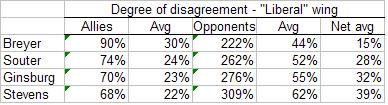
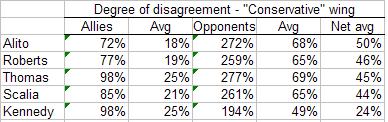
SCOTUSblog has published its final tally of the frequency with which the nine justices of the U.S. Supreme Court disagreed with each other in the 53 non-unanimous cases that were decided in the recently ended term. The tally indicates that Kennedy, the so-called swing justice, generally aligns with the Court’s “conservative” wing, so I placed him there, in company with Alito, Roberts, Thomas, and Scalia. The Court’s “liberal” wing, of course, comprises Breyer, Souter, Ginsburg, and Stevens.*

I then ranked the members of the Court’s two wings according to a measure of their net agreement with the other members of their respective wings. Thus:

090724_Supreme Court disagreement_2

090724_supreme-court-disagreement_3

Alito, for example, was in disagreement with his four “allies” (in non-unanimous cases) a total of 72 percent of the time (see graph below), for an average of 18 percent per ally. Alito was in disagreement with his four “opponents” a total of 272 percent of the time, for an average of 68 percent per opponent.  By subtracting Alito’s average anti-“conservative” score (18 percent) from his average anti-“liberal” score (68 percent), I obtained his net average anti-“liberal” score (50 percent). Doing the same for the other four “conservatives,” I found Alito the most anti-“liberal” of the “conservatives. He was followed closely by Roberts, Thomas, and Scalia, in that order. Kennedy finished fifth by several lengths.

I applied the same method to the “liberals,” and found Breyer the least anti-“conservative” of the lot, with Souter and Ginsburg close to each other in second and third places, and Stevens a strong fourth (or first, if you root for the “liberal” camp). (The apparent arithmetic discrepancies for Thomas, Breyer, and Stevens are due to rounding.)

Thus, if you are a “conservative,” you are likely to rank the nine justices as follows: Alito, Roberts, Thomas, Scalia, Kennedy, Breyer, Souter, Ginsburg, and Stevens. (However, I would place Thomas first, because he comes closest to being a libertarian originalist.) I carried this ranking over to the following graphic, which gives a visual representation of the jurisprudential alignments in the Court’s recently completed term:

090724_supreme-court-disagreement_11

It is hard to see how Sotomayor’s ascendancy to the Court will change outcomes. She may be more assertive than Souter, but I would expect that to work against her in dealings with Alito, Roberts, Thomas, and Scalia. Nor would I expect Kennedy — who seems to pride himself on being the court’s “moderate conservative” — to respond well to Sotomayor’s reputedly “sharp elbows.” Even Kennedy found himself at odds with Stevens 60 percent of the time. And it seems likely that Sotomayor will vote with Stevens far more often than not — in spite of her convenient conversion to judicial restraint during her recent testimony before the Senate Judiciary Committee.

__________
* It would be more accurate to cal Alito, Roberts, and Scalia right-statists, with minarchistic tendencies; Thomas, a right-minarchist; and the rest, left-statists with varying degrees of preference for slavery at home and surrender abroad. (See this post for an explanation of the labels used in the preceding sentence.)

Secession Redux

In “Secession,” I wrote:

The original Constitution contemplates that the government of the United States might have to suppress insurrections and rebellions (see Article I, Section 8), but it nowhere addresses secession. Secession, in and of itself, is not an act of insurrection or rebellion, both of which imply the use of force. Force is not a requirement of secession, which can be accomplished peacefully.

Therefore, given that the Constitution does not require a subscribing State to pledge perpetual membership in the Union, and given that the Constitution does not delegate to the central government a power to suppress secession, the question of secession is one for each State, or the people thereof, to determine, in accordance with the Tenth Amendment. The grounds for secession could be … the abridgment by the United States of the “rights, privileges and immunities”of its citizens.

What about Texas v. White (U.S. Supreme Court, 1868), in which a 5-3 majority anticipated … arguments for a mystical bond of Union; for example:

When … Texas became one of the United States, she entered into an indissoluble relation. All the obligations of perpetual union, and all the guaranties of republican government in the Union, attached at once to the State. The act which consummated her admission into the Union was something more than a compact; it was the incorporation of a new member into the political body. And it was final. The union between Texas and the other States was as complete, as perpetual, and as indissoluble as the union between the original States. There was no place for reconsideration, or revocation, except through revolution, or through consent of the States.

Considered therefore as transactions under the Constitution, the ordinance of secession, adopted by the convention and ratified by a majority of the citizens of Texas, and all the acts of her legislature intended to give effect to that ordinance, were absolutely null. They were utterly without operation in law. The obligations of the State, as a member of the Union, and of every citizen of the State, as a citizen of the United States, remained perfect and unimpaired. It certainly follows that the State did not cease to be a State, nor her citizens to be citizens of the Union.

It would have been bad — bad for slaves, bad for the defense of a diminished Union — had the South prevailed in its effort to withdraw from the Union. But the failure of the South’s effort, in the end, was owed to the superior armed forces of the United States, not to the intentions of the Framers of the Constitution.

In any event, the real jurisprudential issue in Texas v. White was not the constitutionality of secession; it was the right of the post-Civil War government of Texas to recover bonds sold by the secessionist government of Texas. Moreover, as Justice Grier noted in his dissent,

Whether [Texas is] a State de facto or de jure, she is estopped from denying her identity in disputes with her own citizens. If they have not fulfilled their contract, she can have her legal remedy for the breach of it in her own courts.

The majority’s ruling about the constitutionality of secession can be read as obiter dictum and, therefore, not precedential.

Clifford P. Thies makes a similar case in “Secession Is in Our Future“:

The US law of secession is thought to have been decided by the US Supreme Court in White v. Texas, following the Civil War. The actual matter to be decided was relatively insignificant. The Court used the occasion to issue a very broad decision. Chief Justice Chase, speaking for the Court, said,

The union between Texas and the other States was as complete, as perpetual, and as indissoluble as the union between the original States. There was no place for reconsideration or revocation, except through revolution or through consent of the States.

The first sentence I just quoted invokes words such as “perpetual,” and in so doing may create the impression that the Supreme Court decreed that no [S]tate could ever secede from the Union. But, on careful reading, the relationship between Texas and the other [S]tates of the Union is merely “as indissoluble as the union between the original States.” In other words, Texas, having been a nonoriginal [S]tate, has no greater right of secession than do the original [S]tates. As to how [S]tates might secede, the second sentence says, “through revolution or through consent of the States.”

As to why a [S]tate might secede, … Chief Justice Chase presciently discusses the … 10th Amendment[] to the US Constitution, which reserve[s] to the [S]tates and to the people thereof all powers not expressly granted to the federal government, and that the design of the Union, implicit in the very name “United States,” is the preservation of the [S]tates as well as of the Union:

the preservation of the States, and the maintenance of their governments, are as much within the design and care of the Constitution as the preservation of the Union and the maintenance of the National government.

In other words, the federal government abrogates the Constitution when it fails to honor Amendment X:

The powers not delegated to the United States by the Constitution, nor prohibited by it to the States, are reserved to the States respectively, or to the people.

Thies puts it starkly:

The so-called United States of America ceases to exist when the political majority of the country attempts to rule the entire country as a nation instead of as a federal government. In such a circumstance, the “indestructible union of indestructible [S]tates” of which the Court speaks is already dissolved.

I would put it this way: The legal basis for the perpetuation of the United States disappears when the federal government abrogates the Constitution. Given that the federal government has long failed to honor Amendment X, there is a prima facie case that the United States no longer exists as a legal entity. Secession then becomes more than an option for the States: It becomes their duty, both as sovereign entities and as guardians of their citizens’ sovereignty.

See “The Constitution: Myths and Realities“.
The Principles of Actionable Harm

A NEW VERSION OF THIS POST IS HERE.

A New, New Constitution

I have further revised my revision of the Constitution of the United States (earlier version here). The new, new version is below the fold.

Another blogger once said of such efforts that

[a]ll the Constitution really needs is some well-placed “And we mean it!” clauses:

–The Ninth Amendment…and we mean it!

Privileges or Immunities…and we mean it!

–Taking property only for public use…and we mean it!

And so on.

Maybe abolish the well-intentioned but subsequently corrupted Necessary & Proper Clause, clarify the meaning of “regulate” in the Commerce Clause to return it to its intended denotation (i.e., “to make regular,” or “to standardize”) and of “commerce” to “that which is not agriculture or manufacturing” (i.e., trade).

The rest is all bells and whistles.

Au contraire: The devil, as they say, is in the details. The main problem with the Constitution is not what it means but what meanings can be imputed to it because of vagueness and ambiguity. What the Constitution really needs is a lot of loophole-closing and more checks on the legislative, executive, and judicial branches, all of which have subverted and twisted the Constitution‘s intended meanings.

“My” (unitalicized) Constitution (as distinguished from the real Constitution, to which deference is owed but too seldom given) is not only far more specific than the original — and more restrictive of the powers of government — but it also includes more checks on those powers. Specifically, there is this provision in Article V:

A judgment of any court of the United States of America may be revised or revoked by an act of Congress, provided that such any revision or revocation is approved by two-thirds of the members of each house and leads to a result that conforms to this Constitution.

Then there are Articles VII and VIII, Keeper of the Constitution and Conventions of the States, which open thusly:

The responsibility for ensuring that the legislative, executive, and judicial branches adhere to this constitution in the exercise of their respective powers shall be vested in a Keeper of the Constitution. The Keeper may review acts of Congress, the executive branch, and judicial branch that have the effect of making law and appropriating monies.

*    *    *

Delegations of the States shall convene every four years for the purpose of considering revisions to and revocations of acts of the government that is established by this constitution. Such conventions (hereinafter “convention of the States”) may revise and/or revoke any act or acts and/or any holding or holdings, in the sole discretion of a majority of State delegations present and voting.

On top of that, there is Article IX, which authorizes petitions and subsequent elections for the revocation of a broad range of governmental acts and the expulsion of members of Congress, the President, Vice President and justices of the Supreme Court. Also, a constitutional convention may be called pursuant to a successful petition.

To the extent that Articles VII, VIII, and IX would inhibit presidential and congressional ventures into unconstitutional territory, so much the better. Gridlock is good thing when it clogs Washington’s corridors of power.

The new Constitution also provides for secession, the threat of which might further help to preserve its original meaning. Continue reading “A New, New Constitution”

Toward a Constitutional “Monarchy”

As I happened across The Monarchist (via Occam’s Carbuncle*), I remembered that I hadn’t staked out a place for monarchism in my post, “Parsing Political Philosophy.” I had meant to do so, but had second thoughts.

The place for monarchism is found in what I call radical-right-minarchism (R-R-M),

where “radical” means favoring the restoration of the Constitution to its original meaning. What sets R-R-M apart from other types of [minarchists] is their understanding that it is no longer possible to slay or tame Leviathan through electoral politics-as-usual, that the Constitution itself must be reinvigorated. (There are more radical alternatives, a military coup and secession, neither of which has much chance of success, and both of which could backfire. [Randy] Barnetts’s and my proposals would not, if adopted in the way outlined in the third through fifth paragraphs of Barnett’s article.)

Monarchism would be consistent with my idea of a new constitution, which includes, among many things, an Article VIII, Conventions of the States, which opens with this:

Delegations of the States shall convene every four years for the purpose of considering revisions to and revocations of acts of the government established by this Constitution. Such conventions (hereinafter “Convention of the States”) may revise and/or revoke any act or acts and/or any holding or holdings, in the sole discretion of a majority of State delegations present and voting.

Perhaps, instead of unreliable quadrennial conventions, we should have a constitutional “monarch,” to be called (more palatably) “Keeper of the Constitution.” The Keeper’s sole power and duty would be to veto unconstitutional acts of Congress, the executive branch (including “independent” regulatory agencies), and the Supreme Court — as and when such acts occur.

The Keeper, in other words, would be a fourth branch of the federal government — a sorely needed check on the other three branches, which have failed miserably to protect, preserve, and defend the Constitution.

The creation of a Keeper would do much the same thing as the establishment of quadrennial conventions: Push the federal government toward constitutional rectitude with the threat of embarrassing it by very publicly undoing its unconstitutional deeds.

The idea of adding a negatively omnipotent fourth branch raises several tough questions:

  • How should the Keeper be chosen?
  • How long should the Keeper be allowed to serve?
  • What if the Keeper vetoes an act that was in fact constitutional? In other words, who (or what) defends us against an errant or arrogant Keeper?

In answer, I conjure the following constitutional language, beginning with the duties and powers of the Keeper:

1. a. The responsibility for ensuring that the legislative, executive, and judicial branches adhere to this constitution in the exercise of their respective powers shall be vested in a Keeper of the Constitution. The Keeper may review acts of Congress, the executive branch, and judicial branch that have the effect of making law and appropriating monies. The term “making law” includes — but is not limited to — a legislative, executive, or judicial interpretation of an existing law or laws. Covered acts of the judicial branch include — but are not limited to — denials of appeals or writs of certiorari. The Keeper’s purview does not extend to declarations of war; statutes, appropriations, regulations, or orders pertaining directly to the armed forces and intelligence services of the United States; or the employment of the armed forces and intelligence services of the United States. Nor does the Keeper’s purview extend to appointments made by or with the consent of the legislative, executive, or judicial branches.

1. b. The Keeper may nullify any act that lies within his purview, as defined in section 1.a, provided that the act occurred no more than one year before the date on which he nullifies it. The Keeper shall signify each nullification by informing the speaker of the House of Representatives, president pro-tempore of the Senate, president of the United States, and chief justice of the Supreme Court of the United States of his decision and the reason(s) therefor. The Keeper shall, at the same time, issue a public notice of his decision and the reason(s) therefor. The affected branch(es) of government shall, in each case, act promptly to implement the Keeper’s decision. Each implementing act shall be subject to review, as specified in sub-section 1.a.

As for choosing the Keeper:

2. a. The speaker of the House of Representatives and president of the United States, acting jointly, shall nominate a Keeper of the Constitution to the Supreme Court of the United States. The Supreme Court shall vote on a nominee no later than thirty days after receiving notice of a nomination. A nominee shall become Keeper upon the approval by three-fourths of the then-sitting justices of the Supreme Court.

2.b. If a nominee is rejected by the Supreme Court, the speaker and president, acting jointly, shall nominate a different person as Keeper, and shall send this second nomination to the House of Representatives and Senate. The House of Representatives and Senate shall, within thirty days of receiving notice of the nomination, meet as a single body to vote on the nominee. The nominee shall become Keeper upon approval by two-thirds of the total number of Representatives and Senators then present and voting.

2.c. If a nominee is rejected by both the Supreme Court and combined membership of the House of Representatives and Senate, the speaker and president, acting jointly, shall nominate a different person as Keeper, and shall send this third nomination to the Senate. The Senate shall, within thirty days of receiving notice of the nomination, meet to vote on the nominee. The nominee shall become Keeper upon approval by a majority of Senators then present and voting.

2.d. If the Keeper shall resign, die in office, or become unable to hold office because of a physical or mental condition attested to in writing by a unanimous panel of three doctors of medicine appointed jointly by the speaker of the House of Representatives, the president pro-tempore of the Senate, the president of the United States, and three-fourths of the then-sitting justices of the Supreme Court, a successor shall be appointed in accordance with the preceding sub-sections of this section 2.

The progressively easier method of choosing the Keeper provides an incentive for the Supreme Court to confirm the first nominee, rather than let the choice fall to the legislative branch. The provision for a third nomination is designed to ensure that the office won’t stand vacant.

I next address the term of office and related ways of keeping the Keeper “honest”:

3. a. The Keeper shall hold office during good behavior for a term of three years. The same person may not hold the office of Keeper more than once.

3.b. The Keeper may be removed from office only as follows: The speaker of the House of Representatives and president of the United States shall jointly apply to the Supreme Court of the United States for removal of the Keeper, specifying the instance(s) of official misfeasance or malfeasance that prompted their application. The Supreme Court, upon the receipt of such an application, and with due deliberation, shall vote on its merits. If  three-fourths of the then-sitting justices of the Supreme Court approve the application, the Keeper shall thereupon forfeit his office; otherwise, the Keeper then in office shall retain his position until a proper application for his removal is approved by three fourths of the then-sitting justices of the Supreme Court, or his term of office expires.

3.c. Upon removal of the Keeper from office by the foregoing procedure, a new Keeper shall be appointed, in accordance with the procedures of sub-sections 2.a, 2.b, and 2.c. Upon the appointment of a new Keeper, he shall enter upon a three-year term of office, which he may hold during good behavior.

Finally, some “housekeeping” details:

4. The Keeper shall be paid a salary of $1 per annum, but may be reimbursed for reasonable, personal expenses related to the execution of his duties. Congress shall appropriate monies for the reimbursement of the Keeper’s reasonable, personal expenses; for the reasonable compensation of the Keeper’s staff; and for the procurement, operation, and maintenance of  those facilities, equipment, and services that the Keeper and his staff may require for the execution of the Keeper’s responsibilities. The total cost of the foregoing shall not exceed $100 million per annum, which amount shall increase on the anniversary of the date of the adoption of this amendment by the same percentage as the most recent increase (if any) in cost-of-living adjustments to the pensions of veterans of the armed forces.

That’s my idea of a constitutional “monarchy” — one with real but limited power. Imagine the kind of person it would take to gain acceptance (or banishment) by three-fourths of the sitting justices of the Supreme Court (i.e., by seven of the nine). Even at the worst of times, constitutionally, I would expect there to be three or four justices on hand to ensure against the appointment of a pushover for the “living Constitution” —  which is not the Framer’s Constitution.

__________

* Now defunct and sorely missed.

Obama’s Law

Obama seems bent on nominating a woman (preferably a black or Hispanic one) to succeed Justice Souter. (See, for example, the top-10 list of likely nominees, at The Ninth Justice.) There’s nothing wrong with having a woman on the Supreme Court. But Obama’s evident zeal to nominate a woman  speaks volumes about his approach to the law.

The law, to Obama, isn’t a set of rules to protect the honest and — most importantly — limit government. Obama’s law know no constitutional bounds; it is a recipe that combines “empathy” (i.e., cheap compassion), political payoff, and power-lust.

Penalizing “Thought Crimes”

Nat Hentoff, writing at RealClearPolitics, observes with dismay that

the press remain[s] mostly silent about the so-called “hate crimes law” that passed in the House on April 29[.] The Local Law Enforcement Hate Crimes Prevention Act passed in a 249-175 vote (17 Republicans joined with 231 Democrats). These Democrats should have been tested on their knowledge of the First Amendment, equal protection of the laws (14th Amendment), and the prohibition of double jeopardy (no American can be prosecuted twice for the same crime or offense). If they had been, they would have known that this proposal, now headed for a Senate vote, violates all these constitutional provisions.

This bill would make it a federal crime to willfully cause bodily injury (or try to) because of the victim’s actual or perceived “race, color, religion, national origin, gender, sexual orientation, gender identity or disability” – as explained on the White House Web site, signaling the president’s approval. A defendant convicted on these grounds would be charged with a “hate crime” in addition to the original crime, and would get extra prison time.

The extra punishment applies only to these “protected classes.” As Denver criminal defense lawyer Robert J Corry Jr. asked (Denver Post April 28): “Isn’t every criminal act that harms another person a ‘hate crime’?” Then, regarding a Colorado “hate crime” law, one of 45 such state laws, Corry wrote: “When a Colorado gang engaged in an initiation ritual of specifically seeking out a “white woman” to rape, the Boulder prosecutor declined to pursue ‘hate crime’ charges.” She was not enough of one of its protected classes.

Corey adds that the state “hate crime” law – like the newly expanded House of Representatives federal bill – “does not apply equally” (as the 14th Amendment requires), essentially instead “criminalizing only politically incorrect thoughts directed against politically incorrect victim categories.”

Whether you’re a Republican or Democrat, think hard about what Corry adds: “A government powerful enough to pick and choose which thoughts to prosecute is a government too powerful.”

But James Madison, who initially introduced the First Amendment to the Constitution, had previously written to Thomas Jefferson on the passage of the Virginia Statute on Religious Freedom: “We have in this country extinguished forever … making laws for the human mind.” No American, he emphasized later, would be punished for his “thoughts.”

However, doesn’t the House “Hate Crimes Bill” state that nothing in the legislation shall “prohibit any expressive conduct protected from legal prohibition” – or speech “protected by the free speech or free exercise clauses in the First Amendment”?…

This legislation, certain to be passed by the Senate, will come to the Supreme Court….

[The justices] should … remember that the Fifth Amendment makes clear: “nor shall any person be subject for the same offence to be twice put in jeopardy.” But the House “hate crime” bill allows defendants found innocent of that offense in a state court to be tried again in federal court because of insufficiently diligent prosecutors; or, as Attorney General Eric Holder says, when state prosecutors claim lack of evidence. It must be tried again in federal court!

Imagine Holder as the state prosecutor in the long early stages of the Duke University Lacrosse rape case!…

Consider the infamous murder of Matthew Shepard by Russell Henderson and Aaron McKinney. It is evident that Matthew Shepard’s murder — like the mass slayings at Columbine and elsewhere — has been used cynically by advocates of one agenda or another. The agenda is gay rights in the Shepard case; it is gun confiscation in the school-shooting cases.

Those who are rushing to legislate against “thought crimes” should confront these questions: Would Henderson and McKinney’s crime be less heinous if Shepard wasn’t killed because of his homosexuality (a strong possibility)? In other words, why should it more wrong to kill a homosexual because he’s a homosexual than to kill a homosexual for some other reason, or to kill a straight, white male for any reason? Dead is dead, and therein lies the real crime.

If it is more wrong to kill a person because of a personal characteristic than simply to kill a person, consider the case where A kills his neighbor, B, because A dislikes having B as a neighbor. Should neighbor-killing be declared a hate crime? If so, then why not declare all crimes against persons to be hate crimes, and be done with it? That, at least, would comply with the Constitution‘s guarantee of equal-protection, assuming (wrongly, no doubt) even-handed application of the law.

The law should penalize crime, and not presume to read the minds of perpetrators, or — as Nat Hentoff reminds us — grant greater protection to some classes of persons than to others.